
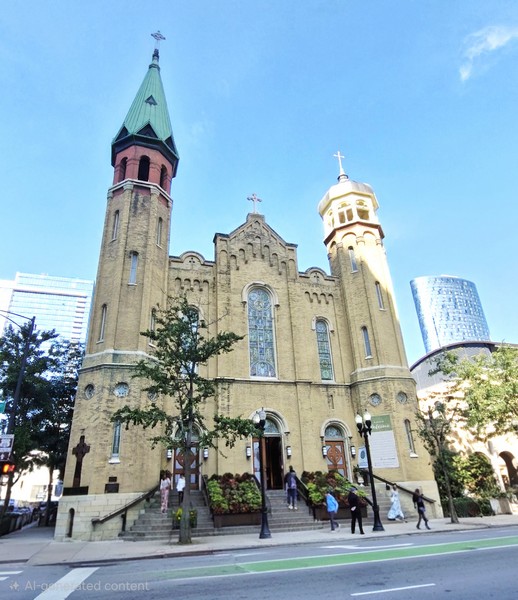
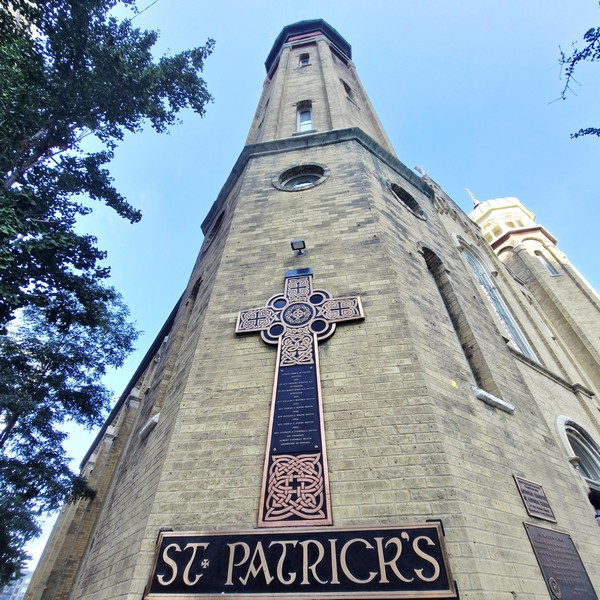
On our first whole day in Chicago, before touring the city, Andy drove the 21-km. distance, from their place, to Old St. Patrick’s Church where we heard the 9 AM mass (it being a Sunday) . Also known as St. Patrick’s Roman Catholic Church and commonly known as Old St. Pat’s, it is the city’s oldest standing church building. Described as the “cornerstone of Irish culture” in Chicago, the main church building is one of a handful of structures remaining in the city that predate the October 1871 Great Chicago Fire which missed Old St. Patrick’s Church by just two blocks.
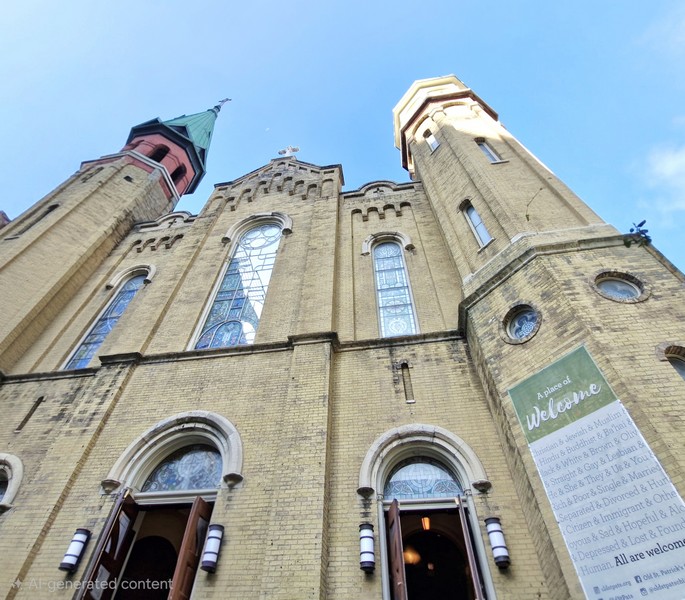
Founded on April 12, 1846 (Easter Sunday) by Irish bishop William Quarter as the first English-speaking parish and the second parish established in Chicago (after St. Mary’s which was built by the French), the parish was originally housed in a wooden building at the intersection of Randolph Street and Des Plaines Street.
The present Romanesque Revival-style church building was designed by Augustus Bauer and Asher Carter, two of Chicago’s earliest practicing architects. On May 23, 1853, the cornerstone was laid and, on Christmas Day, 1856, the building was dedicated by Rev. Denis Dunne, the pastor of Old St. Patrick’s. On St. Patrick’s Day 1857, Mozart’s 12th Mass was performed at the church.
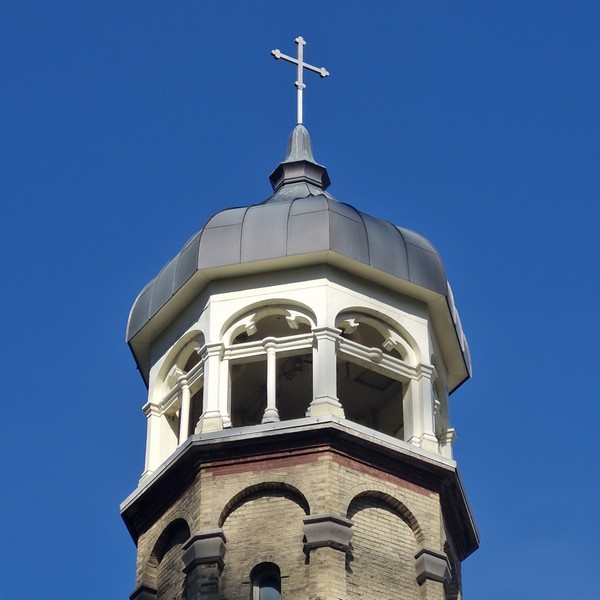
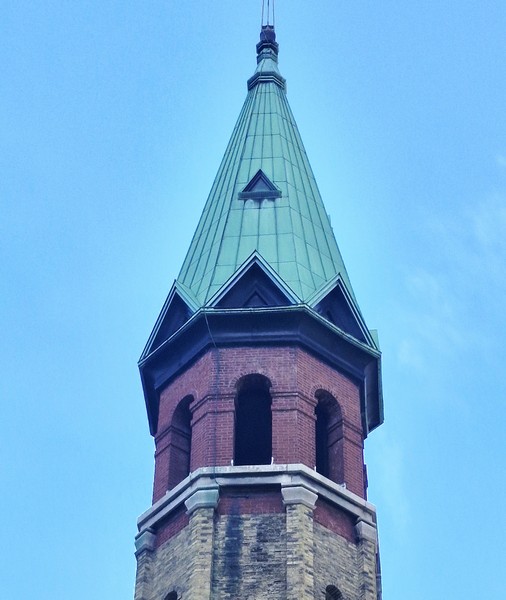
In 1885, two octagonal towers, topped with different spires, were completed by the same architect as the Holy Name Cathedral and the Archbishop’s residence. The steep, pointed south spire represents the Western Church while the north tower, with its Byzantine-inspired onion dome, represents the Eastern Church. Together they symbolize the universality of the Catholic Church in a city once dominated by immigrant Irish, Polish, Italian, Bohemian and German Catholics. In the course of the 1880s, the English-speaking parish of St. Patrick was mostly composed of Irish-Americans.
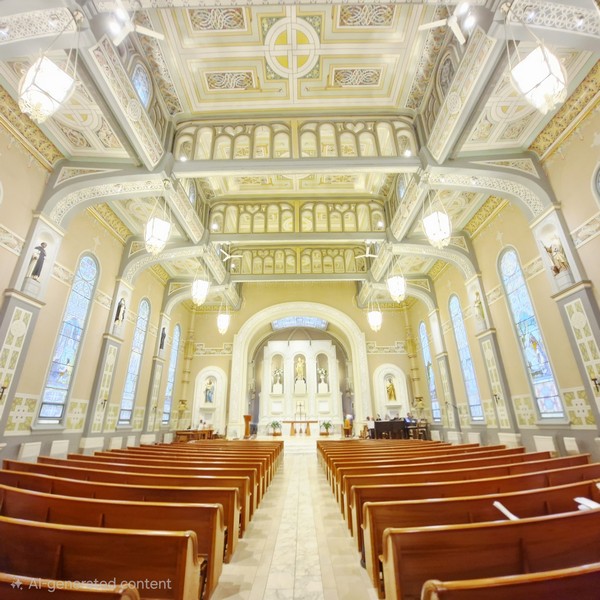
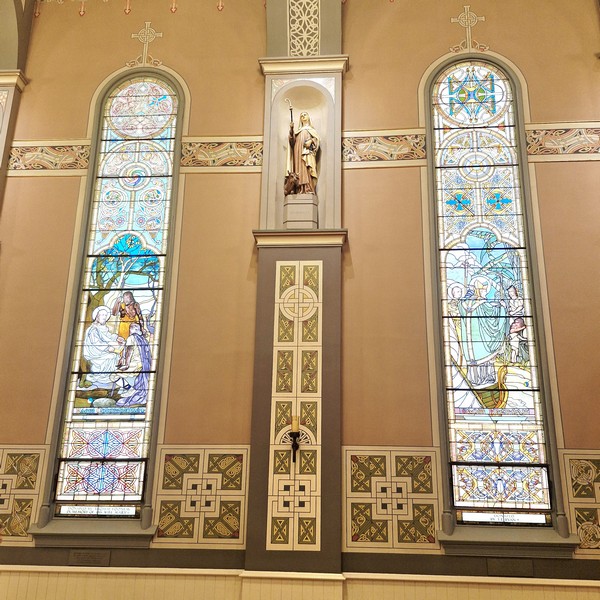
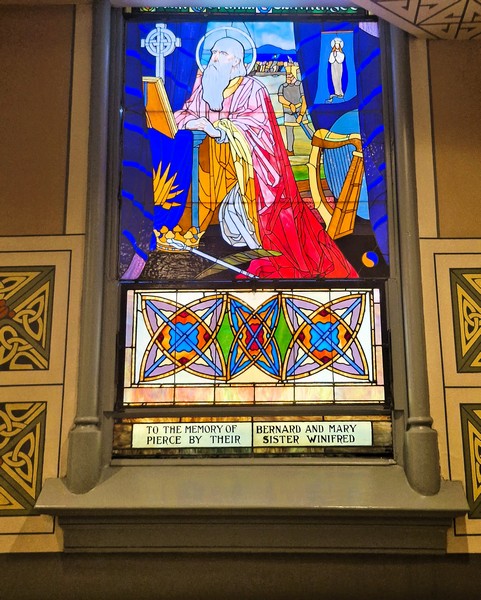
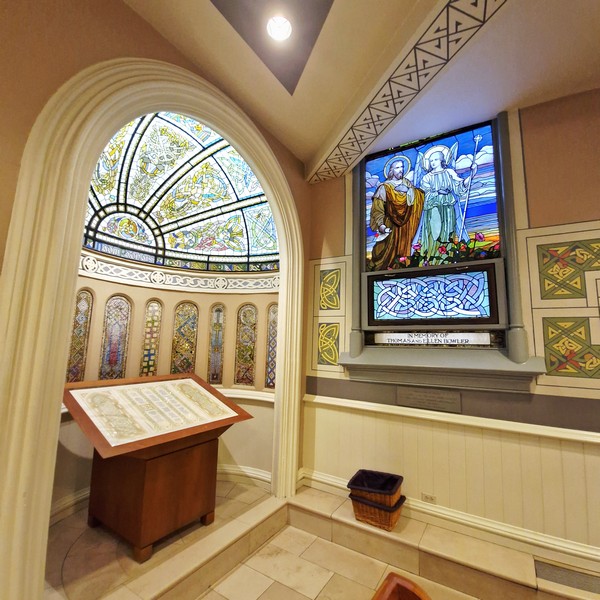
Between 1912 and 1922, the interior was redecorated, in the Celtic Revival style, a nationalistic art movement stressed ancient Celtic links to Catholicism. Chicago Daily News graphic artist and master craftsman Thomas A. O’Shaughnessy (an Irishman from Missouri), inspired by the Celtic art exhibit in the Irish village at the Columbian Exposition of 1893 and the Celtic illuminations found in the late 8th Century Book of Kells (a hand-illuminated Bible housed in Trinity College in Dublin, Ireland, it is one of Ireland’s great national treasures), designed, constructed, and personally installed the 15 beautiful stained-glass windows (depicting Irish saints) of Old St. Patrick’s plus the original interior stenciling, decorative motifs and a mosaic-lined niche in the back of the nave between 1912 and 1922.
In 1921, the final triptych windows, done in an Art Nouveau style, were installed in the eastern facade of the church. On March 10, 1964, the church was designated as a Chicago Landmark and, on July 15, 1977, the building was added to the National Register of Historic Places. In 1985, the first Old St. Patrick’s “World’s Largest Block Party” (which funded the rebuilding of the church) drew 5,000 people to Des Plaines Street. Today, Old St. Pat still hosts this massively popular, annual summer block party. In 1996, the reconstruction and restoration of most of the church interior and exterior were completed.
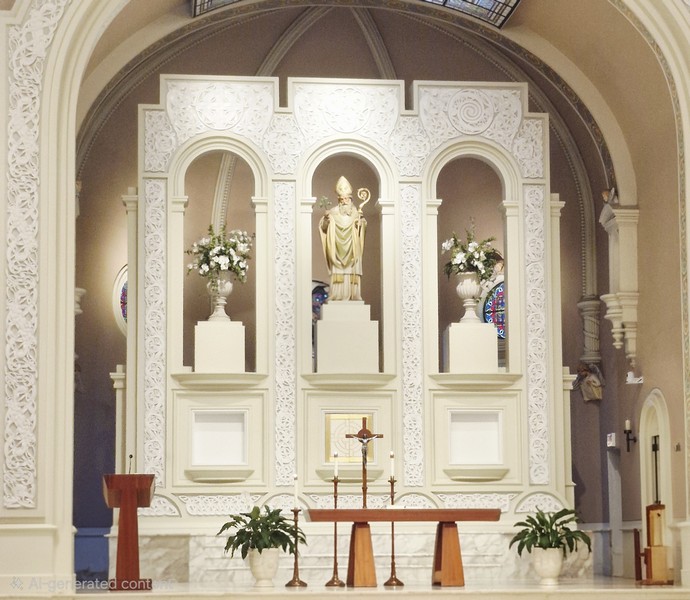
This 37-m. (120-ft.) long and 19.5-m. (64-ft.) wide church was constructed with Cream City brick made from yellowish clay found along the shores of Lake Michigan, near Milwaukee. The base is made of Joliet limestone. Celtic Revival’s entwined bands, lines, dragons and long-tailed birds snaked across the walls and windows of St. Pat’s in determined harmony. The fabulous interlace ornament (lacy lines symmetrically entwined), in paint and glass, were styled, in part, after illuminations found in the Book of Kells.
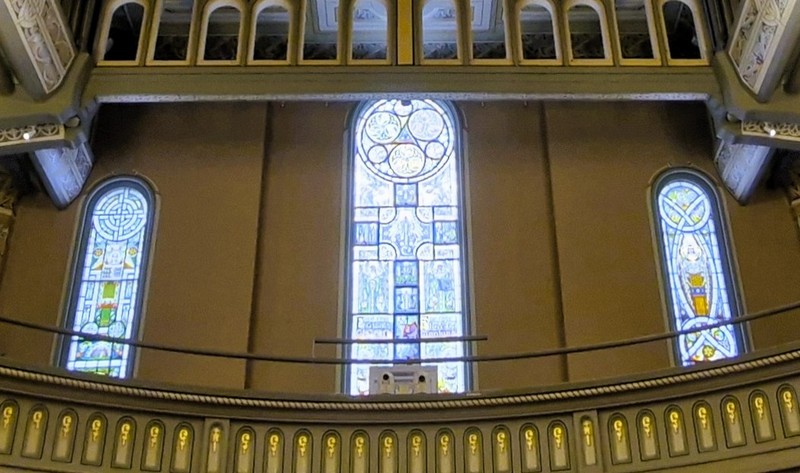
This Art Nouveau triptych, in stained-glass, also called the Faith, Hope & Charity windows as it symbolizes the virtues of faith, hope and charity (viewed left to right from the nave), is an amazing and meticulously composed set of windows. O’Shaughnessy’s tour de force it is, arguably, the finest of its kind in the U.S. Thousands of precisely cut and delicately hued areas of glass, separated by hairlines of lead, copper foil and bronze, were assembled in an unsurpassed spiritual imagery.
The MacSwiney window, the central window (Hope Window), is the most intricate of the lot as it uses more than 250,000 individual pieces of glass and no pint whatsoever. It was named in honor of Terrance McSwiney, the lord mayor of Cork who had died in a hunger strike, in 1920, in the fight for Irish independence from British rule. The glass colors, for all these windows, were manufactured in 1912 by Kinsella Art Glass, as per O’Shaughnessy’s own formulas. Above the doorway is a painted mahogany angel.
Old St. Patrick’s Church: 700 West Adams St. cor, Des Plaines St., Chicago, Illinois 60661. Tel: 312.648.1021. E-mail: info@oldstpats.org. Website: www.oldstpats.org. Coordinates: 41°52′45″N 87°38′40″W.