National Shrine of St. Anne (Hagonoy, Bulacan)

National Shrine of St. Anne

The National Shrine of Saint Anne, honoring St. Anne, the mother of the Blessed Virgin Mary, was first built of stone and brick from 1731 to 1734 by Fr. Juan Albarran OSA, but burned down on August 12, 1748. The church was rebuilt on its present site (moved due to flooding on the former site) by Fr. Eusebio Polo in 1749 and completed in 1752 by Fr. Buenaventura Roldan.

It was replaced with a stone church by Fr. Juan Coronado from 1815 to 1836, damaged by fire in 1856 and enlarged in 1862 by Fr. Manuel Alvarez.  The church was again damaged by during the 1871 earthquake and was repaired in 1872 by Fr. Ignacio Manzanares who strengthened the choir loft’s supporting arches.

NHI plaque installed in 1981

It was intermittently restored in 1936 and, in 1961, a monumental porte-cochere  was added by Fr. Celestino Rodriguez.  Prior to the mid-20th century renovation, the church façade was bare of ornamentation save for volutes founds on the end of the imaginary triangular pediment, circular reliefs and buttress-like pilasters capped with roof tiles.

The church’s Baroque facade

However, much of the design of the façade has been changed after the 1968 to 1970 renovation (under Monsignor Jose B. Aguinaldo and inaugurated on July 25, 1970) when the wood trusses and galvanized iron roofing were replaced, roof and main altar painted and the façade coated white and decorated with images placed above pilasters.

Statue of St. Anne

In 1981, a marker bearing a brief history of the church was installed on the facade by the National Historical Institute (now the National Historical Commission of the Philippines) and, in 1991, church was declared as a National Shrine.

Statues of Augustinian saints

The church’s Baroque façade, pierced with 5 windows (three semicircular arched ones and two rectangular ones on the first level), now sports three arched entrances, all featuring hardwood doors carved with great details.  The main entrance, with an antique hardwood door carved with bas-reliefs, is flanked by two smaller semicircular arched doorways.

Another row of statues of Augustinian saints

The four sets of superimposed pilasters, incorporated with Tuscan capitals, divide the facade into two levels (the first smaller than the second) and ends up in a triangular pediment with huge, contemporary statues of Augustinian saints flanking that of St. Anne.  At the center of the pediment is a rose window and a tableau of Saint Anne and the Virgin Mary. The porte-cochere, with its balustraded top, mars the view of the bottom part of the façade.

Cross with two cherubs at the top of pediment

The second level, dominated by a rose window in the center, has windows corresponding to the choir loft and partly hidden by the portico.  The convent beside the church is now the main building of St. Anne’s Catholic School.

The former convent, now St. Anne Catholic School

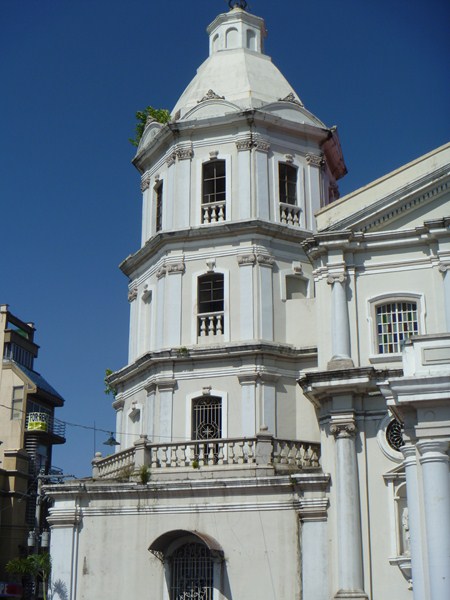
The six-storey square bell tower, to the left of the church, was originally a five-level tower.  During the 1968 to 1970 reconstruction of the church, the sixth level and a cupola was added. for Save for the balustrade, semicircular arch windows and buttresses placed at the corners of the tower, the bell tower is bare of detailed ornamentation. A cross, held up by two cherubs, caps off the entire façade.

Elaborately carved wooden door at main entrance

Another elaborately carved wooden door at the side entrance

This church holds the relics of St. Anne from the Basilica of Sainte-Anne-de-Beaupré, the international shrine in QuebecCanada and also the relics of St. Joachim, the husband of St. Anne. 

The six-storey bell tower

National Shrine of St. Anne: Brgy. Sto. Niño, Hagonoy. Tel: (044) 793-2829. Feast of St. Anne: July 26.

How to Get There: Hagonoy is located 55.6 kms. (a 1.5-hour drive) from Manila an 15.5 kms. (a 40-min. drive) from Malolos City.

Church of St. Ildelfonsus (Guiguinto, Bulacan)

Our slow progress along the MacArthur Highway was finally halted at Guiguinto where the bridge to Malolos was being repaired.  Parking my car at the municipal hall, we walked over to the nearby Church of St. Ildelfonsus.  This stone church and its convent, located near a saltwater stream, was built sometime in the late 17th century (1621 to 1691?), finished by 1734 (?) and was severely damaged during the June 3, 1863 earthquake where the upper part of its belfry fell off.

Guiguinto Municipal Hall

The church has Baroque and Muslim features with 4 sets of paired, superpositioned Doric columns, a large, semicircular main entrance in the center and Muslim-inspired geometric motifs on one of the side entrances.  The triangular pediment has a circular window almost at the base and a raking cornice decorated with volute crestings.

Church of St. Ildelfonsus

Its 4-level, octagonal bell tower, on the church’s left, has a blind surface that ends up in a balustraded pinnacle.  Of its existing bells, one dates to 1889 and was cast by Hilario Sunico and installed by Fr. Pedro Quiros.  A smaller one was installed in 1887.

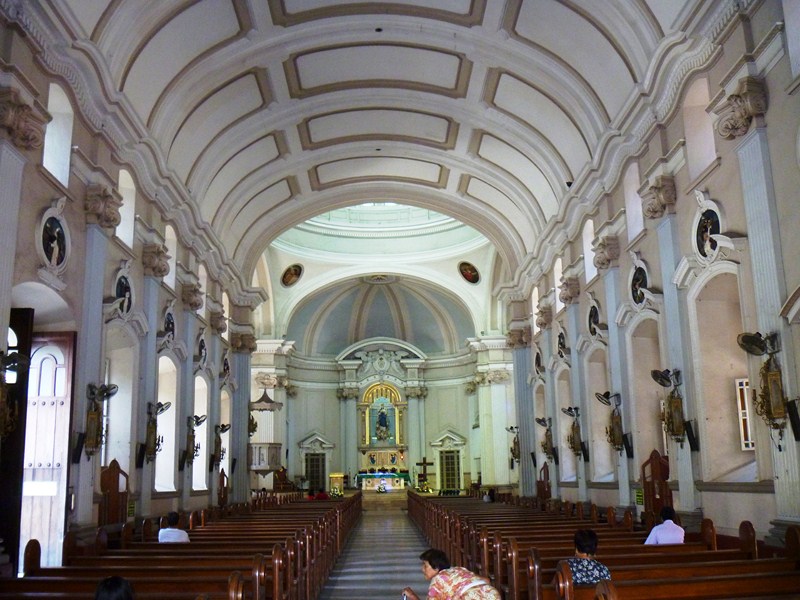
The church’s interior

Back at the municipal hall, it was now time to make our way to Malolos City via the  alternative use of a confusing maze of narrow alleys and byroads.  Luckily, there were assigned personnel to safely guide us along the way.

Upon arrival in Malolos City, Jandy and I checked in at the very popular DJ Paradise Resort & Hotel.  This wasn’t the first I’ve been in this 5.7-hectare, Class AAA resort, having been here during Jandy’s school excursions, but this would be our first time to stay overnight.

Check out “Resort Review: DJ Paradise Resort

DJ Paradise Resort: MacArthur Highway, Brgy. Dakila, Malolos City, Bulacan. Tel: (044) 791-5129 (connecting all departments), 662-4135 & 791-5384.   E-mail: info@djparadise.com.ph.  Website: www.djparadise.com.ph.


MacArthur Highway (Bulacan)

Guiguinto Welcome Arch

This day, Jandy and I planned to stay overnight at the DJ Paradise Resort and Hotel in Malolos City.  However, instead of using the faster but monotonous North Luzon Expressway (and entering Malolos via the Tabang Exit), I plan to leisurely traversed the length of the more interesting but traffic-laden MacArthur Highway to get to Malolos City.  Formerly called the Manila North Road, this old, 2 to 6-lane highway was named after Lt.-Gen.  Arthur MacArthur, not after Gen. Douglas MacArthur, his more famous son, as I previously thought.

Valenzuela City Hall

The highway starts from the Bonifacio Monument in Grace Park, Caloocan City and extends through the Central Luzon provinces of Bulacan, Pampanga and Tarlac up to the Ilocos Region provinces of La Union and OPangasinan.  I entered it at Valenzuela City, a former Bulacan town that is now a city and part of Metro Manila.  Here, we made a short stopover at its city hall. 

Balagtas Public Market

From the city, we now entered the province of Bulacan,  absorbing the rural and urban feel of a number of Bulacan towns (Marilao, Bocaue, Balagtas and Guiguinto) and Meycauayan City along the way.  The highway is not as smooth as the newer NLEX and can be sometimes chaotic as you vie for road space with buses and the slower tricycles and jeepneys.  However, here you drive underneath a canopy of trees and the roadside scenery is more charming.

MacArthur Highway at Meycauayan City

National Shrine of St. Anne (Hagonoy, Bulacan)

National Shrine of St. Anne

First built of stone and brick from 1731 to 1734 by Fr. Juan Albarran, this church was burned down on August 12, 1748. In 1749, it was rebuilt on its present site by Fr. Eusebio Polo  and completed in 1752 by Fr. Buenaventura Roldan. 

It was replaced with a stone church by Fr. Juan Coronado from 1815 to 1836, damaged by fire (which also damaged 30 houses in the town center) in 1856 and enlarged in 1862 by Fr. Manuel Alvarez.  The church was again damaged by during the 1871 earthquake and was repaired in 1872 by Fr. Ignacio Manzanares who strengthened the choir loft’s supporting arches.

Historical plaque installed by the National Historical Institute in 1981

It was intermittently restored in 1936, 1961 (a monumental porte-cochere was added by Fr. Celestino Rodriguez) and from 1968 to 1970 (under Monsignor Jose B. Aguinaldo) which changed much of the design of the façade (the wood trusses and galvanized iron roofing were replaced, roof and main altar painted and the facade coated white and decorated with images placed above pilasters).

Statue of St. Anne

In 1981, a marker bearing a brief history of the church was installed on the church by the National Historical Institute (precursor of the National Historical Commission of the Philippines). In 1991, it was declared a National Shrine.

Statues of Augustinian saints

The church’s Baroque façade, bare of ornamentation (save for volutes founds on the end of the imaginary triangular pediment, circular reliefs and buttress-like pilasters capped with roof tiles), is pierced with 5 windows: three semicircular arched ones and two rectangular ones on the first level.

Main wooden entrance door carved with bas reliefs

porte-cochere, with a balustraded top, mars the view of the bottom part of the façade. . The façade also sports three semicircular arched entrances (one main and two smaller flanking ones), all featuring antique hardwood doors carved with bas-reliefs.

One of two smaller wooden doors

Four sets of superimposed pilasters, incorporated with Tuscan capitals, divide the facade into two levels (the first smaller than the second) and ending up in a triangular pediment with huge contemporary statues of Augustinian saints flanking that of St. Anne.

Cross with two cherubs

The second level, dominated by a rose window and a tableau of St. Anne and the Virgin Mary in the center, has windows corresponding to the choir loft and partly hidden by the portico.  The entire façade is capped off with a cross held by two cherubs.

The six storey bell tower

The convent beside the church is now the main building of St. Anne’s Catholic School.  The six-storey rectangular  bell tower (originally with five levels , a sixth level and a cupola was added during the latest reconstruction of the church) is also bare of detailed ornamentation except for the balustraded semicircular arch openings and buttresses placed at the corners of the tower.

St. Anne Catholic School

National Shrine of St. Anne: Brgy. Sto. Niño, HagonoyBulacan. Tel: (044) 793-2829. Feast of St. Anne: July 26.

How to Get There: Hagonoy is located 55.6 kms. (a 1.5-hour drive) from Manila an 15.5 kms. (a 40-min. drive) from Malolos City.

Olympic Park and Pangu 7 Star Hotel (Beijing, People’s Republic of China)

After our Badaling Great Wall visit, we decided to capped this rainy day with a short visit, though not part of our itinerary, to the Beijing Olympic Park, its structures built for the 2008 Summer Olympics.  Brittany dropped us off at the Ruyi Bridge (over the Pangu Gardens) where, from this vantage point, we had a great view of the “Bird’s Nest” National Indoor Stadium and “Water Cube” Aquatic Center of the Olympic Park on one side and the Pangu 7 Star Hotel on the other.

Beijing National Indoor Stadium

The 18,000-pax Beijing National Indoor Stadium, also known as the National Indoor Stadium, is an indoor arena nicknamed as the Fan due to its design resembling a traditional Chinese folding fan. Opened on November 26, 2007, it hosted, at the 2008 Olympics, the artistic gymnastics, trampolining and handball events. After the Olympics, the stadium was used for sports competition, cultural and entertaining purposes, and as a multi-functional exercise center for local residents.

Bird’s Nest – Beijing National Stadium

The US$423 million Beijing National Stadium, also known as the National Stadium or, colloquially, as the “Bird’s Nest,” was designed for use throughout the 2008 Summer Olympics and Paralympics. Its design was awarded to a submission from the Swiss architecture firm Herzog & de Meuron in April 2003, after a bidding process that included 13 final submissions. The design, which originated from the study of Chinese ceramics, implemented steel beams in order to hide supports for the retractable roof; giving the stadium the appearance of a “bird’s nest.” Leading Chinese artist Ai Weiwei was the artistic consultant on the project. The retractable roof was later removed from the design after inspiring the stadium’s most recognizable aspect. Ground was broken in December 2003 and the stadium officially opened in June 2008.

Water Cube – Beijing National Aquatics Center

The Beijing National Aquatics Center, also known as the National Aquatics Center and nicknamed the “Water Cube,” is an aquatics center that was built alongside Beijing National Stadium in the Olympic Green for the swimming competitions of the 2008 Summer Olympics. Despite its nickname, the building is not an actual cube, but a cuboid (a rectangular box). Ground was broken on December 24, 2003, and the Center was completed and handed over for use on January 28, 2008. During the Olympics, swimmers here broke 25 world records.  After the Olympics, the building underwent a RMB 200 million revamp to turn the inside into a water park.

Pangu 7-Star Hotel

The Pangu 7 Star Hotel,  with its jaw-dropping views of the “Bird’s Nest” National Stadium and “Water Cube” Aquatic Centre, offers 234 guest rooms, including 140 suites. Ten room categories range in size from 45 to 488 sq. m. and all have 3.5-m. high ceilings. It is the only hotel to have been granted permission from the Palace Museum to reproduce priceless artworks from the Forbidden City. The masterworks were recreated on burnished copper panels in Italy.

Ruyi Bridge

On our last night in Beijing, we decided to go shopping at the San Li Tun Commercial Complex.  Our last day was uneventful as our flight left Beijing for Manila at 12 noon.  What an end to summer and a welcome for the rainy season.

The Badaling Great Wall (Beijing, People’s Republic of China)

After this short stopover at the Bona Jade Store, we all returned to our coach in anticipation of a great Great Wall tour.  Then it started to rain.  Upon arrival at the Badaling Great Wall, we found out that our cable car ride was cancelled, bad news for chubby Alex and his senior citizen mom.  Carmen opted to stay behind while Alex gamely joined us.  With the time allotted to us by our guide Brittany, we traversed the snaking portions of the wall as far as we could, donning our jackets for rain protection.  Some of the sections were quite steep.

The Great Wall of China

The entire Great Wall, with all of its branches, stretches for 8,851.8 kms. (5,500.3 miles), 6,259.6 kms. (3,889.5 miles) of which are sections of actual wall while the rest are 359.7 km (223.5 mi) of trenches and 2,232.5 kms. (1,387.2 miles) of natural defensive barriers such as hills and rivers.

The carefully restored, 4.8-km. long Badaling Great Wall, 70 kms. (42 miles) northwest of Beijing, one of 4 places that is accessible to tourist,is its most visited section (opened to tourists in 1957).  On February 24, 1972, the late U.S. Pres. Richard M. Nixon and his wife, accompanied by Vice Premier Li Xiannian, visited this part of the wall during his historic visit to China. On the day of our visit it was filled with tourists, in spite of the rain.  The immediate area around the Badaling Wall has a number of hotels, restaurants and a cable car.

The Great Wall of China, stretching from Shanhaiguan in the east to Lop Nur in the west, along an arc that roughly delineates the southern edge of Inner Mongolia, is a series of stone and earthen fortifications in northern China, built originally to protect the northern borders of the Chinese Empire against intrusions by various nomadic groups such as the Xiongnu from the north and rebuilt and maintained between the 5th century BC and the 16th century.

Since the 5th century BC, several walls have been built that were referred to as the Great Wall. One of the most famous is the wall built between 220–206 BC by the first Emperor of China, Qin Shi Huang. Little of that wall remains; the majority of the existing wall was built during the Ming Dynasty.

Prior to our return to our assembly area at Badaling Hotel, we took some time out to do some pasalubong shopping at a souvenir shop where I bought some marble letterhead stamps etched, on the spot, with the names of Jandy and my daughter Cheska, both in Chinese characters.  I also bought a pair of granite tiles stippled with images of the Great Wall.  Back at the Badaling Hotel, we had a late buffet lunch at its coffee shop.  At the men’s comfort room, we were amused by life-size replicas of the terra cotta warriors of Xian.

Badaling Hotel Coffee Shop

Bona Jade Store (Beijing, People’s Republic of China)

On our third day, after breakfast at the hotel, we were to proceed to our tour’s piece de resistance, the Great Wall of China.  Along the way we dropped by Bona Jade Store, one of the largest jade stores in China, taking the seventh exit of BaDaLing Expressway.

Bona Jade Store

Bona Jade Store manufactures and sells more than a thousand kinds of gorgeous jade ware and jewelry (necklaces, rings, earrings, pendants) that embodies thousands of years of Chinese culturing. Its 2-storey sales hall covers about 6,000 sq. m. and can accommodate several thousand customers. Its big parking lot covers about 8,000 sq. m..

Bona Jade Store Sales Area

Upon entering the store, we were assigned a store guide who briefed us on everything you need to know about Chinese jade.  Jade was prized by the Chinese for its durability; its musical qualities; its subtle, translucent colors, and its alleged protective powers (it was thought to prevent fatigue and delay the decomposition of the body). Chinese jade, renowned throughout the world, is classified according to their beauty, hardness, mellow color, soft feel and pleasant sound. At the sales area, we all bought some jade pixiu necklaces, said to bring good luck, while  Gil bought a ring.

A Display of Jade Ware

Bona Jade Store: Er Bo Zi Road East, Huilongguan, Changping District, Beijing 102208, People’s Republic of China. Tel: 0086-010-80796761. Fax: 0086-010-80796762. Website: www.bonajadestore.com.cn.

Summer Palace (Beijing, People’s Republic of China)

From the Asian Games Panda House, we next proceeded to the Summer Palace, the largest and best-preserved imperial garden in China.  The Summer Palace, located on the western edge of Beijing, between the fourth and fifth ring roads, 12 kms. from central Beijing, was, as its name implies, used as a summer residence by China’s imperial rulers. A pleasure ground in the countryside, yet near to the city, it is virtually a museum of traditional Chinese gardening that uses rocks, plants, pavilions, ponds, cobble paths and other garden styles to create a poetic effect between different scenes.  Points of interest here are the Hall of Benevolence and Longevity and Kunming Lake.

Hall of Benevolence and Longevity

The Hall of Benevolence and Longevity, the main hall of the Summer Palace, was first built in 1750 and was then called the Hall of Industrious Government, but the building was burnt down by the Allied Anglo-French Force in 1860. The present building was reconstructed in 1890 and the name of the hall was given by Emperor Guanxu. This is the most important hail for political activities in the Palace as it was the place for Emperor Guangxu and Empress Dowager Ci’xi to handle state affairs and receive foreign envoys.

Kunming Lake

Kunming Lake, covering ¾ of the area of the Summer Palace, is the most attractive water area in Beijing. Originally, it was a natural lake formed by a number of springs in the northwestern district in Beijing. During the Ming Dynasty (1368-1644), people grew lotus flowers in the lake and planted rice around the lake. Its picturesque beauty was often compared with the charming scenery around the West Lake. Even the emperors were fascinated with it and made boat trips on the lake. During the Qing Dynasty (1644-1911), in order to build Qingyi Garden, the Emperor Qianlong he had the lake expanded. He named it Kunming Lake in a way to praise its incomparable beauty.

Seventeen Arch Bridge

The 150 m. long and 8 m. wide Seventeen-Arch Bridge, built during the reign of Emperor Qianlong (1711-1799), is the longest bridge in the Summer Palace.  It connects the eastern shore of the lake and Nanhu Island in the west.  Nanhu Island lies southeast of Kunming Lake opposite Longevity Hill. With an area of about 1 hectare (2.47 acres), it is the largest island in the Summer Palace. When Emperor Qianlong (1711-1799) enlarged Kunming Lake, he ordered workers to save the temples and buildings but to excavate the earth; thus creating Nanhu Island.

Nanhu Island

The octagonal, 3-storied and quadruple-eaved wood-constructed Pavilion of Buddhist Fragrance (FoXiangGe) is the highest and largest grand architecture in the Summer Palace. The 40-m. high tower is built on a 20-m. high stone terrace half way up the hill – hence it seems to touch the clouds and looks graceful and beautiful. This symbol of the Summer Palace can be seen for miles around.

Pavilion of Buddhist Fragrance

A highlight of our visit here was our (Gil, Jandy, Gibson and me) photo ops dressed in complete and colorful Chinese emperor attire (RMB 10 each).  Azon, on the other hand, dressed up as a frowning concubine.  She did the same thing again at Kunming Lake, this time smiling. Our visit to the Summer Palace capped our day.

Azon Dressed as a Chinese Princess or Concubine

Beijing Zoo – Asian Games Panda House (Beijing, People’s Republic of China)

After having our fill of Peking Roast Duck at the Original Quanjude Restaurant, we returned to our coach and proceeded to the Beijing Zoo where we were to have our first face-to-face encounter with the Giant Panda, an emblem of China, at the Asian Games Panda House. We entered the Zoo’s East Area where the pandas, big cats, bears, small mammals, pheasants and waterfowl are housed.

Beijing Zoo Entrance

The over 10,000 sq. m. Asian Games Panda House, built in 1990 for the 11th Asian Games, currently houses 5 pandas, the youngest being 2 years old. The Giant Panda Hall is designed on a circular pattern inspired by the Tai Chi symbol. The interior has area of 1,452 sq. m. and there is an additional 2000 sq. m. of outside “playgrounds” for the pandas with trees, climbing structures, and lots of places to lean back and enjoy a snack.

Asian Games Panda House

The main part of the house has a bamboo-shaped structure, entered from the southeast side and exited from the northwest, with 11 semicircular arch rings (representing the 11th Asian Games) surrounding it. There are 3 exhibition rooms around the central hall. The center also has rooms for isolating, medical treatment, fresh bamboo, deliveries, food making and TV supervision.  The outdoor sports ground has wooden perches and recreational facilities for pandas.  Bamboo is grown around the Panda House.

A Sleeping Giant Panda

The Giant Panda (Ailuropoda melanoleuca) is a bear easily recognized by its large, distinctive black patches around the eyes, over the ears, and across its round body. Though it belongs to the order Carnivora, the Giant Panda’s diet is 99% bamboo. Other parts of its diet include honey, eggs, fish, yams, shrub leaves, oranges, and bananas when available.

The Giant Panda in Motion

It lives in a few mountain ranges in central China, mainly in Sichuan province, but also in the Shaanxi and Gansu provinces. Due to farming, deforestation, and other development, the Giant Panda has been driven out of the lowland areas where it once lived. The Giant Panda is a conservation reliant endangered species. While the dragon has historically served as China’s national emblem, in recent decades the Giant Panda has also served as an emblem for the country. Its image appears on a large number of modern Chinese commemorative silver, gold, and platinum coins. Though the Giant Panda is often assumed to be docile, it has been known to attack humans, presumably out of irritation rather than predation

Original Quanjude Restaurant (Beijing, People’s Republic of China)

After our Forbidden City tour, we returned to our coach and proceeded to the famous Quanjude Restaurant for lunch.  Established in 1864 during the   reign of the Tongzhi Emperor of the Qing Dynasty, the restaurant is known for its trademark Quanjude Peking Roast Duck and its longstanding culinary heritage.  .This recipe was originally reserved for the imperial families but the first Quanjude manager, Yang Renquan, who started out selling chicken and ducks, paid a retired chef from the palace for the imperial recipe.

The Entrance of Original Quanjude Restaurant

Peking Duck, at the Quanjude in particular, has been a favorite dish for various political leaders ranging from U.S. Secretary of State Henry Kissinger, Cuban revolutionary Fidel Castro and former German chancellor Helmut Kohl.  Now we were going to savor it plus other delectable dishes. Peking Duck, one of China’s national foods, .is cooked using open hung ovens (designed to roast up to 20 ducks at the same time) and non-smoky hardwood fuel such Chinese dates, peaches or pears to add a subtle fruity flavor with a golden crisp to the thin skin.

The cooked Peking Duck was traditionally carved in front of us and served in 3 stages. First, the skin is served dipped in sugar and garlic sauce. The meat is then served with steamed pancakes, spring onionsand sweet bean sauce.  Several vegetable dishes are provided to accompany the meat, typically cucumber sticks. We then spread the over the pancake which is then wrapped around the meat with the vegetables and then eaten by hand.

Peking Roast Duck

In 1958, the restaurant was ranked first in “Chinese Famous Dishes,” compiled by all-China famous chefs under the Ministry of Commerce.  In 1982, it was also ranked first in “Elite of Chinese Famous Dishes,” published by Japan and China.  The Quanjude restaurant chain enjoys a high reputation among domestic and overseas consumers for its peculiar roast technique and outstanding quality, selling over 2 million roast ducks served in 400 different styles to over 5 million customers annually. Quanjude has 8 direct branches and several other franchises in Beijing, 2 in Hong Kong and 1 in Melbourne (Australia).

The Original Quanjude Restaurant: No. 14, Qianmen West St., Beijing, People’s Republic of China.