Calicoan Surf Camp (Guiuan, Eastern Samar)

Our Guiuan host, Ms. Vibina “Bebeng” Juacon, facilitated our visit to Calicoan Island with a call to Mr. Danilo Molina, Gen. Manager  of Calicoan Surf Camp, the resort where she recommended we stay overnight.  Once given the green light, we thanked Ms. Juacon and Jandy and I hired a tricycle (for PhP400) to get to the island and the resort.  There were to be no boat crossings as the “island” is connected to the mainland by a short concrete causeway.  Once across, we traversed a dirt and gravel road  which runs the length of the island.

Calicoan Surf Camp

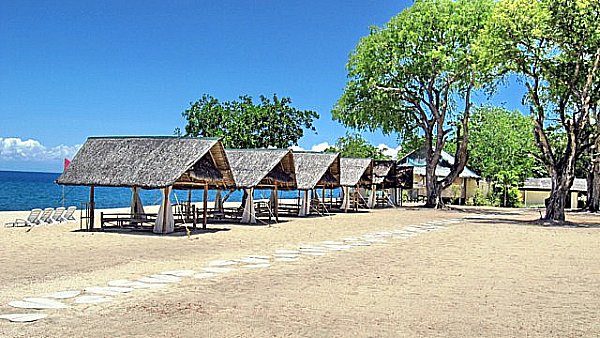
Calicoan Surf Camp is island’s best and most luxurious.  This hideaway was developed by Cebu-based lawyer and pioneer developer Maning Go who owns about 500 hectares of the island’s 1,600 hectares.  It was designed, with distinctive Asian-inspired (Thai, Balinese, Indonesian and Filipino) lines, by Frenchman Nicolas Rambeau, owner and creator of the highly-acclaimed, high-end Pansukian Resort in Siargao (Surigao del Norte).

Bungalow interior

After a short interview with Mr. Molina, we called it a night and Mr. Molina checked us in at one of the resort’s 7 well-appointed, spacious bungalows with its soaring rooflines.  Each bungalow has a native feel, with its own deck and floor with alternating dark and light wood stripes.  Modern amenities include airconditioning, compartmentalized bathroom with hot and cold shower, satellite TV, coffee/tea maker, hair dryer, minibar and safety deposit box.

Infinity pool

Tired after a long trek around the island, we dipped our tired bodies at the resort’s inviting 300-sq. m. saltwater infinity pool bordering the 3-km. long, white ABCD Beach, the island’s prime surfing area.  Verdant pandamus trees (locally called bariw) grow through the pool’s uniquely-designed wooden deck, embracing it and providing cool shade, thus binding nature with design.  Here, we watched the surging, breathtaking surf (boasting perfectly-shaped left or right reef breaks) as the island’s  eastern side juts out to the rolling surf of the Pacific Ocean (its powerful swells tirelessly rolling in over 10,000 m. Philippine Deep), making it a surfer’s paradise. The best surfing months, according to  Mr. Molina, are March, April and September to October when southwesterly winds blow offshore, piling up incoming ocean swells and carving them into glassy shaped hollows.  Surfboards are rented out for a small fee and beginner’s lessons can be provided, on request, by the resort staff.  Surfers must wear booties as protection against the sharp rocks. Although the currents are strong here, the island offers opportunities for big game fishing along the “Tuna Highway,” the migratory route for tuna to Japan.

The resort’s restaurant

Also quite famished after such a long trek, we later indulged ourselves at the resort’s restaurant which offers International and Filipino cuisine including seafood such as freshly caught, fleshy, sweet and delicious lobster, prawns, scallops, abalone, crabs and fish.  After a filling lunch, we packed up our gear, checked out, thanked the resort staff and hired a tricycle (this time for PhP350) to bring us back to the bus station at Guiuan town proper for our trip back to Tacloban City.  Along the way, we made a brief stopover at Calicoan Island Ocean Villas, another of Maning Go’s development projects.  Go enlisted the multi-awarded architectural firm of Francisco “Bobby” Manosa to prepare the island’s master plan.  He envisions zoning development where visitors can make nature treks to large areas of the island without encountering any bar, souvenir shop or billboard, thus offering more natural attractions and leisure activities with less of the hustle of the better-known Boracay.  With continued but controlled growth, may it stay that way, making Calicoan truly a diamond in the rough.

Calicoan Island Ocean Villas

Calicoan Surf Camp: Calicoan Island, Guiuan, Eastern Samar.  Manila Tel: (632) 376-5818.  Website: www.thesurfcamp-calicoanisland.com.

Church of the Immaculate Conception (Guiuan, Eastern Samar)

Church of the Immaculate Conception

After attending the star-studded and colorful Sangyaw Festival of Tacloban City, Jandy and I decided to get some “rest and recreation” at the progressive town of Guiuan in Eastern Samar, our first in the province. To get there, we left the city after lunch, proceeded to downtown and boarded an airconditioned Van-Van van.  The trip took just 3 hrs., made possible by the opening, in the late 1990s, of the South Samar Coastal Road which cut land travel time to Guiuan by about 2 hrs..  As usual, we crossed the beautiful, S-shaped San Juanico Bridge (the country’s longest) into Samar, traveling along a coastal highway which runs past mountains, steep cliffs, distant rock islands and boat-filled bays, then making a right at a T-junction (the left goes to Borongan City) to an occasionally potholed asphalt road all the way to Guiuan.  We arrived there by 4 PM and were guests at the house of Ms. Vibina “Bebeng” Juaban. 

San Juanico Bridge

The best way to explore this coastal town is by hired tricycle.  Vestiges of Spanish era history can be seen at the “fortress Baroque” Church of the Immaculate Conception, considered to be the finest in the Eastern Visayas.  Started in the 1630s, it was rebuilt in stone in the early 18th century.  From 1844 onwards, Fr. Manuel Valverde and Pedro Monasterio renovated the church, covering the roof with tiles. In 1854, Franciscan friars added a transept and baptistery and built a massive bell tower (which once served as a watchtower) on top of a seaside bastion of the fort.   

The church belfry

The church’s façade has triple but slim engaged columns, arches and carvings at the pediment’s borders and 3 entrances with elaborately carved, hardwood doors.  Inside are a single nave with a main altar and two side altars, a beautiful retablo from Franciscan times, a Rococo frontal with the Augustinian emblem and old santos.  The church is enclosed within the partially preserved quadrilateral fort of cut stone, said to be the best and most regularly planned in all the Visayas. Today, this church has been declared as a National Cultural Treasure (unique structures that possess outstanding artistic, historical and cultural values that are significant to the nation), one of 26 named as such by the National Museum in 2001. 

Sangyaw Festival (Tacloban City, Leyte)

Cocowayan Festival of Basilan

I was supposed to attend both the simultaneous Pintados Kasadyaan and the Sangyaw (derived from the Waray word meaning “to herald the news”) Festivals in Tacloban City (Leyte), both held on the month of June, but missed out on the former as my son Jandy still had classes on the day of the parade (June 27).  The Sangyaw Festival’s parade, held on June 29, the day after our arrival, was still worth the visit.  This cultural festival was first created by former First Lady Imelda Marcos in 1974 but was discontinued after 1986.  After an absence of more than 2 decades, it was revived last year by Tacloban City Mayor Alfred S. Romualdez, Imelda’s nephew. 

Image of Sto. Nino de Tacloban

This year’s parade promised to be extra special as it was the 120th celebration of the Fiesta of Sto. Niño de Tacloban, the city’s patron saint, plus Tacloban also just became the first city in the Eastern Visayas Region to be classified as a highly urbanized city.  As with previous parades, our grand view deck for watching the 3-hr., 3-km. long afternoon parade was Avenida Veteranos, packed, since early morning, with thousands of onlookers lining up to watch this unprecedented display of pomp and revelry.

Pattaradday Festival of Isabela

The festival’s street dancing competition was participated in by 17 contingents from different provinces and cities from Luzon (the Pattaradday Festival of Santiago City, Isabela; the Magayon Festival of Legazpi City, Albay; etc.), the Visayas (Sinulog Festival of Cebu City; the Dinagyang Festival of Iloilo City, the Masskara Festival of Bacolod City, Negros Occidental; Kawayan-Banigan Festival of Basey, Samar; etc.) and Mindanao (Bonok Bonok Marajaw Karajaw Festival of Surigao City, the Cocowayan Festival of Isabela de Basilan City, etc.)Tacloban City’s Tribu Kabatuk, last year’s grand prize winner, was on hand to defend their title.  Cash prizes, for the Open or Free Interpretation Category, plus trophies were up for grabs. 

Kawayan-Banigan Festival of Basey

Like with previous cultural competitions, these street dances depicted Filipino culture and tradition.  Each contingent performed, for 3 mins., in designated streets (Imelda St., Rizal St. and Justice Romualdez St.) before performing, for 5 mins., at the Balyu-an Amphitheater. The dance drama presentation showcased the ingenuity, talent and creativity of the over 1,000 participants as well as the cities, schools and institutions they represented. Makati City was ably represented by its Drum, Lyre and Bugle Corp contingent, dressed in their gay blue and white parade attire. 

The Bonok-Bonok Maradjaw-Karadjaw Festival

The Bonok-Bonok Maradjaw Karadjaw Festival, represented by Surigao City’s West Central Elementary School, grabbed all four minor prizes (PhP50,000 each) in the open category (best in costume, best in musicality, best in street dancing and best in choreography) plus  the PhP500,000 grand cash prize. Second place (Php300,000) went to the Kawayan-Banigan Festival and third place (PhP200,000) went to the Pataraday Festival.  

Alibangbang Festival of Dolina

In the community and school-based category (with 10 participating contingents), best in costume (PhP10,000) went to the Alibangbang Festival of Dolina and best in musicality, street dancing and choreography (PhP10,000 each) to the Eastern Visayas State University (ESU).  The eventual grand champion (winning PhP300,000) was EVSU.  Second place (PhP150,000) went to Holy Infant College and third place (PhP100,000) to Sagkahan.  

Makati Drum, Lyre and Bugle Corp

Come nighttime, these same people who lined the streets for the parade also filled up Balyuan Barbecue Park and Amphitheater and the Tacloban City Convention Center, venues of concerts and other entertainment for the weeklong socio-cultural festivities.  Business was brisk and hotels and inns were fully booked with tourists, both local and international, truly an indicator of the festival’s success and its worthiness of being returned to the tourist map.

City Tourism Operations Office: City Hall, Kanhuraw Hill, Tacloban City, Leyte.  Tel: (053) 325-8955, (053) 325-2491, (053) 523-9671 & (053) 325-6248.

Jack’s Ridge Resort and Restaurant (Davao City, Davao del Sur)

After checking out at Pearl Farm Resort, we shuttled back to Pearl Farm Marina at Davao City where we had lunch at Marina Cafe.  After lunch, we had our scheduled Davao City tour, having hired a driver and van the previous day.  Grace and my in-laws opted to visit an orchid farm while the kids and I visited the Philippine Eagle Sanctuary and Wildlife Preserve.

Check out  “Pearl Farm Resort and “Philippine Eagle Sanctuary and Wildlife Preserve”  

Once done, our driver drove us, up a winding cemented uphill road, to Jack’s Ridge Resort & Restaurant for dinner.  This would be my second visit (the first was in 2007 with fellow architect Jose “Jay” Mendoza)  and the first for the rest.

Daytime ridge view of Davao City CBD

When the Americans landed in Davao on May 1, 1945, the retreating Japanese were forced to beat a path to Matina Hills where they set up their headquarters.  Here, they had a commanding view of the Davao Gulf where the American ships were anchored.Thus, it was the scene of fierce fighting between the two forces.

Caves dug by the Japanese still pockmark the area and, once in a while, people still find bullet casings and other war materials in the rocky soil. There is even the ruin of a Japanese plane that crashed on a mountainside beside the ridge.

Davao City by night

Today, over half a century later, this area, now called Jack’s Ridge, is now popular with foreign and local tourists, not only for its commanding view of Central Business District (CBD) of Davao City and Davao Gulf, but also because of its popular and classy restaurants, cafes and bars now located there that offer different delicacies, truly a completely different dining experience.

Jack’s Ridge Resort

One of the most popular restaurants here is Taklobo Restaurant where we dined.  The restaurant is noted for its wide array of delectable and mouthwatering Dabawenyo dishes such as calamares, sinigang, kinilaw, grilled tuna, pork or chicken.  A group of musicians also serenaded us while we were eating amidst the cool evening breeze.  We also posed beside a life-size statue of a Japanese soldier.

Prehistoric taklobos  outside the restaurant

Just outside the  restaurant are some prehistoric giant clam shells (taklobo) found at the ridge, an indication that this area, once submerged under the sea, was tossed  to these heights by strong geological forces millions of years ago. On one side was a covered concrete stairway leading to a spacious and elegant open amphitheater where one can lounge al fresco.

Stairway leading to open amphitheater

Jack’s Ridge Resort & Restaurant: BCG Drive, Shrine Hills, Matina, Davao City. Davao del Sur. Tel: (082) 297-8830 to 31.  Fax: (082) 297-6535.  E-mail: info@jacksridgedavao.com and  jacksridgedavao@yahoo.com.ph. Website: www.jacksridge.com.

Isla Malipano (Island Garden City of Samal, Davao del Norte)

On our second day at Pearl Farm Resort, Grace, Jandy, Cheska, my in-laws and I decided to crossed over (a 2.5-min. boat ride) to the secluded, 7-hectare Isla Malipano and check out its facilities.  We were dropped off at the 200-pax, octagonal and multi-functional Malipano Gazebo at the other end of the island, a perfect alternative for weddings, theme parties and other occasions.  My in-laws decided to stay here while we went around the island.

Check out “Resort Review: Pearl Farm Resort” and “Pearl Farm Resort

Malipano Gazebo

Also a part of the resort, Isla Malipano has a white sand beach, an offshore reef plus 7 lavishly-decorated, 3-storey private luxury villas, each with a wide veranda with breathtaking views of the Davao Gulf. Small barbecue parties can be held at the veranda.

Check out “Resort Feature: Malipano Villas

The island’s sparkingly white sand beach

The villas are composed of 3 octagonal structures with reception areas, guest suites and dining area, all around a cantilevered deck. Their roof design is patterned after the salakot (traditional Filipino hat).  Four of the villas are perched on stilts directly above the sea while the 3 other villas are built over rock outcrops on the beach.

The Malipano Villas

Five villas have 3 bedrooms (with 2 queen-size beds and 2 single beds or 3 queen-size beds) while 2 villas have 4 bedrooms (with 3 queen-size beds and 2 single beds or 4 queen-size beds).

Veranda with a great view

All villas are airconditioned and equipped with minibar, coffee and tea making facilities, safety deposit box (at the master’s bedroom), cable TV, hair dryers, spacious living room and toilet and bath (the master’s bedroom has a bathtub).  Butler service is available for food orders and other guest assistance while a standby speedboat is available to transport guests to the restaurant and other resort facilities.

One of the villa’s master bedrooms

The island is also ideal for scuba diving as the wrecks of two World War II Japanese freighters are located 60 m. away and in front of the resort.  The 40-m. (132-ft.) long Wreck I is located just a few meters from the resort’s Samal houses, in 35 m. (115 ft.) of water.  Here, you can find groupers, jacks, moray eels and others.  For advanced divers, an open bay hatch allows safe penetration.   It is also recommended for underwater photography.  The slightly smaller, 35-m. (115-ft.) long Wreck II rests on its side at a shallower dept of 28 m. (98 ft.) of water.

Pearl Farm Resort: Kaputian District, Island Garden City of Samal, Davao del Norte.  Tel: (082) 221-9970 to 73.  Fax: (082) 221-9979.  E-mail: pearlfarmresort@fuegohotels.com.  Website: www.pearlfarmresort.com.  Davao Citysales office: G/F, Anflocar Corporate Center, Damosa Bldg., Lanang.  Tel: (082) 235-0876 and 234-0601.  Fax: (082) 235-0873.  E-mail: dvosm@pearlfarmresort.com.  Manila sales office: 15/F, 1504 Corporate Center, 139 Valero St., Salcedo Village, Makati City.  Tel: (632) 750-1896 and 98.  Fax. (632) 750-1894. E-mail: mlasm@pearlfarmresort.com.

Pearl Farm Resort (Island Garden City of Samal, Davao del Norte)

My first visit to Pearl Farm Resort in Davao, during the the November 2007 Flavors of Spain, so enamored me with the place so much so that I decided to return, this time with my whole family in tow.

Check out “Flavors of Spain in Davao

The Parola at Pearl Farm Resort

This 11-hectare, Class “AAA” resort, located on a secluded cove at the Island Garden City of Samal’s Kaputian District, was formerly the home, since 1958, of the Aguinaldo Pearl Farm which produced cultured pink, white and gold pearls from white-lipped oysters brought from Jolo.   It ceased operations in 1980 but was developed into a world-class beach resort, opened in 1992.  It started out with 10 hillside cottages and 2 Samal cottages on stilts.

Check out “Resort  Review: Pearl Farm Resort

The resort’s white sand beach and backdrop of greenery

Today, the main resort has expanded into 70 guestrooms (17 standard Hilltop rooms, 21 superior Samal Houses, 6 executive, 2-storey Samal suites and 19 de luxe Mandaya Houses and 7 Malipano Villas) made mainly with bamboo and wood and harmonizing with the clear, blue sea, the white sand and its backdrop of impressive greenery.

Davao International Airport

We book flights with Philippine Airlines and left Manila for Davao City, the gateway to the resort, on the very early 4:30 AM flight.  We arrived at Francisco Bangoy International Airport by 6:30 AM and were whisked, via a resort van together with other guests, to the Pearl Farm Marina in Lanang.  From its developed wharf, we were to be transported to the resort via a large motorized outrigger boat.  Our boat left by 8:30 AM and the ride took all of 45 mins.

Waiting for our boat at Pearl Farm Marina

We arrived at the resort by 9:15 AM and we were checked in at a luxurious, 2-storey, Muslim-inspired Samal Suite, specifically Suite 1.  This was convenient for my octogenarian in-laws as this particular suite was the nearest to the Maranao Restaurant, allowing for shorter walks.  Noted architect Francisco “Bobby” Mañosa designed the cottages and villas as close as possible, in both materials and form, to the different Mindanao tribes they were named for: the Bagobo, B’laan, MaguindanaoTausugT’boli and Yakan.  Ours was the Tausug.  For its depiction of regional traits, the resort received the Kalakbay Award for Best Resort for two consecutive years (1994 and 1995) and was one of the venues of the 1994 Miss Universe pageant.

The Samal Suites

The Samal suites (as well as the cottages) were patterned after the stilt houses of seafaring Samal tribes of the Sulu Archipelago. My wife Grace, my kids Jandy and Cheska and I occupied the master bedroom, with its king-size bed, on the second floor while my in-laws occupied the living room on the first floor which was converted to another bedroom with a sofa bed with trundle bed being provided.  Both floors have their own private bathroom with the masters’ provided with a bathtub.

The master bedroom

Both rooms are airconditioned and provided with cable TV, a well-stocked mini-bar, coffee and tea making facilities, safety deposit box and hair dryer. Our veranda,  overlooking the serene blue water, had a private staircase leading down to our very own small yet private beach. A jar of water and a coconut shell dipper are placed near the entrance to our suite so that we may wash away the sand after a day of barefoot walking on the beach. In local custom, this gesture is also symbolic of a cleansing of the spirit.

The converted living room

After checking in at our suite, we all proceeded to the Maranao Restaurant for brunch.  This cavernous dining pavilion, replete with tribal motifs, has a menu with an assortment of international culinary influences, all wonderfully prepared by Filipino chef Edgar Chavez.  The buffet features Spanish paella and calamares,  Madras seafood curry, Italian pasta, Japanese tempura and even Thai tom yum soup plus sweet pomelo, mangoes and other tropical fruits.

Maranao Restaurant

Cocktails, plus inspiring views of the sea and nearby De la Paz and  Malipano  Islands, can be enjoyed at the Parola Bar.  Both restaurant and bar offer free Wi-Fi internet access.  The resort also has two swimming pools, one of which was built right on the shore, giving the illusion that the pool water meets the sea, while the other has a jacuzzi.

Check out “Isla Malipano

Infinity pool
The resort’s second swimming pool

The Ylang-Ylang Spa, located beside a waterfall and beneath swaying coconut palms, offers several indulgent body and beauty treatments based on natural products.  They include a relaxing Papaya Body Scrub, a revitalizing Honey and Cucumber Facial Cleansing and the refreshing Floral Foot Soak. Massage therapies, embracing the most effective European and Asian techniques and using the stress-busting and soul-soothing power of coconut oil, includes the healthy aromatherapy massage.

Ylang-Ylang Spa
Getting around the resort was easy as there are two shuttles, one of them electric-powered. The Mandaya weaving house has a couple of tribal women making colorful tribal dresses, costumes and jewelries.  Pearls, hats, T-shirts and other accessories can be bought at the nearby boutique. There are also 2 function rooms, 2 tennis courts, game room (billiards, chess, mahjong, etc.), children’s playground and a mini-aviary.

The Game Room
Aqua Sports Center
Function Room
Mandaya Weaving Center

An aqua sports center offers windsurfing, fishing, jet skiing, sea kayaking, island hopping, banana boat rides, Hobie cats, wave runners, snorkeling and scuba diving.   Here, we tried our hand at sea kayaking, Grace and Cheska on a tandem kayak while Jandy and I took single kayaks.  Donning life jackets, we paddled all the way to Malipano Island.  On our way back, it started to rain, some swells started to appear and my kayak capsized.  I floated around for some time, not knowing how to get back on my kayak.  Luckily, the staff at the Aqua Center noticed my predicament and rescued me, using their speedboat.

Cheska and Grace on their tandem kayak
Jandy on his single sit-on kayak
That’s me bringing up the rear


Pearl Farm Resort: Kaputian District, Island Garden City of Samal, Davao del Norte. Tel: (082) 221-9970 to 73.  Fax: (082) 221-9979.  E-mail: pearlfarmresort@fuegohotels.com.  Website: www.pearlfarmresort.com.  Davao Citysales office: G/F, Anflocar Corporate Center, Damosa Bldg., Lanang.  Tel: (082) 235-0876 and 234-0601.  Fax: (082) 235-0873.  E-mail: dvosm@pearlfarmresort.com.  Manila sales office: 15/F, 1504 Corporate Center, 139 Valero St., Salcedo Village, Makati City.  Tel: (632) 750-1896 and 98.  Fax. (632) 750-1894. E-mail: mlasm@pearlfarmresort.com.

Pearl Farm Marina (Davao City, Davao del Sur)

Pearl Farm Marina

Pearl Farm Marina, our docking and loading area for Pearl Farm Resort (a 45-min. motorized boat ride), turned out to be more than just that.  It is also a quaint and secluded hotel for those who wish peace and quiet in luxurious surroundings.  Many of those who stay here are also guests of Pearl Farm Resort who wish to stay overnight in Davao City.  Opened in 2006, it only has  4 rooms (2 standard and 2 deluxe), all equipped with airconditioning, NDD/IDD phones, safety deposit boxes, cable TV and hot and cold shower.

Check out “Pearl Farm Resort

Lunch at the Marina Cafe

It also has a coffee shop (Marina Cafe, open 8 AM-10 PM), a mini-bar and an inviting swimming pool, all exclusive for guests to enjoy while waiting for the next boat service to the resort, their next flight or just to hang around.  The mini-bar (open 7 AM-10 PM), ideal for small meetings, training sessions, seminars and other private functions, can accommodate 20 people.  Both restaurant and mini-bar are wi-fi ready.

Swimming pool

Its garden area, a popular venue for weddings, cocktails, private parties and other special occasions, can accommodate 200 guests. Right beside the hotel is the T’boli Weaving Center where guests can experience the rich cultural heritage of Mindanao.  The ferry boat to the resort leaves 4 times daily (8:30 AM, 1:30 PM, 4 PM and 6 PM).

Jandy at the T’boli Weaving Center

Pearl Farm Marina: Km. 10, Lizada Drive, Lanang, Davao City. Davao del Sur.  Tel: (082) 234-7018 and 234-6987.

Sentosa Resort (Singapore)

After our Singapore Flyer “round” trip, we had a  late lunch at Seafood Paradise. Next in our itinerary was Sentosa and, to get there, we again boarded 2 taxis and dropped off at Sentosa Imbiah Station.

Tiger Sky Tower

Upon arrival, we all first tried out the Tiger Sky Tower, Singapore’s tallest free-standing observatory tower, opened on February 7, 2004.  Once inside the large, 72-pax air-conditioned, disc-shaped cabin fitted with glass windows all round, it then revolved slowly as it ascended the column of the tower to a maximum height of 131 m. above sea level (110 m. above ground). On the way up, we enjoyed panoramic views across Sentosa, Singapore’s southern islands and neighboring Malaysia and even Indonesia.

View of Sentosa and Outlying Islands From Tiger Sky Tower

After our tower ride, we walked to the nearby Images of Singapore building to try out Singapore’s award-winning attraction – the Images of Singapore. A quick peek into Singapore’s history, culture and heritage, this walk down memory lane was the second for me and Grace and the first for the rest.  A journey to the very soul of the nation, it brings the country’s past back to vivid life using multimedia displays, multi-screen theater presentations and life-sized tableaus depicting local history.

Images of Singapore Building

Here, legend, facts and folklore are creatively interwoven into an “I am there” experience as we journeyed from the earliest days of Singapore’s founding, when Sir Thomas Stamford Raffles stepped along the banks of Singapore River, to today’s modern Singapore where cultural diversity, unity of values and adventure converge. We were also amazed by the many colorful festivals celebrated in Singapore.

Images of Singapore

After our Images of Singapore, Jandy, Cheska and I tried out the non-motorized Luge, a self-steering, gravity-driven 3-wheel cart, originally from New Zealand, that is part go-cart, part toboggan. Here, we all navigated 650 m. down the Jungle Trail or 688 m. down  the Dragon Trail with the option to go thrillingly fast or to cruise slowly as we went down the hill to Siloso Beach. Truly a unique outdoor experience.

The Luge

After the Luge, we next boarded the Skyride, along the way taking in the panoramic and breathtaking scenery of the city skyline, harbor and beautiful coastline. The used luges are also slung underneath our seats for transport back up the hill.

The Skyride

Come evening, we proceeded to the S$4.5million Cineblast, opened in June 2007, to watch “Extreme Log Ride,” Singapore’s only cinema ride. This thrilling, 4-dimensional, motion-simulated “ride of your life” combines the virtual “roller coaster” rides with high-definition wide-screen projection.  Here, we all sat inside a cyclone unit that is mounted onto a 6-axis system and then experienced amazing real-life thrusts and motion unlike any other as we felt the exhilaration of flying to the top of the highest mountain, the stomach-churning virtual thrill of rushing into the deepest valleys, and the gripping excitement of being tossed about by whitewater rapids.

Cineblast and 4D Magic

Next, we moved on to the S$3.5 million Sentosa 4D Magix Theater, opened on January 2006, to watch the comedy “Pirates!”   This whole new generation in movie magic, the first in Southeast Asia, is an interactive movie experience with 4-dimensional digital effects, using a state-of-the-art digital projection system and a DTS 6.1 sound system.

Cineblast and 4D Magic

We were seated on a motion-based chair equipped with a wide spectrum of special visual, sound, motion and environmental effects such as built-in speakers as well as environmental effects like water features, seat vibration, leg ticklers and base shakers, placed us right in the middle of the action. During the 3-D show, visual effects kept popping out of the big screen, we were tossed about in our seats, felt the wind blowing in our face and the water rushing our way, all environmental effects that provided a life-like feel.

Songs of the Sea (Palawan Amphitheater)

We again met up with the others at the 2,500-pax, open-air Palawan Amphitheater for the 7:30 PM showing of the mesmerizing “Songs of the Sea.” This one-of-a-kind entertainment spectacle, with a live cast, features dramatic effects, pyrotechnics displays, water jets, flame bursts and lasers amid captivating music.  Truly, a performance we didn’t want to miss.  Designed by Yves Pepin, this show was started on March 26, 2007, replacing the 25 year old Magical Sentosa show. The water jets, water screens, lasers and projectors are hidden at the back of the 120 m. long Malay kampung (or kelong) by the sea. The show runs twice nightly.

Songs of the Sea (Palawan Amphitheater)

After the “Songs of the Sea” presentation, Grace accompanied Dad and Mom back to the hotel while Jandy, Cheska and I tried out the after-dark Go Green Segway® Eco Adventure, a first for all of us.  Here we tried out the Segway, a futuristic personal mobile transporter and mobility device, along a secure circuit.

Segway

After the Segway ride, we had a late dinner at a 7-Eleven outlet and loll around, for some time, at Palawan Beach. We, as well as many other tourists leaving Sentosa, waited a long time for the arrival of the monorail to Vivo City.  From Vivo City, we took the MRT to Dhoby Ghaut and then a taxi back to our hotel.

Sentosa Resort: 33 Allanbrooke Road, Sentosa Development Corporation, Singapore 099981.  Tel: 6275 0388.

Singapore Flyer (Singapore)

After breakfast at the hotel, we all left, on board 2 taxis, for the Singapore Flyer, a giant observation (management refuses to use the word “Ferris”) wheel at the Marina Promenade, located at the southeastern tip of  Marina Center, near the shore of Marina Bay. We wanted to get a breathtaking and panoramic view of Singapore’s magnificent city skyline and what better place to do that than being 42 stories up in a 165 m. (541 ft.) high observation wheel.

Singapore Flyer

The tallest in the world, it is 5 m. (16 ft.) higher than the Star of Nanchang (People’s Republic of China) and 30 m., (98 ft.) higher than the London Eye (United Kingdom).   Designed by Arup and Mitsubishi Heavy Industries, the actual wheel has a diameter of 150 m. (492 ft.).  It was constructed from 2005–2008 and its final capsule was installed on October 2, 2007.

View of the Observation Wheel From the Terminal Building

The wheel started rotating on February 11, 2008 and it was officially opened to the public on March 1, 2008. Its grand opening was held on April 15, 2008. Initially, the wheel rotated in a counter-clockwise direction until, on the advice of Feng shui masters, its direction was changed on August 4, 2008.

The Rainforest at the Atrium

It was almost noon when we all arrived at the 3-storey, 16,000 sq. m.(172,000 sq. ft.) terminal building on which the wheel sits.   The terminal houses shops, bars and restaurants, an adjacent open-air Greek-inspired theater along the waterfront, a jetty, roof gardens and a recreated rainforest (Rainforest Discovery) with waterfall in the terminal’s atrium.

The Airconditioned Exo-Capsules

After paying the S$29.50 admission fee, we entered one of the 28 airconditioned, 28-pax, 26 sq. m. (280 sq. ft.) exo-capsules which, like those of the London Eye, are attached outward of the wheel structure, offering a continuously unobstructed view when the capsule is at the peak, unlike the more common endo-capsule.

Flyer Theater

A complete clockwise (when viewed from Marina Center) rotation of the wheel takes approximately 37 minutes. During all that time, we had a breathtaking, vibration-free view of Singapore’s iconic and historical landmarks, views from the Marina Bay to the Singapore River, City Hall, Raffles Place, Merlion Park, the Supreme Court Building, Empress Place and the Padang.

Singapore's Magnificent Skyline

We also had great 360 degree views of the Marina Bay Golf Course, Marina Bay Sands Integrated Resort (under construction) and the Float at Marina Bay; the Esplanade (Singapore’s performing arts venue), the 280 m. high UOB Plaza One Building (1 of Singapore’s 3 highest buildings) and the Flyer Theater below.  Beyond, about 45 kms. (28 miles) out, are the Indonesian islands of Batam and Bintan, as well as Johor (Malaysia).

The Esplanade

The Flyer also afforded a great view of the Marina Bay Street Circuit of the Singapore Grand Prix (the first Formula One races were held last September 2008) as it is located beside the straight, between turns 21 and 22, and near the pit area.

Singapore Flyer: 30 Raffles Ave., Singapore 039803.  Tel: (+65) 6333 3311 and (+65) 6734 8829 (Corporate Office).  Fax: (+65) 6339 9167.  Website: www.singaporeflyer.com.  Open daily, 8:30 AM-10:30 PM. Visitors can take a free shuttle bus from City Hall MRT Station, which operates every half-hour to and from the Singapore Flyer.

Jurong Bird Park (Singapore)

We decided to spend our second day at Singapore all day at the fresh and interesting Jurong Bird Park, a first for all of us.  At first glance, I did not think that a park with just birds would interest me (that’s why I didn’t go there during previous visits to Singapore), but I was to be proven wrong. Again, the park being very far from the city, we all went there (and returned) via 2 taxis, arriving there by noon after a 20-min. trip.

Main Entrance of Jurong Bird Park

Managed by Wildlife Reserves Singapore, this world-famous S$3.5 million, 202,000 sq. m. (50 acre) bird zoo and landscaped park, built on the western slope of Jurong Hill, within the Boon Lay Planning Area of the Jurong District, was opened on January 3, 1971. In 2006, it  completed its S$10-million makeover.

Souvenir Shop at Main Entrance

The well-maintained Jurong Bird Park, currently the world’s largest bird park in terms of number of birds and second largest in terms of land area, after Germany’s Vogelpark Walsrode, is home to an impressive collection of 4,600 exotic birds of 380 species, (29 of which are endangered) from South East Asia, Africa, South America and Australia. Some exhibits are fully open (Flamingo Lake, Swan Lake and Pelican Cove), some are cage-based (Parrot Paradise) and 4 are large walk-in aviaries.

Birds and Buddies Show (1 PM, Pools Amphitheatre)

Upon arrival, we opted to first watch the 1 PM Birds and Buddies Show (formerly called the “All Star Birdshow”) at the Pools Amphitheater. This lively and entertaining, 25-min. bird show, professionally presented with an environmental message, showcases a large number of species of performing birds, trained to such amazing levels, interacting with humans in a single act.

Birds and Buddies Show (3 PM, Pools Amphitheater)

During the show, we were enthralled by the antics of talented birds like the mimicking cockatoos, parrots and macaws singing , playing basketball, doing stunts etc..   We liked it so much, we attended the second show at 3 PM, also at the same venue.

In between these 2 Birds and Buddies Shows,Jandy, Cheska and I climbed up a couple of flights of stairs and hopped aboard the relaxing, airconditioned Panorail (S$5), the world’s only monorail that runs through an aviary.

The Panorail

We dropped off at the Lory Station were we visited the 3,000 sq. m. (32,000 sq. ft.), 9 storey high Lory Loft, the world’s largest walk-in flight aviary for stunningly colorful lories and lorikeets.

Lory Loft

Here, we walked on suspended bridges at tree top level, surrounded by over 1,000 free-flying lories. The ambiance here is said to be similar to that of a rainforest vale in tropical Northern Australia. Cheska, wanting an up close encounter, tried to offer the lories a specially concocted nectar mix in a little cup (S$3) so that the birds would flock to her.

Up Close and Personal With a Lory

We also visited, on foot, the 32 aviaries (housing 92 species of parrots) and the interpretative pavilion at the 1-hectare Parrot Paradise; the impressive colony of 1,001 roosting, flamboyant flamingos at the beautifully-landscaped Flamingo Lake; and Pelican Cove.

Flamingo Lake

At Pelican Cove, we observed a cosmopolitan colony of all 7 species of pelicans, including the endangered, 11-15 kg. Dalmatian pelican (the largest of the 7), while strolling along a boardwalk. However, we failed to catch them at the world’s first underwater viewing gallery for pelicans, where the birds scoop for fish at feeding time.

Pelican Cove

Next to Pelican Cove is Swan Lake where, from an observation deck close to the water edge, we observed, at close quarters, graceful Black-necked Swan, Black Swan and the Mute Swans roosting, fishing, bathing and swimming amidst the tranquil ambiance.

Swan Lake

Jandy and I again hopped aboard the Panorail and dropped off at the Waterfall Station where we visited the African Waterfall Aviary, the world’s largest walk-in aviary with more than 1,500 free-flying birds from over 50 species from Africa. Species here include the golden-breasted starling, turacos, bee-eaters and the hoopoe.

African Waterfall Aviary

Here, the birds tend to stay further away and we needed to move slowly round the jungle landscaped paths to avoid spooking them. Later, we met up with Mom, Dad, Grace and Cheska at the 30 m. high Jurong Falls, the world’s tallest man-made waterfall in an aviary and a popular photo-ops.

The 30 Meter High Waterfall

At 4 PM, we watched the Birds of Prey Show at the Fuji Hawk Walk. Here, we watched majestic birds of prey such as eagles, hawks, vultures and falcons fly in aerial loops and soar above, moving from one treetop to another. We also learned about falconry as these birds were put through their actions in a simulated hunt.  The birds sometimes swoop just 6 inches from our head.

Birds of Prey Show (4 PM, Fuji Hawk Walk)

After the show, Cheska and Jandy had a cool time having their pictures taken with a live owl, first putting on gloves so that the owl can be transferred to their hands.

Up Close and Personal…. This Time With an Owl

After the show, we next visited the 1,600 sq. m. (17,000 sq. ft.) Penguin Coast which houses 6 species of penguins. Featuring a 21-metre (69 ft) tall Portuguese galleon facade designed to resemble a ship, the interior of Penguin Coast, a great place to escape to during a hot day and one of the few places where you can see live king penguins outside of Antarctica.

Penguin Coast

Constructed with wooden beams and flooring,  Penguin Coast has 2 displays, one indoor and the other outdoor.  The Humboldt, Rockhopper, Macaroni, Fairy and King Penguins live indoors in a captivating, climate-controlled den while Jackass penguins, one of the few species that are adapted to the tropics, can be viewed, with Cape Shelducks and gulls, at an outdoor penguin enclosure.

World of Darkness

At 5 PM, we dropped by the 400 sq. m. World of Darkness, Asia’s first nocturnal bird house, opened in April 1982. It features a system of reverse lighting, converting day to night and vice versa, thereby inducing night-active creatures to come alive during the daylight hours. It is akin to a quiet nocturnal walk along a starlit jungle path, watching birds in a simulated “moonlit” night and hearing them beckon. On display are 31 birds (mostly owls) from 9 species: Black-crowned Herons, Stone Curlews, Lesser Whistling Ducks (Javan Tree Ducks), Snowy Owls, Malay Fish Owls, Eurasian Eagle Owls, Barn Owls, Great Grey Owls and the Bobook Owls.

Royal Ramble

Next, we dropped by the 800 sq. m. Royal Ramble where we had an unobtrusive view of the world’s largest pigeons.  It has a 40 m. long walkway and 3 separate aviaries housing the 3 species of Crowned Pigeons found in the world (Common Crowned Pigeon, the Victoria Crowned Pigeon and the Scheepmaker’s Crowned Pigeon).

Dinosaur Descendants

Finally, at the 4,579 sq. ft. Dinosaurs Descendants we were greeted by a huge rock with a relief of feathers and ostrich eggs. Here, we learned the similarities and intriguing facts which link ratites (flightless birds such as ostriches and cassowaries) to dinosaurs, amidst the simulated grassland habitats of these birds.

Dinner at Bongo Burgers

Come evening, we dined at Bongo Burgers’ delectable but quite pricey choice of pure and lean patties in generous, American-sized servings.

Jurong Bird Park: 2 Jurong Hill, Singapore 628925. Admission: S$18.00 (adults) and S$12.00 (children, 3 – 12 years). Tel: (65) 6265 0022. Fax: (65) 6261 1869. E-mail:info.jbp@wrs.com.sg. Website: www.birdpark.com.sg. Open daily, 8.30 AM-6 PM.