Church of St. Peter the Apostle (Loboc, Bohol)

On my own, I made a short visit to Loboc’s Church of St. Peter the Apostle, listed by the National Museum as a National Cultural Treasure.  Built in 1602 by Fr. de Torres, it is the second oldest church in Bohol.  The present church was built in 1734. 

Church of St. Peter the Apostle

Inside are remarkable nave paintings done (from May 1926 to July 1927) on the walls and ceiling by three artists (Canuto Avila and son Ricardo, Ray Francia), the biggest number of murals on religious subjects.  The ceiling was retouched in 1995 by Cris Naparota.   It also has a Neo-Gothic pulpit with a late 19th century sounding board (portavoz) and 5 retablos between the transept and sacristy. 

Bell Tower

Outside the church, near the riverbank, is the separate 21-m. high, 4-storey octagonal stone bell tower, built after 1768.   It has 7 bells, the oldest dated 1863 and 2 others dated 1914 and 1937.  The tower also has a large wooden matraca (a cranked noisemaker) dated 1899 and a clock from Altonaga Co., acquired through public subscription and installed in 1893.   The bell tower was almost destroyed during the construction of the unfinished Loay Bridge, a folly of the Marcos era which was supposed to be part of an elevated expressway just across the road.  Timely objection by the Lobocanons prevented its destruction.  The project was discontinued. 
Church of Pope St. Gregory the Great (Majayjay, Laguna)

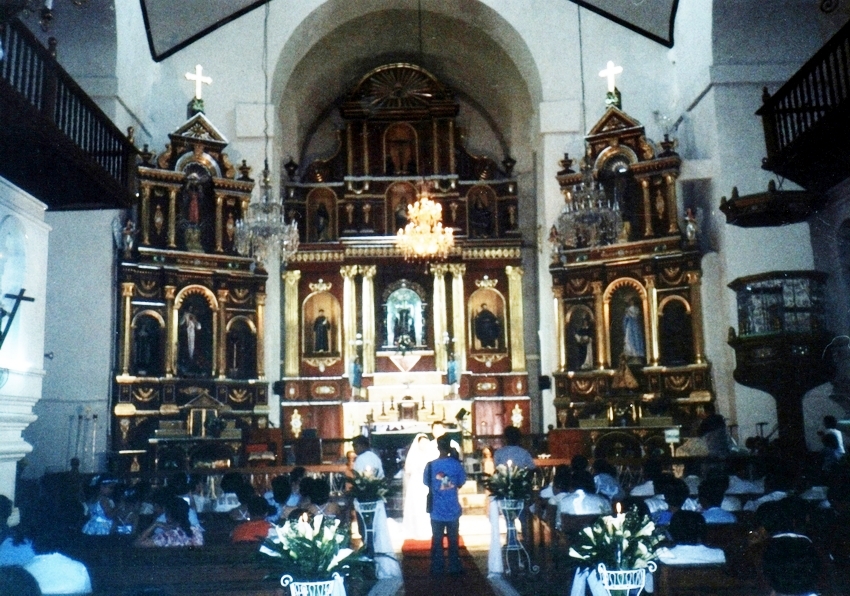
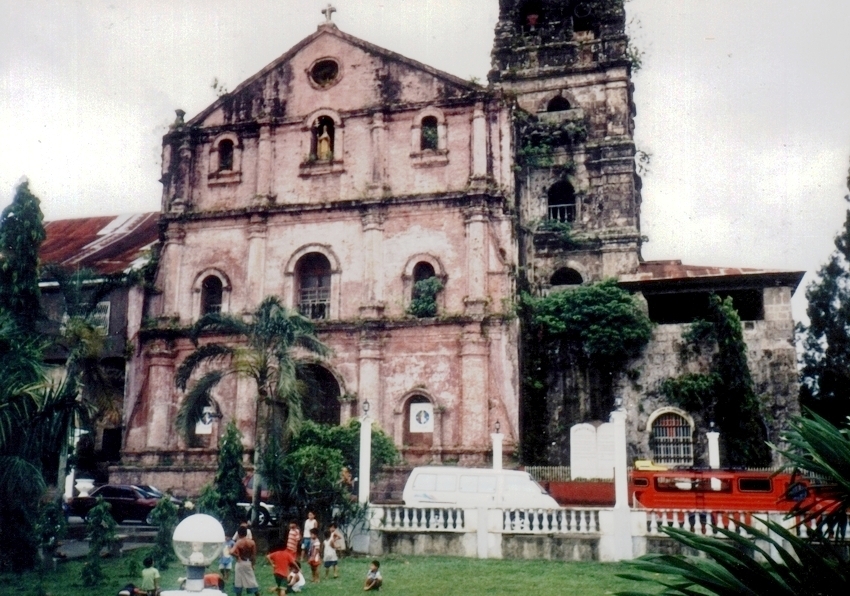
Before departing for Manila, we passed by the Majayjay town center to visit the town’s imposing Spanish-era Church of Pope St. Gregory the Great.  A wedding was in progress when we arrived.  Named after the town’s patron saint (whose feast is held on 12 March), the church suffered successive destruction by fires (1576, 1606, 1660 and 1711) before it was strengthened and enlarged, to its massive and present form, from 1711 to 1734 by Fr. Jose de Puertollano through the forced labor of its 4,000 townspeople.

Church of Pope St. Gregory the Great

The church was again repaired in 1839, 1842 and 1848, because of typhoon damage, and further improved in 1892 when its roof was replaced with galvanized iron by Fr. Gregorio Platero.   During the Philippine-American War, the church became the headquarters of American forces.  The church was repaired again in 1912.

The church interior

This unusually tall, stone and brick colonial Baroque church, with its commanding view of the town and Laguna de Bay, has 6-m. thick adobe walls covered with vines and moss, vaulted halls and enormous and unusual 16.5-m. high solid buttresses supporting a bell tower (with 5 century-old bells) at the rear.  Of equally huge proportions, the tower is topped by a pointed roof and is accessed by concrete steps that also lead to a catwalk above the ceiling (called langit-langitan) that, in turn, leads to the crossing above the transept. The 60-m. long and 17-m. wide nave has balconies on both sides, 3 impressive altars, antique relief statues of saints, azulejo-tiled floor and 5 elaborate retablos (altar backdrops) constructed on the wide pilasters supporting the lateral bays of the capiz window-lined transept.  The adjacent convent, one of the earliest surviving examples in the country, houses a small museum of old parish documents and ecclesiastical silver.  It was slightly defaced when part of it was converted into St. Gregory Academy (later to be renamed Liceo de Majayjay). 

After our church visit, we again passed by Mr. Flory Rosales’ home to thank him personally for the assistance he gave us.  The ladies and Robert also went to the nearby market to buy the fruit of the month of October – lanzones.  As I would say, “Never leave Majayjay without it!” (a pun of the American Express commercial).  I stayed behind to do some people-watching.  One thing noticeable is the unusual number of horse-riding men I saw passing me by.  Majayjay certainly is not your one-horse town.   After a while, my companions returned, all toting 5 kgs. each (at PhP37 per kilo) of the luscious fruit.  These, plus the extra pasalubong of lanzones Mr. Rosales gave us, made us look more like visiting fruit dealers.  Thus fully laden, we all happily went our way back to Manila.

Visita Iglesia (Tayabas and Lucban, Quezon)

Today being Good Friday, Jandy and I also joined Jun and Jane’s relatives for the visita iglesia, the traditional visit to 7 churches.  We motored to the nearby town of Tayabas, just  23 kms. from Sariaya, and dropped by the St. Michael the Archangel Minor Basilica were we recited the 14 Stations of the Cross.  The longest Spanish colonial church in the country and also one of the oldest, this 103-m. long church was first built by the Franciscans in 1585, repaired in 1590 by Pedro Bautista, changed into brick in 1600, destroyed by an earthquake in 1743 and later rebuilt and enlarged in 1856 by building a transept and cupola. The church’s roof was changed to galvanized sheets in 1894 and its belfry contains an 18th century clock, the only one of its kind in the country, that chimes every 30 minutes.  It was made into a minor basilica on October 18, 1988 and has an antique organ, a balcony over the altar and a now unused tunnel from the altar. 

St. Michael the Archangel Minor Basilica
Our second and final stop of the visita iglesia was the town of Lucban, a quiet old Franciscan town of 35,128  people whose name was derived from a delicious fruit of the same name which looks like a small pomelo or suha. The “poor man’s Baguio,” Lucban lies 1,500 feet above sea level at the cool, damp shadow of Mt. Banahaw de Lucban whose clear, ice-cold waters flow through the little canals of the town.  It is almost as cool as  Baguio City in December.  There are also has numerous old and stately Spanish colonial houses.
 
Church of San Luis Obispo de Tolosa
Here, in front of the town’s shady plaza, is the moss and vine-covered Church of San Luis Obispo de Tolosa.  It was first built in 1593, ruined in 1629, reconstructed between 1630-1640, seriously damaged by fire in 1733 and reconstructed in 1738. Its convent was built in 1743.  It was partially destroyed in 1945 during World War II and finally reconstructed by the Philippine Historical Commission in 1966. However, it’s somewhat modern interior, which enshrines the venerated image of San Isidro Labrador, doesn’t blend in with its centuries-old exterior (my opinion).   The church is surrounded by gardens and grottos and fenced in by old stone walls called quince-quince.