
Mt. Famy in Laguna, the nearest and most accessible mountain trekking destination from Manila. The mountain, in itself, is no “tall” order being only about 1,100 ft. (335 m.) high. The charm of the place, aside from its accessibility, lies in its 7 beautiful waterfalls (Ambon-Ambon Falls, Batya-Batya Falls, Buruwisan Falls, Lanzones Falls, Matandang Buruwisan Falls, Sampaloc Falls and Sapang Labo Falls). It was this charm that made me decide to visit the place. I brought with me Jandy and Jesu-Mariae School teachers Mr. Roy Trillo and Mr. Arnel Daliva. We left Manila by 6:30 AM traveling via the C-5 highway to Pasig City, Antipolo City, and the Rizal towns of Cainta, Taytay, Teresa, Morong, Baras, Tanay and Pililla, before crossing the Laguna boundary, to Mabitac and Famy.
 |
| Buruwisan Falls |
The views along the winding and well-maintained asphalt highway at Mabitac were truly spectacular as we feasted our eyes on the surprisingly forested mountains of the majestic Sierra Madres and the calm, azure waters of Laguna de Bay. The route here, and in Antipolo City, is full of sharp, Kennon-like zigzag bends. Asking around at the Caltex station in Famy town, we were beginning to wonder why no one seems to know or even heard about this mountain named after their town. One even gave us wrong directions to a mountain in Pakil. The answer is simply because it isn’t there in the first place. We tried the next town of Siniloan.
 |
| Jandy rafting at the falls |
Later conversations with Siniloan residents Geronimo and Marilyn Pontipedra revealed that our mountain destination was, due to an erroneous land survey, placed within the territorial jurisdiction of Famy town. Hence, the name Mt. Famy. In reality, the mountain belongs to Brgy. Macatad in Siniloan. Here, they call it Mt. Romelo. Two of the mountain’s 7 waterfalls are another story. Buruwisan Falls and Ambon-Ambon Falls, according to some travel brochures that I’ve read, are supposedly under the jurisdiction of neighboring Sta. Maria and Pangil towns respectively. Brgy. Macatad’s residents claim otherwise. We arrived at the jump-off point by 9 AM and parked our car, for a fee, at a house along the highway. All four of us registered our names at the store of Ms. Pontipedra and gave a small donation. Laden with our gear we, at first, refused offers for guides and porters. This was foolish economy on our part as there were many forks along the trails. We finally engaged the services of 13-year old Macatad resident Joel Diaz as our guide. Later, he also became my porter as the heavy weight of my backpack began to tell on my unfit, then 43-year old body. Who ever said age doesn’t matter?
 |
| Camping by the falls |
Our destination, Buruwisan Falls, is accessible by two mountain trails: Puting Bato and Pulang Lupa (the shorter route). I neglected to ask which route we took. The initial part of the trail was through rocky streams and muddy river beds. We soon entered a light forest and it was uphill and downhill all the way through 2 hills, passing occasional spear grass (cogon) trails. The most difficult part was clambering up a steep 45-degree grassy incline to the top of the first hill. Here, two stores offer a welcome relief of cool soft drinks and fresh buko (all for an understandably “steep” price of course) to the victorious climber. This scene is also repeated on the second hill. Both hills offer spectacular mountain views and weak Smart and Globe signals. Beyond the hill, my mobile phone become useless baggage.

It is never lonely along the sometimes muddy trail as it was the peak of the trekking season. Groups of hikers occasionally passed us by (and vice-versa). One even rode on a horse (hired for PhP150 one way). These horses also carry gear and supplies. Soon after passing the second hill, our spirits were buoyed by the sound of rushing water as we neared our destination. After three hours of strenuous trekking, we arrived at the campsite in time for lunch. We pitched our tents below the falls’ rocky overhang (a good shelter from the sun and rain, but quite risky during an earthquake). I particularly situated my tent‘s opening to face the falls. There were already 6 tents pitched before our arrival.
 |
| Lanzones Falls |
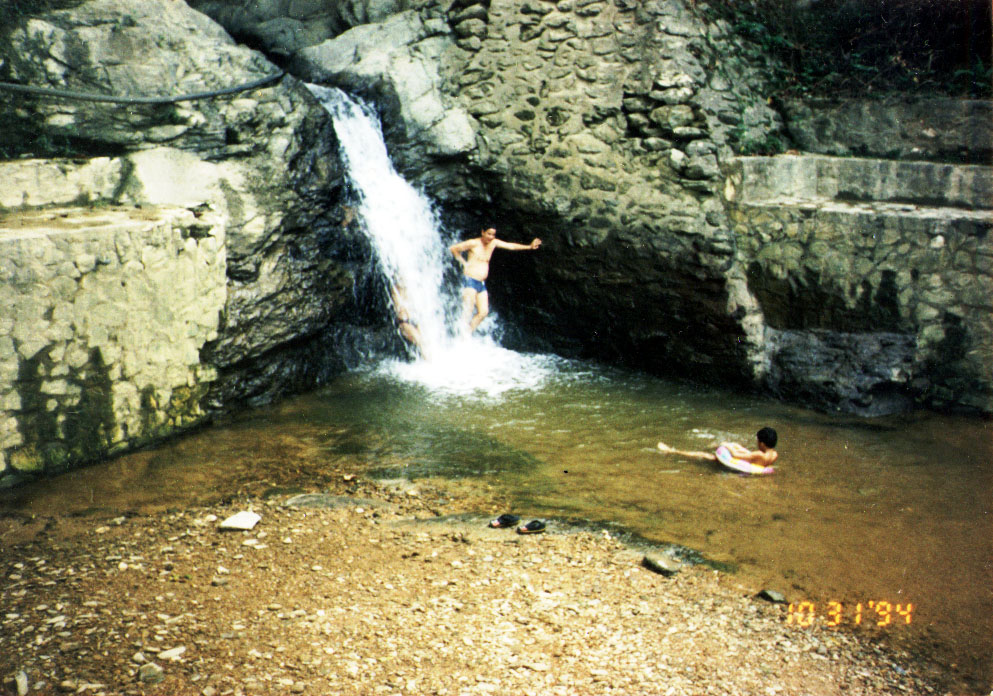
The 50-ft. high, postcard-perfect Buruwisan Fall is featured in many travel books for the rappelling thrills it offers. According to Joel, other visitors here even engage in the very dangerous, extreme sport of diving from the top of the cliff down to the falls’ deep pool. Luckily, no one has, as yet, died from it. On my part, I just engaged in the safer sport of just swimming in its bracingly cold waters while Jandy paddled along on a floating log. Our indispensable Joel who continually served us throughout our stay, later guided me to Lanzones Falls, downstream to the right from Buruwisan Falls. Although half the height of Buruwisan, it was just as spectacular and its shallow pool had surprisingly clearer waters than its predecessor.
 |
| Matandang Buruwisan Falls |
The waters of the two waterfalls meet to form the majestic but rarely visited Matandang Buruwisan Falls (Binaytuan Falls to others). Said to be 200 ft. high, its splendor is rarely seen by visitors as its base can be reached only after a very difficult hike. Joel was one of the lucky ones to have visited it. I could only view it from the falls’ top. After an early supper, we retired to our tents for a much needed rest after a hectic day. Sleep, however, was almost an impossibility as the ground beneath our tents was rocky. The rubber mat I brought along only provided some relief. I was also quite unused to roaring sound of the waterfall beside us.
 |
| Batya-Batya Falls |
We awoke early amidst a slight drizzle, had a hearty breakfast, dismantled our tents and packed our backpacks. Leaving our gear behind at the store of Joel’s grandmother, we then proceeded, with Joel leading the way, upstream to Batya-Batya Falls. Getting there was easier said than done as we had to hop among large boulders and twice wade through 5-ft. deep waters, carrying our belongings above our heads. After a 30 min. hike, we finally reached the falls. Equally beautiful as the others we visited, it was unique in its own way as its crystal-clear waters fell in tiers. There were small, deep basins (hence the name, batya which means “basin”) at every drop. We had the irresistible urge to climb it and all four of us did so. Joel stayed behind with our stuff. Climbing it was quite difficult but well worth the effort. Up the falls was another stream leading to Sampaloc Falls. It entailed a long hike though. Four out of seven waterfalls visited already make a good batting average, so we decide to forego a trek to this fifth fall. With great difficulty, we retraced our steps back down the falls.

We were back to the store by 10 AM. Here, we changed into dry clothes and started our hike back to my car. We made it back in a “record” time of 2 hrs., stopping only for rest at the two hilltop rest areas. After a short talk with Ms. Pontipedra and a late merienda of halo-halo, we left by 1 PM after paying the PhP100 parking fee. We arrived in Manila by 4 PM, stopping only for a late lunch in Antipolo City.




.jpg)