
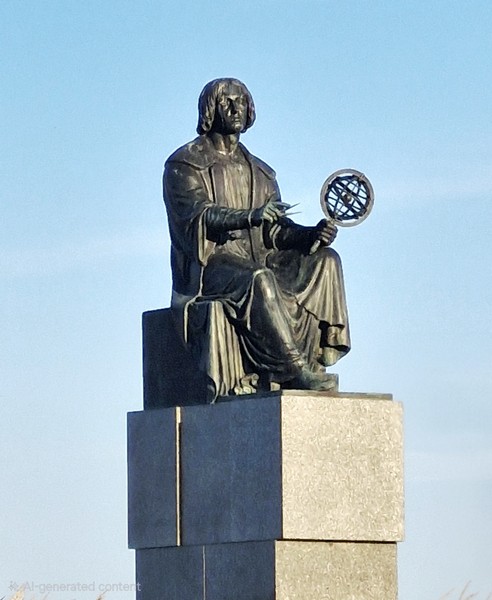
After our tour of Shedd Aquarium, we walked the short 1.3-km. (10-min.) distance, along Solidarity Drive, to Adler Planetarium, a municipal public museum for astronomy and the first planetarium in the United States. As we approached the planetarium, we were greeted by bronze statue of Polish astronomer Nicolaus Copernicus sitting on a pedestal and grazing towards Chicago’s skyline. A bronze replica of the famous 1830 original monument in Warsaw, Poland, created by sculptor Bertel Thorvaldsen, the Chicago bronze cast was executed by Bronislaw Koniuszy and dedicated and installed in 1973 by the Adler Planetarium to mark the 500th anniversary of Copernicus’s birth, with funding spearheaded by the Copernicus Foundation.
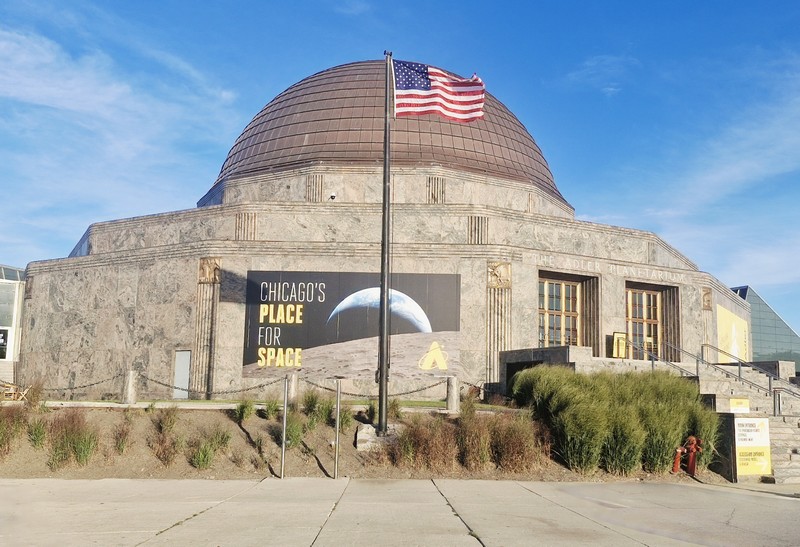
Located on the northeastern tip of Northerly Island (the first of five intended but, otherwise, never executed recreational islands that were to be consistent with Daniel Burnham‘s 1909 Plan of Chicago) on Lake Michigan, the planetarium is part of Chicago’s Museum Campus (which includes the Shedd Aquarium and the Field Museum of Natural History). Operated by the Chicago Park District, a municipal government agency of the City of Chicago, its mission is to inspire exploration and understanding of the universe.
Check out “Shedd Aquarium” and the “Field Museum of Natural History”
Here’s the historical timeline of the planetarium:
- In 1913, Oskar von Miller of the Deutsches Museum commissioned Carl Zeiss Works in Jena, Germany, to design a mechanism that projects an image of celestial bodies onto a dome.
- In 1923, Walther Bauersfeld, scientific director of the firm of Carl Zeiss Works designs an optical projection device that effectively creates the illusion of a night sky. With this innovation, the modern planetarium is born. By 1929, the popularity of the planetarium spreads, and there were fifteen planetariums in Germany, two in Italy, one in Russia, and one in Austria.
- In 1928, local businessman Max Adler (a former executive with Sears, Roebuck & Co. who had recently retired to focus on philanthropic endeavors, primarily on behalf of musical and Jewish communities) and his cousin architect Ernest A. Grunsfeld, Jr. traveled to Germany where Adler was so impressed by the modern Munich planetarium that he donates funds to construct the first planetarium in the Western Hemisphere. He offers $500,000 for the construction of the first planetarium in the Western Hemisphere and commissions Grunsfeld to design the Chicago structure.
- In 1930, at an auction in Amsterdam, Max Adler purchases the collection of antique astronomical instruments of A. W. Mensing. The Mensing Collection became the focus of the Astronomical Museum.
- On May 12, 1930. on Max Adler‘s birthday, the Adler Planetarium and Astronomical Museum is opened to the public. Phillip Fox, Ph.D., a professor of astronomy at Northwestern University, is appointed as the Planetarium’s first director.
- In 1931, Ernest A. Grunsfeld Jr. was awarded the gold medal of the Chicago chapter of the American Institute of Architects for the planetarium’s design.
- In 1931, the planetarium hosted the 44th meeting of the American Astronomical Society.
- In 1933, the Century of Progress Exposition takes place on what is now the Museum Campus.
- In 1941, Phillip Fox is deployed to the Army and, during his absence, Assistant Director Maude Bennot is appointed acting director of the Planetarium.
- In 1952, Max Adler dies.
- In 1967, the board of trustees is created to share in the responsibilities and management of the Adler Planetarium with the commissioners of the Chicago Park District. The Adler Planetarium refurbishes the building and replaces the original Zeiss projector with a new Mark VI Zeiss unit.
- On May 12, 1973, Adler Planetarium’s 43rd birthday, a new underground expansion is opened to the public.
- In 1976, the Board of Trustees assumes full management responsibility for the planetarium but continues to receive support from the Chicago Park District.
- In 1977, the Doane Observatory opens.
- On February 27, 1987, the Adler Planetarium was declared as a National Historic Landmark.
- In 1987, Doane Observatory’s original telescope, a 41-cm. (16-in.) Cassegrain reflecting telescope built by the Adler optical and machine shop staff, was retired and replaced with the current telescope.
- In 1991, the museum unveils the results of the $6.5 million renovation project and, after 23 years of leadership, Dr. Joseph M. Chamberlain retires.
- In 1999, the 60,000 sq. ft. Sky Pavilion, designed by Lohan Associates of Chicago and featuring four new exhibition galleries, including the historic Atwood Sphere and the Definiti (formerly StarRider) Theater, opens to the public.
- In 2005, retired NASA astronaut James A. Lovell Jr. serves as chairman of Adler Planetarium’s 75th-anniversary celebration.
- In 2007, the Adler Planetarium unveils its new Space Visualization Laboratory (SVL) was inaugurated in 2007 to virtually explore the Universe bringing the latest images of space science to the public.
- The Space Visualization Laboratory.
- In 2010, the Adler Planetarium begins transformation of the historic Sky Theater.
- In May 2011, the renamed Grainger Sky Theater, at the time, the most technologically advanced dome theater in the world, was opened. The Clark Family Welcome Gallery, designed by Thomas Roszak Architecture, uses an LED-lit fabric and aluminum structure that includes educational interactive material projected on the fabric walls.
- In 2012, after 21 years of service, Paul H. Knappenberger Jr. Ph.D., announces his retirement.
- In 2013, the Board of Trustees elects astrophysicist and academic leader Michelle B. Larson, Ph.D., as president and CEO, the Adler Planetarium’s ninth leader and the first female president.
- In 2013, “Adler After Dark,” the Adler Planetarium’s 21+ evening event, was voted “Best After Hours Event,” by the Chicago Reader, and “Best Date Night” by Chicago Parent.
- In 2013, the Adler Planetarium undertook the first major renovation of the Doane Observatory. Renovations included the addition of an indoor classroom, a restroom, accessible entry ramps, and telescope and technology upgrades.
- In 2015, the major upgrade of the Doane Observatory was completed.
- In 2025, the Adler Planetarium appoints Elizabeth Babcock as President and Chief Executive Officer.
The Adler Planetarium, a member institution of the Large Synoptic Survey Telescope project, has three theaters (two domed and one standard), space science exhibitions, including the Gemini 12 space capsule, a collection of antique scientific instruments and print materials. The Grainger Sky Theater, the largest of the Adler Planetarium’s theaters, has a dome that measures 21 m./830 in. (69 ft.) in diameter.
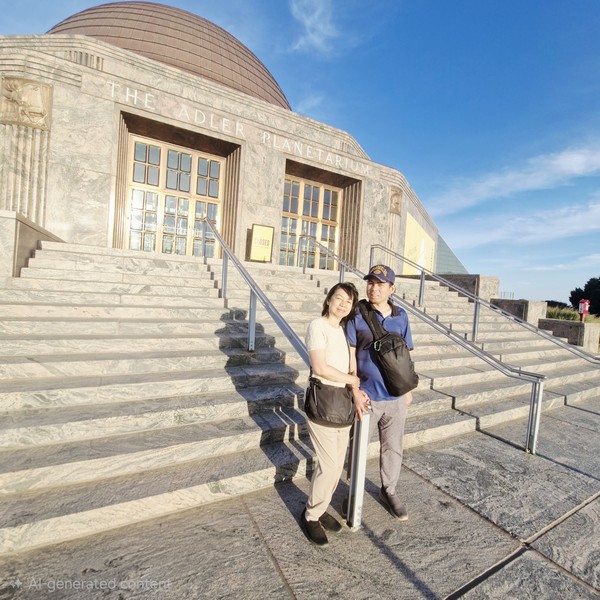
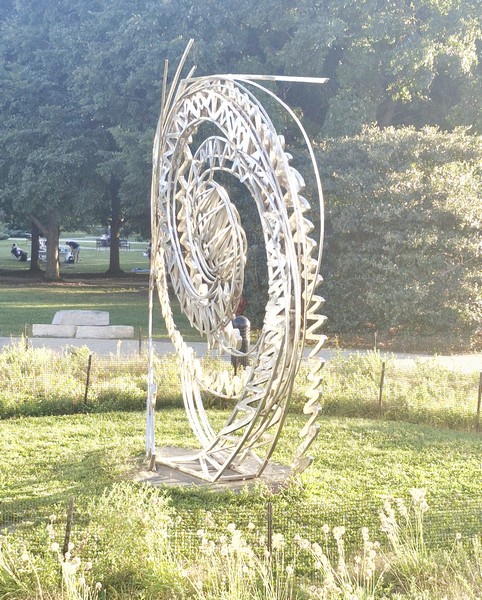
When we approached the planetarium is surrounded by sculptures including Man Enters the Cosmos (Henry Moore, 1980); Spiral Galaxy (John David Mooney, 1998); and America’s Courtyard (Ary Perez and Denise Milan).
Th Adler also hosts the Doane Observatory, a research-active public observatory with the largest aperture telescope available to the public in the Chicago area. With its 51-cm. (20-in.) diameter mirror, the Doane Observatory can gather over 5,000 times more light than an unaided human eye, allowing guests to see celestial objects like the Moon, planets, stars, and galaxies that are trillions of kilometers, if not many light years, away.
The Astronomy Department of Adler Planetarium and the Webster Institute for the History of Astronomy conduct and publish research for both the scientific community as well as the general public. The planetarium’s astronomers possess expertise in many areas of astronomy as well as other closely related science fields and their studies include planetary geology, star formation, gamma-rays, and telescope observing.
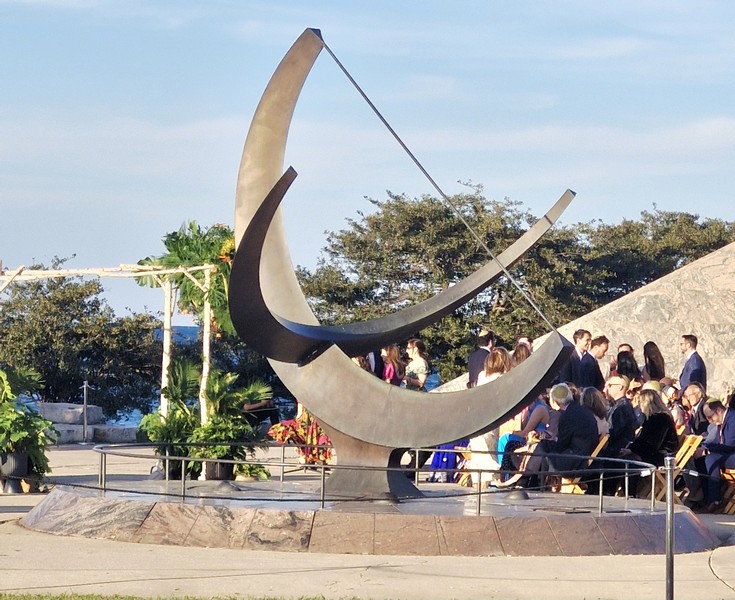
The Collections Department cares for, studies, and interprets the planetarium collections which, since the Adler’s opening, has grown to approximately 8,000 objects, books, works on paper, archival collections, paintings, and photographs. The Adler hosts archives from Derek J. de Solla Price, Michael J. Crowe, and NASA astronaut Jim Lovell, as well as the largest collection of historic scientific instruments in the Western Hemisphere.
The Adler Citizen Science Department is also the U.S. headquarters of The Zooniverse, a citizen science platform and a global collaboration across several institutions that designs and builds citizen science projects and, as of early 2014, has engaged more than 1.1 million online volunteers as active scientists by discovering planets, mapping the surface of Mars, and detecting solar flares.
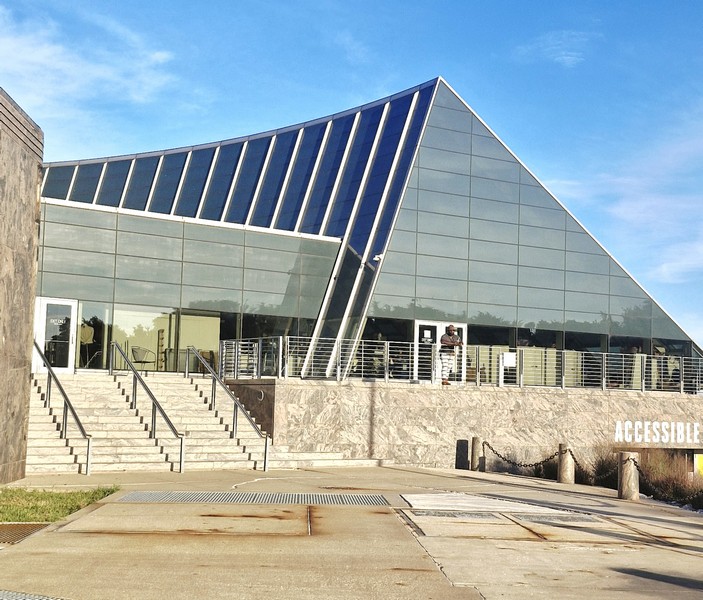
Guests at “Adler After Dark,” the Adler Planetarium’s 21+ evening event, have open museum access, themed programs, sky shows and views of the Chicago skyline. “Astro Overnights” gives families a chance to spend a night under the stars at the Adler. Guests have open museum access, a sky show and educational programming.
The Adler also hosts quarterly “Hack Days” (intended to encourage software developers, designers, scientists, engineers, artists and people who just like to create and build, to work together to solve problems); and summer camps (where participants build rockets, launch high-altitude balloons, and explore the edge of space). The Adler’s hands-on summer camps are designed for children ages 5–14.
Adler Planetarium: 1300 S DuSable Lake Shore Dr., Chicago, Illinois 60605. Tel: +1 312-922-7827. Website: www.adlerplanetarium.org. Open Thursdays through Tuesdays, 9 AM to 4 PM, and Wednesdays, 4 PM to 10 PM (extended evening hours). Admission: $25.00 (adults, ages 12+) and $13.00 (children, ages 3-11). Free admission for Illinois residents. Online advance ticket purchases are required on the Adler Planetarium Tickets page. Coordinates: 41°51′59″N 87°36′24″W.