![]() |
| CAP Building |
![]() |
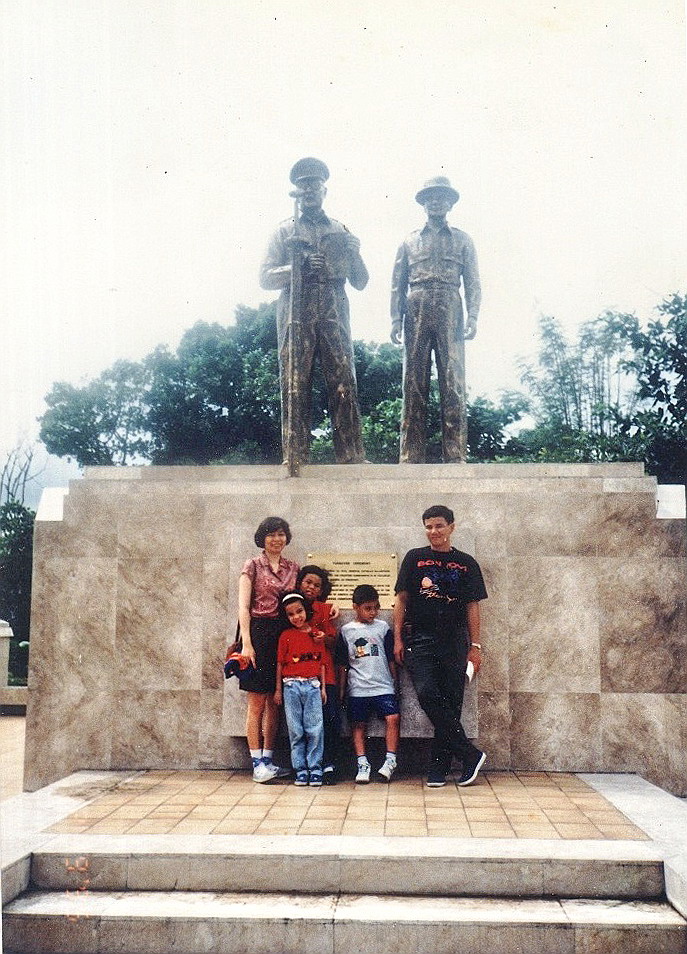
| Statue of MacArthur and Osmena |
![]() |
| CAP Building |
![]() |
| Statue of MacArthur and Osmena |
After breakfast at the Filamor Residence, Grace, Jandy, Cheska and I, together with Manny, Paula, Mark, Nenette, Daddy, Mommy and Cheska’s new friend Kookie Bal left for our tour of Tacloban City. We secured the services of a guide and a van at the Department of Tourism Region 8 office. Our first destination was to be the San Juanico Bridge, the longest bridge in the country as well as Southeast Asia. At the foot of the San Juanico Bridge is the 15-hectare, Japanese-funded multi-million peso National Maritime Polytechnic, a merchant marine training school and the most modern graduate institution for seamen in Asia.
![]() |
| Posing along the San Juanico Bridge |
![]() |
| San Juanico Strait |
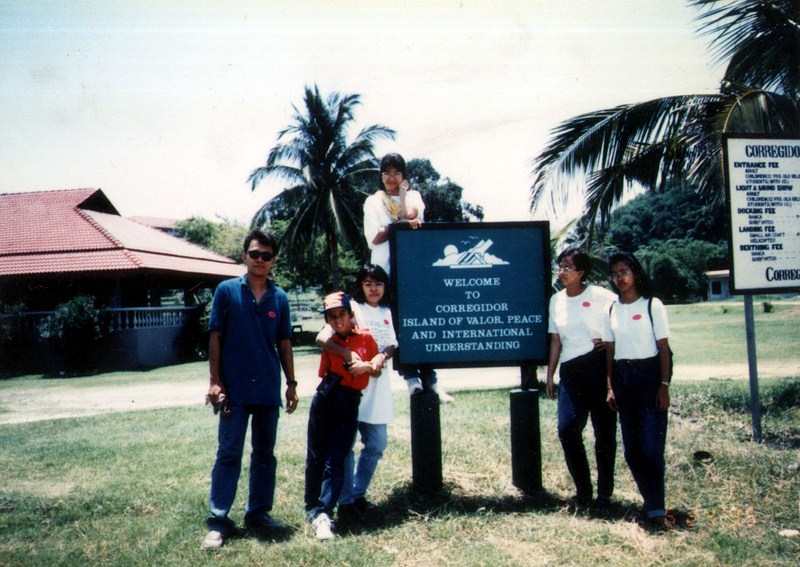
The first time I visited the island fortress of Corregidor was way back in 1975 (via a Philippine Navy LST) when we had our Don Bosco High School CAT (Citizen’s Army Training) bivouac. Back then this bastion of democracy was just as it was – in ruins, and Malinta Tunnel was just a haunt for the ghosts of World War II past. And to add insult to injury, scavengers even made a killing cutting up some of the pre-World War II guns for scrap iron. Surely, its defenders would have turned in their graves.
Things have changed since then. In 1987, the private, non-stock Corregidor Foundation, Inc. was created by the Department of Tourism with the Philippine Tourism Authority as its implementing arm. The island was reforested and its infrastructure was developed and upgraded. Now, more than 50,000 people visit the island each year.
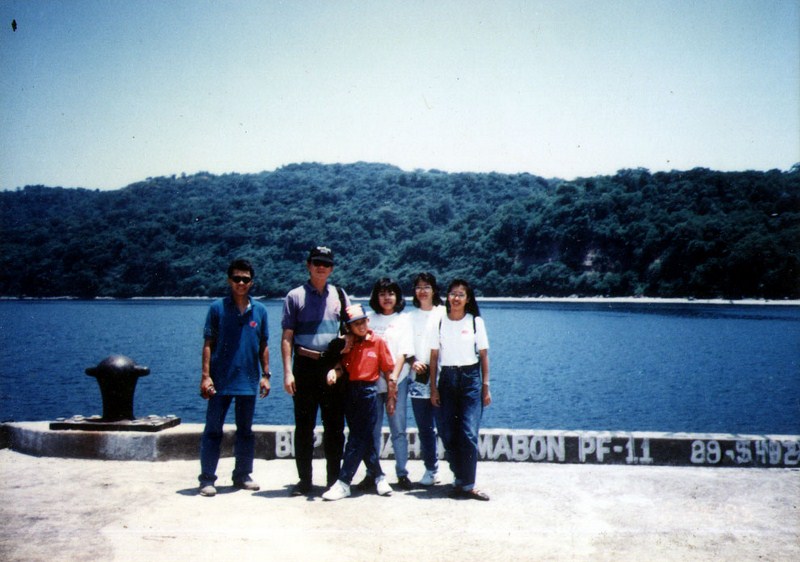
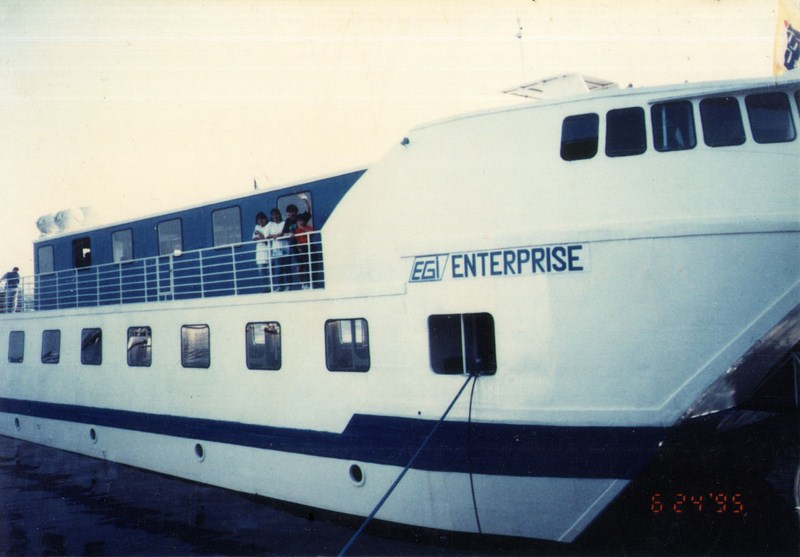
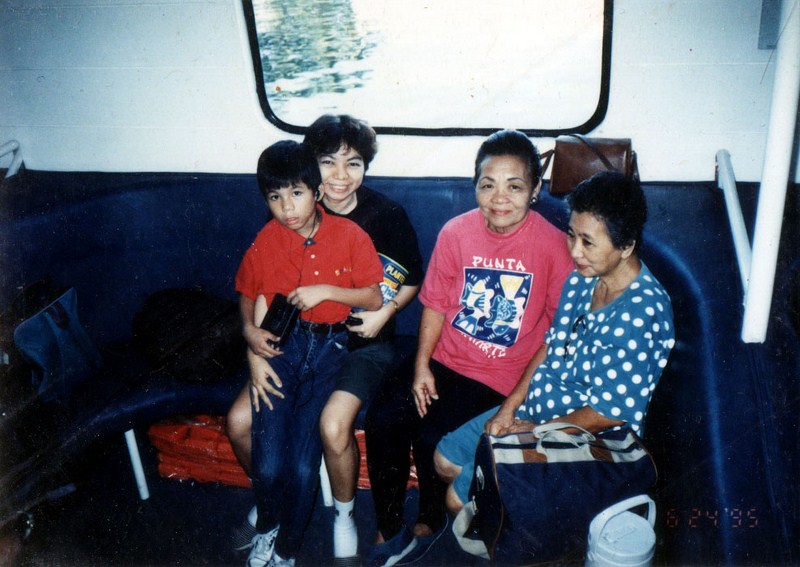
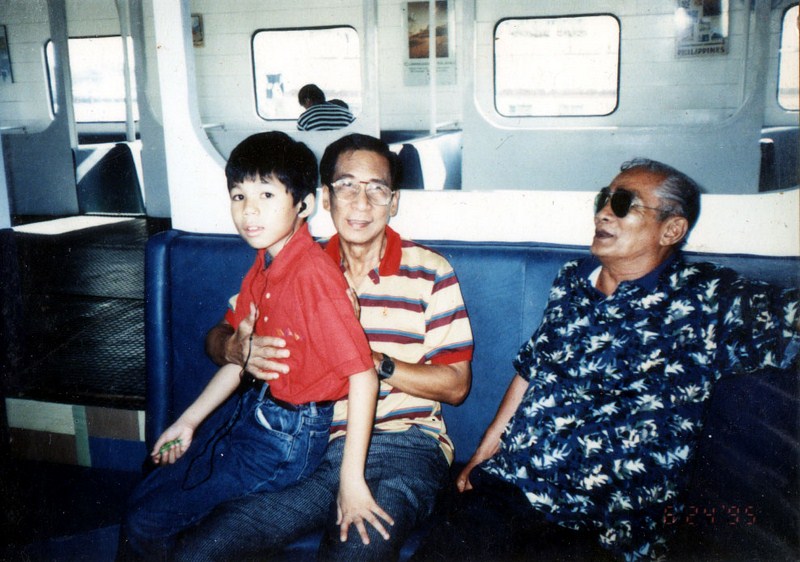
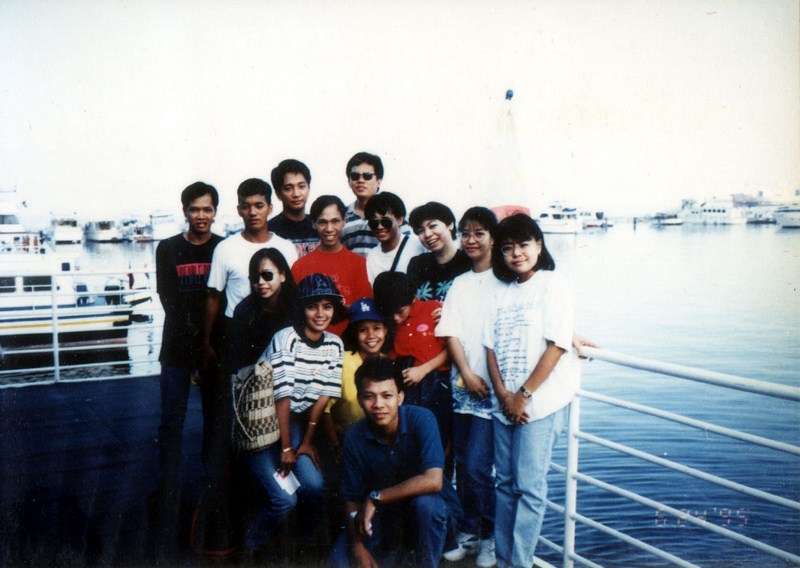
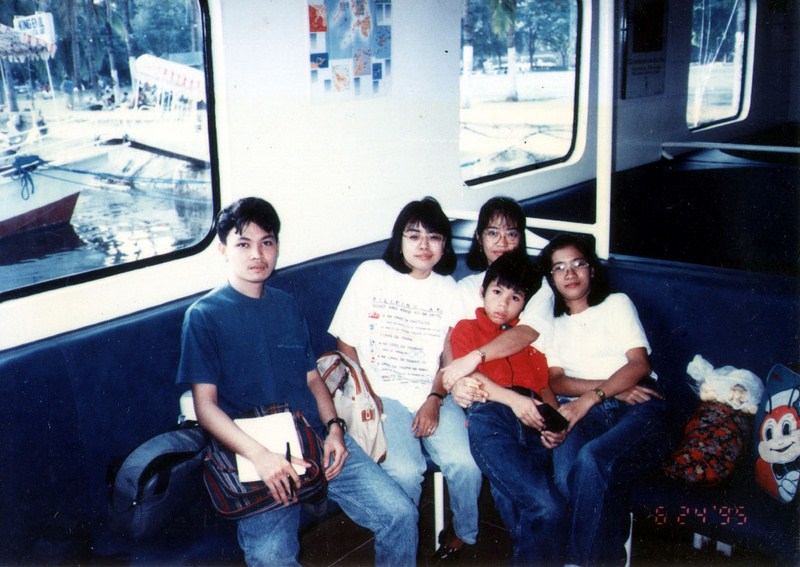
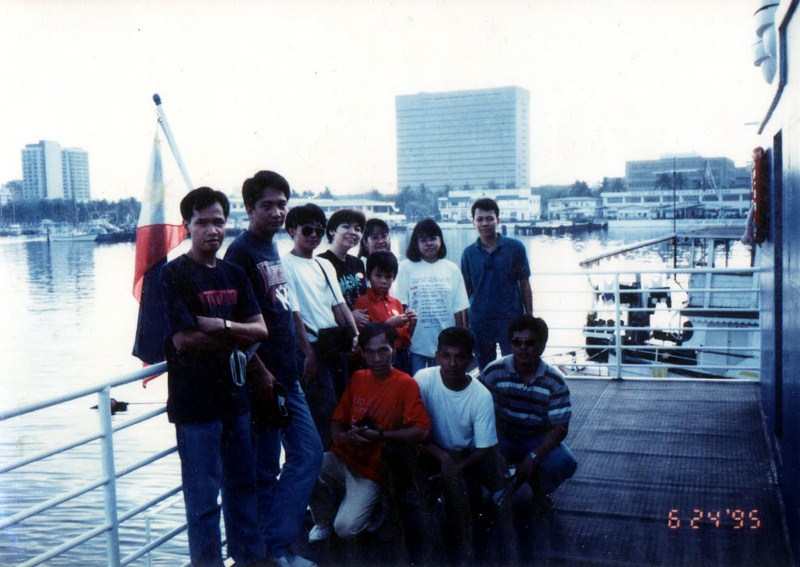
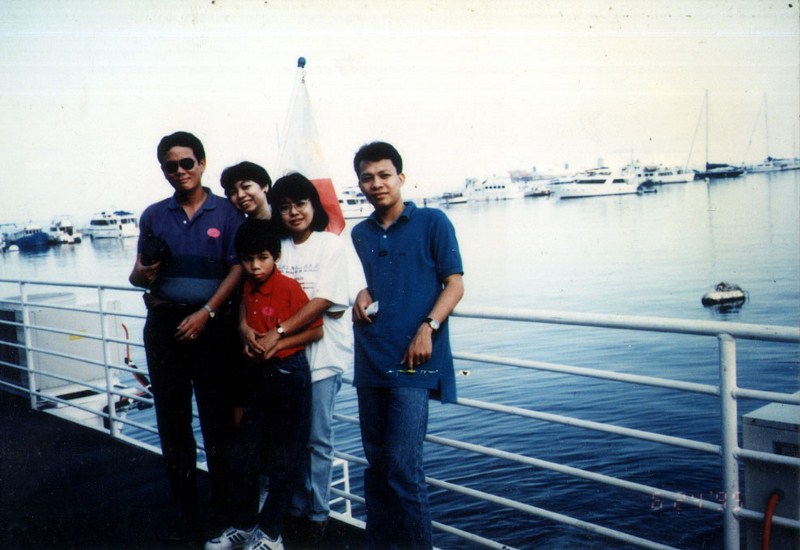
Twenty years since I last visited the island, I again made a pilgrimage to this former bastion of military supremacy in the Pacific. My wife Grace and my 8 year old Jandy joined me and we left early in the morning aboard the MV EGI Enterprise, owned and operated by E. Ganzon Inc. (E.G.I.), the outfit where wife worked.
Joining us were sisters Helen and Cherry Pie Ganzon and E.G.I. officers Mely Macapagal (a distant relative of now President Gloria Macapagal Arroyo) and Raquel Purificacion. Other employees of E. Ganzon, Inc. also joined us. By coincidence, Grace’s Tito Greg and Tita Rory Bilog were also on the trip.
We departed the PTA Bay Cruise Terminal at the CCP Complex by 8 A.M.. The trip took all of three and a half hours and lunch was served before we disembarked.
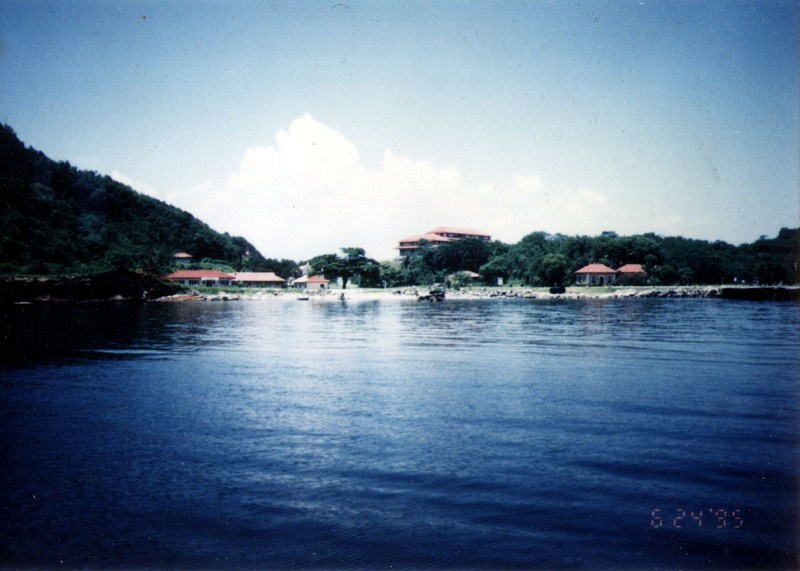
This tadpole-shaped, 9 sq.km. Corregidor Island lies at the entrance to Manila Bay and is dominated by huge limestone formations. It is 5.6 kms. long, 2.4 kms. at its widest point and is 6 kms. off the tip of the Bataan peninsula, 16 kms. from Cavite to the south and 45 kms. across the bay from Manila.
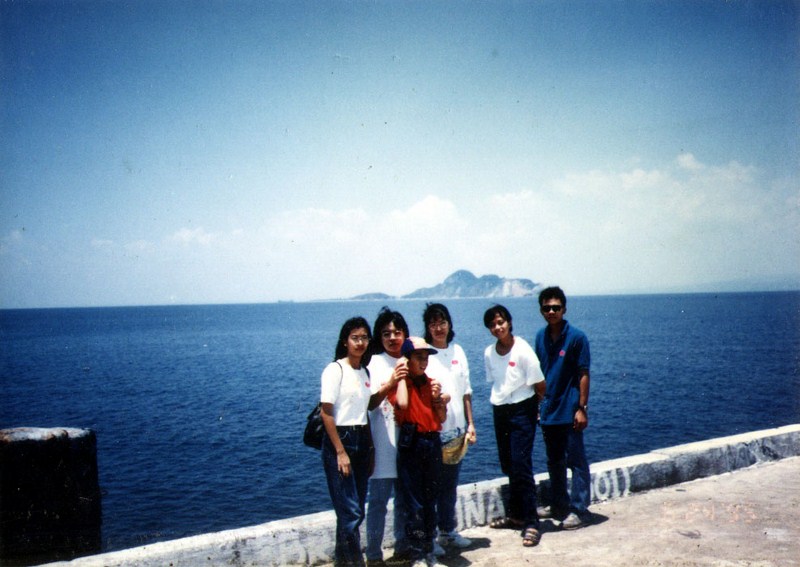
Its head rises 200 m. from the sea, flattens into two plateaus called Topside and Middleside and below them is Bottomside (its lowest point, at 50 ft. above sea level) and Malinta Hill. The distance from Topside to Bottomside is about 3 kms.. The summit affords fine views of the Bataan peninsula and the surrounding sea while the tail end has narrow sandy beaches with clear waters.
The island’s name was either derived from the Spanish name for “corrector” (one who checks and corrects papers of incoming ships) or from the Spanish word corregidor (the man who heads the corregimiento or unpacified military zone). It is currently administered from Cavite Ciy (Cavite). The island is, however, nearer geographically and historically to Mariveles (Bataan) and is currently being contested by the two provinces.
Originally called Maribela, it was the haunt of Chinese and Moro pirates and was a signal station where bonfires were lit to apprise Manila of an incoming galleon. The Dutch captured the island in 1647 and used it as a base for raids on the Bataan coast. The Spanish subsequently built a dockyard, naval hospital, lighthouse and gun emplacements.
The Americans, seeing its strategic value, renamed it Fort Mills and strengthened its fortifications, boring Malinta Tunnel and installing 56 coastal guns in 23 seacoast batteries and mortars and 76 anti-aircraft guns in 13 batteries. The artillery models date back to 1890.
Nicknamed “The Rock” and now a National Shrine, it acquired immense significance as a symbol of determined resistance to Japanese invaders by its embattled Filipino and American defenders during World War II. It was also the seat of the Commonwealth government of Pres. Manuel L. Quezon after the fall of Manila, and the headquarters of Gen. Douglas MacArthur and U.S. High Commissioner Francis B. Sayre.
The island was first bombed by the Japanese on December 29, 1941. After Bataan’s fall on April 9, MacArthur withdrew part of his Fil-American forces to Corregidor and its sister islands, Caballo, Carabao and El Fraile. It was intensively bombarded by Japanese planes and 110 guns, ranging from 75 mm. to 240 mm.. The guns of Corregidor and the other islands countered as best as they could until all its guns were knocked out.
On May 5, the Japanese launched a two-battalion invasion on the beaches, two-thirds were destroyed by the gallant defenders, but the remainder made a successful beachhead. The 13,000 sick and hungry defenders retreated to the Malinta Tunnel system, held out for a day, and surrendered on May 6, 1942.
During the liberation, Corregidor was captured by a combined air (503rd Parachute Regiment led by Col. George M. Jones) and sea assault from February 16-March 1 which cost 210 American lives. Fewer than 50 of the 5,200 Japanese defenders survived.
In 1968, Corregidor again hugged the headlines when over 60 Tausug and Sama youths, recruited for a top secret training program known as “Project Merdeka” (objective: attack disputed Sabah or Borneo), staged a mutiny on the island. They were all killed by their training officers in what became known as the infamous “Jabidah Massacre.” This event was said to have triggered the birth of the Moro National Liberation Front and the rise of its chairman, Nur Misuari.
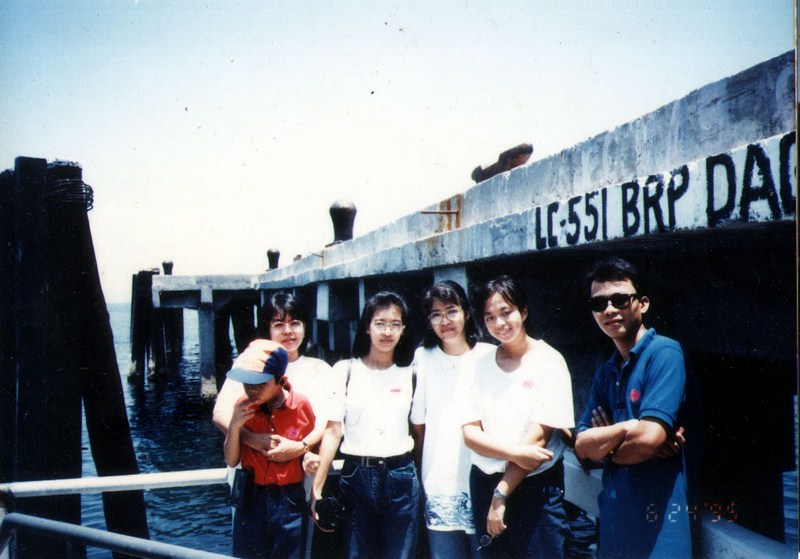
Upon arrival at the island’s North Dock, a jeepney was waiting to tour our group around the island. Our first stop, past the Corregidor Hotel and Resort, was South Dock at Bottomside where the gallant allied garrison surrendered.
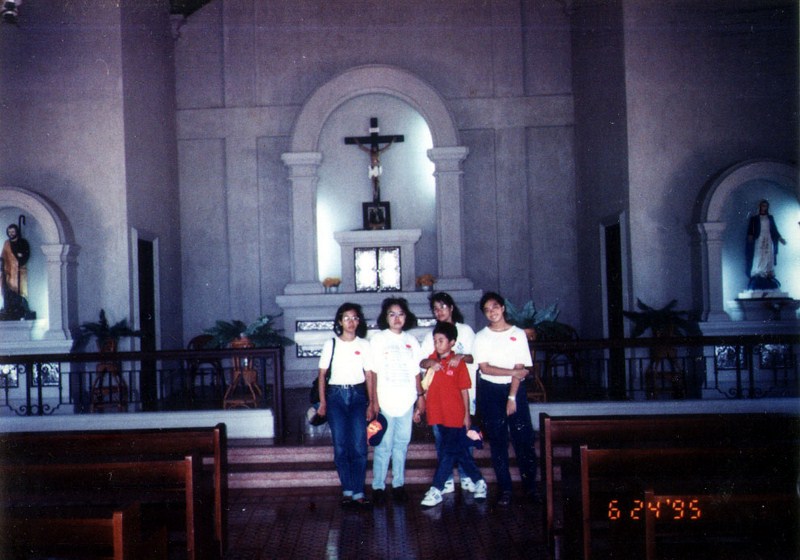
Walking around, we visited Lorcha Dock and San Jose Church. Lorcha Dock is where Douglas MacArthur departed via PT boat for Australia. It contains a life-size bronze statue of the general and a plaque with the immortal MacArthur words “I Shall Return”. San Jose Church, at Barrio San Jose, is a reconstruction of the island’s original church.
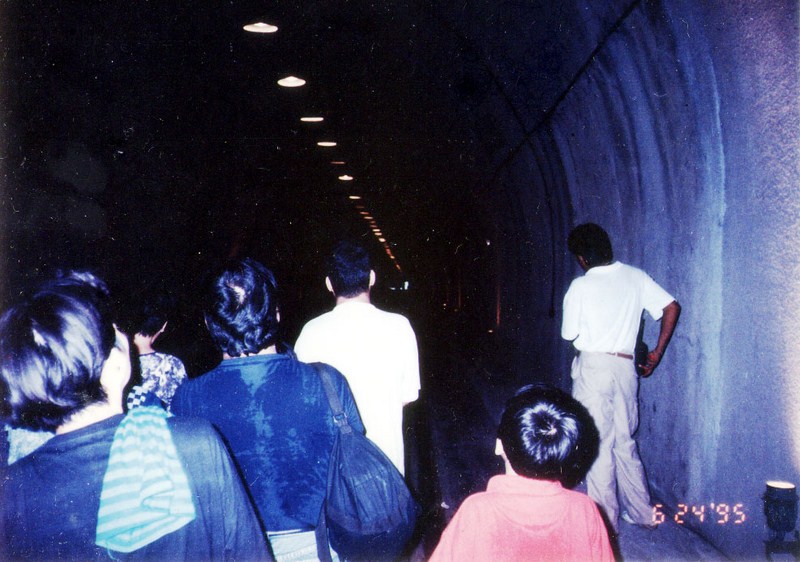
We then booked ourselves (P100 for adults and P50 for children) for the 2 P.M., 30-minute Light and Sound Show at Malinta Tunnel. Vividly staged for visitors, it was scripted by the late National Artist Lamberto V. Avellana and it reenacts dramatic events during World War II like the Japanese invasion, the surrender and the liberation of Corregidor.
Malinta Tunnel, since renamed Wainwright Tunnel, is actually an 836-foot long, fishbone-shaped system of bombproof tunnels with three 227 meter by eight meter main sections and 24 49 m. by 4.5 m. laterals. Besides being the headquarters, it also housed a 1,000-bed hospital, a U.S. Navy command unit and storage areas. It was bored out of Malinta Hill with Old Bilibid Prison inmates between 1922 and 1932. MacArthur stayed here from December 29, 1941 to March 12, 1942 and occupied the third lateral (north side) from the entrance.
After the show and tour of the tunnel, we visited the Aviary which housed foreign and local varieties of birds like the Philippine horned owl, Australian cockatiels, scarlet macaus and peacocks.
Back to our jeepney, we then proceeded to Battery Way and Hearns at Topside. Topside, the heart of Fort Mills, contained all the major caliber seacoast guns around it which commanded the north and south entrances to Manila Bay. It also contained the pre-war Army headquarters (Harbor Defense and Senior Officers Quarters), American High School, parade ground, golf course, theater (Cine Corregidor), old Spanish lighthouse, the “Mile Long” barracks, the Pacific War Memorial and the famous flagpole.
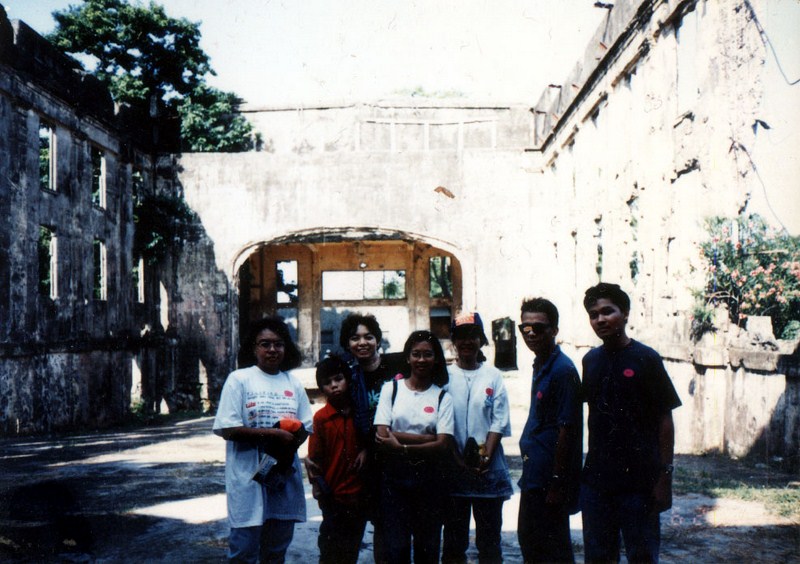
En route to Battery Way, we passed by the ruins of two three-storey buildings of Middleside which housed the 60th Coast Artillery Regiment and the 91st Philippine Scout Coast Artillery Regiment and the post hospital. It was briefly occupied by the 4th Marine Regiment upon its arrival in Corregidor in December 1941.
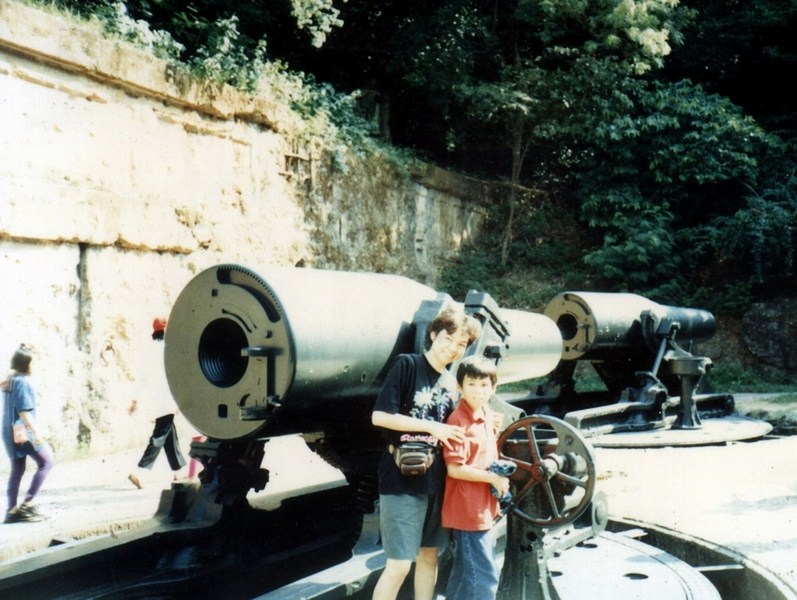
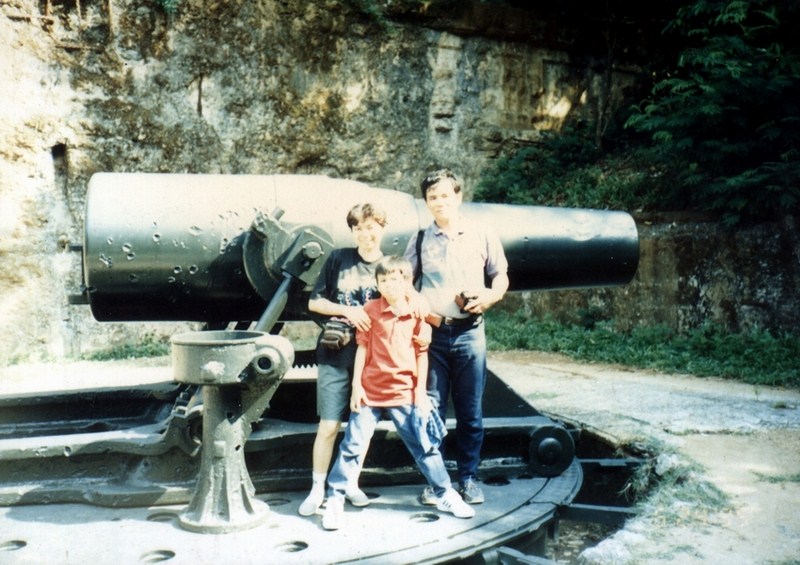
Battery Way, completed in 1913, was armed with four 12-inch mortars capable of firing in any direction with a maximum range of 14,610 yards at the rate of one round per minute per mortar. Three of the serviceable mortars opened fire on April 28, 1942 and on May 2, two of these were hit. After more than 12 hours of continuous firing, the remaining mortar finally froze tight on May 6, the last to cease firing before the surrender.
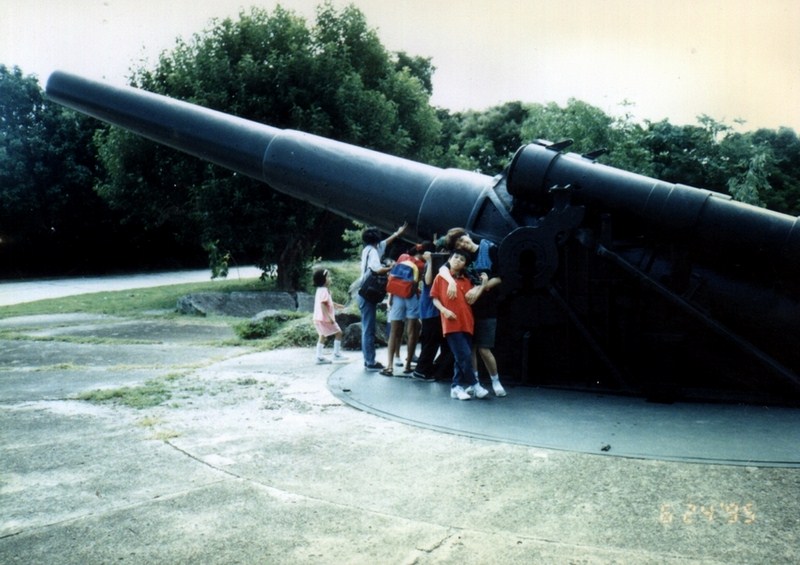
Battery Hearns, a 12-inch seacoast gun with a maximum range of 29,500 yards, was capable of firing in all directions. It was one of the last major additions to the island’s defense system and had been in action firing towards Cavite (from February 1942) and towards Bataan (April 8 and 9). It was captured nearly intact by the Japanese, repaired but completely neutralized by American aerial bombardment from January-February 1945.
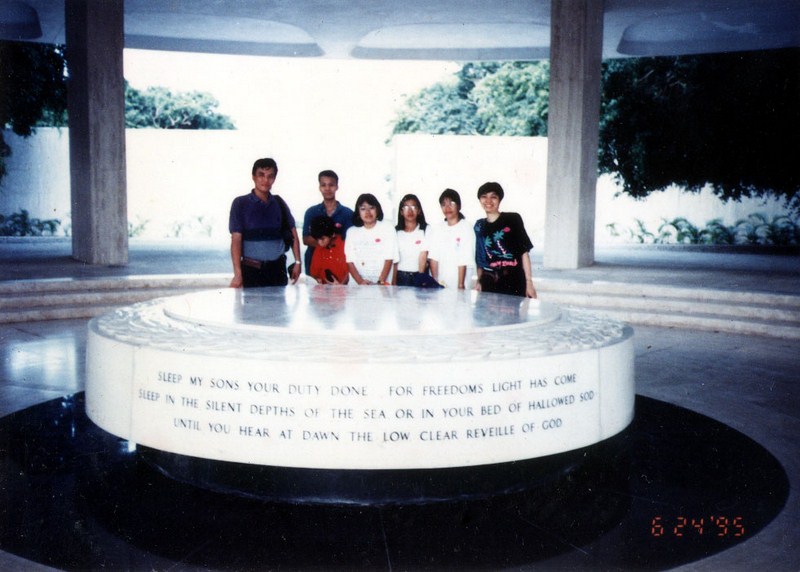
After our visit to these batteries, we then proceeded to the Pacific War Memorial. Standing on the highest part of Corregidor on the island’s west, it was built by the U.S. government and completed in 1948 at the cost of US$ 1,230,000.
Check out “Pacific War Memorial Museum“
It is dedicated to the Filipino and American soldiers who shed their blood on Corregidor. The memorial’s dome has an opening at the top through which sunlight shines through to exactly fill a circular altar on the week of May 6, the Fall of Corregidor.
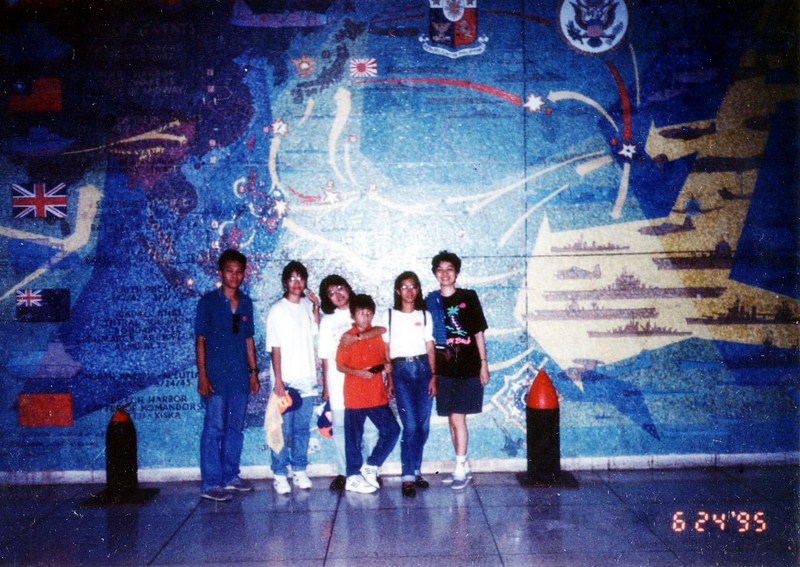
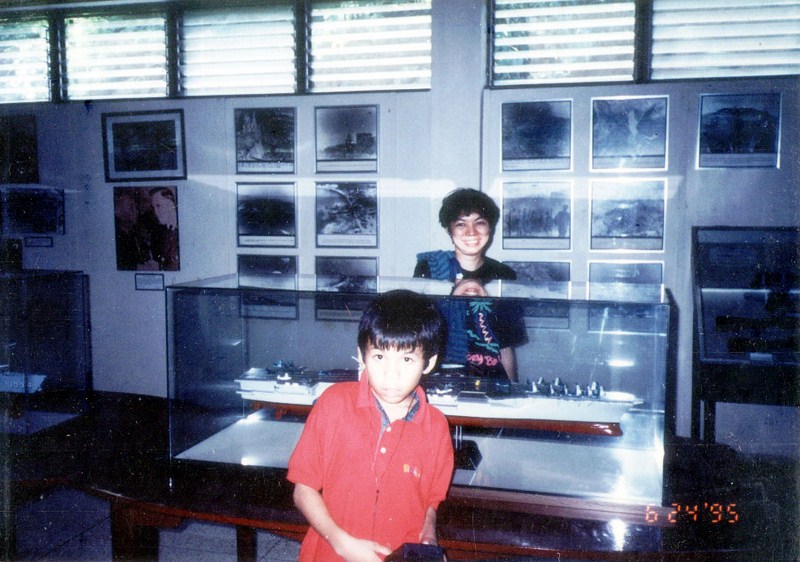
Left of the acacia tree-shaded entrance is the Cine Corregidor Ruins and behind it is a small, modest marble museum containing war relics, photos, a documentary film projection room, souvenir shop and descriptive information.
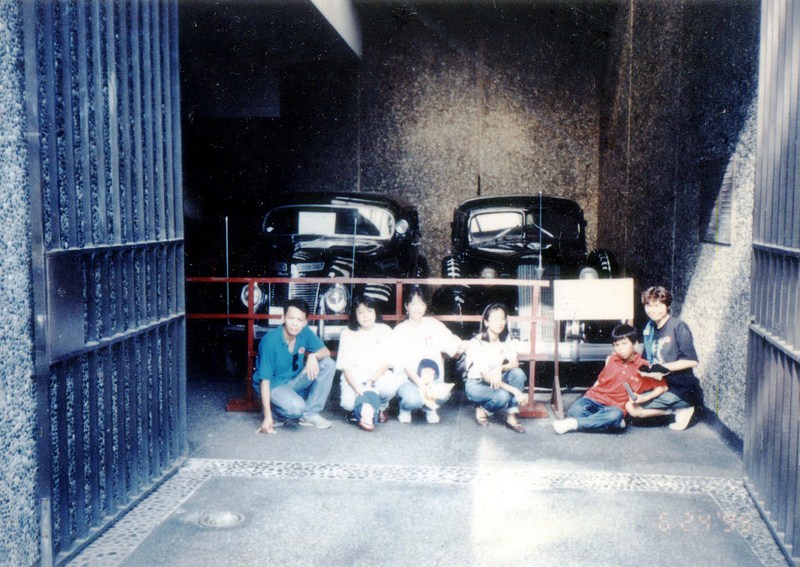
A familiar display is the bullet-riddled car used by former First Lady Dona Aurora A. Quezon when she was ambushed by Huks on April 28, 1949 together with daughter Ma. Aurora and son-in-law Felipe Buencamino III. It was formerly housed in Fort Santiago in Manila.
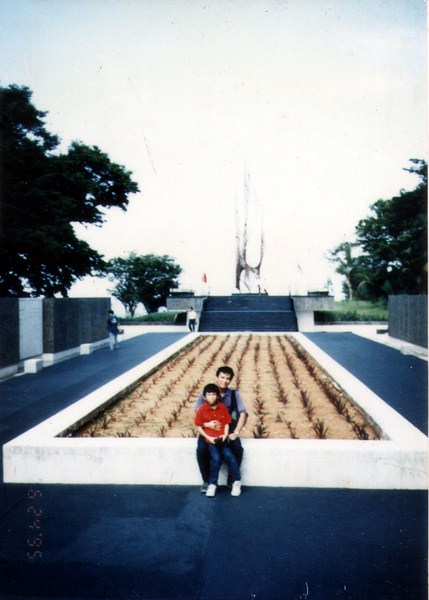
To the right of the museum is the remains of the Bachelor Officers’ Quarters and the Post Headquarters. Within the complex is the steel wing-shaped sculpture Eternal Flame designed by Greek-American sculptor Archimedes Demetrius.
The flagpole, originally a mast of a Spanish warship, was salvaged by Adm. George Dewey after the Battle of Manila Bay, and had it planted in Corregidor. It is where the American flag was lowered during the surrender and raised again during the liberation. The American flag was lowered for the last time on October 12, 1947 and the Philippine flag was hoisted in its stead.
The 880-m. long, three-storey high and hurricane-proof “Mile Long” Barracks is reputedly the world’s longest military barracks. It housed 8,000 men and the headquarters of Gen. Douglas MacArthur. Our visit to the memorial concluded our island tour. It was getting late and we had return to our ship for another three-and-a-half hour trip back to Manila.
There are many other sites that could be visited besides those mentioned here. They include the Japanese Garden of Peace Park, the 6,000-square meter Filipino Heroes Memorial, the Buddhist Shrine, the Spanish Lighthouse for a breathtaking view of Manila Bay and the South China Sea, the 2,000-sq. m., fully landscaped Filipino-America Friendship Park and many other sites.
Check out “Japanese Garden of Peace Park” and “Filipino Heroes Memorial“
The island also brims with numerous other possibilities. For those with a sense of adventure, the island’s beaches, wide open spaces and thick vegetation lend themselves to a number of outdoor activities, like hiking along mountain trails, kayaking, biking, swimming and the game of Gotcha! (a paintball game). You have to bring your own bikes and kayaks.
Early in the morning of the next day, Easter Sunday, we departed Guimaras for Iloilo City, bringing along a memento of our Guimaras visit – a kaing (bamboo basket) of delectable Guimaras mangoes. We were dropped off at Plaza Libertad where we heard mass at the Church of St. Joseph.
![]() |
| Dining on La Paz batchoy |
![]() |
| Jandy and Cheska |
The original SM Iloilo (opened on May 1979), located at the cor. of Delgado and Valeria St., was demolished on February 2, 2004 and a new building was build in the vicinity (inaugurated on December 8 that same year). In 2007, an annex building was built to complete the shopping center’s redevelopment.
| Daliran Cave and Spring |
Our next stopover (3:30 PM) was at the Villa Fe Summer Resort, in Brgy. Old Poblacion, Buenavista, a 5-min. hike from the wharf. Frank and his family, together with a local guide, decided to go spelunking and explore the resort’s Daliran Cave, the most accessible cave in Guimaras, and its cold fresh water spring and stalactites. The rest, including me and my family, just waited outside. Inside, they got down and dirty with guano (bat droppings) as they communed with its denizens of the dark. Yuck!
![]() |
| Posing outside Roca Encantada |
Our final sightseeing stop (5 PM) was Roca Encantada (Enchanted Rock), the summer vacation home of the Lopez family, one of the oldest grand clans of Iloilo and Guimaras. Emily Relucio Lopez was Guimaras’ first governor. We were allowed entry by the caretaker.
| The grand balcony of Roca Encantada |
The mansion, accessed by a long flight of stairs, was built in 1910 by Presentacion Hofilena-Lopez on a promontory on one of 7 picturesque rock islets of the Siete Pecados (Seven Sins) Islands, in Brgy. Getulio. From its grand, spacious and airy balcony, we got a panoramic view of the beachfront, the Iloilo Strait and the 6 remaining islands. A lighthouse is situated on the largest islet.
![]() |
| Presenting the Siete Pecados |
| Trappist Monastery chapel |
After lunch at the resort, we all availed of an afternoon sightseeing tour by jeepney. Our first stop (2 PM) was the Trappist Abbey. It was founded in 1972 and is the first and only one of its kind in the country and in the Orient. The Trappist (or Cisterians of the Most Strict Observance) monks, who called Guimaras the “Island of a Happy Man,” follow the rules of St. Benedict and all adhere to a vow of silence. They take care of the Aeta community through the Contemplative Outreach Program, grow Philippine lemon (kalamansi) and pioneer fruit processing in the province.
![]() |
| The Gift Shop |
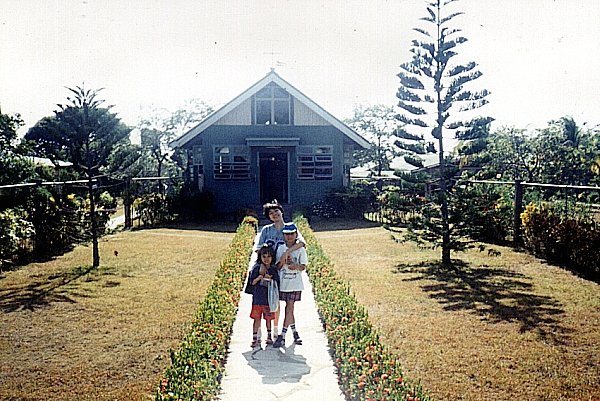
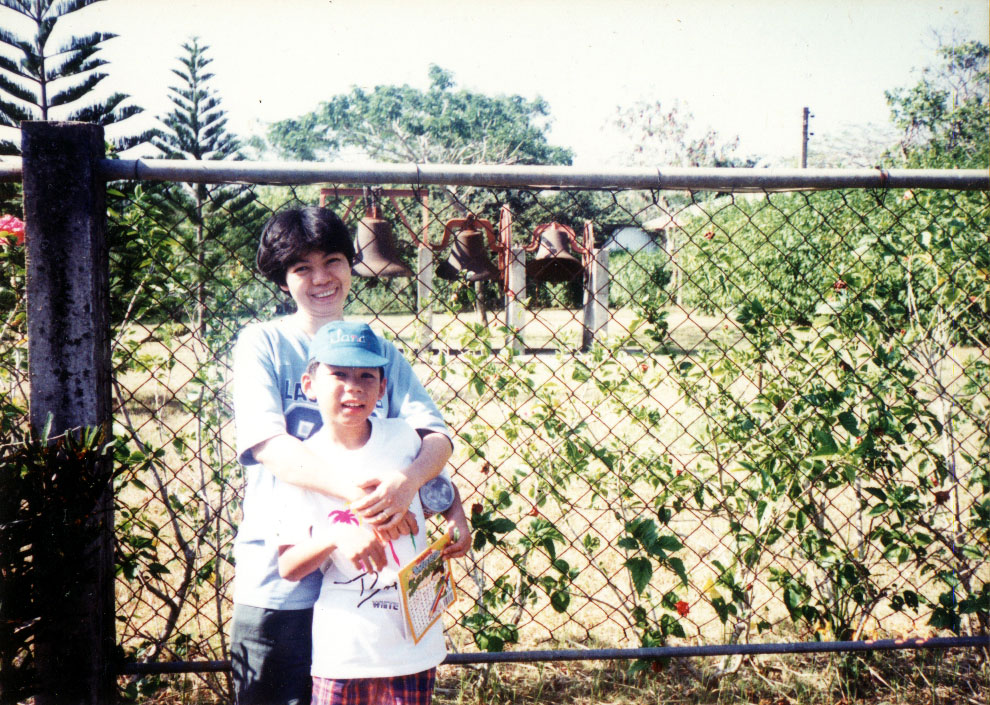
We dropped by the monastery’s Gift Shop where religious items (crucifixes, prayer books, rosaries, etc.) and excellent processed food products such as jam, chutney, prunes, wines, marmalade, candies, ginger tea, cookies, piyaya and jelly (all made from mango, cashew, kamias, duhat, kalamansi and guava) are sold. Grace bought a small crucifix. We also bought some snacks and soft drinks. Grace, Jandy, Cheska and I also visited its small but quaint chapel. At the side of the walkway leading to the chapel are an array of 3 small bells.
![]() |
| An array of small bells |
Trappist Abbey: Brgy. San Miguel, Jordan, Guimaras. Fax: (033) 581-3468.
![]() |
| Learning the basics …. |
Come morning, Frank, Jaja and I took our first lessons in windsurfing from the resort’s lady instructor. It was a breezy morning but learning to windsurf wasn’t a breeze at all. In winds stronger than about 8 knots and also depending on the size of sail used, the rig is actually pulled to windward over the sailor. The force of the wind pushed the rig upwards towards a vertical position, increasing the sail area presented to the wind which, in turn, increased the wind force on the sail.
![]() |
| Trying my hand at windsurfing |
![]() |
| Island hopping tour |
Today, milkfish cultured in marine cages provides livelihood to 4 Nueva Valencia barangays (Igang, Magamay, San antonio and Sto. Domingo) affected by the major oil spill in 2006. They were given operational capital for the construction of fish cages. Income from the production runs was given to 5 organizations now operating cages on their own, with the assistance of SEAFDEC who taught villagers integrated culture and alternate day feeding to improve production.
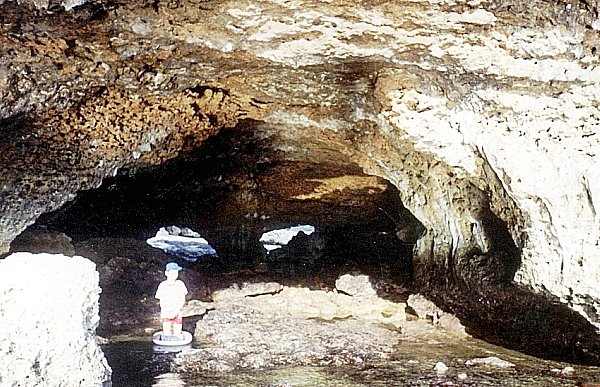
After lunch at the resort’s clubhouse, Jandy and I made a 20-min. hike, along well-marked concrete and dirt trails, past fishponds and Villa Igang, to sea-sculpted Igang Cave in Igang Bay. From a small opening, we waded its cool, crystal-clear and waist-deep waters, and emerged inside a large chamber with a rock platform with a great view of some islets and the western sky, where the sun sets. Taking a photo of the magnificent sunset and these islets, silhouetted by the cave’s opening, would have been a great shot. Too bad, I couldn’t wait for it.
![]() |
| Sacred Heart Hill |
Also that day, the town was presenting the Ang Pagtaltal (meaning “to remove”), the Visayan version of the Oberammergau (South Bavaria, Germany) passion play whose final act is the scene where Jesus is taken off the cross and laid on his Mother’s lap. Too bad we didn’t watch it.
| Puerto del Mar Resort |
Holy Week of 1995 was Layug family reunion time we all opted to spend a 4-day vacation to a place we have never been to or rarely heard of – the 604.65 sq. km., island province of Guimaras. Me, Grace and our kids, 9-year old Jandy and 4-year old Cheska, as well as my mom Carol, our eldest Frank, together with wife Cherry, daughters Jaja and Sandy and son Franco, and our youngest sister Tellie were joining. However, my older sister Salve wasn’t able to join us. We left Manila on April 13, Holy Thursday, on the 4:30 AM PAL flight from Manila to Iloilo City arriving at the Mandurriao airport by 6:30 AM. At the airport, we were picked up by a shuttle which brought us to the city’s Muelle Loney Wharf near the Post Office.
![]() |
| On our way to Guimaras Island |
Directly offshore from Muelle Loney, separated by the 1.5-nautical mile wide Iloilo Strait, is Guimaras Island. Here we boarded a big outrigger boat which brought us to our destination – the Class “A” Puerto del Mar Resort, along Alubijod Bay in Brgy. Sta. Ana, Nueva Valencia, arriving at the resort by 8:30 AM. Breakfast was already being served at its restaurant and we had our first taste of the island’s famous mangoes (8,000 hectares or about 20% of the province is mango orchards).
![]() |
| Dinner at the resort’s restaurant |
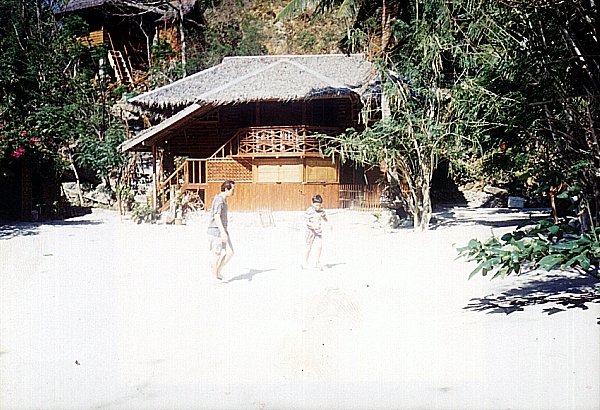
We were billeted at 3 of the resort’s non-airconditioned native-style beachfront cottages with bath. The resort also has a private beige sand beach, picnic coves, an aqua sports club (windsurfing and snorkeling), pavilion, bamboo bridge and serves as a training center for a local maritime school.
![]() |
| Cheska enjoying her hammock along the beach |