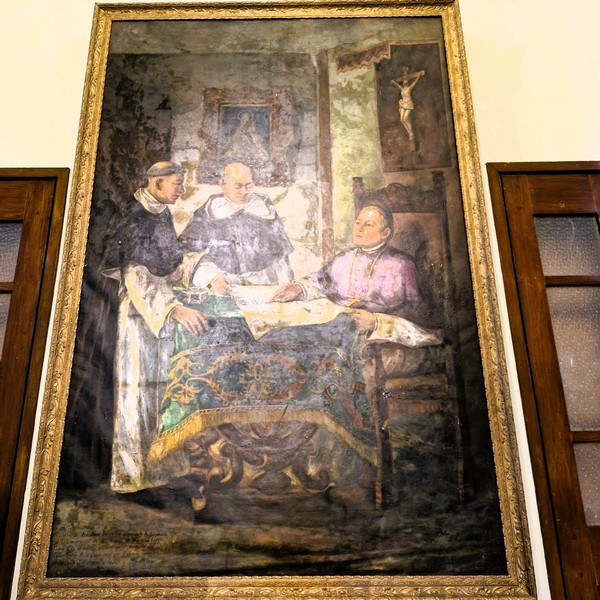
Arch of the Centuries (University of Santo Tomas, Manila)

The Baroque-style Arch of the Centuries, the arched gate at Plaza Intramuros, University of Santo Tomas (UST), is a landmark which symbolizes UST’s role as a “gateway in history to the finest breed of Filipinos.”  It is one of the few relics left from original UST campus in the walled city of Intramuros which was destroyed in 1945 during the Battle of Manila in World War II, leaving the 17th-century campus completely destroyed.  This arch door, called Puerta del Colegio, faced the first Benavides Statue, which was located at Calle Postigo and Calle de Santo Tomas.
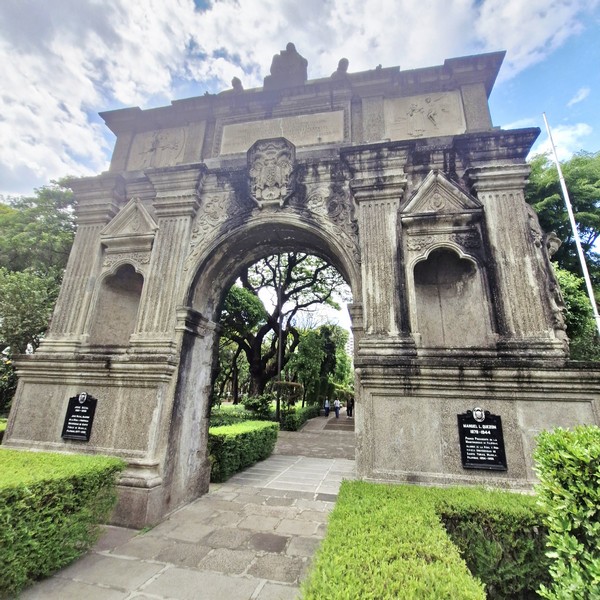
The Arch of the Centuries

In 1927, the university transferred here at its present Sampaloc site and the central lower section of the original facade of the first campus in Intramuros (the side facing the UST Main Building), built in 1680, was dismantle, piece by piece, in 1953, under orders of UST rector Jesus Castañon, by Carmelo Flavier Pablo of C.F. Pablo and Son, a precast contractor, and transferred to the present campus, taking a year to complete.  Carmelo Flavier Pablo also did the other half of the current structure (the side facing España Boulevard), a replica of the arch door inaugurated in 1954, as well as the statues, and the bas-relief panels. The arch became formally known as the Arch of the Centuries.
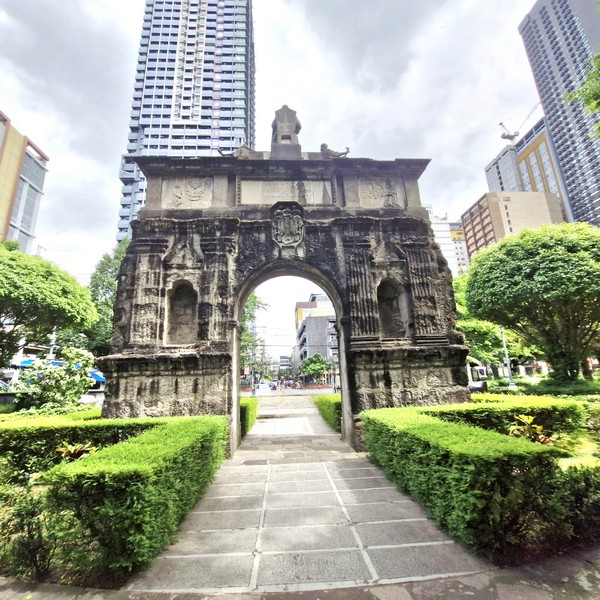
The original facade

On January 25, 2010, , along with the UST Main Building, the UST Central Seminary Building, and the university field, it was declared a National Cultural Treasure by the National Museum of the Philippines. On January 18, 2015, during his visit to the university, Pope Francis passed through the arch.

Check out “UST Main Building

One of the cultural icons of the University of Santo Tomas, it is often the site of important campus events such as the Thomasian Welcome Walk, UST’s tradition of welcoming the freshmen to the university by passing through the arch. The passing through also signifies the completion of their student life in the university when, after the baccalaureate Mass, the candidates for graduation exit through the arch during a parade.  There is an urban legend that claims prematurely exiting the arch, before graduation, would lead to a student’s debarment.
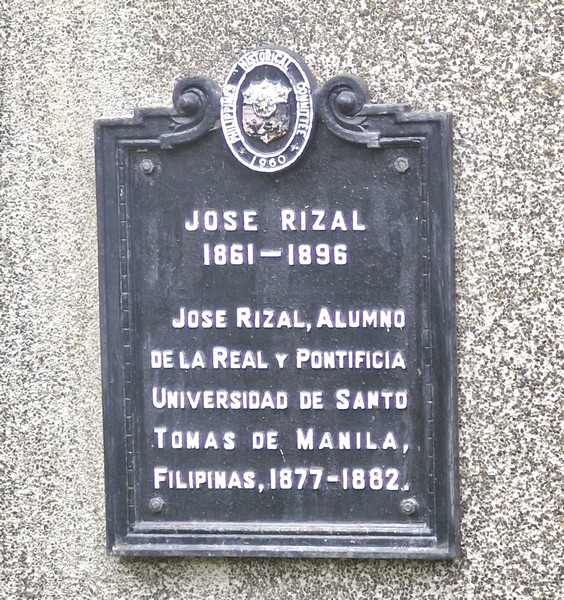
Jose Rizal commemorative plaque

Commemorative plaques, on its lower pillars, facing España Boulevard, honors two distinguished alumni, Philippine President Manuel L. Quezon (1878-1944), on the right and  José Rizal (1861-1896), on the left. The bronze marker, on the side of the left pier, tells the history of the arch. The words underneath it read, Gateway to the history of the finest breed of Filipinos, a reference to the UST alumni.
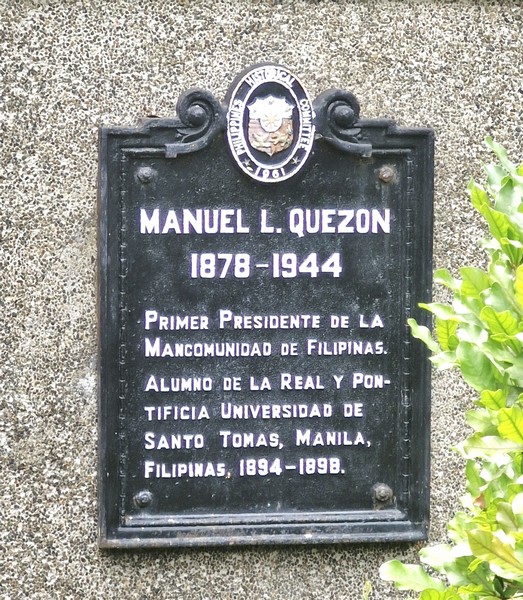
Manuel L. Quezon commemorative plaque

The statue of Thomas Aquinas, above the attic storey, portrayed as a young and energetic man seated on a chair (a depiction similar to the painting by Justus van Gent and Pedro Berruguete), was inaugurated on December 21, 1955. Flanking it are two female figures, the one facing west holding a cross, in her right hand, and an admiralty pattern anchor in her left hand while the one facing east holds a torch, in her left hand, while her right arm rests on a winged wheel.
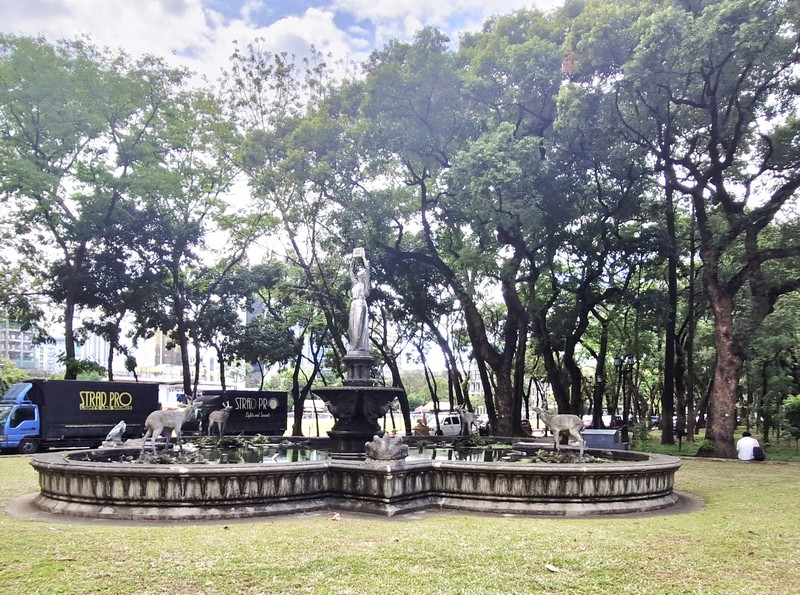
Fountain of Divine Wisdom

These two figures correspond to the Fountain of Divine Wisdom (also called the Fountain of Divine Wisdom) and the Fountain of Human Wisdom (Fountain of Knowledge) that flank the arch. The Fountain of Wisdom, surrounded by four deer and open shells, consists of a barbed, quatrefoil-shaped basin featuring a sculpture of a lady standing on top of a lotus flower (its bowl carried by four phoenixes) while holding a Bible who’s cover depicts the image of the Lamb of God.   The Fountain of Knowledge, surrounded by four owls of Athena and open shells, also features a sculpture of a lady (standing on a cylindrical pedestal adorned by the early disciplines offered in the university) on top of a lotus flower (its bowl carried by four sphinxes) while holding a globe.
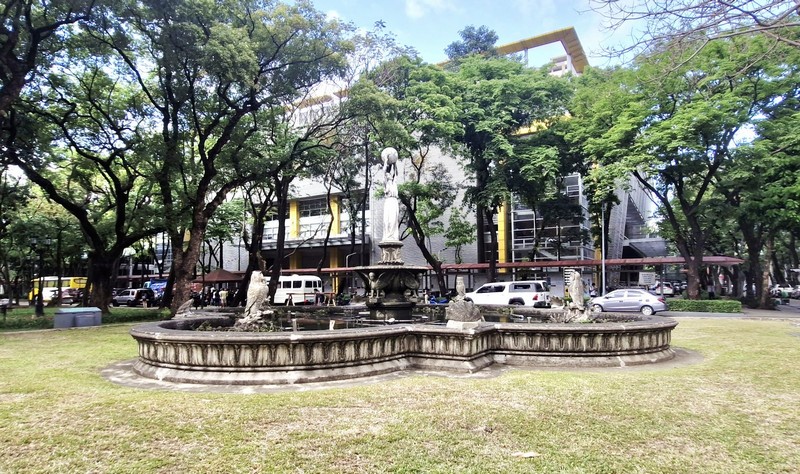
Fountain of Knowledge

The main inscription, directly above the arch, is different on both sides. Four bas-relief panels, depicting the life of Thomas Aquinas, flank the main inscriptions.  The southwest panel depicts two angels giving him the girdle of chastity; the southeast panel depicts Thomas Aquinas speaking to an icon of the crucified Christ; the northeast panel depicts Thomas Aquinas and the Eucharist; and the northwest panel depicts Thomas Aquinas taught by Saints Peter and Paul.
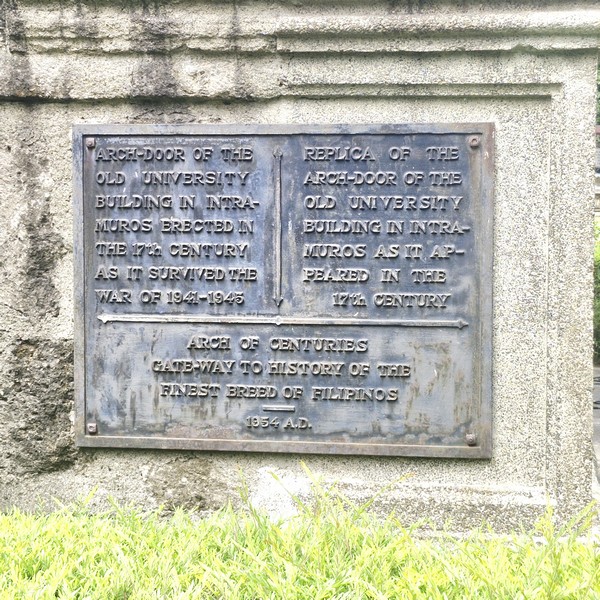
Bronze plaque that tells the history of the arch

A coat of arms, below the main inscription, features a double-headed eagle similar to the one used by Charles I, the King of Spain when the Philippines was discovered. The main façade consists of two columns, of the Doric order, on each side of the archway and the spandrels  consists of Baroque reliefs.

Arch of the Centuries: Plaza Intramuros, University of Santo Tomas, Manila.
UST Main Building (University of Santo Tomas, Manila)

University of Santo Tomas Main Building

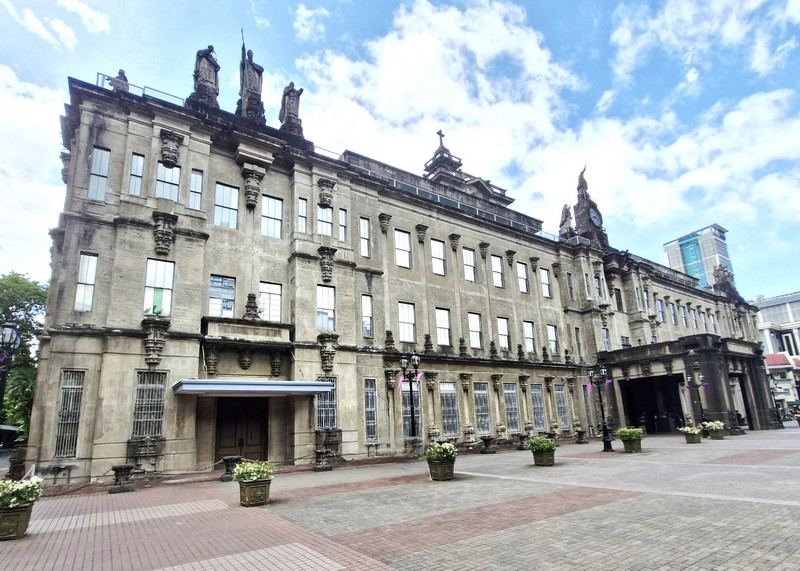
The  majestic, 4-storey, Renaissance Revival-style Main Building of the University of Santo Tomas (UST), functioning as the university’s administrative center, is home of the Faculty of Civil LawFaculty of Pharmacy, the College of Science and the Museum of Arts and Sciences. Designed by Fr. Roque RuañoO.P., this building, influenced by Frank Lloyd Wright‘s Imperial Hotel, Tokyo (which survived the Great Kantō earthquake of September 1, 1923 which flattened Tokyo and Yokohama), is the first earthquake-resistant building in the Philippines.

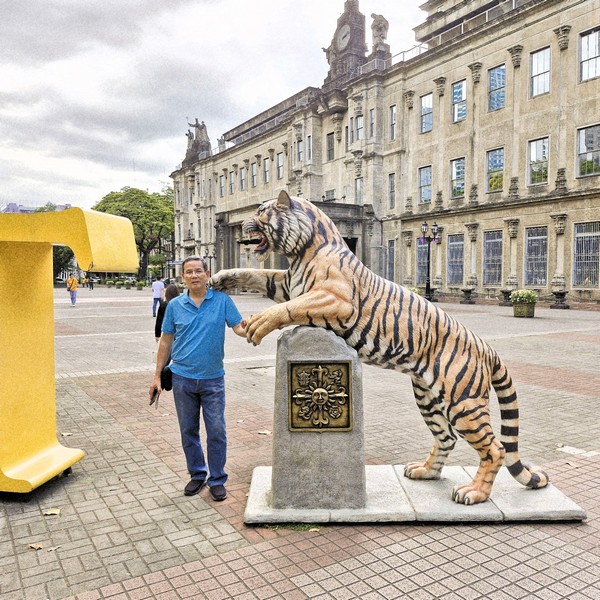
The author with the Main Building in the background

Construction of the building began on 1924 and, before it inauguration on November 12, 1927, the first classes were held there on July 2, 1927. Since then, it has been the focal point of the campus and all succeeding structures revolved around the Main Building.

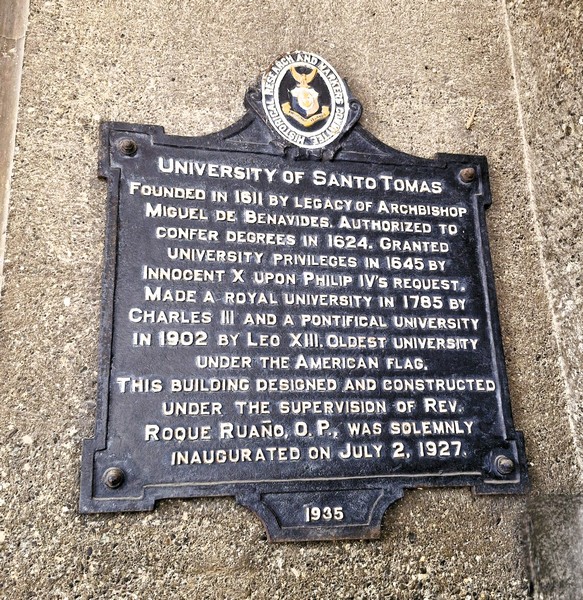
Historical Research and Markers Committee plaque (1935)

Starting on January 4, 1942, during World War II, the Japanese converted the university into the Santo Tomas Internment Camp for Americans and other non-Filipinos, the internees occupying three floors of the building (465 died there from hunger and malnutrition). On February 3, 1945, during the Battle for Manila the university and its around 4,000 Allied POWs and civilian internees were liberated by the 1st Cavalry Division, tanks from the 44th Tank Battalion and Filipino guerrillas led by Capt. Manuel Colayco (a UST faculty member who died securing the place), the first building in Manila to be liberated.  After the war, UST resumed operation, holding classes in the building.

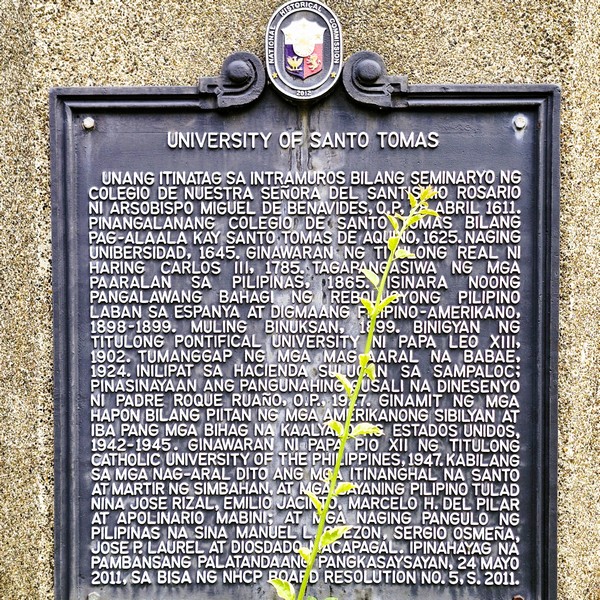
National Historical Commission plaque (2012)

The university and the building was visited by three popes: Pope Paul VI on November 28, 1970, Pope John Paul II on February 18, 1981 and January 13, 1995 (when UST hosted World Youth Day 1995) and Pope Francis on January 18, 2015 (though he did not enter the building). Queen Sofia of Spain also visited the building on July 6, 2012. On January 25, 2010, the National Museum of the Philippines declared it as a National Cultural Treasure.

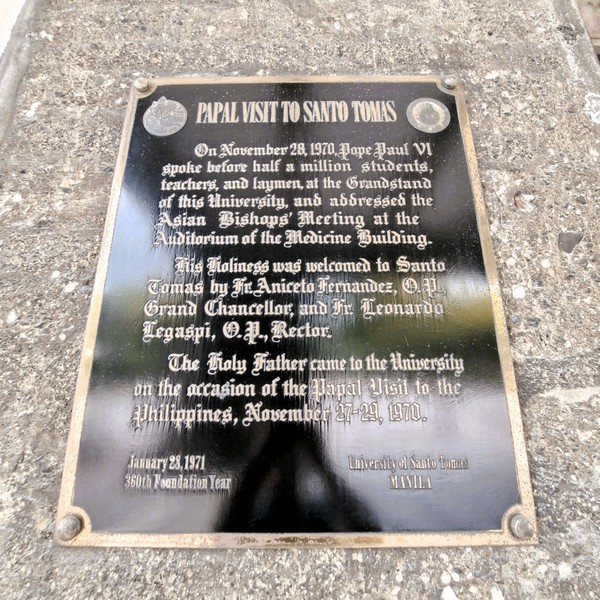
Pope Paul IV Papal Visit Plaque

This 86 m. long, 74 m. wide and 51.5 m. (169 ft.) high, rectangular structure, with two patios  (interior courtyards), is actually made up of 40 separate structures independent from one another, with the only opportunity provided by pre-cast stab flooring. There are four corner units, two midsection units (rear and front entrance), one tower (including two elevator cores) and one entrance canopy.  Another 26 units consists of seven units for the Padre Noval Street side, seven units for the Arsenio H. Lacson Avenue (formerly Gov. Forbes) side, six units for the Dapitan Street side, six units for the España Boulevard side, four for the middle section (or paraninfo) and two stair sections adjacent to the tower and elevator core.

Tria Haec

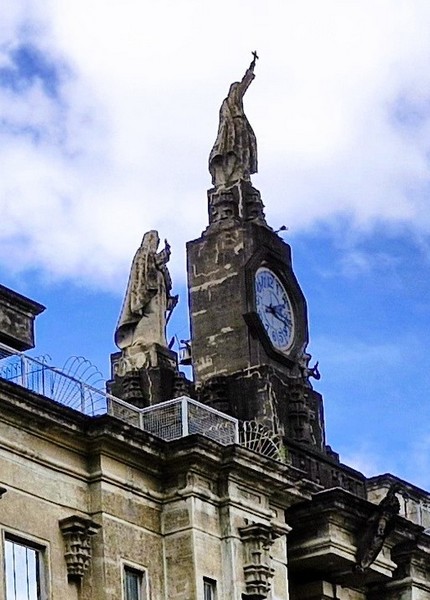
Statues, standing on the pedestals on the fourth floor of the building, symbolize the spiritual and intellectual aspiration of the university. Designed by Italian sculptor Francesco Riccardo Monti, a faculty member of the College of Architecture, they were installed between 1949 and 1953.  The so-called “Tria Haec” (Latin for “These Three”), surrounding the clock, are three statues representing Hope (Spe), Faith (Fides, on top of the clock) and Love (Caritas).

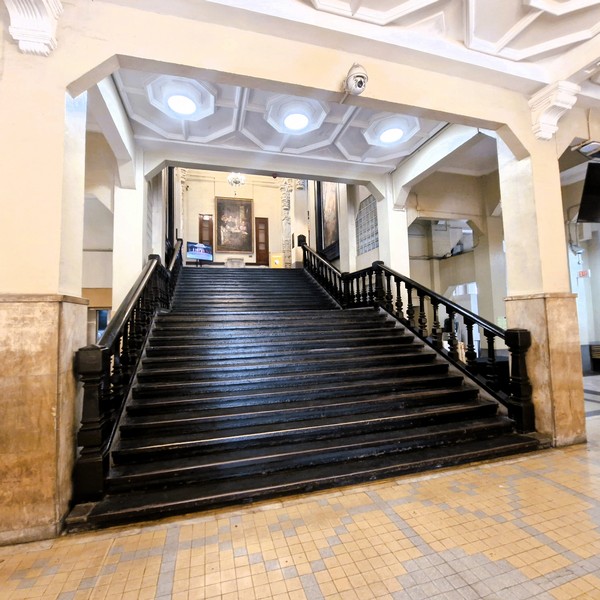
Grand Staircase

To the right of the “Tria Haec” are theologians and historians such as St. Augustine, St. Raymond of Peñafort and Vincent of Beauvais (Dominican monk and writer of Speculum Maius). To their right, facing Padre Noval Street, are the tragedians Pedro Calderón de la Barca, Sophocles and William Shakespeare, while to the left are the philosophers Aristotle, Saint Albert the Great and Plato.  To the left of the philosophers, facing Arsenio Lacson Avenue, are the playwrights Lope de Vega, Aristophanes and Molière.

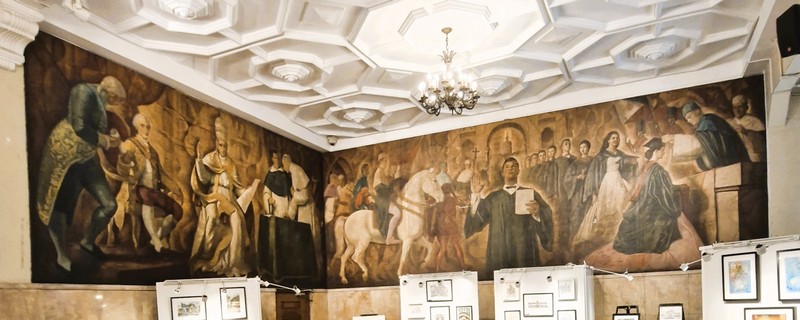
First two panels of History of the University of Santo Tomas Mural (Antonio Garcia Llamas)
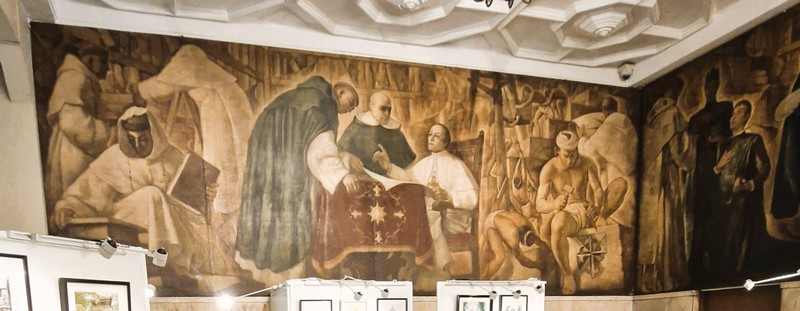
Third and fourth panel of History of the University of Santo Tomas Mural (Antonio Garcia Llamas)

At the ground floor lobby is the four-panel mural “The History of the University of Santo Tomas,” painted by Antonio Garcia Llamas between 1952 and 1954.  It depicts significant milestones of the university including its declaration as a Pontifical University on September 17, 1902 by Pope Leo XIII and the advent of co-education.  At the second floor staircase are paintings by Filipino masters Galo Ocampo and Carlos “Botong” Francisco.

The Foundation of the University of Santo Tomas by Archbishop Benavides (Domingo Celis)

Main Building: University of Santo Tomas (UST), EspañaSampaloc, Manila. Coordinates: 14°36′37″N 120°59′21″E.