Sondheim Theatre
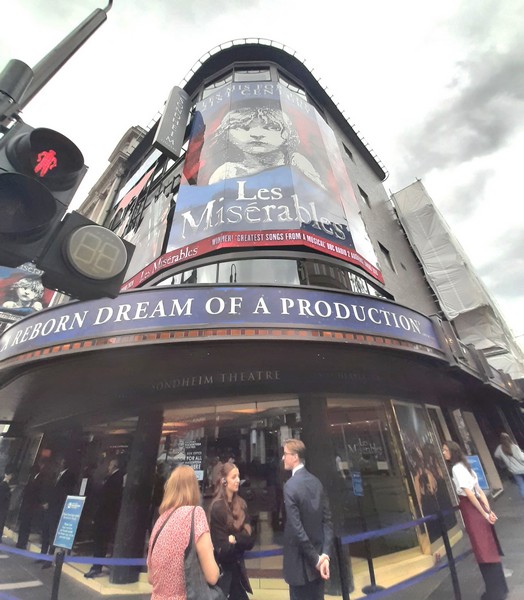
The highlight of our third day in London was to see the brilliant staging of one of the world’s most popular musicals – Cameron Mackintosh’s acclaimed fully-staged new production of Alain Boublil and Claude-Michel Schonberg’s Les Misérables, the West End‘s longest-running musical, at the Sondheim Theatre. This revolutionary Tony Award and Laurence Olivier Award-winning West End musical, opened last September 25, 2021, will run until March 29, 2025.
Check out “Musical Review: Les Miserables”
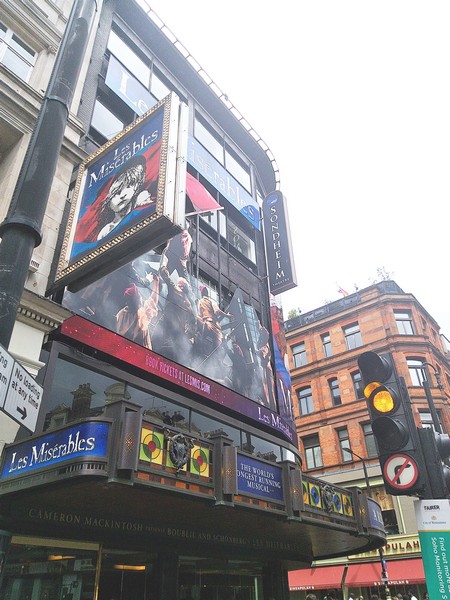
The theatre’s marquee
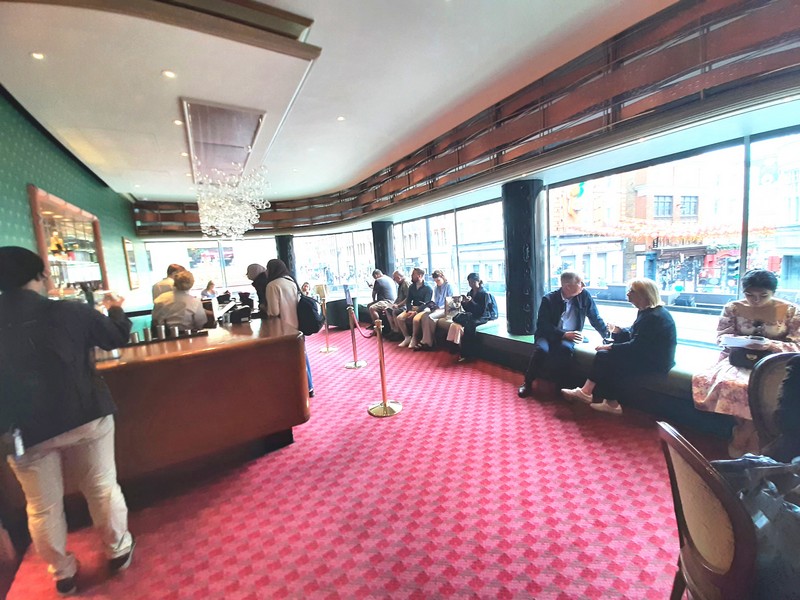
The 1,222-pax Sondheim Theatre (formerly the Queen’s Theatre) was so beautiful, it was an attraction in its own right. Prior to the show, we waited at the luxurious bar which looked like a VIP Lounge. The theatre offers three seating areas: Stalls, Dress Circle and Grand Circle.
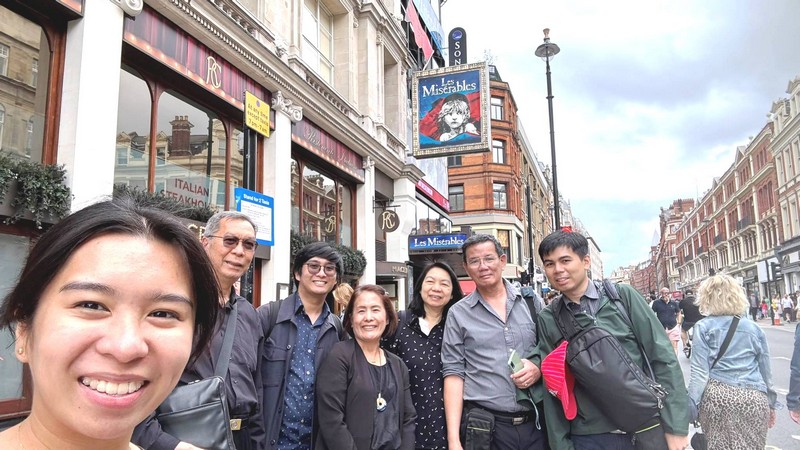
L-R: Selena, Manny, Sean, Paula, Grace, the author and Jandy
This West End theatre opened as the Queen’s Theatre on October 8, 1907, as a twin to the neighboring Hicks Theatre (now the Gielgud Theatre), on the adjoining corner of Shaftesbury Avenue, which had opened ten months earlier. Both theatres were designed by W. G. R. Sprague.
The original plan was to name the venue the Central Theatre. However, after a lengthy debate, it was named the Queen’s Theatre and a portrait of Queen Alexandra was hung in the foyer. The first production at the Queen’s Theatre was a comedy by Madeleine Lucette Ryley called The Sugar Bowl. Although it was poorly received and ran for only 36 performances, the theatre received glowing reviews.
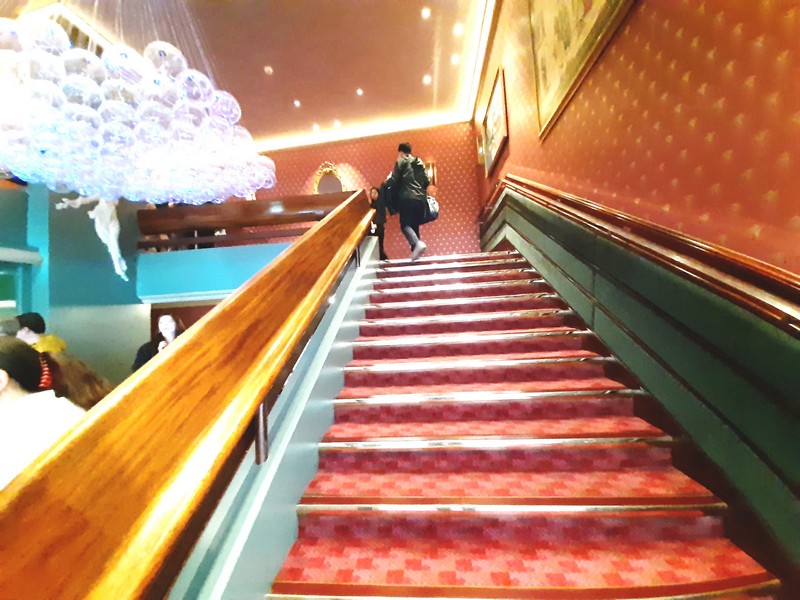
Staircase
In 1913, Tango Teas became a popular pastime and the stalls seats were replaced with tables and chairs where, for the sum of 2/6, people took tea while watching professional tango dancers and dress parades on stage. In 1920, Elsie Janis altered the theatre so that the stalls were “surrounded by a parterre and backed by a luxurious lounge.” A note in the program for It’s All Wrong, described as a “musical complaint,”” read “Miss Janis regrets that her name appears so often in the program, but she does not wish to shirk any of the responsibilities.”
In September 24, 1940, a German bomb landed directly on the theatre, destroying the facade and lobby areas. The production at the time was Daphne du Maurier’s highly successful Rebecca starring Celia Johnson, Owen Nares and Margaret Rutherford.
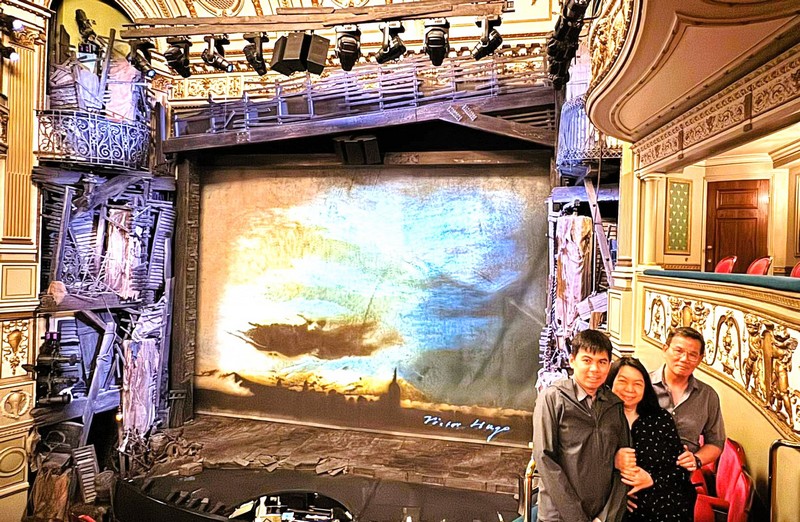
The theatre stage
The theatre remained closed until, almost 20 years later, a £250,000 restoration was completed by Architects Westwood Sons & Partners. With Sir Hugh Casson acting as consultant on the décor, the auditorium retained its Edwardian decor, while the lobbies and exterior were rebuilt in a modern style. On July 8, 1959, the reconstructed theatre opened with Ages of Man, John Gielgud’s solo recital in Shakespeare speeches and sonnets. In June 1972, the theatre was Grade II listed by English Heritage.
From April 2004 to July 2019, the theatre played host to Cameron Mackintosh‘s production of Les Misérables, the West End‘s longest-running musical which, after 18 years, transferred at the nearby Palace Theatre. The musical celebrated its 20th anniversary at the venue on October 8, 2005, and overtook Cats as the West End‘s longest-running musical of all time a year later on October 8, 2006. In 2010, Delfont Mackintosh refurbished Queen’s Theatre for the 25th Anniversary of Les Misérables and, on October 8, 2015, the show celebrated the 30th anniversary of its original opening at the Barbican Centre in 1985. On September 4, 2019, the show celebrated its 14,000th performance.
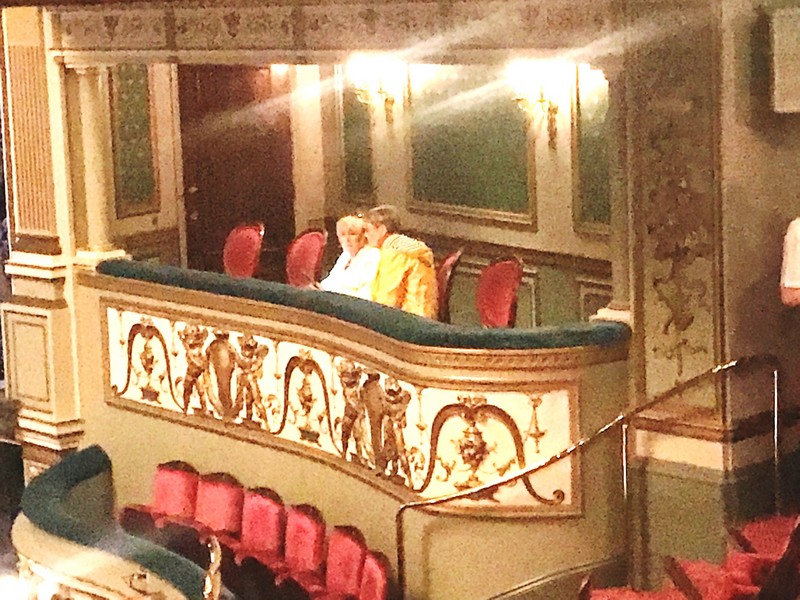
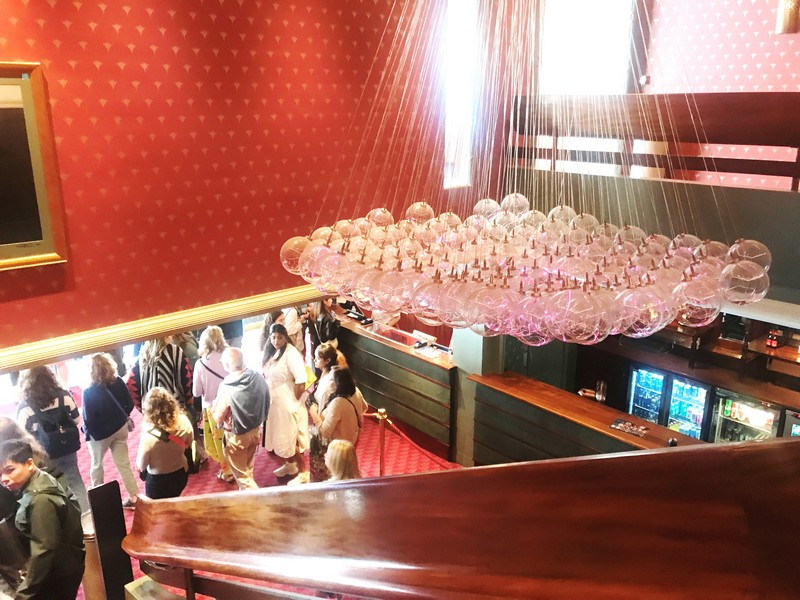
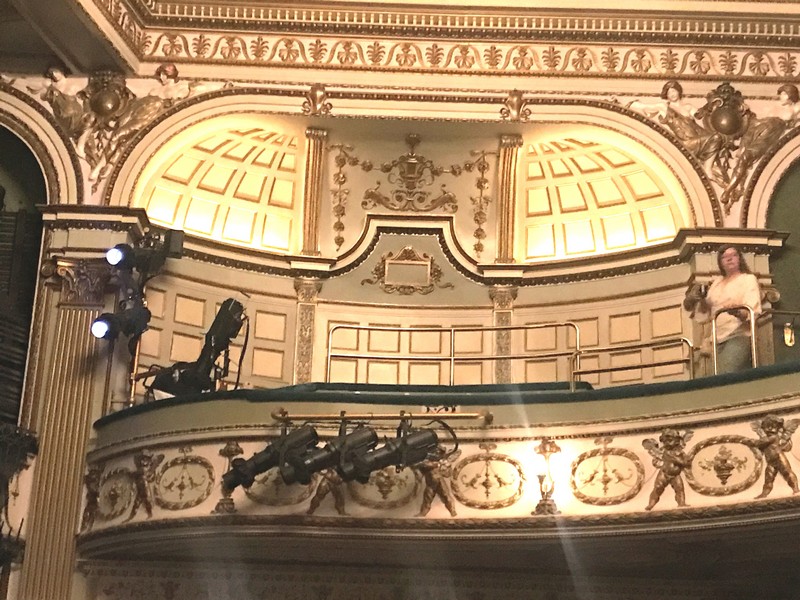
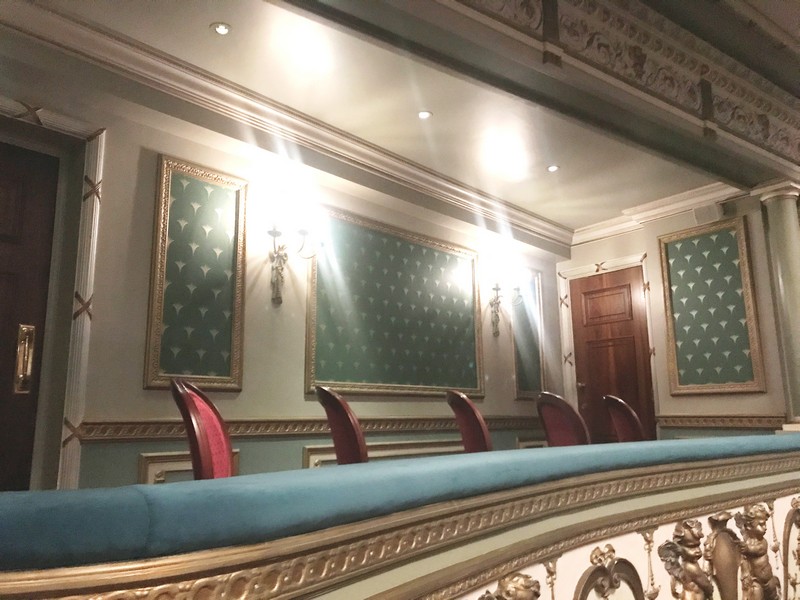
In 2019, Cameron Mackintosh announced that the original production of Les Misérables would close on July 13, 2019 while the theatre underwent an extensive £13.8 million, lightning fast 20-week refurbishment and restoration. The auditorium’s lovely Edwardian splendor was recreated, from the 1950s reconstruction, with the addition of a curved rail and new boxes at dress circle level, named after Maggie Smith and Judi Dench. Overhangs and ceilings on each tier were also redecorated with a recurring W. G. R. Sprague-inspired cherub design in carved plaster and “fifteen colors and seven shades of gold.” In total, approximately 70 to 80% of the plastering in the building was redone and a new, custom-made chandelier was hung.
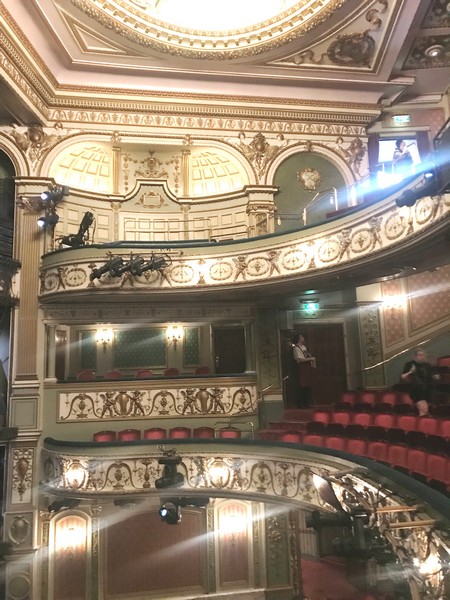
Dress Circle and Grand Circle seating areas
To be closer to the audience, the stage was lowered 30 cm. and the famous and innovative revolving stage, used in Les Misérables to enable smooth and seamless changes between scenes, was also notably removed. In a void space, next door to the theatre, 32 additional toilets were installed. Additional space on every floor, from the basement up, was also reclaimed from a former electricity substation leased to the electric board in 1907. This allowed for more space on stage as well as additional dressing rooms on several floors, now fitted with showers. Finally, to improve audience comfort and sight-lines, new seating was installed.
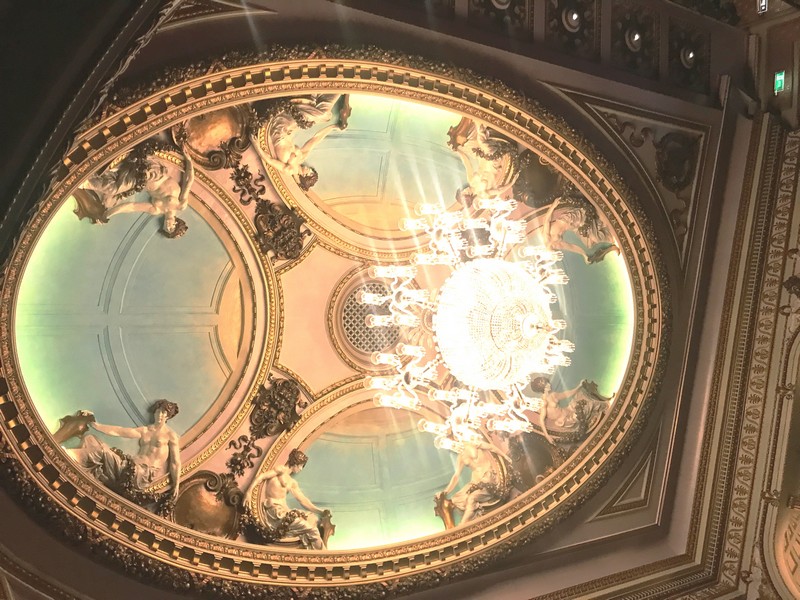
Ceiling and chandelier
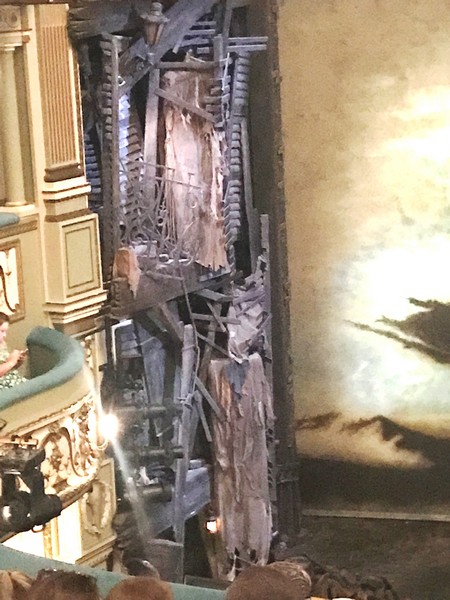
On December 18, 2019, the Queen’s Theatre was renamed as the Sondheim Theatre in honor of composer and lyricist Stephen Sondheim who was also celebrating his 90th birthday. On January 16, 2020, following completion, the Sondheim Theatre re-opened for its first performance of Les Misérables, featuring sets inspired by original paintings by Victor Hugo, in the 2009 touring staging.
Past and present productions
- Hamlet (1930) – this Old Vic production transferred to Queen’s and John Gielgud gave his first Shaftesbury Avenue performances of the role he made almost his own with Donald Wolfit as a strong Claudius.
- Moonlight in Silver (1934) – an ‘ultra-modern problem play’ by Clemence Dane, starred Gertrude Lawrence and Douglas Fairbanks, Jr. This glamorous couple attracted much media attention especially as they were having an affair both on and off stage.
- Short Story (1935) – Robert Morley’s first play, it combined a host of talent in Marie Tempest, Sybil Thorndike, Margaret Rutherford and Rex Harrison.
- 1937 – The Gielgud season of Richard II, The School for Scandal, Three Sistersand The Merchant of Venice brought glittering casts and outstanding performances to the theatre. Those who appeared included Leon Quartermaine, Michael Redgrave, Glen Byam Shaw, Anthony Quayle, Alec Guinness, Peggy Ashcroft and George Devine.
- Stop the World I Want to Get Off (1961) – Anthony Newley and Leslie Bricusse’s thought-provoking musical about the value of personal versus career choices, ran for 478 performances before transferring to Broadway.
- A Suite in Three Keys (1966) – Noël Coward made his final West End appearance.
- In August and September 1966 – Laurence Olivier’s National Theatre presented their first West End season, including famous productions of The Royal Hunt of the Sun and Othello.
- In 1972, Marlene Dietrich appeared for a short season in cabaret. She had first sung in cabaret at the Queen’s in 1964, and her performance can be heard on a live recording.
- Private Lives (1972) – Maggie Smith and Robert Stephens appeared in this acclaimed production.
- Saturday, Sunday, Monday (1974) – by Eduardo de Filippo, Franco Zeffirelli directed Joan Plowright in a notable production.
- Another Country (1982) – Julian Mitchell’s story about Guy Burgess’s schooldays, starred Rupert Everett and launched Kenneth Branagh’s career. Everett was subsequently replaced by Daniel Day Lewis and Colin Firth.
- Wonderful Town (1986) – a major revival of Leonard Bernstein’s musical about New York won both Laurence Olivier Award and Variety Club Awards.
- Three Sisters (1990) – the first time two sisters (Vanessa and Lynn Redgrave) had acted on stage together. Their niece Jemma also appeared here.
- Passion (1996) – Stephen Sondheim‘s love triangle ran for 232 performances and won Maria Friedman an Olivier Award for her role as Fosca.
- The Lady in the Van (1999) – Maggie Smith “acted with every muscle” as the smelly, eccentric Miss Shepherd who lived in playwright Alan Bennett’s drive for many years.
- The Hobbit (November 28, 2001 –February 9, 2002) by Glyn Robbins from R. R. Tolkien‘s book
- Mysteries (February 26, 2002 –May 18, 2002) adaptation by Speir Opera
- Umoja: The Spirit of Togetherness (June 18, 2002 –August 31, 2002) by Todd Twala, Thenbi Nyandeni and Ian von Memerty
- Contact (October 23, 2002 –May 10, 2003) by Susan Stroman and John Weildman
- The Rocky Horror Show(June 23, 2003 –July 5, 2003) by Richard O’Brien, starring Jonathan Wilkes and John Stalker
- Cyberjam (September 23, 2003 –January 3, 2004)
- The RSC’s The Taming of the Shrew (January 15, 2004 –March 6, 2004) by William Shakespeare
- The RSC’s The Tamer Tamed (January 22, 2004 –March 6, 2004) by John Fletcher
- Les Misérables (April 12, 2004 —July 13, 2019, December 18, 2019 –) by Alain Boublil and Claude-Michel Schönberg
- Les Misérables – The Staged Concert (December 5, 2020 – February 28, 2021)
Sondheim Theatre: 51 Shaftesbury Avenue corner Wardour Street, City of Westminster, London W1D 6BA, United Kingdom. Tel: +44 344 482 5151. Coordinates: 51.511944°N 0.132778°W.
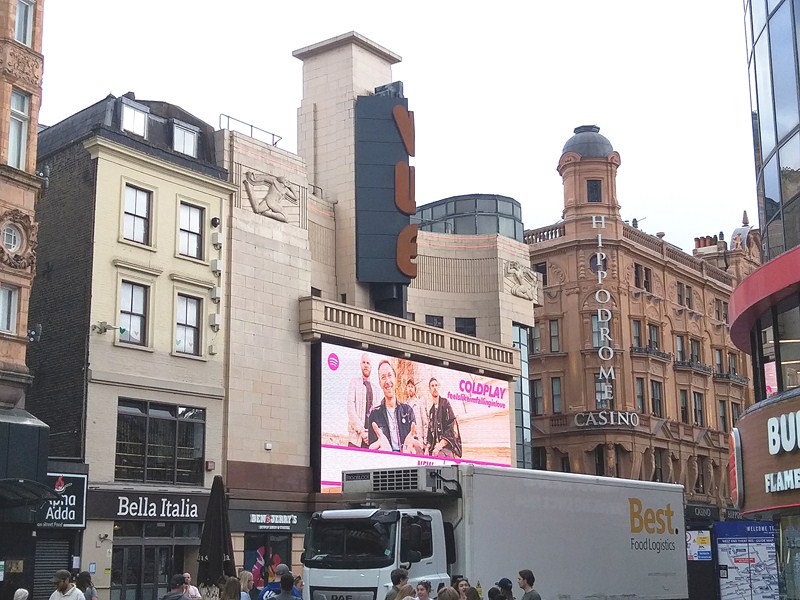
How to Get There: The nearest train station is Charing Cross while the nearest tube station is Piccadilly Circus (take Shaftesbury Avenue along where the famous illuminated signs are. The theatre will be on your left about 100 m. along, just after the Gielgud Theatre).
The nearest bus stops are serviced by numbers 12, 14, 19, 38 (Shaftesbury Avenue) and 6, 13, 15, 23, 88, 94, 139, 159, 453 (Regent Street). Night bus numbers: (Shaftesbury Avenue) 14, N19, N38; (Regent Street) 6, 12, 23, 88, 94, 139, 159, 453, N3, N13, N15, N109, N18, N136.