
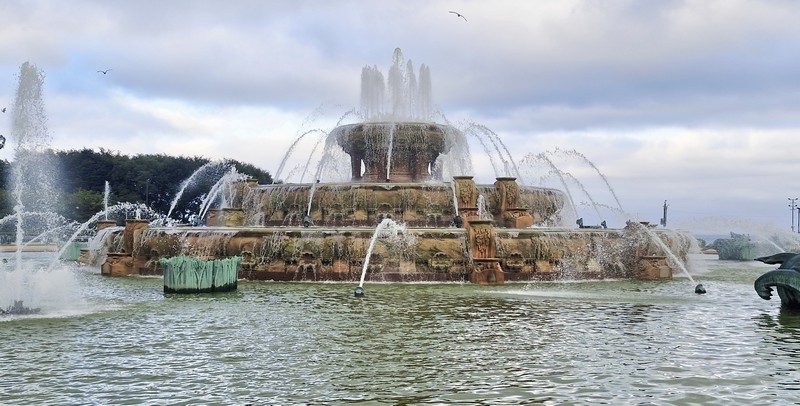
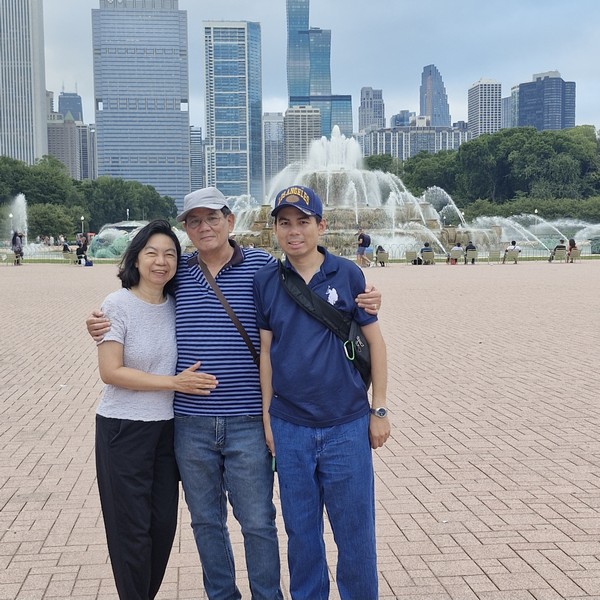
After our late lunch at Andy and Raquel’s place, we drove the 27.2-km. (30-min.) distance to our first sightseeing destination in Chicago – Buckingham Fountain (officially called is the Clarence Buckingham Memorial Fountain), one of the largest fountains in the world. Also considered one of the finest ornamental fountains in America, many tourists and Chicagoans visit the fountain each year. The centerpiece of Grant Park, the fountain area has been called Chicago’s “Front Yard.” It has been designated as a Chicago Landmark and a contributing feature within Grant Park’s listing on the National Register of Historic Places.
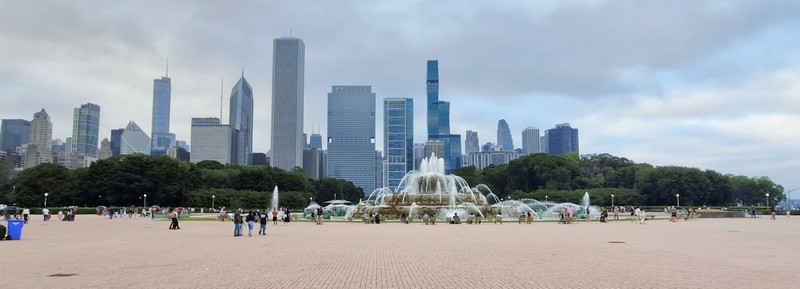
The fountain, constructed at a cost of $750,000 ($13.9 million in 2025), was donated to the city by important Chicago art patron and philanthropist Kate Sturges Buckingham who also established the Buckingham Fountain Endowment Fund with an initial investment of $300,000 to pay for maintenance.
Here’s the historical timeline of the fountain:
- In the mid-1920s, Beaux Arts architect Edward H. Bennett (1874-1954) of the firm Bennett, Parsons and Frost and longtime associate of Daniel H. Burnham (1846–1912) and co-author of his seminal Plan of Chicago, prepared new plans to complete Grant Park, envisioning a monumental fountain to serve as the park’s formal focal point without obstructing views of Lake Michigan. Philanthropist and art patron Kate Sturges Buckingham (1858 – 1937), the last member of the Buckingham family, agreed to donate one million dollars for the magnificent fountain in Grant Park as a memorial to her brother, philanthropist and businessman Clarence Buckingham (1854 – 1913). Engineer Jacques H. Lambert and architect Clarence W. Farrier served as associates on the project.
- On May 26, 1927, the fountain was officially opened to the public
- On August 26, 1927, Buckingham Fountain was dedicated with conductor John Philip Sousa and his band playing “Pomp and Circumstance” before an audience of 50,000 people.
- In the late 1950s, the major water displays, which originally occurred only twice a day, three times a week, were now offered every day.
- In 1968, the light show was first automated. Originally, the engineers used a keyboard, with 21 electric switches, to fade, brighten, and blend colors to create numerous light effects.
- In 1980, when the Chicago Park District entered into a contract with Honeywell, the operations became fully automated (Buckingham Fountain was manually operated, from 1927 through the 1970s, by two stationary engineers who each worked a daily 12-hour shift). The computer was located on site, but the monitoring system took place remotely, off premises, in the Chicago suburbs.
- In the mid-1980s, the monitoring system was moved to Atlanta, Georgia.
- On July 21, 1993, the fountain was officially added to the National Register of Historic Places. That same day, to transform the space and encourage social gathering, the Chicago Park District announced a summer Seating Pilot Program inspired by the Luxembourg Garden in Paris.
- In 1994, due to leaks developed during Chicago’s harsh winters and to address some of its masonry problems, the Buckingham Fountain underwent a major $2.8 million conservation project to its three smallest basins, with Buckingham Fund of the Art Institute and the Chicago Park District cooperatively funding the project. The monitoring system also returned to the pump house of the fountain.
- On August 30, 2000, the fountain was designated as an official Chicago Landmark.
- In September 2008, the three-phase renovation project (to modernized aging internal systems in the fountain and restored deteriorated features) on Buckingham Fountain began. Funding was a combination from the Buckingham endowment, city and park district funds and a grant from the Lollapalooza music festival which is held annually near the fountain.
- On April 3, 2009, Phase I was dedicated. This phase included permeable pavers (a safer and smoother surface which complies with the Americans with Disabilities Act of 1990) surrounding the fountain, which replaced the crushed stone that was used since the fountain was constructed.
- Between 2009 and 2012, additional repairs were made including landscape improvements surrounding the monument, plumbing upgrades, and computer upgrades.
- In 2013, the Chicago Park District upgraded the Buckingham Fountain computer with a non-proprietary Allen-Bradley PLC System.
- In August 2016, in a partnership with the City of Chicago, the Chicago Park District and Everywhere Wireless, the fountain viewing area joined many Chicago beaches and the Museum Campus in providing free Wi-Fi to visitors.
The fountain, built in a Rococo wedding cake style, comprises four basins clad in elaborately-carved granite and pink Georgia marble. It is twice the size and re-circulates approximately three times more water than the Bassin de Latone of the Latona Fountain at the Palace of Versailles, which it was modeled after.
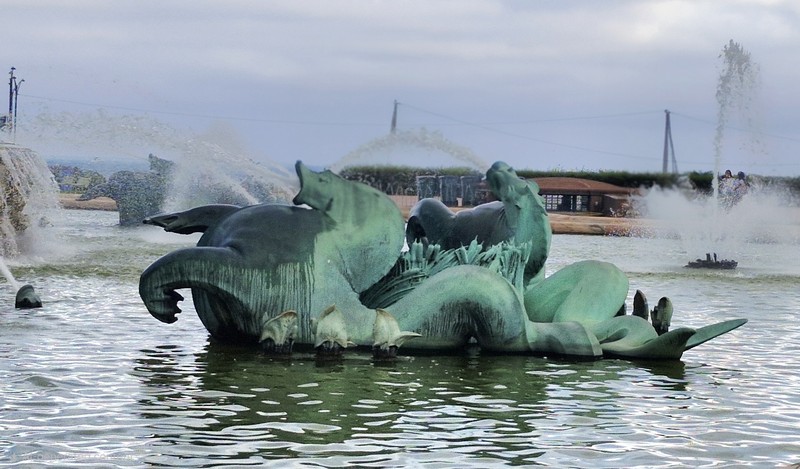
The massive lower basin features four sets of Art Deco-style, bronze (with a natural green copper patina) sea horses (two per set), created by the French sculptor Marcel F. Loyau (1895–1936), representing nearby Lake Michigan, and symbolizing the four states (Illinois, Wisconsin, Michigan and Indiana) that border the lake. To create the sea-related bronze elements, Loyau studied the sea horse collection at a zoological institution in Paris. The fountain’s sculptural elements garnered Loyau the Prix National at the 1927 Paris Salon.
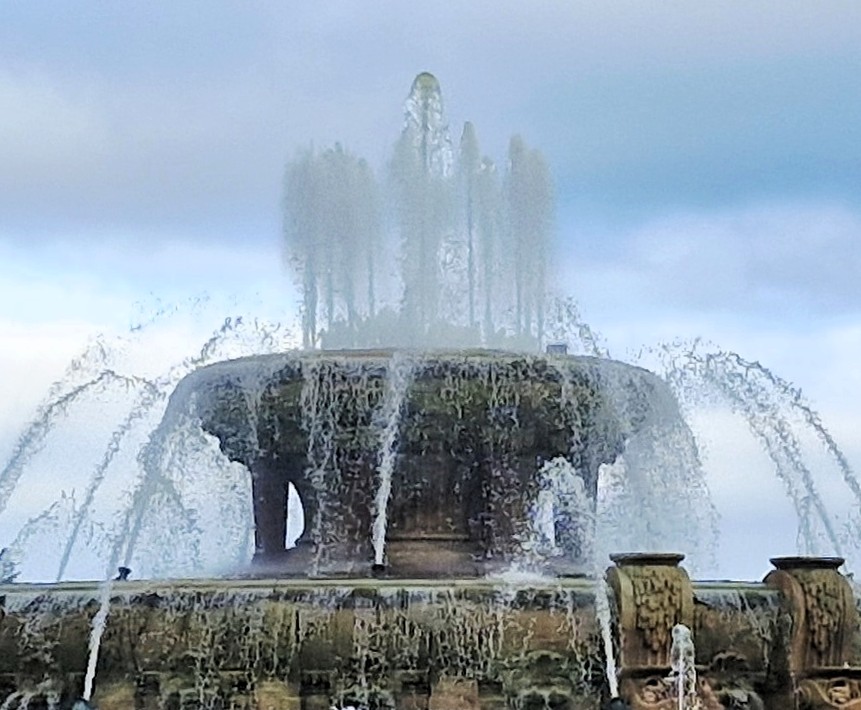
The monument’s original design included colored lighting to emulate the effect of “soft moonlight.” The fountain contains 820 lights with 16 in the top bowl; 72 in the upper trough; 204 in the inner trough; 432 in the lower trough; 24 in the isolated jets; 60 in the sea horses and 12 in the bulrushes.
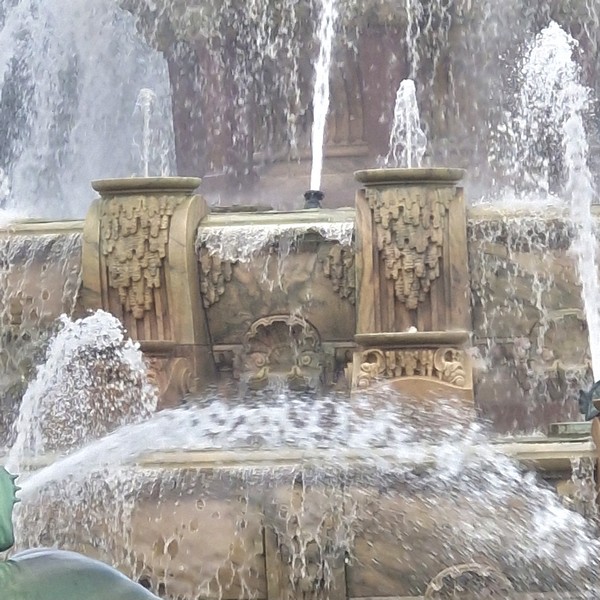
The bottom pool of the fountain is 85 m. (280 ft.) in diameter, the lower basin is 31 m. (103 ft.), the middle basin is 18 m. (60 ft.) and the upper basin is 7.3 m. (24 ft.). The lip of the upper basin is 7.6 m. (25 ft.) above the water in the lower basin. The fountain also contains 820 lights with 16 in the top bowl; 72 in the upper trough; 204 in the inner trough; 432 in the lower trough; 24 in the isolated jets; 60 in the sea horses and 12 in the bulrushes.
The fountain has its original two-level underground pump house with the control room on the first level, and a 35 ft. long and 25 ft. wide lower level pump room. The original pumps and motors are still in operation today. The water displays are powered by three pumps. Pump 1 (75 HP for 1,600 gallons of water a minute) is the primary pump that keeps the fountain running throughout the day while Pumps 2 (190 HP for 5,500 gallons of water a minute) and Pump 3 (250 HP for 7,000 gallons of water a minute) operate during the major display.
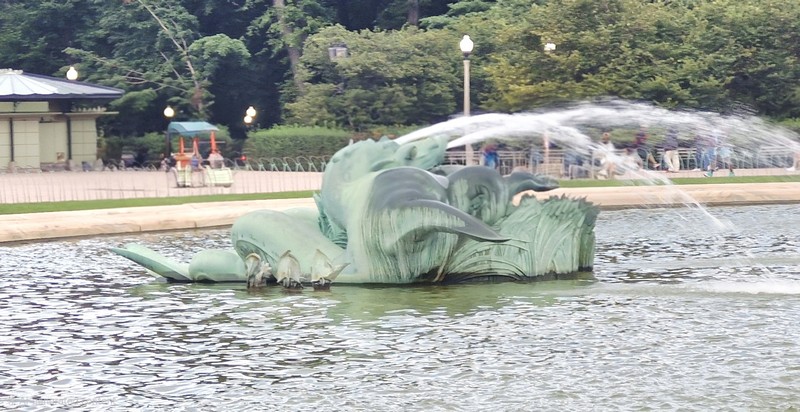
Depending on wind conditions, major displays recirculate approximately 0.88 cu. m. (14,000 U.S. gallons per minute) of water per second are conveyed through 133 jets with one central jet at the top of the upper basin used for the 150-ft. tall geyser; 34 jets pointing upwards from the top basin along the inner top ring; 34 jets at the consoles located along the perimeter of all three basins; 12 jets for each of the three basins that spray an arc to the level about 8 jets spout from the sea horses’ mouths; and 20 isolated jets of 4 groups of 5 spray heads. Water is recirculated from the base pool after the basins are filled and not drawn from the outside except to replace losses from wind and evaporation.
Today, all of the automation and monitoring takes place on-site, with remote alarm monitoring and notification. The fountain’s security system is monitored from Arlington Heights (a Chicago suburb).
The song Spider-Man Dick, by Cupcakke, mentions the fountain. Buckingham Fountain was also featured in the following:
- Title sequence of the TV show Married… with Children
- Title sequence of the TV show Crime Story
- The starting point for the television show The Amazing Race 6 in 2004
- Featured in a task on the television show The Amazing Race 29 in 2017.
- The protagonist’s meeting place in the 1949 film noir film Undertow
Metal chairs (in two styles, one upright and another slightly reclined), manufactured by Fermob in Paris, allow visitors to bask in the warm summer days ahead. Available daily, from May 30 through September, except during major events hosted in Grant Park, they can be moved around to take advantage of the stunning views of the fountain, the park, the lake, and the skyline.
Buckingham Fountain: Columbus Drive (301 East) and Congress Parkway (500 South), Grant Park, Downtown Chicago, Illinois 60601. Tel: (312) 742-3918. Coordinates: 41°52′33″N 87°37′08″W. The fountain operates daily, from 8 AM to 11 PM, typically from mid-April through mid-October, depending on weather. Regular water water-jet displays, beginning at 9 AM and lasting 20 mins., occur every hour on-the-hour. shows, the center jet shoots up vertically to 46 m. (150 ft.), and, after dusk, a spectacular light and music display accompanies the major display, choreographed with colored lights and music (the last show begins at 10 PM and the final display of the day begins at 10:35 PM). The fountain shuts down just after the last display, around 10:55 PM. Display times are subject to change during special events in Grant Park. During winter, the fountain is decorated with festival lights.
How to Get There: The fountain is located in the center of Grant Park, between Queen’s Landing and near the intersection of Columbus Drive and the end of Ida B. Wells Drive. By bus, take either the south-bound CTA bus line #146 or #147 to Congress and Michigan, then walk .3 miles east to fountain. If driving, take Shore Drive (US 41) south to Jackson, right on Jackson to Columbus. Left on Columbus to fountain.