
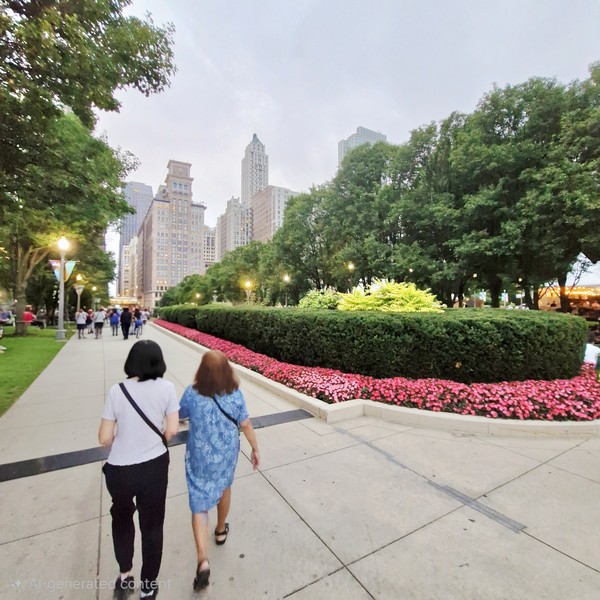
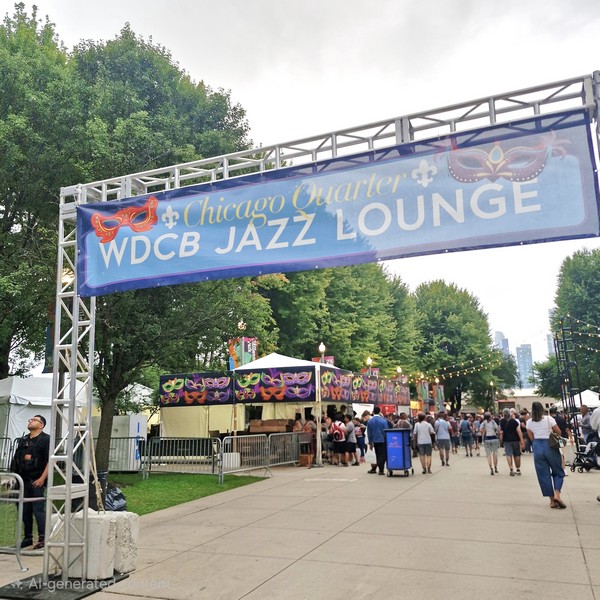
From Buckingham Fountain, it was just a short 0.5-km. drive to Millennium Park, a public park in the Loop community area. Andy dropped us off at the park entrance near the Crown Fountain. It being a Saturday weekend, the park was packed with Chicagoans and tourists. During our visit, the annual Chicago Jazz Festival (September 3 to 6, 2026) was ongoing. It featured an evening lineup headlined by M.E.B. (Miles Electric Band) which celebrates the Miles Davis Centennial. We passed the WDCB Jazz Lounge, a dedicated festival stage hosted by Chicago public jazz radio station WDCB (90.9 FM) during the Chicago Jazz Festival.
Check out “Buckingham Fountain”
This prominent civic center, near the city’s Lake Michigan shoreline, covers a 9.9-hectare (24.5-acre) section of northwestern Grant Park. Operated by the Chicago Department of Cultural Affairs and Special Events (DCASE), it features a variety of public art, outdoor spaces and venues. In 2017, Millennium Park was the top tourist destination in Chicago and in the Midwest, and placed among the top ten in the United States with 25 million annual visitors.
The park is bounded by Michigan Avenue, Randolph Street, Columbus Drive and East Monroe Drive. The community around Millennium Park, one of the most fashionable and desired residential addresses in Chicago, features upscale buildings such as The Heritage at Millennium Park (130 N. Garland), Waterview Tower, The Legacy and Joffrey Tower. The user-friendly park has a very rigorous cleaning schedule with many areas being swept, wiped down or cleaned multiple times a day.
Here’s the historical timeline of the park:
- In October 1997, planning of the park, situated in an area occupied by parkland, the Illinois Central rail yards, and parking lots, began. The park was originally planned under the name Lakefront Millennium Park. The park’s overall design was by Skidmore, Owings & Merrill, and gradually additional architects and artists such as Frank Gehry and Thomas Beeby were incorporated into the plan. Sponsors were sought by invitation only.
- In March 1998, the plans for the park were officially announced
- In February 1999, the city announced it was negotiating with Frank Gehry to design a proscenium arch and orchestra enclosure for a bandshell, as well as a pedestrian bridge crossing Columbus Drive, and that it was seeking donors to cover his work.
- In April 1999, the city announced that the Pritzker family had donated $15 million to fund Gehry’s bandshell and an additional nine donors committed $10 million.
- In October 1998, construction of the park began
- In January 2000, the city announced plans to expand the park to include features that became Cloud Gate, the Crown Fountain, the McDonald’s Cycle Center, and the BP Pedestrian Bridge. Later that month, Gehry unveiled his new winding design for the bridge.
- In January 2001, the Exelon Pavilions were designed.
- On December 20, 2001, the McCormick Tribune Ice Skating Rink was opened, the first attraction in the park to do so, a few weeks ahead of the Millennium Park underground parking garage.
- From June 21 to September 15, 2002, The Plaza at Park Grill served as an open-air exhibition space, hosting the Exelon Presents Earth From Above, the inaugural exhibit in Millennium Park, by Yann Arthus-Bertrand, a French aerial photographer.
- On November 24, 2003, The Park Grill Plaza was opened.
- In January 2004, construction of the Exelon Pavilions began.
- In July 2004, the Southeast and Southwest Exelon Pavilions (jointly the South Exelon Pavilions), along Madison Street, flanking the Lurie Garden, were completed and opened.
- On July 16, 2004, Millennium Park was opened in a ceremony, four years behind schedule. The July 16–18 opening ceremony, sponsored by J.P. Morgan Chase & Co., was attended by some 300,000 people and included an inaugural concert by the Grant Park Orchestra and Chorus. During the grand opening weekend of the park, the AT&T Plaza (now Grainger Plaza) was opened with the unveiling of the Cloud Gate sculpture.
- In November 2004, the Northeast and Northwest Exelon Pavilions (jointly the North Exelon Pavilions), flanking the Joan W. and Irving B. Harris Theater for Music and Dance along Randolph Street, were completed.
- In 2005, an accessibility award ceremony was held at the Jay Pritzker Pavilion.
- In early 2005, workers polished out the seams of the Cloud Gate sculpture.
- In March 2005, Boeing President and Chief Executive Officer James Bell announced the firm would make a $5 million grant to fund construction of the Boeing Galleries. The galleries were built between March and June 2005.
- On April 30, 2005, the Exelon Pavilions were officially opened.
- On May 15, 2006, the Cloud Gate sculpture was formally dedicated
- On August 31, 2005, Tori Amos performed the first rock and roll concert at the Jay Pritzker Pavilion.
- In 2006, Forbes named the park’s 60602 zip code as the hottest in terms of price appreciation in the country.
- On August 4, 2009, the two privately funded Burnham Pavilions were unveiled to commemorate the year-long 100th anniversary celebration of Daniel Burnham‘s 1909 Plan of Chicago. Architects Zaha Hadid and Ben van Berkel were invited to design and build these temporary structures on the Chase Promenade South. Both were meant to symbolize the city’s continued pursuit of the plan’s architectural vision.
- On May 16, 2009, the Nichols Bridgeway was opened.
- From August 10–14, 2009, due to unanticipated wear and tear, the van Berkel pavilion was temporarily closed for repairs.
- After November 1, 2009, the van Berkel and Hadid pavilions were dismantled
- In October 2015, the city announced that its official annual Christmas tree lighting, which had been held at Daley Center since 1966 (except for 1982), would be held at the park in order that the official Christmas tree of the city could be closer to ice skating at McCormick Tribune Ice Skating Rink, the annual Christmas caroling at Cloud Gate and to the new offerings of the nearby Maggie Daley Park.
- In 2021, the Grainger Foundation established a $5 million endowment to support the ongoing enhancement of the plaza (now called Grainger Plaza) and Cloud Gate.
Millennium Park, a portion of the 129.1-hectare (319-acre) Grant Park (known as the “front lawn” of downtown Chicago), has four major artistic highlights – the Jay Pritzker Pavilion, Cloud Gate, the Crown Fountain, and the Lurie Garden. In part due to the grand scale of each piece and the open spaces for display, Millennium Park is successful as a public art venue.
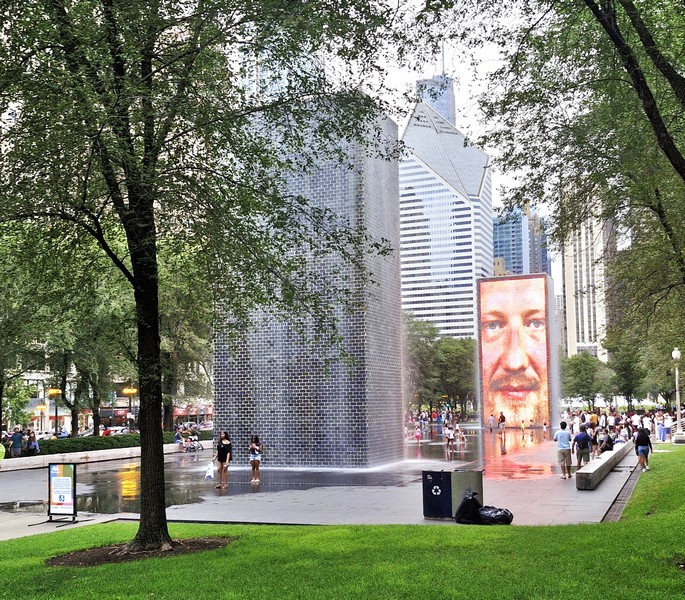
The Crown Fountain, an interactive work of public art and video sculpture, was named in honor of Chicago’s Crown family. Designed by Catalan conceptual artist Jaume Plensa (highlighting his themes of dualism, light, and water, extending the use of video technology from his prior works), it was executed by Krueck and Sexton Architects and cost $17 million. The fountain, promoting physical interaction between the public and the water in an artistic setting, is composed of a black granite reflecting pool placed between a pair of transparent, 15 m. (50 ft.) high glass brick towers which use light-emitting diodes, behind the bricks, to display digital videos on their inward faces.
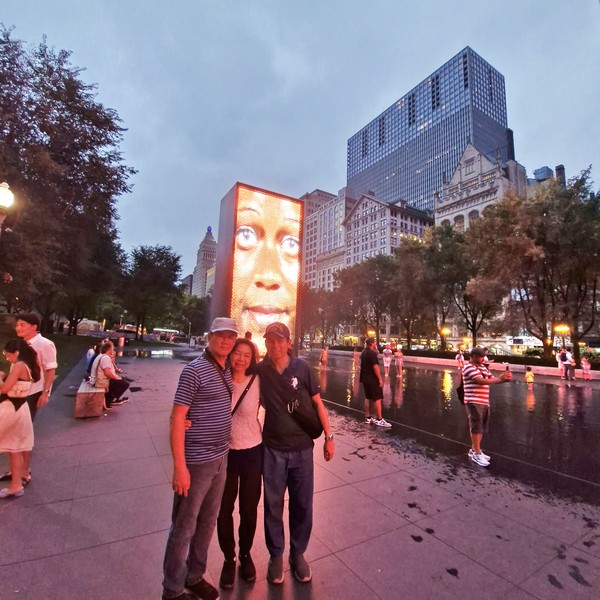
The water, operating from May to October (weather permitting), intermittently cascades down the two towers and spouts through a nozzle on each tower’s front face. To achieve the effect in which water appears to be flowing from subjects’ mouths, reminiscent of gargoyle fountains, each video has a segment where the subject’s lips are puckered, which is then timed to correspond to the spouting water, happening roughly every five minutes.
The fountain, a popular subject for photographers and a common gathering place, has found its way into Chicago pop culture as, while some of the videos displayed are of scenery, most attention has focused on its video clips of Chicagoans, in which almost a thousand local residents randomly appear on two screens. A public play area, the fountain also offers people an escape from summer heat, allowing children to frolic in the fountain’s water.
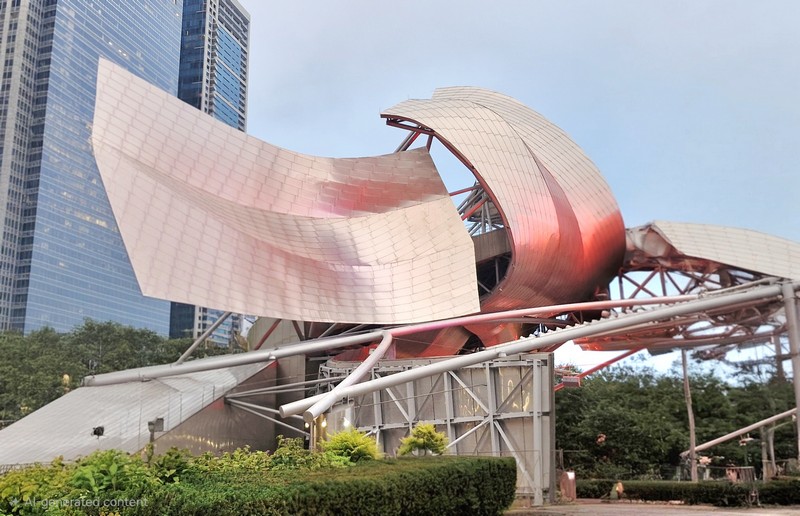
The Jay Pritzker Pavilion, the centerpiece of Millennium Park, was named after Jay Pritzker, whose family is known for owning Hyatt Hotels and was a major donor. Grant Park‘s outdoor performing arts venue for small events, the Jay Pritzker Pavilion is seen as a major upgrade to the Petrillo Music Shell, the park’s older and larger bandshell. Performing on stage, at that time, was Paul Marinaro’s “Mood Ellington,” a nine-piece ensemble celebrating Duke Ellington and Billy Strayhorn.
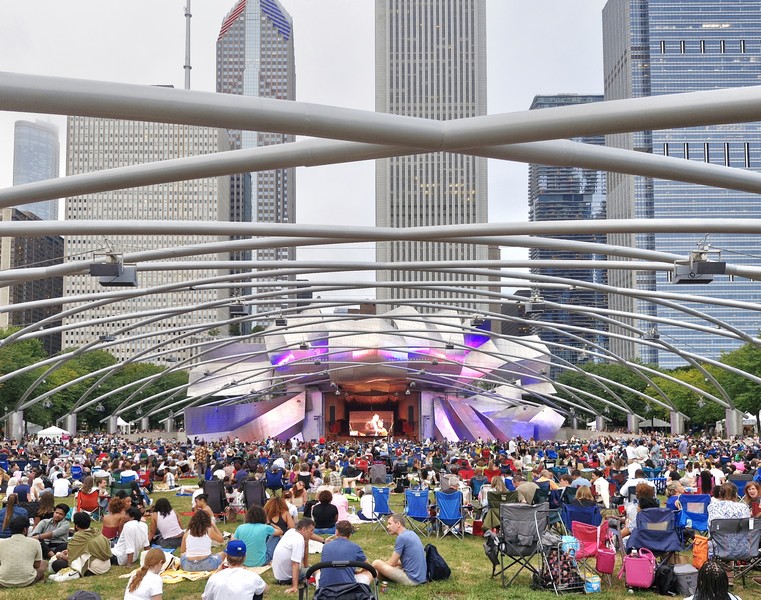
The pavilion is partially built atop the Joan W. and Irving B. Harris Theater for Music and Dance, the park’s indoor performing arts venue, with which it shares a loading dock and backstage facilities. Its bandshell, designed by Frank Gehry, has a stage with a headdress fashioned from curving plates of signature Gehry stainless steel and a large seating area of 4,000 fixed seats, plus additional lawn seating (initially were free for all concerts) for 7,000 at the Great Lawn. A trellis network supports the sound system with an acoustic design that replicates an indoor concert hall sound experience.
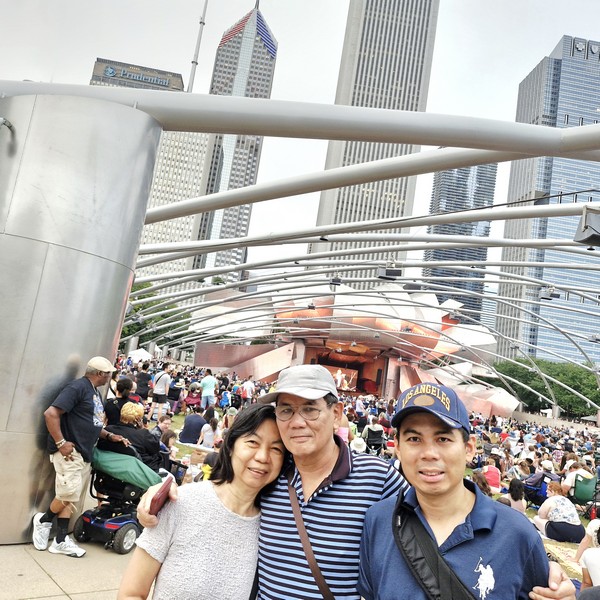
The Jay Pritzker Pavilion is the home, since 2004 (during the event’s 70th season), of the Grant Park Symphony Orchestra, the Grant Park Chorus as well as guest performers and conductors and the Grant Park Music Festival (formerly Grant Park Concerts), an annual 10-week classical music concert series. The nation’s only remaining free, municipally supported, outdoor, classical music series, the Festival is presented by the Chicago Park District and the Chicago Department of Cultural Affairs.
On occasion, the festival has been held at the Joan W. and Irving B. Harris Theater for Music and Dance instead of the Jay Pritzker Pavilion. The tradition of symphonic Grant Park Music Festival was a Chicago tradition since 1935, when Chicago Mayor Anton Cermak suggested free concerts, held at the Petrillo Music Shell in Grant Park, to lift spirits of Chicagoans during the Great Depression.
The Pavilion hosts a wide range of other music series and annual performing arts events. Performers, ranging from mainstream rock bands to the world’s leading classical musicians and opera singers, have appeared at the pavilion. Trained guides are available for the music festival rehearsals which are open to the public and well-attended. They also host physical fitness activities such as yoga.
The Grainger Plaza, a public space that hosts the Cloud Gate sculpture, is located on top of Park Grill, between the Chase Promenade and McCormick Tribune Ice Skating Rink.
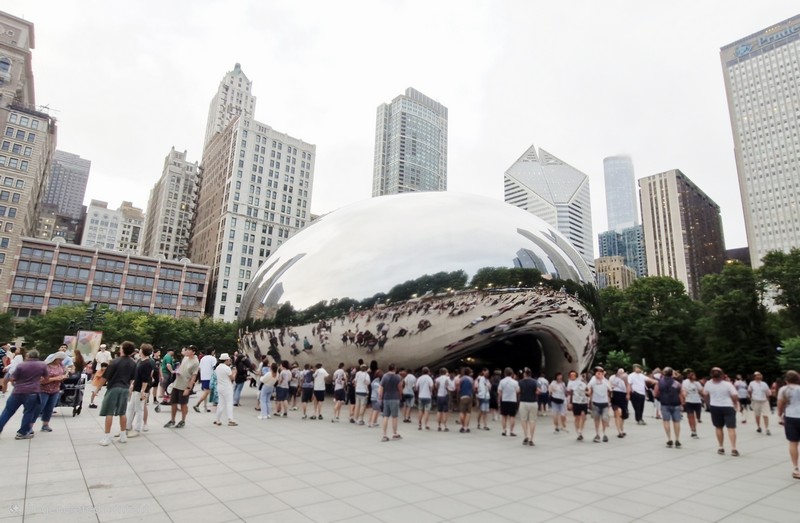
The plaza has become a place to view the ice rink and, during the holiday season, it hosts Christmas caroling. Cloud Gate, a three-storey reflective steel sculpture, is the first public artwork, by world-renowned artist Anish Kapoor, in the United States Dubbed “The Bean” by Chicagoans because of its legume-like shape, this privately funded piece cost $23 million (considerably more than the original estimate of $6 million) and builds upon many of Kapoor’s artistic themes. It has since gained considerable popularity, domestically and internationally.
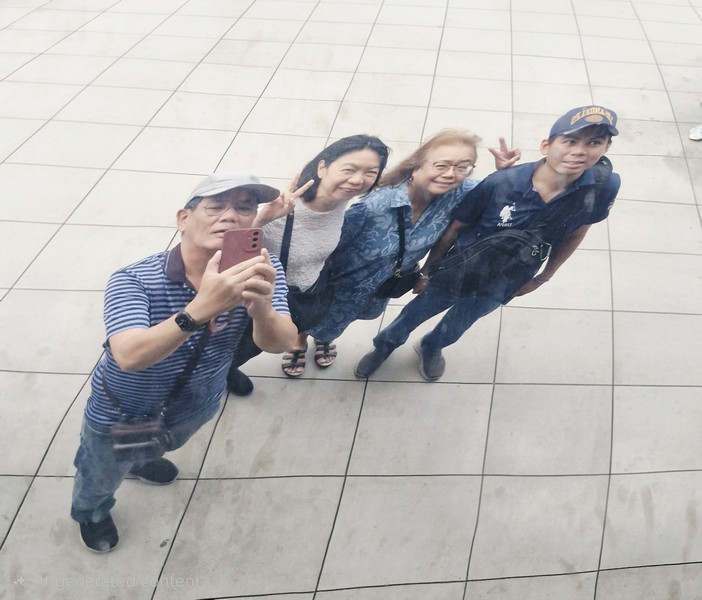
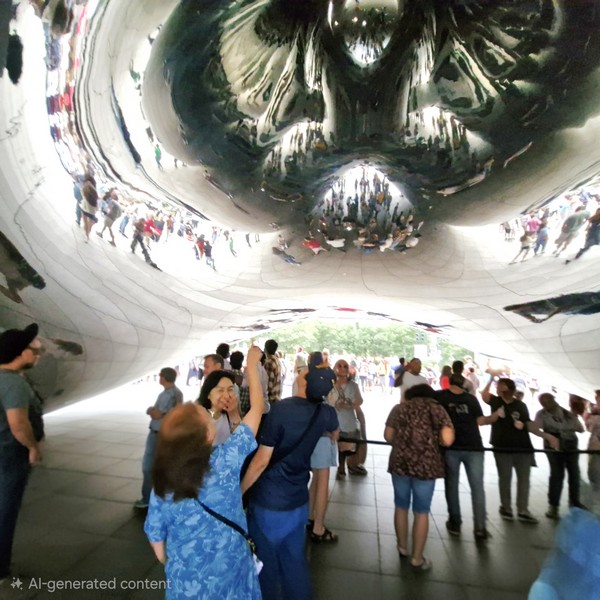
Composed of 168 stainless steel plates welded together, its smooth shape and highly polished mirror-like exterior, inspired by liquid mercury, has no visible seams. Measuring 10 × 20 × 13 m. (33 by 66 by 42 ft.), it weighs 110 short tons (100 t; 98 long tons). Reflecting the city skyline, particularly the historic Michigan Avenue “streetwall”, and the sky, it is a popular photo subject with tourists, providing striking reflections of visitors, who can walk around and under its 3.7-m. (12-ft.) high arch. On the underside is a concave chamber called “omphalos” (Greek for “navel”) that warps and multiplies reflections.
Nearby is the 150-seat The Plaza at Park Grill or Park Grill Plaza, Chicago’s largest al fresco dining facility, located along the western edge of Millennium Park, opposite the street wall of the Historic Michigan Boulevard District, which offers scenic views of the park. During its months of operation, it hosts various culinary events and musical performances. Affiliated with the 300-seat indoor Park Grill restaurant (located beneath the Grainger Plaza and Cloud Gate), The Park Grill Plaza, widely praised for its views, is the only full-service restaurant in Millennium Park, regularly placing among the leaders in citywide best-of competitions for best burger.
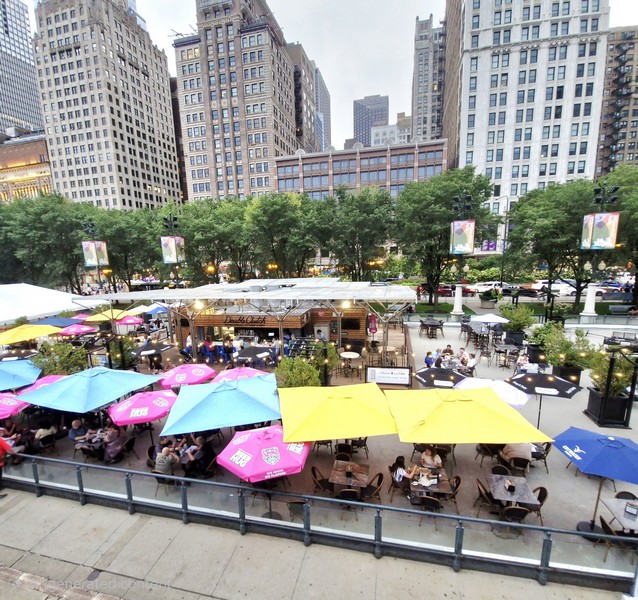
From mid-November until mid-March, The Plaza is transformed into the McCormick Tribune Ice Skating Rink, a $3.2 million multipurpose venue and plaza funded by a donation from the McCormick Tribune Foundation. This free public outdoor ice skating rink hosts over 100,000 skaters annually. During those winter months, the rink, operated by the Chicago Department of Cultural Affairs (rather than the Chicago Park District, which operates most major public ice skating rinks in Chicago), is known as one of Chicago’s better outdoor people watching locations.
Unfortunately, during our visit, the 1-hectare (2.5-acre) Lurie Garden, a public garden located at the southern end of Millennium Park, was closed (since March 2, 2026), for six months of repair and upgrades for the boardwalk and water feature (including new piping, jets, and a cleaned limestone wall) along with lighting improvements). It officially reopened on September 22, 18 days after our visit. The restoration was supported by the $10 million financial endowment donated by philanthropist Ann Lurie (after whom the garden was named after) and the Millennium Park Foundation.
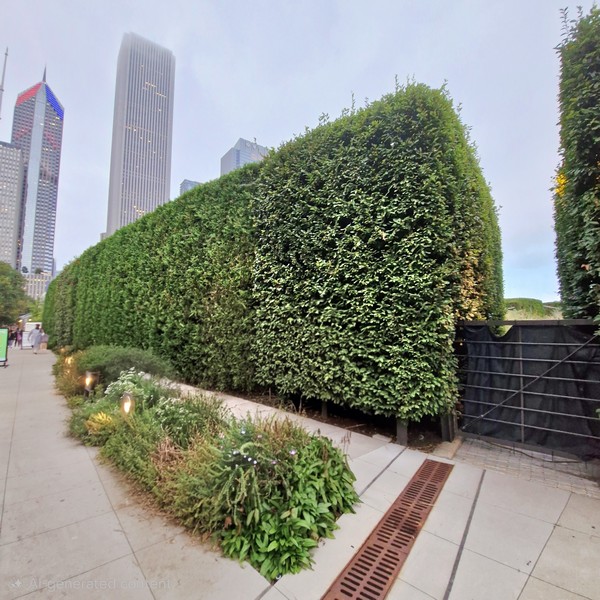
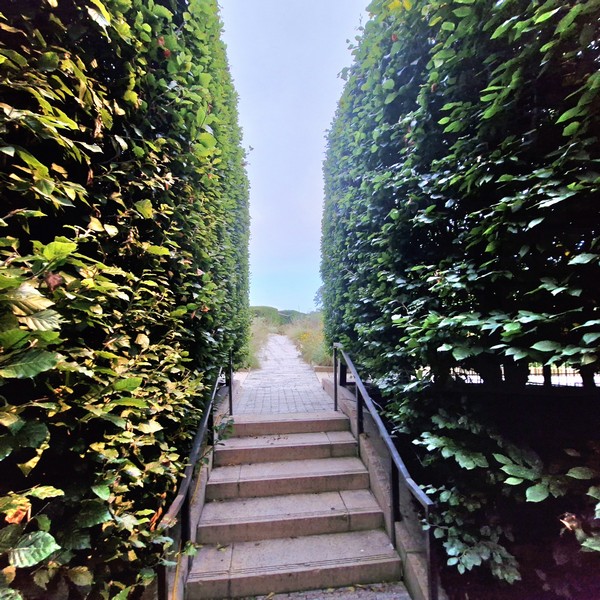
Designed by landscape architecture firm GGN (Gustafson Guthrie Nichol), Piet Oudolf, and Robert Israel and costing $13.2 million, it is a combination of perennials, bulbs, native prairie grasses, shrubs and trees and is the featured nature component of the world’s largest green roof. A tribute to the city (its motto is Urbs in Horto, Latin for “City in a Garden”), the Lurie Garden is composed of two “plates.” Depicting Chicago’s history by presenting shade-loving plants, the dark plate has a combination of trees that will provide a shade canopy for these plants when they fill in. The treeless light plate, representing the city’s future, features sun-loving perennials that thrive in heat and light.
Millennium Park: Grant Park, Chicago, Illinois. Open daily, 6 AM to 11 PM. Admission is free. Coordinates: 41°52′57″N 87°37′21″W. The park is closed from 11 PM to 6 AM daily. Dogs (except on-duty service dogs for the disabled or visually impaired) are not permitted in the park.