Trek to Bayugin Falls (Bulusan, Sorsogon)

Along our way to Lake Bulusan, Bernard, Philip and I decided to visit Bayugin Falls in Brgy. San Francisco, one of Bulusan‘s eco-tourism attractions.  We parked the SUV at the barangay chapel where we made a courtesy call on the barangay captain.  That done, we proceeded on our hike.  According to the barangay captain, the falls is just a 500-m. hike.  Initially the trail, along slippery but hard-packed mud, was relatively flat.  Halfway through the hike, we crossed a wooden footbridge over a very narrow, steep-sided creek which, according to Philip, is a possible fault line.

Philip at the wooden footbridge

Past the bridge, the trail eventually became steeper as we neared the falls, we having to go down steps carved along the hillside. This descent really made my knees shake.  After 20 mins., the sound of onrushing waters heralded our arrival at the falls.  What a magnificent falls it was! The falls, surrounded by a thick, mossy forest, is the source of the Bayugin River which eventually joins the Paghasaan River as it flows into the Bulusan River.  Now a popular swimming and picnic site, concrete picnic tables, a bamboo viewing deck and narrow plank bridges have been installed.

Bayugin Falls

Though we didn’t bring any swimming attire, Bernard couldn’t resist dipping his legs at the cold, onrushing waters.  We lingered at the falls for a cool 20 mins., savoring the sights and sounds and recording it all via camera.  The ascent, on our return, though short, was just as tiring.  Thus refreshed, we returned to our vehicle and continued on our way to Lake Bulusan.

The bamboo view deck

Bayugin Falls: Brgy. San Francisco, Bulusan, Sorsogon.

How to Get There: Brgy. San Francisco is a 20-min. tricycle ride from the town proper. 

Bulusan: Eco-Tourism Haven (Sorsogon)

After our interview of AGAP-Bulusan, Inc. president Philip G. Bartilet at Lake Bulusan, Philip accompanied Bernard and I to the Bulusan municipal hall where we made a courtesy call on, and had lunch, with Mayor Michael G. Guysayko.  Like Philip, first term Mayor Guysayko is supportive of the environment conservation projects of AGAP-Bulusan, the rehabilitation of denuded forests and sustainable eco-tourism in the BVNP.

L-R: the author, Mayor Guysayko and Bernard

After lunch, Philip again accompanied us as we toured Bulusan town’s tourist attractions.  Our first stop was the town’s Church of St. James the Greater in Brgy. Central.  Located on a site called Punta Diamante (named after its diamond-shaped wall formation), it is dubbed the “Intramuros of Bulusan.”  Its walls were made of stacked up volcanic stones.

Punta Diamante

The church wasn’t old (erected around 1760, its Baroque facade was totally renovated in 1970) but the parish compound is enclosed by ramparts of the triangular, Spanish-era muralla (“stone fort”). Around the walls are burial niches and niches for santos (“saints“) while at one end is the equestrian statue of St. James the Greater and a wooden cross, above which is the statue of a standing Jesus Christ, with arms outstretched, on a pedestal.

A baluarte de piedra at Punta Diamante beside burial niches

Four baluartes de piedra (stone watchtowers”) can still be traced from the remaining walls near the shores of Brgys. Central, Dapdap and Mabuhay.  The church’s 4-storey bell tower (locally called kampanaryo), the largest of the 4 watchtowers, was believed to have been built in 1631 after the town was made an independent from Casiguran in 1630.  With 8 sides, the tower’s walls taper upwards in alternating piers. The ill-conceived 4th storey, housing the bells, is a totally inappropriate modern addition.

The church bell tower

From the town proper, we motored, 1 km. out of the town, along the Bulusan-Barcelona Rd., to the white sand Dancalan Beach in Brgy. Dancalan.  A popular swimming spot, the relatively shallow Dancalan Beach is lined with beach resorts and kiosks beneath the coconut trees that provide shade for picnickers.

The white sand Dancalan Beach

We also passed by the Dr. Jose Reyes Ancestral House and, from the vantage point of a bridge, the Bulusan River.  The 12 km. river, formed by the merging of the Dulipay and Malinang Rivers, and the Malugoy-lugoy Rivers, is a potential nature trekking area.  From here, we proceeded on our way to Lake Bulusan where Bernard and I were to do some leisurely kayaking.

The Bulusan River

Irosin Town Proper (Sorsogon)

After breakfast at Nature Spring Resort, Bernard and I, accompanied by Ms. Jerelle J. Marquez, Irosin’s Municipal Tourism Officer, were driven to Irosin town proper.   Here, we  made a courtesy call on town mayor Eduardo Ong, Jr. at the yellow, white and blue, 2-storey municipal hall, the town’s former presidencia.  In olden times, the presidencia was the office of the gobernadorcillo (translated as “little governor”). 

The Irosin presidencia
Bernard and I with Mayor Ong

After our courtesy call, Jerelle and I climbed the 100 or so steps of a grand stairway, beside the presidencia, leading up to the hilltop Cathedral of St. Michael the Archangel.  A number of landings, provided along the wide stairway, allowed me some moments to rest.  The cathedral, whose roof was blown away during a typhoon on August 11, 1987, was renovated in 1996. I was surprised with the finished product.

The grand stairway
The Cathedral of St. Michael the Archangel

Possibly, in an effort to enlarge the cathedral, a 1-storey, box-like extension, with a white-tiled facade and semicircular openings with steel doors, was added during its renovation.  This not-so-carefully thought of  extension blocked the original church facade, its upper storeys seen only from afar or below the stairs.  Besides, this modern extension doesn’t at all match the old facade it replaced in front. The old convent was destroyed during a typhoon on December 25, 1981 and a new one was built at the right side entrance of the sacristy of the present church.       

Cagraray Island (Bacacay, Albay)

From Viento de Mar Beach Resort, we made our way back to the Bacacay municipal hall where we our driver and the Isuzu Crosswind was waiting to bring Bernard and I to the 5-hectare, Class “AAA” Misibis Resorts, Estate and Spa.  Opened in late 2009, this resort is located on the southeastern tip of Cagraray Island and is being touted as the “Boracay of Bicol.”   The island itself is an eco-tourism destination with rich limestone deposits, waterfalls and 28 caves (ancient burial jars were found in 2 of these caves).  Joining us as guide was Mr. Patricio Bechayda, the Fishery Law Enforcement Team (FLET) officer of Bacacay.

Sula Channel

This 71-sq. km., low island is a 20-km. (45-min.) drive from the town.  The fine, white sand Misibis Beach (Brgy. Misibis), one of the town’s 11 white sand beaches, is located on the island’s southeast corner. From the mainland, we crossed over the narrow Sula Channel  to the island via the newly-built,  2-lane Sula Delta Bridge.  Built at a cost of PhP150 million, this bridge is 265 m. long, has 5 spans and was built with modular steel paneling (Delta) with steel decking.  Prior to its construction, motorized bancas and cable cars on a hill, both used to transport people, and barges (for cars) were used to cross over to the island.  During bad weather, the placid Sula Channel was used in olden times as a sanctuary by Acapulco (Mexico)-bound galleons.

Sula Delta Bridge

Past the bridge, the road is lined with eco-friendly solar cell-powered street lamps.  Along the way, we made a short stopover at a covered concrete view deck with a fantastic view of Lagonoy Gulf and the islands of Rapu-Rapu, San Miguel and Agutaya.  We also passed a roadside fishpond with 3 native-style cottages raised on stilts, all connected to the shore by a wooden footbridge.

Bernard and Mang Patricio at the view deck
View of the islands of Lagonoy Gulf

We didn’t have time and the permit (the resort charges a substantial entrance fee) to explore the resort’s 37 luxurious, Asian-inspired villas, swimming pools and small beach.  Instead, we dropped by the 100-hectare Misibis Bay Eco-Park, part of the Misibis Bay Complex just adjacent to and outside the perimeter fence of the beachfront property.

The Eco-Park’s Information Hut

Past its gate is the Information Hut (with its man-made waterfall) and the picturesque, open-air mini-amphitheater, perched on the edge of a cliff, with its stunning backdrop of a shimmering bay and  its surrounding greenery.  The amphitheater was featured in the 5th leg, Philippine pit stop of the 4th season of The Amazing Race Asia which was won by a team from the Philippines.  It was also a shooting venue for the telenovela Dulo ng Walang Hanggang.

The mini-amphitheater

Further up the hill is the Eco-Energy Park Adventure Zone.  It has 4 different zip lines, an obstacle course and a towering climbing wall for adrenaline junkies.  Each zip line differs from the other in length, speed, duration and view.  However, all are exclusively for the use of resort guests.

The Adventure Zone

Eco-Energy Park Adventure Zone: open Mondays to Fridays, 8-11 AM and 1-5 PM; Saturdays, 8-11 AM and 1-3 PM.  Holidays by special arrangement.  Admission: PhP25/pax.

Church of St. Rose of Lima (Bagacay, Albay)

Church of St. Rose of Lima

The Church of St. Rose of Lima was said to have been started in 1660 (stamped on the church entrance), the year Bacacay became independent from Tabaco.    In 1952, it was heavily damaged by super typhoon “Trix” and again, in 1987, by another super typhoon, “Sisang,” which destroyed the roof and broke its glass windows.

AUTHOR’S NOTES:

Its 2-level façade, built with volcanic rock from Mayon Volcano, has semicircular arched main entrance with a poorly conceived and totally inappropriate white-painted concreteportico  built over it.  An earlier, late 1900s photo of the church shows it without one.


It is flanked by paired pilasters and statued niches with single pilasters at the end.  Above is a triangular pediment with a centrally located oculus. The church’s orientation is peculiar as it faces northwest instead of the bay, contrary to the stipulations of the Laws of the Indies.

The 3-storey bell tower

On the left is the 3-storey bell tower with a domed roof and receding storeys. Also on the left side of the church are the ruins of the old church and belfry, with meter-tick walls of volcanic rocks an high windows.  Outside the church is a statue of the risen Christ.

The church’s modern interior

Church of St. Rose of Lima: Bes St., Bagacay, Albay. Tel: (052) 487-2003. Feast of St. Rose of Lima: August 30.

How to Get There: Bacacay is located 502.6 kms. (a 10-hour drive) from Manila and 37.2 kms. (a 1-hour drive) from Legaspi City.

Bacacay: A Blend of History and Nature (Albay)

From Sto. Domingo, Bernard and I motored to the nearby town of Bacacay where we paid a courtesy call on, and had lunch with, 72 year old, first term Mayor Tobias B. “Tobing” Betito, the former vice-mayor and schoolteacher, at the newly renovated (last 2008), 2-storey municipal hall.  Mayor Betito granted us the use of an Isuzu Crosswind and the services of a driver so that we can explore Cagraray Island, the home of the 20-hectare, world-class Misibis Resorts, Estate and Spa.

The 2-storey municipal hall

Before leaving for Cagraray Island, we walked over, across the street, to the Church of St. Rose of Lima (a Peruvian saint).

Check out “Church of St. Rose of Lima

Church of St. Rose of Lima

At the left side of the church are the ruins of the old church and belfry.  My guess is these are the ruins of the church built in 1660.  The present church was probably built in the 1800s.

The old church ruins

We next walked over the hardly discernable remains of Roca Baluarte in Brgy. 3.  Formerly a Spanish-era fort with a lookout tower used to warn against Muslim pirates, it was converted into a beach resort but now lies abandoned, amidst nipa palms and mangroves, after the resort was ruined during super typhoon Reming (international name: Durian) that hit the Bicol Region on November 30, 2006.

Roca Baluarte
Mayor’s Office:  Municipal Hall, Poblacion, Bacacay, Albay. Tel: (052) 588-3243.  Website: www.bacacay.gov.ph.

Sto. Domingo: Birthplace of the Sarung Banggi (Albay)

The next day, Bernard and I left the Governor’s Mansion in Legaspi City and took a jeep to Quick & Hearty for a buffet Filipino breakfast.  Here, we met up with Mr. Martin A. Calleja, head of Bicol Adventures Philippines and Viento de Mar Beach Resort in Bacacay. After breakfast, we made a short stopover at the DOT Region V office at Rawis where we met up with Regional Director Maria O. Ravanilla.  From here, we made the short 11.5 km. drive to the nearby quaint town of Sto. Domingo.

The author with Bernard and Dir. Maria Ravanilla

Sto. Domingo, formerly called Libog (a corruption of the Bicol term libot meaning “roundabout”), is nestled at the foot of Mayon Volcano. The town is noted for its numerous beach resorts along the jet black sand Kalayukaii Beach in Brgy. Kalayukaii, located 3 kms. east of the town.  At the Spanish-era (the former tribunal and presidencia built in 1832) municipal hall in Plaza Pugad Lawin, we made a courtesy call on Mayor Herbie  B. Aguas.

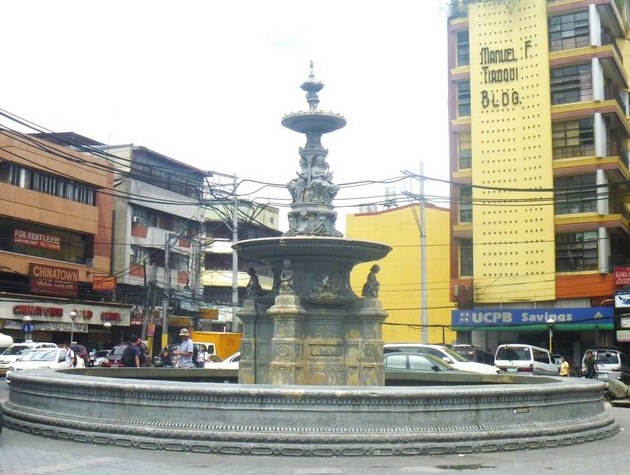
The municipal hall and fountain at Plaza Pugad Lawin

Also at the plaza, across the fountain and municipal hall is the picturesque Church of St. Dominic Guzman, the town’s most prominent landmark.

Check out “Church of St. Dominic Guzman

Church of St. Dominic Guzman

The town is also the birthplace of Potenciano V. Gregorio (May 19, 1880-February 12, 1939), the composer of the famous local ditty Sarung Banggi (meaning “one night”), the best known song in the Bicol dialect, on May 10, 1910.  The 8-day (May 18-25) Sarung Banggi Summer Festival, which features a folk song festival, immortalizes this love song and pays tribute to its illustrious local son.   His ancestral house was burned when a fire hit the town in 1961.

Potenciano V. Gregorio Mausoleum

On May 2005, Mayor Aguas, together with then Albay Gov. Fernando and First District Rep. Edcel Lagman, had Gregorio’s remains exhumed in La Loma Cemetery and brought home to Sto. Domingo for a municipal vigil and reinterred at the town’s cemetery with military honors. In 2006, a mausoleum and his bust, also at the town plaza, was erected and his remains transferred there.  In 2010, Gregorio was declared a municipal artist by the Sangguniang Bayan.

Mayor’s Office: Municipal Hall, Plaza Pugad Lawin, St. Domingo, Albay.  Tel: (052) 435-1357.
Department of Tourism Regional Office V: Rawis, Legaspi City.  Tel: (052) 435-0085 and 482-0715.  Fax: (052) 482-0712. E-mail: dot_bicol@yahoo.com. Website: www.wowbicol.com.

Church of St. Dominic of Guzman (Sto. Domingo, Albay)

Church of St. Dominic Guzman

First built in 1785 with wood and basag (bamboo splits), the second church was built with lava blocks in 1789 and completed in 1832.  Built with forced labor, during its construction, a mixture of lime, egg albumin and tangguli (molasses) was used to bind its massive stone walls. Burned in 1882, the present picturesque Church of St. Dominic Guzman was built with piedras ladradas, chiseled balustrades and twin domes.

The church’s Baroque facade

AUTHOR’S NOTES:

The church’s Baroque façade has a semicircular arched main entrance flanked by rectangular windows and two bell towers with dome-shaped roofs, giving it a graceful symmetry.  On the second level is a centrally located statued niche flanked by two occoli while the triangular pediment’s tympanum also has an occoli.

The church’s modern interior

Church of St. Dominic of Guzman: Tel: (052) 258-7111. Feast of St. Dominic of Guzman: August 4.

How to Get There: Sto. Domingo is located 469 kms. (a 9.25-hour drive) from Manila and 11.5 kms. (a 19-min. drive) northeast of Legaspi City.

Apuao Grande Island (Mercedes, Camarines Norte)

Back on our boat, we still had time to visit Apuao Grande Island, the most famous of the Siete Pecados Islands.  Located 10 kms. northeast of Daet and a 45-min. boat ride from Mercedes, we again made landfall at a beautiful stretch of white sand beach.  The island also has agoho trees (an evergreen species of trees that look like pine trees),  mangrove forests, a sandbar and a steep cliff (ideal for rock climbing) on the Pacific side.

Check out “The Siete Pecados of Mercedes

Apuao Grande Island

Apuao Grande Island was also once home to the once high-end TS Resort, formerly operated by the Australian-run Swagman Hotel chain.  At its heyday in the 1980s, it had 30 non-airconditioned cottages with bath, a restaurant, beach bar, swimming pool, tennis court, gym, sauna, a 9-hole golf course and an airstrip.  Now abandoned due to lack of marketing push and typhoons, most of the solar-powered villas are leased to many expatriates who want to stay on the island.

Posing with Apuao Pequena Island in the background

From Apuao Grande Island, we crossed over to the 24.29-hectare Apuao Pequena Island (also called Apuao Munti Island) which is connected to Apuao Grande Island by a land bridge (during low tide).  It wasn’t low tide yet, but somehow we managed to cross to the other side despite the somewhat strong current.  The island has a 350 m. long shoreline, a 150-ft. high mountain and a campsite.

The campsite at Apuao Pequena Island

We didn’t have time to visit Caringo Island and Malasugui Island (the smallest of the seven) and their white sand beaches and, thus, we again boarded our boat for the return trip back to the mainland. The perfect time for visiting these islands is from late March to early May.  It was such a pleasant surprise to see how beautiful islands such as these have been kept from the national tourism spotlight for so long.  Maybe, next time, they’ll take notice.

Crossing towards Apuao Grande Island

Mercedes Municipal Tourism Development Operation Center: Mercedes Fish Port, Mercedes, Camarines Norte.  Tel: (056) 444-1261.  E-mail: discovermercedes@yahoo.com. Website: www.discovermercedes.gov.ph.

The Siete Pecados of Mercedes

The Siete Pecados

I again got an invitation from Daet Mayor Tito S. Sarion to attend Daet’s Pinyasan Festival together with events organizer Mr. Bernard Supetran.  Two days before the big event, I hopped on the 1 PM Philtranco bus bound for Daet.  Normally, the trip took just 8 hours but traffic due to road widening and repair projects extended my trip another 2 hours.

Check out “Pinyasan Festival 2011

It was just about 10 PM when I arrived at the town, checking in at the Prime Suite Hotel along Vinzons Ave.  After a late dinner at a nearby Jollibee outlet, I met up with Atty. Debbee Francisco, of the Camarines NorteTourism Office, at the Miss Daet/Miss Pinyasan 2012 pageant held at the Daet Agro Sports Center.   Debbie scheduled an island hopping treat for us the next day.

Mercedes Fish Port

The next day, after breakfast, Debbee and Mr. Aldrin Sarion, a member of her staff, picked us up at our hotel and brought us to the municipal port of the nearby (7 kms.) town of Mercedes.  One of the most important and prosperous fishing ports in Luzon, this town, the fish bowl of the Bicol Region, is home to the third largest fishing ground in the country.   Mercedes’ large fishing fleet of 20-m. long basnigs supplies a large bulk of the catch of fish and shrimps to Manila.  We arrived in time for the lively early morning fish market (open from 6-8am).  At the port, we were welcomed by Mr. Victor John Orendain IV, a staff member of the Mercedes Municipal Tourism Development Operation Center.

Mercedes Municipal Tourism
Development Operation Center

Here, a boat (aptly named Dona Mercedes) was chartered for our morning tour of Mercedes’ picturesque Siete Pecados (“Seven Sins”) group of islands which comprises Apuao Grande, Apuao Pequeña, Canimog, Canton, Caringo, Malasugui and Quinapaguian Islands. Victor and Aldrin accompanied us on this trip and we brought along snacks and a tandem kayak.  Debbee stayed behind as she had to attend to their float for the festival.  On several occasions, while we were cruising along, we espied hundreds of flying fish doing their aerial acrobatics around our boat.  About 15 mins. into our trip, we passed (but did not land) by the by the crocodile-shaped Canimog Island, the largest of the 7 islands.  The island has a dramatic lighthouse where one can camp, a grayish sand beach and lush foliage which is home to thousands of huge bats.  Its  lighthouse, erected June 26, 1927, is one of the oldest in the Bicol Region.

Rocky Canimog Island and its lighthouse

About 30 mins. out of town, we arrived off the coast of rocky Canton Island. We also didn’t make landfall here as the island has no beach and has minimal vegetation.  However, the island is noted for its underwater Canton Cave. The cave is visible only at low tide and we were hoping that was the case as we planned to do some kayaking all the way to its entrance.  Disappointment was written in our faces as we neared the cave, still at its high tide mark.  Somewhat strong waves here would also have dashed our kayak to the rocks.  Oh well, maybe next time.   We proceeded on our way

Canton Cave

About 15 mins. later, we arrived at small Quinapaguian Island, this time making landfall at its nice stretch of white sand beach. The island offers a good view of the other islands and has a fish sanctuary where one can go snorkeling.  However, we weren’t there for the latter as offloaded the kayak from our boat, donned life vests, boarded the kayak and started paddling its calm, clear, blue waters towards the other side of the island.  This more than made up for our missed opportunity at Canton Island.

Quinapaguian Island
Bernard and I on our kayaking run

Mercedes Municipal Tourism Development Operation Center: Mercedes Fish Port, Mercedes, Camarines Norte.  Tel: (056) 444-1261.  E-mail: discovermercedes@yahoo.com. Website: www.discovermercedes.gov.ph.