Malay to Nabas Tour (Aklan)

On our third day in Aklan, my good friend Gil Bilog (my wife Grace’s first cousin on her mother’s side) and I had our breakfast at our usual hangout, Seaside Restaurant , Malay  poblacion’s (town center) only full-service restaurant which is owned and operated by Ms. Myra Oczon (Grace’s niece) and her husband Dodoy.  Both also work at the nearby Municipal Hall.  As the name implies, the restaurant is located by the sea, along the poblacion’s clean, gray sand beach.  At night, during supper, we could hear and feel the surf pounding the sea wall.  Along the beach, we could  see the lights along Boracay‘s long beach as well as faintly hear the sounds of its active nightlife.

Malay Poblacion Beach

The native-style restaurant serves a number of Filipino dishes (including my favorite sisig and Gil’s favorite sinigang) and grilled dishes (fish, chicken, pork, squid, etc.) and also has picnic sheds for those who want the feel of the sea breeze as well as get a panoramic view of distant Boracay Island and its well-known white sand beach.   There’s also a pension house with rooms with bath for transients.

Seaside Restaurant

In the afternoon, I decided to tour Gil to the nearby town of Nabas to explore its Union Beach. For lunch, I drove the Mitsubishi Adventure the 6 kms., with Gil and Carl Flores (Grace’s first cousin on her father’s side), along the now completely concreted road, to Andok’s at Brgy. Caticlan’s Jetty Port.  It was already starting to rain when we finished lunch and it remained so as I drove the 20 kms. along the scenic coastal highway to Nabas

Union Beach Resort & Lodge

Along the way, at the left of the highway, we had a stunning vista of unspolied white sand beaches, the likes of which were similar to Boracay before the advent of tourism.  We made a stopover at Union Beach Resort & Lodge where we had hot coffee and a long chat at one of its elevated picnic huts.   As it was the amihan season, the resort had set up screens to prevent wind-blown sand from bothering guests.  

Gil, me and Carl along Union Beach

During a break in the rain, we made our way through the opening in the screen to walk along the beautiful, palm fringed white sand beach.  Boracay and its offshore islands can also be seen in the distance, northwest of the beach.  At a nearby point of land, Carl pointed out a property owned by host and comedian Ariel Ureta.  The resort also has small airconditioned rooms with bath and cable TV for those who want to stay longer in quiet surroundings.

Carl and Gil at Tabon Docking Area.  Behind is Laurel Island

It was again starting to rain when we left the resort.  Driving back to Malay, we made a short stopover at the Tabon Docking Area where boats from Boracay drop off their guests when rough seas prevent their docking at Caticlan’s Jetty Port.  The concrete docking area was now cracked in places and in dire need of repair. Across the port, we had a good view of the rocky, aptly named Crocodile Island, other offshore islands as well as Laurel Island and its white sand beaches.

Crocodile Island

Before returning to Malay poblacion, we made another stopover at Nimya Flores-Thompson’s beautiful seaside house in Brgy. Motag.   Ate Nimya, a long time Australian resident and citizen whose British husband Bill died some years ago (in fact, on November 1, All Saints’s Day), spends part of the year in her home in Malay.  The house is protected from the sometimes raging sea by a concrete sea wall.

Ate Nimya’s beachside house

Nimya entertained us from her porch facing the clean gray sand beach and the sea.   She also has a small separate cottage which she rents out to expats (it was then occupied).  Nimya’s neighbors are also expats who married Filipinas.  They also built beautiful homes in this equally beautiful seaside setting.     

Brgy. Motag’s gray sand beach
Seaside Restaurant: Brgy. Poblacion, Malay, Aklan.  Mobile numbers (0918) 399-8052 and (0908) 140-9791.
Union Beach Resort & Lodge: Brgy. Union, Nabas, Aklan.  Mobile numbers (0949) 750-5177 and  (0921)  762-7564.

New Year’s Countdown at Manila Hotel

Last New Year, my family and I tried tried something new and different, spending the start of the year outside the country, firecracker-free in Kuala Lumpur, Malaysia, a first for all of us.  We just watched the fireworks at the Petronas Towers.  This year, we still had the same mindset, opting again to spend it outside our home (but not outside the country), this time a New Year’s countdown at the prestigious Manila Hotel for an incomparable evening of feast and festivities in a manner worthy of the country’s oldest bastion of hospitality.

Manila  Hotel – the Grande Dame of Manila

The Manila Hotel was opened for the first time to the public on July 4, 1912.  The original US$700,000 hotel, also the country’s first air-conditioned building, was designed in the California Missionary-style by American architect William E. Parsons in 1910.  At the time, this magnificent, white, green-tile-roofed edifice had 149 spacious, high-ceiling rooms. Its fifth floor penthouse, designed by Arch. Andres Luna de San Pedro (son of painter Juan Luna), was, from 1935 to 1941, the home of Gen. Douglas MacArthur (its first chairman of the board), his wife Jean and son Arthur.

The hotel’s beautiful lobby

The hotel played host to author Ernest Hemingway (who said “Its a good story if it’s like Manila Hotel”), actor Douglas Fairbanks, Jr., Edward (Prince of Wales), playwright Claire Boothe Luceand, during the Japanese Occupation,  Prime Minister Hideki Tojo and Gen. Tomoyuki Yamashita.  During the liberation of Manila, it was severely damaged by room-to-room fighting.  Reopened on July 4, 1946, it hosted author James A. Michener; actors Bob Hope, Marlon Brando, Charlton Heston, John Wayne, Tyrone Power and Burgess Meredith; U.S. Secretary John Foster Dulles; Sen. Robert F. Kennedy; British Prime Minister Sir Anthony Eden, the Rockefeller brothers, Publisher Henry R. Luce, rock star Michael Jackson; U.S. Vice-Pres. Richard M. Nixon, U.S. Presidents Dwight Eisenhower and Lyndon B. Johnson, the Beatles and other notable personalities.

The lobby dressed up for the New Year countdown

In 1977, the hotel underwent a US$30,000,000 renovation with an 18-storey tower designed by the late National Artist Architect Leandro V. Locsin built behind the old building.  The lavish interiors were done by American Patricia and Dale Keller and the renovated hotel reopened on October 6, 1977.

The Sunset Suite

We made our own grand entrance at the hotel’s main lobby on the afternoon of the 31st of December.  The 125 ft. (38 m.) long by 25 ft. (7.6 m) wide main lobby, lined with white Doric columns, was designed, not only for making grand entrances, but for sitting as well, its furniture carved with Philippine mahogany.  The lobby floors were made with Philippine marble while the ceiling is lined with chandeliers made of brass, crystal and seashells. Traditional Filipino art also adorns its walls.

Cafe Ilang-Ilang’s Dessert Station

The hotel that day was 90% booked for the countdown, with a long queue at the check-in counter, and it took some time before we finally checked into our fourth floor Sunset Suite, one of 570  traditionally decorated and elegantly furnished rooms that reflect the hotel’s storied past blended with the conveniences of a modern luxury hotel. Our suite had 2 bedrooms, a dining area and a living area.  Amenities here include individually controlled central air conditioning, remote-control TV with cable channels, minibars, separate bath and toilet with extension phone, and secure in-room safes.

Grace, Cheska, the author and Jandy at Cafe Ilang-Ilang

Once settled in, we then went down for our crossover buffet dinner (6 PM to 9 PM) which extends through all the hotel’s celebrated food and beverage outlets: Cafe Ilang-Ilang, Champagne Room, Mabuhay Palace (an impeccable Chinese restaurant), Tap Room Bar and Lobby Lounge.  That night, it was not a choice of which restaurant to go to, but, rather, which restaurant to visit first.  We chose the famous Cafe Ilang-Ilang which was recently renovated and launched as a 3-period meal buffet restaurant. It opens to the newly renovated Pool and Garden areas and boasts of 9 live cooking stations.

The Tap Room Bar

Here, we faced a stunning and wide array of Filipino and international (Korean, Japanese, Indian, etc.) cuisine, tried-and-true dishes prepared by Filipino and foreign chefs, all backed by years of professional experience in acclaimed restaurants around the world.  To fully enjoy the cafe’s  stellar main courses, we ate small portions of everything.

The countdown begins …..

After our filling buffet dinner, we moved on to the Tap Room Bar for dessert and brewed coffee. We capped our evening with the New Year’s Countdown at the Lobby where, prior to bidding farewell to 2011 and counting the seconds to 2012, we enjoyed live entertainment, with music and dancing provided by the Filipinas Band.

The Filipinas Band
Manila Hotel: 1 Rizal Park, Ermita, Manila: Tel: 527-0011. Fax: 527-0022-24 & 527-1124.  Domestic Toll Free: 1-800-9-1888-0011.  Email: sales@manila-hotel.com.ph and reservations@manila-hotel.com.ph.  Website: www.manilahotel.com.ph.

The Amazing Street Art of Angono (Rizal)

After our tour of the Ang Nuno Artist Foundation Gallery at Balaw-Balaw Restaurant, Jandy and I again boarded our car to tour the town proper.  Angono’s streets are very narrow and hopelessly riddled with traffic.

C.V. Francisco – Bunung Brazo, 1958 (Charlie Anorico, 2005)

However, upon reaching Dona Aurora St., my exasperation was somewhat mitigated when we caught sight of amazing concrete murals beautifully embellishing and adorning this street, all meant to honor Angono’s artistic roots.

Mt. Makiling in the Eyes of Botong (Carlos V. Francisco)

These extraordinary works of art are bas relief reproductions of local son and well-known Filipino muralist Carlos “Botong” Francisco’s works cast in concrete, all done by Charlie Anorico, Gerry Bantang and Ebong Pimpino.

C. V. Francisco – Merienda, 1958 (Charlie B. Anorico, 1999)

Upon turning a different corner, we were greeted by another mural honoring Lucio San Pedro, another local son, whose most famous composition, the perennial Filipino lullaby “Sa Ugoy ng Duyan,” is depicted on a wall as a music sheet, with cast metal notes jutting out of the concrete.

In fact, these murals as well as sculptures are a recurring theme throughout the town, with a  preponderance of mermaids.  The stone marker of Brgy. Poblaction is a sculpture of “Ang Nuno” (meaning “old man”), the origin of the town’s name.

There’s even a reproduction of the Statue of Liberty, painted in gold.  Angono is truly a town still very much in touch with its unique artistic heritage.

Bayanihan (Carlos V. Francisco, 1960)

Angono Street Murals: Dona Aurora St., Brgy. Poblacion Itaas, Angono, Rizal

Ang Nuno Artists Foundation Gallery (Angono, Rizal)

Balaw-Balaw Restaurant

After my interview with Nemi R. Miranda, Jandy and I moved next door to the Balaw-Balaw Specialty Restaurant.  This restaurant, made famous by Andrew Zimmern in Discovery Travel and Living’s “Bizarre Foods,” offers truly exotic cuisine such as sautéed ants and crickets, wood worms and frog cooked adobo style, Soup No. 5 (cow butt and testicles),  adobong uok (beetle larvae), among others.

Wooden sculptures of Angono’s higantes

Andrew tried the last two.  However, having already taken lunch, we weren’t there for the exotic food (Maybe next time).  Rather, we wanted to explore the Ang Nuno Artists Foundation Gallery  at the second floor.

Luckily, Andre, the restaurant manager (and also an artist) son of the late artist and sculptor Perdigon N. Vocalan, was there and he granted us permission to explore the gallery upstairs. The dining area is already a gallery of sorts, with colorful paper mache sculptures and paintings (with subjects ranging from basket of fruits to mythical creatures) all around the patchwork property.  Outside, soda bottle lanterns hang from trees.

Upon climbing the spiral staircase, we were ushered into an impressive repository of Philippine treasures that showcases Filipino heritage through colorful papier mache, antiques and artworks by Perdigon, his sons Andre and Rembrandt as well as other independent and budding local artists and craftsmen from Angono and other Rizal towns.

A collection of wood sculpture and furniture

The accomplished Vocalan was influenced by the late National Artist and Angonon Carlos “Botong” Francisco (November 4, 1912 – March 31, 1969) and his  various paintings, sculptures and woodcarvings, inspired by Filipino traditions and legends,capture Angono’s rich cultural heritage as well as depict folk stories and characters like the kapre (a menacing creature that seeks refuge in big trees), duwende (goblin)tikbalang (demon horse), manananggal (a woman with the ability to detach the two halves of its body at the waist), and the like. He also depicted women in all their glory and beauty.  There are also several depictions of the Mother and Child.

Dining table with tapayan above it

The gallery, a reflection of Perdigon’s eclectic taste, also has an impressive collection of antiques and religious objects such as statues of saints (some just heads without a body), a complete tableau of the Last Supper and a Santo Entierro (statue of the dead Christ). There’s also a collection of antique furniture including folding chairs, a complete dining table set (with earthen, knee-tall jars or tapayans hanging above it)  and a huge, intricately carved wooden door.

Tableau of Last Supper

I also took a peek, via a spiral stairway, at the third floor which houses a workshop  where huge, colorful masks of the higantes for the Higantes Festival are made. In 1987, Perdigon conceived the idea of the Higantes Festival.

Wooden sculpture of a mermaid

He advocated having more higantes (papier mache giants) in the town fiesta by coordinating with the barangays of Angono to come up with higantes that will represent their barangay. Miniature papier mache dolls, great examples of Filipino folk art, are also made here for souvenir hunters.

More wooden sculpture

Ang Nuno Artists Foundation Gallery: Balaw-Balaw Specialty Restaurant, 16 Doña Justa Subd., Phase I, Brgy. San Roque, Angono, Rizal.  Tel: (632) 651-0110 & 295-2698. Mobile number: (0923) 714-4209. E-mail: balaw2x@yahoo.com. Open daily, 10 AM-10 PM.

Nemiranda Arthouse (Angono, Rizal)

Nemiranda Arthouse/Atelier Cafe

After lunch at a Shakey’s outlet in Taytay,  Jandy and I proceeded to the next town of Angono, the “Arts Capital of the Philippines.”  Using the only Angono map I had, I tried to find the Nemiranda Arthouse/Atelier Cafe only to find out it wasn’t where its supposed to be in the map.

I finally resorted to asking the locals.  That worked and soon enough we found the place, a lofty old wood, bamboo and concrete house converted into a home-studio with a prominent signage at the street corner.

I entered the arthouse (also known as “The House of Myths and Legends”), via a side gate, into the coffee shop where I was welcomed by Katrina, the painter daughter of 62 year old local artist Nemesio “Nemi” R. Miranda (popularly known in the art circle as Nemiranda), who was currently touring some children around the art gallery.

I was hoping to interview Nemiranda, but Katrina told me that I just missed him as he left on his motorcycle.  She gave us free rein to tour the extensive, 3-floor art gallery ourselves.  A massive, larger-than-life, pastel blue stone mermaid (sirena) is prominently placed above the art gallery’s arched entrance.

Art Gallery entrance

A Fine Arts graduate of  University of Sto. Tomas and a disciple of the late noted Angono artist Carlos “Botong” Francisco, this highly figurative artist’s artworks employ figurative realism  (which he calls “imaginative figurism”) wherein the human form is drawn from pure imagination.

Nemiranda’s work inevitably evolves around the female form and it is vividly seen in almost every artwork that we observed. These include mother and child sketches, mermaids, nudes (Nemiranda is also deemed as an erotic painter) done in different styles, women giving birth, nursing mothers, etc..

Nemiranda’s Imaginary Figurism

Other stunningly beautiful paintings depict random subjects such as rural life (families in pastoral scenes, etc.) and subjects from local folklore such as mythical creatures and nature goddesses.  On display at one section are wood carvings of the “Stations of the Cross.” Also on display are artworks by Nemiranda’s 5 sons and daughter Katrina as well as fellow artists from Rizal.

Wood carvings of the “Stations of the Cross”

We also saw Nemiranda’s impressive collection of local and international awards, proof of his countless unparalleled excellence and achievements in the arts.   At the end of the gallery are some art pieces for sale. This veteran artist has launched over 35 solo art exhibitions in various parts of the world and was commissioned to do monumental sculptures and mural paintings throughout the country.

Sculpture of a pregnant woman

Some of Nemiranda’s popular and impressive commissioned works includes the “History of the Philippine Army,” a relief sculpture located at the parade ground of Fort Bonifacio; the EDSA Shrine Mural (along with 14 other Angono artists), muted murals interpreting and depicting the 4-day  People Power revolution in the main chapel of the EDSA Shrine; the EDSA II Relief Sculptures; “The Way of Mary,” a 20-relief sculpture of the Mysteries of the Holy Rosary, from EDSA Shrine to Antipolo Shrine; and the 40-ft. high “Crucified Christ” (unveiled in Tacloban City in 2002), the map of Leyte interpreted as a sculptural island shaped by nature into the image of the crucified Christ. His paintings also hang in the many prestigious homes and offices, both here and abroad.

A collection of nude paintings

Jandy and I were still exploring the art gallery when Nemiranda finally arrived.  We were introduced to him by Katrina and I proceeded to interview him at length. As a true-blooded Angonon, Nemiranda has been instrumental in making Angono as the “Art Capital of the Philippines,” making great contributions in promoting the town’s rich heritage.

The Arthouse is also part of Nemiranda’s mission to nurture the artistic consciousness, not just for the Angonons, but for all Filipinos as well, conducting, for years on a regular basis, lectures, guiding services and painting workshops designed to inspire the youth who, by talking to Nemiranda and watching the artist go through the creative process, might see how an idea can grow into a finished work of art.

Some of Nemiranda’s numerous awards

In 1975, Nemiranda  founded the renowned Angono Ateliers Association, the first in the town to popularize sculpture in concrete (started in 1970).  He was also chairman of the Angono Tourism Council and the promoter of the town’s Higantes (“giant”) Festival and the fluvial procession dedicated to San Clemente, Angono’s patron saint. He also institutionalized the Nemiranda Family Art Museum, the Angono School for the Arts and the Nemiranda Atelier Café, all catering to the development, promotion and growth of the Angono art community.

The author with Nemiranda
Nemiranda Arthouse/Atelier Cafe: 10 Doña Elena St., Doña Justa Village, Brgy. San Roque, Angono, Rizal. Tel:  (632) 651-0109-10. Fax: (632) 651-3867. Email: inquiry@nemiranda.net and nemi_miranda@yahoo.com. Website: www.nemiranda.net. Admission fee: PhP30.

Church of St. John the Baptist (Taytay, Rizal)

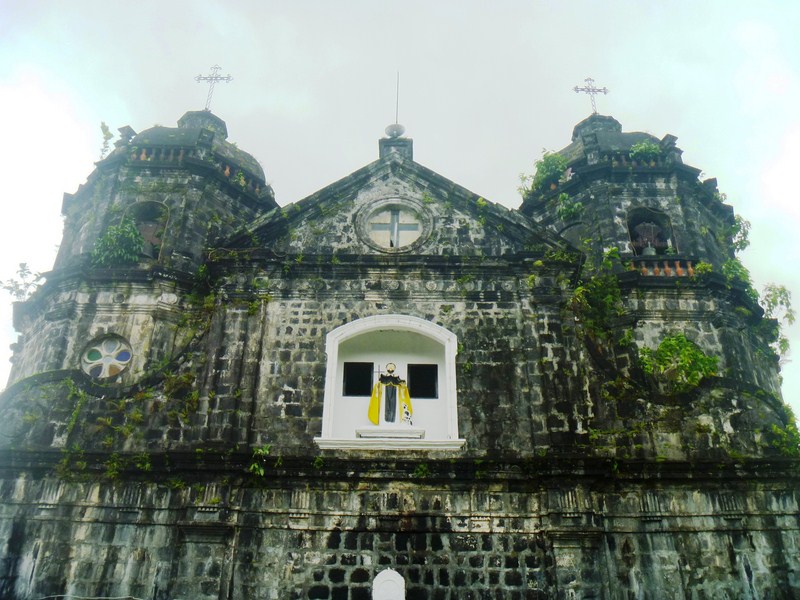
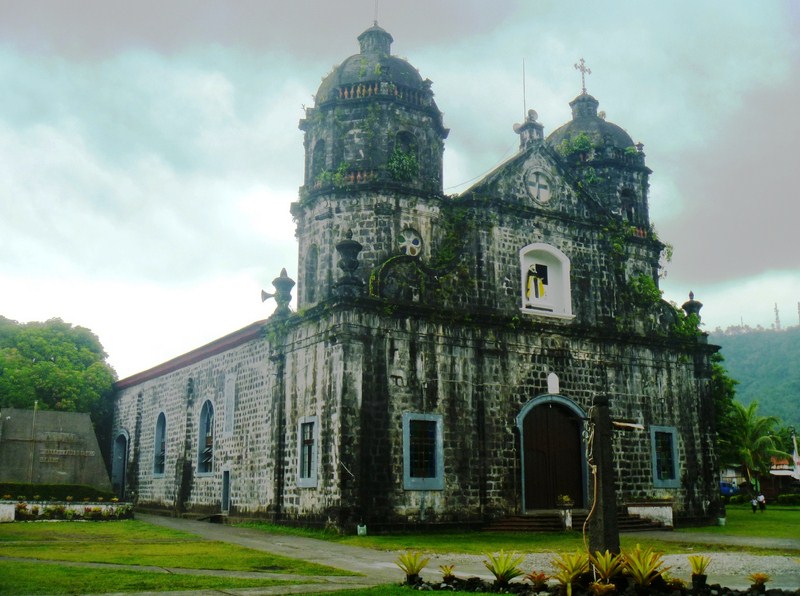
Church of St. John the Baptist

The town’s first church (Visita de Sta. Ana de Sapa) was a chapel made of light materials near the shores of Laguna de Bay dedicated to its patron saint, John the Baptist.

Due to frequent flooding from the shores of Laguna de Bay, it was transferred by Jesuit Fr. Pedro Chirino (who documented the Tagalog language as well as the way of life of Filipinos from his interactions with the inhabitants, forming the basis for his book Relación de las Islas Filipinas) to its present site, a higher location in a hill which called San Juan del Monte where the parish has remained to this day.

The Early Renaissance facade

The town’s church, started in 1599 and completed in 1601, was considered to be the first church built by the Jesuits out of stone outside Manila.

Bas-relief of the Holy Eucharist.  The fluted Ionic pilasters are both topped by angels.

In 1630, a larger church was constructed by Fr. Juan de Salazar. In 1632, a typhoon blew away the roofing of the new church, which was soon replaced with the help of the townspeople.

Bas-relief of Crossed Keys. The two symbolic keys form a St. Andrew’s Cross. These keys appear on the coat-of-arms of the Holy See,Vatican City and of every pope since the 12th century.

In 1639, the church sustained significant damage when the Chinese, during their revolt against Spanish authorities, set fire to the church.

Bas-relief of a cross between two lambs. The lambs represent the faithful coming to Christ (represented by the Cross)

St. Pedro Calungsod (the second Filipino declared as a saint by the Catholic Church) once served as an altar boy in the church in 1666 and then serving as assistant to Blessed Diego Luis de San Vitores in the Marianas in 1672 (when both were martyred). In 1768 (under secular priests) and 1864 (under Augustinian Recollects), additional works were made to the church.

Statue of St. John the Baptist

During the Philippine–American War, both the church and the convent were reduced to ruins. After the war, the church was reconstructed. Massive renovations in the 1970s left very little of the original Classic façade.

Jandy with the church interior in the background

The present church, built with concrete, shows no traces of the old Jesuit church. In 1992, the National Historical Institute (NHI), now the National Historical Commission of the Philippines (NHCP), unveiled a historical marker in the church.

NHI plaque installed in 1992

AUTHOR’S NOTES:

The church’s Early Renaissance facade has three levels of superpositioned, fluted pilasters (the first level is Doric and the other two Ionic).  The first level has a semicircular arch main door with canopy (a later addition), with a semicircular arch statued niche above it and along the flanks.

The walls of the second and third levels are decorated with pairs of huge bas-reliefs of the Crossed Keys and a Cross between two lambs and one of the Holy Eucharist.  The triangular pediment, topped by a cross, is lined with dentils.

The four-storey square bell tower, on the right side of the church, has semicircular arch windows and is topped by a pyramidal roof.  On the left side of the church is a huge statue of St. John the Baptist.

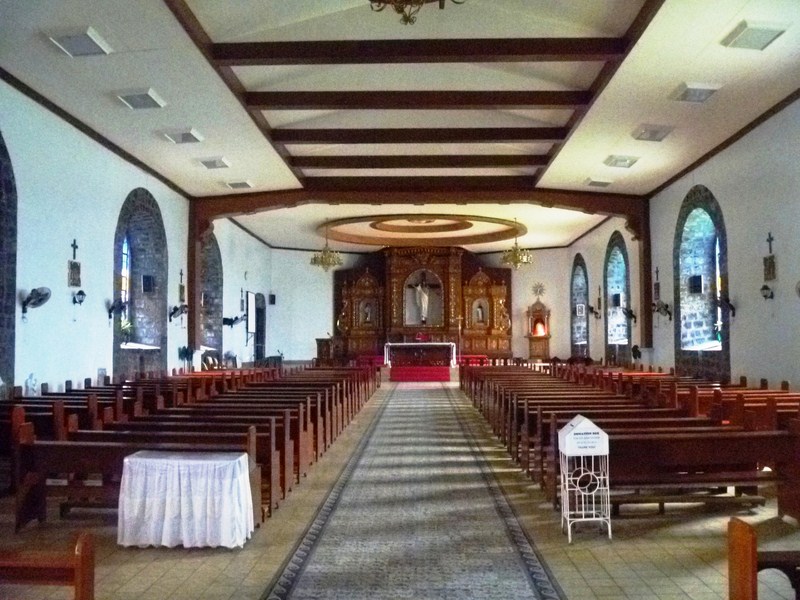
The main altar

Church of St. John the Baptist: J. Sumulong St., Brgy. San Isidro, TaytayRizal.  View Map>>> Tel: (632) 8658-6489.  Feast of St. John the Baptist: June 24.

How to Get There: Taytay is located 23.4 kms. from Manila and kms. (a drive) from Antipolo City.

Panumpaang Bayan (Tanza, Cavite)

From the Tejeros Convention Site in Rosario, Jandy and I were back on the road again, this time proceeding to the next historical town of Tanza and on to its church and convent.  Over a hundred years ago, Gen. Emilio Aguinaldo also followed our lead, proceeding, after his election as President of the revolutionary government in Tejeros, the day before, to the hall of the town’s 2-storey parish convent (now called the Panumpaang Bayan or Oath Taking Hall), built in the 1860s.

Parish Convent Hall (Panumpaang Bayan)

Here, around 8 PM on March 23, 1897, Gen. Aguinaldo and Gen. Mariano Trias took their oath of office in a solemn ritual, before Fr. Cenon Villafranca, as President and Vice-President, respectively, of the revolutionary government that replaced the Katipunan.  The next day, around 1 AM, Pascual Alvarez (as Director of the Interior), Severino de las Alas (as Director of Justice), Emiliano Riego de Dios (as Director of War) and the reluctant Artemio Ricarte* (as Captain-General or General-in-Chief), one by one, also took their oath of office.  The first cabinet meeting also took place here.

*It was said that Ricarte was forced to take his oath of office so that he could leave the place unmolested.  In fact, he signed a protest regarding this, stating that he could not accept the position of Captain-General because the election in Tejeros (Rosario, Cavite) did not reflect the real “will of the people” and that he took his oath because he feared for his life.

AUTHOR’S NOTES

In 2012, the renovation of the convent was started and, on March 23, 2014 (the 117th anniversary of the oath taking), its second floor was inaugurated as the Sta. Cruz Convent Museum.  It now houses historical memorabilia, the black flag used by Gen. Mariano Llanera, paintings that depict the history and arts of Tanza, antique furniture and life size diorama depicting the “Oath in Tanza.” It is open Tuesdays to Sundays, 8 AM to 5 PM. Admission is free.

Panumpaang Bayan: Brgy. Poblacion 1, Tanza.

Tejeros Convention Site (Rosario, Cavite)

From the town of Rosario, we entered the town of Gen. Trias (formerly San Francisco de Malabon).  Just past the boundary marker is the Tejeros Convention Site (still a part of Rosario), the site of the historic March 22, 1897 Tejeros Assembly (or convention).  A milestone in Philippine history, the assembly  established the first Philippine government that replaced the Katipunan with a government that would meet the manifold demands of the revolution.  The site is also considered as the birthplace of the Armed Forces of the Philippines (AFP).

Tejeros Convention Center

Located at the 7,800-hectare Tejeros Casa Hacienda Ruins, the former Recollect estate house, here the warring Magdalo faction of Emilio Aguinaldo and the Magdiwang faction of Andres Bonifacio met to establish a revolutionary government.  Presided over by Bonifacio, the assembly decided to establish a central revolutionary government toward the end of the session.   Aguinaldo was elected President, Mariano Trias as Vice-President, Artemio Ricarte as Captain-General, Emiliano Riego de Dios as Director of War and Andres Bonifacio as Director of the Interior.  While Bonifacio was being proclaimed, Daniel Tirona, a Magdalo, stood up and questioned Bonifacio’s qualifications.  A lawyer, he said, should fill the position.  Bonifacio, invoking his authority as presiding officer, declared the proceedings null and void and left in disgust.  He established his own government in Naic, Cavite.

Casa Hacienda Ruins

The site is now a landscaped park with the Cañas River to the west.  At the northwestern corner of the lot are the ruins of a heavy adobe structure with stairs, believed to be the Casa Hacienda.  Within the ruins is a tunnel, possibly a secret escape route leading to the river.  In 1941, a bronze marker was installed on the site by the Philippine Historical Committee. Two markers, from the National Historical Institute (NHI), in English and Tagalog, were installed in 1973.

Tunnel said to lead to the river

Also within the site is the new 3-storey Tejeros Convention Center (damaged during a recent typhoon) and, in front of it, a standing statue of Gen. Emilio Aguinaldo.

Interior of Tejeros Convention Center
Tejeros Convention Center: Gen. Trias Drive, Brgy. Tejeros Convention, Rosario, Cavite.
.

Home of Another Aguinaldo (Kawit, Cavite)

After my visit to the Aguinaldo Shrine, Jandy and I returned to our car and retraced our way back to Brgy. Binakayan, also within Kawit, this time in search of the home of where Baldomero Aguinaldo (February 26, 1869-February 14, 1915), Emilio Aguinaldo’s first cousin, lived as an adult.

Check out “Aguinaldo Shrine” and “Liwasang Emilio Aguinaldo

Baldomero was also a lieutenant-general during the Philippine Revolution (he figured in the battles of Binakayan-Dalahican, Noveleta, Zapote River, Salitran and Alapan), Emilio’s right-hand man and a member of the latter’s cabinet (Auditor General, Director of Finance, Secretary of the Treasury, Auditor of War and Secretary of War and Public Works).  He also helped draft and signed the Constitution of Biak-na-Bato. During the Philippine-American War, he returned to the battlefield as commanding general of the Southern Luzon provinces.

Baldomero Aguinaldo Shrine

Built with narra and molave wood in 1906 and now painted in pastel blue and white, this typical 2-storey country home of a gentleman farmer was turned over by his grandson, former Prime Minister Cesar E.A. Virata (who also happens to be the father of my U.P. classmate Steven) to the Philippine government in 1982. This shrine has a museum on the ground floor with a diorama of the Battle of Binakayan.  On the second floor are antique furniture such as a turn-of-the-century upright piano.  Opposite the house is the former kamalig (storage shed for produce), now a museum showcasing Cavite’s role in the revolution.  On the walls are photographs and drawings of Cavite’s military heroes.

Behind the house, in a quiet corner, is the family plot where Baldomero, his wife (Petrona Fauni Reyes-Aguinaldo), their 2 children (Leonor and Aureliano) and their spouses (Dr. Enrique T. Virata and Liwanag Virata) are all buried.  The shrine is now administered and managed by the National Historical Institute (NHI) which installed a historical marker here on June 12, 1983.

NHI Historical Marker
Baldomero Aguinaldo Shrine: Brgy. Binakayan, Kawit, Cavite.  Open Tuesdays to Saturdays, 8 AM to 4 PM.  Admission is free.  Lectures and guiding service can be arranged.

Liwasang Emilio Aguinaldo (Kawit, Cavite)

It was the eve of All Saints Day and Jandy and I, again bored at home, decided to go on a day-long tour of the historic and nearby province of Cavite.  Our first destination, fittingly, was the town of Kawit, home of the Aguinaldo Shrine, the site of the proclamation of Philippine Independence.  After about  2.5 kms. past the Island Cove Resort and Leisure Park, we arrived at the shrine and parked our Toyota Revo at the shrine’s parking lot.

Aguinaldo Shrine and Liwasang Emilio Aguinaldo

On ordinary days, the shrine receives an average of 375 visitors a day and, during weekends, visitors to the museum and the park are usually families from Manila (only a few come from Cavite).  From August to February, visitors are mostly of students from Manila who go there on educational tours.  Jandy himself visited during a Jesu-Mariae School educational tour on March 7, 2000.

Equestrian Statue of Emilio Aguinaldo

The shrine that day was closed, it being a holiday, so we just explored Liwasang Emilio  Aguinaldo, a people’s park  fronting the house. The grounds of the house is bordered by a river on the east and a fish pond to the south. The Aguinaldo house was previously fronted by a busy street.  In 1998, a few shanties were demolished to give way to the park inaugurated on June 11, 1998 in time for the Philippine Centennial celebration held the next day (100 Philippine flags were hoisted during the celebration).

Marble Slab with Act of Proclamation of Independence

It now has a long promenade and used to have 2 long pools (now covered with stones).  It is highlighted by a bronze equestrian statue of Gen. Emilio Aguinaldo set on a black marble pedestal.  Around it are 2 black marble wall slabs, one etched with the text of the written manifesto on the “Act of Proclamation of Independence of the Filipino People”and the other with the signatures of the signatories.

Marble Slab with Signatures of Signatories
Aguinaldo Shrine: Kawit, Cavite.  Open Tuesdays to Sundays, 8 AM to 4 PM. Admission is free.