Holy Week in Pangasinan

El Puerto Marina Beach Resort & Spa

Come Holy Week, I got an invitation from El Puerto Marina Beach Resort and Spa owners Roland and Flordeliza Versoza to stay at their resort in Lingayen and, not having any other activity planned for the holidays, decided to accept their offer.

A group of flagellants

A penitent carrying a wooden cross

It was also to be my first visit to Pangasinan’s capital.  For company, I brought along my children Jandy and Cheska and we all left on Wednesday afternoon, the eve of the Holy Week rush.  As such, my 227-km. trip, normally a 4.5-hour drive, took all of 6 hrs., it being a holiday.  We arrived at the resort by 8 PM.

Check out “Resort Review: El Puerto Marina Resort and Spa

Our room for the night

We were welcome by Flor who billeted us at one of the resort’s rustic airconditioned native-style bungalows with bath and cable TV.  Resting on stilts, these bungalows are cantilevered over a fishpond and reached via an S-shaped wooden footbridge. Quite famished, we dined at its equally rustic pavilion before calling it a night.

Cheska at the Hundred Islands

The next day, we joined a group which included Fil-American Katrina Nogoy and Malaysian-American Janet Jun Siew Loh, both teachers in Japan, for a tour of the Hundred Islands  (Cheska was a first-timer to these islands) in Alaminos City. On our way back to the resort, we dropped by the Cathedral of the Epiphany of our Lord in Lingayen.

Check out “Return to the Hundred Islands” and the “Cathedral of the Epiphany of Our Lord” 

Picnic sheds along Lingayen Beach. We pitched our tent at the second hut from the right

On our second night at the resort, I brought out my 5-pax Coleman tent and  went camping along this adjoining, gently-sloping, cool, quiet gray sand beach. A bonfire was set up that night by the resort.

One of the resort’s resident arapaimas

The next day, we watched 2 big South American arapaimas being fed at the resort’s  koi pond. Later, Katrina and Janet joined us as we toured Lingayen, visiting the Pangasinan Provincial Capitol, the Sison Cultural and Heritage Center and the War Memorial Museum.

Check out “Pangasinan Provincial Capitol,” “Sison Cultural and Heritage Center” and “War Memorial Museum

Cathedral of the Epiphany of Our Lord

Provincial Capitol

The author (left) with Cheska and Jandy at War Memorial Museum

Sison Cultural and Heritage Center

El Puerto Marina Beach Resort and Spa: Don Martin Domingo St., Pangapisan North, Lingayen, Pangasinan.  Tel: (075) 542-5328.  Fax: (075) 542-2285.  Mobile: (0917) 867-3908 and 3906. Manila tel: (632) 852-3404, 986-3404 and 775-6789.  Fax: (632) 824-7384.   E-mail: inquiries@elpuertomarina.com.  Website: www.elpuertomarina-pangasinan.com.

Malinta Lateral Tour (Corregidor Island)

After the launch of the ROCKet Zipline, I joined the media group on a ghost-hunting tour of the unexplored and unlighted hospital laterals of Malinta Tunnel.   Here,we donned hard hats for head protection (some parts of the tunnel have low head rooms) and brought flashlights.  We started the tour at the tunnel’s east entrance, proceeded to the second lateral on the right side, then headed northward towards the tunnel’s north entrance.

Check out “Launch of the ROCKet Zipline

Malinta Tunnel entrance

Malinta Tunnel entrance

At one time, our tour guide requested us to turn off our flashlights for a few seconds so as to have a feel of the eerie darkness of night.  He also pointed out the location where, just prior to the recapture of Corregidor by the Americans, a number of Japanese soldiers who, rather than surrender, strapped themselves together and committed suicide by blowing themselves up with grenades.

Into the darkness

Into the darkness

Our guide narrating the tunnel's past history

Our guide narrating the tunnel’s past history

The guide  also pointed to a piece of bone (presumably Japanese), charred as a result of the Americans pouring gasoline down the air vents and then dropping grenades to detonate it. As a result, most of tunnel walls (ironically, built with Japanese Asada cement) were blackened with soot.  Of the 2,000 remaining Japanese, only 26 of them survived the blazing inferno.

An air vent where gasoline was poured into the tunnel

An air vent where gasoline was poured into the tunnel

Land crab - denizen of the dark

Land crab – denizen of the dark

Sun Cruises, Inc. (SCI) – Reservation Office: CCP Terminal A, CCP Complex, Roxas Blvd., Manila.  Tel: (632) 831-8140 and (632) 834-6857 to 58.  Fax: (632) 834-1523.  E-mail: suncruises@magsaysay.com.ph.

Sun Cruises, Inc. (SCI) – Sales Office: 21/F,  Times Plaza Bldg., Ermita, Manila.  Tel: (632) 527-5555 local 4511 and 4512.  Fax: (632) 527-5555 local 4513.  E-mail: sales@suncruises.com.ph.

Tree of Prosperity Show at Wynn Hotel (Macau)

After our own Macau churches tour, Jandy, Cheska and I had our dinner at MacDonald’s in Leal Senado Square. After dinner, we made our way to Wynn Hotel Macau, the first Las Vegas-style blended resort in Asia, where we were to meet up with Daddy, Mommy and Grace. Together, we were to watch the hotel’s signature performance of the Fountains of the Performance Lake and the Tree of Prosperity and Dragon Shows, all open for public viewing and free.

The Musical Fountain Show at the Performance Lake

When we arrived, they were already seated in one of the benches in front of the fountain and lake in front of the hotel.  The lake houses over 200 water nozzles and shooters and holds 800,000 gallons of water. Together, we watched a fascinating and delightful fountain show featuring lofty plumes of water and fire shimmering and dancing through the air to the tune of classical and popular music as well as Broadway show tunes, all expressing a complexity of moods, rhythms and emotions.

The Opulent Ceiling at the Atrium

After this vibrant performance, we proceeded to the atrium in one of the wings of the casino to watch the Tree of Prosperity Show.  The atrium has an opulent and beautiful golden dome ceiling decorated with the 12 animals depicting Chinese and Western astrological symbols of the Zodiac.

The Ceiling Opens

The show begins when its 20 m. wide ceiling opens to reveal a screen of abstract designs. A giant chandelier then slowly descends. At the same time, a copper dome on the ground floor opens and a tall golden tree ascends and then rotates with the music.

An Abstract Display of Lights

The iconic golden Tree of Prosperity, a symbol of auspiciousness, has over 2,000 branches and 98,000 leaves composed of 24-karat gold leaf and brass leaf. As the tree rotates, there’s a play of lights that changes the tree’s vibrant color according to the four seasons (Winter, Spring, Summer and Fall).

A Chandelier Drops From the Ceiling ......

Later, after 30 minutes, we witnessed the Dragon Show on the same atrium platform. However, instead of a tree, a giant dragon structure emerged from the dome on the ground. We, as well as the other guests, can’t help but be thrilled and excited as we marveled at the creativity and showmanship of this truly beautiful and impressive technical shows. Truly a choreographic masterpiece of shimmering, sculptural patterns, music, video and light.

..... And the Tree of Prosperity Emerges From the Ground

Wynn Macau: Rua Cidade de Sintra, NAPE, Macau. Tel: (853) 2888 9966.  Fax: (853) 2832 9966. Email: inquiries@wynnmacau.com. Website: www.wynnmacau.com.

Mount Fortress and Museu de Macau (Macau)

From St. Anthony Church, Jandy and Cheska, and I walked to Mount Fortress (Fortaleza do Monte), one of Macau’s fortresses that give parts of city an old European skyline. From the fort’s vantage point, we easily visualized how effectively the forts covered all approaches to Macau. As with forts in Europe, those in Macau stood on stone foundations, with many of the walls differing considerably. They were made with chunambo (said to be able to withstand cannonballs), a mixture of earth, straw, lime and oyster shells, tightly packed in layers between strips of wood.

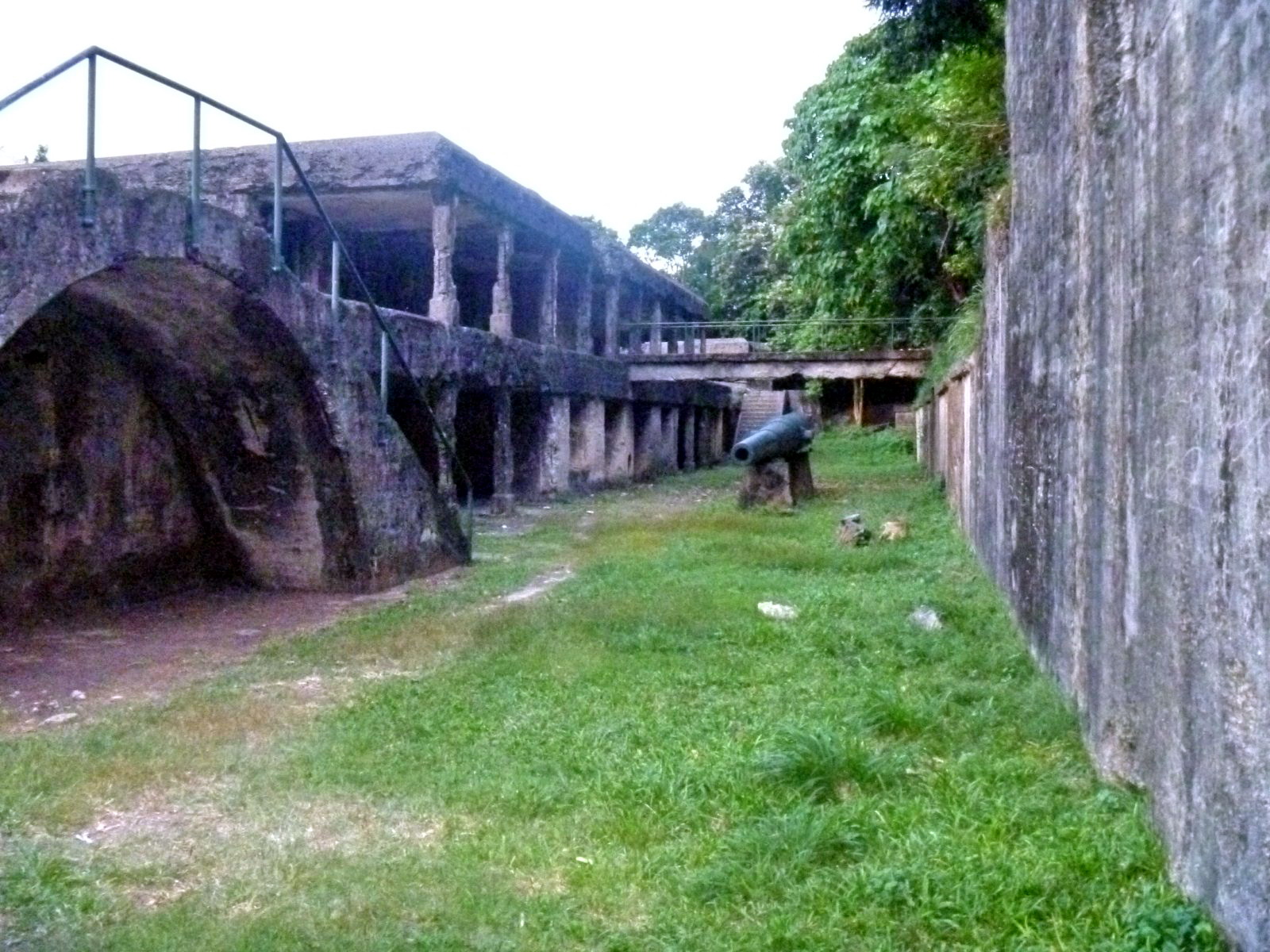
Mount Fortress

The approximately 8,000 sq. m., trapezoid-shaped Mount Fortress, strategically located on a hill top 52 m. above sea level, was built from 1617 to 1626 to protect the Porto Interior (Inner Harbor), the Praia Grande Bay and, to a lesser extent, the Porto Exterior (Outer Harbor) and the Chinese border. The city’s principal military defense structure, it was crucial in successfully holding off the attempted Dutch invasion of Macao in 1622.

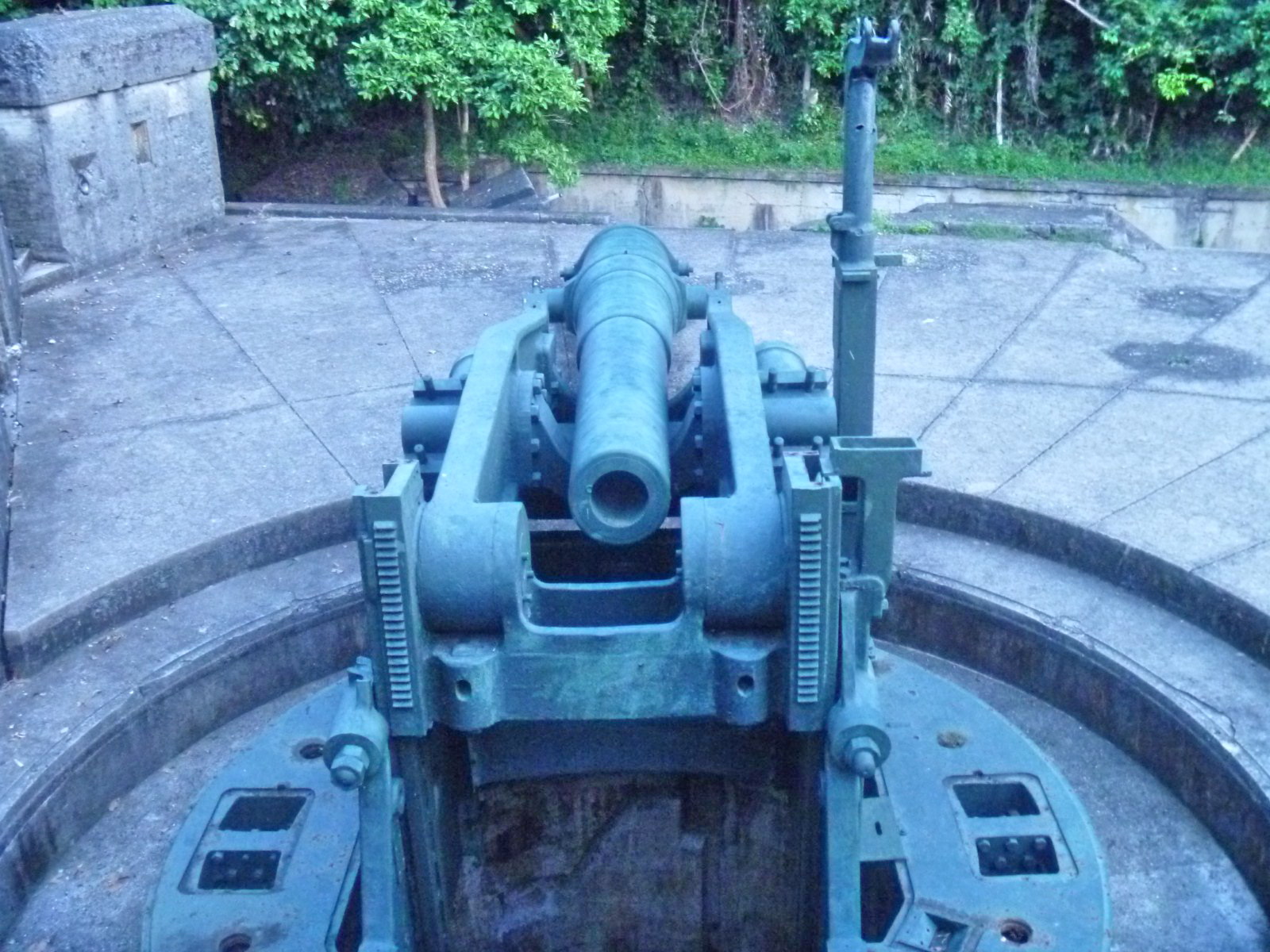
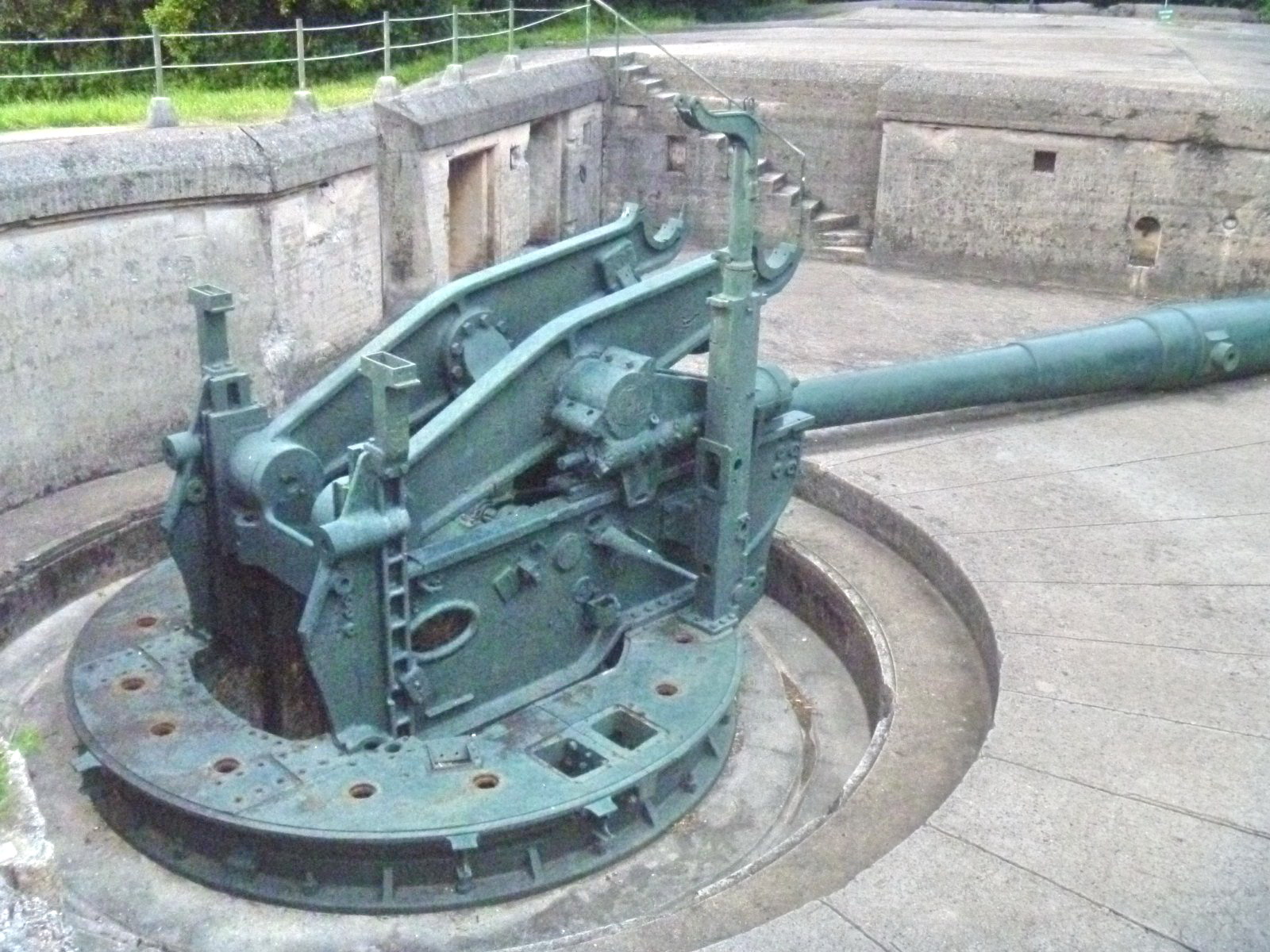
The Cannons of Mount Fortress

The fort was equipped with cannons, military barracks, well and an arsenal that held sufficient ammunition and supplies to endure a siege lasting up to 2 years. Its 4 corners protrude to form bulwarks. The northeastern, southeastern and southwestern walls are built on 3.7-m. wide granite bases. The walls, 9 m. high narrowing upwards to 2.7 m. wide at the top, are made of solid rammed earth, further strengthened by a thick stucco of ground oyster shells.

A Fantastic View of the City From Mount Fortress

The parapets were crenelated for the installation of 32 cannons and the two corners of the southeast wall have watchtowers. The walls facing the Chinese mainland do not have any battlements, indicating that the fortress was built only for defense against attacks from the sea.

Museu de Macau

On April 18, 1998, the 2,800 sq. m. Macao Museum was installed at the site, consisting of 2 underground levels and a third one above the fortress’ top platform following the location, volume and design of the old military barracks that existed at the site before the area was demilitarized in 1965. The museum presents the history of the city and territory of the former Portuguese colonyof Macau.

Museu de Macau – Interior

Church of St. Anthony of Padua (Macau)

From the Protestant Cemetery, Jandy, Cheska and I walked over to the nearby Church of St. Anthony of Padua (Igreja de Santo António) at Sto. Antonio Square.  Consider to be the very first church of Macau, the original church, which marks the site where the Jesuits set up their earliest headquarters in the city, was first built of bamboo and wood before 1560. A stone church was erected in 1638, burned down in 1809 and rebuilt in 1810 and again in 1875. The present Neo-Classical church was a reconstruction carried out again in 1930.  Further construction and repair works were done on the facade and tower in 1940.

Church of St. Anthony of Padua

Previously, members of the Portuguese community would hold wedding ceremonies there, so giving rise to the Chinese name of Fa Vong Tong (Church of Flowers). The 2-storey church has a simple asymmetrical Neo-Classical facade, a 3-storey high bell tower and is topped by a boldly ornamented classical pediment. Decorative window architraves on the second level stretch the width of the building, providing additional architectural interest to the design.

Church of St. Anthony of Padua – Interior

Old Protestant Cemetery (Macau)

From the Camoes Garden, Jandy, Cheska and I proceeded to the Old Protestant Cemetery where 150 British and American graves recall the days of the foreign trading and naval presence in Macau.  The cemetery was established by the British East India Company in 1821 in response to a lack of burial sites for Protestants in Macau.  Looking around, I found it interesting reading some of the head stones and seeing just how young some people were when they died.

Protestant Cemetery

Its small Morrison Chapel, situated on the edge of the Camoes Gardens and adjoining the stately mansion of the Fundacao Oriente, was built in 1821. It was named after linguist and missionary Robert Morrison (January 5, 1782-August 1, 1834), author of the first Chinese-English Dictionary and the first translation of the Bible into Chinese.  The chapel serves as a focus for Macau’s English speaking Protestant community. Its stained glass window shows an open Bible with Chinese characters for “In the beginning was the Word.”

Morrison Chapel

Aside from Mr Morrison and fellow British missionary Samuel Dyer (February 20, 1804–October 24, 1843), the cemetery has a few famous residents buried there, including that of noted English painter George Chinnery (January 5, 1774-May 30, 1852) who died at his home on Rua De Ignacio Baptista.  His memorial can be found on the northern wall of the cemetery. The Macau Museum has some of his works from India and the Far East.

Morrison Chapel – Interior

Others buried here include Royal Navy Capt. Henry John Spencer-Churchill (son of the 5th Duke of Marlborough and great-great-grand-uncle of Winston Churchill) and US Naval Lt. Joseph Harod Adams (grandson of John Adams, the second president of the United States, and nephew of the sixth, John Quincy Adams). The cemetery was closed in 1858.

Luis de Camoes Garden (Macau)

From the Barrier Gate, Jandy, Cheska and I took the public bus and dropped off at the hilly, heavily wooded Camoes Garden (also known as Dove’s Nest), one of Macau’s oldest parks and its largest (at nearly 20,000 sq. m.). Upon entry into the park, we were welcomed by a fountain, built in 1990, that contains a bronze sculpture entitled Embrace, specially made to symbolize the centuries’ old friendship between Portugal and China.

The Park’s Fountain and its Bronze Scuplture “Embrace”

The land where the park stands was donated by a Portuguese merchant, after his death, to the government. It was later opened to public as a memorial garden dedicated to Luis Vaz de Camoes (1524-June 10, 1580), Portugal’s greatest poet, who was exiled to Macau for 2 years, after riling the court officials.

Camoes Grotto

We visited the Cameos Grotto, the most famous scenic spot in this garden. Here, Luis de Camoes lived in a cave where he later finished Os Lusiadas (Soul of Portugal), the national epic that chronicles the great Portuguese explorations that created the world’s first globe-girdling empire. His bronze bust was installed in natural rocky alcove in the wooded garden in 1886 when the grotto became state property.

The Park’s Pleasant Gardens and Walkways

In front of the grotto is a spacious and pleasant garden, with benches shaded by banyan trees, where people meet with friends or bring their caged birds (a Chinese custom) for an outing.  At the far end of the park is a statue dedicated to martyred St. Andrew Kim Taegon (August 21, 1822-September 15, 1846), the first Korean Catholic priest. Camoes Garden also comes alive in the morning when groups perform slow, silent t’ai chi or lively aerobics.

A Small Park Pond

Walking along the winding path, we reached the Gazebo, a Chinese pavilion at the highest point in the park.  Here, stone tables and stools were installed for local people to rest, read newspapers, play Chinese checkers or chess, or enjoy the panoramic view of the city’s Inner Harbor.

Panoramic View of the Inner Harbor

Luis de Camoes Gardens: Praca Luis de Camoes, Macau. Open daily, 6 AM-10 PM.

St. Michael Cemetery and Chapel (Macau)

From Macau Cathedral, Jandy, Cheska and I then proceeded to St. Michael Cemetery, Macau’s largest Catholic cemetery.  This cemetery, located northeast of Mount Fortress, along a small and quiet street  between Ruins of St. Paul’s and Guia Hill, contains lavishly decorated tombstones and sepulchers that can only be described as Baroque ecclesiastical works of art, combining Chinese and European motifs, an interesting example of Macau’s cultural diversity.

St. Michael's Cemetery and Chapel

Near the cemetery’s main entrance is the doll-sized and charming Church of St. Michael.  Dating back to 1875, tt has a tiny choir loft, pretty porticoes,   pastel pea green and white walls and beautiful stain glass windows.

The Chapel's Interior

St. Michael Cemetery and Chapel: 2A Estrada do Cemitério, Northern Macau Peninsula. Open 8 AM-6 PM.

.

Macau Cathedral (Macau)

From St. Lawrence Church, Jandy Cheska and I walked over to Cathedral Square where the Macau Cathedral, Paco Episcopal Bishop’s House and Cartorio da Se and a fountain (added in the place of a car park when the courtyard was beautified from 2005-2006) are located.

Cathedral Square

Macau Cathedral (also called Se Cathedral or, simply Se) is the mother church of the Catholic Diocese of Macau, which once included the Catholic parishes in China, Japan and Korea. It was built around 1622 and repaired in 1743 and 1780. The cathedral was originally constructed with taipa (compound material consisting soil and straw).

Macau Cathedral and its Fountain

During the restoration of 1780, the religious services of the Cathedral were temporarily transferred to the old chapel of the Holy House of Mercy. The cathedral was damaged by a typhoon in 1836 and its services were then transferred to St. Dominic’s Church, until repairs were completed in 1850, following the design of local architect Tomas d’Aquino.

Macau Cathedral – Interior

The facade is characterized by a massive front entrance with pilasters and the twin bell towers in front that stand out on the streetscape. The exterior is clad in Shanghai plaster, giving the church a monolithic subdued grey appearance.  Compared to the other churches I saw in Macau, the cathedral is somewhat plain. The cathedral holds sacred relics of Japanese martyrs from the persecution of Christians in the 17th century.

Paco Episcopal Bishop’s House

To the left of the cathedral (or right, if you’re looking out from it) is the Paço Episcopal Bishop’s House.  Finished in stucco and painted cream, with white trimmings, it more like the other churches I saw in Macau. Right in front of the Cathedral is the Cartório da Sé (Cathedral Registrar) where marriage registrations, births and deaths are recorded.

Cartorio Da Se

Macau Cathedral: 1 Cathedral Square, Macau

St. Lawrence Church (Macau)

From St. Augustine Square, Jandy, Cheska and I walked next to Rua de Sao Lourenco to visit St. Lawrence’s Church (Igreja do Sao Lourenco), one of the oldest churches of Macau. It was originally built with wood by the Jesuits in 1560, with clay in 1618 and reconstructed in stone around 1803. The present church was the result of the works carried out in 1846.

St. Lawrence’s Church

Located on a hilly part on the southern coastline of Macau, overlooking the sea, we approached the church via a beautiful stone staircase and entered it via an ornamental double swing, wrought iron gate decorated by a simple Greek cross symbol.  Also here, on the front steps leading to the church, families of Portuguese sailors used to gather to pray and wait for the return of their loved ones, hence it was given the name Feng Shun Tang (Hall of the Soothing Winds).

The Beautiful Stone Staircase

The church has a Neo-Classical facade divided into 3 sections, with the center flanked by the 2 square bell towers, each measuring around 21 m. high. The facade is filled with classical features like the pilasters and volutes over the windows and is topped by an iron cross and the symbol of Mary consisting of the intertwined letters A and M (Auspice Mari’a, a monogram of the Virgin Mary).

Facade of St. Lawrence’s Church

The central section of the main facade is characterized by a pediment interrupted in the middle by an oval emblem. The ground plan of the church is in the shape of a Latin cross, measuring 37 m. by 29 m.. The shorter arms of the building form two interior chapels. The longer extension of the building corresponds to the main nave inside.

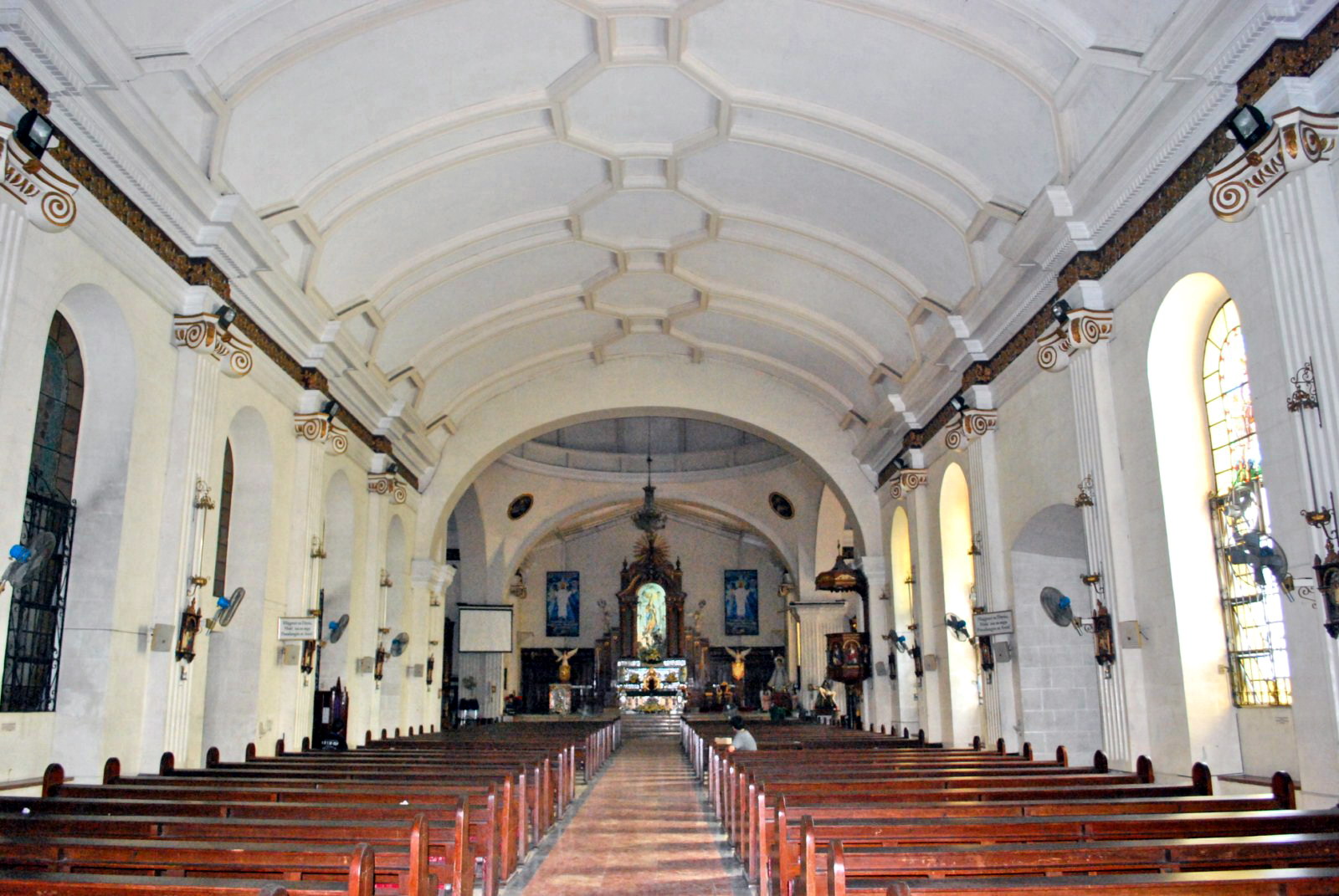
St. Lawrence’s Church – Interior

Ornamented pillars and exquisite chandeliers create an elegant church interior, heightening its ambiance. The main altar separated by a vaulted arch and the nave is covered with Chinese tiles.