St. Patrick’s Cathedral
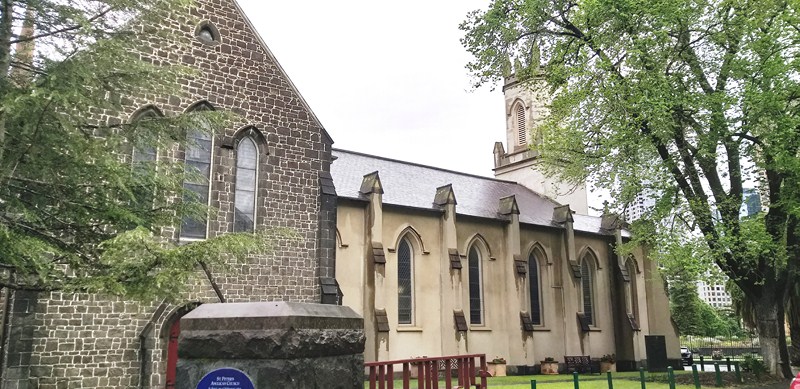
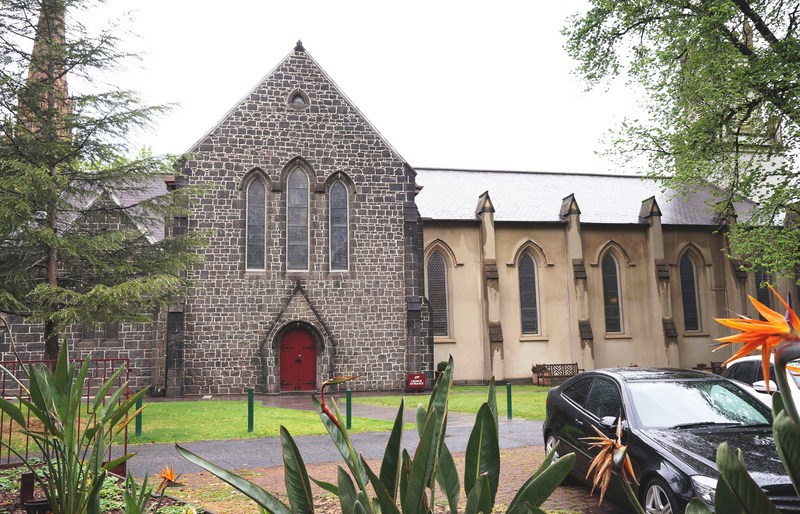
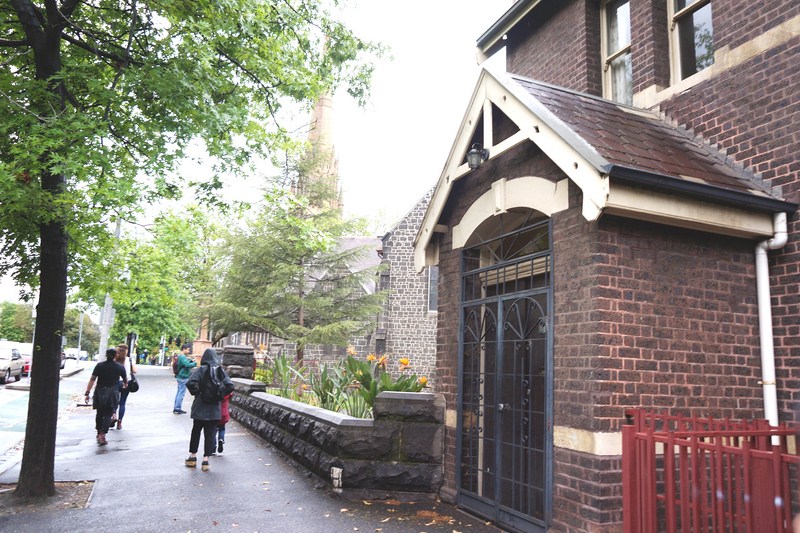
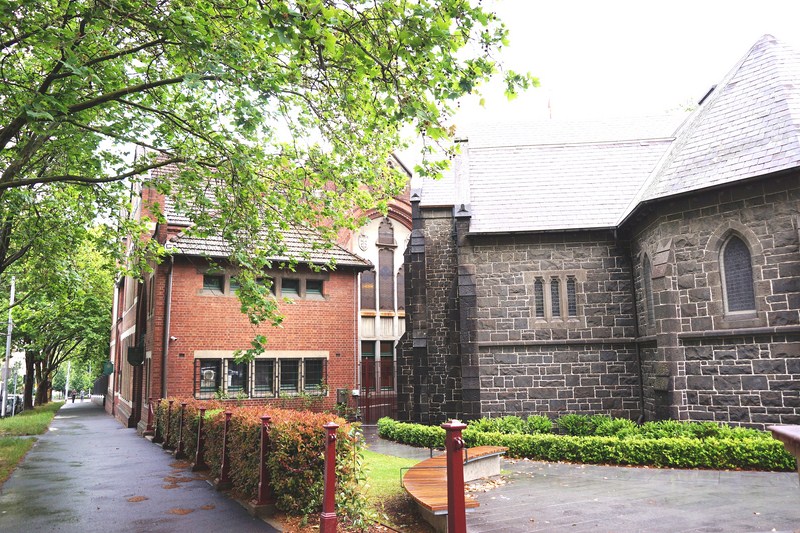
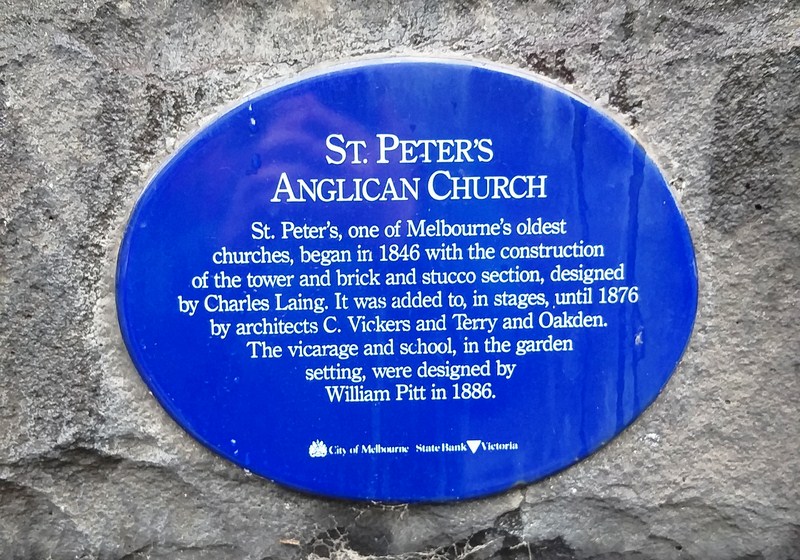
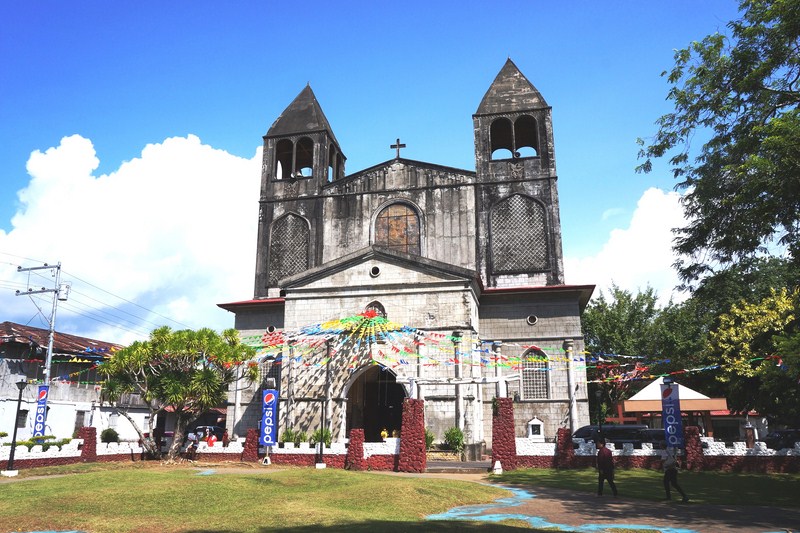
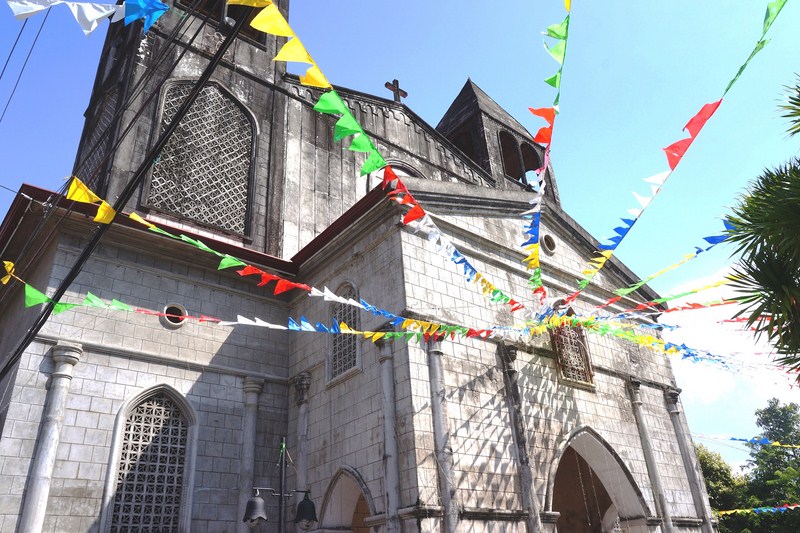
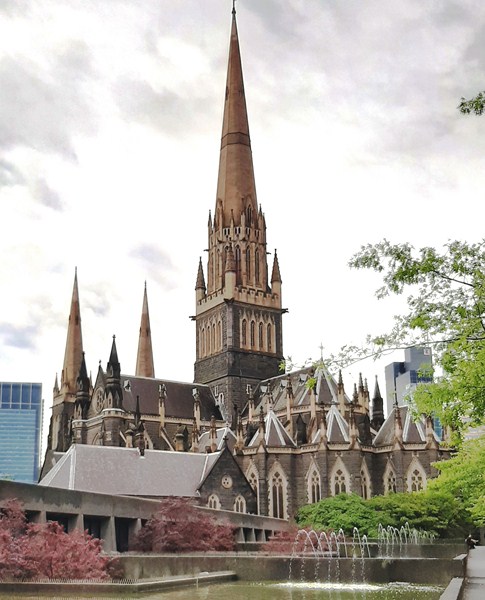
The first and only mass we attended in Melbourne was, fittingly, at the Cathedral Church and Minor Basilica of St. Patrick (colloquially St. Patrick’s Cathedral), near Fitzroy Park, located on Eastern Hill, in an area bounded by Albert Street, Gisborne Street, Lansdowne Street and Cathedral Place. Just to the east, across Gisborne Street is St Peter’s Church, the Anglican parish church of Melbourne constructed from 1846 to 1848.
Check out “Fitzroy Park”
Here are some interesting trivia regarding the cathedral:
- Although its 103.6-m. (340 ft.) length is marginally shorter than that of St Mary’s Cathedral (Sydney), St Patrick’s has the distinction of being both the tallest and, overall, the largest church building in Australia.
- It the cathedral church of the Roman Catholic Archdiocese of Melbourne and seat of its archbishop (currently Peter Comensoli).
- Since the Catholic community of Melbourne was, at the time of it construction, almost entirely Irish, the cathedral was dedicated to St Patrick, the patron saint of Ireland.
- William Wardell, Melbourne’s foremost ecclesiastical architect, was commissioned to prepare plans for the cathedral. A remarkably ambitious and capable architect, he went on to design the second St Mary’s Cathedral, Sydney in a similar style, even larger than St Patrick’s, but with a completely English square East End.
- St Patrick’s Cathedral was one of the two largest churches (the other is St Patrick’s Cathedral, New York, United States) brought to substantial completion anywhere in the world in the 19th century.
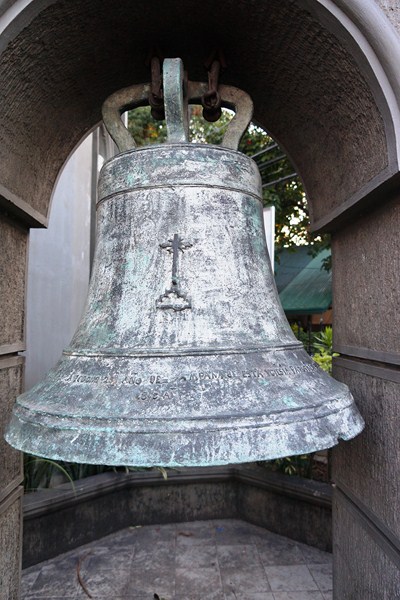
- The bells of the cathedral are unusual in that they were cast unturned (they ring anti-clockwise instead of clockwise) and are thought to be the only ring of eight bells cast by John Murphy of Dublin which are still in operation today.
- The 1992 – 1997 restoration works were awarded the Royal Australian Institute of Architects (Victorian Chapter) John George Knight Award for Heritage Architecture 1996.
- One of the gargoyles, restored by the masonry team, was modeled on the then-Premier of Victoria, Jeff Kennett as the previous gargoyle apparently had striking similarities.
Check out “St. Patrick’s Cathedral (New York City)”
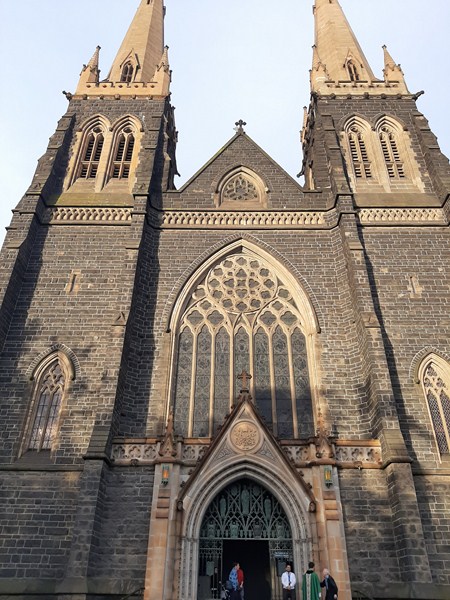
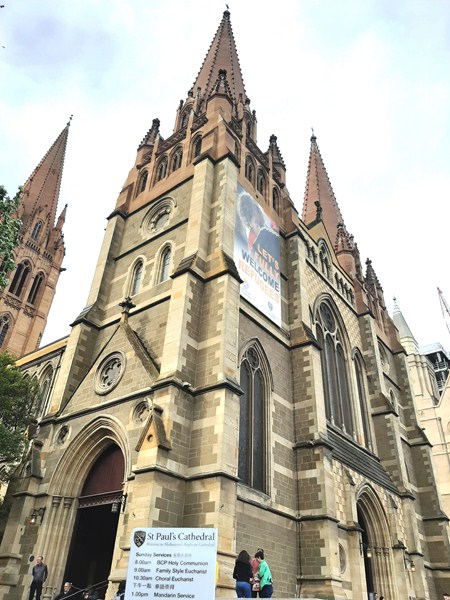
The Geometric Decorated Gothic-style facade
The cathedral, planned is in the style of a Latin cross, is built on a traditional east–west axis, with the altar at the eastern end (symbolizing belief in the resurrection of Christ).
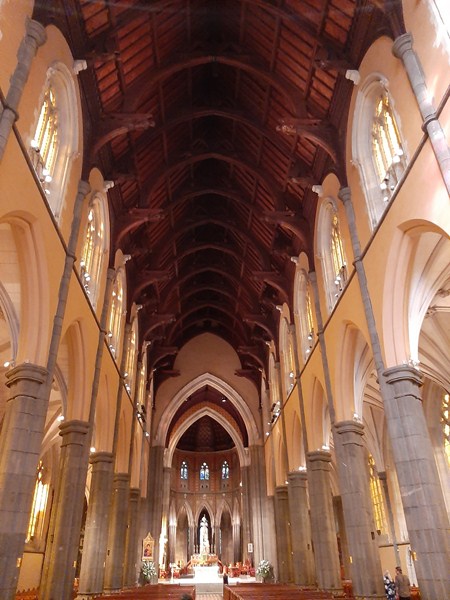
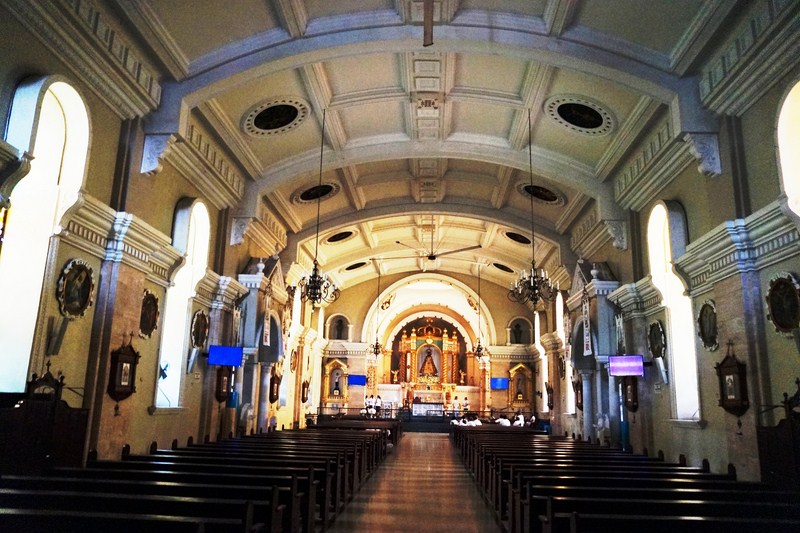
The cathedral interior
It consists of a nave with side aisles, transepts with side aisles, seven chapels grouped in a semicircle around the central sanctuary, and sacristies. It was built in stages, between 1858 and 1940.
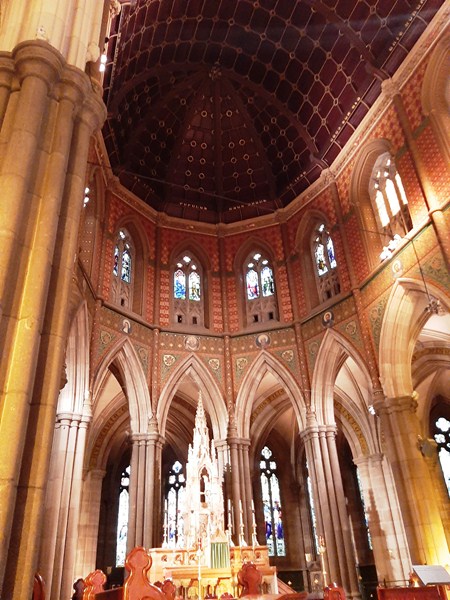
Apse: Its ceiling, vaulted in timber, has a Latin quotation from the book of Revelations carved around the base
Here is the historical timeline of the cathedral:
- In 1848, negotiations with the colonial government for the grant of five acres of land for a church in the Eastern Hill area began.
- On April 1, 1851, only 16 years after the foundation of Melbourne, the Colonial Secretary of Victoria finally granted the site to the Roman Catholic Church. Augustinian friar James Goold, the first bishop of Melbourne and the fourth bishop in Australia (after Sydney, Hobart and Adelaide) decided to build his cathedral on the Eastern Hill site.
- In 1851-1852, when Bishop Goold visited Europe, he bought a peal of eight bells for £500 (with some records showing that it cost £700) for the cathedral.
- In 1853, the bells arrived in Australia
- On December 8, 1858, William Wardell was commissioned to plan the cathedral and that same year, its foundation stone was laid and building commenced. An earlier building, by stonemason David Mitchell (father of operatic soprano Nellie Melba and later partner of John Monash), was demolished for the cathedral.
- On November 29,1868, the bells, hung in a low frame at ground level in the western aisle, were consecrated by Bishop Goold in a service attended by around 5,000 people. The bells were eventually hung at the south-eastern tower.
- Before 1868, the original front entrance, with a double-arched doorway and a pillar dividing it, was removed.
- In 1869, the nave and aisles were opened.
- In 1871, the ringers of St Patrick’s began the custom of ringing in the New Year.
- By the 1880s, St Patrick’s Cathedral became the leading tower for Australian change ringing.
- In 1891, a severe depression which hit Melbourne further delayed the construction.
- On May 30, 1891, the statue of Catholic emancipator Daniel O’Connell (1775-1847) by sculptor Sir Thomas Brock, was erected by public subscription and unveiled.
- In 1897, under the leadership of Archbishop Thomas Carr, the remainder of the cathedral itself and the sacristy were completed and consecrated.
- In 1914, the bells were rung for the requiem mass of Pope Pius X
- In the late 1930s, Daniel Mannix (Archbishop of Melbourne in 1917) oversaw the addition of the spires and other elements.
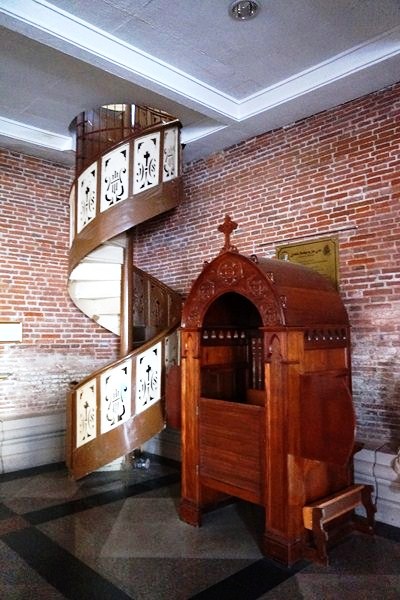
- From 1936-40, the spires (higher than Wardell originally intended) and confessional were added and the west door rebuilt.
- In 1939, the building was officially completed.
- By 1959, the belfry fell into disrepair and the bells became unringable.
- In 1974, Pope Paul VI conferred the title and dignity of minor basilica on it.
- In 1986, Pope John Paul II visited the cathedral and addressed clergy during his Papal Visit.
- In 1988, as the major Victorian project among Bicentennial bell restorations, the cathedral’s peal was sent to Eayre and Smith Bell foundry in England.
- On December 8,1988, the peals and an added ninth bell (Angelus bell), was consecrated. An electronic chiming mechanism was also installed, at this time, for all the bells with the original manual method retained in order to replicate how the bells would have sounded if they were rung by hand.
- From 1992 till 1997 (the centenary of its consecration), the cathedral was closed and significant restoration and conservation works were undertaken under the guidance of Falkinger Andronas Architects and Heritage Consultants. Funds were contributed by the federal and Victorian governments, corporate and philanthropic donors and the community of Melbourne. Nothing was added to the main building.
- From 1996-97, the organ was refurbished for the centenary of the cathedral.
- In March 1999, the statue of Dr. Daniel Mannix (long-serving former Catholic Archbishop of Melbourne) by English sculptor Nigel Boonham, was unveiled.
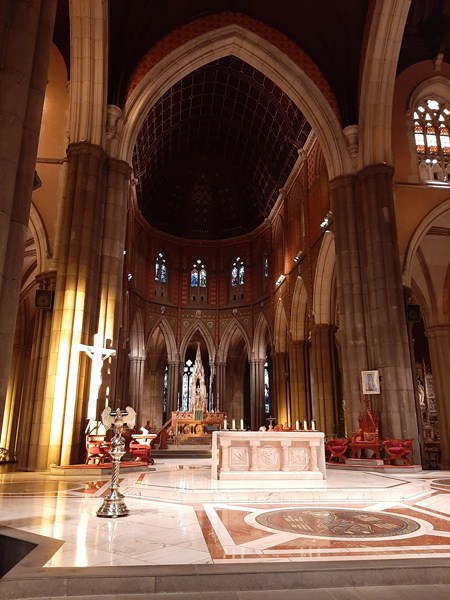
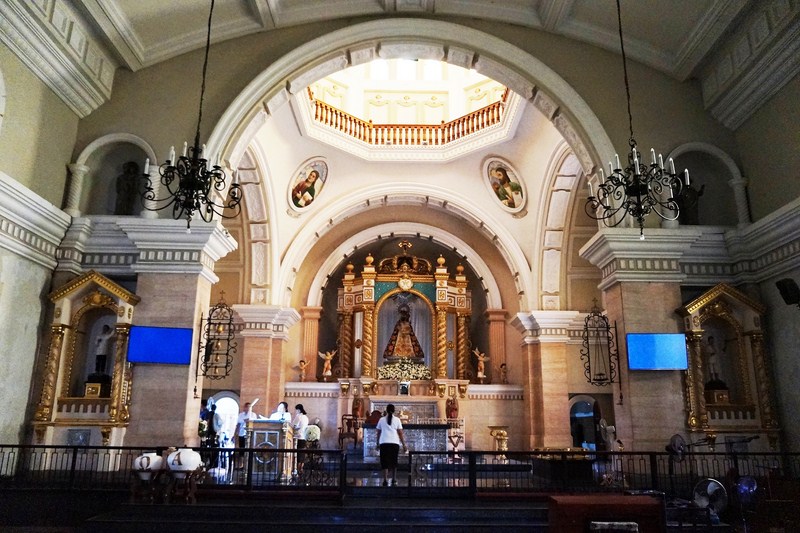
Central Sanctuary
The cathedral, designed specifically in the Geometric Decorated Gothic style, in response to the revival of Gothic architecture (as promoted by Augustus Welby Pugin and others as the most appropriate for the building of churches), was based on the great medieval cathedrals of England.
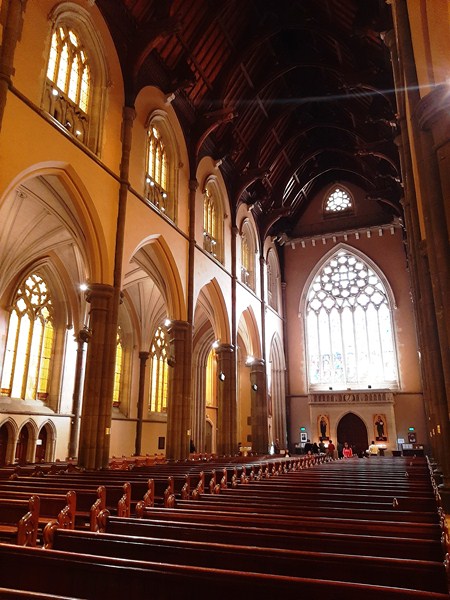
West Wall
This style is at its most complex in the large west window of the nave.
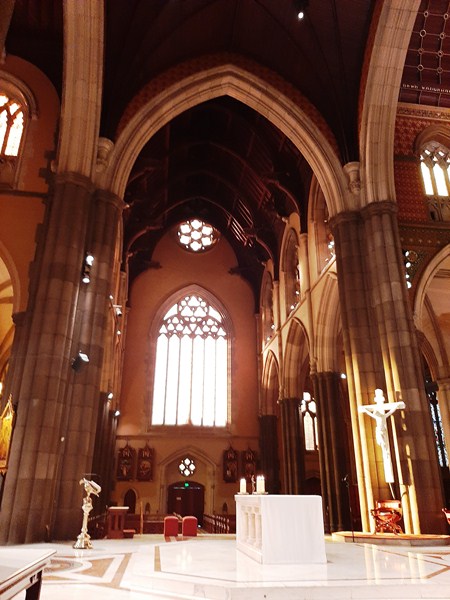
South Transept
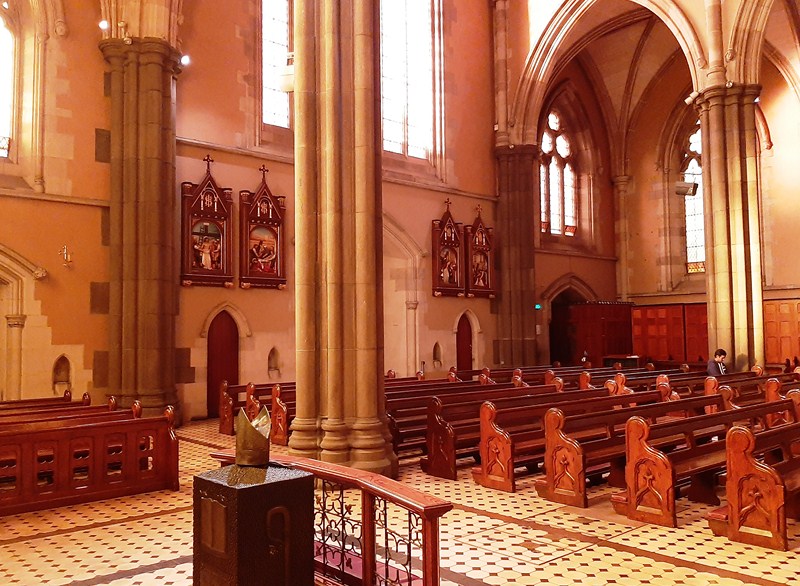
North Transept: its north wall shows four of the Stations of the Cross
The eastern arm, with its chevet of radiating chapels in the French manner, is still principally in the English Gothic style of the late Thirteenth Century (giving the most complete essay attempted in that style during the Nineteenth Century).
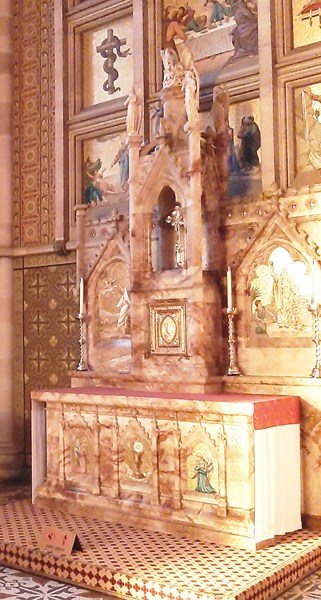
Blessed Sacrament Chapel: located closest to the North Transept, its altar reredos has two mosaics depicting the “Sacrifice of Abraham and Isaac” and of “Abraham and Melchisedech.” The tabernacle, made in 1900, features a pelican ( a symbol of Christ) motif, representing the Eucharist.
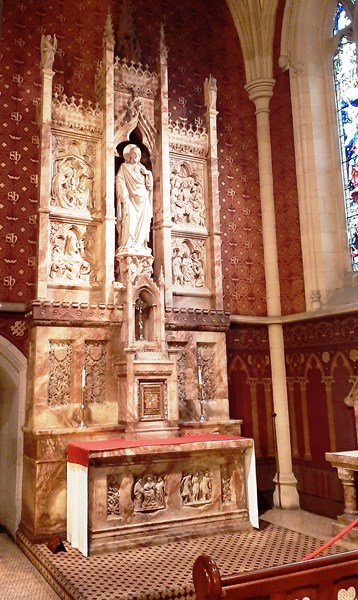
Sacred Heart Chapel: Originally designated to be the organ and choir gallery, this chapel, dedicated to the Sacred Heart of Jesus (after the arrival of a Sacred Heart statue from Germany in 1874), has a Sacred Heart statue in the center of reredos and surrounded by relief carvings of the Nativity and the Last Supper. Below are carvings of “The Crowning with Thorns” and “The Agony in the Garden” and a carved inscription “Cor Jesus, Thronus Misericordiae” (Heart of Jesus, Throne of Mercy). The altar is made of alabaster. Its frontal features carvings of Jesus before Pilate and the scourging at the pillar. The tabernacle door is inscribed with the words ‘Cor Jesus, Salue in Te sperantium’ (Heart of Jesus, Salvation of those who hope in Thee).
The massive cathedral, made with bluestone (sourced from basalt deposits in nearby Footscray) and sandstone, is 103.6 m. (340 ft.) long on its long axis, 56.4 m. (185 ft.) wide across the transepts and 25.3 m. (83 ft.) wide across the nave.
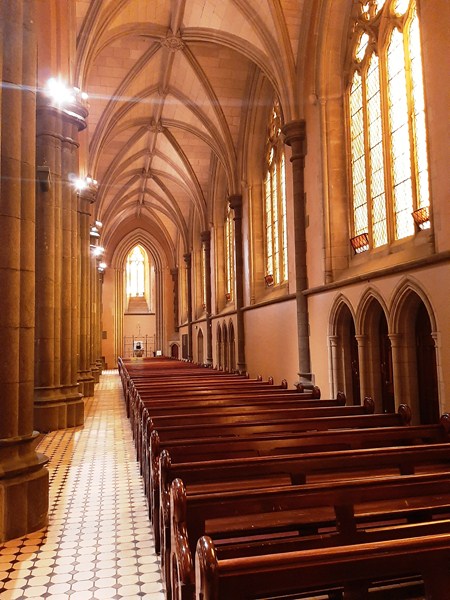
South Aisle
The nave and transepts are 28.9 m. (95 ft.) high, the central spire 105 m. (344 ft.) high and the flanking towers and spires 61.9 m. (203 ft.) high.
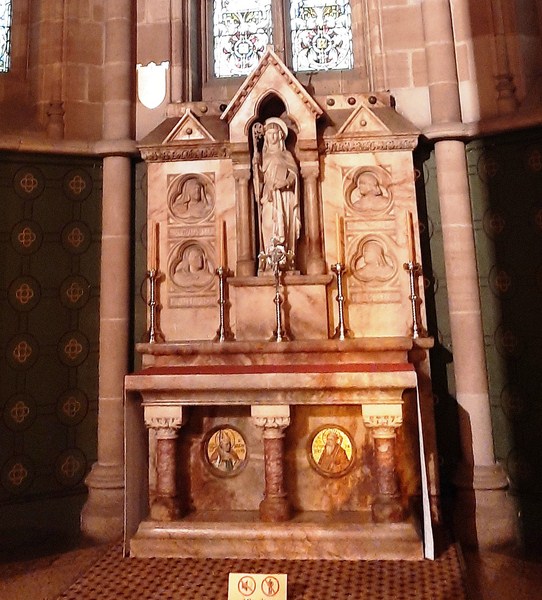
St. Brigid and the Irish Saints Chapel: originally called the Chapel of the Irish Saints but later became known as the Children’s Chapel dedicated to St Brigid, children contributed to the cost of the chapel’s completion. On the archway over the chapel is inscribed a text from the 44th Psalm. The altar is constructed of alabaster, its frontal panel features small mosaics of St. Patrick and St. Columbanus. A marble statue of St. Brigid is located in the niche of the reredos. Carved images of four Irish saints (St. Dympna, St. Reyna, St. Ita and St. Bees), from the sixth and seventh centuries, are also represented in the reredos.
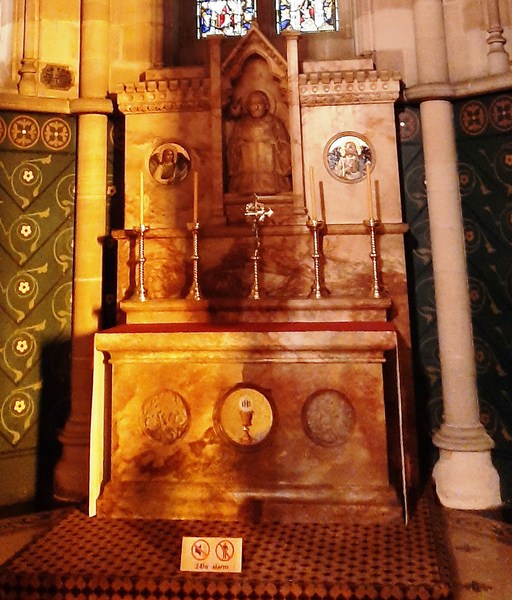
St. Thomas Aquinas Chapel
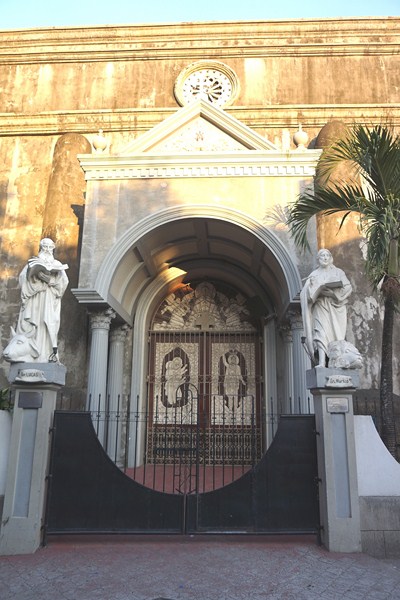
The 4.87 m. high and 3.65 m. wide front door has three columns, recessed and carved jambs with a Gothic arch crowned by a paneled, molded and carved gable finished with a carved cross.
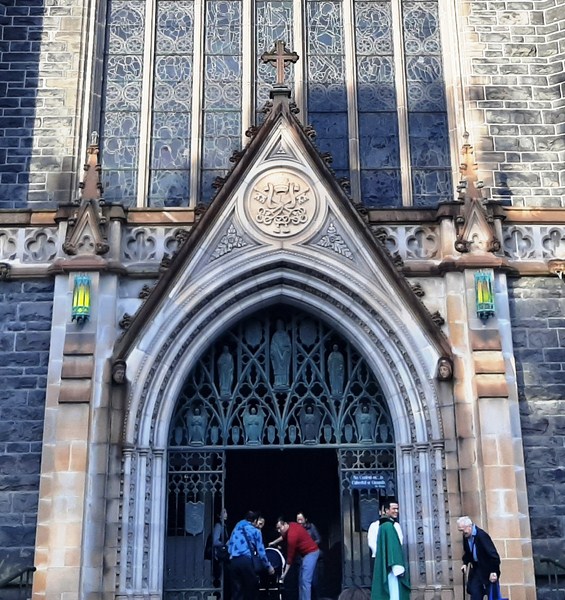
Entrance doorway
Buttresses support the gables and these are topped with carved pinnacles and quatrefoil-paneled side parapets. In 1974, the original gable was replaced by a carving of the Papal Coat of Arms when Pope Paul VI conferred the title and dignity of Minor Basilica on the Cathedral.
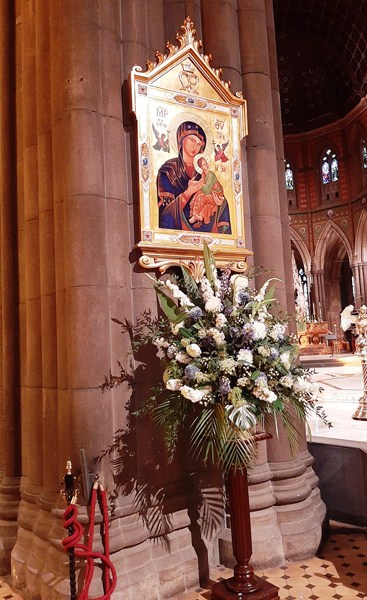
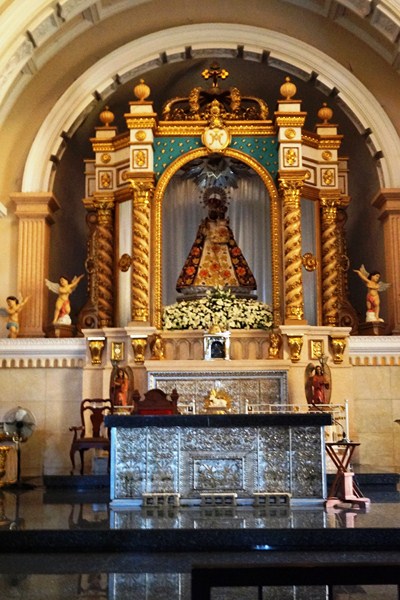
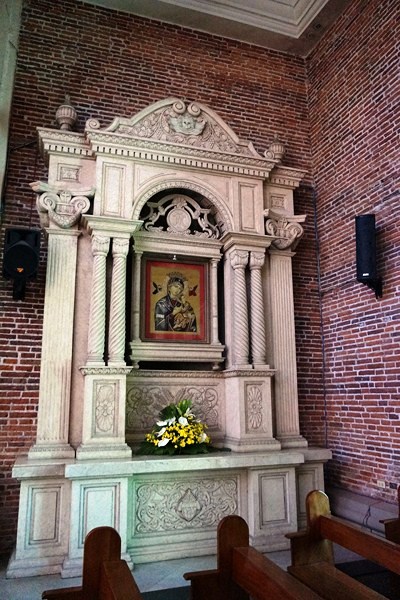
Icon of Madonna and Child
The archway, filled with a bronze tracery grill, features St. Patrick, with St. Brigid and St. Columba on either side. In the space between and above are the monograms of the Holy Name (IHS) and of the Blessed Virgin Mary (BVM).
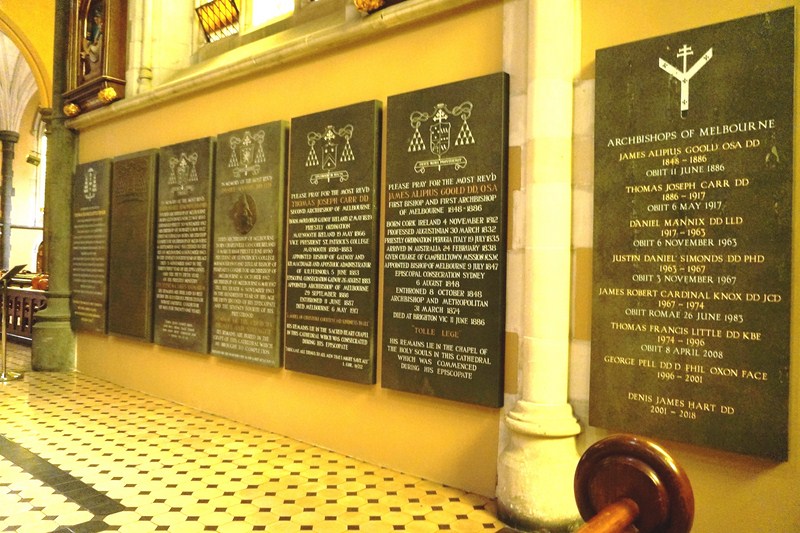
Archbishop’s Memorial: located in the northern transept, plaques here commemorating Melbourne’s Archbishops, James Alpha Goold (1848 –1866), Thomas Joseph Carr (1886–1917), Daniel Mannix (1917–1963), Justin Daniel Simonds (1963–1967) and James Cardinal Knox (1967–1974). Archbishops Mannix and Simmonds and Cardinal Knox are buried in the vault beneath the floor of this transept.
It also features four angels and eight shields bearing symbols of the Old and the New Testaments: Noah’s Ark, the brazen serpent and the instruments of the Passion, the chalice and host, and Christ as the Lamb.
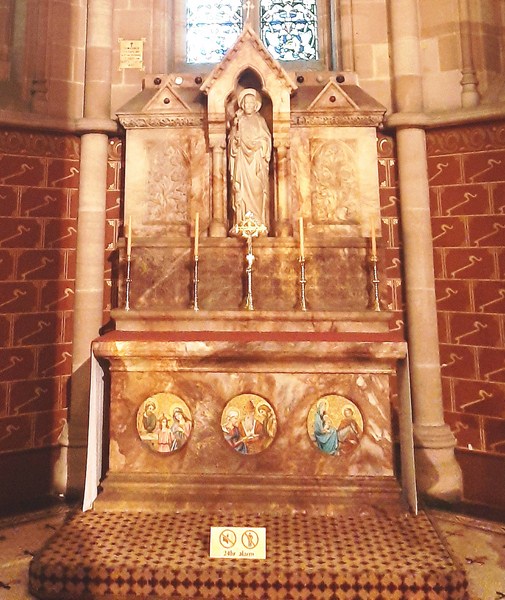
Statue of St. Mary MacKillop
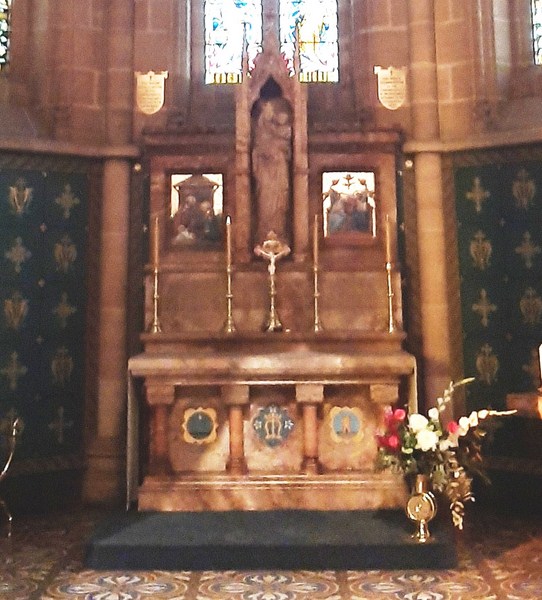
The Lady Chapel: located directly behind the high altar, its foundation stone was laid by Archbishop Goold on September 8, 1879. Made of English red and white alabaster, its altar is 4.11 m. high and 2.36 m. wide and its front has three ornamented panels, in the center, a mosaic of the monogram of Our Lady with slightly smaller mosaic of Star of the Sea and of the Tower of David, titles given to Our Lady, on either side. The reredos have a molded canopied niche that features a marble statue of Our Lady with the title of Regina Coeli (“Queen of Heaven”). The panels, on either side of the reredos, have mosaics depicting the “Nativity of Our Lord” and “The Coronation of the Blessed Virgin.” Above the reredos are the words: “Mater Salvatoris, ora pro nobis” (“Mother of the Savior pray for us”).
On the panels of the gates of the grill are the coats of arms of Pope Pius XII (who was the reigning pontiff when the additions were installed) and of the first three archbishops of Melbourne.
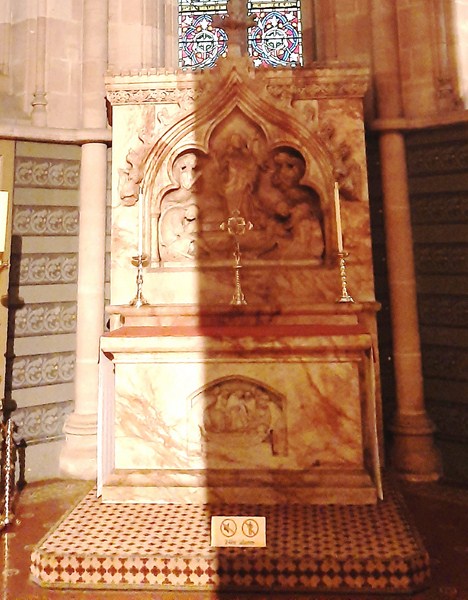
Holy Soul’s Chapel: Originally known as the Mortuary Chapel, this chapel was dedicated to the memory of Archbishop Goold (who laid the first stone in 1880) who is buried beneath the chapel (a brass memorial plaque marks his resting place). On June 9, 1888, the first Mass in the newly finished chapel was offered by Archbishop Carr for the repose of the soul of his predecessor.
The majority of stained glass in the cathedral was done by Hardman of Birmingham, with two windows by Mayer of Munich and one by Montgomery.
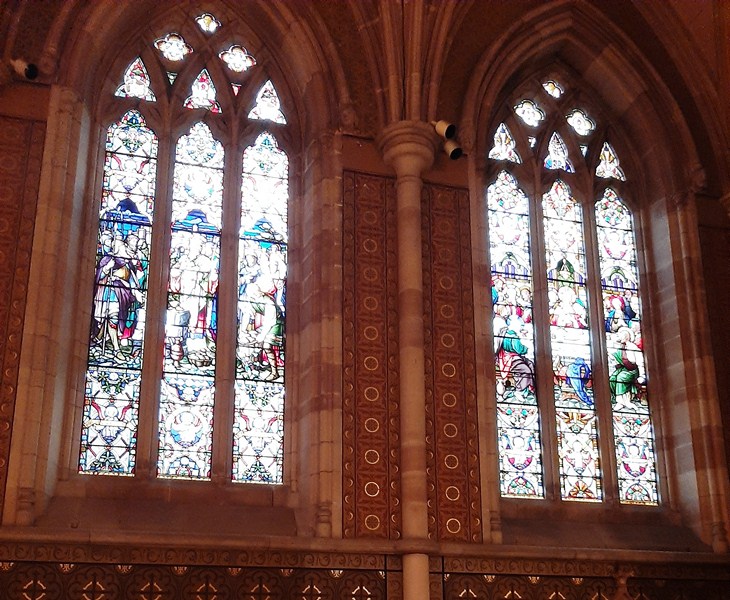
Stained Glass Windows: Located in the Blessed Sacrament Chapel, they depict “The Sacrifice of Melchizedech” and “The Last Supper.” Made in Munich for the 1881 Melbourne International Exhibition, they were purchased by Archbishop Goold.
The stenciling and painting of the sanctuary was done by Charles Firth, the carved altars by Farmer and Brindley, and the throne, credence tables, bishop’s chair and confessionals carved by C N Bell. The intended wall mosaics and paintings were not completed.
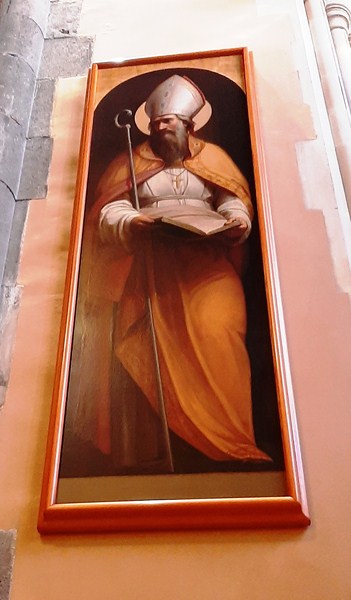
Painting of St. Ambrose: Aurelius Ambrosius, better known in English as St. Ambrose, was one of the four original doctors of the Church. He was born in Trier in 337 AD and died in Milan in 397 AD. St. Ambrose was an archbishop of Milan who became one of the most influential ecclesiastical figures of the 4th century.
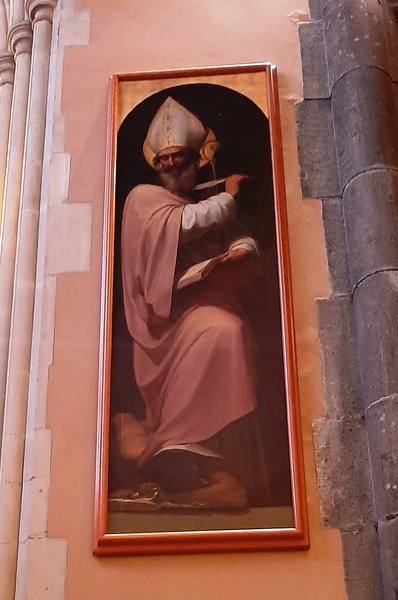
Painting of St. Augustine: On a column near the baptistery, this painting shows St Augustine with quill in hand.
The cathedral’s original pipe organ, built in the late 1870s by Robert Mackenzie to serve the liturgical needs of the cathedral (the organ is also occasionally used for recitals and recordings), was completed in 1880 by George Fincham.
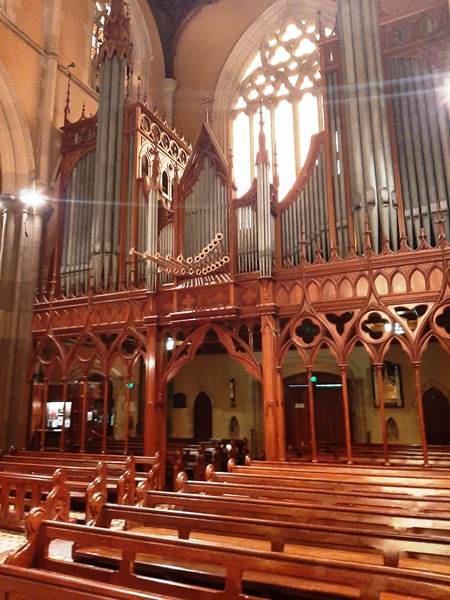
Pipe Organ: built by George Fincham & Sons, Melbourne in 1962-64, it incorporates a substantial part of the instrument built in the west gallery of the cathedral in the late 1870s by Robert Mackenzie and completed in 1880 by George Fincham. Refurbished with additions by Australian Pipe Organs, Melbourne in 1996-97, it is used for occasional recitals and recordings, as well as serving the regular liturgical needs of the cathedral. The organ has 76 speaking stops involving almost 5000 pipes, 24 Spanish trumpets, and a four manual console.
The current installation in the west gallery of the cathedral, built by George Fincham & Sons, Melbourne, from 1962 – 1964, incorporates a substantial part of the original. It comprises 81 speaking stops (some dated to 1880 or 1896, when the instrument was enlarged) spread over four manuals and pedals.
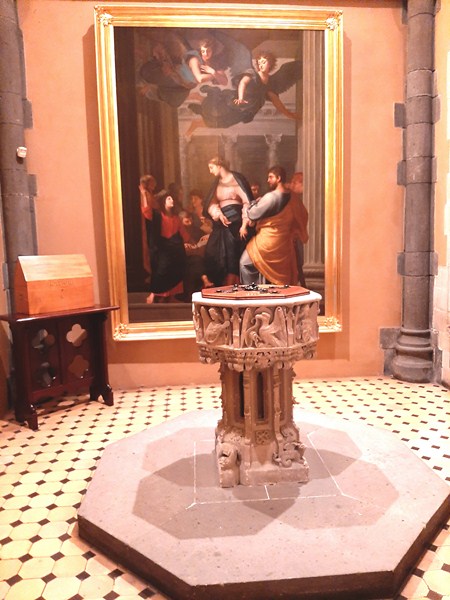
Baptismal Font: located in the northwest corner of the nave, it is made of soapstone and features symbolic representations of graces received through baptism. At the foot of the font are various grotesques, representing the devils cast out by baptism. A 17th century painting of “The Finding of the Child Jesus in the Temple” forms a backdrop.
The peal of eight bells, all cast by John Murphy of Dublin in 1852 and bearing the coat of arms of Bishop Goold, are in F natural, with the tenor weighing 12 long cwt 1 qr 10 lb (1,382 lbs. or 627 kgs.) and the treble 4 long cwt 12 qr 14 lb (798 lbs. or 362 kgs.). The peal set weights around 3,556 kgs. (7,840 lbs.).
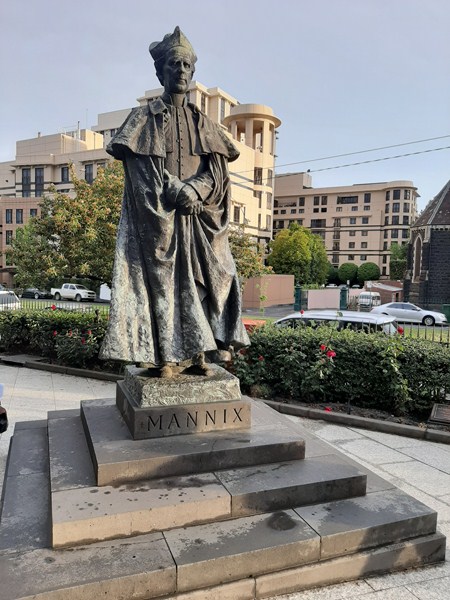
Statue of Archbishop Daniel Mannix: this larger-than-life statue, sculpted by Nigel Bonnham, watches over the area in front of the cathedral’s main west entrance. It was during the his reign that the cathedral was finished. The three towers and spires were enlarged and completed in 1939, to the design of Conolly and Vanheems, to commemorate the centenary of Catholicism in Melbourne.
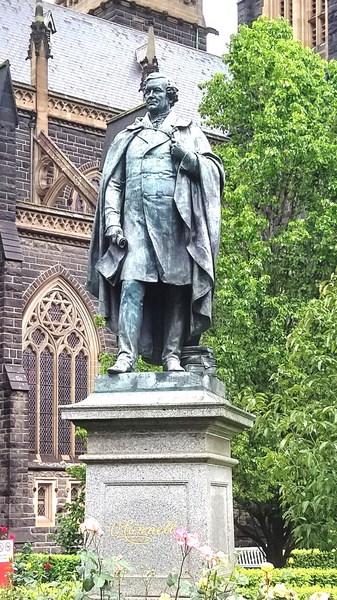
Statue of Daniel O’Connell: located around the north side, O’Connell is often referred to as The Liberator or The Emancipator, and was an Irish political leader in the first half of the 19th century. He campaigned for Catholic Emancipation, including the right for Catholics to sit in the Westminster Parliament, denied for over 100 years, and repeal of the Act of Union which combined Great Britain and Ireland.
The Cathedral Shop, located adjacent to the Presbytery Office, offers a wide range of souvenirs, gifts, CDs, handcrafted items, rosary beads, fine cards and more.
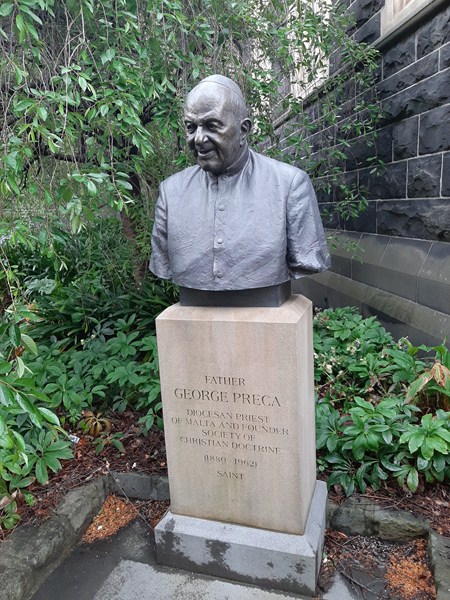
Bust of Fr. George Preca. St. George Preca (1880 – 1962) was a Maltese Roamn Catholic priest and the founder of the Society of Christian Doctrine as well as a Third Order Carmelite. He is known as “Dun Ġorġ” in Maltese and Pope John Paul II dubbed him as the “Second Apostle of Malta.” Pope Pius XII, in 1952, titled him as a Monsignor despite his uneasiness about it. He had assumed the religious name of “Franco” after becoming a Secular Carmelite.
St. Patrick’s Pilgrim Path, a wide path to the south transept door on the southern approach to the cathedral, is divided by a delightful flow of water over a sequence of small drops. Created by Green and Dale Landscape Architects, its central concept is that of flowing water which cascades down the channel that divides the two sides of the stepped pathways that progress up the incline.
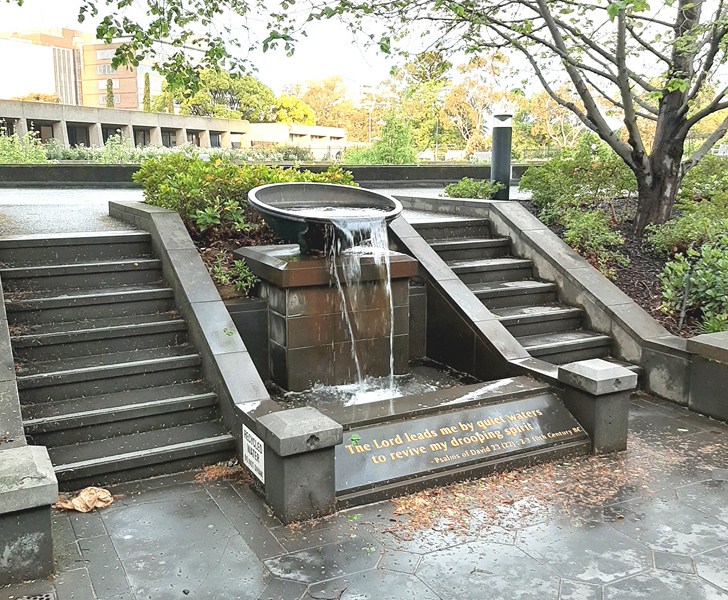
Gospel of St. John 4.14
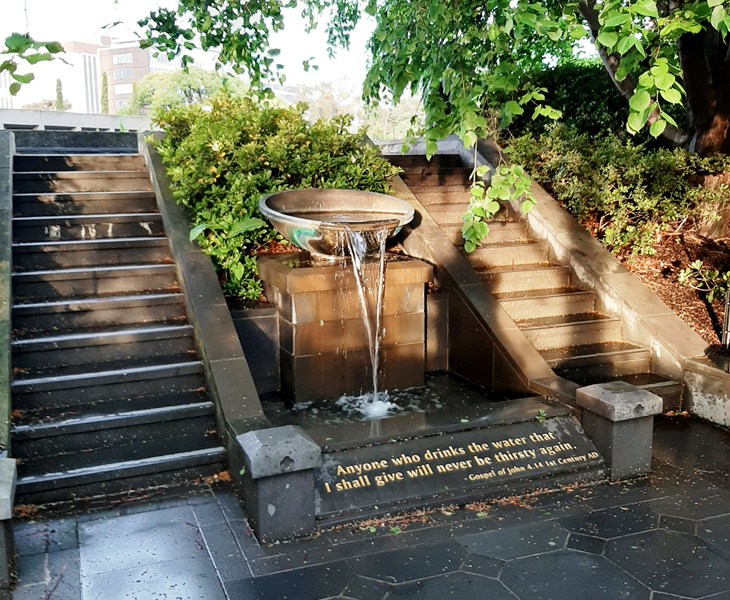
Psalms of David 23
Salutary selections of quotations, cut with gold inlays into a number of blue stone structures, features quotations from James McAuley (one of Australia’s great poets), Gospel of St. John 4.14 (1st Century AD) and from Psalms of David 23.
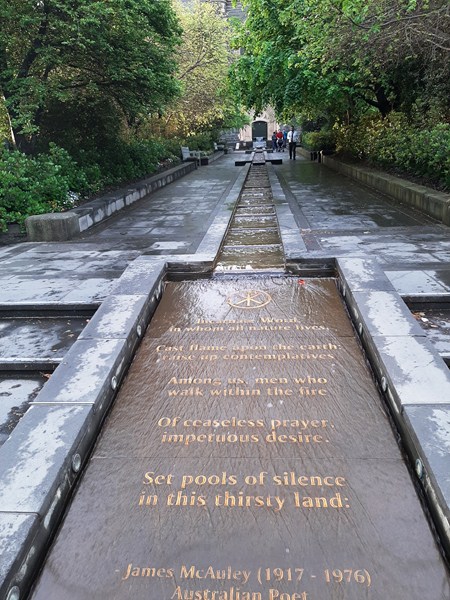
Quotation from James McAuley
A giant bronze bowl, the origin of the water supply, contains a submerged golden image of “The Lamb.” Water here cascades in three directions onto the seven-stepped structure below. Around the bowl’s rim are inscribed verses from the Book of Apocalypse.
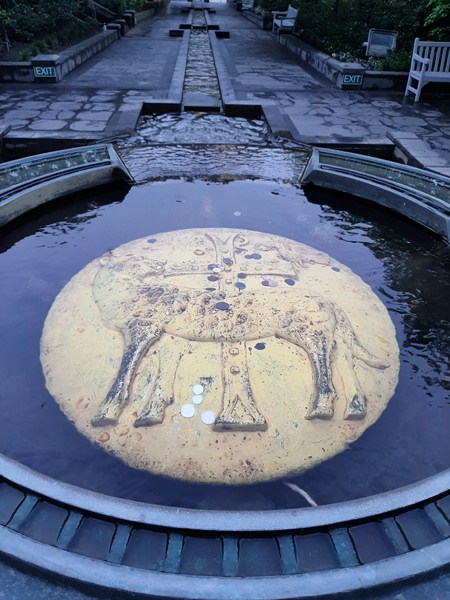
Bronze bowl with submerged image of The Lamb
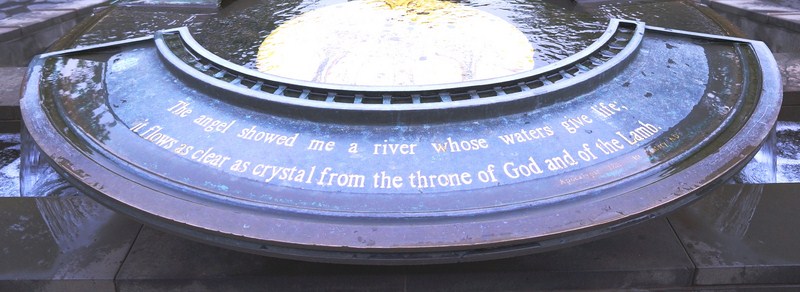
Verses from the Book of Apocalype
Around the path are statues of St. Francis of Assisi (c 1181-1226) and St. Catherine of Siena (1347 – 1380), both sculpted by Louis Lauman, a Melbourne based artist.
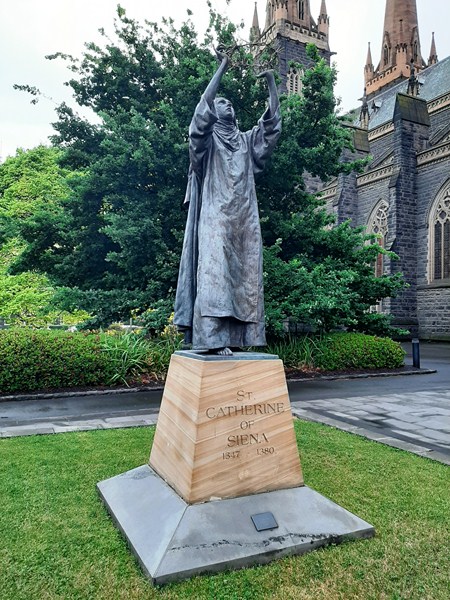
Statue of St. Catherine of Siena: Located opposite the statue of St Francis, it depicts Catherine of Siena (1347 – 1380) holding up a crown of thorns. Sculpted by the Melbourne – based artist Louis Lauman.
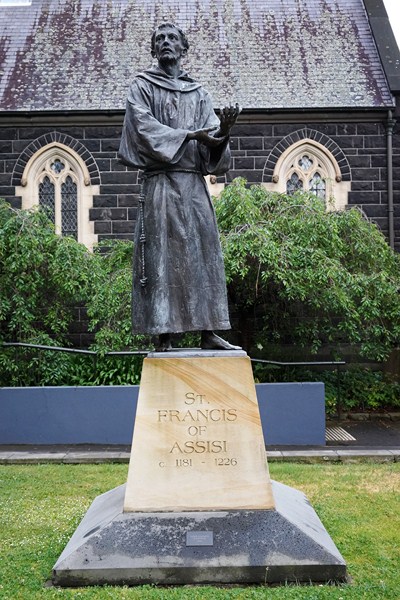
Statue of St. Francis of Assisi: this Italian Catholic friar and preacher founded the men’s Order of Friars Minor, the women’s Order of St. Clare, and the Third Order of Saint Francis for men and women not able to live the lives of itinerant preachers followed by the early members of the Order of Friars Minor or the monastic lives of the Poor Clares. Though he was never ordained to the Catholic priesthood, St. Francis is one of the most venerated religious figures in history.
These were blessed and dedicated by Archbishop George Pell on December 17, 2000 in the presence of Sir James Gobbo, the Governor of Victoria, and his wife, Lady Gobbo.
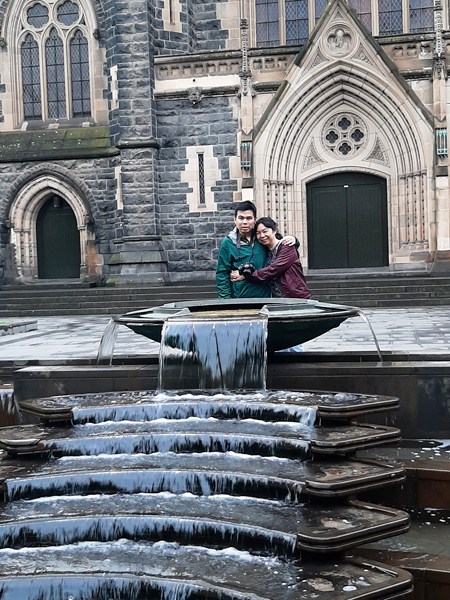
Jandy and Grace at the Pilgrim Path
Cathedral Church and Minor Basilica of St. Patrick: 1 Cathedral Place, East Melbourne, Victoria 3002, Australia. Tel: 9662 2332. E-mail: cathedral@cam.org.au. Open Mondays to Fridays, 9 AM – 5 PM. Masses: Saturday – 8 AM, 6 PM (Vigil), Sundays – 8 AM, 9.30 AM, 11 AM (Solemn Mass), 6.30 PM, Weekdays – 7 AM, 1 PM. The Cathedral Shop is open Mondays to Fridays, 9.30 AM to 4.30 PM, and Sundays, 8.30 AM to 1 PM.