| SM City Baguio |
| The veranda of the mall |
| The mall’s atrium lobby |
| SM City Baguio |
| The veranda of the mall |
| The mall’s atrium lobby |
Jandy and I, together with United Tourist Promotions (makers of EZ Maps) employees Bernard Gonzales and Rodel Vivas, were on our way to Baguio City when nighttime caught up with us in Gerona in Tarlac. Already hungry, we decided to stop at Fresh Catch Isdaan for dinner. This open restaurant was one huge koi-filled fishpond with “floating” (actually on stilts) cabanas with tables for diners, all connected by bamboo walkways. All over the place are huge, eye-catching statues of Buddhas, mermaids, monkeys, dinosaurs and crocodiles; Disney characters; noted Filipinos (Corazon Aquino, Joseph Estrada, Jaime Cardinal Sin, Ninoy Aquino, etc.) as well as Marvel comic characters such as Batman, Iron Man and the Incredible Hulk.
| Fresh Catch Isdaan |
Food served here was mostly Filipino, the restaurant being part of the Barrio Fiesta Restaurant Group. Its signature dishes include chicken tinupig, sisig, adobong pusit, bulalo, manok sa gata, kare-kare, sinampalukan, sizzling tanigue, hototai (mixed vegetable soup), Bicol Express, pinakbet, inihaw na liempo, buko pandan, binagoongang baboy, sinigang na hipon, lumpiang shaghai, fried chicken or porkchop, lechon kawali, among others. While waiting for our order to arrived, I went about exploring the place. There were subli dancers as well as roaming singers with guitars serenading guests, all dressed in approapriate Filipiniana attire.
| Koi-filled fishpond |
| Tacsiyapo Wall |
One big surprise was Tacsiyapo Wall, a cool and neat though not original idea which is bound to bring tourists, looking for stress relief, to this place. Here, you can release your anger by throwing crockery such as cups (PhP15), bowls (PhP18), plates (PhP35), pitchers (PhP100), vases or even a broken TV (PhP2,000) at a wall. According to the attendant, to get the feel of it, you need to shout “tacsiyapo!” (A Kapampangan word meaning, at best, “shame on you” or, at worst, similar to the Tagalog P…I….). Before throwing, you can choose at a selection of targets on the wall such as “Taksil!,” “Sip-sip!,” “Bolero!,” “Bolera!,””Ingitera!,” “Tsismosa!,” etc.
Fresh Catch Isdaan: MacArthur Highway, Brgy. Salapungan, Gerona, 2302 Tarlac. Tel: (045) 931-2196.
![]() |
| Nayong Pilipino sa Clark |
During a lull in the Flavors of Spain Foodfest held at Hotel Vida, Grace, Norma, Ethel, Mitch and I boarded a van and visited the Nayong Pilipino sa Clark Expo at Clark. Formally opened on November 30, 2007 after a PhP40 million rehabilitation, Nayong Pilipino sits on a 3.5-hectare portion of the Clark Expo, formerly Expo Pilipino. This historical and cultural theme park, transferred here from its original site in Pasay City, is divided into two areas: the pre-colonial division and the colonial division. The pre-colonial division proudly shows the culture of the ethnic tribes of the northern Philippines long before the Spanish occupation through exhibits, native cottages and demonstrations that are accurately designed.
![]() |
| Kalinga Village |
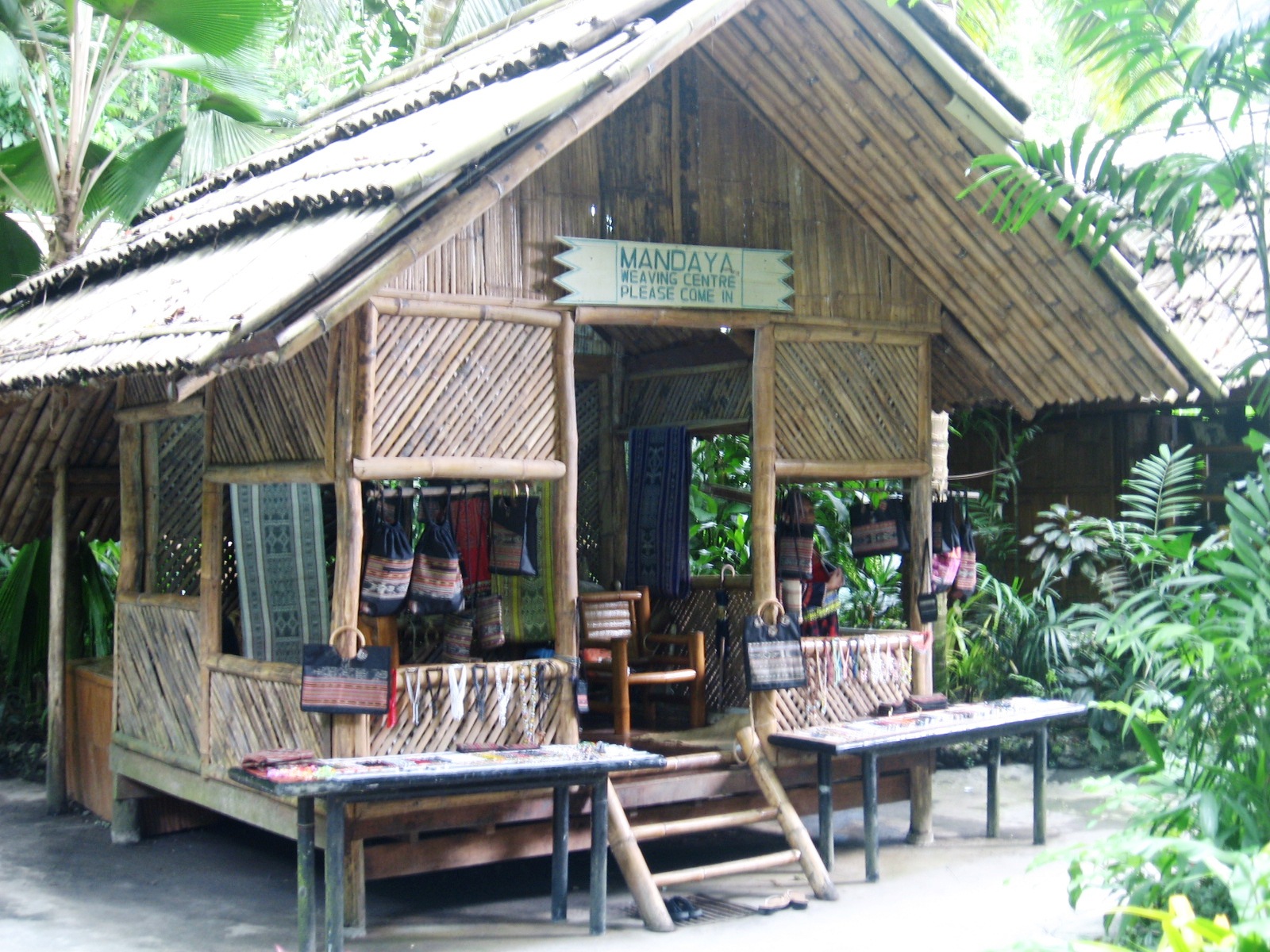
Its outdoor museum features the Ifugao Village (features typical Ifugao houses called ulog, under which is an Ifugao woodcarver carving various wooden artifacts for souvenirs), the Kalinga Village, the Aeta Village and the Muslim Village (features the Torrogan House). Adjacent to the Torrogan House is a replica of Tabon Caves. The Labuad Village is where ethnic Kapampangan handicraft and artwork are on sale. There are also replicas of the Banaue Rice Terraces and Mayon Volcano.
![]() |
| Replica of Barasoain Church |
The colonial division, on the other hand, displays the Spanish regime on the archipelago through replicas of Spanish-style houses and other edifices. It includes the far from faithful replicas of Malolos’ Barasoain Church (a mass is held here every Sunday, 10 AM) as well as the ancestral houses of National Hero Dr. Jose Rizal, Pres. Emilio Aguinaldo and Apolinario Mabini (a museum for Kapampangan artifacts). The Colonial Plaza, fronting the church, has a 3-tiered fountain. The Hero’s Plaza has a statue of a bolo and KKK flag-wielding Andres Bonifacio.
![]() |
| The Jose Rizal House |
Interspersed between the two areas are clean open spaces. Guests can go boating and fishing at the Lagoon. The Spanish Culture & Religion Museum and the Philippine Museum are 2 separate structures that look like fortresses. Also within the grounds are a 1,000 seat outdoor amphitheater used for social gatherings, theater plays and cultural presentations.
Nayong Pilipino sa Clark Expo: Clark Expo, ClarkField, Pampanga. Tel: (045) 436-1718 and (045) 599-2813. E-mail: nayon_saclark@yahoo.com. Website: www.nayonsaclark.com. Admission: PhP30 (adults) and PhP20 (children). Open 8 AM-6 PM.
This visual arts museum, opened in September 2005, houses the art collection of Ambassador Alfonso T. Yuchengco, highlighting his distinguished career as a businessman, diplomat, collector, philanthropist, patron of the arts and advocate for education in the Philippines and beyond.
This museum, as an exhibition venue, aims to be a cultural bridge to the regional Asian and Pacific Rim communities. The museum also aims to bring out the excellent artistic and creative expressions of the Chinese Filipinos as well as look at the best attributes of the twin-heritage, namely the Chinese’s hardworking skills and craftsmanship and the Filipinos’ highly expressive and adaptive sensibility.
Its Masters Gallery highlights three of the most celebrated Filipino visual artists: Fernando Amorsolo, Carlos Francisco and Juan Luna. Also part of the Museum’s permanent collection are key art pieces from the Yuchengco Group of Companies executive offices consisting of works by Filipino Modernists such as Anita Magsaysay Ho and by National Artists such as Napoleon Abueva, Victorio Edades, Jose Joya, Ang Kiukok, Cesar Legaspi, Vicente Manansala, etc. The YGC Collection also has a sizeable number of works in the folk genre by Angelito Antonio, Manuel Baldemor, and Norma Belleza, and prints by Boy Rodriguez and Manuel Rodriguez Sr.. Some thematic exhibitions periodically presented in the museum feature these pieces.
To promote better understanding of art and heritage, collections and creative industries, the museum regularly holds educational and extension programs (Young Curators Program; volunteer and internship programs; etc.) that link various sectors and audiences. Art workshops on Chinese traditional painting on Shui-Mo or “ink and water” as well as calligraphy are also conducted regularly.
Yuchengco Museum: RCBC Plaza, cor. of Ayala and Sen. Gil Puyat Ave., Makati City, Metro Manila. Open Mondays to Saturdays, 10 AM to 6 PM. Admission: PhP100 for adults, PhP50 for students 15 years and below (with valid ID, PhP25 for accompanied children and senior citizens and free for YGC employees (with ID) and UNESCO-ICOM and media pass holders. Group tours for children below 15 years old must be accompanied by adults and apply for special permission. The museum also has education and extension programs that link various sectors and audiences and promote better understanding of art and heritage, corporate collections, and the creative industries. Curator: Ms. Jeannie Javelosa. Tel: (632) 889-1234. Fax: (632) 887-5144. E-mail: info@yuchengcomuseum.org.
Website: www.yuchengcomuseum.org.
This museum, as an exhibition venue, aims to be a cultural bridge to the regional Asian and Pacific Rim communities. The museum also aims to bring out the excellent artistic and creative expressions of the Chinese Filipinos as well as look at the best attributes of the twin-heritage, namely the Chinese’s hardworking skills and craftsmanship and the Filipinos’ highly expressive and adaptive sensibility.
Its Masters Gallery highlights three of the most celebrated Filipino visual artists: Fernando Amorsolo, Carlos Francisco and Juan Luna. Also part of the Museum’s permanent collection are key art pieces from the Yuchengco Group of Companies executive offices consisting of works by Filipino Modernists such as Anita Magsaysay Ho and by National Artists such as Napoleon Abueva, Victorio Edades, Jose Joya, Ang Kiukok, Cesar Legaspi, Vicente Manansala, etc. The YGC Collection also has a sizeable number of works in the folk genre by Angelito Antonio, Manuel Baldemor, and Norma Belleza, and prints by Boy Rodriguez and Manuel Rodriguez Sr.. Some thematic exhibitions periodically presented in the museum feature these pieces.
To promote better understanding of art and heritage, collections and creative industries, the museum regularly holds educational and extension programs (Young Curators Program; volunteer and internship programs; etc.) that link various sectors and audiences. Art workshops on Chinese traditional painting on Shui-Mo or “ink and water” as well as calligraphy are also conducted regularly.
Yuchengco Museum: RCBC Plaza, cor. of Ayala and Sen. Gil Puyat Ave., Makati City, Metro Manila. Open Mondays to Saturdays, 10 AM to 6 PM. Admission: PhP100 for adults, PhP50 for students 15 years and below (with valid ID, PhP25 for accompanied children and senior citizens and free for YGC employees (with ID) and UNESCO-ICOM and media pass holders. Group tours for children below 15 years old must be accompanied by adults and apply for special permission. The museum also has education and extension programs that link various sectors and audiences and promote better understanding of art and heritage, corporate collections, and the creative industries. Curator: Ms. Jeannie Javelosa. Tel: (632) 889-1234. Fax: (632) 887-5144. E-mail: info@yuchengcomuseum.org.
Website: www.yuchengcomuseum.org.
![]() |
| Taal Vista Hotel |
A lot of my childhood memories included family visits to Tagaytay City where we enjoyed the cool and crisp (average temperature is 22.7 degrees Celsius) mountain air and a picture-pretty view of Taal Volcano from its original grand viewdeck: Taal Vista Hotel. I wanted to sample what the hotel had to offer, so I brought along my wife Grace, kids, Jandy and Cheska, plus in-laws, and stayed two nights in 2 (out of 88) interconnected superior rooms. On arrival, we were welcomed by the soft-spoken, Mr. Ikuo Itoi, and Ms Zeny Alcantara.
Check out “Hotel and Inn Review: Taal Vista Hotel“
![]() |
| De luxe room |
The hotel has its beginnings way back in 1935 when the Zamoras of Manila Hotel bought six hectares of flatland perched atop an incline along Ilong Kastila (people say it resembles a nose or ilong) from American Hammon H. Buck, the Superintendent of Schools in Batangas. Two years later, hotel was built. Its architect was probably Andres Luna de San Pedro who, just a few years earlier, renovated another landmark, the Manila Hotel, to accommodate a suite for Gen. Douglas MacArthur.
Its contractor was probably the well-known Pedro Soichi who built the Rizal Memorial Stadium in Manila. Both were favored by Commonwealth President Manuel L. Quezon who was then, as I still am now, equally fascinated with Tagaytay. Upon completion, Quezon frequently held cabinet meetings in the lodge’s premises and, on 21 June 1938, he converted Tagaytay into a chartered city by virtue of Commonwealth Act No. 338.
During World War II, the lodge was converted into quarters for Japanese officers. Between 1956 and 1964, Tagaytay began to be promoted as a major tourist attraction of the Philippines and Taal Vista Lodge was one of its leading attractions. n fact, the hotel was the public viewing ground to the September 28, 1965 (8 PM) major eruption of the volcano as well as mild to moderate eruptions from 1966 to 1970 (lasting from three to 65 days), and mild eruptions in 1976 (September 3 to October 23), 1977 (October 3 to 4 and November 9 to 12) and 1991. In 1973, Taal Vista Lodge, now a three-star hotel, boasted a large pavilion for dinner and dancing, a bowling alley, a golf course, a billiards hall and a horseback riding area beside the lodge.
One its many regular visitors was a young man who often chose one spot in the grounds from which he gazed out and dream. That dreamer was Henry Sy whose SM Investments Corp. would later acquire the hotel. In 2002, he had the hotel rebuilt in the style of the original lodge and added 2 new extensions on the east side of the complex to provide 128 rooms, conference facilities and amenities. In 2004, this reinvigorated and now first-class hotel welcomed back guests and visitors. Today, it remains a landmark deeply entrenched in the history and heritage of Tagaytay City.
The original building now houses the hotel’s front desk, business center, shops, ball room and meeting rooms. At the hotel foyer is the 26-ft x 8-ft. Taal Vista Hotel Historical Mural, a joint project of Paolo Alcazaren and Felix Mago Miguel.
![]() |
| Seasons |
However, the building’s focal point are its three food and beverage outlets: Cafe-on-the-Ridge, Season’s, and the Lobby Lounge. Both take you far beyond the plate,whether al fresco or from within, as their panoramic floor-to-ceiling glass windows allows diners to watch, aside from Taal Volcano and Lake, the fog rolling in, the captivating sunset and, at nighttime, the stars or the pinpoint lights of fishing boats and the lakeshore towns. cafe-in-the-ridge, offering a la carte & buffet service, recreates the cuisine and ambiance of two continents, featuring a menu that distinctly highlights the simple elegance of Europe, the carefree disposition of Spain and the Asian mystique was offered with live entertainment at night. Season’s, where you can dine of the finest gourmet creations made from the freshest of the season, is a classy fusion of setting and landscape, is a perfect place for intimate dinners and cozy get-togethers.
The Lobby Lounge, with its natural motifs, was an ideal rendezvous for a lazy after dinner conversation, evening interludes and winding down moments. Its well-stocked bar offers light meals, coffee or cocktails. Here, warmed by the fireplace, we all sampled hot chocolate while listening to a piano.Try sampling the Chocolate Eruption, a sinfully delicious dessert concoction prepared and baked, minutes before serving, by Canadian executive chef Bill McGrath.
![]() |
| Swimming pool |
The tropical style Ylang-Ylang Spa, ran by French doctor, Charles Sutter and his Filipina wife Pristine in Davao, applies all-natural techniques and ingredients rooted on the principle of “touch therapy” which has been proven to stimulate the release of endorphins which is supposed to make you happy.
The hotel is in the midst of a Php 650 million (US$16 million) expansion which will add 133 more rooms, 6 function rooms, and a 1,000-seater grand ballroom. By the end of the year, the hotel will have a total of 261 guestrooms, 2 grand ballrooms and 16 function rooms.
It has a façade of balconies and a overhanging wooden gallery, a beautiful inner courtyard and antique Philippine, Oriental and European furniture and furnishings. Designed by Arch. Jose Ramon Faustmann with interiors by Martin I. Tinio, Jr., it is a window to the opulent 19th century lifestyle of the gentry.
Though the house is just a reproduction, its exhibits aren’t. No photography was allowed inside. On display are antique 17th to the early 20th century jewelry, finely-crafted local, Chinese and European furniture and other items from the Intramuros Administration’s collection.
Casa Manila: Plaza San Luis Complex, Gen. Luna cor. Real St., Intramuros, Manila. Tel: (632) 527-4084. Open Tuesdays to Sundays, 9 AM to 6 PM. Admission: Php50 for children, students with valid ID and faculty members; and PhP75 for adults.
Francis and Vicky Dionela, our balikbayan relatives, from Vienna, Austria, were in town and my brother-in-law Mark and I toured them around Intramuros, availing of a calesa to do so. Joining us were Mark’s sons Miguel and Matthew. The first stop in our calesa tour was the San Agustin Church. I have been inside this church a couple of times, notably during the wedding of the former Susan O. Bilog, my wife’s first cousin, to Alfredo Azarcon on January 31, 2001. However, this was my opportunity to explore it in detail. During our visit, the church was again being prepared for another wedding.
| San Agustin Church |
| The adjacent San Agustin Museum |
| Corridors leading to the San Agustin Museum |
| TheProto-Baroque molave main door |
| The church interior |
| The tromp-l’oeil ceiling |
| The pulpit |
| The main altar |
| A side altar |
| Another side altar |
![]() |
| White sand beach |
I have always been a frequent visitor to Boracay, my father-in-law being a native of Malay town which has jurisdiction over the island. During this latest visit, for a change of scenery, my son Jandy and I opted to visit the nearby 28.9 sq. km. Carabao Island, touted as the “Next Boracay.” This island, part of Romblon province, was so named because of its carabao shape but is commonly called, by its natives, as Hambil. It is 3 times bigger than Boracay and can be viewed from Boracay’s Mt. Luho View Deck. Relatively-unknown until lately, the prices of real estate in San Jose, Carabao Island’s only town, which is virtually occupied and owned by its original settlers, is also much cheaper compared to Boracay and foreign investors from the European Union, Taiwan, South Korea and Japan have shown interest in relocating to San Jose after they discovered the island’s white sand beaches and crystal-clear waters said to rival, if not equal, Boracay’s. Reportedly, investors were also discouraged to find taxes on Boracay Island to be “quite high.”
| Carabao Island seen from Boracay |
I wanted to visit this still pristine island before the onset of continuous and uncontrolled Boracay-like development spills over to the island. This is inevitable as plans are now underway for San Jose to be the site of the Romblon Special Economic Zone and that work on a modern PhP5 billion international airport with a 4,000 m. long runway, to accommodate large-bodied Airbuses and similar aircraft, is expected to begin. A boat to the island leaves, once daily, around 7:30 AM, from a landing near the Caticlan Jetty Port. My co-passengers included a French couple, with their two cute little daughters, and Lanas barangay captain Ms. Emerita Sombilon whom I chatted with along the way. The boat trip took about an hour, passing by Boracay’s rapidly developing east coast and Puka Beach on the north, the closest part of Boracay to Hambil. We again touched ground on Hambil’s jetty around 9 AM and decided, together with the Frenchman, to walk along the beach to the first resort that came our way: Ivy Vine Beach Resort. We were welcomed by amiable British couple Graham and Pamela “Pam” Hill who were managing the resort in the absence of owners. We instantly fell in love with the place and decided to stay, billeting ourselves in two of its 7 fan-cooled rooms with bath. The resort also has a 3-4 pax dorm.
![]() |
| Graham Hill of Ivy Vine Resort |
After lunch (ordered in advance) at the resort’s restaurant, Jandy and I decided to walk long the coast as far as our legs would allow, surveying the wonderful and bucolic scenery and the existing tourism infrastructure such as Nipa Hauz and the currently closed Carabao Beach Resort. There are no jeepneys or tricycles for getting to and from the island’s 5 barangays as the narrow, single-track and partially concrete (but mostly rough) road only allows for motorcycles and mountain bikes. We bought cool, refreshing drinks and halo-halo at small stores along the road.
![]() |
| A bucolic scene |
Come dusk, I decide to forego going to the town proper which was celebrating its fiesta (the Feast of St. Joseph, the town’s namesake). Instead, we opted to have a quiet dinner at the resort and chat with Graham, Pam and the guests. It was also an opportunity to view its beautiful, uncluttered sunset which I found to be much better than Boracay’s which is usually obstructed with numerous boats and swimmers.

The author with 3 gutsy ladies
During a visit to Club Balai Isabel (Talisay, Batangas) I met, in person, 3 women who exemplify the Pinay spirit at its best: the Kaya ng Pinay Mt. Everest Team composed of Janet Belarmino, Carina Dayondon and Noelle Wenceslao.
These 3 Filipinas, all members of the Philippine Coast Guard (PCG), made history by becoming the first Southeast Asian women to reach the summit of 8,848-m. (29,028-ft.) high Mt. Everest (also called Mt. Qomolangma), the world’s tallest mountain (literally the top of the world) and the ultimate challenge to human endurance (it has now been summitted 3,067 times).

Janet Belarmino
Everest sits on the border of Nepal and the Tibetan region of China. In 2006, Filipinos Leo Oracion, Erwin “Pastour” Emata and Romy Garduce successfully climbed from Nepal on the shorter but arguably the more dangerous, so-called South-East route.
The 3 women are the first women in the world to traverse or cross Everest from the less treacherous North side (with its earlier summit window) to the South side, crossing the mountain from Tibet to Nepal, a feat done by a handful of mountaineers – all of them men. The traverse poses a bigger challenge for the women as they will be passing an unfamiliar route to come down the mountain.

Carina Dayondon
Janet, from Nueva Vizcaya, is a member of the University of the Philippines Mountaineers, a fitness instructor for the Moro Lorenzo Fitness Gym in Ateneo and an excellent sport climber, lawn tennis coach and champion triathlete. Noelle, a prized member of the Dragonboat team, is also an expert biker, extreme adventure athlete and mountaineer.
Both women were consistent winners in the Philippine and Hong Kong legs of the AXN adventure races. Carina, a formidable sport climber and the youngest member of the team, has been scaling mountains in her native Bukidnon since she was 17 when she was studying at Xavier University in Cagayan de Oro City. She climbed 7,548-m. (24,758-ft.) high Muztagh Ata in China-Pakistan, the highest peak ever reached by any Filipino, man or woman, before Everest.
Carina and Noelle, plus team doctor Ted Esguerra, documenter Fred B. Jamili, Emata and team leader Arturo Valdez, were to leave on May 19 to participate at the 42-km. 6th Hillary-Tenzing Mt. Everest Marathon, the highest marathon in the world (commemorates the 55th anniversary of the Edmund Hillary–Tenzing Norgay climb), from the 17-149-ft. level Mt. Everest Base Camp at Nepal (South side) to the town of Namche Bazar in Nepal (11,300 ft.), over rough and treacherous trails with two steep uphill sections. Ten days later, on May 29, Carina finished first, among foreign female climbers and behind 7 Nepali women, in the aforementioned marathon, with a time of 6 hours and 45 minutes.

Noelle Wenceslao
At a presscon held at the resort’s function room, all 3 recounted their hardships and sacrifices in the face of what appeared to be insurmountable obstacles. Janet had to battle personal problems prior to the climb, giving birth, in December 2006, to a healthy baby boy named Himalaya, just one month before their training for the Everest climb started (she was thus, the first woman to summit Everest just months after giving birth). She said it was emotionally a very difficult thing to leave her small son at home with her husband Ricky and join the expedition, putting her life at great risk at the mercy of the mountain.
Noelle, on the other hand, lost her mom to a stroke as she was on her way to the airport to pick up Noelle who successfully climbed 20,320-ft. Mt. McKinley (also called Mt. Denali) in Alaska, the highest in North America. Carina, on the other hand, was the family’s breadwinner. During the climb, they also missed their families in the Philippines – something that proved to be an additional burden for them. At the Himalayas, Noelle also suffered from acute mountain sickness (AMS) and pulmonary edema while climbing (she had to descend to 5,000 m. to recover).
Their skin, especially on the face, was damaged due to the extreme cold and heat. All came down with blotches and sunburn on their faces. Theoretically, the 3 women’s route was longer and the journey much more difficult. During their climb, the weather was not too cooperative. They carried backpacks weighing 50 lbs, an ice axe that is at least 2 lbs. and wore high altitude boots and down suit that acted like thermal blankets.

Janet wearing her Mt. Everest outfit
The Filipinas also had to negotiate the dreaded Khumbu Icefall (where 3 Sherpas recently lost their lives), a large slab of ice that covers the lower part of the mountain’s south face. Ice seracs (pointed masses of ice), deep crevasses and ever-shifting masses of ice make for a dangerous trek. Climbers usually use metal ladders to cross crevasses, making sure that the anchors on their ropes are secure. Down the mountain, at Camp 2 (which has a reputation as the “Death Zone” where extreme cold can sap a climber’s strength), the Filipinas will encounter the Lhotse Face, a steep and narrow ice-laden ledge.
Combining hard work, dogged determination and a positive attitude, they all conquered these obstacles by training to be tough mentally as well as physically. They went to New Zealand to train for alpine climbing. On the Himalayan range in Nepal, they climbed the lower, 5,500-m. high Gokyo Ri (which had a full view of Everest) so that their body could adjust to the lower oxygen level (50% compared to sea level) at higher altitudes.
In spite of strong support from sponsors and a solid team behind their backs, they still worked on a tight budget. Their route, aside from being relatively safer, was also cheaper as the permit for climbing, per person, from Tibet is about $4,000 compared to $10,000 on the Nepalese side. They did their laundry in very cold rivers and, to save on shower expenses, they did not take a bath for more than 60 days.
A small window of good weather (very clear with winds in between 20-30 kms./hr.), a little good luck, prayers back home and a lot of determination, they reached the top of Everest to once again plant the Philippine flag on the highest point in the world. Noelle (with Sherpa Lakpa Gyalzen) was the first to reach the summit at 6:10 am Nepal time (8:10 am in Manila) followed by Carina (with Pemba Choti) 10 minutes later. They stayed on the summit for 20 minutes. Janet, who reportedly initially lost radio contact with the Philippine team at the Everest’s base camp, was delayed because she had to wait her turn among the climbers wanting to reach the summit. She arrived at around 7:45 am, Nepal time, with Pasang Norbu.
All three Sherpas guided Leo Oracion and Pastor Emata in their historic climb to Everest. This was no small feat for three tough-as-nails ladies whose childhood exposure to ice, until three years before (in India), was limited to ice cubes, sorbetes and halo-halo. Again, they proved that if we set our minds to it and unite in a common cause, we can climb whatever heights and reach whatever distance we imagine. They didn’t just do it for themselves, but for all the Filipinas around the world struggling to conquer their own mountains. In doing so, they have again made the country proud and left a legacy of hope, faith and triumph of the human spirit. The real victory is conquering, not Mt. Everest, but ourselves, our fears, our insecurities and our differences.
![]() |
| Taal Lake Yacht Club |
After our Taal Volcano hike and press conference at Club Balai Isabel, Bernard and I dropped by, on the way home, at the Taal Lake Yacht Club (TLYC), the “Sailing Mecca of the Philippines,” to try some Hobie Cat sailing, a first for me. Hobie Cats are small, twin-hulled sailing catamarans manufactured by the Hobie Cat company. The club is dedicated to the promotion of sailing through its learn to sail program, and the creation of its Hobie 16 one design racing program. At TLYC, Bernard introduced me to Commodore Peter Capotosto, TLYC owner, Mr. Joe Hagedorn, Sailing Manager/Membership Coordinator. TLYC grants memberships to accomplished sailors and rowers.
TLYC, established in 1996 and located on the northern shore of Taal lake, started to build up a successful and competitive Hobie 16 fleet and, today, has over 50 privately-owned or TLYC-owned Hobie 16s that form the core of several events that are undertaken throughout the year. Hobie Cat 16 is the most popular catamaran ever made and the most competitive catamaran class in the world. The first Hobie 16 National Championship was held at TLYC in early February of 1997 and was held every first weekend in February till 2003 when it was changed to the end of January to accommodate the Philippine Hobie Challenge dates. The club’s monthly races take place every second Sunday of every month while the Round Taal Volcano Regatta is held annually at the end of November..
![]() |
| A Hobie Cat 21SC |
The club has a very competitive Hobie 16 fleet and 8 Topper class dinghies for training and recreation. Topper regattas, held every second Sunday of the month, are open to all. TLYC is also considered one of the best campgrounds within 1 hour from Metro Manila, with open cabanas and toilets available for member and their guests. Campers here also have a fantastic view of Taal Lake. TLYC also offers windsurfing (October-April), kitesurfing, keelboats, sunfishes, lazers, optimists, Hobie 21s (good for groups of 7) and ocean kayaks. They also offer trips to Taal Volcano.
![]() |
| Sailing away |
As the wind was good, Peter allowed Bernard and I used a 21-ft. long, 8.5-ft. wide Hobie Cat 21SC (Sports Cruiser) operated by a sailing instructor. A lady guest also joined us. This spacious catamaran, intended for casual sailing, has a front trampoline, wings, an outboard motor mount and a unique built-in, 68-quart marine grade cooler. It also has 29-ft. mast and 222 sq. ft. (21 sq. m.) of sail. The cruise, though short, was exhilarating as we sailed to the cool Taal Lake breeze. Another “must experience” item scratched from my Bucket List. This has been a fruitful day.
Taal Lake Yacht Club: Talisay, Batangas. Tel: (043) 773-0192. Mobile number: (0917) 838-3726. Manila reservation office: Corinthian Plaza, Paseo de Roxas, Makati City. Tel: (632) 811-3183 or 811-3283. Fax: (632) 811-3236. Website: www.sailing.org.ph/tlyc and www.tlyc.com. E-mail: peter@sailing.org.ph, peter@tlyc.com or sailphi@i-manila.com.ph.