Return to Mt. Makulot (Cuenca, Batangas)

The summit of Mt. Makulot

Four months have passed since my climb to Mt. Makulot and here I am making plans to climb again, this time to camp at the shoulder and make for the peak.  Aside from Jandy, also traveling with us are Ms.  Glorain “Rainy Canillas” and Ms. Marge Yu, former SPED (Special Education) teachers of Jandy; and Warner Bros. executive Ms. Lourdes “Lulu” Seguinza and Ms. Rosevie Sevilla, both friends of Rainy and me.  All, except Rainy (who made it up the campsite a few years back), were first timers up the mountain.         

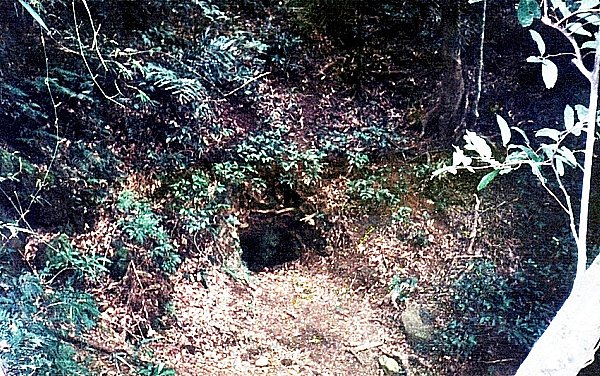
A World War II Japanese tunnel
Laden with backpacks, tents, sleeping bags and provisions for an overnight camping stay, we left Manila at 6 AM, Friday, February 25, 2000 (Edsa Revolution anniversary and a non-working holiday), passing through the South Luzon Expressway (SLEX) up to the Calamba Exit, then entering Batangas to Sto. Tomas, Tanauan, Malvar and Lipa City before turning right to Cuenca, arriving there at 9 AM.  At the barangay hall of Brgy.  7, we all registered and paid the required PhP5 fee .  Here, I secured the services of 3 porters to carry the bulk of our equipment.  We parked our car at the Mountaineer’s Stopover Store and began our climb from here.
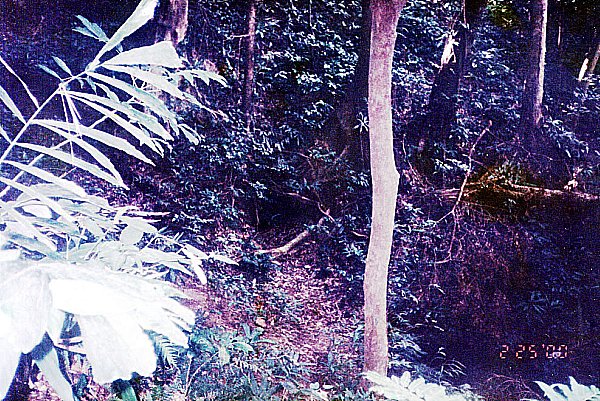
Another tunnel

My first climb to the campsite was a breeze compared to the climb we were doing now.  During my first visit the skies were overcast, the weather was cool and the ground along the trail, slightly wet due to rain the day before, was nevertheless compact, making it easier to climb.  Today, the sun was shining intensely bright and the weather was humid. There wasn’t a gust of wind.  We were in boisterous spirits when we initially started out over the gentle, moderate grade gravel trail, chatting and laughing as we went along.  As the porters were carrying our equipment, we only carried our bottles of water.  Pretty soon, the chatting died down as our tongues were beginning to hang out due to thirst and heat stroke.  Even as our load was beginning to lightened (we were drinking our water at an alarming rate), we frequently had to stop to recover our breath and replenish our system with water.

The mountain spring

After about 30 minutes, the trail became steeper as we entered the light forest.  As the ground was very dry, we frequently slipped and literally had to crawl our way up.  There were many refreshment stations along the way selling fresh buko juice (good for rehydration), a welcome relief.  Things changed as the forest gave way to an even narrower, dusty and more slippery path through tall, sharp cogon grass, virtually unprotected from the intense heat of the sun.  And worse, there were no more refreshment stations along the way. The pace was beginning to tell on us especially Lulu who was a little bit under the weather.   She practically lost her voice and had to be assisted.  Our once compact group was now splintered as the others were beginning to lag behind and we had to wait for them.  Other hikers, all seemingly fit and able, occasionally passed as by.  We all arrived at the campsite after about 2 hrs.; hungry, thirsty, drenched with perspiration and bedraggled.  Again, it seemed like an eternity getting there.

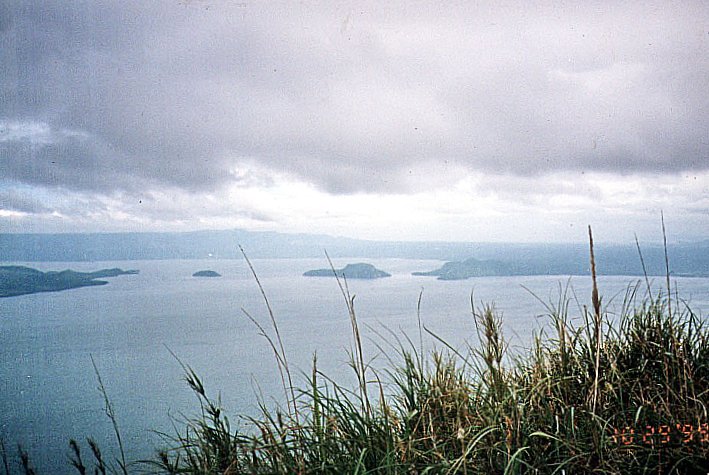
Being a long 3-day holiday, there were many campers and tents were sprouting like mushrooms all around us. By the end of the day, there would be 250 names registered in the barangay hall logbook.  Mang Ed, together with his wife, was there to welcome us.  Both were minding their store and doing brisk business, selling canned goods, snacks, soft drinks in cans, bottled water and buko juice from which we quenched our thirst.  Their son, Ramon, showed us a suitable place to pitch our tents. The spot we chose, at the edge of the clearing, had a good worm’s eye view of the now cloud-free (it was cloud-shrouded during my first visit) main summit.  Further off, we also had an impressive view of Taal Lake, Lipa Point, Volcano Island, the nearby towns and beyond it, Laguna de Bay and the sea. We pitched our 3 tents beside each other.  It took me some time to figure out how to set up our tent, a 6.5-ft. by 4.75-ft.Bobcat dome tent with ultra-light aluminized coating.  After about 30 mins., our tents were set up and we settled down to a late lunch, dining on provisions that we brought along: packed rice, pork and beans and sausages.  Being very hot and tired indeed, we decided to postpone our final trek to the main summit for the next day.

On top of the Rockies

Instead, we decided to visit the Japanese World War II caves (there are 5 on the mountain) and the bukal (spring) located about 100 m. down the campsite.  The trail was also well-marked and we passed (but did not explore) 3 caves, a group of campers and a cluster of tents along the way to the spring.  The spring, the mountain’s only water supply, was actually a constantly dripping aquifer by the side of a cliff.  The only way to get to it was by clambering down the huge, exposed roots of a tree beside it.  I was the only who attempted this and the others just contented themselves with the view and the sound of the spring.  Upon reaching the spring, I rewarded myself with a refill of my water bottle.  On the way back we had a photo session by a huge dangling aerial root of a huge tree.

Sunset at Mt. Makulot

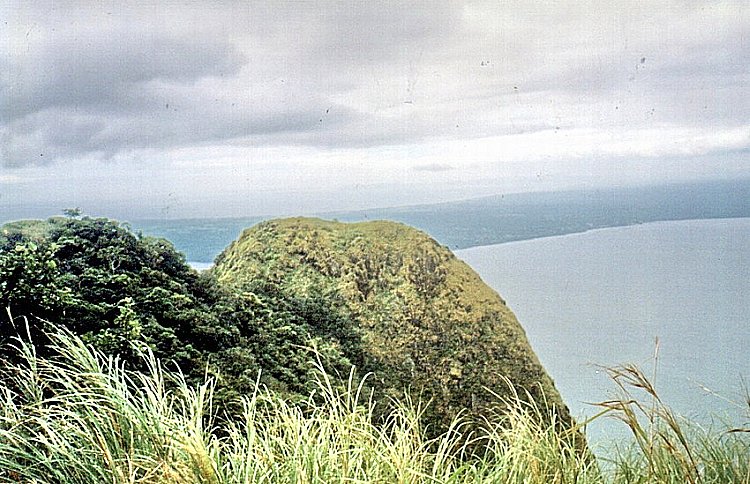
After about an hour, we returned to the campsite as we didn’t want to miss the beautiful sunset.  We proceeded along a small trail through the cogon grass to the Philippine Air Force marker. Beyond it was the knife’s edge leading to the 700-m. rocky drop-off of the “Rockies”.  Its peak was beginning to fill with people waiting for the sunset.  Rainy, Marge and I decided to join them.  The way up wasn’t easy as we had to negotiate the narrow, but well-marked, knife’s edge and then clamber up the cliff.  Sometimes, we had to stop to give way for others going down.  After about 10 mins. we reached the top.  The 360 degree view here was even more spectacular.  This is as close to God and Heaven as I have ever been and I was not the only one who felt that way.  Nearby was a religious group of young people singing their high praises to the Lord above.  After admiring the spectacular sunset, I descended the way I came in.  

Campsite at the shoulder

It was getting dark and we made arrangements with Mang Ed for a hot supper.  It was also getting very icy cold and windy and we arrived at Mang Ed’s store wrapped up in our warm sweaters, jackets and caps.  The night was very cold and windy.  We soon had our fill of the hot supper prepared for us and prepared to retire to bed literally with the night sky and stars as our blanket.  Too bad we can’t start a bonfire (it is prohibited) to keep warm. Dead tired, we decided to retire early to our sleeping bags.  However, sleep for me was an impossibility since the spot I chose to build my tent was quite lumpy and uncomfortable.  I envied Jandy who was sleeping soundly. While still dark, I mustered the courage to get out of my tent, wrapped as warmly as possible, to have hot coffee and a chat with Mang Ed.

Halfway Up Mt. Makulot (Cuenca, Batangas)

Mt. Makulot

Jandy and I checked out of Casa Punzalan in Taal early in the morning and proceed to Cuenca, passing by the towns of Sta. Teresita and Alitagtag.   We planned to climb the 1,145 m. high Mt. Makulot, the highest mountain in Batangas.  The weather was perfect.  Mt. Makulot (also called Macolod), located at the northeast boundary with Laguna, is said to have been named after the kinky-haired people who lived on the mountain.  The mountain dominates the southeastern shore of Taal Lake and has a rounded, densely-forested  main summit and an extended shoulder on the west flank which ends abruptly in a 700-m. rocky drop-off.  The mountain  is thought to be the highest part of the caldera rim that was not blown away in Taal’s ancient eruptions.  Others say the mountain is part of another extinct volcano.  It was the last Japanese stronghold in the province during World War II, and 5 Japanese-built tunnels still exist in the area.  To preserve the mountain for future generations, the mountain was adopted by the Philippine Air Force, under then commanding Gen. William Hotchkiss, on February 21, 1998.

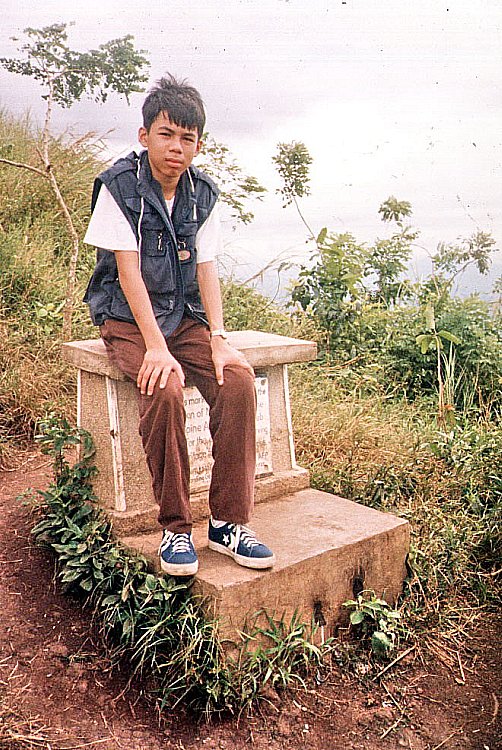
The Philippine Air Force Marker

Upon entering Cuenca town, we stopped at the town hall where we were advised, as a safety measure, to register (PhP5 per person)  at the Barangay 7 hall.  After registration, we were given a quick lecture lecture on how to get to the campsite.   I parked our Nissan Sentra at the Mountaineer’s Stop-over Store.  At the last minute, I decided not to bring my camping equipment and to just go on a day hike up to the mountain’s shoulder.  I wanted to go home early.  We donned jackets, changed into rubber shoes and packed 5 bottles of mineral water, my camera, extra shirts, my cell phone and a first aid kit.

The Rockies

The initial trail is a fairly gentle, moderate grade section through a gravel path.  After passing some residential houses, including an expensive-looking one, and entering a forest, we reached a fork along the trail.  Remembering the lecture, we took the left trail (the one descending), and went past a dried rivulet and another fork. We asked around and were told to take the right trail.  We were also told that the left trail leads to a staircase down a cliff to the lake shore.  Surely for the more adventurous.  The trail became steeper (and more lung-busting) as we entered the forest.   We needed both hands to hold on to roots and branches of trees.  Rest stops became more frequent.  All the while, hikers, as well as local residents, were passing me by.  I was shamed by the sight of a woman carrying a heavy load of long bamboo stems.  As we went along, I befriended a man laden with two backpacks and an icebox full of soft drinks, all slung on a pick.  Named Eduardo Puso, he was a Barangay 7 tanod on his way to bring supplies for his store on top of the mountain.  His two sons, Eduardo Jr. and Ramon, also carrying provisions, passed me by a while earlier.

The knife’s edge leading to the Rockies

The last quarter of the hike was through an even narrower path through tall cogon grass which swayed in rhythmic, wave-like motions when the wind blew. At around 11:30 AM, we reached the campsite at the mountain’s shoulder.  Mang Ed and his sons were already tending to their store, which is beside another store tended by a woman.  Even on this mountain, the spirit of healthy competition lives on.   The campsite, Makulot’s main attraction, is actually a small clearing on the cogon-covered shoulder.  We explored a small trail through the cogon grass leading to a clearing with a marker installed by the PAF. 

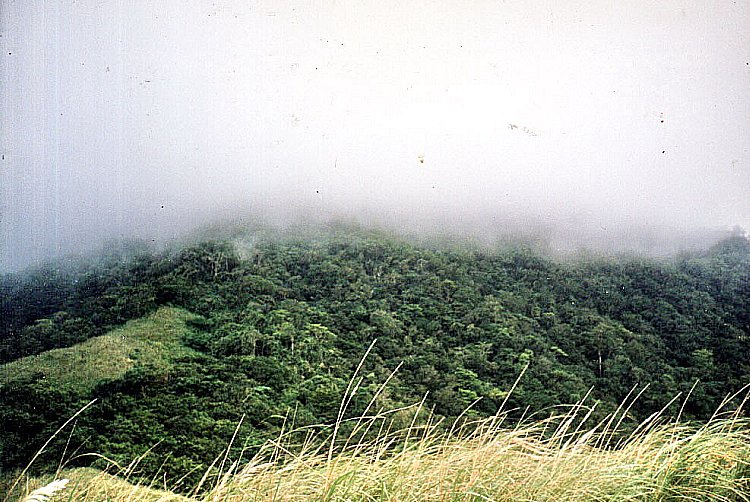
The fog-covered peak

Here, we were presented with an impressive view, the best I’ve seen so far, of Taal Lake, Lipa Point, Volcano Island, the surrounding towns and beyond it, Laguna de Bay and the sea. Over a knife’s edge is the 700-m. drop-off (500 m. of which are almost vertical).  Locals call it the “Rockies” after its American namesake.   We returned to Mang Ed’s store and I interviewed him about the mountain.  He said that Makulot has 14 Stations of the Cross frequented by townsfolk during Holy Week.  Trekkers and campers come here even in adverse weather conditions and peak days are Fridays to Sundays when up to 200 campers converge.  

View of Volcano Island

Mang Ed opens his store only during those peak days.  Set up with money borrowed from a “five-six” loan shark, the store offers cigarettes, bread, candies, soft drinks in cans, real buko juice and, only on request, cooked food.  When provisions run low, he quickly sends his sons down the mountain for supplies.  Prices are high, but understandably so considering the labor involved. Mang Ed, being an elected barangay tanod, sees to it that the campsite remains clean. He frowns on campers who leave their rubbish behind.  Just the same, he and his sons gather the trash and carefully burn it.  They also assist in bringing down badly injured campers on a stretcher and advises climbers not to go beyond the Rockies. In 1994, a woman fell to her death (some say it was a suicide).  In 1997, another man fell but survived.  He was evacuated by helicopter.

Eduardo Jr. guided me 100 m. down the mountain to a bukal (spring) where potable water can be had.  As can seen from discarded shampoo sachets, campers frequently bathe here. Also in the area are four bat-and-bird-inhabited tunnels built by the Japanese close to one another during the war. Birds panicked and flew away as we entered one guano-filled tunnel.  It is said that campers caught by storms seek refuge here.  The fifth and longest tunnel is located a distance away.  A Japanese expedition had tried to enter it but retreated. And it remains unexplored to this day.

Upon our return, Mang Ed invited me to a late lunch, and we feasted, kamayan-style, on tuyo, fried egg and rice, washed down by mountain spring water.  We left the campsite at around 2:30 PM.  The descent was faster and less tiring, but slippery and harder on the joints.  Along the way we passed and conversed with two groups of backpackers on the way up.  Peak season has just began.  We reached the Mountaineer’s store at around 4 PM, snacked on crackers and soft drinks, changed our clothes and left for Manila, passing by Lipa City and the towns of Malvar, Tanauan, Sto. Tomas and Calamba City before entering the South Luzon Expressway.  We were home by 8:30 PM. 

Casa Punzalan and the Taal Heritage Foundation (Taal, Batangas)

We decided, due to the late hour, to spend the night in Taal.  Driving back to the municipal hall, we stopped at nearby Casa Punzalan, Taal’s first pensionnne. The ancestral home of the prominent Punzalan family, it was leased by Mr. Jesus Samala Punzalan, Jr. and Capt. Nieto Punzalan, at no cost, to the Taal Heritage Foundation.  We were welcomed by Ms. Betty Lualhati, a U.S. balikbayan and one of the foundation’s members.

Jandy at Casa Punzalan

The foundation was, together with the Department of Tourism and in close coordination with the municipal government, in the forefront of Taal’s recent failed campaign to be included in the World Heritage List of the UNESCO (United Nations Educational, Scientific and Cultural Organization).  They also organized the Taal Heritage Tour (or Taal Walking Tour), an educational, enriching and entertaining guided tour that allows the visitor to experience the lifestyle of the town; its culture, arts, crafts and the warm hospitality of the people.

It just so happened that we were the only boarders at Casa Punzalan for the night, and I not only got the feel of Taal’s 19th century lifestyle, but also a tingling feeling one gets when one stays alone in a old, haunted house.  The inn has 7 rooms, all named after owners (Graciano and Juliana) and their children; 5 of them fan-cooled (PhP600) and 2 airconditioned (PhP1,00-1,200), all accessed by a grand staircase.  It also has common baths (mens and ladies), a living room (sala), a coffee shop and a gift shop.  We opted to stay at the corner and well ventilated Graciano Room with its excellent view of the basilica and park from its capiz windows.  After a well-deserved bath at the modern-looking common bathroom, we retired to an uneventful sleep.

Graciano Room

We were awaken at 6 A.M., stirred by the sound of crowing roosters, packed our bags and were off, after an early breakfast at Lemery, to Cuenca and its stately 1,145-m.  high guardian, Mt. Makulot.

Casa Punzalan: cor. C. Ilagan and P. Gomez St., Brgy. Poblacion 7, Taal, Batangas.  Tel: (043) 408-0084.

Taal Heritage Foundation: Casa Punzalan, Taal, Batangas. Tel: (043) 421-3034, 421-1053 & 421-1071.  Fax: (043)  408-0577.

Felipe Agoncillo Mansion and Monument (Taal, Batangas)

Later, accompanied by the HME Embroidery Store caretaker, Jandy and I crossed the street to the 2-storey Felipe Agoncillo Mansion and Monument, birthplace of Felipe Agoncillo, the husband of Marcela  who was appointed by Pres. Emilio Aguinaldo as ambassador to the U.S. to campaign for recognition of Philippine independence.  He is considered as the first Philippine diplomat.  In the well-manicured front garden is a prominent brass statue of Felipe.

Felipe Agoncillo Mansion and Monument

Known as the White House, this mansion is also known as the Don Gregorio R. Agoncillo (nephew of Felipe) Museum and is now a National Historical Landmark.  As we were accompanied by the store caretaker, we were allowed passage.  On the second floor are Edwardian and Spanish-inspired antique, 1800s to early 1900s furniture and choice period items plus busts of the Agoncillo ancestors.

Agoncillo Mansion dining room
Felipe Agoncillo Mansion and Monument: J.P. Rizal St., Brgy. Poblacion 13, Taal, Batangas

HME Embroidery Store (Taal, Batangas)

From the Leon Apacible Museum and Library, Jandy and I proceeded to the HME Embroidery Store, one of the town’s pioneers in the now dying art of fine needlework of hand-embroidered, semitransparent pina (made from pineapple fibers) cloth which is usually done by women in their homes and sundried around the market.    

HME Embroidery Store

The store is located within the Art Deco-style ancestral house (also called the “Pink House”) of Ramon and Jovita Estacio, built in 1918 with narra and molave shipped all the way from Mindoro.  We were shown around the second floor by Mrs. Ofelia Estacio, the wife of Honesto Estacio, the current owners, where we appreciated its antique furniture. I bought barong cloth for PhP600 at the ground floor store.

HME Embroidery Store: J.P. Rizal St., Brgy. Poblacion 13, Taal, Batangas

Leon C. Apacible Museum and Library (Taal, Batangas)

Returning to our car, I drove further up the street, across Taal National High School, to the Leon C. Apacible Museum and Library, ancestral house of Leon and Matilde Apacible.  Leon Apacible, son of Don Vicente Apacible and Catalina Castillo, was Gen. Emilio Aguinaldo‘s finance officer and was a delegate to the Revolutionary Malolos Congress of 1898.  This extremely well-preserved bahay na bato home to 4 generations of Apacibles, was remodeled twice, in 1870 and from 1938-40.  It was recognized as a National Historical Landmark and was donated to the government on December 6, 1976 by former town mayor (1975-80) Mrs. Corazon Apacible Caniza, daughter of Leon Apacible, Jr. and Consolacion Noble.  It is now managed by the National Historical Institute with Mrs. Annie Marie Moreno as curator. 

Leon Apacible Museum and Library
Upon entering the house’s foyer, the first thing you would notice is a karitela (horse carriage) restored by the NHI on August 1992.  We were toured by Mr. Oprenilo Canoza.  Below the stairs are displays of old documents, faded photos, a chart showing the family’s genealogy and a 400-year old gallinera said to have been used as a coop for the master’s (and his friend’s) fighting cocks. Upstairs we were shown the house’s extremely well-preserved American Art-Deco interiors with details carved and inlaid into the floor and door trims.  Display cases exhibit the hand-painted fans of Dona Matilde, lace veils, the fans of Corazon when she was five years old, embroidered camisa blouses, and the children’s clothes she wore.

On display at the dining room are blue and white Ming Dynasty Chinese pottery, gilded Florentine wine decanters and a gilt-edged and hand-painted Venetian dinner service. The kitchen, which is still being used by the adjoining house of Mrs. Caniza, is closed to the public.  The family collection of fine antique furniture includes an 18th century hand-carved mahogany divan.  Inside the 2 bedrooms are 19th century vanity tables adorned with 4 oval mirrors inlaid with a hundred tiny circular mirrors; a beautiful carved wooden cabinet with two big mirrors; an early 19th century mahogany cabinet with 3 big mirrored doors;  an 18th century writing desk; a massive escritorio displaying Dr. Galicano Apacible’s 19th century medical equipment and 4-poster beds.   A piano, made in 1870 by M.F. Rachals of Hamburg, Germany, still works.  On the ceiling above the stairs is an 18th century chandelier.   There are also a 16th century statue of the Virgin of the Holy Rosary and 17th century ivory santos.

On the enresuelo (ground floor) are old documents showing Don Leon’s involvement in the revolutionary movement; a 1880 laminated photo of 16-year old Jose Rizal, Don Leon and younger brother Don Galicano as members of Intramuros’ Artist Club; pictures of Don Leon and his family and paintings of the Don Leon’s ancestors.   Underneath the azotea (court garden) is the aljibe (cistern) where rainwater is stored. Also on display are an old cannon, a stone water purifier, horse and cow brands, rice and corn grinders and other artifacts.  

Leon Apacible Museum and Library: M.M. Agoncillo St., Brgy. Poblacion 4, Taal, Batangas.  Open daily, 8 AM-5 PM. Admission is free. 

Marcela M. Agoncillo Museum and Monument (Taal, Batangas)

The first ancestral house Jandy and I visited was the 2-storey Marcela M. Agoncillo Museum and Monument, ancestral home of the wife of Aguinaldo’s first Secretary, Felipe Agoncillo, and the country’s equivalent to America’s Betsy Ross.  While in exile in Hongkong with husband Felipe, Marcela sewed, with the assistance of her daughter Lorenza and Herbosa de Natividad (National Hero Jose P. Rizal‘s niece) and in the tradition of Taal’s fine embroidery, our first Philippine national flag

Marcela M. Agoncillo Museum and Monument

The house was built in the late 17th century by Marcela’s grandfather, Andres Marino, making it one of the oldest, if not the oldest structure in the town.  Don Felipe and Dona Marcela had six offspring, all daughters who never married. Like most Spanish-era ancestral  houses, the main living quarters were located on the second floor which still has its original wooden floorboards.  The antique furniture, arranged in the Louie XVI (Luis Quince) and Charles XII (Carlos Trece) style, are mixed with Viennese bentwood pieces.

The garden with Marcela’s statue

The house is now managed by the National Historical Institute with Ms. Estela Atienza as curator.  We were toured by Mrs. Sylvia Alvarez who showed us the house’s antique period furniture, a chart showing the family’s genealogy, the library of old Tagalog, English and French books; portraits of Don Andres, Doña Marcela and Don Felipe in the chapel-shaped drawing room (with its carved ceiling and four corner angels), capiz windows and a display of the different flags of the revolution at the basement.  Beside the house, and accessible by a steel gate from the street, is a garden with flagpoles displaying the Katipunan and revolutionary flags as well as a bronze statue of Dona Marcela presenting the new flagsculpted by Florante Caido and inaugurated on February 14, 1985.   

Marcela M. Agoncillo Museum and Monument: M.M. Agoncillo St., Brgy. Poblacion 4, Taal, Batangas. Open Mondays-Fridays, 8 AM-5 PM, admission is free.

The Ancestral Houses of Taal (Batangas)

After exploring the town’s plaza, Jandy and I proceeded by car to M.M. Agoncillo St., the town’s main street and site of many of the town’s large, well-appointed and well-preserved bahay na bato (stone ancestral houses).   Most were built by the immensely rich and aristocratic illustrado merchant class   who made an economic windfall in 1841, planting Mexican coffee beans which flourished in the rich and fertile volcanic soil of Taal.   However, the town’s role as the province’s premier commercial hub declined in the 1890s due to a coffee disease caused by the bayombong worm.  Many of the prominent Taalenos actively participated in the revolutionary struggle.

Marcela M. Agoncillo Street

These massive and stately, 200-year old mansions, with their carved wooden eaves, solid stone foundations, “kissing”  balconies and brick roofing, exude Moorish influence.  They include the Felipe Agoncillo Mansion and Monument, the well-preserved Ylagan-De la Rosa Ancestral House (registered with the National Historical Institute in 1998), the Gliceria Marcela de Villavicencio Ancestral Home (33 Parella cor. Del Castillo St., not open to the public)and the Ananias Diokno Ancestral House (the former home of revolutionary general Ananias Diokno,  it now houses the totally inappropriate Powerhaus Fitness Clinic).

Ylagan-De la Rosa Ancestral House

A number have been been converted to museums managed by the National Historical Institute (Marcela M. Agoncillo Museum and Monument and Leon Apacible Museum and Library) while Casa Punzalan has been converted into a pension house, Taal’s first. The Eulalio Villavicencio Ancestral House is now a boarding house.  Casa Calanog and Casa Montenegro, both facing the basilica, feature copious and superbly rendered capiz windows, all having cloud-shaped capiz transoms.

Ananias Diokno Ancestral House

Ananias Diokno Ancestral Home: 2 R. Diokno St., Taal, Batangas

Casa Calanog: Brgy. Poblacion 7, Taal, Batangas

Casa Montenegro: Brgy. Poblacion 7, Taal, Batangas

Gliceria Marcela de Villavicencio Ancestral Home: 33 Parella cor. Del Castillo St., Brgy. Poblacion 2, Taal, Batangas

Ylagan-De la Rosa Ancestral House: Brgy. Poblacion 12, Taal, Batangas.

The Twin Wishing Wells of Sta. Lucia (Taal, Batangas)

Later, Jandy and I proceeded to to the back of the Chapel of the Virgin of Caysasay where we ascended the 5-m. wide Chinese granite (“piedra china”) stairway called Hagdan-Hagdan.  This stairway was built in 1850 by Fr. Celestino Mayordomo to replace the original adobe stairs.  

Hagdan-Hagdan

After the first flight, we crossed over the railing and proceeded down a well-defined dirt path to the Twin Wishing Wells of Sta. Lucia.   This is the spot where the 2 Marias found the image.  It has a Chinese-inspired (supposedly erected by ethnic Chinese) coralstone arch with a bas-relief of the Virgin of Caysasay.

Twin Wishing Wells of Sta. Lucia

Underneath are two wells, the waters of which are reputed to have miraculous healing and therapeutic powers.  Devotees usually pray at the grotto to the Virgin at the back, wish and light candles and then take baths at the wells.  The waters of the left well, said to cure head injuries, is for the initial bath and the waters of the second well, for healing the body, is for “rinsing.”  Returning back to Hagdan-Hagdan, we reached the San Lorenzo Ruiz Arch, renamed after the first Filipino saint, after 125 steps and 3 flights.

Chapel of the Virgin of Caysasay (Taal, Batangas)

Returning to my car which was parked at an empty lot across the street, we proceeded up along M.M. Agoncillo St. and turned left to a street leading to Taal Coliseum.   Further down the road and fronted by an ugly and inappropriate basketball court is the small and beautiful coral-hewn Chapel of the Virgin of Caysasay. Located in Brgy. Caysasay (better known as Labac), it is home of the 272-mm. high pinewood image of the Blessed Virgin of Casaysay.

Chapel of Caysasay

According to the awe-inspiring folklore of this deeply religious community, the carved wooden image was found in 1603 by Juan Maningkad, an honest fisherman and town chief, caught in a fishnet near the mouth of the Pansipit River.  Some claim its appearance as miraculous and a token of divine favor.  Others say that it was brought by some Spanish soldiers and given to some natives or that it was just lost from a passing or shipwrecked Spanish or Portuguese ship.

It was brought to Fr. Juan Bautista de Montoya, Taal’s prior, and was given a grand religious celebration.  The priest then entrusted the image to Maria Espiritu, widow of a judge, who enthroned it in a precious urn and guarded it zealously.  In spite of her zeal, the image mysteriously and continually disappeared from her niche and reappeared later on.

Informed of these strange excursions, Fr. de Montoya later placed it in a special niche above the main altar of the town’s church.   All the while, the image kept disappearing from the church and reappearing a few days later.  Later, it completely disappeared from the church.  A meticulous search proved fruitless and it was given up for lost.

Several days later, two women, Maria Baguhin and Maria Talain, gathering firewood in the forest, drew water at a water well 7 kms. from Lumang Taal, and discovered the image on a branch of a sampaga tree, surrounded by lighted candles on each side and guarded by a kingfisher (locally called a casaycasay).

It was brought back to the church but again regularly disappeared, reappearing at its chosen haven near the well.  Henceforth, the image was called the Virgin of Caysasay and a provisional chapel was erected in 1611 near the spot.

The present 50 m. long and 10 m. wide reef-stone chapel, located on a deep ravine by the right bank of the Pansipit River, was started in 1639 under the direction of its then parish priest, Fr. Alonso Rodriguez. Its roof was partially destroyed by ash and boulders during Taal Volcano’s 1754 eruption and the walls and the towers fell during the December 24, 1852 earthquake.

The church was later reconstructed in 1856 but was again damaged during the 1867 earthquake.  Fr. Marcos Anton repaired it, clothed the image of the Virgin with pure gold, installed a new altar and built an iron balustrade around the main altar.  The Italian artist Cesar Alberoni decorated its beautiful interior.   An organ was bought in 1880 from the famous organist, Don Doroteo Otorel (they previously installed the organs at Manila Cathedral and at Oslob’s church), in Palencia (Spain).

The chapel altar

The chapel has a central cross vault and a beautifully painted dome embellished with small windows.  Behind the main altar is the sacristy housing the niche of Blessed Virgin of Casaysay.  It is reached by a small staircase. Adjacent to the chapel is the hewn stone orphanage managed by the Oblate Sisters of the Holy Spirit. Formerly the convent, it was allegedly built in the mid-19th century by a Chinese maestro de obra.

The chapel pulpit

The image is transferred from its special niche in the Basilica of St. Martin of Tours to the chapel every Thursday and returned on Saturday afternoon, a continuous tradition since 1857 interrupted only in 1952 when then Bishop (and later Cardinal) Rufino Santos ordered the image’s permanent enshrinement at the sanctuary.  This controversial decree caused great apprehension and was resolved only when, upon the request of many of Taal’s fervent devotees, the tradition was revived.

The beautiful ceiling

On December 8, 1954, the Feast of the Immaculate Conception, the image was canonically crowned by Spanish Cardinal Fernando Quiroga y Palacios, Archbishop of Santiago de Compostela and official representative of Pope Pius XII.  Since then her feast is celebrated on that day and is highlighted by the Taal river festival.

Chapel of the Virgin of Caysasay: Brgy. Tatlong Maria, Taal, Batangas.