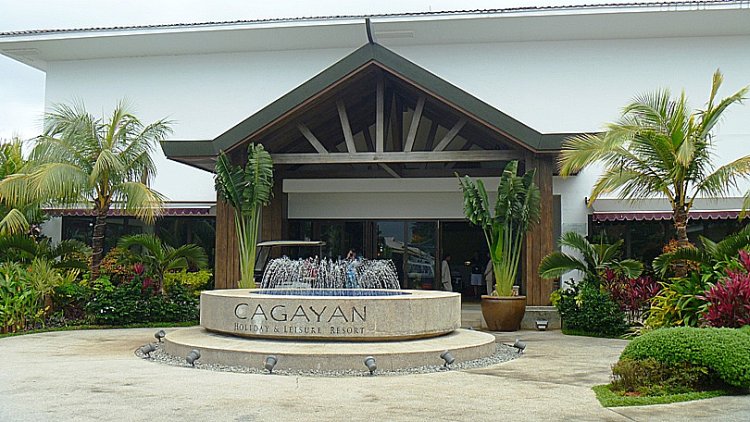
Microtel Inn and Suites (Tarlac City, Tarlac)

After our visit to the Manaoag Shrine, our media group proceeded to Tarlac City where we were invited by representatives of the Tarlac Convention and Visitors Bureau (TCVB) for dinner at Fisherman’s Diner.  Their crispy pata was really good.  Also here, after dinner, we had a ball singing our hearts out during the videoke challenge (won by Gabby Malvar).
Microtel Inn and Suites Tarlac

It was now late and we arrived at the Microtel Inn and Suites by 2 AM for a little shuteye prior to our very early morning departure for Brgy. Sta. Juliana, Capas, Tarlac, our jump-off point for our Mt.Pinatubo  trek.

Our double queen room

We stayed in one of the hotel’s 50 airconditioned rooms with bath, fridge, IDD/NDD phone, internet-ready data port, electronic key card entry system  and cable TV (single/double queen and suites, PhP2,106-3,861).  The hotel also has a 20-pax meeting room and offers wi-fi access (at lobby), safety deposit boxes (at lobby), currency exchange, mailing and fax services. 

Tarlac Convention and Visitors Bureau (TCVB): TCVB Pasalubong Center, Robinsons Luisita, San Miguel, Tarlac City, Tarlac.  Mobile number: (0917) 514-3619.  E-mail: tarlac_cvb@yahoo.com.ph.
Fisherman’s Diner:  Sitio Mannga 2, Brgy. Matatalaib, Tarlac City, Tarlac.
Microtel Inn & Suites Tarlac: Luisita, Brgy. San Miguel, Tarlac City, Tarlac 2301.  Tel: (045) 985-1770 (trunkline) & 985-1974.  . Fax: (45) 985-1975. E-mail: tarlac@microtel.ph.  Website: www.microtelinn.comManila sales and reservation office: 2/F, PHINMA Bldg., 166 Salcedo St., Legaspi Village, Makati City.  Tel: (632) 810-9526, 813-7523 & 813-8553.  Fax: (632) 817-3942.  Domestic toll-free: 1-800-1888-7171. 

Shrine of Our Lady of Manaoag’s Candle Gallery (Pangasinan)

Shrine of Our Lady of Manaoag

After our very educational patupat factory visit in Pozorrubio (Pangasinan), we now boarded our special Victory Liner media bus for the long haul drive to Microtel Inn & Suites Luisita (Tarlac) where we were to be billeted prior to our Pinatubo trek.  Along the way, we made a short stopover at Manaoag, also in Pangasinan, so visit the Shrine of Our Lady of Manaoag (formally Nuestra Señora del Santissimo Rosario de Manaoag or Our Lady of the Most Holy Rosary of Manaoag) and its newly opened Candle Gallery.  I have been to the shrine a number of times but this would be my first time to visit the Candle Gallery, built on the site of the old comfort rooms and canteen, to accommodate pilgrims who want to light candles as they make their humble petitions. The building, designed by Arch. Armando “Don” de Guzman, was only blessed December 7 of last year by Fr. Stephen Redillas, OP, the Prior of the Manaoag Shrine.

Our Lady by the Fountain at the Candle Gallery

Its centerpiece is an 8-ft. high wooden statue of Our Lady by the Fountain with the baby Jesus and the Holy Rosary in her arms, both sculpted by Nicolas Lugue,  and at its base is a fountain, its water cascading from the four sides of the rock base, guarded by four angels, and then down to a circular pool where the pilgrims may sit and reflect.   Above, naturally providing light to the image, is a glass skylight. Beside the Candle Gallery is the Blessing Area where pilgrims who brought or bought (from the new store that sells candles, rosaries, images of saints, spiritual books, etc.) religious articles, may have them blessed by a priest right after every Mass celebrated in church (3-4 PM).  It also accommodates the pilgrim’s requests for holy water and the blessing of their vehicles.The Feast of Our Lady of Manaoag is held on the third Wednesday after Easter but as Our Lady of the Most Holy Rosary of Manaoag, it observes its universal feast day on the first Sunday of October.

Shrine of Our Lady of Manaoag: Tel: (075) 529-0132.  Website: www.ourladyofmanaoag.org. Victory Liner, Five Star and Dagupan Bus Line buses ply the 4-hr. Manila to Manaoag route. From Baguio City (Benguet), it is a 2-hr. drive.

The Patupat of Pozorrubio (Pangasinan)

Panutsa in sursur (coconut shells)

We had just finished an adrenalin-filled morning zip lining and driving ATVs at Pugad Pugo Adventure Park in Pugo, La Union and we were all tired and taking catnaps when we arrived at Pozorrubio, Pangasinan for a less tiring, quieter and more educational cottage industry observation tour as guests of Mayor Artemio Chan and Pangasinan Visitors Bureau (PVB) representatives Ms. Marion Puzon and Ms. Montserrat Escano.  This time we were to observe the making of  patupat, a uniquely Ilocano delicacy made from sticky rice called malagkit and wrapped in coconut or banana leaves.  The patupat of Pozorrubio is reportedly the best in the country. The factory, located in a large, open G.I.-roofed shack, was located right in the midst of a sugar plantation which was a short but quite muddy hike from the road where our special media bus was parked.

The  now motor-driven dadapilan (sugar cane mill)

The traditional method for making patupat starts with the dadapilan, the sugar cane mill.  For years, the mills were driven by carabaos but now they use motors.   Here, sugar cane is fed into the mill and pressed by its big iron rollers to extract sugar cane juice. At the same time, uncooked glutinous rice is poured into intricately designed, rectangular baskets or bags of different sizes made from banana or coconut palm leaves cut into even widths, then tied up and sealed.  The weaving of this basket is an art by itself. Using young coconut leaves with the midribs removed and knotted at both ends, the baskets are woven  with one leave overlapping the other, ending with two corners.  After the knots are removed, they are then joined to complete the basket. The baskets with the glutinous rice are then cooked and caramelized for at least 30 mins. in a large kawa or taliasi (cauldron) filled with a mixture of boiling and bubbling sugar cane juice and coconut milk, over a fire fueled by pressed sugar cane stalks. After boiling, the patupat are then tied together and hanged to drip. Soon, they would be ready to be served, cold or hot, and will be good for 3 days. On the other hand, the boiled sugar cane juice and coconut milk concoction, once thoroughly cooked and sticky, is poured into sursur (cut coconut bowls) then dried to be sold as panutsa or matamis na bao (brown sugarcane).  Thus, very little is wasted in the process.  The patupat has made Pozorrubio proud and is the star of the Patupat Festival, held annually in the town since 1999.

Boiling a concoction of sugar cane juice 
and coconut milk

Mayor’s Office: Municipal Hall, Poblacion, Pozorrubio, Pangasinan. Tel: (075) 566-7015 and 566-7020. 

Pangasinan Visitors Bureau (PVB): 33 Gov. Antonio Sison St., Lingayen, Pangasinan. Mobile number: (0928) 733-4798. Email: marionpuzon@yahoo.com.

The Pugad (Pugo Adventure) Tour (Pugo, La Union)

Four-wheeled, all-terrain vehicles (ATV)

We were now in Lakbay Tour’s second day and, after an art-filled first day in Baguio City, we were now in for some adrenalin pumping adventure featuring zip lines (3 to be exact) with some all-terrain vehicle (ATV) excitement thrown in at Pugad Pugo Adventure Park in Pugo, La Union.   Pugad, “bird’s nest” in the vernacular, is actually a hybrid of the two words Pugo, the name of the town, and “adventure.” We alighted from our special Victory Liner tour bus (its body sticker-wrapped with the tour’s sponsors), at the Flying V (incidentally also a Lakbay Norte 2 tour sponsor) station along Marcos Highway in Brgy. Cares in Pugo and transferred to a smaller Pugad shuttle bus.  DOT Region 1 representatives Evangeline M. Dadat (senior tourism operations officer) and Reynaldo Gesmundo (tourism operations officer II) joined us.  After a 300 m. drive over a narrow road (unfit for our big bus), we finally arrived at the resort. Though this inland swimming resort has 2 crystal-clear outdoor swimming pools (adult and kiddie), picnic cottages, clean toilets, shower rooms, conference halls and a hanging bridge over a clean river, Pugad Resort  is more known for the extreme adventure it offers. Pugad’s famous 380-m. long and 240-ft. high Super Man Zip Line 1, one of the resort’s  three zip lines, stands out as the longest zip line in Luzon and is reportedly the second longest in the country.  Rates for the 3 zip lines is PhP900 per person or PhP1,000 if it includes wall climbing and breathtaking rappelling.This was too good to miss out.

Pugad Pugo Adventure Park

But first we had to wait in line as only five people can be accommodated at a time.  While waiting, we opted to try out out the  4-wheel, all-terrain vehicles and dune buggies at the nearby dirt track.  Unlike the zip line, this was a first for me and I drove cautiously over the winding and hilly but well-designed, 2.5-km. long course with its numerous bumps and turns, at one time falling into a ditch in spite of my caution.   My other companions confidently drove like seasoned racers. However, I soon speeded up midway round the course, only slowing down as I tackled the final 4-ft. high and steep hill back to our starting point.
 
Hannah Barrios finally enjoys Zip Line 3


This initial adrenalin rush now over, it was now time for some state-of-the-art zip lining. There were no more waiting lines as only three of us were left, the other two being Studio 23’s  Hannah Barrios and Joshua “Red” Nietes, both reluctant and scared first-timers. After filling up the necessary waiver forms, we were suited up with the necessary Petzl C29 Pandion harness and Petzl helmets for our safety then bundled into the back of a pickup truck, then driven up the cliff,  We then made a short hike, up a concrete stairs, to our first zip line—the Super Man Zip Line 1 (so named because we had to do it in a flying Superman pose), the highest and the longest in duration (30 seconds) of the three.

I tried it first, as Hannah and Red  were reluctant.  Soon I was harnessed parallel to the ground and on my way. It was everything it was hyped up to be, with picturesque views of a smooth flowing, boulder-strewn river, small rice terraces and lush, forested mountains. It was sometime before Red then Hannah took the plunge but, after having done so, liked it so much that they were both first at the succeeding 2 zip lines. The 280-m. long, 160-ft. high and less picturesque Zip Line 2, the fastest among the three (10 seconds with its 100-m. descent), and the 250-m. long, 60-ft. high and relaxing, 20 second long Zip Line 3, the basic and beginner’s zip line, were both done in the sitting position.  The last passes over the swimming pool and the river before ending at the campsite. It was starting to rain when I finished the last of the zip lines, making rappelling and wall climbing out of the question as the wall had become quite slippery. Besides, it was now time for lunch at the resort’s restaurant prepared by resort owners Eugene Martin, a retired police director, and his wife Pricilla, a Pugo councilor.  Heck out my Business Mirror article “Pugo’s 3 in 1 Adventure Tour.” 
 
Pugad Pugo Adventure Park: Sitio Kagaling, Brgy. Palina.  Mobile number (0927) 667-2619.  Tel: (072) 603-1592.  E-mail: pugoadventure@yahoo.com.

Hotel Elizabeth: A Touch of the Mediterranean in Baguio (Benguet)

The Mediterranean-inspired Hotel ElizabethThe first day of our Manila North Tollways Corp. (MNTC)/North Philippines Visitors Bureau (NPVB)-sponsored Lakbay Norte 2 media tour started in Baguio City, the Philippines’ “Summer Capital,”  where we checked out the city’s vibrant art scene, notably the Tam-awan Village in the morning and the BenCab Museum (and meeting BenCab himself) in the afternoon.

It was overcast during the former and it rained at the latter but the sun did peek out, albeit for a short time, just enough time for us to be awed by the Mediterranean splendor of Hotel Elizabeth, the place where we were to stay overnight, as we entered its driveway flanked by gazebos on one side and beautiful landscaping on both sides. It was more so when we entered its lavish but tastefully-decorated atrium-like lobby.  

Check out “Hotel and Inn Review: Hotel Elizabeth

Our 4-bed De Luxe Room

Dandi Galvez, Ivan ManDy, Art Villasanta and I were billeted in one of its stylishly furnished and European-inspired four-pax carpeted suites. Come nighttime, we were treated to dinner at the Floral Cafe where we partook of creamy vegetable soup, rosemary chicken with fish fillet and marinara sauce and steamed vegetable sidings plus a dessert of pastries and fruit.  Wi-Fi was strong here and in the lobby, though weak in our room.

After this delicious three-course meal, a number of us decided to burn our excess calories by exploring nearby attractions such as the Mansion House (and its Pool of Pines) and Wright Park, both 200 m. away.  The Good Shepherd Convent and Mines View Park are also within that same distance.

Floral Coffee Shop

Come early morning, after a equally delicious breakfast at our previous watering hole, hotel owner Ms. Jean Salonga-Fernando toured us around the hotel’s other rooms.

Hotel Elizabeth: 1 Felipe St. cor. Gibraltar Rd., Baguio City, Benguet.  Tel: (632) 911-2161 local 148 and 912-2691 (direct line).  Fax: (632) 912-2693. Website: www.hotelelizabeth-baguio.com.

A National Artist and a Haven for his Art (Tuba, Benguet)

After our Lakbay Norte 2 visit to Tam-awan Village in Pinsao Proper in Baguio City, we all returned to our bus and proceeded to Asin Rd. in Tuba, 6 kms. from the city, to visit a prominent Filipino artist who has taken up permanent residence in the Philippines’ “Summer Capital.”

The author with Benedicto “Bencab” Cabrera

The city, whose lovely natural environment and the rich Cordillera cultural heritage has inspired creativity, has become a natural haven for artists and now home to a growing number of gallery cafes and exhibits that showcase the paintings and sculptures of groups of local as well as visiting artists.

He is one of many who shared a passion for indigenous art, injecting local elements and techniques in their works, and dedicated to nurturing and preserving Cordilleran culture. That man is painter, printmaker and 2006 National Artist for the Visual Arts Benedicto R. Cabrera, more popularly known as BenCab.

He’s not named Benjamin as mentioned in other write ups though I wish he had the same first name as me. He, together with popular local artists such as solar artist Jordan Mang-osan, mixed-media painter John Frank Sabado and self-taught artist Ged Alangui set up the Chanum Foundation.

The author seated at a hagabi (a rich Ifugao’s bench)

Chanum which, in Ibaloi, means “water,” was the name adopted to symbolize its vision and role to be as nurturing and life-giving as a spring in the once vast pastureland of Pinsao.

After passing a woodcarver’s village with rows of shops selling a fabulous collection of carved figures, in varying sizes, ranging from giant statues to “stickmen,” we arrived at the ultra-modern BenCab Museum, built on a promontory.

Here, we were welcomed by BenCab himself. A Baguio resident for a quarter of century now, Bencab set up this permanent home for his art as well as his personal collection of the works of other acknowledged Filipino masters and rising contemporary artists and his collection of Cordillera artifacts.  After the interview, we explored the different areas of the museum.

The BenCab Gallery features the artist’s own works over a continuing artistic career that spans more than four decades.

The Cordillera Gallery is the repository of BenCab ’s collection of Cordilleran tribal artifacts and indigenous crafts such as bulols (rice granary gods); functional carved objects such as furniture, spoons, bowls and other utilitarian implements such baskets; and tribal weapons.

The Philippine Contemporary Art Galleries (1 and 2) houses the artist’s collection of paintings, drawings, prints and sculpture accumulated by BenCab through the years.

Philippine Contemporary Art Gallery

The Maestro Gallery houses a selection of works acknowledged masters of Philippine art such as Lee Aguinaldo, Roberto Chabet, Victorio C. Edades, Jose Joya, Cesar Legaspi, Arturo Luz, Anita Magsaysay-Ho, Juvenal Sanso, Fernando Zobel and others.

Erotic Gallery – Sculpture

Erotica Gallery

The Erotica Gallery houses paintings, drawings, sculpture and other artworks by various artists with an erotic subject or theme. The Print Gallery exhibits vintage maps, prints, photographs and postcards on the Philippines as well as contemporary prints and photographs.

The tall Sepia Gallery, adjoining the museum shop (which sells art books, paper products such as postcards, and notepads, highland art & crafts such as wood carvings and textiles as well as other souvenir items from t-shirts, and caps), is a venue for changing exhibitions.

Patio Salvador, an open terrace adjoining the Indigo Gallery, is used for receptions and sculpture shows while the Larawan Hall serves as a function room for art workshops, meetings, seminars, art film showings, and other related activities.


Prior to leaving, we enjoyed a merienda of clubhouse sandwiches and pasta dishes at Cafe Sabel, the museum’s coffee shop which overlooks the hill beyond and the mini-forest and duck pond below the museum.

Also below the museum is the farm and garden which showcases organic farm produce (seasonal vegetables, herbs, strawberries, sweet potatoes, coffee and ornamentals) and the typical Ifugao, Kalinga and Bontoc indigenous architecture.

Cafe Sabel

A river, which meanders through the property, has cascading waterfalls on one end.  There is an aviary housing peacocks and various birds,plus  ducks, geese, turkeys and other local livestock.

The organic farm below

BenCab Museum: Km. 6, Asin Rd., Tadiangan, Tuba, Benguet.  Tel: (074) 442-7165.  Mobile: (0920) 530-1954.  E-mail: bencabartfoundation@gmail.com.  Website: www.bencabmuseum.org. Open Tuesdays to Sundays, 9 AM-6 PM.  General Admission: PhP100.  Students and Senior Citizens (with valid ID): PhP80.

Tam-awan Village: A Showcase of Cordillera Life (Baguio City, Benguet)

Tam-awan Village

The first leg of our Manila North Tollways Corporation (MNTC)/North Philippines Visitor’s Bureau (NPVB)-sponsored Lakbay Norte 2 Tour brought us to Baguio City, the country’s “Summer Capital,” where we were to check out the city’s art scene inspired by Baguio’s lovely natural environment and the rich Cordillera cultural heritage.  Our first stop was, fittingly, Tam-awan Village in Pinsao Proper where we were welcomed by Baguio City Visitors Bureau (BCVB) representatives Eric Pangilinan, Matt Roncal and Claire Iniong. This model village is laid out just like a traditional Cordillera village, making it accessible for those who have not had the opportunity to explore the different parts of the vast Cordillera region in the Philippines.  This recreated village, uniquely blending indigenous aesthetics and exquisite Cordilleran craftsmanship, has a charming collection of 9 authentic knock down huts built by clever mortise makers without nails or hardware Seven of these are compact and deceptively simple Ifugao huts transported from Bangaan, (Ifugao ).  The other two are more spacious Kalinga huts made of hand-hewn pine wood.  Some huts are over a hundred years old but have new cogon roofs which are periodically re-roofed from time to time.  All huts are named after the areas where they come from.

Jordan Mang-osan with one of his works  

Upon entering the compound, our media group, consisting of travel writers, bloggers and photographers, all explored the grounds including its art works at the art gallery and gazebo (across which is a stone-paved dap-ay where rituals and dances are performed) and the areas used for conferences, seminars and workshops.  Workshops here offer livelihood and crafts demonstrations on woodcarving, bamboo crafts, papermaking, weaving, printmaking, rice wine making and solar drawing, all envisioned to foster a deeper understanding, respect and pride in the cultural heritage of the Cordillera people.  The latter, a specialty of  Mr. Mang-osan, is an ancient Ifugao technique wherein a wooden surface  is burned using the sun’s rays to create an image.  

Portrait Sketching Session with local artistsA highlight of our visit was having our portraits sketched (for a fee of PhP100 per sketch), using charcoal pencil, by one of the many well-known artists who have their artwork on display. Other members of our group tried a hot cup of aromatic native Arabica coffee or sipped a glass of Winers tapuy (made from rice) or bugnay (made from Benguet strawberries) wine. Come lunchtime, we were served native pinikpikan, kintuman (brown rice), a salad of Baguio veggies and strawberry crepes for dessert.   Pinikpikan is prepared by beating a live chicken with a stick prior to cooking. The beating bruises the chicken’s flesh, bringing blood to its surface, which is said to improve the flavor after cooking.   
Tam-awan Village: 366-C Pinsao Proper, Baguio City, Benguet.  Tel: (074) 446-2949.  Fax: (074) 442-5553.  Website: www.tam-awanvillage.com. Admission: PhP50 (adults), PhP30 (students and senior citizens), and PhP20 (children).
Baguio Convention Visitors Bureau: 2/F Philippine Tourism Authority Bldg., Abad Santos Drive, Burnham Park, Baguio City, Benguet.  Tel: (074) 442-4315.  E-mail: baguio.cvb@gmail.com.

Kape Alamid: My First Taste of Coffee Heaven (Rosario, La Union)

Kape Alamid

I first heard of kopi luwak from the 2008 movie Bucket List (literally, “things to do” before one “kicks the bucket” or dies) starring Academy Award winners Jack Nicholson (as hospital magnate and billionaire Edward Cole) and Morgan Freeman (as blue-collar mechanic Carter Chambers). Cole drinks a specific brand of coffee called kopi luwak, one of the most expensive coffees in the world, and Carter and Cole both “laugh till they cry” (an item from Carter’s bucket list) when Cole finds out that his favorite coffee comes from the undigested beans defecated from the Asian palm civet.  Well, so much for the movies.  However, the movie did bring out the curious in me as I added “trying out kopi luwak” in my own bucket list. Only lately did I find out that we had a local version called kape alamid (in the Tagalog area, but called motit coffee in the Cordilleras).

S.O.U.L. Cafe

Kafe alamid comes from civets (you guessed it, locally called alamid or musang)  who eat the coffee beans for their fleshy fruit pulp. Proteolytic enzymes in the civet’s stomach seep into the beans, making shorter peptides and more free amino acids and, when defecated, the beans keep their shape. After gathering, they are thoroughly washed, sun dried and lightly roasted. S.O.U.L (Soul for Spice of Urban Life) Café in Rosario, La Union was our first stopover (6:30 AM) on the road to Baguio City during the 5-day, North Philippines Visitors Bureau (NPVB) and Manila North Tollways Corporation (MNTC)-sponsored Lakbay Norte 2 Tour (officially launched on January 23 from the Victory Liner Terminal near Kamias St. in Quezon City).

Breakfast of Alaminos longanisa, garlic fried rice
 and tortang talong

Our hearty Filipino breakfast combo here consisted of Alaminos logganisa, boneless daing na bangus, garlic fried rice, hot chocolate, tortang talong made with creamy egg pesto and olive oil and, to kick start our day, an expresso shot of kape alamid with caramel. According to the menu, this expresso shot costs PhP350 and, according to the cafe manager, was sourced all the way from Cavite. This brewed concoction truly lived up to its name as one of the most expensive coffee in the world as it proved to be more aromatic and less bitter than the other coffee treats I’ve tried. Banish the thought of where it came from and you get a truly great coffee experience, with its great flavor without the bitter after taste of other brewed coffee.  Scratch this one from my bucket list.

The cafe’s chic interior

S.O.U.L. Cafe: Camp One, Rosario, La Union.  Tel: (072) 712-0852.  Fax: (072) 712-1190.

New Year’s Day (Kuala Lumpur, Malaysia)

Upon our return to our hotel from our Melaka trip, we decided to rest a bit. It was now just a few hours before New Year’s Eve, our first outside home and country, and we asked around at the front desk on where to spend our countdown party.  They suggested watching the free, spectacular fireworks displays at either the Merdeka Square (Dataran Merdeka) or the Petronas Towers.  We opted for the latter.

The Last Dinner of the Year at Sushi Tei (Pavilion Mall)

Before anything else, we still have to take our dinner so we all walked to Pavilion Mall along Jalan Bukit Bintang and dined on Japanese cuisine at Sushi Tei.  Here, we were surprised to find out that our waiters were Filipinas.  One was already a supervisor.

Waiting for the New Year at Petronas Towers

After dinner, we returned to our hotel to change clothes and decided to start our long walk all the way to Petronas Tower.  Others were doing the same. The numerous pubs we passed by were also filled with countdown revelers.  When we arrived at the park in front of the iconic Petronas Towers, it was already packed full with local residents and foreign tourists.

The Brightly-Lit Petronas Twin Towers

At the stroke of midnight, the street party started, with kisses, hugs, greetings and shouts of “Happy New Year!,” just as spectacular fireworks started to lit up, coloring the sky near the brightly-lit, landmark towers, Mandarin Hotel and the other buildings around us. The show was over when the fireworks stopped. There were no crackling and exploding firecrackers like in Manila, just horns and merriment in the streets.  What a unique way to start the New Year.

The Spectacular Fireworks Show

Sushi Tei: Level 1, Pavilion Kuala Lumpur, 168 Jalan Bukit Bintang, 55100 Kuala Lumpur, Malaysia. Tel: +603 2141 4640. Fax: +603 2141 466.

Jonker Street (Melaka, Malaysia)

The last leg of our walking tour, prior to our return to our tourist bus waiting for us at the Tamil Methodist Church, was all shopping at the narrow but busy Jonker Street (Jalan Hang Jebat). From Stadthuys, we crossed a bridge over the Melaka River to get there. The Melaka River is now canalized to resemble an Amsterdam (Netherlands) canal, with a popular river cruise service running along the river.

Melaka River

Once the rich man’s street, Jonker Street is famous for its more than 15 antique shops (antique furniture, Chinese porcelain, brassware, cast iron beds, lamps, etc.).  Also along this street are cafes (Hai Nan coffee, Nyonya cuisine, beer, etc.), several art galleries,  mini-markets and souvenir shops among others. Souvenirs sold here include items made in Melaka, China and other Asian countries (Thai puppets, Balinese masks, etc).

Jonker Street

Local food stalls sell local delicacies such as cendol (a cold mixture of coconut milk, brown syrup made from the local gula melaka, and shaved ice), laksa (spicy noodle soup), durian puffs, grapes-dipped in chocolate, caramel encrusted kiwis. kaya (a spread made from coconut) filled waffles, etc. The festively-decorated Restoran Famosa, occupying a century-old former goldsmith shop, specializes in dishes served with unique chicken rice balls, actually Hainanese Chicken Rice in the form of golf ball-sized, sticky rice balls cooked in butter and ginger.

Restoran Famosa

Pedestrians here share the same road with passing vehicles and trishaws during daytime but, during weekend night markets (6 PM-12 midnight, Fridays, Saturdays and Sundays), the road is closed to traffic and its atmosphere turns carnival-like.

Jonkers Street

A living proof of Melaka’s rich Baba-Nyonya heritage, its buildings are immaculately constructed with elaborate carvings on its pillars and walls.  Also along this street is the Hokkien Huay Kuan, a well-preserved clan house. Its front porch has a pair of symmetrical pillars with dragon relief.  Beyond it are a striking set of door and wall panels with intricate carvings and bold colors. Two rows of Chinese characters frame the entrance door.

Hokkien Huay Kuan (Clan House)

Restoran Famosa Chicken Rice Ball: No. 28-30, Jalan Hang Kasturi, off Jonker Street, 75200 Melaka, Malaysia. Tel: 06-286 0120. Website: www.chickenriceball.com