Exploring Guimaras on Foot

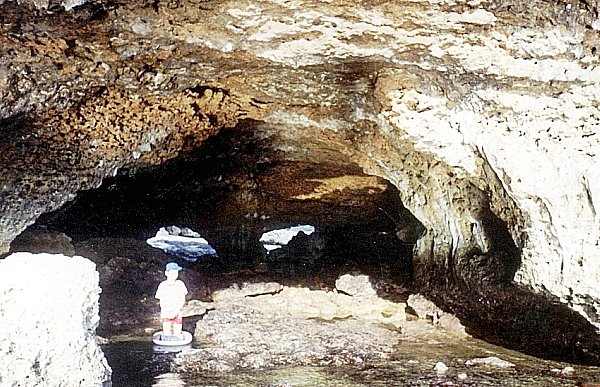
After lunch at the resort’s clubhouse, Jandy and I made a 20-min. hike, along well-marked concrete and dirt trails, past fishponds and Villa Igang, to sea-sculpted Igang Cave in Igang Bay.  From a small opening, we waded its cool, crystal-clear and waist-deep waters, and emerged inside a large chamber with a rock platform with a great view of some islets and the western sky, where the sun sets.  Taking a photo of the magnificent sunset and these islets, silhouetted by the cave’s opening, would have been a great shot.  Too bad, I couldn’t wait for it.     

Villa Igang
Jandy at Igang Cave
The late afternoon of the next day, Good Friday, Jandy and I hiked to Sacred Heart Hill (with its huge statue of Jesus Christ) as well as tried the alternative route to Igang Bay via a 30-min. crossing, over the murky waters of a mangrove forest, of a long and winding bamboo bridge where we observed, up close, these huge trees that are so essential for protecting marine life.   

Sacred Heart Hill

Also that day, the town was presenting the Ang Pagtaltal (meaning “to remove”), the Visayan version of the Oberammergau (South Bavaria, Germany) passion play whose final act is the scene where  Jesus is taken off the cross and laid on his Mother’s lap.  Too bad we didn’t watch it.

A Unique Dining Experience

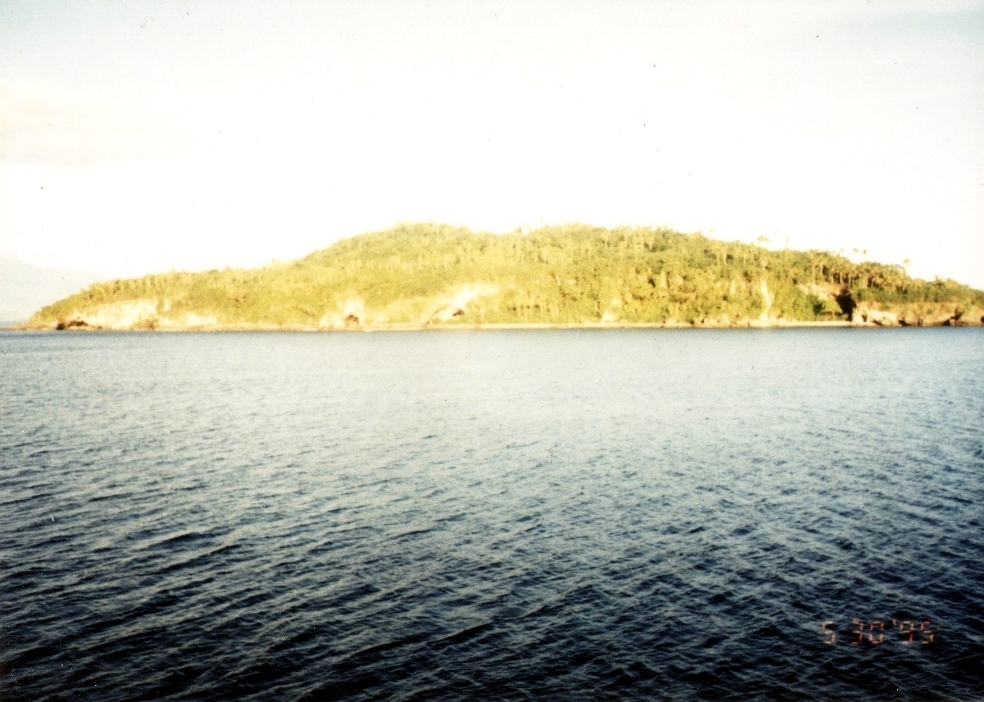
Isla Walang Lang-aw

Upon our return to the resort, from Calauit Island, late in the afternoon, we, as well as all the other resort guests, were again sent off on another boat ride, this time to back to nearby Isla Walang Lang-aw.    This small island, with its limestone cliff (ideal for rock climbing) and white sand bar, was to be the scene of our final dinner.  Our food was brought along in food warmers.  No chairs were provided, but we didn’t mind as we sat on mats on the sand and dined by torchlight.  What a romantic setting!  The night was cool and windy, the sky was clear and the stars were out.

Posing with resort staff

Alas, all good things must come to an end.  The next day, after a very early breakfast, we, together with other guests, left the island via the 7:30 AM boat after being given a warm send-off by the gracious resort staff.  It saddened me as I saw the waving staff, as well as the island, grow smaller as we sped away.  We left on the 10 A.M. Pacific Air flight back to smog-laden, traffic-clogged, garbage-infested and overpopulated Manila.

Calauit Island Game Reserve and Wildlife Sanctuary (Busuanga, Palawan)

Calauit Island

After my trial dive,  we booked ourselves on an optional half-day tour of Calauit Island Game Reserve and Wildlife Sanctuary, located just off Busuanga Island’s northwestern coast and opened to tourists since 1985.  Cost, including permit and boat ride,  was to set us back US$30 per person.  We left right after lunch at the resort.

An eland

This 3,700-hectare, DENR-administered Strict Nature Reserve was, in response to an appeal made by the International Union of Conservation of Nature (IUCN), was established as a repository for 108 African animals endangered by the 1977 drought and Kenya’s civil war on August 1976 by virtue of Presidential Proclamation No. 1578 issued by the late Pres. Ferdinand Marcos.  Its original 250 island families were relocated, 40 kms. away, to Halsey Island and compensated with land titles.  Since 1994, it was managed by the Office of Palawan Council for Sustainable Development, a  government body dealing with environmental issues in Palawan.

On our way to Calauit

We, together with other resort guests, left the resort by 1 PM on the resort’s motorized outrigger boat.  The trip took about 45 mins.  Upon arrival, we first logged in at the sanctuary’s office.  Then, accompanied by a guide, we ushered to the back of the sanctuary’s only “safari” vehicle, a converted 6 x 6 truck which resembled a huge open cage.  From our slow-moving and somewhat dilapidated truck, we got up close and personal with these herbivores as some fed near the road we were traveling while zebras grazed under shading trees.  Bushbucks (Tragelaphus sylvaticus), Grévy’s zebra (Equus grevyi), Common Eland (Taurotragus oryx), Topi (Damaliscus lunatus jimela), Impala (Aepyceros melampus), Thomson’s gazelle (Eudorcas thomsonii),  Reticulated Giraffe (Giraffa camelopardalis reticulata) and Waterbuck (Kobus ellipsiprymnus) can be seen, in pairs or in groups, as they feed or gracefully gallop at the sign of our presence.

A short necked giraffe

Graceful giraffes, with their somewhat shorter necks (maybe because trees here are shorter), were unmindful of our presence as they continued  feasting on the branches of their favorite acacia trees.  Our vehicle halted when these tall “jaywalkers” crossed the road.  Others stayed put for a short while as if purposely posing for our cameras.   Too bad we weren’t able to bond or interact with the giraffes by feeding them (it is discouraged), truly a highlight of any trip to the sanctuary.  Such an experience would probably  come second to swimming beside a whale shark or butanding off Donsol (Sorsogon).

Zebras in the wild

From the original 108 African animals brought here in 1977, 3 or 4 generations of offspring have increased the animal population to 570  heads comprising 8 species, all herbivorous.  At the time of our visit, there were now 43 giraffes, 155 impalas, two Thompson gazelles, 122 water bucks, 78 zebras, 50 elands, 14 topis and 16 bushbucks. Together with indigenous animals, they range freely around the island in an environment that loosely approximates their original environment.

The Palawan bearcat

The guided tour includes stops at pens holding many of Palawan’s indigenous species.  The sanctuary has saved from extinction, by  successfully breeding in captivity, the foot-high The Philippine mouse-deer (Tragulus nigricans) or pilanduk, the smallest hoofed animal found in Asia; the largely nocturnal and endangered Calamian Deer (Hyelaphus calamianensis)  and the Philippine reshwater crocodile (Crocodylus mindorensis) which now lives along the mangrove swamps.  Also bred in captivity are the Palawan bearcat or Binturong (Arctictis binturong), Palawan bearded pig (Sus ahoenobarbus), tarsier or mago (Tarsius philippensis), scaly anteater or balintong (Manis javanica), leopard cat or maral (Felis bengalensis), Philippine porcupine (Hystrix pumila) or landak/duryan  and monitor lizard (Varanus salvator).  I had a very close encounter with a forever hungry binturong.  Too close, in fact, that he snarled when I tried to feed him a banana.

An encounter with a snarling bearcat

There are also over 120 species of birds, endemic and transient and, as a boon to birdwatching enthusiasts, the personnel here are quite capable of identifying these birds.  There are also protected rearing and egg-laying areas for giant sea turtles or pawikan (Chelonia mydas). The project also includes a 7-km. marine sanctuary which protects the highly endangered 16-20 dugongs or sea cows (Dugong dugon) that feed along the offshore sea grass beds, and  7 species of clams including what is believed to be the largest live giant clam shell (Tridacna gigas) in the world which weighs as much as 300 kgs..  As fishing is prohibited, commercial fishes, crabs and lobsters now breed here in undisturbed .  The coral reefs around the island have shown a 75% recovery rate.

Scuba Diving Palawan

Trial dive with Mike Olondriz

The next day was the anniversary of the EDSA Revolution.  I woke up by 5:30 AM for my morning stroll with my videocam.  It turned out to be an educational tour as I had my first close encounter with the endangered Calamian hog-deer (Axis porsinus calamianensis).  Introduced in the early 1990s, it is now said to number more than a dozen.  The sounds of colorful exotic bird life is also evident among the trees as the island is home to orioles, kingfishers, turtle doves and imperial pigeons.  It also has a resident baruray or Rufous Night Heron.  Although I didn’t see any, there are also monitor lizards (Varanus salvator) and green sea turtles (Chelonia mydas).

Attending pre-dive lecture

After breakfast, it was off to my first trial dive.  It comes free with the travel package.  Tellie and my mom (for obvious reasons) begged off.  Our divemaster was Mike Olondriz.  At first I mistook him for a foreigner, but any notions I had were dispelled after he spoke Tagalog.  Later late-evening conversations with him revealed him to be a resident of Magallanes Village in Makati City.  His brother was a barkada of my friend (and SPED teacher of my son Jandy), Inaki Martinez.  Small world.  

Getting into the water

Before the actual dive, I had to undergo a lecture on the use of the scuba gear as well as breathing techniques.  Then it was off to the beach with Mike.  I looked silly as I walked backwards to the beach wearing my fins, but once in the water, I was fitted with my tank, weight belt and mask.   The 15-min. dive was easy at first, but when we got to the 15-ft. depth, my ears began to hurt as they felt like popping.  We ascended to the 10-ft. depth where Mike handed me bread crumbs to feed the fish.  I was soon surrounded by them, large and small, and some of the large fish (probably a Napoleon wrasse) took nips at my bare legs.

Suiting up in the water

AUTHOR’S NOTES

“Is it ethical?”  Books that I have read later have revealed that this fish feeding craze which brings the fish closer for underwater photography also makes them tamer and ideal spear gun targets.  Also feeding leftovers could also be fatal as these fish sometimes die of indigestion.

Exploring Dimakya Island and its Environs

View of Isla Walang Lang-aw from Eagle’s Nest

The next day, I made an early morning, lung-busting hike, with many rest stops, along a trekking trail to the island’s highest point called Eagle’s Nest.  Along the way, I was on the lookout for wild boar (baboy damo) and wild chickens which, the resort staff said, hid in the woods. 

The resort as seen from my vantage point at Eagle’s Nest

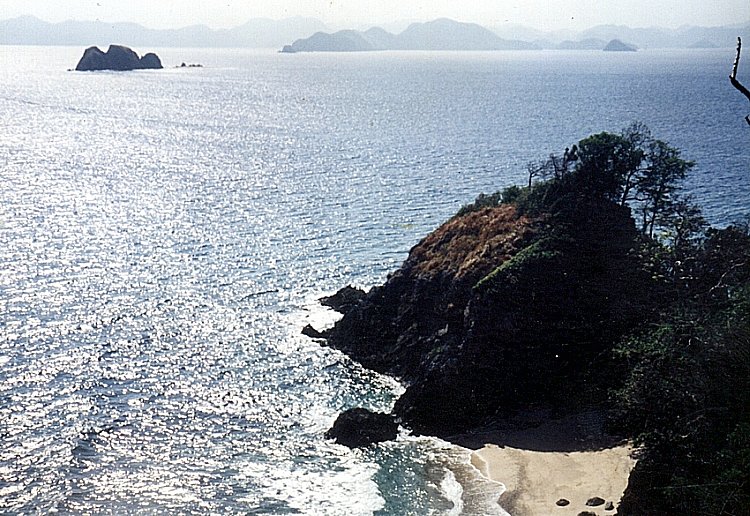
Upon reaching the top, I got a panoramic eagle’s view of the surrounding islands including nearby Isla Walang Lang-aw (Island Without Trees).  A treehouse and a viewdeck is located here.  For a brief moment I felt like Daniel Defoe’s Robinson Crusoe.  After about an hour, I retraced my way back down to again be part of Swiss Family Robinson. 

After lunch, we, together with other guests, booked ourselves on an island-hopping tour (US$20 per person).  Our boat ride took us past numerous islands with thickly-vegetated, sea-and-wind-sculpted limestone cliffs and white sand beaches.   We stopped over on 3 of these islands (Tapadyan Island, Liatui Island and Isla Walang Lang-aw) were Tellie and I went swimming and snorkeling and did some trick photography.

Trick photography at Isla Walang Lang-aw

Back at the resort, we, as well as the other guests, were treated to another boat ride, this time a sunset cruise on board the resort’s 55-ft. long trimaran (with its all-convenient toilet).  We sat at the spacious front area, sipping drinks as we awaited the sun’s setting .  We weren’t disappointed as the sun set on the horizon, amidst a clear, cloudless night sky.

On board the trimaran
Sunset at paradise

Upon our return from our sunset cruise, we returned to our cottage to freshen up and were served dinner by candlelight, albeit in a different setting: by the beach.  The restaurant’s tables and food were set up along the beach and, while dining, we could hear the sound of the waves hitting the shore.

Dinner along the beach

On Our Way to Coron (Palawan)

The DOT-accredited Club Paradise Resort, on the idyllic Dimakya Island, a beautiful 19-hectare rock island paradise on the northwest coast of Busuanga Island in Palawan, offered a low, 4-day vacation package of PhP11,500 per person, inclusive of airfare, accommodations, food and complimentary use of some of its facilities, and I, together with my youngest sister Tellie and my 69-year old mother Carol decided to avail of this.  This would be our first visit to Palawan.  We left Manila early in the morning of February 23, on a 80-min. Pacific Air flight to Busuanga, and arrived a little past 10 AM at Busuanga’s Yulo King Ranch (YKR) Airport.

Landing at Yulo King Ranch Airport

At the airport, we transferred to a passenger jeepney for a 30-min. leisurely drive, along a dirt road, to a mangrove forest.  Here, we made a 15-min. walk, along a 300-m. long wooden boardwalk lined with mangrove trees.  At the end of the boardwalk was a pier where a motorized outrigger boat awaited us to take us to the island.  The boat trip took all of 45 mins. and we reached the resort at just about noon.

Boat ride to the resort

Pulong Laki (Calapan, Mindoro Oriental)

The next day, All Saints Day, Jing again packed us some lunch (including beer) for our excursion to Pulong Laki (Big Island), one of the 3 Baco Islets, the others being Pulong Munti (Little Island) and Pulong Gitna (Middle Island).  All have white sand beaches.  We espied these beautiful islands during the ferry crossing from Batangas City to Calapan.  Ronnie also brought along his fishing rod.

On our way

Jing also chartered a boat very early in the morning for our use as, if there are no charters, their owners usually leave early in the morning to catch fish for a living.  From Ronnie’s home, we walked towards the nearby beach where our motorized outrigger boat and the boatmen where waiting for us.  Once on board, we were soon on our way.  The trip was smooth, usual for the morning and, after about an hour, we made landfall on the island.

The island’s coarse sand beach

The island had a broad, coarse sand beach, with vegetation and shade some distance away.  This didn’t matter much to us as we savored our first dip in a Mindoro Oriental beach.  From the beach, we also had a panoramic view of a couple of islands.  We were the only excursionists on the island that day.  I guess that most Calapenos were visiting their dead while most local and foreign tourists were in Puerto Galera.  We had this beach to ourselves.  

Doing some trick photography

Ronnie went fishing  and sunbathing while the rest went swimming or shell hunting.  Ronnie caught a couple of small fish that day which he cooked.  By mid afternoon, we all left the island, upon the boatman’s suggestion,  to avoid the high, late afternoon waves.  Back on the mainland, we again had supper at the house of Ronnie and Jing’s aunt.    

Tour of Calapan (Mindoro Oriental)

From Calapan port, we all boarded tricycles which brought us to Ronnie’s 2-storey house which is located by the sea. Upon arrival, we were welcomed by Ronnie’s elder sister Jing and their other relatives.  

At dining room with Ronnie (left) and Jing (center)
The porch overlooking the sea

Probably the only concrete house in the area, it had a spacious porch facing the sea (ideal for fishing and catching the sea breeze) and an airy roof deck where we had a panoramic view of the town, the sea and offshore islands.

View of Calapan Point
View of the town from the roof deck
View of offshore islands

After lunch, we all made a walking tour of the town proper.  At the town plaza, in front of the municipal hall, is a monument to a Mangyan youth.  There are also statues to our national heroes Jose Rizal and Andres Bonifacio as well local son Macario Adriatico, the first representative of Mindoro.

The town plaza

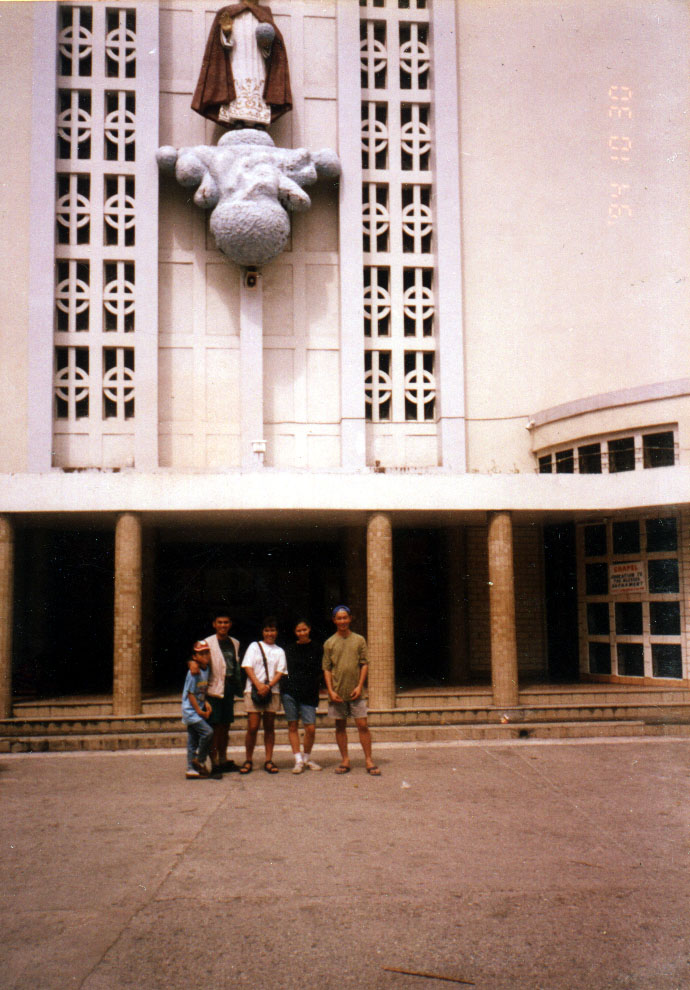
The Cathedral of the Holy Infant (Sto. Nino) is the seat of the Calapan Vicariate since October 3, 1951.  The original church, founded by Recollect Fr. Diego de la Madre in 1670, had two watchtowers.  It was torn down in 1959 to give way to the new cathedral. 

The Cathedral of the Holy Infant
After our sightseeing tour of the town center, we proceeded to the gray sand Aganhaw Beach which is located 4 kms. from the town proper.

Aganhaw Beach

After our sightseeing tour, we all proceeded to the house of Ronnie’s aunt where we had supper before returning home for a much needed rest.

My First Visit to Mindoro Oriental

During the All Saints Day break, 8 year old Jandy and I joined Jandy’s TLC (The Learning Center) teachers Erwin Cifra, Glorain “Rainy” Canillas and Felipe Ronnie Martinez plus Rainy’s friends Lourdes “Lulu” Siguenza and Liezl Lumbao, on a tour of Mindoro Oriental, a first for both of us.  We plan to stay in Ronnie’s family home in Calapan, the capital of the province.  

L-R Erwin, Jandy, Rainy, Lulu & Liezl

From Manila, we all took the very early morning (4:30 AM) airconditioned  BLTB (Batangas Laguna Tayabas Bus) bus bound for Batangas City.  The land trip took just 2.5 hrs. and we arrived at Batangas International Port in time to buy tickets and catch the next RORO (Roll On Roll Off) ship to Calapan.

On our way

Aside from passengers, these ancient, ocean-going ships also carry wheeled cargo such as cars, trucks, trailers and buses that are driven on and off the ship on their own wheels.  They are so named for their built-in ramps and doors that allow cargo be “rolled on” and “rolled off” the vessel when in port.

One of the islands we passed

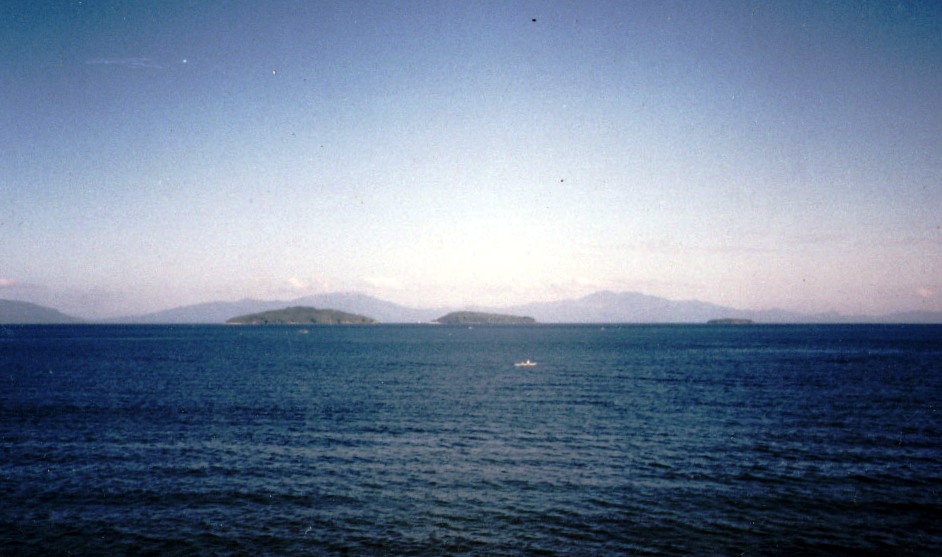
The boat trip, via the Verde Island Passage (one of the busiest sea lanes in the country) took a slow 2.5 hours.  Still, it was scenic all the way as our passed a bevy of islands.  Just out of Batangas Port, we were awed by the rugged cliffs and white sand beaches of the 8-km. long, thickly vegetated Verde Island.  Then, as we approached Calapan Bay, we passed the much   smaller but equally beautiful Baco Chico Island, Pulong Gitna and Pulong Munti.  We arrived at Calapan port by 9:30 AM.

Coral Island – Koh Larn (Pattaya, Thailand)

After an early breakfast at the hotel, we prepared for a change of pace as we were scheduled to do an island tour, with lunch, of Koh Larn (translated as “Coral Island”).  Located about 7-8 kms. off the coast of Pattaya Beach, Koh Larn is about 4 kms. long and 2 kms. wide.  It has 2 villages (Ban Ko Lan and Ban Krok Makhan)  and a number of white sand beaches (Tonglang Beach, Tien Beach, Samae Beach, Naon Beach, Na Ban Beach, Ta Waen Beach, etc.) with clear, blue waters, mostly on the western side.  Koh Larn is part of a cluster of 3 islands called the Near Islands (the other 2 are Koh Sak and Koh Krok).

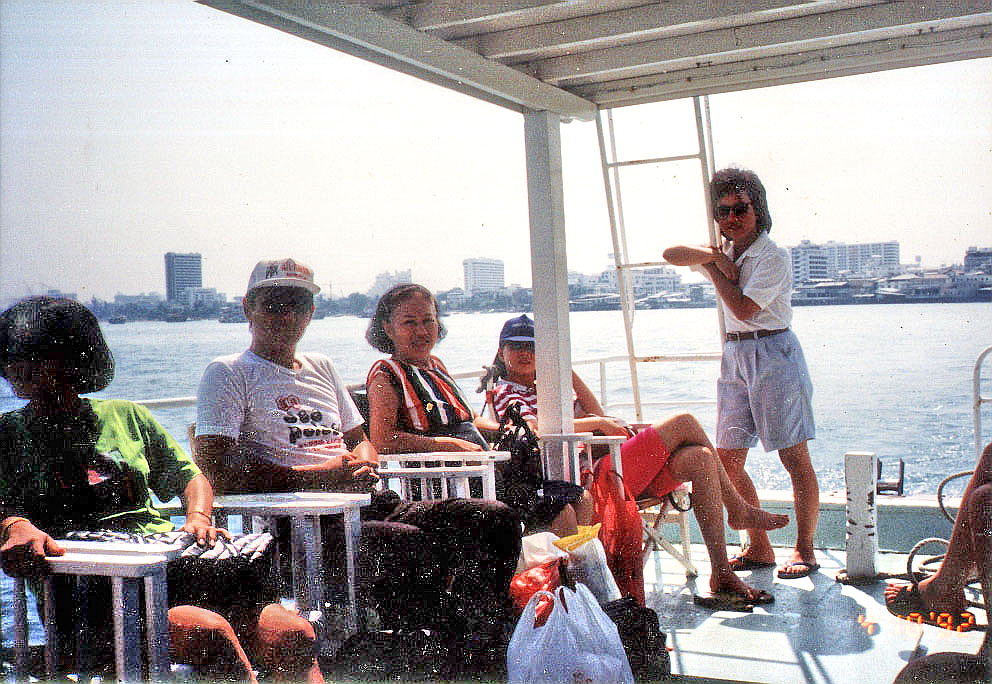
On Our Way to Koh Larn

From the Bali Hai Pier, we all boarded a cruiser for the 45-50 min. trip, across the Gulf of Thailand, to the hilly island.  Within sight of the crescent-shaped Ta Waen Beach (the most frequented beach), we all transferred to a glass-bottom boat so that we could view the marine life and offshore coral garden.

Glass-Bottom Boat Ride

Upon landing, we were assigned to a long picnic shed with other guests. As the beach was very inviting, the sun was out and the skies were clear, we all changed into our swimming attire.  The sand here was definitely much cleaner (and whiter) than in Pattaya Beach.

Koh Larn (Coral Island) – Ta Waen Beach

Salve and Tellie tried jetskiing while I donned  mask and snorkel and explored the island’s coral garden.  Come noontime, we returned to our picnic hut were a seafood lunch was arrayed before us. This we feasted on with gusto.  After lunch, we all went back to our boat for the return trip back to the mainland. Once on shore, we returned to the hotel, checked out and, by 4:30 PM, boarded our bus for the return trip to Bangkok.  Back in the city, we had supper at a MacDonald’s outlet along Sukhumvit Rd., then returned to our hotel.