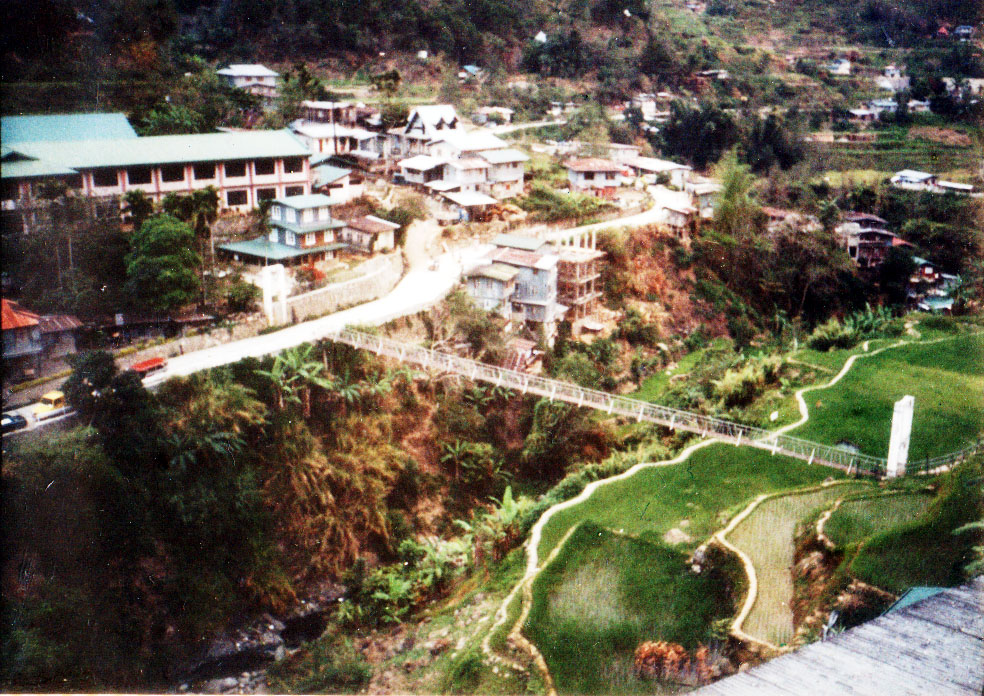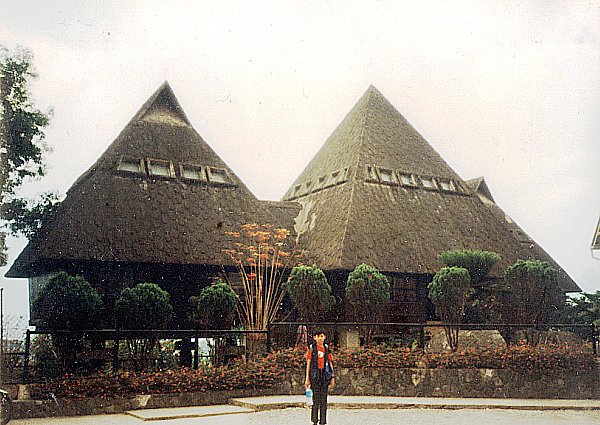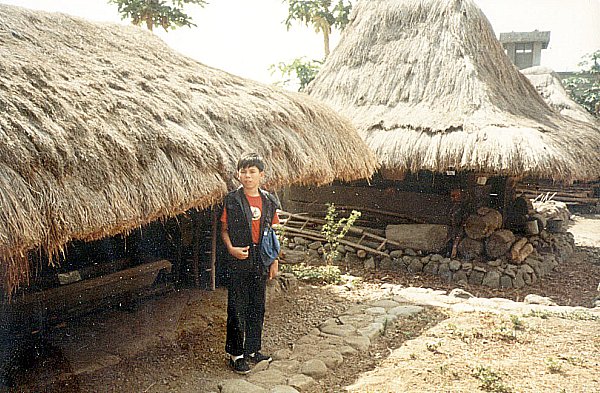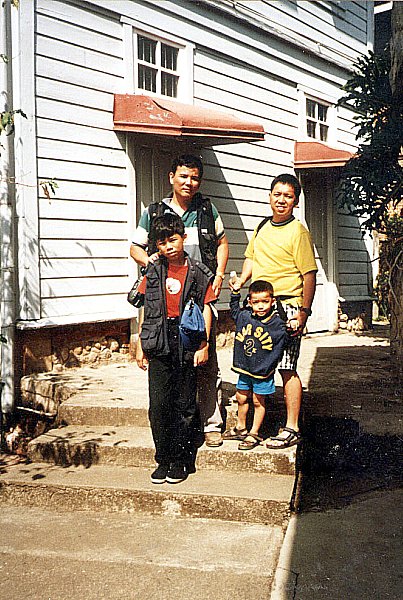
Arrival in Sagada (Mountain Province)

Sagada

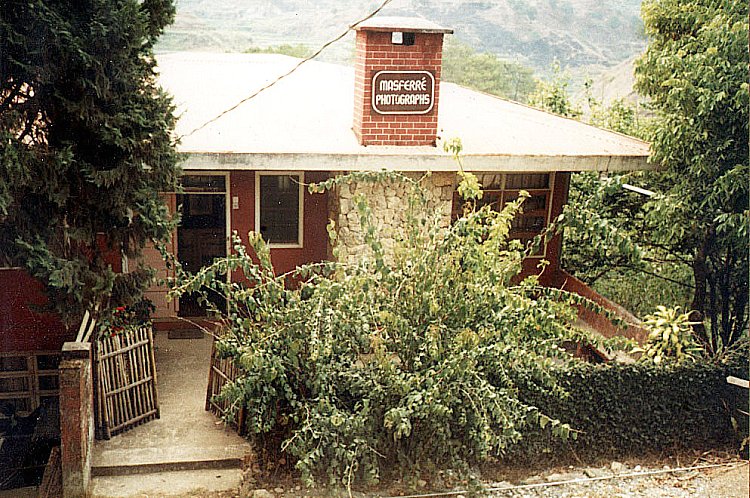
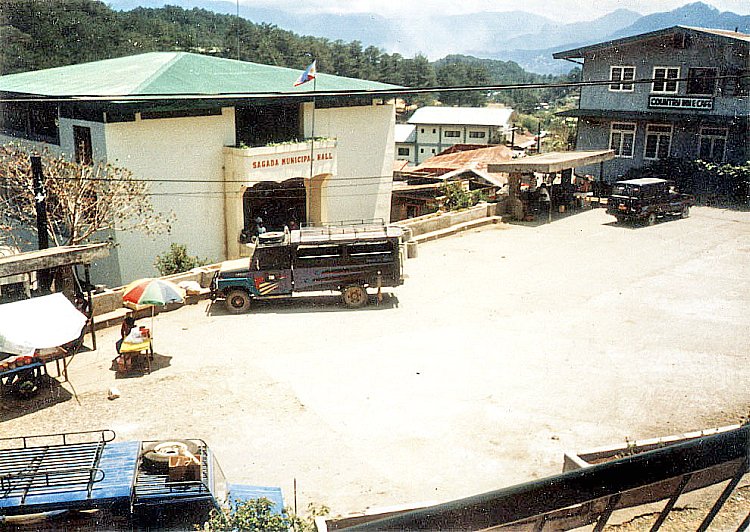
We arrived at Sagada by 4 PM. Upon our arrival at the bus terminal near the municipal hall, Jandy and I checked in at one of the 5 double rooms with common bath at the second floor of nearby Ganduyan Inn, managed by Hanzel and Marina Biag. The inn was strategically located as it was just across the bus terminal and the municipal hall.  Rate was a very cheap PhP75 per person per day. The inn also had a restaurant.  According to Marina, her husband, as well as a significant portion of Sagada’s population, are descendants of Biag, a folk hero of the Igorots  and the most important figure in Sagada’s history.  Biag introduced new rites, prayers and customs.

Ganduyan Inn

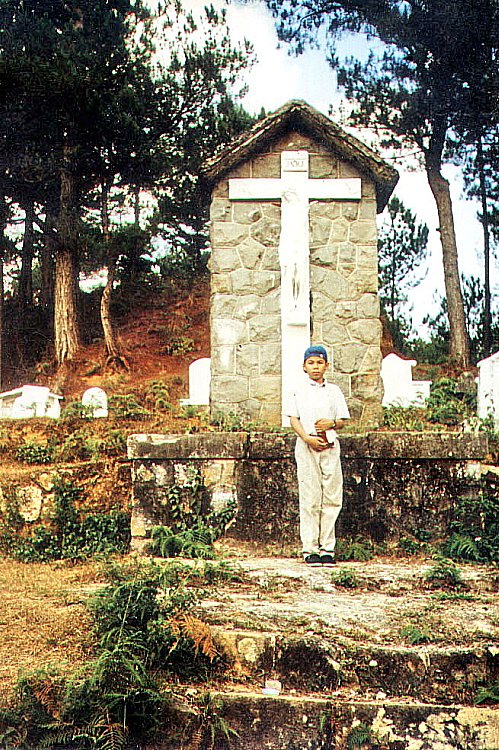
As it was late in the afternoon, we decided to just visit the nearby Episcopal Church of St. Mary the Virgin.  Along the winding, pine needle-paved cement lane, to the  right of the basketball court, is this massive, gray stone Anglican church,  originally built under the direction of Reverend John Staunton and consecrated on December 8, 1921.  It was  badly damaged (especially the belfry) by U.S. bombing raids during World War II and later repaired.  The oldest church in the Cordilleras outside of Baguio City, its foreign architectural design is fused with indigenous motifs.  Further down is the 30-hectare St. Mary’s High School.  Founded in 1912, it was destroyed in World War II, rebuilt in 1950, destroyed by fire in 1975 and reopened in 1983.

Episcopal Church of St. Mary the Virgin

After this short tour we returned to the inn for supper at its coffee shop.   Food in Sagada is really cheap and the servings humongous.  Noteworthy is its tasty native red rice (kintuman), mountain tea and its aromatic and strong Arabian coffee, locally-grown, grounded and roasted.

Sagada Municipal Hall

The Road to Sagada (Mountain Province)

From Baguio City, we left for Sagada around 9:30 AM, Tuesday, April 7, on board an ordinary Lizardo Transit bus from the Dangwa Tranco terminal, off  Magsaysay Ave..  Once outside Baguio City, my mobile phone became useless.   The 151-km. trip from Baguio City to Sagada passes through the spectacular 146-km. Halsema (named  after Engr. Eusebius Julius Halsema, American civil engineer and mayor of Baguio City, 1920-36) Mountain Highway. It was originally a foot trail used by mountain folk and was improved and widened by the Americans. The highest highway system in the country, it was formerly called the “Mountain Trail” and it links La Trinidad and Baguio City with Bontoc.  It took more than 15 years to build and was finished in 1936.

View of dried up rice terraces

The trip took all of 7 hrs. (including stops for lunch and snacks) as we cut through mountain peaks, gorges and  steep cliffs, cross deep ravines and skirted dangerous slopes.  It could have been shorter but more than half of the drive was over rough, dusty and unpaved roads.  Jandy had a case of biyahilo (travel dizziness) and threw up.  Some sections were so narrow that only one vehicle could pass at a time. A narrow section over one treacherous gorge was simply breathtaking (but I was afraid to look out the window).   It was the peak of the El Nino phenomena and a number of the terraces were dry.  Smoke from some small forest fires could also be seen in the distance. Still the drive was scenic all the way as we passed through some of the most spectacular mountain vistas found anywhere. We also passed the highest point of all Philippine highways  – at Km. 50 near Bayangan,  2,225 m. above sea level.  Here, where the road crosses 2,450-m. high Mt. Paoay, we had good views  of Mt. Pulog, Kabayan, Atok and the Agno Valley.  Too bad we didn’t  stop.   

Crystal Caves (Baguio City, Benguet)

During the Holy Week break, I decided to bring Jandy to Sagada and Banaue.  However, to get to Sagada, we had to go via Baguio City as there is no direct route there, by public transportation, from Manila.  That being the case, I decided to stay 2 nights in the city before leaving for Sagada. We took the very early 7 AM Victory Liner bus for Baguio City and arrived there by 1:30 PM.  From the bus terminal, we took a taxi to the city proper and booked ourselves at the AJ Pension House.  Once settled in, we had a late lunch at a Chowking outlet.  As it was already late in the afternoon, I decided to just bring Jandy to the Crystal Caves,   located 5 kms. from the city center, off the Palispis-Aspiras Highway.  We got there via jeepney.  
 
Inside Crystal Cave
I remembered visiting Crystal Caves with my Dad and brother Frank when I was still young. Back then, I was impressed by the firefly-like, crystalline rock the cave was named for.  These interconnected caverns, found on the northern foot of Mt. Sto. Tomas, are believed to be an old Igorot burial site just like the nearby Timbac Caves.  At the cave entrance, we were swamped by natives offering their services as guides.  I got a couple of guides with some torches and flashlights.
 
Traversing the cave from end to end wasn’t difficult as it was horizontal all the way.  I was quite disappointed with what I saw inside.  The cave has now been stripped by robbers of its stalactites, stalagmites and precious crystals which were sold to tourists.  The cave survived World War II bombings and the 1990 earthquake but it is slowly dying or irretrievably dead from all  this looting.  The high cave ceiling, blackened from the soot of torches, only had a couple of resident bats.  Worst, there seems to no conservation effort to save what’s left of the cave.
 
Disappointed at this turn of events, we returned to the city proper, had dinner at Star Cafe and returned to our inn.
 
Crystal CavesCrystal Cave Rd., Baguio City, Benguet.  
 
How to Get There:  Take a jeepney at the cor. of Otek and Chanum Sts. to Palispis-Aspiras Highway.  Visit only during the dry season (May to November).  

Gigantes Island Hopping (Carles, Iloilo)

Gigante Norte Island

After a hearty breakfast with the whole group at the coffee shop, a hectic schedule of island hopping awaited us.   We left Balbagon Island, together with other resort guests, by 10 AM. on board a large outrigger boat.  Along the way we passed many of the beautiful islands that the Gigantes are known for.  After about 30 mins., we reached our first destination: the southern side of Brgy. Gabi in Gigante Norte Island.  Our boat docked along a steep rocky wall.  As it was high tide, our climbed up the wall was shorter.  Upon reaching the top of the wall, we beheld before us  a hidden lagoon with clear, shallow waters  surrounded by steep and rugged limestone cliffs covered with sparse vegetation.

A hidden lagoon called Tangke

Calm, circular and lake-like lagoons (doubtless from the Spanish word laguna meaning “lake”) such as these are found in low latitude countries such as the Philippines.  They have openings to the sea, always leeward of prevailing winds, but are protected from it by a sandbar or coral reef.  Here, the clear shallow waters rise and fall with the tides.   According to one theory, lagoons are formed when hard coral growth in the center fails to keep pace with those on the periphery.  Waves and storms disintegrate coral in the center and pile them up at the margin, increasing the height of the island which in the course of time become covered by vegetation.

This salt water lagoon before us was locally called Tangke (“tank”).  The lagoon’s rugged limestone periphery, weathered to an incredibly rough surface, are of organic origin.  They are formed by the accumulation of the calcareous skeletons of marine animals and plants, mainly coral and coralline algae.  Its flora is sparse, mostly a few widely distributed strand plants and trees.   Living coral polyps continually extend the fringe. Such was the beauty of the place that we can’t wait to get into our swimming outfits and dip in its shallow, sparklingly clear waters.  Simply Heaven! Other members of the party opted to climb its lofty cliffs in an effort to be physically (and dangerously) nearer to their Creator.  The place is also a 15-min. boat ride east of Sitio Langub.

Little Boracay

After about 30 mins. of lolling around the lagoon, we again boarded our pumpboat for our next destination, a beach called “Little Boracay.”   We arrived at 11:10 AM.  The beach before us was truly a mini-version of the country’s number one destination, albeit shorter.  The other difference is its seclusion.   The beach is backed by a steep, densely-vegetated limestone cliff and because of this there are no resorts. The turquoise waters were just as clear and the white sand beach gradually sloping and fine as sugar, with hardly any shells or pebbles.     Jandy and Cheska were soon off swimming in the shallow waters as our portable monobloc chairs and tables and beach umbrellas were unloaded.  Lunch was served al fresco in food warmers by the beach and eaten kamayan style.  And what a lunch it was!  Tropical paradise at its best.

The sandbar of Cabugao Gamay Island

We would have wanted to stay longer in this beautiful, secluded beach but our itinerary dictated otherwise as we had to leave for our next destination.  After packing our stuff, it was off to another boat ride to an inhabited Cabugao Gamay Island which had a very long, treeless sandbar with beige sand.  We arrived by 1 PM and were greeted by a native selling to us a sea turtle secured by a rope tied around a notch at the rear of its shell.  What a sorry sight.  Poor fellow.  We refused his offer.

After the usual photo shoot for posterity, it was back to our boat for the return trip.  We were back at the resort by 2 PM.  Our island hopping tour was the highlight of our trip to Balbagon and the Gigantes Islands.  Too bad, all good things must come to pass.  The next day, we all left the island early in the morning for the boat trip back to Estancia and the long and tiring land trip to Iloilo City where we had lunch and took the last flight back to Manila, arriving there by 5 PM.

Balbagon Island: Coral Cay Resort (Carles, Iloilo)

Coral Cay Resort in Balbagon Island

The Gigantes Islands, located off northeast Panay in Carles (Iloilo), first came into prominence long before Boracay became a byword  in the tourism industry.  In the 1970s and 80s, its luxurious Sicogon Island Club was one of the first beach resort hotels in the country to achieve international recognition. Its happy days ended when the resort closed down in 1989.  There is more to the Gigantes than just Sicogon as it still has 100 small, rugged, idyllic and fascinating islands, most with white sand beaches, plus hills covered with spectacular first and second growth virgin forests, hidden coves, and many massive wind-carved and steep rock formations containing many deep, cathedral-like granite and marble caves. It also has rich marine life and simple fishing villages inhabited by 300 families.   My wife Grace’s outfit for many years now, E. Ganzon Inc., owned and developed a resort called Coral Cay Resort on Balbagon Island.  We decided to give it a visit after Christmas Day.

Villa Lily Beach Resort in Estancia

I, together with Grace, 11 year old Jandy and 7 year old Cheska left on the early morning Philippine Airlines flight to Iloilo City.  Joining us were Atty. Jose Salazar, his wife and kids and Grace’s fellow E.G.I Properties employees Mr. Disney Sevilla, Ms. Marivic Santiago, Ms. Carol Reyes and Ms. Rhoda Evora.  At the airport, we were picked up by a company van that would take us on a 135.6-km.  (3.5-hr.) long-haul drive to Villa Lily Beach Resort in Estancia, jump-off point to more than 20 of the islands of the Gigantes including Balbagon Island.    

Arrival at Balbagon Island

Upon arrival at the hilltop resort, we waited 30 mins. for the arrival of company boat that would bring us, together with other guests, to the island. The 8 nautical mile long boat trip took about an hour, passing by the large Gigantes islands of Binulangan and Calagnaan as well as the smaller islands of Tabugon, Tulunan-an and Ojastras before reaching the relatively flat, fish-shaped island of Balbagon.  As there was no pier on Balbagon, we alighted a la MacArthur, getting our feet wet before reaching dry land.

The 42-hectare, 1.5-km. long Balbagon Island is located near Gigante Sur Island and is a 20-min. boat ride from the island’s Brgy. Lantangan. Upon our arrival here, we were billeted in one of Coral Cay Resort’s 10 airconditioned cottages. Each cottage, with its bamboo-cladded interior walls and exterior walls cladded with split coconut logs, has its own tiled bathroom and verandah.  This  Class “A” resort also has 25 fan-cooled cottages with bath and a coffee shop/restaurant.

A Balbagon sunset

On our first night on the island, a torch-lit dinner was served al fresco under the stars along its dazzling white sand beach lined with prickly aroma trees. Seafood, consisting of crabs, shrimps and fish, was the “standard” cuisine and was mostly eaten by many in the kamayan style.  The next two days at the resort were packed with stress-free fun: swimming, sunbathing, shell picking, eating, camaraderie, videoke, waiting for the beautiful sunset  or simply just relaxing by the beach and reading a good book.  No work, TV, telephones, pollution, noise and traffic jams. Our 12th wedding anniversary on the 28th (Ninos Inocentes) was spent quietly in much the same way.  Disney and I circumnavigated the island’s 3 km. long shoreline in about 30 mins., passing by a rocky shore where sea birds roost as well as the nearby barangay.  We also walked along the exposed reef at low tide. Along the way, we discovered a beached basket sponge which we brought back to the resort.

Tops Lookout (Cebu City, Cebu)

After breakfast at the Zodiac Restaurant at the hotel, Grace, Jandy, Cheska and I joined Grace’s fellow EGI employees who were going, via van, to the popular Tops Lookout (better known as “Tops”), a must-visit viewpoint situated 2,000 ft. (610 m.) atop Busay Hill. On our long drive up the hill’s steep, winding road, we passed by Cebu Plaza Hotel where Grace and I stayed over a decade ago for our honeymoon. 

Tops Lookout

About 4 kms. past the hotel, we finally reached Tops and paid the required parking fee and admission fee for each of us.  This modernist, fortress-like and well-maintained viewpoint has kiosks where we could buy snacks and drinks; toilet facilities and benches where we could sit and have a breathtaking, panoramic view of Cebu City, Mactan and Olango Islands and Bohol in the  background.

Our breathtaking view

It was very windy and a bit chilly while we were there.  Other ideal times for a visit are during sunrise or sunset up to the wee hours of evening when you can see the city basking in lights.

Tops Lookout: Brgy. Malubog, Busay, Cebu City, Cebu. Admission: PhP100/pax

EGI Resort and Hotel (Lapu-Lapu City, Cebu)

Right after Christmas, 10-year old Jandy and I flew to Cebu, arriving on the early morning PAL flight with Grace’s fellow E. Ganzon, Inc. (EGI)  employees Cecille Marquez and Mary Jane Malamug.  Grace and and 6 year old Cheska were to follow the next day.  We were picked up at Mactan International Airport and shuttled, in about 15 mins., to the 8-storey E.G.I.-owned EGI Resort and Hotel, located amidst a strand of world-class resorts and hotels in Mactan Island.  

EGI Resort and Hotel
Upon arrival at the resort, we checked into a corner airconditioned suite with cable TV, a fridge with minibar, NDD/IDD phone, bath (with bathtub and shower with hot and cold water) and a private balcony with a beautiful view of the sea and the nearby Club Kon-Tiki Resort (with its man-made white sandbar) and Cebu Mactan Island Member’s Club.
 
Our suite
This resort, the only condominium resort hotel on Mactan Island, also has a restaurant at the Zodiac Pavilion, function rooms, a free-form swimming pool and a small stretch of white sand beach.
 
The resort’s swimming pool
EGI Resort and Hotel: Pajac-Maribago Rd., Brgy. Looc, Maribago District, Lapu-Lapu City, Mactan Island, Cebu.  Tel: (032) 232-3111 to 15. Fax: (032) 232-3117.  E-mail: egiresort2003@yahoo.com. Website: www.egiresortandhotel.com. Manila sales office: 29/F, EGI Taft Tower, 2339 Taft Ave., Manila.  Tel: (632) 302-6418.  Fax: (632) 302-6420.

Club Panoly Resort (Boracay, Malay, Aklan)

Club Panoly Resort

During our 1990 visit to Boracay, my first such visit, we made an ocular visit of the new (opened November 1989), 4-hectare, Singaporean-owned (CTW Group) and operated Club Panoly Resort, the first triple AAA resort in Boracay. A year later, the resort was the site of the 1991 RPN-9 mini-series Boracay which starred Dina Bonnevie, Fe Delos Reyes (singer/comedienne), Joel Torre, Rollie Quizon and Noel Trinidad (the fictional resort owner).

Posing at the resort entrance

Six years later, Grace and I decided to plan our next stay on the island on this world-class resort, staying here for 5 days and 4 nights.  Together with our kids Jandy and Cheska, we departed for Kalibo on the 9 AM Philippine Airlines flight, arrived by 10 AM and, from Kalibo Airport, boarded an airconditioned  Boracay Star bus for Jetty Port in Brgy. Caticlan, arriving there by 11:30 AM.

Cafe Punta Bunga

At the port, we boarded the resort’s shuttle boat and arrived at Club Panoly in time for lunch at Cafe Punta Bunga, the resort’s coffee shop.   Sprawled throughout this luxurious resort are 8 native-style octagonal clusters with 5 cottages, all fully air conditioned, with hot and cold shower, cable TV, minibar, complimentary coffee and tea and 24-hour IDD telephone facilities, all standard features in all rooms. The custom-designed furniture were made with indigenous creativity and materials. 

Lounging by the swimming pool and poolside bar

Aside from Cafe Punta Punta, the resort also has a restaurant, a bar (El Capitan) and a beach bar.  There’s also has a swimming pool (with poolside bar), a plexi-paved tennis court, two jacuzzis, spa, sauna, multi-purpose conference room, billiards, children’s playground, souvenir shop, seaport and offers waterskiing, windsurfing, jetskiing, diving, paddle boating and speed boats.

Trying out the jacuzzi
Club Panoly Resort: Sitio Punta Bunga, Brgy. Yapak, Boracay Island, Malay, Aklan. Tel: (032) 288-3011. Fax: (036) 288-3134.  Metro Manila booking office: International Vacations Corp.,  G/F, ACT Tower, 135 Sen. Gil Puyat Ave., Salcedo Village, Makati City.  Tel: (632) 812-2233 local 107 or 403.  Fax: (632) 812-6455 and 812-6434.  E-mail: info@thepanoly.com.  Website: www.thepanoly.com.

Residence Inn Zoo (Tagaytay City, Cavite)

From the 41st Division P.A. USAFFE Shrine, Jandy and I continued on our way to Residence Inn.  As it was along the highway, it was easy to find.  There’s an entrance fee.  The inn,  which also has an excellent view of Taal Volcano and Lake, has airconditioned accommodations and a restaurant.

Check out “41st Division P.A. USAFFE Shrine

However, we were just there on a 1-day tour of its mini-zoo which is more like an interactive petting zoo as, at the entrance, fresh fruits and other food  are sold to visitors who want to feed the animals (except the tigers).  The zoo has a menagerie of 30 or so animals,  some caged while others were free-roaming.

Jandy beside a free-roaming cassowary
A caged tiger

The first animals we saw were the noisily chirping parrots and cockatoos, some caged while others were out, tied loosely to their perches.  Also near the entrance were pythons, fishes and a tiger cub.  There were also screaming monkeys, caged Malay civet cats and tigers, free-roaming peacocks, ponies, llamas,  a free-roaming cassowary, wild pigs and crocodiles.  The zoo could actually be toured in an hour.

A caged crocodile
A python in a glass case

Residence Inn: Km. 65, Brgy. Neogan, Tagaytay City, Cavite. Tel: (632) 899-9829 (Manila)

41st Division P.A. USAFFE Shrine (Tagaytay City, Cavite)

After my jobsite inspection at La Residencia de Laguna and lunch in Tagaytay City, Jandy and I went out of our way to visit the Residence Inn Zoo.  Along the way, we made a stopover at the 41st Division P.A. USAFFE (United States Armed Forces in the Far East) Shrine, beside the City Hall and Tagaytay Convention Center.

Check out “Residence Inn Zoo

41st Division P.A. USAFFE Shrine

Within the shrine are marble walls etched with the names of all 6,000 servicemen of the 41st Division, Philippine Army, under the command of Brig.-Gen. Vicente P. Lim.  Coming from Cavite, Batangas, Laguna, Tayabas (now Quezon) and Palawan, these men mobilized on Tagaytay Ridge on August 1941.  Here, they set up camp and trained for war, prior to joining the ensuing Battle of Bataan. A bas-relief sculpture also helps tell the heroic story of the defenders of Bataan and Corregidor.

The bas-relief sculpture

41st Division P.A. USAFFE Shrine: Km. 59, Emilio Aguinaldo Highway, Brgy. Kaybagal South, Tagaytay City, Cavite.