Malacanang Museum and Library (Manila)

January came and went without me visiting a notable Philippine museum and I wasn’t about to let February pass without visiting one.  It was with great anticipation that my family (wife Grace, son Jandy, daughter Cheska and grandson Kyle) and I was looking forward to visit the Malacanang Museum and Library, especially with my balikbayan aunt, Pacita B. “Paz” Layug, with Chinese-American friend Harold (a first-time Manila visitor), joining us, both on a short Manila stopover on their Asian cruise.  Also joining us was my sister Tellie.  We all met up at the Kalayaan Gate by 9:30 AM and our museum tour promptly started at 10 AM.

Malacanang Museum and Library

Malacanang Museum and Library

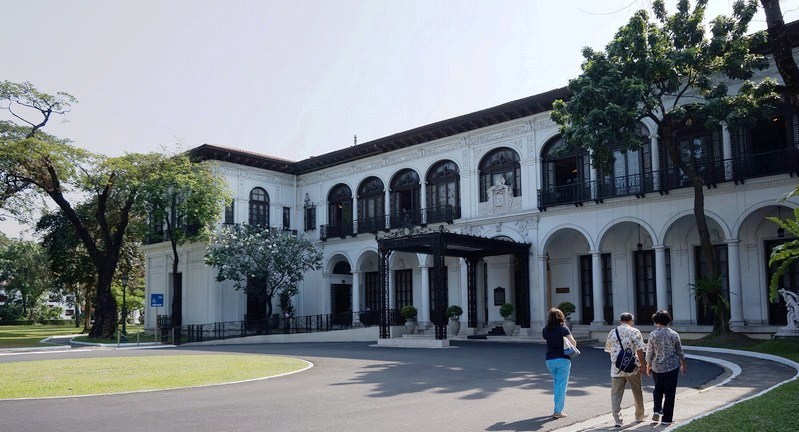
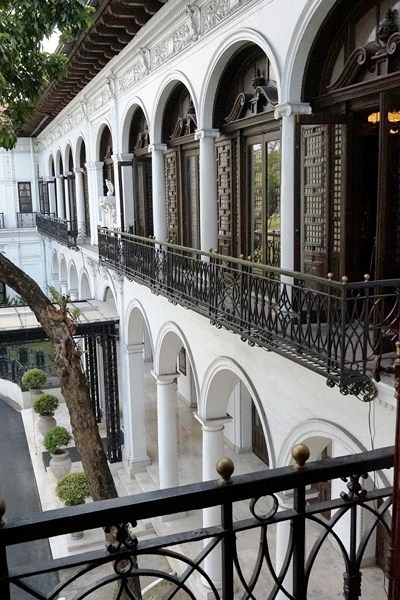
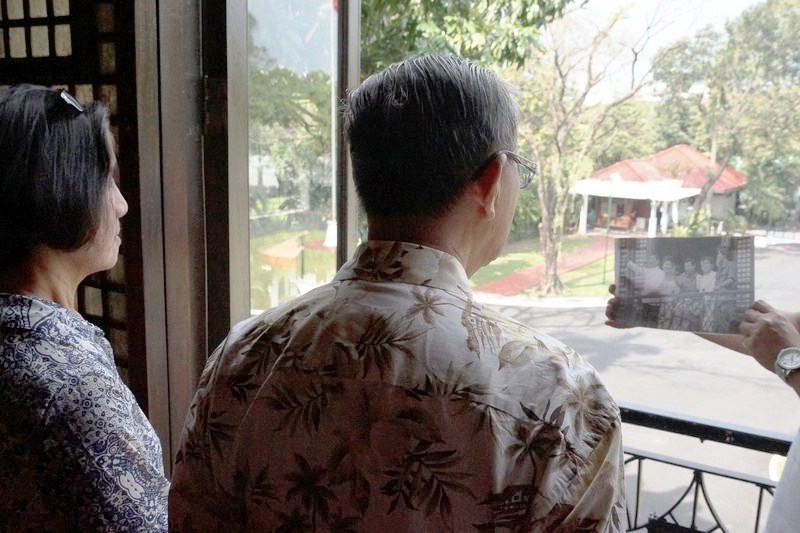
The Palace grounds, with its huge lawn and tress, and its buildings were truly imposing.  Behind it is the Pasig River. The handsome, arcaded museum, housed within the historic Kalayaan Hall (called Maharlika Hall during the time of Pres. Ferdinand E. Marcos), the old Executive Building designed by Ralph Harrington Doane in the elegant Neo-Renaissance style and built in 1920, had the ambiance of an old and grand ancestral house, but warm and homey.

Malacanang Museum and Library (4)

Relaunched in 2003, the museum was, for the most part, restored during the term  of Pres. Gloria Macapagal-Arroyo and has been open to the public since then.  Photography was allowed but only one camera is allowed per group booking, so we choose  Jandy’s Sony AR-3500 digital SLR. Stickers were used to cover our group’s Smartphone lenses.

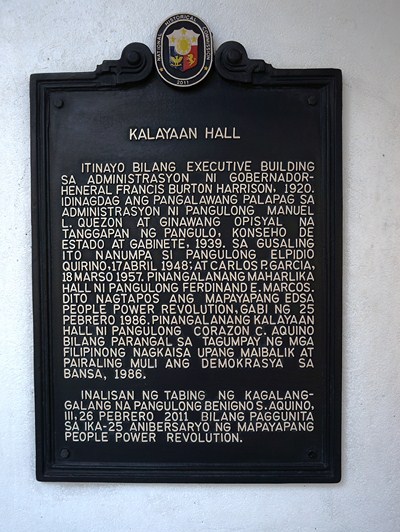
Plaque installed by National Historical Commission

Plaque installed by National Historical Commission

At the lobby, we met up with Mr. Brian Paul R. Luna, our knowledgeable and lively museum guide.  With his assistance, we learned interesting facts, trivia and stories that add to the many narratives about the Philippine presidents and the Palace during our 2-hour tour. He shared with us the rich history of each of the 9 stately, historically important and architecturally significant rooms in the country displaying the impressive legacies of the nation’s past presidents.

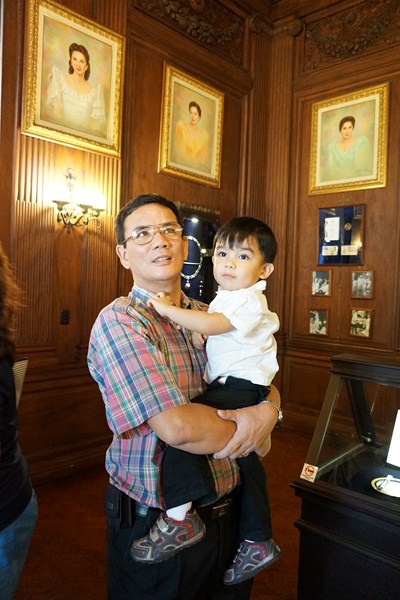
The author and Kyle at the Old Executive Secretary’s Office

The author and Kyle at the Old Executive Secretary’s Office

The well-maintained museum is organized by theme and by period. It features galleries and exhibits showcasing the heritage of the Palace and the Presidency of the Philippines as well as a well-curated collection of  artwork and furniture from the Palace collections.  The exhibits include the history of Malacañang Palace, featuring gifts, relics, memorabilia, artwork and photographs, principally at the ground floor rooms which are dedicated to American colonial era.  Most are paneled in hardwood and sumptuously carved by Isabelo Tampinco, a renowned Filipino master woodcarver, who also carved the wood and plaster ornamentation.

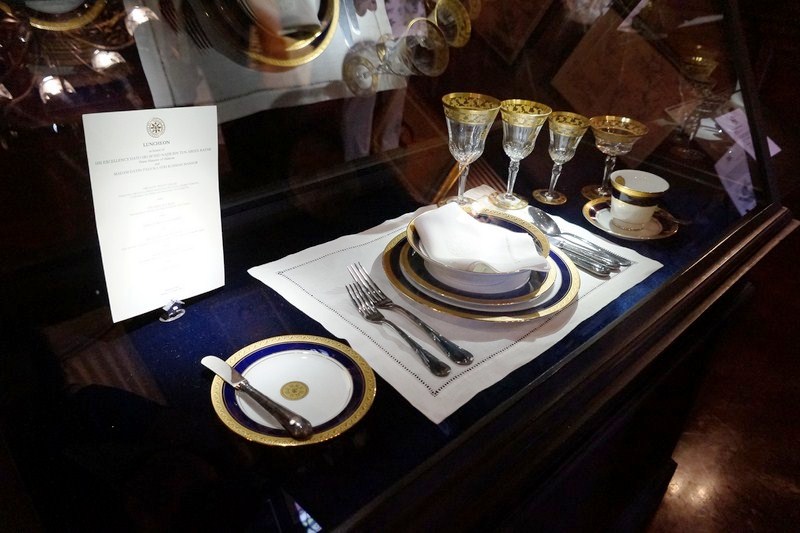
Table settings, in a regal royal blue accented with gold trim

Table settings, in a regal royal blue accented with gold trim

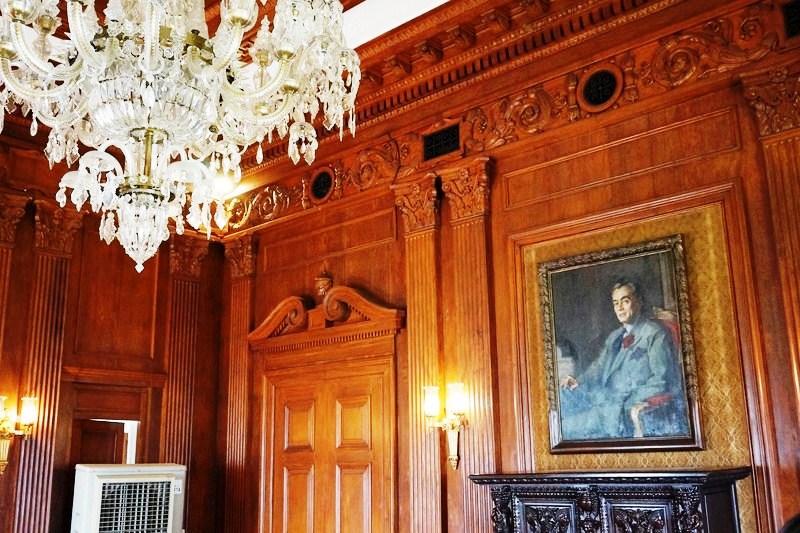
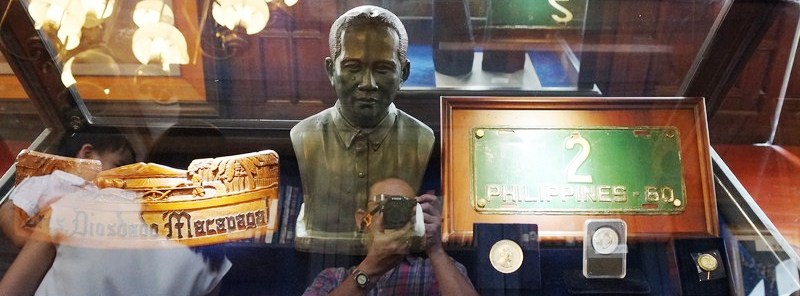
The first room we visited was the Old Executive Secretary’s Office.  It is now a display room for First Ladies (the “Official Hostess of the Palace”), from the time of Manuel L. Quezon’s own first lady, Aurora, to Luisa “Loi” Estrada. However, there was no picture of First Gentleman Jose Miguel “Mike” Arroyo.  On the left is the portrait of the controversial Imelda R. Marcos (also the only one with a bronze bust on display), the country’s most beautiful First Lady.

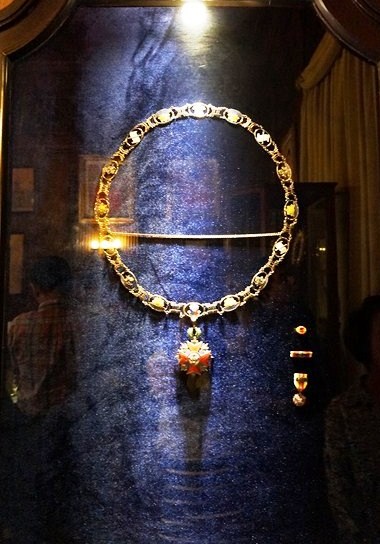
The Order of Sikatuna

The Order of Sikatuna

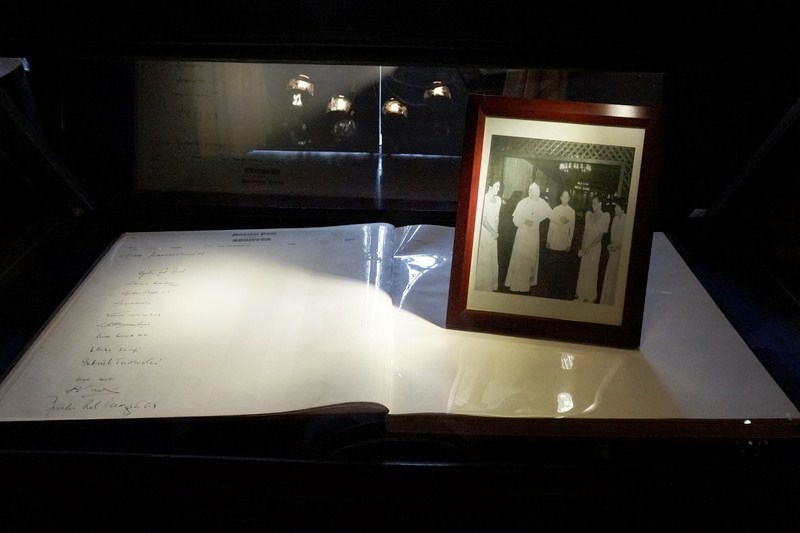
Also on display is the Grand Collar of the Order of Sikatuna, Rank of Raja, usually conferred to Heads of State; table settings, in a regal royal blue accented with gold trim, used for official Palace events; and a sample guest book for official state functions and dinner (including the guestbook, encased in glass, signed by the late Pope John Paul II in 1972).

The guestbook, encased in glass, signed by the late Pope John Paul II in 1972

The guestbook, encased in glass, signed by the late Pope John Paul II in 1972

We all then went up a staircase to the Quezon Executive Office, said to be the first airconditioned office in the Philippines. First used by Pres. Manuel L. Quezon as his office, it was later used by Gen. Fabian Ver, the Chief of the Armed Forces of the Philippines under Marcos During Pres. Corazon C. Aquino’s administration, it was transformed into the office of the Press Secretary.

Quezon Executive Office

Quezon Executive Office

Inside is the original presidential desk, elaborately carved by Tampinco; and the first state portrait of Quezon on the main wall, done by Leon Gordon, which was first hung in the Palace Reception Hall from 1937 to 1979.  Now preserved as an executive office, national and presidential flags, as well as the seal of the president, are displayed in accordance with protocol.

The main wall with the first state portrait of Quezon, done by Leon Gordon

The main wall with the first state portrait of Quezon, done by Leon Gordon

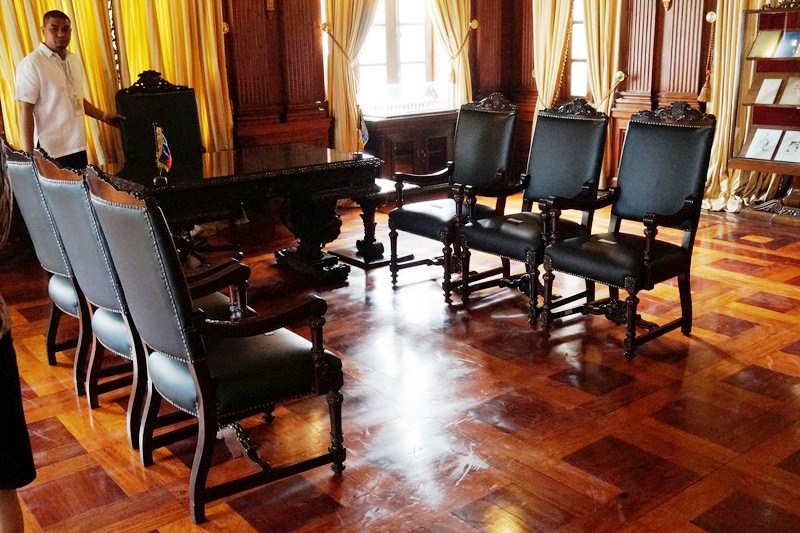
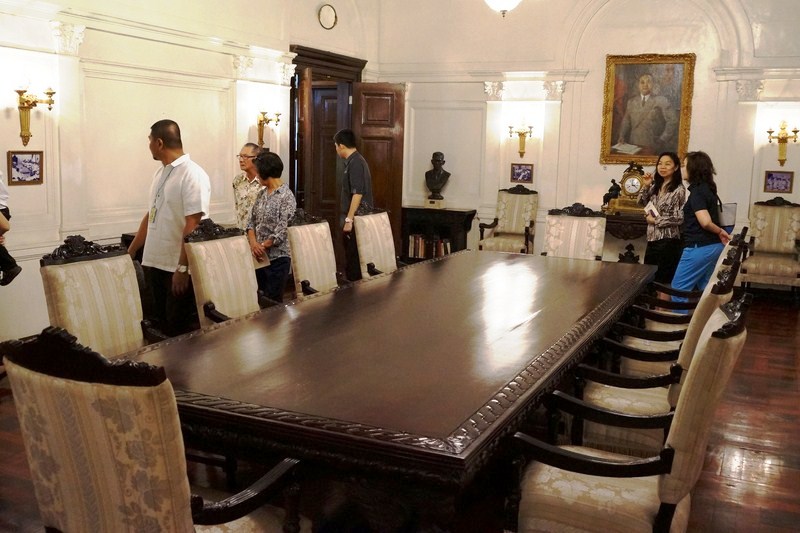
From this room, we moved on to the Roxas Cabinet Room, easily one of the brighter rooms in the Palace, with windows that opened up into terraces.  Named after Pres. Manuel L. Roxas, who first used the space as the Cabinet Room, the administrations following him used it for meetings and as offices. In 1981, it was converted into into the control room for President Marcos’ television studio. It is interesting to note that the Seal of the Republic is engraved on the backrest of the 8 chairs.

The Roxas Cabinet Room

The Roxas Cabinet Room

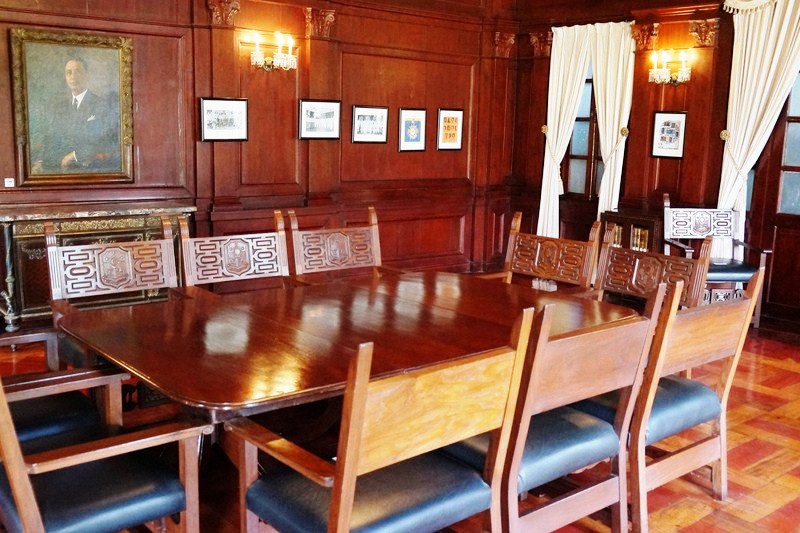
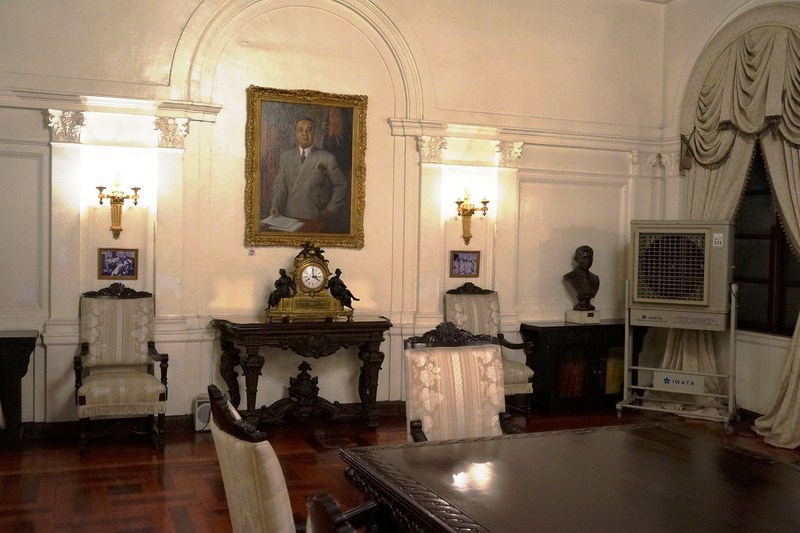
Next room in line during our tour was the Quirino Council of State Room, colored a shade of ivory, windows draped with heavy curtains and with gold-gilded lanterns lining the wall.  Constructed in 1937-39 as the Council of State Room, it was where the newly-reconstituted Council of State during the administration of Pres. Manuel L. Quezon met, a practice kept until the Diosdado P. Macapagal Administration. It was also here that the National Economic Council, today’s NEDA, met. Pres. Manuel L. Quezon preferred to have his cabinet meetings in this room, as did Presidents Elpidio R. Quirino, Carlos P. Garcia and Diosdado Macapagal.

Quirino Council of State Room

Quirino Council of State Room

Presidents Roxas, Quirino, Magsaysay, Garcia, Macapagal, and Marcos also had important meetings in this room and it was here, until the Marcos administration, that officials generally took their oaths of office before the President of the Philippines. From the administration of Pres. Manuel Roxas until Carlos P. Garcia, all treaties and conventions entered into by the Republic of the Philippine and foreign governments were also signed in this room. Pres. Elpidio Quirino (on April 17, 1948, after the sudden demise of Pres. Manuel Roxas) and Carlos P. Garcia (on March 18, 1957, after the tragic death of Pres. Ramon Magsaysay) also took their oaths of office in this room.

Wall with portrait of Pres. Quirino painted by the late National Artist Fernando C. Amorsolo

Wall with portrait of Pres. Quirino painted by the late National Artist Fernando C. Amorsolo

During the administration of Pres. Ferdinand E. Marcos, cabinet meetings were transferred to the State Dining Room (now the Aguinaldo State Dining Room) in Malacañan Palace, and this room was turned into part of a television studio in 1981. It was restored to its original state in 2003 and, on November 16, 2003, was renamed after Pres. Elpidio Quirino by virtue of Proclamation No. 501. On display here are furniture original to the room (perfectly matching the drapes), a portrait of Pres. Quirino painted by the late National Artist Fernando C. Amorsolo and sculptures, from the Malacañan Palace Collection, by National Artist Guillermo E. Tolentino.

The Main Hall

The Main Hall

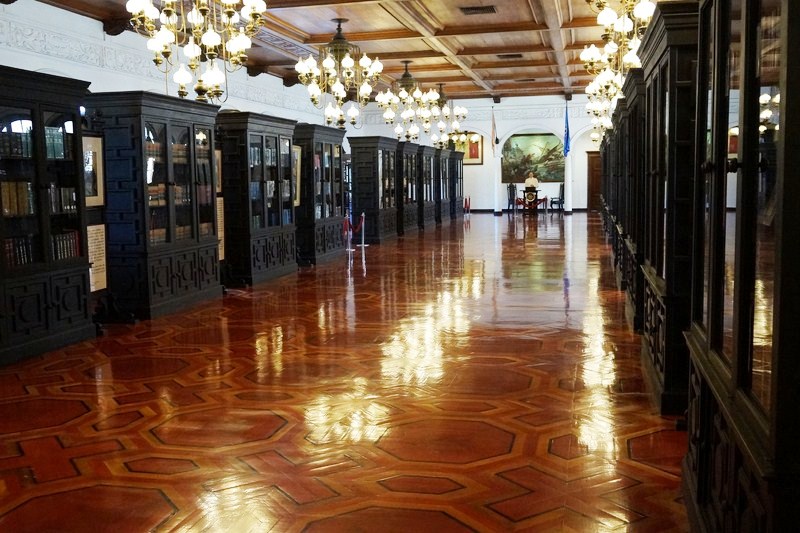
From these rooms, we proceeded to the Main Hall, formerly the site of guest bedrooms when the building was first constructed in 1920.  During the early years of the Philippine Commonwealth, it was transformed into offices to accommodate the growing bureaucracy. In 1968, upon the directive of President and Mrs. Marcos, the area was cleared and converted into the Maharlika Hall (Royalty Hall), a ceremonial hall where state dinners, large assemblies and lavish parties were held.

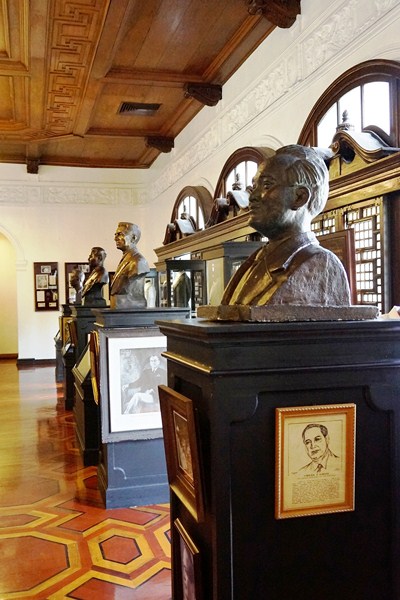
Presidential busts

Presidential busts

In 1972, it was temporarily used as an evacuation center for the victims of a typhoon that damaged a large part of Central Luzon. On February 25, 1986, the front west balcony of this hall was where Pres. Marcos proclaimed himself the victor of the 1986 Snap Elections, took his last public oath of office and delivered his farewell speech.

Balcony where Marcos declared himself the winner of the snap election

Balcony where Marcos declared himself the winner of the snap election

The hall now houses the Gallery of Presidents of the Philippines together with a display of selected  State and Official Gifts to Pres. Gloria Macapagal-Arroyo and the Special Exhibit of Campaign Posters of the 1965 Presidential Elections.

Diosdado Macapagal Gallery

Diosdado Macapagal Gallery

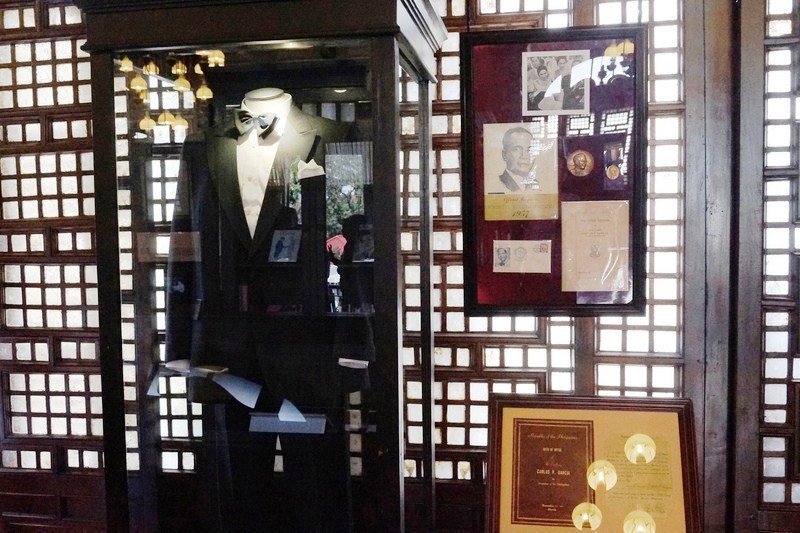
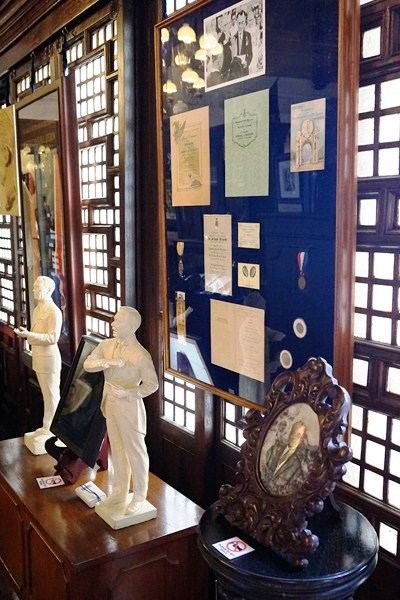
Each President in the Gallery has his own bust as well as as a suit or a dress they once wore.  The suits and accessories of presidents, from Emilio F. Aguinaldo to Quezon, is quite interesting as, aside from their other artifacts of clothing, there was the predominance of walking canes, a sign of social status.

Carlos P. Garcia Gallery

Carlos P. Garcia Gallery

However, it is worth noting that none of our presidents grew mustaches, another sign of social status which ilustrados (Spanish for ‘erudite’ or ‘learned ones’) such as José P. Rizal, Marcelo H. del Pilar and Graciano López Jaena all grew.

Manuel L. Quezon Gallery

Manuel L. Quezon Gallery

Other clothing items on display include the riding boots of Pres. Ramon Magsaysay, necklaces of President Gloria Macapagal-Arroyo and more.  As the incumbent president, and entire division is dedicated to Pres. Benigno S. “Noynoy” Aquino III, complete with a life-sized image of himself which we took pictures with.

Posing with the life-size statue of Noynoy Aquino (6)

Posing with the life-size statue of Noynoy Aquino (6)

Also on display is the original, well-preserved blackboard, used by Gen. Fabian Ver and the other generals who were loyal to President Marcos, for planning their attack during the People Power Revolution.  It has a chalk-drawn sketch of the original plans, showing San Juan (Metro Manila), to diffuse the growing crowds along EDSA. On the right hand side is data with the names of Sen. Juan Ponce Enrile and Gen. Fidel V. Ramos.

State and Official Gifts

State and Official Gifts

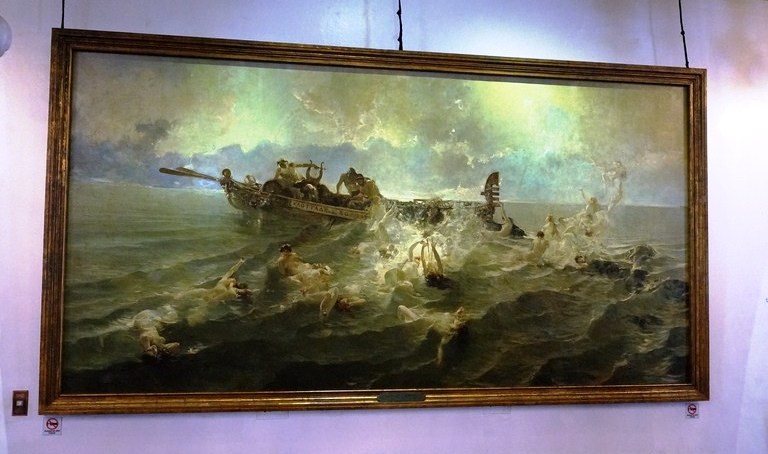
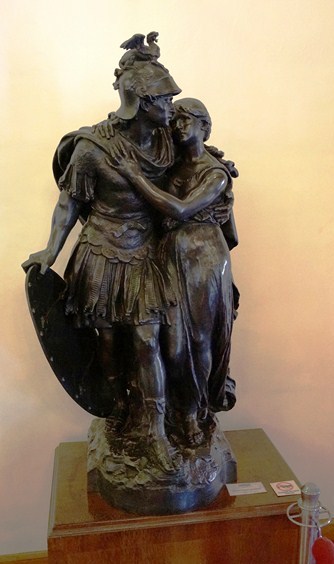
Painting and sculpture that decorate Maharlika Hall are breathtaking, with pieces made of metal, bronze, and marble, mostly of Italian influence – Roman gods and goddesses or playful nymphs – all from the Marcos’ private collection.

“Nereids” (Las Nereidas) of Joaquin Sorolla

“Nereids” (Las Nereidas) of Joaquin Sorolla

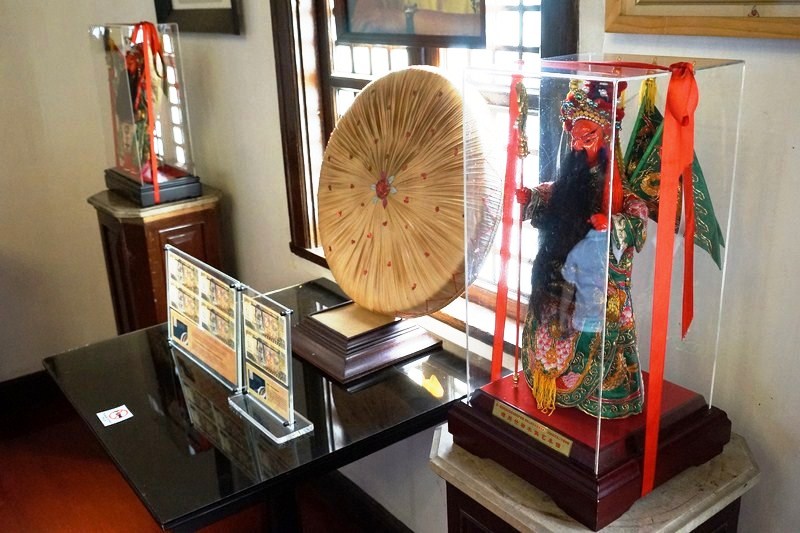
Gifts and trinkets from visiting dignitaries are also on display.  There’s a statue of former Pres. Gloria Macapagal-Arroyo dressed as a ship captain, with her hands on the helm and,  in the background, what seems to be the spirit of Jesus Christ guiding her. There’s one thing wrong with this statue though, she’s a tad too tall. Some of the more impressive collections come from the Marcoses, such as the library the former First Lady Imelda Marcos bought from the estate of Marie Louise of Austria (a.k.a. Maria Ludovica Leopoldina Franziska Therese Josepha Lucia von Habsburg-Lothringen), the second wife of Napoleon I, Emperor of the French, and later Duchess of Parma.

Perseus and Andromache of Auguste Moreau

Perseus and Andromache of Auguste Moreau

There’s also the bronze statue“Perseus and Andromache” signed by famous French artist Auguste Moreau (1855-1919), and the painting “Nereids” (Las Nereidas) of Joaquin Sorolla y Bastida (1863-1923), donated by Alma le Normand de Bretteville Spreckels and conserved and restored by the National Museum, Union Fenosa and Cooperacion Espanola in 2001.

Southeast Gallery

Southeast Gallery

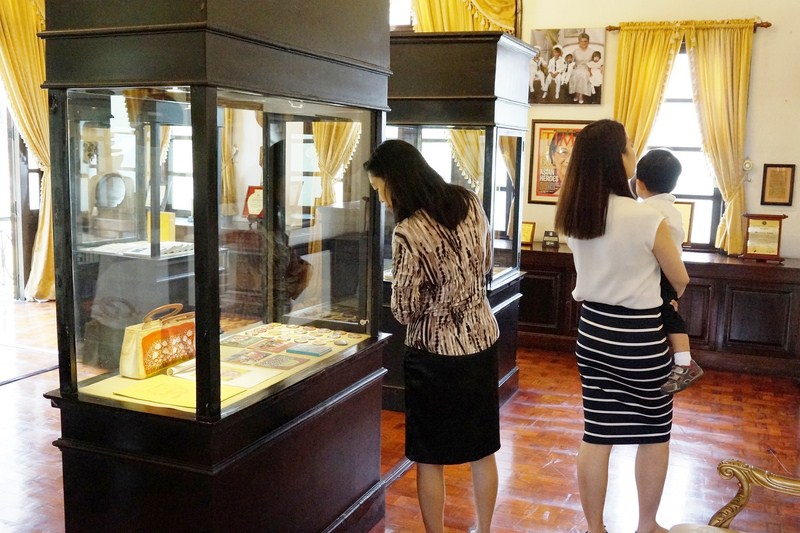
From the main hall, we proceeded to the Southeast Gallery which displays the memorabilia of the late Pres. Corazon C. “Cory” Aquino, the nation’s first female president and the incumbent president’s mother.  A humble housewife, Cory was the only president, thus far, who did not hold any public office prior to being elected the Chief Executive.

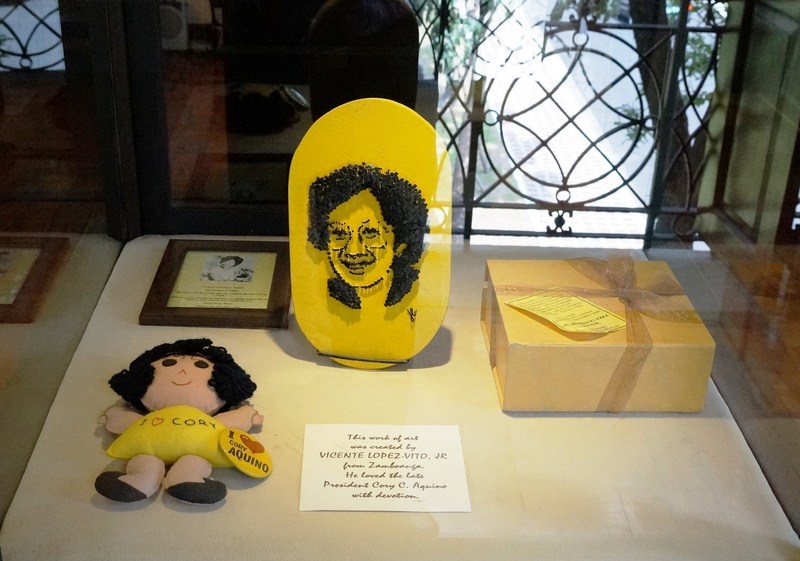
Portrait of Cory, by Filipino artist Vincente Lopez Vito, Jr., using nails

Portrait of Cory, by Filipino artist Vincente Lopez Vito, Jr., using nails

On display are some photographs, paintings (including a portrait of Cory, by Filipino artist Vincente Lopez Vito, Jr., using nails), the awards she received during and after her presidency, campaign materials, and other artworks evoking her life and achievements.

Osmena Room

Osmena Room

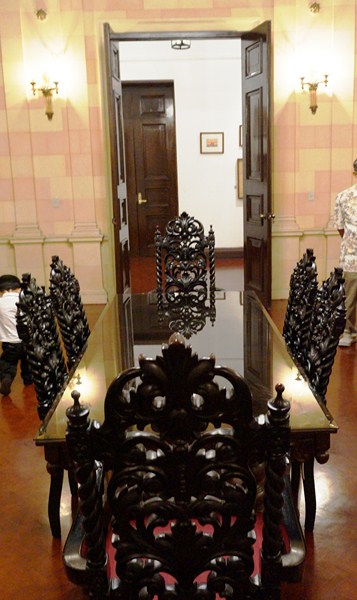
The more feminine-looking Osmena room was, in my mind, the most amazing. The walls here, decorated with cotton candy pink, were lined with Champagne yellow faux stone stucco with gold accents; the chandelier was impressive and the very masculine black and red dining table was huge enough to evoke a sense of power. It was easy to imagine the many critical decisions that must have been reached in that room.

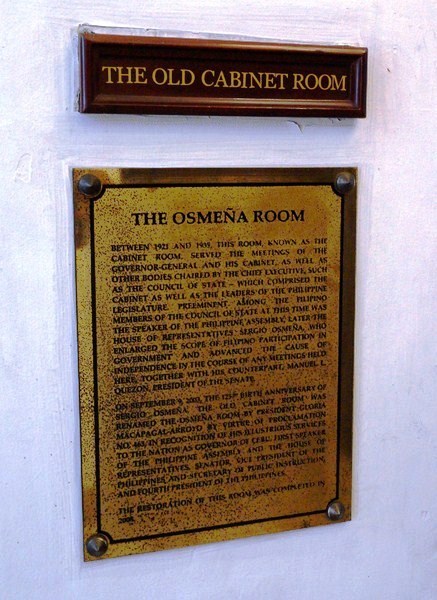
Osmena Room Plaque

Osmena Room Plaque

The overhead cement French frieze, also done by Tampinco, featured different Filipino landscape scenes amid cherubs, eagles and sea lions.  Between 1921 and 1935, the Cabinet Room served as the meeting room of the Governor-General and his Cabinet as well as other bodies, such as the Council of State (which included Sergio Osmena), chaired by the Chief Executive. On September 9, 2003, the 125 birth anniversary of Osmena, it was renamed the Osmena Room by virtue of Proclamation No. 463.  Its restoration was completed in 2008.

The Old Governor-General's Office

The Old Governor-General’s Office

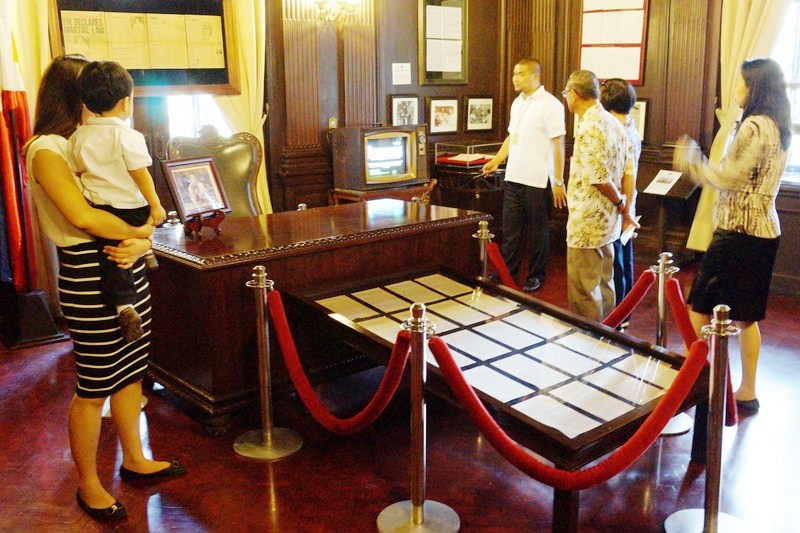
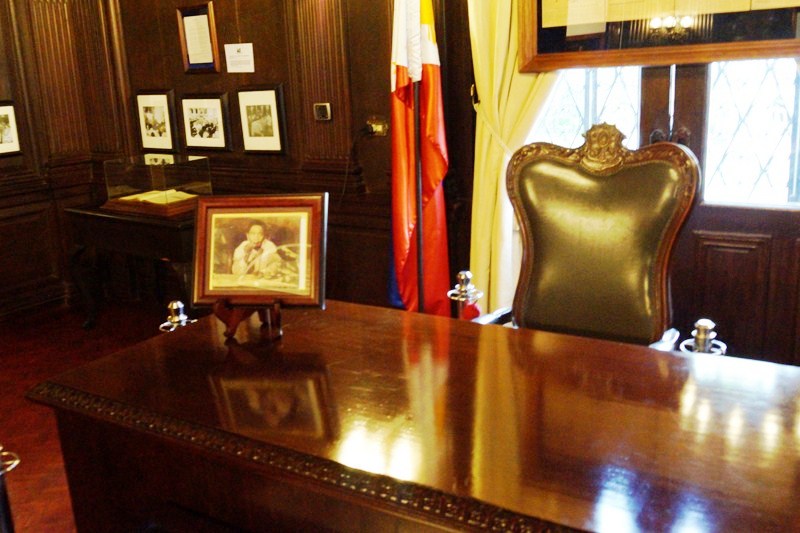
The Old Governor-General’s Office, used by the various U.S. governor-generals during the American occupation was, as far as I am concerned, the room to see.  It has nothing to do with its origin but, rather, what it holds inside. Inside is the actual furniture set, including the desk used by Pres. Ferdinand E. Marcos when, on September 21, 1972, he announced Proclamation No. 1081 declaring Martial Law, a grim date and an event that would forever alter Philippine history and the psyche of the Filipino people.

The desk used by Pres. Ferdinand E. Marcos when, on September 21, 1972, he announced Proclamation No. 1081 declaring Martial Law

The desk used by Pres. Ferdinand E. Marcos when, on September 21, 1972, he announced Proclamation No. 1081 declaring Martial Law

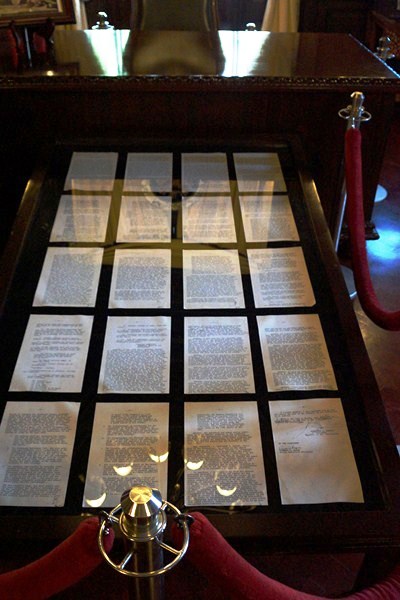
Here, we even watch the actual black-and-white clip of his TV broadcast on a 1970’s TV set.  Also on display is a reproduction of the text of Proclamation 1081, as well as facsimiles of important documents promulgated by former Chief Executives of the Philippines from Malacañang.

Reproduction of the text of Proclamation 1081

Reproduction of the text of Proclamation 1081

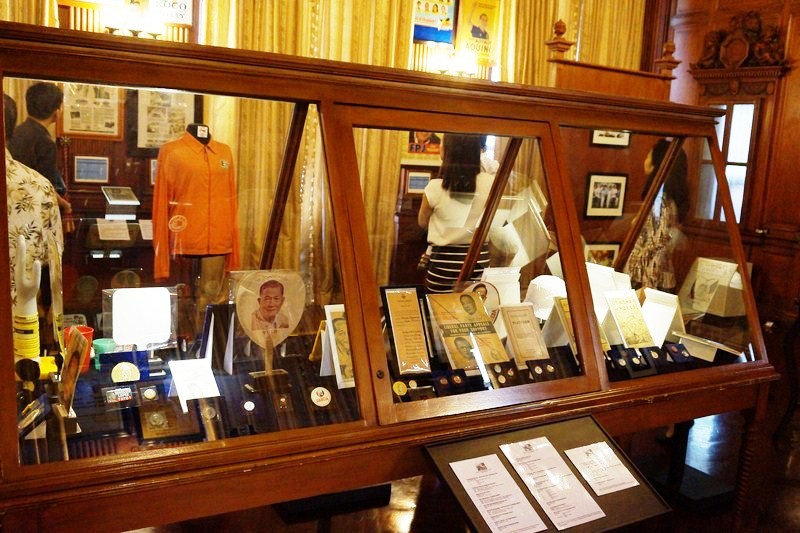
The Old Waiting Room, surrounded by old wooden hardwood panels and big mirrors from the Spanish occupation, with carvings of cherubs and eagles looking down from the walls,  showcases presidential campaign materials and paraphernalia dating back to the time of Manuel Roxas, the fifth president.

Old Waiting Room

Old Waiting Room

They include such items as the neon yellow Noynoy Aquino shirt, the bright orange “Erap Para sa Mahirap” (Erap for the Poor) jacket plus various materials from presidential candidates that didn’t win (posters of Jose de Venecia, Jr.Raul S. Roco, etc.). We also listened to “Mambo Mambo Magsaysay,” appreciating the rock ‘n roll element of this 1950s ditty that was Ramon Magsaysay’s famous campaign jingle.

The Presidential Studio

The Presidential Studio

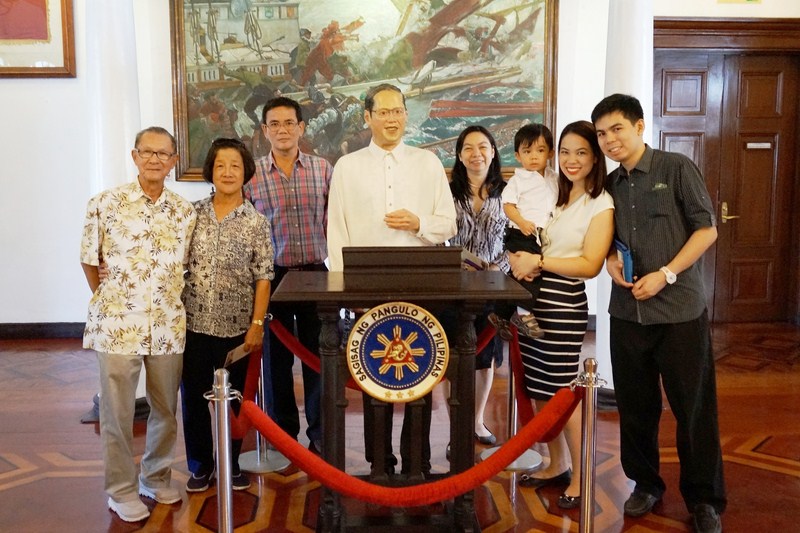
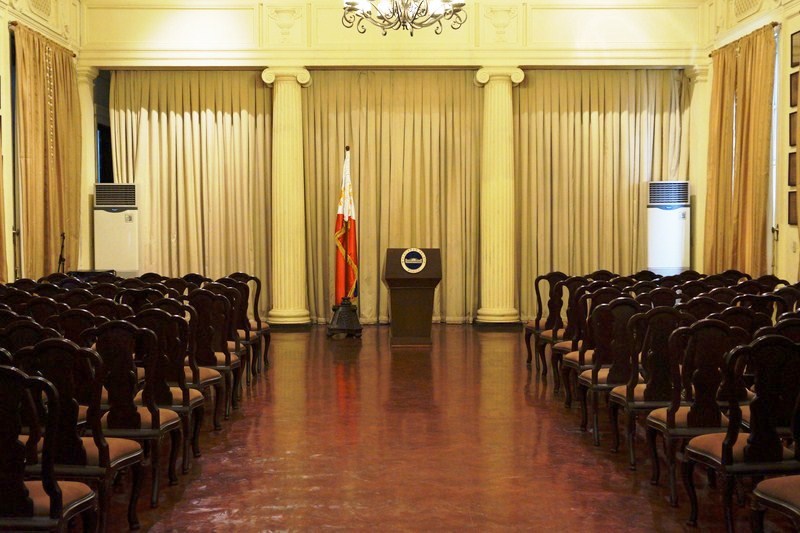
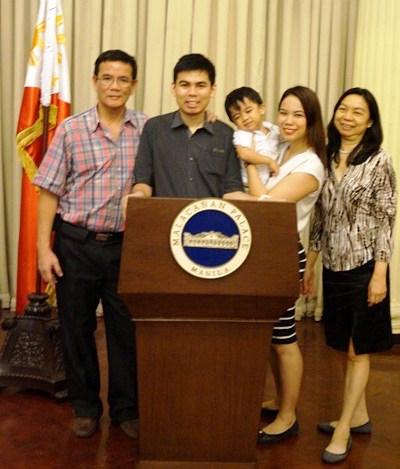
Our last tour stop was the Presidential Studio, basically a function room that was officially last used in 2012 for the wake of the late Secretary of the Interior and Local Government Jesse M. Robredo.  Here, we had our picture taken behind the podium, carrying the official seal, which the President uses when he rehearses for the SONA (State of the Nation Address).

My family at the podium, carrying the official seal, which the President uses when he rehearses for the SONA (State of the Nation Address).

My family at the podium, carrying the official seal, which the President uses when he rehearses for the SONA (State of the Nation Address).

On our way out, we passed by the tiny souvenir’s booth near the exit door.  Here, you could buy some nice, affordable and unique souvenir items such as bags, mugs and T-shirts with palace’s logo, plus the usual stuff such as key chains and ball pens.

Our worthwhile tour, aside from showing us some amazing rooms and exhibits in the Palace plus some exquisite works of art, also added an insightful take into events that transpired within Kalayaan Hall, helping us  delve deeper into the symbolism and meaning of Malacanang Palace, a silent witness to the men and women who have led this nation, for better or for worse, for the past 100 years. Truly a tour for any history buff or for those who are simply looking to discover and learn.

Malacañang Museum and Library: Kalayaan Hall, Malacañang Palace Complex, 1000 J.P. Laurel, Sr.  St., San Miguel District, Manila. Open Mondays to Fridays, 9 AM to 12 noon and 1 – 3 PM.  Tel: (632) 784-4286 local 4945 or 4645.  Fax: (632) 784-4286 local 4722. Admission: PhP50 (PhP30 for students and senior citizens).  Website: www.malacanang.gov.ph.

Visits are strictly by appointment only and can be initiated by writing or faxing the Director at least seven days in advance.  The communication must contain the full names and nationalities (for foreign nationals, a photocopy of his or her passport main page must be attached to the reservation form) of all people included in the visit, as well as the desired date and time of the visit and contact information. This information is required for security clearance by the Presidential Security Group.  Once the communication has been received, the Visitor and Tours Coordinator at the Malacañang Museum will facilitate the request and confirm the visit. Confirming that the request has been duly received is the responsibility of the requesting party. Approval or denial of the request can be confirmed one day before the date of visit. Groups that are late by more than 30 minutes beyond their scheduled tour appointment shall not be entertained. They may, however, be moved to the next available slot by the Tour Coordinator.

Those not included in the guest list shall not be allowed entrance to the Palace grounds. Visitors to the Museum are advised to adhere to a smart casual dress code. Those wearing shorts, sleeveless tops, and slippers shall not be granted entry to the Palace grounds. All visitors are provided with a tour guide.

Photography is allowed, but is restricted to within the Malacañang Museum. However, taking video footage is prohibited without prior clearance from the Presidential Security Group.  All scheduled visits and tours are subject to rescheduling or cancellation on the advice of the Presidential Security Group.

Entrance is through the Kalayaan Gate. Visitors in private vehicles or by taxi can enter the Malacañang environs through either Arlegui Street or J.P. Laurel Street Entrances and either park or disembark in the Mendiola Street Car Park, after which a short stroll along J.P. Laurel Street will bring them to Kalayaan Gate. Visitors on foot can also arrive via the General Solano Street or San Rafael Street Entrances.

New Year Countdown at the Manila InterContinental (Makati City)

Fireworks (12)

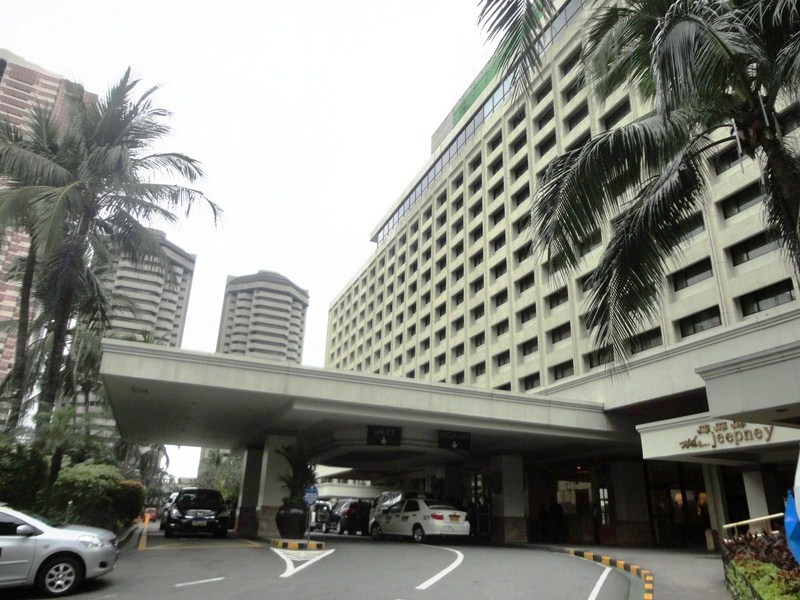
For the third time around (the first was in the iconic Manila Hotel, followed by the Dusit Hotel), my family and I decided to spend New Year’s Eve in a hotel and, this time around, we chose to stay at the nearby InterContinental Manila (colloquially Intercon/ICM).  This 5-star InterContinental hotel, part of the longest operating international chain hotel in the Philippines, holds the distinction of being the first 5-star deluxe hotel in Makati and the second InterContinental hotel to open in Asia.

InterContinental Manila Hotel

InterContinental Manila Hotel

Designed by my uncle, the late National Artist Leandro Locsin, this 14-storey landmark hotel opened on April 11, 1969 as part of the overall redevelopment plan for Makati.It is owned by Ayala Land Hotels and Resorts Corp., Ayala Land’s wholly owned subsidiary. Conveniently located within Ayala Center (Makati Commercial Center years before), opposite the Glorietta, it is walking distance to 5 big shopping malls (SM, Rustans, Landmark, etc.), great restaurants, an MRT-3 station (Ayala Station) and cinemas. It still exudes the charm and elegant atmosphere of the old Manila I am familiar with.

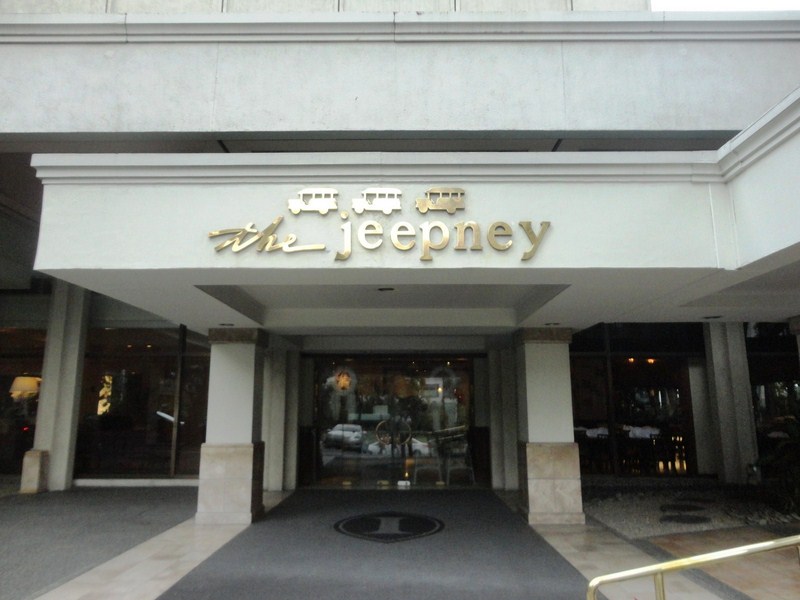
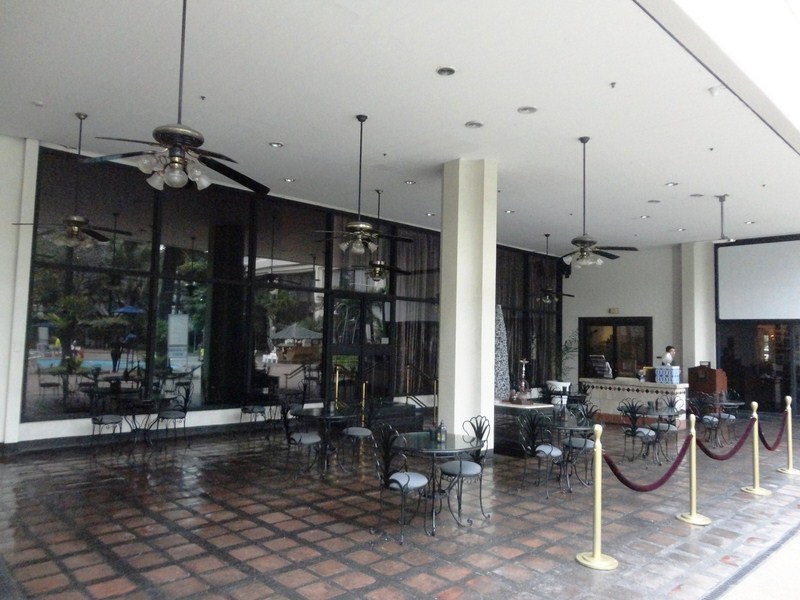
Cafe Jeepney

Cafe Jeepney

 This old but well-maintained hotel has won numerous awards such as the “Best Hotel Kikay Festival” for “Festival Gastronomique le Kikay Bleu” in 1982 and 1983; the Green Globe Award for Outstanding Environmental Programs in 1998; “Outstanding in Community Involvement for Southern Asia” among InterContinental hotels in 2002; and the TTG (Travel Trade Gazette) Travel Awards as the “Best City Hotel” in 2010, 2011 and 2013.

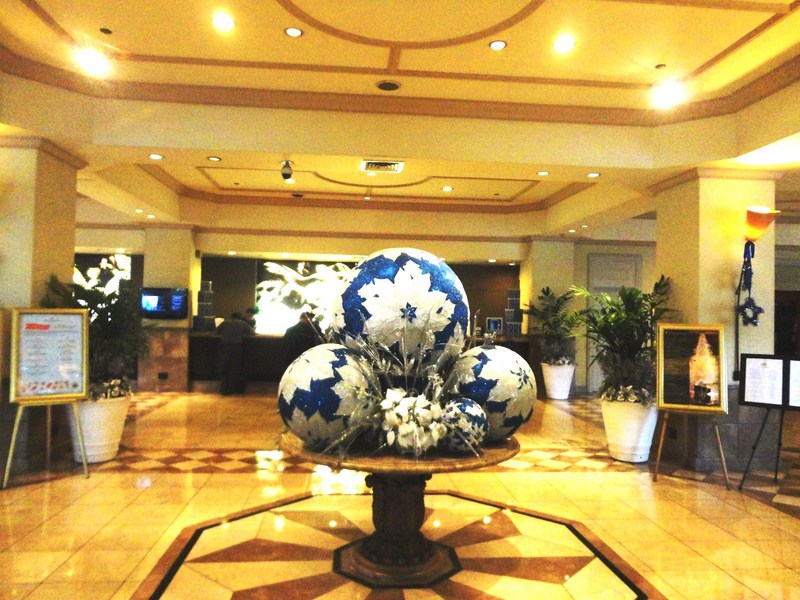
Hotel Lobby

Hotel Lobby

In 1997, the hotel also placed first in Asia Pacific and third in the world in the D’Richey Report and, in 2007, it was voted by readers of Business Traveler Magazine Asia Pacific as one of the three top hotels in the Philippines.

Cafe Jeepney (1)

Cafe Jeepney (2)

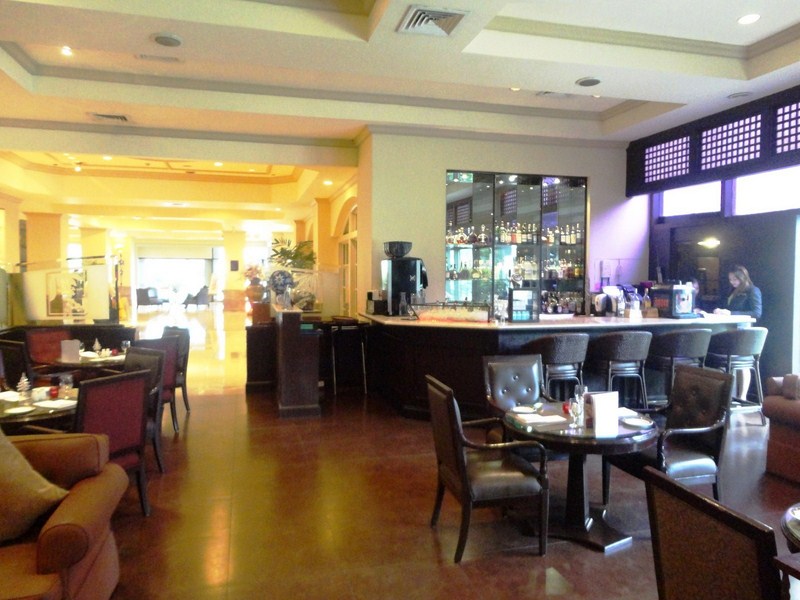
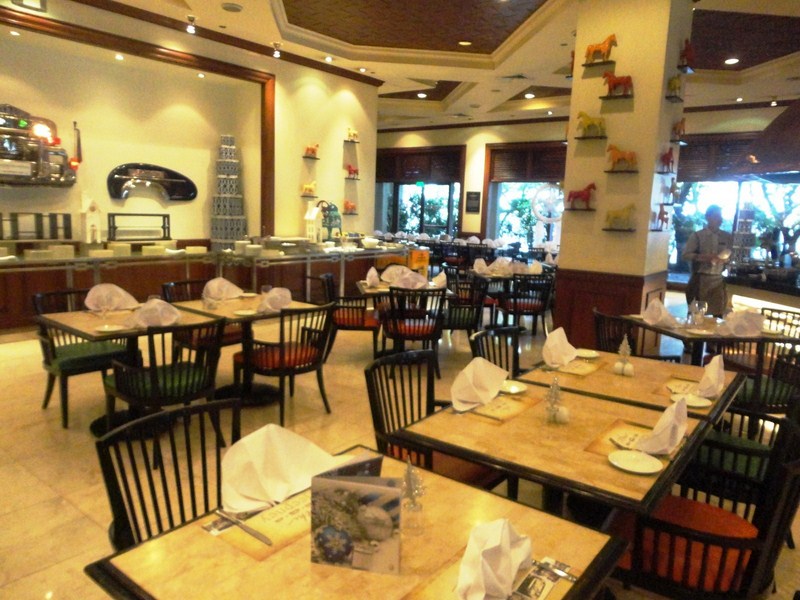
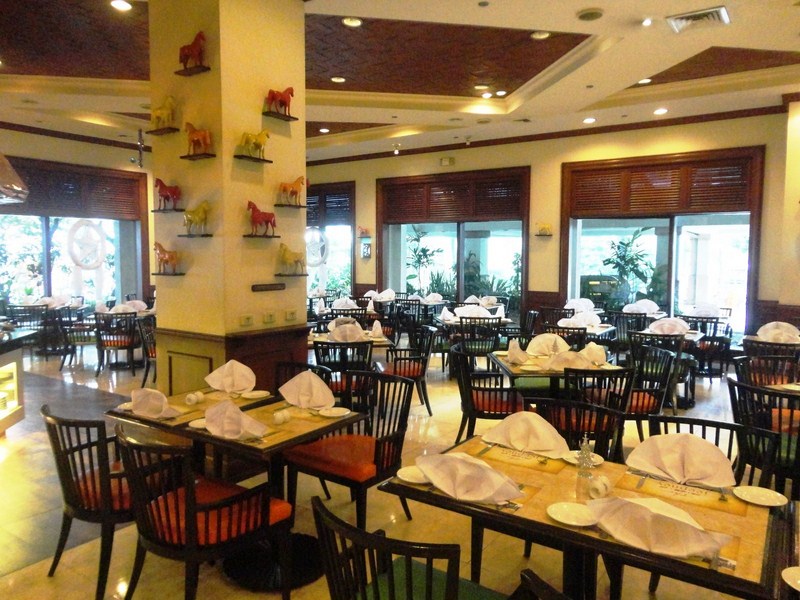
Cafe Jeepney dining area

We all checked in at a spacious and comfortable 2-bed De Luxe room (Suite 839), one of 332 guest rooms that were updated in 2006. Incorporating traditional and modern Filipino design infused with a refined European touch, each room had warm earth tones and rich, walnut wood finish. it features individually-controlled airconditioning, flat-screen LCD cable TV, work desk with lamp, in-room safe, IDD/NDD phone, coffee/tea making facility, mini fridge, private bathroom with bathtub and free high-speed wireless internet.

Double Bed De Luxe Suite (Suite 839)

Double Bed De Luxe Suite (Suite 839)

The staff was polite, efficient and attentive to our needs.  The presence of pretty Ambassador ladies greeting guests at the entrance was a nice touch.  They also offer valet, airport transfers, currency exchange, tours, concierge, car rental, laundry and room service.  InterContinental Manila has 4 restaurants and bars that offer a wide selection of food and wines to suit every taste and to match the occasion.

Gambrinus Bar

Gambrinus Bar

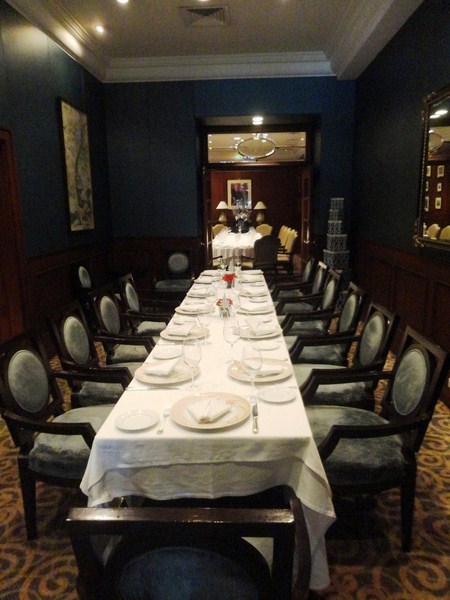
The Prince Albert Rotisserie, a fine dining restaurant, offers gourmet French and Continental fare, classic wines and is best known for its tableside preparation of US prime rib and Crepe Suzette. In addition to the main dining section, the restaurant boasts of three dining salons for guests desiring more privacy. During our stay, they offered a special New Year’s Eve set dinner menu (PhP2,990++ per person) which included veal, duckling, and morel terrine and roast prime rib of Aberdeen Angus beef with baked potato, buttered garden vegetables and red wine sauce. A special à la carte menu was likewise be offered. Its impeccable service has reaped prestigious awards and numerous citations including Ordre Mondial des Gourmets Gustateurs ‘Trés Belle Carte” (Best Wine List) Award.

Sol y Sombra

Sol y Sombra

Café Jeepney, a favorite meeting place and watering hole for people in the news and those who write about them, was where we had our breakfast.  The evening of our stay, they offered a buffet for PhP2,000++ per person. Themed around the world famous Filipino jeepney, it features a mouth-watering spread of Filipino and international fare, a la carte and buffet style, including live cooking and carving stations.

Function Room

Function Room

The ground floor Gambrinus Bar, a venue to meet family and friends amongst the view of the poolside garden, offers an appetizing selection of a la carte dishes, bar chows and cocktails while listening to live music in the evening.  Sol y Sombra offers savory snacks, tropical thirst quenchers and cocktails by the poolside or inside one of the “bahay kubos” (nipa huts).

Club Lounge

Club Lounge

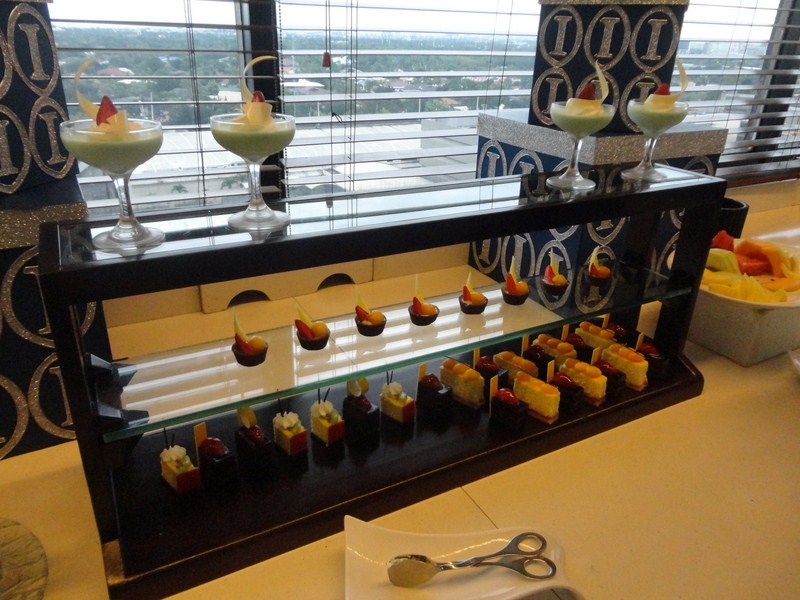
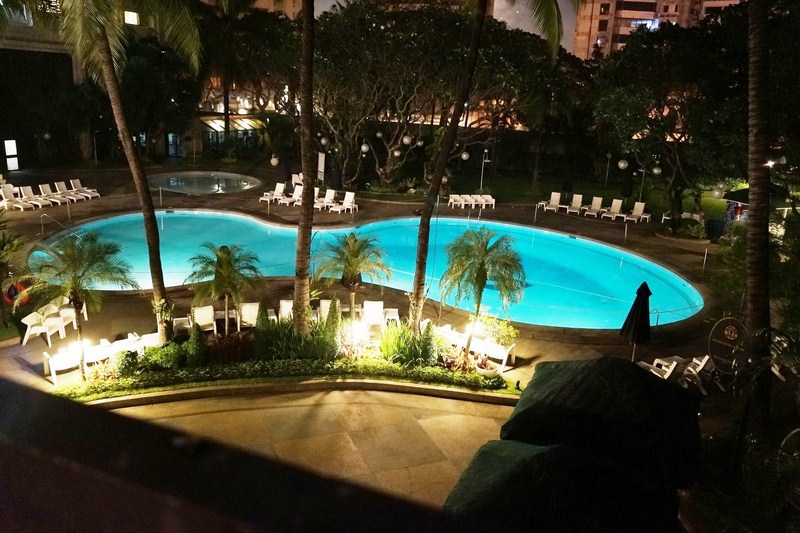
The Club Lounge, where we had access, offered breakfast and snacks throughout the day as well as happy hour in the evening.  It had a stunning view of the Makati skyline.  The hotel also has an outdoor swimming pool (said to be the largest in Makati), an 800-1,000-pax grand ballroom, 7 meeting rooms (Bahia, San Lorenzo, etc.), business center, full-service spa (Suriya), sauna, gift shop, beauty salon and a gym (Gold’s Gym)..

Swimming Pool

Swimming Pool

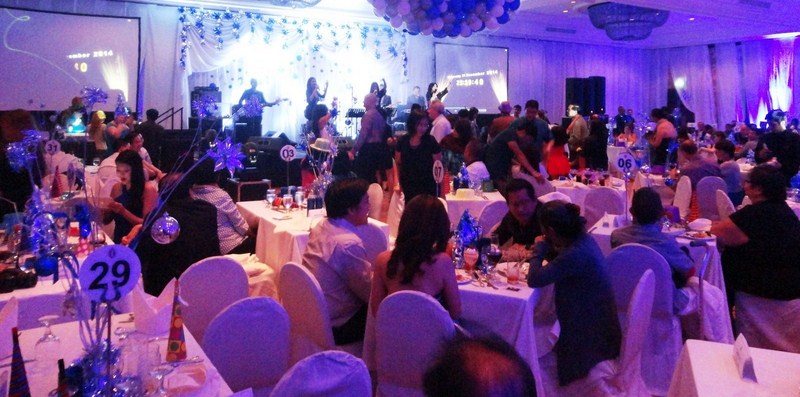
Our room package (PhP9,888 net) also included a New Year’s Countdown for two, which started  8 PM onwards, at its Grand Ballroom, with free-flowing red and white wine, champagne, soda, iced tea, and a buffet spread of holiday favorites.

New Year Countdown (Grand Ballroom) (1)


New Year Countdown at the Grand Ballroom

New Year Countdown at the Grand Ballroom

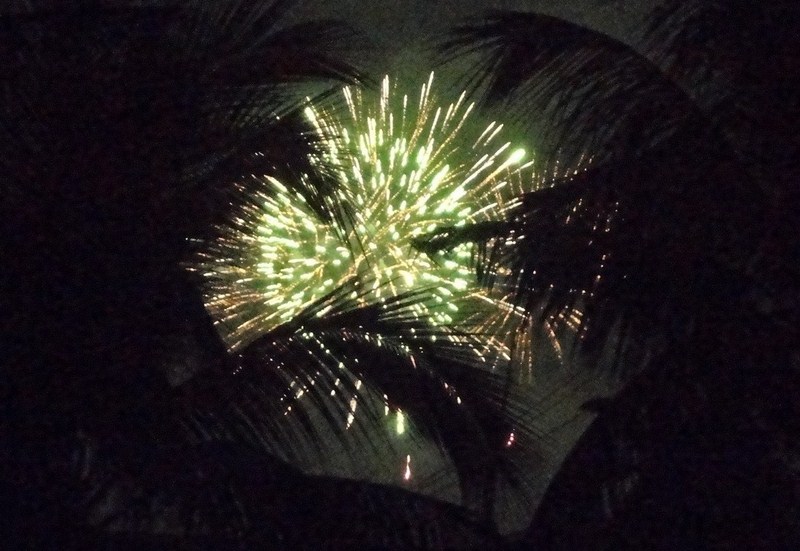
Performing live music on stage was the all-girl (AJ Salvado, Jen Manalac, and Pia Diamante) Silk Band who rendered rhythm & blues and the best of OPM, from the 1970s to the present.  Right after the countdown, we watched the fireworks outside.

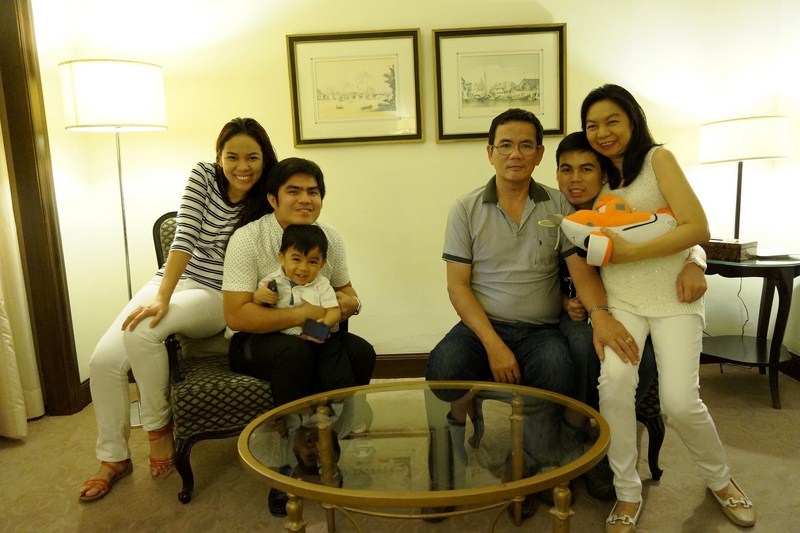
Family bonding at the InterContinental Manila

Family bonding at the InterContinental Manila

InterContinental Manila: 1 Ayala Ave., Ayala Center, Makati City, 1226 Metro Manila.  Tel: (632) 793-7000. Website: www.intercontinental.com/Manila.

Georgia on My Mind (Republic of Georgia That Is)

The Philippine delegation at Gudauri, Republic of Georgia. L-R: Pancho Piano, Riva Galveztan, the author, Mel Dizon-Dulalia and Buddy Cunanan

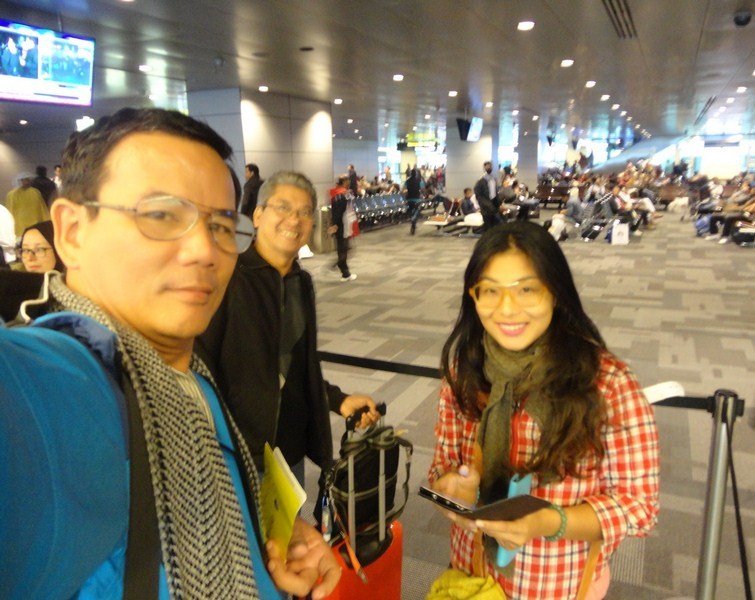
Upon the invitation of Mr. Thelmo “Buddy” O. Cunanan Jr., honorary consul of Georgia in the Philippines, I joined a group that would cover the Colors of Hope exhibit of Mr. Pancho Piano, the first Filipino artist to officially present his work in Georgia and the entire Caucasus region. Aside from Buddy, Pancho and I, also joining the group were Ms. Riva M. Galveztan (health food advocate) and Prof. Melissa “Mel” Dizon-Dulalia. Our Republic of Georgia odyssey was to last 11 days (November 24 – December 4, 2014).

Check out “The Colors of Hope Exhibit

Diosdado Macapagal International Airport in Clark, Pampanga

On the first day of our trip, I met up with Buddy at Resorts World where a bus was to take us Diosdado Macapagal International Airport at Clark Freeport Zone, Pampanga.  Along the way, we picked up Pancho Piano at Centris Mall in Quezon City.

The author at the check-in counter of the airport

Upon arrival at Clark, we met up with Mel at the airport.  Riva was to meet us in Tbilisi on another flight the day after our arrival in Tbilisi. While waiting for our flight, all four of us had a late breakfast at the VIP 1 Lounge of the airport.

On board our Qatar Airways plane

We all left the airport on the 10:50 AM Qatar Airways (QR 931) flight on board a Boeing 787-8 aircraft. A rather long 9-hour flight brought us to Hamad International Airport in Doha, Qatar, our first stopover, arriving there at 2:50 PM (Doha time). Here, Pancho, Mel and I were in for a long 17-hour layover.   Buddy opted to leave the airport and check in at a hotel in Doha.

Check out “Hamad International Airport

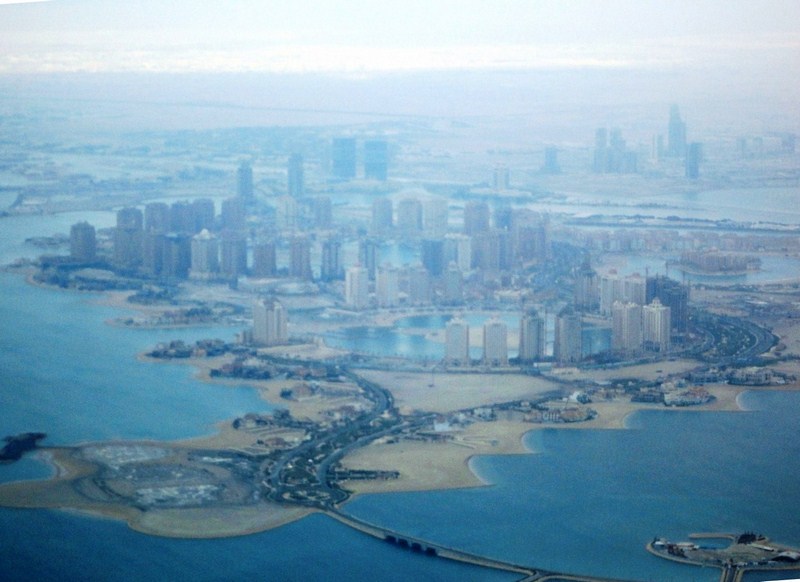
View of Doha from our plane

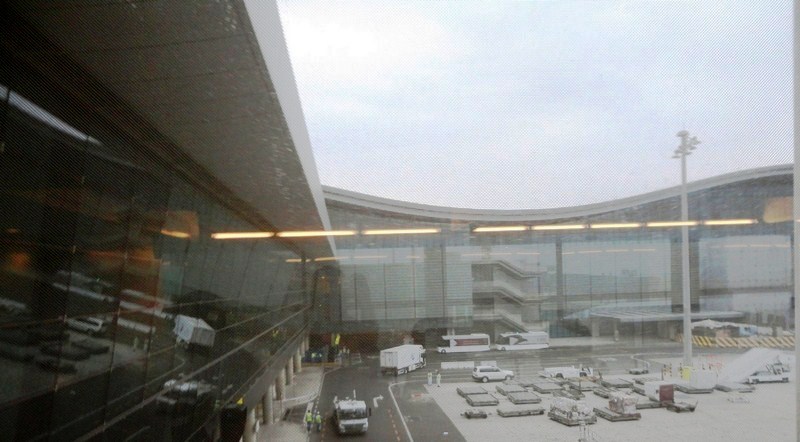
Hamad International Airport in Doha, Qatar

We whiled the time away admiring the artwork, taking turns sleeping on airport lounge chairs and, come morning, having breakfast at a Burger King outlet.

The author, Pancho Piano and Mel Dizon-Dulalia at Hamad International Airport

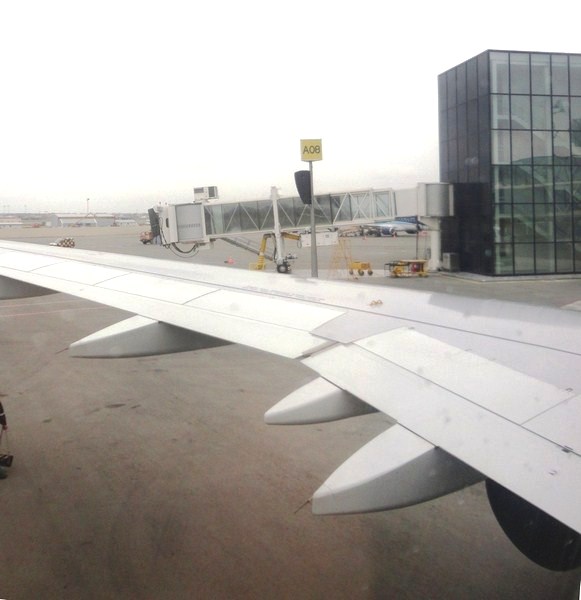
Buddy joined us the next morning in time for our 7:45 AM (QR 251) connecting flight to Tbilisi, this time on board an Airbus A320 aircraft. Normal flight time is 3 hours and 15 minutes but we made a 1-hour stopover in Heydar Aliyev International Airport in Baku (Republic of Azerbaijan) to offload as well as load some new passengers.

Stopover in Heydar Aliyev International Airport in Azerbaijan

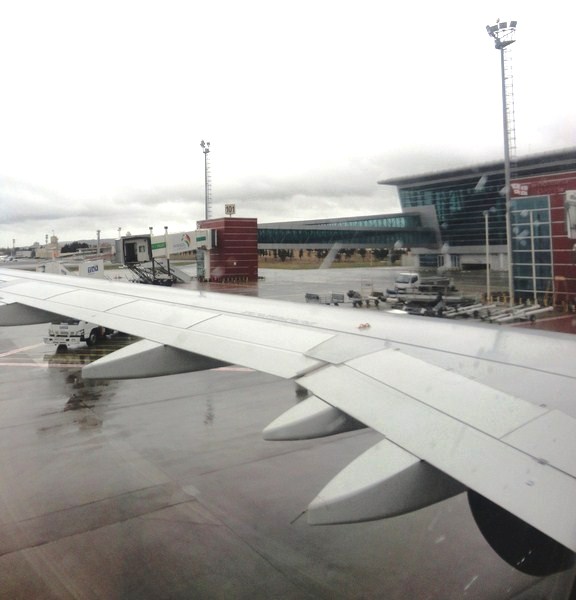
Touchdown at Tblisi International Airport

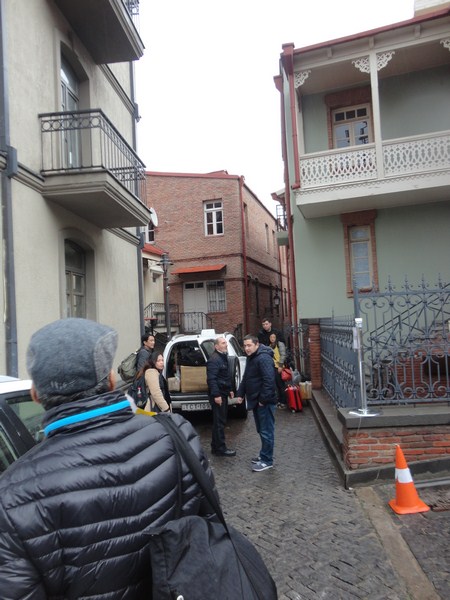
We arrived in Tbilisi International Airport by lunchtime where we were met by Ms. Ruby Bebita, a Filipina working in Tbilisi, who assisted us in getting a place to stay in the city. After buying and installing local SIM cards at the airport, we boarded a taxi to bring Pancho, Mel and Buddy to a hostel, near Meidan Square, while I stayed at the nearby Envoy Tours Hostel.

Check out “Hotel and Inn Review: Envoy Tours Hostel

Arrival at the hostel.  Ruby is the lady at left

Envoy Tours Hostel: 45 Betlemi Street (on Junction to Orbiri St. leading up to the Narikala Fortress), 0105 Tbilisi City, Georgia. Tel: +995-322-920-111.  Website: www.envoyhostel.com.

The Chinese Compound (Pasay City)

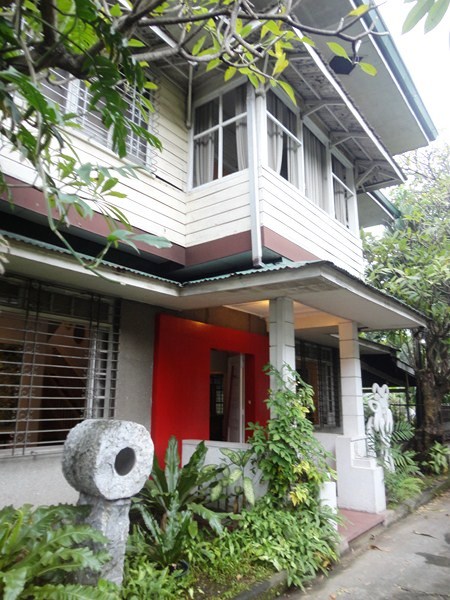
From My Mother’s Garden, we began the afternoon leg of our AAP-sponsored Pasay Media Familiarization Tour, proceeding, along F.B. Harrison St., to a compound where, upon entering its red main gate, I was instantly transported to another place and time smack in the middle of urban chaos, which makes for an interesting contrast.

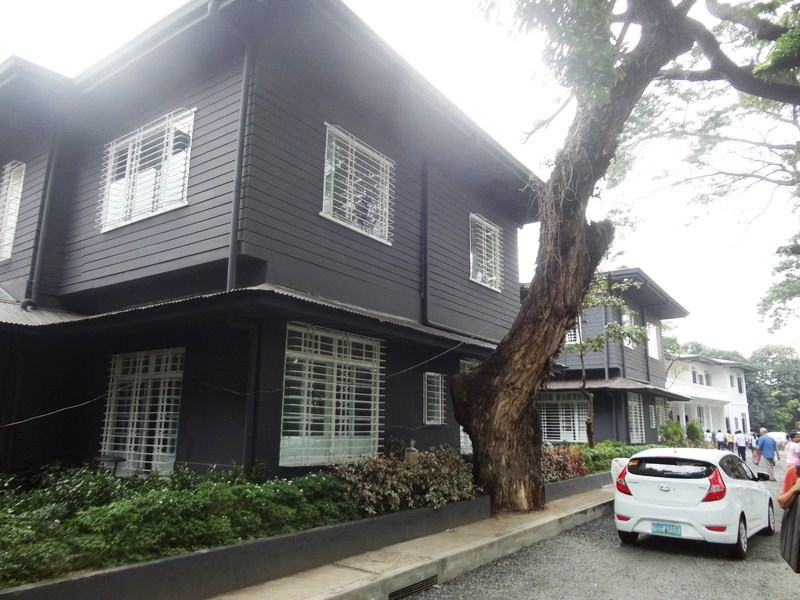
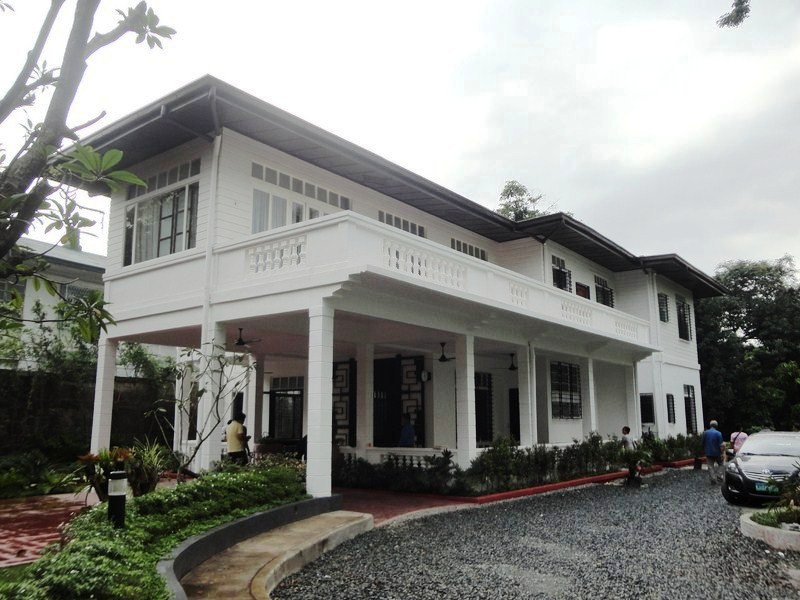
The Chinese Compound

The Chinese Compound

Set amidst lush greenery is an interesting enclave of 15 post-World War II, medium-sized and nearly identical 2-storey houses.  All these houses, designed to facilitate air flow before the introduction of air-conditioning, have high ceilings, large windows and a second floor balcony.  Its floors are laden with Machuca tiles.

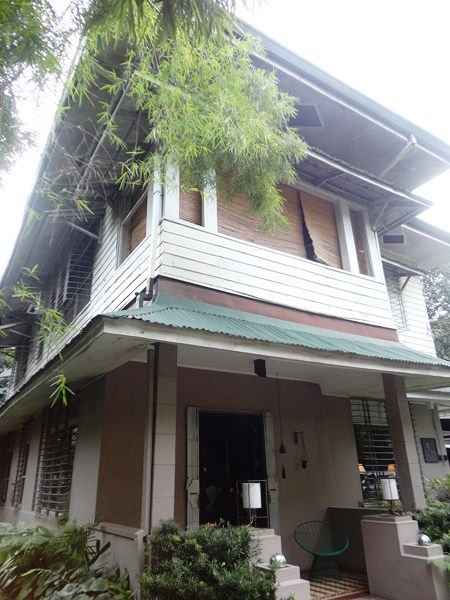
The boutiue hotel

The boutiue hotel

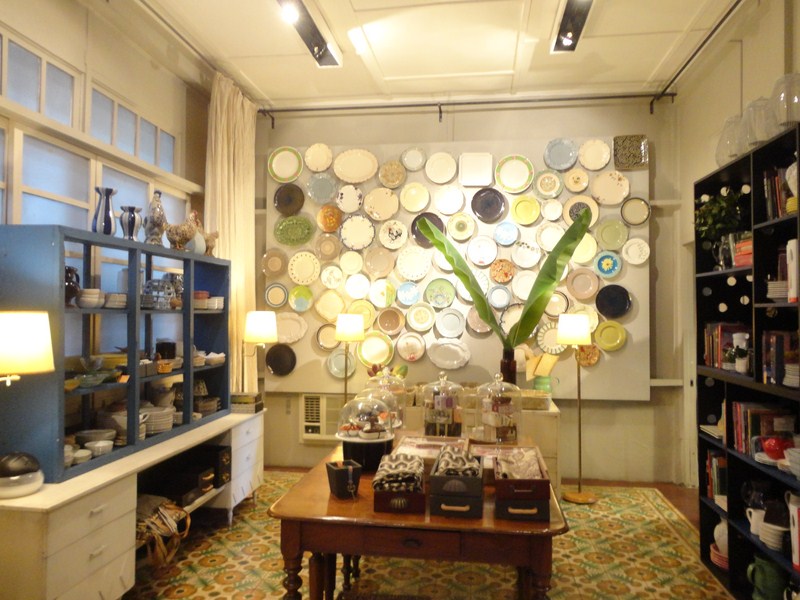
Formerly a residential abode for the Chinese owner’s large family (it is called the Chinese Compound), this tree-lined compound simply awed me with its old-world charm and serenity.  Some of these 1950s houses are just regular homes of people not connected to the artistic world  but several of the homes now house several interesting establishments such as the art gallery of Albert Avellana (Avellana Art Gallery), the atelier of top fashion designer Jesus “Jojie” Lloren and the furniture showroom (Artelano 11 Furniture Gallery- A11) of interior designer Eric Paras which occupies 2 houses.

Artelano 11 Furniture Gallery

Artelano 11 Furniture Gallery

Five of the houses are also being turned into a boutique hotel, an example of adaptive reuse.  It will have a swimming pool and a restaurant.  We all toured each of these establishments (save for the boutique hotel which was still being constructed) which made the compound an artistic hotbed ever since it was occupied by creative souls. All are filled with art, classic French crockery, rustic table settings and furniture and decor that channel everything from Art Deco to mid century to a more industrial style. The space is reputed to be a source for well-known interior designers all over the country.

An A 11 furniture showroom

An A 11 furniture showroom

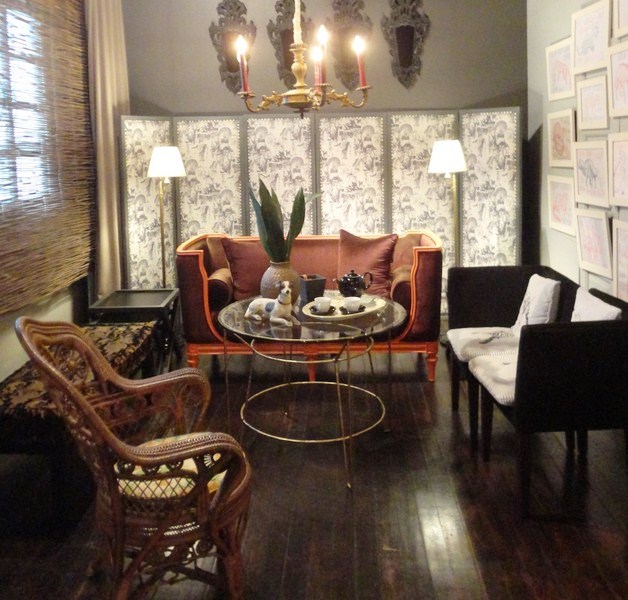
The Artelano 11 Furniture Gallery, opened last January 2013, houses, in a home setting, many of Eric’s designer furniture plus some  items he brought in from elsewhere.  They include a double-tiered, mid-century side tables; metal-based furniture pieces such as an iron bed frame with a wood-framed screen upholstered in toile de jouy fabric; a mid-century ambassador’s chair finished in black; an antique writing desk refinished in a dark hue; table tops and shelving units with thick slabs of exotic wood; a 4-panel screen, hung with small artwork, made with old doors; low console table, for Eric’s line of lighting, made from an enormous wood column; a metal framed lamp, topped by a marble cylindrical shade, with geometric patterns; a marble wash basin filled with decorative woven rattan balls; a pair of side tables, topped with polished white marble, with hollowed wood bases etched with designs in a random pattern; a cylindrical center table base wrapped with metal strips in a loose weave pattern; and Eric’s collection of colorful ceramic accessories.

Another A 11 showroom

Another A 11 showroom

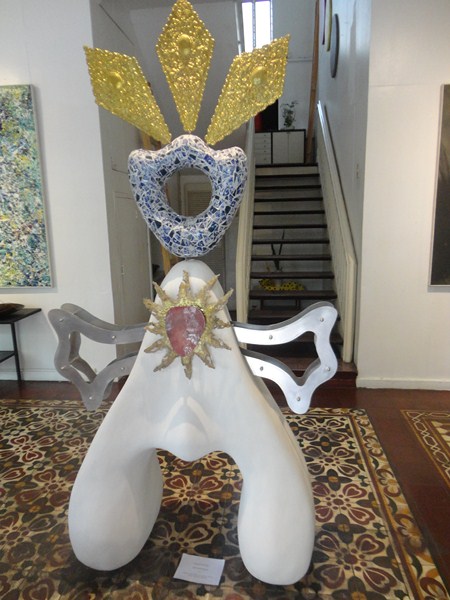
The Avellana Art Gallery, opened in 1997, specializes in eye-catching Filipino art. Its genteel old space was turned by Albert into a retro-modern gallery for the functional art.  The two floors are full of art, with the top floor being used for moving exhibitions, a perfect venue for new and more established artists.  At the entrance lobby is the sculpture “Love From Above” by Pidge Reyes.

Avellana Art Gallery

Avellana Art Gallery

Love from Above by Pidge Reyes

Love from Above by Pidge Reyes

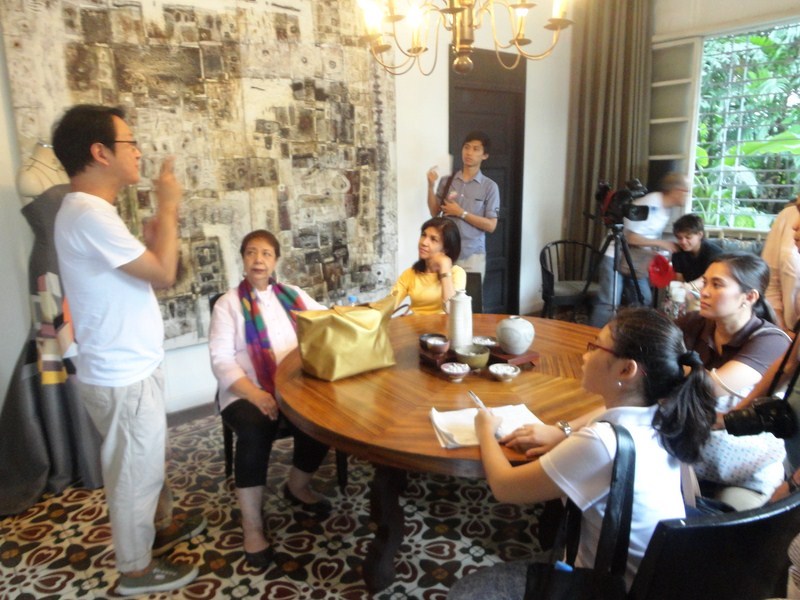
At the atelier of Jojie Lloren, we were welcomed by the mild-mannered and pleasant designer himself.  We all listened to him at his spacious living room, sitting at contemporary chairs around an old round table. His atelier looks a bit French Art Nouveau, the compact space of his workshop made stylish and beautified, in the bayanihan spirit, by his close friends.

Listening to Jojie Lloren at his atelier

Listening to Jojie Lloren at his atelier

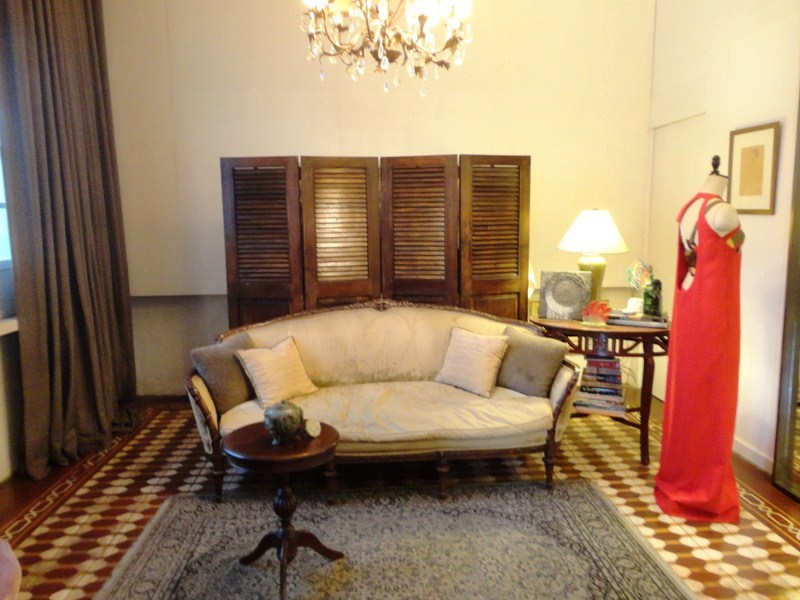
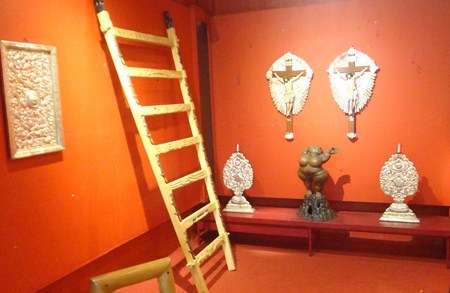
There were furniture pieces (couch, ceramic garden stools, etc.) from Eric Paras’ A11, a louver screen from Albert Avellana, a bird cage from designer James Reyes, and a chandelier from lighting designer Ricky David; all these things close to Jojie’s heart.  Jojie also added period pieces he bought from thrift shops along Evangelista St. in Makati. His display of Filipino religious includes antique Marian medallions ((that spell out his name) and modern Marian prints by Virgilio Aviado.  There are also paintings, including one from Popo San Pascual.

Reception area with a chandelier from Ricky David, couch from Eric Paras and louver screen from Albert Avellana

Reception area with a chandelier from Ricky David, couch from Eric Paras and louver screen from Albert Avellana

Despite the heavy Pasay traffic and braving the pollution and the gritty stretch of urban decay on that day, the sudden change of atmosphere, once inside this place of calm, was truly worth the extra effort.

Religious art collection of Jojie

Religious art collection of Jojie

Avellana Art Gallery: Unit A-19, 2680 F.B.Harrison St., Pasay City. Tel: (632) 833-8357. E-mail: avellana_gallery@yahoo.com.  Open Mondays to Saturdays, 10 AM to 7 PM.

Atelier of Jojie Lloren: Unit A-17 2680 F.B Harrison St., 1300 Pasay City.  Tel: (632) 556-4725, (632) 641-9347 and (632) 401-1194. Fax: (632) 896-7199. E-mail: lyorenne@hotmail.com.

Artelano 11 Furniture Gallery: Unit A-11, 2680 F.B. Harrison St., 1300 Pasay City.  Tel: (632) 832-9972.  Mobile number: (0917) 837-0115. E-mail: a_eleven05@yahoo.com.  

Automobile Association Philippines (AAP): 28 EDSA, Greenhills, San Juan City.  Tel: (632) 655-5889.  Fax: (632) 655-1878.  E-mail: info@aap.org.ph. Website: www.aap.org.ph.
AAP Travel: G/F, Sea Tower Bldg., 2332 Roxas Blvd. cor. Arnaiz Ave., Pasay City. Tel: (632) 551-0025.  Fax: (632) 551-0014. E-mail: info@aaptravel.com.  Website:www.aaptravel.com.ph.
Exploring Sumilon Island (Oslob, Cebu)

The Sumilon Island hiking trail

The Sumilon Island hiking trail

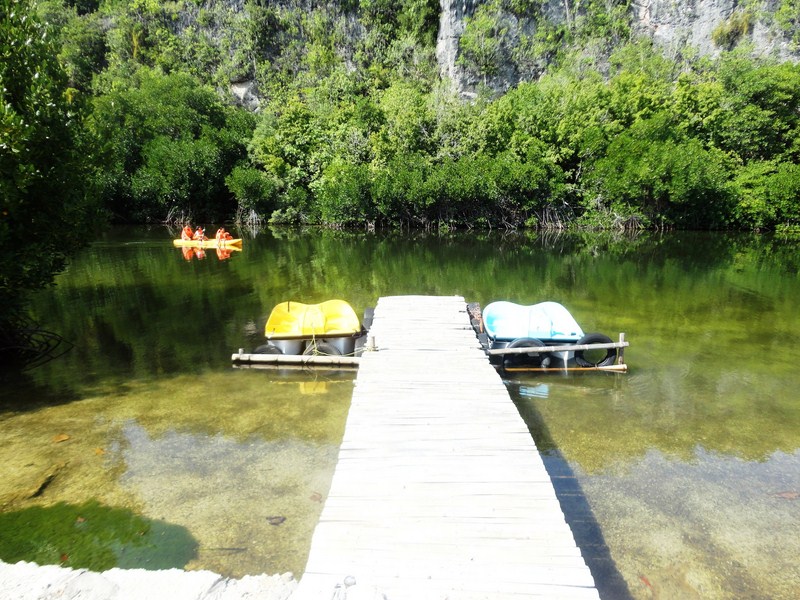
After our lunch at the Island Pavilion Restaurant, Lara, Joy, Jimbo, Rachelle, Risa, Leica (Pete’s daughter) and I decided to burn some calories by doing a hike, with a resort guide, around the 24-hectare island.  Liana and Kaycee opted to stay behind to rest.

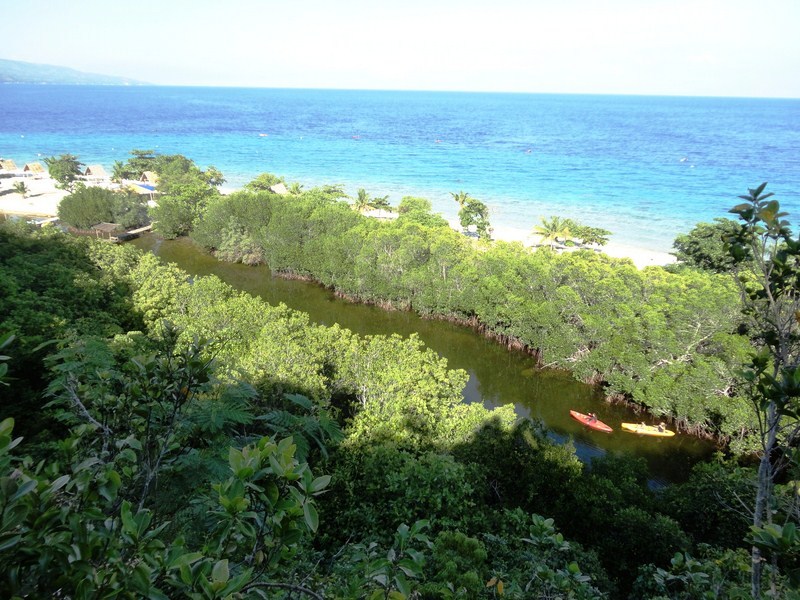
View of the natural lagoon from the cliffside trail

View of the natural lagoon from the cliffside trail

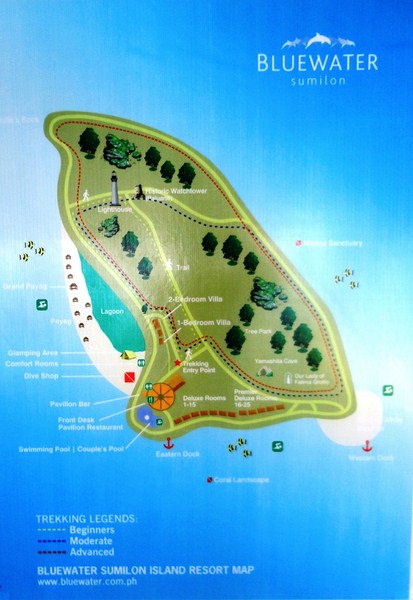
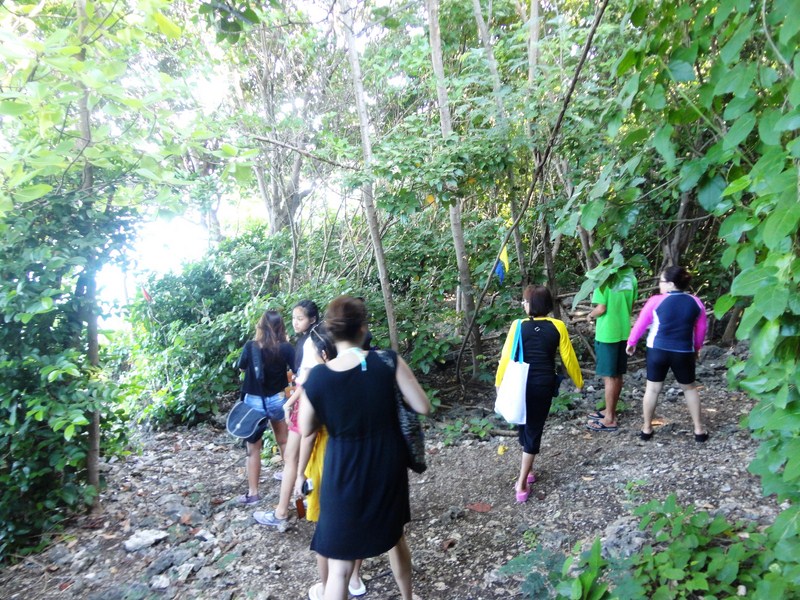
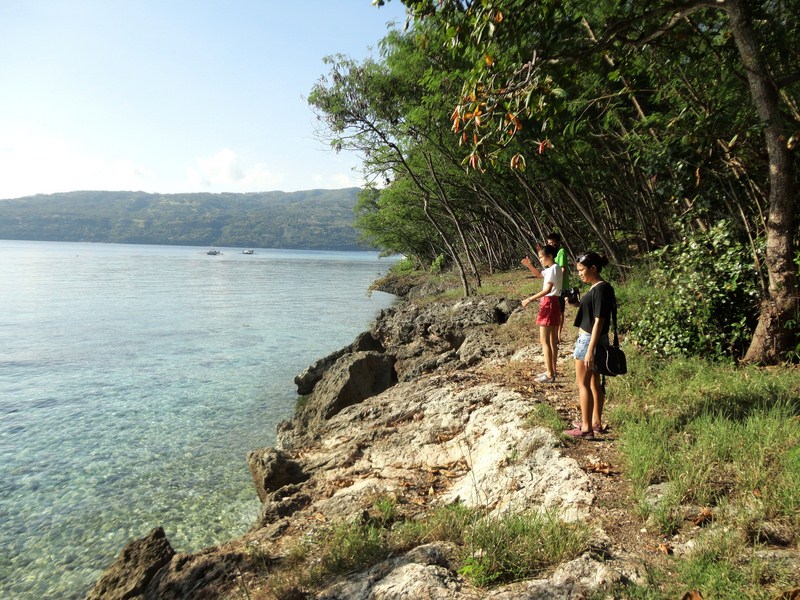
The nicely laid out hiking trail (open from 6 AM – 4 PM) started as we descended the steps down from the restaurant and traversed the cliffside pathway, strewn with coral rock, overlooking the natural lagoon where we could see a number of guests kayaking.  Soon enough, we entered the lush forest.  Along the trail are colored pennants tied to trees that indicate the difficulty of the trail – yellow for beginners, blue for moderate and red for advanced.

Hiking along the coral rock-strewn trail

Hiking along the coral rock-strewn trail

Soon we reached a fork in the trail.  The trail on the left traverses the northern point of the island where panoramic views of white sand beaches along the northwestern and eastern shores of the island can be seen.  The trail on the right cuts through the spine of the island and leads up to the island’s highest point, 28 m. above sea level, where a lighthouse and a Spanish-era baluarte (watchtower) is located.  We chose to explore this route.

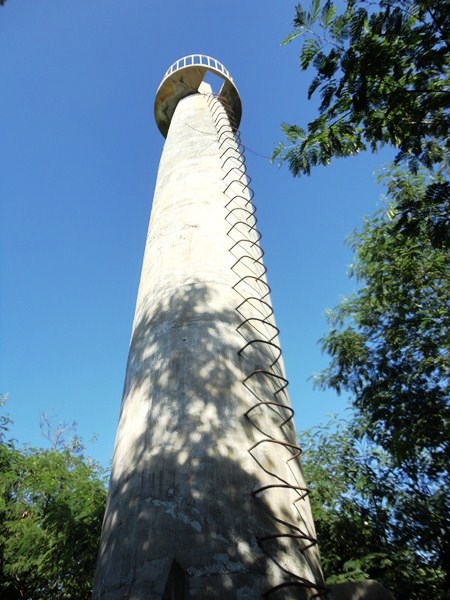
The concrete lighthouse

The concrete lighthouse

The concrete lighthouse on the top wasn’t much.  It didn’t have a hollow core with a spiral stairway leading to the top, a feature found in many lighthouses.  Instead, steel, U-shaped ladder rungs imbedded in the concrete exterior was used.

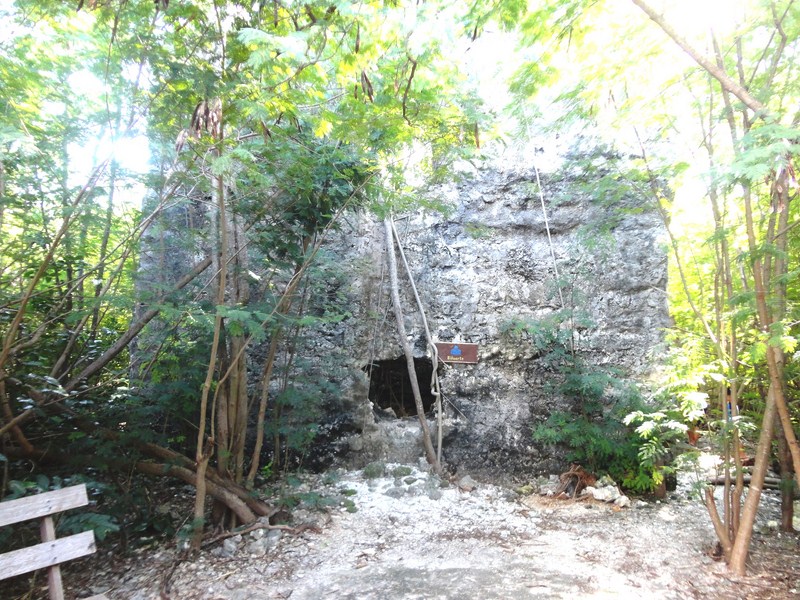
The Spanish-era baluarte (watchtower)

The Spanish-era baluarte (watchtower)

The quadrilateral, heavily overgrown but still relatively intact baluarte was more interesting.  It was part of a network of watchtower and fortlets, extending from Santander to Sibonga, built by Augustinian Fr. Julian Bermejo (pastor of Boljo-on from 1804-1836) to warn the townspeople of the approach of pirates.  Lara and Joy entered the watchtower through a small, square hole in one of its sides.

The marine sanctuary

The marine sanctuary

The abandoned marine station of Silliman University

The abandoned marine station of Silliman University

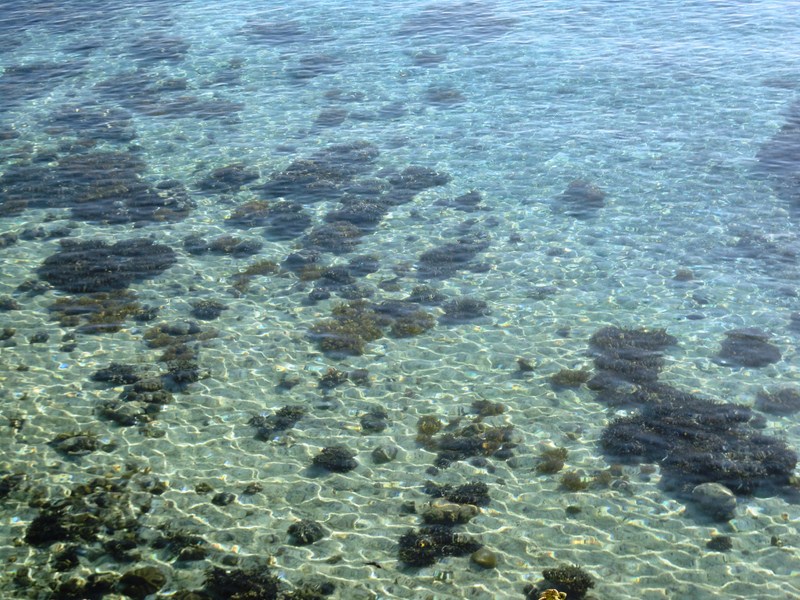
From this vantage point, we now made our way down the trail to the pristine blue waters of the western side of the island where part of Sumilon Island Marine Park is located.  Situated off Cebu’s southeastern coast, 5.5 kms. east northeast of Tanon Point, this marine sanctuary was formerly administered by Siliman University in Dumaguete City (Negros Oriental) as evidenced by a now abandoned hut of the marine station along this part of the trail.  Today, the sanctuary is managed by the resort.  Motorized water sports such as jetskiing and water skiing are not allowed to ensure that the sanctuary is not disturbed.

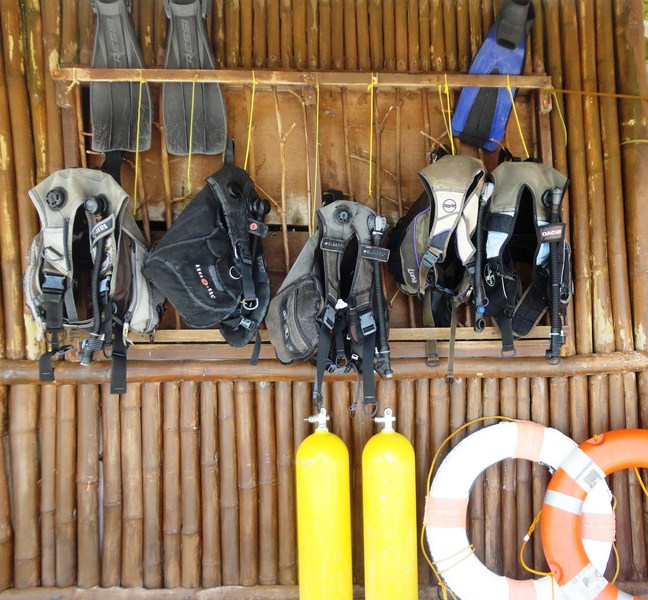
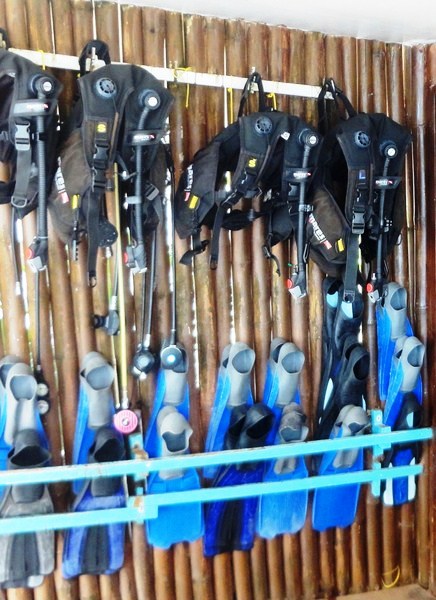
Aquamania Dive Shop

Aquamania Dive Shop

Equipment at Aquamania Dive Shop

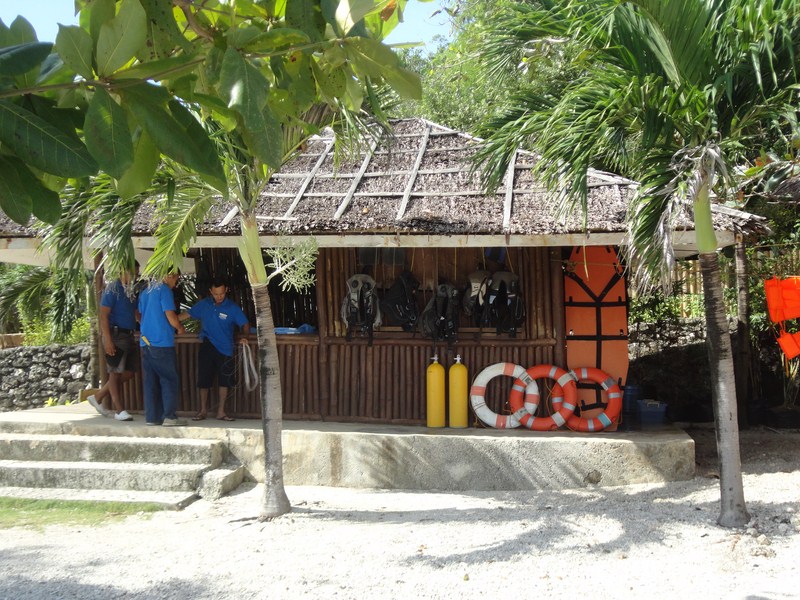
However, fine snorkeling, over coral gardens, can be done along the western, northern and eastern sides of the island.  For scuba divers, it offers waters two to 5 m. deep and 200 m. wide and a drop-off about 100 m. off the southwest coast with spectacular underwater life including the big garoupa.  Large schools of jacks, manta rays, sharks, barracudas, sea snakes, turtles and even an occasional whale shark can be seen off the northern and southern tip.  Dive sites here include Coral Landscape, Garden Eel Plaza, Julie’s Rock and Nikki’s Wall.  Diving season is all year round.  Visibility reaches 30 m. and average depth is 20 m. with a maximum of 35 m..  Waters here are usually calm with strong currents to sometimes very rough, fierce and physically demanding currents.  The resort has a dive shop (Aquamania) with certified dive instructors and extensive diving facilities.

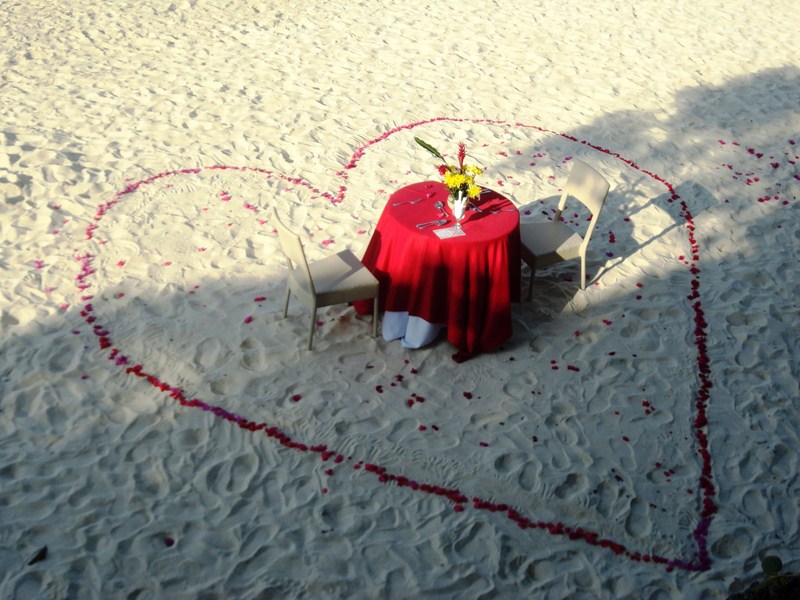
Flower-bedecked table set-up for two at the sandbar

Flower-bedecked table set-up for two at the sandbar

A marriage proposal etched on the sand

A marriage proposal etched on the sand

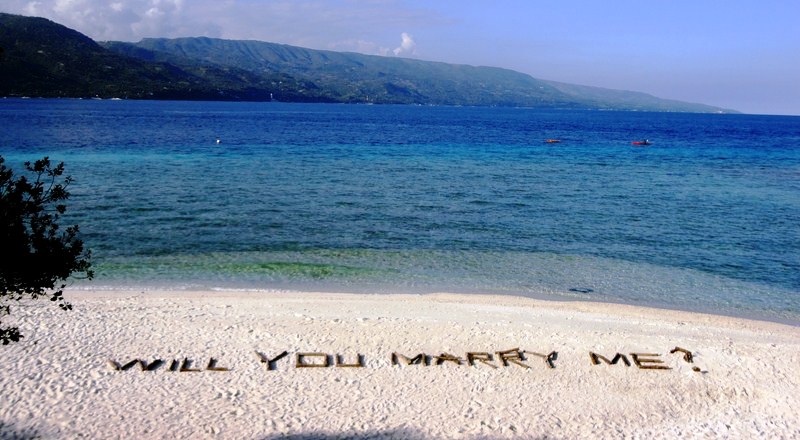
Further down the trail, we soon reached the island’s white sandbar, the only part of the island that is open to the public.  It shifts and changes its shape with the tides and the current.  Here, we can swim, snorkel or sunbathe.  It was also the setting for last night’s al fresco dinner.  When we passed by, it was already set up for a marriage proposal, with a table for two, surrounded by flower petals shaped into a heart,  set up along the beach.    Nearby, along the sand, were the words “Will you marry me?” etched with pieces of tree branches.

Grotto of Our Lady of Fatima

Grotto of Our Lady of Fatima

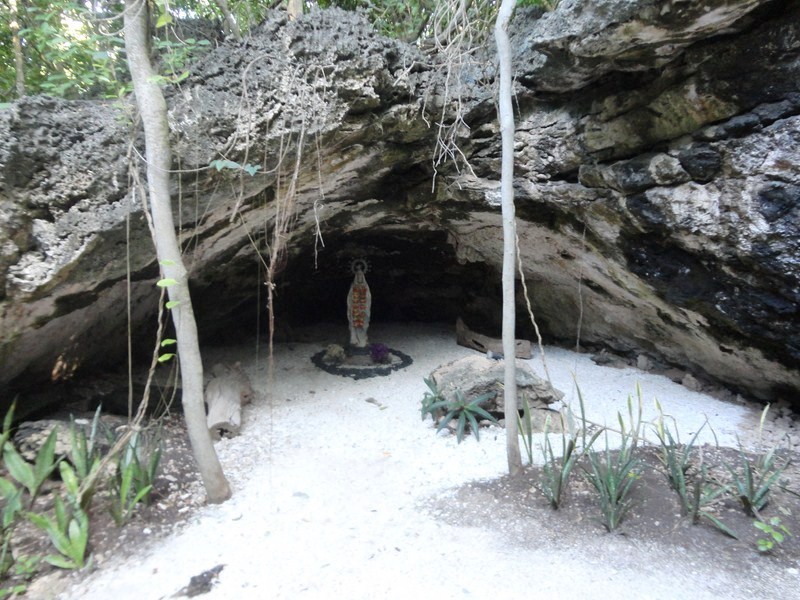
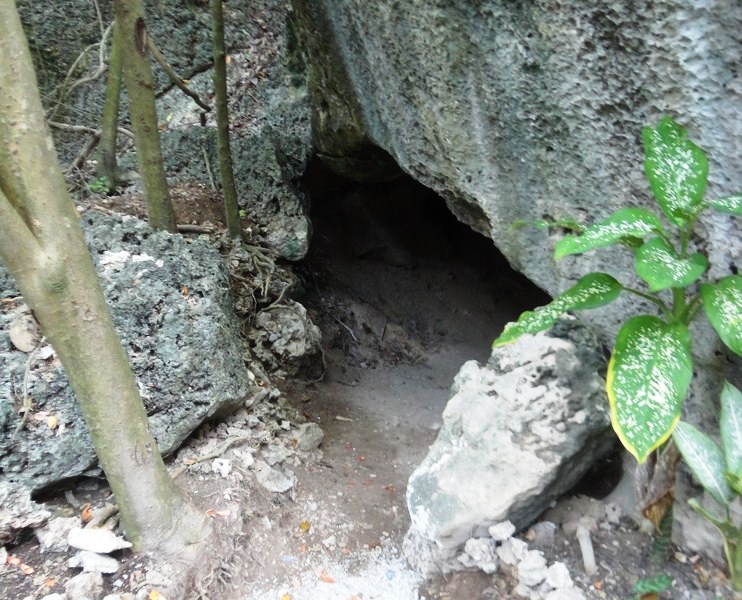
On our way back to our cottages, we passed by a grotto with a statue of Our Lady of Fatima and, just past it, the short and seemingly man-made Yamashita’s Cave.  We entered the latter and were surprised by a Halloween set-up, meant to scare visitors, at its very end.  We were totally drained and drenched with sweat by the time we returned to our rooms.

Entrance to Yamashita Cave

Entrance to Yamashita Cave

Sumilon Bluewater Island Resort: Brgy. Bancogon, Sumilon Island, Oslob, 6025 Cebu.  Tel: (032) 382-0008 and (032) 318-9098. Mobile numbers: (0917) 631-7514 and (0917) 631-7512.  Email: info.sumilon@bluewater.com.ph.
Cebu City booking office: CRM Bldg., Escario cor. Molave Sts., Lahug, 6000 Cebu City. Tel:  (032) 412-2436. Mobile numbers (0917) 631-7508 and (0998) 962-8263. E-mail: sales.sumilon@bluewater.co.ph.
Manila Office: Rm. 1120, Cityland/Herrera Towers, 98 Herrera cor. Valero St. Salcedo Village, Makati City. Tel: (632) 817-5751 and (632) 887-1348. Fax: (632) 893-5391.  E-mail: sumilon@bluewater.com.ph. Website: www.bluewatersumilon.com.ph.
Oslob Town Proper (Cebu)

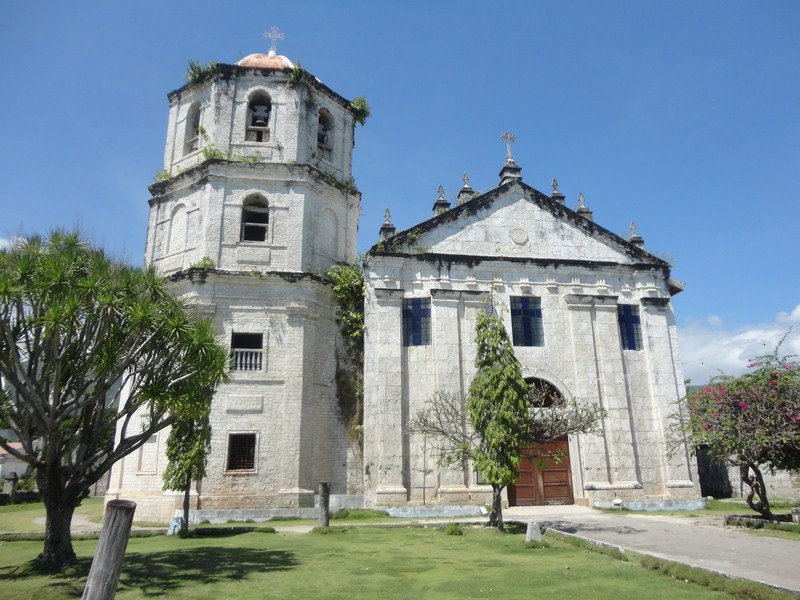
From Tumalog Falls, we again boarded our airconditioned van for the short trip to the town proper of Oslob.  Within its Municipal Heritage Park are a number of Spanish-era structures and at the center of it all is the town’s massive Church of Our Lady of the Immaculate Conception (Nuestra Señora de la Inmaculada Conception).

Church of Our Lady of the Immaculate Conception

Church of Our Lady of the Immaculate Conception

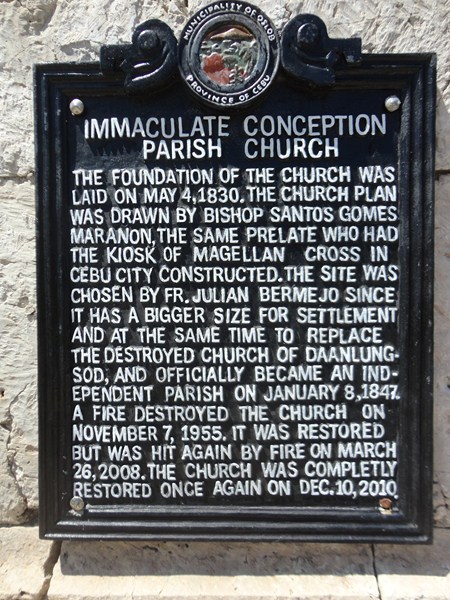
The church was designed by Bishop Santos Gomez de Marañon (the same prelate who built the kiosk of Magellan’s Cross in Cebu City) to replace the destroyed church at Daanglungsod (Boloc-Boloc).  It cornerstone was laid by Fr. Julian Bermejo on May 4, 1830. Townspeople from neighboring Tañon (now Santander) and Ivisan (now Nueva Caceres, Oslob) helped in its construction. The church was finished in 18 years and blessed by Bishop Romualdo Ximeno in 1847.

The church's historical plaque

The church’s historical plaque

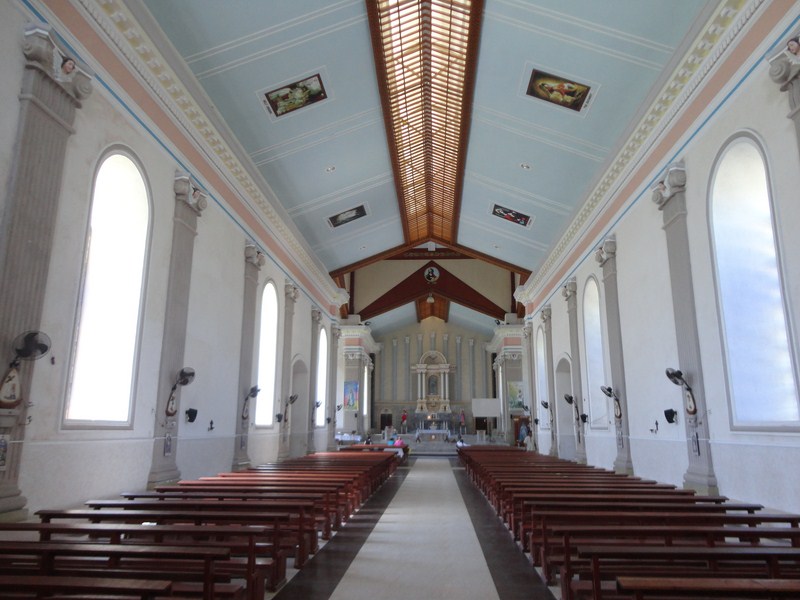
The church's modern interior

The church’s modern interior

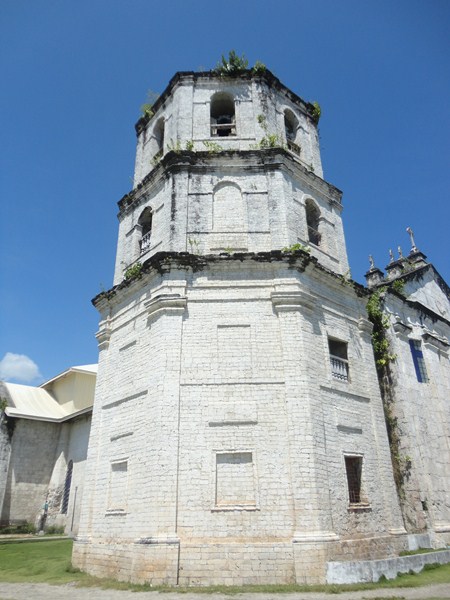
The bell tower on the church’s left was built by Fr. Apolinar Alvarez in 1858 and Fr. Gregorio de Santiago Vela installed 11 bells at the fifth storey in 1894.  The bells were transferred to the fourth storey when the fifth was destroyed during a strong typhoon.  The bell tower was later repaired by Fr. Mauricio Alvarez (who also built the cemetery, municipal tribunal and the municipal church and made known the medicinal uses of the sulfuric waters of Mainit springs).

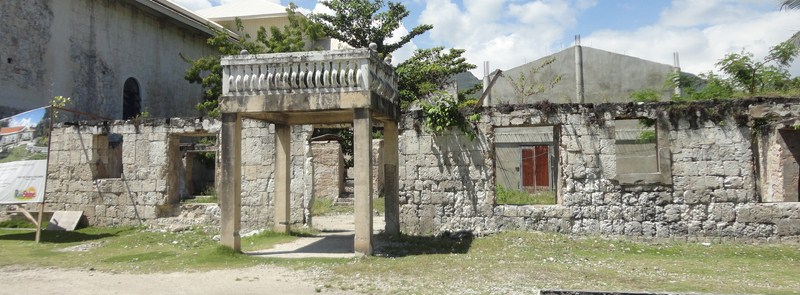
The still unrestored, roofless convent

The still unrestored, roofless convent

The convent on the right was started by Fr. Julian Bermejo. The church was finished and reinforced with solid buttresses from 1848 to 1850 by Fr. Juan Jose Aragones, Oslob’s first parish priest (1848–1854 and 1859–1861) and later Bishop of Nueva Segovia.  It was renovated by Fr. Constantino Batoctoy in 1977. The roof, made of tejas sourced out and baked locally at a place now known as Lulukhan, were replaced with corrugated iron sheets by Fr. Pablo Alaxa in 1932.  The church was totally burned by Cebuano guerillas in 1942 and, later on, the vault and dome fell.  In 1954, the wooden flooring of the church was replaced with baldoza tiles.

The now 4-storey bell tower

The now 4-storey bell tower

Fire of unknown origin gutted the complex on November 7, 1955 leaving only the masonry walls of both buildings.  It was restored, with the cooperation of the townspeople, by Fr. Benedicto Zapra and completed in 1980 by Fr. Constantino Batoctoy in time for the sesquicentennial celebration of the original church’s construction (1830 to 1980).  A 2.5-hour (1:40-4 AM) fire again hit the church and adjacent convent on March 26, 2008 but spared the icon of Our Lady of Immaculate Conception, which is inside a glass case, and the 73 other icons near the door to the bell tower.  The church was complete restored on December 10, 2010.

The church gate

The church gate

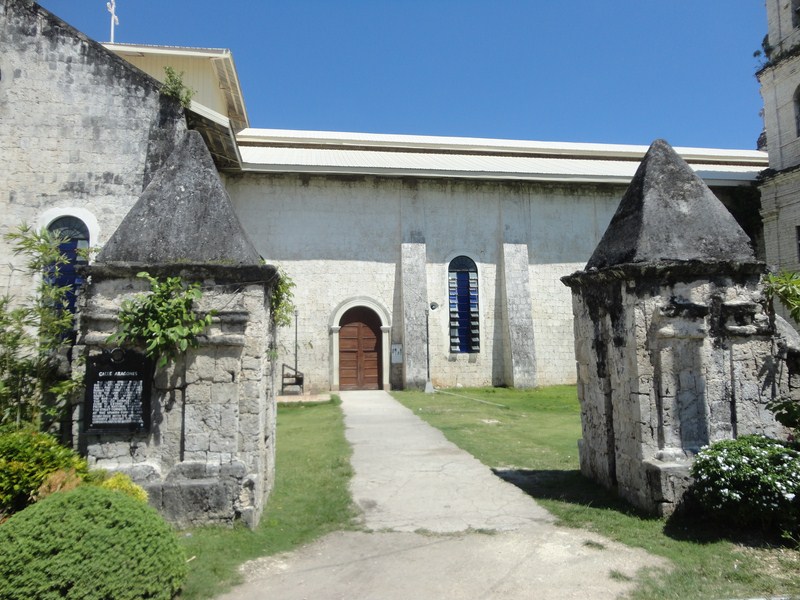
The church is 64 m. long, 15 m. wide, 9 m. high and has a simple, sober but attractive facade with a semicircular arched main entrance, rectangular widows, half-embedded pilasters and a triangular pediment.  The 4-storey, 30 m. high and octagonal bell tower has rectangular and semicircular arched windows alternating with blind ones. The dome is typically Neo-Classic.

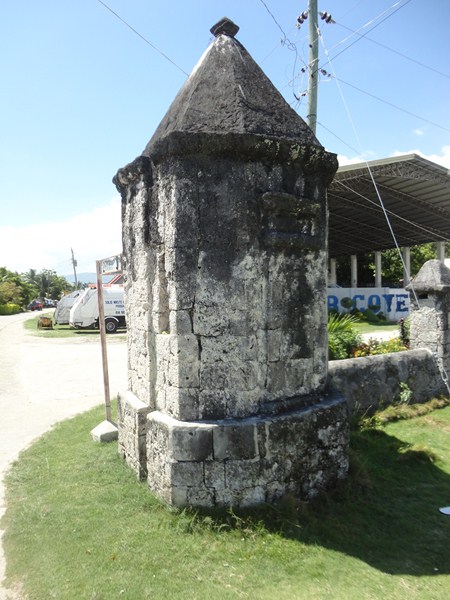
A garita (guardhouse)

A garita (guardhouse)

In front of the church is a prayer room, also known as a waiting chapel, built in 1847.  It was used as an isolation chamber for leprosy-afflicted patients. It has a pediment decorated with a relief of a human skeleton.

Calle de Aragones

Calle de Aragones

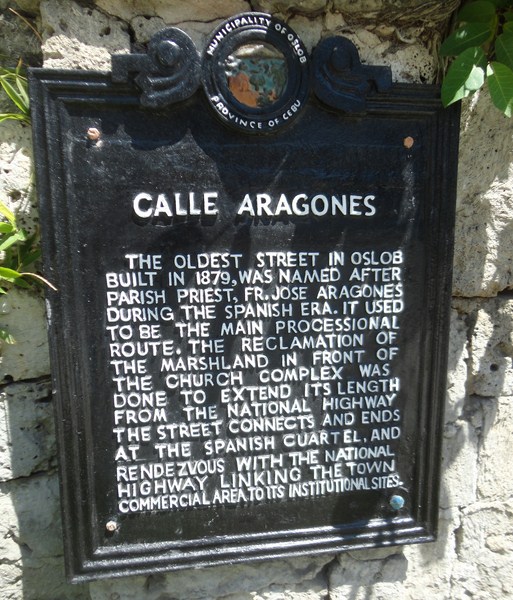
Calle de Aragones historical plaque

Calle de Aragones historical plaque

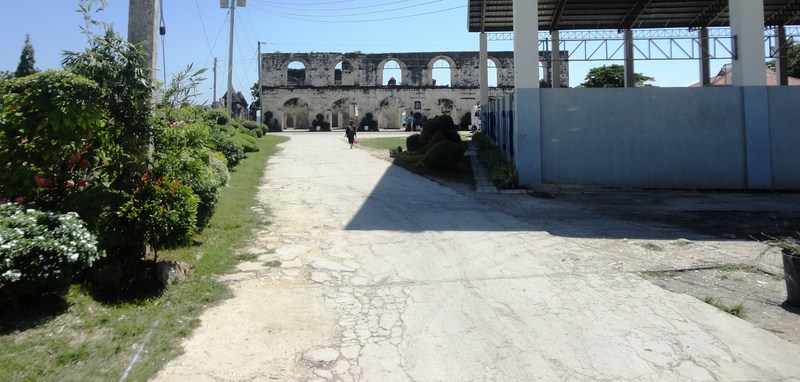
On the left side of the church is Calle de Aragones, the town’s oldest street, built in 1879.  It was named after Fr. Juan Jose Aragones.  At the end of the street, at the intersection of Calle Aeternidad, is the unique, unfinished cuartel.

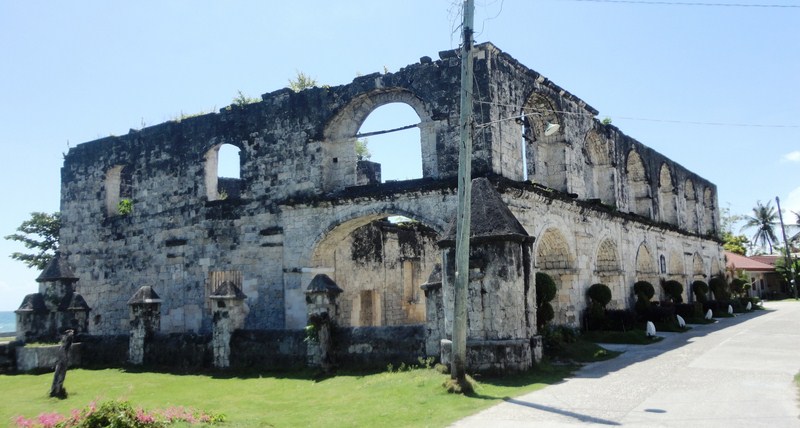
The unfinished coral stone cuartel

The unfinished coral stone cuartel

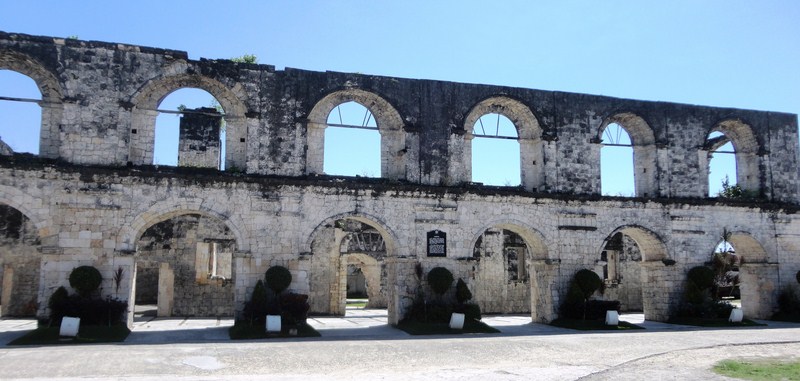
The cuartel's double row of arches

The cuartel’s double row of arches

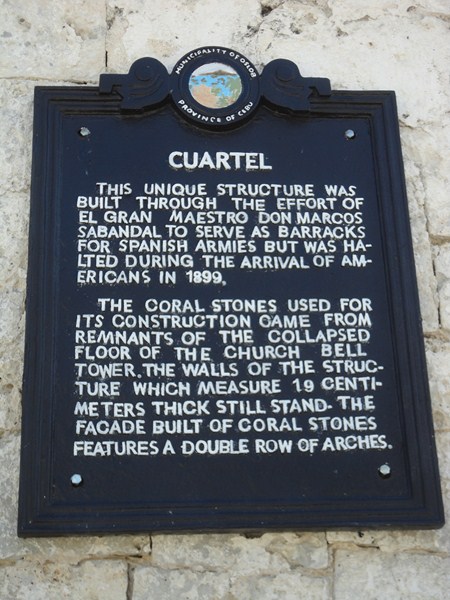
The construction of this barracks for the Guardia Civil was started by el gran maestro Don Marcos Sabandal but was halted with the arrival of the Americans in 1899.  The coral stones used in its construction of its 19 cm. thick walls came from the remnants of the floor of the collapsed church bell tower.  Its façade features a double row of arches.

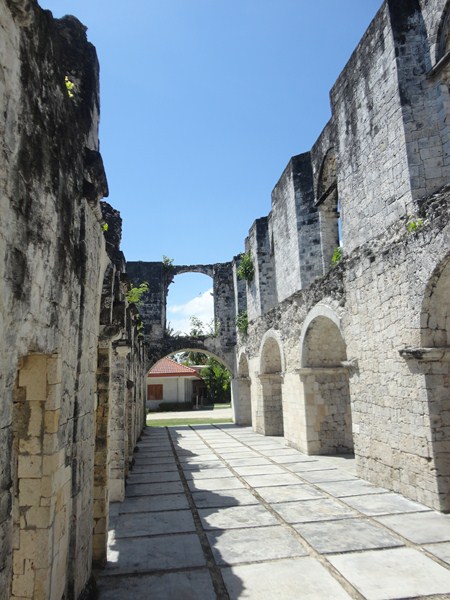
The interior of the cuartel

The interior of the cuartel

Historical plaque of cuartel

Historical plaque of cuartel

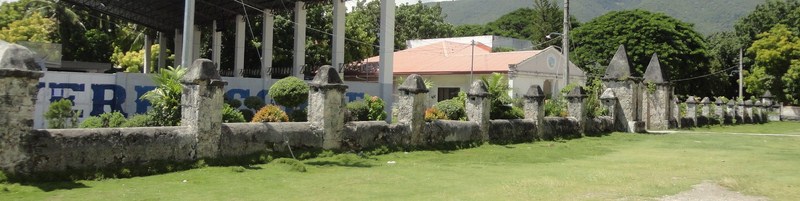
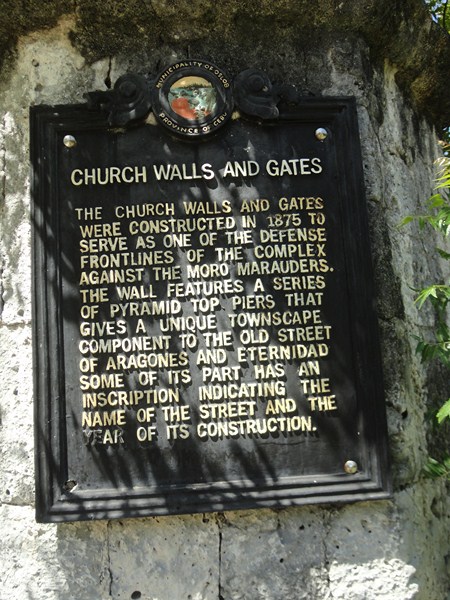
The thick coral stone walls and gates surrounding the church complex, called paril, are topped by a series of inverted, cone-shaped stones.  They were built in 1875 as a defense against raiding Muslim pirates.

The church walls and gates

The church walls and gates

Historical plaque of church walls and gates

Historical plaque of church walls and gates

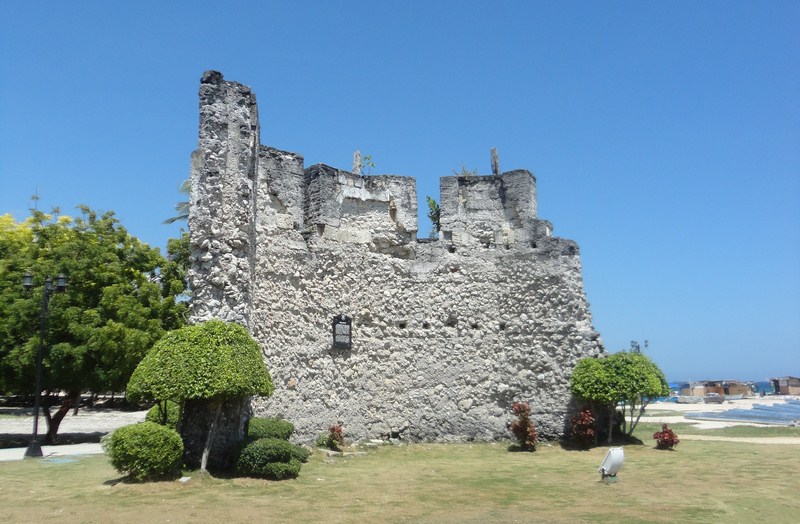
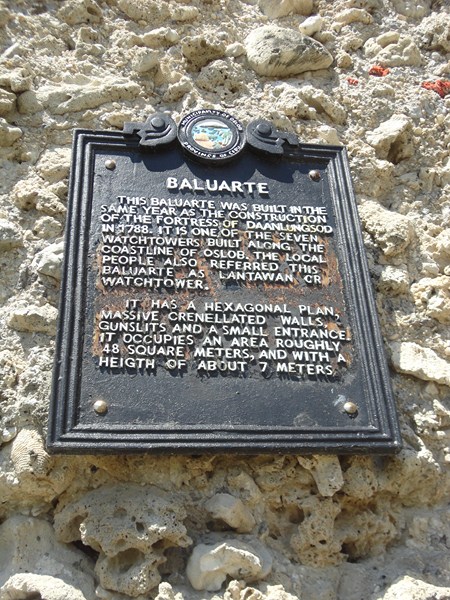
Along Calle Eternidad, parallel to the coast, is a baluarte (a watchtower locally called lantawan), one of 7 built by the warrior-priest Fr. Julian Bermejo, parish priest of Boljo-on.  Hexagonal in plan and occupying an area of 48 sq. m., it has massive 7 m. high crenellated walls.  Only about a half of the watchtower remains. In 1813, this baluarte, as well as the other watchtowers, helped Fr. Bermejo and the townspeople of Oslob repel Moro slave raiders led by Sultan Goranding during a naval battle near the waters off Sumilon Island. Sultan Goranding was captured during the battle.

Baluarte (watchtower)

Baluarte (watchtower)

Historical plaque of baluarte

Historical plaque of baluarte

How to Get There: Oslob is located 117 kms. (a 3-hr. drive) south of Cebu City.

Tumalog Falls (Oslob, Cebu)

After our butanding (whale shark) interaction at Brgy. Tan-awan, we boarded our airconditioned van for the short 10-min. drive to Tumalog Falls, another great attraction of Oslob.   A visit here is usually combined with your swim with the butanding. The van can only bring us at the entrance since the paved road from there on is very steep.

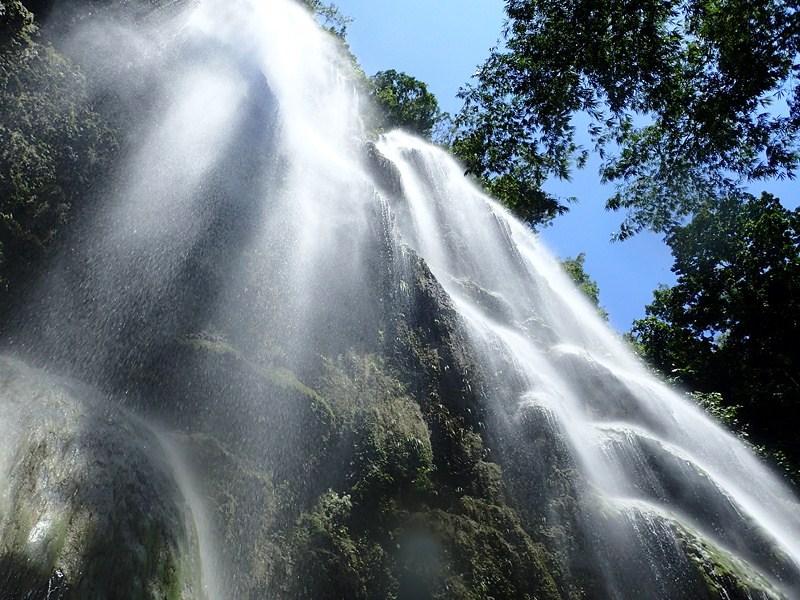
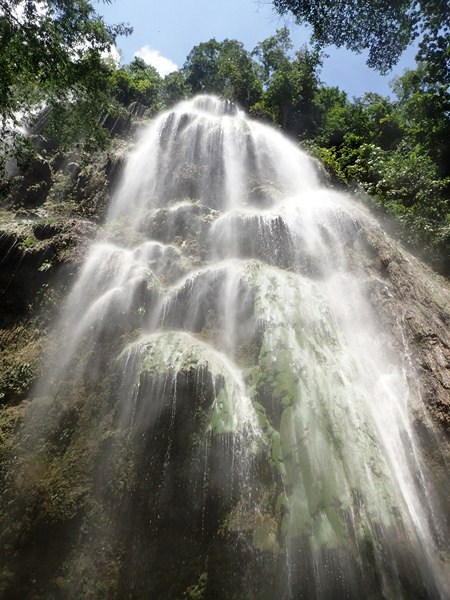
Tumalog Falls

Tumalog Falls (photo: Liana Smith-Bautista)

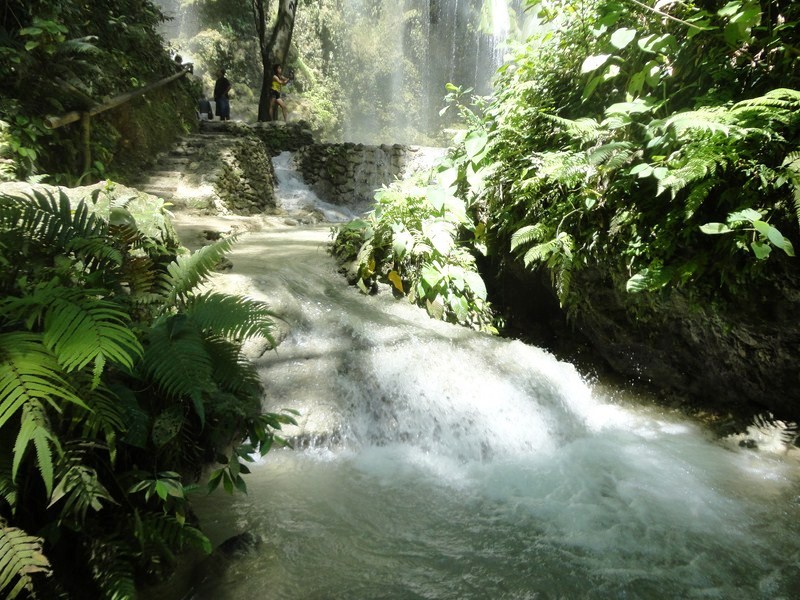
From hereon, we could either make a 15-min. hike (a good hike and a warm up for your body) or go via a habal-habal, the local term for riding a motorcycle and ride at the back of the driver. We all chose the latter. The habal-habal ride along the rather steep, 50-degree inclined road going up the mountain is no joke and was an experience by itself.  Along the way, we could already behold the beauty of the postcard-pretty, imposing and multi-tiered falls hidden away in a forest.

OLYMPUS DIGITAL CAMERA

Photo: Liana Smith-Bautista

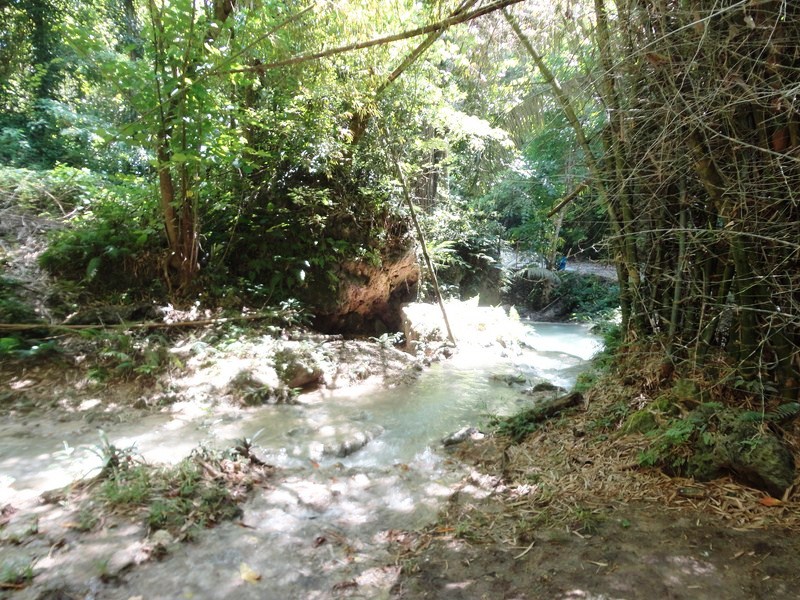
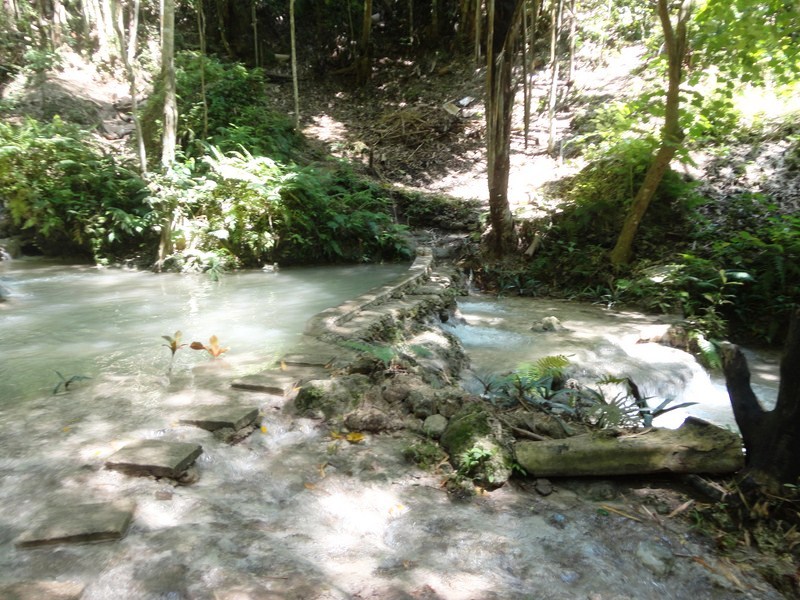
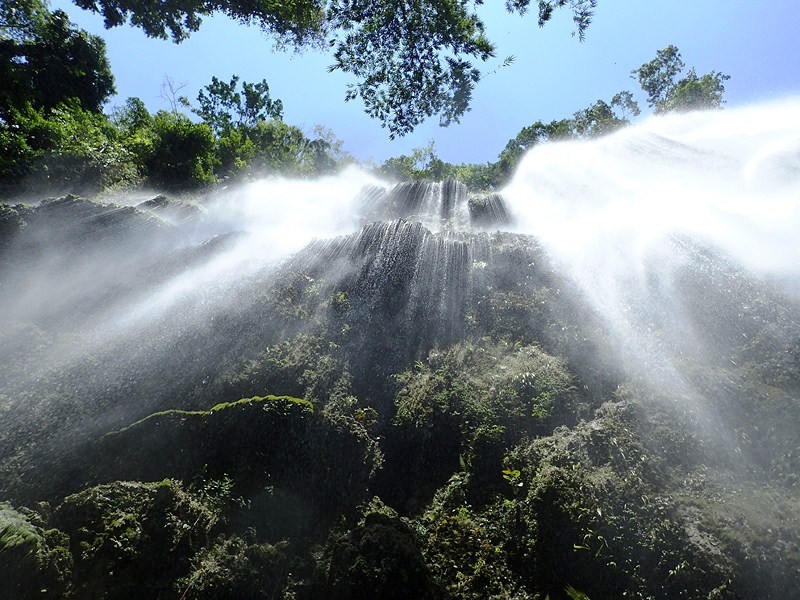
The falls was really awesome! For city people like us, a view like this was really a breathtaking experience. The beautiful mountainous scenery, with moss hanging off the mountainside and many fine areas of misty water spread out over a glistening green moss mat, was one of the most breathtaking nature scenery that I have ever seen, reminding me of Avatar movie forest scenes. The local government has installed concrete stepping stones, making it easier and safer for us to walk around.

Tumalog Falls (3)

I got a cool feel from the mist of the falls and savored the soothing and very calming sound of falling water as I tried to enter its waters to wash away the sea salt after swimming the ocean during my previous butanding interaction.  Bbbbrrrr, it’s really damn cold! However, I soon got used to the cold.

OLYMPUS DIGITAL CAMERA

The falls has a unique appearance very distinct from all the other waterfalls that I have seen. As the drizzle from the falls touched my face, the stress from my head, shoulders down to the tip of my fingers, all tired from arduous swimming and flipping at the butanding interaction, were all washed away. You cannot really swim here since the falls is not that deep, around 3.5 to 4 ft. (a nice and safe swim for kids), but the sight is exhilarating and refreshing.

Tumalog Falls (4)

The bracingly cold water was clean and the pools they flowed into were clean as well. People around us all seemed to be enjoying. There were families having picnics at some nearby open wooden huts; others were busy taking candid and dramatic photos at the fall’s nooks and crannies, all green with moss and wild growth; while others just bathe. There’s even a small pool, where the water from the falls overflows, where you can a fish spa experience, dipping your feet and letting small fish eat your dead skin off. Definitely a good place to chill and relax.

Tumalog Falls (8)

Despite the many tourists that visit it, it was still a very well maintained area. For those who get local “guides,” they are experts at suggesting the best areas to take pictures. Aside from the very beautiful falls and the magnificent rock formations, there are also wonderful bamboo trees around, all perfect for photos. I even saw a slightly visible rainbow created by the lovely rays of sunlight hitting directly through the falling waters. I was only able to take shots of the falls from a distance but, luckily for me, Liana brought along her waterproof camera. After the heart pounding whale shark encounter in Oslob, seeing and savoring Tumalog Falls brought my blood pressure back to its normal level. I could have stayed there for the whole day.

OLYMPUS DIGITAL CAMERA

Photo: Liana Smith-Bautista

Such a breathtaking natural sight makes you realize that, yes, there is a God. It also felt mystical (I was half expecting fairies to show up). Truly, nature knows how to show off.  This has been one of the most surreal places I have ever been! Despite the booming tourism of Cebu, this place has been not touched by too much commercialism and this natural treasure needs to be kept in its natural form to retain the pristine beauty for all generations to see and experience.

OLYMPUS DIGITAL CAMERA

Photo: Liana Smith-Bautista

The falls does not have a closing time but it does not have lighting at night. Food is not available in the falls area so bring your own. There are no tables, no lockers, some benches, no vendors, no food stalls, no changing rooms and no lounge area. A rudimentary gender specific bathroom is available. Be careful in slippery parts and protect your camera gear since the falls exudes droplets of water. For those making a return hike, the store at the entrance, near the parking lot, offers refreshments such as young coconut, banana cue and soft drinks.

OLYMPUS DIGITAL CAMERA

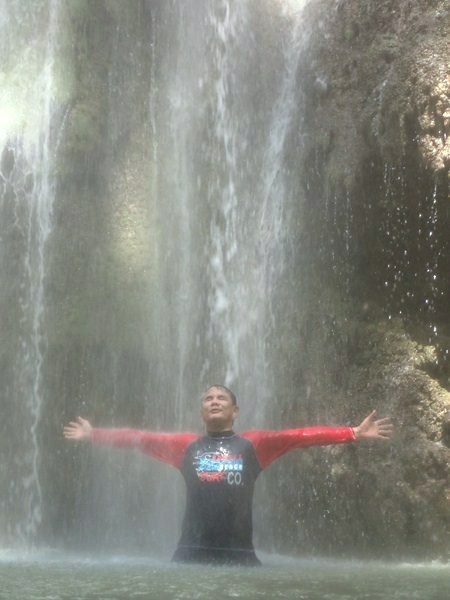
Doing a U.P. Oblation pose (photo: Liana Smith-Bautista)

Tumalog Falls: Brgy. Tumalog, Oslob, 6025 Cebu. Admission: PhP20.  

Habal-habal at the entrance

Habal-habal at the entrance

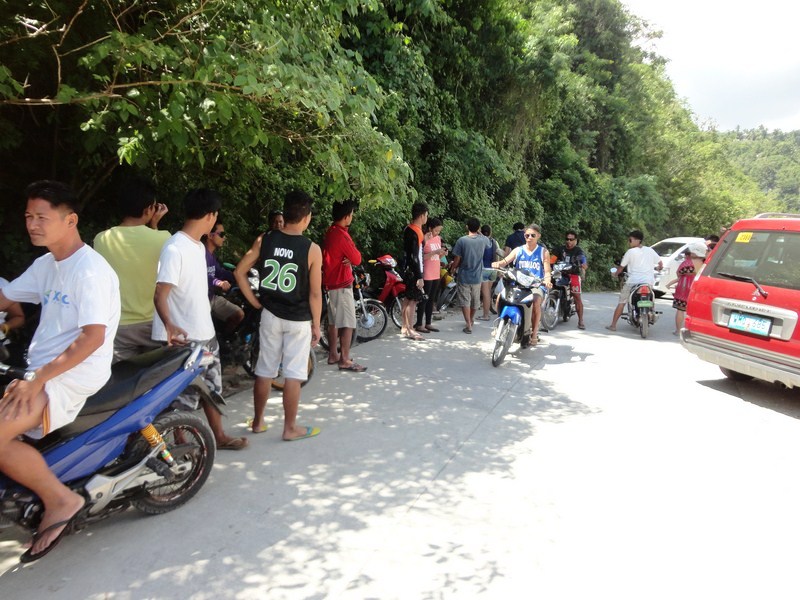
How to Get There: From the Oslob whale watching station in Brgy. Tan-awan, you can hire a habal habal (140/pax) or a multi cab (600 for 5 pax), both round trip, to get to the entrance. They are parked and available at the entrance of the whale shark center, near the main road. From the highway, it is a 5-min. habal-habal ride to entrance. The habal-habal ride to the falls costs PhP30 (one-way) and PhP50 (round trip).

Whale Shark Interaction (Oslob, Cebu)

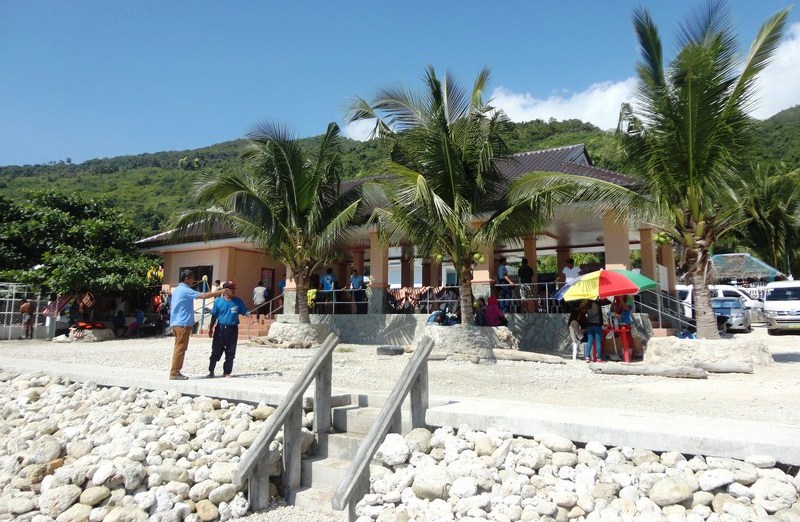
After an early breakfast at Sumilon Bluewater Island Resort, we were in for whole morning of resort-sponsored tours over at Oslob – whale shark (butanding) interaction, Tumalog Falls and the Municipal Heritage Park.  At the resort wharf, we again boarded the Jeffrey (the same boat that brought us in) that would take us to Brgy. Tan-awan in the mainland ((10 kms. away from the center of the town), where whale sharks converge.  The boat trip took just 10 mins. and, near the shore, we transferred to a small outrigger boat that brought us to shore.

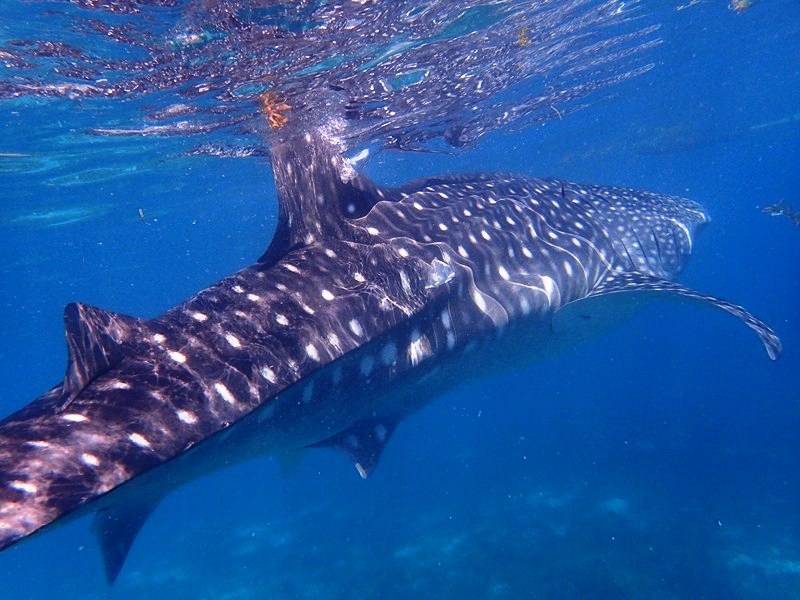
The gentle but majestic whale shark (photo: Liana Smith-Bautista)

The gentle but majestic whale shark (photo: Liana Smith-Bautista)

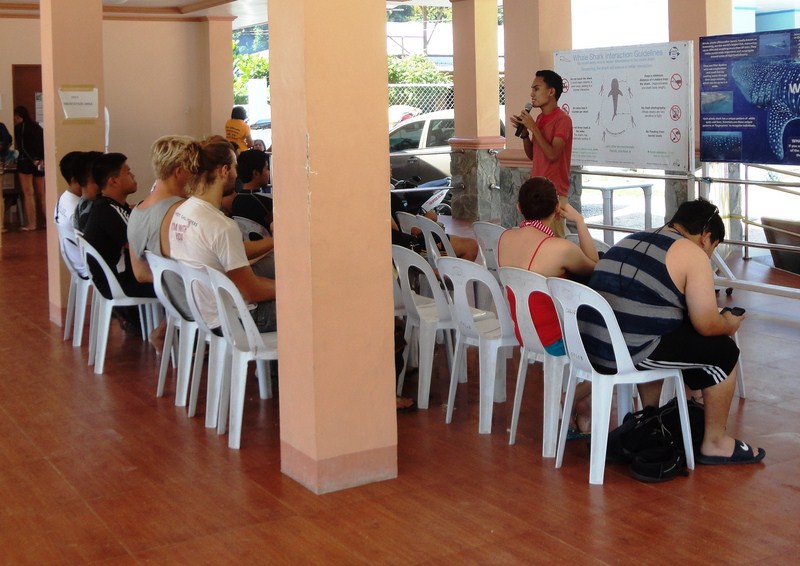
Before we could start our butanding interaction, we first had to go first to the briefing area where we registered ourselves and attended a short but straightforward 15-min. orientation on the do’s and dont’s. You can swim with the whale sharks but should be 4 m. away from it and not ride them (there is a fine of PhP2,000 or you can go to jail) and for those who would like to swim with it, they should wash off their sun block lotion as these have chemicals are harmful to the whale sharks. If you worry about getting burned in the sun while doing the activity, better wear rashguard. Pictures can be taken underwater by one of the divers assisting the activity but no flash photography is allowed as whale sharks are sensitive to light.

The briefing area

The briefing area

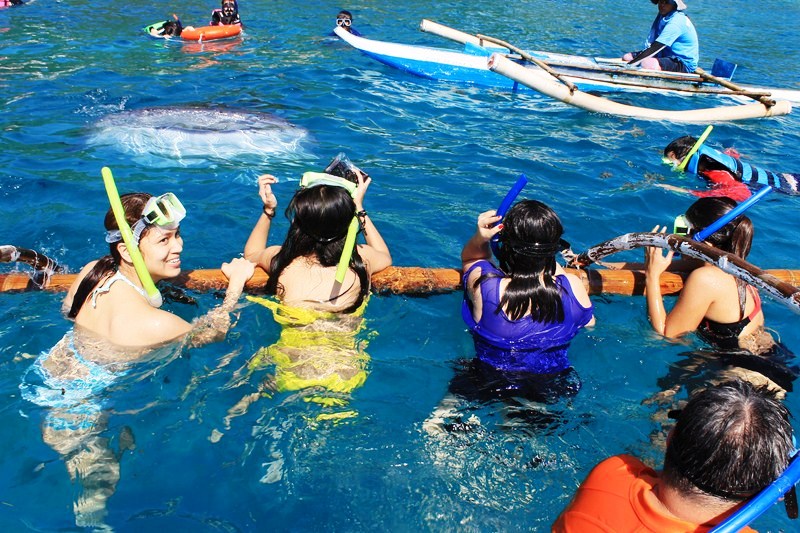
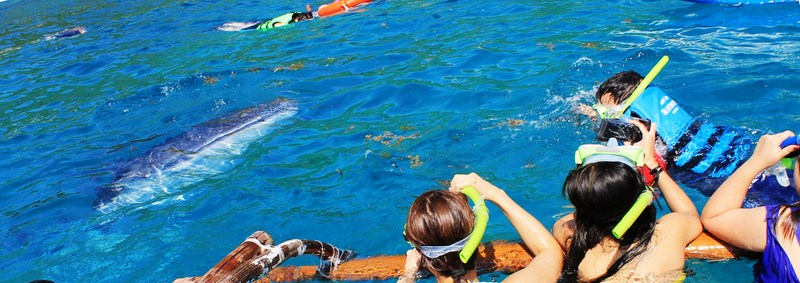
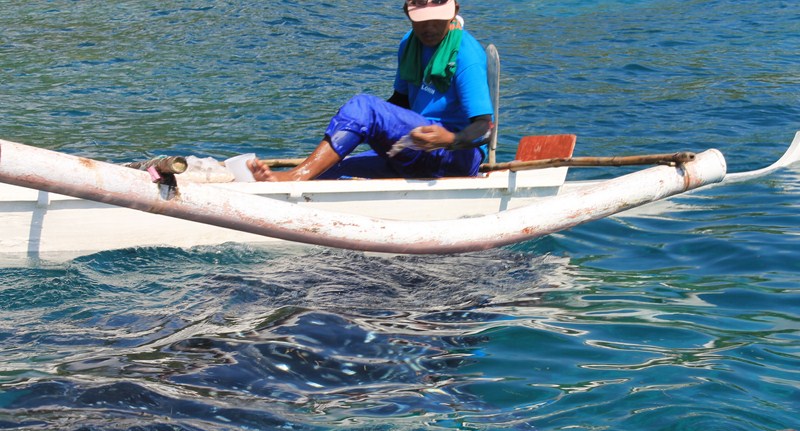
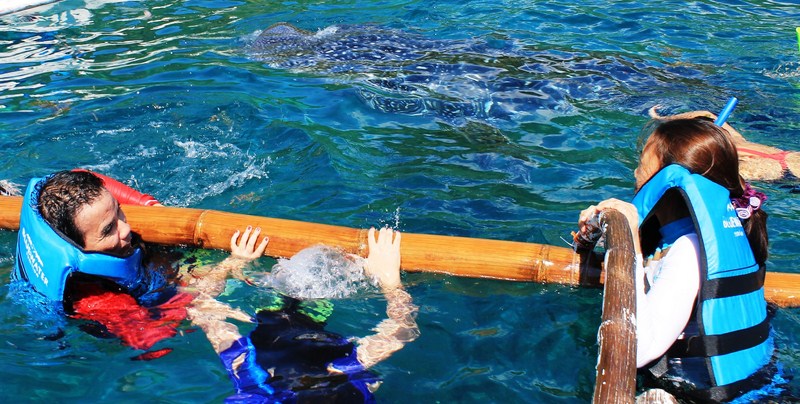
After this short briefing, we all returned to our boat and, just about 200 m. from the shore, the butandings were already visible.  We all donned our snorkel and masks and jumped into the water. Most of the time, the whale sharks just hang around in the water, tilting upwards at 45 degrees, with their mouths wide open as men on boats throw krill down their throats.

Our short orientation

Our short orientation

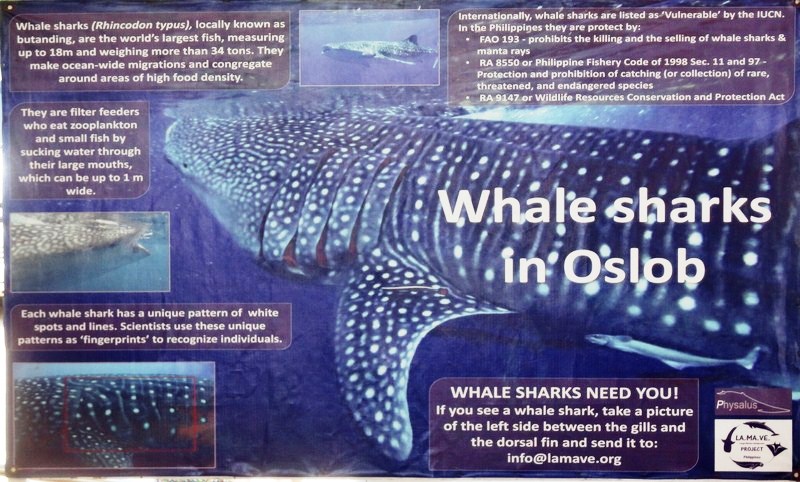
Facts about the whale shark

Facts about the whale shark

It was a bit scary at first, considering how big they were and how close they were to us, but we had nothing to fear.  A number of butanding came near me and one actually brushed under me. Any fear is eventually replaced with amazement after seeing how gentle these majestic creatures were.

The whole gang with a whale shark

The whole gang with a whale shark (photo: Ma. Joy C. Felizardo)

It was an unforgettable experience and words are not enough to describe how wonderful (and frightening for some) it is. The exhilarating and unique experience of having one of these truly amazing, gentle juvenile giants not only swim close by, but actually brush past me is one I’ll take with me to my grave.

The author's (upper right) close encounter with a whale shark (photo: Ma. Joy C. Felizardo)

The author’s (upper right) close encounter with a whale shark (photo: Ma. Joy C. Felizardo)

Oslobanons are happy and grateful to the whale sharks as they have given them an unexpected and better income. However, the idea of feeding the whale sharks on a daily basis can be disruptive for the sharks’ nature of searching for their food. Added to that, as too many people are around at any given time, you also have to be constantly on your guard as you have to dodge boats that can run over you. Their guidelines are also good in theory and are monitored by a marine biologist but they are almost impossible to police. The 4 m. required distance between man and shark is also impossible to keep as there are so many swimmers and sharks. For me, the jury is out on whether this is sustainable.

Fisherman feeding a whale shark

Fisherman feeding a whale shark

Oslob Whale Shark Watching: Brgy. Tan-awan, Oslob 6025, Cebu.  Mobile number (0925) 897-8687.  Open daily, 6:30 AM to 12 noon.

Rates: PhP500/30 mins. interaction (whale shark watching + snorkeling), PhP300 if you just want to stay in the boat (whale shark watching). An underwater camera can rent for PhP500 and the boatman can be your photographer as well. If you don’t have a memory card, they charge another PhP50 (the pictures were then transferred to our own memory card).

Sumilon Bluewater Island Resort (Oslob, Cebu)

Sumilon Bluewater Island Resort

Sumilon Bluewater Island Resort

I again got an invitation, from Mr. Pete Dacuycuy, to join a media familiarization tour of another Bluewater resort (the first one we visited was the Panglao Bluewater Resort in Bohol), this time to Sumilon Bluewater Island Resort.  Joining me was fellow Panglao visitor Ms. Ma. Joy Elaine C. Felizardo (www.gastronomybyjoy.com) and Ms. Lara Louise Gabrielle L. Antonio (Editorial assistant at Mabuhay Magazine) plus Mr. Jimbo Owen B. Gulle (Editor-in-chief of Powerplay Magazine); Ms. Ma. Katrina Camille Cabanos (ZALORA Philippines); Ms. Liana Kathleen Smith-Bautista (www.liveloveblog.com); and Ms. Risa Halaguena and Ms. Rachelle Elaine Mapa (Account Manager), both from Essential Philippines Magazine.

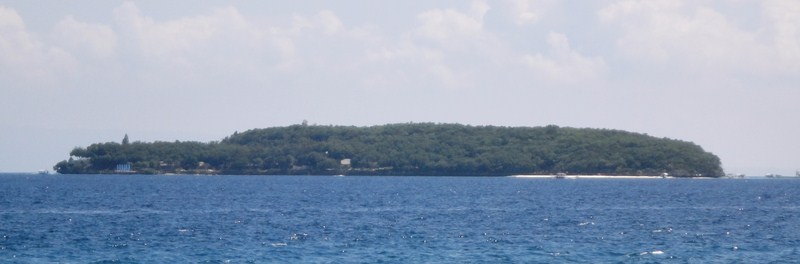
Sumilon Island

Sumilon Island

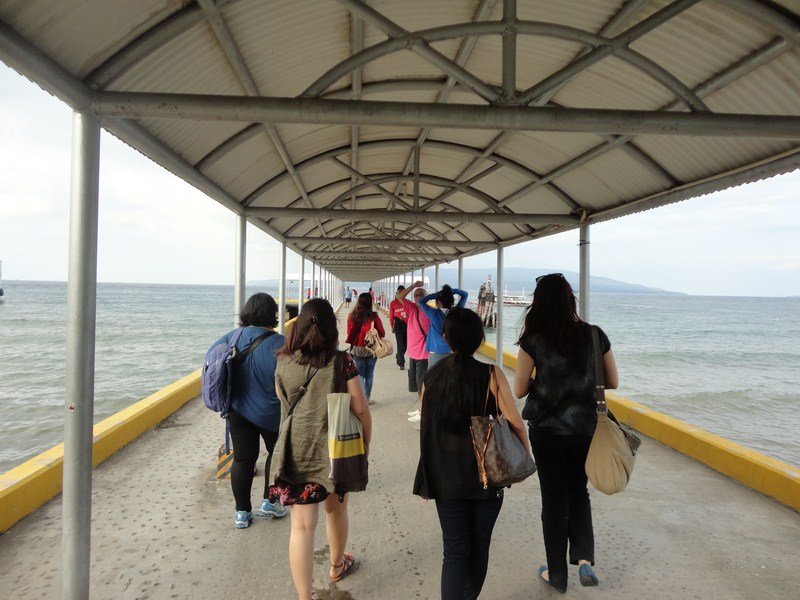
We all arrived at Sibulan Airport (Negros Oriental) by 3:30 PM via a PAL Express flight. Upon exiting the terminal, we were whisked, via two airconditioned vans, to Sibulan Port where a big 50-pax outrigger boat (Jeffrey) was waiting to bring us to the island.  Normally, to get to the island, visitors usually make a 20-min. land trip to Tampi port, then ride a fast craft going to Oslob on Cebu Island.

Sibulan Port

Sibulan Port

From Oslob (a 3-hour drive from Cebu City), they then make a 10-min. land trip to Bancogon Pavilion, where the private ferry port going to  Sumilon Bluewater Island is located. The free 2-way transfers between the the pavilion and Sumilon Island are scheduled at 1.5 hr. intervals with the first trip at 7 AM and the last at 4:30 PM. We were to forego this tedious land-sea transfer and, instead, directly get to the island via a 1-hr. boat trip.

Arrival at Sumilon Island Wharf

Arrival at Sumilon Island Wharf

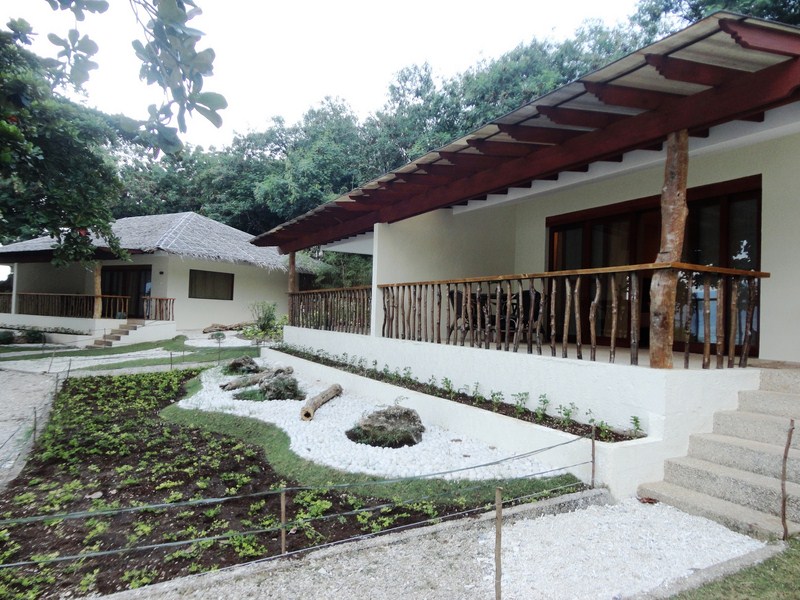
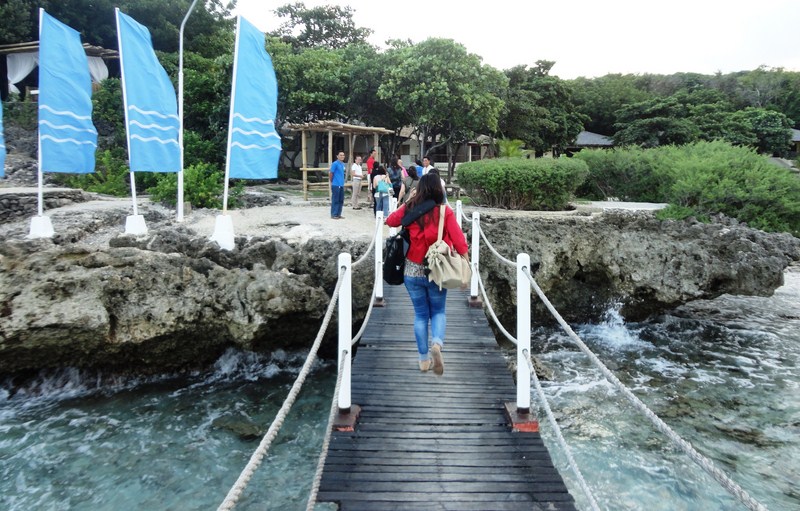
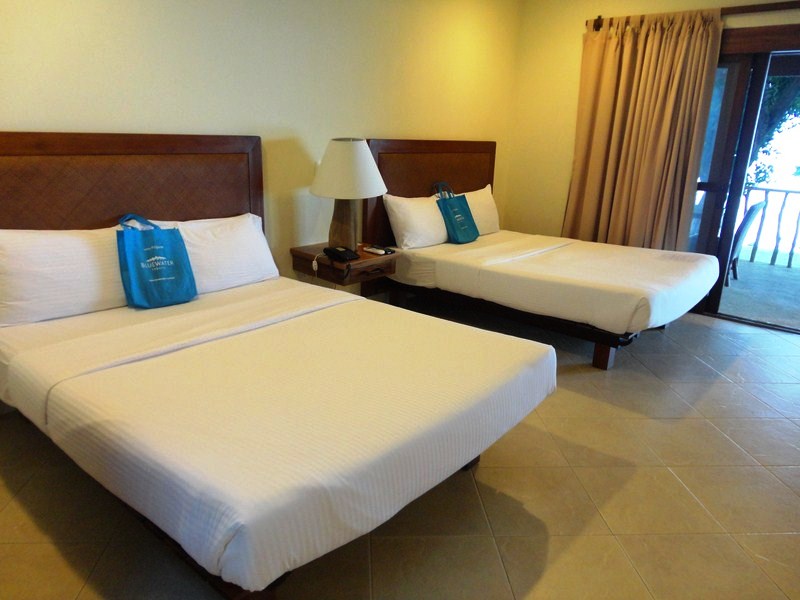
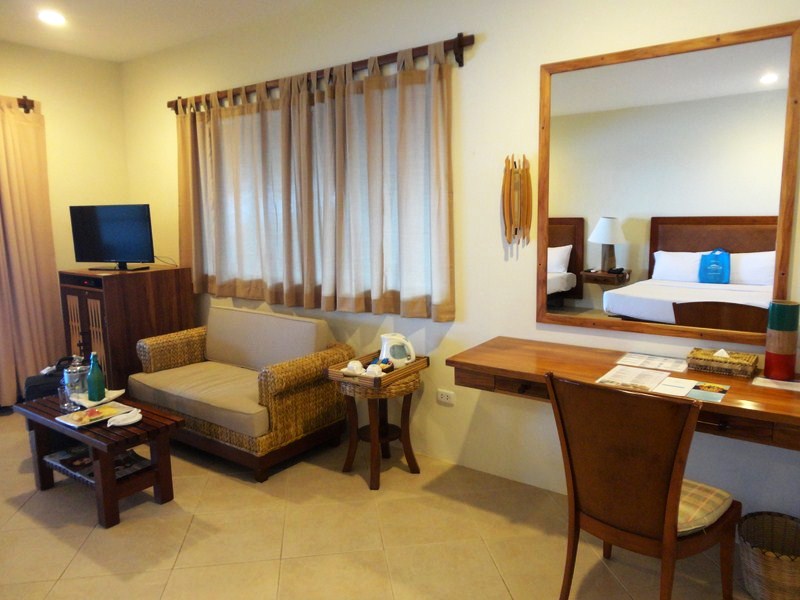
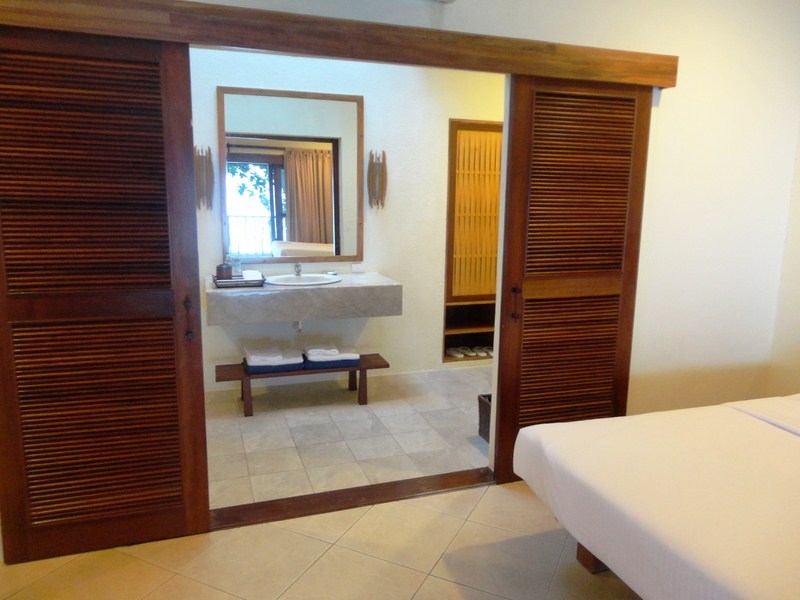
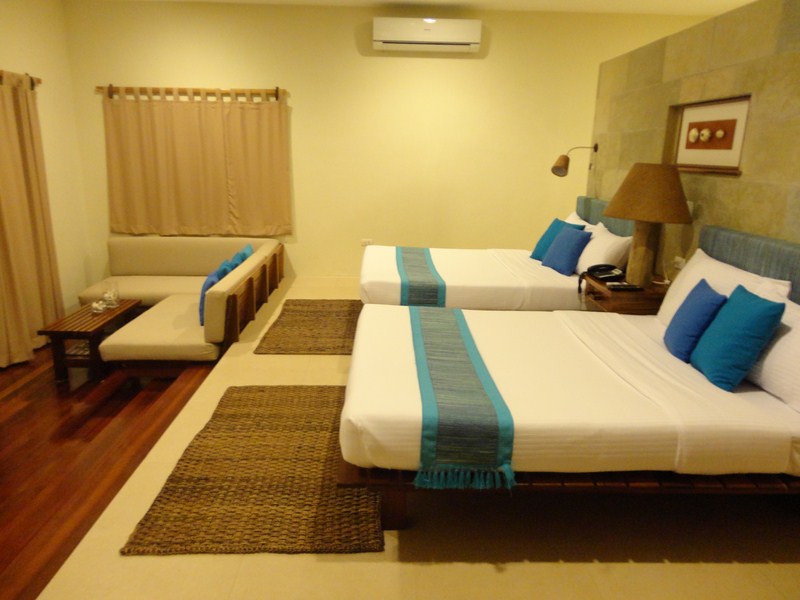
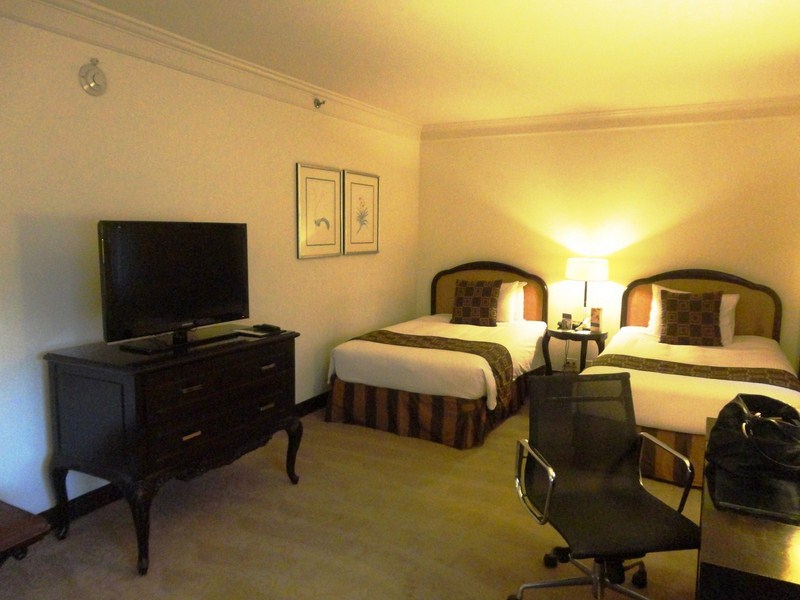
We arrived at the island by 4:50 PM and were assigned our respective de luxe rooms in duplex villas.  Jimbo and I stayed at the newly renovated Villa 14-A. Our spacious, tastefully and comfortably decorated airconditioned room had a high ceiling and impressive interiors with 2 very comfortable queen-size beds with many fluffy pillows, a big private bathroom with hot/cold shower and a skylighted ceiling, cable TV with DVD player, a work desk, coffee/tea making facility, sitting area, minibar and a private veranda with lounge chairs.  Glasses of the most refreshing lemongrass-calamansi iced tea and a platter of assorted fruits welcomed us inside our room.

Villa 14-A

Villa 14-A

Sitting area and writing desk

Sitting area and writing desk

Wooden sliding louver doors leading to the bathroom

Wooden sliding louver doors leading to the bathroom

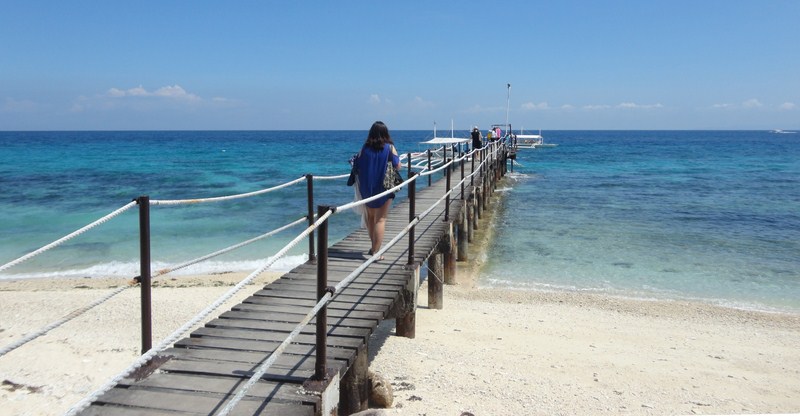
Wi-fi is available in our rooms and public areas (pavilion, the pools, some parts of the beach and the lounge areas along the coastline).  Lounge areas, with seats and hammocks, are located along the seaside and wooden stairs lead guests to a pocket beach. I’ve nothing but praises for the friendly, courteous and efficiently pro-active staff’s hospitality and their earnest desire to fulfill every request.
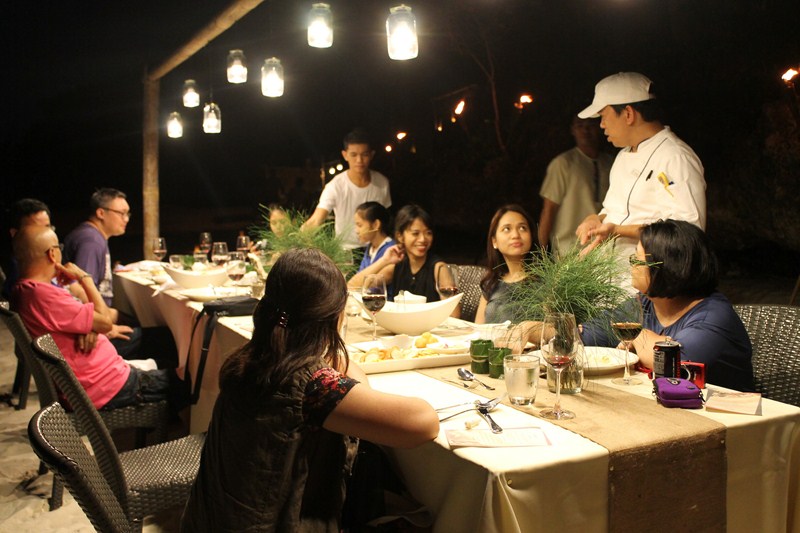
Al fresco dining at the sandbar

Al fresco dining at the sandbar (photo: Joy Elaine C. Felizardo)

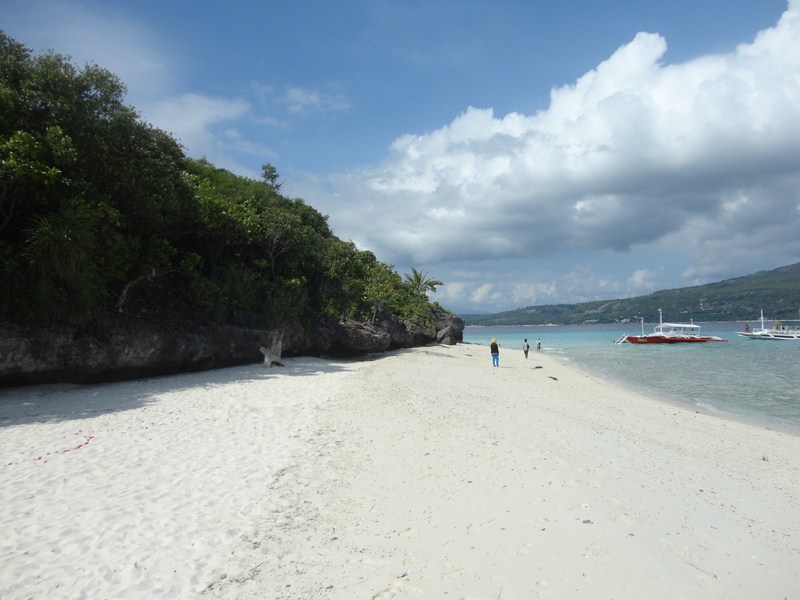
The island's signature shifting sandbar

The island’s signature shifting sandbar

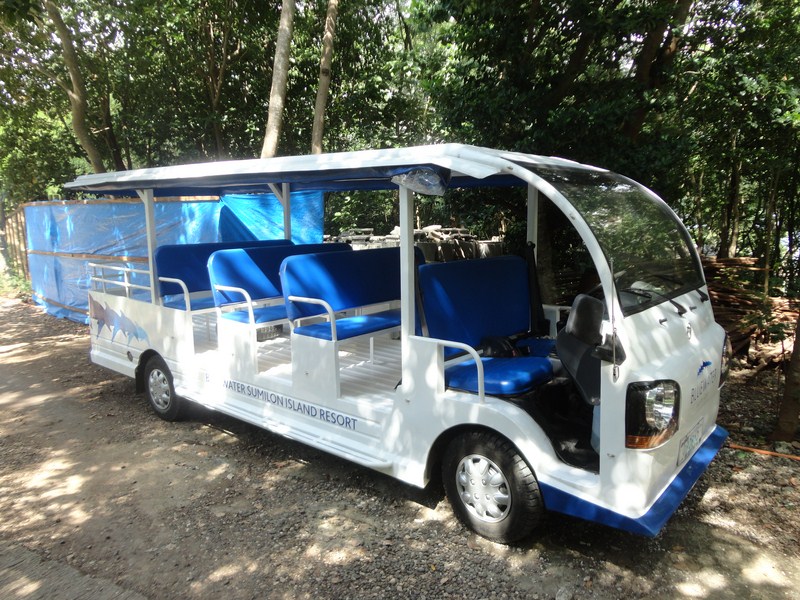
Dinner was prepared, al fresco, along the island’s signature shifting sandbar. After this refreshing repast, we made an ocular tour, using an electric tram, of the resort’s  1 and 2-bedroom villas.

The electric tram

The electric tram

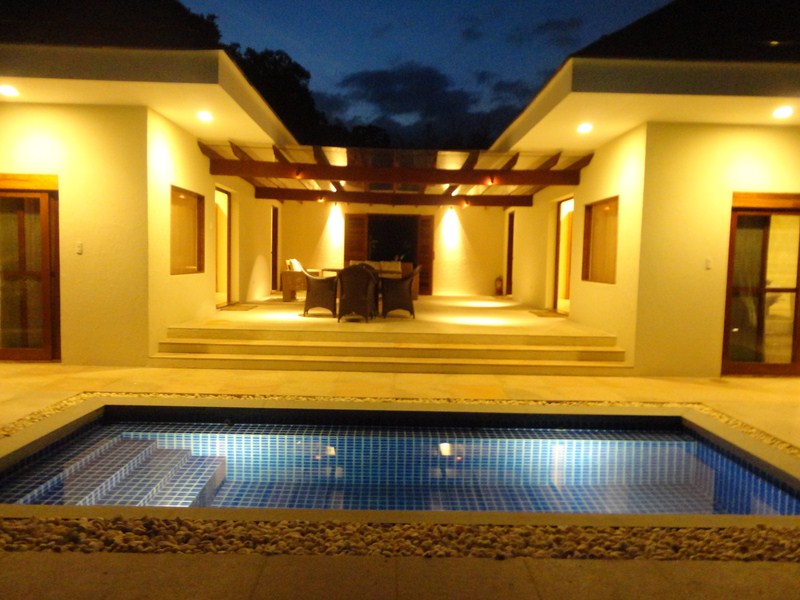
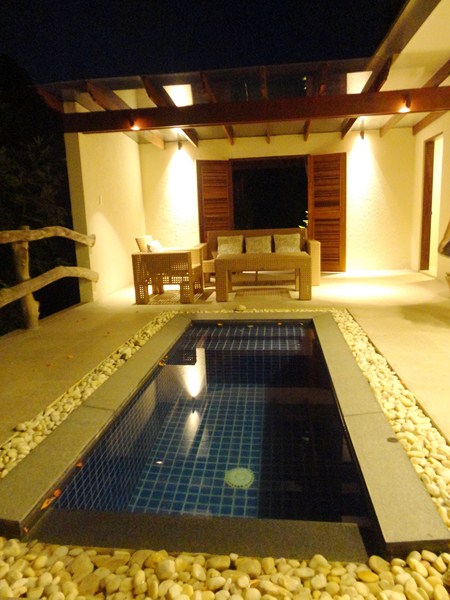
These villas feature, aside from the aforementioned de luxe room amenities, a sitting area, a dipping pool and a free-standing bathtub (also a feature in Panglao Bluewater Resort) for the 2-bedroom villa.

2-Bedroom Villa

2-Bedroom Villa

Interior of 2-Bedroom Villa

Interior of 2-Bedroom Villa

Dipping pool at 1-Bedroom Villa

Dipping pool at 1-Bedroom Villa

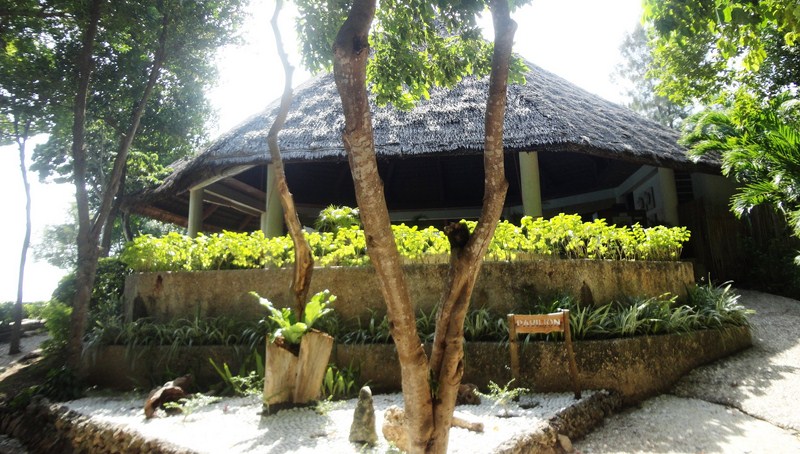
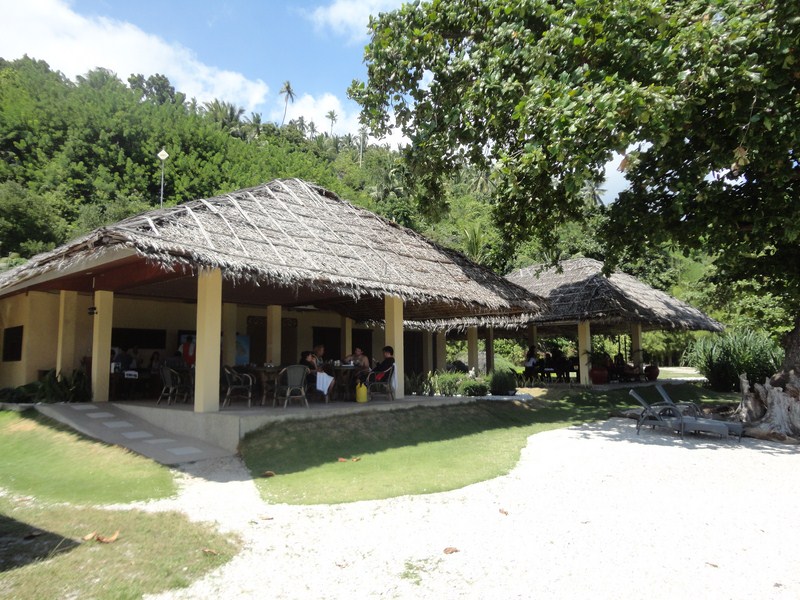
Come morning, we had our buffet breakfast at its quiet and lovely, octagonal Island Pavilion restaurant.  It offers assorted breads with orange marmalade, strawberry jam and butter spreads; juice (orange or four seasons); fresh milk; hot chocolate, coffee, hash brown potatoes, crispy bacon, omelet, tocino, noodles, etc.

Pavilion Restaurant

Pavilion Restaurant

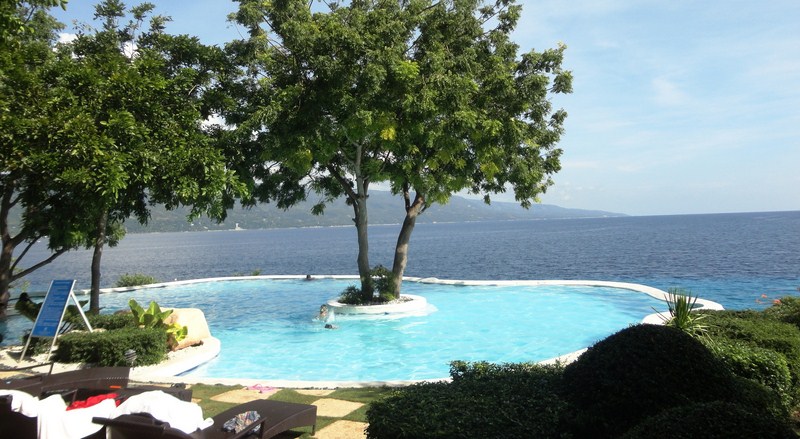
Beside the pavilion is an inviting outdoor infinity swimming pool, overlooking Oslob, with loungers and a breathtaking view of the beach.  Just nearby is the resort’s well-stocked bar.

Infinity swimming pool

Infinity swimming pool

Poolside bar

Poolside bar

Up ahead was a full day of resort-sponsored activities at Oslob, starting with a 10 min. boat ride to the mainland where we bonded with butanding (whale sharks) and  frolicked at Tumalog Waterfalls.

The author (left) bonding with a whale shark

The author (left) bonding with a butanding (photo: Ma. Joy C. Felizardo)

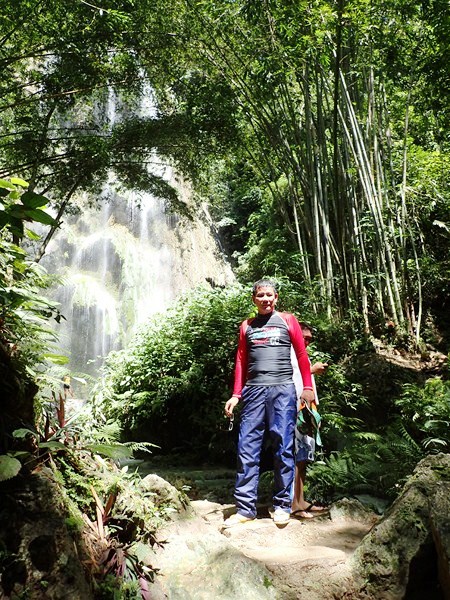
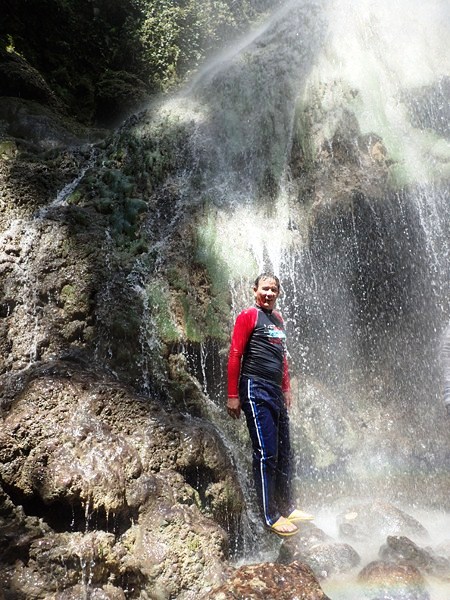
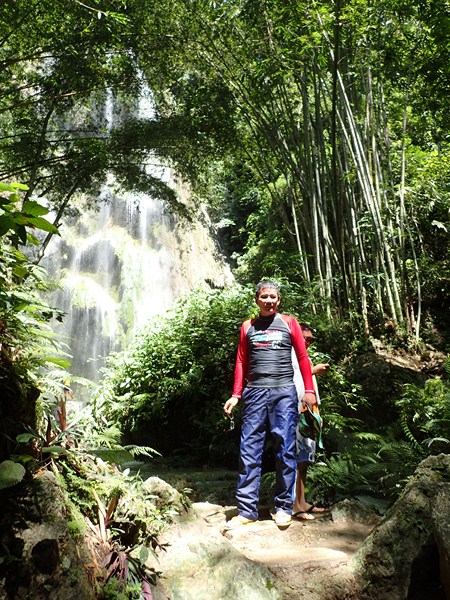
The author at Tumalog Falls

The author at Tumalog Falls

We also reminisced the town’s historical past at the poblacion where we visited  the Spanish-era Church of the Immaculate Conception, Cuartel (barracks), baluarte (watchtower), gates and walls.  We returned to the resort via a 15-min. boat ride from Bancogon Pavilion and Wharf.

Bancogon Pavilion

Bancogon Pavilion

Bancogon Wharf

Bancogon Wharf

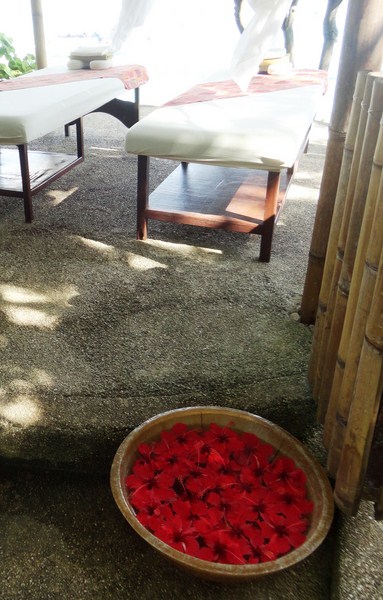
In the afternoon, we all explored the island via a nicely laid out hiking trail, through lush forests, making stopovers at the lighthouse, a Spanish-era baluarte, Yamashita’s Cave and  Our Lady of Fatima grotto.  Come evening, to refresh their tired bodies, some of the ladies also tried out an outdoor massage at the resort’s Anuma Spa.

Hiking around the island

Hiking around the island

Anuma Spa

Anuma Spa

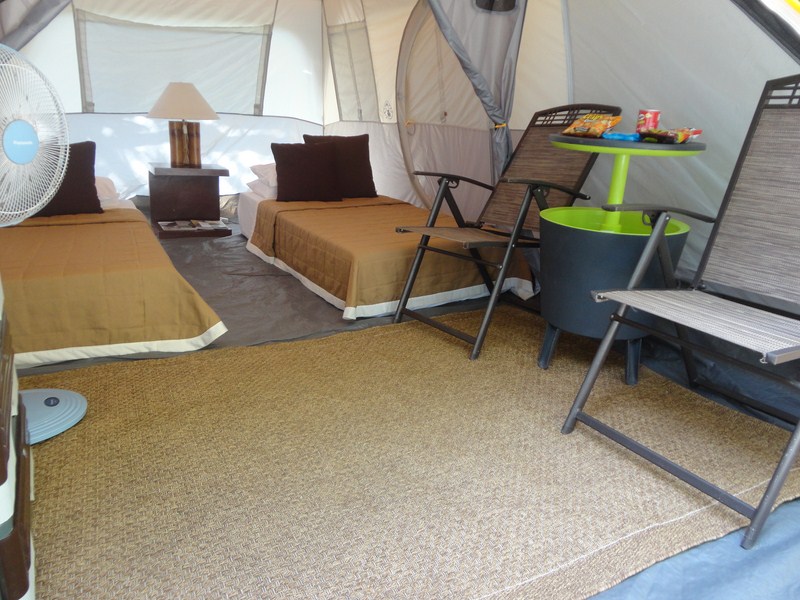
On our last day at the resort, Joy and I checked out their 3 glamping tents.  Glamping is short for “glamorous camping.” It basically means going camping while trying to make yourself feel that you’re not camping.  The tent has all the other features of a regular room such as 2 single beds, carpeted floor, cabinets, lamps, electric fans and a cooler filled with assorted drinks (beer, soda, juice) and chips, all for free.  The campsite is located near the beach and the natural lagoon and a bathroom and shower room is close by.

A furnished glamping tent

A furnished glamping tent

The natural lagoon

The natural lagoon

The resort also has a children’s playground, library, dive shop (Aquamania Dive Shop), game room and a souvenir shop.   They also offer, airport transfers, 24-hour room service, , kayaking, fish feeding and fishing at the lagoon, Hobie Cat sailing, snorkeling, windsurfing, paddle boating and scuba diving.  In the evening, you can join fishermen as they catch krill to feed the butanding the next day.

Aquamania Dive Shop

Aquamania Dive Shop

This highly recommendable resort, an excellent escape from the hustle and bustle of city life and the chaos and stresses of the mind and body, is truly a good place for reflection, prayer, rest, relaxation and romance.

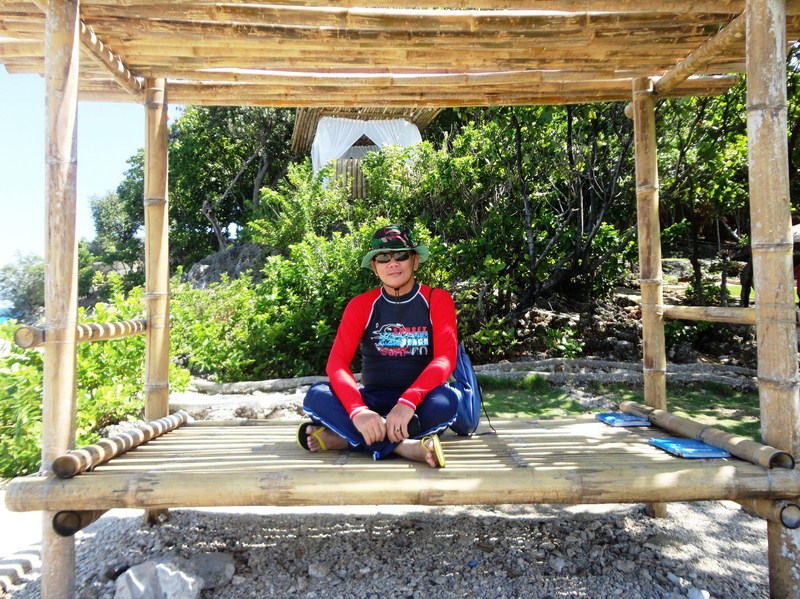
The author at Sumilon Island

The author at Sumilon Island

Sumilon Bluewater Island Resort: Brgy. Bancogon, Sumilon Island, Oslob, 6025 Cebu.  Tel: (032) 382-0008 and (032) 318-9098. Mobile numbers: (0917) 631-7514 and (0917) 631-7512.  Email: info.sumilon@bluewater.com.ph.

Cebu City booking office: CRM Bldg., Escario cor. Molave Sts., Lahug, 6000 Cebu City. Tel:  (032) 412-2436. Mobile numbers (0917) 631-7508 and (0998) 962-8263. E-mail: sales.sumilon@bluewater.co.ph.

Manila Office: Rm. 1120, Cityland/Herrera Towers, 98 Herrera cor. Valero St. Salcedo Village, Makati City. Tel: (632) 817-5751 and (632) 887-1348. Fax: (632) 893-5391.  E-mail: sumilon@bluewater.com.ph. Website: www.bluewatersumilon.com.ph.

Church of the Immaculate Conception of the Virgen Mary (Baclayon, Bohol)

Church of the Immaculate Conception of the Virgin Mary

Church of the Immaculate Conception of the Virgin Mary

From the Bohol Bee Farm, it was back to our airconditioned coach for the short 15-min. (11-km.) drive, via the Dauis-Panglao Road and Tagbilaran East Road, to the town proper of Baclayon.  Here, we made a stopover at the town’s Church of the Immaculate Conception of the Virgen Mary, one of the oldest churches in the country, the best preserved Jesuit-built church in the region and one of the best examples of Philippine Baroque combined with Western and Eastern influences.

The collapsed bell tower surrounded by scaffolds

The collapsed bell tower surrounded by scaffolds

Stacks of retrieved coral stone

Stacks of retrieved coral stone

Just like a number of Bohol’s Spanish-era churches, it too was damaged during the devastating October 15, 2013 earthquake which caused the collapse of its simple Early Renaissance portico facade and its formerly separated 21 m. high, quadrangular coralstone bell tower (connected to the church by the portico in 1875). Fortunately, its nave remains largely intact.  An international team of heritage restoration experts have assessed damage to this as well as other Bohol churches and it could take around two to three years for the damaged churches to be restored.

The church interior, looking towards where the facade used to be

The church interior, looking towards where the facade used to be

When we arrived, braces and scaffolds to shore and support the unstable structure (to prevent any further damage from future earthquakes) were being installed and temporary storage facilities were constructed.  Loose coral stone blocks retrieved from the clearing of earthquake debris have been amassed and stacked at the spacious church patio for future documentation, labeling and use in future restoration work.

The main altar with its painted ceiling

The main altar with its painted ceiling

Luckily for us, the church interior and its small adjacent Baclayon Museum can still be visited. , The ceiling and intricately-carved, gilded altar and icons plus two side retablos (altar backdrop), all dating back to the Jesuit era, were all spared from destruction.  The floor’s glazed azulejo tiles, imported from Mexico and Spain and installed in 1875 after the completion of the portico, were also spared.

Left side altar

Left side altar

Right side altar

Right side altar

The museum, located at the second floor of the former convent (now the Immaculata High School), displays centuries-old relics, religious artifacts and antiquities dating back to the 16th century. The church inventory books have helped in dating some pieces. However, we weren’t allowed to take photographs inside.

The Baclayon Museum

The Baclayon Museum

Its impressive amount of preserved liturgical material includes an ivory statue of the crucified Christ looking towards heaven; relics of St. Ignatius of Loyola; a statue of the Blessed Virgin  said to be presented by Queen Catherine of Aragon; old gold embroidered ecclesiastical vestments; books with carabao skin covers; and librettos of church music written in Latin on sheep skins.

Stairs leading up to Baclayon Museum

Stairs leading up to Baclayon Museum

There are also cuadro paintings executed by famed 19th century Filipino painter Liberato Gatchalian in 1859. Among the Baclayon cantorals (large handwritten music books) on display is the Misa Baclayana, a musical setting for the Mass which has been revived and is part of the repertoire of the Loboc Children’s choir.