Chapel of the Cartwheels (Manapla, Negros Occidental)

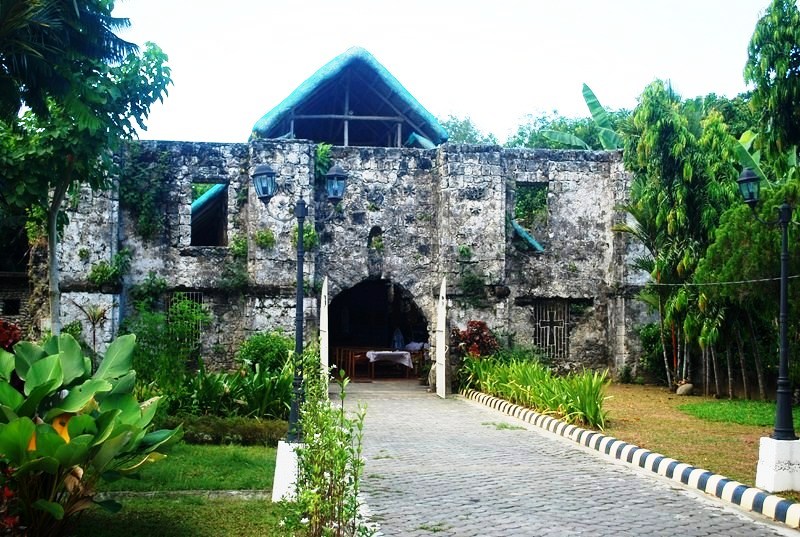
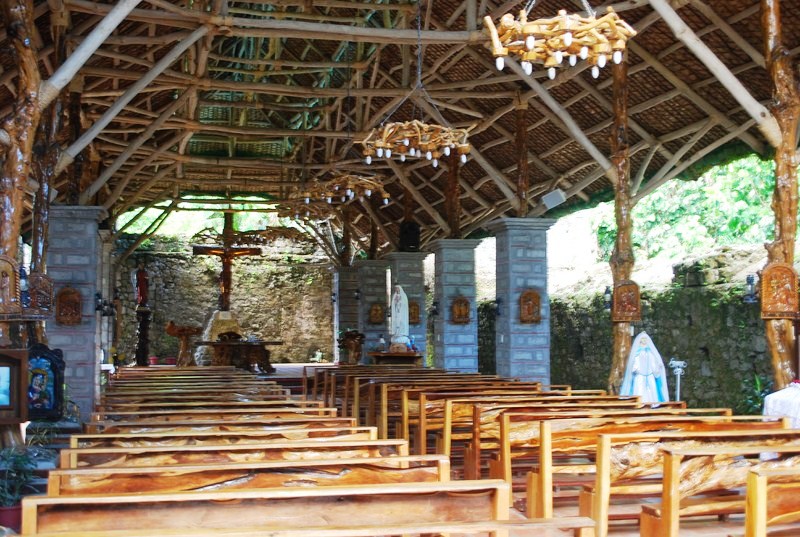
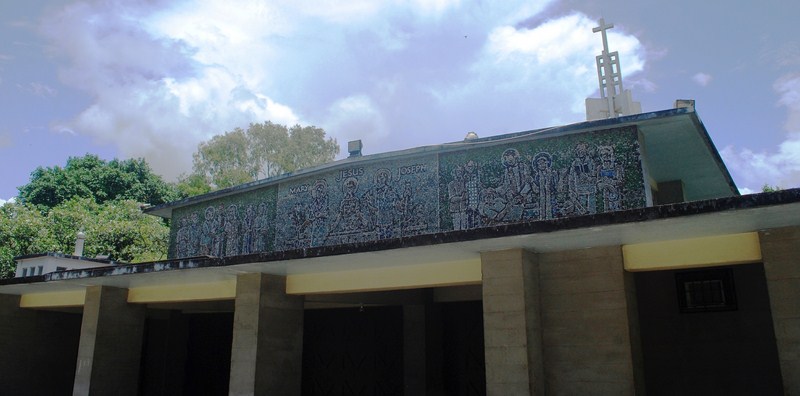
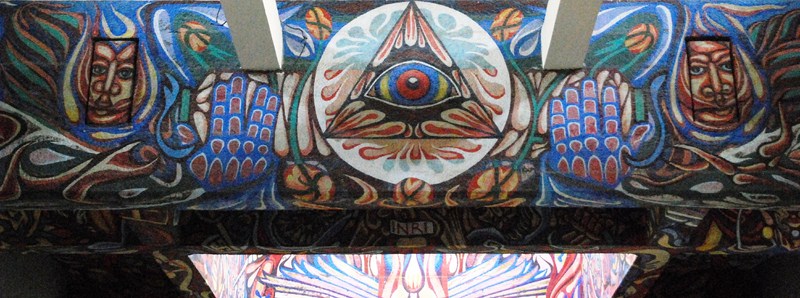
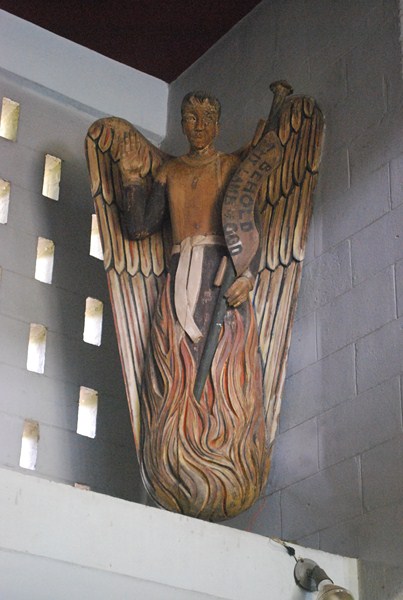
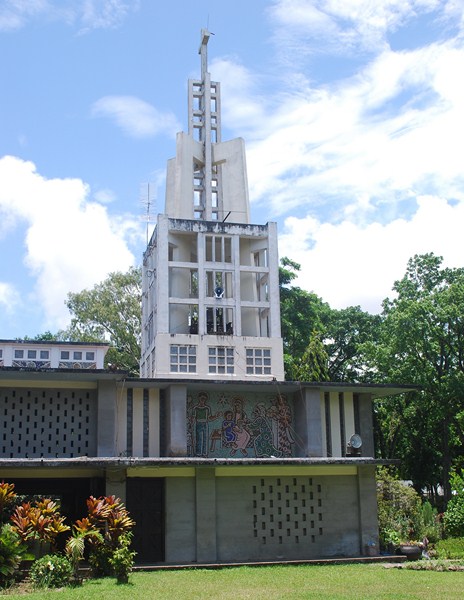
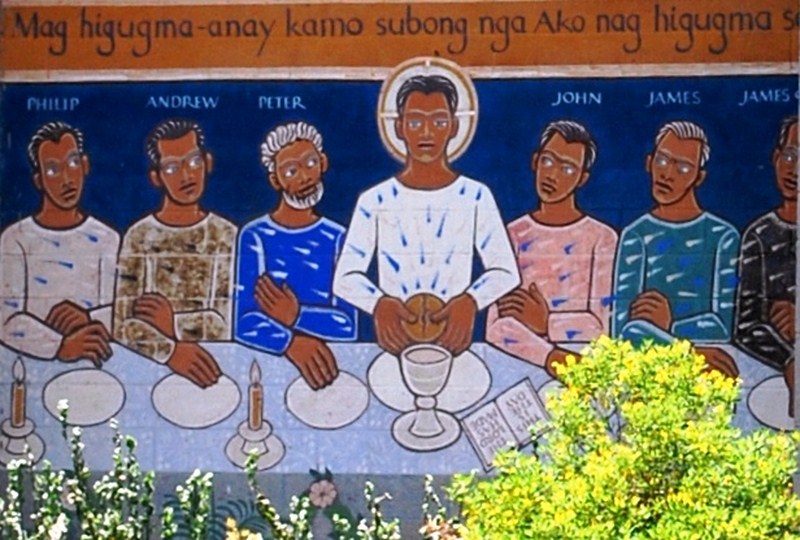
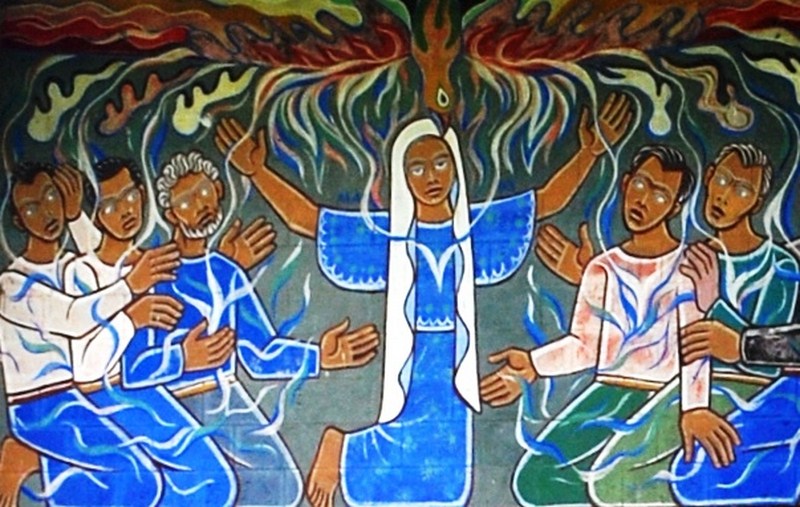
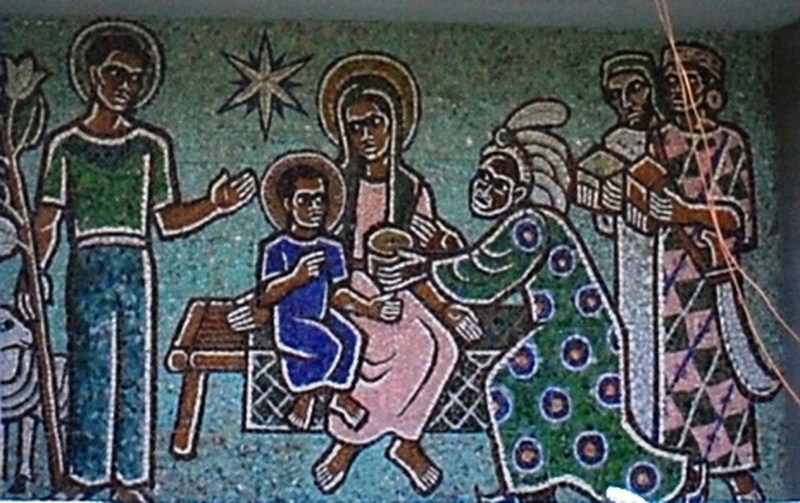
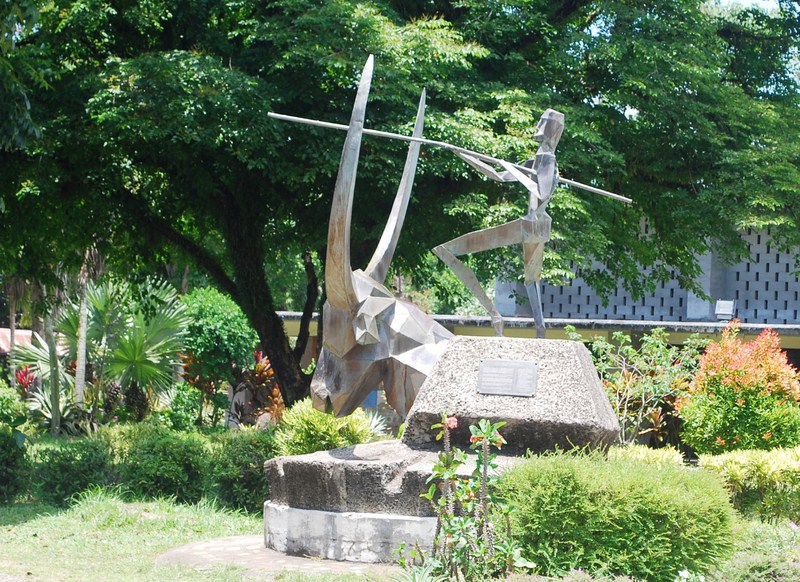
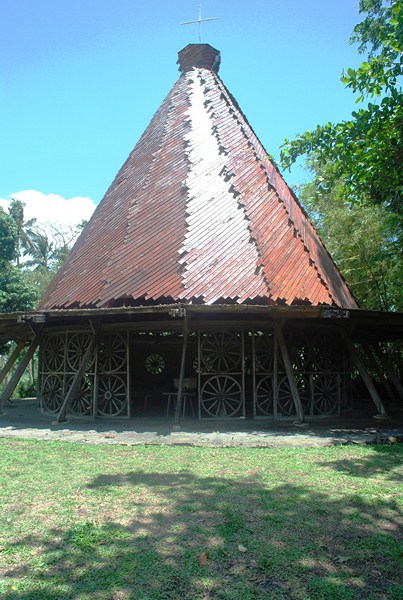
From the mansion, Mark next drove us a short distance, across the field behind the Gaston Mansion, to the hacienda’s unique chapel.  Built during the hacienda days of the 1960s, it is probably the most native-looking of all Philippine churches.

Chapel of the Cartwheels

Chapel of the Cartwheels

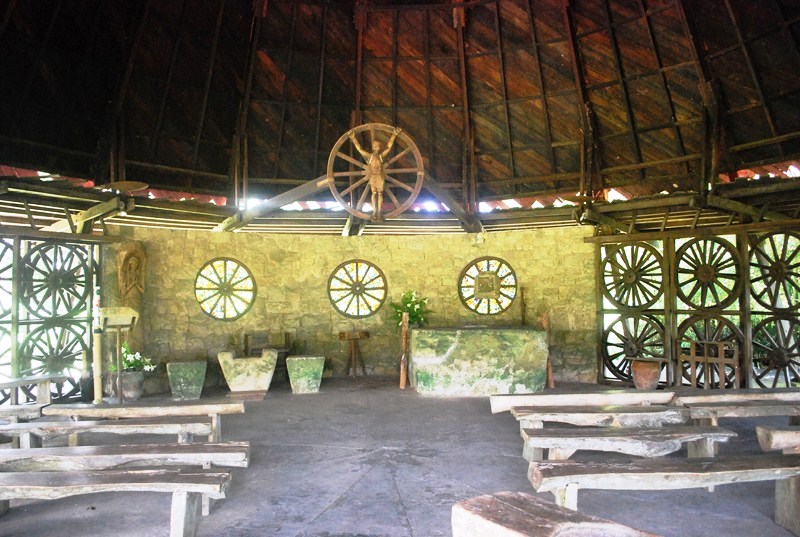
Built by secular priest Msgr. Guillermo “Gigi” Gaston for the farm’s workers, its farming motif is reflected in its facade made mainly from various farm implements including plows, mortar (candle holders) and pestles (a holy water container), all indigenous to Hacienda Rosalia, as well as margaha sand and rocks from the nearby seashore.  The chapel’s benches were each made with slabs of hardwood by families who attended the mass.

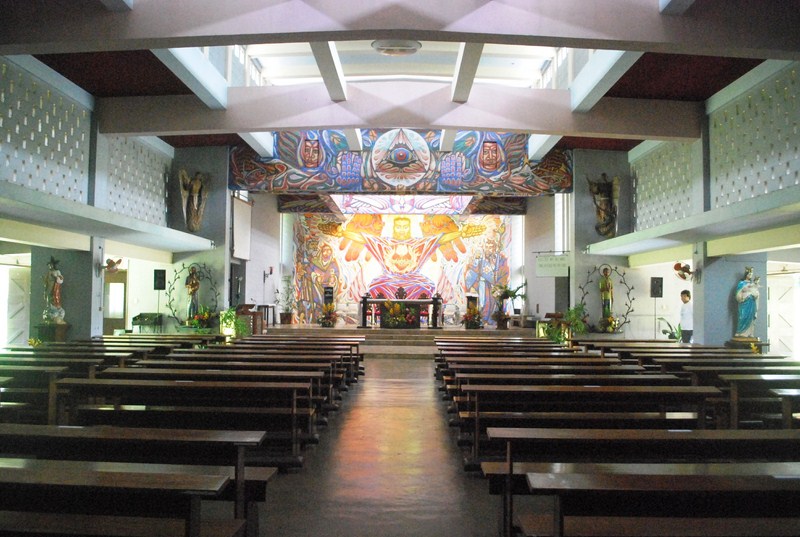
The chapel's interior

The chapel’s interior

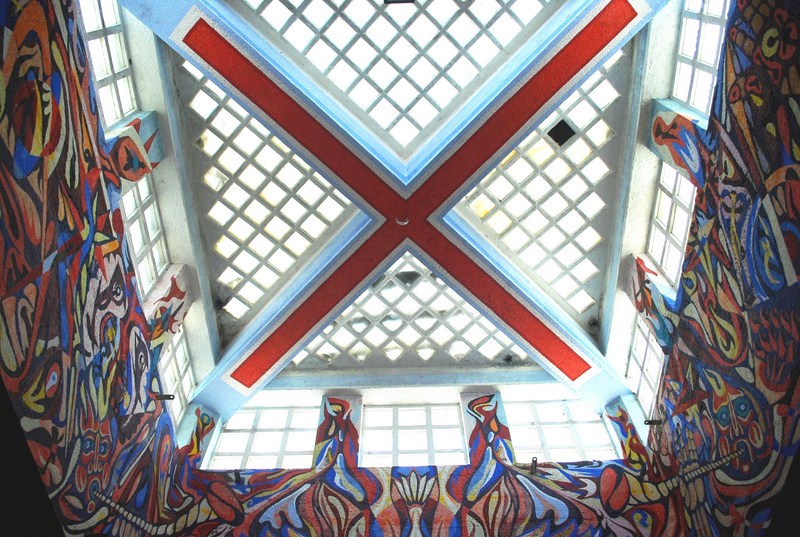
Its tall roof is a stylized wooden salakot (headgear) and the walls are made of artistically-linked discarded carabao cartwheels, an idea thought of by Msgr. Gaston who knew that the farm workers and their families could easily relate to this simple but widely used object in the farms where they worked.

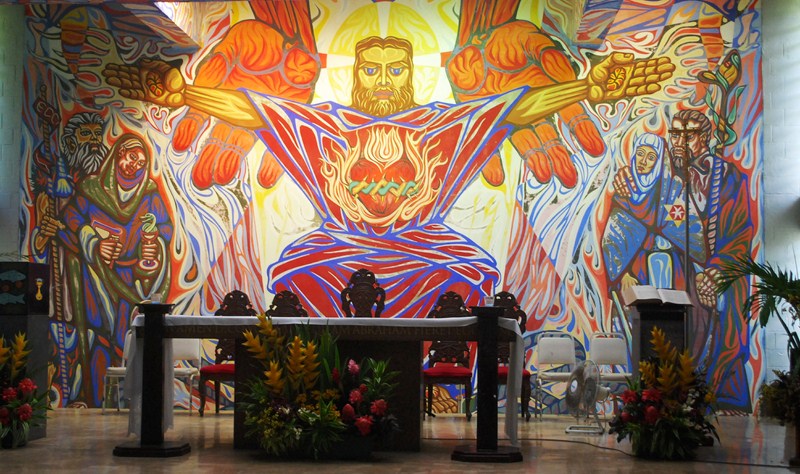
The chapel's altar

The chapel’s altar

For him, the cartwheel also symbolizes the Holy Trinity with God the Father as the center of the wheel; Jesus Christ as the spokes surrounding it, leading the people towards God; and the the Holy Spirit as the outer rim  who ensures that the people don’t get lost on their way towards the center.

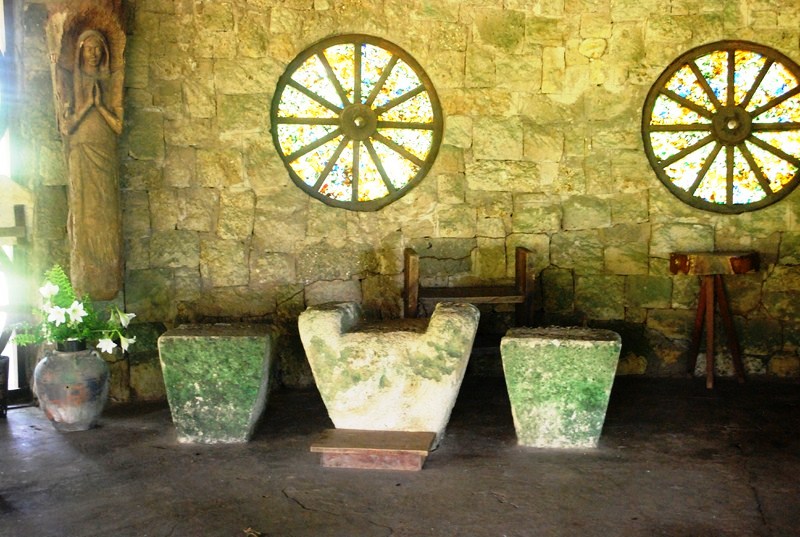
Seating area for the priest and 2 sacristans

Seating area for the priest and 2 sacristans

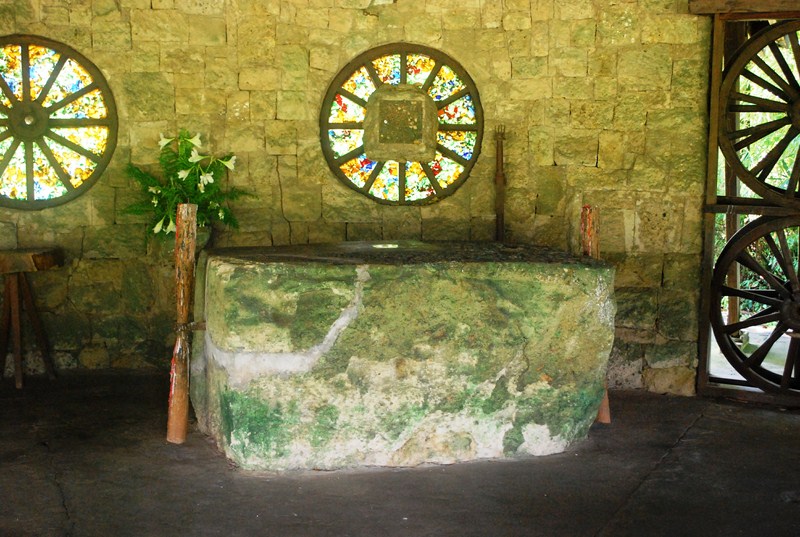
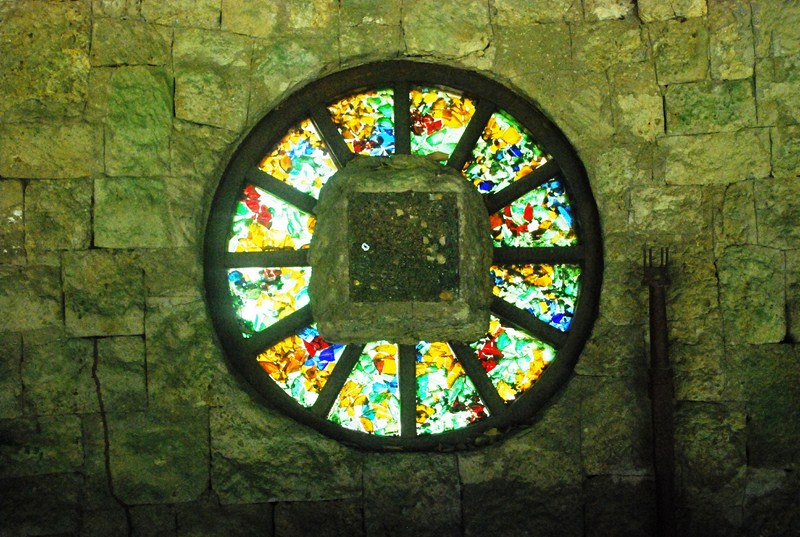
A huge, centuries-old boulder serves as the altar and the wall behind it is made of native stone and punctured by 3 cartwheel-shaped stained glass windows (representing God the Father, God the Son and God the Holy Spirit) with broken pieces of glass bottles (wine, milk and soda) in different colors, giving the altar a more creative and lively look. Boulders were also used as the podium top and seats for the sacristans.

Stained glass window

Stained glass window

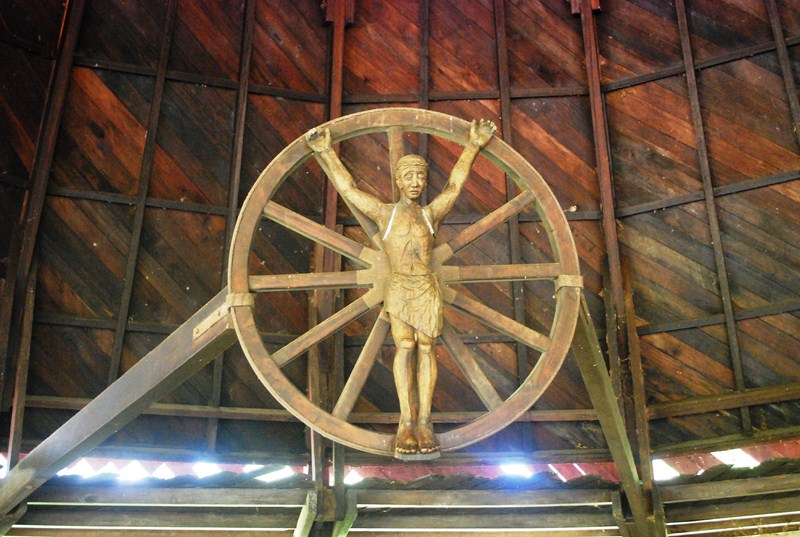
The sliding doors feature mats of 128 panels portraying Biblical events and the usual Christ on the cross is modified by a farmer crucified on a cartwheel. Masses,  attended by hacienda farm workers and their families, are still being held in the chapel. The chapel, also open to guests and tourists who visit the town, is also a popular venue for weddings.

Christ on a crucified on a cartwheel

Christ crucified on a cartwheel

Chapel of the Cartwheels: Hacienda Rosalia, Manapla, Negros Occidental.

How to Get There: Manapla is located 44.7 kms. (a 1-hour drive) northeast of Bacolod City.

The Gaston Mansion (Manapla, Negros Occidental)

Jandy and I arrived at the Manapla Municipal Hall by 10:30 AM.  Here, we met up with town councilor Marcos “Mark” L. Escalante, my nephew and son of town mayor Lourdes Socorro “Uding” L. Escalante, my first cousin, who was at the U.S. at that time. Mark drove us to Hacienda Rosalia, home of the Gaston Mansion and the Chapel of the Cartwheels, two of Manapla’s tourist attractions.

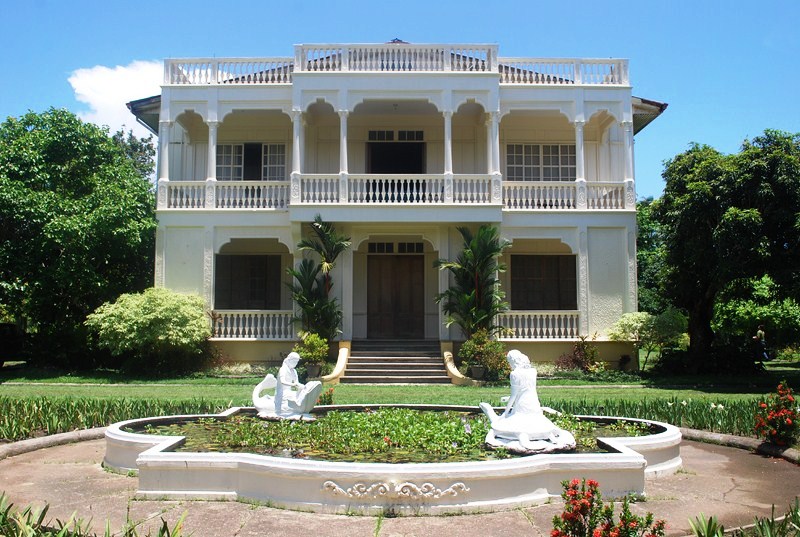
The Gaston Mansion

The Gaston Mansion

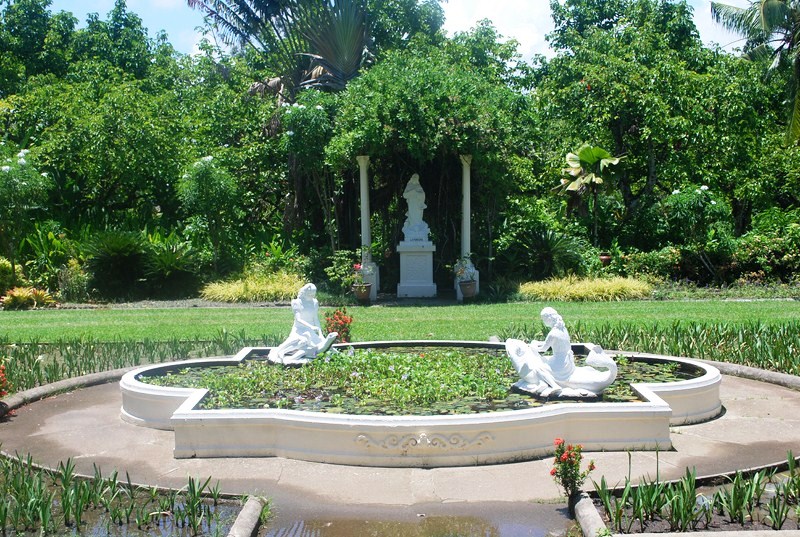
The mansion's lush garden

The mansion’s lush garden

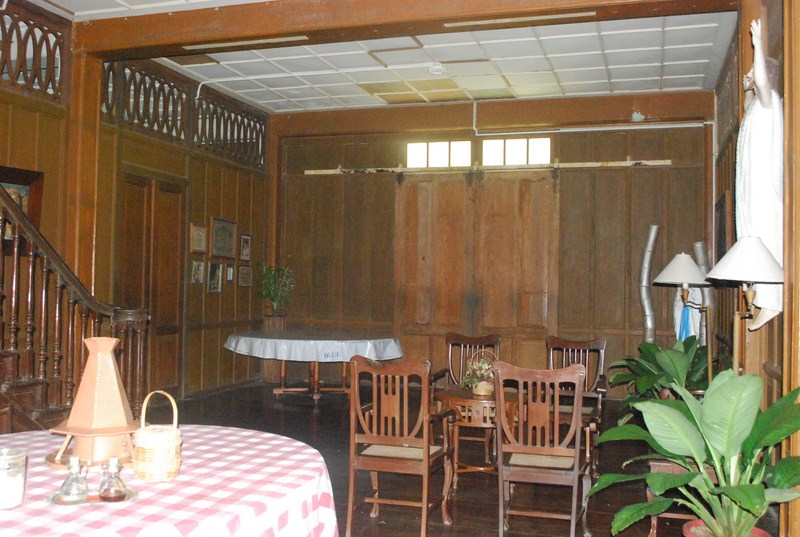
We first stopped over at the Gaston Mansion.  Its resident and current owner, the secular priest Msgr. Guillermo “Gigi” Gaston, wasn’t around, being at Bacolod at the time of our visit, but the caretaker allowed us to look around the living and dining areas of the mansion.  Incidentally, the mansion was featured in Peque Galalga’s 1982 multi-awarded film Oro Plata Mata, where it was referred to as Hacienda Lorenzo.

The ground floor

The ground floor

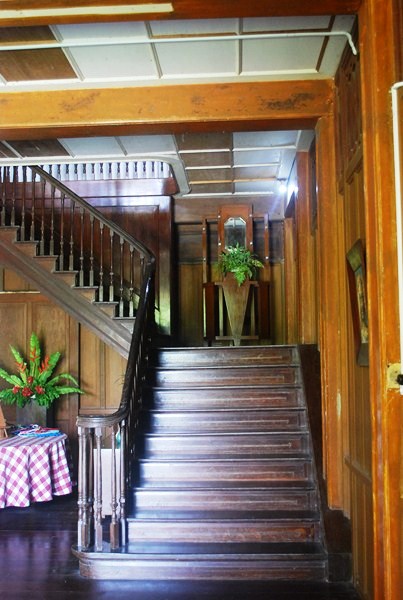
Stairway to second floor

Stairway to second floor

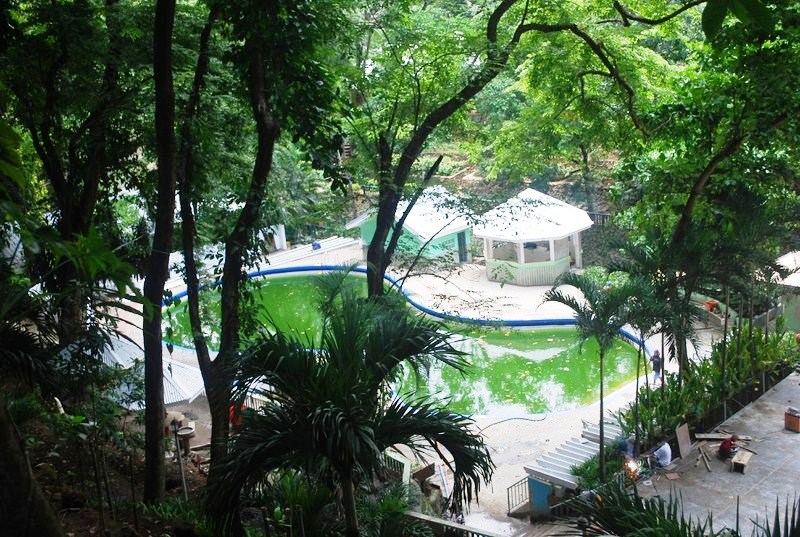
This stately and elegant, 2-storey mansion, the  ancestral home of Jose Gaston, one of the sons of Yves Leopold Germain Gaston, and his wife Consuelo Ascona, was built in the 1930s.  They had 8 children.  It is set in lush, verdant and gorgeous garden of flowers, shrubs, trees, potted palms and herbs. Within the grounds are a now-disused swimming pool (used as hiding place during World War II), a Victorian fountain, a pond and a time-worn shoe house (which was used before as a playground).

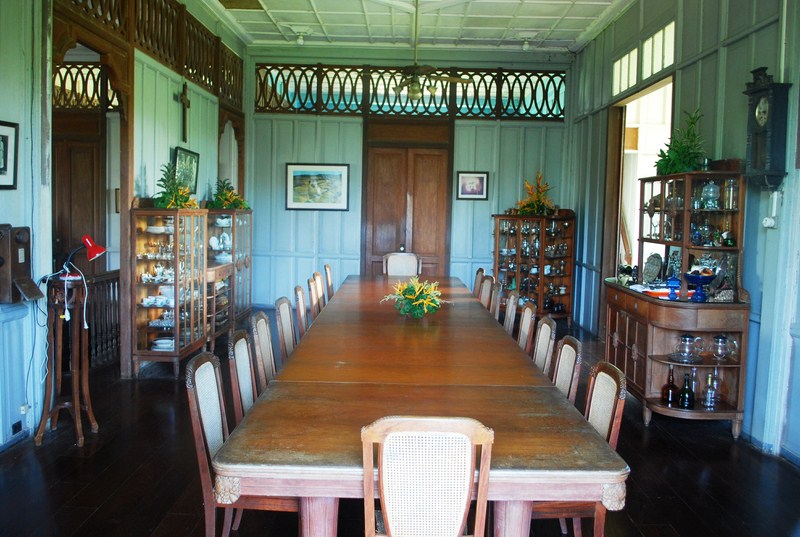
Dining Area

Dining Area

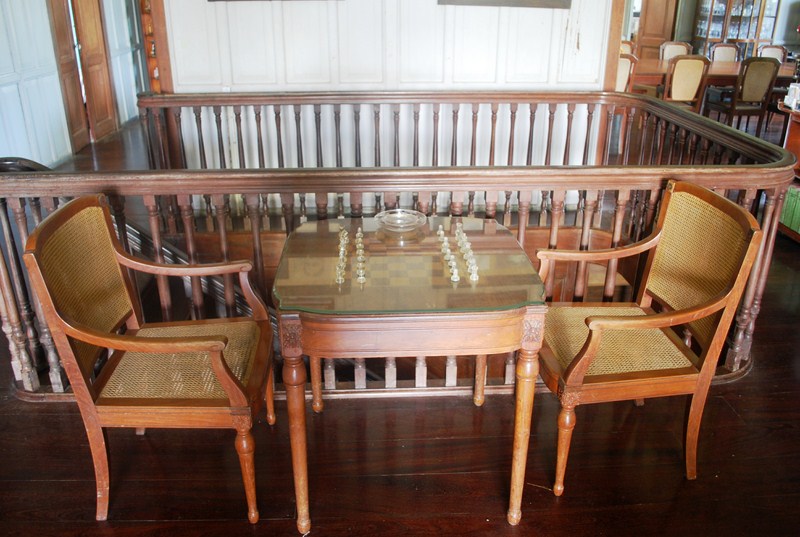
Chess table

Chess table

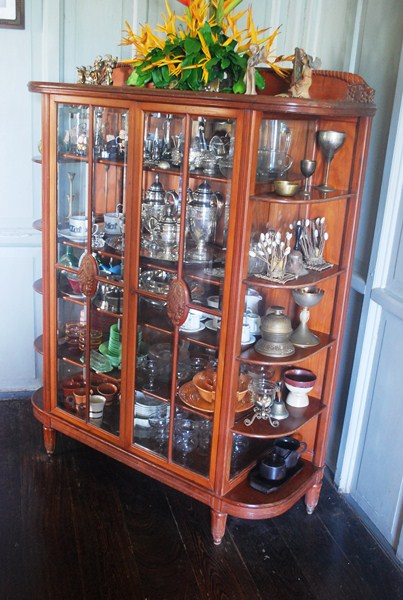
Its second floor dining room, opening into a breezy azotea overlooking the garden, had a wooden floor, a high ceiling and large windows.  What truly amazed me was its antique, 24-seater wooden table.  All around it are cabinets filled with crystal stemware, antique silverware and fine china.  Buffet lunches, served by servants of the Gaston family, are also offered for paying guests.

China cabinet

China cabinet

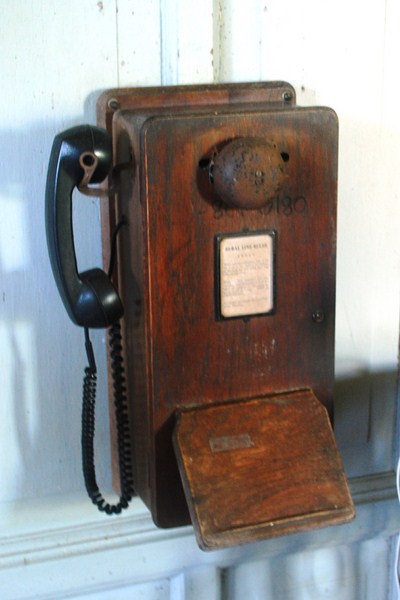
Antique telephone

Antique telephone

Gaston Mansion: Hacienda Rosalia, Manapla, Negros Occidental.

How to Get There: Manapla is located 44.7 kms. (a 1-hour drive) northeast of Bacolod City.

The Ruins (Talisay City, Negros Occidental)

The highlight of our Silay Heritage Tour was our visit to The Ruins in nearby Talisay City.  Here, a wacky, English and Tagalog-speaking tour guide narrated to visitors the fascinating tale of The Ruins, injecting humor along the way.

The Ruins - the Taj Mahal of Negros

The Ruins – the Taj Mahal of Negros

The Ruins is what remains of the grand, 2-storey mansion that Negrense sugar baron, Don Mariano “Anoy” Ledesma Lacson (1865-1948) built in the middle of his 440-hectare sugar cane plantation in the early 1920s, following the death of his first wife, Maria Braga, a Portuguese from Macau who died in an accident while pregnant with their 11th child. Don Mariano is the youngest of the 8 children of Lucio Lacson and Clara Ledesma from Molo, Iloilo.

Our tour guide explaining the history of The Ruins

Our tour guide explaining the history of The Ruins

He later remarried, this time to Concepcion Diaz from Talisay, adding 3 more children to his existing brood of 10 (which included Rafael Lacson, the former governor of Negros Occidental). It became the residence of Don Mariano and his unmarried children. After drawing lots, Don Manuel’s sugar plantation was divided among the 10 children by his first wife Maria and  the mansion went to Mercedes Lacson who married Manuel Javellana from Jaro District in Iloilo.

The interior of The Ruins

The interior of The Ruins

Later, the land was again divided into equal parts among the couple’s 12 children and the 3.6 hectares that included the mansion was given to Ramon Javellana. Raymund Javellana, one of Ramon’s children, thought of restoring the mansion and converting it to a tourist spot but the mansion remained abandoned for 67 years until they started to develop it on May 2007.  On January 2008, it was officially opened to the public as a tourist attraction.

The main entrance

The main entrance

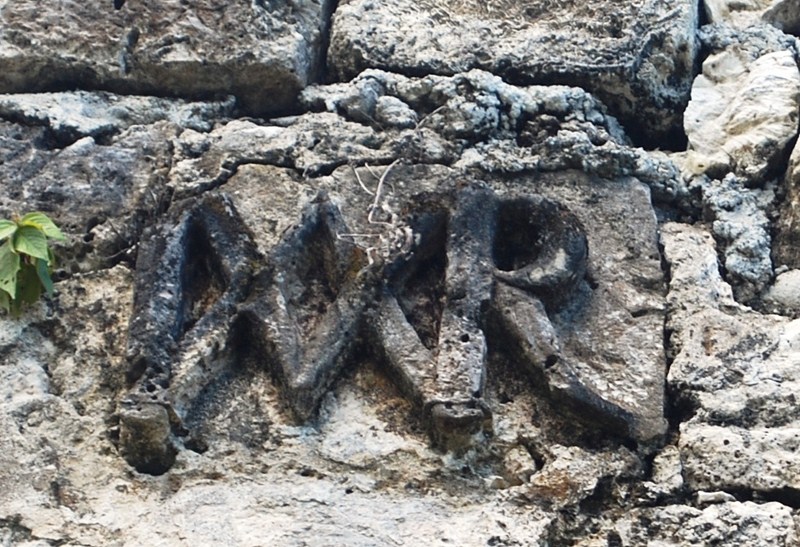
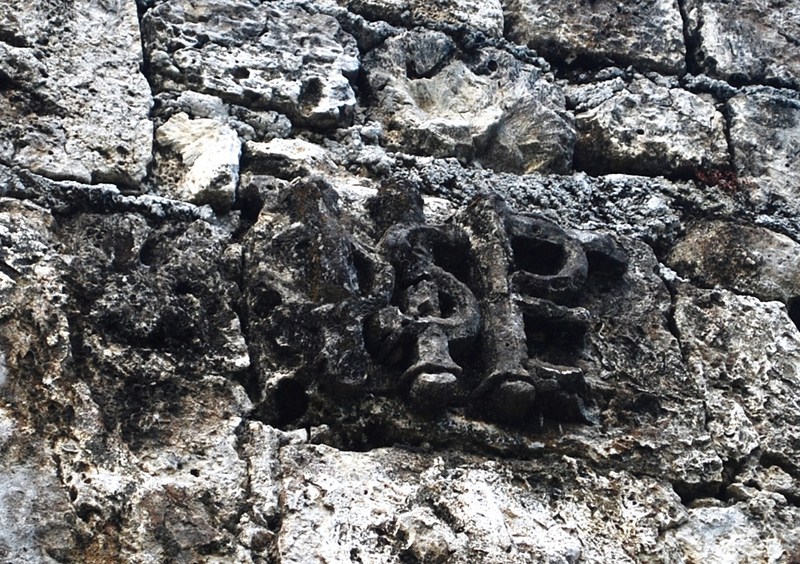
The 903 sq. m., 10-room (8 rooms for their children, a master’s bedroom and a family room) mansion, of Italianate architecture, has twin Neo-Romanesque columns with the first letters of the names of Don Manuel and Dona Maria engraved onto the mansion’s posts.  They actually looked like Es that face each other.

The mansion grounds

Cheska, Marve, Kyle and Grace at the mansion grounds

Facing the main door, the boys’ and girls’ bedrooms, at the ground and second floors respectively, were all located on the left side. The master’s bedroom and the family room were both located upstairs and facing west, on the left and right, respectively. A small arched window, between the kitchen and the dining area, facilitated the movement of food, minimizing the servants going in and out of the kitchen.

The "M" moldings

The “M” moldings

The picturesque mansion, one of the top 12 fascinating ruins in the world and the Taj Mahal of Negros, has many interesting tales to tell.  Its top edges also feature a shell-inspired decor which, in New England, indicates that the homeowner is a ship captain. At the glassed-in sunroom with bay windows, Don Mariano would be often seen sitting as he viewed ships that come and go along the coastal waters of Talisay. Maria Braga’s father was also a ship captain.  Again, in keeping with the marine theme, the mansion’s second story also features a belvedere, between the master’s and family room  and also facing the west, where the family would gather to watch the sunset.

The restaurant dining area

The restaurant dining area

Felipe, one of Don Manuel’s sons, supervised the continuous concrete mixing and pouring, done 24 hours a day, 7 days a week.  This ensured that the concrete was very compact and that no air got in, resulting in the high-quality strength of the structure.  The concrete mixture also incorporated egg whites which, to this day, visitors can still see the gloss or shine on the mansion’s walls because of it.

The remains of the stairs

The remains of the stairs

In 1942, during the Japanese occupation in the early part of World War II, the mansion was reduced to its skeletal frame when USAFFE (United States Armed Forces in the Far East) guerillas set the mansion ablaze, with the consent of Don Manuel, so it would not be used as headquarters by the Japanese forces.

Detail of column capital

Detail of column capital

The mansion’s roof, ceiling and the 2-inch thick, meter wide and approximately 20.5 m. long, jointless wooden floors, extending from the main entrance up to the end of the dining area, were all burned during the non-stop, 3-day fire but the foundations remained standing, thanks to its oversized steel bar reinforcement and the meticulous way of pouring the A-grade mixture.  The original Spanish machuca floor tiles, the hardest and most expensive during that time, also survived.

Detail of arch

Detail of arch

The original, 4-tiered fountain outside the mansion was, in its heyday, surrounded by a beautiful lily garden maintained by a Japanese gardener who, following the burning of the mansion, mysteriously disappeared.   Today, its landscaped garden draws various inspirations – from formal English to Japanese-inspired gardens.

The original 4-tier fountain

The original 4-tier fountain

Viewed just outside the mansion, with a tree on top, is the chimney (simborio) of the muscovado sugar mill (where the juice of the sugarcane is extracted) of the family’s sugar farm. From the mill, the extracted sugarcane juice is then transferred to large vats, heated and then cooled to produce the sugar crystals.
Exterior detail

Exterior detail

Inside The Ruins is a semi-fine dining restaurant (offering Mediterranean cuisine), a mini-bar and a souvenir shop while around it are modern additions – an 18-hole mini golf course, a snack bar and newly built toilets that still use the mansion’s original septic tank.

Belvedere detail

Belvedere detail

Aside from tours and dining, The Ruins are also be used for special events such as weddings, family reunions, pre-nuptial pictorials, etc.  There are also a stall selling Erv’s sugar cane juice, camping and picnic grounds, bath houses and a pavilion. Also within the grounds is a 3 m. high obelisk,the Landmark Award of the Philippine Institute of Civil Engineering (PICE). Too bad, we left at 5 PM.  According to our guide, you will see the building glow from the sunset around 5:30 PM.

The simborio

The simborio

The Ruins: Open daily, 8:30 AM to 8 PM. Tel: (034) 476 4334. Admission: PhP60 (adults), PhP40 (students) and PhP30 (children).


Silay Museum (Silay City, Negros Occidental)

Entrance

Entrance

The Silay Museum, inaugurated last November 4, 2012, the eve of the Cinco de Nobiembre celebration, is located at the former site of the City Library.  It is a fulfillment of the dream of Mayor Jose “Oti” Montelibano and the Silaynons for a museum that would tell Silay’s history and the aspirations of its people. The concept, prepared by city councilor Neil Solomon L. Locsin, grandson of the late Sen. Jose C. Locsin, was executed by cultural affairs officer Achilles “Panoy” Corteza.  

Jose C. Locsin Memoabilia

Jose C. Locsin Memorabilia

Near the door and adorning a cozy nook along the walls are  numerous photographs, taken by members of the Camera Club of Negros, through the Negros Cultural Foundation, of 28 ancestral houses which were identified by the National Historical Commission (NHC) as architectural landmarks. 
Photo Gallery of Ancestral Houses

Photo Gallery of Ancestral Houses

museum-1Glass enclosures preserve a collection of clothes and manuscripts owned by famous sons and daughters of Silay.  They include the vestments of Silay parish priest Fr. Eusebio Locsin of Molo (who encouraged his relatives in Iloilo to settle in Silay because of its promising sugar industry), collection of traje de Silay (gowns) and precious documents (last entry of Fr. Eulogio Saez in Libro de Baptismo de Silay, etc.) and articles  (old statue of San Diego Alcala, etc.) from the San Diego Pro-Cathedral and the Diocese of Bacolod, with permission from Fr. Demetri Gatia and Bishop Vicente M. Navarra.
Dioramas

Dioramas

A collection of 27 paintings (“KABUHI, Paghim akas kag Pagkabahaginan ni Rizal”), done by the relatively unknown and underrated Caviteno master painter Simon Saulog (1916-1995), was commissioned by Sen. Jose C. Locsin in 1957 for the Filipiniana section of the public library.  They depict the different episodes in the work, life and death of Philippine National Hero Jose Rizal whom the senator personally admired. Saulog was trained in the Fernando Amorsolo school of painting espousing Classicism and idealizing rural life.

museum-3

Its seven eye-catching and colorful dioramas, inspired by the Ayala Museum. tells the cultural history of Silay from its beginnings (The Village by the Sea: 16th -17th Century, Life within the Estacada: 18th Century), how it was shaped by the sugar industry (Migration and Development: 19th Century), the the struggle for freedom (Cradle of Freedom: 1898 Cinco de Noviembre Revolution), the birth of the “Paris of Negros” (The Golden Age: The 20th Century), the effects of the war (The Last Stand: World War II, ) and to where it is now (Cityhood). 

Fr. Eusebio Locsin vestments

Fr. Eusebio Locsin vestments

Also on display are memorabilia and manuscripts (including a classified document presented to him that discusses, among other things, action plans that the country will take upon the expiration of the 1954-1974 Laurel-Langley Agreement) of the late Sen. Jose C. Locsin;, old coins and paper currency; antique furniture;  scaled models of Balay Negrense and San Diego Pro-Cathedral; an old kawa (cauldron used in the making of muscovado sugar); and old photos of Silay and its notable personalities. 

Simon Saulog paintings

Simon Saulog paintings

Silay Museum: Jose C. Locsin Cultural and Civic Center (in front of the Silay Tourism Office), 6116 Silay City, Negros Occidental. Tel: (034) 495-5553.

Silay City Tourism Division: Tel: (034) 495-5553.Fax: (034) 495-0848. Email: silaycity_tourism@yahoo.com.

Dinosaur Island (Clark Special Economic Zone, Pampanga)

Dinosaur Island Entrance

Clark Freeport Zone’s very own Dinosaurs Island, the Philippines first ever animatronics dinosaur amusement theme park, is the next best thing to watching Jurassic Park.  

Apatosaurus (Deceptive Lizard) 

Irritator

It was designed to help us understand better the dinosaurs that roamed the earth  and what transpired during the Mesozoic era over 100 million years ago.

Tyrannosaurus (Tyrant Lizard King)

Brachiosaurus (Arm Lizard) 

Opened on August 4, 2012, this new attraction in Clark Field is the Philippine version of the 1993 film Jurassic Park.  It has four attractions – Dino Trail, Fossil Museum, Dino World of Fun and Adventure Ride.

Maiasaura (Good Mother Lizard) 

Baronyx

At the Dino Trail, visitors, upon entering the big wooden doors of the park, follow the forest trail, via a dino guided tour, to learn more about how the dinosaur era may have looked like as well as get up close to see how large they were in their time.

Stegosaurus (Roof Lizard)

Over 30 species of dinosaurs, living in a natural habitat with tall, probably centuries-old trees as backdrop, are featured at a moving dinosaur display.  

Dimetrodon (Two-measures Tooth) 

Iguanodon (Iguana Tooth) and Velociraptor (Swift Thief) 

Along the trail are Dilophosaurus (Two-crested Lizard),  Apatosaurus (Deceptive Lizard), the flying Angustinaripterus (Narrow Nose), Brachiosaurus (Arm Lizard), Dimetrodon (Two-measures Tooth), Irritator Spinosaurus (Spiny Lizard), Maiasaura (Good Mother Lizard), Parasaurolophus (Near Crested Lizard),Stegosaurus (Roof Lizard), Styracosaurus (Ostrich Mimic), Triceratops (Three-horned Face), Tyrannosaurus (Tyrant Lizard King) and Wuerhosaurus (Wuerho Lizard). There’s also an Iguanodon (Iguana Tooth) attacked by 3 Velociraptors (Swift Thief). 

Fossil Museum 

These are brought to life using the latest animatronics technology similar to the techniques used in the movies and TV, making them look, sound and move their heads and limbs like the real ones, triggered by strategically placed motion sensor devices as people approach them.

Tuojiangosaurus (Tuo River Lizard)

Triceratops (Three-horned Face)

Some expand their chests like they are breathing or open wide their enormous jaws to bare those sharp, pointed teeth.

Yandusaurus hongheensis

At the Fossil Museum, you get to see mounted replicas of dinosaur fossils as well as our real life-sized skeletons that help you understand more about their evolution and extinction.

Skull of Allosaurus 

Horn of Styracosaurus  

On display are complete skeletons of Triceratops (Three-horned Face), Yandusaurus hongheensisTuojiangosaurus (Tuo River Lizard, found in the Tuojiang Area, China) and Tyrannosaurus (Tyrant Lizard King); the scattered bone of a Shunosaurus (Shu Lizard); the horn of a Styracosaurus (Spiked Lizard); the skulls of an Allosaurus and Hadrosaurus; and the toe bones of a Plateosaurus (Broad Lizard). 

Toe Bones of Plateosaurus 

Skull of Hadrosaurus 

The World of Fun is a designated area where dino mascots roam around, interacting with or chasing visitors and little kids or doing dance numbers.

World of Fun 

Dino Mascot

Dinosaur Island: Clarkland Picnic Grounds, Gil Puyat Ave., Clark Freeport Zone, Pampanga.  Mobile numbers: (0905) 261-6521, (0915) 943-3689 (Globe), (0932) 744-9783 and. (0923) 907-7342 (Sun).  Tel: (632) 293-0531.  Admission: PhP350 (adults) and PhP300 (children). Kids 3 years old and below get in for free. Open daily, 9 AM – 5 PM. E-mail: dinosaurisland_clarkland@yahoo.com.

How to Get There: coming from the Main Gate, take M.A. Roxas Ave., then turn right at C.M. Recto Ave.. Upon reaching Gil Puyat Ave., turn right until you reach Clark Nature Park. Dinosaur Island is at the farthest end.   Coming from Mabalacat Gate, go straight along Gil Puyat Ave. then turn right at Clark Nature Park.

Silangang Nayon Park and Restaurant (Pagbilao, Quezon)

Our final stop on our Appsline Travel-sponsored Lucena City/Pagbilao tour was the Silangang Nayon Park and Restaurant where we were to have dinner.  From Pagbilao Wharf, we followed Lurhen as we drove to this popular destination and quiet retreat which is a 25-min. drive from Lucena City.  From the Maharlika Highway, we turned right and drove 6.5 kms. inland before reaching the resort.  It was just about dusk when we arrived and we were welcomed by general  manager Ms. Mary Ann Padilla who asked us to proceed to its floating restaurant.

Silangang Nayon Park and Restaurant

Silangang Nayon Park and Restaurant

We descended down a series of paved walkways with dining cottages, nestled along the edge of cliffs, on either side.  At the base of the cliff, we next had  to cross a long footbridge with a sturdy  foundation of concrete stilts, passing two other dining cottages, before reaching the larger, boat-shaped restaurant at its end which overlooks Tayabas Bay, Pagbilao Grande Island and Patayan Island.

The footbridge and floating restaurant

The footbridge and floating restaurant

Ms. Padilla soon joined us at the table and we proceeded to interview her, at length, about the resort. The resort first opened in 2003 with just one seaside cottage. As the years went by it slowly grew into a cozy park with a  main restaurant (a very nice place to view the sunrise and feel the cool sea breeze while dining); bamboo dining cottages, function hall; a mini-zoo and a children’s playground.

DSC_0573

The resort also has a bed and breakfast, on top of a cliff and overlooking the sea, with affordable room rates: PhP2,500 (good for 2-4 persons with free breakfast for 2), Php4,000 ( good for 8 persons with free breakfast for 4) and PhP5,000 (good for 8-10 persons).  Each spacious, clean airconditioned cottage has a TV and a private bath with hot and cold shower.  They also offer boat trips or kayaking to Patayan Island Puting Buhangin Beach and Kwebang Lampas.

Interior of restaurant

Interior of restaurant

The place also had its share of misfortunes, being almost reduced to rubble by the wrath of typhoons, notably Milenyo. From the ruins, it slowly rebuilt, replacing the bamboo and thatch main restaurant and the bamboo bridge with sturdy concrete.  It also closed down a not so successful second branch at SM City Lucena.  Even with the same cooks preparing the same food at both branches, the SM branch simply could never relicate the ambiance of the original.

L-R: Lurhen, Mary Ann, Mel, the author and Rannie

L-R: Lurhen, Mary Ann, Mel, the author and Rannie

Even as we were interviewing her, our cooked food slowly arrived, delivered to the restaurant from the main kitchen/grilling area on the mainland via a helicopter-shaped dumbwaiter running along a steel cable, truly an attraction by itself. The restaurant serves very affordable and great tasting Filipino and Chinese seafood dishes and we got to sample a number of their signature dishes.

Seafood Cream Soup

Seafood Cream Soup

Beef with Broccoli

Beef with Broccoli

First up was the filling seafood cream soup (PhP340 for medium and PhP500 for large) followed by the green mango encelada, beef with broccoli, calamares and crab szechuan (PhP100/100 gms.). The ostrich with mushroom sauce (PhP415 for medium and PhP615 for large), its meat sourced all the way from Cagayan de Oro in Mindanao, was really tender and tasted like beef.  The piece de resistance was the grilled oysters .  These oysters are first steamed, then grilled and flavored with garlic and butter.  For dessert, we had the not so sweet but still great tasting buchi plus brewed coffee.

Camaron Rebosado

Calamares

Ostrich with Mushroom Sauce

Ostrich with Mushroom Sauce

It was now late in the evening when we finished dinner and, as we had a long 3.5-hour drive back to Manila, we said our thanks and goodbye to our gracious host Mary Ann as well as Ms. Lurhen.  With me at the wheel of the car, traffic was almost non-existent but we were sometimes traveling at a snail’s pace because of slow-moving trucks.  We arrived in Manila past midnight.

Grilled Oysters

Grilled Oysters

Silangang Nayon Park and RestaurantBrgy. Bantigue, Pagbilao 4302, Quezon. Tel: (042) 716-0077 and (042) 622-2173. Mobile no.: (0922) 886-7677, (0920) 813-2324 and (0919) 442-0042. Contact Person: Ms. Mary Ann Padilla.  Email:  silangang_nayon@yahoo.com.ph

Appsline Travel Services and Consultancy: Phase 2, Krisanta Village, Brgy. Bukal, Maharlika Village, Pagbilao, Quezon.  Tel: (042) 716-0067.  Mobile number: (0922) 633-0363 (Ms. Lurhen T. Cortes). E-mail: yvette_24@yahoo.com and appsline0305@gmail.com.

Ouan’s The Farm Resort (Lucena City, Quezon)

After checking out at the Quezon Premier Hotel, Mel, Rannie, Angela, Maichel and I drove out to Ouan’s The Farm Resort, , a popular  choice of visitors to Lucena City, whether for business or pleasure, exploring or just passing through.  Here, the thrills of a complete family resort are combined with the simple, laid back life on the farm, with its butterfly haven, fish pond, goats, chickens, fruit-bearing trees, lush vegetation and fresh air.

Ouan's The Farm Resort

Ouan’s The Farm Resort

Upon arrival at the reception area, we were welcomed by resort Gen. Manager Ma. Louchiel S. Labay who prepared for us a breakfast of pancit habhab, chicken empanada, fresh buco and pandan juice.  Also on hand was travel/tourism consultant Ms. Lurhen T. Cortes, Gen. Manager of Appsline Travel Services & Consultancy, who was to tour us around Pagbilao town.

Olympic size swimming pool

Olympic size swimming pool

Pancit Habhab

Pancit habhab

After breakfast, Lurhen and some of the resort staff toured us around the grounds.  The resort has overnight accommodations (standard rooms, suites, dorms) and a number of swimming pools ranging from Olympic size, to free form and kiddie pools.  It also has a coffee shop (Grandma’s Kitchen); cozy and spacious conference rooms and function halls; a firing range; tennis court; basketball/volleyball court, camp site; sauna and football field.

Angela scales the climbing wall

Angela scales the climbing wall

Of particular interest to us was their wall climbing, rappelling and zipline facility and everybody proceeded there.  My four companions decided to try out all 3 activities while I, with my bum knees, just watched from the sidelines. Louchiel’s daughter also joined them on the single pulley zipline.  Once on the other side, they then climbed another tower and zipped back to the starting point.  Maichel and Angela also successfully climbed up and rappelled down the climbing wall.  Mel only did the latter while Rannie tried and failed on the former.

Maichel tries ziplining

Maichel tries ziplining

Back at the reception area and prior to leaving, Louchiel also introduced to us their new product – milkfish (bangus) sardines.  These fish are cooked in a pressure cooker so that the bones become so tender they can be eaten.

Ouan's signature bangus sardines

Ouan’s signature bangus sardines

Louchiel also introduced us to her father, retired PNP Chief (during the Ramos administration) Dir.-Gen. Recaredo A. Sarmiento II (PMA Class 1966), who is from Buenavista in Marinduque.  His father and namesake was Buenavista’s longest serving mayor.  A proponent of modern farming, he was once a provincial agriculture program consultant in Marinduque.  Back at the farm, he tends to his tree plantation, notably his duku and longkong lanzones trees.

L-R: Maichel, Lurhen, Gen. Sarmiento, Mel, Rannie, Angela and the author

L-R: Maichel, Lurhen, Louchiel, Gen. Sarmiento, Mel, Rannie, Angela and the author

Ouan’s The Farm Resort: Km 133 Diversion Road, Kanlurang Mayao, Lucena City 4301, Quezon. Tel: (042) 710-4552 and (042) 373-4728. Mobile numbers: (0923) 744-4181 and (0923) 749-4333. E-mail: ouansfarm@yahoo.com. Website: www.ouansthefarmresort.com.

Appsline Travel Services and Consultancy: Phase 2, Krisanta Village, Brgy. Bukal, Maharlika Village, Pagbilao, Quezon.  Tel: (042) 716-0067.  Mobile number: (0922) 633-0363 (Ms. Lurhen T. Cortes). E-mail: yvette_24@yahoo.com andappsline0305@gmail.com.


CCP Museo ng Kalinangang Pilipino (Pasay City)

Diwa: Buhay, Ritwal at Sining

The Museo ng Kalinangang Pilipino (Museum of Philippine Culture), an integrated humanities museum established in 1988, gathers together the works of Filipino traditional artists and preserves Filipino artistic traditions; studies and interprets these to provide a deeper understanding of Filipino national culture evolving with and for the people; and strengthens the people’s awareness of the integral, dynamic role of creativity and artistic expression in national life and culture.

Bpagapel (Maguindanawon healing rite)

“Diwa: Buhay, Ritwal at Sining” (Spirit, Life, Ritual and Art), a permanent exhibit, presents an overview of aspects of Philippine traditional culture and showcases significant Filipino artistic traditions as well as explores the development of Philippine art and aesthetics in the socio-cultural context.   

Komedya of Peñaranda, Nueva Ecija

Different artistic forms are presented as a result of the Filipino’s interaction with five conditions/concepts – Bayan (Nation), Buhay at Kamatayan (Life and Death), Kamag-anakan at Pamayanan (Kin and Community), Lupa (Land), and Kaluwalhatian (Divinity).

Ifugao House

On display are sunduks (grave markers) and models of indigenous houses (the Agta lean-to, the Higaonon treehouse, the Badjao houseboat, the Ivatan house, the Mandaya house, the Ifugao house and the Maranao torogan).

Sunduk (grave marker) of Tausug of Sulu)

CCP Museo ng Kalinangang Pilipino: 4/F, Cultural Center of the Philippines Main Bldg., CCP Complex, Pasay City. Tel (Visual Arts & Museum Division)(632) 832- 3702, (632) 832-5094 and (632) 832-1125 local 1504,1505 and 1508.  Open Tuesdays to Sundays, 10 AM to 6 PM. Admission: PhP40 for adults and PhP30 for students and children. If there are performances at the Main Theater, exhibit hours are extended up to 10 PM. Mobile number: (0920) 470-0690.  E-mail: ccp.exhibits@gmail.com.

CCP Collection of Traditional Asian Musical Instruments (Pasay City)

CCP Collection of Traditional Asian Musical Instruments

CCP Collection of Traditional Asian Musical Instruments

The CCP Collection of Traditional Asian Musical Instruments, another important permanent exhibit at the Museo ng Kalinangan Pilipino, displays a collection of Philippine and Asian traditional musical (stringed, percussion, woodwind, etc.) instruments.  The Asian instruments were acquired by the CCP from 1969 to 1986 through donations by a number of Southeast Asian and East Asian countries.

Interior

Interior

Indonesia donated a gender barung (14 bronze bars suspended by a cord over sheet iron resonating tubes in a teakwood frame), a bonang barung (12 bronze pots in two rows of six located in square openings in rectangular teakwood), a gender panerus (14 bronze bars suspended by a cord over sheet iron resonating tubes in a teakwood frame), a saron panerus (known by its nickname Peking, it is the smallest saron in the Saron family), a gong ageng (Javanese meaning “large gong”), a  gambang (a xylophone-like musical instrument), a saron barungsaron demung and a slenthem (a Javanese metallophone which makes up part of a gamelan orchestra).

Bonang Barung

Bonang Barung

Gender Barung

Gender Barung

The Chinese government donated a gu zheng (a plucked zither with 18 or more strings and movable bridges), a chung hu (a medium- pitched fiddle), an er hu (a two-stringed bowed musical instrument), a ti hu (a two-stringed bowed vertical fiddle), a pan hu (a “piccolo” version of the er hu), a ching er hu, a yueh hu (a bowed string instrument) and a hua pen gu (a flower pot drum).
China Exhibit

China Exhibit

Yue qin (China)

Yue qin (China)

Thailand donated a khaw-ng wong lek (or khong wong lek, a gong circle with 18 tuned bossed gongs), a khaw ng mong, glaw-ng that (drum with two heads stretched tightly and fastened down with pegs or nails), a ta pho-n (barrel-shaped drums with 2 heads) and a khaw-ng wong yai (or khong wong yai, a  circle with gongs with 16 tuned bossed gongs in a rattan frame and is played with two beaters).
Khaw-ng Wong Yai

Khaw-ng Wong Yai

Ta Pho-n

Ta Pho-n

South Korea, the latest to donate, contributed  an ajaeng (a large bowed zither having 7 strings), a changgo (or janggu, an hourglass-shaped, waisted drum used in traditional music), a taegum (or daegeum, a transverse bamboo flute with a distinctive sound), a komun’go (or geomungo, a traditional stringed musical instrument of the family of zither instruments with both bridges and frets), a hyang-p’iri (a cylindrical, double reed oboe), a tanso (or danso, a notched, end blown vertical bamboo flute), a chi, a kayagun (or gayageum, a traditional zither-like stringed instrument), a hun (a globular flute), a sogum (or sogeum, a small bamboo transverse flute) and a tungso (a comparatively long notched bamboo flute).

South Korean Exhibit

South Korean Exhibit

From Japan came the shakuhachi (a Japanese end-blown flute) and a biwa (a Japanese short-necked fretted lute, often used in narrative storytelling) while India brought in a tabla (a 2-piece percussion instrument), flutes and a  tavil (or thavil, a Southern Indian drum).

Japanese Exhibit

Japanese Exhibit

The Philippine musical instruments were donated by the late Dr. Lucrecia R. Kasilag, a National Artist for Music and a musical instrument collector for over 50 years.  She is particularly known for incorporating indigenous Filipino instruments into orchestral productions.

Philippine Exhibit

Philippine Exhibit

The instruments on display include a kudyapi (or kutiyapi, a two-stringed, fretted boat-lute), a gangsa (a single hand-held smooth-surfaced gong with a narrow rim), an octavina (a guitar-shaped Filipino instrument with a tuning similar to the laud ), a laúd (a plectrum-plucked chordophone), a bandurria (a steel-stringed, 12-stringed instrument), a bajo de unas (bass guitar), a bungkaka (a bamboo buzzer), a kubing (a type of jaw harp made from bamboo), a gabbang (a bamboo xylophone widely used in the southern Philippines), and the all too familiar guitar.
Banduria, Laud and Octavina

Banduria, Laud and Octavina

CCP Museo ng Kalinangang Pilipino: 4/F, Cultural Center of the Philippines Main Bldg., CCP Complex, Pasay City. Tel (Visual Arts & Museum Division): (632) 832- 3702, (632) 832-5094 and (632) 832-1125 local 1504,1505 and 1508.  Open Tuesdays to Sundays, 10 AM to 6 PM. Admission: PhP40 for adults and PhP30 for students and children. If there are performances at the Main Theater, exhibit hours are extended up to 10 PM. Mobile number: (0920) 470-0690.  E-mail: ccp.exhibits@gmail.com.

Why Do I Travel?

Why do I travel? Over three decades ago, you wouldn’t imagine me traveling the way I do now. Even during my Holy Week school break, when just about everybody was out in the provinces having a great 4-day vacation, I was spending mine at home.  So why do I do it? For many, it’s to fulfill a dream of seeing the world, for others it’s for education, earning a living, to prove to oneself you can do it or simply just for the hell of it.

Father and son on Mt. Makulot

Father and son bonding on Mt. Makulot

I did so when I was already married, and a father to boot, and I did it for the most fatherly of reasons – to show my autistic son Jandy the beauty of this country and world, through travel and immersion, and not imprison him to the confines of a home, school or, worse, a mental institution.

Contemplating my future on the Rockies of Mt. Makulot.  Who would Have thought I would be a writer?

Contemplating my future on the Rockies of Mt. Makulot. Who would have thought I would be a writer much less an author?

October 27 to 29, 1999 would be one of the few times father and son would be traveling alone, this time on a 3-day odyssey to circumnavigate Taal Lake, visit the Southern Luzon heritage town of Taal and culminate it with a climb up the 1,145 meter high Mt. Makulot, Batangas’ highest mountain.

Mt. Makulot, Batangas' highest mountain.  The campsite is on the mountain's shoulder on the left

Mt. Makulot, Batangas’ highest mountain. The campsite is on the mountain’s shoulder on the left

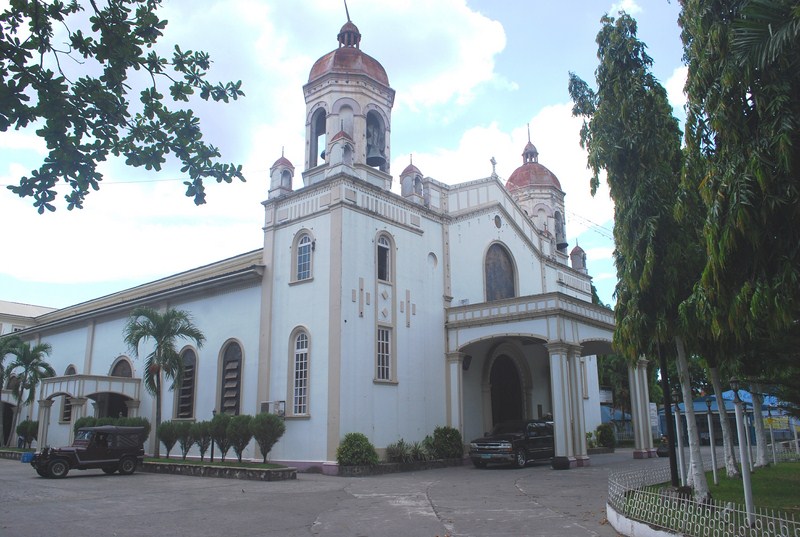
Being an architect, first and foremost, our visit to Taal town brought me, up close and personal, with some of the country’s Spanish and American-era vernacular architecture (churches, ancestral houses, historical buildings, etc.) and the need to preserve them as part of the country’s patrimony so that future generations would live to see and feel them the way we see and feel them today.  I also got to experience, firsthand, the deep religiosity of the Filipinos.

Taal's Basilica of St. Martin of Tours, the largest in the Far East

Taal’s Basilica of St. Martin of Tours, the largest in the Far East

A somewhat scary experience was our overnight stay in the town’s Casa Punzalan, an ancestral house converted into an inn.  We were the only boarders that night and the caretaker left early because he was feeling sick and locked us within for security, with our permission, of course.   That wasn’t the scary part.  The ghosts of Taal’s past being where we were was.   Thus, it was a great relief when the sun came out that morning and the caretaker unlocked the inn’s main entrance.

Jandy in front of the Chapel of Our Lady of Caysasay

Jandy in front of Taal town’s Chapel of Our Lady of Caysasay

The climb up the campsite on the Mt. Makulot’s shoulder, on the other hand, introduced us to the joys of mountaineering and camping.  It also showed me how unfit I was, huffing and puffing, as we went up the mountain, more so when I saw a woman carrying a heavy load of long bamboo stems and a man laden with two backpacks and an icebox full of soft drinks, all slung on a pick.  We never made it, past the campsite, to the peak that day, it already being very late in the day to do so.  However, we did so, four months later, on another climb with Jandy plus four other companions.

Casa Punzalan.  We stayed at the second floor corner room.  We survived the night.

Casa Punzalan. We stayed at the second floor corner room and survived the night here.

Barely three months after this memorable trip, I decided to write about this unique father and son bonding experience and sent the drafts of two articles to Ms. Rosario “Chato” Garcellano, travel editor of the Philippine Daily Inquirer (PDI). On January 20, 2000, a memorable day for me, my first article “Makulot Beckons” came out on newsprint.  I have become a travel writer!!! This was followed three months later, on April 2, by “Taal: The Grande Dame of Batangas.”

Jandy at our room in Casa Punzalan

Jandy at our room in Casa Punzalan

After two more PDI articles, I had a much longer stint as a travel writer for TODAY (now Manila Standard TODAY).  It was during this time that I decided to raise the bar a little higher and add additional feathers on my hat by becoming an author – compiling my four published PDI and 28 TODAY travel articles into a book entitled “A Philippine Odyssey: A Collection of Featured Travel Articles,” published by New Day Publishers in 2005.

A framed copy of "Makulot Beckons" - my first published article (PDI)

A framed copy of “Makulot Beckons” – my first published article (Philippine Daily Inquirer, January 20, 2000).  That’s Jandy on the upper left corner of the article

From all these firsts, came four more travel books on Boracay and Philippine churches (a favorite topic of mine), national shrines and museums; copy editing stints with two publishing houses; development of a travel website (Biyahero: A Philippine Travel Portal, www.biyahero.net) with 3 other friends, my own travel blog (B.L.A.S.T. – Benjie Layug: Adventures of a Savvy Traveler, www.benjielayug.com), more travel writing stints with different newspapers (I’m now with the Business Mirror) and magazines (COLORS, Business Day and 7107 Islands Magazine); lots of media invitations to cover and promote Philippine travel destinations; and now, an urge to travel, here and abroad, when the opportunity presents itself.

My first book “A Philippine Odyssey: A Collection of Featured Travel Articles.”  That's me with daughter Cheska on cover

My first book “A Philippine Odyssey: A Collection of Featured Travel Articles.” That’s me with daughter Cheska on cover

A love for churches awakened by my visit to Taal town inspired me to write this book

A love for old Philippine churches, awakened by my visit to Taal town’s two churches, inspired me to write this book

All these because a concerned father wanted to see his son break out of the prison we call autism.  At such a young age at that time, my son has packed in more adventure than what most people would experience in their lifetime. Today, though still classified as autistic, my wife and I have seen him graduate, one small step at a time, from grade school, high school and, finally, college where he finished two degrees – Multi-media Arts and Tourism Management.  He sometimes joins me in media familiarization tours as my photographer.

With my family at the launching of my fourth book, September 18, 2010, at SMX Convention Center

With my family at the launching of my fourth book, September 18, 2010, at SMX Convention Center

Talking about a life-changing experience, that 3-day moment in time when a father bonded with his son changed my life forever.  Today, Holy Weeks are no longer stay-at-home experiences.