War Remnants Museum (Ho Chi Minh City, Vietnam)

War Remnants Museum

War Remnants Museum

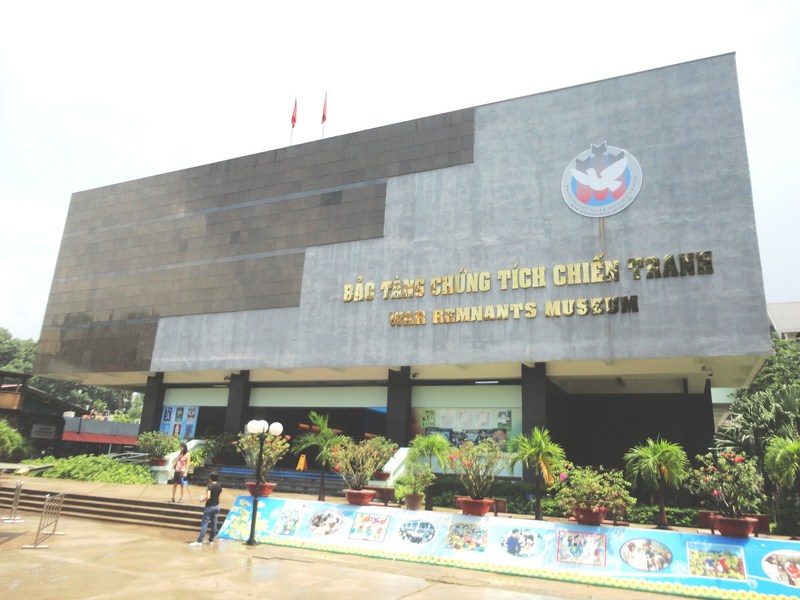
We departed Ben Thanh Market in our van during a driving rain and it was still raining when we arrived at the War Remnants Museum (Bo tàng Chng tích chiến tranh), perhaps the most famous and popular museum in the city.
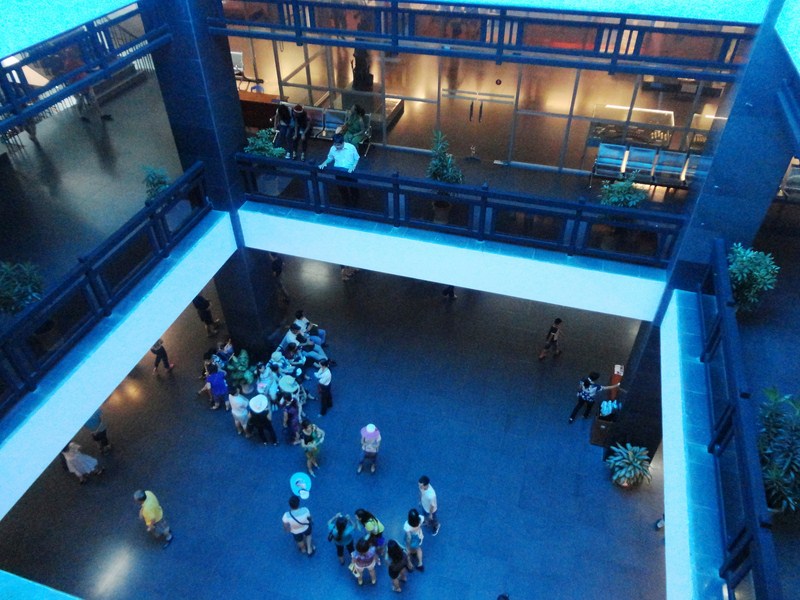
Museum atrium

Museum atrium

The museum, opened to the public on September 4, 1975, attracts approximately half a million visitors every year, about two-thirds of them foreigners.  Previously called the Museum of American War Crimes, the name was altered in 1995 so as not to cause offence to American visitors following the normalization of diplomatic relations with the United States and end of the US embargo the year before.
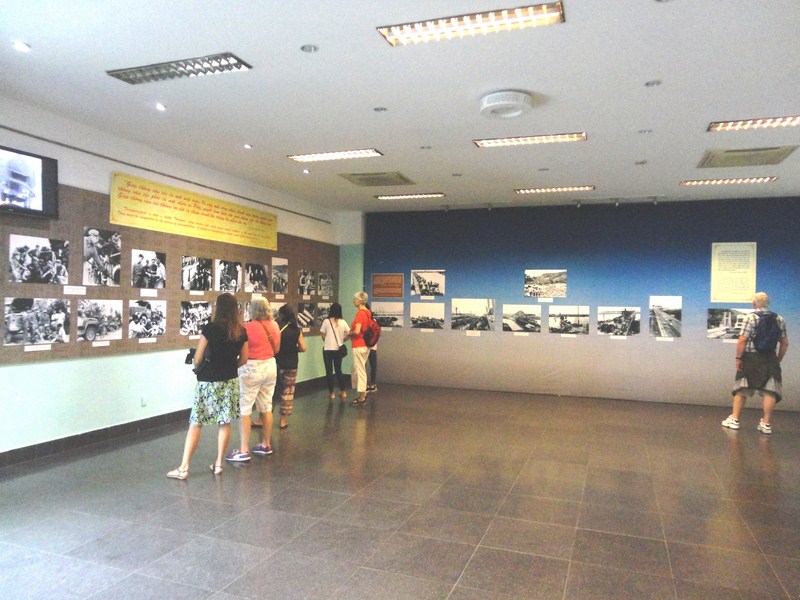
Museum lobby exhibit

Museum lobby exhibit

Comprising a series of themed rooms in several buildings (most in the former austere, concrete 3-storey United States Information Agency building), it primarily contains exhibits relating to the horrific American War (known in the U.S.A. as the Vietnam War), one of the bloodiest wars ever, also known as the second Indochina War, but also includes many exhibits relating to the first Indochina War involving the Vietnamese’  former French colonial masters.
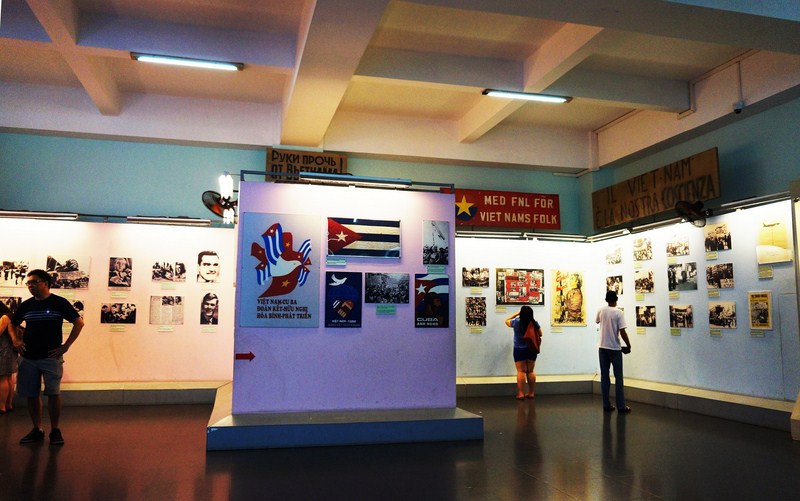
The World People in support of Vietnam's Resistance

The World People in support of Vietnam’s Resistance

The 8 main permanent exhibits and various other special collections are – “International Support for Vietnam in its Resistance” in the ground floor; “Agent Orange Aftermath in the U.S. Aggressive War in Vietnam” and “Aggression War Crimes” at the second floor; and “Historical Truths”, “Requiem,” the “War and Peace Pavilion” and “Agent Orange in the War” at the third floor.  In another building is the “Imprisonment System” (shows the torture methods used in detention camps). Captions are in Vietnamese, English and Japanese.
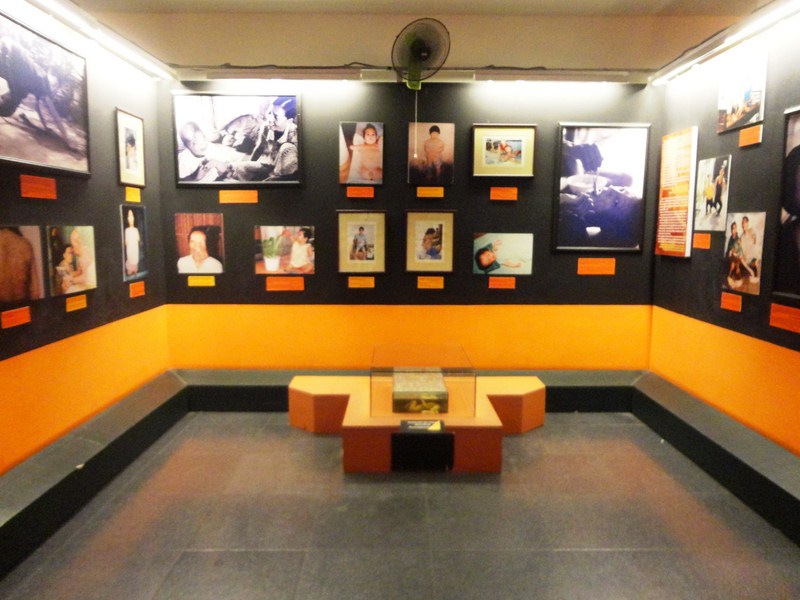
Agent Orange Aftermath in the US Aggressive War in Vietnam

Agent Orange Aftermath in the US Aggressive War in Vietnam

This is also possibly one of the few museums in the world that allows you to take photos of the exhibits inside and outside.  These exhibits took us a few hours to view and I concentrated more on the captions than a lot of the actual pictures. The copies of newspaper clippings are interesting.
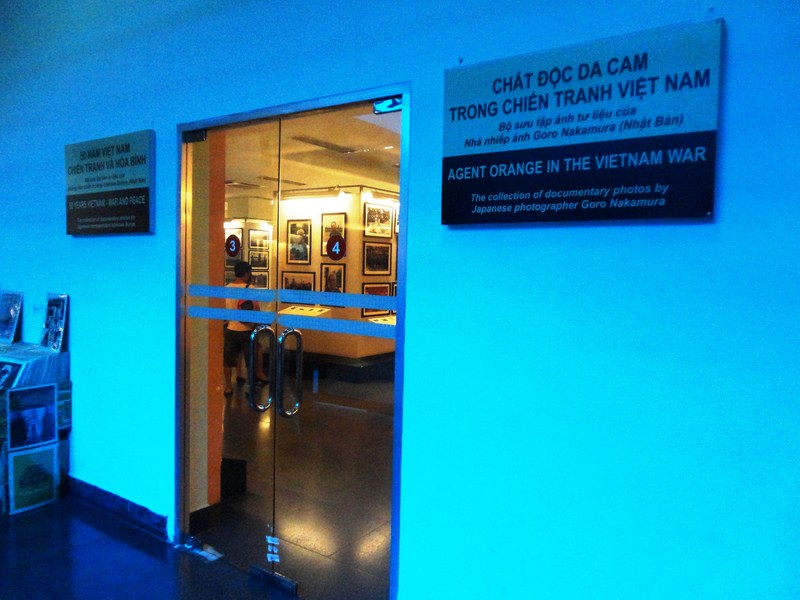
Agent Orange in the Vietnam War Pavilion

Agent Orange in the Vietnam War Pavilion

The “International Support for Vietnam in its Resistance Pavilion” is dedicated to the Vietnam peace movements all over the world, is devoted to a collection of posters and photographs showing international opposition (mostly communist countries such as Cuba, People’s Republic of China, the then Soviet Union, North Korea and prominent Western communist leaders) to the war as well as many old posters from the 1970’s American peace movement proclaiming “Stop the War.”  A powerful exhibit here is the bunch of medals given by U.S. Sgt. William Brown to the Vietnamese people with an apology saying ‘To the people of an united Vietnam, I was wrong, I am sorry.”
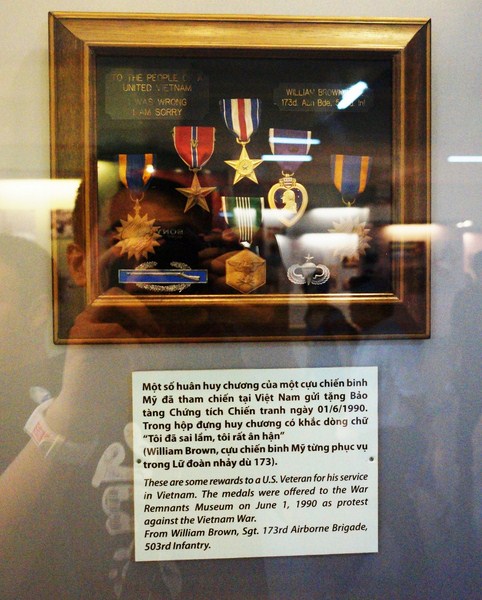
Medals given by U.S. Sgt. William Brown to the Vietnamese people

Medals given by U.S. Sgt. William Brown to the Vietnamese people

The “Agent Orange Aftermath in the U.S. Aggressive War in Vietnam Pavilion” covers the effects of Agent Orange and other chemical defoliant sprays. Prominent displays here include pictures of hideously deformed babies and three pickling jars of preserved human fetuses allegedly deformed by exposure to Agent Orange. They also have a video screening showing its effects on the Americans using chemical weapons during the war as well as highlight how the chemicals still affect the Vietnamese, even today.
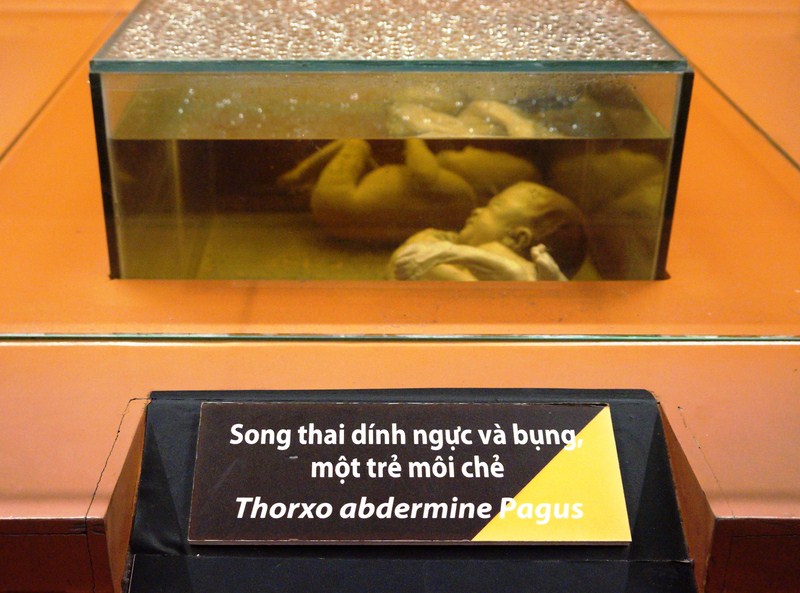
Preserved human fetuses allegedly deformed by exposure to Agent Orange

Preserved human fetuses allegedly deformed by exposure to Agent Orange

The “Aggression War Crimes Pavilion,” a room at the second floor heavily dosed with anti-American propaganda, is a distressing compendium of the horrors of war that shows the mistreatment of civilians during the war through the use of napalm and phosphorus bombs and war atrocities such as the infamous My Lai massacre.   Here, we had the rare chance to see some of the experimental weapons used in the war which were, at one time, military secrets, such as the fléchette, an artillery shell filled with thousands of tiny darts.
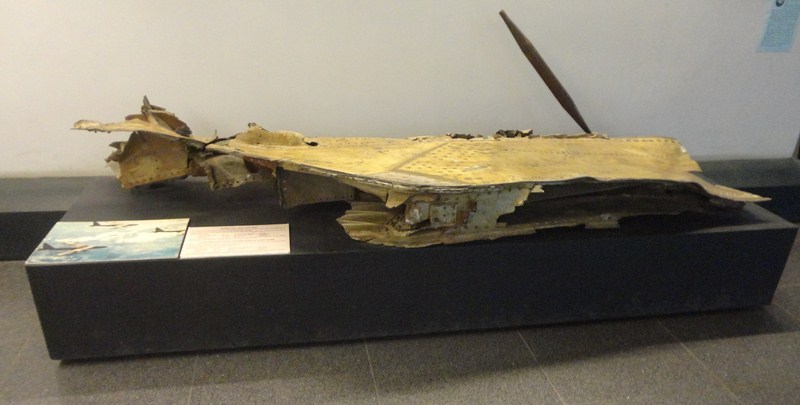
Fragment of the Wreckage of a B-52 Plane

Fragment of the Wreckage of a B-52 Plane

The “Historical Truths Pavilion,” devoted to the causes, origins and processes of aggressive wars, contains photographs, propaganda, news clippings, and signboards geared toward showing the wrongdoings of the U.S. government in the 1960s and 1970s.
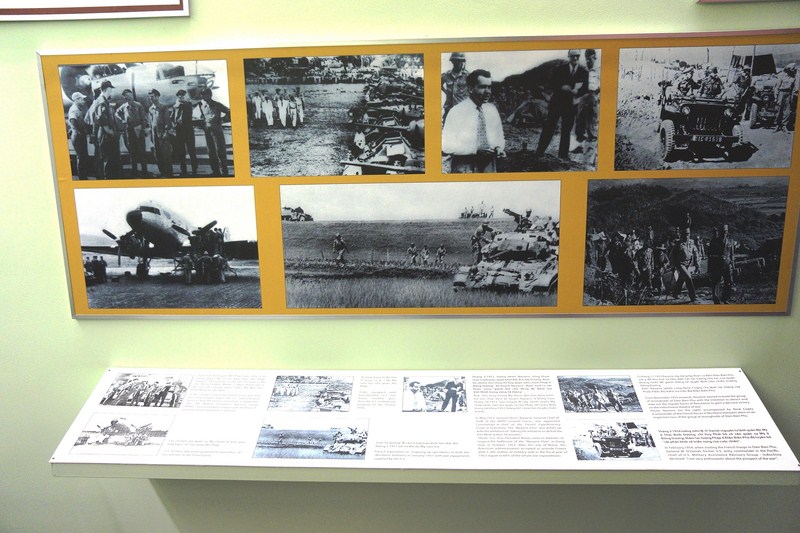
Historical Truths

Historical Truths

The “War and Peace Pavilion” has a collection of colorful paintings submitted by schoolchildren from across Vietnam in response to a contest for pictures on the themes of war and peace and the healing of the wounds of war, is the most cheerful exhibit in the building.  Some pictures are sad, others happy, but it does give you a sense of hope for the future. This somewhat upbeat and really uplifiting display provides some respite from the grizzly museum displays on the horrors of war. Children and adults alike can also draw on the free paper and pastels given out specifically to relieve stress.
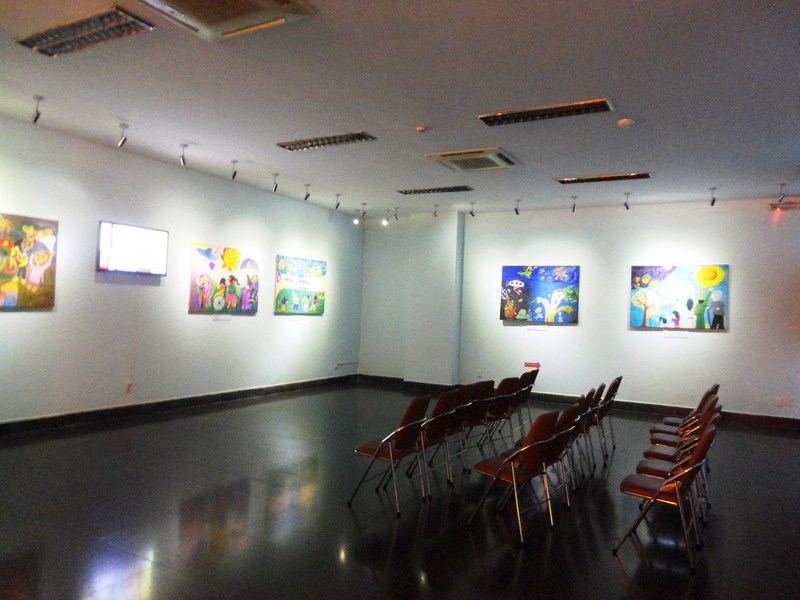
Vietnam - War and Peace

Vietnam – War and Peace

The “Agent Orange in the War Pavilion” highlights America’s decision to use chemical weapons, giving emphasis to chemical weapon called “Agent Orange.” Dioxins and dioxin-like compounds were contained in 75 million liters of toxic chemicals which  were dumped across the country including 44 million liters of the defoliant spray Agent Orange.
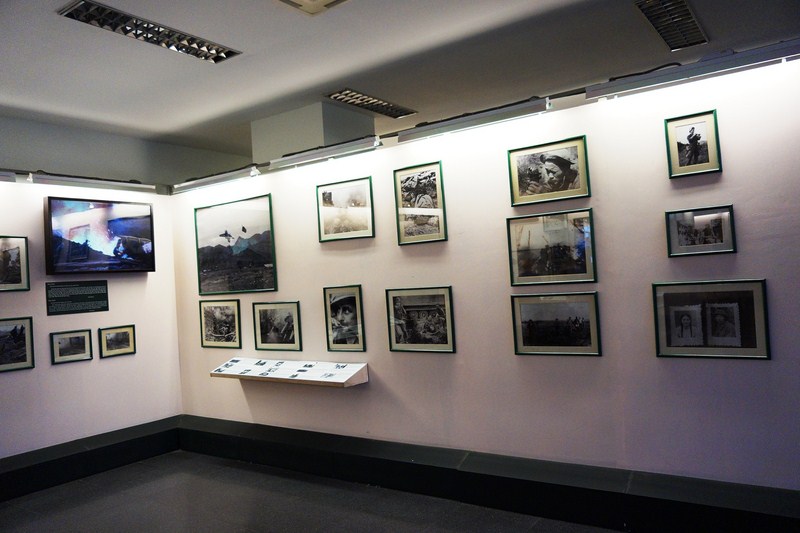
Requiem

Requiem

The excellent “Requiem Pavilion” houses a powerful and striking collection of assorted iconic photographs (some Pulitzer Prize-winning) and photo montages taken by 134 frontline journalists and photographers of 11 nationalities, on both sides, who were killed during the course of the conflict and compiled by legendary war photographer Tim Page.
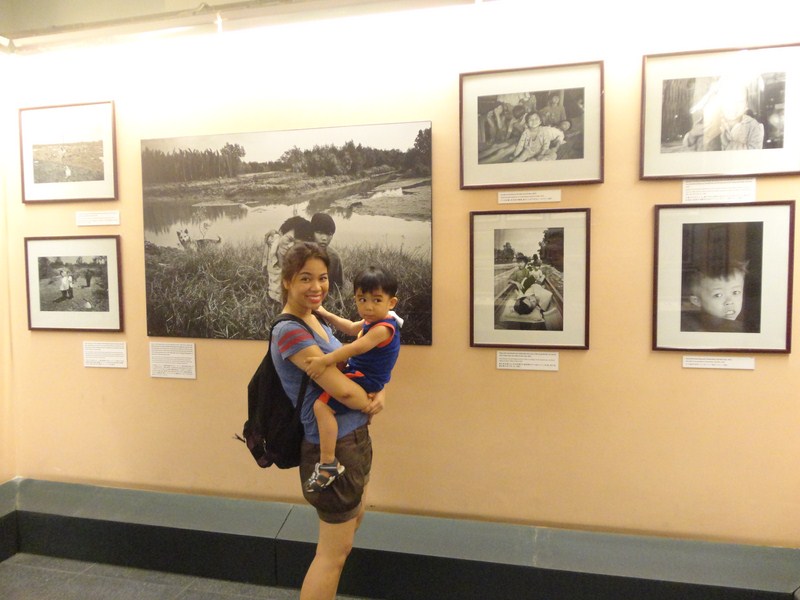
Ckheska and Kyle at Requiem Exhibit

Ckheska and Kyle at Requiem Exhibit

This moving tribute includes works by Larry Burrows and Life Magazine’s Robert Capa who died on May 25,1954 stepping on a land mine. Pictures and short biographies of the photographers are by their featured photos.
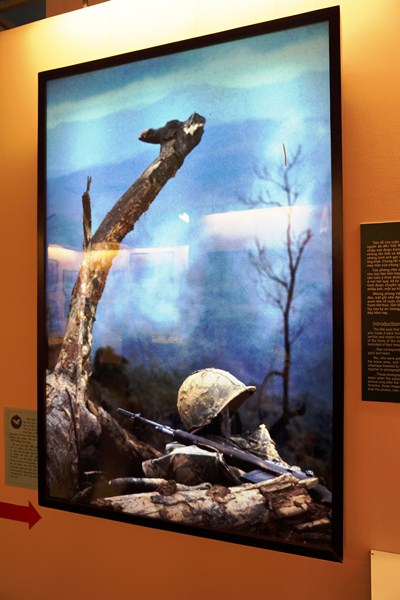
Life Magazine cover photo taken by photographer Larry Burrows near Khe Sanh

Life Magazine cover photo taken by photographer Larry Burrows near Khe Sanh

This incredible collection of black and white photos (in some cases, very graphic that will distress viewers) from the American conflict is heart-wrenching and shows the deep suffering endured by the Vietnamese during the war.  Most photographs are captioned with “His/her last photograph” or “The last sighting of them as they set off for a VC checkpoint.” The most moving, however, was “A chaplain reading their last rites.”
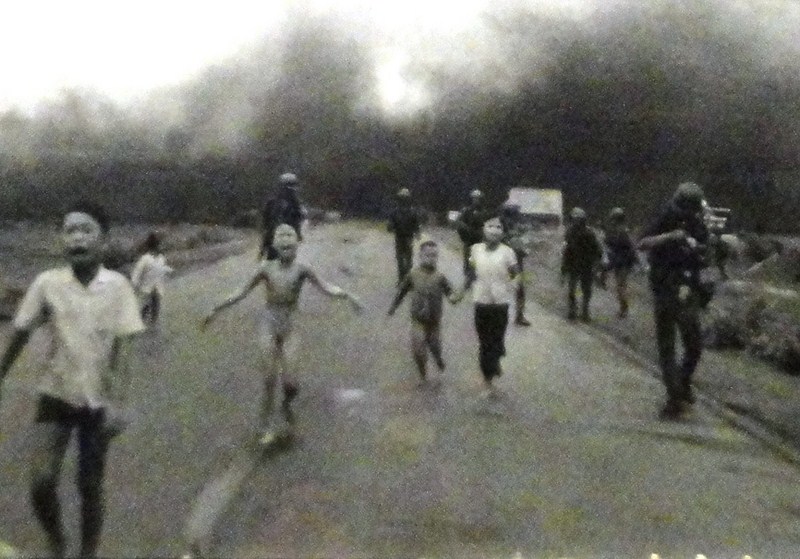
June 8, 1972 photo of napalm girl taken by Huynh Cong Ut

June 8, 1972 photo of napalm girl taken by Huynh Cong Ut

A photo that caught my attention was that of a mother fleeing away from her enemies with her children. Another one that struck me was the famous Pulitzer Prize winning photo of Huynh Cong Ut of a girl fleeing from the scene, being injured by the napalm bomb.
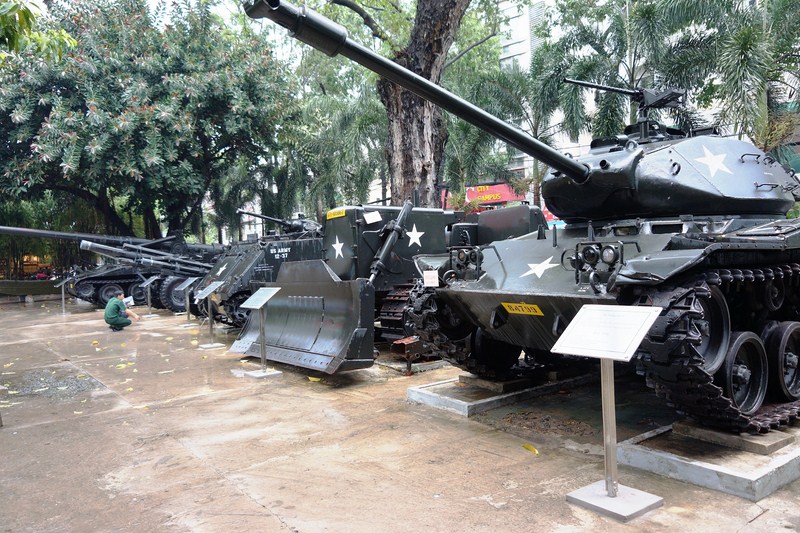
The Outdoor Exhibit

The Outdoor Exhibit

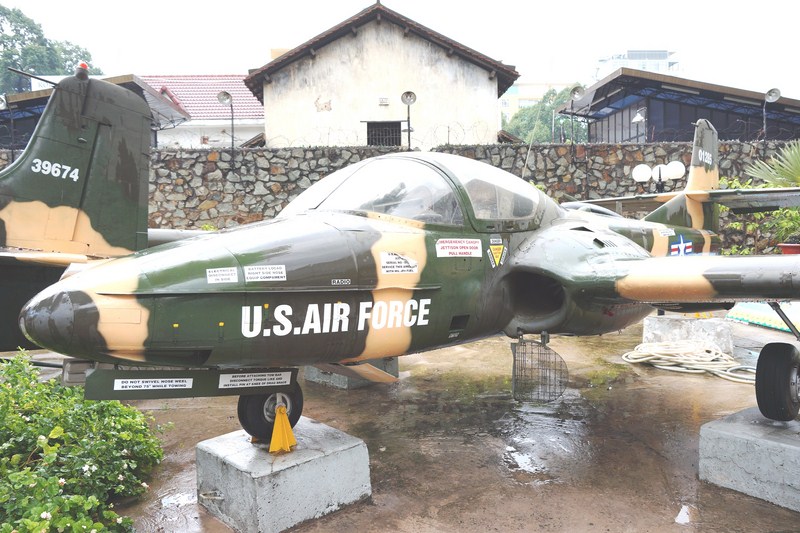
The rain had stopped and the sun was already shining when we finished our tour of the indoor exhibits, allowing us the opportunity to observe, up close, impressive state-of-the-art period military equipment placed within a now enlarged walled yard. The military equipment includes a UH-1 “Huey” helicopter, a BLU-82 “Daisy Cutter” bomb, M48 Patton tank, a renovated Douglas A-1 Skyraider attack bomber, an F-5A fighter and an A-37 Dragonfly attack bomber.
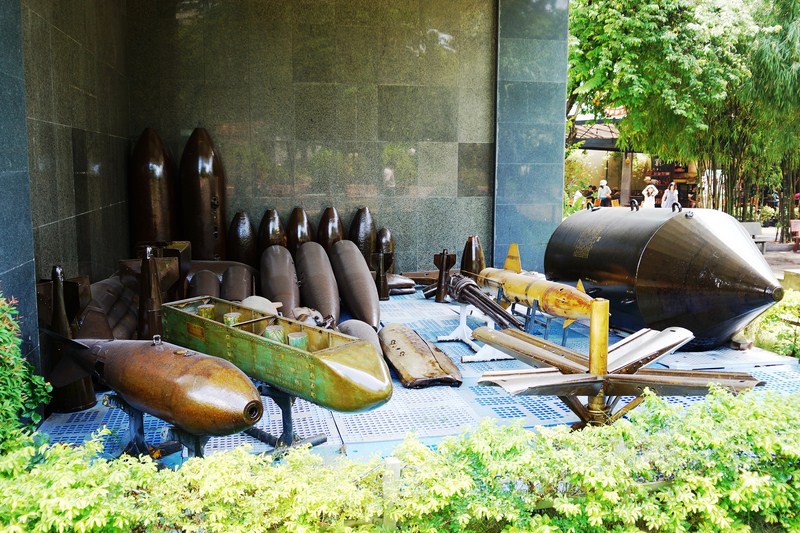
Defused ordnance

Defused ordnance

The last two are captured former South Vietnamese Air Force (VNAF) aircraft. Stored in the corner of the yard  are a ghoulish collection of unexploded ordnance , with their charges and/or fuses removed. When they called this place the War Remnants Museum, they weren’t joking.
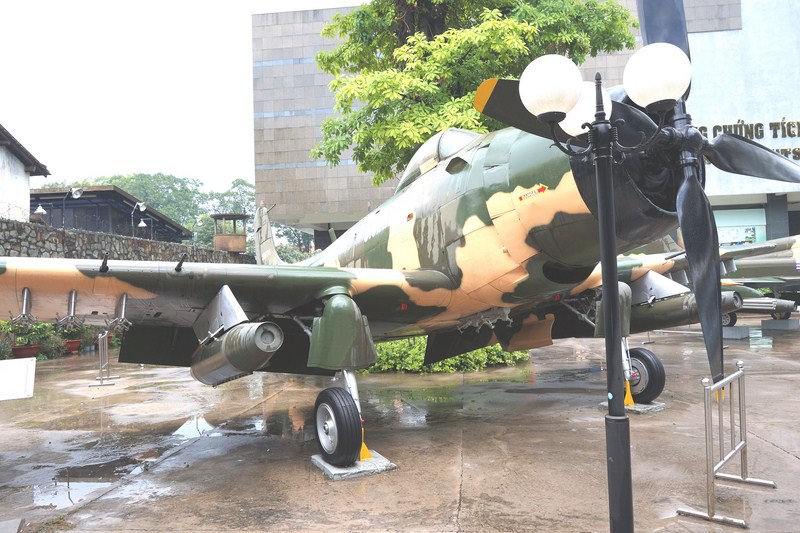
A-1 Skyraider
A-1 Skyraider

A-37 Fighter Bomber

A-37 Fighter Bomber

One corner of the grounds is devoted to the notorious French and South Vietnamese prisons on the infamous prison islands of Phu Quoc and Con Son near the Mekong Delta. Displays include the guillotine (that most iconic of French punishment devices) pictures, torture tools, and a grisly mock-up of the notoriously gruesome and inhumane “tiger cages” (with eerie wax models of prisoners sitting inside) used by the South Vietnamese government to house captured regular NVA prisoners-of-war, NLF (Vietcong) guerillas and political prisoners. The latter measures 2.7 m. x 1.5 m. x 3 m. and between 5 to14 prisoners were kept in each cage during the hot season, while only one or two were kept during the winter season. 
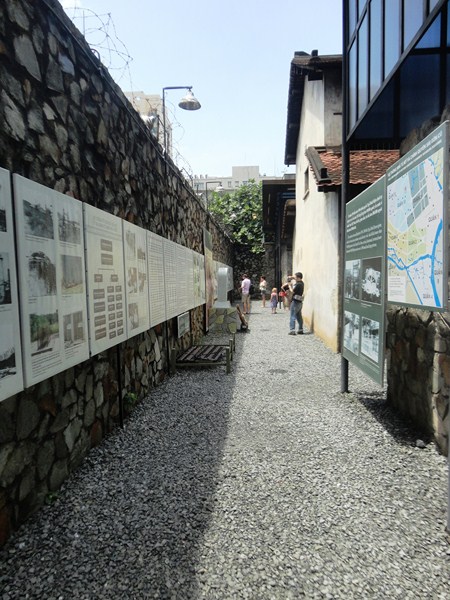
The Imprisonment System

The Imprisonment System

The famous guillotine, brought to Vietnam by the French in 1911, was used in a jail along Ly Tu Trong Street. During the Vietnam War, it was transported to all of the provinces to decapitate Vietnamese patriots. Mr Hoang Le Kha, member of the Provincial Committee of the Vietnamese Workers’ Party in Tay Ninh province, was the last man executed in 1960.
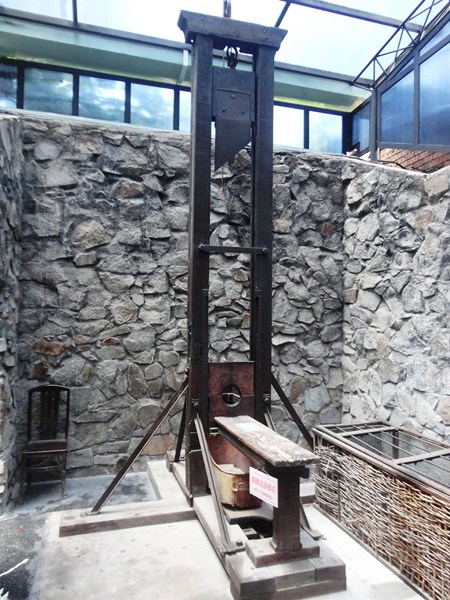
The guillotine

The guillotine

A visit to the War Remnants Museum is a quite sobering experience, especially for people like me where war seemed so far away, making me value the peace that we have now. They make no attempt to sugar-coat what they have to say here – man’s inhumanity to man. This humbling and sorrowful tribute to the thousands of men, woman, and children that suffered death and injury was successful in driving home the fact that wars are brutal and that innocent civilians are the biggest losers. Their pains deserve to be remembered.
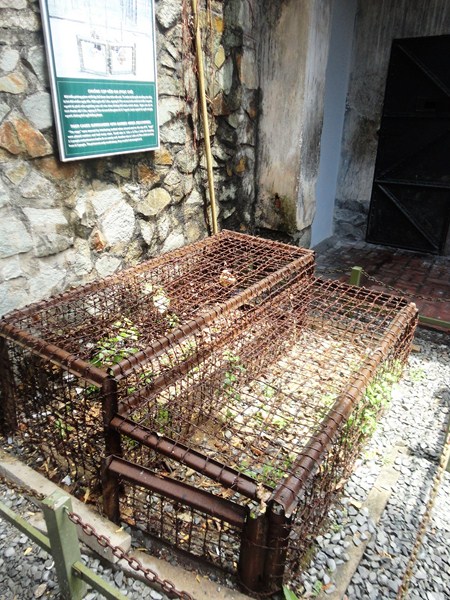
Mock up of a tiger cage

Mock up of a tiger cage

It’s certainly not a fun place to go to but an eye opener all the same.  Much of what is on display isn’t easy to stomach, but that’s the point. Nevertheless, I would perhaps think twice about bringing children here.  The prison cells can be especially scary for the little ones.   Americans will probably say that it is extremely biased as its displays do tell the story from an anti-American perspective (not knowing that apparently 95% of the material came from the US archives) and it might be true. However, this powerful and politically charged testimony of the Vietnamese side constantly and subconsciously reminds us of the Winston Churchill’s idiom that “History is written by the victors.”
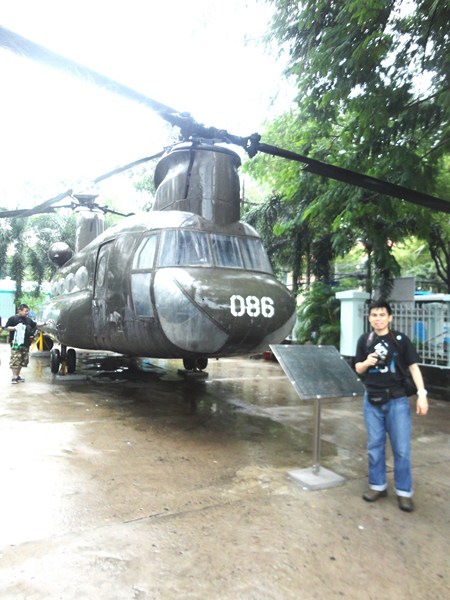
Jandy beside a CH-47 Chinook

Jandy beside a CH-47 Chinook

Disturbing, disgusting and tragic, the grisly photos of decapitated bodies and people begging for their lives, solemn, grim reminders of the cruelty of war, will open your eyes and churn your stomach.  Still, I was still very glad that I went there.  Their exhibits are compulsory viewing for all politicians worldwide. The museum gets busy in late afternoon as tours to the Cu Chi Tunnels (another good view of the Vietnam War),finish there. Avoid the crowds by going earlier in the day.
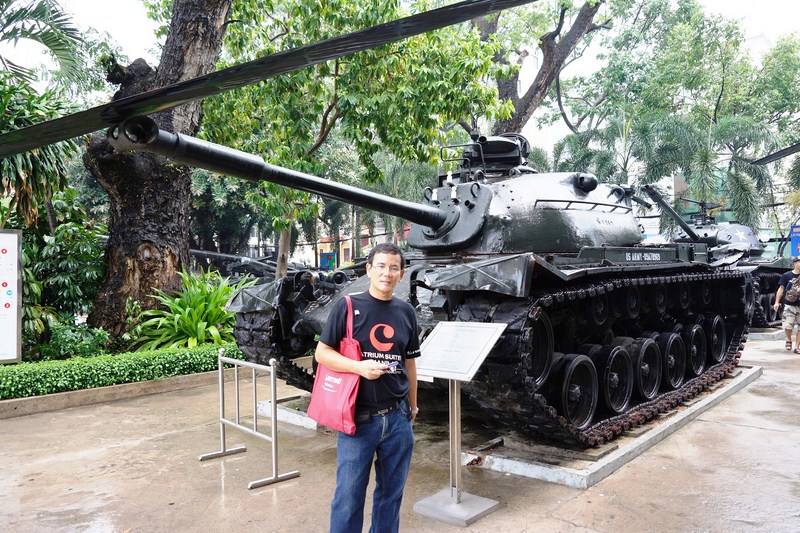
The author beside an M-48 A3 Tank

The author beside an M-48 A3 Tank

War Remnants Museum: 28 Võ Văn Tần, District 3, Hồ Chí Minh, Vietnam.  Tel: (84-4) 39302112 and (84-8) 39306325.  E-mail: warrmhcm@gmail.com.  Website: www.warremnantsmuseum.com.  Admission: 15,000 VND.  Children below 12 years old are free and discounts are offered for some categories of people. Open Tuesdays to Sundays, 7.30 AM- 12 noon & 1:30-5 PM. Last admission is 4:30 PM.

How to Get Thereif you are not within walking distance, there are different buses that go past the museum, . Bus Route No. 14: BX Eastern – 3/2 – BX West. Bus Route No. 28: Ben Thanh Market Cho Xuan Thoi Thuong Bus Route No. 06: Cholon BX – University of Agriculture and Forestry
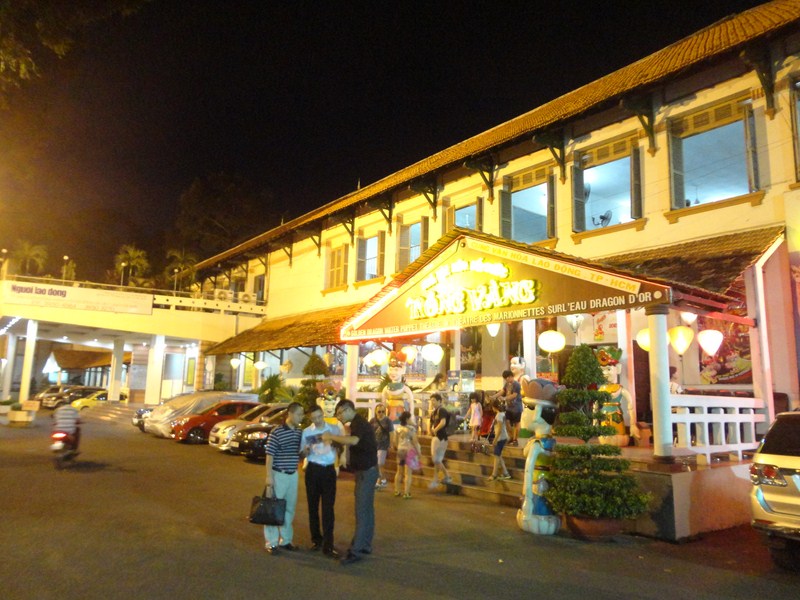
Golden Dragon Water Puppet Theater (Ho Chi Minh City, Vietnam)

Golden Dragon Water Puppet Theater

Golden Dragon Water Puppet Theater

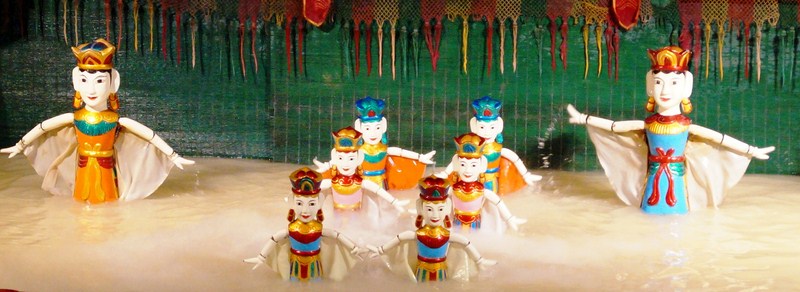
Upon our arrival at the Elios Hotel in the Pham Ngu Lao area, I checked out pamphlets and advertisements for various tourist activities in the city. Among the pamphlets is one for the Golden Dragon Water Puppet Theater, the pre-eminent water puppet theater in Ho Chi Minh City, which outlandishly claims that you “haven’t really been to Vietnam until you’ve seen a water puppet show.” This 50-minute long show features marionette puppets in water.

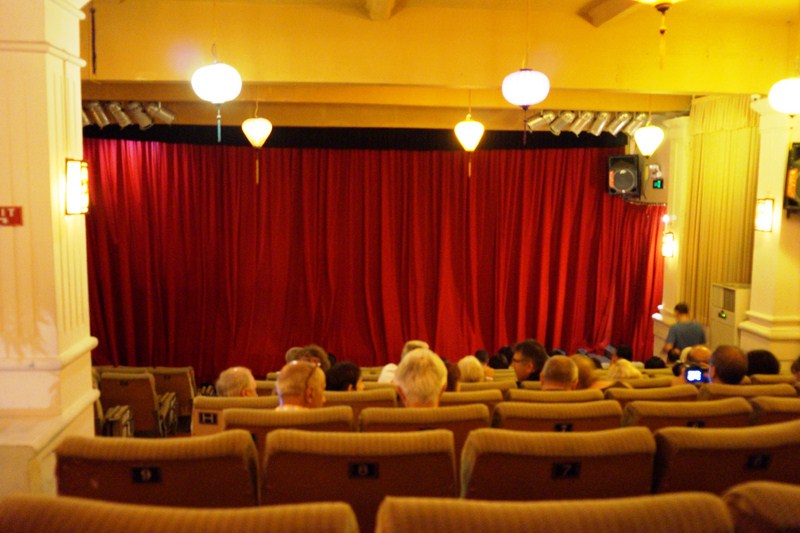
The theater seating area

The theater seating area

The exact time when water puppetry (múa ri nước), began in Vietnam is not known.  However, the oldest record mentioning water puppetry is found on an inscription on a stone stele called Sùng Thiện Diên Linh, dating from 1121, which was found in Đọi Sơn Pagoda, Duy Tiên District, Hà Nam Province, about 50 kms. from Hanoi. It eulogized the merits of King Ly Nhan Tong and describes a scene: “A golden tortoise, with three mountains on its shell, was seen on the rippling surface of the water. It showed both its carapace and four legs… the cavern’s entrance opened and fairies in the play appeared…Flocks of precious birds and herds of animals sang and danced…”
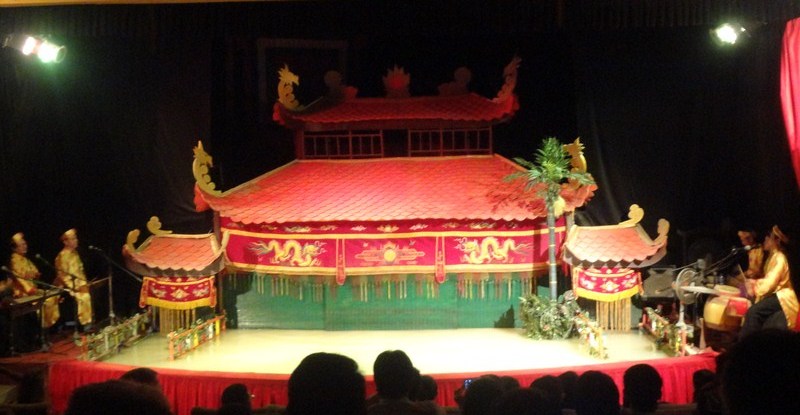
The water stage

The water stage

From the 11th to 14th centuries, after a period of rapid development, the art of water puppetry escaped the confines of the royal palaces of the Le and Nguyen dynasties and began showing up at village festivals and ceremonies in the Red River Delta, thus jump-starting the development of the country’s traditional stage arts. This art form, unique to Northern Vietnam, was first displayed in Hanoi in 1958 and, in 1973, the first state-run puppetry troop was established to serve the public audience.  In 1984, as a result of normalized relations with the West, Vietnamese water puppetry was introduced to the world stage for the first time (in France).

Waiting for the show to start

Waiting for the show to start

During the early 1990s, the country’s three foremost companies, the National Puppet Theatre (Nhà hát Múa ri Trung Ương), the municipal Thăng Long Puppet Company (Nhà hát Múa ri Thăng Long) of Hanoi and the Hồ Chí Minh City Puppet Company (Đoàn Ngh thut Múa ri Thành Ph H Chí Minh) gained increased international attention. Today, the main venues in Vietnam are the Thăng Long Water Puppet Theatre in Hanoi and the Golden Dragon Water Puppet Theater in Saigon.

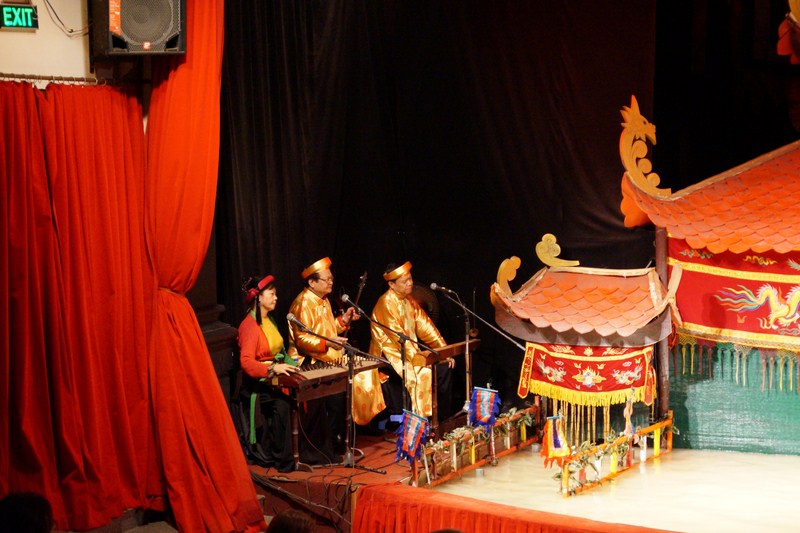
Musicians and singers on the left

Musicians and singers on the left

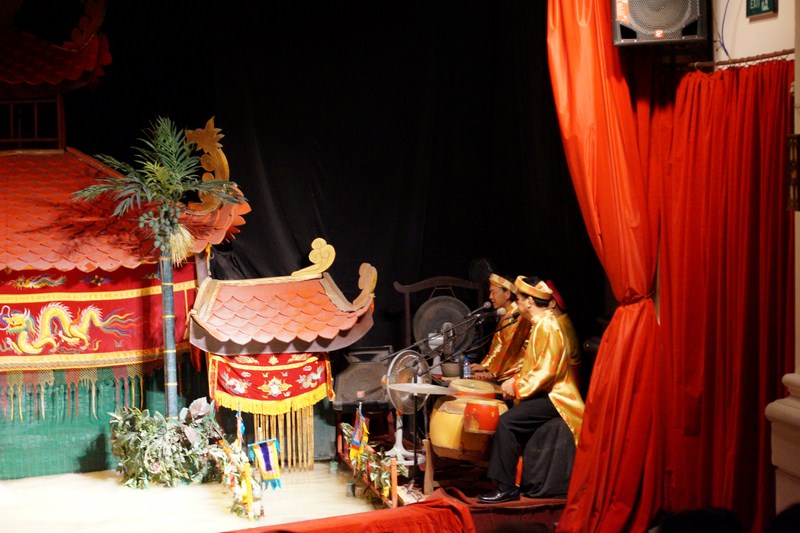
Musicians and singers on the right

Musicians and singers on the right

After a short rest at our hotel and lunch at a nearby noodle house, Grace and I checked out a nearby travel agency where we booked ourselves for the last 7:45 PM show (other show times are 5 PM and 6:30 PM).  The regular admission per person at the ticket booth is US$7.50 and since the theater hosts three shows a day, obtaining tickets is not difficult. However, to facilitate things we paid the travel agent US$9.00 per person which included our taxi fare going there.

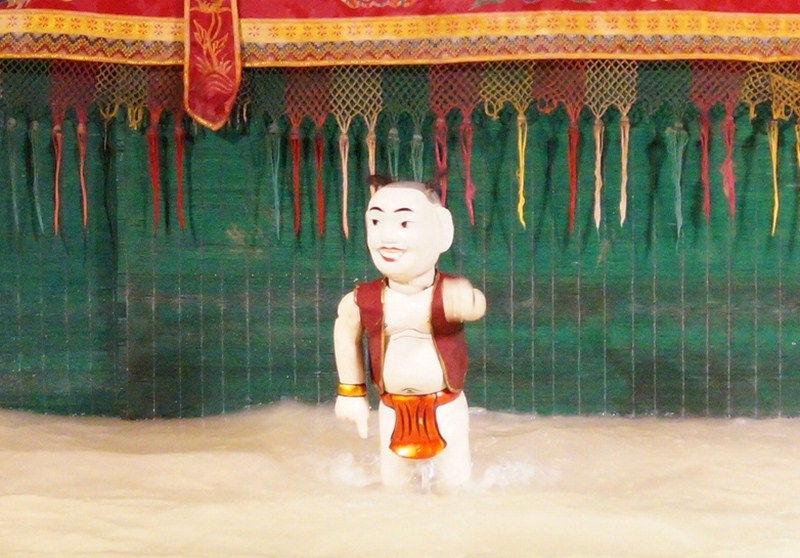
Uncle Teu

Uncle Teu – the master of ceremonies

We arrived at the theater, which is just a short distance from the Reunification Palace in the Labour Cultural House, half an hour before the start of the show.  The red velvet-covered auditorium seats around 200 visitors but, though we weren’t in the first few rows (which is definitely a splash zone), we were seated at the back rows which was quite far from the stage. Luckily, the theater wasn’t fully booked that night and, minutes before the start of the show, we were allowed to transfer to the middle row.

Water Puppet Show (19)

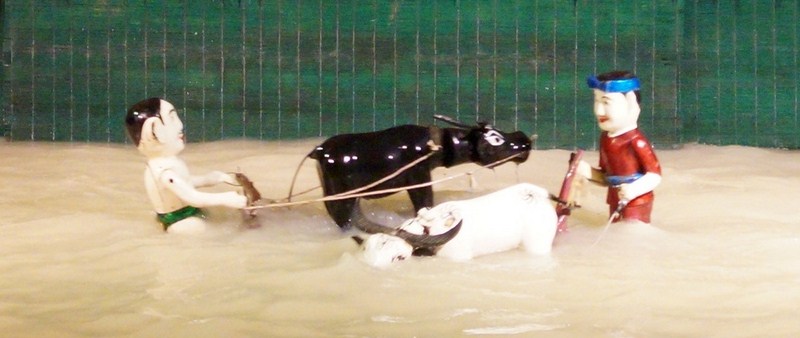
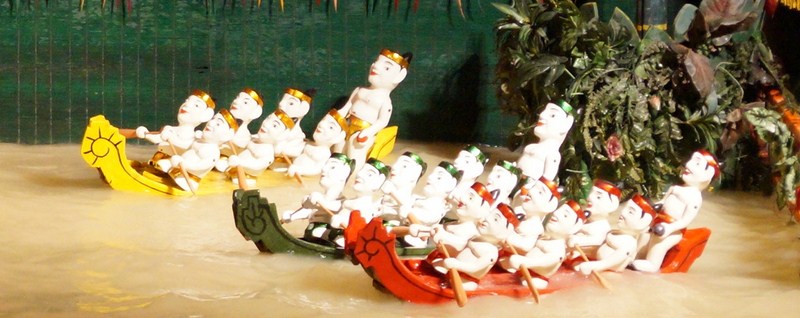
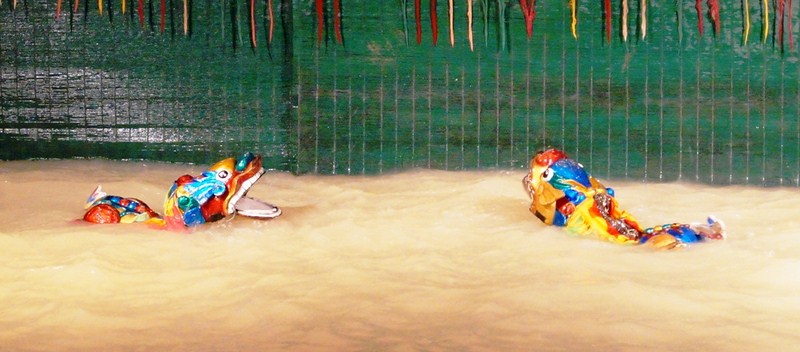
The show, with no intermission, was performed entirely in Vietnamese.  It is about the ancient origins of Vietnam and its rural upbringings, with a splash of the mythical goddesses, dragons and talking fish that go along with the traditional stories.

Water Puppet Show (132)

The orchestra of this modern theater consisted of professional musicians and singers, sitting in their traditional au dais, are set off to the left and right sides of the stage. They play traditional musical instruments like drums, clarinets, cymbals, Chinese guitars, bamboo flutes, zithers, two-stringed violins and, the most noteworthy instrument of them all, a monochord with a single string which can create wonderful tune. The singers not only accompany the orchestra but also converse with puppets, especially with the humorous and intelligent puppet Uncle Tễu which functions as the master of ceremonies. The show is split into around 12 acts, each telling a separate story.

Water Puppet Show (141)

As in other traditional Vietnamese performing arts such as chèo (popular opera), tung (classical opera) and ci lương (renovated opera), the program started with a boisterous music composition to attract attention and create a joyful atmosphere.  The colorful puppets danced and performed numerous interesting items on the shimmering water surface of the water stage in the theater, accompanied by animated music and singing. They even performed acrobatics, spectacular acts which cannot be done by modern robots. We saw no puppeteer, no machines, instruments or controlling strings and poles. By grandson Kyle was spellbound by the performance.

Water Puppet Show (146)

A lot of the scenes were easy to understand, even for non-Vietnamese speakers like me, but there were scenes that were quite hard to follow.  Sometimes, an entire act finished and I only had only a slight idea of what happened. I can understand why some people would dislike the show. However, this traditional but highly developed Vietnamese art form, handed down for nearly 1,000 years, is full of joy, lighting and colors, myriad charms and shocking surprises and is enjoyable to watch.  Watching it, we immediately experienced the boisterous and joyful atmosphere of a real folk festival. The jubilant and sweet puppets particularly enchanted us with their hilarious games. This is the power which can only be found in a water puppet.

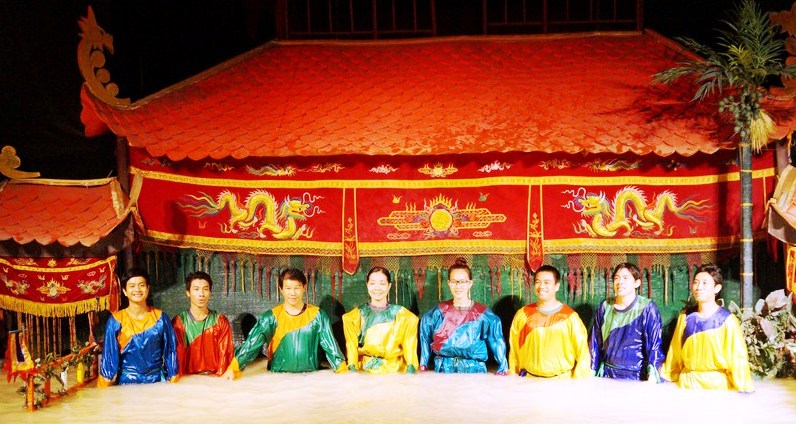
The puppeteers

The puppeteers

Though we can watch the water puppet show on VCDs, DVDs, television programs or on YouTube, none of these can replace the real live performance in which we sat near a sparkling water surface. The handling of the water puppets was ingenious and the puppet’s voice actors are truly skilled and multi-talented.  Both contributed to a fascinating performance. Most shows do get pretty full so, to get the best seats in the house, show up early. To be less confused, read the pamphlet which is distributed outside the theater.  It briefly explains what each scene is about.

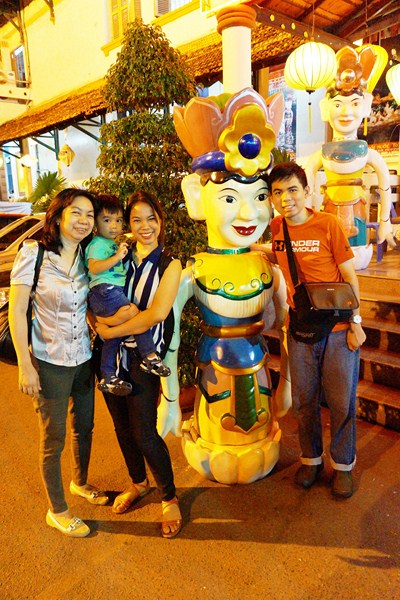
Grace, Kyle, Cheska and Jandy

Grace, Kyle, Cheska and Jandy

Golden Dragon Water Puppet Theater: 55B Nguyen Thi Minh Khai St., Ben Thanh Ward, District 1, Ho Chi Minh City, Vietnam. Tel: +84 8 3930 2196(booking office) and (84) 0913874808.  Email: nhahatrongvang@gmail.com. Website: www.goldendragontheatre.com. Daytime performances are by special arrangement.

Ho Chi Minh City to Phnom Penh Bus Trip

After our Huyen Sy Church visit, we returned to Elios Hotel to pick up our luggage. The previous day, Violet was able to book all of us on  an airconditioned Sorya 168 Bus from Ho Chi Minh City to Phnom Penh for US$9 each. The travel agency where we booked our bus was along Pham Ngu Lao St. where our hotel was located and it was just a short walk away.  Upon arrival, we were all picked up by a van and brought to our waiting Hyundai bus.

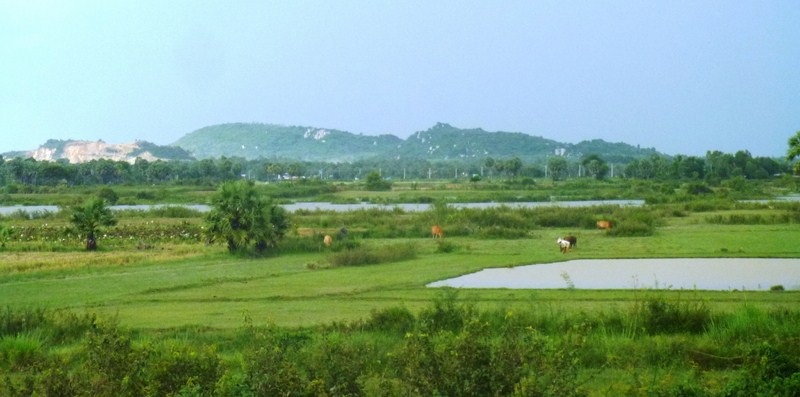
Rural scene along the route

Rural scene along the route

We all occupied a row of reclinable, side-by-side bucket seats with armrests, stored our hand carried bags at overhead racks and our large luggage at the back (though there was a huge baggage storage compartment at the side of the bus, below the passenger deck).

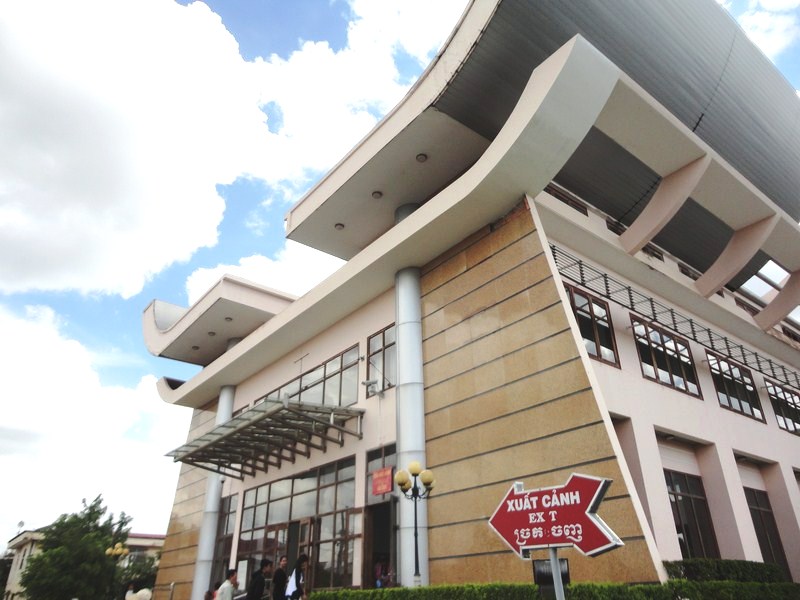
Moc Bai Border Gate (Vietnam)

Moc Bai Border Gate (Vietnam)

Our bus left the station by 12 noon.  We were in for a long 285-km. (177 mi.)/6-7-hr. trip.   As soon as we left, the bus steward started collecting our passports as well as of other passengers bound for Phnom Penh. Naturally, I did not like this idea of giving away our passports to a stranger but looking around, I noticed that this was normal and routine. The steward was to hold on to it within the duration of the trip up to the Vietnam-Cambodia border where he will hand these over to the Vietnamese immigration officer for the stamping of the exit date.

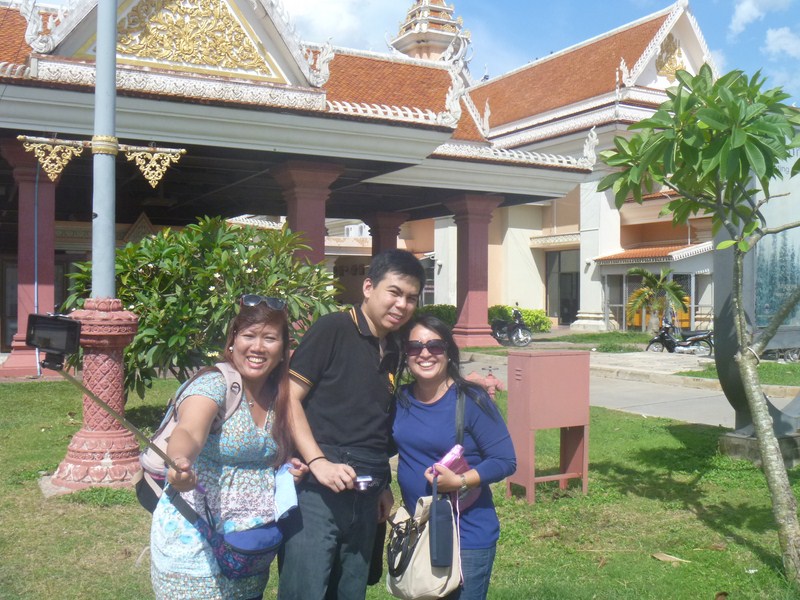
Bavet Border Gate (Cambodia)

Bavet Border Gate (Cambodia)

After a 2.5 hour (70 km.) trip along the National Highway 22 (the Vietnam section of the Trans-Asia Highway) through Cu Chi, we reached the Moc Bai border gate in Tây Ninh Province and we all got off from the bus and entered a building where the Vietnam immigration passport checkpoint is located.  Here, our passports were stamped with the exit date. We didn’t wait a long time.

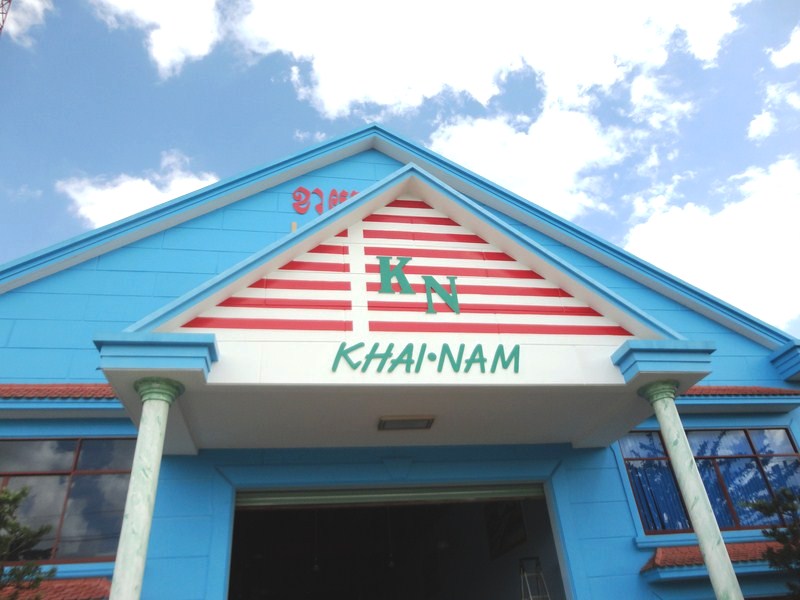
Khai-Nam

Khai-Nam

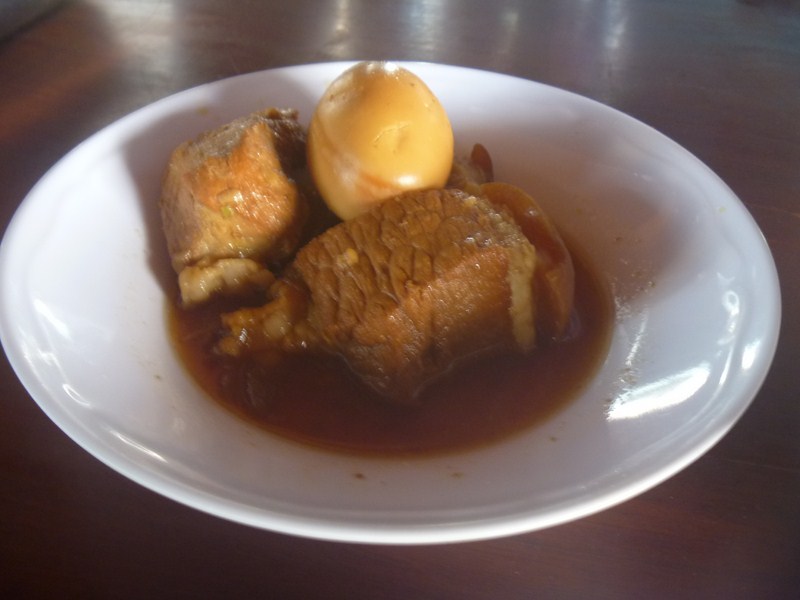
Caramelized pork and eggs.

Caramelized pork and eggs.

Fried chicken rice

Fried chicken rice

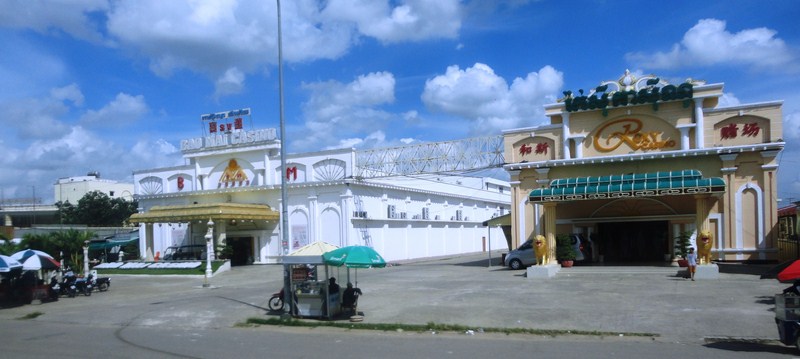
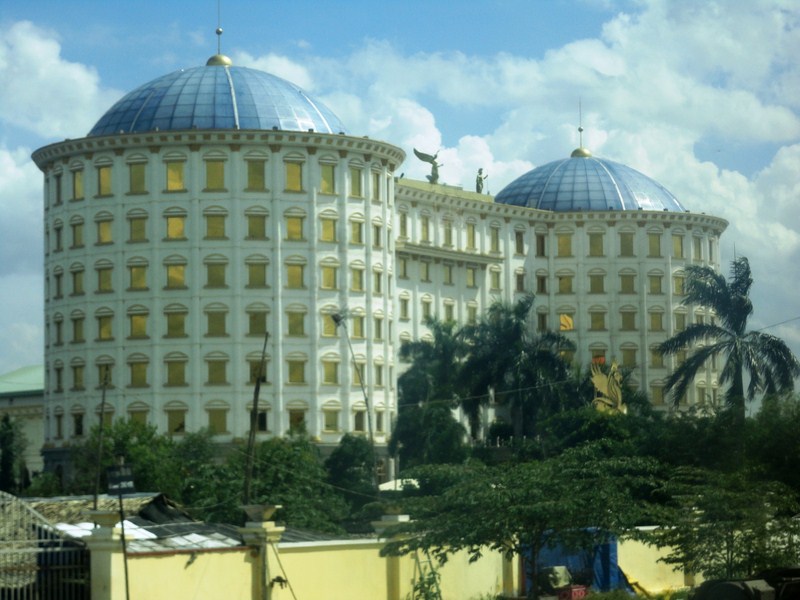
From the Moc Bai border gate, we again boarded our bus and, upon reaching the Cambodian border, alighted again upon reaching the Bavet border gate at  Svay Rieng. Bavet is one of the “special economic zones” (SEZ) of Cambodia, with established textile industries, bicycles factories plus 10 to 12 big and small casinos (Bao Mai Casino,  Roxy Casino, Crown Bavet Casino, Le Macau Casino-Hotel, Titan King Casino, etc.) attended by Vietnamese.

The small Bao Mai Casino & Roxy Casino ,,,,

The small Bao Mai Casino & Roxy Casino ,,,,

....... and the huge Titan King Casino

……. and the huge Titan King Casino

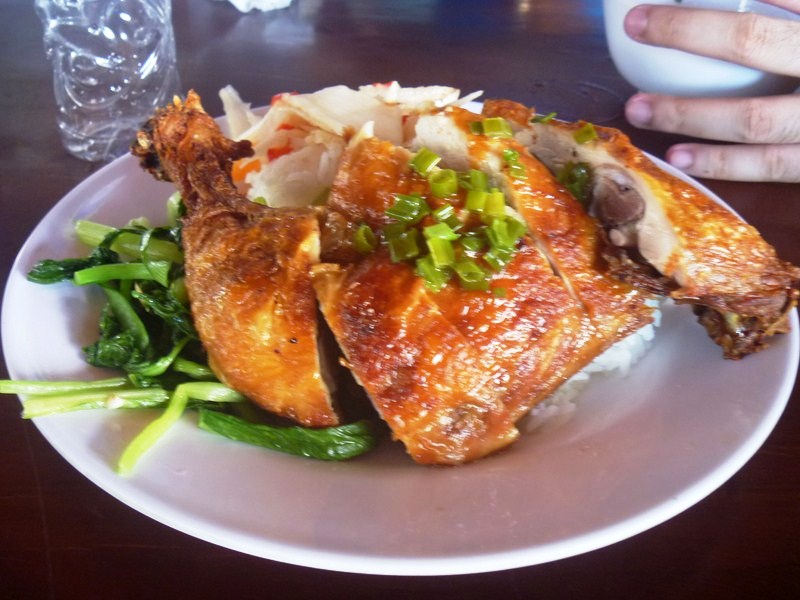
After clearing with Cambodia immigration, we again boarded our bus and traveled 1 or 2 kms. before making a 30-min. stopover for a late lunch at a cafeteria called Khai-nam.  A meal here costs US$2 (yes they accept US dollars as well as the Vietnamese dong and Cambodian riel).  Back at our bus, our passports were finally returned to us by the steward.

Roll-On Roll-Off ferry

Roll-On Roll-Off ferry

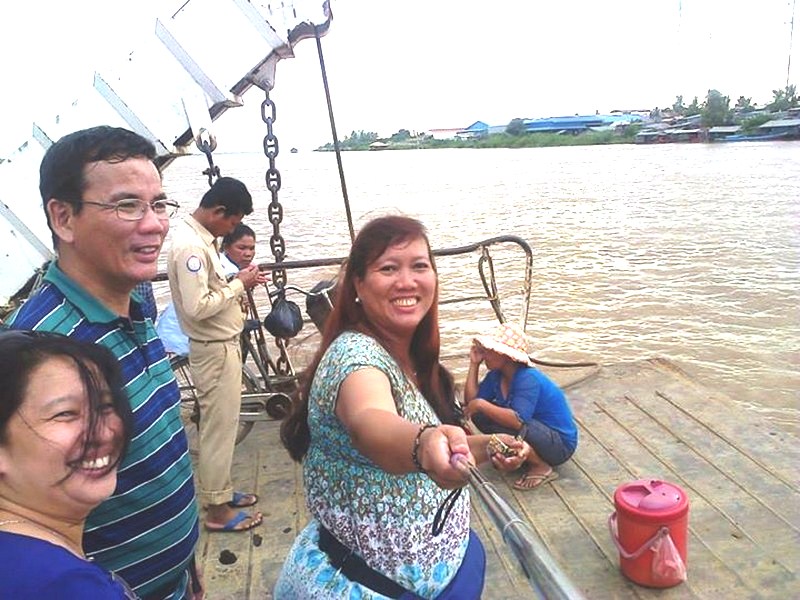
Enjoying the ferry crossing

Enjoying the ferry crossing

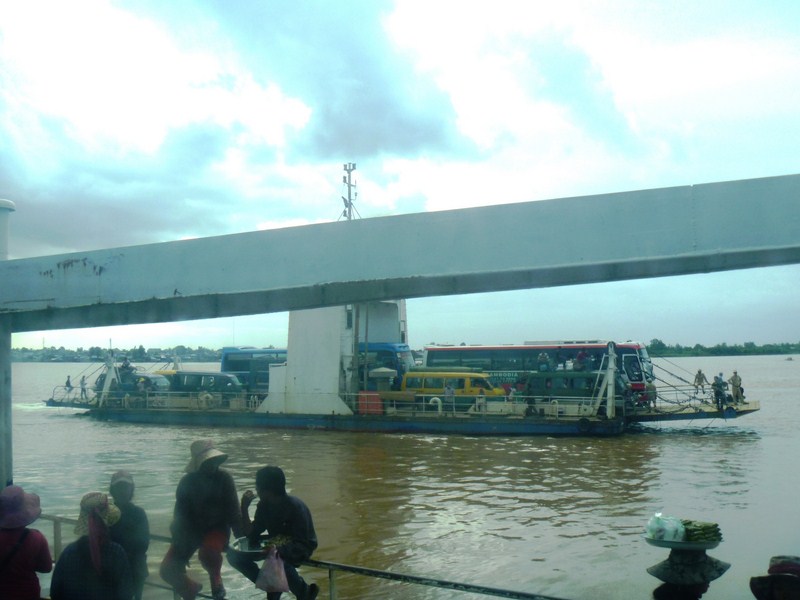
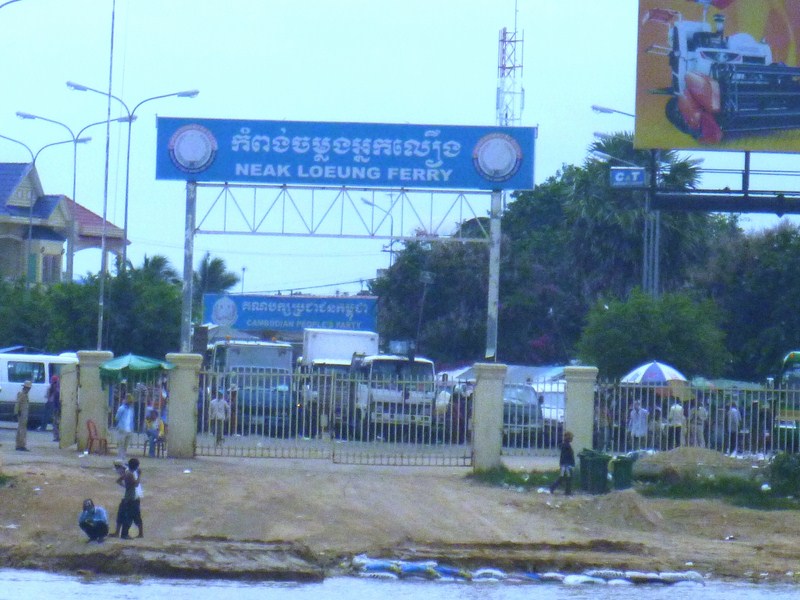
We still had a long 170-km. drive to get to Phnom Penh and the trip was uneventful save for the occasional downpour and  the roll-on-roll-off ferry crossing at Neak Loeung where our bus crossed the Mekong River. As the traffic was flowing smoothly, our bus got to board the ferry in less than 15 minutes.  We were lucky as there are times when there are many vehicles wanting to cross the river and a traffic jam occurs. The wait can sometimes stretch up to 2 hours. The crossing itself took less than 10 minutes.

Neak Loeung Ferry Terminal

Neak Loeung Ferry Terminal

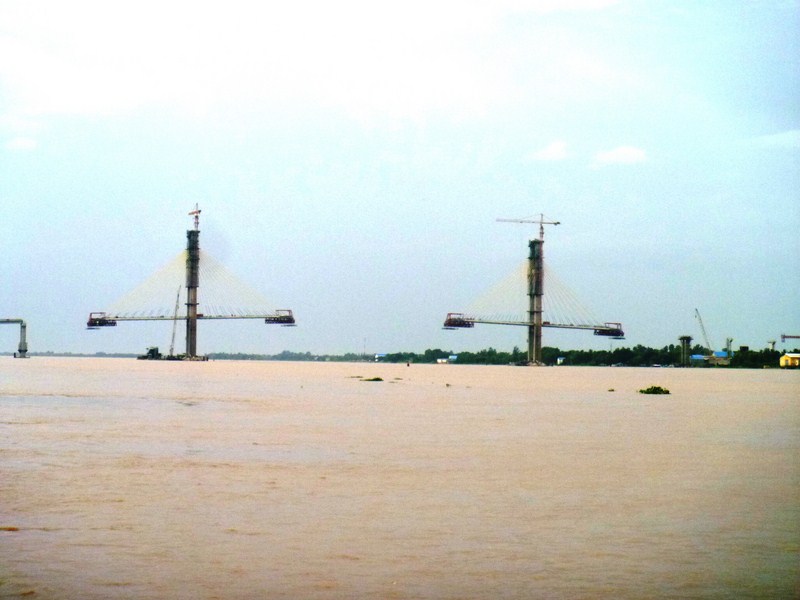
The unfinished Neak Loeung Bridge

The unfinished Neak Loeung Bridge

Currently, a 2-km.long, Japan-funded bridge, connecting the National Rd. 1, near Neang Lerg, is being built and is slated to be finished by 2015, making it the longest bridge in Cambodia.  We arrived at Phnom Penh’s Central Market by 6 PM.  Here, we hired a tuk tuk (a motorcycle with an open cabin, suspended upon the rear fork, with an in-line seat on each side), at US$1 per pax, to take us to Elite Boutique Hotel where Jandy and I stayed.

Check out “Hotel and Inn Review: Elite Boutique Hotel


Huyen Sy Church (Ho Chi Minh City, Vietnam)

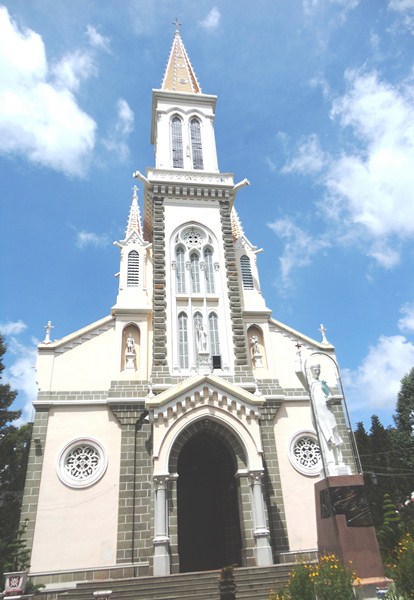
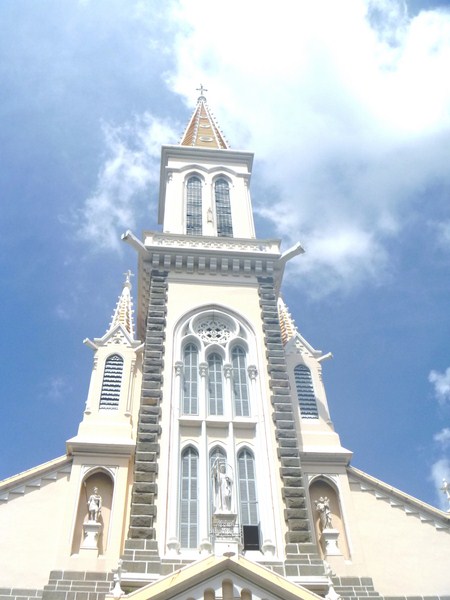
Huyen Sy Church

Huyen Sy Church

Violet, Osang, Jandy and I still had the whole morning free prior to our departure, via aircon bus, from Ho Chi Minh City to Phnom Penh in Cambodia, so we decided to walk over to nearby Huyen Sy Church, the oldest and one of the four biggest Catholic churches in the city (it is the second largest).  Widely regarded as one of the most beautiful churches in the city, it imitates the style of many European cathedrals and small churches in France and I was looking forward to add this to my Saigon photo collection.

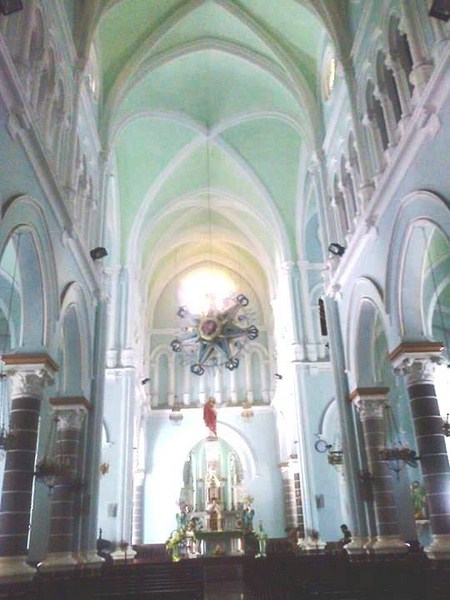
Church interior

Church interior

The church, sometimes known as Nhà thờ Chợ Đũi (Đũi Market Church) because it was located in Chợ Đũi parish, was designed by Fr. Charles Boutier (1845-1927), an architect of considerable merit who had previously designed the Thủ Đức Church and redesigned the Sisters of Saint Paul de Chartres’ École de Sainte-Enfance complex (after its original wooden buildings had been damaged by termites).

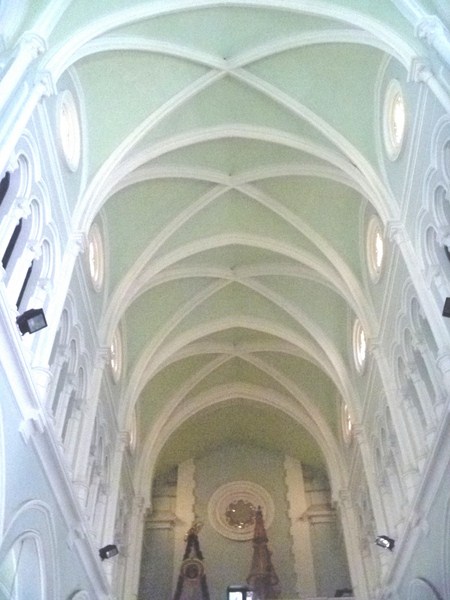
The vaulted ceiling of the nave

The vaulted ceiling of the nave

Constructed from 1902 to 1905, it was named after Huyen Sy (1841-1900, real name Philippe Lê Phát Ðạt), the richest man in Saigon at that time and grandfather of Queen Nam Phuong (Marie-Thérèse Nguyễn Hữu Thị Lan), first and primary wife of King Bảo Đại, Vietnam’s last king.

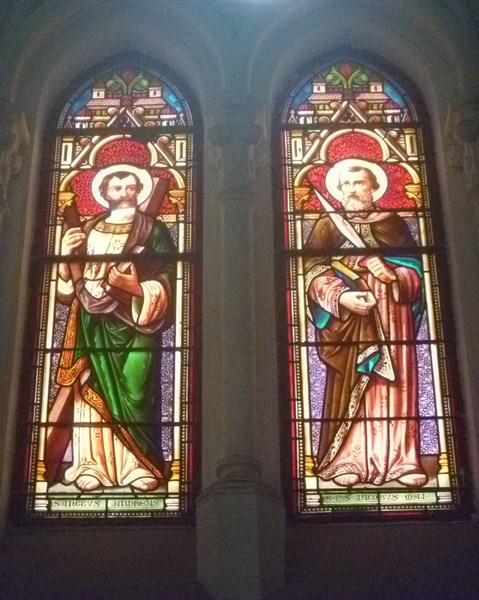
Italian stained glass windows

Italian stained glass windows

Funder of the church’s construction (he donated one seventh of his family inheritance to build the church and also contributed the land on which it sits), he also funded the construction of the churches in Chí Hoà and Thủ Đức.  He died before the building was completed. His son Denis Lê Phát An later built the extraordinary Byzantine-style church in Hạnh Thông Tây.

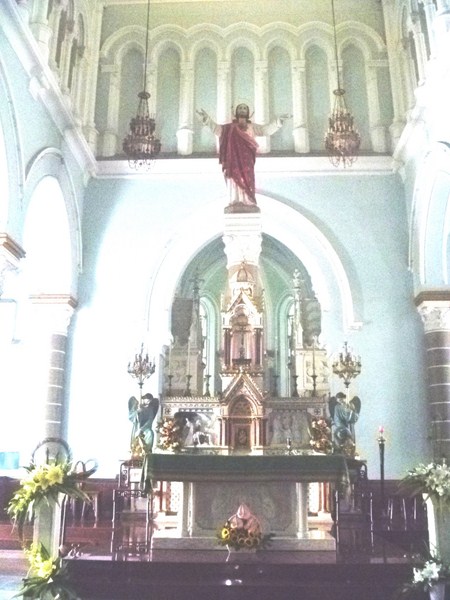
The high altar

The high altar

This 40 m. long by 18 m. wide, Gothic-style church has Romanesque decorative elements and a vaulted nave flanked by vaulted aisles decorated in pastel green and white.  Off the nave, in the axial Huyện Sỹ memorial chapel immediately behind the chancel, are the tombs of Huyen Sy and his wife Huỳnh Thị Tài (1845-1920). Elaborately carved from the finest marble, the tombs feature full-length effigies of the couple. Busts of Huyện Sỹ and Huỳnh Thị Tài are also installed on the walls.

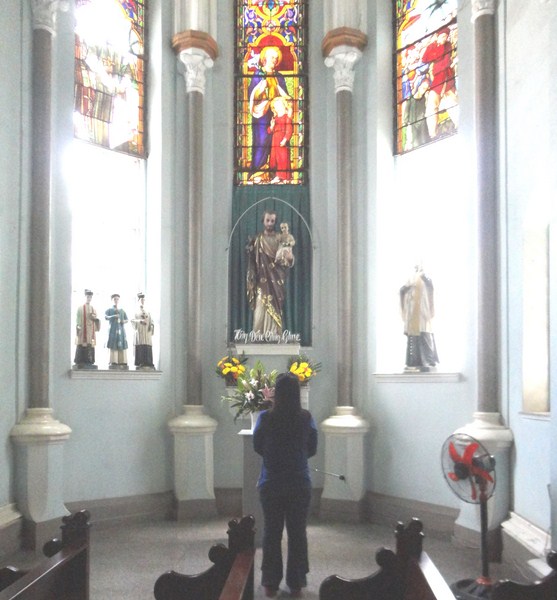
Chapel dedicated  to St. Joseph

Chapel dedicated to St. Joseph

Aside from using brick, this is also one or a few churches that used Bien Hoa granite, a kind of stone that shows wealth but is very hard to carve patterns.  It was used in the façade, base, the main columns and decorative work.The high ceiling, with its vertical emphasis, is defined by an ogival arch that is supported by pillars made from Bien Hoa granite.

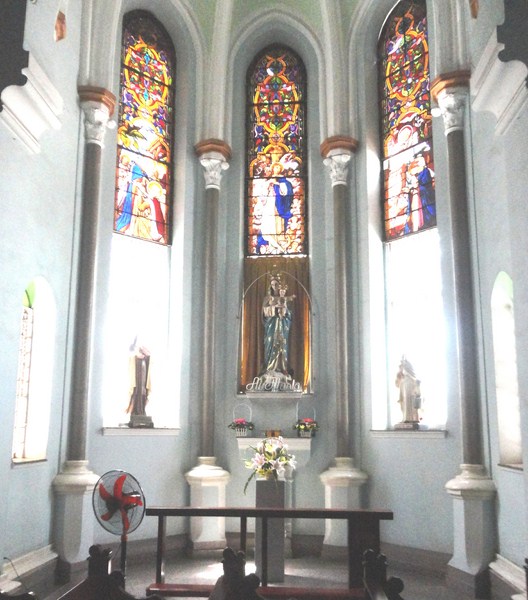
Chapel dedicated to the Virgin Mary

Chapel dedicated to the Virgin Mary

Its Italian stained glass windows, which keeps out as much of the tropical heat as possible, are adorned with images of Bible stories while, along the walls, are statues of Biblical and Vietnamese saints and the 14 Stations of the Cross. On either side of the transept are small chapels dedicated to the Virgin Mary and St Joseph.

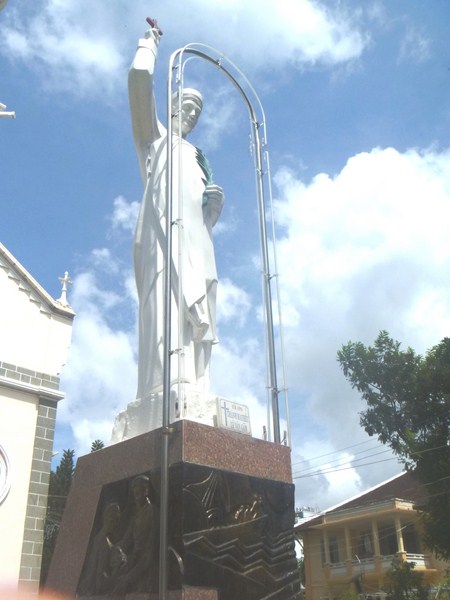
Statue of St. Matthieu Le Van Gam

Statue of St. Matthieu Le Van Gam

The chancel features a richly-decorated marble high altar standing on an open platform and featuring ornate gilding work and exquisitely-carved bas-reliefs of Biblical scenes, including the Last Supper and Mary being visited by the Angel Gabriel.

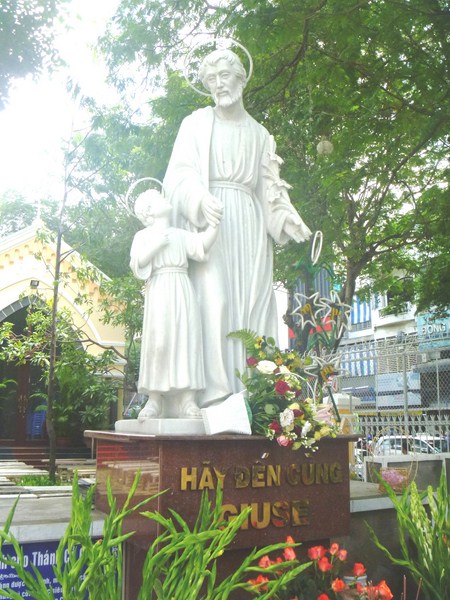
Statue of St. Joseph and the Child Jesus

Statue of St. Joseph and the Child Jesus

The church is dedicated to St. Philip the Apostle (a statue of St Philip stands at the main entrance).  Immediately in front of the church stands a statue of St. Matthêu Lê Văn Gẫm (Lê Văn Bôi, 1813-1847), a Vietnamese priest and merchant from Biên Hòa Province who was captured and beheaded, for his Catholic missionary activities, in the Chợ Đũi area on the orders of the Nguyễn Dynasty court. In 1900, he was beatified by Pope Leo XIII and, every year on May 11, the date of his execution, a festival of remembrance is held at the church.

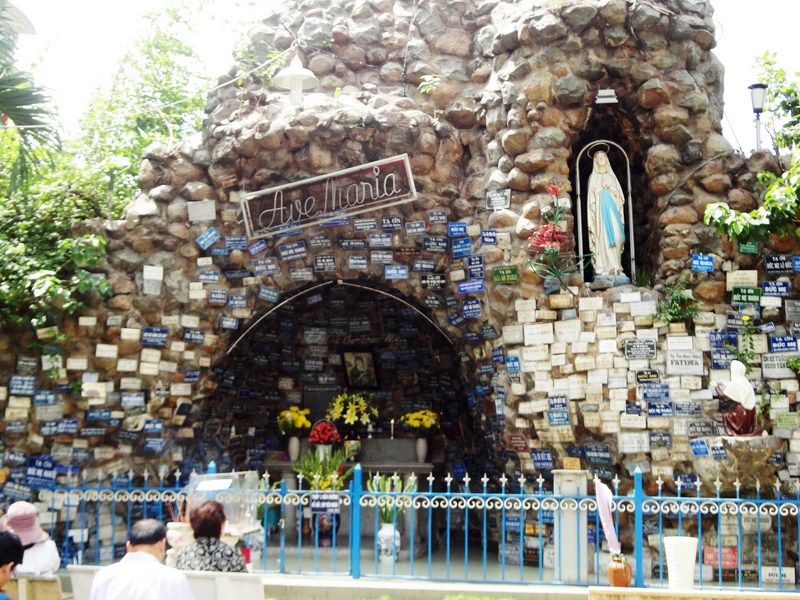
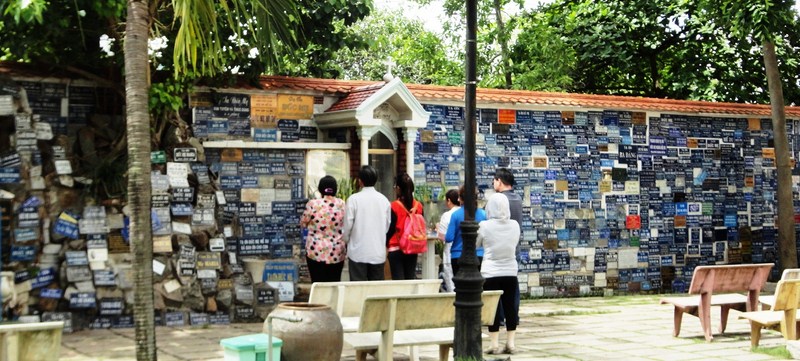
The popular Ave Maria prayer spot

The popular Ave Maria prayer spot

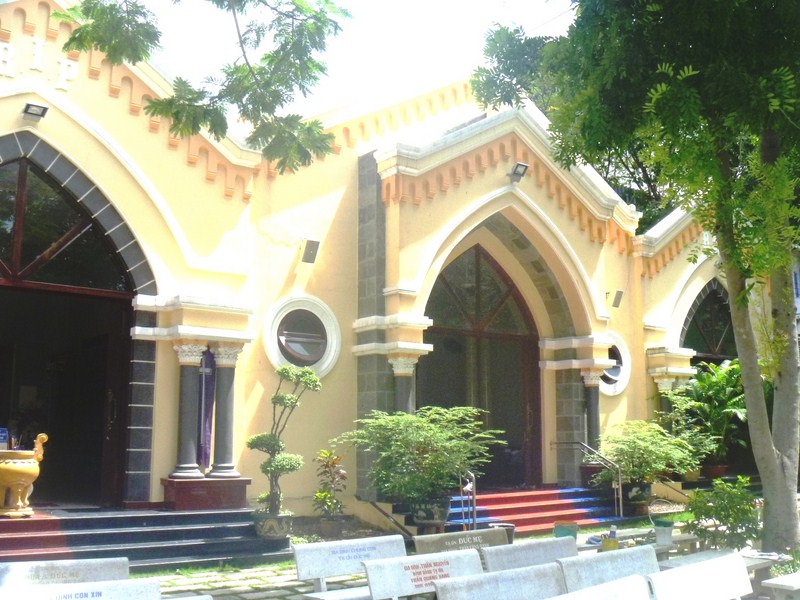
The grounds also contain numerous other shrines, including a statue to St Joseph and a Mountain of Our Lady, built in 1960. A Chapel of Rest has recently been added. On numerous occasions, the church has been refurbished, most recently from 2007 to 2009. Above the front vestibule is a 57 m. high bell tower which contains 4 bells cast in France in 1905.

The Chapel of Rest

The Chapel of Rest

The two largest bells (diameter 1.05 m.) were presented to the church by Jean Baptiste Lê Phát Thanh, one of Huyện Sỹ’s sons, and his wife Anna Đỗ Thị Thao. To honor their contribution to the Huyện Sỹ Church, their busts are also displayed in the memorial chapel behind the chancel. The donor of the two smaller bells (diameter 0.95 m.) is not known.

The church's 3 spires

The church’s 3 spires

This century-old, grand and imposing church, a tranquil haven with a warm and awe-inspiring interior, is popular among Vietnamese Catholics who come to Huyen Sy to pray and light incense and votive candles.  On the church grounds is a peaceful flower garden. 

Votive offerings

Votive offerings

Huyen Sy Church: 1 Ton That Tung Road (formerly Rue Frère Guilleraut) corner Nguyễn Trãi St. (formerly Rue Frère Louis), , District 1,  Ho Chi Minh City, Vietnam. Tel: 84 (0) 8 3833 0820 and 84 (0) 8 3925 5806. Open Tuesdays-Saturdays, 8-11 AM and  2-4:30PM.

Half-Day Cu Chi Tunnel Tour (Ho Chi Minh City, Vietnam)

No visit to Ho Chi Minh City is complete without a visit to the infamous Cu Chi Tunnels and, during our walking tour of the French Quarter, Osang, Violet, Jandy and I visited the Saigon Tourist Office to book a half-day afternoon guided tour.  After lunch at the Propaganda Cafe, we promptly returned to the tourist office by 1 PM where we were to be picked up by our tour bus.

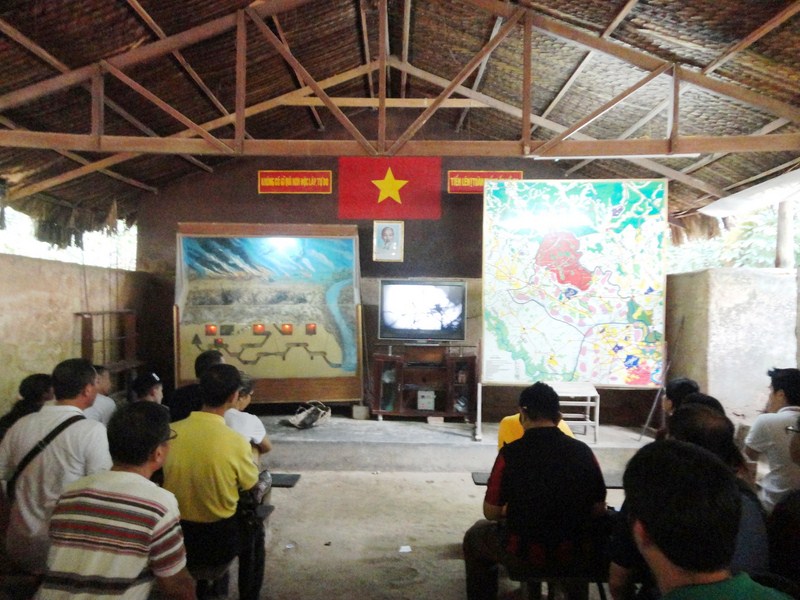
The video documentary

The video documentary

This 75-mile (121 km.) long complex of tunnels has been preserved by the Vietnamese government and turned into a war memorial park with two different tunnel display sites open to visitors – Ben Dinh, closer to Saigon, and Ben Duoc (15 kms. further) which contains part of the original tunnel system. We were to visit the former, the site where most group tours go. As such, it can be extremely crowded.

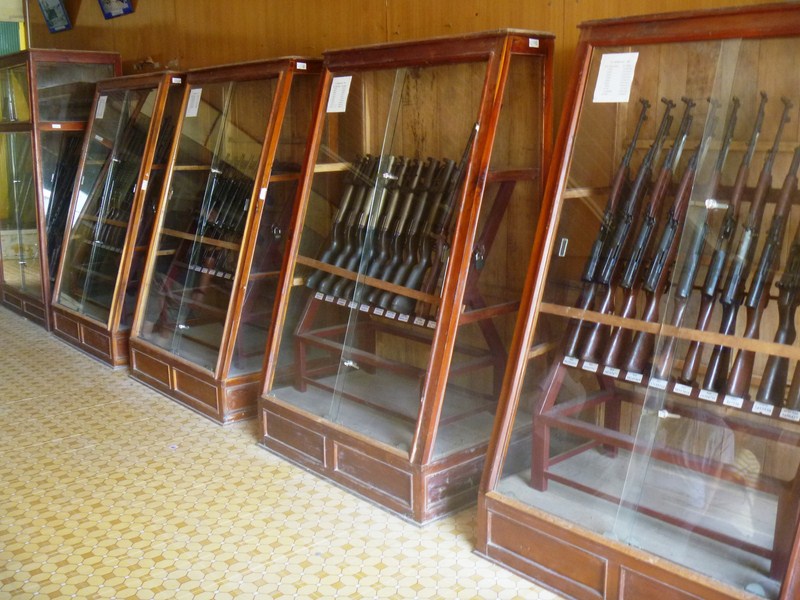
Exhibit of Vietnam-era weapons

Exhibit of Vietnam-era weapons

Our 40-km. trip to Ben Dinh took us 1.5 hours. There are a number of stalls selling food and drinks near the entrance. Our Cu Chi tunnel tour started at a classroom-style hut with a wall chart and a cross-section of the tunnels.  Here, we were shown an introductory black and white, Russian-made video detailing the tunnel’s long 25-year construction as well as live footage of American planes dousing the land with Agent Orange and destroying it with bombs.

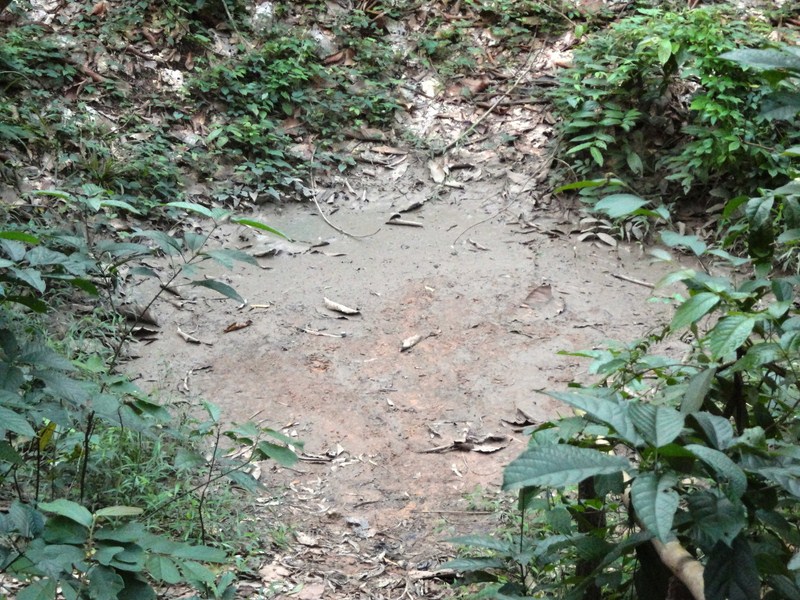
A B-52 bomb crater

A B-52 bomb crater

Then, Mr. Do Thanh Ngan, our local English-speaking guide took us on a fascinating tour of the Cu Chi tunnels along a well defined walking track, with lots of interesting things to see spaced at regular intervals, that loops around the area. Along the way, we walked past huge, mind-boggling hollow basins of earth, actually bomb craters that are evidence of the heavy B-52 bombing campaigns in the region during the Vietnam War.

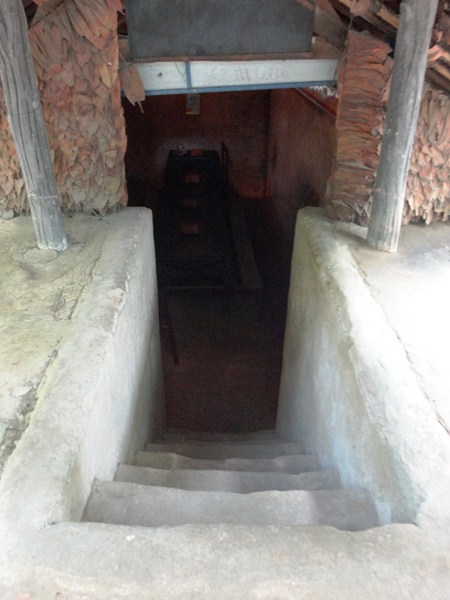
Entrance to the Ham Hoi Truong (meeting room)

Entrance to the Ham Hoi Truong (meeting room)

During the Vietnam War, the tunnel system was a safe haven for thousands of Vietnamese soldiers and civilians and it was virtually an underground city with dwelling houses, schools, hospitals and factories. Through lots of compelling photos and personal effects left behind, we learned more about the conditions these people lived in, the hardships they faced, and the amazing ingenuity employed to maintain life in the tunnels.  We also saw examples of how people lived and what they ate.

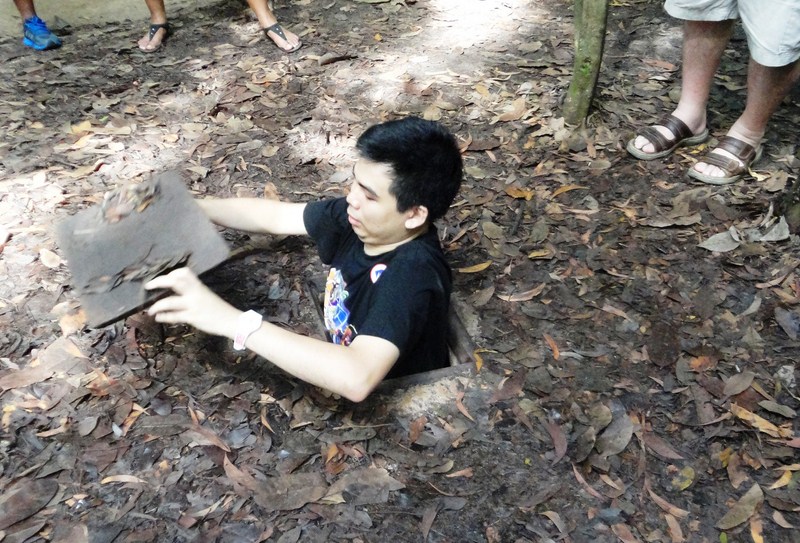
Jandy trying out the hidden tunnel entrance

Jandy trying out the hidden tunnel entrance

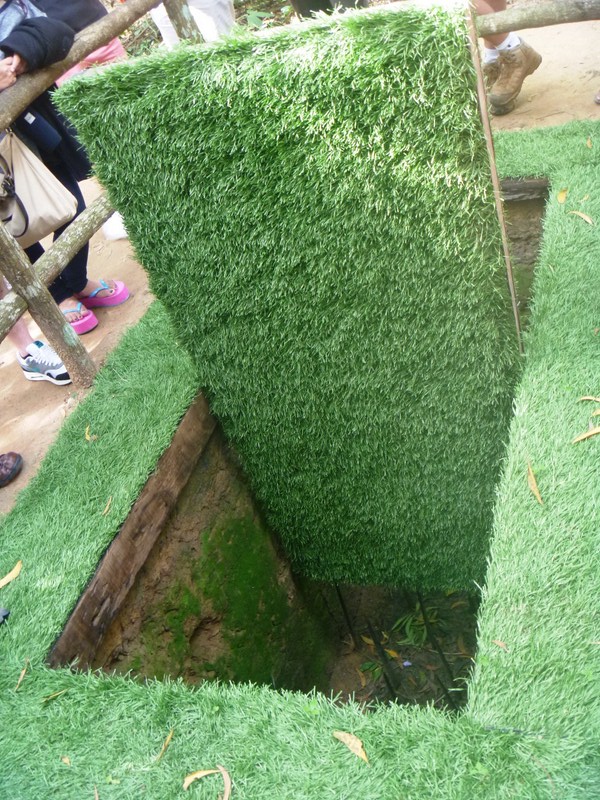
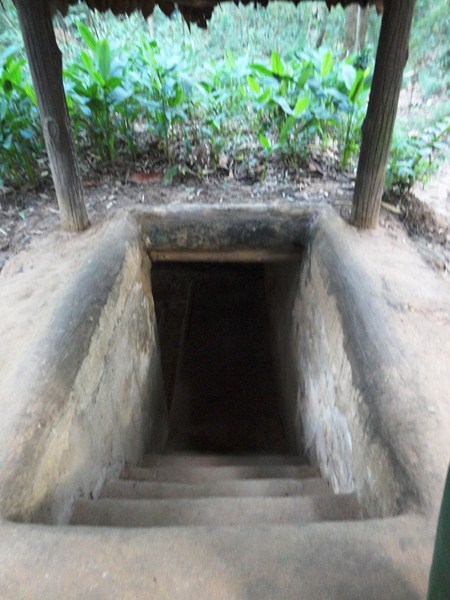
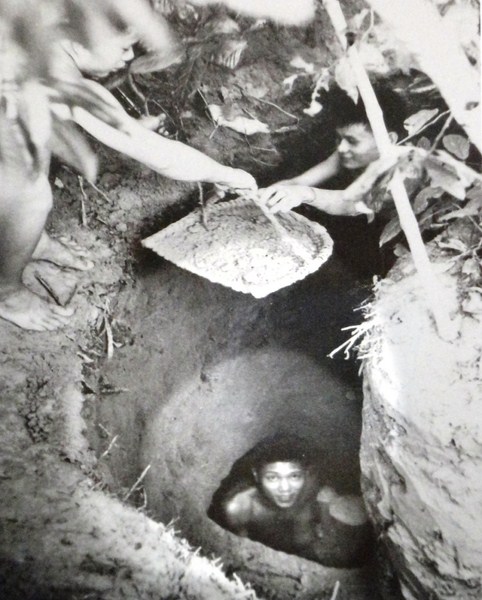
At one seemingly empty area, our guide pointed to us a small, hidden tunnel entrance just beneath our feet.  A Vietnamese soldier first demonstrated to us how to enter and exit the tunnel, closing the entrance with a 2 x 1.5-ft. manhole cover.  A tourist also successfully tried her hand in doing so, followed by Jandy.

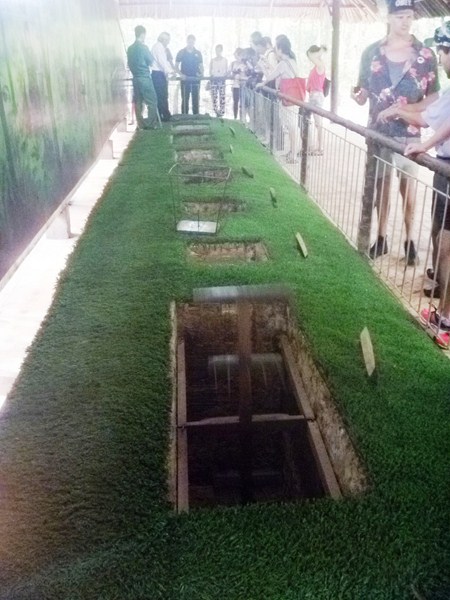
An array of terrifying but lethal booby traps

An array of terrifying but lethal booby traps

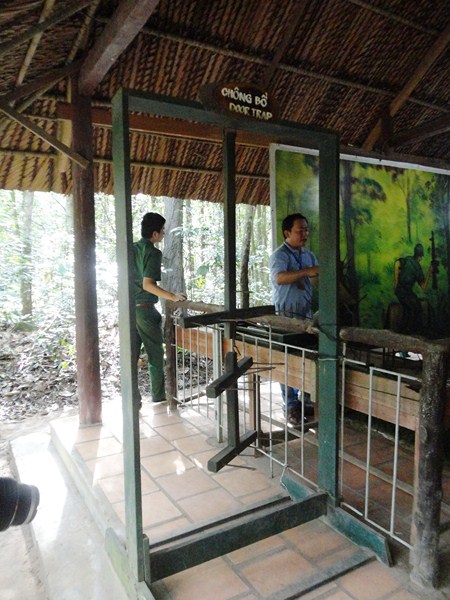
Chong bo (door trap)

Chong bo (door trap): heavily spiked wooden cross sections suspended above a door or opening via a trip wire.  When the wire is tripped, the trap swings down and impales the victim

A see-saw trap

A see-saw trap with sharp punji sticks at the bottom of the pit

Also on display were the different types of lethally terrifying but clever booby traps using punji sticks, ironically made from the scrap metal of the American’s artillery, bomb and rocket shells, which were used on American soldiers – chong bat (swinging up trap), chong can coi (see-saw trap), chong canh cua (window trap), chong ghe xep (folding chair trap), chong tru quay (rolling trap), chong-hom (fish trap), chong bo (door trap) and hong tho (sticking trap).

Chimneys

Tiny chimneys that disperses smoke from the kitchen

Tiny ventilation shafts

Tiny ventilation shafts

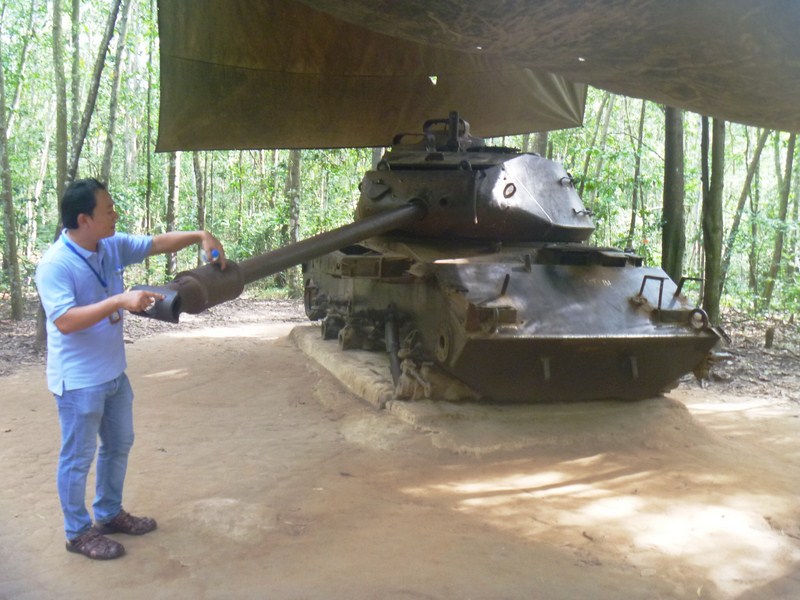
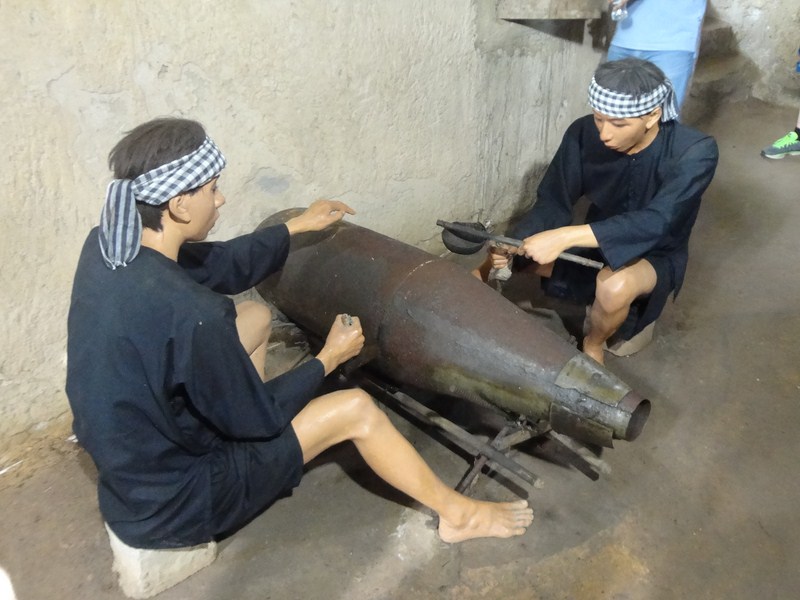
We also wandered past tiny little chimneys in the ground that dispersed smoke from the underground hoang cam kitchens, tiny ventilation shafts and climbed up what remained of a U.S. army M-41 tank destroyed by a delay mine in 1970.  Underground conference rooms (ham hoi truong), where campaigns such as the Tet Offensive were planned in 1968, have also been restored.   There were also some mannequins re-enacting soldiers in different settings (an army camp, military workshop, etc.).

The destroyed American M-41 tank

The destroyed American M-41 light tank

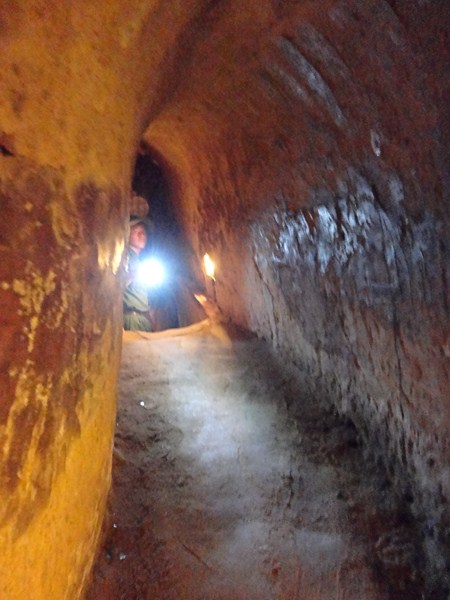
Jandy and I, as well as other guests, were given the opportunity to do a tough crawl through a 100 m. long section of the “touristed” tunnels, never part of the real network, which have been specially created and enlarged (around 50%) and widened so that the larger Western tourists can now fit through.  Though low powered lights have been installed to make traveling through them easier, it is still not recommended for the claustrophobic.

The tunnel entrance

The tunnel entrance

The tunnel we entered

The tunnel we entered

Violet tried but gave up while Osang remained above ground.  The crawl space was so small and tight that I found it impossible to believe that anyone ever survived here before the tunnel was enlarged. For those who may not want to, or may not be able to continue, exit points were located at the 20 m., 40m., 60m. and 80 m. marks. Jandy and I exited after 20 m.  This was the highlight of our tour

Cong binh xuong (military workshop)

Cong binh xuong (military workshop)

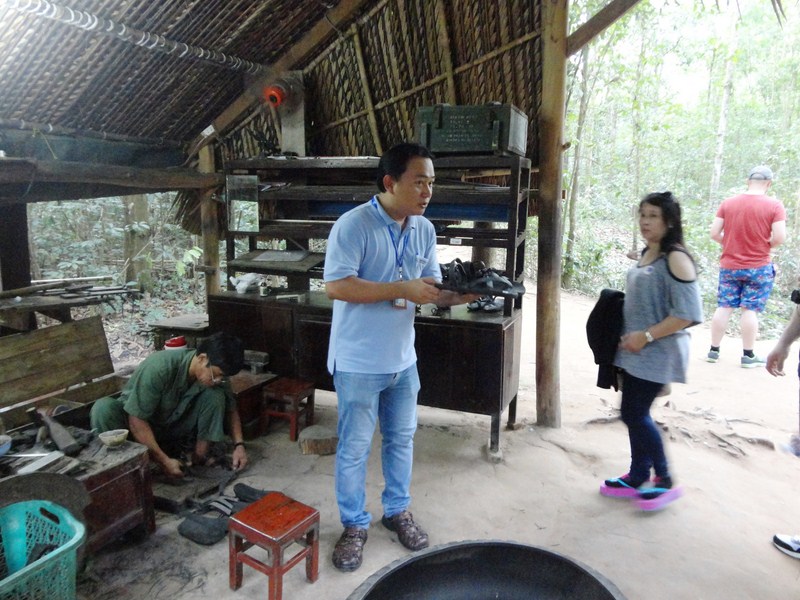
A sandal-making factory

A sandal-making factory

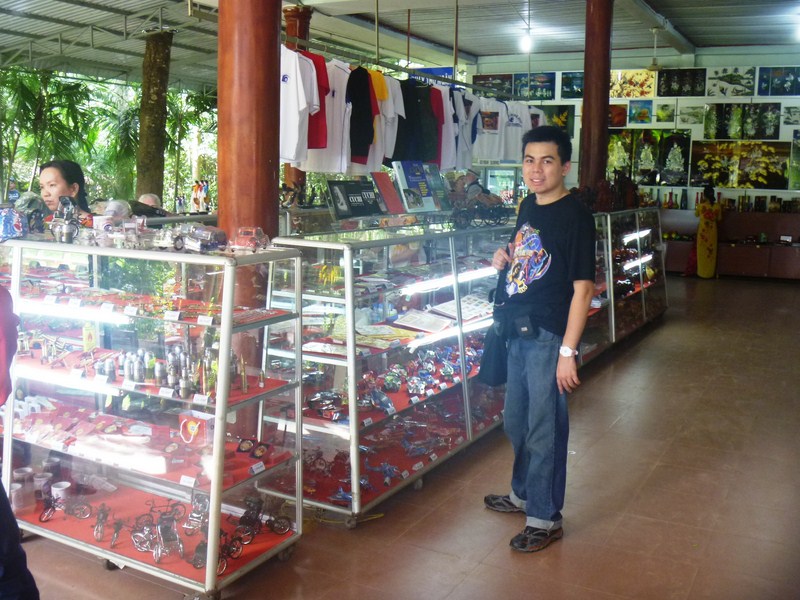
Other above-ground attractions include numerous souvenir shops, at the end of the walking track, some focusing on war memorabilia as well as the traditional Vietnamese souvenirs which could be found elsewhere.  Nearby is a shooting range where visitors can play real war games by firing a variety of authentic Vietnam-era assault weapons such as the K-54 pistol, the M-16 rifle, AK-47, M1 carbine, M1 Garand, Russian SKS and the M-30 and M-60 light machine guns.

Jandy at one of the souvenir shops

Jandy at one of the souvenir shops

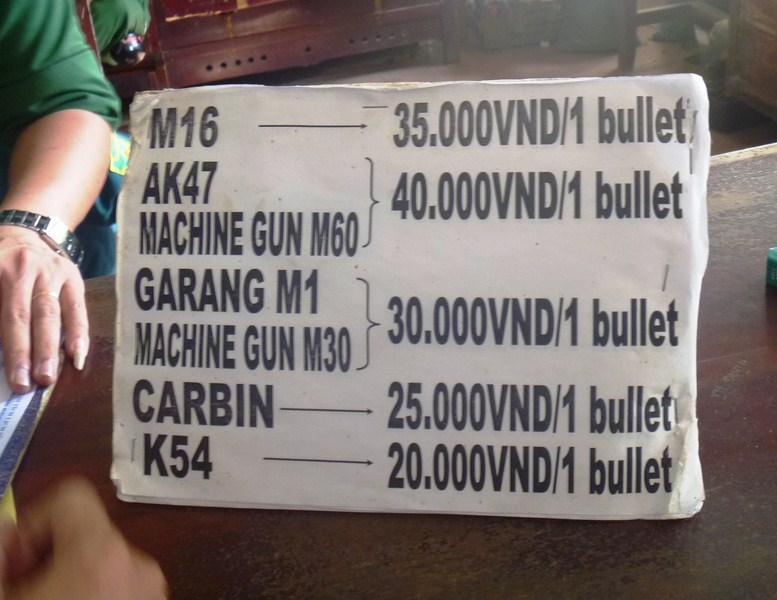
Firing range rates

Firing range rates

Sounds like great fun but I cannot help but put off from my mind what these “toys” were really designed for – killing. Besides firing a weapon costs 20,000 VND/bullet (US$0.95) for the K-54 pistol all the way up to 40,000 VND/bullet (US$1.88) for AK-47 and M-60 machine gun, and you have to buy at least 10 bullets (you can, however, share these with someone else).

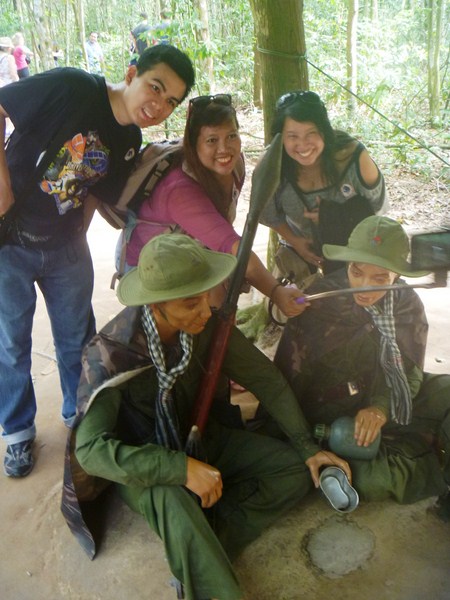
Jandy, Violet and Osang posing with some manikins

Jandy, Violet and Osang posing with a pair of mannequins

Cu Chi Tunnels (Ho Chi Minh City, Vietnam)

The Cu Chi Tunnels, in the Cu Chi District, were the improvised response of the poorly-equipped Viet Minh peasant army to the American’s high-tech ordnance, helicopters, artillery, bombers and chemical weapons.  Started sometime in the late 1940s during the war against the French (used mostly for communication between villages and to evade French army sweeps of the area), these dugouts and tunnels were built in the hard, red earth of Cu Chi (ideal for their construction) over a period of 25 years.

Combat tunnels and trenches

Constructing combat tunnels and trenches

Around 1960, the Viet Cong’s National Liberation Front (NLF) insurgency began in earnest and the old Viet Minh tunnel system assumed enormous strategic importance.  Most of Cu Chi district and the nearby area were brought under firm Viet Cong control and, within a few years, the tunnels were repaired and new extensions excavated.  It was used as a base for infiltrating intelligence agents and sabotage teams into Saigon and, during the 1968 Tet Offensive, the stunning attacks in Saigon were planned and launched from Cu Chi.

A primitive weapon factory (1962)

A primitive weapon factory (1962)

In early 1963, the Ngo Dinh Diem government implemented the Strategic Hamlets Program. Fortified encampments, built to house people who had been ‘relocated’ from communist-controlled areas, were surrounded by many rows of sharp bamboo spikes. The program was carried out with incredible incompetence, alienating the peasantry.  The Viet Cong also launched a major effort to defeat it, tunneling into the hamlets and controlling them from within and, by the end of the year, the first showpiece hamlet (in the Ben Cat district, next to Cu Chi) had been overrun.

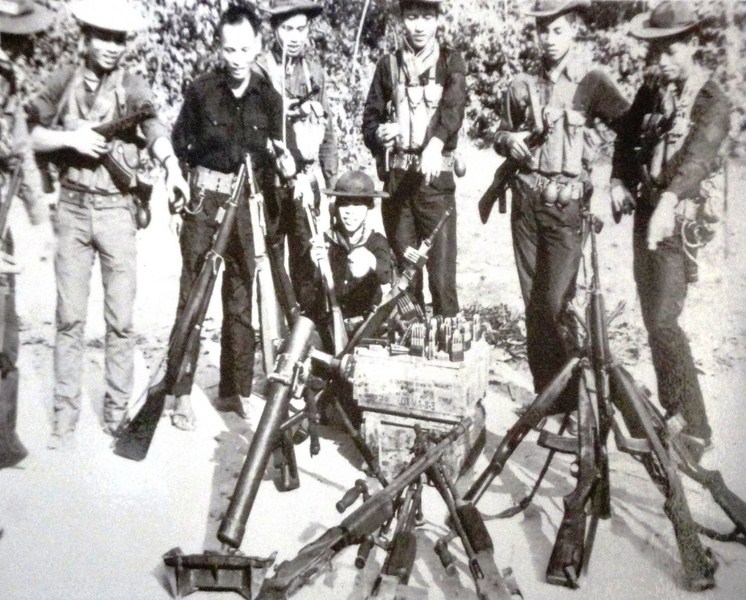
Captured American weapons (1966)

Captured American weapons (1966)

By the end of 1965, a complete Viet Cong victory became a distinct possibility after the series of setbacks and defeats suffered by the South Vietnamese forces in the Cu Chi area. In the early months of that year, the guerrillas boldly held a victory parade in the middle of Cu Chi town and their strength in and around Cu Chi was one of the reasons the Lyndon B. Johnson administration decided to involve U.S. troops in the war.

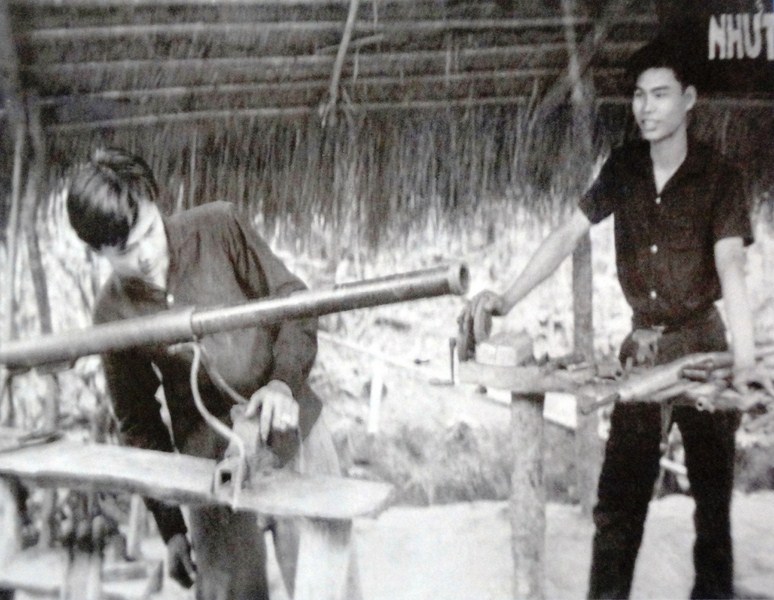
Children sawing the barrel of a cannon for use in an underground shelter (1968)

Children sawing the barrel of a cannon for use in an underground shelter (1968)

To deal with the threat posed by VC control of an area so near the South Vietnamese capital, one of the U.S.A.’s first actions was to establish a large base camp in Cu Chi district. Unknowingly, they built it right on top of an existing tunnel network. It took months for the 25th Division to figure out why they kept getting shot at in their tents at night.

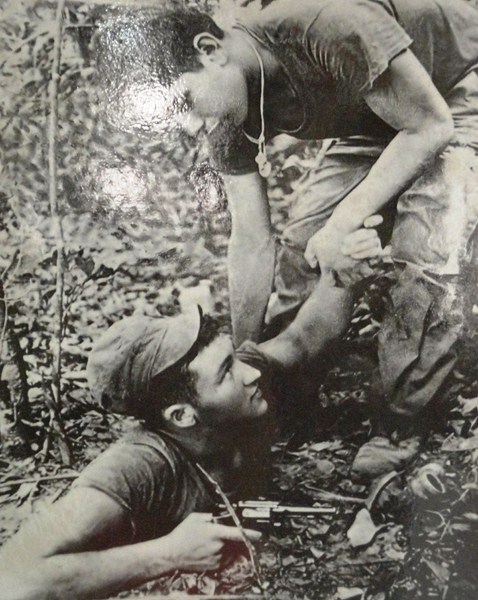
American tunnel rat creeping out of a tunnel

American tunnel rat creeping out of a tunnel

The US and Australian troops tried a variety of methods to ‘pacify’ the area around Cu Chi, which came to be known as the Iron Triangle. They launched large-scale ground operations involving tens of thousands of troops but failed to locate the tunnels. To deny the VC cover and supplies, rice paddies were defoliated, huge swathes of jungle bulldozed, and villages evacuated and razed. The Americans also sprayed chemical defoliants on the area aerially and a few months later ignited the tinder-dry vegetation with gasoline and napalm. But the intense heat interacted with the wet tropical air in such a way as to create cloudbursts that extinguished the fires. The VC remained safe and sound in their tunnels. Unable to win this battle with chemicals, the US army began sending men down into the tunnels. These ‘tunnel rats’, who were often involved in underground fire fights, sustained appallingly high casualty rates.

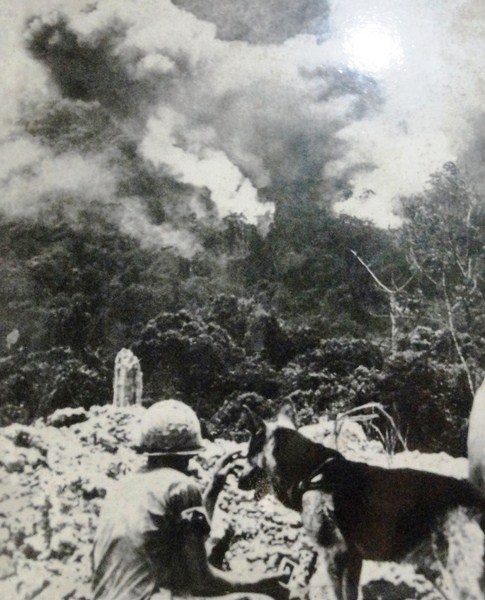
American soldiers using dogs to discover tunnels

American soldiers using dogs to discover tunnels

When the Americans began using German shepherd dogs, trained to use their keen sense of smell to locate trapdoors and guerrillas, the VC began washing with American soap, which gave off a scent the canines identified as friendly. Captured US uniforms were put out to confuse the dogs further. Most importantly, the dogs were not able to spot booby traps. So many dogs were killed or maimed that their horrified handlers then refused to send them into the tunnels.

Getting ready for battle to protect base (1966)

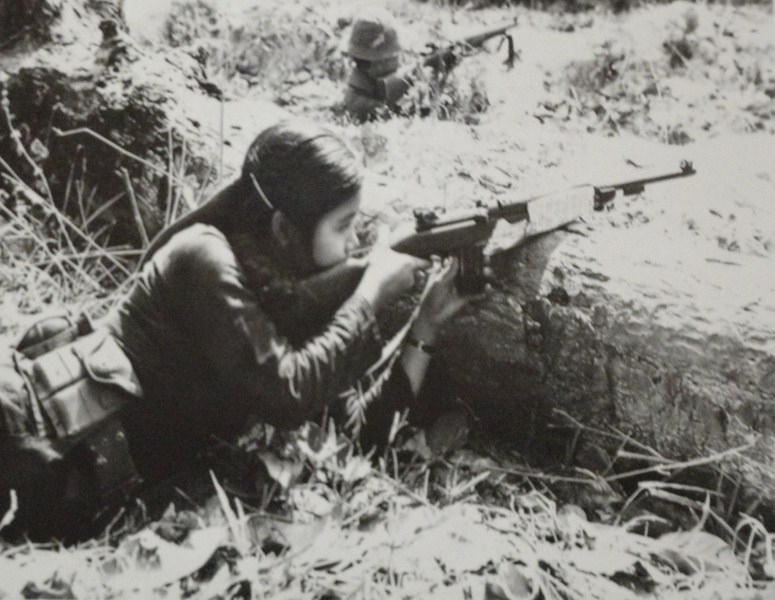
Guerillas getting ready for battle to protect their base (1966)

The U.S.A. declared Cu Chi a free-strike zone: little authorization was needed to shoot at anything in the area, random artillery was fired into the area at night, and pilots were told to drop unused bombs and napalm there before returning to base. But the VC stayed put. Finally, in the late 1960s, American B-52s carpet-bombed the whole area, destroying most of the tunnels along with everything else around. The gesture was militarily useless by then because the U.S.A. was already on its way out of the war. The tunnels had served their purpose.

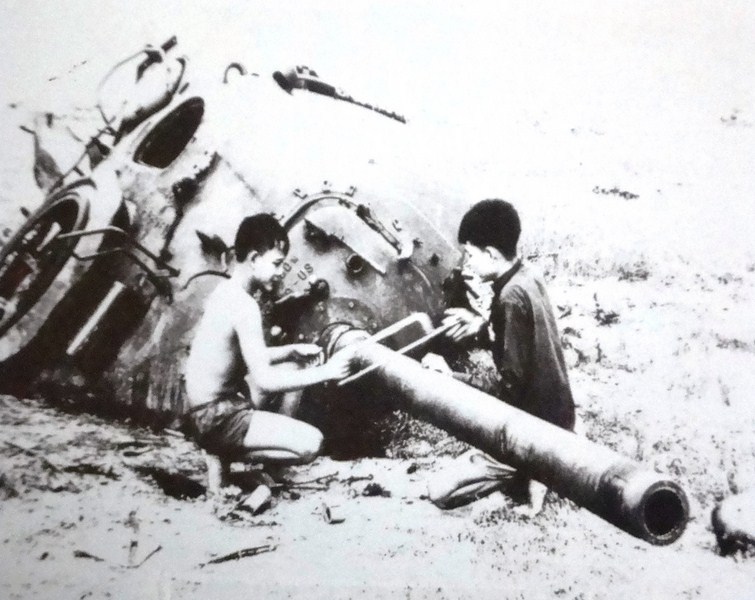
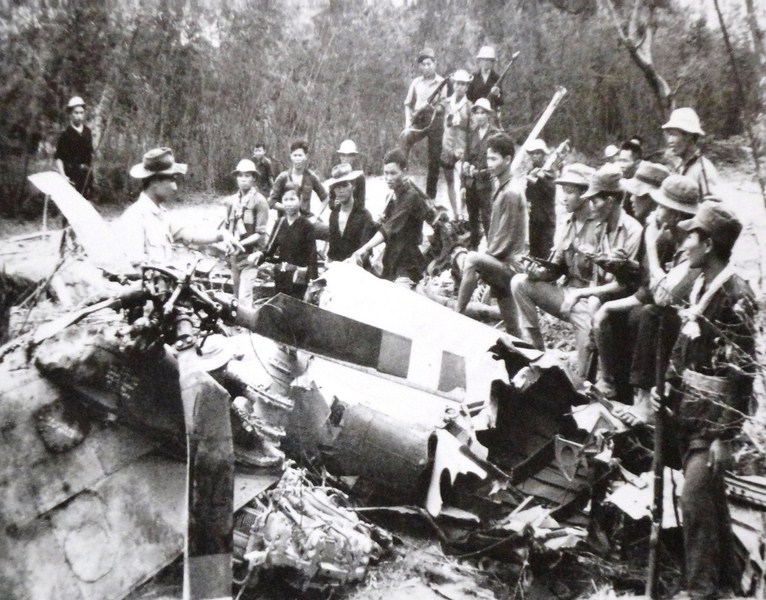
Guerillas of Nguan Duc village on the wreck of an American helicopter (1965)

Guerillas of Nguan Duc village inspect the wreck of an American helicopter (1965)

The VC guerrillas serving in the tunnels lived in extremely difficult conditions and suffered horrific casualties. Only about 6,000 of the 16, 000 cadres who fought in the tunnels survived the war. Thousands of civilians in the area were killed. Their tenacity was extraordinary considering the bombings, the pressures of living underground for weeks or months at a time and the deaths of countless friends and comrades.

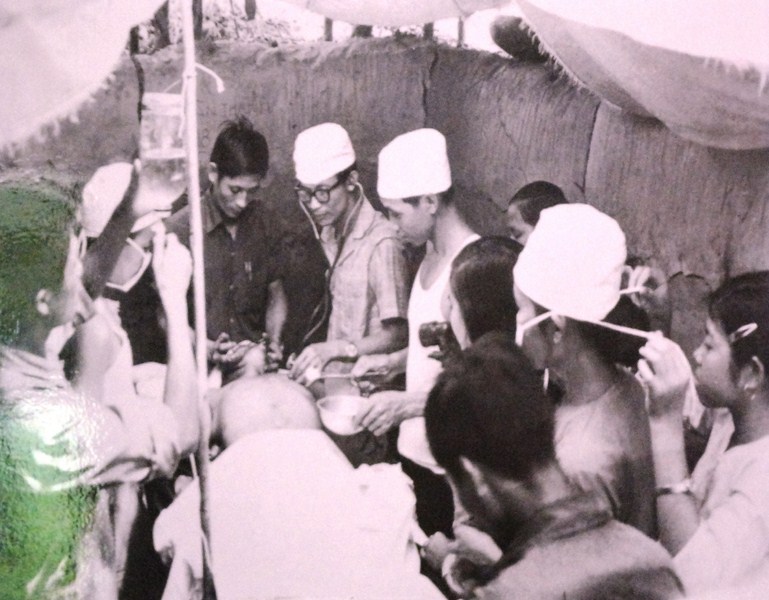
Surgery inside the tunnels

Surgery performed inside the tunnels

The villages of Cu Chi have since been presented with numerous honorific awards, decorations and citations by the government, and many have been declared ‘heroic villages’. Since 1975 new hamlets have been established and the population of the area has more than doubled; however, chemical defoliants remain in the soil and water, and crop yields are still poor.

Saigon Central Post Office (Ho Chi Minh City, Vietnam)

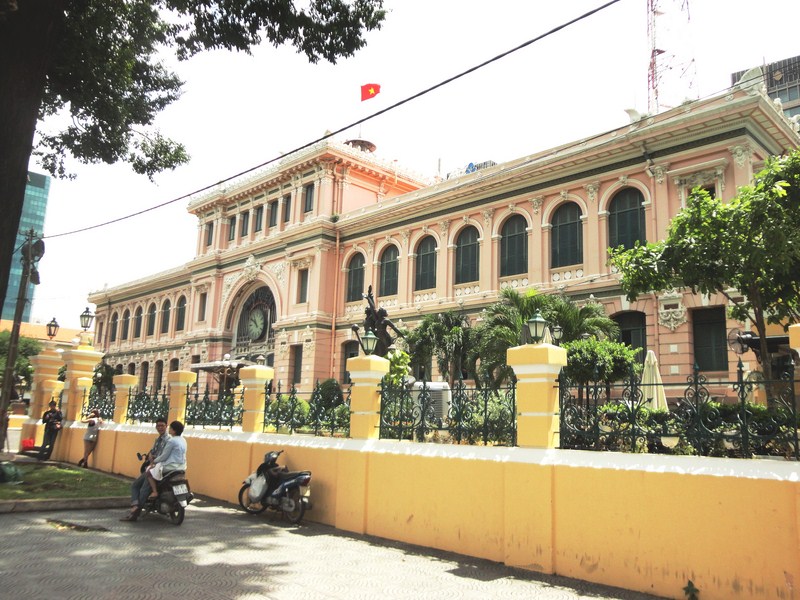
The largest and busiest central post office in Vietnam, this Neo-Classical-style building, one of the most recognizable landmarks in the city and a fine example of French colonial architecture, is a mixture of Gothic, Renaissance and French influences.  This big, airy and spacious building  was designed and constructed, between 1886 and 1891, by the famous French civil engineer and architect Gustave Eiffel (of Eiffel Tower fame).

Saigon Central Post Office

Saigon Central Post Office

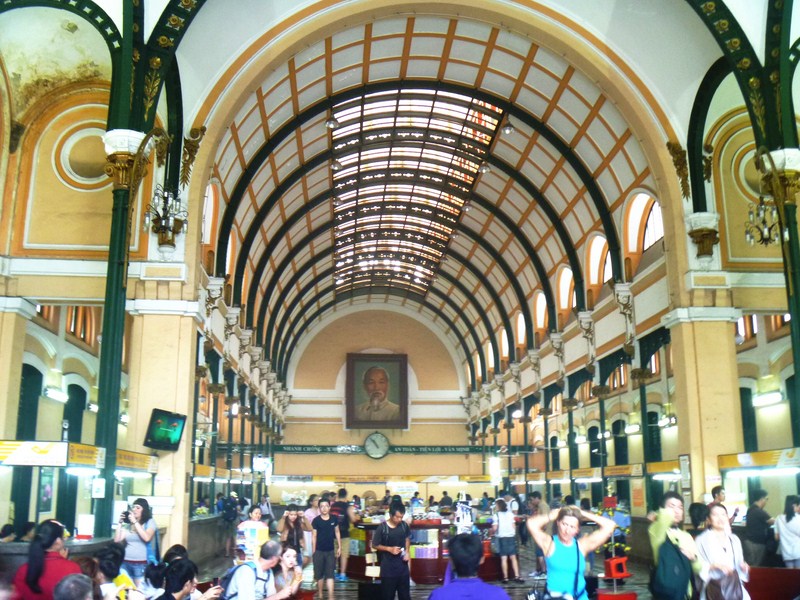
Its vaulted roof, massively high arched ceiling (carried by the two rows of steel pillars), numerous wickets, wooden counters (that seem like ticket counters), ornate furnishings, green window shutters and creatively designed arched windows (with engaged piers) are reminiscent of old European railway stations.

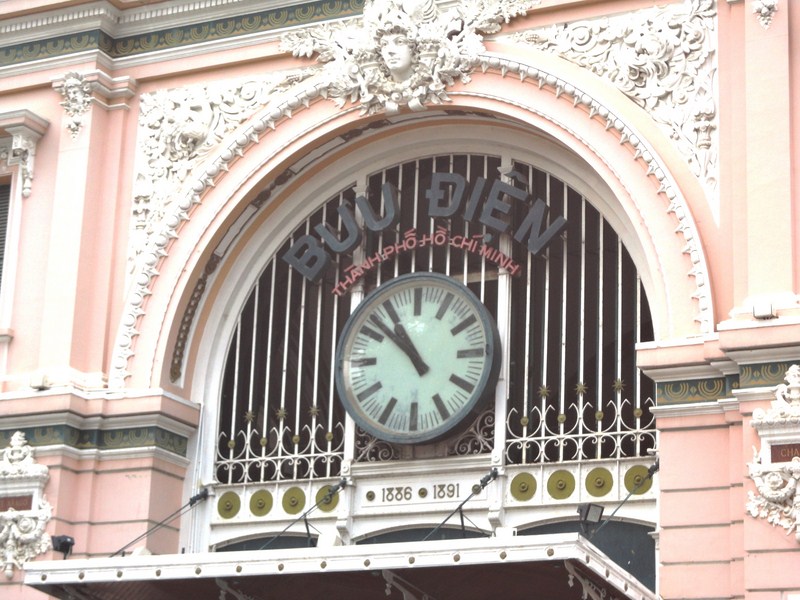
Clock above the main entrance

Clock above the main entrance

Above the main entrance, with its intricate ironwork, is its original and still working giant clock. The gorgeous, patterned floor tiles inside represent antique maps.

The post office's massive interior

The post office’s massive interior

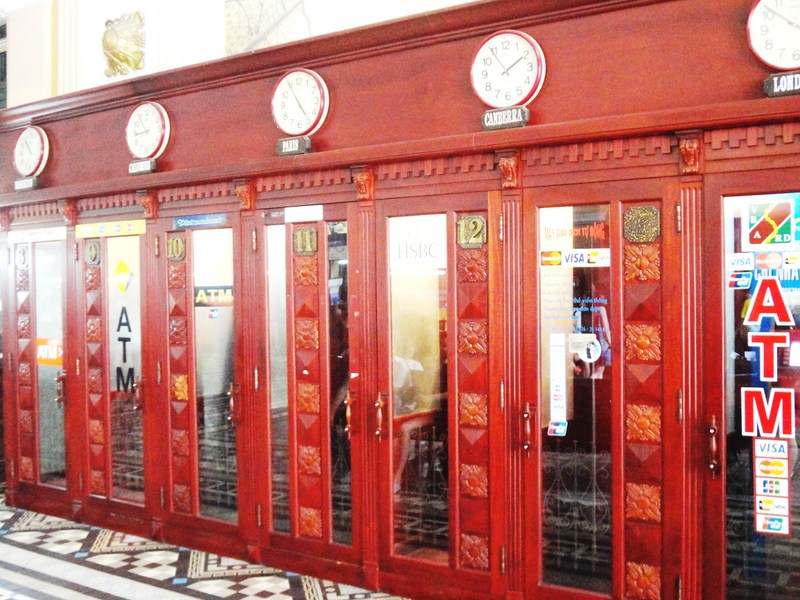
Though still a completely functional post office housing a useful office center with phones and fax lines, the building administration have also added souvenir shops (ref magnets, post cards, T-shirts, wallets, coin and stamp collector sets, etc.), currency exchange offices (though their rates was pretty high they are better than rates at the airport), wooden benches for tired tourists, and the still original phone booths (above which are clocks with times of select Asian cities) to make international calls (others are now ATM booths).

Phone and ATM booths

Phone and ATM booths

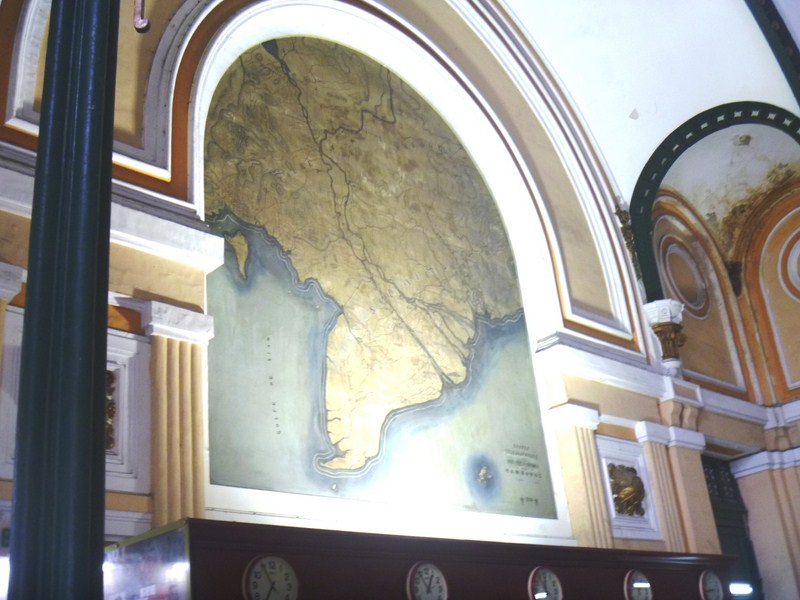
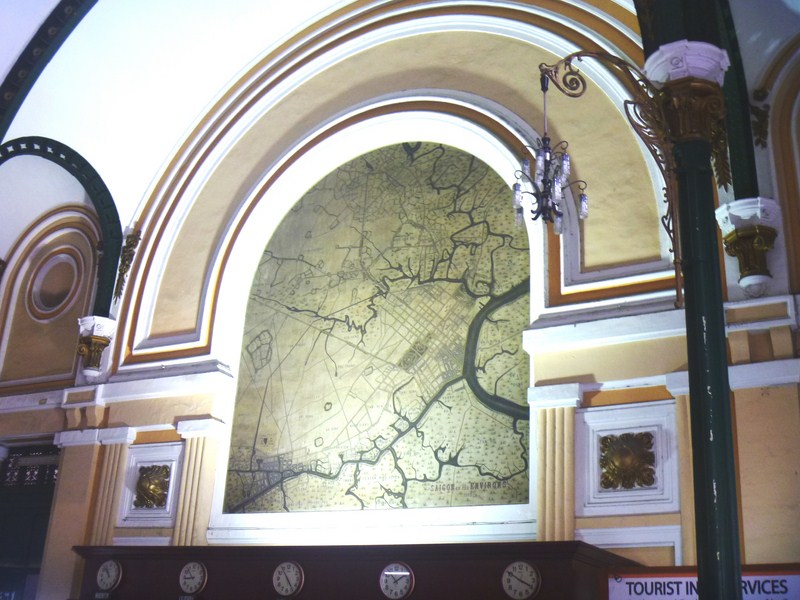
Inside this never too crowded but never really empty post office, on the upper part of both walls flanking the main entrance, are two large, eighteenth century maps that were painted on the walls just after the post office was built.

Map of Southern Vietnam and Cambodia

Map of Southern Vietnam and Cambodia

Map of Greater Saigon

Map of Greater Saigon

On the left side is a map of Southern Vietnam and Cambodia entitled Lignes telegraphiques du Sud Vietnam et Cambodge 1892 (“Telegraphic lines of Southern Vietnam and Cambodia 1892”) while on the right side is a map of Greater Saigon entitled Saigon et ses environs 1892 (“Saigon and its environment 1892’). At the end of the expansive hall is a huge portrait of Ho Chi Minh. 

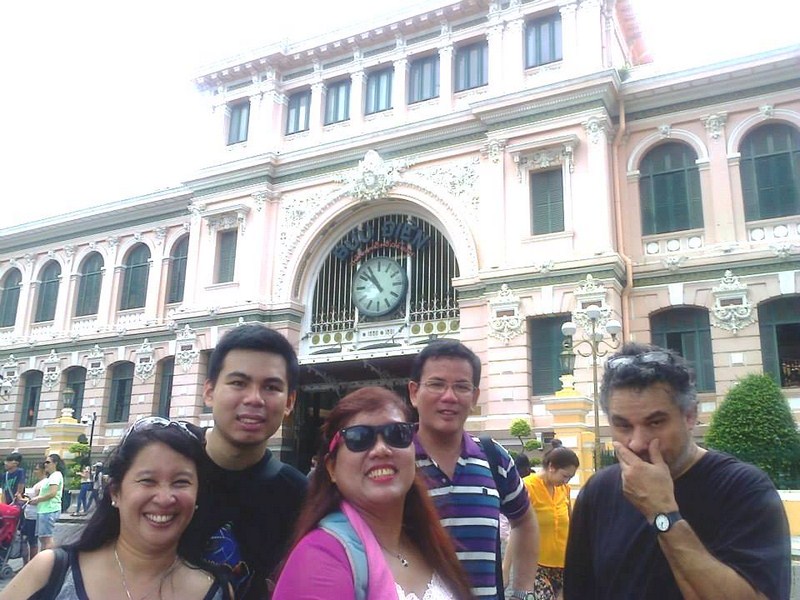
Osang, Jandy, Violet, the author and Australian friend Gerald Hosiah

Osang, Jandy, Violet, the author and Australian friend Gerald Hosiah

Saigon Central Post Office: 2 Công xã Paris, Bến Nghé, tp. (opposite Notre Dame Cathedral), Ho Chi Minh City.  Open 8 AM – 5 PM. Tel: +84 8 3822 1677.   

Notre Dame Cathedral (Ho Chi Minh City, Vietnam)

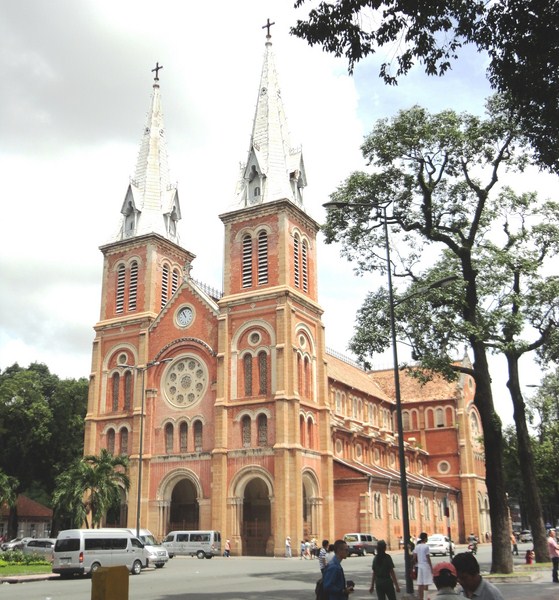
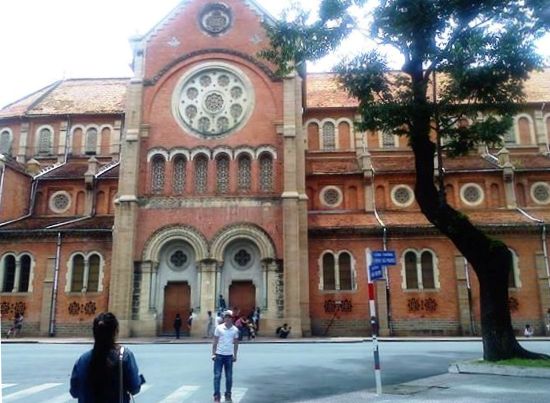
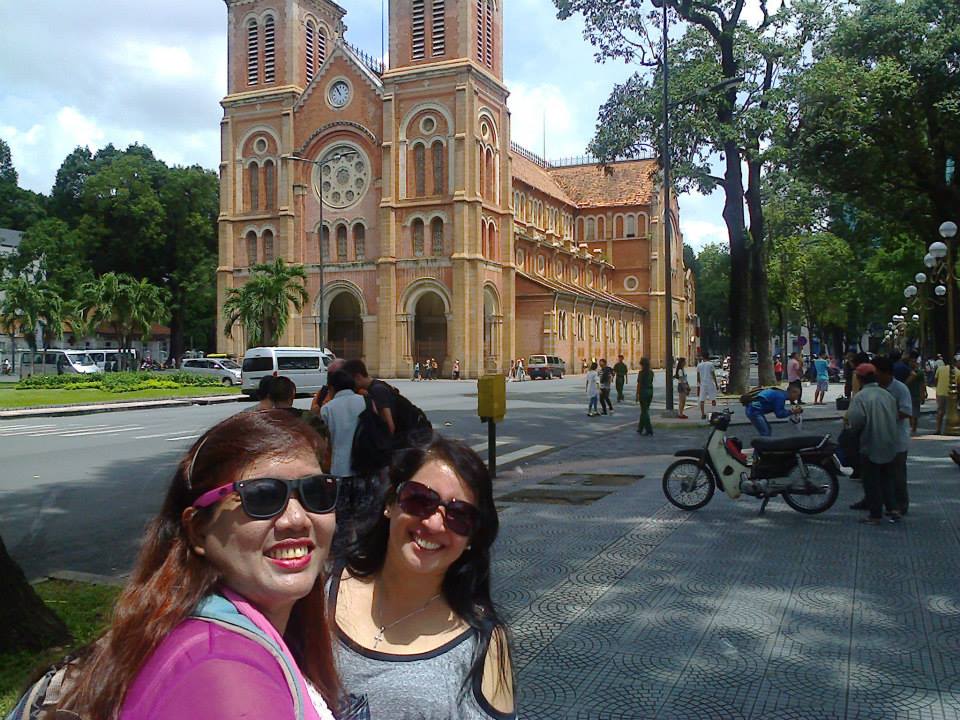
The Neo-Romanesque-style and French-inspired Notre Dame Cathedral, officially the Basilica of Our Lady of The Immaculate Conception, is a modest replica of its namesake in Paris.  It faces Ð Dong Khoi and is set in the heart of HCMC’s government quarter.  When we arrived, its front gates as well as the heavy timber doors on the side of the building that faces Reunification Palace were locked so we never got to see its interior.  Sunday masses here are held in both Vietnamese and English.  The cathedral is also a favorite for pre-nuptial photo shoots.

Notre Dame Cathedral

Notre Dame Cathedral

The granite plate inside the main entry gate commemorates the start and completion dates and designer. It states that, on October 7, 1877, Bishop Isidore Colombert laid its first stone in an inaugural ceremony. The construction of the cathedral construction work, managed by a French engineer named Baurad, took three years and, on April 11, 1880, Easter Sunday, a blessing and ceremony of completion was solemnly organized in the presence of Cochinchina  Gov. Charles Le Myre de Vilers.

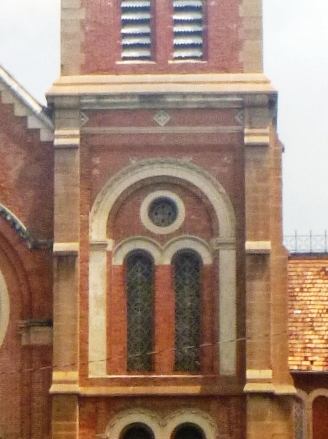
Bell tower detail

Bell tower detail

The total construction cost, at that time, was 2,500,000 French francs. Its foundation was designed to bear ten times the weight of the cathedral. All its original building materials were imported from France and the bricks of exterior walls, which still retained their bright red color until today, came from Marseille. Most of the tiles are  carved with the words “Guichard Carvin, Marseille St André France” (perhaps stating the locality where the tiles were manufactured) while others are carved with the words “Wang-Tai Saigon.” Many tiles damaged during the war have since been replaced by tiles made in Ho Chi Minh City. Its 56 stained glass squares were supplied by the Lorin firm of Chartres province in France and installed by famous French artisans. These were destroyed during World War II and have since been replaced with plain glass

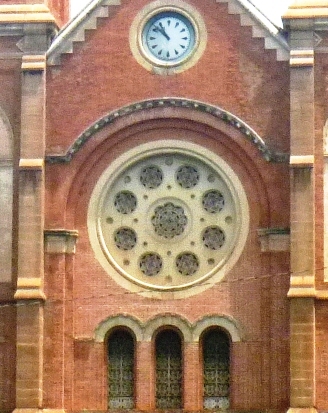
Rose window

Rose window

At the beginning, the cathedral was called State Cathedral due to the source of the construction funds. On February 17, 1959, during the closing ceremony of the Marian Congress, the cathedral was then-on called Notre-Dame Cathedral. In 1960, the cathedral was titled Saigon Chief Cathedral and, in 1962, Pope John XXIII conferred on it the status of a basilica. From this time, this cathedral was called Saigon Notre-Dame Cathedral Basilica.

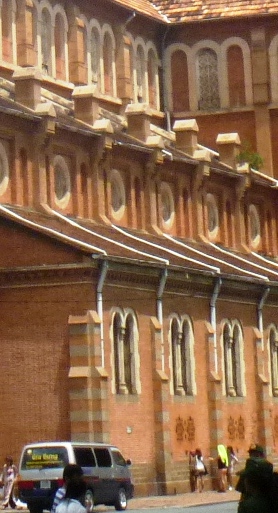
Side elevation

Side elevation

The cathedral has two main central bays and two sidereal corridors, with tall pillars and light coming in through sets of high windows. Its two 57.6 m. (190 ft.) high square bell towers, added to the cathedral in 1895, dominate the scenic Le Place Pigneau de Behaine (with its beautiful flower garden) which is bounded by the main post office.  Tipped with iron spires, they have six bronze bells (with a total weight of 28.85 metric tons). On the top of each tower are 3.5 m. high and 2 m. wide crosses weighing 600 kgs.

Another view of the side

Another view of the side

The total height of the cathedral, from ground to the top of the cross, is 60.5 m. In front of the cathedral and in the center of the square is a granite statue, made in Rome and installed on February 16, 1959, of the Our Lady of Peace (which was given the title of Regina Pacis). During October 2005, the statue was said to have shed tears, which flowed down the right cheek of the face of the statue.  It attracted thousands of people and forced authorities to stop traffic around the cathedral.

Violet and Osang

Violet and Osang

Notre Dame Cathedral:  Bến Nghé, tp., District 1, Hồ Chí Minh City.

Saigon Opera House (Ho Chi Minh City, Vietnam)

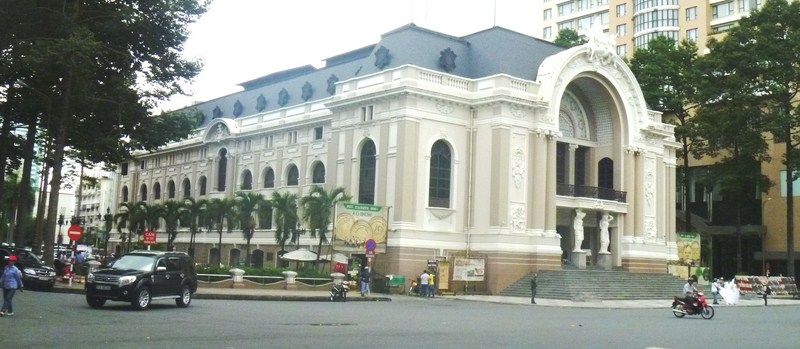
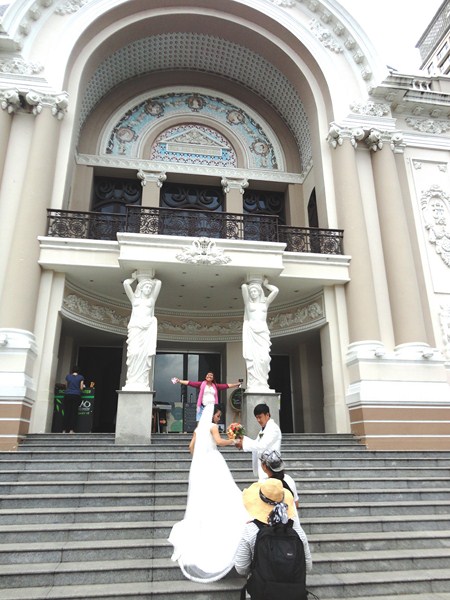
The iconic, stately and elegant Saigon Opera House, also known as the Ho Chi Minh Municipal Theater, is hard to miss as it is located at the intersection of Ð Dong Khoi and ÐL Le Loi.  The front of the building is a good place to take photos or maybe just sit round and spend some time people-watching. A Highland Coffee Shop outlet is located behind the building. During our visit, a pre-nuptial photo shoot was ongoing at the bottom of the steps in front of the theater.

Saigon Opera House

Saigon Opera House

Unfortunately, we weren’t allowed to see the inside unless we watched an actual performance (plays, concerts, ballet, opera, and Vietnamese traditional dance) or the 60-min. AO Show (6 PM and 8 PM), a show fusing dance, circus and musical forms in a vibrant and light-hearted series of sketches.  However, prices for these performances don’t come cheap. For the AO Show, admission ranges from 630,000 VND to 1,470,000 VND (US$29.7 to US$69.3).

A venue for pre-nuptial photo shoots

A venue for pre-nuptial photo shoots

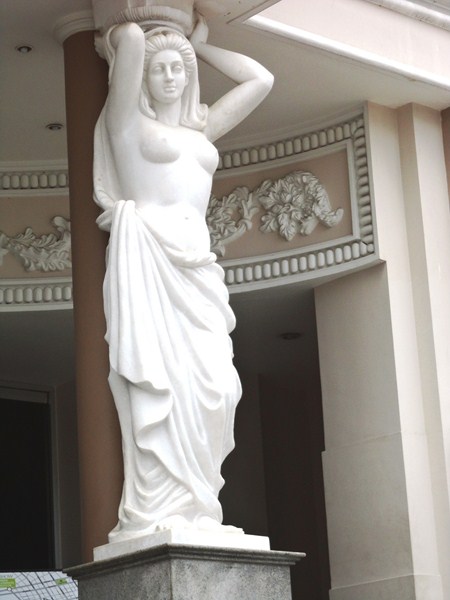
This grand, 1,800-seat colonial building, an example of French Colonial architecture in Vietnam, was designed, as the Opėra de Saigon, by architect Felix Olivier and its construction, started in 1898, was supervised by architects Ernest Guichard and Eugène Ferret. The theater was completed on January 1, 1900. Its applied ornaments, balustrades, cartouches and roof are particularly French while the large central arch, Ionic columns, coffered ceiling and the caryatids (though less modestly clothed than Greek examples) are Greco-Roman motifs.

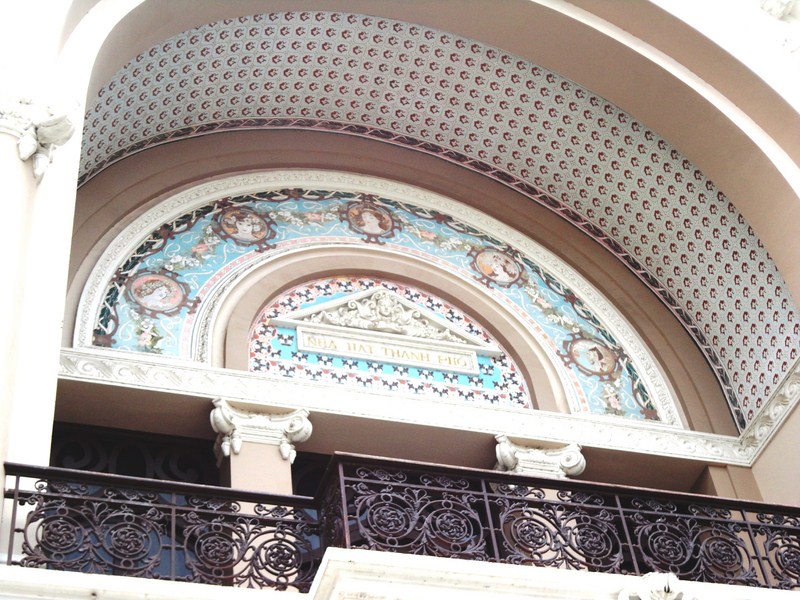
The veranda and richly-engraved arch

The veranda and richly-engraved central arch

In 1944, the theater was damaged by the Allied air attacks and, in 1954, was used as a temporary shelter for French civilians arriving from North Vietnam. After 1956, the building was restored and used as the home of the Lower House assembly of South Vietnam and it was not until 1975, after the fall of Saigon, that it was again used as a theater. In 1995, the theater was again restored.

A scantilly clad carytid

A scantily clad caryatid

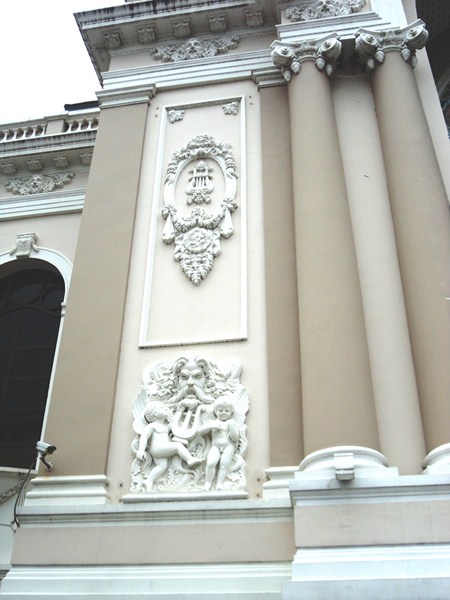
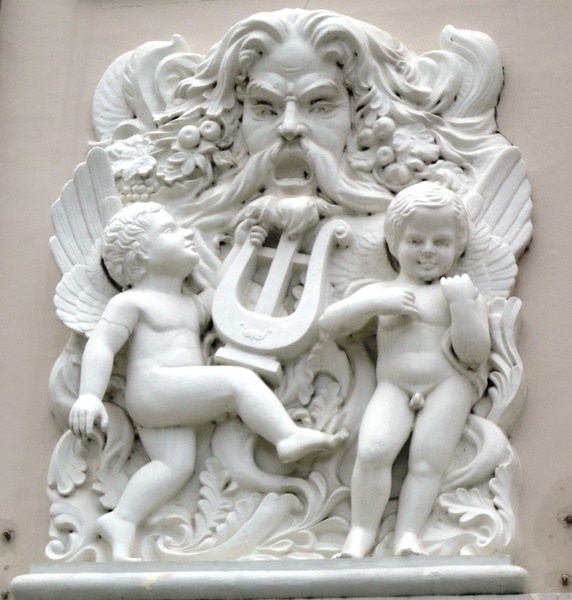
Shaped like the Opéra Garnier in Paris, the Municipal Theater is a smaller counterpart of the Hanoi Opera House (built between 1901 and 1911).  Influenced by the flamboyant style of the French Third Republic, its ornate façade, decorated with inscriptions and bas reliefs, is shaped like France’s Petit Palais (“little palace”) which was also built in 1900. In 1943, some of its decorations, engravings and statues were removed from the theater façade (to make the the theater look more youthful) but, in 1998, during the 300th anniversary celebration of Saigon, a portion was restored by the city government.

Bas reliefs and paired Ionic colums

Bas reliefs and paired Ionic colums

This opera house has an 800-seat main seating floor plus two levels of seating above; a sweeping staircase; and all the inscriptions, décor, and furnishings were designed and drawn by a French artist and sent from France. It now hosts the Ho Chi Minh City Ballet Symphony Orchestra and Opera (formerly the Ho Chi Minh City Symphony and Chamber Orchestra), one of the city’s premiere entertainment companies.

Deatil of bas relief

Deatil of bas relief

The theater is equipped with state-of-the-art lighting and sound systems, and safety equipment. Many of its original architectural and decorative features, including a stone veranda, white stone statues at the entrance, colorful granite tiled floors, chandeliers, bronze statues in front of the stairs, richly-engraved auditorium arch and wall statues, have been incorporated. In 2009, an outdoor lighting system was installed on the roof of the Opera House.

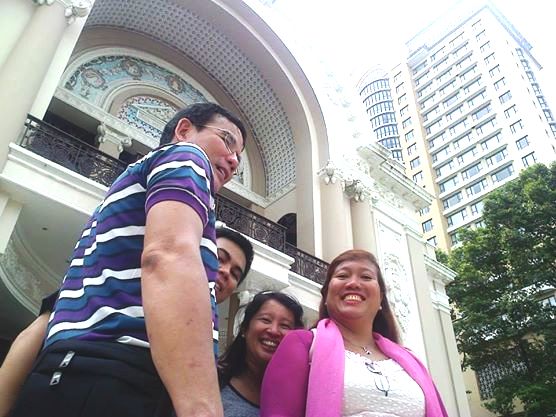
The author, Jandy, Osang and Violet

The author, Jandy, Osang and Violet

Saigon Opera House: 7 Lam Son Square, Ben Nghe Ward, District 1, Ho Chi Minh City. Tel: 08 3829 9976.

People’s Committee Building (Ho Chi Minh City, Vietnam)

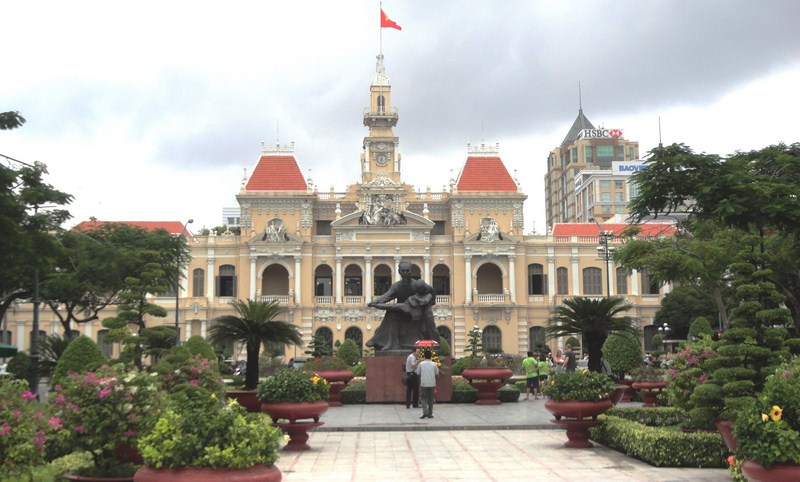
People Committee Building

People Committee Building

The 2-storey People’s Committee Building, one of the city’s most prominent landmarks and one of the most photographed buildings in Vietnam, is the home of the Ho Chi Minh City People’s Committee. Formerly the Hôtel de Ville de Saïgon, it was designed in the French colonial style by famous French architect P. Gardes and was modelled after the Hotel de Ville (City Hall) of Paris.

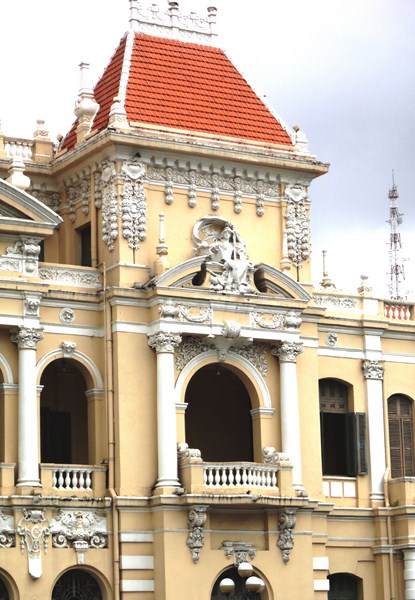
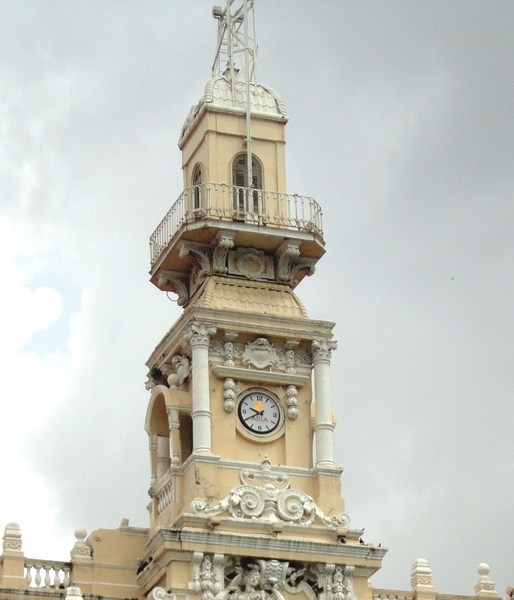
Tower with Mansard roof

Tower with Mansard roof

Built between 1901 and 1908, it was renamed as the People’s Committee Building after April 1975.  This building, noted for its beautiful gardens and ornate facade, is often referred to as the “Gingerbread House” due to the impressive exterior’s cream and white facade and ornate features. It has a main hall, rectangular wings and a central clock tower.

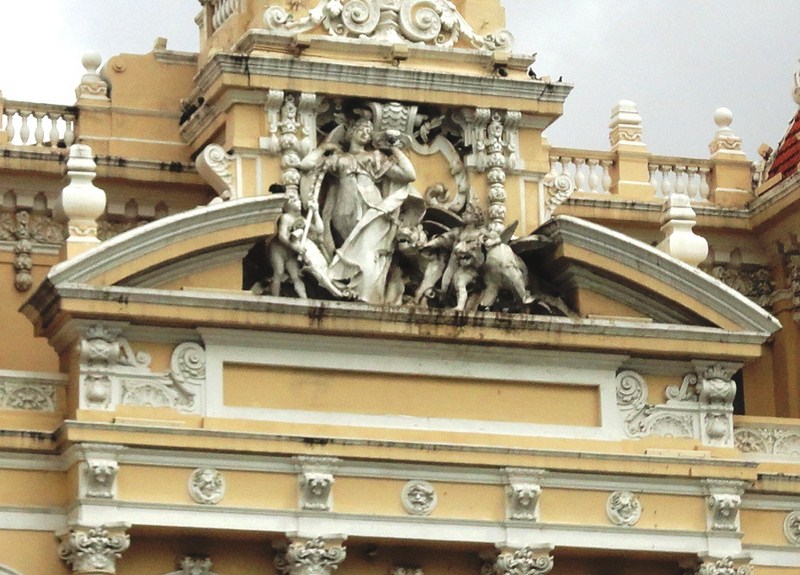
Broken segmental arch with statue of a woman, a child and 2 wild beasts

Segmental arch with statue of a woman, a child and 2 wild beasts

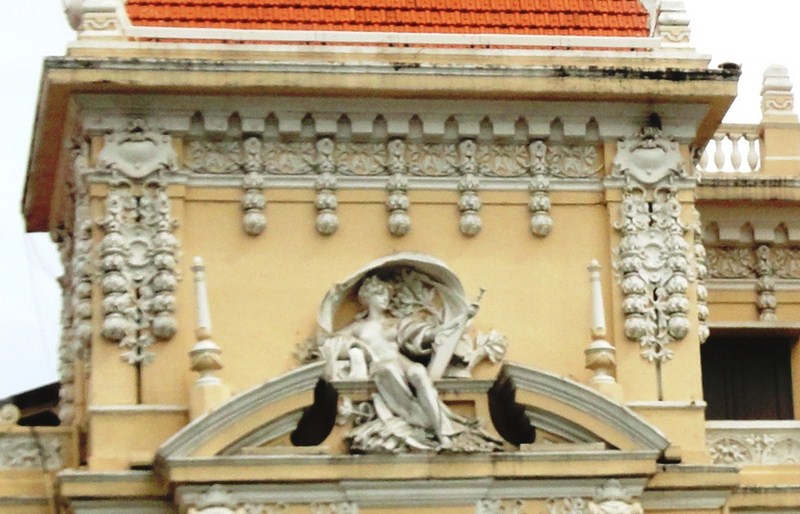
The central façade, flanked by two towers with red-tiled Mansard roofs, has broken segmental arches with statues.  In the middle is a statue of a standing woman and a child with two wild beasts while flanking it are statues of seated women with swords. There are also sculpted cornices and delicate bas-reliefs on the walls, a popular feature of French colonial style.

Segmental arch with statue of a seated woman with a sword

Segmental arch with statue of a seated woman with a sword

It was regrettable that tourists such as us as well as the general public weren’t allowed inside this working government building.  Only civil servants and cleaners are allowed.  Its elegant interior is said to be lit with crystal chandeliers.

The clock tower

The clock tower

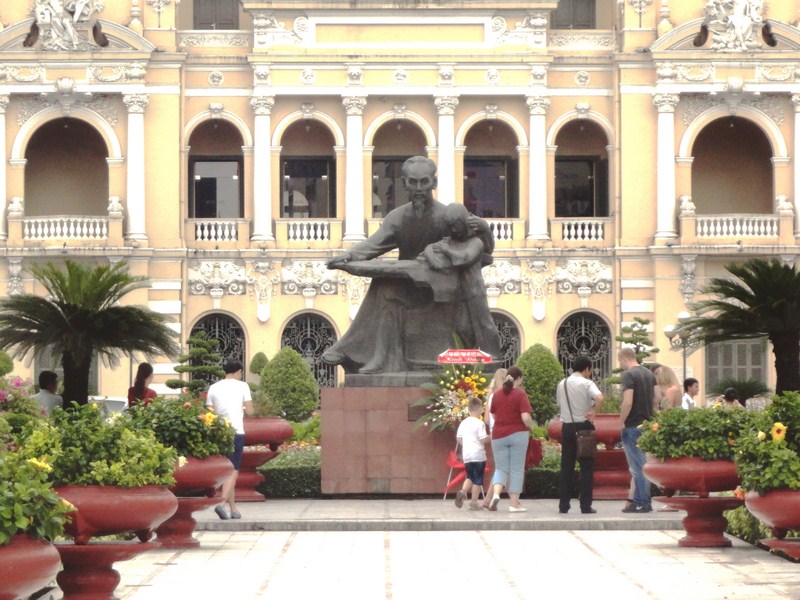
Standing on a small, lovely park (with beautiful flowers, trees and a fountain) in front of the building is the iconic bronze statue of revolutionary leader and National Hero Ho Chi Minh, sitting and reading a book to a little girl, with a protective arm around her.  Called “Uncle Ho and Children,” it was made by artist Nguyen Minh Chau.

Bronze statue of Uncle Ho and Children

Bronze statue of Uncle Ho and Children

Too bad we also didn’t visit after dark as this extremely photogenic building, beautiful by day, is also stunning at night as it is spectacularly floodlit by colorful lights installed by engineers and artists from Lyon (France).

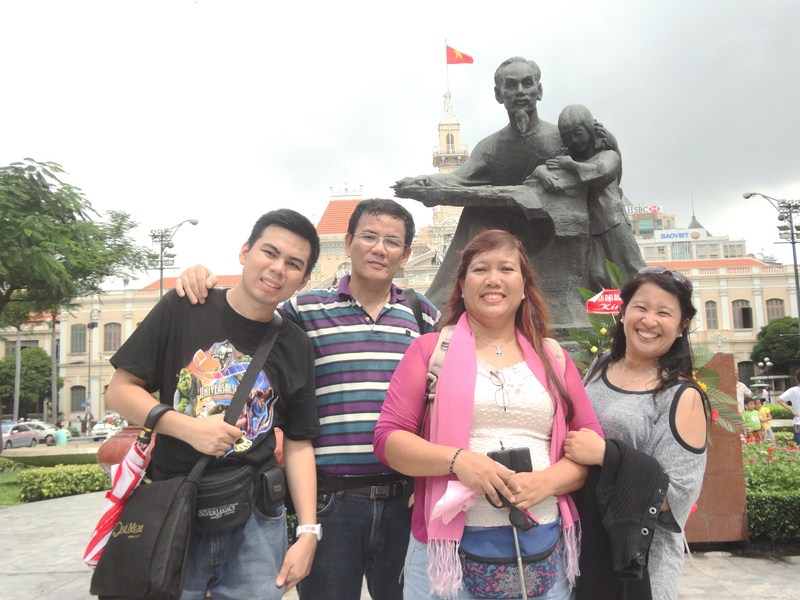
Jandy, the author, Violet and Osang

Jandy, the author, Violet and Osang

People’s Committee Building: 86 Le Thanh Ton St., District 1, Ho Chi Minh City