Poctoy White Sand Beach (Torrijos, Marinduque)

After lunch, we got dressed up, boarded our taxi and proceeded another 30 kms./1.5 hours to the town of Torrijos.  Upon entering the town, we made a short stopover at the nearby Pulang Lupa Battle Shrine, site of a Filipino victory during the Philippine-American War.

Vener and Jowel at the Pulang Lupa Shrine

Upon reaching Brgy. Poctoy, we dropped off at the 1-km. long, fine white sand Poctoy White Sand Beach.  Said to be Marinduque’s best, this postcard-pretty beach, with the dormant, 871-m. high Mt. Malindig as a backdrop, was surprisingly deserted it being a Good Friday. The only other people we saw roaming the beach were 2 missionaries from the Latter Day Saints.   It seems people here follow the long running rule of no bathing on Good Friday.

The deserted Poctoy White Beach
Bonding with Jandy and Cheska

From the beach, we hiked north to a nearby two-room homestay rented out to visiting tourists by Hans Peter Ulrich, a German national, and his Filipina wife Marilou.  The homestay was then being rented by 7 vacationing production staff (6 women and a man) of GMA 7’s Starstruck program.

Marilou’s Homestay

The homestay’s 2 rooms were both fan-cooled, had a wide bed with mosquito netting, a bathroom with running water and a common porch and cooking station with a working stove where they can do their own cooking.  As there is no refrigerator, they have to go to the market for provisions.  Once this need arises, they just call or text, via mobile phone, a tricycle driver (recommended by Hans) who can bring them there.

The homestay’s resident dog joins in
Starstruck in Marinduque

Fronting the cottage is a small, coconut palm-fringed private cove of sparkling white sand and the Good Friday rule did not stop us from frolicking the inviting waters of this beautiful beachfront.  Its reef drop-off, located 200 to 300 m. offshore, is ideal for snorkeling.  What more can you ask? Given the opportunity in the future, I would gladly return to this idyllic beach.

Cheska with Mr. Ulrich
Prior to our departure we made a short stopover at the residence of Hans Peter and Marilou Ulrich.

Marilou’s Homestay: Brgy. Poctoy, Torrijos, Marinduque.  Mobile number: (0921) 751-6930 and (0919) 485-0531.

A Tour Around Marinduque: Boac to Buenavista

On our second day in Marinduque (Good Friday), we hired  a Toyota Tamaraw FX, owned and driven by Mr. Herman Matre, for PhP1,200, to tour us around the island.  For food, we brought along packed lunches prepared for us by Ms. Laura Lahm, the owner of Barbarosa Restaurant (said to be the best place to eat in Marinduque).  We can actually drive around the island in 3 hours, as the main highway connects all 6 towns, but we opted to do this in a more leisurely pace.
 
Gaspar Island
Baltazar Island
Melchor Island

Traveling along the road, we espied, from afar, a  number of beautiful islands.  The 11-hectare, aptly named Elephant Island, has sheer cliffs, a half-kilometer long white sand beach and a soon-to-open, world-class resort (now Bellaroca Island Resort & Spa).  The Tres Reyes Islands consists of Baltazar (also called Pangikol Island), Gaspar (also called Manya Island) and Melchor (also called Polo Island) islands, all named after the Biblical Three Kings.  Uninhabited Baltazar and Melchor Islands have steep cliffs and underwater caves.  Gaspar Island has a small village, clear blue-green waters and a short, lovely white coral beach which offers fine snorkeling and diving.  In 1980, the wreck of a 15th century Chinese junk was discovered, in 38 m. of water, near Brgy. Pingan about 100 m. north of the island.  A large number of ceramic pieces were recovered including Swatow porcelain, stoneware jars and some iron skillets. All three Tres Reyes islands are ideal dive sites, having several good caves and walls and gorgeous sea fans.

Malbog Sulfur Springs

Our first stopover would be Malbog Sufur Spring (formerly known as Susana Hot Springs), located a few kilometers inland, at the foot of 1,157-m. (3,797-ft.) high, rarely climbed Mt. Malindig(with its 3 unique peaks), the highest mountain in the province.   Located 3 kms. from Buenavista and volcanic in origin, the spring has 5 main pools with hot therapeutic waters heated by Mt. Malindig and said to cure certain skin ailments, a welcome relief for us.  After paying a small entrance fee, we all took a dip in one of its tepid pools.  After this refreshing break, we all later partook of our packed lunches.

Country Nook (Basco, Batanes)

Country Nook

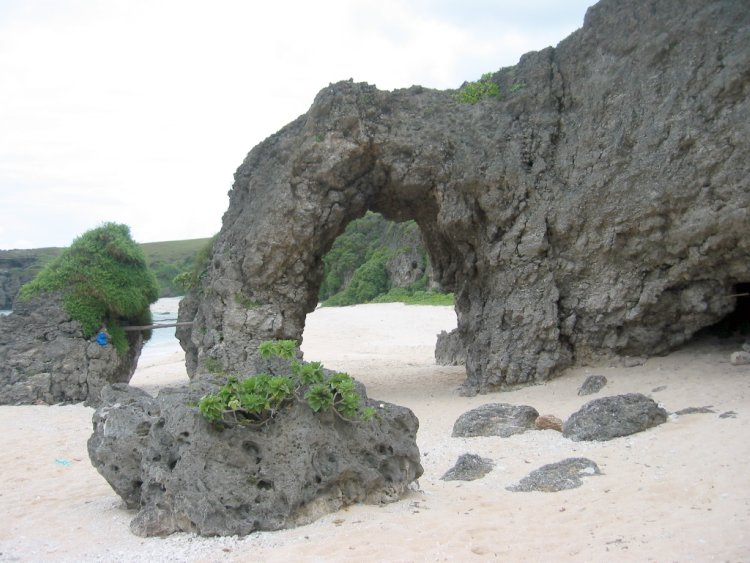
On the day prior to my departure, I was invited to joined a picnic at Country Nook hosted by youthful Basco Mayor Manuel Viola, again feasting on true Ivatan seafood fare.  Country Nook had a couple of magnificent rock formations just offshore.  Joining us was Ms. Carol Pobre (of DOT Region II) and Francis “Chico” Domingo, a certified PADI divemaster and A.D.S. instructor.  They were to dive deeper portions of Batanes’ marine environment which is rich with marine resources.  Batanes is one of the few remaining sites where pink and red corals (Corallum sp.), some of the rarest sea corals in the world, are found.  Chico has a vast knowledge of the province’s dive sites.

Carol and Chico take a dive

I could only watch in envy as Carol, accompanied by Chico, explored the offshore marine sanctuary’s beautiful underwater scenery and marine life.  I was offered and wanted to join them but, according to Chico, diving wasn’t allowed 12 hours prior to my flight (I was leaving 8 AM the next day).  Carol was leaving a day after my departure.  However, my disappointment was later dispelled by a beautiful Batanes sunset. 

A beautiful Batanes sunset. Carol is in the foreground

Country Nook: Sitio Vavayat, Brgy. Chanarian, Basco, Batanes

Morong Beach (Sabtang, Batanes)

After that filling and unique lunch, I found out that I still had time to spare before taking the last falowa back to the mainland, so I decided to make a quick visit to Brgy. Sumnanga.  Inaccessible by the Toyota Revo, I hired the services of Mr. Alex Habana, hitching on his motorcycle to get there.  I had no time to explore, on a walking tour, the barangay proper, a portion of which used to be called “Little Hongkong” because of the cobblestones that used to cover its pathways.

Morong Beach and Ahaw Arch

I, however, visited the white sand Morong Beach (often mistakenly called Nakabuang Beach), with its sea-sculpted cave and its landmark Ahaw Rock Arch.  A number of tourists were swimming along the beach but I didn’t have the luxury of time so I made my way back, dropping by the new lighthouse along the way for some photo ops.  We arrived at the port in time for last (4 PM) boat trip back to Ivana.

Sabtang’s lighthouse

Return to Guimaras

After breakfast at the Fine Rock Hotel, Charlie and I again boarded our Ford Explorer and drove to Muelle Loney (Iloilo River Wharf).  Here,  we loaded the car on the MV Felipe, another ancient RORO (Roll On Roll Off) ferry of F.F. Cruz Shipping Corp., bound for  Jordan, the provincial capital of Guimaras, where we plan to do GPS mapping.  This would be my second visit to this island province, having been there 10 years ago with my family.

RO-RO Port at Jordan

Our ship left Muelle Loney by 9:30 AM and the smooth crossing to the RO-RO port in Brgy. Hoskyn took just 30 mins..  Once docked, we drove off, with Charlie on the wheel, for Jordan town proper where we made a short stopover at the municipal hall and the town plaza, said to be the smallest in the country.

Jordan municipal hall
The town plaza, the country’s smallest

From thereon, we proceeded on our GPS mapping around the island.  At Nueva Valencia, we again made a short stopover at Raymen Beach Resort which was situated in a cove.  The narrow, beige sand beach was clean and the left side of the cove was a marine reserve with beautiful corals.

Raymen Beach

The resort itself, considered the most popular win the province, is about an hour’s drive away from Jordan Wharf.  It has a mix of airconditioned rooms with bath and TV and fan-cooled cottages with bath.  They also have a canteen, billiards and videoke. 

Raymen Beach Resort

Past Nueva Valencia, the road to Sibunag and San Lorenzo turned bad and I replaced Charlie at the wheel of the Ford Explorer for the second time in our 3-week GPS mapping expedition (the first time was from Kalibo to Iloilo City).  Once done with our mapping, we returned to Jordan port and left on the 5:30 PM ferry.  We were back in Fine Rock Hotel in time for dinner.
  
F.F. Cruz Shipping Corp.: Lapuz, Iloilo City, Iloilo.  Tel: (033) 337-1046, 336-9329 and 336-4195.  
F.F. Cruz Shipping Corp.: Jordan, Guimaras.  Tel: (033) 581-1701.
Raymen Beach Resort: Sitio Alubijod, Poblacion, Nueva Valencia, Guimaras.  Tel: (033) 396-0252.

Mindoro Trail: Puerto Galera (Mindoro Oriental)

White Beach

After breakfast at Calapan Bay Resort, we left the city by 11 AM, April 10, for Puerto Galera.  Part of the 49-km. drive entailed negotiating dusty, Kennon-like zigzag roads (Puerta Galera is considered as the “Little Baguio” of Mindoro) and steep ravines.  We made a short photo op stop over at the Waterfalls Bridge at Brgy. Villaflor where we can view the 131-m. high, roadside Tamaraw Falls, the highest waterfall in the province.  Its pool is a popular swimming spot for weekenders. The enchanting view of Varadero Bay heralded our arrival at the beach town of Puerto Galera which spreads out 10 kms. along the coast.  

Tamaraw Falls
Located on a Y-shaped peninsula on the northwestern tip of Mindoro Island, the popular tourist destination of Puerto Galera has numerous fine beaches with sheltered coves beneath the green mountainous backdrop of the 1,086-m. high Mt. Alinyaban, 1,185-m. high Mt. Talipanan and 1,228-m.  high Mt. Malasimbo, all of which are rich in mineral deposits of marble, gold, lime and silica.
 
Muelle Pier
We arrived at the town proper and its ferry dock at Muelle by 1:30 PM  and had a late lunch at one of the restaurants.  Muelle has an excellent natural yacht harbor, effectively protected by Medio Island, at the mouth of picture-perfect Muelle Bay.  From here, we can view the mooring area of Puerto Galera Yacht Club.  From the pier, Sabang Beach and White Beach are both 6 kms. away.

Puerto Galera town proper

A marble cross, located beside Cocopoint Hotel, commemorates the sinking of the Spanish warship El Canonero Mariveles, on November 18, 1879, during a storm off Soguicay Bay.   The cross was originally erected in wood on March 18, 1897 but was renovated in 1938 by Spaniard Luis Gomez y Sotto.   Its inscription reads Ultima tierra que pesarou los tripolantes del Canoneros Mariveles el 18 de Noviembre de 1879.

El Canonero Mariveles Cross

After lunch, we made an ocular inspection of Sabang Beach, Small La Laguna Beach, Big La Laguna and White Beach, 4 of the at least 13 superb connected beaches that have been developed for tourism within 7 kms. or so of the town.  The somewhat gray sand Sabang Beach has the most developed resorts and offers a good choice of restaurants, discos and watersports facilities. Small La Laguna Beach, sometimes called Coral Beach, has whiter sand and is fairly quiet and cozy.  It attracts a lot of foreign backpackers and other budget travelers who like to stay a long time at Puerto Galera.  The broad, 1-km. long White Beach, on the other hand, is immensely popular with local tourists.  Our last stop, we had our dinner here.

Ponderosa Golf & Country Club

After our beach tour, we drove all the way back to Muelle where we decided to check in at fan-cooled rooms with toilet at bath at Coco Point Resort.  Breakfast at its restaurant, come morning, was a pleasure as I had a beautiful view of the natural yacht harbor.  We checked out right after breakfast and drove 5 kms. (half of it unpaved) all the way up to the 9-hole, 20-hectare Ponderosa Golf and Country Club, located 600 m. above sea level, midway up Mt. Malasimbo in Brgy. Minolo.  From this cool and windy vantage point, located southwest of Puerto Galera, we had a tremendous bird’s eye view of Puerto Galera Cove and Batangas’ Verde Island, Maricaban Island and Sombrero Island.  Facilities here include a restaurant and bar.

Balatero Pier

After about 30 mins., we left Ponderosa by 9 AM, driving back down the mountain and, once back on level ground, made a long stopover at White Beach.  It was time to go and we drove to Balatero Pier, 15 mins. from White Beach and near the town proper, arriving there by 11 AM.  RO-RO ships dock here and, after paying the necessary fees and fare, we loaded the Ford Explorer on the MV Starlite Odyssey.  Our ship left Puerto Galera by 12 noon and we arrived at Batangas Port by 1:40 PM.  I arrived in Manila by 4:30 PM.

Mindoro Trail: Pandan Island Resort (Mindoro Occidental)

Pandan Island’s sparklingly white sand beach

Day Two was to be a long haul drive from Mamburao to San Jose, a distance of little over 160 kms..  What would normally be a 2.5-hr. drive in excellent road conditions, took us double that.  We made a stopover at surprisingly progressive Sablayan (coined from the Visayan word meaning “where the waves meet’) town, the gateway to the remote and undeveloped Apo Reef Natural Park (a 2.5-hr. boat ride), the largest atoll-like reef in the country, the second largest in the world and one of the world’s best dive spots.  The park has a sunken lagoon system noted for its spectacular wall diving. 

Foot bridge at Sablayan

Once at the town proper, we decided to take a welcome breather and check out the Pandan Island Resort.  Located at the 38-sq. km. North Pandan Island (also called Pandan Grande Island), it is highly touted by noted German travel writer Jens Peters as one of his favorite islands.   We parked our vehicle along a road beside the Bagong Sabang River, and hired a banca (PhP300 roundtrip) to bring us to the island. 

Bagong Sabang River

Once out into Pandan Bay and past South Pandan Island (also called Pandan Piqueño), the island’s palm-fringed, sparklingly white sand beach soon hove into view.  The boat trip took just 15 mins. and soon we were walking barefoot on its Boracay-like sand.     The resort, established sometime in 1993, is managed by French adventurer Dominique Carlut and his Ilongga wife Marina.  The island is much like Boracay during its early years when it was without electricity.  It has 16 cottages (5 budget, 10 standard and 1 family), all with their own toilet and bath.  There are no televisions.

One of the resort’s cottages

The cottages, as well as the restaurant, are all built using native nipa, bamboo and sawali, simple yet comfortable and truly in harmony with the island’s natural features.  But unlike Boracay during the early years, the resort doesn’t rely on eco-unfriendly electric generators using, instead, cleaner solar energy (12 volts)  to supply the lighting needs of its cottages.   To charge lights, cameras, laptops etc., 220 volts (as well as an internet connection) is only available at its well-equipped dive shop (Mariposa Divers Pandan, established in 1992). 

The resort clubhouse

For lunch, we feasted, buffet-style, on Filipino and French cuisine with its variety of fresh fish, poultry or meat with vegetables, fruits and coffee. The bar has a selection of fine, white and red French wines which you can sip while watching the sun sink into the South China Sea. In 1994, the island was declared as a marine park and thanks to this strict no fishing and “hands off” policy, the variety and density of the marine life has grown by leaps and bounds. The dive sites around the island range from shallow, tropical fish-rich coral gardens, easily reached from the beach, to deep drop-offs on the island’s north, ideal for experienced divers, and reached by dive boats in about 15 mins..  Dive safaris are available to Apo Reef  Natural Park (a 1.5 to 2-hr. boat ride),and the World War II Japanese wrecks at Busuanga (Palawan). 

Caminawit Port

After snorkeling its coral and tropical fish-rich waters, we left the island and returned to the reality of another bumpy, 80-km. drive to equally progressive San Jose, another starting point for diving excursions to Apo Reef.  Offshore are Ambulong Island, Ilin Island and White Island.  The town has an airport and a port (Caminawit Port).  Upon arrival, we checked in at airconditioned rooms with bath at the Mindoro Plaza Hotel, again the town’s best.  No videoke this time as we had a big next day ahead of us. 

Mindoro Trail: Batangas City to Mamburao (Mindoro Occidental)

The 10,245-sq. km. Mindoro Island, the country’s fifth largest island, remains relatively unknown in the tourism highway.  Outside of Puerto Galera and what little we know of the traditionally animist, polytheistic and semi-nomadic Mangyan tribe and the rare, severely endangered and elusive Mindoro dwarf water buffalo or tamaraw (the country’s largest wild animal), very few have even heard of it.  More so with Mindoro Occidental, its western part.


Batangas International Port

Yours truly, together with Mr. Harland “Charlie” Kemplin of United Tourist Promotions (makers of EZ Maps), wanted to correct this sad state of affairs by creating a tourist map of the island (featuring Puerto Galera, Calapan City, Mamburao, Sablayan, Pandan Island Resort, etc.), probably the first of its kind to be so conceived.  To do this, we had to experience the island, first-hand, by circumnavigating.  For this purpose, we will be using the latest Global Positioning Satellite (GPS) technology plus a rugged, 4-wheel drive, circa 1994 but newly refurbished Ford Explorer.  We intend to complete this island circuit in 5 days.  We left early in the morning of 6 April, Charlie driving all the way to Batangas City’s International Port in a little over 2 hrs..  There are 3 entry points to Mindoro from Batangas City: Abra de Ilog in Mindoro Occidental and Puerto Galera and Calapan City, both in Mindoro Oriental.  We opted for Abra de Ilog, the least traveled of the three.   

A RO-RO Ship

We estimated that the ancient RORO (Roll-On-Roll-Off) ferry boat we loaded the car on had a capacity for 9 vehicles but we were told it would carry 13.  How this came about was soon revealed to us when 3 cars were fitted in a space ideally suited for only 2, forcing the driver to stay inside (unless he could exit via a sunroof) for the duration of the 2.5-hr. cruise with no toilet breaks.  We entered last, parking where the ship narrowed at the bow, thus allowing us to get out of the car.  We also had the added advantage of being the first out the ship upon landing at Abra de Ilog.

Tayamaan Beach

One thing was revealed to us before the trip: there is no road (erroneously indicated in other maps) connecting Abra de Ilog with neighboring Puerto Galera.   The only way to proceed was south.  A portent of things to come was revealed as soon as we left Abra de Ilog’s Wawa Port by 2:30 PM for the 35 km. drive to Mamburao, the provincial capital.  A road less traveled is probably a road unpaved and the road south was mostly such.  The only comfortable drive we encountered was an 18-km. stretch past San Isidro.

The Provincial Capitol

Upon reaching Mamburao, we made brief stopover at the town’s beautiful but short Tayamaan Beach.  Next, we proceeded to the Provincial Capitol where we met up with provincial officials.  We were given advanced warning of the horrendous road conditions from San Jose to Bulalacao (the first town on the Oriental side).  Charlie, who did all of the driving, was having second thoughts of pushing on but, with our pioneering spirit egging us on, insanity finally prevailed.  But first, we had to rest and we checked in at 2 airconditioned rooms with bath and cable TV at the upscale La Gensol Plaza Hotel, the best in town.  Later that night, we sang our hearts out at a videoke, together with Provincial Tourism Officer, Ricky Martin-wannabe and namesake Mr. Benjie Datinguinoo.   

Governor’s Island (Hundred Islands, Alaminos City, Pangasinan)

From Martha Island, our boatmen brought us over to Governor’s Island for a brief stopover, One of 3 developed islands in this mini-archipelago (the others are Quezon Island and Children’s Island), it has a governor’s guesthouse with 2 bedrooms for 6-8 people, living room, dining room, toilet and bath, kitchen (with dining and cooking utensils provided for), ceiling fans and generator lighting.  It also has 2-pax nipa huts and camping is also allowed here.  
 
The viewpoint of Governor’s Island
There are white sand beaches on both sides of the island.  From the beach, we a short hike up some carved steps that lead to the island highest point.  At this viewpoint, we had an  unobstructed panoramic view of the many granite and scrub-covered islands that compose this national park.  After some photo ops, we made our way back down the hill.  Back at our boat, we were finally brought back to Lucap Wharf.  After paying our boatmen, we had our first freshwater shower at the complex, loaded our gear at our car, had lunch and proceeded on our way to Bolinao.

Martha Island (Hundred Islands, Alaminos City, Pangasinan)

The sun was already low in the sky when we packed our tent and belongings and again boarded our boat to take us to nearby Martha Island.  We thought we had the island to ourselves as the white sand beach, connecting the two islands, was deserted.  Once on dry land, our boatmen left us, promising to return the next morning to pick us up.  We were soon setting up our tent and was  just about done doing this when boats, one after the other, began unloading local tourists, with the same mindset as ours, on our tiny strip of beach.  I guess there’s simply no escaping the maddening crowd.  

Martha Island

It was too dark to go swimming, so we just settled down in our tents, ate our packed dinner and spent the rest of the night playing cards.  Jandy and the others slept inside the tent while I slept outside, on my rubber mat.  I thought I came fully prepared for camping but I forgot one essential item – Off Lotion. There were no mosquitoes around.  Instead, what bothered me during my sleep were nasty sandflies (locally called niknik).  The ground I was sleeping on was also lumpy.  Sleep didn’t come easy to me that night, if at all.   

Relaxing under the shade
The island’s beach

Come morning, we prepared our breakfast of coffee and sandwiches.  Luckily for us, the rocky outcrop beside our tent shaded us from the morning sun.   Right after breakfast, we donned our swimming attire to go swimming.  The waters by the shoreline wasn’t as clear or as inviting nor its slope as gradual as the beach in Romulo Island.  Poor visibility meant no snorkeling.   Still we made do with what was before us.  Our boatmen arrived earlier than expected, so we packed up our tent and belongings and boarded our boat.