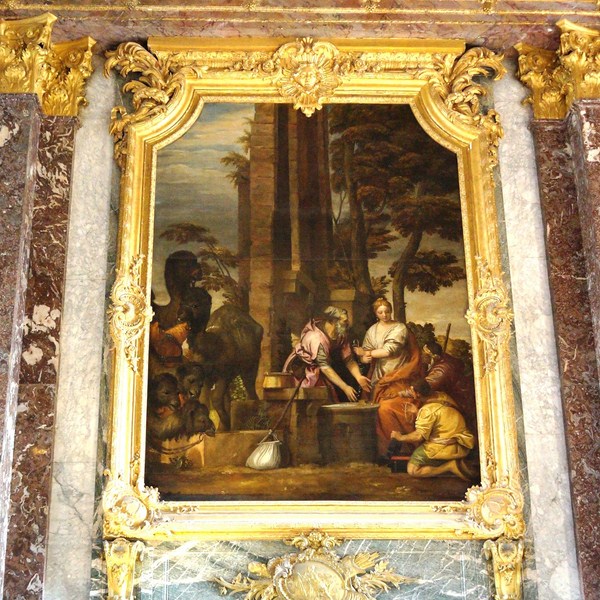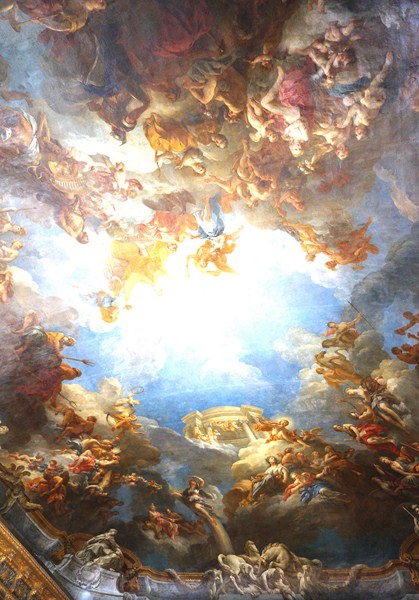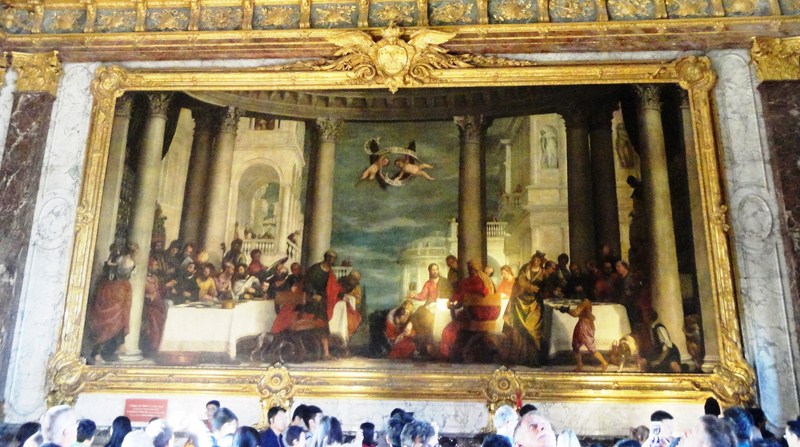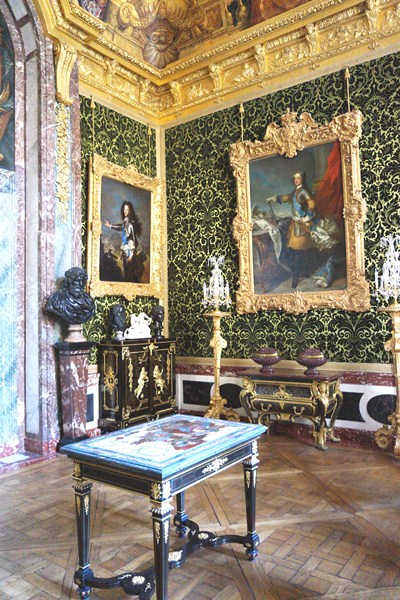
Versailles Palace – Gallery of Illustrious Men (France)

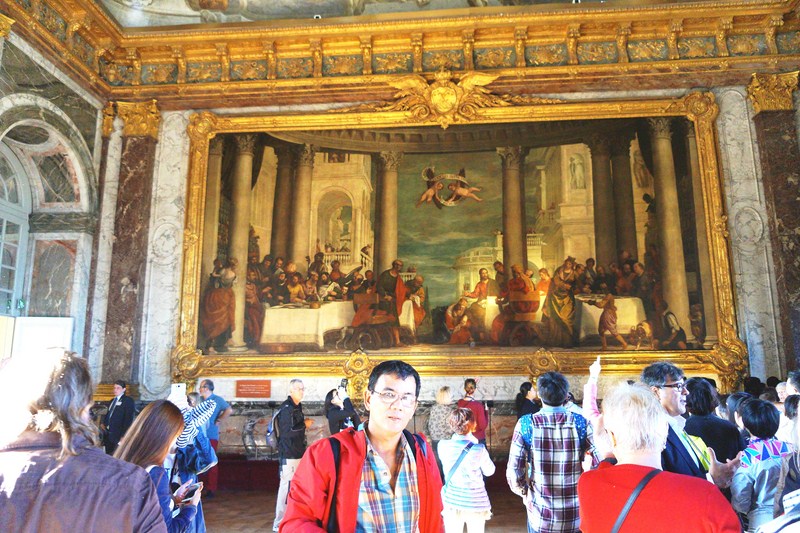
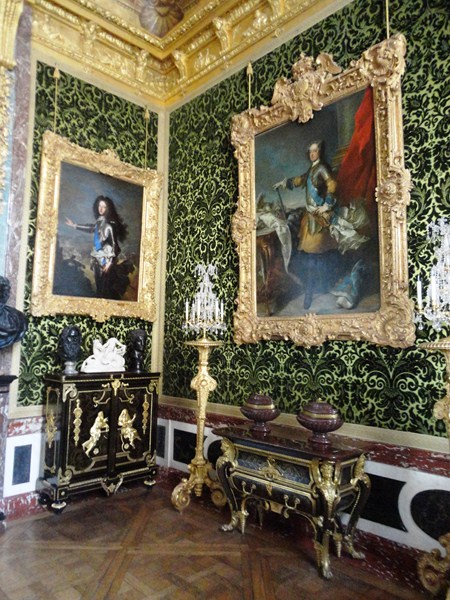
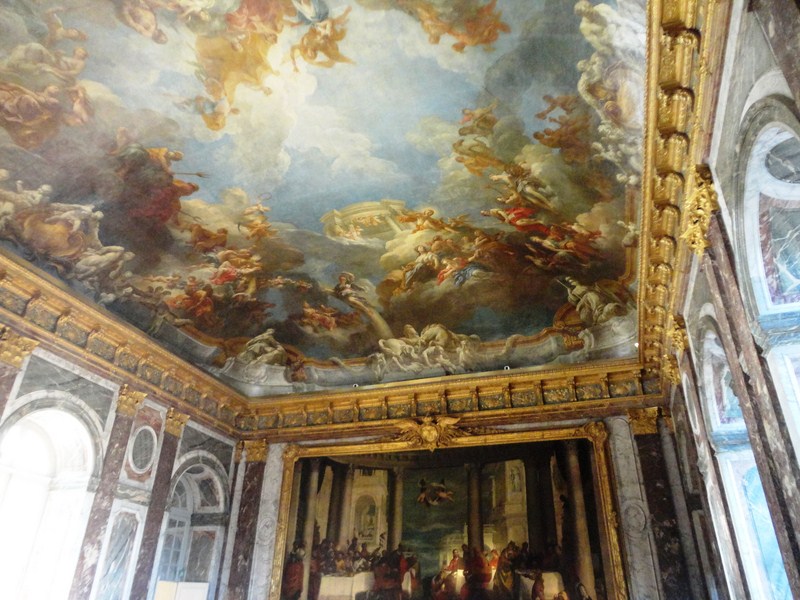
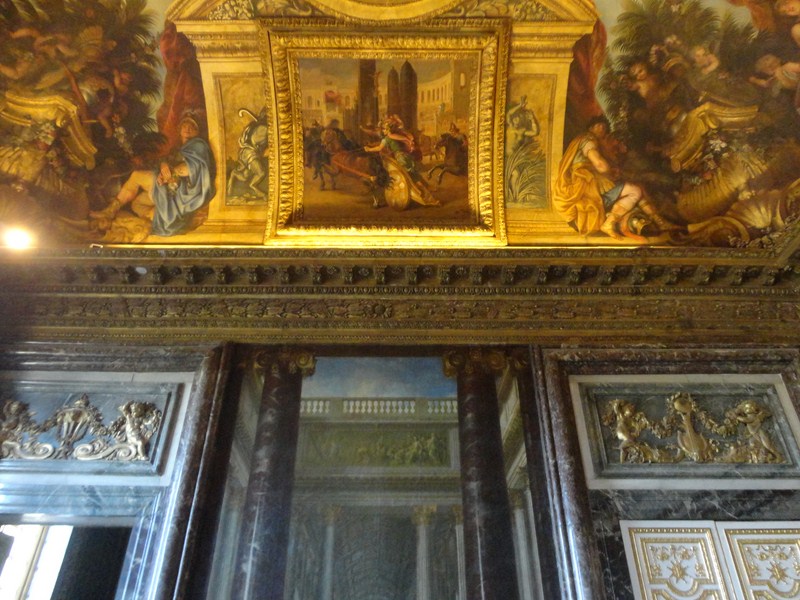
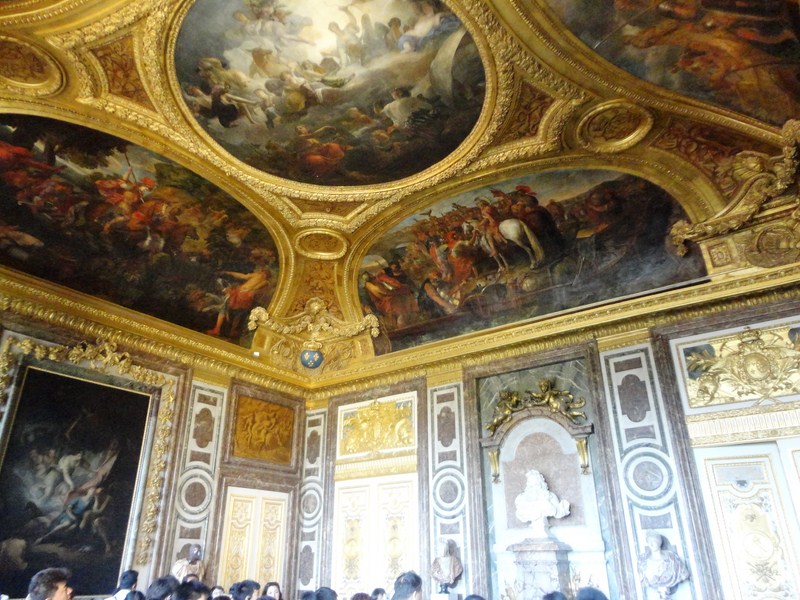
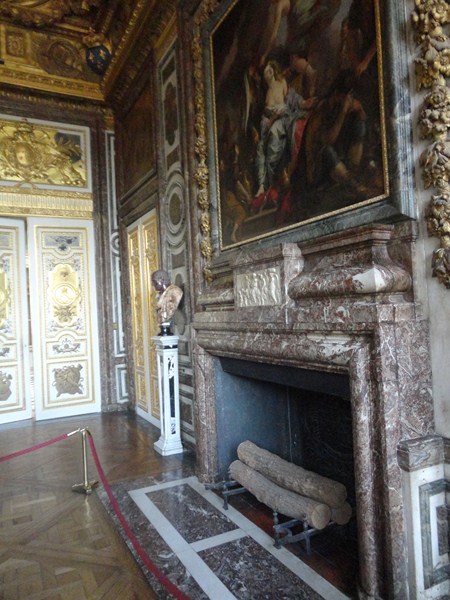
Gallery of Illustrious Men

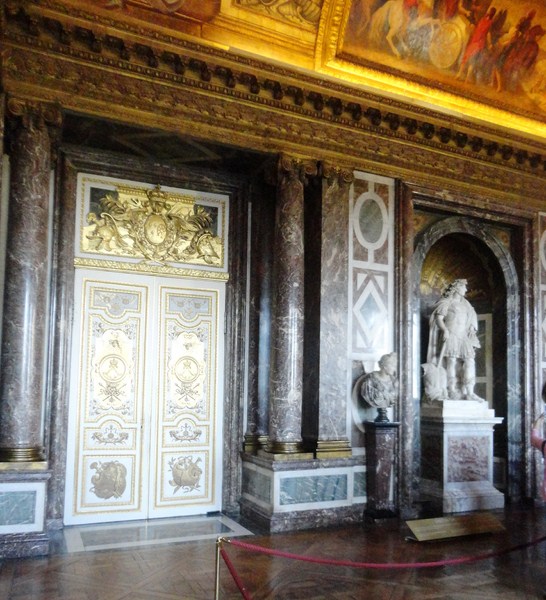
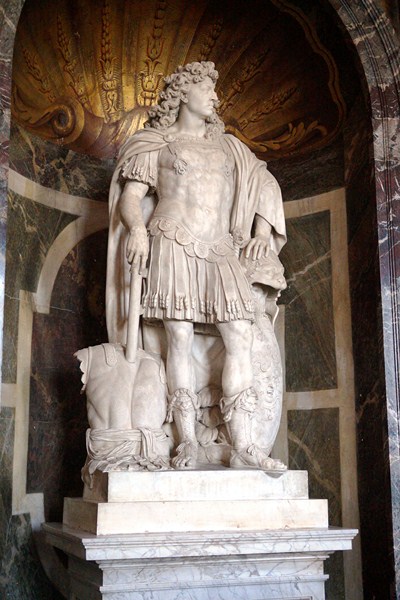
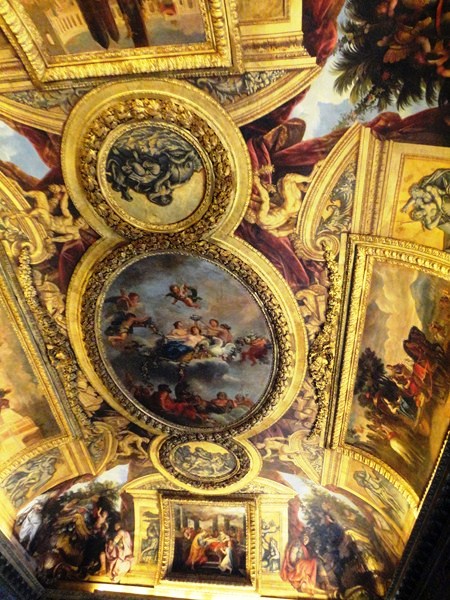
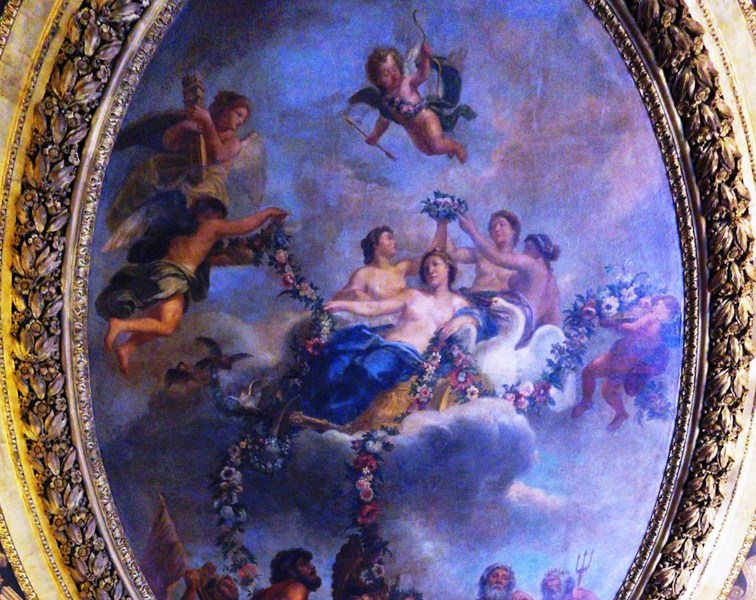
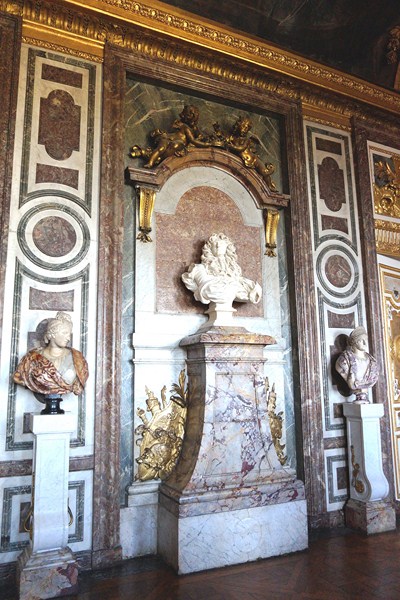
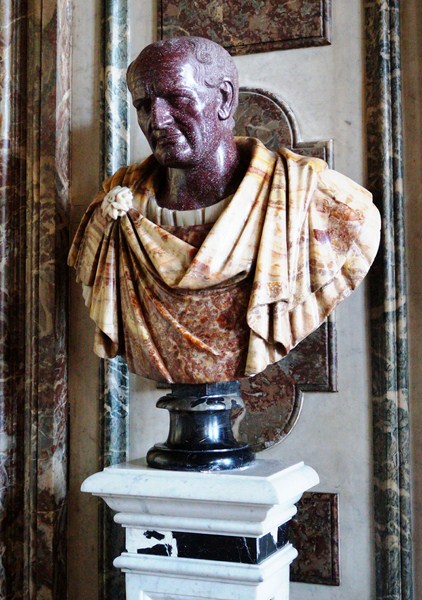
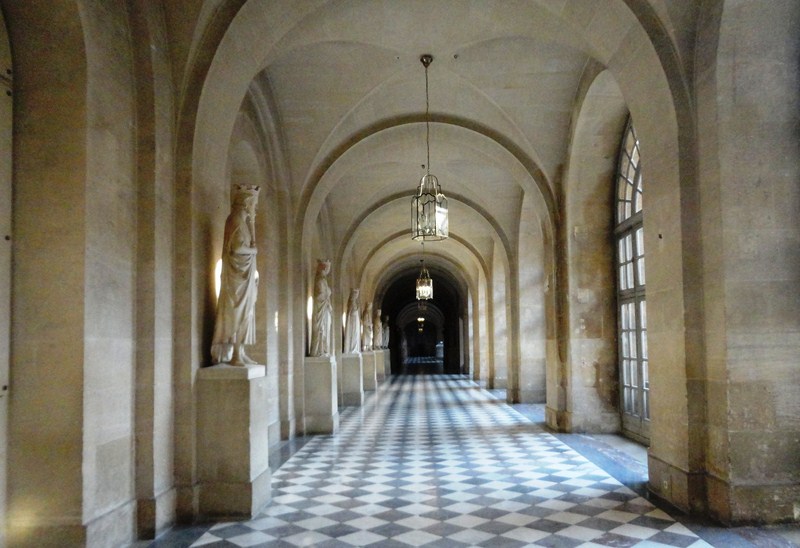
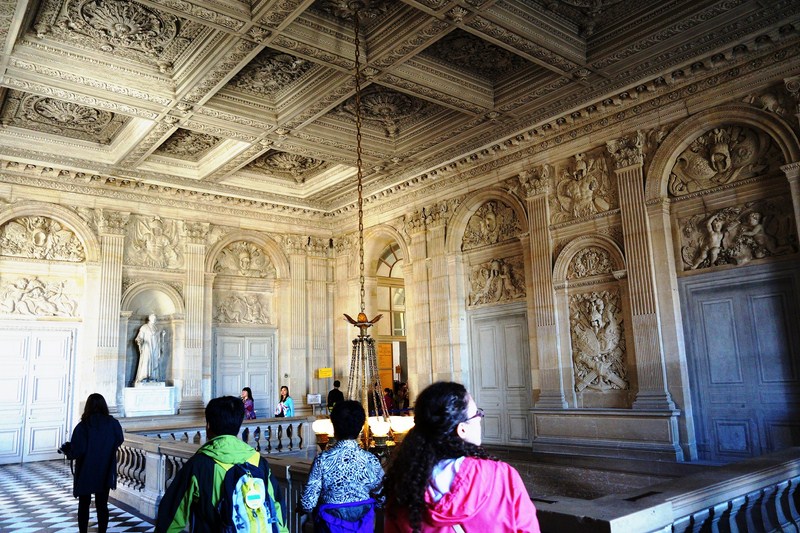
The Gallery of Illustrious Men, probably the longest in Versailles (it stretches almost the entire North Wing), is only interrupted by the emergence of the Royal Opera. In Louis XVI’s time, busts of Enlightenment-philosophers were added to the gallery.

Check out “Versailles Palace

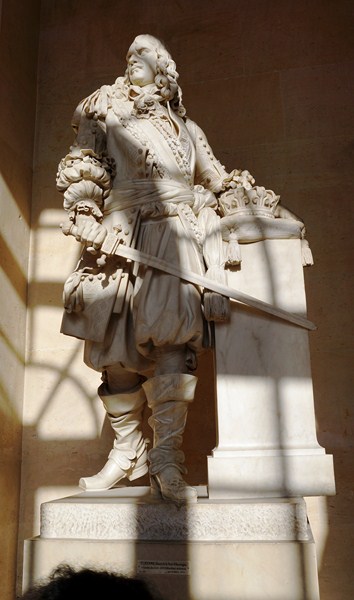
Statue of Henri Turenne (Augustin Pajou, 1783)

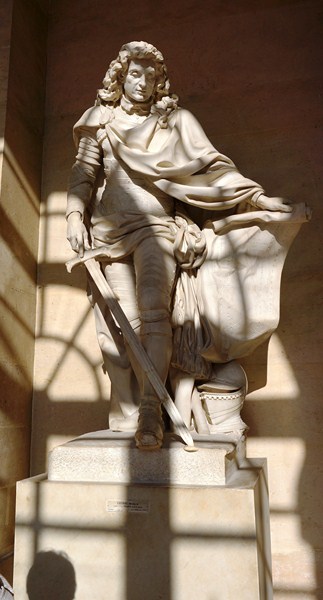
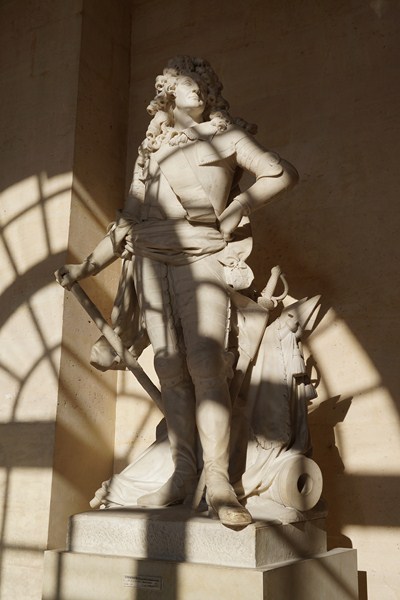
Statue of Nicolas de Catinat (Claude Dejoux)

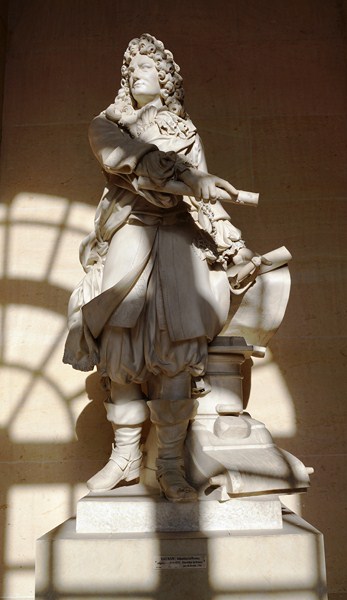
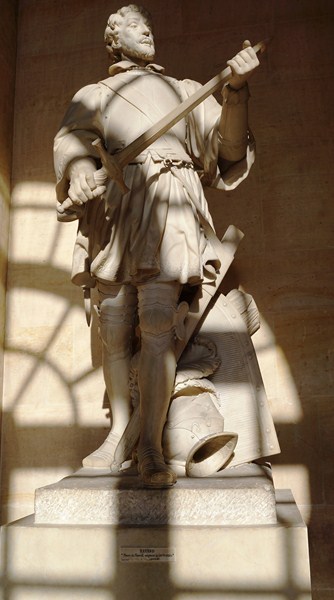
Some of the statues that line this gallery are Marshals of France who served under King Louis XIVLouis II de Bourbon (Prince of Condé), Henri de La Tour d’Auvergne (Viscount of Turenne), François de Montmorency, Sébastien Le Prestre (Marquis of Vauban), Anne Hilarion de Tourville and Nicolas Catinat.

Statue of Francois Henri de Montmorency (Louis-Philippe Mouchy)

Statue of Sebastien Le Prestre Vauban (Charles-Antoine Bridan, 1785)

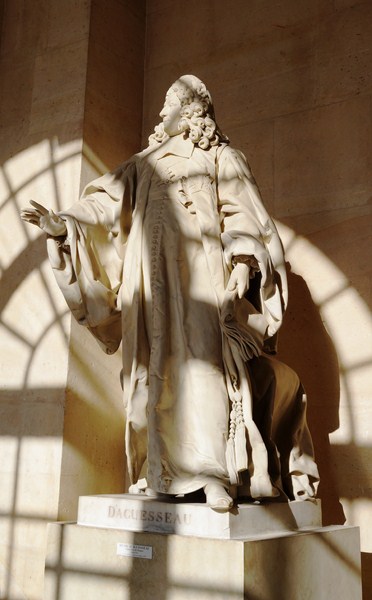
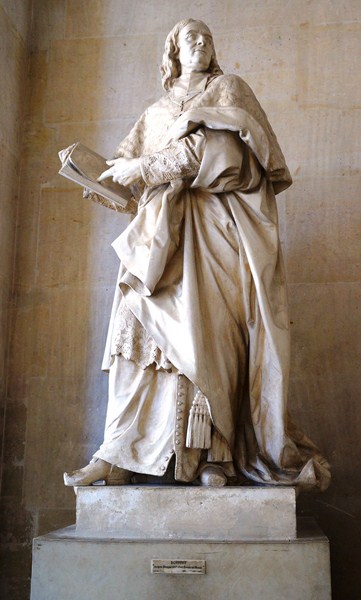
Other statues of those who served under King Louis XIV include Jacques-Benigne Bossuet (court preacher and tutor to the nine-year-old Dauphin, oldest child of Louis XIV) and Abraham Duquesne (Vice-Admiral who distinguished himself in the Third Dutch War).

Statue of Henri Francois d’Aguesseau (Pierre Francois Berruer)

Statue of Anne Hilarion de Tourville (Jean-Antoine Houdon, 1781)

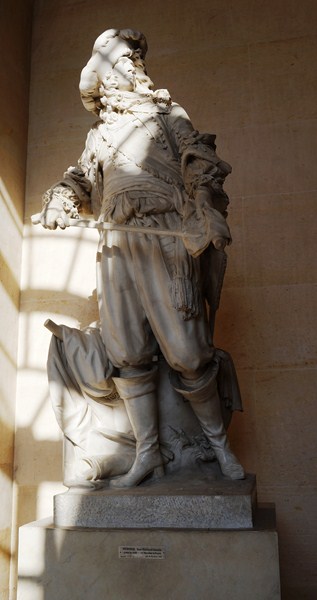
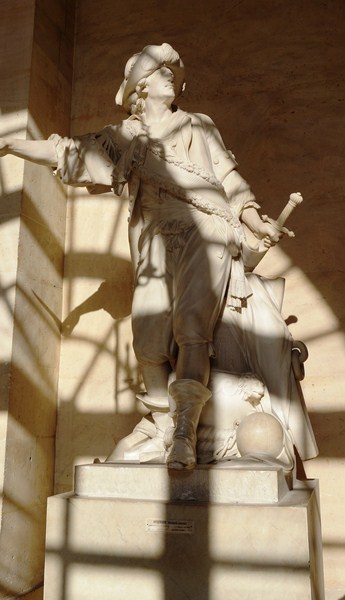
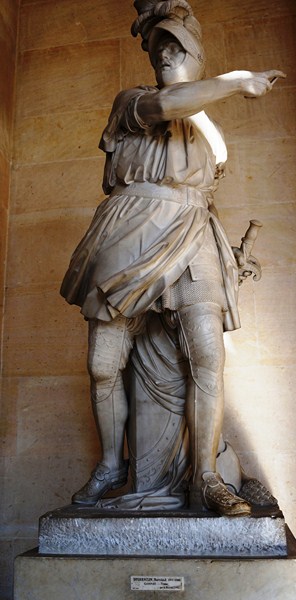
Statues of other famous men in French history are represented here.  They include several Chancellors (Henri François d’Aguesseau and Michel de L’Hopital) as well as Carloman (king of the Franks from 768 until his death in 771),  Bertrand du Guesclin (an important military commander on the French side during the Hundred Years’ War),  Francois Fenelon (French Roman Catholic archbishoptheologianpoet and writer), Pierre Terrail, seigneur de Bayard (a French knight at the transition between the Middle Ages and the Renaissance).
Statue of Jacques-Benigne Bossuet (Augustin Pajou)

Statue of Abraham Duquesne (Martin Claude Monot, 1784-87)
All these statues were works of some of the noted French sculptors of that time – Martin-Claude Monot, Louis-Philippe Mouchy (1734 – 1801), Jean-Joseph Foucou (1739 – 1821), Jean-Antoine Houdon (1741 – 1828), Pierre Francois Berruer (1733 – 1797), Augustin Pajou (1730 – 1809), Claude Dejoux (1732 – 1816) and Charles Antoine Bridan(1730 – 1805)

Statue of Bertrand Duguesclin (Jean-Joseph Foucou, 1799)

Statue of Pierre du Terrail Bayard (Charles Antoine Bridan, 1787)

Gallery of Illustrious Men: North Wing, Chateau De Versailles, Place d’Armes, 78000 Versailles, France. Tel: +33 1 30 83 78 00. Website: www.chateauversailles.fr.  Open daily (except on Mondays and May 1), from 9:00 AM to 6:30 PM.  Last admission is 6 PM while the ticket office closes at 5.45 PM. The estate of Trianon and the Coach Gallery only open in the afternoon while the Park (7 AM to 8:30 PM) and Gardens (8 AM to 8.30 PM, last admission: 7 PM) are open every day. Access to the Gardens is free except on days of fountains shows. You can access the estate of Trianon through the Gardens or through the city. The Petit Trianon is only possible via the Grand Trianon.
Admission: 27 € for Passport with Timed Entry (days with Musical Fountains Shows or Musical Gardens), 20 € for Passport with Timed Entry (without musical fountains show or musical gardens), 12 € for Estate of Trianon ticket(without Musical Fountains Show or Musical Gardens), 10 € for Passport with Timed Entry (free admission, days with Musical Fountains Show or Musical Gardens), 9,50 € for Musical Fountains Show ticket, 8,50 € for Musical Gardens ticket, 28 € for the Fountains Night Show.

How to Get There: The cheapest option for reaching Versailles is by train. There are three train stations in Versailles.  RER line C arrives at Versailles Château – Rive Gauche train station, the closest one of the Palace (just 10 minutes’ walk to the Palace). SNCF trains from Gare Montparnasse arrive at Versailles Chantiers train station, which is 18 minutes on foot to the Palace. SNCF trains from Gare Saint Lazare arrive at Versailles Rive Droite train station, 17 minutes on foot to the Palace. RER C and SNCF train times are available on www.transilien.com.
Versailles Palace (France)

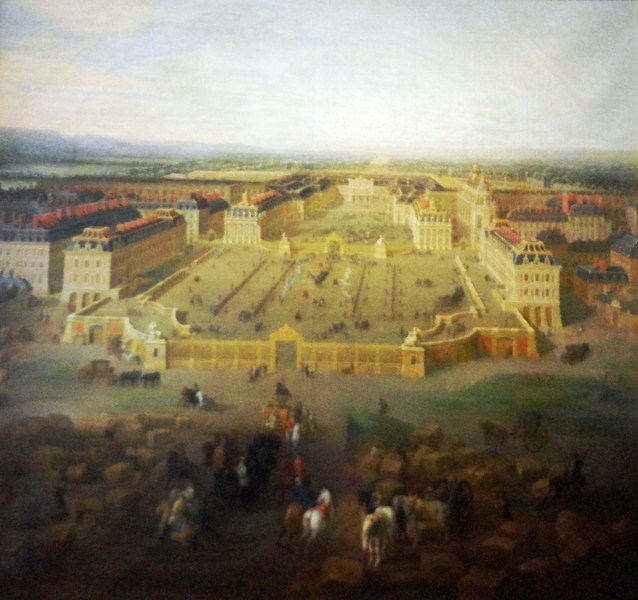
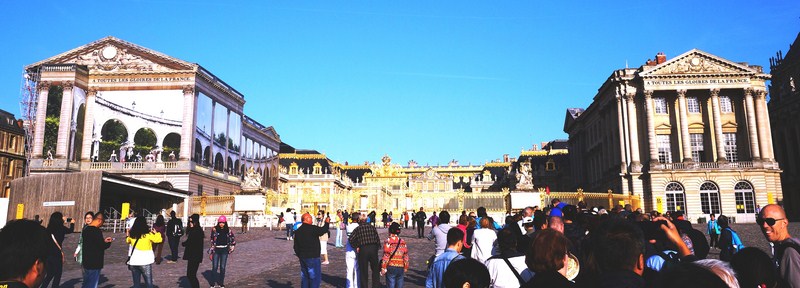
Palace of Versailles (Chateau de Versailles) seen from the Place d’Armes

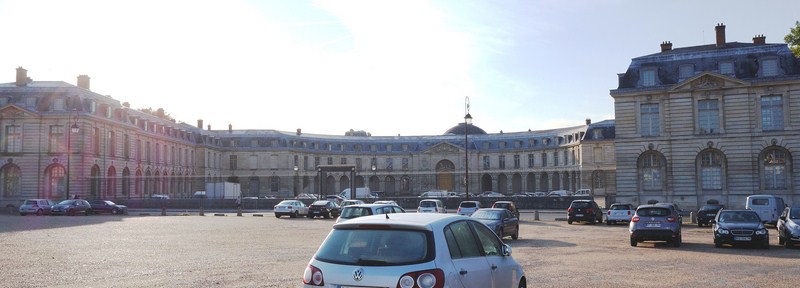
After a 10-min. walk from the Versailles Château – Rive Gauche train station, we finally at the Place d’Armes, the roughly fan-shaped square with its equestrian statue of Louis XIV in the center and the Grande Écurie and the Petite Écurie (Royal Stables) to the east.  We entered the  Palace of Versailles via the  royal gate into the Court of Honor (cour d’honneur), the courtyard in front of the palace.

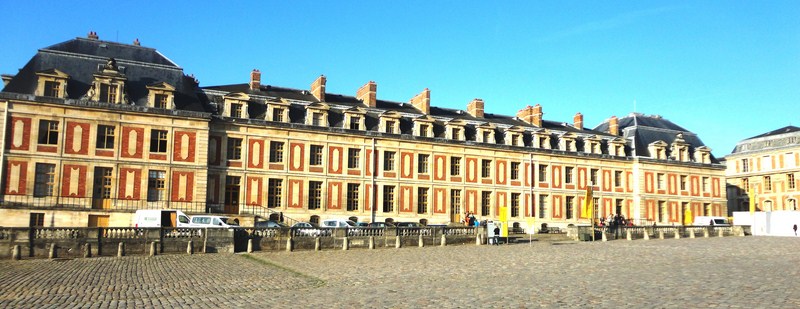
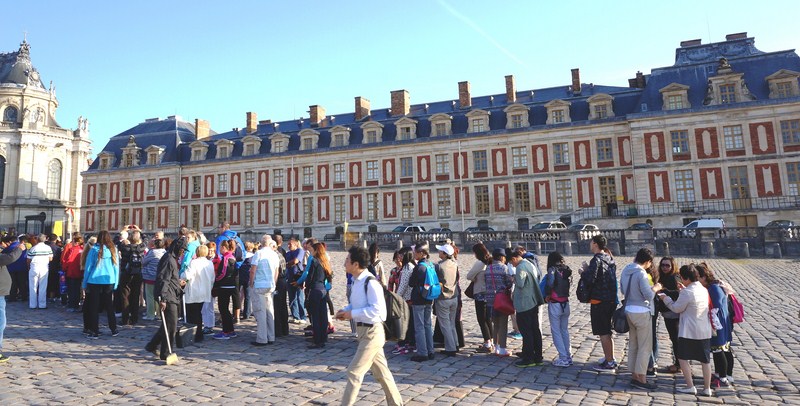
Place d’Armes, facing the La Grand Ecurie and Petite Ecurie

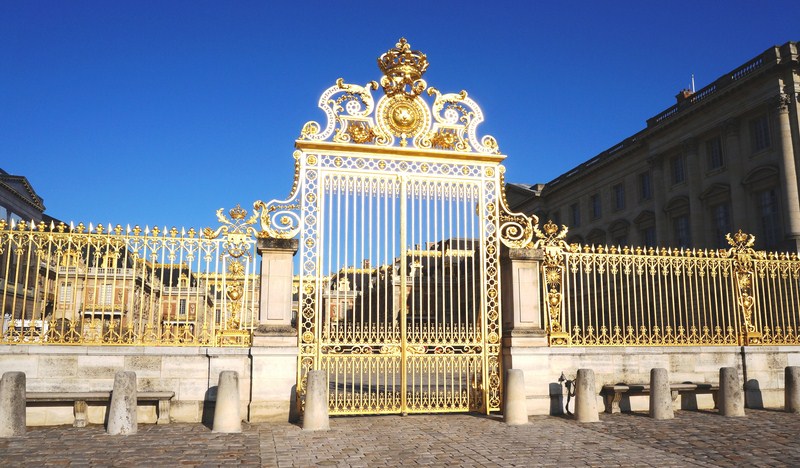
The original Baroque-style steel gate, designed by Jules Hardouin-Mansart, was torn down during the French Revolution.

The recreated Royal Gate

The new 80 m. high, recreated steel gate, decorated with 100,000 gold leaves, was unveiled last February 4, 2008 after two years of painstaking work by legions of top craftsmen and history experts with private donors contributing five million euros (eight million dollars) to ensure an exact replica would be produced.  As we had already bought our tickets online, we entered the palace via Entrance A.

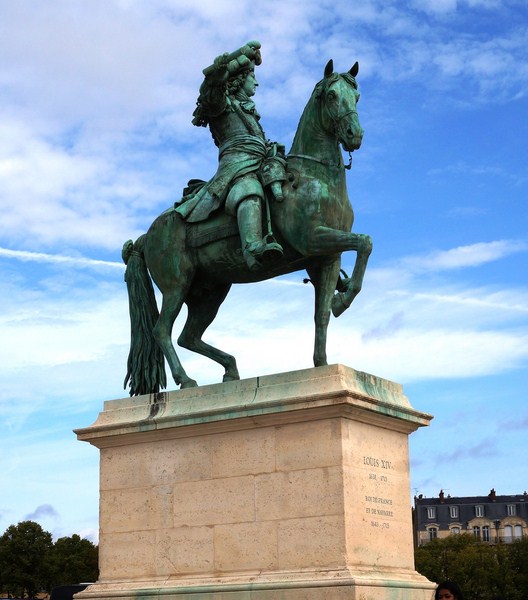
The bronze equestrian Statue of Louis XIV designed by Pierre Cartellier. The rider is the work of Louis Petitot, son-in-law of Cartelier, and the whole was cast in bronze by Charles Crozatier in 1838. The proportions of the statues of the horse and the king are slightly different. Previously located in the Cour d’Honneur, it was relocated to the Place d’Armes in 2009.

The royal court of Versailles, home of the French nobility and a symbol of the system of absolute monarchy of the Ancien Régime, was the center of political power in France from 1682 (when Louis XIV moved from Paris) until October 1789, after the beginning of the French Revolution, when the royal family was forced to return to the capital.

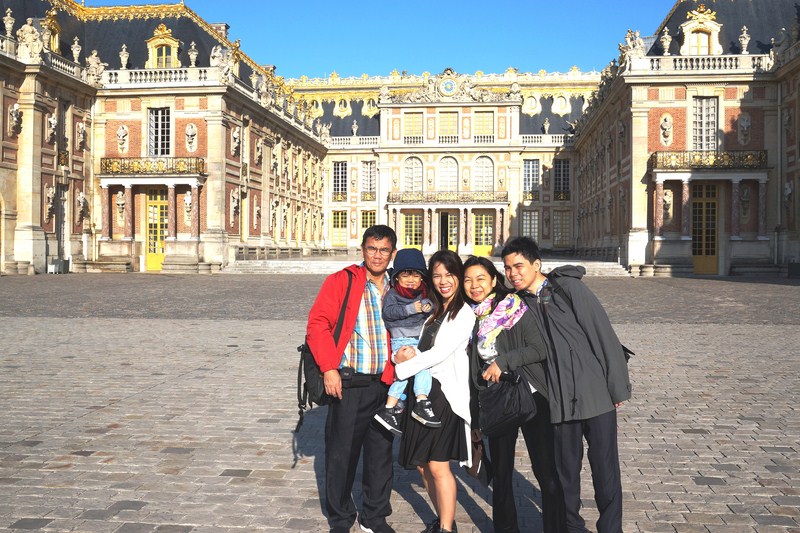
The Court of Honor. L-R: the author, Kyle, Cheska, Grace and Jandy

Here is the historical timeline of the palace:

  • From 1661–1678, the first phase of the expansion into a royal palace by Louis XIV, designed and supervised by the architect Louis Le Vau, culminated in the addition of three new wings of stone (the enveloppe), which surrounded Louis XIII’s original building on the north, south, and west (the garden side). As a result of Le Vau’s enveloppe of Louis XIII’s château, the king and the queen had new apartments in the new addition (known at the time as the château neuf).  Charles Le Brun designed and supervised the elaborate interior decoration. André Le Nôtre (who landscaped the extensive Gardens of Versailles) and Le Brun (who supervised the design and installation of countless statues) collaborated on the numerous fountains.
  • In 1670, after Le Vau’s death, the work was taken over and completed by his assistant, François d’Orbay.
  • From 1678–1715, during the second phase of expansion, two enormous wings north and south of the wings flanking the Royal Court (Cour Royale) of the main château were added by the architect Jules Hardouin-Mansart who also replaced Le Vau’s large terrace on the west (garden) front with what became the most famous room of the palace, the Hall of Mirrors. Mansart also built the stables (Petites Écuries and Grandes Écuries), on the opposite (east) side of the Place d’Armes, in front of the palace and the château known as the Grand Trianon (or Marble Trianon), replacing Le Vau’s 1668 Trianon de Porcelaine in the northern section of the palace park.
  • By 1682, work was sufficiently advanced that Louis XIV was able to proclaim Versailles his principal residence and the governmental center of France, and to give rooms in the palace to almost all of his courtiers.
  • In 1683, after the death of his consort Maria Theresa of Spain, Louis XIV undertook the enlargement and remodeling of the royal apartments in the oldest part of the palace, the château built by his father.
  • In 1688, the Royal Chapel of Versailles, located at the south end of the north wing, was begun by Mansart.
  • In 1710, after Mansart’s death in 1708, work on the Royal Chapel was completed by his assistant Robert de Cotte .
  • In 1738, Louis XV remodeled the king’s petit appartement on the north side of the Cour de Marbre (Marble Court), originally the entrance court of the old château.
  • In 1768, the Petit Trianon, a pavilion in the palace park designed by Ange-Jacques Gabriel, was finished.
  • In 1770, the Opéra, a theater at the north end of the north wing designed by Gabriel, was completed in time for the marriage of the Dauphin (the future Louis XVI), Louis XV‘s grandson, and Marie Antoinette.
  • After he became king in 1774, Louis XVI made only a few changes to the main palace, primarily to their private apartments. Marie Antoinette made extensive changes to the interior of the Petit Trianon as well as its gardens, including adding her private Théâtre de la Reine and the Hameau.
  • In 1783, the three treaties of the Peace of Paris (1783), in which the United Kingdom recognized the independence of the United States, where signed in the Palace.
  • On October 5, 1789, growing anger in Paris led to the Women’s March on Versailles wherein a crowd of several thousand men and women, protesting the high price and scarcity of bread, marched from the markets of Paris to Versailles. Taking weapons from the city armory, they besieged the Palace and compelled the King and Royal family and the members of the National Assembly to return with them to Paris the following day.
  • In 1792, the Convention (the new revolutionary government), ordered the transfer of all the paintings and sculptures from the Palace to the Louvre.
  • Between 25 August 1793 and 11 August 1794, auction of furniture, mirrors, baths and kitchen equipment, were sold in seventeen thousand lots. All fleurs-de-lis and royal emblems on the buildings were chambered or chiseled off. The empty buildings were turned into a storehouse for furnishings, art and libraries confiscated from the nobility.
  • Beginning in 1793, the empty grand apartments were opened for tours and a small museum of French paintings and art school was opened in some of the empty rooms.
  • In 1810, Napoleon Bonaparte, prior to his marriage with Marie-Louise, he had the Grand Trianon restored and refurnished as a springtime residence for himself and his family, in the style of furnishing that it is seen today.
  • In 1820, Louis XVIII ordered the restoration of the royal apartments, but the task and cost was too great.
  • In 1833, Louis-Philippe initiated effort to restore and maintain Versailles when he changed the palace when he began renovation the south wing of the Palace, which had been used to house some members of the royal family, to convert them into the Museum of the History of France, including the Galerie des Batailles (Hall of Battles) which lies on most of the length of the second floor. To give greater uniformity of appearance to the front entrance, the far end of the south wing of the Cour Royale was demolished and rebuilt to match the Gabriel wing of 1780 opposite.
  • On June 30, 1837, the museum was inaugurated.
  • During the Franco-Prussian War of 1870–1871, the general staff of the victorious German Army occupied the Palace and parts of the chateau, including the Gallery of Mirrors, were turned into a military hospital.
  • On January 18, 1871, the creation of the German Empire, combining Prussia and the surrounding German states under William I, was formally proclaimed in the Hall of Mirrors.
  • In March 1871, until the signing of the armistice with the Germans, the government of the new Third French Republic moved into the Palace. The National Assembly held its meetings in the Opera House.
  • In 1892, Pierre de Nolhac, poet and scholar and the first conservator, began restoration efforts at the Palace. Though interrupted by two world wars, the conservation and restoration work still continues until the present day.
  • In June 1919, the Treaty of Versailles, formally ending the First World War, was signed in the Hall of Mirrors.
  • Between 1925 and 1928, American philanthropist and multi-millionaire John D. Rockefeller gave $2,166,000 (the equivalent of about thirty million dollars today), to restore and refurnish the palace.
  • On April 9, 1957, further restoration of the backstage areas of Royal Opera of Versailles was completed and the Royal Opera of Versailles was reopened in the presence of Queen Elizabeth II of the United Kingdom.
  • In 1978, parts of the Palace were heavily damaged in a bombing committed by Breton terrorists.
  • In 1979, the palace and its garden were inscribed in the UNESCO World Heritage List.
  • In 2003, the “Grand Versailles” project, a new restoration initiative, was started. It began with the replanting of the gardens which, on December 26, 1999, had lost over 10,000 trees during Hurricane Lothar .
  • In 2006, the restoration of the Hall of Mirrors was completed. 

Check out “Versailles Palace – Royal Chapel,” “Versailles Palace – State Apartments of the King,” “Versailles Palace – Gallery of Great Battles” and “Versailles Palace – Hall of Mirrors

Here are some interesting trivia regarding the palace:

  • The palace was originally a hunting lodge built in brick and stone by King Louis XIII in 1623.
  • The land on which the palace was built on was situated on a narrow plateau with many swamps around it and not fit for the construction. For the project to happen, they needed to restructure the whole area by drying the swamps up and fill the area around the plateau with soil and stones. Earthwork and leveling were also essential for the construction to begin.
  • The Palace of Versailles is the second-most visited monument in the Île-de-France region (7,700,000 visitors in 2017), just behind the Louvre and ahead of the Eiffel Tower.
  • Versailles was one of the few castles in France that wasn’t located near a river so artificial ponds were created and aerial and underground aqueducts built to supply water for the Palace’s fountains and all the surrounding waters were redirected to it. They also pumped the water out of the Seine River using new techniques and hydraulic methods. A revolutionary pumping machine, built for this project, drew water from the river and, for it to reach the aqueducts that would lead the water to the Palace, drove it through pipes more than one hundred meters above the Seine level.
  • The Palace was not restricted only for the King and his court and though everyone could freely visit the Palace and walk its gardens, elegance was essential in the Palace of Versailles and visitors needed to be well-dressed to be allowed to walk the Palace. Those who did not have a proper outfit, could rent one at the entrance of the Palace.

Check out “Eiffel Tower

The palace, enthusiastically promoted as one of France’s foremost tourist attractions by the Fifth Republic, still serves political functions.  Heads of state are regaled in the Hall of Mirrors and the French Senate (Sénat) and the National Assembly (Assemblée nationale) meet, in congress, in Versailles to revise or otherwise amend the French Constitution, a tradition that came into effect with the promulgation of the 1875 Constitution.

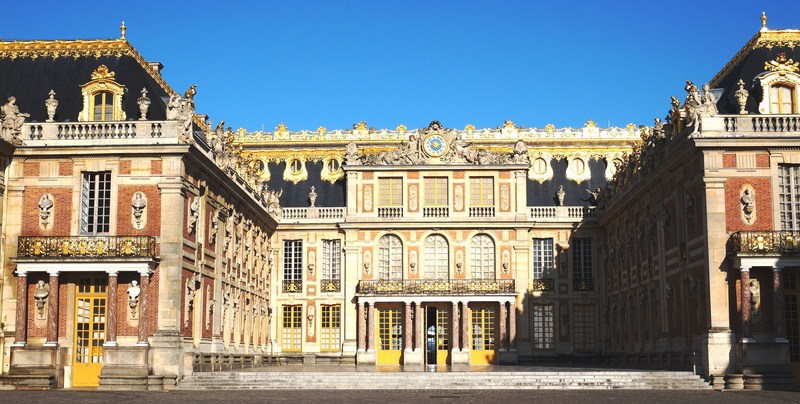
The Marble Court (made with contrasting red brick, white stone and grey slate highlighted with god decoration) and the facade of the first chateau built by King Louis XIII

The Grand Apartments (grands appartements), known respectively as the King’s Grand Apartment (grand appartement du roi), consisting of an enfilade of seven rooms, and the Queen’s Grand Apartment (grand appartement de la reine) forming a parallel enfilade with that of the grand appartement du roi, occupied the main or principal floor of the New Palace (château neuf).

Check out “Versailles Palace – State Apartments of the King” and “Versailles Palace – Queen’s Grand Apartment

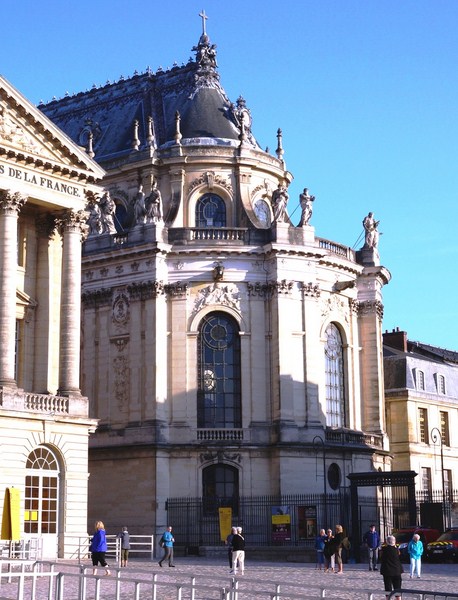
The Royal Chapel

Le Vau’s design for the state apartments, closely following Italian models of the day, is evidenced by the piano nobile (a convention the architect borrowed from 16th- and 17th-century Italian palace design), the  placement of the apartments on the next floor up from the ground level.

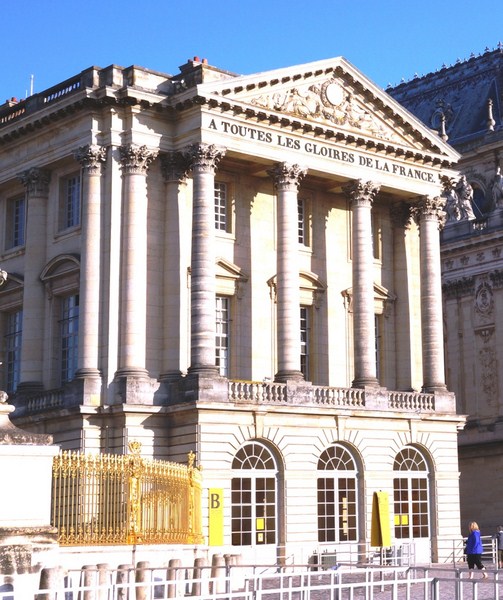
Gabriel Pavilion

Owned by the French state, the Palace of Versailles’ formal title is the Public Establishment of the Palace, Museum and National Estate of Versailles and, since 1995, has been run as a Public Establishment, with an independent administration and management supervised by the French Ministry of Culture.

Offering a visual history of French architecture from the 17th century to the end of the 18th century, the Palace of Versailles began with the original château, with the brick and stone and sloping slate (from Angers) Mansard roofs of the Louis XIII style, used by architect Philibert Le Roy. With the addition of the colonnades and flat roofs of the new royal apartments, done in the French Classical or Louis XIV style, as designed by Louis Le Vau and, later, by Jules Hardouin-Mansart, it then became grander and more monumental. In 1768, it concluded in the lighter and more graceful Neo-Classical Louis XVI style of the Petit Trianon, completed by Ange-Jacques Gabriel.

Dufour Pavilion

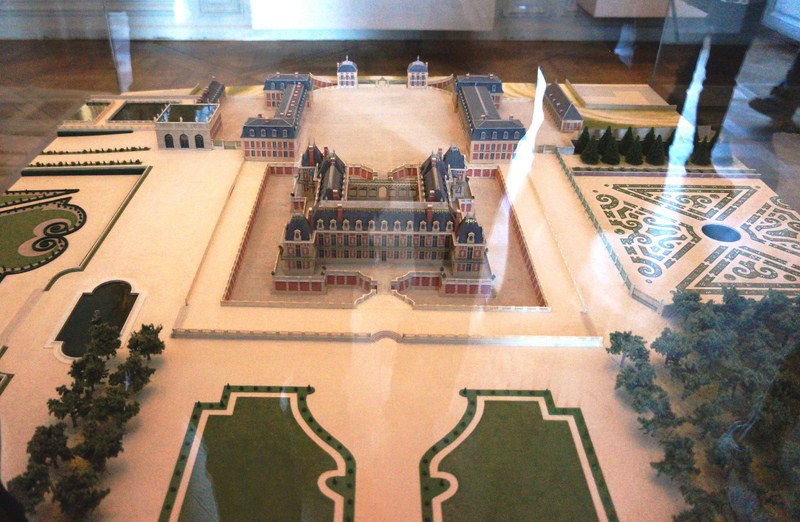
Largely completed by the death of Louis XIV in 1715, the eastern part of the palace has a U-shaped layout, surrounding a black-and-white marble courtyard, with the corps de logis and symmetrical advancing secondary wings terminating with the Dufour Pavilion on the south and the Gabriel Pavilion to the north, creating an expansive cour d’honneur known as the Cour Royale (Royal Court).

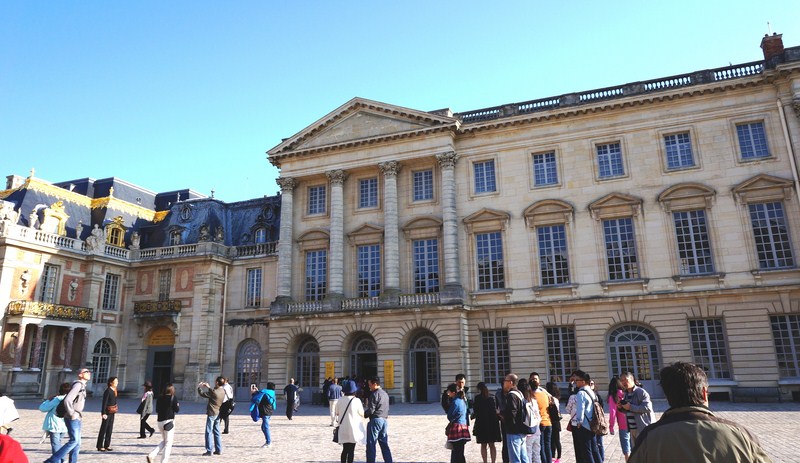
The North Wing

Two enormous asymmetrical wings, flanking the Royal Court, results in a 402 m. (1,319 ft.) long facade. The palace, covered by around a million sq. ft. (10 hectares) of roof, has 2,143 windows, 1,252 chimneys, and 67 staircases.

The Princes’ Staircase overlooking the Gallery of Great Battles

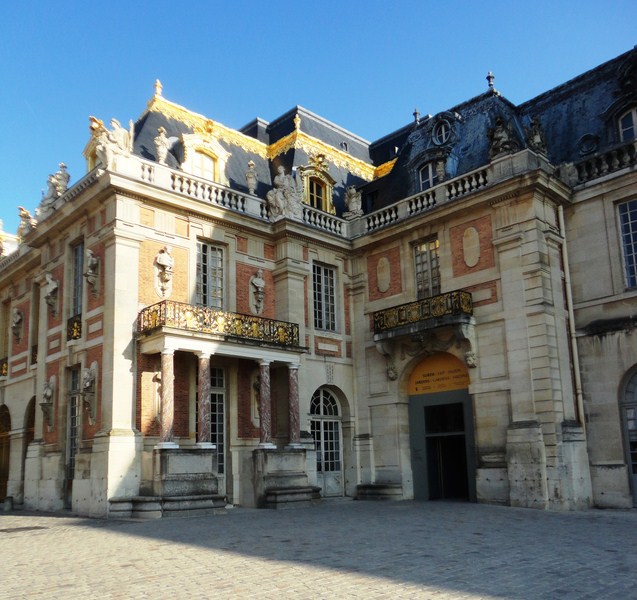
The façade of Louis XIII’s original château, preserved on the entrance front, was built of red brick and cut stone embellishments. In the center of the courtyard is a 3-storey avant-corps fronted with eight red marble columns, supporting a gilded wrought-iron balcony and surmounted with a triangle of lead statuary surrounding a large clock (its hands stopped upon the death of Louis XIV).

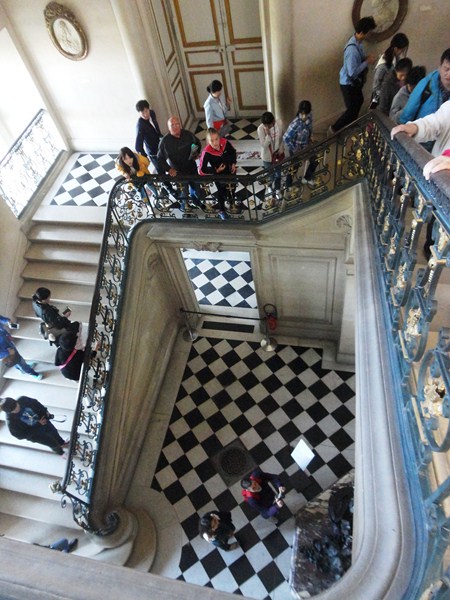
Questel Staircase, located at the North Wing, was named after architect Charles-Aususte Questel.  It replaced the one built by Questel’s predecessor, Frédéric Nepveu, during the July Monarchy.

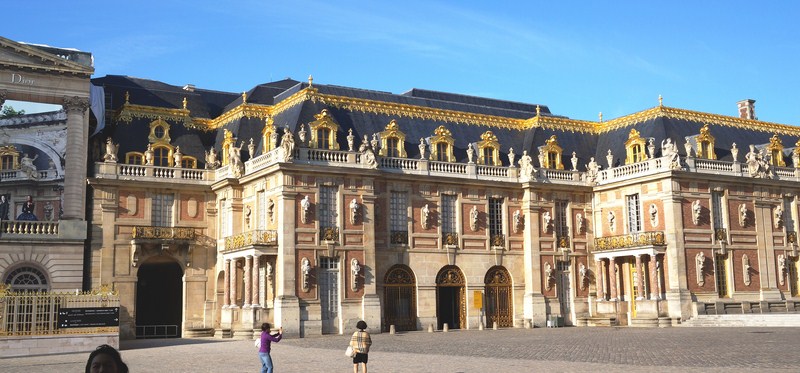
Columns, painted and gilded wrought-iron balconies plus dozens of stone tables decorated with consoles (holding marble busts of Roman emperors) completes the rest of the façade while atop the slate Mansard roof, are elaborate dormer windows and gilt lead roof dressings, added by Hardouin-Mansart in 1679–1681.

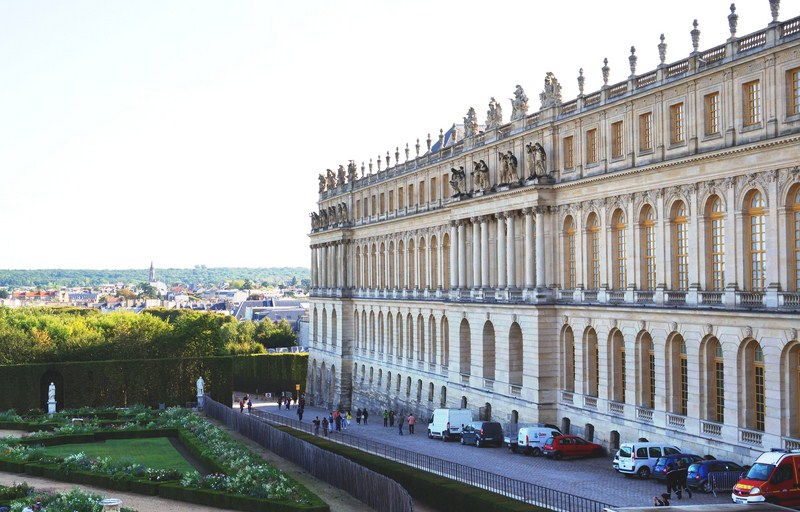
The garden front and wings, inspired by the architecture of Baroque-style Italian villas but executed in the French Classical style, were encased in enveloppe (white cut ashlar stone from L’Oise) by Le Vau in 1668-1671 and modified by Hardouin-Mansart in 1678–1679.

The exterior features an arcaded, rusticated ground floor, supporting a main floor with round-headed windows divided by reliefs and pilasters or columns, while the attic storey, with square windows and pilasters, is crowned by a balustrade bearing sculptured trophies and flame pots dissimulating a flat roof.

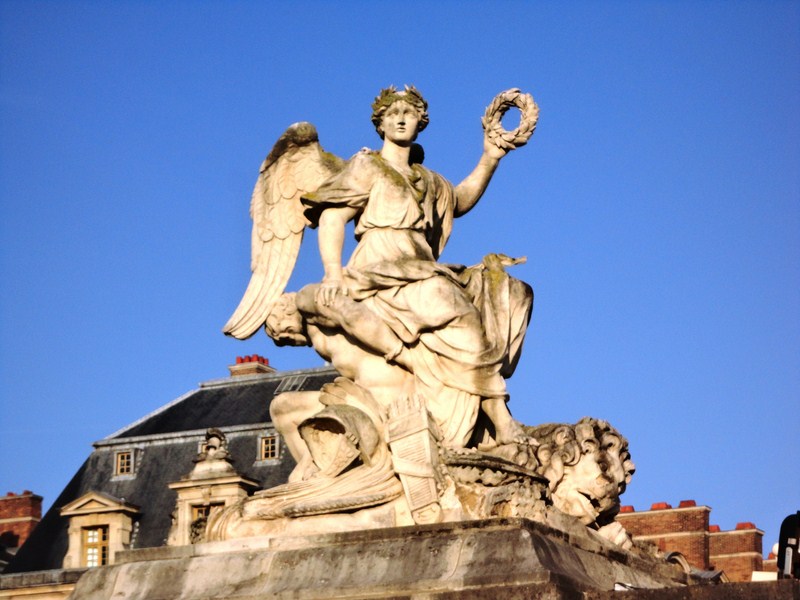
Angel and Lion Statue

Chateau de Versailles: Place d’Armes, 78000 Versailles, France. Tel: +33 1 30 83 78 00. Website: www.chateauversailles.fr.  Open daily (except on Mondays and May 1), from 9:00 AM to 6:30 PM.  Last admission is 6 PM while the ticket office closes at 5.45 PM. The estate of Trianon and the Coach Gallery only open in the afternoon while the Park (7 AM to 8:30 PM) and Gardens (8 AM to 8.30 PM, last admission: 7 PM) are open every day. Access to the Gardens is free except on days of fountains shows. You can access the estate of Trianon through the Gardens or through the city. The Petit Trianon is only possible via the Grand Trianon.

Admission: 27 € for Passport with Timed Entry (days with Musical Fountains Shows or Musical Gardens), 20 € for Passport with Timed Entry (without musical fountains show or musical gardens), 12 € for Estate of Trianon ticket(without Musical Fountains Show or Musical Gardens), 10 € for Passport with Timed Entry (free admission, days with Musical Fountains Show or Musical Gardens), 9,50 € for Musical Fountains Show ticket, 8,50 € for Musical Gardens ticket, 28 € for the Fountains Night Show.

How to Get There: The cheapest option for reaching Versailles is by train. There are three train stations in Versailles.  RER line C arrives at Versailles Château – Rive Gauche train station, the closest one of the Palace (just 10 minutes’ walk to the Palace). SNCF trains from Gare Montparnasse arrive at Versailles Chantiers train station, which is 18 minutes on foot to the Palace. SNCF trains from Gare Saint Lazare arrive at Versailles Rive Droite train station, 17 minutes on foot to the Palace. RER C and SNCF train times are available on www.transilien.com.

Seine River Cruise (Paris, France)

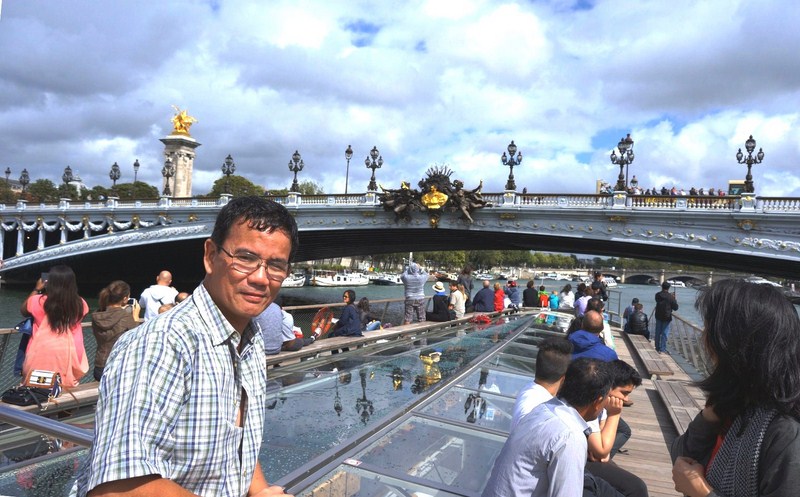
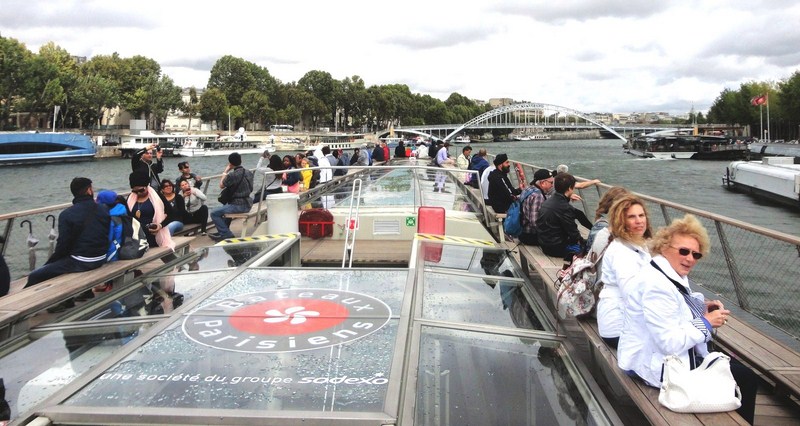
Seine River Sightseeing Cruise via Bateaux Parisiens

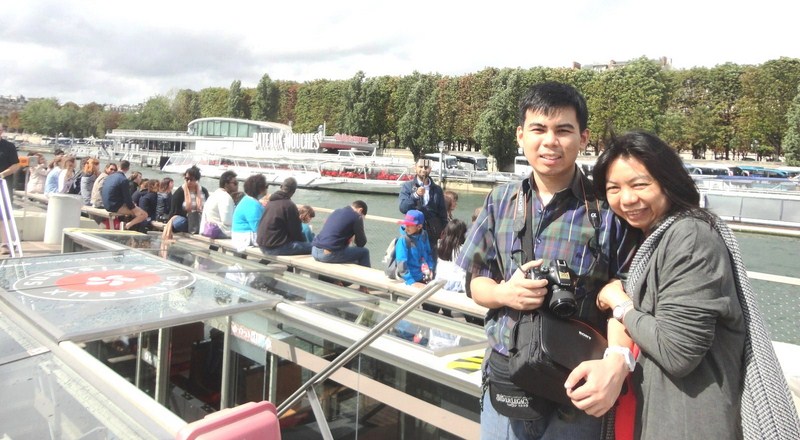
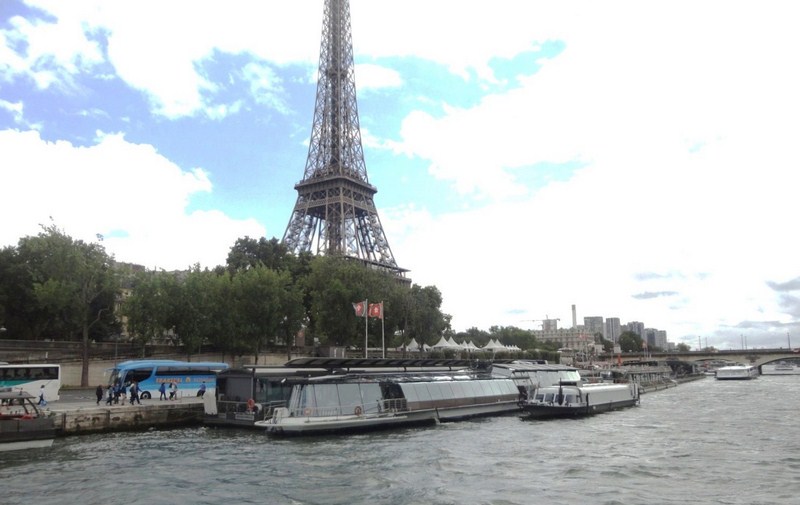
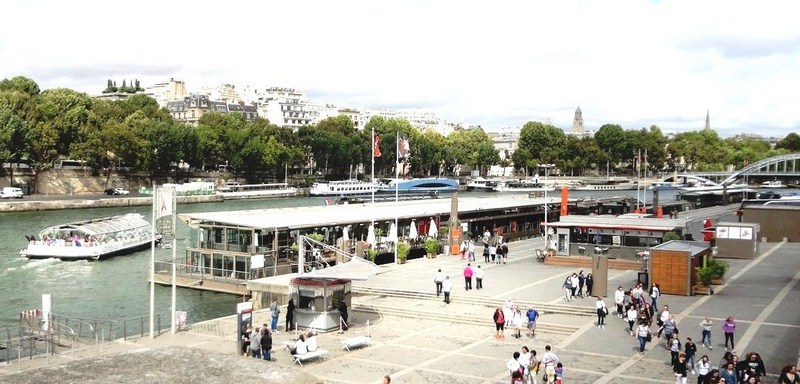
After our morning tour of the Eiffel Tower, we made our way, by foot, to the boat docking station at Port de la Bourdonnais where we hopped aboard a popular and modern Bateaux Parisiens glass-topped trimaran  to embark on a quintessential, scenic and leisurely cruise along the Seine riverbanks.

Port de la Bourdonnai

Bateaux Parisiens trimaran

All aboard …..

Bateaux Parisiens has a fleet of four trimarans, three named after legendary French actresses (Catherine Deneuve, Isabelle Adjani and Jeanne Moreau) and another after a French businessman (Pierre Bellon). They each hold up to 600 passengers.

The author

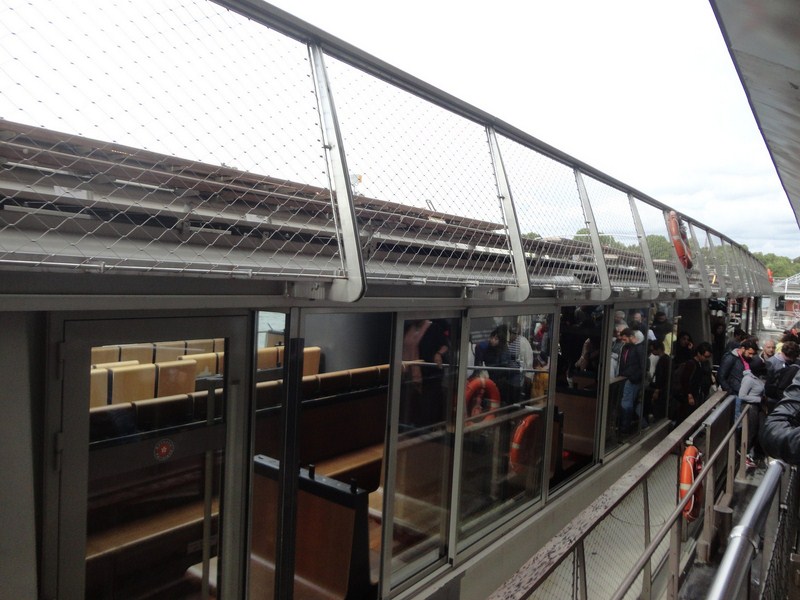
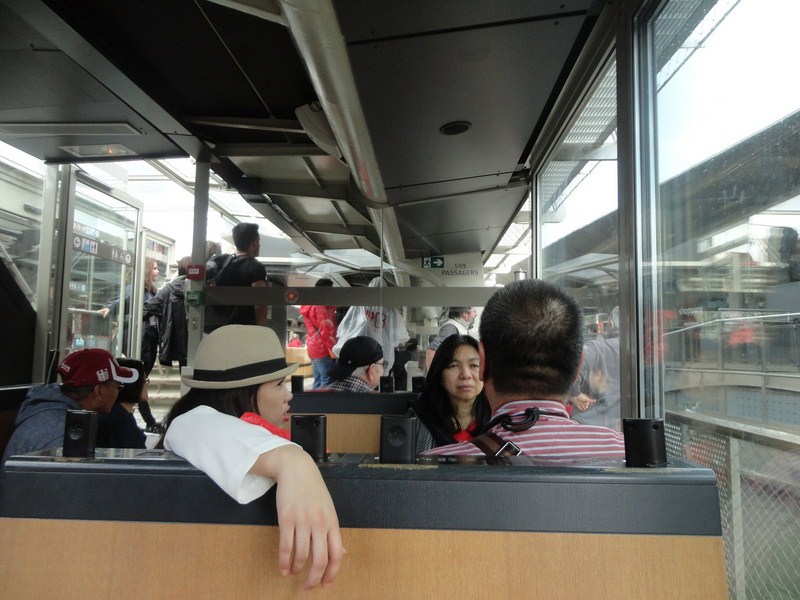
Our trimaran, with terrace and exterior passageways, was well equipped, clean and well maintained, with plenty of outdoor seating at the upper deck.

Jandy and Grace

The company also has nine smaller boats, some of which are used for dinner cruises and private events.  They offer high priced lunch and dinner, to the sound of the resident band, with a choice of four different a la carte menus, on separate restaurant boats.  All boats follow the same 12-km. long route.

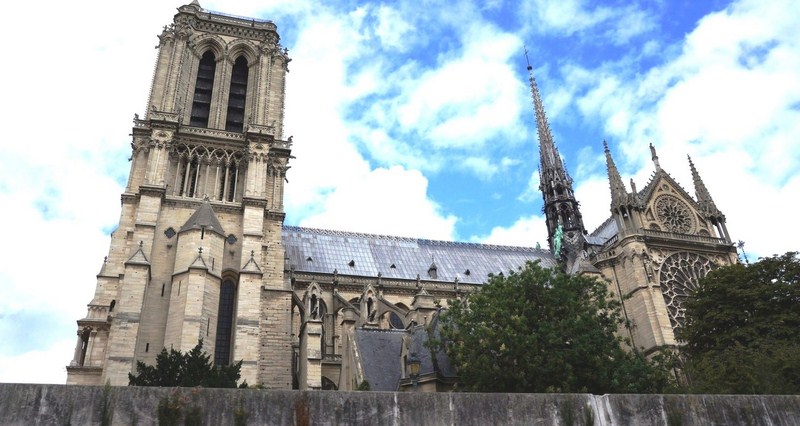
Notre Dame Cathedral

Eiffel Tower

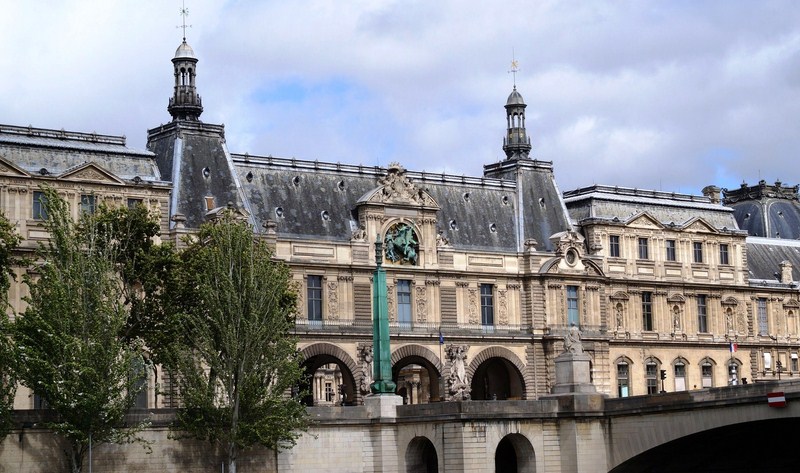
Louvre Museum

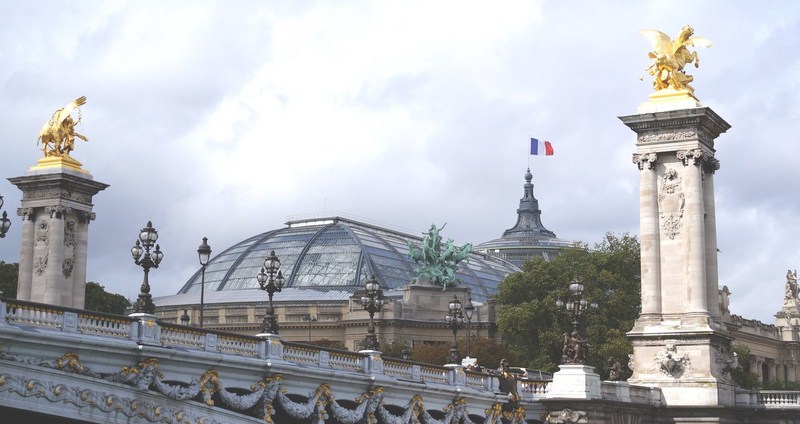
The Grand Palais, a large historic site, exhibition hall and museum complex located at the Champs-Élysées, was built in the style of Beaux-Arts architecture.

Check out “Louvre Museum,” “Notre Dame Cathedral” and “Eiffel Tower

A fantastic introduction to the highlights and magic of Paris, we soaked up the passing sights of iconic, world-famous monuments and landmarks as we cruised up and down  the Seine River.

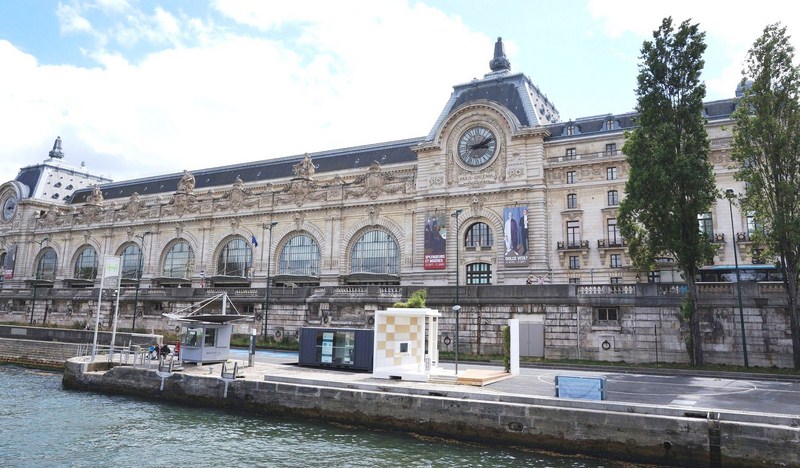
Musee d’Orsay

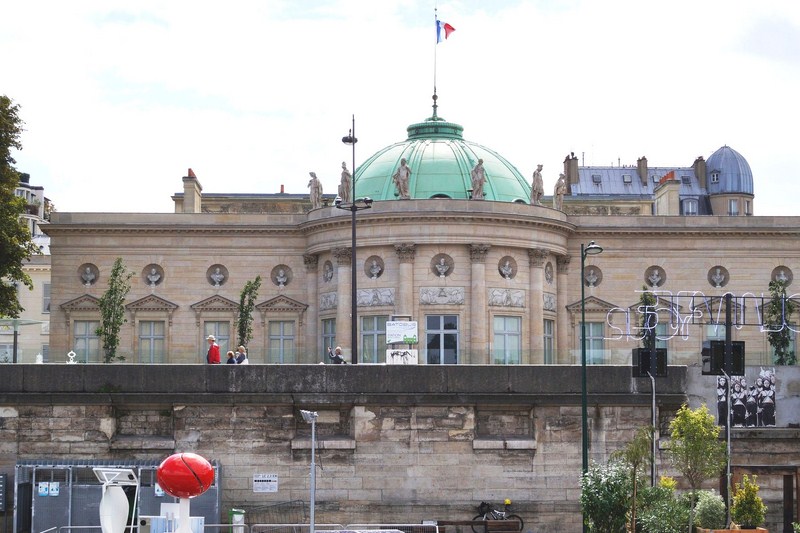
National Museum of the Legion of Honor and Orders of Chivalry, created in 1925, displays a history of France’s honors, medals, decorations, and chivalric orders from the time of King Louis XI to the present, including Napoleonic souvenirs and more than 300 portraits. A special section is dedicated to foreign orders. Its library and archives contain more than 3,000 works.. Located beside the Musee d’Orsay, it is housed within the Hôtel de Salm, built in 1782 by architect Pierre Rousseau for Frederick III, Prince of Salm-Kyrburg.

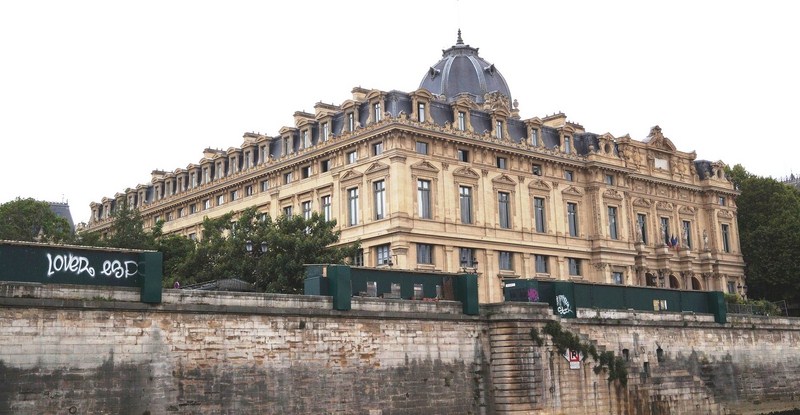
Registry of the Paris Commercial Court

Check out “Musee d’Orsay

On the left bank are the Notre Dame Cathedral, the National Museum of the Legion of Honor and Orders of Chivalry, Conciergerie, National Assembly, Les Invalides, the Institut de France, and the Musée d’Orsay.

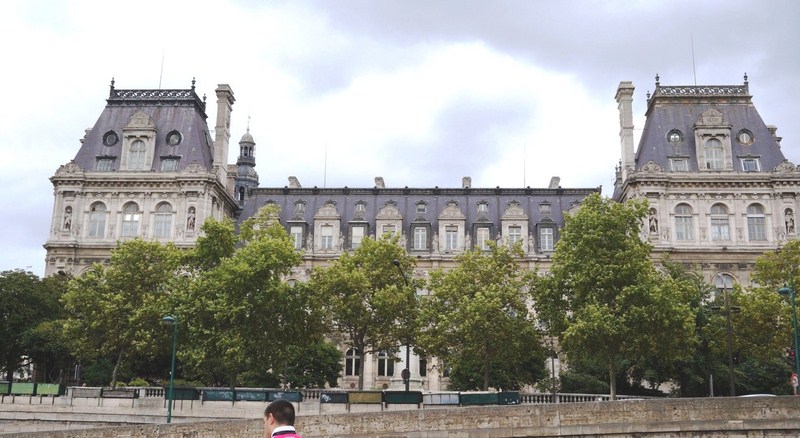
Paris City Hall, the headquarters of the municipality of Paris since 1357, serves multiple functions, housing the local administration, the Mayor of Paris (since 1977), and also serves as a venue for large receptions.

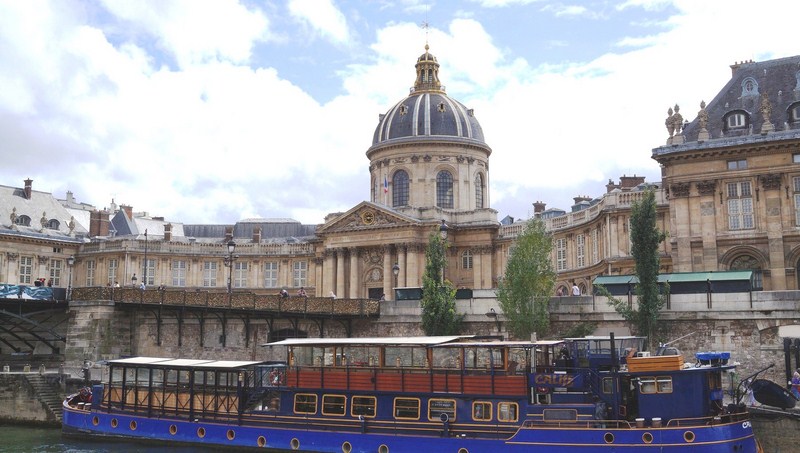
Institut de France, a French learned society, groups five académies (including the Académie Française). It manages approximately 1,000 foundations, as well as museums and châteaux open for visit..

On the right bank, during the return trip, are the Louvre,  the Grand Palais, the Obelisk at the Place de la Concorde, Tuileries Garden, the Paris City Hall, and the Eiffel Tower.

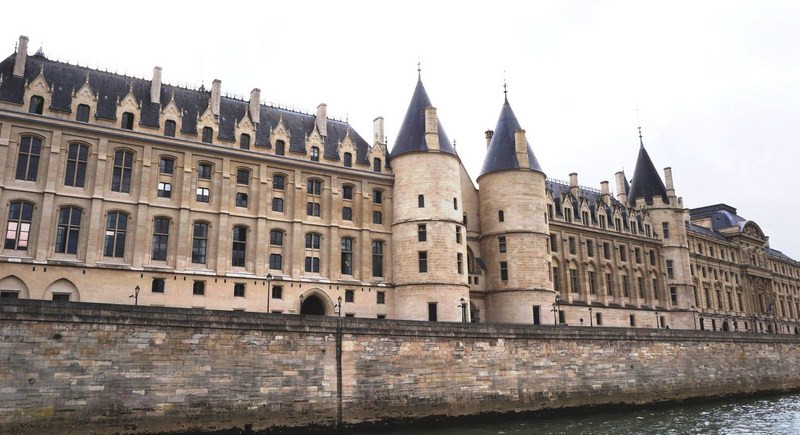
The Conciergerie Paris, located on the west of the Île de la Cité, was formerly a prison but is presently used mostly for law courts. During the French Revolution, hundreds of prisoners were taken from the Conciergerie to be executed by guillotine at a number of locations around Paris.

We also glided beneath beautiful historic bridges (37 bridges span the river), including the famous Pont Neuf. Even the Seine riverbanks, collectively designated a UNESCO World Heritage Site since 1991, are a sight to behold.

Check out “Bridges Along the Seine River

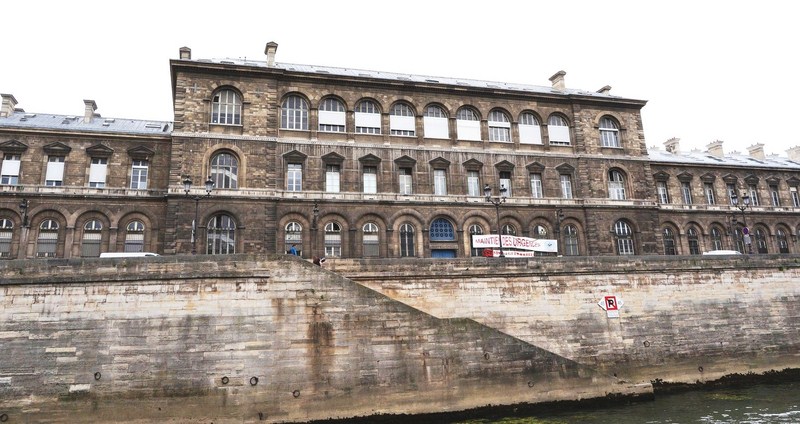
Hotel Dieu, a hospital located on the Île de la Cité, on the parvise of Notre-Dame, is the oldest hospital in the city and the oldest worldwide still operating. Ravaged by fire several times, it was rebuilt for the last time at its present location between 1867 and 1878, as part of Haussmann’s renovation of Paris.

After half an hour, our boat turned around and cruised back up along the opposite bank. Our 1-hour cruise ends back at the original departure point near the Eiffel Tower.

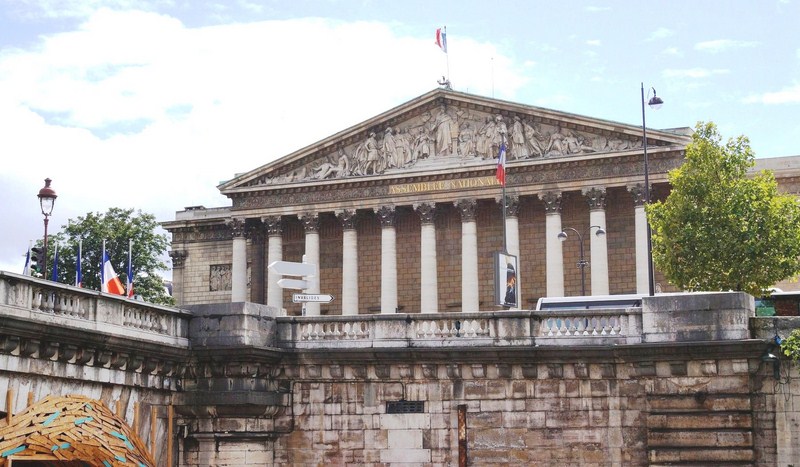
The Palais Bourbon serves as a meeting place of the French National Assembly, the lower legislative chamber of the French government. It is located on the left bank of the Seine, across from the Place de la Concorde.

Bateaux Parisiens: Pontoon 3, Port de la Bourdonnais, 75007 Paris, France. Tel: +33 825 01 01 01 and +33 1 76 64 14 66.  Open 9:30 AM – 10 PM. Website: www.bateauxparisiens.com. Admission: adults (€15), children under 12 yrs. (€7), free for children under 3 years old. Ticket will be valid for one year at any given time. Departures: April to September (from 10:15 AM -10:30 PM, every 30 mins., no departures at 1:30 PM and 7:30 PM), October to March (from 11 AM -8:30 PM, at least every hour). Book online in advance to avoid queues. The boat also departs from Notre Dame Cathedral. Audio guide commentary with musical accompaniment, from a handset, available in 13 languages (English, French, German, Spanish, Italian, Portuguese, American, Russian, Dutch, Polish, Chinese, Japanese and Korean). Smoking is not allowed on the boat and animals are not permitted on board.

How to Get There: Champ de Mars Tour Eiffel (RER C) 5 . Nearest metro: Trocadero or Bir Hakeim

Louvre Pyramid (Paris, France)

Louvre Pyramid

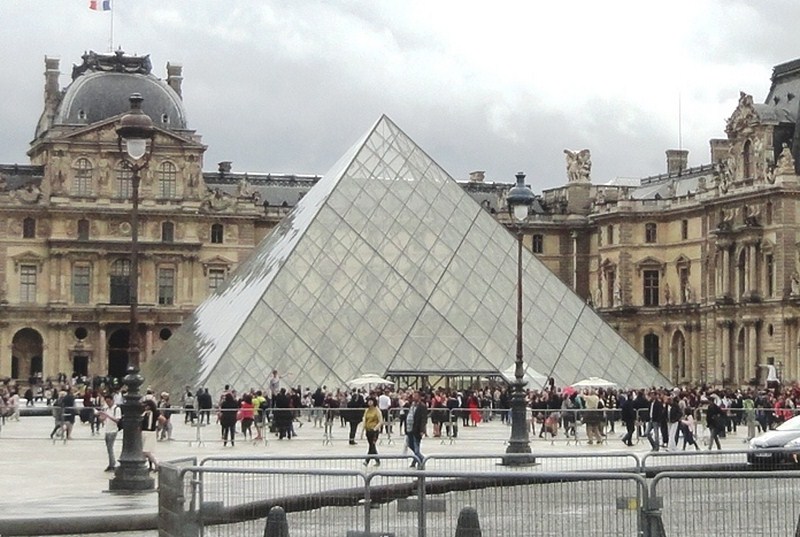
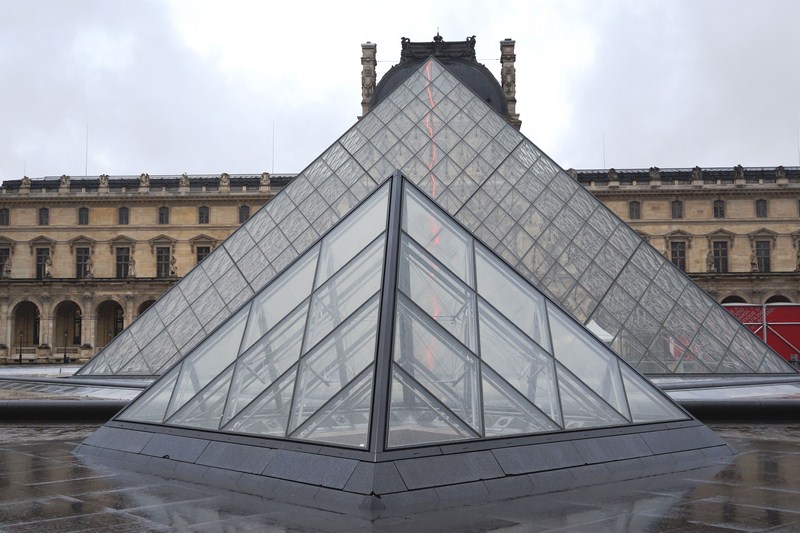
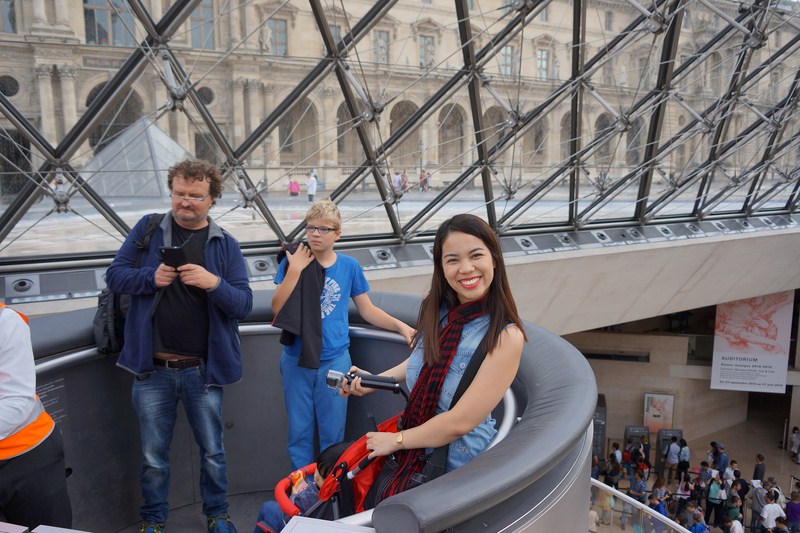
The Louvre Pyramid

At the main courtyard (Cour Napoléon) of the Louvre Palace (Palais du Louvre) is the Louvre Pyramid (Pyramide du Louvre), a large, glass and metal pyramid that serves as the main entrance to the Louvre Museum. Designed by the late Chinese-American architect I. M. Pei (Ieoh Ming Pei), the founder of Pei Cobb Freed & Partners known for his stellar work at the National Gallery in Washington as well as the Fine Arts Museum in Boston.

Check out “Louvre Museum

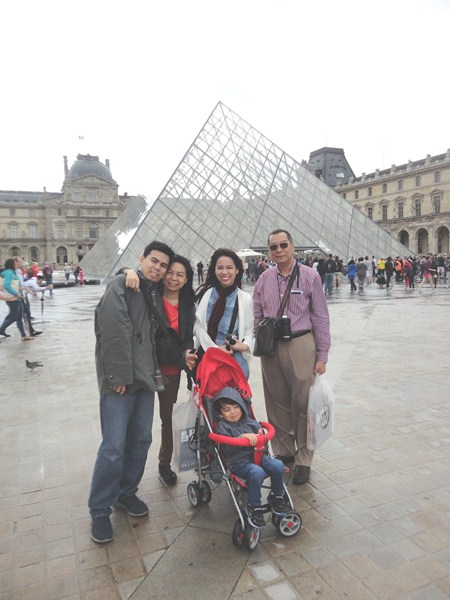
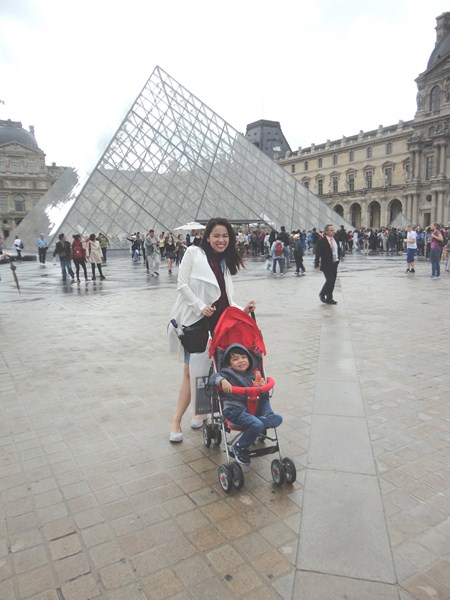
L-R; Jandy, Grace, Cheska, Kyle and Manny

It was commissioned in 1984 by the, François Mitterrand, President of France, and completed on March  29, 1989 (symbolically, the bicentenary year of the French Revolution).

Cheska and Kyle

I.M. Pei’s most famous structure, this controversial structure, now an iconic symbol for the largest museum in the world,  has become, together with the Arc de Triumphe and the equally controversial Eiffel Tower, a landmark of the city of Paris.

Check out “Arc de Triomphe” and “Eiffel Tower

One of the three smaller pyramids

Here are some interesting trivia regarding the Louvre Pyramid:

  • There are actually five pyramids throughout the museum. The Louvre Pyramid is surrounded by three smaller pyramids, positioned to create light shafts for access to the museum’s collections, plus the Pyramide Inversée (Inverted Pyramid), an upside-down and smaller version of the Louvre Pyramid. The latter is a skylight in the Carrousel du Louvre shopping mall in front of the Louvre Museum.
  • The large pyramid has the exact same proportions as the Great Pyramid of Giza.
  • The choice of the pyramid figure serves as a reminder of the importance of the Egyptian antiquities collection inside the museum.
  • The Louvre Pyramid was featured near the beginning the 2006 film The Da Vinci Code. Here, Robert Langdon, the main character, meets French Police Captain Bezu Fache in front of the Louvre Pyramid. Today, the sites at the Louvre which are portrayed in the film are the subject of a special visitor trail which enters through the Pyramid and concludes at the Inverted Pyramid.
  • Because of a series of problems with the Louvre’s original main entrance (it could no longer handle, on an everyday basis, the enormous number of visitors, then at 5 million visitors a year), the Louvre Pyramid was created so that visitors entering through the pyramid first descend into the spacious, 60,386 sq. m. (650,000 sq. ft.) underground lobby before ascend into the museum’s three pavilions — Denon, Richelieu and Sully.  However, in 2014, the Louvre’s attendance had doubled and the pyramid proved inadequate, necessitating a thorough redesign of the layout of the foyer area in the Cour Napoleon, including better access to the pyramid and the Passage Richelieu, between 2014 and 2017.
  • As soon as the Louvre Pyramid project, costing 5 billion euros, was announced, it triggered many years of strong and lively aesthetic and political debate. Accused of disfiguring the architecture, some questioned what direction the museum was headed. They criticized the Modernist style of the edifice being inconsistent with the majestic, old and classic French Renaissance architectural style and history of the Louvre; the pyramid being an unsuitable and anachronistic intrusion of an ancient Egyptian symbol of death in the middle of Paris; the hugely unpopular project being an immodest, pretentious, megalomaniacal folly imposed by then-President François Mitterrand (political critics referred to the structure as “Pharaoh Francois’ Pyramid”); and that Chinese-American architect I.M. Pei being insufficiently French to be entrusted with the task of updating the treasured Parisian landmark. Even today, many people still feel that the harsh modernism of the edifice is out of place.
  • M. Pei also included large glass pyramid concept on the roofs of the IBM Somers Office Complex(Westchester County, New York, 1989, the same year the Louvre Pyramid opened) and at the Rock and Roll Hall of Fame (1995, Cleveland, Ohio).
  • Several other museums have also duplicated the pyramid concept, most notably the Museum of Science and Industry(Chicago, Illinois) and the Dolphin Centre (opened April 1982, by Prince Richard, Duke of Gloucester).
  • It has been claimed by some that the glass panes in the Louvre Pyramid number exactly 666, “the number of the beast” often associated with Satan and the beast in the Apocalypse. Dominique Stezepfandt’s book François Mitterrand, Grand Architecte de l’Universalso declares that “the pyramid is dedicated to a power described as the Beast in the Book of Revelation (…) The entire structure is based on the number 6.” The story of the 666 panes originated in the 1980s, when the number 666 was mentioned in various newspapers as well as the official brochure published during construction (even twice, though, in a few pages earlier, the total number of panes was given as 672 instead). In 2003, the myth resurfaced when Dan Brown incorporated it in his best-selling novel The Da Vinci Code.  In the book, the protagonist reflects that “this pyramid, at President Mitterrand’s explicit demand, had been constructed of exactly 666 panes of glass.”  However, the Louvre museum states that the finished pyramid contains 673 glass panes (603 rhombi and 70 triangles). David A. Shugarts obtained a higher figure from Pei’s offices, reporting that the pyramid contains 689 pieces of glass.
  • During the design phase, there was a proposal that the design include a spire on the pyramid to simplify window washing. However, Pei objected and this proposal was eliminated.
  • Just in case any glass pieces ever break, laminated glass manufacturer Saint-Gobain made enough to build two pyramids. However, after more than 30 years, no repairs have yet been needed.
  • In the early days, mountaineers were actually hired to scale the Pyramid and clean the glass, a monumental task. However, in the 1990s, a robot was designed to do the job. Then, in 2002, Advanced Robotic Vehicles, a Seattle company, developed a “double breadboxed-sized robot” which boasts a squeegee and rotating brush. When secured to the glass via suction cups, it is maneuvered by remote control to climb the Pyramid on tracks. However, human ropers are still used to repair the joints and descale the glass from time to time.
  • Although the Pyramid was constructed to accommodate a visitor entrance, it’s not the only way to get into the Louvre. Visitors, with single or group tickets, can enter through the Passage Richelieu, which is just off the Rue de Rivoli across from the Palais Royal-Musée du Louvre metro station. You can also enter via the Carrousel du Louvre, an underground shopping and dining space opened in 1993 and the location of the suspended Inverted Pyramid. Whichever entrance you choose, they all converge in the lobby beneath the Louvre Pyramid.

Check out “Louvre Museum – Egyptian Antiquities Department

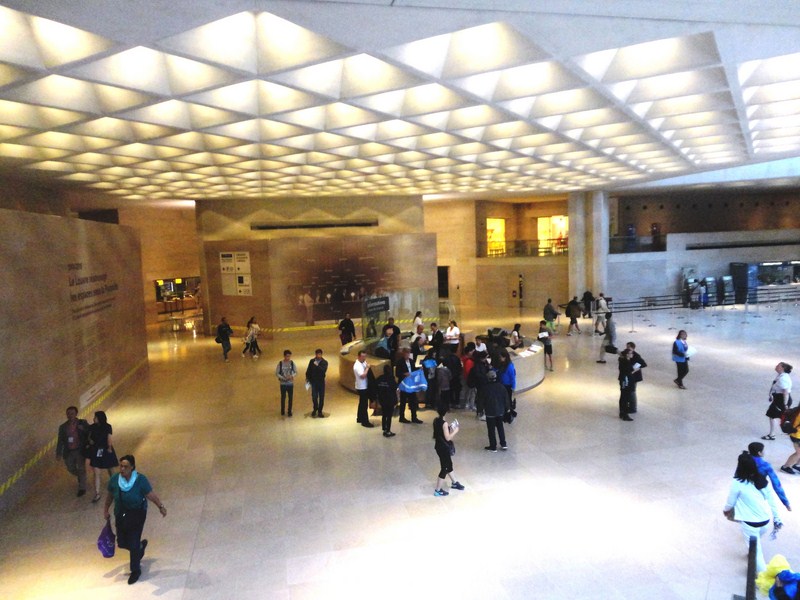
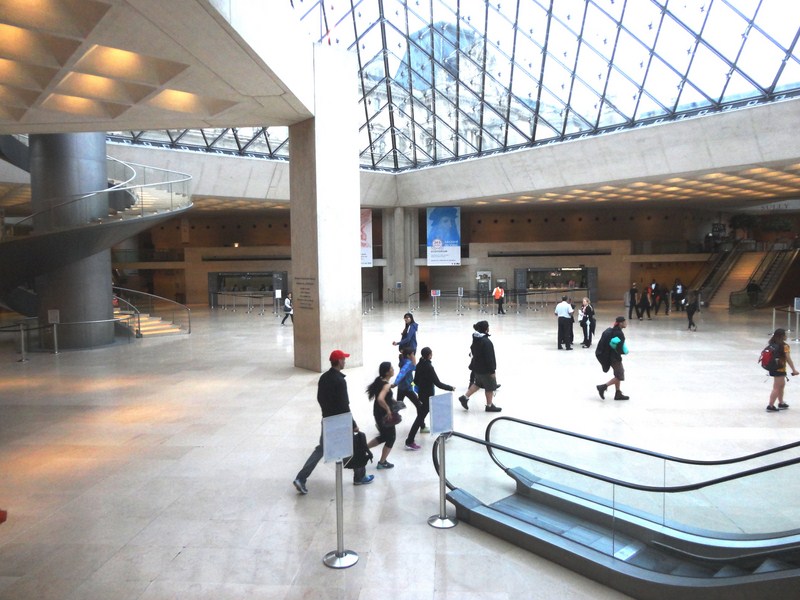
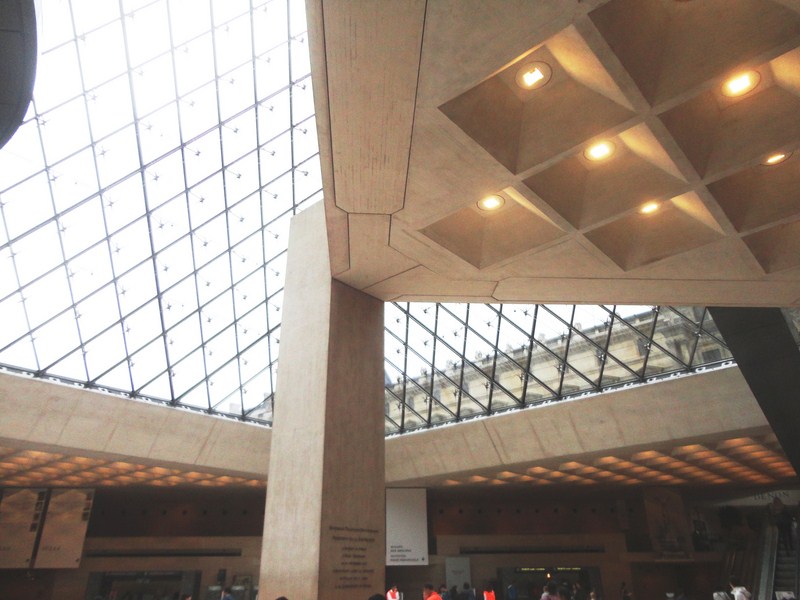
The underground lobby

Constructed entirely with 21.5 mm. (0.8-in.) thick, extra clear “Diamond Glass” laminated glass segments, totaling 1,800 sq. m. (19,375 sq. ft.) in area, and 6,000 metal poles, the structure, supported by 95 tons of steel and 105 tons of aluminum, is 21.6 m. (71 ft.) high and its square base has sides of 34 m. (112 ft.) and a base surface area of 1,000 sq. m. (11,000 sq ft.).

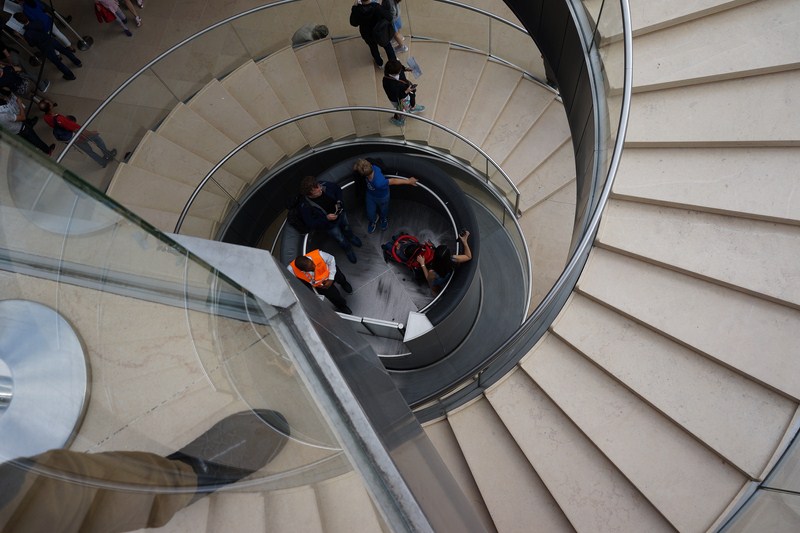
Spiral stair

Consisting of 603 rhombus-shaped and 70 triangular glass segments, elementary arithmetic allows for easy counting of the panes.  Each of the three sides of the pyramid without an entrance has 18 triangular panes and 17 rows of rhombic ones arranged in a triangle, thus giving rhombic panes (171 panes total).

The side with the entrance has 11 panes fewer (9 rhombic, 2 triangular), so the whole pyramid consists of rhombi and triangles, 673 panes total.

The pyramid structure was engineered by Nicolet Chartrand Knoll Ltd. of Montreal (Pyramid Structure/Design Consultant) and Rice Francis Ritchie of Paris (Pyramid Structure/Construction Phase).

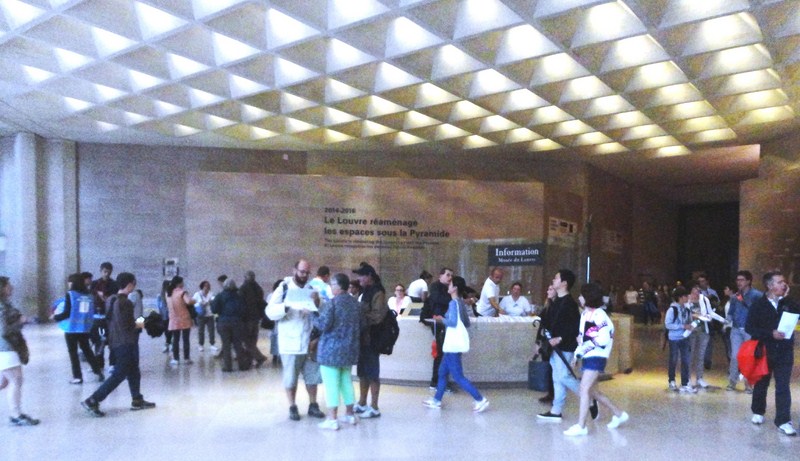
Information counter

Louvre Museum: 75001 Paris, France.  Tel: +33 1 40 20 50 50. Open daily, except Tuesdays and holidays, 9 AM- 6 PM (until 10 PM on Wednesday and Friday evenings).

The Louvre has three entrances: the main entrance at the pyramid, an entrance from the Carrousel du Louvre underground shopping mall, and an entrance at the Porte des Lions (near the western end of the Denon wing).

Admission is free, from October to March, on the first Sunday of every month. Still and video photography is permitted for private, noncommercial use only in the galleries housing the permanent collection. The use of flash or other means of artificial lighting is prohibited. Photography and filming are not permitted in the temporary exhibition galleries. 

How To Get There: the Louvre can be reached via Metro lines 1 and 7, station Palais Royal – Musée du Louvre Métro or the Louvre-Rivoli stations. By bus, take No. 21, 24, 27, 39, 48, 68, 69, 72, 81, 95 as well as the touristic Paris l’Open Tour. By car, there is an underground parking reachable by Avenue du Général Lemonier, every day from 7 AM – 11 PM.

Louvre Museum – From Louis XIV to Louis XVI (Paris, France)

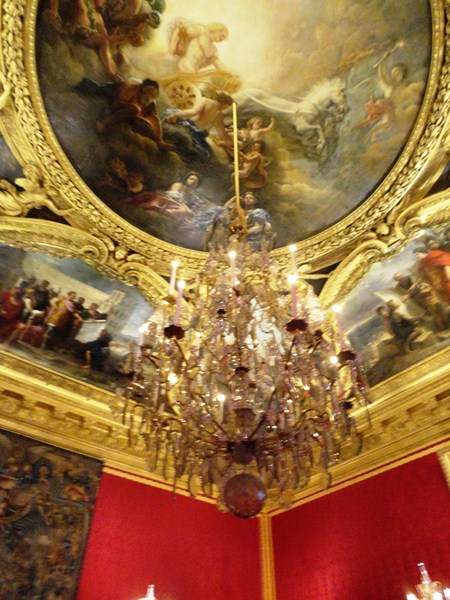
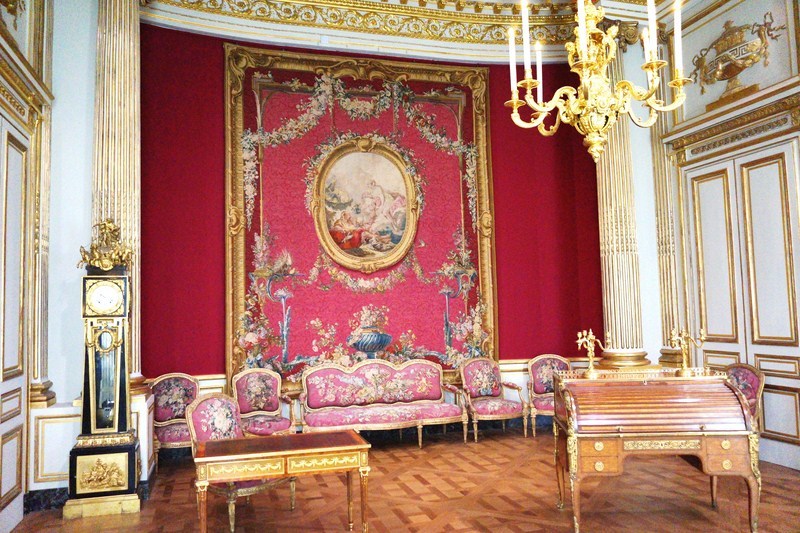
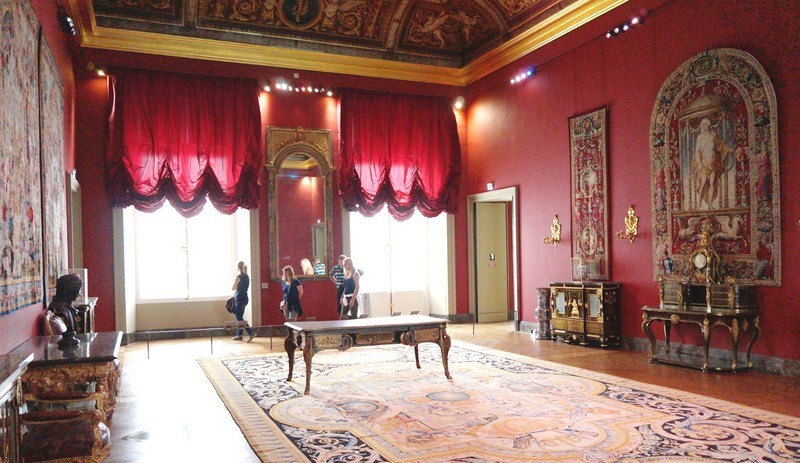
Parade room of the Hôtel de Chevreuse (Room 622)

The Louvre Museum  houses one of the most prized collections of largely 18th-century French decorative arts, some drawn from donations from benefactors like Comte Isaac de Camondo, Baronne Salomon James de Rothschild, Basile de Schlichting, René Grog and Marie-Louise Grog-Carven, J. Paul Getty, the Duchess of Windsor and the Kraemer family.

Check out “Louvre Museum”

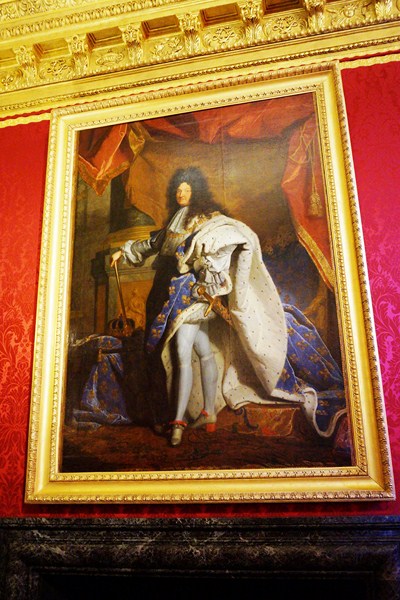
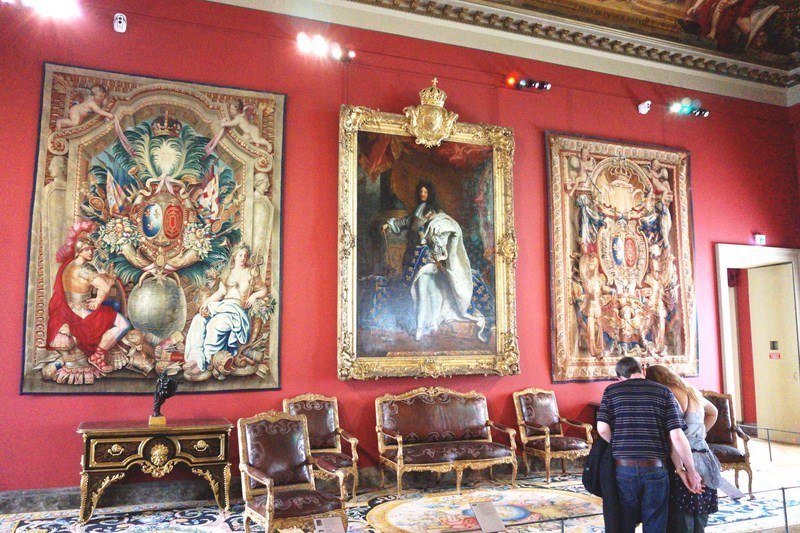
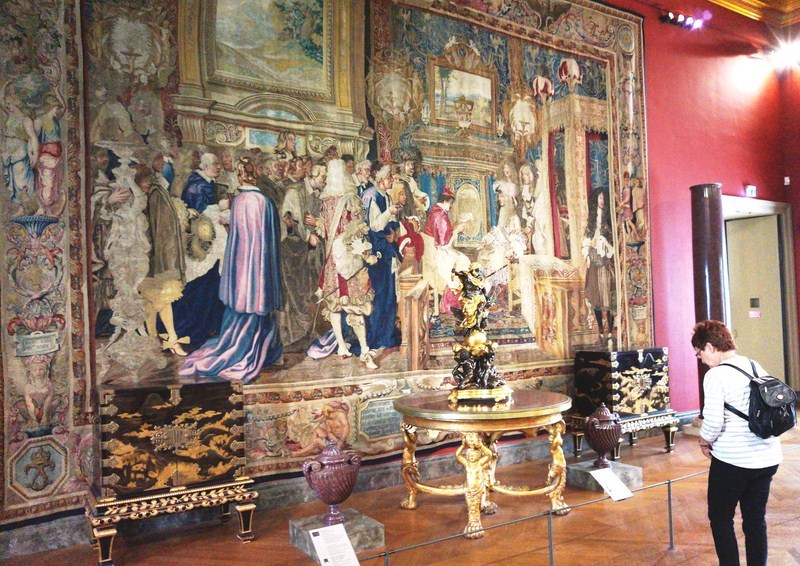
Room 601 (Louis XIV Room) with a portrait of King Louis XIV by Hyacinthe Rigaud (oil on canvas, 1701, 277 cm. × 194 cm.)

A section entitled “From Louis XIV to Louis XVI” (“De Louis XIV à Louis XVI”), presented by the Department of Decorative Arts’ Collections, is a series of rooms, with over two thousand treasures of French art and design, we can walk through.

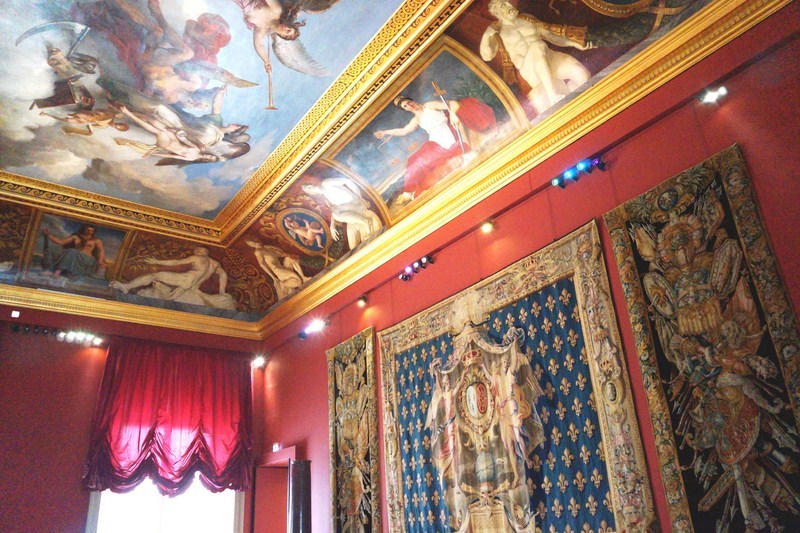
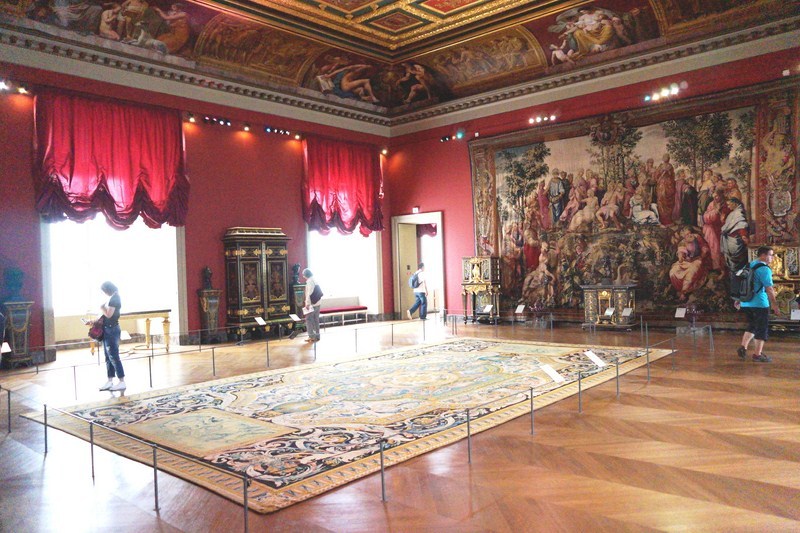
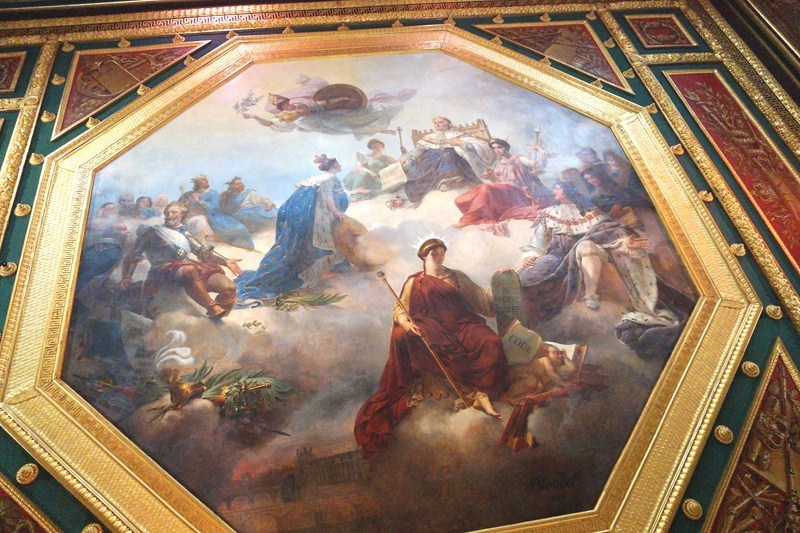
Room 603 with ceiling fresco “La France victorious at Bouvines” (Merry Joseph Blondel) which commemorate the victory at the Battle of Bouvines

This relatively new (opened last June 17, 2014) setting, designed to shed light on both the technical and stylistic history by introducing the major residences and key figures of the time (artists, craftsmen, and those who commissioned their work), offered a broad panorama of interior design, production from major manufactories, crafts, and the art trade.

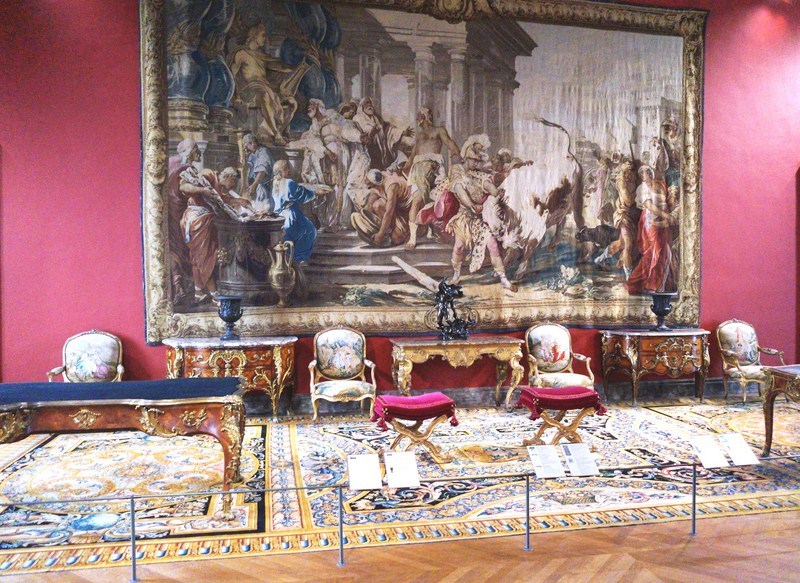
The tapestry “Theseus tames the bull of Marathon and offers it as a sacrifice to Apollo” (Room 604)

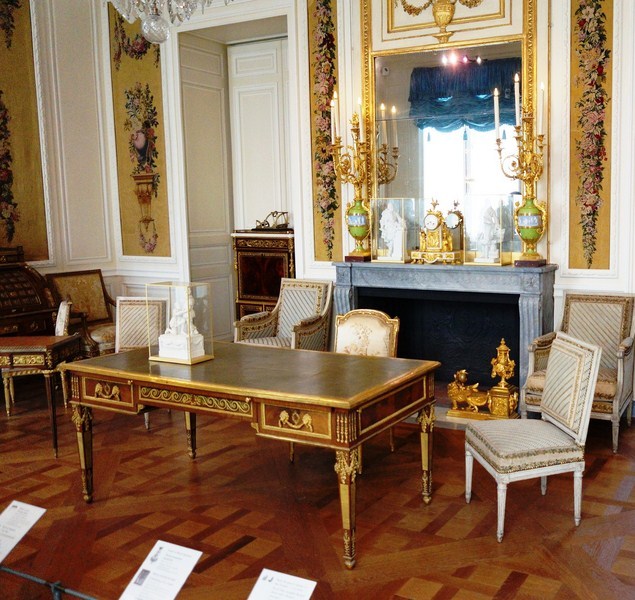
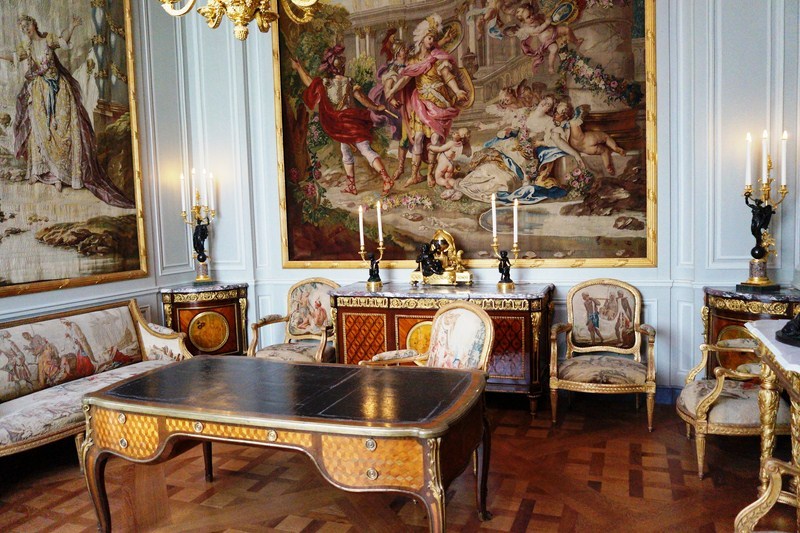
Primarily French in character, from the reign of Louis XIV up to the French Revolution, this remarkable collection, most originally commissioned for royal or princely residences and formerly the preserve mainly of royalty but now for the enrichment of future generations, consist of wood paneling made of hand carved gilt boiserie and painted decorative elements, lots of gorgeous Sèvres porcelain, some furniture and personal effects of Marie Antoinette‘s, tapestries, fine furniture, decorative bronze work, marble items, gold- and silverware, jewelry, scientific instruments, silks, clocks, European faience, porcelain and sumptuous brocades, all previously hidden away in museum storerooms.

“The Audience given by Loius XIV at Fontainebleau, to Monsignor Cardinal Chigi,” a tapestry at Room 601, made at the Gobelins (Mobilier National, Paris, first version, 1665-1672).

To provide a clearer understanding of this luxurious art of living, particular care had been taken in refurbishing the 33 dedicated galleries which were previously closed for almost a decade. Their approach to exhibition design (masterminded by interior designer and French decorative arts connoisseur Jacques Garcia), adopted by some history museums in the nineteenth century, was to reconstruct the finest inventions of interior decorators and master craftsmen in their natural setting.

Room 631 (Furniture of Royal Residences, 1774-1792)

Through a US$35.4 million (€26 million) major renovation (the museum’s first major project entirely funded by private donors, mainly by the famous watch manufacturer Breguet) and complete revamp of the Louvre’s Louis XIV, Louis XV and Louis XVI rooms, these masterpieces by the artists and craftsmen from that bygone era were presented in 2,200 sq. m. of exhibition space in chambers that once housed the Council of State and the entire first floor of the north wing of the Cour Carrée.

The visitor trail is divided into three main chronological and stylistic sequences make up – Louis XIV’s personal reign and the Régence (1660–1725), development of the Rococo style (1725–1755) and return to Classicism and the reign of Louis XVI (1755–1790).

Room 603

A team of artisans, under the supervision of the Louvre’s successive curators of the Department of Decorative Arts under the direction of Marc Bascou, helped the 18th century galleries regain their original splendor, thereby succeeding in safeguarding uncommon skills – cabinetmaking (Charles Cressent, Jean-Jean Henri Riesener, Jean-Baptiste-Claude Séné and Bernard II van Risenburgh), bronze work, silver- and gold smithing (Thomas Germain, Jacques Roëttiers and Robert-Joseph Auguste), gilding, upholstering, painting and decorating (Charles Le Brun and Charles-Antoine Coypel), parquet work and art restoration.

Room 603.  On the right is a tapestry set of The Vatican Stanze – Parnassus. A transposition, into tapestry, of one of Raphael’s compositions, painted to adorn a wall in the Stanza della Segnatura (Room of the Signatura) at the Vatican: the god Apollo is depicted as guardian of the arts, surrounded by the Muses and the most illustrious poets.

The rooms, adopting a chronological approach, took us through a natural progression of the major stylistic periods, from the flamboyant Louis XIV aesthetic and the Regency style, to the elaborate but lighthearted Rococo art, followed by a return to the antique taste and Neo-Classicism with its pure, geometrical proportions, straight lines and refined colors.

Cabinet woodwork of L’Hôtel Dangé-Villemaré

The master works on display, contributing to the spread of French culture, were done by the greatest artisans of their day, whose workshops served not only the French court, but also its European counterparts.

Room 609 displays a collection of scientific instruments (compass, magnets, perpetual calendar, etc.) donated by Nicolas and Simone Landau (1957 and 2002)

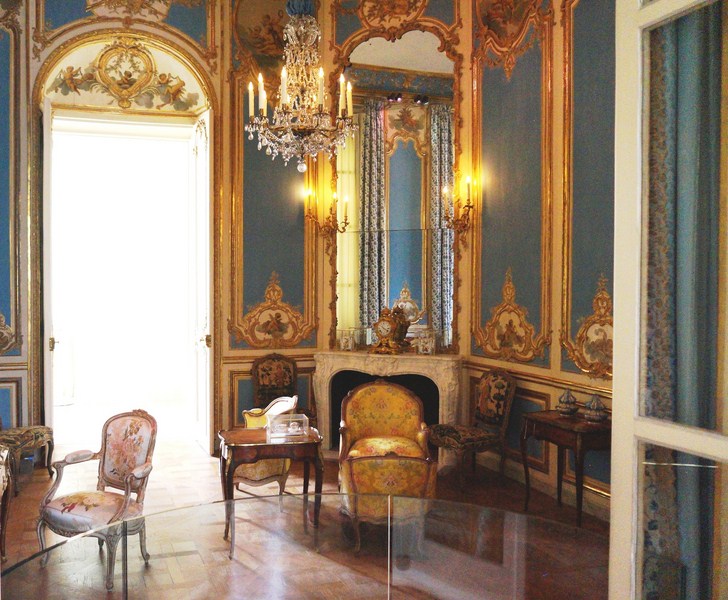
The three sparkly “new” and lavish period rooms (a rarity in French museums), formerly from palatial and fashionable private residences of the period and reconstructed, are the. faithfully reconstructed 1750 drawing room, salons, library and private sitting room of the former L’Hôtel Dangé-Villemaré (built in 1709 and redecorated in 1750, it is one of the most important surviving examples of an interior by a Louis XV-era Parisian workshop) at Place Vendôme, the drawing room of the Château d’Abondant, and the ceremonial bedchamber of the Hôtel de Chevreuse).  They are in the style of Louis XIV and continue through to Louis XVI and Marie Antoinette.

France, in the Midst of the Legislator, Kings and French Jurisconsults, Receives the Constitutional Charter from Louis XVIII (Merry Joseph Blondel, 1827)

All are prime examples of interior design by Parisian workshops under the reign of Louis XV. Brought back to life and put on display, it reconstituted a coherent decorative setting in terms of floors, paneling, doors, windows, cornices and ceilings, thus allowing us to view objects in historic context.

Grand Salon of the Château d’Abondant

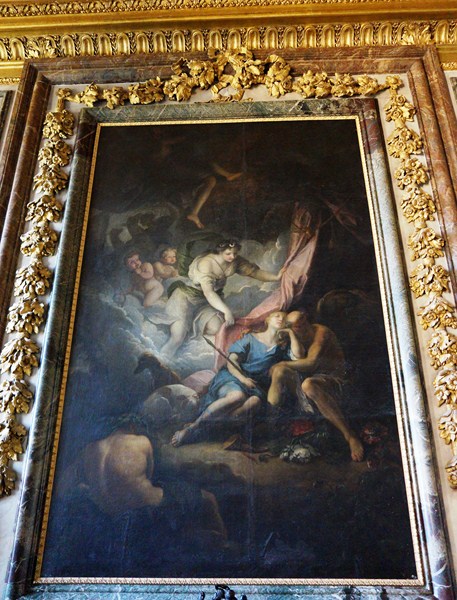
A fully restored, reassembled and installed cupola fresco, in a Neo-Classical space at the heart of the new galleries, depicts mythological subjects from The Toilet of Venus painted in 1774 by Antoine-François Callet and Pierre-Hyacinthe Deleuze for Louis Joseph de Bourbon, Prince de Condé.

The Turkish cabinet of the Comte d’Artois, brother of Louis XVI (Room 630)

Some of the exceptional pieces in the exhibit include:

  • A top-quality, perfectly-proportioned Louis XVI garden with dolphins vase with a blue background in Sèvres porcelain made for the son of the king, painted by Pierre Joseph Rosset l’Ainé and gilded by Jean-Pierre Boulanger.
  • A gold coffer made for Louis XIV by goldsmith Jacob Blanck, with a wooden body covered in blue silk satin, cast, chased and filigreed gold and gilt bronze.
  • A Marie-Antoinette’s traveling case in mahogany containing 94 objects in silver, crystal, porcelain, steel, ivory and ebony.
  • An amazingly-detailed carved, elegantly painted and gilded wood paneling, originally created for aristocrat Le Bas de Montargis’ residence, which once adorning the Comte d’Artois’ Turkish-designed study in Versailles
  • A complete set of nine decorative paintings, in the grotesque style, depicting leisurely country pastimes by Jean-Baptiste Oudry.
  • A Louis XVI commode, by Martin Carlin, with a red griotte marble top, ebony and rosewood veneers and chased gilt-bronze mounts which highlights imported Japanese lacquer screen panels featuring Asian landscapes (among the best examples in the world of the cultural exchanges between Asia and France at the time).
  • A set of six straight-backed armchairs and a sofa owned by the financier Pierre Crozat in carved, gilded walnut, red and fawn-colored leather, and red-and-white silk braiding
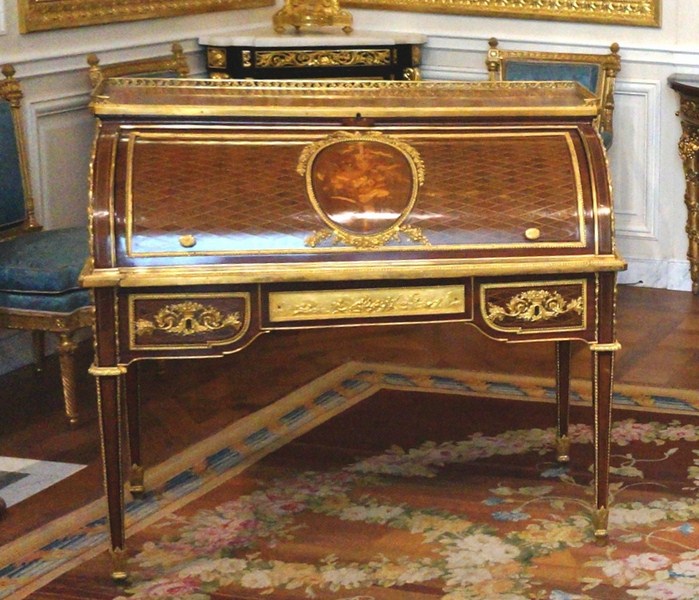
  • A roll-top desk by Jean-François Leleu in oak, tulipwood veneer, gilt bronze and marquetry of barberry wood, hollywood, maple burr and boxwood on brown-stained maple, decorated with Sèvres porcelain plaques.
  • An armoire, for the royal furniture depository, in oak, softwood, ebony veneer, marquetry of tortoise shell, brass, pewter and stained horn, and gilt-bronze mounts, created by André-Charles Boulle, the first cabinetmaker to use lavish gilt-bronze mounts to enhance the decoration of his furniture. 

Salle Marie-Antoinette (Room 632)

The luxurious art of living was made instantly perceptible and easier to understand via this museological concept, returning the creations of decorators and master artisans to their natural environment.

Marie Antoinette’s cylinder desk (Jean-Henri Riesener, 1784)

From Louis XIV to Louis XVI: First Floor, Sully Wing, Louvre, 75001 Paris, France.  Tel: +33 1 40 20 50 50. Open daily, except Tuesdays and holidays, 9 AM- 6 PM (until 10 PM on Wednesday and Friday evenings).

The Louvre has three entrances: the main entrance at the pyramid, an entrance from the Carrousel du Louvre underground shopping mall, and an entrance at the Porte des Lions (near the western end of the Denon wing).

Admission is free, from October to March, on the first Sunday of every month. Still and video photography is permitted for private, noncommercial use only in the galleries housing the permanent collection. The use of flash or other means of artificial lighting is prohibited. Photography and filming are not permitted in the temporary exhibition galleries.

 How To Get There: the Louvre can be reached via Metro lines 1 and 7, station Palais Royal – Musée du Louvre Métro or the Louvre-Rivoli stations. By bus, take No. 21, 24, 27, 39, 48, 68, 69, 72, 81, 95 as well as the touristic Paris l’Open Tour. By car, there is an underground parking reachable by Avenue du Général Lemonier, every day from 7 AM – 11 PM.

Louvre Museum – Near Eastern Antiquities Department (Paris, France)

Near Eastern Antiquities Department

Our visit to the the Near Eastern Antiquities Department, the second newest and one of the most spectacular departments of the Louvre, began at the Ground Floor of the Sully Wing. Here, we spent at least a half hour.

Check out “Louvre Museum

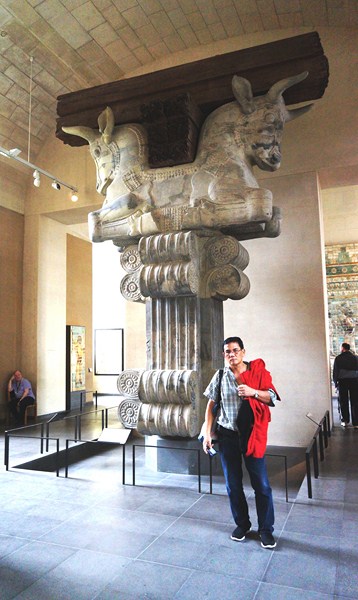
The author. In the background is one of the heads of the columns of the audience hall (Apadana) of King Darius I. It formed part of the decoration of a 358-foot square room. Room 12-A, First Floor, Sully Wing

The world’s first “Assyrian Museum,” the precursor to today’s department, annexed to the “Department of Antiques,” was opened in 1847 and, in 1881, a “Department of Oriental Antiquities.” When the Louvre expanded with the Richelieu Wing, the department rearranged its collections and the first phase of this transformation, occupying the new wing, was inaugurated in 1993.

The second phase, funded by a generous donation, was inaugurated in 1997. A third phase, in the Denon Wing, was scheduled for the fall of 2012.  It aims to organize joint exhibitions by the three Antiquities Departments, based on Roman objects from the eastern Mediterranean.

The museum’s collection consists of the following:

  • The 37 the monumental bas-reliefs discovered during archaeological excavations in Khorsabad, started by Paul-Émile Botta (consul of France in Mosul) from 1843-1854 in the ancient Assyrian city of Dur-Sharrukin.  The excavation showed the existence of a palace built by King Sargon II in 706 BC. During transport on the Tigris River, a large part of the objects were lost in a shipwreck.
  • Palestinian and Jewish antiquities from his archaeological expedition of Louis Félicien de Saulcy.
  • Sumerian works excavated from the site of Tello (in Lower Mesopotamia) by the French vice-consul at Basra, Ernest de Sarzec.
  • The core of the Phoenician collection supplied by Ernest Renan’s excavations in Lebanon.
  • The first Cypriot collection established by Melchior de Vogué.
  • The first elements of the polychrome brick decoration of the Palace of Darius, discovered by the Marcel-Auguste Dieulafoy excavations in 1886.
  • The Code of Hammurabi, a basalt stele discovered by the archaeological mission led by Jacques de Morgan in 1901 in Susa, covers family law, slavery, commercial & agricultural law, and even sets prices and salaries.
  • Claude Schaeffer’s excavations at Ras Shamra (Ugarit)
  • Excavations conducted at Mari, from 1933 to 1974, by André Parrot while pursuing his career as department curator, then as director of the Louvre  (1968-1972).
  • Significant collections of Cypriot (Enkomi) and other antiquities, derived from excavations by the Biblical School of Jerusalem at Tell el-Farah (Tirzah) by donations and acquisitions.
  • The Anatolian, Punic, and South Arabian collections added with loans from the Bibliothèque Nationale de France and the Institut.
  • The large private collection, assembled by Louis de Clercq around 1900, and donated by Henri de Boisgelin in 1967
  • The Coiffard collection of Luristan bronzes, acquired in 1958
  • Collections extended toward Central Asia thanks to a number of acquisitions made in recent decades.
  • A set of objects unearthed during rescue excavations at Meskene (Emar) which entered the Louvre in 1980.
  • A rare gypsum statue from Ain Ghazal (dated around 7000 BC, currently the oldest major artwork in the Louvre), discovered in 1985 in a Neolithic site, entered the department in 1997 via a loan agreement with Jordan. Sully Wing, Room D.

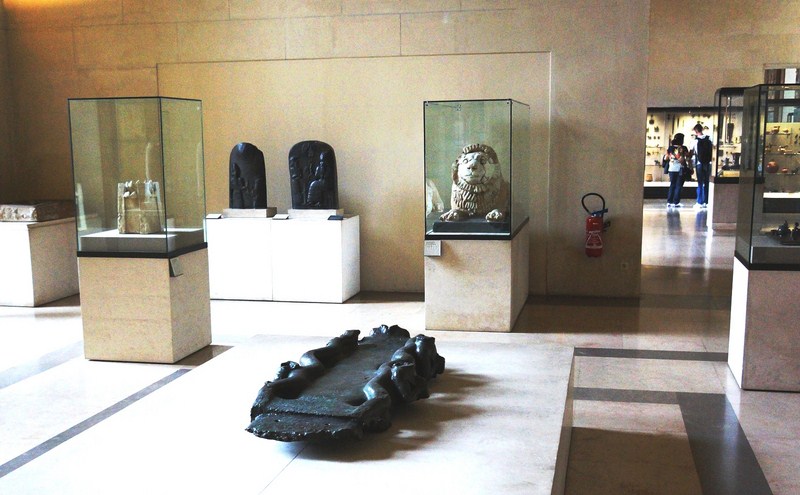
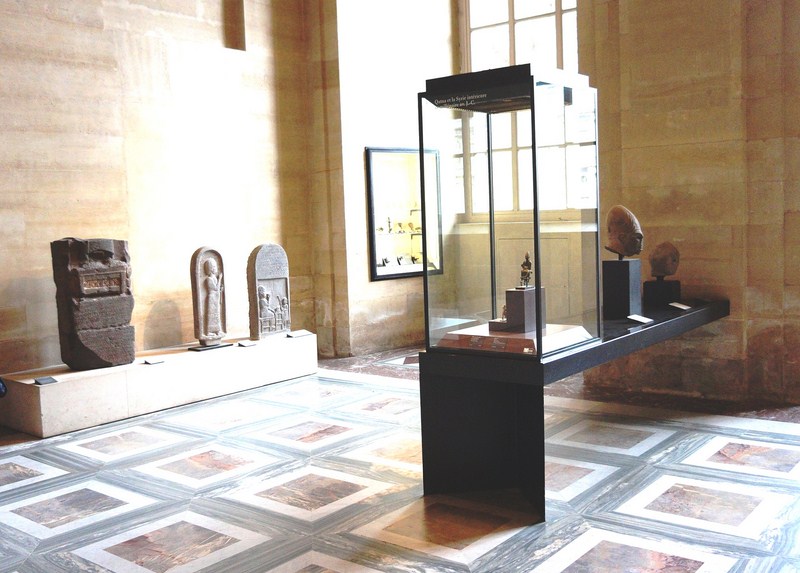
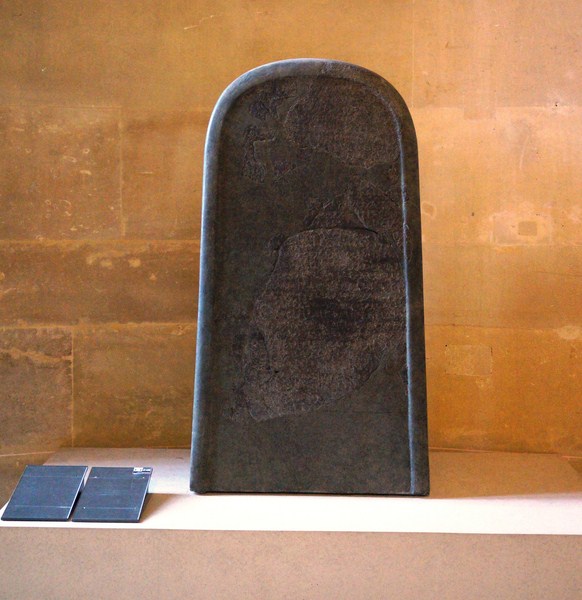
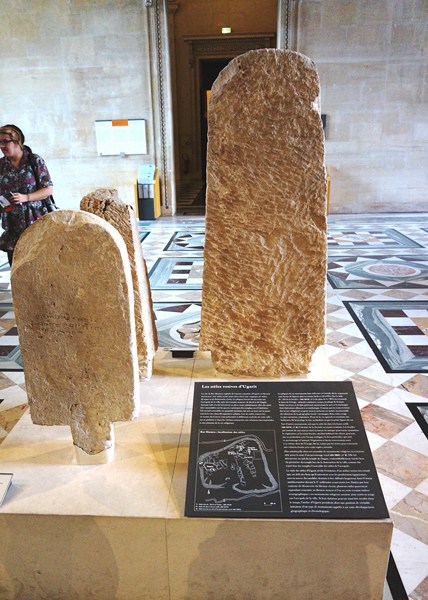
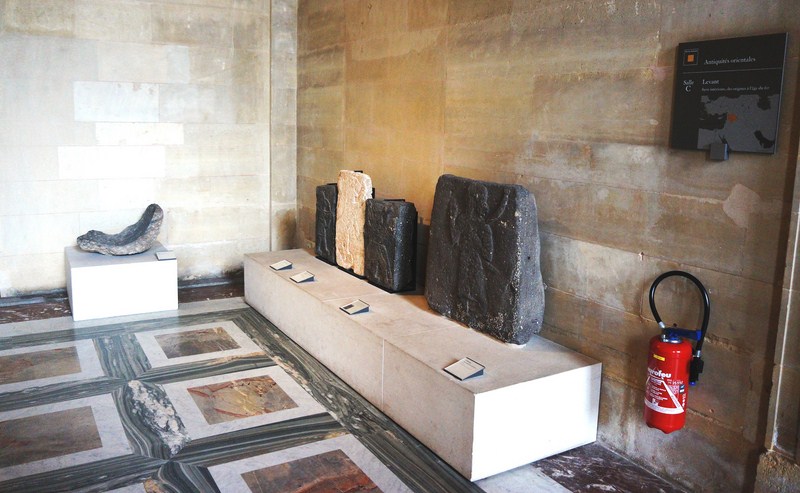
The Mesha Stele, also known as the Moabite Stone, is a stele (inscribed stone) set up around 840 BCE by King Mesha of Moab (a kingdom located in modern Jordan).

The Near Eastern Antiquities Department presented an overview of the ancient civilizations of the Near East, which extends from nine thousand years ago, and the “first settlements” before the arrival of Islam, and encompasses an area stretching from North Africa to the Indus Valley and Central Asia, and from the Black Sea (Anatolia) to the Arabian peninsula (as far as the Indian Ocean).

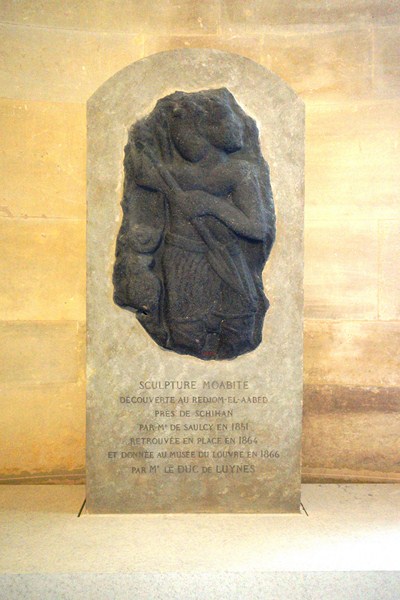
The basalt Shihan stele, was the oldest monument from the Holy Land to be found in the Louvre’s collection until the inter-war excavations bore their fruit.

The department, covering 25 rooms, is divided into three major cultural and geographic areas, with the exhibits arranged chronologically – the Mediterranean Levant (the lands west of the Euphrates, including Cyprus, Anatolia, the Arabian Peninsula, and North Africa), ancient Mesopotamia (Iraq), and Persia (Iran as far as Central Asia).

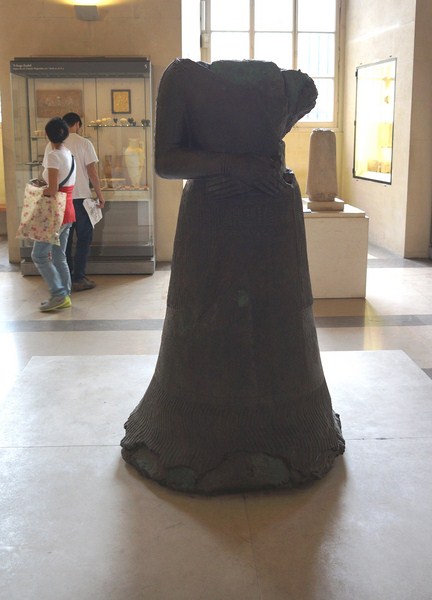
Statue of Queen Napirasu, wife of King Untash-Napirisha

The scope and diversity of the collections allow for a historical approach. Illustrated in this department are the names of Sumer, Akkad, Ur, Babylon, the Hittites, Assyria and many others.

Votive Steles of Ugarit

The museum contains major sculptures and monuments such as the Prince of Lagash’s Stele of the Vultures (from 2450 BC); the stele erected  by Naram-Sin, King of Akkad, to celebrate a victory over barbarians in the Zagros Mountains; the 18th-century BC mural of the Investiture of Zimrilim; the 25th-century BC Statue of Ebih-Il (found in the ancient city-state of Mari), the 5,52 m. high “Hero Overpowering a Lion,” and the 2.25m. (7.38 ft.) high Code of Hammurabi (the great emblem of Mesopotamian antiquity, it prominently displays Babylonian Laws  so that no man could plead their ignorance) in Room 3, Richelieu wing, Ground Floor.

Rooms 1 to 6, comprising the complete Mesopotamian section, features Sumerian artwork, the Code of Hammurabi and the Khorsabad Court. In Room 2 is the special and well conserved for his age (2100 BC) seated statue of Goudea, prince of Lagash (Sumer).

The Iranian Collection

The ancient Iranian civilizations were essentially represented by works from excavations at Susa (a city founded around 4000 BC), its cultural richness reaching its peak with the works of Darius and Xerxes, the great kings of the Persian Empire.

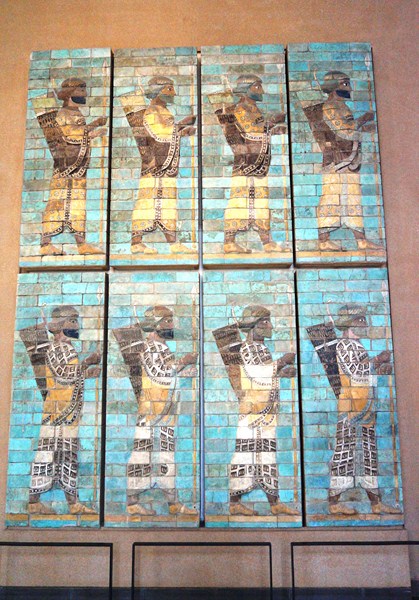
Frieze of Archers from Darius’ Palace

Rooms 7 to 10 house the first part of the Iranian section while the north wing of the Cour Carrée continues the Iranian section with the Iron Age collection (1st millennium BC), the remains of the palace of Persian king Darius I in Susa, and objects representing the Parthian and Sassanian empires.

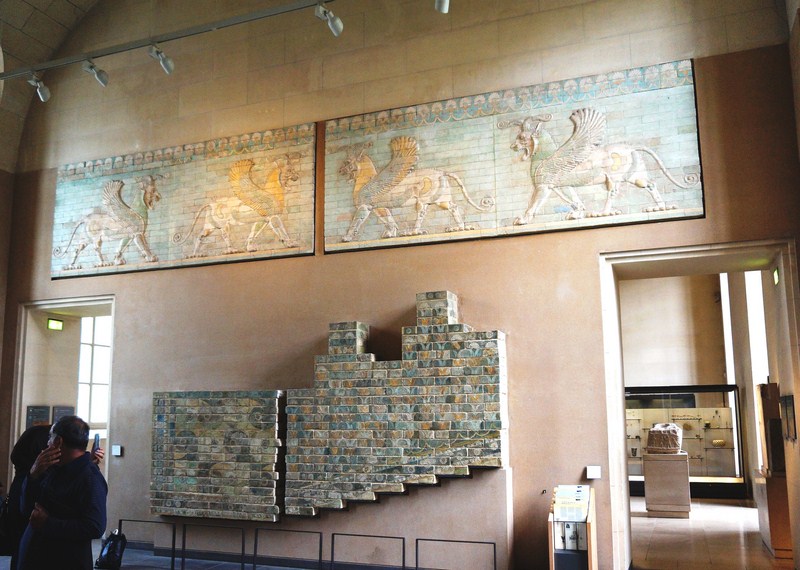
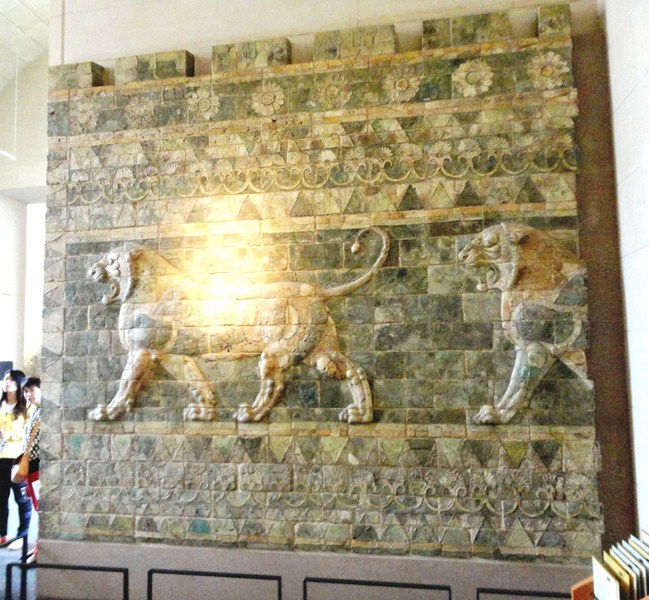
Lion Relief from the Palace of Darius I

The Iranian section contains rare objects from Persepolis which were lent to the British Museum for its Ancient Persia exhibition in 2005.The Funerary Head and the Persian Archers of Darius I are both works from the archaic period.

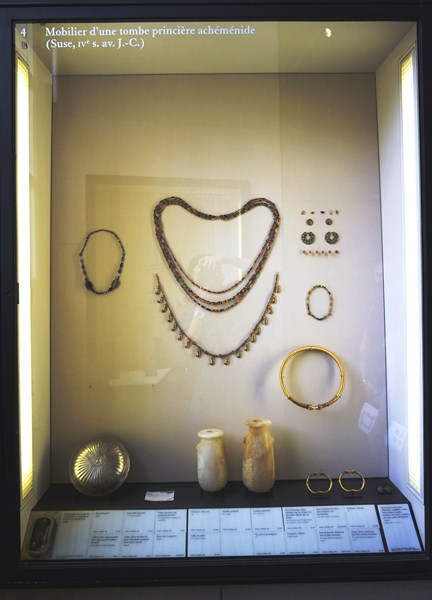
Furniture From a Princely Achaemenid Tomb

In Room 12-B are the friezes of parades of archers (armed with lances and bows on their shoulders) and lions, glazed, colored brick decorations of the palace of Darius at Susa.

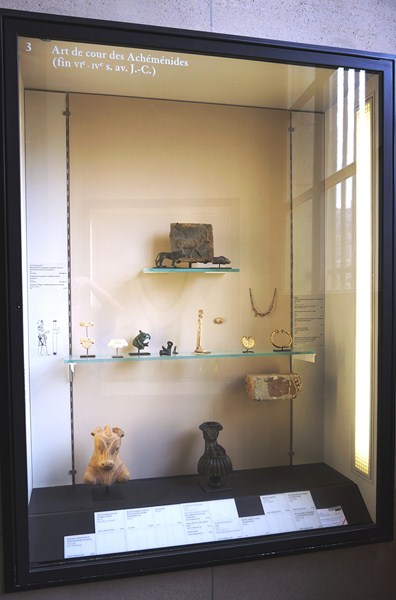
Art of the Achaemenid Court

Most visitors always like to have their photos taken in front of the spectacular winged human-headed winged bulls of 4 x 4 m., protective genies placed as guardians at the gates of the city. However, one of them is a copy, the original being in the Oriental Institute of Chicago.

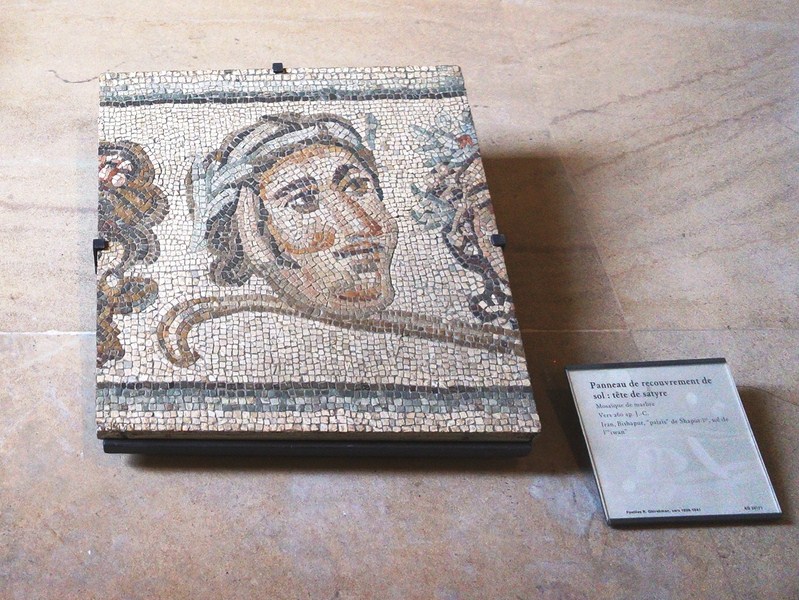
Floor Covering Panel – Satyr Head

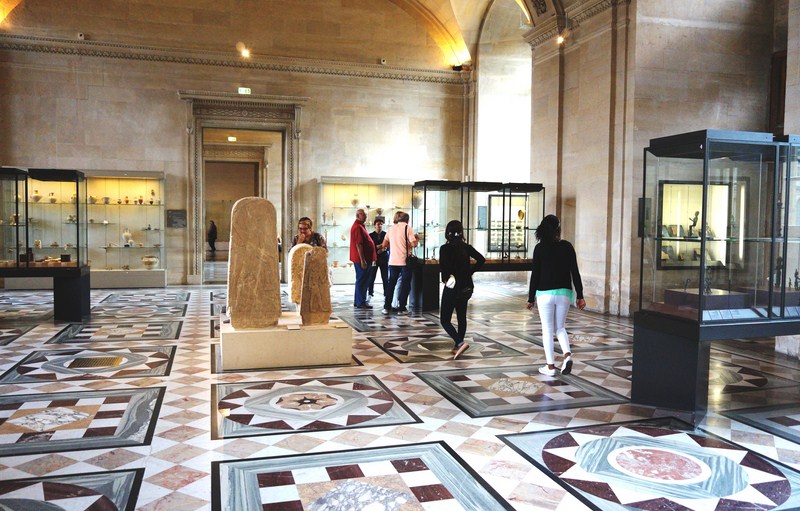
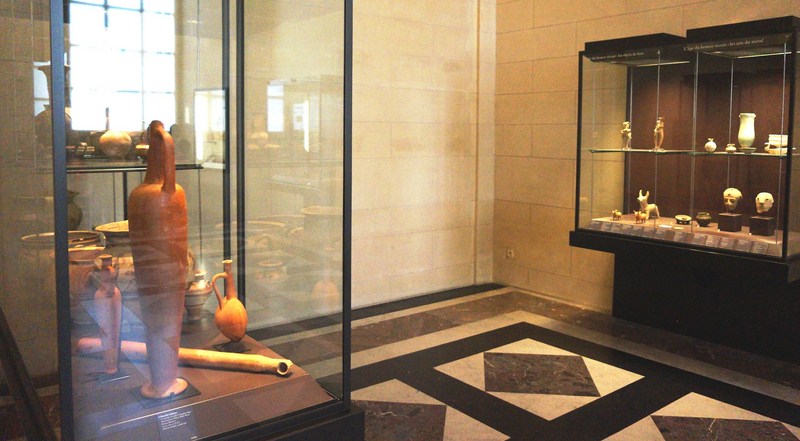
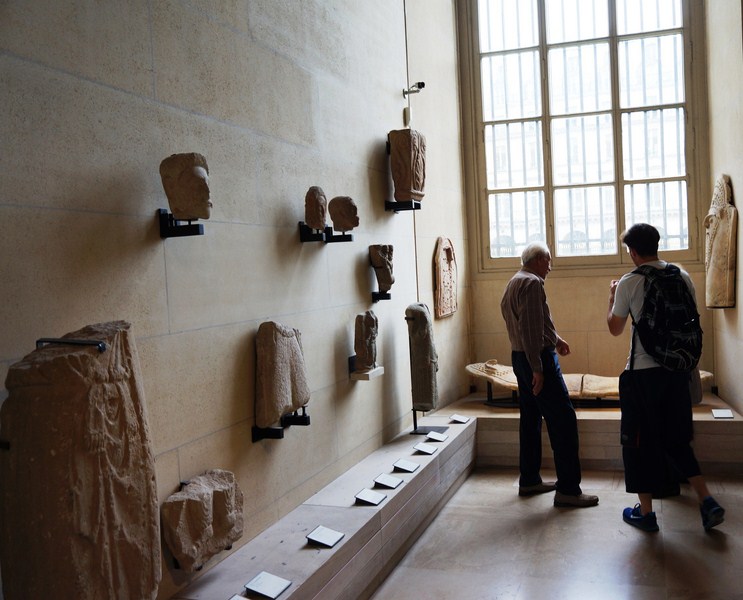
Rooms A to D, in the west wing of the Cour Carrée (opened in 1993), is devoted to Cyprus and the Levant, from Prehistory to the Phoenician Period (early first millennium BC).

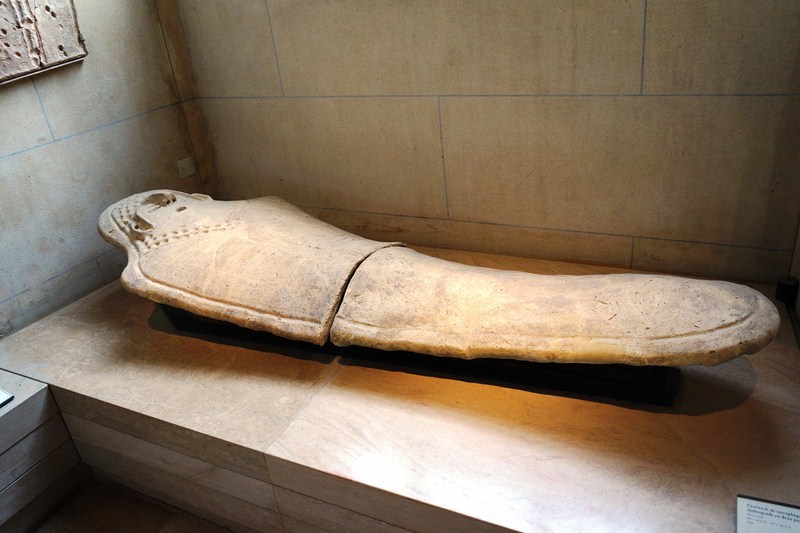
Sarcophagus Lid

A section of the north wing houses galleries devoted to the Levant (until the conquest of Alexander the Great), with royal sarcophagi from Sidon. The Phoenicians in the West are represented by Carthage and Punic North Africa.

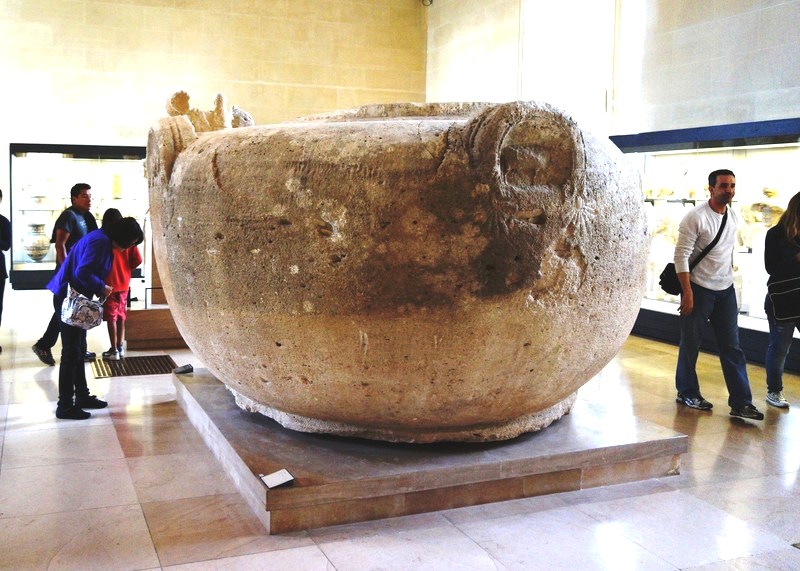
Vase from Amathus

A section dedicated to Cyprus in the 1st millennium BC is structured around the monumental vase from Amathus.

The last rooms are devoted to the civilizations of pre-Islamic Arabia from the 7th century BC to the 3rd century AD (essentially Yemen and Hauran), and to the caravan cities of Syria (Palmyra and Dura Europos).


We weren’t able to visit Cour Khorsabad at the ground floor of the adjoining Richelieu Wing.  This courtyard houses the impressive remains of the palace inaugurated by King Sargon II in Khorsabad (a city in northern Iraq) in 706 BC., its sculpted reliefs displayed in their original configuration, re-creating the monumental architecture of the palace.

Louvre Museum: 75001 Paris, France.  Tel: +33 1 40 20 50 50. Open daily, except Tuesdays and holidays, 9 AM- 6 PM (until 10 PM on Wednesday and Friday evenings).

The Louvre has three entrances: the main entrance at the pyramid, an entrance from the Carrousel du Louvre underground shopping mall, and an entrance at the Porte des Lions (near the western end of the Denon wing).

Admission is free, from October to March, on the first Sunday of every month. Still and video photography is permitted for private, noncommercial use only in the galleries housing the permanent collection. The use of flash or other means of artificial lighting is prohibited. Photography and filming are not permitted in the temporary exhibition galleries. 

How To Get There: the Louvre can be reached via Metro lines 1 and 7, station Palais Royal – Musée du Louvre Métro or the Louvre-Rivoli stations. By bus, take No. 21, 24, 27, 39, 48, 68, 69, 72, 81, 95 as well as the touristic Paris l’Open Tour. By car, there is an underground parking reachable by Avenue du Général Lemonier, every day from 7 AM – 11 PM.

Louvre Museum – Egyptian Antiquities Department (Paris, France)

Egyptian Antiquities Department

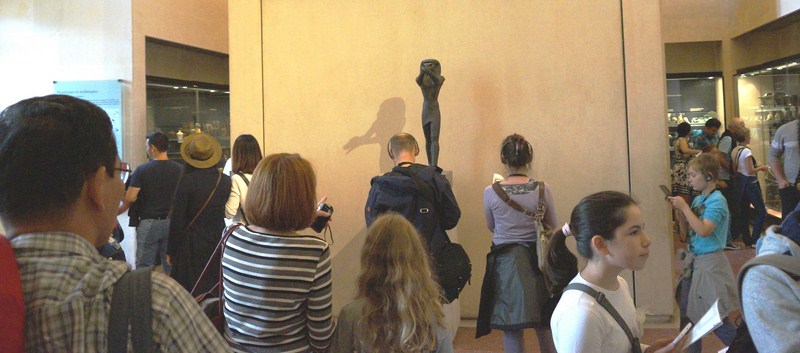
Egyptian Antiquities Department – crowds gathered around a statue of Horus

After viewing the paintings of Italian and French masters at the Denon Wing, Jandy and I proceeded to the underground level of the Sully Wing to visit the Egyptian Antiquities Department, passing the Winged Victory of Samothrace (190 BC) statue and the excavated and preserved remains of the medieval fortress and moat of the Louvre.

Check out “Louvre Museum

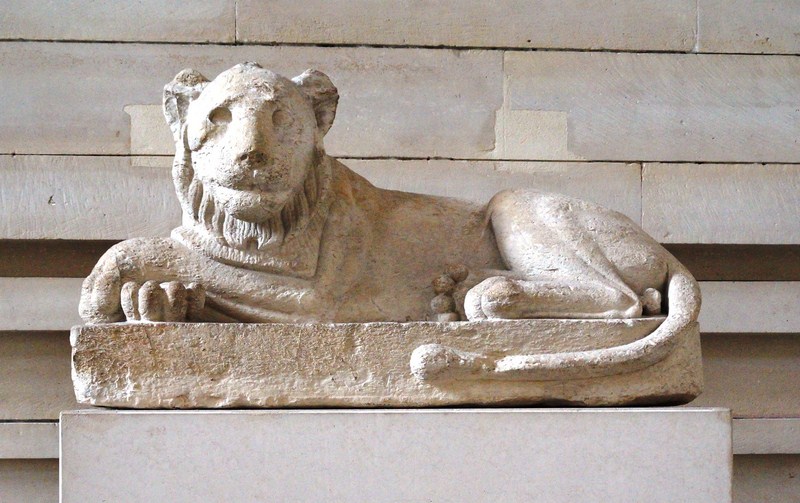
Guardian Lion at the Entrance to a Chapel of the Serapeum of Saqqara

Guardian Lion at the Entrance to a Chapel of the Serapeum of Saqqara

A numbers of visitors to the Louvre come with the sole aim of visiting this department and it would be a real pity if we did not to spend at least one hour here.

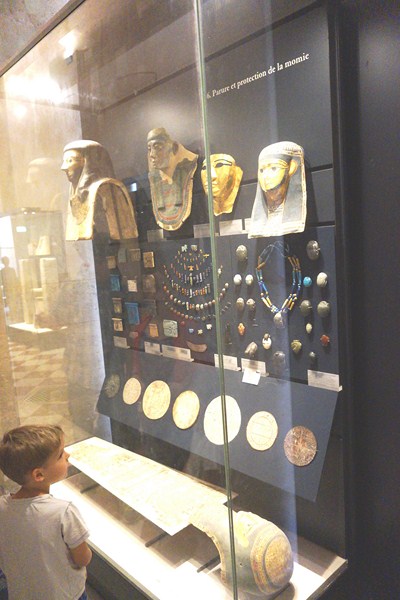
Set for protection of the mummy

Set for protection of the mummy

The Egyptian Antiquities collection of the Louvre, the second biggest in the world after the Cairo Museum, comprises over 50,000 pieces, includes artifacts from the Nile civilizations which date from 4,000 BC to the 4th century AD. The collection overviews Egyptian life spanning Ancient Egypt, the Middle Kingdom, the New KingdomCoptic art, and the RomanPtolemaic, and Byzantine periods. 

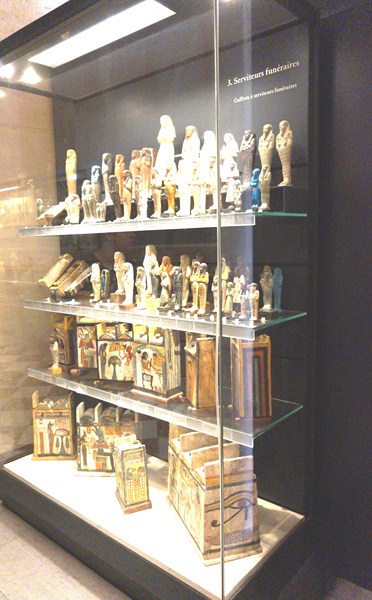
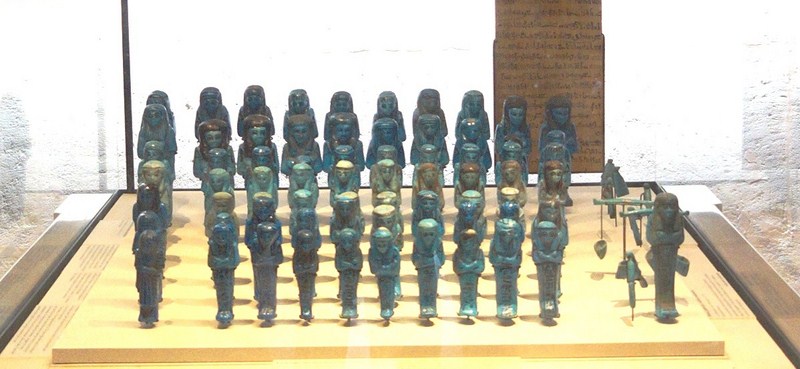
Funerary servants

Funerary servants

The department’s origins lie in the royal collection, but it was augmented by Napoleon’s 1798 expeditionary trip with Dominique Vivant, the future director of the Louvre. After Jean-François Champollion translated the Rosetta StoneCharles X decreed that an Egyptian Antiquities department be created.

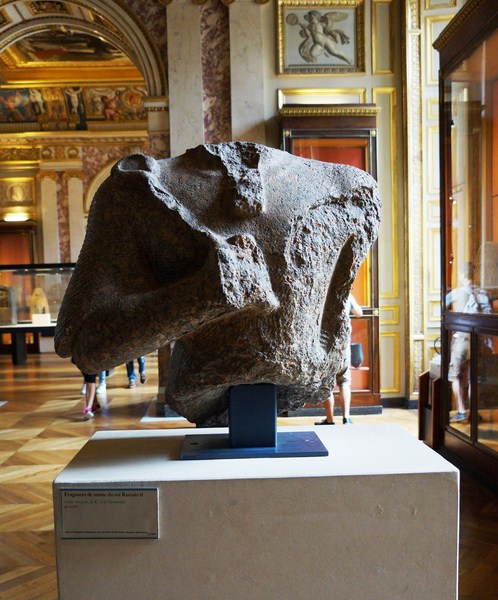
Fragment of Statue of Ramses II

Fragment of Statue of Ramses II

Champollion advised the purchase of 7,000 works from the three its continued via acquisitions by Auguste Mariette, founder of the Egyptian Museum  in Cairo. Mariette, after excavations at Memphis, sent back crates of archaeological finds including The Seated Scribe.

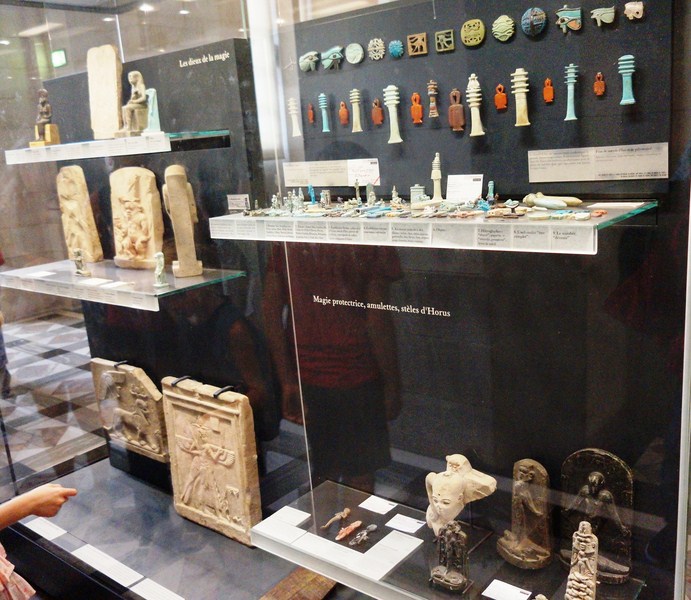
Magic protection, amulets, steles of Horus

Magic protection, amulets, steles of Horus

In 1997, during the Grand Louvre renovation project, this huge collection was distributed on two different floors in what is now called the Sully Wing at the east end of the Louvre.

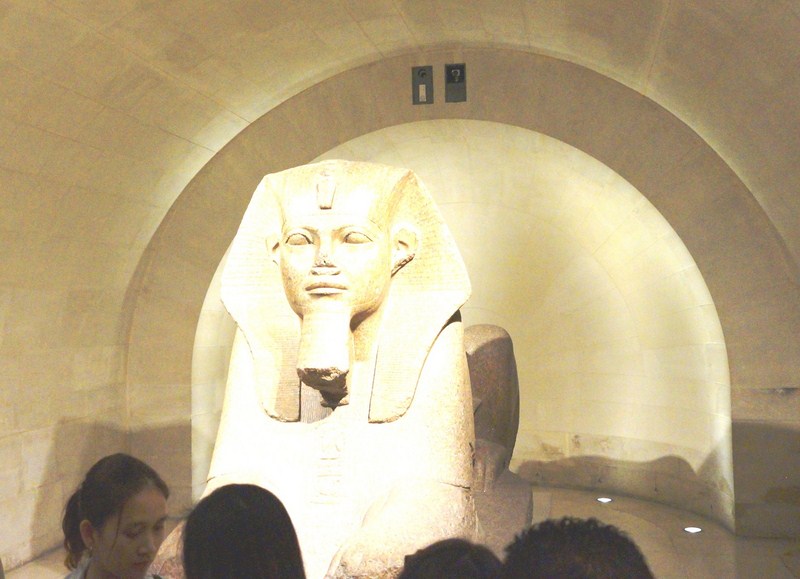
Sphinx guarding entrance

Sphinx of Tanis guarding entrance

Guarded by the Great Sphinx of Tanis (c. 2000 BC), this department now fills 30 large rooms. Holdings include art, papyrus scrolls, mummies, tools, clothing, jewelry, games, musical instruments and weapons.  

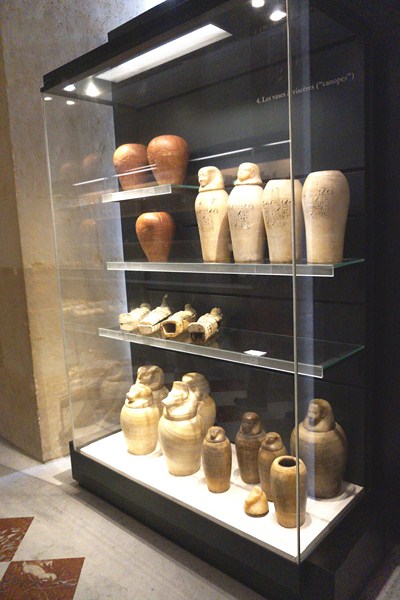
Canopes (Vases)

Canopes (Vases)

The 19 rooms on the ground floor include two in the basement for particularly heavy exhibits (another reason they are at ground level is that there are pedestrian entrances to the courtyard). As the heaviest objects had to remain on the ground floor, it was impossible to arrange the works by period.

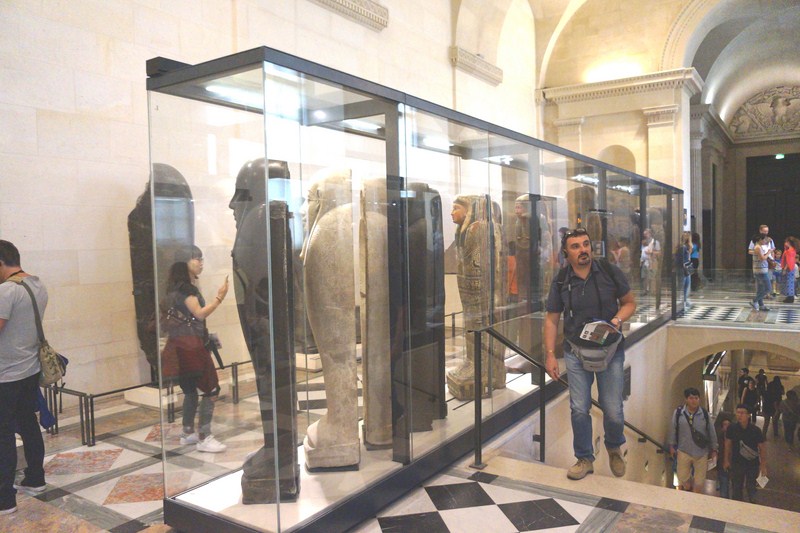
Sarcophagi Room (Room 14)

Sarcophagus Room (Room 14)

Instead, they are organized into a “thematic circuit” centered on the major aspects of Egyptian civilization (i.e. the daily life in Ancient Egypt), using authentic relics and artworks to illustrate and explain the topics of agriculture, hunting, fishing, animal husbandry, writing, arts and crafts, domestic life, temples, funeral rites and gods in ancient Egypt. The ground floor includes the Temple Room (Room 12) and the Sarcophagus Room (Room 14).

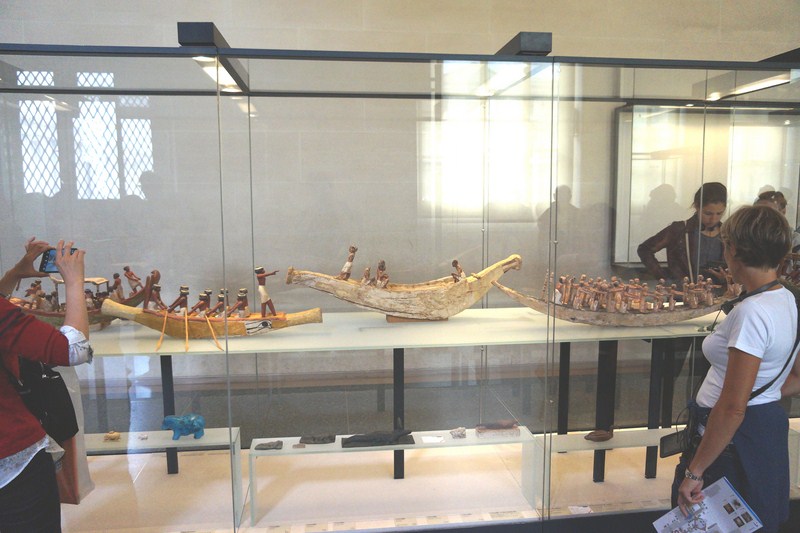
Room 3

Room 3

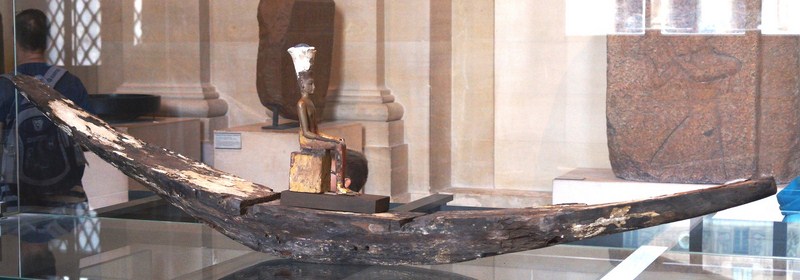
Room 3 has models, found in graves, that show people rowing on the Nile River or poling through shallow water. The models were perhaps intended to provide transportation in the afterlife for the person who had died.

Model of a funeral boat

Model of a funeral boat

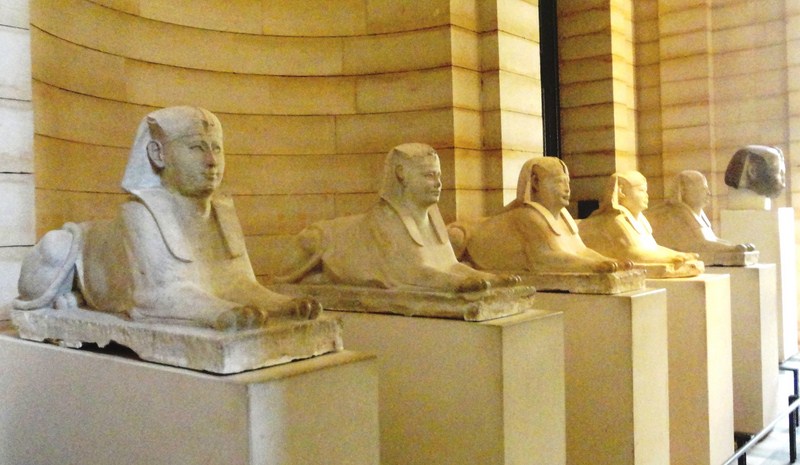
Room 11 contains a row of six of the sphinxes which were set up, in the 4th or 3rd century BC, along the aisle leading to the temple Sérapéum de Saqqara in Egypt. In 1851, these were discovered and excavated out of the sand by workers under the direction of Auguste Mariette.

A row of 6 sphinxes in Room 11

A row of 6 sphinxes in Room 11

Later, in 1869, Mariette was asked to suggest a plot for an opera about ancient Egypt, and his idea was accepted as the basis for the opera Aida by Giuseppe Verdi.

Naos Housing a Statue of Osiris

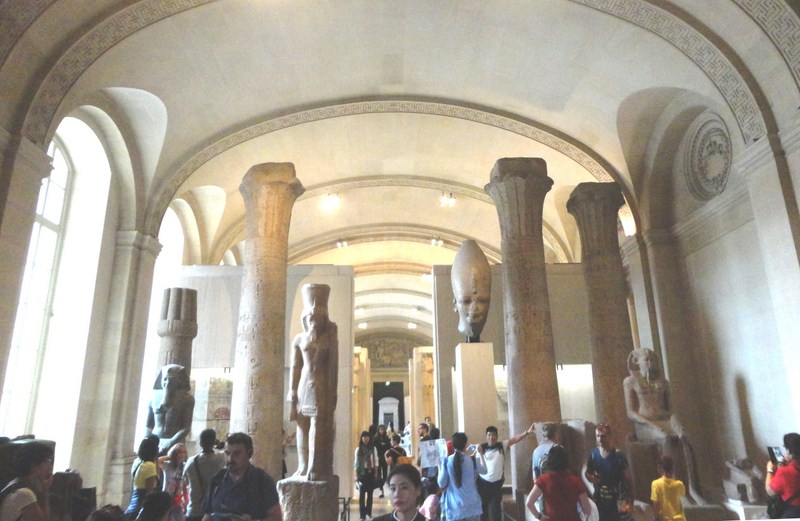
The large Temple Room (Room 12), divided into 4 sections, shows the remains of sanctuaries from various sites and all epochs of ancient Egyptian history.  It gives us an idea of the structure and function of a temple and the ceremonies that took place there.

The large Temple Room (Room 12)

The large Temple Room (Room 12)

After visiting the 12 densely packed rooms of the thematic tour of ancient Egypt, we went down a long staircase (there’s also an elevator for people with restricted mobility) that lead down to the basement.

Room 13

Room 13

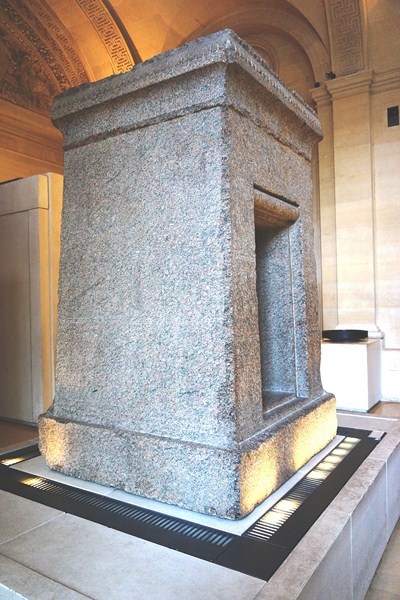
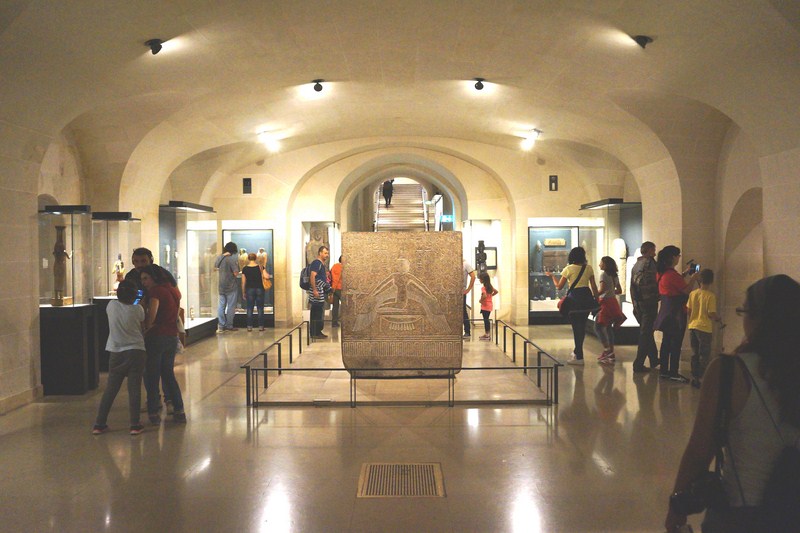
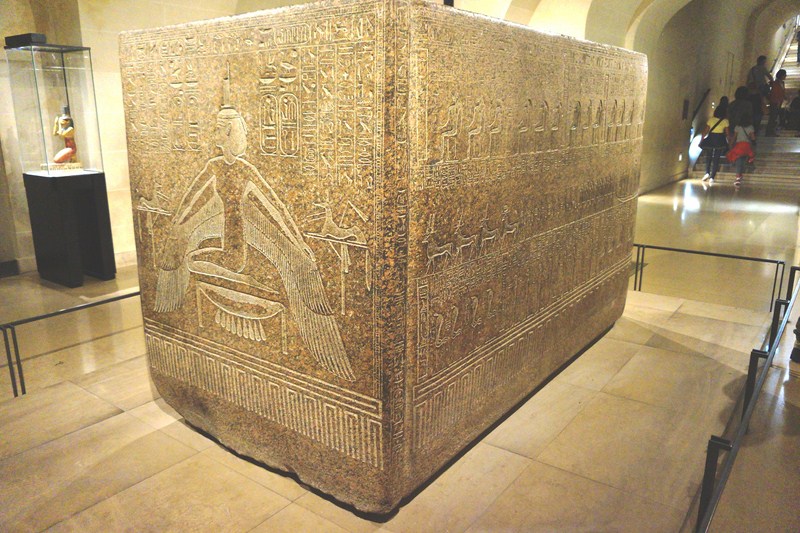
Here, Room 13 displays the huge, extremely heavy red granite royal tomb of pharaoh Ramses III, who ruled from 1186–1155 BC. This room is also identified as the crypt of the god Osiris.

The red granite tomb of pharaoh Ramses III at Room 13

The pink granite cartouche-shaped tomb, at Room 13, once contained the nest of coffins of Pharaoh Ramesses III.

Rooms 18 and 19 have an alphabetical guide to the ancient Egyptian gods, including their appearance, their attributes, their roles, all illustrated with authentic figurines made of metal, ceramics or stone. There is also an exhibit of mummified animals.

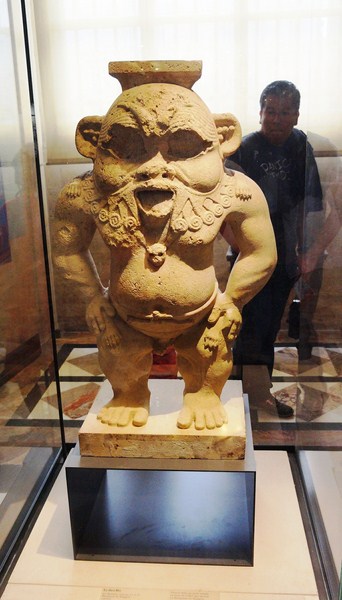
Statue of Bes, god of matrimony, as a dwarf

Statue of Bes, god of matrimony, as a misshapen nude dwarf with overly long arms, bowed legs, and a face combining leonine and human features

Rooms 20 to 30, on the first floor, on the other hand, is organized into a “chronological circuit” showing outstanding examples of Egyptian art, from the earliest to the latest periods of ancient Egypt. present a chronological approach, highlighting the different historical periods and the development of Egyptian art from 4000 BC to 400 AD.

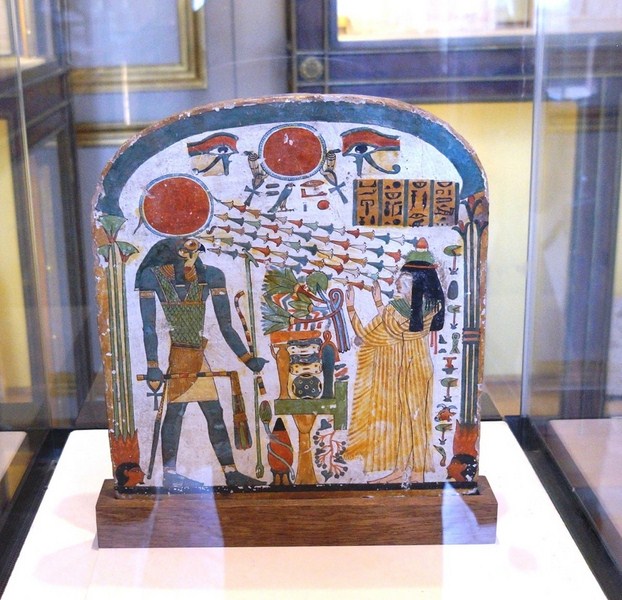
Stele of LadyTaperet

The small wooden stele features an image of Lady Taperet praying to different aspects of the sun: Ra, the sun at its zenith, on one side; and Atum, the setting sun, on the other

Pieces from the ancient period include the Gebel el-Arak Knife from 3400 BC, the Head of King Djedefre and The Seated Scribe, its most famous artifact. Probably the most famous statue in the Egyptian collection of the Louvre, “The Seated Scribe” (c. 2620-2500 BC), in room 22 on the 1st floor, always impresses visitors.  Its inlaid eyes are the most striking aspect of this sculpture.  Nothing is known about the person portrayed

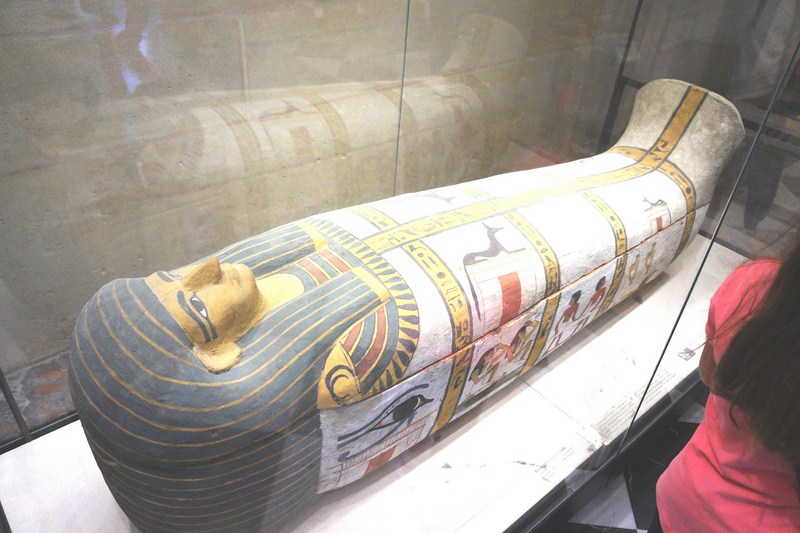
Well Painted Coffin of the Lady of Madjadiscovered in a cemetery in West Thebes overlooking the valley of Deir el-Medina, behind the hill of Qurnet Mourai

The highly decorated coffin of the Lady of Madja discovered in a cemetery in West Thebes overlooking the valley of Deir el-Medina, behind the hill of Qurnet Mourai

The Middle Kingdom art, known for its gold work and statues, moves from realism to idealization.  This is exemplified by the schist statue of Amenemhatankh and the wooden Offering Bearer. The New Kingdom and Coptic Egyptian sections are deep, but the statue of the goddess Nephthys and the limestone depiction of the goddess Hathor demonstrate New Kingdom sentiment and wealth.

Troop of funerary servant figures

Troop of funerary servant figures

In Room 28 (Musee Charles X), the exhibits are about Egyptian Princes and courtiers in the period from 1295–1069 BC.  However, its ceiling painting, by Horace Vernet (1789-1863), shows something completely different -Pope Julius II ordering Bramante, Michelangelo, and Raphael to build the Vatican and Saint Peter’s in Rome.

Check out “Charles X Museum

Musee Charles X

In Room 29 (Musee Charles X), the exhibits are about the Third Middle Period of ancient Egypt, from about 1069–404 BC. Here the ceiling painting, L’Egypte sauvée par Joseph (Egypt saved by Joseph) by Alexandre-Denis Abel de Pujol (1785-1861), has to do with Egypt.

Fragment of a Statue of a Nubian

Fragment of a Statue of a Nubian

Louvre Museum: 75001 Paris, France.  Tel: +33 1 40 20 50 50. Open daily, except Tuesdays and holidays, 9 AM- 6 PM (until 10 PM on Wednesday and Friday evenings).

The Louvre has three entrances: the main entrance at the pyramid, an entrance from the Carrousel du Louvre underground shopping mall, and an entrance at the Porte des Lions (near the western end of the Denon wing).

Admission is free, from October to March, on the first Sunday of every month. Still and video photography is permitted for private, noncommercial use only in the galleries housing the permanent collection.The use of flash or other means of artificial lighting is prohibited. Photography and filming are not permitted in the temporary exhibition galleries.

How To Get There: the Louvre can be reached via Metro lines 1 and 7, station Palais Royal – Musée du Louvre Métro or the Louvre-Rivoli stations. By bus, take No. 21, 24, 27, 39, 48, 68, 69, 72, 81, 95 as well as the touristic Paris l’Open Tour. By car, there is an underground parking reachable by Avenue du Général Lemonier, every day from 7 AM – 11 PM.

Louvre Museum – Charles X Museum (Paris, France)

Salle des Colonnes (Column Room) of Charles X Museum (Musee Charles X)

The Charles X Museum (Musee Charles X), located in a series of 9 inner rooms on the first floor (not the ground floor, but one flight up) of the southeast wing of the Cour Carrée, first housed the apartments of the reigning queen, next to the king’s pavilion. The western part is located in the wing built by Pierre Lescot, while the eastern part was built by Louis Le Vau.

Check out “Louvre Museum

After the king left for the Palace of Versailles, the Academy of Architecture occupied this wing but, after the Revolution, the entire wing was used as housing and workshops for artists. Under Napoleon I, the development of this space, began by the architect Fontaine, was completed in 1819. It had 4 rooms on each side of the Columns room located in the Arts pavilion. Between 1819 and 1827, these rooms were used for exhibitions of the products of industry and the Salon of living artists.

Room 30

The increase in the collections of the Louvre museum required new exhibition spaces and King Charles X commissioned some of the leading architects (including Fontaine) and painters of his day to redesign and redecorate the suites. Each room turned out to be quite lavish and impressive, with mahogany-veneered glass cabinets (by Jacob Desmalter), a fireplace topped with a mirror and a painted ceiling whose theme recalls the country whose works are exhibited in the room. On December 15, 1827, the museum was inaugurated by King Charles X.

The exhibits have been rearranged several times since then but, today, the first four rooms of the Musée Charles X are still used to display a small part of the Louvre’s huge collection of Egyptian and Greco-Roman antiquities. During our visit to the museum, we admired the ceiling decoration and the showcases which offer a rare testimony of a 19th century museography.

Egyptian Antiquities Department

Room 28, the second room of the Musée Charles X, has the ceiling painting “Pope Iulius II Orders the Works of Vatican and Saint-Peter Basilica” by Horace Vernet (1789-1863) which shows Pope Julius II ordering Bramante, Michelangelo and Raphael to build the Vatican and St. Peter’s Basilica in Rome. Its exhibits are about Egyptian princes and courtiers in the period from 1295–1069 BC.

Check out “Louvre Museum – Egyptian Antiquities Department

Study and Genius Unveiling Ancient Egypt to Greece (1826, François-Edouard Picot)

In Room 29, the ceiling painting has to do with Egypt – Egypt saved by Joseph” (L’Egypte sauvée par Joseph) by Alexandre-Denis Abel de Pujol (1785-1861). The exhibits are about the Third Middle Period of ancient Egypt, from about 1069–404 BC..  In Room 30 is Study and Genius Unveil the Antique Egypt to the Greece.(by François-Édouard Picot) while in Room 27 is The Genius of France Animates the Arts and Protects Humanity.

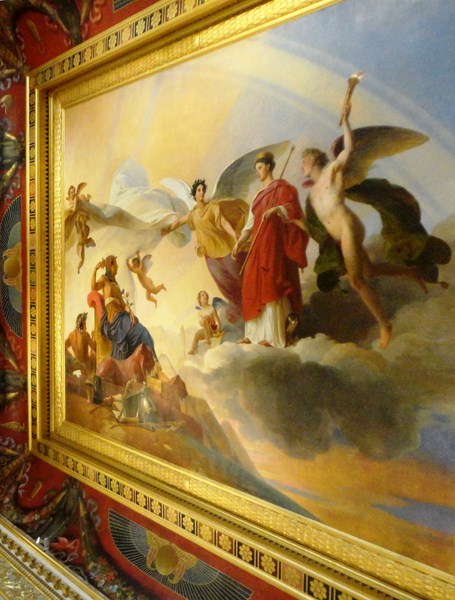
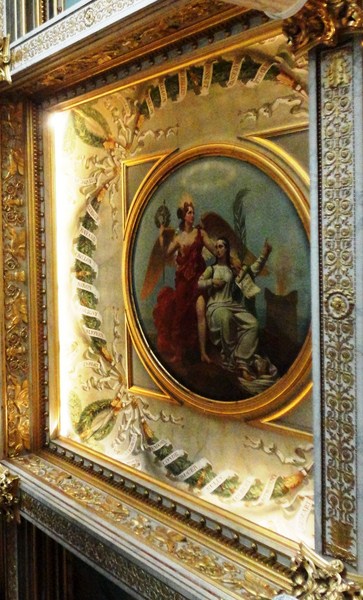
The crossing between Greek and Egyptian Antiquities  is the Column Room of the Pavillon des Arts. On the ceiling are The Time raises Truth to the throne of Wisdom and Real Glory is supported by Virtue.

Check out “Louvre Museum – Greek, Etruscan and Roman Department


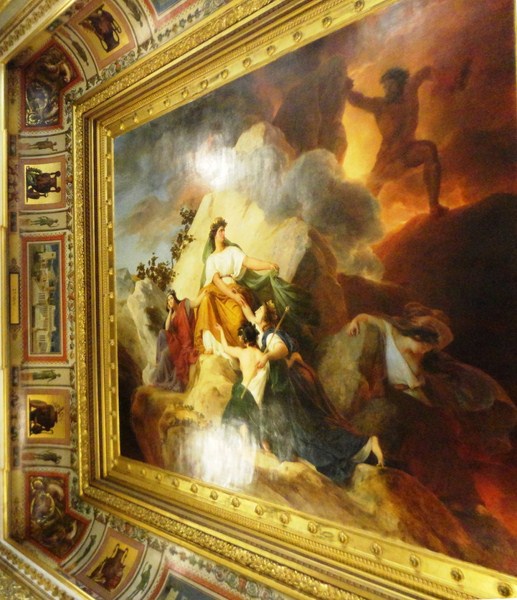
Cybele protects from Vesuvius the towns of Stabies, Herculanum and Pompei

Rooms 35 – 37 display Greek terracotta figurines. The ceiling paintings found here are The Apotheosis of Homer by Ingres‎ (Room 35), Vesuvius Receiving from Jupiter the Fire Which Will Consume Herculanum, Pompei and Stabies‎ (Room 36) and  Nymphs of Parthenope (Napoli) Bring Far From Home Their Penates to the Banks of Seine River‎ (Room 37). In Room 38 is Cybele protects from the Vesuvius the towns of Stabies, Herculanum and Pompei‎.

Real Glory is Supported by Virtue (Antoine-Jean Gros)

Louvre Museum: 75001 Paris, France.  Tel: +33 1 40 20 50 50. Open daily, except Tuesdays and holidays, 9 AM- 6 PM (until 10 PM on Wednesday and Friday evenings).

The Louvre has three entrances: the main entrance at the pyramid, an entrance from the Carrousel du Louvre underground shopping mall, and an entrance at the Porte des Lions (near the western end of the Denon wing).

Admission is free, from October to March, on the first Sunday of every month. Still and video photography is permitted for private, noncommercial use only in the galleries housing the permanent collection.The use of flash or other means of artificial lighting is prohibited. Photography and filming are not permitted in the temporary exhibition galleries. 

How To Get There: the Louvre can be reached via Metro lines 1 and 7, station Palais Royal – Musée du Louvre Métro or the Louvre-Rivoli stations. By bus, take No. 21, 24, 27, 39, 48, 68, 69, 72, 81, 95 as well as the touristic Paris l’Open Tour. By car, there is an underground parking reachable by Avenue du Général Lemonier, every day from 7 AM – 11 PM.

Louvre Museum – Greek, Etruscan and Roman Department (Paris, France)

The Department of Greek, Etruscan and Roman Antiquities, one of the museum’s oldest, is home to a collection of artworks representing the Greek, Etruscan, and Roman civilizations, spanning from the Cycladic Period to the decline of the Roman Empire.

Check out “Louvre Museum” 

Crowds gathered in front of the ca. 190 BC Winged Victory of Samothrace, a magnificent Hellenistic statue that may have commemorated a naval victory, possibly by a fleet from Rhodes in the 2nd century BC. Excavations on the island of Samothrace, where it was found in 1863, revealed that it originally stood on the prow of a grey marble ship, at the center of an ornamental fountain. It depicts the winged Hellenistic goddess Nike. During World War II, this masterpiece, along with the Mona Lisa, Slaves by Michelangelo and the Venus de Milo sculpture were shifted to Château de Valençay.

The best artists from the reign of Charles X (Jean-Auguste-Dominique ngres, Vernet, Fragonard, etc.) amazingly combined palace décor from 1827 with antiquities collections to evoke Homer, Pompeii and Herculaneum. The Winged Victory of Samothrace welcomed Jandy and I as well as other visitors, dazzling us with its triumphant silhouette, as we appreciated its size from the top of the steps of the Daru staircase.

The author (right)

The exhibits, housed on the first floor of the Denon Wing (part of it also seen on the mezzanine) and part of the Sully Wing, are themed and chronological, with the Greek works separated from the Roman and Etruscan antiquities

Here’s the historical timeline of the museum:

  • In 1793, the department was formed around the appropriated former royal art collections (some of which was acquired under Francis I), initially focused on marble sculptures.
  • During the French Revolution, it was further enriched by property seized
  • During the Napoleonic Wars, works such as the Apollo Belvedere
  • In 1800, the museum was installed in the summer apartments of Anne of Austria.
  • In the 19th century, works including vases from the Durand collection and bronzes such as the Borghese Vase from the Bibliothèque Nationale, were acquired by the Louvre.
  • In 1807, the purchase of over five hundred marble sculptures from the Borghese collection required the refurbishment of the Salle des Cariatides, the ground floor of the Pavillon du Roi, and the queen’s winter apartments.
  • In 1815, after the return of the works to Italy (including the Apollo Belvedere), Ennio Quirino Visconti (1751-1818), the Louvre’s first curator of antiquities, adopted an active acquisitions policy.
  • In 1818, the Tochon collection was purchased enriching, with archaeological objects, the Louvre’s collection which mostly comprised of marble sculptures. This was followed by that of Durand (1825-1836).
  • In 1821, the Venus de Milo (a sculpture of Aphrodite with her arms missing discovered on the Greek island of Milos, in the Cyclades Archipelago) entered the museum. It was first offered to Louis XVIII by the Marquis de Rivière, after which  the monarchy donated it to the Louvre.
  • in 1827, the Musée Charles X, on the first floor of the Louvre palace, was opened.
  • In 1861, when the Campana collection was acquired, its vases were installed on the first floor of the Cour Carrée’s south wing, in a gallery parallel to the Musée Charles X.
  • During the second half of the 19th century, as a result of archaeological expeditions, the museum acquired many objects from North Africa and the Ottoman Empire.
  • In 1884, The Winged Victory of Samothrace, discovered by Champoiseau in 1863, was placed at the top of the Daru staircase. Ancient Greek sculpture then came to the fore with the Kore of Samos, the Rampin Head, the Lady of Auxerre, and the Tanagra figurines of Boeotia.
  • In the early 20th century, it was decided to renovate the department completely, and this project was carried out in various stages.
  • In 1934, the museum of sculpture inaugurated by Napoleon was dismantled, and chronological classification was established. A section devoted to Greek art, centered on the sculptures in the queen’s winter apartments, the Salle de Diane, and the Salle des Cariatides, was opened on the ground floor; and a Roman art section was created around the former summer apartments of Anne of Austria.
  • In the postwar period, the first floor was reorganized. Bronzes were displayed in the Salle Lacaze, Etruscan art in the Salle Henri II, and Roman silverware and frescoes in the Salle des Bijoux.
  • In 1980, an ambitious reorganization plan was initiated resulting in the present arrangement of the department. The Etruscan collections were displayed on the ground floor (between the Cour du Sphinx and the Petite Galerie), and Roman sculptures moved to the Petite Galerie and the Salle d’Auguste.
  • In the 1990s, after the inauguration of the Louvre pyramid, a new organizational project was launched, initially concerning the Greek art collection and the first-floor rooms (1997-2010).
  • In 1997, the Pre-Classical Greek gallery opened, supplemented by a gallery dedicated to Greek epigraphy, a room representing the Severe style, and a new room (under the Winged Victory staircase) devoted to the Temple of Zeus at Olympia. As a result, a new entrance to the department was created, combining artworks representing a wide range of materials and techniques.
  • The same year saw other changes, with the renovation of the Galerie Daru, and the refurbishment of the first floor: silverware was moved to the Salle Henri II, glassware to the former jewelry room, terracotta figurines and reliefs took over half the former Musée Charles X, and the bronze room and Galerie Campana were fully renovated.
  • In 2004, the Salle du Manège was opened That same year, a remarkable life-sized horse’s head, a fragment from an Archaic Greek sculpture dating from the 6th century BC., was acquired.
    In 2006, the Salle de Diane was rearranged to display the Parthenon marbles.
  • In July 2010, the renovation of the Greek art section was finalized with the opening of rooms dedicated to classical Greek and Hellenistic art, and a new home for the Venus de Milo.

Salle du Manège

The department illustrates the art of a vast area encompassing Greece, Italy, and the whole of the Mediterranean Basin, and spans the period from Neolithic times (4th millennium BC) to the 6th century.

The Louvre collection counts 2700 vases on display in new and elegant showcases.  It includes a large number of Greek vases of all shapes such as amphora, krater, hydria, long shaped lekythos, cups and some interesting rythons with a head of a donkey. In Room 43 is a unique oenochoe (wine jug) in the form of a head from a black slave.

Niobid Krater. Ca. 470 to 450 BC., it shows the god Apollo and his sister Artemis killing the children of Niobe who were collectively called the Niobids.

Masterpieces from the Hellenistic Era include the Winged Victory of Samothrace (190 BC) and the Venus de Milo (Room 16 on the ground floor of the Pavillon du Roi, presented to Louis XVIII by the Marquis de Rivière in 1821), symbolic of Classical art. The latter, the highlight of the museum, stands at the staircase linking the Denon and Sully wings.

Jewelry and pieces, such as the limestone Lady of Auxerre (from 640 BC) and the cylindrical Hera of Samos (circa 570–560 BC.), demonstrate the archaic.

Daru Gallery

The Galerie Daru (Room 406), which formed part of Napoleon III’s “New Louvre,” was originally intended as a sculpture gallery for the annual Paris Salon. It now displays Greek and Roman antiquities, notably the celebrated Borghese Gladiator which exemplifies increased focus on the human form after the 4th century BC.

Check out “Louvre Museum – Daru Gallery

Borghese Gladiator (Daru Gallery), created at Ephesus about 100 BC, is a life-size, Hellenistic marble sculpture portraying a swordsman.

An outstanding collection of more than one thousand Greek potteries are displayed at the long Galerie Campana.

Roman Art (Julio-Claudian Period I, Between 1655 and 1658), at Room 410, Ground Floor, Denon Wing,  houses the Roman Department.   Louis Le Vau transformed Anne of Austria’s summer apartments. The new decoration featured paintings by Giovanni Francesco Romanelli and stucco work by sculptor Michel Angier. The apartments became a gallery of antiquities in 1799.

Paralleling the Seine River are galleries that display much of the museum’s Roman sculpture.   Roman portraiture, representative of that genre, include the portraits of Agrippa and Annius Verus. Among the bronzes is the Greek  Apollo of Piombino.

Bronze Room (Salles des Bronzes)

The Bronze Room (Salle des Bronzes, Room 32, 1st Floor, Sully Wing), built between 1551 and 1553 by the architect Pierre Lescot, was designed as the centerpiece of the 16th-century additions to the Louvre.

Between 1936 and 1938, it was transformed by Albert Ferran and the gallery now houses the museum’s collection of more than 1,000 pieces of ancient art created from bronze (helmets, Hellenic rings, the crown of laurel in gold, etc.), as well as other precious metals.

The Cy Twombly Ceiling

Standing out is Cy Twombly’s 344 sq. m. (3700 sq. ft.) ceiling mural created in 2010. Alongside German Anselm Kiefer and Frenchman Francois Morellet, Twombly is the third artist and the first American to ever paint a permanent modern decorative work for the Louvre. Along the edges are white strips that contain the names (in Greek) of seven renowned Greek sculptors from the Classic period.

The first-floor Salle des Sept Cheminées, formerly the King’s chamber (above the Venus de Milo room), is devoted to Italic and Etruscan art.

The completely refurbished Rooms 7-17 (open to the public since July 7, 2010), at the Sully Wing, are devoted to the classical Greek and Hellenistic art while Rooms 35 – 37 (Musée Charles X)  displays Greek terracotta figurines arranged chronologically, geographically and thematically.

Check out “Charles X Museum

Musee Charles X

The terracotta figures (“Tanagra figurines”) date from the Archaic, Pre-Classical Hellenistic and Roman periods. It includes the small and quite elegant “Victory with Wings” (from 190 BC.).

Terra cotta figurines

The Salle des Caryatids, at Room 348, is located on the ground floor of Pierre Lescot’s 16th-century Renaissance wing.  This room takes its name from the four female figures sculpted by Jean Goujon in 1550 to support the musicians’ gallery. Today, it houses Roman copies of Greek originals long since disappeared.

Louvre Museum: 75001 Paris, France.  Tel: +33 1 40 20 50 50. Open daily, except Tuesdays and holidays, 9 AM- 6 PM (until 10 PM on Wednesday and Friday evenings).

The Louvre has three entrances: the main entrance at the pyramid, an entrance from the Carrousel du Louvre underground shopping mall, and an entrance at the Porte des Lions (near the western end of the Denon wing).

Admission is free, from October to March, on the first Sunday of every month. Still and video photography is permitted for private, noncommercial use only in the galleries housing the permanent collection.The use of flash or other means of artificial lighting is prohibited. Photography and filming are not permitted in the temporary exhibition galleries. 

How To Get There: the Louvre can be reached via Metro lines 1 and 7, station Palais Royal – Musée du Louvre Métro or the Louvre-Rivoli stations. By bus, take No. 21, 24, 27, 39, 48, 68, 69, 72, 81, 95 as well as the touristic Paris l’Open Tour. By car, there is an underground parking reachable by Avenue du Général Lemonier, every day from 7 AM – 11 PM.

Louvre Museum – Apollo Gallery (Paris, France)

Apollo Gallery (Galerie d’Apollon)

The iconic Galerie d’Apollon (Apollo Gallery), home to some of the Louvre’s most precious historical collections, is famous for its high vaulted ceilings with painted decorations. Originally called the ‘Petite Galerie’ of the Louvre, this room was decorated, according to designs by Martin Fréminet for Henri IV of France, by the artists of the Second School of Fontainebleau, most notably Toussaint DubreuilJacob Bunel and his wife Marguerite Bahuche.

Check out “Louvre Museum

Gallery entrance

Originally designed as a reception hall, this was the first Royal Gallery for Louis XIV and served as a model for the Hall of Mirrors of the Palace of Versailles. The gallery, left incomplete during the reign of Louis XIV, was filled with paintings by members of the Royal Academy of Painting and Sculpture in the 18th century. With a total surface area of 600 sq. m., it is 61.34 m. long, 15 m. high and was built over 350 years ago and decorated over the course of two centuries.

Here is the historical timeline of this room:

  • On February 6, 1661, a fire destroyed much of this small gallery and the young Louis XIV ordered the reconstruction of this part of the Louvre as a reception hall, in line with the fashion of palaces and noble houses at that time.
  • Between 1661 and 1663, architectural work was entrusted to architect Louis Le Vau who carried out reconstruction activities. The sculptor François Girardon was responsible for the stucco sculptures.
  • From 1663–1677, interior decoration was implemented by Charles Le Brun, the first painter to Louis XIV, who was assigned responsibility by Colbert.
  • In 1692, the academy of painting and sculpture was installed at the Louvre which encouraged young artists to finish the room with “reception” or “masterpieces.”
  • From 1766–1781, the gallery was completed under the supervision of six academics.
  • From 1848–1851, complex restoration work was done by architect Félix Duban, with painting The Race of Apollo by Eugène Delacroix, Aurore by Muller and Triumph of the Earth or Cybele by Joseph Guichard.
  • From 1999–2004, restoration activities were carried out by the French restoration service of historical monuments.

As part of the Louvre, this unique masterpiece is both a national and World Heritage Site. A witness to 200 years of art history, it showcases 105 artworks (41 paintings, 36 sculpture groups made up of 118 sculptures and 28 tapestries) along the vaulted ceiling and frescoed walls.

The French Crown Jewels

Dozens of French artists contributed to this exceptional interior.  Le Brun authored three large paintings, designing a painted and sculpted decor on the theme of the sun and its movement through space (earth, water and continents) and time (zodiac).

Fall of Icarus (Merry-Joesph Blondel)

The Sun King Louis XIV is glorified by the myth of the sun god Apollo, also evoked by the procession of the Muses. An idyllic vision of the universe in harmony, governed by Apollo, is offered by the overall program. The central section of the ceiling, left blank since Le Brun had worked on the room, was adorned by Eugène Delacroix who thus created the spectacular Apollo Slays the Python.

As of 1663, the stuccoes were made by François Girardon, followed by the Gaspard brothers, Balthasar Marsy, and Thomas Regnaudin, resulting in the majestic, dynamic ensemble we see today.

Since 1861, the gallery has housed Louis XIV’s collection of hardstone vessels in large gilt-wood display tables and vitrines, and those along the walls and under the windows.  In 1887, it was joined by the French Crown Jewels, the legacy of centuries of monarchs who successively owned them and had them remounted to their liking.  The jewels are presented in custom-made display cases created in the 19th century.

Some of the most precious artworks in the Louvre, this inalienable collection of jewels were initially assembled by Françis I in 1532, grew under Louis XIV and reached its peak under Louis XV. During the French Revolution, the items were dispersed but they were brought back together by Napoleon I. In 1887, however, the French State unfortunately decided to sell almost the entire collection.  Luckily, the “Regent,” a white diamond “the size of a Reine Claude plum” (Saint-Simon) was not included in the auction.  Acquired by Louis XV, it is the largest of its kind known to exist in Europe.

Display cases housing the French Crown Jewels

The remaining 23 pieces of  jewels and precious stones held by the Louvre are now displayed in three cases in the center of the gallery and grouped by period: pre-Revolution (including the “Regent” and “Sancy” diamonds, which adorned the crown used at the coronation of King Louis XV in 1722), the First French Empire, the Bourbon Restoration, the July Monarchy and the Second Empire (including what remains of Empress Eugénie’s jewelry sets). Several protective cases designed to hold the items are also presented nearby.

Crown of Louis XV

NOTE:

Following the completion of works that began in March 2019, the Galerie d’Apollon reopened. Improvements were made to both the room itself and the presentation of the artworks held within with three new display cases created for the French Crown Jewels (which are now shown together), offering a complete overview of their history.

Several changes were also made in the presentation of Louis XIV’s collection of hardstone vessels. For informational purposes, further examples have been added along with a centerpiece given to Napoleon I by Charles IV of Spain, part of another artwork of royal origin and made of an equally rich variety of materials.

Conservation work was also carried out on the gallery’s décor, returning the room to its former glory.  The paintings and stuccoes, along with the tapestries (masterpieces commissioned from the Gobelins manufactory by Félix Duban and put in place in 1852), were dusted and new lighting and an improved security system were installed.  A second entrance, making the gallery accessible by both the Rotonde d’Apollon and the Salon Carré, was also opened.

Emerald and Diamond Tiara made for the Duchesse d’Angouleme

Louvre Museum: 75001 Paris, France.  Tel: +33 1 40 20 50 50. Open daily, except Tuesdays and holidays, 9 AM- 6 PM (until 10 PM on Wednesday and Friday evenings).

The Louvre has three entrances: the main entrance at the pyramid, an entrance from the Carrousel du Louvre underground shopping mall, and an entrance at the Porte des Lions (near the western end of the Denon wing).

Admission is free, from October to March, on the first Sunday of every month. Still and video photography is permitted for private, noncommercial use only in the galleries housing the permanent collection.The use of flash or other means of artificial lighting is prohibited. Photography and filming are not permitted in the temporary exhibition galleries. 

How To Get There: the Louvre can be reached via Metro lines 1 and 7, station Palais Royal – Musée du Louvre Métro or the Louvre-Rivoli stations. By bus, take No. 21, 24, 27, 39, 48, 68, 69, 72, 81, 95 as well as the touristic Paris l’Open Tour. By car, there is an underground parking reachable by Avenue du Général Lemonier, every day from 7 AM – 11 PM.