Sentosa Island – Pioneers of Singapore/Surrender Chambers Museum (Singapore)

Upon arrival at the ferry terminal, we strolled along the Fountain Garden to the eclectic Pioneers of Singapore/Surrender Chambers Museum (opened in 1983).

Fountain Gardens

The Pioneers of Singapore offers a chronological history of the city-state, from the 14th century to the early 20th century, recreated via an animated and narrated tableaux in wax depicting the pre-British period of Malaysian rule, British colonialism, the founding of colonial Singapore by Sir Thomas Stamford Raffles, the Japanese Occupation and the post-colonialist era under Lee Kuan Yew, Singapore’s first Prime Minister.
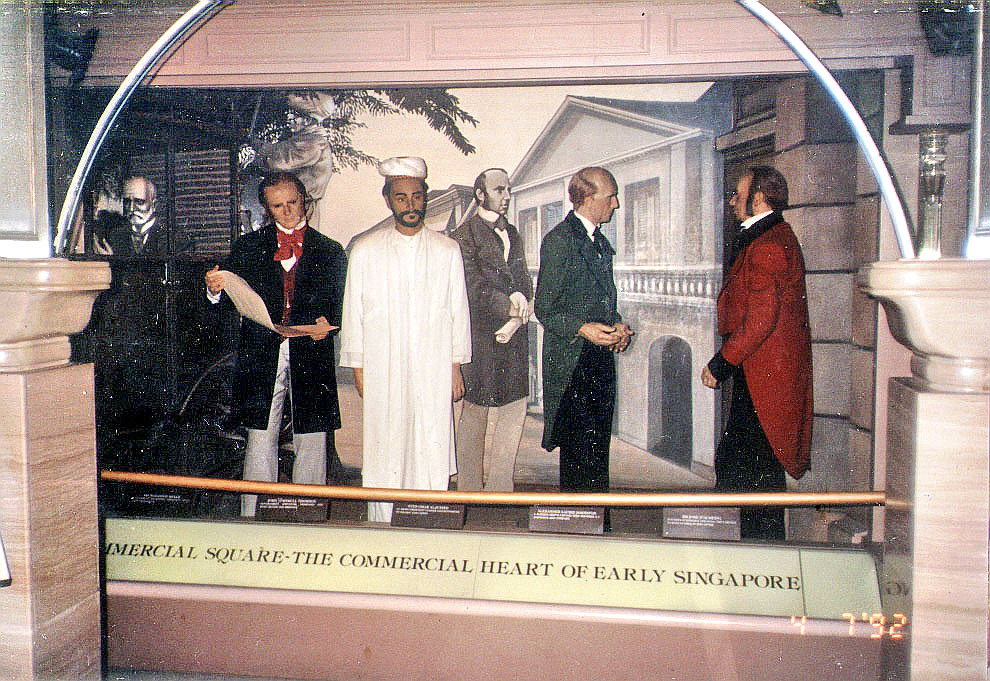
Pioneers of Singapore

The Surrender Chambers, which depicts Singapore during the World War II years (1941-1945), captures the humiliation of defeat and the joy of victory through the use of rare audio and visual archive material such as photographs and footage, with realistic wax works recapturing the historical moments of the signing of both the British’s humiliating surrender on February 15, 1942 and the Japanese surrender to the Allies on September 12, 1945.

In 1994, the Pioneers of Singapore/Surrender Chambers Museum was extended to include a section called Festivals of Singapore and the attraction was rechristened “Images of Singapore.” The popular wax tableau Surrender Chambers has now been relocated, from Sentosa’s Images of Singapore Museum, to Fort Siloso.

Surrender Chambers

AERA Memorial Museum (Villa Escudero Plantation & Resort, San Pablo, Laguna)

Part of day tour package of Villa Escudero Plantation & Resort included admission to the resort’s AERA Memorial Museum which houses the priceless collections of Arsenio and Rosario (nee Adap) Escudero.  Begun on June 29, 1923, it is run by the AERA (acronym of the founders’ names) Memorial Foundation.  It is housed in an exact replica of the beautiful San Francisco Church of Intramuros.  The original church was destroyed by heavy American artillery bombardment on February 3, 1945 during the liberation of Manila and the site is now occupied by Mapua Institute of Technology. 

The pink-colored  building took 10 years to build on a massive 7-ft. thick concrete foundation and has a high 200-sq. ft. ceiling with trompe l’ oeil paintings by Benny Cabezada.  Attached to the ceiling are ten chandeliers copied from an Arte Espanol original.  Its display arrangement was said to have taken 3 years to complete.  Ninety percent of the display is family-owned while the rest were donated or acquired by the foundation.

AERA Memorial Museum

The museum’s collection of religious art is its main attraction.   A wooden bas-relief of the Nuestra Senora de Augustia, donated by my late uncle and National Artist, Arch. Leandro V. Locsin, is located by the massive  ornate door made in 1768.  By the way, cameras and videocams are not allowed.   A kamagongSto. Entierro (glass bier of the Dead Christ, circa 1856) carriage fashioned by noted sculptor, Isabelo Tampingco, was formerly from the Sta. Cruz Church of Manila.  It is adorned with 24 batikuling (a local aromatic softwood) cherubs and was donated by Dona Maria Luisa Quiogue (of the funeral parlor chain).

Other displays include an ivory-headed statue of Virgen Dolorosa from a church in Marinduque, a Pieta by Ireneo Cristobal, rows of ivory-headed santos, a granite Chinese fu dog guarding the staircase, an ornate wrought iron pulpit (raised platform used by a preacher) on the right side of the nave, silver sanctuary lamps, statues of Christ with the Cross on his Second Fall, a statue of Christ embracing a molave Cross, silver main altar acquired from Quiapo parish in the 1960s and a massive retablo (altar backdrop) from Agno (Pangasinan).
       
Its non-religious collection includes a couple of 1,400-year old and 1.5-ft. high Chinese Tsu-Chao jars, 12th and 13th century celadon pottery, tear vials of early Roman aristocrats, gilded carrozas (Spanish carriages), life-size dioramas of ethnic tribes in authentic costumes, ethnic artifacts and clothing, antique furniture, paintings, a numismatic display of obsolete coins and money, U.S. astronaut suits, a Philippine and African beetle collection and an extensive freshwater, terrestrial and marine shell collection (including the rare “Golden Cowrie”). 
       
Next to it are a dioramas of stuffed rare and some already extinct Philippine fauna. The only foreign stuffed animal is a big leopard shot during the 1923 Manila Carnival for attacking and killing a dancer.  It was later bought by the Escuderos and mounted.   A properly identified 22,000-piece butterfly collection is at the ground floor gallery.  A walk through our country’s political history is revealed in the display of inaugural suits and gowns of all the past twelve Philippine presidents and their First Ladies, from Emilio Aguinaldo to Corazon Aquino.  There are also costumes of former beauty queens.  Outside are World War II weapons and relics including tanks and cannons.
       
For me, the most unusual (and grotesque) item in the collection is an amazingly preserved, fist-size shrunken head from the Upper Amazon River Indians of Ecuador.  A trophy of war and bravery, it was acquired from a Swedish collector.  Another unusual item is a pen-and-ink portrait of Christ which was donated by an American couple in 1970 and surrounded by cherubs.  I took a closer look with a magnifying glass and it revealed an actual text of the New Testament, from the first word to the last.  

Villa Escudero Plantation & Resort: San Pablo City, Laguna.  Manila booking office: 1059 Estrada St., Malate, Manila.  Tel: (632) 521-0830, 523-0392 and 523-2944. Website: www.villaescudero.com

Gallery XI – Our Natural Inheritance (National Museum of Natural History, Manila)

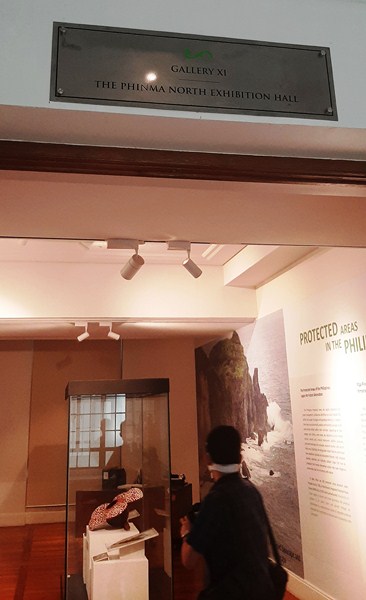
Gallery XI (Our Natural Inheritance)

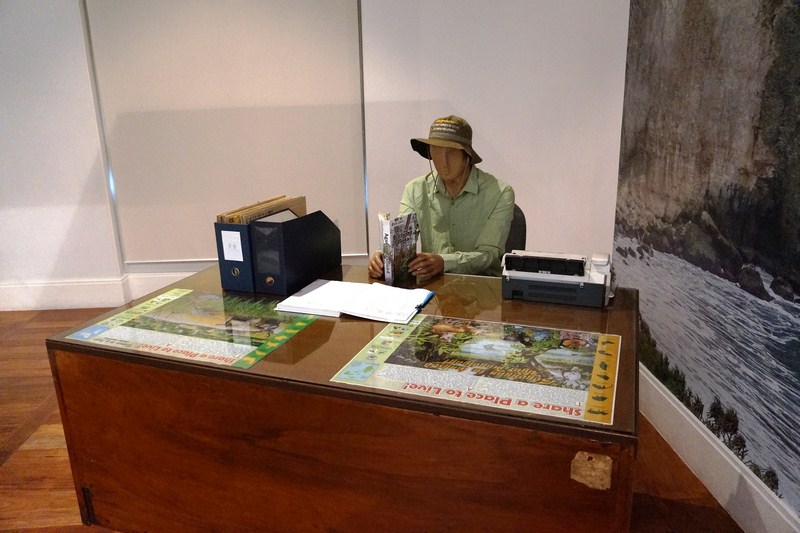
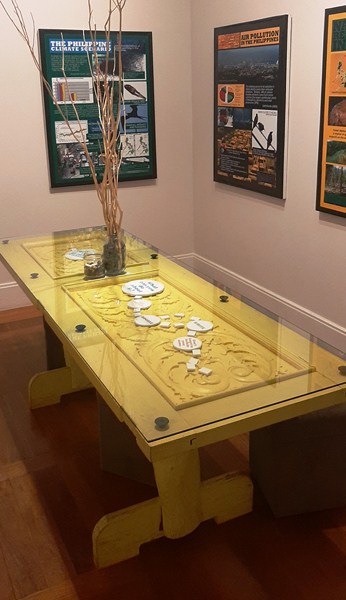
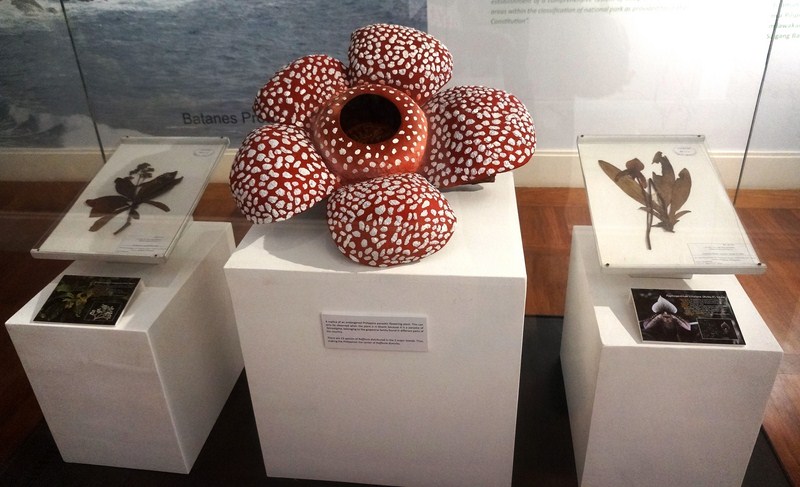
Gallery XI (Our Natural Inheritance) of the National Museum of Natural History, focusing on climate change, is where you can learn various environmental issues that the country has been facing over the years.

Check out “National Museum of Natural History

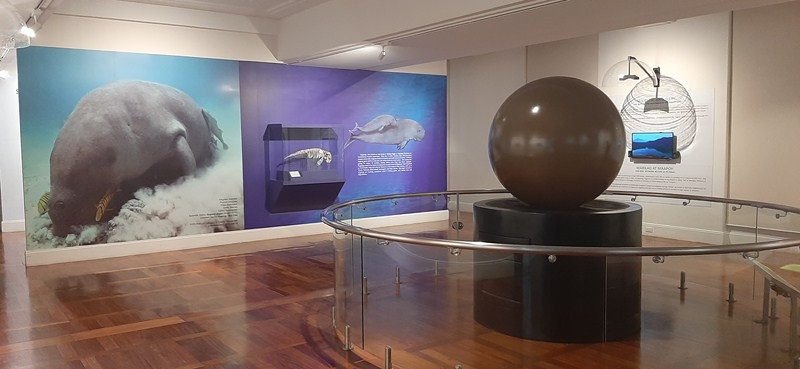
The electronic globe showing the earth’s biosphere

This gallery starts with a five-minute audio-visual presentation of the UNESCO World Heritage Sites in the Philippines that are protected areas in the country with an introduction into the amazing biodiversity of the country.

Sitting at the center of the adjacent room is an electronic globe showing the Earth’s biosphere and some phenomena affecting the Earth’s climate system such as the 1991 eruption of Mt. Pinatubo, the 1997 El Nino phenomenon and the 2004 Indian Ocean earthquake and tsunami.  It animates ocean currents, phytoplankton movements, tsunamis and more.

Around it are audio-visual presentations with state-of-the-art sound domes of some of the country’s flagship species as well as species recently described in the past decade.

Some of the NIPAS Declared Sites

Gallery XI (Our Natural Inheritance): Phinma North Exhibition Hall, 2/F, National Museum of Natural History,  Agrifina Circle in Rizal Park, T.M. Kalaw Street, corner General Luna Street, Manila. Open Tuesdays – Sundays,   9 AM to 12 noon (cut off time is 11 AM) and 1 to 4 PM (cut off time is 3 PM). Tel: 82981100 local 3000 and 85277889.  E-mail:  cmvod@nationalmuseum.ph or inquiry@nationalmuseumph.gov.ph. Visitors shall be limited to 100 per museum per session. Visitors are required to pre-book online at https://reservation.nationalmuseum.gov at least a day before the visit. Confirmation of booking will be sent through email.Group reservations are limited to five (5) persons only.  Walk-in visitors will NOT be accommodated.  Coordinates: 14°34′59.9″N 120°58′55.9″E.