The National Gallery of Art (Manila)

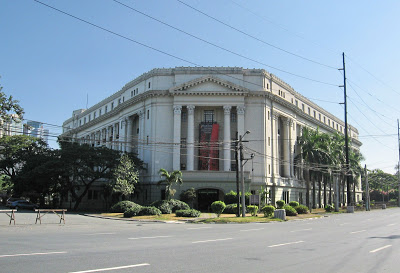
The next day, I continued on my rounds of the National Museum, this time proceeding to the next door National Gallery of Art, housed in the Old Legislative (Congress) Building.  This historic edifice, a magnificent Neo-Classic-inspired structure with stylized Corinthian columns, is a work of art in itself.

It was designed in the Federal style of architecture as a museum/library in 1921 by American architect and Manila and Baguio City planner Daniel H. Burnham and Filipino architect (and later 1973 National Artist) Juan Nakpil.  It functioned as a museum/library until 1935 when it was made the legislative seat of the Philippine Commonwealth.

This grand, earthquake-proof edifice, was, however, reduced to rubble during the Liberation of Manila.  After the war, the building was rehabilitated with Ralph Doane and Antonio Toledo as architects in charge for its construction and extensive renovation.  A fourth floor was added.

After the declaration of martial law on September 21, 1972, Congress was abolished and the building was closed.  After years of neglect, the building was restored to its former glory as the Executive House, Office of the Vice-President, Philippine Senate and finally as the permanent home of the National Gallery of Art.  It was formally inaugurated as such on October 18, 2001, during the National Museum’s centennial.

The museum’s ground and fourth floors houses offices, laboratories and storage.  The second floor houses art exhibits while the third floor has a seminar hall and two major halls, also airconditioned, for science exhibits.   Today, the National Gallery of Art has amassed a collection of 1,204 visual art pieces, most of which are paintings housed in three major halls and three smaller halls at the second floor, all airconditioned.  A session hall, for formal lectures and concerts, has just been refurbished.

The National Gallery of Art
The star attraction of the National Gallery of Art is the Juan Luan Hall facing the front entrance lobby of the second floor.  It houses the Juan Luna Collection, a September 19, 1990 bequest of the now defunct Far East Bank and Trust Company.  Inside are 162 oil paintings (on canvas, panelboard and wood panels) and charcoal sketches of foremost Filipino master painter Juan Luna y Novicio (October 23, 1857-December 7, 1899) as well as Andres Luna de San Pedro (1887-1952).   

The remarkable Juan Luna studied and perfected his craft by living in the art capitals of the world: Rome (Italy), Paris (France) and Madrid (Spain).  In Spain, he was commissioned by the Spanish Senate and King Alfonso XII to paint El Batalla de Lepanto (The Battle of Lepanto) which now hangs at the halls of the Spanish Senate.

Another work, La Muerte de Cleopatra (Death of Cleopatra), won the silver medal at the 1881 Exposicion General de Bellas Artes in Madrid, Spain. His last major work, Peuple et Rois (People and Kings), completed in 1889, was acclaimed as the best entry in the 1904 St. Louis Exposition.  Unfortunately, it was destroyed by fire during World War II.  But these were not his greatest obra maestras.

Juan Luna’s Spoliarium
Populating a whole wall in the gallery is Luna’s famous and awesome (425 cm. x 775 cm.) mural masterpiece Spoliarium which won the first gold medal (grande prix) awarded by the elitist Salon des Beaux Arts during the 1884 Exposicion General de Bellas Artes in Madrid, Spain.  Luna, upon the instigation of Francisco de Paula Redoreda, painted this colossal multi-figure mural depicting a scene of dead gladiators being mourned by relatives. 

Rendered in frenzied fin de siecle brushstrokes, it was identified by Jose Rizal as an allusion to the exploitation of the country by Spain.  This art achievement underscored the ability of Filipinos to compete with Europeans at their backcourt and it was also a subtle affirmation of the Filipino’s capability to run affairs back home.

The Art Donations to the National Museum Hall displays notable donated art pieces by rising stars Emilio Aguilar-Cruz, Lex Cachapero, Elizabeth Chan, Papo de Asis, Jaime de Guzman, Gene de Loyola, Josie de Ocampo, Zozimo Dimaano, Miguel Galvez, Elmer Gernale, Ang Kiukok, Gregorio Lim, Hernando R. Ocampo, Joaquin Palencia, Al Perez, Jonathan Pulido, Carlos P. Valino and Roy Veneracion.

A retablo at the Religious Art Hall

The Religious Art Hall houses Spanish-era statues of saints, paintings and retablosRetablos are intricately carved and decorated altar pieces which are often gilded, polychromed and embellished with rosettes, scrolls, Solomonic columns and cherubs. On display are a huge retablo from Leyte (late 18th century) and another smaller one from Dimiao (Bohol).

The oldest painting in the collection is the unsigned, circa 1800 oil on wood painting Coronation of the Virgin.  Another hall houses the still ongoing Centennial Celebration of Wood & Form by Jerusalino “Jerry” Araos which was opened last October 24, 2001.

The Colonial Art Hall houses oil paintings on canvas and wood as well as pencils sketches of genre scenes, typical landscapes known as pasajes, still life as well as portraits done by prominent Spanish and American-era Filipino painters.

The most noteworthy is Juan Luna contemporary Felix Resurreccion Hidalgo (1855-1913) who won the second prize for Virgenes Cristianas Espuestas al Populacho in the same Madrid competition won by Juan Luna’s Spoliarium .   His teacher (as well as Juan Luna’s), Lorenzo Guerrero (November 4, 1835 to April 8, 1904), is a painter of religious and native landscapes. Gaston O’Farrell (1879 to 1942), on the other hand, was a student of Juan Luna.

Fabian de la Rosa (May 5, 1868 to December 14, 1937) is famous for his painting Planting Rice which won in the 1904 St. Louis Exposition.   Rafael Enriquez (July 1, 1850 to May 5, 1937) was the first director of the U.P. College of Fine Arts.  Prominently displayed at the center of the gallery is a terra-cotta bust of Gov. Ricardo Carnicero done by National hero Dr. Jose Rizal in 1892.

The Colonial Art Hall

The Old and Contemporary Figurative Art Hall houses works done by seven of the country’s National Artists as well as other noted artists.  These National Artists are painters Fernando Amorsolo (1892 to 1972), Victorio Edades (1895 to 1985), Carlos V. “Botong” Francisco (1913 to 1969), Cesar Legaspi (1917 to 1994) and Vicente S. Manansala (1910 to 1981), and sculptors Napoleon V. Abueva and Guillermo Tolentino.  They consist of oil paintings done on canvas or wood, pastel on paper and charcoal on paper as well as sculptures.

The Zoology Division, born in 1901, is one of the oldest pillars of the National Museum.  Their exhibits are both interesting and captivating, providing a true-to-life showcase of our rich and diverse Philippine fauna.

The country is home to 172 terrestrial mammals, 351 reptiles and amphibians, 573 birds and 1400 butterflies.  Of the 1,236 species known to occur in the country, 512 are endemic.  As the Department of Tourism Building hasn’t been officially turned over to the National Museum, the zoological displays are still confined at the National Gallery of Art.

The Philippine Terrestial Fauna at the third floor was opened last October 30, 2001 with the theme “Ride the Green Wave.”  It features a walk-in diorama of preserved and mounted endangered specimens in their simulated habitats.   They include the Mindoro dwarf water buffalo or tamaraw, scaly anteater or tangiling, Palawan bearcat or binturong, Philippine brown deer or usa, mouse deer or pilanduk and Gray’s monitor lizard or butaan.

Birds include the critically endangered Philippine eagle or haribon (our national bird), rufous hornbill or kalaw, black-naped oriole or tulihao/kilyawan, grey-headed fish eagle and the pink-bellied imperial pigeon.  Mounted in glass cases on the walls are various insects like butterflies, moths, beetles, grasshoppers, locust, bugs, ants, wasps, bees, crickets and cicadas.

Also on display are a glass enclosure of a termite colony plus another of anthropods of a more pesky nature but still of medical importance: dog louse (garapata), sucking lice (lisa), human lice (kuto), bedbug (surot) and the mosquito (lamok).

The Bones from Prehistoric Times to the Present

The Bones from Prehistoric Times to the Present Exhibit, an exhibit with a lot of stories to tell, is also located on the third floor.  It was opened last October 10, 2001.  On display are skeletons of man, mammals, frogs, birds, fishes, snakes, dolphins and sharks (entered through a bite-size portal surrounded by huge shark teeth).

There are also fossilized specimens of a stegodon (Stegodon sp.) tusk found at the Espinosa tusk site in Solana (Cagayan), an Elephas sp. molar, a Rhinoceros philippensis mandible with teeth and a giant tortoise (Gechelone sp.) limb bones and claw. There are also bone awls and ivory seals from the Ambangan site (Butuan City, Agusan del Norte) and Stone Age tools and knives.

Also noteworthy, as a shining example of the Filipino’s oftentimes wildly fertile imagination, are the remains of a basking shark found near the shores of Burias Island (Masbate).  It was mistakenly identified as those of a Loch Ness-type monster or dinosaur, and presented as such in sensational Jurassic stories featured by the Philippine Star (February 24, 1997) and the Pilipino Star Ngayon (March 1, 1997).

The exhibit’s star attraction, however, is a huge, complete and centrally displayed skeleton of a sperm whale (Physeter catodon).  A “must see” for medical detectives and forensic scientists, this whale skeleton has a tale to tell.

It is not a whodunit tale but rather a “who didn’t do it” story of extreme pain as this specific specimen suffered from osteoarthritis as shown by an extra bone along the margin of the articular surface of vertebra no. 24 and 25.  It also had a fractured rib.  However, this was not the smoking gun that killed the whale because signs of healing are seen on several broken ribs.

National Gallery of Art: National Gallery of Art Bldg., cor. Taft and P. Burgos Ave., Manila.  Tel: (632) 527-0278 and 527-1215.   Fax: (632) 527-0306. Open 10 AM-4:30 PM.  Admission is free.  Website: www.nationalmuseum.gov.ph.

Museum of the Filipino People (Manila)

After a 20-year hiatus, I returned to my old training ground (the National Museum was my college thesis) to see for myself how the rehabilitated National Museum was faring and to write an article about it.    I sought the assistance of Ms. Francis Caberoy (Assistant Chief of the Museum Education Division) and Ms. Phoebe Espinas (Information Officer 3), before I was given the necessary passes and permits to photograph.

Museum of the Filipino People

Housed in the former Finance Building, this museum was the second building pledged to the National Museum.  As a cultural center, it takes the lead in the study and preservation of the nation’s rich artistic, historical and cultural heritage in the reconstruction and rebuilding of our nation’s past.

The impressive, Neo-Classic-influenced, 5-storey Finance Building was built in 1940 on the same Federal architectural style concept of American architect and Manila and Baguio City planner Daniel H. Burnham.  Its construction was implemented by Arch. Antonio Toledo of the Bureau of Public Works.  He was responsible for the construction of Manila government structures under the American colonial regime.

Trapezoidal in plan, its planning called for a vast extensive system of parks and walkways with views of Manila Bay.  The building was barely finished when World War II broke out on December 7, 1941.  During the Liberation of Manila, the building, because of its strategic location, became a Japanese stronghold that was intensely bombarded by the Americans.  Its recapture on March 3, 1945 actually marked the end of the Battle of Manila. After the war, the building was rebuilt by the company of A.M. Oreta.  Half a century later, during the centennial celebration of Philippine independence, the building was refurbished and inaugurated to house the Museum of the Filipino People.

The building has approximately 7,000 sq. m. of display area and it houses anthropology, archaeology and history collections.  At the ground level are the Gallery of the “Best of Philippine Art,” four seminar rooms (Cabinet Ladies Foundation, Nestle Philippines, SGV & Co. and the SSS) and the Pamana Museum Shop, a souvenir shop.  At the open court is an actual Ifugao House (Fhaley Ad Henenga) from Mayoyao presented by Petron Corporation.

The “Treasures of the San Diego are  are displayed at the 4 seminar rooms at the ground floor (Cabinet Ladies Foundation, Nestle Philippines, SGV & Co. and the SSS) and at Asianbank Corp./A. Soriano Corp./Phinma Group Gallery at the second floor.    The San Diego’s 5,000 artifacts on display represent a time capsule of the known world at that time.  Its recovery confirmed the Philippines’ reputation as a rich ground for underwater archaeology.  And why not?  Records show that 59 galleons alone sank in Philippine waters.  Of this total, only three – the Nuestra Senora de la Vida, the San Jose and now, the San Diego, have so far been retrieved.

The Treasures of the San Diego

Navigational instruments recovered from the San Diego are a major scientific find as they represent a much delayed, but altogether appropriate, reply to Chinese inventions such as the compass, an 11th century Chinese innovation.

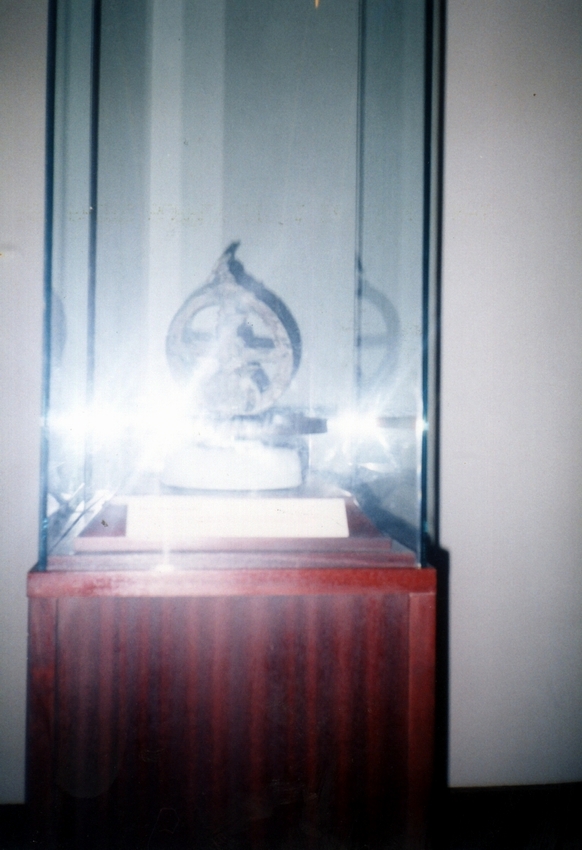
One of the most important treasures recovered from the San Diego is an old astrolabe, one of only 67 that have been preserved and, more uniquely, 1 of 5 oldest as well as 1 of 6 or 7 known examples dating before 1600.  As one authority exclaimed, “the entire cost of the whole expedition was worth that one piece of nautical antiquity.”

Called the oldest scientific instrument in the world, the astrolabe is used to determine latitude accurately by measuring the angle a heavenly body (sun or stars) makes with the horizon. It is derived from the planispheric astrolabe invented by Greek mathematicians in ancient Alexandria (Egypt).

The San Diego astrolabe

The astrolabe appeared in Europe in the late fifteenth century, first used in Portugal and adapted by nearly all Western mariners.  The San Diego astrolabe weighed 2,434 gms. had a diameter of 182.5 mm. and was 17 mm. thick at the top and 18 mm. at the bottom.

The absence of a date and signature on makes it impossible to determine the astrolabe’s geographic origin or date of manufacture.  The instrument, however, bears a remarkable resemblance to the Valencia astrolabe at England’s Greenwich Maritime Museum (which almost certainly came from the Spanish Armada).  The only difference is that its spokes have footers and no handles.  Its similarities lead us to believe that they were made in the same workshop.

Another important discovery was an astronomical ring, the only known example of this type, in terms of both mechanism and shape.  Its exact function has not been determined; although it is known that the position of the Philippines on the map was calculated using a similar instrument.

A compass was also recovered with its glass intact and the original liquid still present inside the glass casing.  Other navigational instruments recovered include sounding weights and a ruler which were more suitable for reading charts and navigating in coastal waters than for open ocean voyages.

Model of the San Diego

According to the ships inventory list, the San Diego brought 14 cannon from the fortress of Manila.  They were outstanding examples of bronze casting techniques and gave an excellent overview of artillery at the end of the 16th century.  Of the 14, 7 are dolphin-types (with handles shaped like dolphins), 2 are foot-types, 1 lion-type, 1 box-type and 2 are unidentified.  Their maximum lengths range from 208 to 359 cms., their mouth diameters range from 14.5 to 27.5 cms. and their bore diameters range from 7 to 18 cms.. They were fabricated in the Philippines, Flanders (Netherlands) and Portugal.

The cannons from Portugal were more advanced and were called breech loaders.  Eleven of the cannon are displayed at the museum’s ground floor and the rest at the second floor. There were 8 grades of caliber which required different types of ammunition.  There were 197 cannonballs recovered.  The iron cannonballs were for the smaller cannons and the stone for the bigger ones.  The cannonballs range from 6.5 to 14 cms. in diameter and weighed between one and 7 kgs..

Aside from the cannons, little remains of ship’s offensive weaponry:  arquebuses, muskets and swords.  Arquebus spring shots (lead, brass or iron wire) range from 0.4 to 3.5 cms. in diameter.  Also found were a gunpowder shovel and cases for musket shot made of lead that were attached together by brass coil.  A glimpse of the soldier’s outfit came from 3 morions (military helmets of copper alloy), pieces of armor (shoulder and neck armor, breastplate), sword handles, belts and shoe buckles.  Also a ball mold to press musket and arquebus balls was found.

The possibility of high ranking Japanese samurai (possibly mercenaries) on board the ship can be seen from a pair of recovered Japanese bushi swords, 2 dozen sword decorative elements, a writing set with a rare aubergine (fruit of the eggplant)-shaped porcelain water dropper and two stones for mixing ink.

Cannons of the San Diego

It must be remembered that the San Diego was a galleon (trading ship) before she was pressed into service as a battleship by Antonio de Morga.  As preparations were being rushed to meet the Dutch, there had been no time to unload the bulky porcelain cargo in the main hold and these all went down with the ship.  To the Western world, Chinese porcelain seems to be the most accurate reflection of China and it was an important part of trade in Manila.

The San Diego carried a cargo of assorted ceramic objects that survived in a much better condition than the metal objects. A majority of the recovered ceramic ware was intact and many pieces were restorable.  They include a precious cargo of more than 500 fine, exceptionally strong, blue and white China porcelain. They date from the Wan Li Period (1573 to 1619) of the Ming Dynasty (1368 to 1644) and come in the form of plates, dishes, bottles and kendis (pitchers).  This special class of pottery is made from kaolin from Jiangxi, near the city of Jingdezhen in China.  Their white background is decorated principally with cobalt oxide and applied with a brush under a glaze.

It is believed that the San Diego also carried over 750 Chinese, Thai, Burmese and Spanish or Mexican stoneware jars to store food, water and cargo as well as serve as ballast.  They date from the sixteenth century and many have applied handles where a rope could be strung to secure and protect them from breaking.  Animal bones from preserved meats as well as coconut shells and seed (prunes and chestnuts) remains have been found inside the jars.

There are also over 70 Philippine-made amphora-like earthenware jars influenced by European stylistic forms and types. They were originally used to transport olives and oil, but they also have been used to hold wine, preserved fruit or the tar used to caulk the ship.  Their capacity varied from 4 to 15 liters (4.2 to 15.9 quarts) and they weighed between 3 and 9 kgs. (6.6 to 19.8 lbs.).

Many recovered artifacts provide fascinating insights of life on board a galleon.  Recovered were a piece of rope made of Manila hemp; a wooden pulley; writing implements (3 inkstands, 2 powder cans with powder used to dry the ink, a metal pen, etc.); a silver candle snuffer; a bronze candlestick; ivory and wood chessmen; locks; keys; a well-preserved wood pole with a hammock tied to it; a hammer; a glass plate with wooden frame (probably from the captain’s cabin); barber’s kit (2 razors, various weights, remains of a beam balance); and a block of hardened resin that was noted, in historical accounts, to have been used in caulking and for making fire in stoves. Also recovered were two coral-encrusted iron anchors.

A meager haul of 8 gold artifacts was also recovered.  They provide a rare look at ornaments of 16th century Philippines and, ultimately, an insight into the Spanish and Filipinos of that time.  One of the artifacts is an Asian coin while the rest are articles of personal adornment or functional objects crafted in gold: a neck ring of gold wire with scrolled clasp; a 78-inch long, multiple loop-in-loop necklace woven with fine gold wire; a dress ornament; a book clasp with pin for girdle prayer book; a ring with granulation; an oval document seal cap of Morga (which “seals” the positive identification of the wreck); and a rosary with ivory beads and crucifix and chain of gold wire.  None were stamped or hallmarked.

The rosary, girdle prayer book and the ring may have been made for women.  Were there women on board the San Diego? Initial studies on human bones recovered from the site indicate that some of them may have been females.  Or were they good luck keepsakes given by shore-bound lovers?  God only knows.

A total of 428 sixteenth century silver coins, as well as six small and one big cluster of cemented coins, were recovered.  Most are of uneven roundness and flatness and its markings and designs are unclear.  Struck the year before its sinking (either in Mexico or Potosi), the majority are 1, 2, 4 and 8 reales of American origin, an indication of the lively trade between New Spain (Mexico) and the Philippines.

The “Best of Philippine Art” Gallery houses selected art pieces from the National Museum Collection.  They include 3 Juan Lunas, 3 Hidalgos, works of 6 National Artists (Napoleon Abueva, Fernando Amorsolo, Victorio Edades, Carlos V. “Botong” Francisco, Cesar Legaspi and Vicente Manansala), a bronze (Mother’s Revenge) and terra cotta (El Ermitanio) sculpture by Jose Rizal, other sculptures in glass (Ramon Orlina), adobe (Abueva), bronze (Abdulmari Imao, Solomon Saprid) and wood (Abueva, Jose Alcantara, Graciano Nepomuceno) plus paintings by other noted masters.

Best of Philippine Art

Before the coming of the Spaniards, merchant vessels were already sailing through Southeast Asia, charting new routes for trade and commerce and venturing into the unknown.  The Exhibit on “Five Centuries of Maritime Trade,” at the museum’s second level, reaffirms this active interchange that existed among peoples of the region.  On display are artifacts recovered from sunken Chinese merchant junks at five wreck sites.     The blue and white Ming Dynasty chinaware from the San Isidro Wreck Site were recovered at 50-m. deep waters off the coast of Zambales.

The Lena Shoal artifacts, numbering 5,000 pieces, date from the 15th to early 16th century and were excavated in 1997 at the north of Palawan.  They include elephant tusks, small bronze cannons and greenware (celadon), 2,183 of which were recovered whole, 213 slightly damaged and 1,501 heavily damaged.

The pre-colonial Pandanan artifacts, recovered in 1993 off Pandanan Island in Southern Palawan, date from the Long Ye Period (1403-24) as seen from a Chinese copper coin recovered.  They consist of 4,722 pieces (80% of which were intact) recovered after 947 dives totaling 1,044 hours.

The Investigator Shoal artifacts, dating from the 12th-13th century, were found under three to four-meter deep waters in a coral environment.   It had a cargo of greenware and quingbai in the form of cups, saucers, bowls and plates.  The junk was probably used for the illicit trade of smuggling as 54 kgs. of bronze bracelets were hidden in a large jar under a layer of tea.

The Breaker Reef artifacts, mostly copper items, date from the late 11th to early 12th century (1004-1100) and were found off the western shore, halfway along an island on a reef known as “Breaker” in Northwest Palawan.

The museum’s main attraction is the “Story of the Filipino People,” a permanent, 1,600-sq. m. exhibit located at the third floor.  It provides a thematic “story-telling display” of the museum’s anthropology and archaeology collections.  Anthropology deals with the study of the structure and evolution of humans as animals while archaeology deals with the study of human history and prehistory through excavation of sites and analysis of physical remains. The triumphant partnership between Filipino and foreign researchers has reaped dividends for Philippine archaeology.

On March 28, 1962, American Dr. Robert B. Fox (National Museum Anthropology Division Head) and Manuel Ma. Santiago (also of the National Museum), discovered the fossilized Pleistocene skullcap of the “Tabon Man” (actually a woman’s) in Tabon Caves in Quezon (Palawan).  It was carbon-dated to be between 22,000 to 24,000 years, the oldest known habitation site and trace of man in Southeast Asia.

The archaeological excavations in two of the three limestone caves of Bato Caves in Brgy. Bato in 1959, also by Dr. Robert Fox, have unearthed Late Neolithic artifacts dated to 100 B.C. such as stone tools, blades, bowls, drinking cups, burial jars, strung shell beads and nautilus shell spoons.

Another extensive archaeological project was the discovery in Calatagan (Batangas) of over 500 pre-Hispanic (late 14th-early 16th century) Tagalog grave sites yielding coins, glass beads, metal ornaments (including some with gold leaf covering), bracelets, native pottery (including some with syllabic inscriptions), statuary and weapons.  The discovery of 1,135 pieces of Chinese Ming Dynasty, Annamese and Siamese porcelain and stoneware indicated pre-Hispanic trade with neighboring Asian nations

The Manunggul Jar

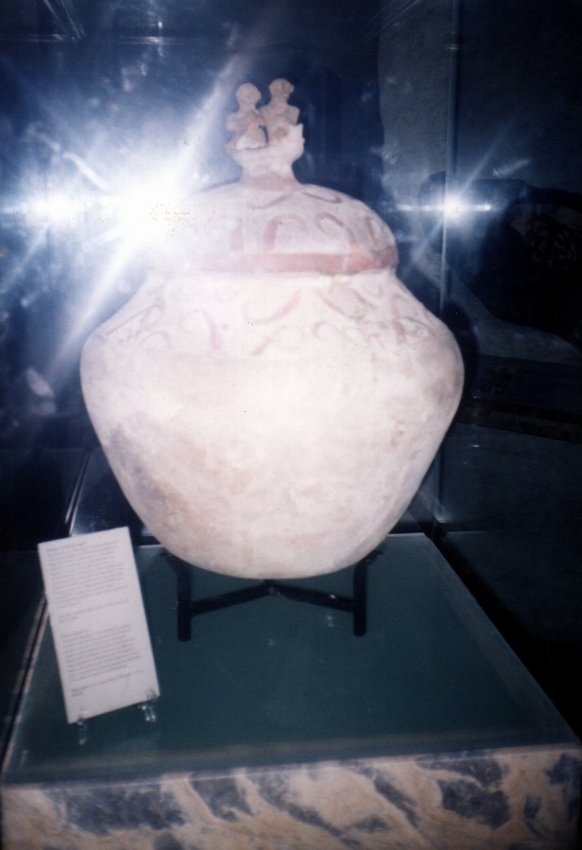
The splendid Manunggul Jar, a late Neolithic secondary burial jar (dated 890 to 710 B.C.), was found in Palawan’s Manunggul Cave.  This painted, incised jar has impressed decoration on its lid, on top of which is a unusually compelling finial of 2 small round-eyed human figures representing souls paddling to the afterworld on a death boat.  The branched-curl designs at the upper portion of the jar had been dabbed with hematic. The jar was found along with other highly developed earthenware burial jars and relics including bone fossils of at least 3 other individuals, pebble flake tools from the Late Pleistocene and early post-Pleistocene Period, deer bones, Sung and Yuan Dynasty porcelain and stoneware, spoons and other utensils.

The Bolinao skull of gold was recovered from the excavation of a 13th and 14th-century burial cave at the mouth of the Balingasay River in Brgy. Balingasay, 6 kms. south of Bolinao in Pangasinan.  It indicated a rich and flourishing early culture as seen from remarkable fish-scale patterned gold embedded in skull teeth, earrings, necklaces, gold bracelets as well as Tang, Sung and Ming dynasty porcelain. However, most of the valuable pieces have been spirited away by antique collectors and treasure hunters for their private collections.

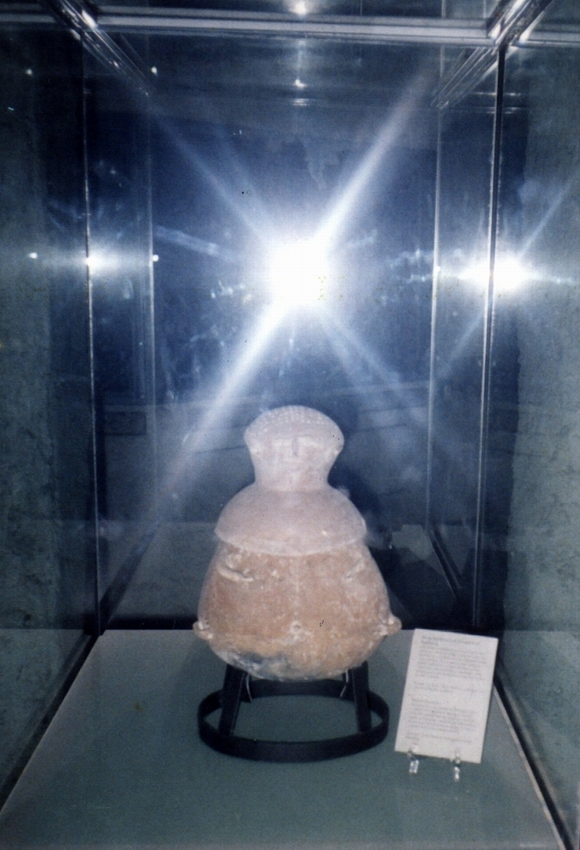
Maitum Anthropomorphic Pottery

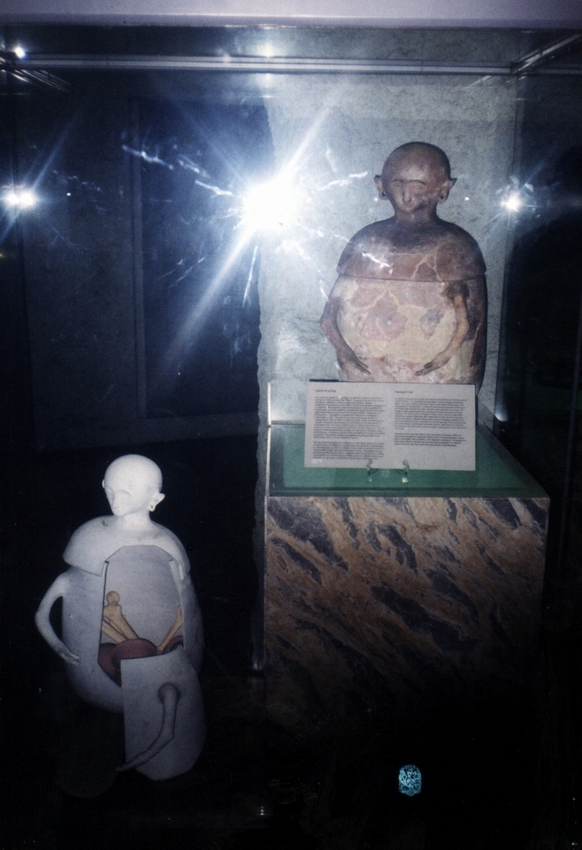
The Maitum Anthropomorphic potteries found in Ayub Caves in Brgy. Pinol in Maitum (Saranggani) are large earthenware jars sculpted to represent humans.  Dated to approximately 5 BC to 370 AD, they are characteristic of the Metal Age.

Maitum Anthropomorphic Pottery

The Banton relics were found at the Hanging Cemetery, a cliffside burial cave located a short distance from Banton town (Romblon).  It contained 17 small hollowed hardwood log coffins dating from the 14th-15th centuries which indicate that early inhabitants practiced secondary burial.  Also found were skulls, two burial jars and pieces of Chinese and Siamese tradeware.

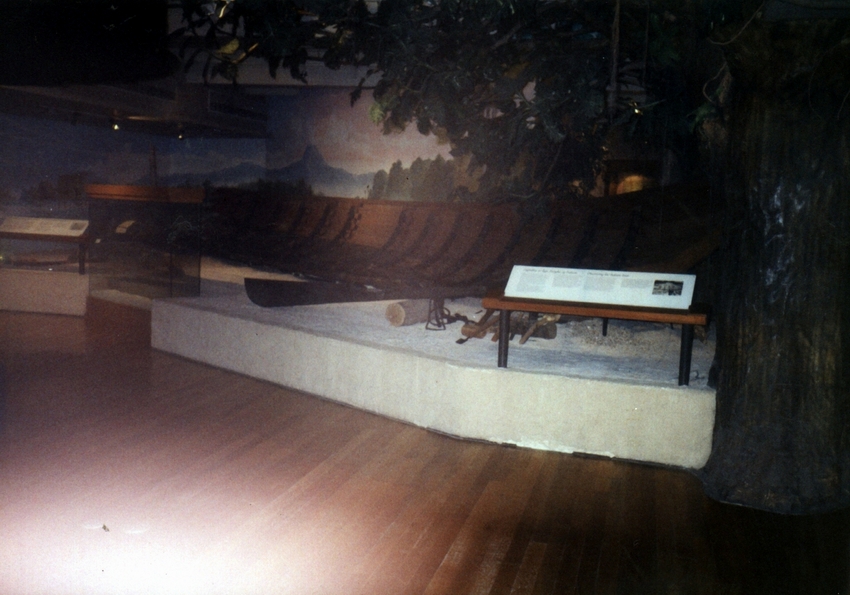
Another milestone in Philippine prehistory and archaeology was the discovery in 1976, by pot hunters in search of Chinese ceramics, of nine balanghai boats at Brgy. Ambangan in Butuan City, Agusan del Norte.   When news of its discovery reached the National Museum, 8 of its water-logged timber boats were excavated.  One of these boats has been preserved and reconstructed for public display at the museum.

These large sea-going wooden plank-built and edge-pegged outrigger boats are 15 m. long and 3 m. wide across the beam.  Carbon-14 dating indicates it belongs to the 4th and 13th to 14th century AD. The oldest was dated to 320 AD by Tokyo’s Gakushuin University.  Two others were dated to 990 and 1250 AD. These predate the relics of Viking ships in European museums and they represent the oldest fleet of boats excavated in one place.

Balanghai boat

Other star archaeological exhibits of the museum are the limestone urns of Kulaman Plateau (Cotabato), the gold mask and nose shield of Oton (Iloilo), Duyong Cave excavation (Palawan), the Laguna copperplate inscription, musical instruments, fishing, farming and kitchen implements, Ifugao bul-ols, Maranao Art and sample writings of the Hanuno Mangayan and Pala’wan tribes.

These veritable goldmine of interesting pre-history discoveries are displayed at the “Kaban ng Lahi Archaeological Treasures” at the Don Vicente Madrigal Gallery, “Origins” at the Cabinet Ladies Foundation Gallery and “The Filipinos Today” at the Meralco Lopez Group of Companies Gallery, all at the 3rd floor.

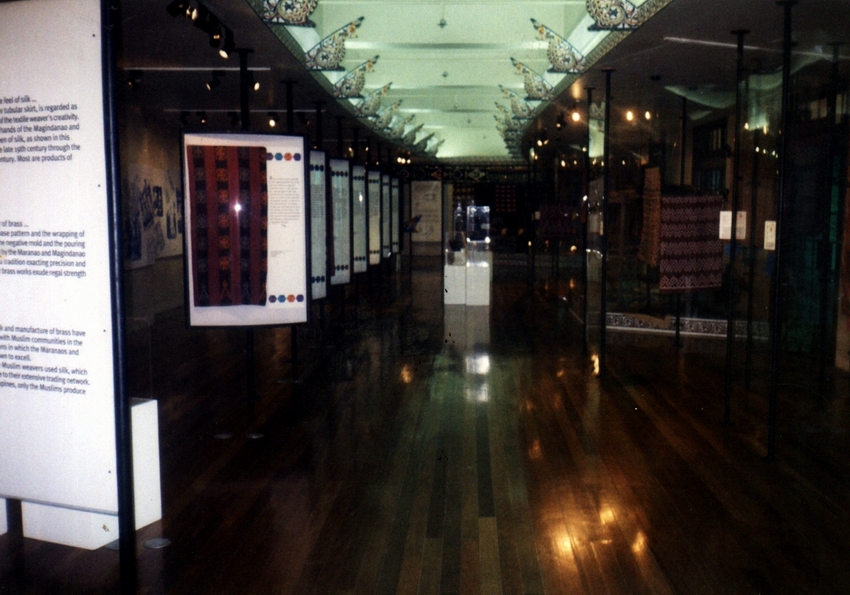
The “Silk and Brass: Highlights of the Datu Matsura Collection,” at the 4th level, showcases the creativity of the Maguindanao and Maranao textile silk weavers and brass artisans.  On display are various malong cloth and a pedal frame loom known as irwan.  Brass items include bells, a sword (kris), pitcher (kendi) and a ladle (sakdo).

A brass frog, used as a container for tobacco or money, signified the high position, power and authority held by Datu Michael Matsura, a direct descendant of Sultan Kudarat, in Maguindanao society. Prominently displayed at the corner, opposite the exit, is a lavish platform-type bed with a canopy found in a torrogan, the sultan’s residence.

The “Cloth Traditions,” at the  4th level Metrobank Foundation Textile Gallery, displays different types of clothing materials made from calado and sombrado needlework techniques, bark beating (to produce bark cloth) and reserved dying tradition.  The latter is called Bedbed or Budbud and refers to the process known elsewhere by the Indonesian terms ikatplangi or tritik.   At the entrance is a glass case with the remains of a Banton cloth death shroud, a warp-dyed ikat cloth found enshrouding the remains of a person in a wooden coffin in a 400-year old grave site in Banton Island (Romblon).

At the end of the gallery are a display of clothes worn by Bukidnons, B’laans and Ubos of Mindanao as well as abaca clothes, all from the early 20th century collections of John M. Garvan, O.V. Wood, Dean Conant Worcester, Robert B. Fox and Harold C. Conklin.  Some were exhibited at the 1904 St. Louis Exhibition and subsequently returned to the National Museum.

The “Mga Hinabing Panaginip” Exhibit, also at the 4th level, features the long and tedious t’nalak weaving of the T’boli weavers.  T’nalak, made of the whitest abaca and dyed red and blackest brown, are used in rituals and are considered works of art.  Its patterns, bestowed on the weaver by Fu Daku, the spirit of the abaca, are handed from mother to daughter.

Felipe Agoncillo Mansion and Monument (Taal, Batangas)

Later, accompanied by the HME Embroidery Store caretaker, Jandy and I crossed the street to the 2-storey Felipe Agoncillo Mansion and Monument, birthplace of Felipe Agoncillo, the husband of Marcela  who was appointed by Pres. Emilio Aguinaldo as ambassador to the U.S. to campaign for recognition of Philippine independence.  He is considered as the first Philippine diplomat.  In the well-manicured front garden is a prominent brass statue of Felipe.

Felipe Agoncillo Mansion and Monument

Known as the White House, this mansion is also known as the Don Gregorio R. Agoncillo (nephew of Felipe) Museum and is now a National Historical Landmark.  As we were accompanied by the store caretaker, we were allowed passage.  On the second floor are Edwardian and Spanish-inspired antique, 1800s to early 1900s furniture and choice period items plus busts of the Agoncillo ancestors.

Agoncillo Mansion dining room
Felipe Agoncillo Mansion and Monument: J.P. Rizal St., Brgy. Poblacion 13, Taal, Batangas

Leon C. Apacible Museum and Library (Taal, Batangas)

Returning to our car, I drove further up the street, across Taal National High School, to the Leon C. Apacible Museum and Library, ancestral house of Leon and Matilde Apacible.  Leon Apacible, son of Don Vicente Apacible and Catalina Castillo, was Gen. Emilio Aguinaldo‘s finance officer and was a delegate to the Revolutionary Malolos Congress of 1898.  This extremely well-preserved bahay na bato home to 4 generations of Apacibles, was remodeled twice, in 1870 and from 1938-40.  It was recognized as a National Historical Landmark and was donated to the government on December 6, 1976 by former town mayor (1975-80) Mrs. Corazon Apacible Caniza, daughter of Leon Apacible, Jr. and Consolacion Noble.  It is now managed by the National Historical Institute with Mrs. Annie Marie Moreno as curator. 

Leon Apacible Museum and Library
Upon entering the house’s foyer, the first thing you would notice is a karitela (horse carriage) restored by the NHI on August 1992.  We were toured by Mr. Oprenilo Canoza.  Below the stairs are displays of old documents, faded photos, a chart showing the family’s genealogy and a 400-year old gallinera said to have been used as a coop for the master’s (and his friend’s) fighting cocks. Upstairs we were shown the house’s extremely well-preserved American Art-Deco interiors with details carved and inlaid into the floor and door trims.  Display cases exhibit the hand-painted fans of Dona Matilde, lace veils, the fans of Corazon when she was five years old, embroidered camisa blouses, and the children’s clothes she wore.

On display at the dining room are blue and white Ming Dynasty Chinese pottery, gilded Florentine wine decanters and a gilt-edged and hand-painted Venetian dinner service. The kitchen, which is still being used by the adjoining house of Mrs. Caniza, is closed to the public.  The family collection of fine antique furniture includes an 18th century hand-carved mahogany divan.  Inside the 2 bedrooms are 19th century vanity tables adorned with 4 oval mirrors inlaid with a hundred tiny circular mirrors; a beautiful carved wooden cabinet with two big mirrors; an early 19th century mahogany cabinet with 3 big mirrored doors;  an 18th century writing desk; a massive escritorio displaying Dr. Galicano Apacible’s 19th century medical equipment and 4-poster beds.   A piano, made in 1870 by M.F. Rachals of Hamburg, Germany, still works.  On the ceiling above the stairs is an 18th century chandelier.   There are also a 16th century statue of the Virgin of the Holy Rosary and 17th century ivory santos.

On the enresuelo (ground floor) are old documents showing Don Leon’s involvement in the revolutionary movement; a 1880 laminated photo of 16-year old Jose Rizal, Don Leon and younger brother Don Galicano as members of Intramuros’ Artist Club; pictures of Don Leon and his family and paintings of the Don Leon’s ancestors.   Underneath the azotea (court garden) is the aljibe (cistern) where rainwater is stored. Also on display are an old cannon, a stone water purifier, horse and cow brands, rice and corn grinders and other artifacts.  

Leon Apacible Museum and Library: M.M. Agoncillo St., Brgy. Poblacion 4, Taal, Batangas.  Open daily, 8 AM-5 PM. Admission is free. 

Marcela M. Agoncillo Museum and Monument (Taal, Batangas)

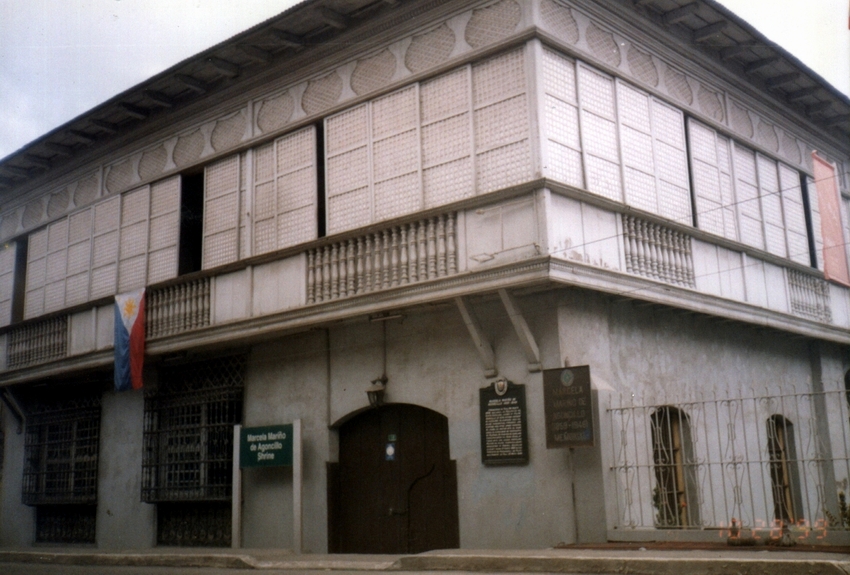
The first ancestral house Jandy and I visited was the 2-storey Marcela M. Agoncillo Museum and Monument, ancestral home of the wife of Aguinaldo’s first Secretary, Felipe Agoncillo, and the country’s equivalent to America’s Betsy Ross.  While in exile in Hongkong with husband Felipe, Marcela sewed, with the assistance of her daughter Lorenza and Herbosa de Natividad (National Hero Jose P. Rizal‘s niece) and in the tradition of Taal’s fine embroidery, our first Philippine national flag

Marcela M. Agoncillo Museum and Monument

The house was built in the late 17th century by Marcela’s grandfather, Andres Marino, making it one of the oldest, if not the oldest structure in the town.  Don Felipe and Dona Marcela had six offspring, all daughters who never married. Like most Spanish-era ancestral  houses, the main living quarters were located on the second floor which still has its original wooden floorboards.  The antique furniture, arranged in the Louie XVI (Luis Quince) and Charles XII (Carlos Trece) style, are mixed with Viennese bentwood pieces.

The garden with Marcela’s statue

The house is now managed by the National Historical Institute with Ms. Estela Atienza as curator.  We were toured by Mrs. Sylvia Alvarez who showed us the house’s antique period furniture, a chart showing the family’s genealogy, the library of old Tagalog, English and French books; portraits of Don Andres, Doña Marcela and Don Felipe in the chapel-shaped drawing room (with its carved ceiling and four corner angels), capiz windows and a display of the different flags of the revolution at the basement.  Beside the house, and accessible by a steel gate from the street, is a garden with flagpoles displaying the Katipunan and revolutionary flags as well as a bronze statue of Dona Marcela presenting the new flagsculpted by Florante Caido and inaugurated on February 14, 1985.   

Marcela M. Agoncillo Museum and Monument: M.M. Agoncillo St., Brgy. Poblacion 4, Taal, Batangas. Open Mondays-Fridays, 8 AM-5 PM, admission is free.

Stopover at Bontoc (Ifugao)

Bontoc Village Museum

After a 4-day stay in Sagada, Jandy and I left in a jeepney bound for Bontoc, the Ifugao provincial capital, early in the morning of April 11, Black Saturday.  The 18-km. trip took all of an hour and we arrived at the provincial capital’s municipal plaza by 11 AM. From here, we were to take another jeepney bound for Banaue (Ifugao).  The 396.1 sq. km. Bontoc, the biggest town in the Cordillera heartland and the Bontoc Igorot’s cultural center, lies 3,000 ft. above sea level in a trough formed by the eastern and central ranges of the Cordillera mountains in the Chico Valley.

With curator Sister Teresita Nieves Valdes

We still had time to spare before the jeepney leaves for Banaue, so we did some sightseeing. We walked to nearby Catholic ICM Sisters’ convent and the St. Vincent’s Elementary School and visited the Bontoc Village Museum. Also called the Ganduyan Museum, it was established by Mother Basil Gekiere and run by the Belgian ICM missionaries.  The museum presents a good overview of the differences and similarities between the mountain tribes (Bontoc, Kalinga, Kankanai and Tingguian and the Gaddang, Isneg and Ibaloi of the Ifugao).

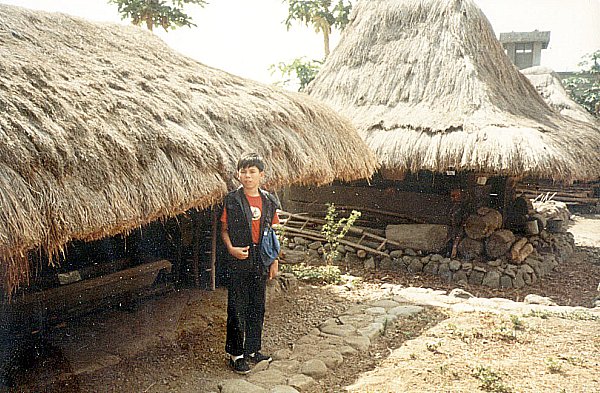
Jandy at the outdoor museum

Its 4 well-laid out and labeled  rooms features artifacts (woven fish traps, death chair, head basket, ceremonial bowls, ritual backpack, etc.), musical instruments (jew’s harp, zither, flute, etc.), a group of miniature traditional houses, a collection of rocks and fossils from different parts of the Cordilleras and interesting old photos of the Bontocs’ colorful pre-Christian history, including some early 1900s photos of their headhunting days (one shows a beheaded person tied up in a bamboo pole and, another, a burial for such a beheaded person). At the basement is a library with a limited collection of books. There is also a carved wooden chest to put a curse on people and a basket where a chick is placed to awaken the spirits with its constant chirping. Its museum shop sells postcards, carved wood  items and other novelties.  I,  being a postcard collector,  bought a sepia-colored  postcard pack of 6 featuring pictures of the museum artifacts.  I also got to interview Sister Teresita Nieves Valdes, the museum curator.

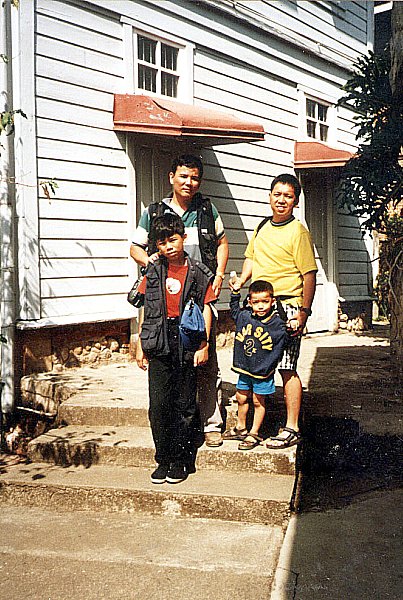
Banny and me with our sons

We also visited the adjacent outdoor museum with its full-scale model of a traditional Bontoc village including the ulog for maidens and a pit shelter for swine.  On my way out I met my former officemate (Manosa-Zialcita Architects) Jose Bayani “Banny” Hermanos who was also travelling with his wife Carol and two sons.  An avid traveler like me, he is also a professional photographer whose colored photos were featured in The Philippines: Action Asia Adventure Travel Guide.  After our museum visit, we proceeded to the nearby Pines Hotel & Kitchenette for a quick lunch. Then, we went back to the municipal plaza where we boarded the last Banaue-bound jeepney. Here, I befriended sisters Asia and Min-Min, one of which was traveling with her German boyfriend named Tom.  We left Bontoc by 1:30 PM.

Hiking along Bontoc Road (Sagada, Mountain Province)

We spent the whole afternoon hiking along Bontoc Road. On both sides of the road is the 34-hectare Mission Compound.  It includes St. Theodore’s Hospital (established in 1926), the Rectory, the recently restored Doctor’s Residence, the Girl’s Dormitory (established in 1912) and residence  of American historian William Henry Scott. Across St. Theodore’s Hospital  is the DOT accredited and Episcopalian parish-operated St. Joseph’s Resthouse. Further out along Bontoc Road, on the left, is Sagada Weaving & Souvenir Shop.  Established  in 1978, it produces quality products hand-woven on backstrap looms and supervised by Mrs. Andrea Bondad and daughter Rhoda.  Finished products sold at reasonable prices include backpacks, shoulder bags, tapis (Igorot skirts), wallets and blankets.

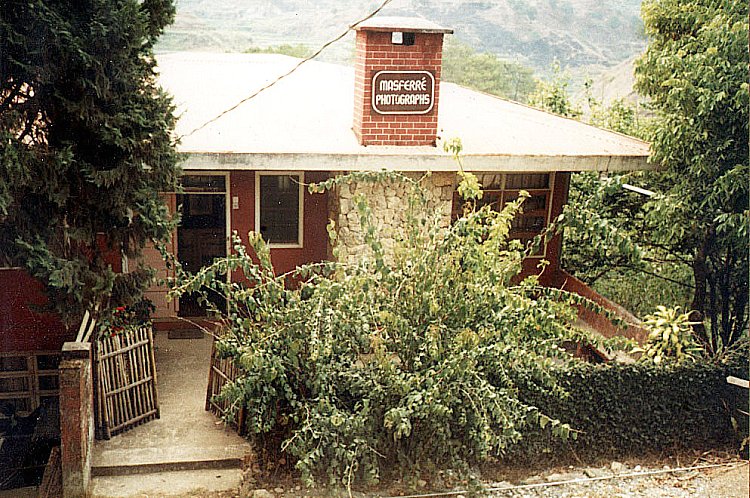
Masferre Photographs

Further out along Bontoc Road, at the Bagaan Road Junction, is the Masferre Gallery.  Here, Mrs. Nena Masferre, wife of the late photographer Eduardo Masferre, welcomed us.  In the 1930s, 40s and 50s, through his pioneering skill and sensitivity as a photographer, Eduardo took photographs of the vanishing life and culture in the villages of Mountain Province. Mrs. Masferre showed us the black and white photographs taken by her husband and a few maps and artifacts.

Eduardo, a Spanish mestizo, was born on April 18, 1909, the second of eight children.  He was the son of Jaime P. Masferre, a retired Spanish soldier from Cataluna, who settled in Sagada at the turn of the century, became a coffee farmer, married an Kankanai woman (Mercedes Cunyap Langkew), joined the Episcopal Church and became a minister.  From 1914 to 1921, Eduardo first lived with his family in Spain where he began his education.  After completing his schooling in the Philippines, he became a missionary teacher like his father and then a missionary administrator.  In addition, he took up farming.

In the 1920s, he learned photography from U.S. missionaries.  Returning to photography in 1934, his artistic focus were the mountain people of the Cordilleras with whom he shares part of his heritage.  After World War II, he opened a photographic studio in Bontoc.  In 1951, he married Nena Ogues, a nurse from Kapangan.  The union produced six children.

His grainy, high contrast monochrome photos are displayed here and around the world.  His first exhibit was held in Manila in 1982.  After a second Manila exhibit the following year, his work traveled to Copenhagen (1984) and Tokyo (1986).  In 1988, his third Manila exhibit was mounted.  A book of his work, “E. Masferre: People of the Philippine Cordillera” was also produced.  Mobil Philippines funded the work, provided 1,500 copies to Philippine schools, museums and libraries, and funded the touring exhibit of his works to the cities of Baguio, Cebu, Cagayan de Oro, Davao and Bacolod.

In 1989, Masferre exhibited his works at Les Recontres International de la Photographie in Arles (France), the only Filipino to be accorded such an honor.  In 1990, again with Mobil support, the Smithsonian Institute of Washington D.C. purchased 120 of his impressive original photos and exhibited them for six months at the main rotunda of the American National Museum of Natural History.  They are now carefully archived in the same museum.  He died on June 24, 1995 at the age of 86.

Jandy with Ms. Nena Masferre

Plodding on, we reached a bend opposite the Rocky Valley Inn.  Here, a path lead down to the small Matangkib Burial Cave. However, it was closed due to the recent death of a hapless Irish tourist who slipped and broke his head.  Coffins here are carefully stacked. At  the lower end of the path, to the left of Matangkib burial cave, is the unmistakable mouth of the Latang Underground River.  We didn’t bring along a good flashlight and weren’t prepared for a 15-min./500-m. spelunking hike through  cold, knee-deep waters and a scramble over rocks.  It was late in the day and we made our way back to the inn.

Latang Underground River

The night was chilly and foggy.  Tourists from Manila were beginning to arrive, all looking for places to stay and most without any success.  Even St. Theodore’s hospital beds were rented out (barring any emergencies) for PhP45 per head.  Others camped out on the Mission grounds while others just slept in their vehicles.  Poor fellows.  Sagada has a reputation as a meeting place for travelers and I also made a number of friends during my stay.  Many were guests staying at the inn while the others I met were straying in the town’s  different coffee shops.

Sto. Nino Shrine & Heritage Museum (Tacloban City, Leyte)

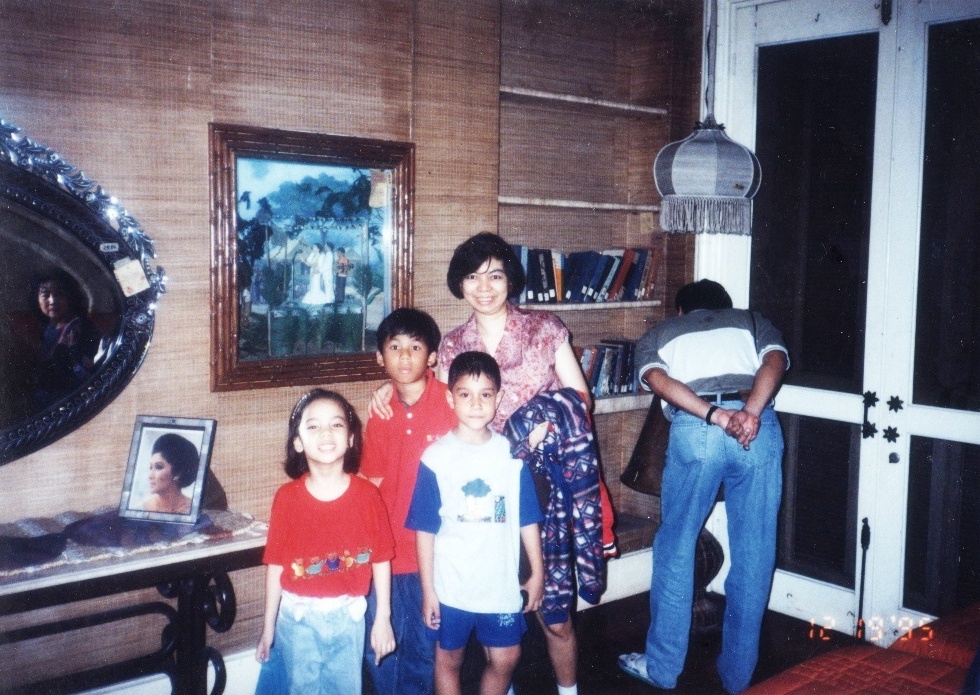
After lunch at Agus Restaurant, Grace, Jandy, Cheska and I, with Manny, Paula, Mark, Nenette, Dad, Mom and Cheska’s new friend Kookie Bal, continued on our tour of Tacloban City, this time visiting the Sto. Nino Shrine & Heritage Museum, one of 29 presidential resthouses built by the late Pres. Ferdinand E. Marcos and Tacloban’s top tourist attraction because of its association with Mrs. Marcos.  This 20-room, colonial-style structure, designed by Arch. Jorge Ramos and built from 1979 to 1981, houses former First Lady Imelda R. Marcos‘ vast collection of art objects from all over the world.  

Sto. Nino Shrine & Heritage Museum

At the ground floor is the 100-pax chapel, lit with beautiful chandeliers from Czechoslovakia; with narra pews and a replica of the image of the Sto. Nino of Leyte (made with Italian ivory) as the altar’s centerpiece.  This is where the Sto. Nino connection ends.  Everything else speaks of the Marcos family, especially the former First Lady.

Posing in front of the replica of the Sto. Nino de Leyte

On the chapel’s periphery, elevated by 2-3 steps, are 13 tastefully decorated guestrooms of varied Filipino motifs, each unique and exceptional as they represent the different regions of the country. Each room had a diorama of the First Lady.

One of the themed guestrooms
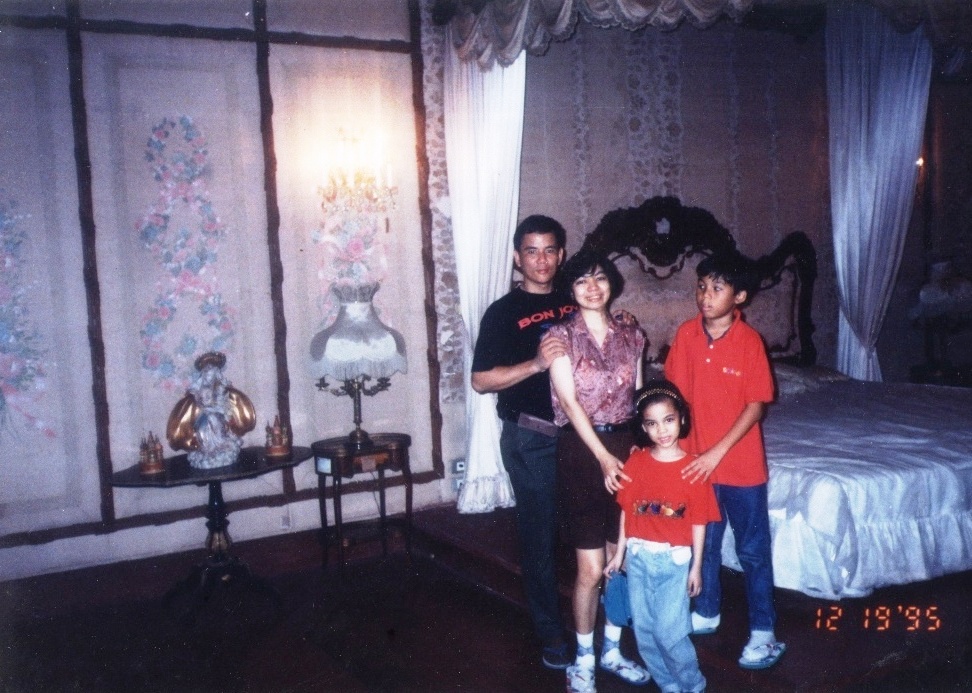
At the second floor is a spacious ballroom, a 30-pax dining/conference room and 7 magnificently designed and decorated private bedrooms for the First Family.  Imelda’s bedroom had a very large bathroom.  The whole place just screams grandeur, power and magnificence. 
 
Wooden bas relief of Malakas and Maganda
The whole mansion was furnished with original paintings done by by the late National Artist Fernando Amorsolo, Amadeo Y. Manalad and Malang; the 14 Stations of the Cross done by Filipino painters; priceless furniture; musical instruments; fine English, French and Chinese porcelain; Austrian mirrors; Argentinian and Persian carpets, grandfather clocks; Italian tiles; wooden bas-relief of the legend of Malakas and Maganda, ivory and wooden sculptures of local and foreign  origin; Russian dolls; Chinese Qing Dynasty vases: a whole glass case filled with ivory carvings; and other priceless collectors items. 
 
One of the 7 bedrooms
Sto. Nino Shrine & Heritage Museum: Real St., Tacloban City, Leyte.  Tel: (053) 321-9775. Admission: PhP60 (maximum of 6 per group).  Open daily, 8 AM to 5 PM.  Guided tours from 8 to 11 AM and 1 to 4 PM.

Sentosa Island – Pioneers of Singapore/Surrender Chambers Museum (Singapore)

Upon arrival at the ferry terminal, we strolled along the Fountain Garden to the eclectic Pioneers of Singapore/Surrender Chambers Museum (opened in 1983).

Fountain Gardens

The Pioneers of Singapore offers a chronological history of the city-state, from the 14th century to the early 20th century, recreated via an animated and narrated tableaux in wax depicting the pre-British period of Malaysian rule, British colonialism, the founding of colonial Singapore by Sir Thomas Stamford Raffles, the Japanese Occupation and the post-colonialist era under Lee Kuan Yew, Singapore’s first Prime Minister.

Pioneers of Singapore

The Surrender Chambers, which depicts Singapore during the World War II years (1941-1945), captures the humiliation of defeat and the joy of victory through the use of rare audio and visual archive material such as photographs and footage, with realistic wax works recapturing the historical moments of the signing of both the British’s humiliating surrender on February 15, 1942 and the Japanese surrender to the Allies on September 12, 1945.

In 1994, the Pioneers of Singapore/Surrender Chambers Museum was extended to include a section called Festivals of Singapore and the attraction was rechristened “Images of Singapore.” The popular wax tableau Surrender Chambers has now been relocated, from Sentosa’s Images of Singapore Museum, to Fort Siloso.

Surrender Chambers

AERA Memorial Museum (Villa Escudero Plantation & Resort, San Pablo, Laguna)

Part of day tour package of Villa Escudero Plantation & Resort included admission to the resort’s AERA Memorial Museum which houses the priceless collections of Arsenio and Rosario (nee Adap) Escudero.  Begun on June 29, 1923, it is run by the AERA (acronym of the founders’ names) Memorial Foundation.  It is housed in an exact replica of the beautiful San Francisco Church of Intramuros.  The original church was destroyed by heavy American artillery bombardment on February 3, 1945 during the liberation of Manila and the site is now occupied by Mapua Institute of Technology. 

The pink-colored  building took 10 years to build on a massive 7-ft. thick concrete foundation and has a high 200-sq. ft. ceiling with trompe l’ oeil paintings by Benny Cabezada.  Attached to the ceiling are ten chandeliers copied from an Arte Espanol original.  Its display arrangement was said to have taken 3 years to complete.  Ninety percent of the display is family-owned while the rest were donated or acquired by the foundation.

AERA Memorial Museum

The museum’s collection of religious art is its main attraction.   A wooden bas-relief of the Nuestra Senora de Augustia, donated by my late uncle and National Artist, Arch. Leandro V. Locsin, is located by the massive  ornate door made in 1768.  By the way, cameras and videocams are not allowed.   A kamagongSto. Entierro (glass bier of the Dead Christ, circa 1856) carriage fashioned by noted sculptor, Isabelo Tampingco, was formerly from the Sta. Cruz Church of Manila.  It is adorned with 24 batikuling (a local aromatic softwood) cherubs and was donated by Dona Maria Luisa Quiogue (of the funeral parlor chain).

Other displays include an ivory-headed statue of Virgen Dolorosa from a church in Marinduque, a Pieta by Ireneo Cristobal, rows of ivory-headed santos, a granite Chinese fu dog guarding the staircase, an ornate wrought iron pulpit (raised platform used by a preacher) on the right side of the nave, silver sanctuary lamps, statues of Christ with the Cross on his Second Fall, a statue of Christ embracing a molave Cross, silver main altar acquired from Quiapo parish in the 1960s and a massive retablo (altar backdrop) from Agno (Pangasinan).
       
Its non-religious collection includes a couple of 1,400-year old and 1.5-ft. high Chinese Tsu-Chao jars, 12th and 13th century celadon pottery, tear vials of early Roman aristocrats, gilded carrozas (Spanish carriages), life-size dioramas of ethnic tribes in authentic costumes, ethnic artifacts and clothing, antique furniture, paintings, a numismatic display of obsolete coins and money, U.S. astronaut suits, a Philippine and African beetle collection and an extensive freshwater, terrestrial and marine shell collection (including the rare “Golden Cowrie”). 
       
Next to it are a dioramas of stuffed rare and some already extinct Philippine fauna. The only foreign stuffed animal is a big leopard shot during the 1923 Manila Carnival for attacking and killing a dancer.  It was later bought by the Escuderos and mounted.   A properly identified 22,000-piece butterfly collection is at the ground floor gallery.  A walk through our country’s political history is revealed in the display of inaugural suits and gowns of all the past twelve Philippine presidents and their First Ladies, from Emilio Aguinaldo to Corazon Aquino.  There are also costumes of former beauty queens.  Outside are World War II weapons and relics including tanks and cannons.
       
For me, the most unusual (and grotesque) item in the collection is an amazingly preserved, fist-size shrunken head from the Upper Amazon River Indians of Ecuador.  A trophy of war and bravery, it was acquired from a Swedish collector.  Another unusual item is a pen-and-ink portrait of Christ which was donated by an American couple in 1970 and surrounded by cherubs.  I took a closer look with a magnifying glass and it revealed an actual text of the New Testament, from the first word to the last.  

Villa Escudero Plantation & Resort: San Pablo City, Laguna.  Manila booking office: 1059 Estrada St., Malate, Manila.  Tel: (632) 521-0830, 523-0392 and 523-2944. Website: www.villaescudero.com