Church of Our Lady of the Immaculate Conception (Sta. Cruz, Laguna)

Church of the Immaculate Conception

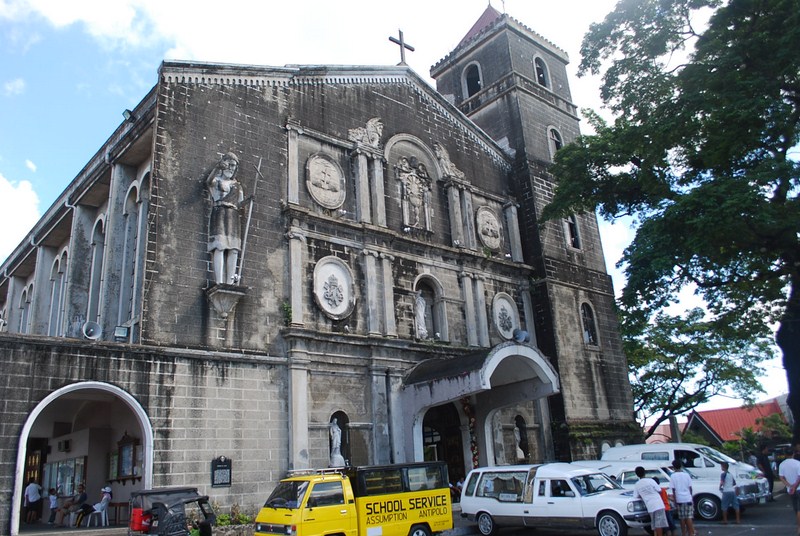
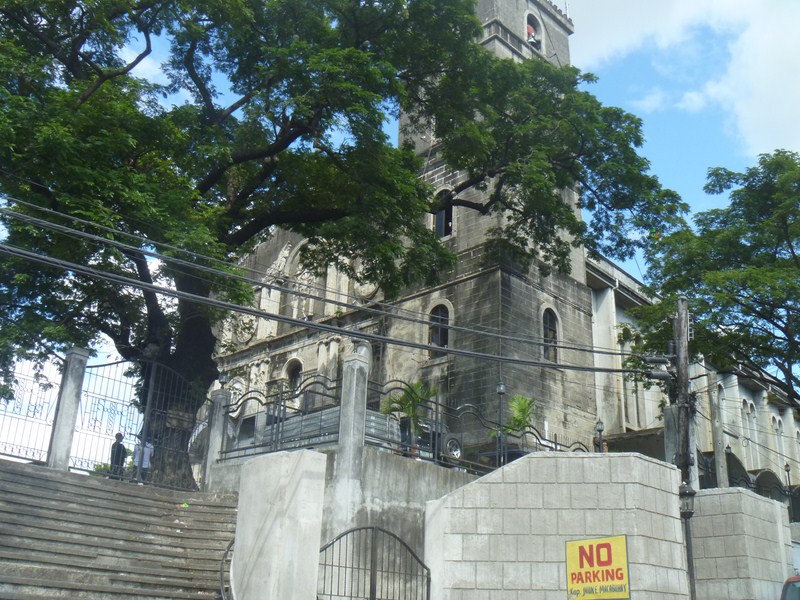
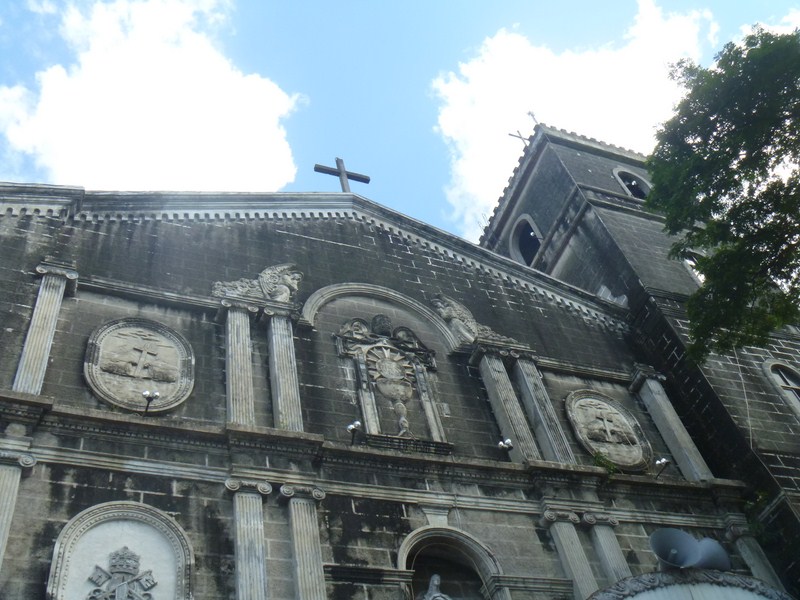
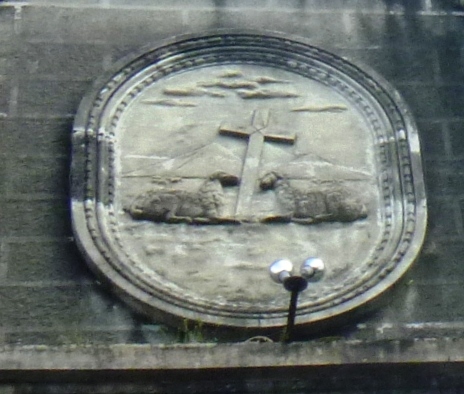
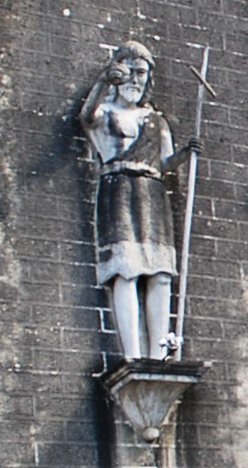
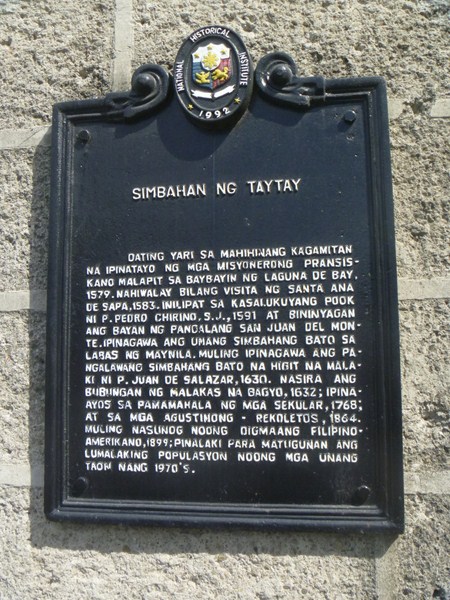
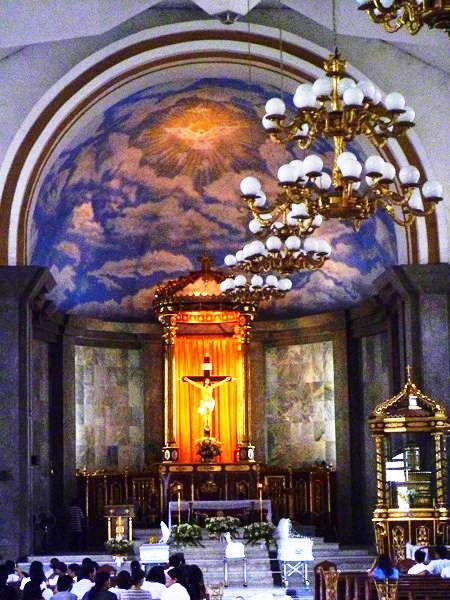
The Church of Our Lady of the Immaculate Conception, first built by  Franciscan parish priest Fr. Antonio de la Llave in 1608 and enlarged in 1672 by Fr. Miguel Perciva with the addition of 2 wings (giving the church the form of a cross).  It was improved in 1850 by Fr. Juan Antonio Marzo who built the principal nave and convent and remodeled the 5 altars.  The church was destroyed during the July 18, 1880 earthquake and was reconstructed by Fr. Antonio Martin de Vidales in 1881 (assisted by Filipino Fr. Gregorio Ercilla, his coadjutor).

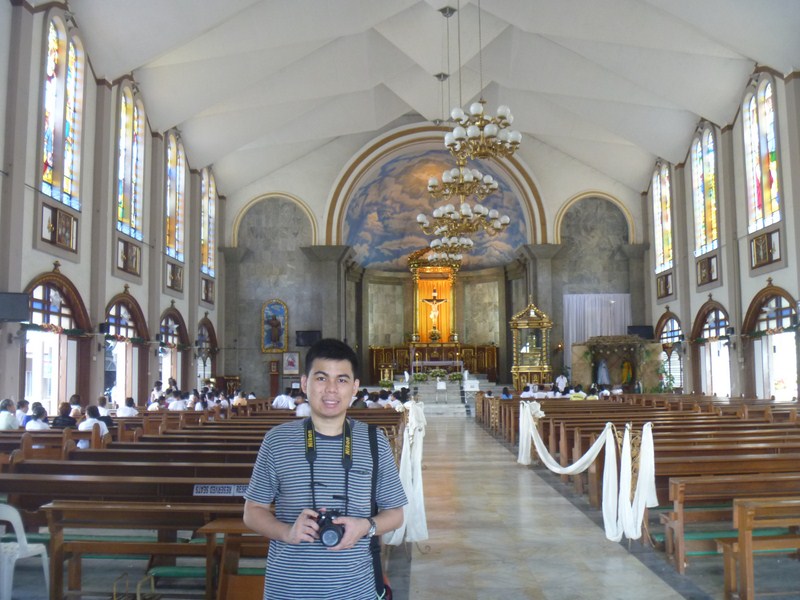
Church of the Immaculate Conception – Interior

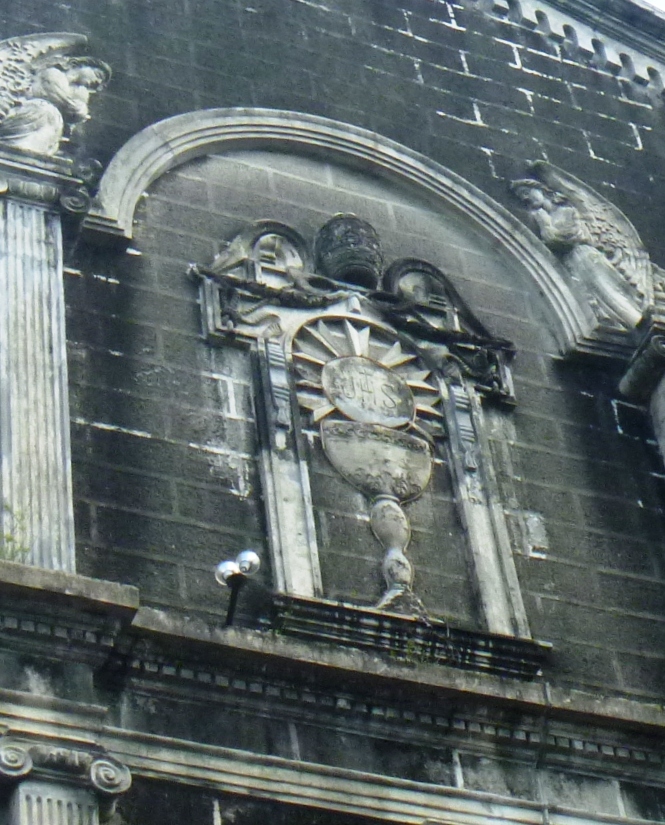
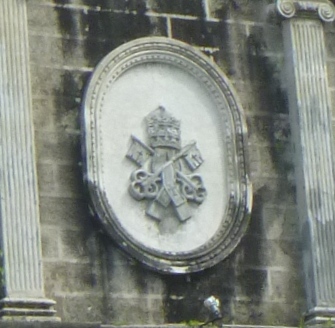
On January 26, 1945, during the liberation in World War II, the church was partly destroyed by fire,  leaving only the walls and stairs of the convent.  The present church, a reconstruction in 1948 (through the initiative of Fr. Mariano O. Limjuco), now has an Early Renaissance facade with a pair of large pilasters supporting a plain pediment.  Inside is a bas-relief of the Stations of the Cross, a main altar with a stained glass rendition of the Blessed Mother and the apostle John watching over the crucified Jesus Christ and stained glass depictions of the Joyful and Glorious Mysteries.  On its left is its heavy, massive 3-storey bell tower topped by dome.

Church of Our Lady of the Immaculate Conception: Pedro Guevarra Ave., Brgy. Poblacion, Santa Cruz 4009, Laguna.  Tel: (049) 537-0211.

Sta. Cruz: Laguna’s Provincial Capitol

Laguna Provincial Capitol

It was already late in the afternoon when Jandy and I arrived at Sta. Cruz town, Laguna’s provincial capital and one of the province’s 2 main route centers (the other is San Pablo City). The health, education, transportation, commerce and social services center for the entire province, Sta. Cruz also serves as the business and commercial hub particularly for the predominantly rural northeastern towns of Cavinti, Famy, Luisiana, Mabitac, Majayjay, Nagcarlan, Pakil and Pangil.

Sta. Cruz Municipal Hall

Formerly a part of Lumban, it became a separate municipality in 1602 and was made into the provincial capital in 1858, replacing Pagsanjan.  This town is made famous for its delicious kesong puti (salty white cottage cheese).  This native delicacy, made from carabao’s milk, is cooked in large vats to which salt and vinegar is added till it curdles.  The cheese is then fermented, strained and molded and then individually wrapped in banana leaves.

Church of the Immaculate Conception

Upon arrival at the town, I parked the Revo across the blue and white municipal hall at the town plaza.  The town’s layout seems to be broader than most Laguna lakeside settlements. Sta. Cruz, however, has no natural tourist attractions, only man-made.   Near the plaza is the Church of Our Lady of the Immaculate Conception.

Check out  Church of Our Lady of the Immaculate Conception

Old Provincial Capitol Building

After merienda at a MacDonald’s outlet nearby, we proceeded to visit the Provincial Capitol Building along P. Guevarra St..  Also within the compound is the old provincial capitol.  Our visit to Sta. Cruz capped our Laguna joy ride and we proceeded on our 87-km. drive back to Manila.

Mayor’s Office: Municipal Hall, Poblacion, Sta. Cruz,  Laguna.   Tel: (049) 808-1008


The Ancestral Houses of Pila (Laguna)

Pila Municipal Hall

Past the town of Victoria, we soon reached the Pila town proper (87 kms. from Manila) and its plaza lined with shady, giant talisay trees.  Surrounding it are quaint early 20th century, American-era ancestral houses and, finding them interesting, decided to make a long stopover here to explore the town further.  I parked my Toyota Revo at the Municipal Hall, a heritage building built in 1931 and faithfully restored by Mayor Edgardo Ramos.

Town Plaza

Pila is cited as one of the few intact examples of Spanish colonial town planning where the center of the town was the plaza complex surrounded by the church, tribunal, school and large ancestral houses of the town’s leading citizens.  On May 17, 2000, as a consequence of these efforts, Pila was declared as a National Historic Landmark (a status also enjoyed by Vigan City in Ilocos Sur, Silay City in Negros Occidental and Taal in Batangas) by the National Historical Institute (NHI) .

Pila’s ancestral homes

Unlike nearby Sta. Cruz and Pagsanjan towns which were reduced to rubble by American bombing, Pila survived the ravages of World War II because American bombers failed to spot it.  Because of this great piece of luck, Pila still boasts of 36 19th century and turn-of-the-century structures, 28 of them ancestral homes.  Mostly located in Brgy. Sta. Clara, many of these ancestral homes, a good number of which belong to the Agra, Alava, Dimaculangan, Relova and Rivera families, have withstood the test of time and are still well-preserved, with fresh coats of paint with pastel and cream colors.  These home owners take great pride in town’s old world charm and their rich and varied heritage.  Once parked, Jandy and I strolled along the town’s plaza and its quiet streets, enjoying up close or from afar, the experience of seeing these stately structures that reflect a rich and varied architectural history.

Jose Agra Ancestral House

This lakeshore town, founded by Franciscan missionaries in 1580, has been given the moniker Lupang Pinagpala (“The Blessed Land”) and there are a number of reasons for this. In 1610, in recognition of the noble Pileños refined manners and genteel customs, this town steeped in history and culture was conferred the special status of La Noble Villa de Pila (“The Noble Town of Pila”), one of only five towns in the country accorded this honor by Spain (the others being Cebu, Vigan in Ilocos Sur, Libon in Albay and Oton in Iloilo). The town also survived the ravages of World War II because American bombers, on a bombing run to flush out Japanese soldiers, failed to spot it.  Nearby Sta. Cruz and Pagsanjan towns were not so lucky, both being reduced to rubble.

Relova Ancestral House

In December 1993, the Pila Historical Society Foundation was established to preserve and maintain these remnants of a gentler way of life.  The foundation raised funds and, with the cooperation of the late Mayor Querubin Relova and the Sangguniang Bayan, undertook the huge task of demolishing and relocating new structures that detracted from the beauty, purpose and historical relevance of the original town plan.  Pila is cited as one of the few intact examples of Spanish colonial town planning where the center of the town was the plaza complex surrounded by the church, tribunal, school and large ancestral houses of the town’s leading citizens.

Rudolfo Relova Ancestral House

Many houses built during the Commonwealth Period reflect a shift in architectural styles, evolving from the massive bahay na bato (stone house) to the charming American chalet-style houses with touches of Spanish design elements, decorative Art Deco or Art Nouveau treatments.  Using more Philippine hardwoods and cement, all provide comfort, a respite from the tropical heat and a general feeling of airiness with their high ceilings; tall and wide capiz or paned-glass windows that allow the breeze to come in and woodcarvings on the ventanillas that allow for good cross ventilation. The living and dining rooms, on the second floor, are accessed by stairs that figure prominently in the facade.  The ground floors of many houses facing the plaza, formerly used as storage areas, now house cafeterias and shops.

Pila Historical Society Foundation: tel: (049) 559-0382 (Ms. Cora Relova).

Diocesan Shrine of St. Anthony of Padua (Pila, Laguna)

After our museum visit, we next dropped by the town’s present Early Renaissance-style Diocesan Shrine of St. Anthony of Padua, the first Antonine church in the country.  Located beside the Liceo de Pila (founded in 1947), it was built in 1849 by Frs. Antonio Argobejo and Domingo de Valencia but, during the July 18, 1880 earthquake, was badly damaged and its bell tower toppled.  It was then repaired by Fr. Damaso Bolaños and finished by Fr. Francisco de Santa Olalia.

Diocesan Shrine of St. Anthony of Padua

Its bell tower was rebuilt by Fr. Lope Toledo.  The convent, completed in 1849, was also seriously damaged during the 1880 earthquake.  On July 9, 2002, it was proclaimed as a diocesan shrine by Bishop Francisco O. San Diego of the Diocese of San Pablo. Two relics of St. Anthony of Padua are enshrined behind the tabernacle.  During healing masses, devotees flock to the shrine for a chance to touch the miraculous relics.

The church interior
The church’s Early Renaissance facade, divided into 3 segments by superimposed Doric columns, has a semicircular arched main entrance.  On the second level is a statued niche flanked by pedimented windows.  The pediment, with its balustraded raking cornice, has a statued niche framed by an arched order.  On its left is the 3-storey bell tower with pointed roof.
Diocesan Shrine of St. Anthony of Padua: San Antonio St., Brgy. Sta. Clara, Pila, Laguna.  Feast of St. Anthony of Padua: June 13

Pila Museum (Laguna)

A short leisurely walk from the town plaza brought us to the Pila Museum, the former Spanish-era escuela pia (school).  This refurbished building, probably the oldest structure in the town, now houses priceless pre-Hispanic Northern Sung (960-1127 AD), Southern Sung (1127-1280 AD) and Yuan Dynasty (1280-1368 AD) Chinese porcelain (plates, jars, jugs, etc.) and tradeware transferred to this heritage building in 1994 by the Pila Historical Society Foundation.

Pila Museum

These were recovered, from May to October 1967, from the Esso Standard Philippines-Manuel Elizalde excavations of an ancient crematorium (the oldest in the country) and habitation sites among the coconut plantations in Brgy. Pinagbayanan and Bagong Pook.  The project was led by Ms. Julita G. Fernandez and Ms. Amelia O. Rogel, graduate students of anthropology from the University of the Philippines.  They were supervised by Dr. Robert Fox and Mr. Avelino Legaspi of the Anthropology Division of the National Museum.

Some 250 to 300 pieces of the finds were donated to the town by Mr. and Mrs. Manuel Elizalde. These include celadon dishes with fish motif; celadon censers; qingbai blue and white jarlets; small, lead-glazed water droppers and teapots; qingbai double gourd vessels; large, gray-glazed ewers; figurines of carabao with riders in plain and spotted qingbai; brown wares of all shapes and sizes; iron and glass bracelets; and colored beads and earrings that appear to be gold or copper.

Home of "The Other Rizal" (Los Banos, Laguna)

The Paciano Rizal Shrine

My next stop in my Laguna (Calamba City to Sta. Cruz) joy ride with my son Jandy was the charming resort town of Los Banos.  The town is famous for its hot medicinal sulfur springs that flow from the foot of Mt. Makiling and its present name is derived from the Spanish word for “The Baths.” These thermal springs were discovered in 1590 by Franciscan martyr St. Peter Baptist (San Pedro Bautista).   Today, most of the sulfur springs are piped into the pools and baths of the many hot spring resorts that line the National Highway.  This is the Los Banos that most people know and not many people know this town’s association with “the other Rizal.”

The old Los Banos Municipal Hall

To find out, I parked my Toyota Revo at the old municipal hall (a new one is being built along the National Highway).  Beside the town’s fire station is the inconspicuous retirement home of Paciano Mercado Rizal, Jose Rizal‘s elder (and only) brother who was also a revolutionary general (he led the defense of Laguna) and Emilio Aguinaldo‘s first Minister of Finance.  Though not as popular as the Jose Rizal Shrine in Calamba, this shrine, jutting out to Laguna de Bay, was built atop a hot spring in 1927 by Andres Luna de San Pedro (son of master painter Juan Luna) when Paciano’s original nipa hut was destroyed in a typhoon in 1926.

The back of the house

Rizal lived here, as a gentleman-farmer, with 2 helpers (with occasional visits from his grandsons, from daughter Emiliana, Franz and Edmundo), until his death from tuberculosis on April 30, 1930.  First buried in Manila North Cemetery, his remains were later transferred here, with full military honors, in 1985.  A historical marker was installed here on April 13, 1983 and the house was declared as a National Historical Shrine by the National Historical Institute on July 31, 1992.

Laguna de Bay

This modest American-style, one-bedroom bungalow was turned into a Japanese garrison during World War II, resulting in the loss of much of Paciano’s personal effects. Still around are some photos of his grandchildren, binoculars he used during the revolution, a pair of his shoes and a Quiroga bed.  Rizal’s spinster sisters Josefa and Trinidad are also buried in the sprawling garden which has a bronze statue of Paciano Rizal, on a pedestal, in his general’s uniform.  The shrine has a view of Talim Island. At the back of the house is the Paciano Rizal Park.

Church of the Immaculate Conception (Los Banos, Laguna)

Church of the Immaculate Conception

From the municipal hall, we next drove a short way to the town’s Church of the Immaculate Conception.  First built as a chapel from 1613, it was later destroyed by fire in 1727 and rebuilt in stone on its present site by Fr. Domingo Mateo OFM in 1790.

The church’s interior

The belfry, sacristy and tile roofing were supervised by Fr. Manuel Amat in 1852.  The convent and bell tower were destroyed during the 1863 earthquake but repairs were made during the administration of Frs. Manuel Rodriguez and Gilberto Marin in 1880. During World War II, it was headquarters and garrison for the Japanese forces. Across the church is the Liceo de Los Banos.

Liceo de Los Banos

Church of the Immaculate Conception: Brgy. Timugan, Los Banos, Laguna. Feast o the Immaculate Conception: December 8.

The Country’s Tallest Rizal Monument (Calamba City, Laguna)

The new Rizal Monument

Unusually August 27 to 30, a long vacation, came and go without me and my son Jandy getting out of town due to Typhoon Mina (international name: Nanmadol). Thus, when the sun shone a bit the next day (still no classes for Jandy), we decided to hop into my Toyota Revo and go on a joy ride around Laguna, from Calamba City to Sta. Cruz, photographing historical sites and old churches along the way.Traveling via the South Luzon Expressway (SLEX), I took the Calamba Exit and made our first stopover at Calamba City, the birthplace of National Hero Jose Rizal, by noon.

The Calamba City Hall

Across the modern, 4-storey City Hall (inaugurated on August 16, 2005) along Bacnotan Road, on a 6.7-hectare government property, is the 6.7 m. (22-ft., representing the 22 languages Rizal spoke) high bronze statue of Rizal, said to be the tallest statue of the National Hero anywhere in the world.  The previous one was a 16-ft. high bronze statue, built by naturalized Jordanian philanthropist Mahmoud Asfour, in Bayombong, Nueva Vizcaya,

It stands on a tiled concrete pedestal mounted on a platform surrounded on all 4 sides by 15-step (representing 150 years) flights of stairs.  Calamba City is also home to the smallest statue of Rizal, a bronze statue of Rizal as a child in the Rizal Shrine,  done by Duddley Diaz and unveiled on June 19, 1998.  The Rizal Shrine is a 10-min. drive from the monument.

Posing beside the plaque

The monument was unveiled, by Pres.  Benigno Aquino III, during the 150th birth anniversary of Rizal  last June 19, 2011.  If measured from its concrete base, the whole monument stands 4 storeys high. The statue, started in December 2010, was designed and executed by 35 year old sculptor Jose Dionas “Jonas” Roces of Marikina City with about a dozen assistants.  Roces also did medium-sized sculpture of Pres. Aquino’s parents, martyred opposition leader Benigno “Ninoy” Aquino Jr. and the late Pres. Corazon Aquino.

NOTE: This Rizal statue was the tallest one from 2011 until 2014 when the 7.93 m. (26 ft.) high bronze Rizal Monument, sculpted by Toym Imao (son of National Artist for Sculpture Abdulmari Asia Imao), was unveiled in Santa Cruz, Laguna for the 2014 Palarong Pambansa  hosted by the province. Depicting Rizal wearing a fencing uniform and holding an epee, it is the only one of its kind in the world.

Rizal Monument: Calamba’s Real Village, Brgy. Real, Calamba City, Laguna.

Enchanted with Cagbalete Island (Mauban, Quezon)

Cagbalete Island

Come morning and after breakfast at the Mayor’s house, Bernard and I decided to do some more sightseeing.  Omar, Baby and Dax left earlier to cover the unveiling of the historical marker at Rizal Hill Park.  To burn some of our excess calories, we visited, on foot, a number of the town’s old ancestral houses (Alquiros Residence, Quintana Residence, Pansacola Residence and Taino Residence) and the monument to native son Fr. Horacio V. de la Costa.  By 10 AM, all of us met up at the municipal hall as we were slated to go on a day tour of the 1,640.48 sq. km. Cagbalete Island, one of Mauban’s top tourist draws.

Taino Ancestral House

We boarded to tricycles to get to the port at Brgy. Daungan as we were hoping to still catch the morning trip (10 AM) to the island and leave the island on the afternoon boat (1:30 PM).  At the port, we were met by Mr. Romano “Roman” Balatbat, the former barangay captain of Brgy. Cagbalete 1 (now headed by his wife), one of the island’s 2 barangays (the other being Cagbalete 2).  Mang Roman is a Visayan migrant to the island, just like most of the island’s inhabitants.  Our huge motorized outrigger boat left the port by 10:45 AM and the 6 km. trip took all of 45 mins..  Along the way, we passed the the 440 MW, coal-powered Quezon Power Project.  Built in 2000, it is the first privately built, owned, and operated power generating facility in the Philippines.

Quezon Power Project

We were within sight of the island’s beach by 11:30 AM but we had to transfer to a smaller, flat-bottomed boat to get to shore as we were anchored some distance away, it being low tide.  Just the same, I had to raise my pant legs and remove my shoes and socks to wade ashore.  Mang Roman first invited us to his house where a simple but filling lunch of fried chicken, fish and soft drinks was prepared for  us.  After lunch, we walked along the barangay’s narrow pathways and, after that, the beach itself to get to the island’s other side  where the island’s white sand beaches are less populated and at their most beautiful.  

Cagbalete Beach

Naturally, there were a number of resorts located along this beautiful stretch of white sand and we spent a substantial amount of time at the quaint Pansacola Beach Resort.  The resort has rustic fan-cooled, 8-10-pax nipa huts with common toilets and bath (rented for PhP2,000) and 12-20-pax houses with private toilets and bath (rented for PhP4,000).  Open beach huts are rented for  PhP1,000.  Other resorts located on the island, all in Brgy. Cagbalete 1, include Little Prince, MVT Sto. Nino and Villa Cleofas, said to be the best on the island.   

Pansacola Beach Resort

Our enchantment with the beautiful beach, where we did some “leaping” photo ops, made us forget about the time and, realizing this, we soon thanked the resort caretaker and quickened our pace to make it back to the landing area.  Too late.  We were still some distance away when we espied our boat already leaving the beach and us for that matter.  Luckily for us, there were still other, smaller motorized boats around, the barangay being a fishing community, and Mang Roman made arrangements for a boat to bring us back to the port.  The trip back took a little longer, it being a smaller boat, and there was to be no roof to shade us from the hot afternoon sun.  Still, we were thankful that we made it back to town as we had to depart for Manila in the late afternoon.  

The Public Bath

Back at the port, we thanked our gracious host and savior Mang Roman and met up with his wife (now barangay captain of Cagbalete 1).  Then, we returned to the municipal hall to inform the Tourism Office of our safe arrival.  Later, we left  it laden with bottles of nipanog wine, parting gifts courtesy of Mayor Llamas.  Before leaving the town, we visited the parents of Lee at their Mauban home (and again left it laden with additional 4-gallon bottles filled with nipanog wine for us and Lee)  and the town’s Public Baths at the end of San Buenaventura St. (cor. Mabini St.), between Brgys. Daungan and Mabato.  Built in 1725 by Kapitan Luis de la Cruz, it has 2 compartments, boys on the left and girls on the right.  The baths used to be supplied with overflow water from the town’s reservoir.  Now they’re dry.  Mauban is the only municipality in the country to have such a structure.

A Walking Tour of Mauban (Quezon)

The Municipal Hall

We finally arrived at Mauban, at the midst of its Maubanog Festival, by 4 PM and we made a stopover at the municipal hall were we all dropped by the Municipal Tourism Office and paid a courtesy call on Mayor Fernando Q. Llamas, the uncle of our good friend Lee Llamas.  Prominently displayed outside the municipal hall is an old cannon, 1 of 3 (the other 2 are at the Museo ng Mauban) bestowed by Spanish Gov.-Gen. Rafael Maria Aguilar to the town as a reward for the rescue efforts done for the Spanish friars captured by Moro pirates. The cannon were later used against the Spanish to effect the surrender of Tayabas to the revolutionaries in 1898.  All 3 were  restored on April 16, 2004.  

Traditional Mauban products

After our courtesy call on the Mayor, we  all dropped by the Mauban Product Development Office, beside the municipal hall, to check out the town’s traditional products such as finely-crafted nilala woven hats, baskets, slippers, wallets, bags, boxes, caddies, etc.;  delicacies such as pinangat, binalawan, pinais, tikoy, kalamay, pastillas, botarts, mazapan, suspiro, etc.; and nipanog, wine made with sasa (toddy palm nectar) instead of coconut and available in different flavors such as liputi, katmon, guyabano, mango, pineapple, guava, jackfruit, kalamias, tamarind and santol. Being a fiesta, booths selling these products, and more, were found in front of the municipal hall as well as along the major streets. 

Church of St. Bonaventure

While they were checking out the products, I took time out to visit the town’s present, modern Church of St. Bonaventure (the town’s patron saint).   This church underwent a lot of rebuilding since it was first built in 1647 and demolished in 1769.  The second structure, built in 1773, was badly damaged during the 1830 earthquake and rebuilt between 1836 and 1845.  The church collapsed during the July 1880 earthquake and the present church was built in 1891.  The bell tower, built in 1773, was seriously damaged during the 1880 earthquake and the portion that remained was partially destroyed again during the August 20, 1937 earthquake. 

Gat Uban Park

With the sun still up, we still had time to make a walking tour to Gat Uban Park, at the end of Gomez St., along the sea wall.  The park has a seaward facing statue the legendary Dumagat warrior and leader Gat Pangil who defended the town against ruthless Moro attacks.  Gat Pangil was also known as Gat Uban because of his gray hair (uban).  Accordingly, the town was named after the fact.  The well-lighted promenade area, with its gentle sea breeze, is a favorite meeting place for Maubanons. 

View from Rizal Hill Park

It was near sunset when we dropped by Rizal Hill Park (locally called Calvario Hill), along San Buenaventura St. in Brgy. Rizaliana.  To get to the top, we had a  choice of taking the shorter route (climbing a steep concrete stairway) or the longer route via a winding ramp skirting the hill.  Of course, we chose the latter.  At the top of the hill is a statue of National Hero Jose Rizal, erected on December 1912 by the Mauban Circle Association of Students.  The  park offers a panoramic view of the whole town.  In olden times, the hill was used as a sentinel post and a place for religious activities during the Spanish era, as headquarters by American troops, as an outpost by the Philippine Constabulary during the Japanese Occupation and, after the war, by the Civilian Emergency Administration.

Rizal Hill Park

Soon after our arrival,  Mr. Ludovico Badoy and Ms. Carminda R. Arevalo, Executive Director  and Officer-in-Charge (NHCP Research, Publications and Heraldry Division), respectively, of the National Historical Commission of the Philippines (NHCP), formerly the National Historical Institute (NHI), also arrived.  They supervised the installation of a historical marker recognizing the hill for its historical significance.  The marker was to be unveiled the next day, with Mayor Llamas and Mr. Badoy leading the ceremony.  It was now evening when we left the hill and, after dinner at the house of Mayor Llamas, we were billeted for the night at the nearby Llamas ancestral house.

Municipal Tourism Office – Municipal Hall, Poblacion, Mauban, Quezon.  Tel: (042) 784-1205 and 713-0314.  E-mail: gat_uban@yahoo.com.