Church of St. Anthony of Padua (Macau)

From the Protestant Cemetery, Jandy, Cheska and I walked over to the nearby Church of St. Anthony of Padua (Igreja de Santo António) at Sto. Antonio Square.  Consider to be the very first church of Macau, the original church, which marks the site where the Jesuits set up their earliest headquarters in the city, was first built of bamboo and wood before 1560. A stone church was erected in 1638, burned down in 1809 and rebuilt in 1810 and again in 1875. The present Neo-Classical church was a reconstruction carried out again in 1930.  Further construction and repair works were done on the facade and tower in 1940.

Church of St. Anthony of Padua

Previously, members of the Portuguese community would hold wedding ceremonies there, so giving rise to the Chinese name of Fa Vong Tong (Church of Flowers). The 2-storey church has a simple asymmetrical Neo-Classical facade, a 3-storey high bell tower and is topped by a boldly ornamented classical pediment. Decorative window architraves on the second level stretch the width of the building, providing additional architectural interest to the design.

Church of St. Anthony of Padua – Interior

Old Protestant Cemetery (Macau)

From the Camoes Garden, Jandy, Cheska and I proceeded to the Old Protestant Cemetery where 150 British and American graves recall the days of the foreign trading and naval presence in Macau.  The cemetery was established by the British East India Company in 1821 in response to a lack of burial sites for Protestants in Macau.  Looking around, I found it interesting reading some of the head stones and seeing just how young some people were when they died.

Protestant Cemetery

Its small Morrison Chapel, situated on the edge of the Camoes Gardens and adjoining the stately mansion of the Fundacao Oriente, was built in 1821. It was named after linguist and missionary Robert Morrison (January 5, 1782-August 1, 1834), author of the first Chinese-English Dictionary and the first translation of the Bible into Chinese.  The chapel serves as a focus for Macau’s English speaking Protestant community. Its stained glass window shows an open Bible with Chinese characters for “In the beginning was the Word.”

Morrison Chapel

Aside from Mr Morrison and fellow British missionary Samuel Dyer (February 20, 1804–October 24, 1843), the cemetery has a few famous residents buried there, including that of noted English painter George Chinnery (January 5, 1774-May 30, 1852) who died at his home on Rua De Ignacio Baptista.  His memorial can be found on the northern wall of the cemetery. The Macau Museum has some of his works from India and the Far East.

Morrison Chapel – Interior

Others buried here include Royal Navy Capt. Henry John Spencer-Churchill (son of the 5th Duke of Marlborough and great-great-grand-uncle of Winston Churchill) and US Naval Lt. Joseph Harod Adams (grandson of John Adams, the second president of the United States, and nephew of the sixth, John Quincy Adams). The cemetery was closed in 1858.

Luis de Camoes Garden (Macau)

From the Barrier Gate, Jandy, Cheska and I took the public bus and dropped off at the hilly, heavily wooded Camoes Garden (also known as Dove’s Nest), one of Macau’s oldest parks and its largest (at nearly 20,000 sq. m.). Upon entry into the park, we were welcomed by a fountain, built in 1990, that contains a bronze sculpture entitled Embrace, specially made to symbolize the centuries’ old friendship between Portugal and China.

The Park’s Fountain and its Bronze Scuplture “Embrace”

The land where the park stands was donated by a Portuguese merchant, after his death, to the government. It was later opened to public as a memorial garden dedicated to Luis Vaz de Camoes (1524-June 10, 1580), Portugal’s greatest poet, who was exiled to Macau for 2 years, after riling the court officials.

Camoes Grotto

We visited the Cameos Grotto, the most famous scenic spot in this garden. Here, Luis de Camoes lived in a cave where he later finished Os Lusiadas (Soul of Portugal), the national epic that chronicles the great Portuguese explorations that created the world’s first globe-girdling empire. His bronze bust was installed in natural rocky alcove in the wooded garden in 1886 when the grotto became state property.

The Park’s Pleasant Gardens and Walkways

In front of the grotto is a spacious and pleasant garden, with benches shaded by banyan trees, where people meet with friends or bring their caged birds (a Chinese custom) for an outing.  At the far end of the park is a statue dedicated to martyred St. Andrew Kim Taegon (August 21, 1822-September 15, 1846), the first Korean Catholic priest. Camoes Garden also comes alive in the morning when groups perform slow, silent t’ai chi or lively aerobics.

A Small Park Pond

Walking along the winding path, we reached the Gazebo, a Chinese pavilion at the highest point in the park.  Here, stone tables and stools were installed for local people to rest, read newspapers, play Chinese checkers or chess, or enjoy the panoramic view of the city’s Inner Harbor.

Panoramic View of the Inner Harbor

Luis de Camoes Gardens: Praca Luis de Camoes, Macau. Open daily, 6 AM-10 PM.

St. Michael Cemetery and Chapel (Macau)

From Macau Cathedral, Jandy, Cheska and I then proceeded to St. Michael Cemetery, Macau’s largest Catholic cemetery.  This cemetery, located northeast of Mount Fortress, along a small and quiet street  between Ruins of St. Paul’s and Guia Hill, contains lavishly decorated tombstones and sepulchers that can only be described as Baroque ecclesiastical works of art, combining Chinese and European motifs, an interesting example of Macau’s cultural diversity.

St. Michael's Cemetery and Chapel

Near the cemetery’s main entrance is the doll-sized and charming Church of St. Michael.  Dating back to 1875, tt has a tiny choir loft, pretty porticoes,   pastel pea green and white walls and beautiful stain glass windows.

The Chapel's Interior

St. Michael Cemetery and Chapel: 2A Estrada do Cemitério, Northern Macau Peninsula. Open 8 AM-6 PM.

.

Macau Cathedral (Macau)

From St. Lawrence Church, Jandy Cheska and I walked over to Cathedral Square where the Macau Cathedral, Paco Episcopal Bishop’s House and Cartorio da Se and a fountain (added in the place of a car park when the courtyard was beautified from 2005-2006) are located.

Cathedral Square

Macau Cathedral (also called Se Cathedral or, simply Se) is the mother church of the Catholic Diocese of Macau, which once included the Catholic parishes in China, Japan and Korea. It was built around 1622 and repaired in 1743 and 1780. The cathedral was originally constructed with taipa (compound material consisting soil and straw).

Macau Cathedral and its Fountain

During the restoration of 1780, the religious services of the Cathedral were temporarily transferred to the old chapel of the Holy House of Mercy. The cathedral was damaged by a typhoon in 1836 and its services were then transferred to St. Dominic’s Church, until repairs were completed in 1850, following the design of local architect Tomas d’Aquino.

Macau Cathedral – Interior

The facade is characterized by a massive front entrance with pilasters and the twin bell towers in front that stand out on the streetscape. The exterior is clad in Shanghai plaster, giving the church a monolithic subdued grey appearance.  Compared to the other churches I saw in Macau, the cathedral is somewhat plain. The cathedral holds sacred relics of Japanese martyrs from the persecution of Christians in the 17th century.

Paco Episcopal Bishop’s House

To the left of the cathedral (or right, if you’re looking out from it) is the Paço Episcopal Bishop’s House.  Finished in stucco and painted cream, with white trimmings, it more like the other churches I saw in Macau. Right in front of the Cathedral is the Cartório da Sé (Cathedral Registrar) where marriage registrations, births and deaths are recorded.

Cartorio Da Se

Macau Cathedral: 1 Cathedral Square, Macau

St. Lawrence Church (Macau)

From St. Augustine Square, Jandy, Cheska and I walked next to Rua de Sao Lourenco to visit St. Lawrence’s Church (Igreja do Sao Lourenco), one of the oldest churches of Macau. It was originally built with wood by the Jesuits in 1560, with clay in 1618 and reconstructed in stone around 1803. The present church was the result of the works carried out in 1846.

St. Lawrence’s Church

Located on a hilly part on the southern coastline of Macau, overlooking the sea, we approached the church via a beautiful stone staircase and entered it via an ornamental double swing, wrought iron gate decorated by a simple Greek cross symbol.  Also here, on the front steps leading to the church, families of Portuguese sailors used to gather to pray and wait for the return of their loved ones, hence it was given the name Feng Shun Tang (Hall of the Soothing Winds).

The Beautiful Stone Staircase

The church has a Neo-Classical facade divided into 3 sections, with the center flanked by the 2 square bell towers, each measuring around 21 m. high. The facade is filled with classical features like the pilasters and volutes over the windows and is topped by an iron cross and the symbol of Mary consisting of the intertwined letters A and M (Auspice Mari’a, a monogram of the Virgin Mary).

Facade of St. Lawrence’s Church

The central section of the main facade is characterized by a pediment interrupted in the middle by an oval emblem. The ground plan of the church is in the shape of a Latin cross, measuring 37 m. by 29 m.. The shorter arms of the building form two interior chapels. The longer extension of the building corresponds to the main nave inside.

St. Lawrence’s Church – Interior

Ornamented pillars and exquisite chandeliers create an elegant church interior, heightening its ambiance. The main altar separated by a vaulted arch and the nave is covered with Chinese tiles.

Sir Robert Ho Tung Library (Macau)

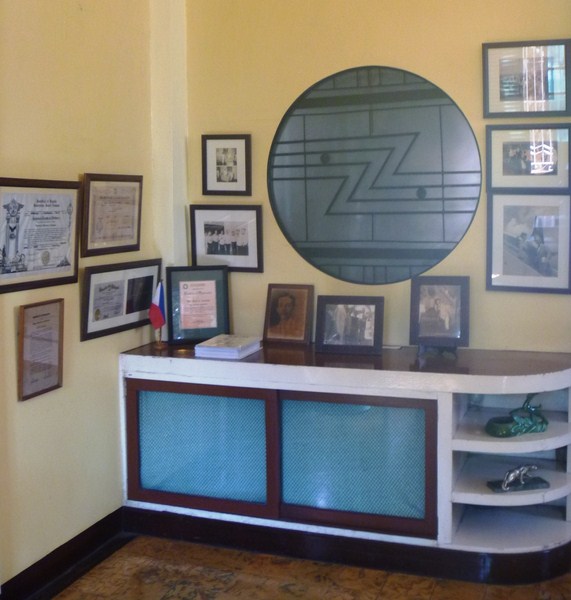
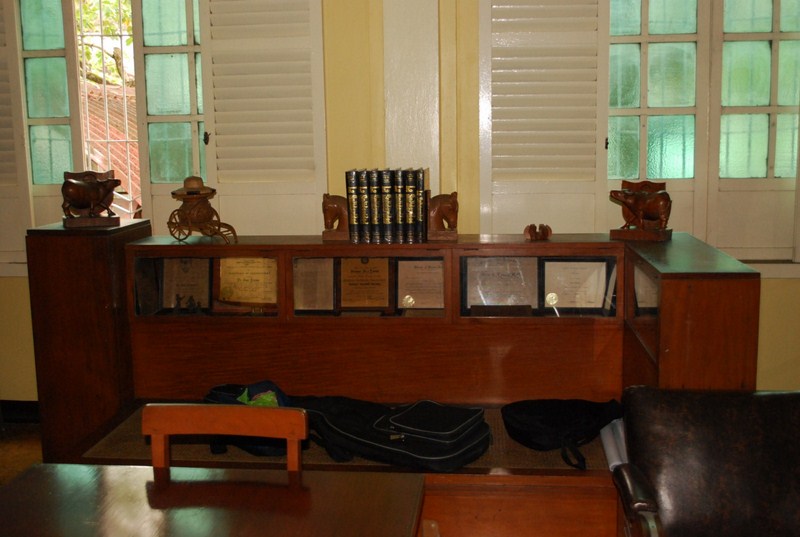
From St. Augustine Church, we proceeded to the 3-storey Sir Robert Ho Tung Library.  Built before 1894, it was originally the residence of Dona Carolina Cunha. Hong Kong businessman Sir Robert Ho Tung purchased it in 1918, using it as his retreat until his relocation to Macau during World War II when Hong Kong fell into the hands of the Japanese in 1941.

Sir Robert Ho Tung Library

He passed away in 1955 and in accordance with his will, the building was presented to the Macao Government for conversion into a public library.  In 1958, the Sir Robert Ho Tung Library was officially opened  to the general public.

Sir Robert Ho Tung Library – Facade

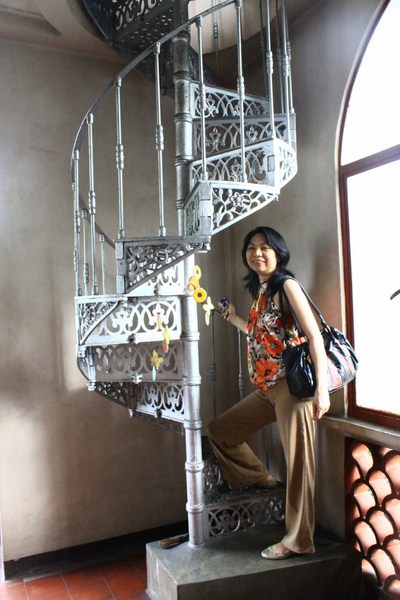
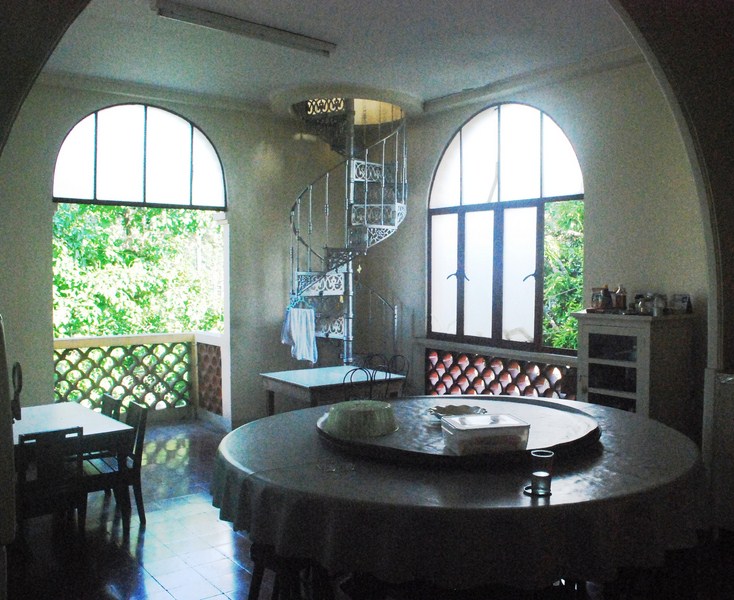
This Macanese mansion has 5 interconnecting corridors on the ground floor, while the 2 upper layers are decorated with 5 arched-windows. Its arcaded facade, decorated with pilasters and Ionic columns, is highlighted in white stucco against yellow plastered walls, with molding running along the facade’s width. The roof dome, with 4 ridges, is built in red bricks. The library’s intricate steel gate and arches open to the St Augustine Square and the St Joseph Seminary.

Seminary of St. Joseph

In 2005, a new MOP20 million, 4-storey building was constructed near the back garden of the mansion, making the now 30,000 sq. m. library the biggest public library in Macau.  The library displays historical archives and ancient literature. At the second level, the Ho Sir Literature Archive provides 16 various categories of ancient literature and books on Chinese history and Catholicism, including the compendium of Weng Fang Gang’s Siku Tiyao (Complete Library of the Four Treasures) which constitues a large collection of books on Chinese history.

St. Augustine’s Church (Macau)

From Dom Pedro V Theater, we walked further up the square to St. Augustine’s Church, part of a monastery founded in 1586 by Spanish Augustinians, was rebuilt in 1828. The facade was originally of the Baroque style but the existing facade, dating from 1814, is more Neo-Classic. This church maintains the tradition of organizing one of the most popular processions through the city, the Easter Procession, with thousands of devotees..

St. Augustine’s Church

Its normal (10:30 AM in Tagalog and 4:30 PM in English) Sunday religious service takes into account an especially strong participation from Macau’s large Filipino community. The church has a simple, Neo-Classical facade which contrasts with the elaborate decoration of the interior nave, chancel and service area. The main entrance, flanked by 2 pairs of granite Doric columns, has windows framed with simple white relief plasterwork and a triangular pediment, on the top, with a centrally located niche with statue of the Virgin Mary.

St. Augustine’s Church – Interior

The nave is divided into 3 sections by 2 rows of archways supported on Corinthian-inspired columns. The wooden ceiling over the nave is decorated with paintings, mostly over the main altar area. There are small side altars and niches following up to the main altar, with some decorative details that display a Baroque influence. Over the main entrance there is a choir that extends to the side walls, forming a narrow balcony, a design similar to that of the Church of St. Dominic’s.

St. Augustine’s Church – High Altar

St Augustine Church’s marble-clad high altar contains a statue of Christ carrying the cross, Our Lord of the Passion (Nosso Senhor dos Passos)

Dom Pedro V Theater (Macau)

From Largo de Leal Senado, Jandy, Cheska and I walked all the way to Augustine’s Square (Largo de Santo Agontinho), site of various classified buildings such as St. Augustine’s Church, Dom Pedro V Theater, St. Joseph’s Seminary and Sir Robert Ho Tung Library. Its cobblestone pavement unifies the area and reflects a traditionally Portuguese streetscape.

St. Augustine’s Square

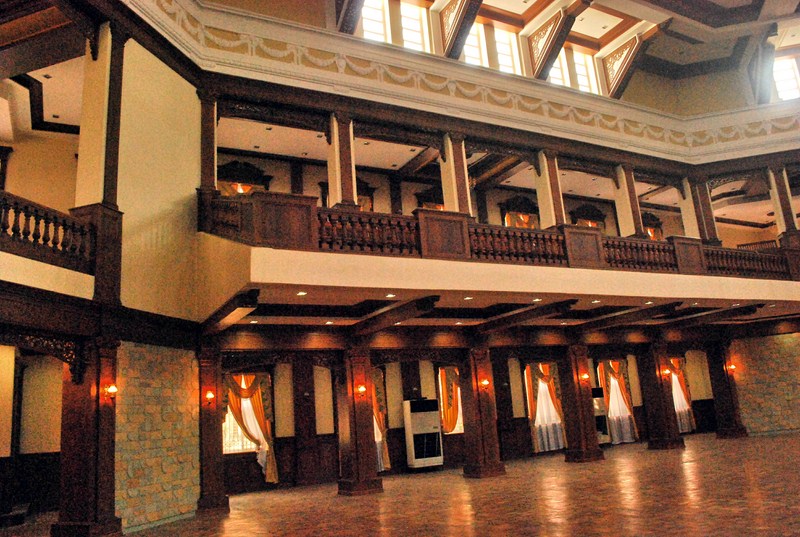
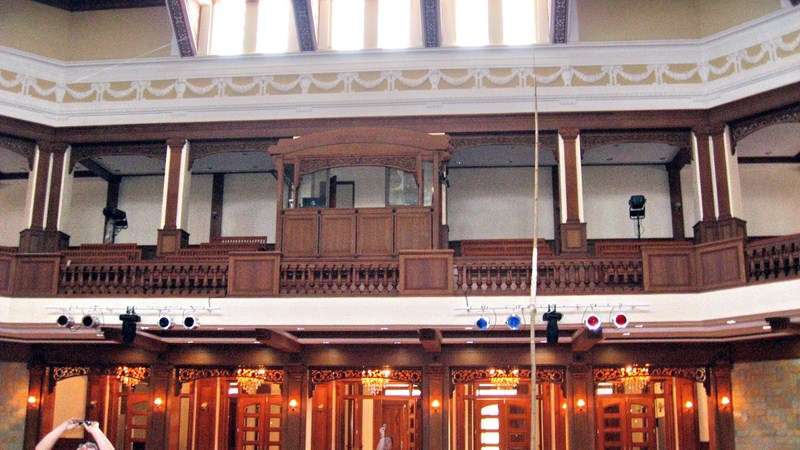
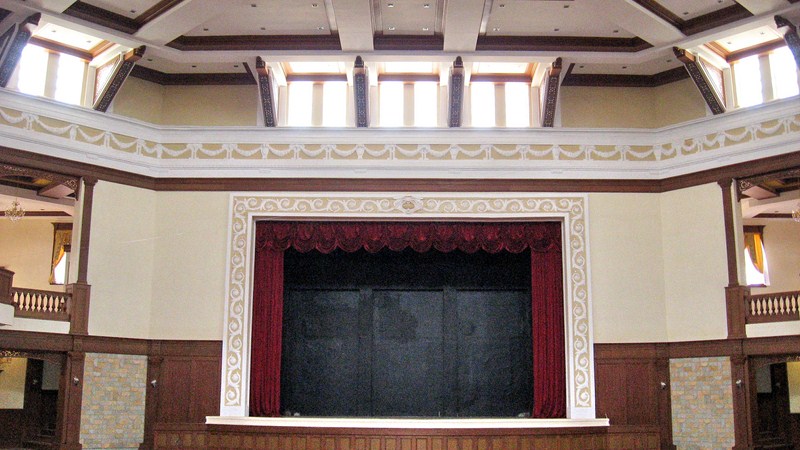
We first visited the Dom Pedro V Theater, built in 1860 and renovated in 1873.  The first Western-style theater in China, today it is one of the most important cultural landmarks in the context of the local Macanese community and is a venue for important public events and celebrations that remains in use to this day. The Dom Pedro V Theater is Neo-Classical in design, incorporating a portico front on a rectilinear plan.

Dom Pedro V Theater

The facade is topped with a triangular pediment supported on 4 sets of Ionic columns. Three archways, each measuring 3 m. wide by 6 m. high, rise on pedestals resting on granite steps. The ornamentation on the green stucco facade is relatively restrained, with festoons above the arches and simple floral patterns around frames accentuated in white plaster. Similarly the cornice and architrave mouldings are highlighted in white, in contrast with the building.

Dom Pedro V Theater – Facade

Leal Senado Building (Macau)

From Largo de Leal Senado Square, we crossed Almeida Ribeiro Ave. to the Neo-Classical Leal Senado Building, now the Civic and Municipal Affairs Bureau.  Originally built in 1784 , this building was Macau’s first municipal chamber, a function it maintains to the present.  Severely damaged by a typhoon in 1874, it  underwent major renovation work in 1876. In 1887, the building’s roof was repaired and, in 1904, the building underwent extensive renovation, adapting it to more functional uses.  In 1936, it was again damaged by a typhoon and restoration work began in 1938 and was completed in 1940.

Civic and Municipal Affairs Bureau (Leal Senado Building)

The Leal Senado Building has retained all its original master walls and primary layout, including the courtyard garden in the back. The main facade is 14.5 m. high and 44 m. wide and is divided into 3 sections by vertical granite projections. The central section of the main façade juts out slightly from the rest of the building and is topped by a triangular pediment which, at its highest point, is 17 m. above the ground. Granite Doric columns, supporting lintels made of the same material, flank the main entrance.

Some of the Leal Senado Building’s Row of Windows

The building’s rows of windows, in simple Renaissance style with granite casings and following a repetitive rhythmic pattern, are the the main architectural element and decorative feature of the completely symmetrical facade.  In the middle section, there are 3 French windows on the first floor, opening out to balconies with iron railings.

The Leal Senado Building’s Courtyard

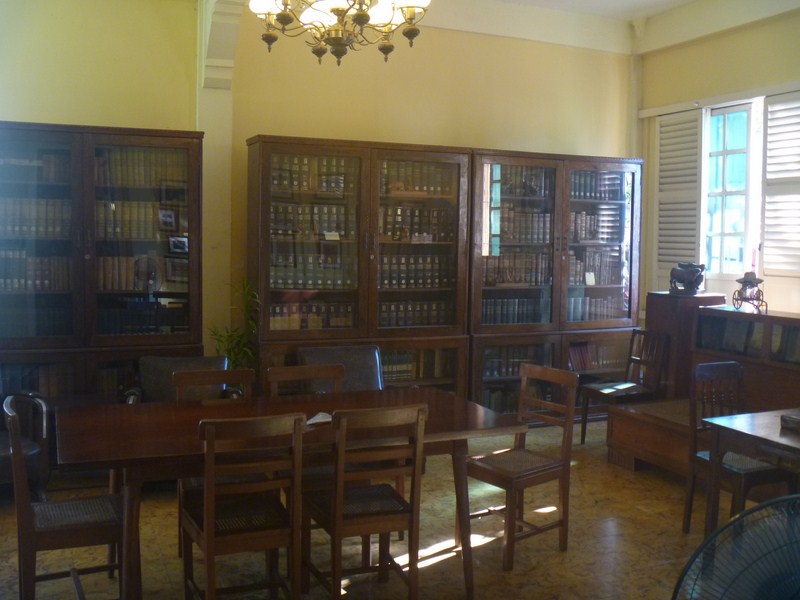
Inside the first floor of this U-shaped building, its arms turning away from Almeida Ribeiro Ave., are a spacious lobby used for public exhibitions, a reception area, a ceremonial meeting room that opens onto an elaborate carved library (styled after the library of Mafra Convent in Portugal) and a small chapel.

The Courtyard Fountain with 2 Heads

Walls covered with blue and white Portuguese ceramic tiles, a most distinctive feature rarely found in other buildings in Macao, flank the granite staircase, the central axis of the building. The building is painted white which enhances the dark green color of the window frames and the main entrance door.