Loboc River Cruise (Bohol)

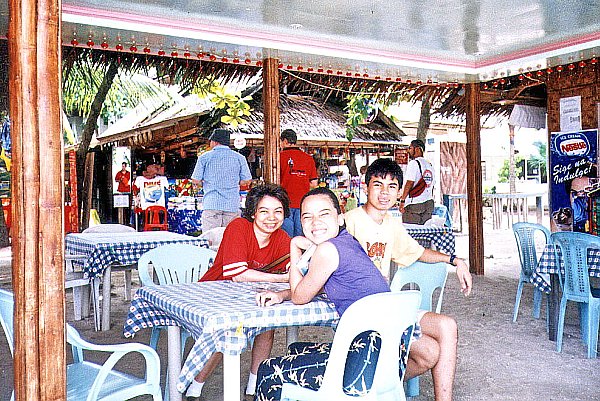
After our short bonding with the tarsiers and my church visit, we all returned to the dock where our double-hulled, flower-bedecked floating restaurant was now waiting for us.  The restaurant has 4 long tables, 8 benches, kitchen, mini-bar and comfort room and is pushed along the river by a motorized boat.   We started our cruise from Loay Bridge. Cruising along, we dined on grilled pork or fish, fried shrimps or steamed crabs, all with chopped tomatoes and onions on the side; pansit plus other native fare, all served with generous servings of pandan-scented rice on wooden plates lined with banana leaves.  We washed these all down with either ice-cold soft drinks or the much healthier buko juice.   

Loboc River Cruise

The idyllic rural scenery is also a visual treat.  Along the way we observed heartwarming daily activities like mothers washing clothes and children bathing nude or diving from coconut trees bent precariously close to the water.  We also passed returning floating restaurants and small native outriggers loaded with passengers.  The endpoint of our 2-km.  cruise was Busay (or Tontonan) Waterfalls.  The falls drops 15 m. in 2 stages and is used to generate electricity for the town.   Here, we dropped anchor and guests were given the option to go for a quick, cool swim or just continue chatting or dining.  We just did the latter.  After about 30 mins., the boat made the return trip back to Loboc.   

Busay Falls

Church of St. Peter the Apostle (Loboc, Bohol)

On my own, I made a short visit to Loboc’s Church of St. Peter the Apostle, listed by the National Museum as a National Cultural Treasure.  Built in 1602 by Fr. de Torres, it is the second oldest church in Bohol.  The present church was built in 1734. 

Church of St. Peter the Apostle

Inside are remarkable nave paintings done (from May 1926 to July 1927) on the walls and ceiling by three artists (Canuto Avila and son Ricardo, Ray Francia), the biggest number of murals on religious subjects.  The ceiling was retouched in 1995 by Cris Naparota.   It also has a Neo-Gothic pulpit with a late 19th century sounding board (portavoz) and 5 retablos between the transept and sacristy. 

Bell Tower

Outside the church, near the riverbank, is the separate 21-m. high, 4-storey octagonal stone bell tower, built after 1768.   It has 7 bells, the oldest dated 1863 and 2 others dated 1914 and 1937.  The tower also has a large wooden matraca (a cranked noisemaker) dated 1899 and a clock from Altonaga Co., acquired through public subscription and installed in 1893.   The bell tower was almost destroyed during the construction of the unfinished Loay Bridge, a folly of the Marcos era which was supposed to be part of an elevated expressway just across the road.  Timely objection by the Lobocanons prevented its destruction.  The project was discontinued. 

Bonding with the Tarsier (Loboc, Bohol)

Bonding with a tarsier

After our tour of Chocolate Hills, we retraced our way back south to the town of Loboc where we were to take a buffet lunch on board 1 of 5 floating restaurants as we took a 30-min. cruise along the scenic, palm-fringed Loboc River.   While waiting for our boat to arrive, we made a visit to nearby Pedboy’s Place for an unusual bonding (and pictorial) with another Bohol favorite: the tarsier (Tarsius syrichta).  If there was an animal that could be fittingly be called Bohol’s mascot, the tarsier would be it.   Jandy and Cheska, as well as their cousins Gelo and Matthew, enjoyed having their pictures taken with cute and furry creatures on their head, shoulders and arms.  The adults, including Mike, followed suit, but Grace begged off .

Author’s Notes

Days after our Bohol trip, I got to thinking, “What are these nocturnal, forest-loving tarsiers doing out here in the daytime and in an urban setting?”  The tarsier is now endangered because of the destruction of its forest habitat, predation by house cats and illegal hunting of tarsiers for pets or trade.     It is my hope that the display of this truly delightful, but now captive, primate does more good than harm.  Maybe it would open the eyes of visitors to the sorry plight of this endangered species.  Or maybe not…
Pedboy’s Place: Loboc, Bohol.

Chocolate Hills (Bohol)

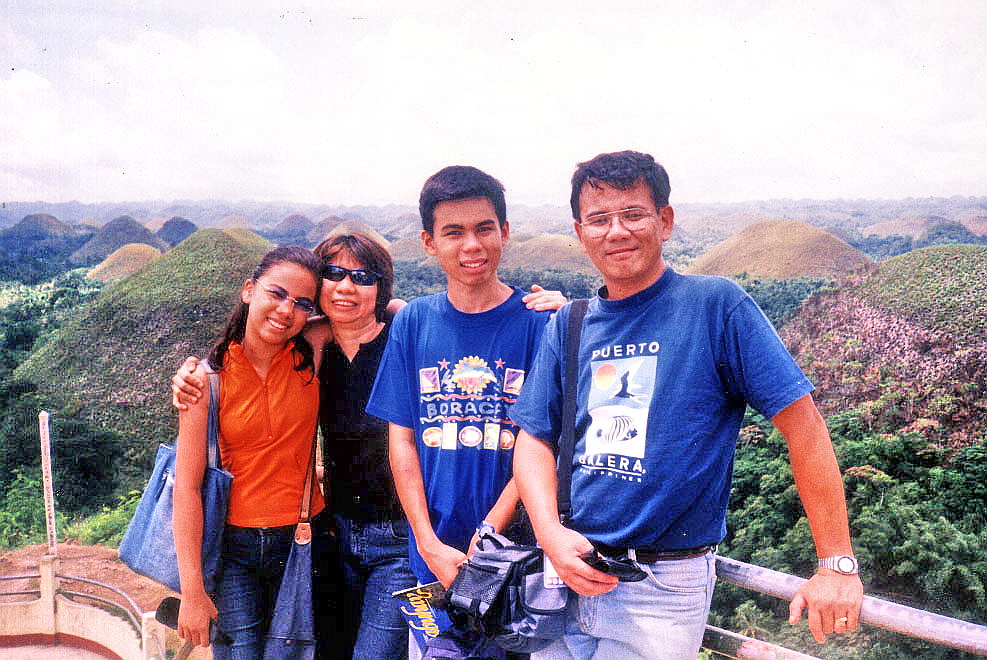
From Baclayon, we proceeded to the junction town of Loay and, from there, traveled up north to the town of Carmen and the Chocolate Hills, a destination truly synonymous with the province.  Along the way, we passed some of Bohol’s wonderful scenery, including a man-made forest of mahogany trees in Bilar standing in perfect symmetry along the road leading to Carmen.  Upon arrival at the complex, we ascended 213 concrete steps to reach the observation deck, the hill’s main vantage point.  Early morning and late afternoon (to watch the setting sun) are said to be the best times for photographing this strange and mysterious landscape.  You can also hike between the hills.

Chocolate Hills

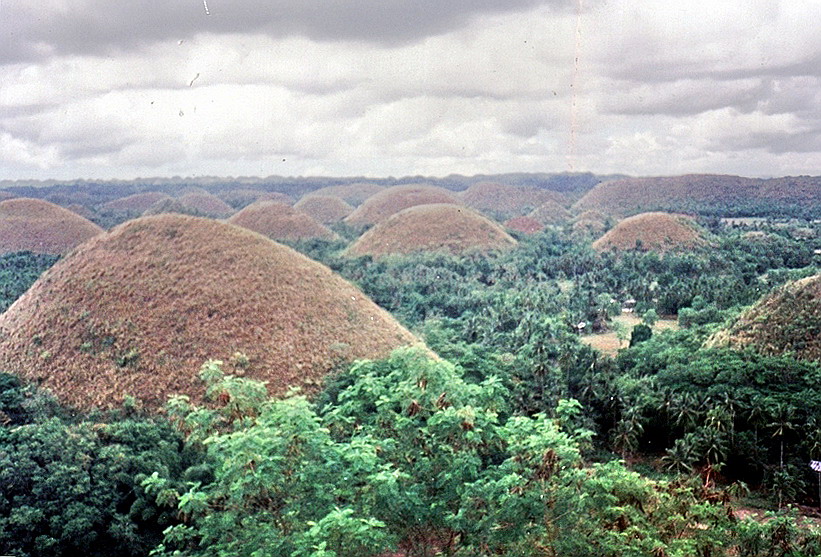
This 14,145-hectare Philippine National Geological Monument consists of 1,268 grass-covered, cone-shaped “haycock” hills, a broad, half-kilometer high upland plateau irregularly distributed among the towns of Carmen, Sagbayan and Sierra-Bullones in the east central part of the island.  Formed of sedimentary limestone, shale and sandstone, these 30 to 120-m.  high, beautifully arranged and symmetrically formed hills look like droplets of Hershey’s chocolate, thus their rather sumptuous name.  They also look a delectable chocolate brown during the dry months of April and May, before turning a deep shade of green during the rainy season. 

Church of La Purisima Concepcion de la Virgen Maria (Baclayon, Bohol)

Church of La Purisima Concepcion de la Virgen Maria

We had just finished unloading our luggage and were savoring our welcome drink at our resort when our tourist van arrived to pick us up.  Barely catching our breath, we were again on the move as we had to compress a tight, pre-arranged sightseeing tour around Bohol within the day.   The province has a quite efficient road system with concrete roads encircling the province and traversing the land from Trinidad on the north and Loay in the south.  Besides this, second-class roads also connect the other towns, thereby completing a truly serviceable transportation network.  Touring the island is thus a breeze since travelers can start practically anywhere.  From Panglao, we again crossed the bridge to Tagbilaran City.  About 3 kms. out of the city, we made a photo op stopover at the Blood Compact Site at Brgy.  Bool, the site of the blood compact between Spaniard Miguel Lopez de Legaspi and Rajah Sikatuna on March 16, 1565.

The Blood Compact Site

Our first real stop was at the town of Baclayon were we visited the Church of La Purisima Concepcion de la Virgen Maria, one of the best examples of Philippine Baroque combined with Western and Eastern influences.  Reputed to be the oldest church in the country, it was first built by the Jesuit Frs.  Juan de Torres and Gabriel Sanchez in 1595.  The present coral stone church was built in 1727. The church’s simple Early Renaissance facade has a 21-m. high, massive square bell tower (now connected to the church by a portico-façade installed in 1875), a fine porch and massive stone piers (in which some of the town’s priests are entombed.   Inside are an intricately carved, gilded altar and icons plus two side retablos, all dating back to the Jesuit era.  It also has a pipe organ installed in 1824.  The pulpit, installed in 1870, is located at the epistle corner.  The floor’s glazed tiles were installed in 1875 after the completion of the portico. 

Panglao Island (Bohol)

Alona Beach

We all left Cebu City very early in the morning of May 24 via an Oceanjet fast ferry for Tagbilaran City, Bohol’s capital and route center.  Upon arrival at the city’s wharf, we motored, via taxi, to Panglao Island which is connected to the mainland via 2 bridges. The older Taytay Bridge, near the City Hall, goes to Panglao (18.1 kms. away) while the Gov. Jacinto Borja Bridge, located 2 kms. southeast, connects the city’s Bool District with Dauis (3.1 kms. away).  The flat 98.4 sq. km., coralline limestone Panglao Island is located south of the city.    

Lost Horizon Beach Resort

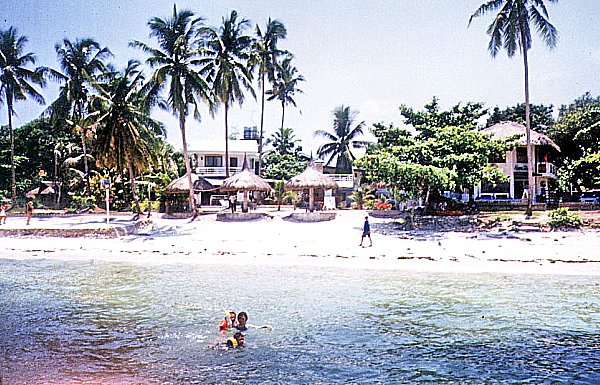
We booked ourselves at an airconditioned room with bath and cable TV at Lost Horizon Beach Resort along Alona Beach.  The resort also has fan-cooled rooms with bath or common bath, a restaurant, swimming pool and a bar.   Alona Beach is one of Panglao Island’s 4 beaches, all of them white sand.  The  other beaches are the 1.2-km. long, pretty shallow Doljo Beach (located between rocky promontories); Dumaluan Beach along the east coast; and Momo Beach on a quiet cove on the west side. 

At Trudie’s Place

The sand off these beaches, although not as fine as that in Boracay, is just as white.  A fact, known only by a few people, is that many white sand beaches on Mactan Island in neighboring Cebu are covered by sand imported from Bohol, including Panglao.  Alona Beach, on the southeast side, is the most beautiful, most popular and, tourist-wise, the most developed beach of the four on the island. This beach, located in Brgy. Tawala, is said to have been named after Alona Alegre, the bomba star of the 1970s whom people say romped naked here during a film shoot.  It has a number of small, individually-designed beach resorts, restaurants, beach bars and dive shops, all spread along the beach for about 1.5 kms..  This attractive, white sand beach is good for snorkeling.  It is, however, clogged with seaweed growing in knee-deep waters, especially between December and March.    

Lost Horizon Beach Resort: Brgy. Tawala, Alona Beach, Panglao, Bohol.  Tel: (038) 502-9099 & 502-9088.  Cebu City booking office: fax: (032) 232-4893. Website: www.losthorizonresort-bohol.com.

A Family Trip to Cebu and Bohol

The children’s summer vacation was about to end and we didn’t want to end without us going on an out-of-town trip.  My brother-in-law Mark also had the same thing in mind so we decided to stay overnight Cebu City (where Mark had some business to attend to), then cross over to Bohol for some real bonding time with our families.  Aside from my wife Grace and kids Jandy and Cheska, rounding up the group were Mark’s wife Nenette, their two kids Miguel and Matthew and their Malaysian friend Michael Chang.

We all took a 1-hour Philippine Airlines flight to Mactan International Airport where we all picked up by our travel agent and brought to the Waterfront Cebu City Hotel & Casino.  Here, we checked in at 3 of the hotel’s 562 (the biggest hotel in the country with regards to number of rooms) rooms.

Check out “Hotel and Inn Review:  Waterfront Cebu City Hotel & Casino

Waterfront Cebu City Hotel & Casino

Waterfront Cebu City Hotel & Casino:
 1 Salinas Drive, Lahug District, Cebu City, Cebu. Tel: (032) 232-6888. Fax: (032) 232-6880.  E-mail: wcch@waterfronthotels.com.  Website: www.waterfronthotels.net.  Manila booking office: 27/F, Wynsum Corporate Plaza, 22 Emerald Ave., Ortigas Center in Pasig City.   Tel: 687-0888.    Fax: 687-5970 & 687-5973-74.  E-mail: msro@waterfronthotel.comand wpi@the.net.ph.  Website: www.waterfronthotel.com.ph.

Puno ng Pandil (Morong, Bataan)

The next day, Saturday, was family day and what better way to spend than a day of swimming at the beach.  However, the nearby beach was heavily-crowded with Holy Week revelers and so we decided to look for our own secluded spot by hiring a motorized banca for this purpose.  The long stretch of black sand beach was lined with a number of beach resorts, notable of which are the upscale Strand and Waterfront Resort.

Puno ng Pandil

There are also a number of private beachfront residences.  Just when we thought we would never find our own private cove, we espied the picture-perfect and postcard-pretty scene of an unusually white sand beach backed up by a sugar loaf mountain.  Locally called Puno ng Pandil, we finally found our own private nook.  Here, we swam to our heart’s delight with the cool feel of the white sand beneath our feet.  It was truly something worth returning to.

Hike to Pintong Alipi Falls (Morong, Bataan)

Morong River

We arrived at Sitio Kanawan in Brgy. Binaritan by 11 AM. A very short hike led us to a pastoral scene of the moderately flowing Morong River fringed on both banks by dense forest and crossed by a hanging bridge of wood planks and steel cables.  Two in our party went ahead to prepare lunch at the Aeta Resettlement Area.  We, however, couldn’t and didn’t resist a cool dip at the river’s inviting waters.  That done, we crossed the bridge and proceeded, along a well-marked trail, toward Kanawan, pausing only to rest at Mang Kit’s mango tree farm.  Kanawan’s 147 households have a mixed population of lowlanders or unat (meaning “straight-haired”) and resettled Aetas or kulot (meaning “kinky-haired”).  The Mt. Pinatubo-displaced Aetas were resettled there in 1987 (through Pres. Corazon Aquino’s Proclamation No. 129) and an Aeta kapitana (captain) currently heads the village.  Every 5 May, the Aetas perform a kabikin or marriage ritual.

Hanging bridge

We arrived at the village just in time for a tinolang manok lunch.  This we attacked with gusto, and justly so as we would need the energy to tackle the long hike ahead.  Laden with water containers, we also secured the services of 48-year old Mr. Iglezerdo “Guilling” Alejo of Task Force Kalikasan as our guide.  After a short hike through rice paddies, our band soon entered the cooling shade of the dense forest.  And dense it really was as about 70% of Morong town is included in the SBMA reservation, with 9,694 hectares identified as watershed primary growth forest area.

The trek begins …..

The hike, through an often well-marked trail strewn with dried leaves and rocks, entailed some dry streambed crossings and quite steep and strenuous mountain climbing.  At the end of this very tiring, almost three-hour hike was the rewarding vista of the well-hidden, 80-foot high Pintong Alipi Falls which is fed by numerous springs sweeping along the mountain.  We relaxed our visibly tired bodies at the cool, refreshing waters of the fall’s shallow pool, as well as enjoyed a back massage underneath the falls itself.  It was truly worth the long hike.

Pintong Alipi Falls

Recharged, we began our return trek to Kanawan, meeting two Aetas gathering honey along the way.  We arrived by 5:30 PM.  After a short rest and some sustenance, we groped our way back to our jeep, our path lit by flashlights.  Our progress back to the town was somewhat stalled by the Good Friday parade of carrozas.   Instead of fretting, we just curiously watched the parade pass us by.  Back at Mang Kit’s house, we hungrily gorged ourselves at supper.  I was just too spent to even walk the short distance back to Vener’s house, collapsing instead to a blissful sleep at Mang Kit’s living room sofa.

Bataan’s Vietnamese Connection

It being Good Friday, we fittingly made plans for a self-imposed, late afternoon Calvary-like hike, up Mt. Agalis, to the remote Pintong Alipi Falls.  Bienvenido “Kit” Nazareno, Vener’s 55-year old uncle, volunteered to drive and accompany us there.  The 30-min. jeepney trip to the jump-off point included passing by the 380-hectare, Subic Bay Metropolitan Authority (SBMA)-managed Bataan Technology Park in Brgy. Sabang. Now being developed as the “Silicon Valley of the Philippines,” this place used to have a humanitarian beginning, it being the former site of the Refugee Processing Center (PRPC), a refugee processing camp for Vietnamese “boat people.”  

A Vietnamese relic at Bataan Technology Park

It was said that the PRPC was among the most comfortable refugee camps in the world.  No barbwire fences and no border soldiers to accost the refugees coming in and out of the camp.  Set up in 1979 under the United States Repatriation Program, it served as a temporary home and transit center for the relocation of Indo-Chinese refugees (Vietnamese, Khmers and Laotians) victimized by the American war in Southeast Asia.  Here, they were trained in English, American history and vocational skills.  The center housed 18,000 refugees at one time and more than 100,000 have passed through here.

Remains of the first Vietnamese refugee boat

Today, the PRPC is no more as it was closed in 1994.  All we saw during transit was a shrine and the rotting remains of the first refugee boat to arrive there.  Vietnamese cuisine, however, has left an imprint in the town.  Near the town hall is a store serving hu-thieu, a soup concoction consisting of sotanghon noodles, sliced hard-boiled eggs, spices and bean sprouts.  We sample this before we departed Morong for Manila.  We, however, missed out on the bun-mi, another Vietnamese-inspired favorite which consists of grilled bun stuffed with pipino, tomatoes, onions and sliced meat with spices, mustard and mayonnaise added.