A Calesa Tour of Intramuros (Manila)

After Jandy and I finished touring Fort Santiago and its Rizal Shrine, a calesawas waiting outside for us.  During our absence, my daughter Cheska, always the adventurer, took a fancy for a ride in that horse-pulled contraction and was able to convince Grace to hire one (for PhP200).

It surprised me that the 4 of us were able to fit in a carriage with a backseat made to seat just 2 passengers comfortably.  Jandy and later Cheska took turns on the driver’s seat.  Our driver, Boy Javier, rode shotgun.  Grace and I, plus one of our kids, just managed to squeeze (or should I say contort) ourselves at the back.  We all took it good-naturedly and proceeded in high spirits on our nostalgic 1-hour tour which took us from the fort to Manila Cathedral, Plazuela de Sta. Isabel, San Agustin Church, around the walls and gates of Intramuros and back.  Boy, quite familiar with Intramuros’ history, acted as our tourist guide.

During the Spanish era, Intramuros was breached by eight main gates or puertas: Aduana (Pasig River), Almacenes, Isabel II (Pasig River), Sta. Lucia (Manila Bay), Sto. Domingo, Parian (landward), Postigo del Palacio (Manila Bay) and Real (landward).  The last three were main gates of the original 16th century fortifications. When the Americans took over the 67-hectare walled city, two of the eight gates, Aduana and Almacenes, were torn town to make way for wharves, warehouses and vehicular access. 


The Postigo del Palacio, along Calle Postigo (from the Spanish word meaning “door latch”), was built in 1783 and was the private gate of both the archbishop and the governor-general, who would use it whenever they wanted to enter or leave the city incognito.  Our National Hero Jose Rizal was led to his December 30, 1896 execution through this gate from his cell in Fort Santiago.


The Puerto Real (Royal Gate), built in 1663, was the gate reserved for the governor for his stately entrance or exit.  It was originally located at Calle Real del Palacio (now Gen. Luna St.), at the right side of Baluarte de San Diego facing Bagumbayan.  It was destroyed during the British invasion of 1762.  Later, it was transferred from to its present site along Muralla St. and was made narrower and lower.  Civil and religious parades that used to pass the old gate were later rerouted to Puerto del Parian.  Two spiral staircases lead to the ramparts.  Its interior holds a collection of church silver.  Musical performances take place in the Puerto Real Gardens.

Puerta del Parian, the official gate of the governor after the British invasion, links the city with the bustling Chinese ghetto (Parian de Arroceros, one of Intramuros’ earliest concentrations of Chinese merchants) outside the walls. 


Puerto de Isabel II, at Magallanes Drive, diagonally across the Bureau of Immigration, was built as a storage arsenal and was the last gate built by the Spaniards in Intramuros.  Opened in 1861 to ease the traffic between Intramuros and Binondo, flanking it are vaulted chambers which served as soldiers’ barracks and arsenals for storing munitions.  A bronze statue of Queen Isabel, which once stood in front of Malate Church, was unveiled in 1860 at Plaza Arroceros (now Liwasang Bonifacio) but was moved next to the restored gate for the 1975 state visit of Prince (and later King) Juan Carlos de Bourbon of Spain.  Today, its vaulted chambers house a series of seven restaurants and cafes: Aposento, Café Provencal, Capone Bistro, E-hive, Pancake House, Starbucks Café and Tamayo Café.  The open area outside are reserved for chairs and tables.
Puerto de Santa Lucia, built in the 18th century, has two side chambers.  One chamber has steps leading to a dungeon-like cell that served as a septic tank.  The gate led directly to Malecon Drive, a popular promenade ground, through an excavated and restored cobblestone bridge.

  
Intramuros had a total of 10 bulwarks or baluartes : six of which were in Intramuros proper (Dilao, San Andres, San Diego, San Gabriel, Sta. Lucia and Sto. Domingo) and the rest in Fort Santiago.  Three ravelins or revellins (Bagumbayan, Parian and Recoletos), four mini-bulwarks or baluartillos (San Eugenio, San Francisco, San Juan and San Jose) as well as two redoubts or  reductos (San Francisco and San Pedro), were added to strengthen weak areas and serve as outer defenses


Baluarte de San Gabriel, once Intramuros’ most important defense to the north, faced the settlements of San Gabriel and Parian, both heavily populated by Chinese merchants, traders and transients.  After the British invasion of 1762, its bulwarks were renovated by Spanish Engineer Miguel Antonio Gomez to strengthen its defense.


Baluarte de San Andres, formerly known as Baluarte de San Nicolas y Carranza, still has its original lookout tower (logarita), bombproof powder magazine (built in 1733, it contains military artifacts on display), stable house, drainage and foundation.  A reconstructed guardhouse overlooks the powder magazine.    Today, there are 3 commercial establishments within it: Mas y Mas Music Lounge (opened July 28, 2000) at the far end, Creole Café inside the powder magazine and Ciudad Fernandina (opened December 1999) at the site of the former stable house.

Baluarte de Dilao was also called at different times as San Lorenzo, San Francisco de Dila, San Fernando de Dilao or simply Dilao (after the Japanese suburb it faced across the moat).  Part of the original fortification of Intramuros in 1592, it was constructed to reinforce the intermediate space of the walls between Parian and Real called frente de tierra.  Reduced to rubble during World War II, its reconstruction in 1984 was based on the original 1773 plans of Engr. Dionisio O’Kelly.


Baluarte de San Diego was known as the Fundicion or foundry.  The noted blacksmith, Panday Pira (who built the six lantakas or bronze cannons of Sulayman’s bamboo-palisaded fort), forged cannons for the Spanish at the site.   It was the only bulwark facing the sea (although part of it has now been reclaimed and is now the Port Area) and was built and designed by Jesuit Fr. Antonio Sedeno from 1586 to 1587 as a circular fort called Nuestra Senora de Guia, the first stone fort of Manila.  It was renovated in 1593 to join the walls of the city.  The old fort was of poor quality and it soon fell into disrepair.  In 1979, high walls of three concentric circles were discovered and excavated, part of the original fort’s round tower.  In 1644, construction of the present baluartewas started and was completed between 1653 and 1663.  This subterranean arsenal storage also served as dungeons for the Spanish military’s prisoners.   Shaped like an ace of spades it was formerly covered with a big mound of earth. Its walls were breached by the British cannon fire in 1762.  After the British occupation, its walls were restored and strengthened.  It was again damaged during the 1863 earthquake and destroyed in 1945 during the liberation of Manila.  It was again restored from 1979-92 after the archaeological excavation of the old fort.
       
Both are now major attractions in Intramuros.  It being so, we all made a stopover here.  Preparations for a wedding were then in progress, with the ceremonies to be held at the left of the entry and the reception at the right.  The old fort was accessible via a spiral stone stairway.  From the bulwark, we had a bird’s eye view of the city as well as the 18-hole Club Intramuros golf course.  The old fort is close after 6 P.M. to discourage lovers’ trysts.  


Ravellin de Recoletoswas so named because of its proximity to the Agustinian Recollect Church.  It served as defense to fill the gap between Baluarte de San Andres and Baluarte de Dilao.  The original entrance was sealed off and a new one opened in 1941 to make way for new Victoria St..  It is now converted into the Aurora Gardens (named after the late wife of Commonwealth Pres. Manuel L. Quezon).

       
Revellin de Real de Bagumbayan, also built in 1663, was used as prison cells during the American period and was later converted into the Manila Aquarium just before World War II.  During the Japanese Occupation, it was used as barracks and was damaged during the liberation of Manila in 1945.  It was restored in 1969 and additional works were done in 1982. The Manila Aquarium was maintained until its closure in 1983.  It was reopened in 1990 with the name Acuario de Manila.  It has an impressive collection of Philippine fishes on display.  The moat that separated it from the gate is now a garden of tropical greens and coconut palms.  It serves as a venue for performing art presentations.   
     
Revellin del Parian, the defensive bastion or outwork of Puerto Parian, was named after the Parian de Arroceros across which lived the Chinese living outside across the moat. It was built in 1603 soon after the Chinese uprising (October 3, 1603, St. Francis Day) and its cannons were hereafter aimed at them. The ravelin was used as a defense line between the curtain walls of Baluarte de San Andresand the Parian Gate.  Its vaulted chambers were built in 1739 to house soldiers and military supplies.  The entire defense works were completed in 1782 and it was restored, after World War II damage, from 1967-82.       Archaeological excavations of the site yielded 17th century artifacts and Japanese Occupation mass graveyards.  Some of the gruesome World War II findings include finger bones clutching an unexploded grenade or clinging to a rusty bayonet.
       
Baluartillo de San Jose, known as “No. 1 Victoria Street”, served as Gen. Douglas MacArthur’s headquarters in 1941.  A tunnel-like passage built in with a drainage canal emptying out into the moat, its primary use was to transport ammunition to Reducto de San Pedro.

       
Reducto de San Pedrois an independent pentagonal structure built outside the walls.  A powder magazine during Spanish times, it had its own stockpile of cannon balls deposited in recessed ledges at the entrance.  A ramp on one side of the structure leading to the parapet made their transport easier.  Gun emplacements looked out.  During the pre-World War II period, it was an office of the USAFFE.        

During our tour, Grace and I could not help but notice the proliferation of fine-dining restaurants and cafes inside portions of the ancient walls, vaulted chambers and some fortifications, notably at Baluarte de San Andres and Puerta de Isabel II, all built in the name of “adaptive re-use,” a concept wherein the past is adapted to keep it as a living part of its newer environs.  Here, the argument between conservationists (notably the Heritage Conservation Society, an NGO) and the Intramuros Administration.  The first is  concerned by this commercial invasion of Intramuros’ past while the latter concerned with the task of preserving it by any and all means.      In these days of national budget deficits and cuts and the Asian financial crisis, economic imperatives have necessarily come into the picture.  A great deal of funding is needed in the restoration and preservation (and later, the operation) of historic sites such as Intramuros.  That is a given.   On one side of the coin, the IA is hoping that revenues earned from these restaurant and café endeavors would help in the economic revitalization of Intramuros by creating new jobs, promoting heritage tourism, increasing the area’s property value and, in the long run, attracting new investments.  In short, they are hoping that this economic base will eventually support Intramuros’ preservation.  “Revitalized” historical districts usually cited include Clarke Quay in Singapore, Covent Garden in London and the Cartagena de Indias Fortifications in Colombia.     On the other side of the coin, conservationists and moralists are concerned that these new constructions will violate the IA charter by debasing the structural integrity of the historic walls.  The IA charter states that “all walls, fortifications and gates are special zones subject to specific rules and regulations regarding allowable and prohibited uses, specific building requirements and architectural standards”.   They also contend that these restaurants and cafes endanger Intramuros’ unique historical atmosphere as well as damage the morals of students studying in the nearby schools and universities.     As architects, Grace and I are doubly concerned with how these new commercial developments may compromise Intramuros’ structural, as well as, aesthetic integrity.  Just the same, we are also pragmatists who believe, especially in these days of economic uncertainty, that these are viable ways of making restoration and preservation pay for itself.     However, it is our hope that, with proper monitoring of building regulations and violations, a compromise might be struck between the two sides.  

Revisiting Fort Santiago (Manila)

After our lunch at Toho Restaurant in Chinatown, Grace, Jandy, Cheska, Dad, Mom and I drove to Intramuros and parked the car at Fort Santiagojust across the Manila Cathedral.  Being a weekend, there was a steady stream of visitors, including foreigners, all strolling leisurely. With Jandy, I planned to revisit the fort, our last visit being  way back March 1, 1993 when Jandy was just 6 years old.   

Upon entry, we were ushered into the well-kept Plaza Moriones, a public promenade that was fenced off by the Spanish military in 1864.   It now has beautiful landscaping, a flagpole and a fountain. To the right is the Almacenes Reales (Royal Warehouses) where goods brought in by the galleons were stored.  We passed by the Administrative Office, a refreshment kiosk and the picnic area (at its back is the archaeological excavation of the Artilleria de Maestranza, the foundry which cast cannons and ammunition during Spanish times) before reaching the moat and, across it, the fort’s main gate. 
       
The original gate was built in 1714, destroyed during the American liberation and was restored in 1983.  Its stone carvings were done by Zacarias Salonga.  Above the gate is a wooden equestrian relief carving of St. James (Santiago Matamoro, after whom the fort was named) slaying the Moors done by Wilfredo Layug (a distant relative?). Guarding its flanks are Baluarte de San Miguel (Manila Bay side) on the left and the Medio Baluarte de San Francisco (Pasig River side) on the right.
      
Immediately upon entry is Plaza Armas, the fort’s main square and probable site of the palisaded fort of Rajah Sulayman.  On its left are the ruins of the Spanish Barracks and the Rizal Shrine and on its right is the renowned Dulaang Rajah Sulayman, an outdoor theater built on the site of the old barracks.  It has a 3-dimensional stage built amidst the fort’s adobe walls.  Next to the theater is the Postigo de la Nuestra Senora del Soledad (Postern of Our Lady of Solitude) used as a passage to the Pasig River.
    
Fronting Plaza Armas, on the right, is the Casa del Castellano, site of the fort commander’s residence and now occupied by a terraced garden.  Below it is a dungeon/cellar where food supplies were kept.  On the left, is the Baluarte de Sta. Barbara, strategically located to overlook both the Pasig River and Manila Bay.  Started as a wooden platform in 1593, storage vaults and the bombproof powder magazine where added in 1599.

       
Almost destroyed in the fighting of 1945, Sta. Barbara has since been landscaped and now contains a memorial park known as the Shrine of Freedom. Its Memorial Cross marks the common grave of 600 World War II victims found there.   On its Pasig River side are the Falsabragas de Sta. Barbara and Media Naranja, 2 false walls which protected the main bulwark when heavily bombarded from the river.
On our way out we noticed the brass shoeprints (many of them now missing) installed during the 1998 centennial to trace the path of National Hero Jose Rizal when he walked from his cell to Bagumbayan for his execution (7:03 A.M., December 30).  After exiting the fort’s gate, it was back to Plaza Moriones and some more time travel.  Past the Wall of Martyrs, the American Barracks Ruins and the picnic grounds is the Baluartillo de San Francisco Javier. Built by Gov.-Gen. Sabiniano Manrique de Lara, it protected the old postern gate when the first Governor’s Palace was located inside the fort until 1654. It kept military supplies.  Its Reducto de San Francisco Javier, added in 1773, now houses the Shrine of Nuestra Senora de Guadalupe.
       
Restored in 1985, the Baluartillo’s 10 chambers now house the Intramuros Visitors Center (IVC).  It consists of an information center, a photo gallery exhibiting the Walled City’s past and present, an audio-visual chamber (where “The Sanctuary of the Filipino Spirit”, an 18-min. video-documentary on Intramuros, is shown), a restaurant/coffee shop and souvenir shops.

A Boat Tour Around Boracay Island

After lunch at Sea Lovers Restaurant along White Beach, Grace, my kids Jandy and Cheska and I opted to do something we haven’t done before in Boracay – going around the island by pumpboat.  Getting a tour was no problem, there are lots of operators going around White Beach offering this service.  All we had to do was haggle for a low price.  This settled, we boarded our boat along White Beach and were soon on our way.

Crocodile Island

Just off the southeast coast of Boracay, we passed by rocky Crocodile Island, so named because of its crocodile shape from a distance.  It has no beaches but is said to be a good snorkeling area and a popular venue for scuba diving.

The entrance of Crystal Cove

After 20 mins., our boat dropped anchor at the white sand beach in front of the welcome arch of Boracay Crystal Cove atTigwati-an Island.  This 2-hectare, privately-owned island, formerly called Laurel Island, is located just off Tabon Point, east of Boracay.

Resting along the island’s circumferential path

To explore the island and its caves, we paid an entrance fee (P75 per adult and P30 per child).The island had a circumferential cement path and, during our tour, we encountered statues of mythical characters. The island’s chief attraction are its 2 caves.

Posing among statues of mythical characters

One is located on a hill top.  There is also a small, 8-m. long cave at the tip of the island which is liberally covered with yellow and orange polyps.  The kids and I were excited to enter it but Grace opted to stay behind and just wait for our return.  The cave has a natural shallow pool on the side of the beach where we swam through.

One of the island’s caves

Back at our boat, we proceeded directly up north, near Yapak, to our last destination – the 800-m. long, blissfully deserted Puka Shell Beach (also called Yapak Beach). This beach, the island’s second longest, covers half of the northern tip of the island and ends abruptly at Lapuz-Lapuz Cliffs on the island’s extreme northern point. This most primitive and rugged part of Boracay has yellow, less fine sand and a stronger surf and a more abrupt change of depth than at White Beach.  We were careful when we swam there.

The blissfully deserted Puka Shell Beach
This beach was made famous by its heishi and shiny white (sometimes dotted with brown) Puka shells (actually part of the core of a shell), said to be the best in the world due to its luster and whiteness. Also found in Bali (Indonesia) and Hawaii, these shells were collected and stringed into fashion necklaces and bracelets and other jewelry in the 1970s and 80s.  Elizabeth Taylor once appeared in celebrity circles wearing such a necklace.  They are now very rare and the collecting, selling and buying of these shells are now prohibited by law.  However, women still collect, make and sell these jewelry pieces.  The beach also has a fine view of Romblon’s Carabao Island.
 
Boracay Crystal Cove: Tabon Point, Brgy. Caticlan, Malay, Aklan, 5608.  Tel/Fax: (036) 288-7482. Mobile number: (0918) 911-8134.  E-mail: info@crystalcoveisland.net. Website: crystalcoveisland.net and crystalcoveisland.com.

Solitude at Kibila Beach (Guinsiliban, Camiguin)

Kibila Beach

On April 12, Holy Thursday, we checked out of Dayon sa Cabuaan Beach Resort and proceeded to Kibila Beach, in Sitio Kibila, Brgy. Cantaan, Guinsiliban where we were to stay two nights. This 750-m. long, coarse white sand beach, the only one in the mainland, has a well by the beach and a seabed that slopes gradually.

We all stayed at the DENR Training Center and Dive Camp, managed by the Cantaan Fishermen’s Assn., CBFM Scholarship Foundation, Inc. and the DENR.  It has a canteen, dining hall, cottage with bath and a seminar hall.  Our stay was spent sunbathing, snorkeling, dining al fresco, chatting (and playing Taboo) by a bonfire at night and sleeping in folding beds by the seashore.  We also visited a nearby Clam Culture Farm funded by a PhP120,000 grant from the Foundation for the Philippine Environment.  One of our evenings was capped by a marriage proposal (with the accompanying engagement ring hidden in a crab shell) coming from Jake to his girlfriend Tey.  How romantic!

We departed Camiguin on an early Black Saturday morning , April 14,  on board a very delayed and hopelessly overcrowded ferry back to Cagayan de Oro City for an overnight stay.  After last minute shopping for pasalubong at Cagayan de Oro’s Cogon Market (mostly Indonesian batik products) Jandy, Vi and I left the city for Manila on April 15, Easter Sunday, on the 11:35 AM Cebu Pacific flight, arriving at Manila by 1 PM.  The others followed suit on the 3:30 PM PAL flight (They almost missed it).

Surviving Mt. Hibok-Hibok (Mambajao, Camiguin)

Mt. Hibok-Hibok

We were now on our fourth day, April 11,  in Camiguin and we felt that our stay here would not be complete without climbing one of Camiguin’s 7 volcanoes (there are more volcanoes than towns in Camiguin).  The king of them all is the 1,250-m.  high Mt. Hibok-Hibok, the island’s only active volcano which, on December 5, 1951, erupted without warning, issuing steaming hot gases and killing 3,000 people who were asphyxiated when huge amounts of oxygen were absorbed in the air.  A glowing avalanche of lava devastated many villages and covered about 10 sq. kms..  More than 30,000 people left the island after the eruption.  

Now, almost half a century later, we were going to test our mettle by climbing this volcano.  Making the climb were  ladies Lulu Siguenza and Rosevie Sevilla and guys Carl Allen, Nubbin Beldia, Henry Chua, Jake San Diego, Randy Ypon, Jandy and I.  We woke up by 7 AM, had our usual Filipino breakfast, dressed up in casual shorts (the ladies wore pants), T-shirts, caps, sunglasses and rubber shoes and sandals, brought our cameras  and were picked up by our usual hired passenger jeepney driven by the ever reliable and friendly Camiguinons Charlie and Rico). We left at 8 AM and arrived, 20 mins. later, at Ardent Hot Spring Resort in Brgy. Esperanza, the take-off point for the climb. 

For provisions we each brought bottled water  (Jandy and I each brought a 1-liter bottle) and 2 loaves of sliced bread and chicken spread bought at the public market. At the resort, we hired the services of Camiguinon guides Hamilton and RV (for the fee of PhP350 each, they also carried our provisions). After about 10 mins. of stretching exercises, we  began out climb at 8:30 A.M..  Hamilton took point while RV took the rear.  We walked through a light forest and a hamlet of two houses and went past a coconut plantation before entering another light forest. The cheerful banter soon gave way to subdued silence as we  made our way up loose soil and  blackened volcanic rocks, grasping at trees and  oftentimes sharp, meter-high spear grass (cogon) for support.  Soon scratches appeared on our hands, arms and legs.  We were also consuming our water at an alarming rate, and I had Jandy to just wet his lips instead and I had to impose water discipline on Jandy, asking him to just wet his lips instead.  Our rest periods were frequent. Carl suggested 2-min. rest period after a 10-min. hike.  Nubbin, on the other hand, suggested the reverse, drawing laughter from all of us.  There’s nothing like a touch of laughter (the best medicine) to make us forget, albeit temporarily, our sore muscles and flagging spirits.

View of White Island

As we went higher up the mountain, the panorama of clear blue sky above, Mt. Tres Marias below, and C-shaped White Island far out into the sea came into view.   An ideal photo opportunity.  We hiked for 2 hrs. and were relieved to enter a gently sloping  light forest.  The tip of volcano still loomed far, far ahead.  From here to the summit it would be a tough scramble on  a steeper, 40-45 degree section over loose rocks, boulders, scree, lava and rock faces.   It was now noon and we decided to have our lunch of bread and chicken spread. We had difficulty washing it down because of our alarmingly low water supply.  We realized how inadequate our provisions were.  Soon they were all gone.   It was also during this rest period that I began to feel pain in my legs.

At the peak of Mt. Hibok-Hibok

We decided to get going at 1 PM in order to make it to the peak by 2 PM.  We estimated a return trip of 3 to 4 hrs., and we didn’t want to be caught by nightfall.  Nobody had thought to bring flashlights.  I was bringing up the rear and, my legs bothered me all too frequently.   When I saw that I was slowing the group down, I told the others to go on ahead and leave me with Jandy.   However, Jandy wanted to join the others so I let him go after getting assurances from the rest that he would be watched and guided carefully.   Soon they disappeared up the trail. 

Nubbin exploring the crater’s rim

During the long wait, I fell into a fitful sleep and was only awakened when they were on their way down the volcano.  Jandy  was accompanied by Lulu, Vi and Henry. According to the group, Jandy was third up the summit, followed by Randy, Carl and Henry.  The women brought up the rear.  All perched precariously on the barely 5-ft. wide knife’s edge on the crater’s rim. After a 30-mins. rest and photo shoot, Jandy, Henry, RV and the women started their descent.  The other guys decided to stay and explore the crater’s rim. It was getting very late and we had to go down as fast as we could before sundown.  Our water supply was now exhausted and we would have to go down the mountain thirsty.

As  the soil  was loose, the descent was slippery all the way and we had to watch our step on loose rocks.  There was also the need to cling to something, but it was painful to just cling to the sharp cogon grass.  Vi made the mistake of grasping at prickly ground ferns.  No one in the group was exempt from bleeding cuts and scratches.   It was also hard on the joints as we sometimes have to slide down the very steep slopes. My knees soon began to ache.  We also had to combat our hunger and thirst.  Jandy wanted to stop and rest, but I had to goad him on as it was getting dark.   RV and V were soon out of sight as Henry, Lulu and Jandy and I  rested, and Carl, Randy and Jake, left behind earlier, soon caught up with us and passed us by.

Relief came in the form of RV bringing our bottles refilled with spring water from the hamlet we passed on our way up.   Our spirits were somehow revived.   It was still a long way off, but now we did not have to contend with thirst.  We reached the Ardent Hot Spring Resort at 6 PM, bedraggled, hungry, thirsty, scarred and weak. It had taken all of 6 hrs. to reach the top and another 3.5 hrs. to make it down.  For 30 mins., we lolled in the therapeutic, but scalding hot, mineral spring waters that gushes forth from the bowels of Mt. Hibok-Hibok into beautifully-designed natural stone swimming pools.  Water temperature reaches as much as 50 degrees and picnickers here boil fresh eggs on the shallow portions. Later, remembering our hunger, we hied off to the restaurant for a well-deserved dinner.  After dinner, we returned to the resort and were all in bed by 8 PM.

White Island (Mambajao, Camiguin)

Mt. Vulcan Daan

On our third day in Camiguin, April 10, Tuesday, we opted to do some island hopping and what better place to go than to White Island.  After lunch, we proceeded to Caves Beach & Dive Resort along Agoho Beach in Brgy. Agoho.  About 1,5 to 2 kms. offshore is the C-shaped, picture-perfect White Island, Camiguin’s pride. Also called Medano Island, it is a small, uninhabited and treeless sandbar with dazzling white, sugar-fine sand.The island’s shape differs depending on the tides and the constantly shifting currents. The island is also accessible from Brgy. Yumbing, at a boat station behind Paras Beach Resort.

Mt. Hibok-Hibok

We hired two pumpboats at PhP250 per boat to ferry our group and we reached the island after a 15-min. boat ride.  The island’s postcard-perfect view was marred by the sight of makeshift stalls and tents doing brisk business selling buko juice, soft drinks, beer and snacks to visitors at the southern end of the island.  It being the Holy Week, I could only sigh in disbelief at the sight.  However, they do provide temporary shelter and good shade from the hot afternoon sun.

Still, nothing can mar the backdrop of picturesque and majestic Mt. Hibok-Hibok and Mt. Vulcan Daan.  The ladies were off to their usual sunbathing while the guys went snorkeling and swimming 150-200 m. off the island.  Later, as the afternoon wore off into evening, we were rewarded by a beautiful sunset.  The island shrinks substantially during high tide, so visit early in the morning or late in the afternoon.  Not visiting the island would be like not visiting Camiguin at all.

Sunset at White Island

Sunken Cemetery (Catarman, Camiguin)

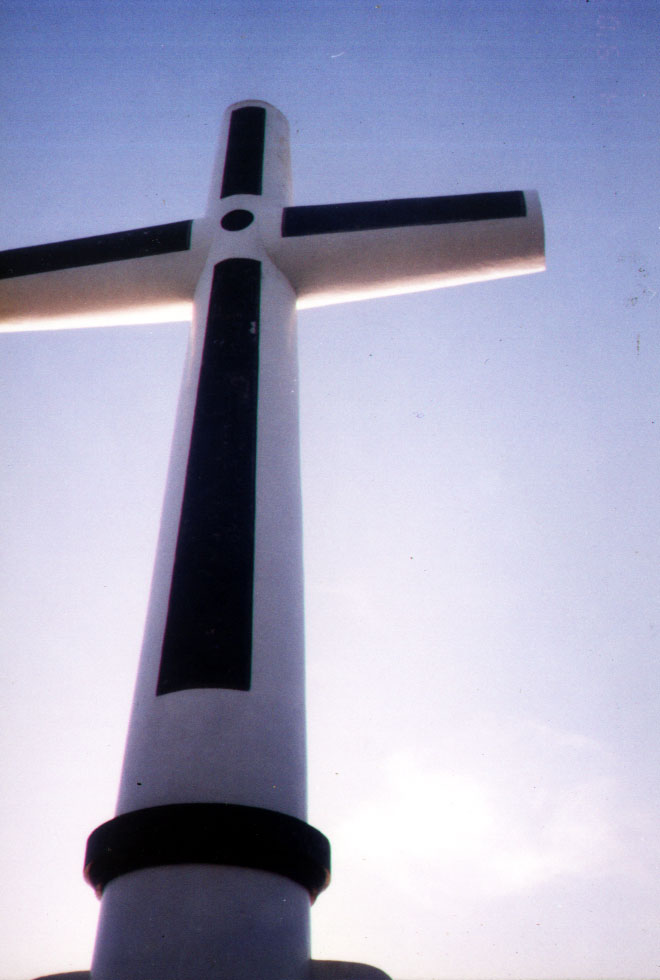
From Cotta Bato, we made a short drive to the Sunken Cemetery, site of the community cemetery which sank during the 1871 eruption.  After paying a PhP2 entrance fee, we proceeded down the hill to secluded, brown-sand Sabang Beach.  About 200 m. offshore is the huge concrete white cross which was built from 1997 to 1999 to replace another installed further offshore in 1982.  

Cross at Sunken Cemetery

Sunken Cemetery (6)

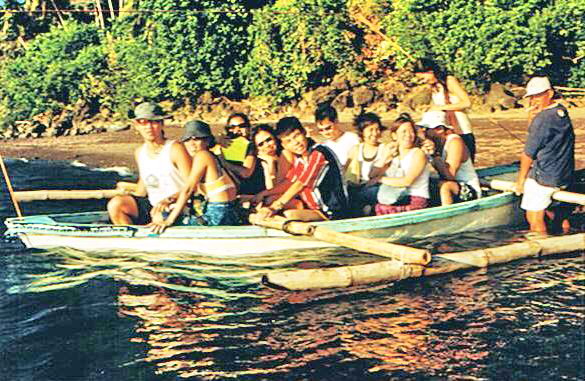
Connecting the cross with the shore is a nylon rope from which is tethered a boat for crossing.  We paid PhP10 each for the two-way trip.   According to the boatman, years ago, gravestones were still visible during low tide.  Now they can no longer be seen.  Every year, on May 1, a fluvial procession is held there.  The islanders row out to offer flowers and floating candles to the dead.

View from Sunken Cemetery

From our vantage poin at its terracet, we had a panoramic view of Mts. Vulcan Daan and Tres Marias. Scattered along Mt. Vulcan Daan’s northwestern slope is a winding trail with life-size, white-washed cement figures of the 14 Stations of the Cross depicting the passion death and resurrection of Jesus Christ.

Sunken Cemetery (12)

The last station is a sepulcher carved out of volcanic rock.  During Holy Week, a Panaad is held for religious retreat and penitence.  It features a 2-day, 64-km. trek around the island, from Brgy. Benoni to the Stations of the Cross.  The sun was just setting when we returned to shore and a well-deserved rest back at the resort.  

Sunken Cemetery (9)

Sunken Cemetery (4)

Sunken Cemetery: Brgy. Bonbon, Catarman, Camiguin

Old Guiob Church Ruins (Catarman, Camiguin)

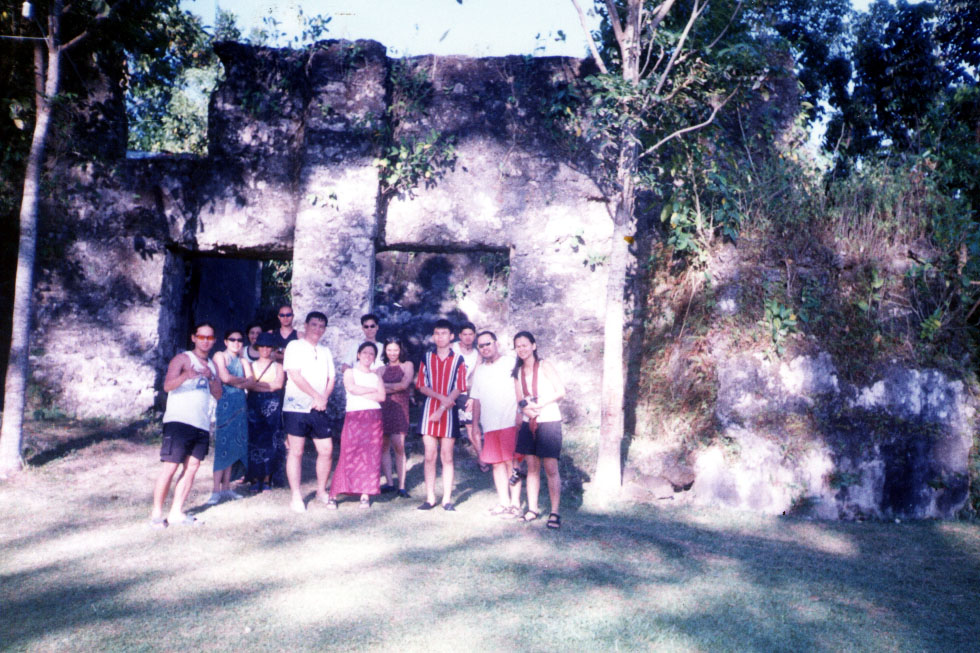
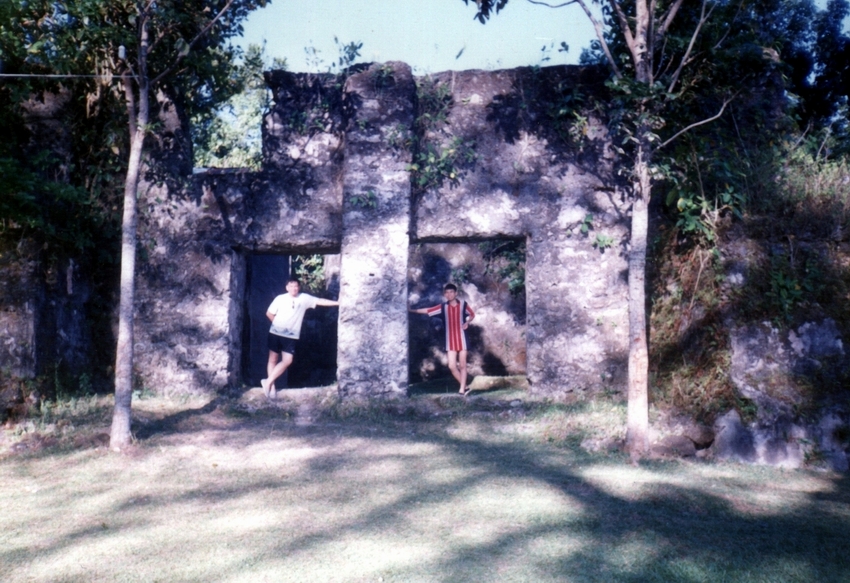
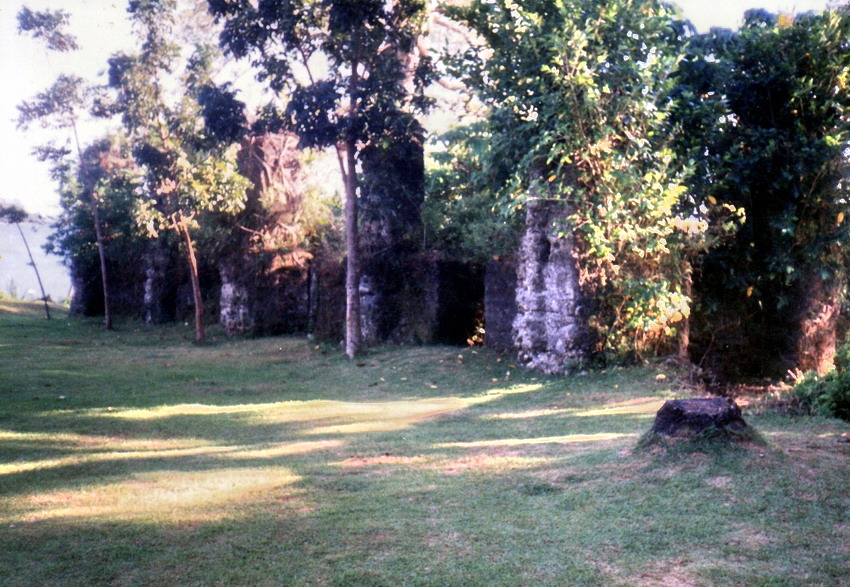
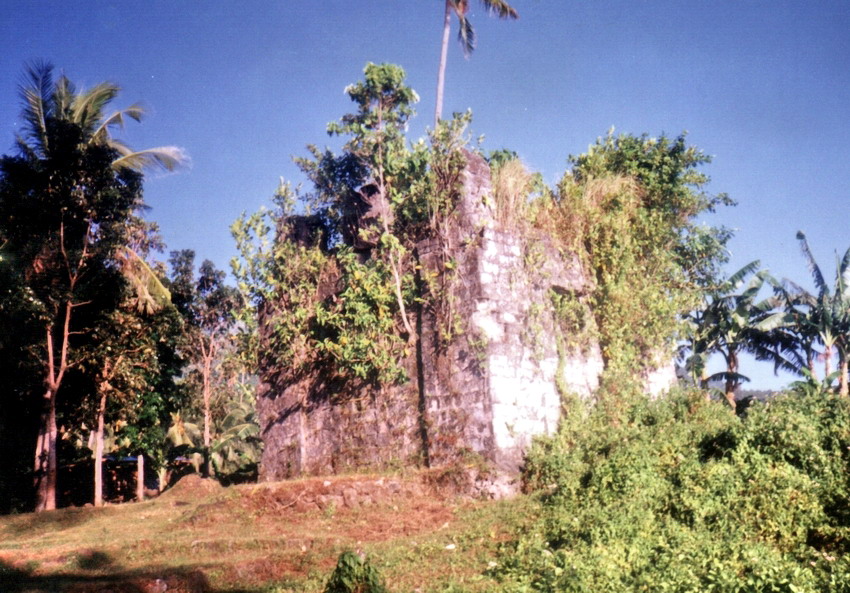
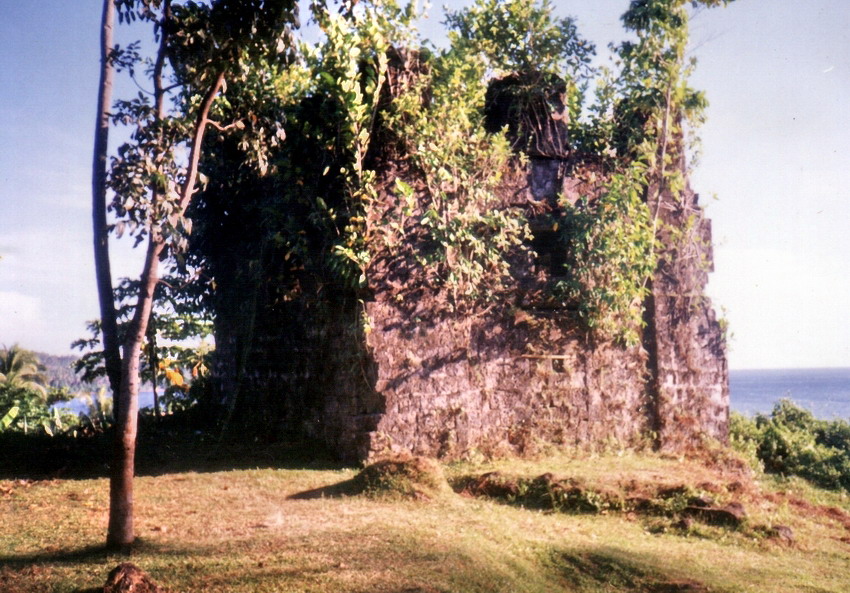
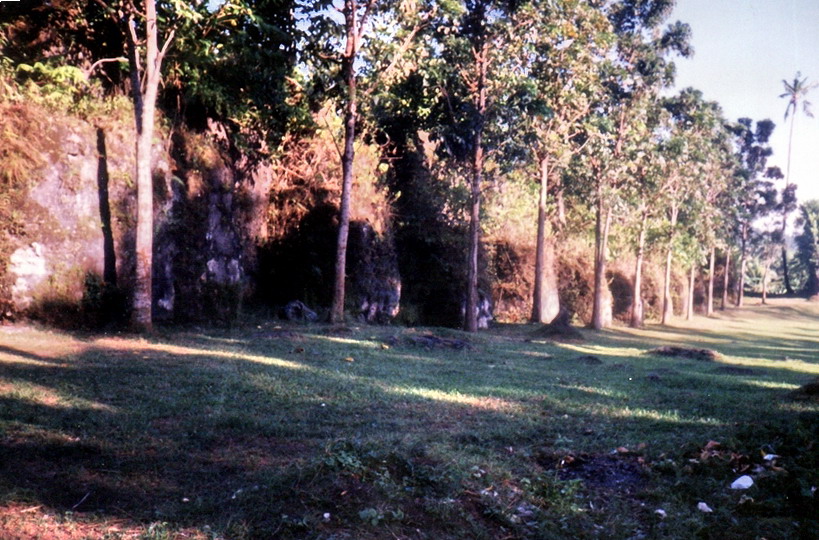
From Sto. Nino Cold Spring, a 30-min. drive brought us to the ruins of the old Gui-ob Church (Cotta Batto) in Catarman.  This coral and stone-hewn church, Camiguin’s version of Albay’s Cagsawa Ruins, is located 16 kms. from Catarman and 20 kms. from Mambajao proper.  It was built in 1623 as the parish of San Roque  before it was half buried by lava flows during the May 1, 1871 eruption of the 838-m. high Vulcan Daan (locally called Tandang Bulkan) which destroyed the town. 

Old Gui-ob Church (Cotta Batto)
Old Gui-ob Church (1)
Old Gui-ob Church (11)
Old Gui-ob Church (7)

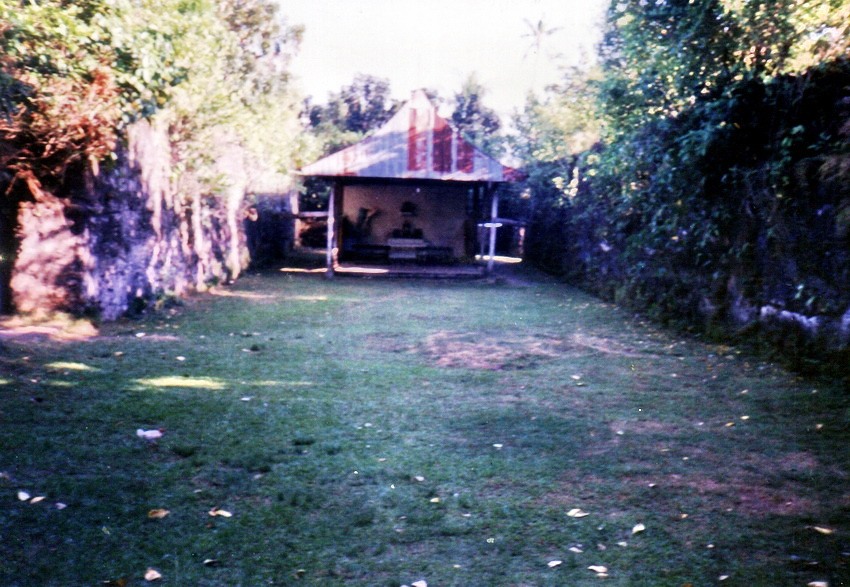
Within its thick, century-old adobe walls is a makeshift chapel.  A short distance away is the bell tower and a moss and vine-covered convento, reminiscent of the Spanish era.  Viewed in the late afternoon sun, all three made nice subjects for a photo shoot.

Old Gui-ob Church (4)
 Old Gui-ob Church (5)
Old Gui-ob Church (8)
Old Gui-ob Church (9)
Old Gui-ob Church (10)
Old Guiob Church Ruins: National Highway, Brgy. Bonbon, Catarman, Camiguin.

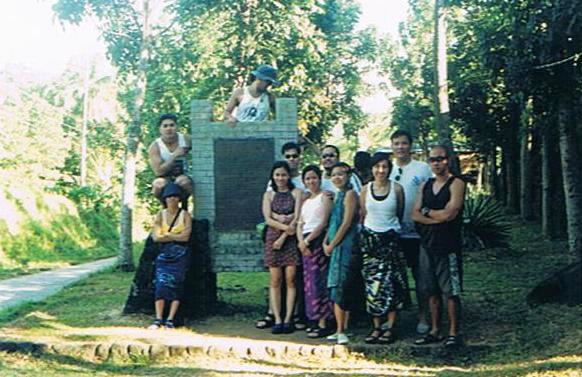
Sto. Nino Cold Spring (Catarman, Camiguin)

After our delightful lunch at Taguines Lagoon, we again boarded our hired jeepney and proceeded, along the west coast of the island, to Sto. Nino Cold Spring.  Also known as Kiyab Pool, it is located 4 kms. north and uphill of Catarman town proper.  From the main road, we made a turn into 2-km. long  dusty track.

Sto. Nino Cold Spring

The spring has 2 stone pools, the larger one measuring 25 m. by  40 m.  and its depth varies from one-half meter to 2 m.. The other is a kiddie pool.  The resort also has picnic huts, toilets, function hall and native stores for picnickers.  Being a holiday, the resort was packed with picnickers.  After paying an entrance fee, we swam its icy-cold, crystal-clear  spring water sprouting from its sandy bottom.  We shared the spring waters with some tiny fish.  After half an hour of swimming, we left the resort by 4 PM.  

Sto. Nino Cold Spring: Brgy. Mainit, Catarman, Camiguin.  Admission: PhP20/pax.

Taguines Lagoon (Mahinog, Camiguin)

We all left Katibawan Falls by 11 AM and proceeded on a 40-min. drive to Taguines Lagoon, near Benoni Port, for lunch.  This beautiful artificial lake has mantles of limpid water surrounded by craggy cliffs, huge boulders and gently rolling hills.  Truly, a relaxing break from a tiring tour around the island.

Taguines Lagoon

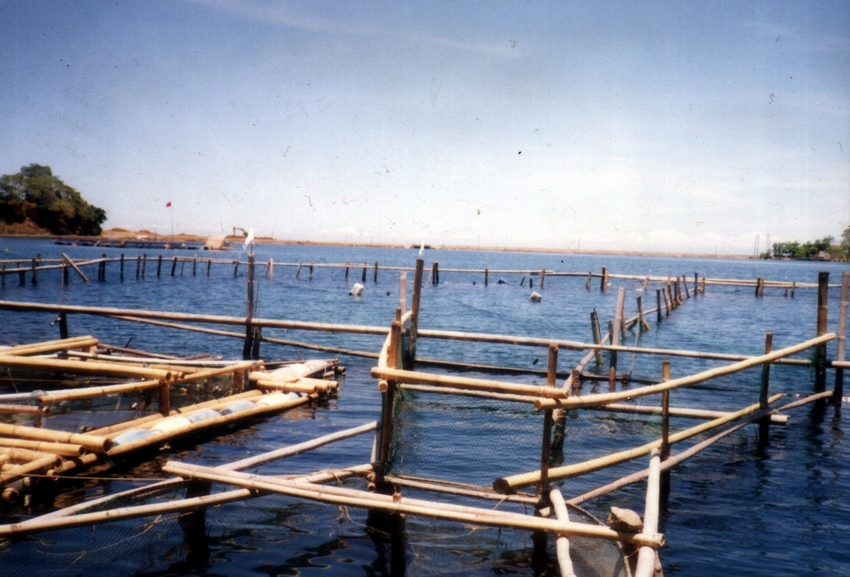
We stopped at J.A. Fishpen, a restaurant on stilts overlooking the lagoon.  Around it are fishpens where bangus (milkfish), mamsa (jack), lunab (surgeonfish), katambak (spadefish), danggit (seganid), maming (parrotfish), kitong and alimango (crabs) are bred.  Quite hungry, we feasted, kamayan-style, on fresh-caught and cooked alimango. kitong and bangus, plus fried chicken, pancit canton and halaan soup and washed it all down with buko and green mango shakes.

Image-03

J.A. Fishpen: Brgy. Benoni, Mahinog, Camiguin.  Tel:  (088) 387-4008.