Macau City Tour

The next day, after breakfast at the hotel, Grace and I decided to go on a day tour of the nearby Portuguese enclave of Macau via fast ferry from Hong Kong.  This would our first visit to this city renowned for its gambling and annual Macau Grand Prix.

On December 20, 1999, the People’s Republic of China assumed formal sovereignty over Macau from Portugal and it is now one of its 2 Special Administrative Regions (SAR), the other being Hong Kong.

From the hotel, we proceeded to Jordan MRT Station and took the MRT to Sheung Wan Station.  From there, we walked to the HK-Macau Ferry Terminal. High-speed Jetfoils leave here every 30 mins. or so and the trip took an hour.

Macau

Upon arrival at the Macau-Hongkong Ferry Terminal, we proceeded to the terminal’s tourist information desk to inquire on how to tour the city.  We were surprised to find the desk being manned by a Filipino.  He suggested we hire a taxi to go around the city and soon a taxi driver appeared. We placed our trust in our kababayan as he dictated an itinerary to our designated “tour guide.”

Our leisurely taxi ride first took us past  Macau’s Casino on Avenida de Almeida Ribeiro (the main street), to the Fortress of Our Lady of Guia, the highest point on Macau.  Here, we had a good view of the city, the outlying islands, the harbor and the Macau-Taipa Bridge.

Macau-Taipa Bridge

Guia Fortress was designed to defend the border with China but because of its position overlooking the entire city, its chief value has been as an observation post. Built from 1637 to 1638 by Captain of the Artillery, Antonio Ribeiro, Guia fort has 10-ft. high masonry walls, 2 brickwork turrets and occupies 8,600 sq. ft. in a rough pentagon as dictated by the rough terrain.  Its dominating feature is the 52.5-ft. high lighthouse, built in 1865 and the oldest on the China coast.  Its light could be seen for 20 miles in clear weather.

We also had a short walking tour at postcard-pretty Leal Senado Square with its European-inspired architecture of the Leal Senado, shops and pretty fountain.

Leal Senado Square

A substantial part our itinerary were churches and we visited a couple of them.  When Macau was established by the Portuguese, it was expected to be a bastion of Christianity as well as trading post, and they called it “City of the Name of God, Macau.”  Macau became an early center for Jesuit missionary activity.  In 1580, the Bishopric of Macau (which included the Indonesian island of Timor and the Christians of Malacca and Singapore) was created. The first settlers included priests and some of the first buildings were churches, initially constructed with wood and matting.  Later, they were made with taipa (rammed clay) and from the mid-17th century, of stone and plaster.  They were built by Jesuits and other monastic orders with funds provided by the city and the Portuguese crown.

Over the centuries fires and storms have devastated Macau’s churches, but almost all have been restored or rebuilt.  Macau’s multi-colored churches, all named after popular saints (St. Joseph, St. Augustine, St. Paul, St. James, St. Francis Xavier, etc.) as well as the Blessed Virgin (Our Lady of Fatima, Our Lady of Sorrows, Our Lady of Guia, Our Lady of Carmel, etc.), has a predominantly European Baroque flavor with Oriental and tropical features incorporated.  These can be seen in roofs of Chinese tiles, panels of terra cotta and Eastern motifs carved on some facades.

Chapel of Our Lady of Penha

The Chapel of Our Lady of Penha, atop Penha Hill, was founded in 1622 by the crew and passengers which narrowly escaped capture by the Dutch.  The chapel served as a point of pilgrimage for sailors embarking on a hazardous journey.  It was completely rebuilt, along with the Bishop’s Palace, in 1837.

Chapel of Our Lady of Penha

St. Paul’s (Rua de Sao Paolo), the greatest of Macau’s churches and the major landmark of Macau, was built in 1602 and adjoins the Jesuit College of St.Paul’s.  After the expulsion of the Jesuits, the college was used as an army barracks and in 1835 a fire started in the kitchens and destroyed the college and the body of the church.  Now in ruins, all that remained was the magnificent carved stone façade (built from 1620 to 1627 by Japanese Christian exiles and local craftsmen under the direction of Italian Jesuit Father Carlo Spinola) and the grand staircase.

The façade rises in four collonaded tiers and is covered with the statues of the Virgin and saints and carvings of the Garden of Eden, the Crucifixion, the angel, the devil, a Chinese dragon, a Portuguese sailing ship, a Japanese chrysanthenum and pious warnings inscribed in Chinese.

We also visited the Temple of A-Ma.  As with many others in Macau, the temple combines both the Buddhist and Taoist beliefs.  A-Ma (meaning “Honored Mother”) is a much-revered Taoist goddess, the patron of seafarers and the Queen of Heaven.

The history of the goddess goes back to around 1044 AD when in Fukien province (about 350 miles north of Macau), a poor fisherman named Lin gave birth to a baby girl.  At the time of birth a red glow was seen over the house. She grew to be a most remarkable child, never crying, hardworking, obedient and devout.

One day, when the girl was sleeping, she dreamt that two junks carrying here father and brothers were caught in the storm.  In the dream, she stretch out her arms and clenched the masts of the vessels with her fists.  Her alarmed mother, fearing that her child was suffering a fit, shook her by her arm to wake her up, causing her to let go of one of the boats.  Later, when her brothers returned, they told the story of a vision of a beautiful girl that reached out to save them but was unable to hold unto the father’s boat and thus he perished.

Lin died tragically in her early 20’s but stories of miraculous rescues at sea, with the lovely woman calming the waves and bringing the sailors to safety.  Two centuries later, during the Ming Dynasty (1368 to 1643 AD), she was canonized as the First Lady Attendant in Heaven and Protector of Seafarers.  In the years that followed, she was elevated with more titles till finally, in 1683, she was promoted to Tien Hau (Queen of Heaven).

A-Ma has taken on the mantle of the protector of Macau as a whole and people from all walks of life pay homage to her.  Childless women believe that, in her capacity as Honored Mother, prayers to her will help them conceive the child that they long for.

A-Ma Temple was the last item in our itinerary and our guide brought us back to the ferry terminal where we took another high-speed ferry back to Hong Kong.

Return to Hong Kong

Grace’s officemate Ms. Arachel “Chel” C. Borja was leaving for Hong Kong with her kids to accompany her husband who was to attend a convention and Grace and I decided to join them.  We all left Manila for Hong Kong on 6:30 AM flight, arriving at Kai Tak International Airport by 8:10 AM.

This was to be our last entry into Hong Kong via this international airport. Landings at this airport were dramatic to experience and technically demanding for pilots.  A little over a year later, on July 6, 1998, Kai Tak was closed and replaced by the new Hong Kong International Airport at Chek Lap Kok, 30 kms. to the west. There were plans for the site of Kai Tak to be used for housing development.

From the airport, we all took a bus to the city proper and checked out our accommodations at Payless Pension along Nathan Rd..  Grace and I found it quite rundown and decide not to take it.

BP International Hotel – Twin Room

We all had lunch at a MacDonald’s outlet then dropped off Chel and her family at the Hyatt Regency Hotel.  We then decided to check in at one of the BP International Hotel’s 529 guest rooms.

Check out “Hotel and Inn Review: B P International Hotel

B P International Hotel: No. 8 Austin Road, Tsim Sha Tsui, Kowloon, Hong Kong.  Tel: (852) 2376 1111. Fax: (852) 2376 1333. E-mail: enquiry@bpih.com.hk. Website: www@bpih.com.hk.

Tops Lookout (Cebu City, Cebu)

After breakfast at the Zodiac Restaurant at the hotel, Grace, Jandy, Cheska and I joined Grace’s fellow EGI employees who were going, via van, to the popular Tops Lookout (better known as “Tops”), a must-visit viewpoint situated 2,000 ft. (610 m.) atop Busay Hill. On our long drive up the hill’s steep, winding road, we passed by Cebu Plaza Hotel where Grace and I stayed over a decade ago for our honeymoon. 

Tops Lookout

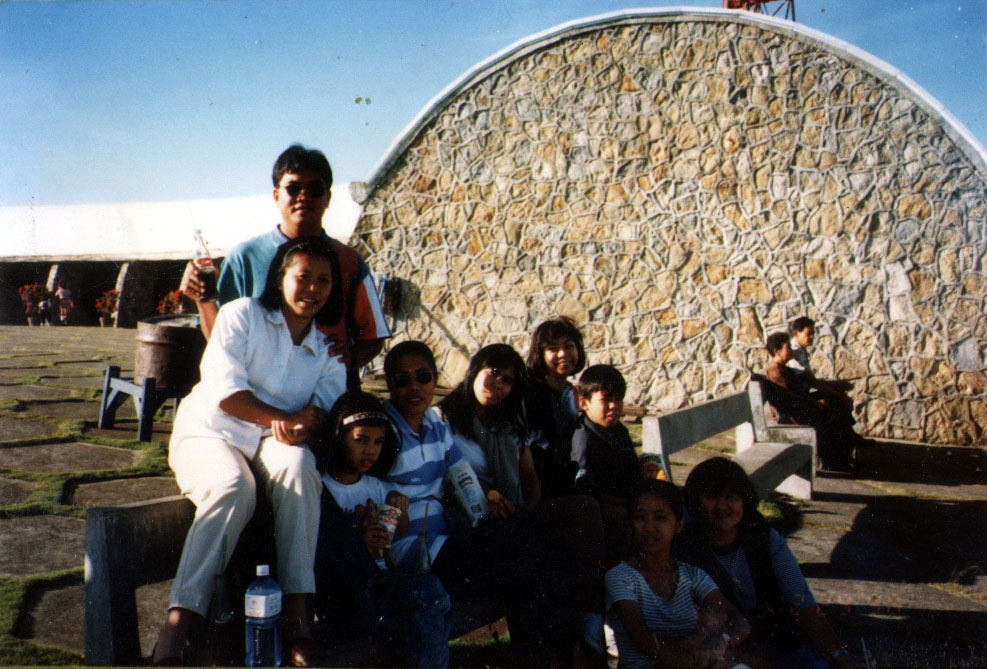
About 4 kms. past the hotel, we finally reached Tops and paid the required parking fee and admission fee for each of us.  This modernist, fortress-like and well-maintained viewpoint has kiosks where we could buy snacks and drinks; toilet facilities and benches where we could sit and have a breathtaking, panoramic view of Cebu City, Mactan and Olango Islands and Bohol in the  background.

Our breathtaking view

It was very windy and a bit chilly while we were there.  Other ideal times for a visit are during sunrise or sunset up to the wee hours of evening when you can see the city basking in lights.

Tops Lookout: Brgy. Malubog, Busay, Cebu City, Cebu. Admission: PhP100/pax

EGI Resort and Hotel (Lapu-Lapu City, Cebu)

Right after Christmas, 10-year old Jandy and I flew to Cebu, arriving on the early morning PAL flight with Grace’s fellow E. Ganzon, Inc. (EGI)  employees Cecille Marquez and Mary Jane Malamug.  Grace and and 6 year old Cheska were to follow the next day.  We were picked up at Mactan International Airport and shuttled, in about 15 mins., to the 8-storey E.G.I.-owned EGI Resort and Hotel, located amidst a strand of world-class resorts and hotels in Mactan Island.  

EGI Resort and Hotel
Upon arrival at the resort, we checked into a corner airconditioned suite with cable TV, a fridge with minibar, NDD/IDD phone, bath (with bathtub and shower with hot and cold water) and a private balcony with a beautiful view of the sea and the nearby Club Kon-Tiki Resort (with its man-made white sandbar) and Cebu Mactan Island Member’s Club.
 
Our suite
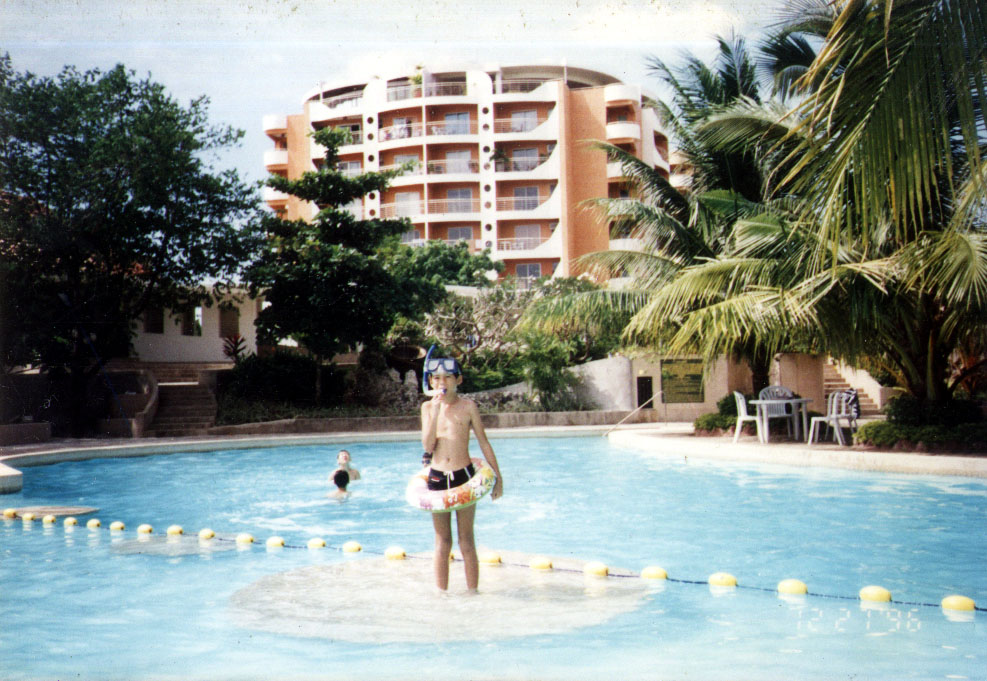
This resort, the only condominium resort hotel on Mactan Island, also has a restaurant at the Zodiac Pavilion, function rooms, a free-form swimming pool and a small stretch of white sand beach.
 
The resort’s swimming pool
EGI Resort and Hotel: Pajac-Maribago Rd., Brgy. Looc, Maribago District, Lapu-Lapu City, Mactan Island, Cebu.  Tel: (032) 232-3111 to 15. Fax: (032) 232-3117.  E-mail: egiresort2003@yahoo.com. Website: www.egiresortandhotel.com. Manila sales office: 29/F, EGI Taft Tower, 2339 Taft Ave., Manila.  Tel: (632) 302-6418.  Fax: (632) 302-6420.

Club Panoly Resort (Boracay, Malay, Aklan)

Club Panoly Resort

During our 1990 visit to Boracay, my first such visit, we made an ocular visit of the new (opened November 1989), 4-hectare, Singaporean-owned (CTW Group) and operated Club Panoly Resort, the first triple AAA resort in Boracay. A year later, the resort was the site of the 1991 RPN-9 mini-series Boracay which starred Dina Bonnevie, Fe Delos Reyes (singer/comedienne), Joel Torre, Rollie Quizon and Noel Trinidad (the fictional resort owner).

Posing at the resort entrance

Six years later, Grace and I decided to plan our next stay on the island on this world-class resort, staying here for 5 days and 4 nights.  Together with our kids Jandy and Cheska, we departed for Kalibo on the 9 AM Philippine Airlines flight, arrived by 10 AM and, from Kalibo Airport, boarded an airconditioned  Boracay Star bus for Jetty Port in Brgy. Caticlan, arriving there by 11:30 AM.

Cafe Punta Bunga

At the port, we boarded the resort’s shuttle boat and arrived at Club Panoly in time for lunch at Cafe Punta Bunga, the resort’s coffee shop.   Sprawled throughout this luxurious resort are 8 native-style octagonal clusters with 5 cottages, all fully air conditioned, with hot and cold shower, cable TV, minibar, complimentary coffee and tea and 24-hour IDD telephone facilities, all standard features in all rooms. The custom-designed furniture were made with indigenous creativity and materials. 

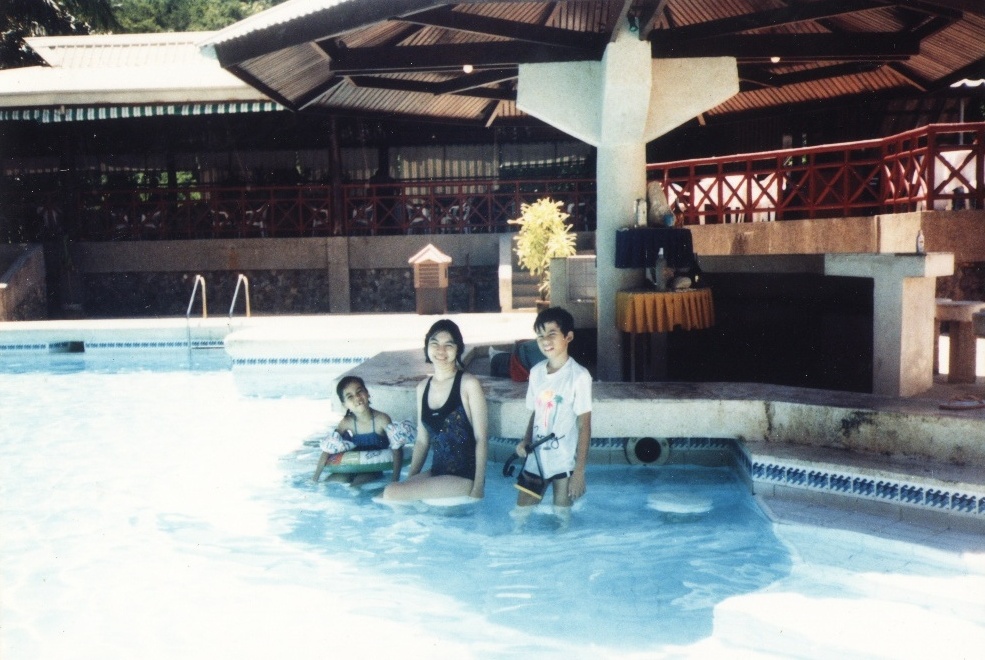
Lounging by the swimming pool and poolside bar

Aside from Cafe Punta Punta, the resort also has a restaurant, a bar (El Capitan) and a beach bar.  There’s also has a swimming pool (with poolside bar), a plexi-paved tennis court, two jacuzzis, spa, sauna, multi-purpose conference room, billiards, children’s playground, souvenir shop, seaport and offers waterskiing, windsurfing, jetskiing, diving, paddle boating and speed boats.

Trying out the jacuzzi
Club Panoly Resort: Sitio Punta Bunga, Brgy. Yapak, Boracay Island, Malay, Aklan. Tel: (032) 288-3011. Fax: (036) 288-3134.  Metro Manila booking office: International Vacations Corp.,  G/F, ACT Tower, 135 Sen. Gil Puyat Ave., Salcedo Village, Makati City.  Tel: (632) 812-2233 local 107 or 403.  Fax: (632) 812-6455 and 812-6434.  E-mail: info@thepanoly.com.  Website: www.thepanoly.com.

Residence Inn Zoo (Tagaytay City, Cavite)

From the 41st Division P.A. USAFFE Shrine, Jandy and I continued on our way to Residence Inn.  As it was along the highway, it was easy to find.  There’s an entrance fee.  The inn,  which also has an excellent view of Taal Volcano and Lake, has airconditioned accommodations and a restaurant.

Check out “41st Division P.A. USAFFE Shrine

However, we were just there on a 1-day tour of its mini-zoo which is more like an interactive petting zoo as, at the entrance, fresh fruits and other food  are sold to visitors who want to feed the animals (except the tigers).  The zoo has a menagerie of 30 or so animals,  some caged while others were free-roaming.

Jandy beside a free-roaming cassowary
A caged tiger

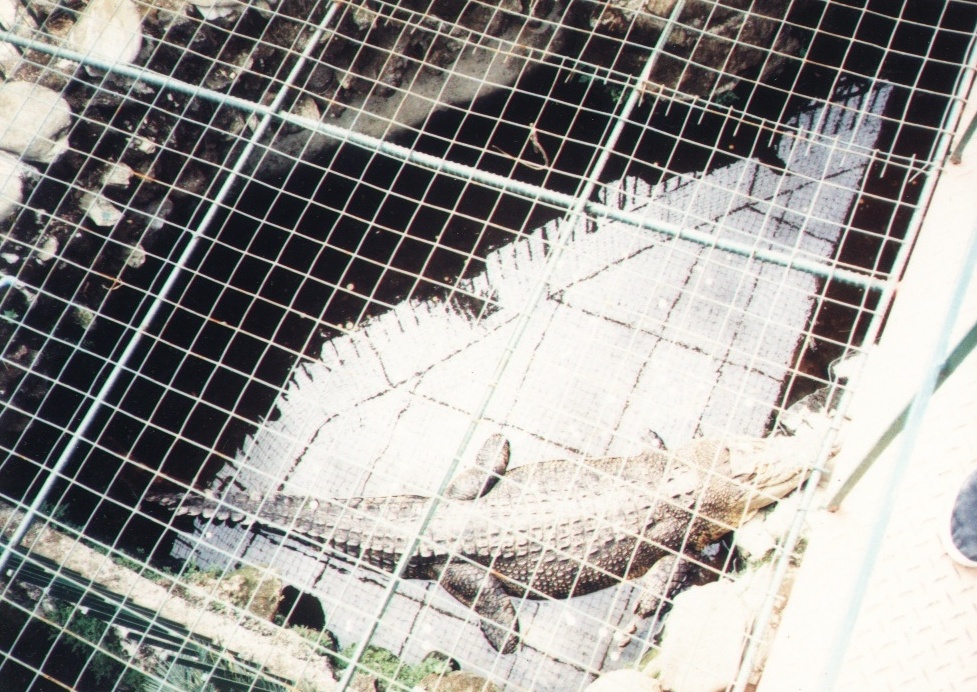
The first animals we saw were the noisily chirping parrots and cockatoos, some caged while others were out, tied loosely to their perches.  Also near the entrance were pythons, fishes and a tiger cub.  There were also screaming monkeys, caged Malay civet cats and tigers, free-roaming peacocks, ponies, llamas,  a free-roaming cassowary, wild pigs and crocodiles.  The zoo could actually be toured in an hour.

A caged crocodile
A python in a glass case

Residence Inn: Km. 65, Brgy. Neogan, Tagaytay City, Cavite. Tel: (632) 899-9829 (Manila)

41st Division P.A. USAFFE Shrine (Tagaytay City, Cavite)

After my jobsite inspection at La Residencia de Laguna and lunch in Tagaytay City, Jandy and I went out of our way to visit the Residence Inn Zoo.  Along the way, we made a stopover at the 41st Division P.A. USAFFE (United States Armed Forces in the Far East) Shrine, beside the City Hall and Tagaytay Convention Center.

Check out “Residence Inn Zoo

41st Division P.A. USAFFE Shrine

Within the shrine are marble walls etched with the names of all 6,000 servicemen of the 41st Division, Philippine Army, under the command of Brig.-Gen. Vicente P. Lim.  Coming from Cavite, Batangas, Laguna, Tayabas (now Quezon) and Palawan, these men mobilized on Tagaytay Ridge on August 1941.  Here, they set up camp and trained for war, prior to joining the ensuing Battle of Bataan. A bas-relief sculpture also helps tell the heroic story of the defenders of Bataan and Corregidor.

The bas-relief sculpture

41st Division P.A. USAFFE Shrine: Km. 59, Emilio Aguinaldo Highway, Brgy. Kaybagal South, Tagaytay City, Cavite.

Leyte Landing Memorial (Palo, Leyte)

From the Sto. Nino Shrine & Heritage Museum, we were next driven 12 kms. to the next town of Palo where we visited our final destination, the Leyte Landing Memorial along Red Beach, 2 kms. north of the Palo town center.  Marking the spot of Gen. Douglas MacArthur’s Leyte landing, this beautifully landscaped memorial was established in 1973.

Leyte Landing Memorial
The memorial contains the 7 bronze statues (1.5 times bigger than lifesize) of MacArthur (taller than the others to create perspective, it was designed by the late National Artist Leandro V. Locsin), Pres. Sergio Osmeña, Sr., Brig.-Gen. CarlosP. Romulo, Gen. Richard K. Sutherland (MacArthur’s Chief of Staff), Adm. Thomas C. Kinkaid followed by two staff members, standing on a shallow, man-made lagoon.
 
Red Beach

Fifty meters away is the Philippine Commemorative Rock Garden of Peace, designed by Renato L. Punzalan and built in 1994 for the 50th anniversary of the landing.  It has messages of peace from leaders of different countries etched in stone slabs indigenous to these countries.  These are set around a bronze sculpture of the Eternal Flame of Peace.

Rock Garden of Peace

Leyte Landing Memorial: Brgy. Candahug, Palo, Leyte.

Sto. Nino Shrine & Heritage Museum (Tacloban City, Leyte)

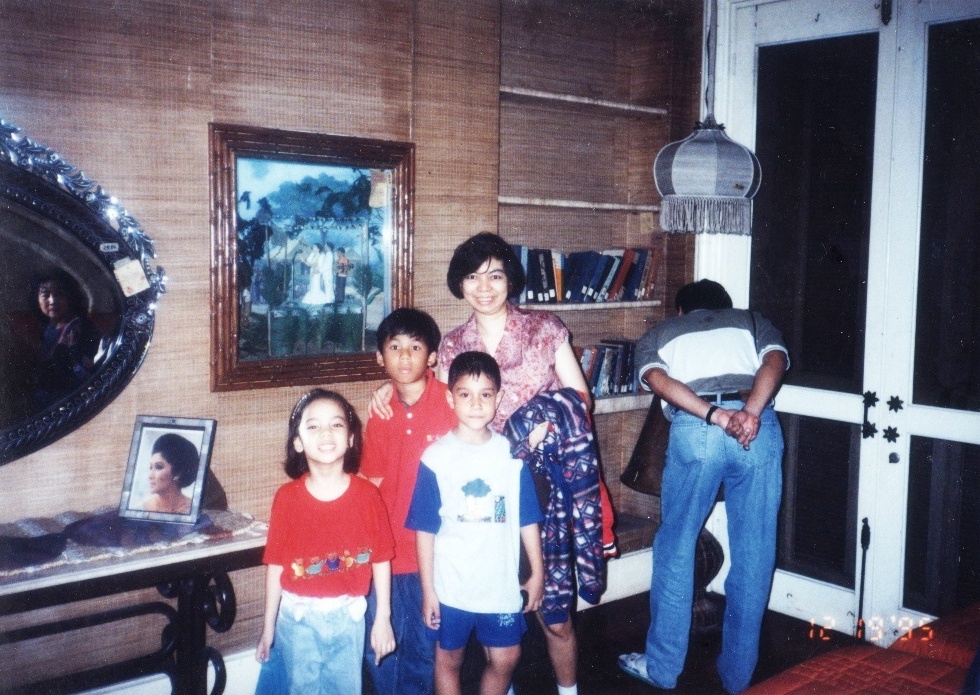
After lunch at Agus Restaurant, Grace, Jandy, Cheska and I, with Manny, Paula, Mark, Nenette, Dad, Mom and Cheska’s new friend Kookie Bal, continued on our tour of Tacloban City, this time visiting the Sto. Nino Shrine & Heritage Museum, one of 29 presidential resthouses built by the late Pres. Ferdinand E. Marcos and Tacloban’s top tourist attraction because of its association with Mrs. Marcos.  This 20-room, colonial-style structure, designed by Arch. Jorge Ramos and built from 1979 to 1981, houses former First Lady Imelda R. Marcos‘ vast collection of art objects from all over the world.  

Sto. Nino Shrine & Heritage Museum

At the ground floor is the 100-pax chapel, lit with beautiful chandeliers from Czechoslovakia; with narra pews and a replica of the image of the Sto. Nino of Leyte (made with Italian ivory) as the altar’s centerpiece.  This is where the Sto. Nino connection ends.  Everything else speaks of the Marcos family, especially the former First Lady.

Posing in front of the replica of the Sto. Nino de Leyte

On the chapel’s periphery, elevated by 2-3 steps, are 13 tastefully decorated guestrooms of varied Filipino motifs, each unique and exceptional as they represent the different regions of the country. Each room had a diorama of the First Lady.

One of the themed guestrooms
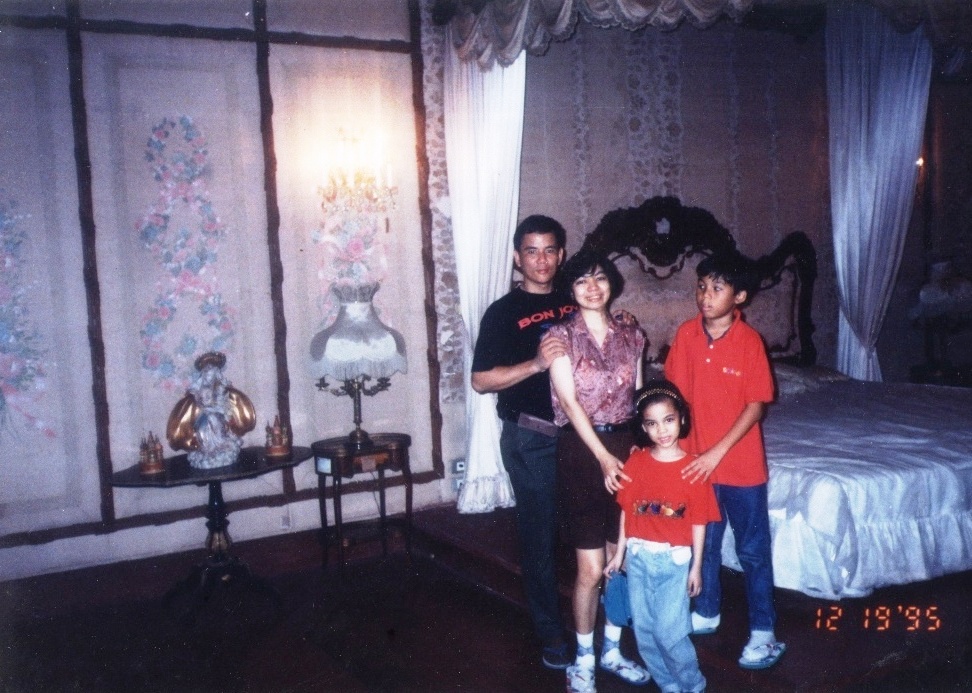
At the second floor is a spacious ballroom, a 30-pax dining/conference room and 7 magnificently designed and decorated private bedrooms for the First Family.  Imelda’s bedroom had a very large bathroom.  The whole place just screams grandeur, power and magnificence. 
 
Wooden bas relief of Malakas and Maganda
The whole mansion was furnished with original paintings done by by the late National Artist Fernando Amorsolo, Amadeo Y. Manalad and Malang; the 14 Stations of the Cross done by Filipino painters; priceless furniture; musical instruments; fine English, French and Chinese porcelain; Austrian mirrors; Argentinian and Persian carpets, grandfather clocks; Italian tiles; wooden bas-relief of the legend of Malakas and Maganda, ivory and wooden sculptures of local and foreign  origin; Russian dolls; Chinese Qing Dynasty vases: a whole glass case filled with ivory carvings; and other priceless collectors items. 
 
One of the 7 bedrooms
Sto. Nino Shrine & Heritage Museum: Real St., Tacloban City, Leyte.  Tel: (053) 321-9775. Admission: PhP60 (maximum of 6 per group).  Open daily, 8 AM to 5 PM.  Guided tours from 8 to 11 AM and 1 to 4 PM.

CAP Building (Tacloban City, Leyte)

Back in our van, we made our way back to the city proper.  Near the wharf, we made another stopover at the CAP Building.  Formerly the Price Mansion, this American colonial house was built in 1910 by American businessman Mr. Walter Scott Price, founder of the Leyte Transportation Co., Ltd. (Letranco). During World War II, it  was used as a Japanese Officer’s Club. 
 
CAP Building
For three months during the liberation, it served as Gen. Douglas MacArthur‘s headquarters and residence.   Here, the general escaped injury when a Japanese bomb penetrated the roof over his room but failed to explode.  The hole left by that attack can still be seen.  It is now the headquarters of the College Assurance Plan, Inc..
 
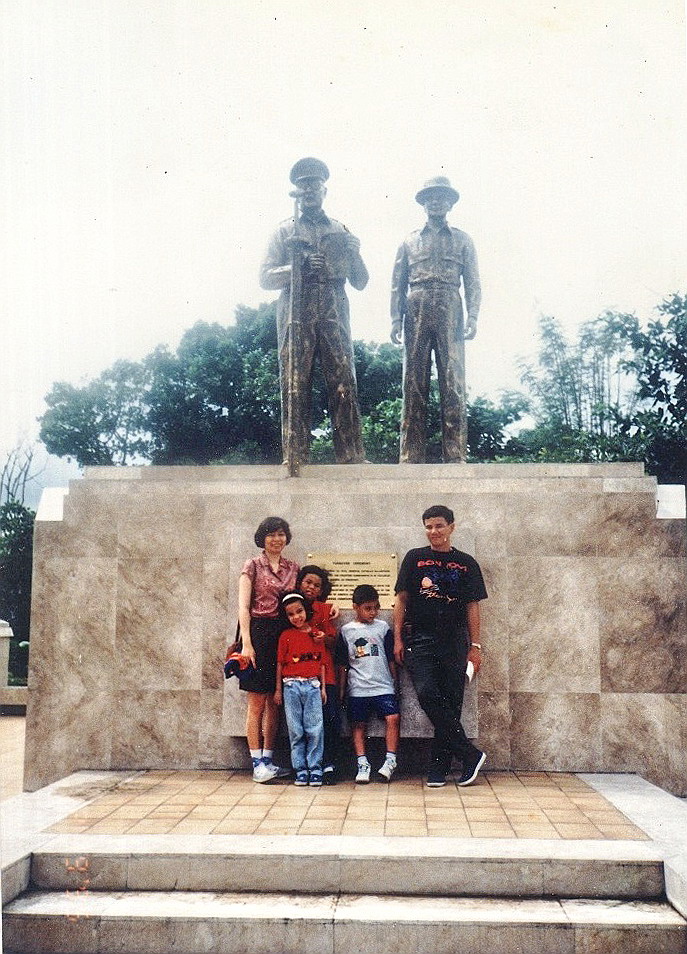
Aside from being the company’s office, the building also houses a MacArthur memorabilia room (second floor), an art gallery and a conference center.  On the right side of the mansion, facing Romualdez St., is a statue of Gen. MacArthur and Pres. Sergio Osmena.
 
Statue of MacArthur and Osmena
CAP Building: Justice Romualdez cor. Sto. Nino St., Tacloban City, Leyte.  Tel: (053) 523-9856.