Yehliu Geological Park (Keelung City, Taiwan)

From Chang Chung Park, we next proceeded, down the hill and out of the city proper, to Yehliu Geological Park. Along the way, we passed the remains of the Taiwanese-owned, Panama-registered gravel ship Jui Hsing.  On October 3, 2011, this 155 m. long, 11,500 ton ship, bound for Fujian province in China, ran aground and broke in half, in high seas 185 m. off Dawulun Beach, near Keelung Harbor, during the height of Typhoon Nelgae. Of its 21-man crew, 6 were killed, 4 missing and 11 were rescued.
The beached remains of the Jui Hsing

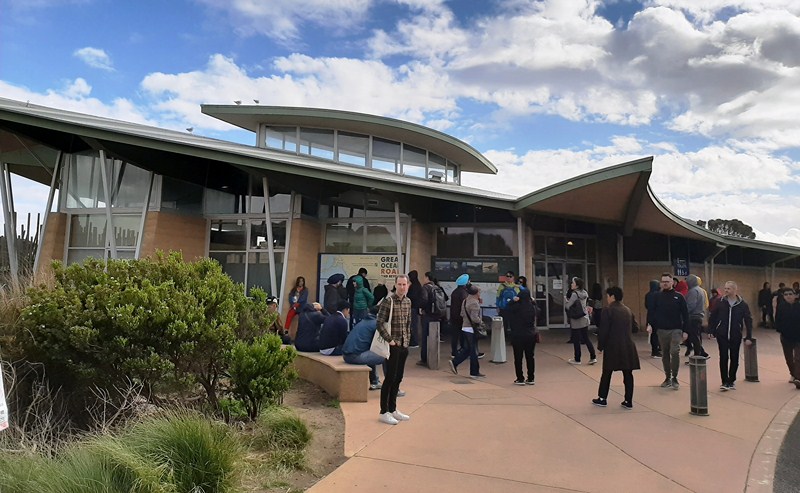
When we arrived at the Visitor’s Center (Yehliu Nature Center), the parking lot was filled with tourist buses loaded with tourists bound for either Ocean World, Yehliu Geopark or both.  Ocean World, the first marine center in Taiwan for exhibition of ocean evolution, has an undersea sightseeing tunnel where you can observe about 200 rare fish species.  Its 3,500-seat stadium is also the site of excellent shows featuring whales, dolphins and seals doing  diving, ballet on water and other talent shows.

Ocean World

However, we were just here for the Geopark.  Operated by the North Coast and Guanyinshan National Scenic Area Administration, the park is located on a cape, also known as the Yehliu Promontory, that forms part of the Taliao Miocene Formation.  Stretching approximately 1,700 m. into the sea, it was formed as geological forces pushed Datun Mountain out to the sea. When seen from the air, the place looks like a giant turtle sinking into the sea, thus it is also called “Yehliu Turtle.”
Yehliu Geological Park

Its sandstone seashore is subjected to sea erosion, weathering and earth movements giving rise to a scenery consisting of sea trenches/holes, candle-shaped rocks and pot-shaped rocks. The lunar-like landscape is divided into 3 sections, the first 2 of which were visited by us.  The first section has cleavages, potholes, melting erosion panels and mushroom and ginger rock formations such as the “Ice Cream Rock” and the “Candle.”

The iconic “Queen’s Head”

The second section, similar to the first area but with lesser numbers of mushroom and ginger rock rock formations, is home to the iconic “Queen’s Head”  (the unofficial emblem for the town of Wanli), “Bean Curd” and the “Dragon Head.” Near the coast, rocks here have also developed into 4 different kinds of formations: “Elephant Rock,” the “Fairy’s Shoe,” “Earth Rock” and “Peanut Rock,” special shapes resulting from sea erosion.

“Elephant Rock” Legend has it that a fairy forgot to bring the elephant back when she defeated the turtle elf; as result, the elephant stood there waiting to be taken home, refusing to go ashore.

“Fairy’s Shoe” Legend has it that this one piece of shoe was left accidently by a fairy that came down to earth to tame the naughty turtle elf.

Ginger rock formations

Yehliu Geopark’s distinctive features are the hoodoo stones that dot its surface. These rock formations have been given imaginative names based on their shapes. The most well-known is the iconic “Queen’s Head.”  Other formations include “The Fairy Shoe,” “The Bee Hive,” “The Ginger Rocks” and “The Sea Candles.”

Posing beside the “Japanese Geisha”

The much narrower third section, the wave-cut platform located on the other side of Yehliu, has sea-eroded caves, seal-shaped rock, etc. One side of the platform is adjacent to steep cliffs while, down below, the other side is a scene of torrential waves.  It has several rocks of grotesque shapes and sizes, all a result of sea erosion, including the “24 Filial Piety Hill,” “Pearl Rock” and “Marine Bird Rock.” In addition to the said rock landscapes, the third area also includes the major ecology reserve of Yehliu Geopark.

Statue of Lian Tianzhen overlooking the park

While touring, we also noticed a statue dedicated to Lian Tian Zhen, a local fisherman who, on March 18, 1964,  jumped into the sea to save student Chang Guoquan who fell into the sea by accident. Unfortunately, both of them drowned.

Yehliu Geological Park: No.167-1, Kantung Rd., Yehliu Village, Wanli District, New Taipei City 20744, Taiwan.  Tel: (+886-2) 2492-2016.  Fax: (+886-2) 2492-4519.  Website: http://www.ylgeopark.org.tw.  E-mail: info@ylgeopark.org.tw. Open 8 AM-6 PM. Admission: NT$50 (20% discount for group ticket of 30 people or more).

How to Get There:

From Taipei City, take the Kuo-Kuang Co. express bus bound for Jinshan Youth Activity Center at its West Station A

From Keelung City, take the express bus bound for Jinshan or Tamsui at Keelung station (near Keelung Railway Station)

From Tamshui, take the express bus bound to Jinshan at Tamshui station (near Tamshui MRT Station).

The Surreal World of Kapurpurawan Rock Formation (Burgos, Ilocos Norte)

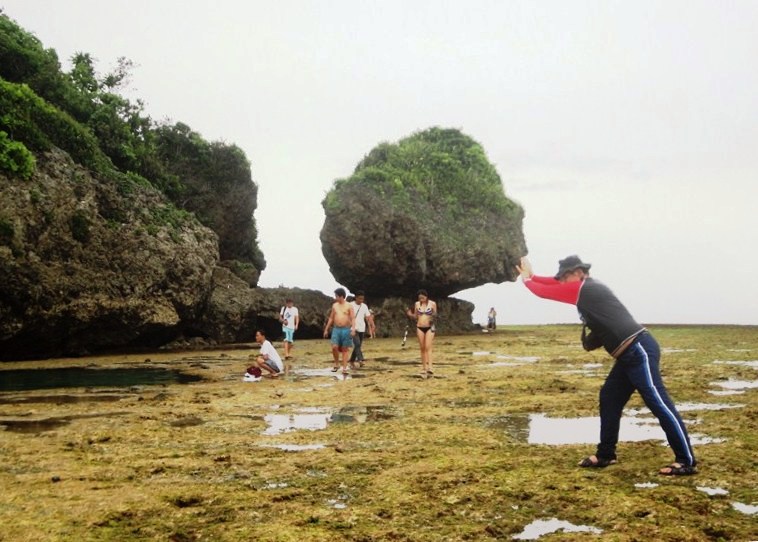
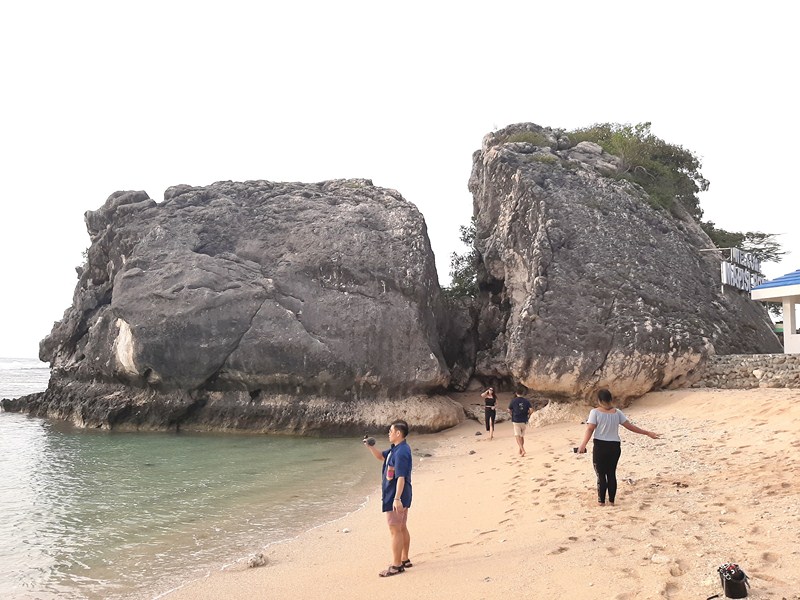
Kapurpurawan Rock Formation: The Sphinx-like “Head”

After our biscocho and salt making observation tour in Pasuquin, our Lakbay Norte 2 media group then boarded our bus and proceeded to the fellow Ilocos Norte town of Burgos.   From the National Rd. our bus turned towards a gravel road and traversed it for about 3 kms. until we reached a makeshift picnic hut, our jump-off point for the amazing, unique and Sphinx-like Kapurpurawan  Rock Formation, one of the best places to visit in the town, aside from the iconic Cape Bojeador Lighthouse, the country’s tallest.

Bonsai-like plants amid pools of limpid sea water

From the hut, it was a 30-min. walk, along concrete steps, dirt track and then, through a tidal pool.  At the tidal pool, sea water-filled coral rock pools, of varying sizes, and bonsai-like vegetation can be seen sporadically.  The rock formation was formed from sandstone naturally carved by weathering from wind, sand and water to create different surreal shapes such as the iconic “Head,” “Cradle” and the “Resting Dragon.” The word kapurpurawan was derived from the Ilocano root word puraw meaning “white” and these formations are said to be much whiter during the summer months of April and May.

This rock formation, possibly the “Resting Dragon,” looks
like a slithering cobra  about to pounce

Our short Kapurpurawan Rock Formation hike made us hungry and, as it was lunchtime, we proceeded to the nearby, picturesque town of Paoay for lunch at Cafe Herencia.

Check out “Restaurant Review: Cafe Herencia

Herencia Cafe: MacArthur St., Brgy. 14, Sangladan, Paoay, Ilocos Norte.  Tel: (077) 614-0214

Millennium Tree (Maria Aurora, Aurora)

The Millennium Tree of Maria Aurora

The eerie and somewhat creepy Millennium Tree, a  massive, 49-m. high, 10-15 m. wide balete or weeping fig tree (scientific name: Ficus balete Merr.) amidst papaya plantations, is the star attraction in Maria Aurora town. Southeast Asia’s (others say in Asia) largest banyan tree, it has been carbon dated to be between 400 – 600 years old (not quite millennial) and is one of the oldest in the country,

Aerial roots

A cave-like opening among the roots

They say it takes 40 to 60 people to encircle the gigantic trunk. The incredible tree’s thick aerial roots have grown above the ground, forming “caves,” and one can also enter the hollow interior of the tree which was once another tree clung to and killed by the balete tree.  Its 60 m wide crown has survived numerous extreme typhoons. The trunk occupies around 190 sq. m..

The author with Cheska and Jandy

Millennium Tree: Balete Park, Brgy. Quirino, Maria Aurora, Aurora. Admission: PhP10/pax.

How to Get There: Balete Park is located 3.5 kms. from Maria Aurora. From Baler, hire a tricycle to get there (30-min. travel time).  Coordinates: 15.7698N 121.4770E.

Chocolate Hills (Bohol)

From Baclayon, we proceeded to the junction town of Loay and, from there, traveled up north to the town of Carmen and the Chocolate Hills, a destination truly synonymous with the province.  Along the way, we passed some of Bohol’s wonderful scenery, including a man-made forest of mahogany trees in Bilar standing in perfect symmetry along the road leading to Carmen.  Upon arrival at the complex, we ascended 213 concrete steps to reach the observation deck, the hill’s main vantage point.  Early morning and late afternoon (to watch the setting sun) are said to be the best times for photographing this strange and mysterious landscape.  You can also hike between the hills.

Chocolate Hills

This 14,145-hectare Philippine National Geological Monument consists of 1,268 grass-covered, cone-shaped “haycock” hills, a broad, half-kilometer high upland plateau irregularly distributed among the towns of Carmen, Sagbayan and Sierra-Bullones in the east central part of the island.  Formed of sedimentary limestone, shale and sandstone, these 30 to 120-m.  high, beautifully arranged and symmetrically formed hills look like droplets of Hershey’s chocolate, thus their rather sumptuous name.  They also look a delectable chocolate brown during the dry months of April and May, before turning a deep shade of green during the rainy season. 

Sohoton Natural Bridge National Park – Natural Bridge (Basey, Western Samar)

Sohoton Natural Bridge

After about an hour and a half of exploration, we exited the cave and proceeded back to our boat for the trip to Sohoton Bridge.  After a short distance, shallow water grounded our boat to a stop and we were told to alight and walk the remaining distance.  There are 2 winding, moss and fern covered trails going to the bridge, one a longer but more scenic 700-m. hike and the other being half the distance.  We took the scenic route.  Pretty soon we came upon the huge, 15-m. high natural parabolic stone arch entrance (from which the park got its name) stretching across the valley and connecting two mountain ridges.  Underneath is the Sohoton River.

The Sohoton River

Based on my research on caves, I theorized that millions of years ago, the bridge was formerly part of a tunneled cave with the Sohoton River flowing underground through it.  The active river eventually enlarged the cave too much for roof stability, collapsing some parts to form cylindrical shafts leading above ground.  Further collapses reduced the cave roof to stretches of tunnel or arches, forming a gorge.  The process of unroofing ceased when the level of the river fell. The narrow Sohoton natural bridge is the one remaining arch of this cave.   That this bridge was once part of a cave is seen from the huge stalactites still hanging below the bridge.

We went no further than the natural bridge, returned back along the trail, clambered down to the riverbank and retraced our steps back to the boat which was moored near the river’s rapids.   Feeling hungry, we invited Sidong and the boatmen to join us for lunch and we feasted on the contents of our picnic basket – tipay (scallops baked with garlic), lechon manok, (roasted chicken), lechon de leche (roasted pig), rice; and then pushed it all down our systems with bottled water and canned soft drinks.  The river was inviting, so we were soon down to our trunks and tried to test our strength against the rapids.  After a one-hour refreshing swim, we got dressed, packed our stuff and made the 90-min. return trip along the river back to the town.  Upon arrival at Basey, we paid our guide and boatman and were soon on our way back to Tacloban, arriving in time for the Palm Sunday mass.