Leal Senado Building (Macau)

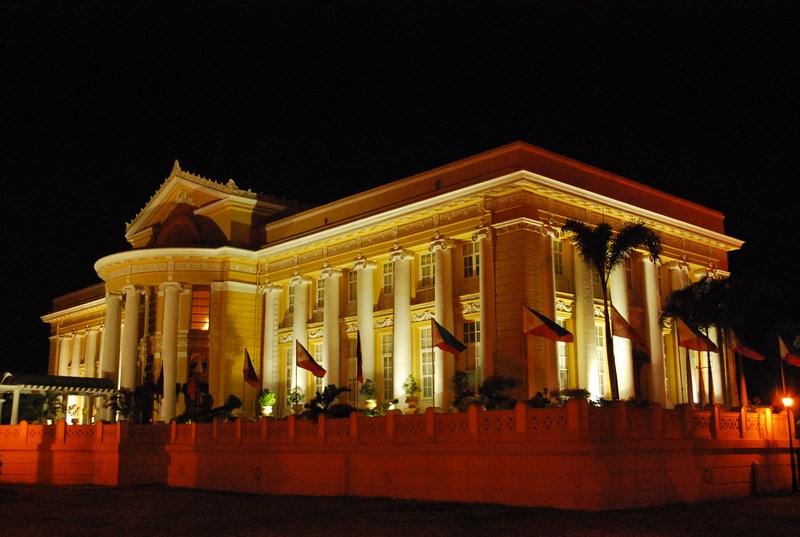
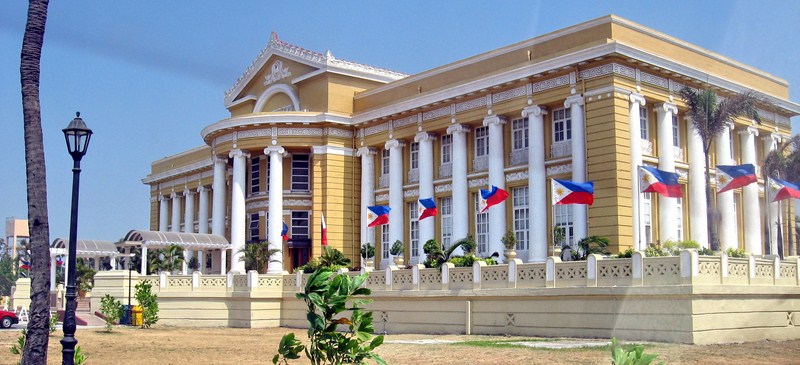
From Largo de Leal Senado Square, we crossed Almeida Ribeiro Ave. to the Neo-Classical Leal Senado Building, now the Civic and Municipal Affairs Bureau.  Originally built in 1784 , this building was Macau’s first municipal chamber, a function it maintains to the present.  Severely damaged by a typhoon in 1874, it  underwent major renovation work in 1876. In 1887, the building’s roof was repaired and, in 1904, the building underwent extensive renovation, adapting it to more functional uses.  In 1936, it was again damaged by a typhoon and restoration work began in 1938 and was completed in 1940.

Civic and Municipal Affairs Bureau (Leal Senado Building)

The Leal Senado Building has retained all its original master walls and primary layout, including the courtyard garden in the back. The main facade is 14.5 m. high and 44 m. wide and is divided into 3 sections by vertical granite projections. The central section of the main façade juts out slightly from the rest of the building and is topped by a triangular pediment which, at its highest point, is 17 m. above the ground. Granite Doric columns, supporting lintels made of the same material, flank the main entrance.

Some of the Leal Senado Building’s Row of Windows

The building’s rows of windows, in simple Renaissance style with granite casings and following a repetitive rhythmic pattern, are the the main architectural element and decorative feature of the completely symmetrical facade.  In the middle section, there are 3 French windows on the first floor, opening out to balconies with iron railings.

The Leal Senado Building’s Courtyard

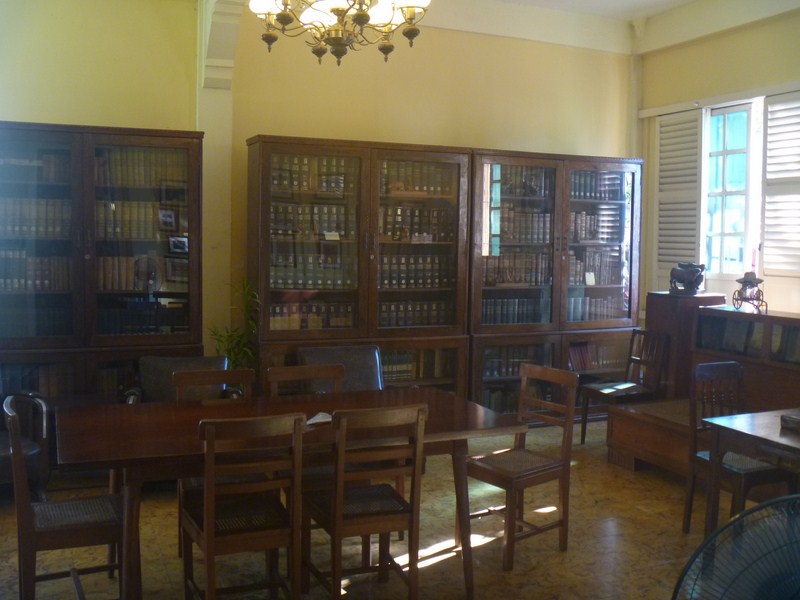
Inside the first floor of this U-shaped building, its arms turning away from Almeida Ribeiro Ave., are a spacious lobby used for public exhibitions, a reception area, a ceremonial meeting room that opens onto an elaborate carved library (styled after the library of Mafra Convent in Portugal) and a small chapel.

The Courtyard Fountain with 2 Heads

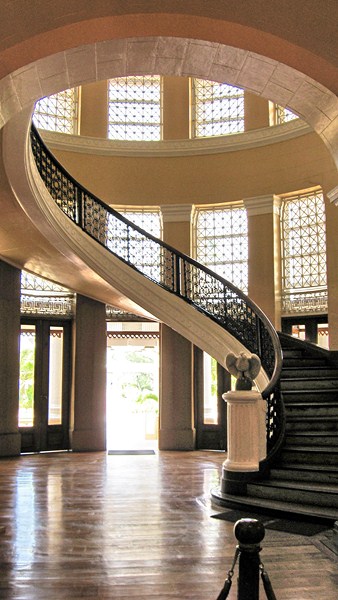
Walls covered with blue and white Portuguese ceramic tiles, a most distinctive feature rarely found in other buildings in Macao, flank the granite staircase, the central axis of the building. The building is painted white which enhances the dark green color of the window frames and the main entrance door.

Leal Senado Square (Macau)

After our tour of Macau Fisherman’s Wharf, we returned to our bus which brought us to the Metro Park Hotel for lunch.  After lunch, Grace, Dad and Mom were to be brought back to the Venetian while Jandy, Cheska and I asked to be dropped off at Leal Senado Square (Largo do Leal Senado), our starting point for our own tour of Macau’s churches.

Leal Senado Square

Here, we got the best rate for exchanging Philippine pesos to Macau Patakas or MOP$, doing so on the recommendation of a Filipino kababayan doing the same thing.  Macau has a sizeable Filipino community (officially 2% of Macau’s population) working in casinos (including the Venetian), retail outlets, restaurants, transport companies and even in the airport where there is a need for amiable, hard-working and English-speaking staff.  Aside from telling me which money changer to go to, they were also helpful sources of information (we had a hard time talking to the Chinese natives in English) on where the free shuttles are parked, where to buy certain goods, directions to tourist spots, etc.

Leal Senado Square at Night

The postcard-pretty Leal Senado Square, part of the UNESCO World Heritage Site “Historic Center of Macau,” has been Macau’s urban center for centuries. In the past, this Portuguese-style piazza was where the governors inspected military troops and the police force when they took up their posts. The square is still the most popular venue for public events and celebrations today.

The Square is Filled with Boutiques and Restaurants

It has coffee shops (Starbucks), restaurants (including a MacDonalds), market lanes and shops (garments, lingerie, fashion ware, kids clothes, accessories, sportswear, shoes, etc.) and is always filled with people and tourists, whether day or night.

Macau Business Tourism Centre

Located close to the former Senate building (now the Civic and Municipal Affairs Bureau Building), the 3,700 sq. m. square is surrounded by pastel-colored, Neo-Classical buildings, creating a consistent and harmonious Mediterranean atmosphere.  They include the Macau General Post Office Building, the Church of St. Dominic and the Holy House of Mercy (Santa Casa da Misericórdia) which was being renovated during our visit. At the center of the square is a beautiful fountain.

Avenida de Almeida Ribeiro

Its pavement is a beautiful wave-patterned mosaic of colored stones created by Portuguese experts. From Avenida de Almeida Ribeiro to the Church of St. Dominic, the pavement extends to the Ruins of St. Paul’s, making the heart of the city a pedestrian paradise. Avenida de Almeida Ribeiro, built in 1918 to link Praia Grande with the Inner Harbour, passes through the old “Christian Quarter” and “Chinatown.”

The Square’s Beautiful Fountain

The Macau General Post Office Building, completed in 1929, has also been selected as a building of architectural and artistic value. It was designed by a Chinese architect, Chen Kunpei, and was built on the site of Tong Sin Tong, a Chinese charitable institution that consisted of some small low houses. The Post Office is the only grand project to have been built along the lines of Classical architecture, and it stands 3 storeys high, with a basement, constructed entirely of cement.

Macau General Post Office Building

St. Dominic Church and Treasures of Sacred Heart Museum (Macau)

When we were in Largo do Leal Senado, my kids and I visited the Church of St. Dominic, situated right in the middle of the  square.  Built in 1587 by 3 Spanish Dominican priests, it is one of the most beautiful churches in Macau.   Originally built in wood, it was, in 1828, rebuilt in stone and was restored in 1994.

St. Dominic Church

The first Portuguese newspaper, A Abelha da China (The China Bee), was published here in 1822.   The church’s basic layout is influenced by both Portuguese and Spanish styles and its architecture is Jesuit Mannerist. The church is now part of the UNESCO World Heritage Site Historic Centre of Macau.

St. Dominic Church – Interior

We also dropped by bell tower at the back which was modified into the small Treasure of Sacred Art Museum. On the right side of the church is the sacristy (dedicated to Our Lady of the Rosary), the only surviving part of the old monastery/convent that was built with the church.  Here, we went up the stairs that lead to the museum located at second and third floors.

Treasure of Sacred Art Museum – Exhibit

When the Religious Orders were abolished in Portugal in 1834, the museum received many articles of sacred art that are now presently displayed. The museum, opened to visitors in 1997, occupies what is left of the ancient cloister and also the other rooms that are still connected to the church.

Treasure of Sacred Art Museum – Exhibit

There are approximately 300 pieces of excellent quality artifacts, many of which are also from Macau. that date back from the 17th to the 19th centuries.  The rich collection includes gold objects, statues, richly ornamented canonicals, religious paintings and other liturgical vessels.

Ruins of St. Paul’s (Macau)

The last destination in our city tour is St. Paul’s (Rua de Sao Paolo), the greatest of Macau’s churches and the major landmark of Macau. Built from 1582 to 1602 by the Jesuits, this church was dedicated to St. Paul the Apostle and was the largest Catholic church in Asia at the time. A fire started in the kitchens, during a typhoon, destroyed the body of the church in 1835.

Ruins of St. Paul’s

Now in ruins, all that remained was the magnificent, intricately carved stone facade (built from 1620 to 1627 by Japanese Christian exiles and local craftsmen under the direction of Italian Jesuit Fr. Carlo Spinola), the crypts of the Jesuits who established and maintained the cathedral, and the grand, 66-step staircase.

To preserves its aesthetic integrity, the facade is now buttressed with concrete and steel and a steel stairway allows tourists to climb up to the top of the facade from the rear. From this stairs, it is customary to throw coins into the top window of the ruins for luck. Behind the façade are remains of the original pillars and a shrine.

The facade, rising in 4 colonnaded tiers, is crowned by the cross of Jerusalem, below which are 3 tiers with niches containing statues, cast from bronze at a local cannon and bell factory. It is covered with Jesuit statues with Oriental themes (such as a woman stepping on a 7-headed hydra, described by Chinese characters as “Holy Mother tramples the heads of the dragon”), carvings of the Garden of Eden, the Crucifixion, the angel, the devil, a Chinese dragon, a Portuguese sailing ship, a Japanese chrysanthemum, pious warnings inscribed in Chinese, founders of the Jesuit Order, the “Conquest of Death by Jesus” and, at the very top, a dove with wings outstretched.

Macau Fisherman’s Wharf (Macau)

From Macau Tower, we next proceeded to the Macau Fisherman’s Wharf, the first theme park in Macau, located near the Hong Kong-Macau Ferry Pier and right beside the huge Sands Casino. Grace, Mom and Dad stayed behind at the bus, leaving just me, Jandy and Cheska to explore the place.  There weren’t too many people around during our visit.

Sands Casino Macau

The HK$1.9 billion, 111,500 sq. m. (28 acres, 40% reclaimed from the sea) Macau Fisherman’s Wharf complex, was opened on December 31, 2005.  The complex has a slots hall, a 72-room hotel, a casino and is divided into three major theme “wharfs”: Dynasty Wharf, East Meets West and Legend Wharf.

Fisherman’s Wharf

Dynasty Wharf, composed of many Chinese towers which are built in the imitation of the Tang-style, encapsulates Chinese history and culture in the form of traditional items sold on the streets, handicrafts in the exhibition halls, and sampan and “jumbo” seafood restaurants.

East Meets West

East Meets West, constructed on mainly reclaimed land, mixes together Oriental traditions and features of Western design.  Vulcania, a  a 40 m. (131 ft.) high man-made volcano, “erupts” every evening. Housed inside are waterfalls, night-time laser shows, the ‘River of Fire’ white-water and ‘Dragon Quest’ roller coaster rides. The exterior of Vulcania includes walkways styled on the Potala Palace in Lhasa (Tibet).

Vulcania and Potala Palace

There’s also an ancient battleship, an Arabian children’s play area, a  and large ceramic crucibles and mine carts to ride in inside for that Indiana Jones experience.  Alladin’s Fort,  an attraction in the style of a Middle-Eastern fort, is home to a large variety of children’s funfair rides and  playground for kids and teenagers.  The Greek Square serves as a leisure park and performance area, with banqueting facilities and ice-skating rink attached. Aqua Romanis is a Roman-themed shopping center. The outdoor, 2,000-pax Roman Amphitheater is designed as a venue for concerts and other performances.

Roman Amphitheater

Legend Wharf includes over 150 stores and restaurants in buildings built in the style of different world seaports such as Cape Town (South Africa), Amsterdam (Netherlands), Miami (U.S.A.), New Orleans (U.S.A.), Lisbon (Portugal), Venice (Italy), the Italian Riviera and Spain. It features the leaning Tower of Pisa, a 16th century Portuguese restaurant, 18th century French inns and a galleon museum.

Legend Wharf

It also has a disco and is equipped with all kinds of recreational facilities such as a 21st century, high-tech games center and a video games center.  Its Vasco da Gama Waterworld is a performance venue, complete with dolphins, for water-based shows including four jet-ski performances every day.

Macau’s Fisherman’s Wharf: 1/F., Rome, Avenida da Amizade e Avenida Dr. Sun Yat-Sen, Macau. Tel: (853) 8299 3300, (853) 8299 3581 and 8299 3582. E-mail: info@fishermanswharf.com.mo.  Website: www.fishermanswharf.com.mo.

How to Get There: Take bus no. 1A, 3, 3A, 8, 10, 10A, 10B, 17, 28A, 28B, 28BX, 28C and 32, get off at Macau Fisherman’s Wharf. Free shuttle bus service from ferry terminal to the Fisherman’s Wharf leave every 30mins..

A-Ma Temple (Macau)

A-Ma Temple, situated on the southwest tip of the Macau Peninsula, halfway up the western slope of Barra Hill, is one of the oldest and most famous Taoist temples in Macau. Also known as Barra Temple, Tianhou Temple, Juehai Temple, and Zhongjue Buddhist Temple, it is dedicated to A-Ma (meaning “Honored Mother”). Also called Mazu or Tin Hau, she is a much-revered Taoist goddess who is also the patron of seafarers and fishermen and the Queen of Heaven. In fact, the name Macau is thought to have been derived from A-Ma-Gau (meaning “Bay of A-Ma”).

A-Ma Temple

The temple was originally built in 1488 during the Ming Dynasty but the oldest surviving structures date to 1573. The temple was damaged by fire in 1974 and restored in 1975. It was once again restored in 1987, 1996 and 1997 by the Cultural Institute.  In 2005, the temple became one of the designated sites of the Historic Center of Macau enlisted in the UNESCO World Heritage List.

The temple consists of a prayer hall, 4 pavilions (Hongren Hall, Zhansuo Hall, Zhengjue Hall and Kun Iam Hall) and courtyards built into the boulder-strewn hill and connected by winding paths through traditional moon gates and miniature  gardens. It is believed that the Hongren Hall has the longest history in the complex.  Across the temple is the Maritime Museum.

Three of the temple’s 4 pavilions are dedicated to A-Ma and contain some fine statues of the goddess together with a model of a junk with cannons, brass vessels and chapels to Buddhist and Taoist gods. On boulders are carved red characters invoking the gods or repeating a prayer.

Couplets Engraved in Stone

The temple’s main prayer hall, at the roadside, is also called First Palace of the Holy Mountain.  First built in 1605 and rebuilt in 1629,  this granite structure has lattice windows and up-pointing roof ridges. and there are other pavilions and altars ranging up the hillside and connected by a flight of steps.

Aside from us tourists, there were also a lot of devotees thronging to this temple, giving thanks to A-Ma and praying for good fortune by making offerings and burning lots of incense. We all entered the temple through the Memorial Arch.  At the entrance is a large boulder with a colored relief of a lorcha (a traditional sailing junk of the South China Sea).

Carved Red Characters

Winding paths connect the different shrines of the complex.  We first reached the Hongren Hall (the Great Mercy Hall or Hall of Benevolence), dedicated to A-Ma.  At its gate are couplets engraved on stone.  Believed to have been constructed in 1488, its 4 walls are made of granite and brick and the altar is placed under a roof covered with green glazed roof tiles and ornamental roof ridges. Some relief engravings, such as water monsters and fairies, are found on the wall beside the altar.

Burning Incense

Further ahead is the Hall of Avalokitesvara (Goddess of Mercy), constructed in a simple style using mainly using bricks and stone.  The Zhengjiao Chanlin, a Buddhist hall, is tastefully designed, both in  size and architectural style. Within it is a shrine to A Ma and a resting area with yingshan roofing.  The Kun Iam Hall, a plain brick structure distinguished by beautiful flush gable tiled roofing called yingshan, has spectacular views from the upper gardens.

The festival of A-Ma takes place on the 23rd day of the 3rd moon (April or May). Firecrackers, to scare away evil spirits, are exploded in the entrance courtyard to greet tour groups and lions dances are performed here on weekends.

A-Ma Temple: Rua de São Tiago da Barra. Open Mondays to Fridays, 10 AM-4 PM, and Saturdays, 10 AM-1 PM.  Closed on Sundays. Admission is free.

The Venetian Resort Macau (Macau)

The 40-storey, US$2.4 billion Venetian Resort Macau at the Cotai Strip, our home during our 4-day visit, was officially opened on August 28, 2007.  The Venetian’s casino space is the largest in the world at 550,000 sq. ft. (51,000 sq. m.) with over with 3,400 slot machines and 800 gambling tables.  Also the largest single structure hotel building in Asia and the 4th largest building in the world (by area), it also has 3,000 suites (Level 7-38) served by 250 guest lifts, 111,000 sq. m. of convention space, 149,000 sq. m. of retail (330 shops), and a 15,000-seat entertainment/sports arena.

The Venetian Resort Macau

Its foremost attractions are Cirque du Soleil’s Zaia, an aerial ballet that takes place above the audience’s heads, and the gondola rides where visitors are rowed, by a gondolier serenading you in Italian, through the romantic indoor Grand Canal, the next best thing to Venice.

The Venetian Resort Macau – Interior

We tried dining at the 1,000-seat Festivita Foodcourt, located on the 3rd level of The Grand Canal Shoppes.  It offers 21 big brand names in fast, mid-priced food offering almost every international cuisine (Japanese, Korean, Chinese, Vietnamese, Thai, Mexican and American). When we looked up, we found ourselves under the perfect blue sky although we were actually indoors. The ceiling was done in a way so as to create an impression of a clear blue sky (even at night) which is Pantone 14-4318 (Sky Blue). Some say it was done to lull shoppers into thinking that it’s not yet time to go and that there’s still more time to shop.

Festivita Foodcourt

Venetian Resort Macau: Estrada Da Baia De N., Senhora Da Esperança, s/n, Taipa, Macao. Tel: (0)2882 8888.  Website: www.venetianmacao.com.

Calicoan Island (Guiuan, Eastern Samar)

Talisay Beach

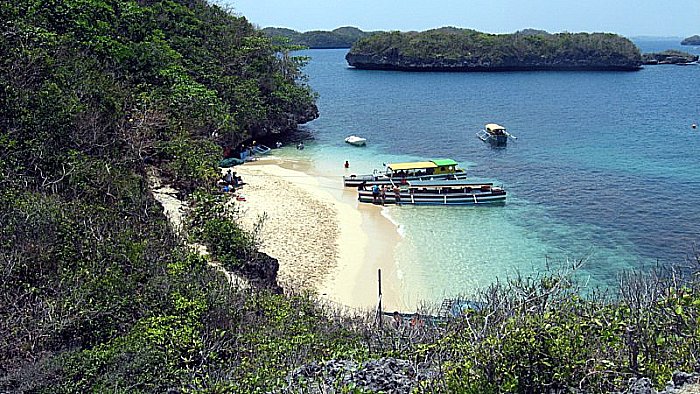
One of the 2 reasons why Jandy and I dropped by Guiuan (the other was the town itself) was to visit Calicoan Island.  Called the “Sleeping Beauty of Eastern Samar,” this island is blessed with long stretches of unspoiled white sand beaches; limestone cliffs (tempting for rock climbers); alien abstract rock formations (great for camera buffs); dive destinations (Pearl Island, Binabasalan Island and Baul Island); crystal clear blue waters; numerous, cathedral-like caves for spelunkers (the large Buro Cave is accessible during low tide) with stalactites along the seashore; 20 isolated and romantic coves; 6 huge and unexplored saltwater lagoons and nature trails inside tropical virgin forests (50% of the area).

Causeway to the island

Come morning, after a hearty Filipino breakfast at the Calicoan Surf Camp’s restaurant, we opted to burn calories by exploring the island on foot (for me still the best way), bringing along resort staffer Mr. Marcial Orocay as guide.  From the resort, we cut across the 3-km. width of the island, to the western side which faces the calm waters of Leyte Gulf, its 8-km. long beach ideal for swimming, snorkeling, picnics and watching magnificent sunsets.   The forest along the way is said to be home to mischievous monkeys, monitor lizards and colorful birds.  Though we didn’t get to see any up close, we did get to see a snake crossing our trail.

Sulangan Beach

Skirting the western coast, we visited Sulangan Beach, the habitat of the world-famous and rare Golden Cowrie (Conus gloriamaris) shell. These shells were being sold (at a whopping PhP1,500 per piece) at souvenir shops at nearby  St. Anthony of Padua Church, also a notable pilgrimage site.  With its schools of multi-colored fish, Sulangan Beach is also an ideal site for scuba diving.

The original 3149 Base flagpole

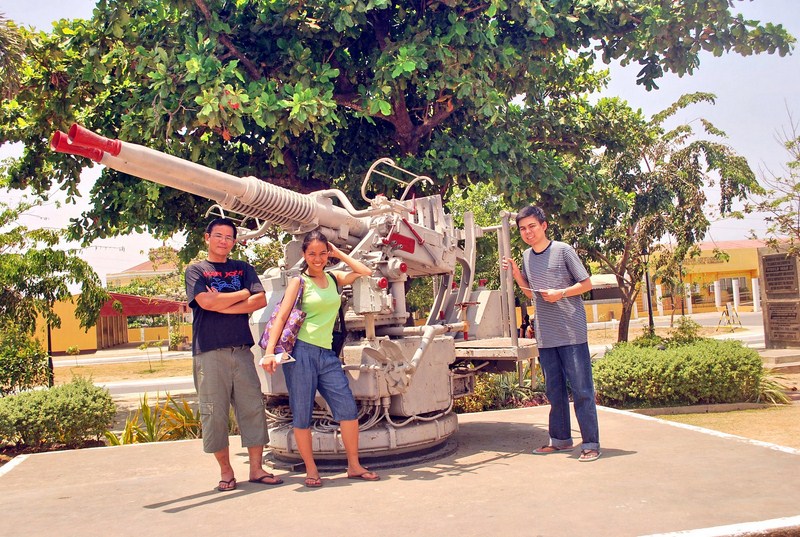
Caliocan Island, a low coralline island in Brgy. Ngolos, 23 kms. from the town was, during World War II, the site of the U.S. Navy’s 3149 Base.  The base’s original flagpole still stands.  The late U.S. Pres. John F. Kennedy, a PT boat commander during the war, was also stationed here.

Guiuan Airport runway

The runway of the former U.S. Navy airbase, located on the eastern edge of the town, was once one of the biggest U.S. bases in the Pacific and was also used actively until the Korean War.  Its 60 m. wide and 1.9 km. long runway was built, during the liberation, by U.S. Army engineering battalions in December 1944.  Here, the B-26 Superfortress bomber Enola Gay, which dropped the atomic bomb on Hiroshima, Japan (August 6, 1945), was launched.  Disused for some time after its turnover to the Philippines, it is now undergoing a PhP142 million rehabilitation (its runway, now with an overlay of asphalt, is now 2.134 kms. long) and will opened this October as a feeder airport for chartered or regular flights.  Its opening would be heaven-sent as it would make Guiuan easily accessible by plane (cutting its dependence on Tacloban City’s airport), thus supporting the commercial and tourism industry in the region, most especially Calicoan Island, an upcoming island resort which boasts of miles of white sand beaches as well as powerful swells rolling in from the Pacific over the 10,000 m. Philippine Deep, making it a surfer’s paradise. A PhP38 million water system that would supply the island resorts’ operational requirement is also nearing completion. All these aim to promote Guiuan as the next eco-tourism hub in the country, a place that offers visitors a lot when it comes to cultural and historical heritage sites, natural beauty plus the warmth and hospitality offered by its 38,694 Guiuananons.

Calicoan Surf Camp (Guiuan, Eastern Samar)

Our Guiuan host, Ms. Vibina “Bebeng” Juacon, facilitated our visit to Calicoan Island with a call to Mr. Danilo Molina, Gen. Manager  of Calicoan Surf Camp, the resort where she recommended we stay overnight.  Once given the green light, we thanked Ms. Juacon and Jandy and I hired a tricycle (for PhP400) to get to the island and the resort.  There were to be no boat crossings as the “island” is connected to the mainland by a short concrete causeway.  Once across, we traversed a dirt and gravel road  which runs the length of the island.

Calicoan Surf Camp

Calicoan Surf Camp is island’s best and most luxurious.  This hideaway was developed by Cebu-based lawyer and pioneer developer Maning Go who owns about 500 hectares of the island’s 1,600 hectares.  It was designed, with distinctive Asian-inspired (Thai, Balinese, Indonesian and Filipino) lines, by Frenchman Nicolas Rambeau, owner and creator of the highly-acclaimed, high-end Pansukian Resort in Siargao (Surigao del Norte).

Bungalow interior

After a short interview with Mr. Molina, we called it a night and Mr. Molina checked us in at one of the resort’s 7 well-appointed, spacious bungalows with its soaring rooflines.  Each bungalow has a native feel, with its own deck and floor with alternating dark and light wood stripes.  Modern amenities include airconditioning, compartmentalized bathroom with hot and cold shower, satellite TV, coffee/tea maker, hair dryer, minibar and safety deposit box.

Infinity pool

Tired after a long trek around the island, we dipped our tired bodies at the resort’s inviting 300-sq. m. saltwater infinity pool bordering the 3-km. long, white ABCD Beach, the island’s prime surfing area.  Verdant pandamus trees (locally called bariw) grow through the pool’s uniquely-designed wooden deck, embracing it and providing cool shade, thus binding nature with design.  Here, we watched the surging, breathtaking surf (boasting perfectly-shaped left or right reef breaks) as the island’s  eastern side juts out to the rolling surf of the Pacific Ocean (its powerful swells tirelessly rolling in over 10,000 m. Philippine Deep), making it a surfer’s paradise. The best surfing months, according to  Mr. Molina, are March, April and September to October when southwesterly winds blow offshore, piling up incoming ocean swells and carving them into glassy shaped hollows.  Surfboards are rented out for a small fee and beginner’s lessons can be provided, on request, by the resort staff.  Surfers must wear booties as protection against the sharp rocks. Although the currents are strong here, the island offers opportunities for big game fishing along the “Tuna Highway,” the migratory route for tuna to Japan.

The resort’s restaurant

Also quite famished after such a long trek, we later indulged ourselves at the resort’s restaurant which offers International and Filipino cuisine including seafood such as freshly caught, fleshy, sweet and delicious lobster, prawns, scallops, abalone, crabs and fish.  After a filling lunch, we packed up our gear, checked out, thanked the resort staff and hired a tricycle (this time for PhP350) to bring us back to the bus station at Guiuan town proper for our trip back to Tacloban City.  Along the way, we made a brief stopover at Calicoan Island Ocean Villas, another of Maning Go’s development projects.  Go enlisted the multi-awarded architectural firm of Francisco “Bobby” Manosa to prepare the island’s master plan.  He envisions zoning development where visitors can make nature treks to large areas of the island without encountering any bar, souvenir shop or billboard, thus offering more natural attractions and leisure activities with less of the hustle of the better-known Boracay.  With continued but controlled growth, may it stay that way, making Calicoan truly a diamond in the rough.

Calicoan Island Ocean Villas

Calicoan Surf Camp: Calicoan Island, Guiuan, Eastern Samar.  Manila Tel: (632) 376-5818.  Website: www.thesurfcamp-calicoanisland.com.

Church of the Immaculate Conception (Guiuan, Eastern Samar)

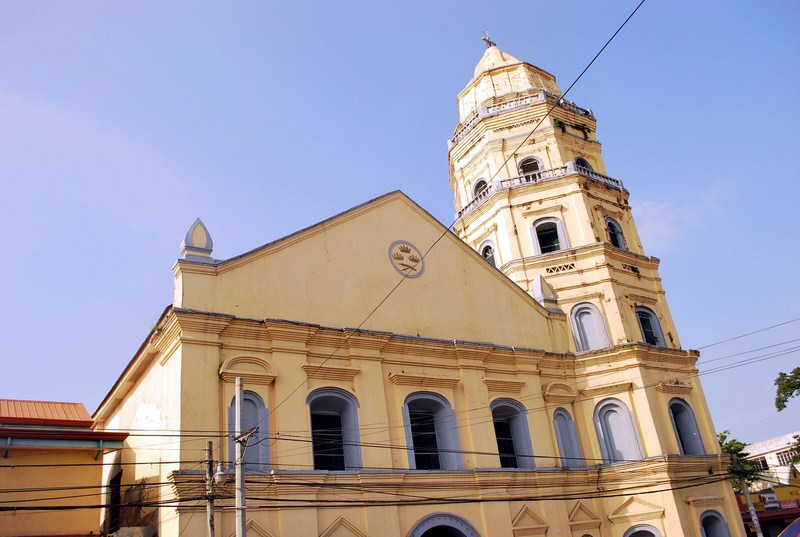
Church of the Immaculate Conception

After attending the star-studded and colorful Sangyaw Festival of Tacloban City, Jandy and I decided to get some “rest and recreation” at the progressive town of Guiuan in Eastern Samar, our first in the province. To get there, we left the city after lunch, proceeded to downtown and boarded an airconditioned Van-Van van.  The trip took just 3 hrs., made possible by the opening, in the late 1990s, of the South Samar Coastal Road which cut land travel time to Guiuan by about 2 hrs..  As usual, we crossed the beautiful, S-shaped San Juanico Bridge (the country’s longest) into Samar, traveling along a coastal highway which runs past mountains, steep cliffs, distant rock islands and boat-filled bays, then making a right at a T-junction (the left goes to Borongan City) to an occasionally potholed asphalt road all the way to Guiuan.  We arrived there by 4 PM and were guests at the house of Ms. Vibina “Bebeng” Juaban. 

San Juanico Bridge

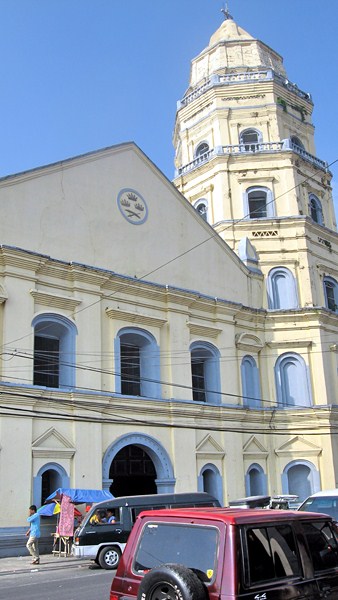
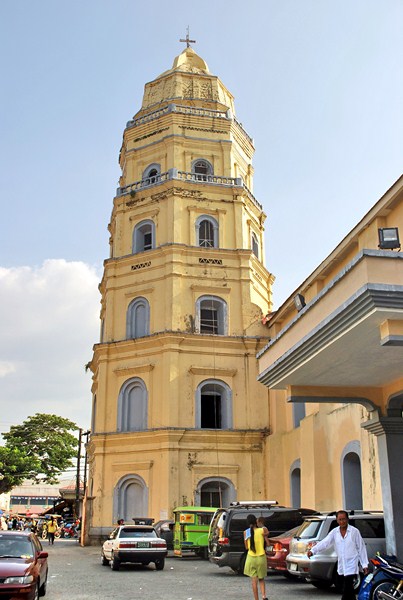
The best way to explore this coastal town is by hired tricycle.  Vestiges of Spanish era history can be seen at the “fortress Baroque” Church of the Immaculate Conception, considered to be the finest in the Eastern Visayas.  Started in the 1630s, it was rebuilt in stone in the early 18th century.  From 1844 onwards, Fr. Manuel Valverde and Pedro Monasterio renovated the church, covering the roof with tiles. In 1854, Franciscan friars added a transept and baptistery and built a massive bell tower (which once served as a watchtower) on top of a seaside bastion of the fort.   

The church belfry

The church’s façade has triple but slim engaged columns, arches and carvings at the pediment’s borders and 3 entrances with elaborately carved, hardwood doors.  Inside are a single nave with a main altar and two side altars, a beautiful retablo from Franciscan times, a Rococo frontal with the Augustinian emblem and old santos.  The church is enclosed within the partially preserved quadrilateral fort of cut stone, said to be the best and most regularly planned in all the Visayas. Today, this church has been declared as a National Cultural Treasure (unique structures that possess outstanding artistic, historical and cultural values that are significant to the nation), one of 26 named as such by the National Museum in 2001.