
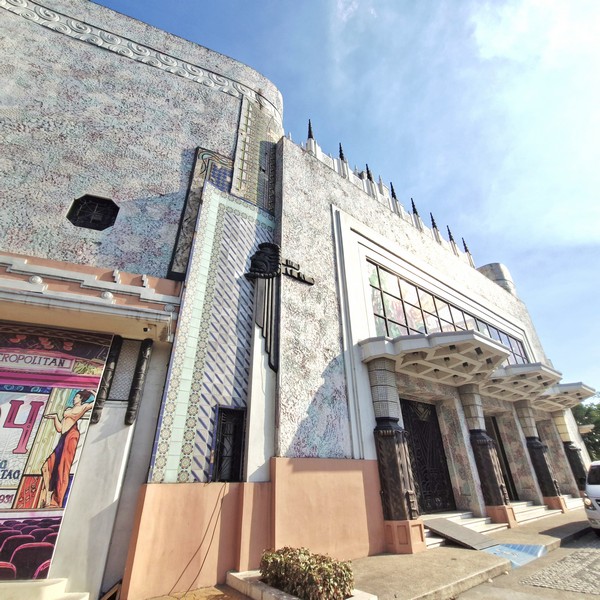
After nearly 13 years, I finally got to see the historic Manila Metropolitan Theater (abbreviated as the MET), a renowned Filipino-influenced Art Deco masterpiece, in its restored state (after surviving the Second World War, it went through periods of disrepair and neglect before undergoing successful restoration), attending the closing and turnover ceremony of the Filipino Food Month 2026 at its ballroom. Located along the Pasig River and in front of the equally classic Manila Post Office, it was recognized as the forefront of the Art Deco architectural style (then a rage in the U.S.A.) in the Philippines.
Check out “Save the Manila Metropolitan Theater!!!“ and “Closing and Turnover Ceremony of Filipino Food Month“
Designed by the late National Artist (for Architecture) Juan M. Arellano, its cornerstone was laid in February 1928, with construction by Pedro A. Siochi & Co. as contractors. The biggest in the Far East at that time, the theater was inaugurated on December 10, 1931.
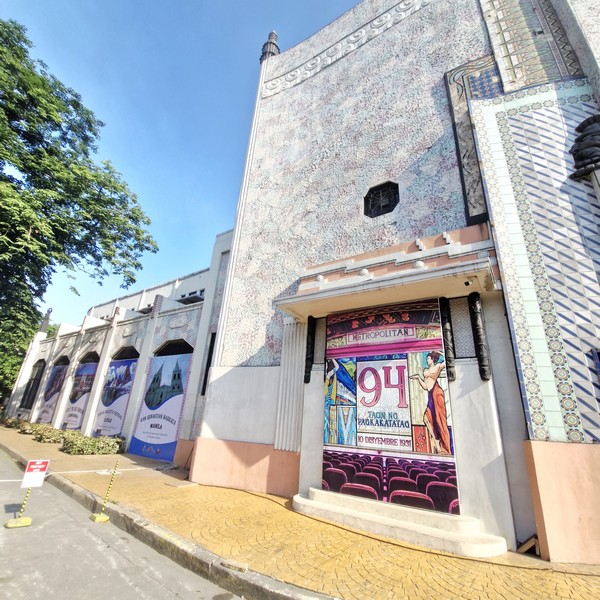
Arellano, known for his Neo-Classical architectural style employed in his design of the Legislative Building and Manila Post Office, departed from this and the Metropolitan Theater marked his departure towards more modern designs. For the structural configuration of the building, Arellano was inspired by the phrase “On Wings of Song,” a rectangular-shaped auditorium flanked by pavilions on either side. Throughout the design, Arellano weaved Filipino decorative elements into the Art Deco style. Philippine Magazine editor A.V.H. Hartendorp described the style as “modern expressionistic.”
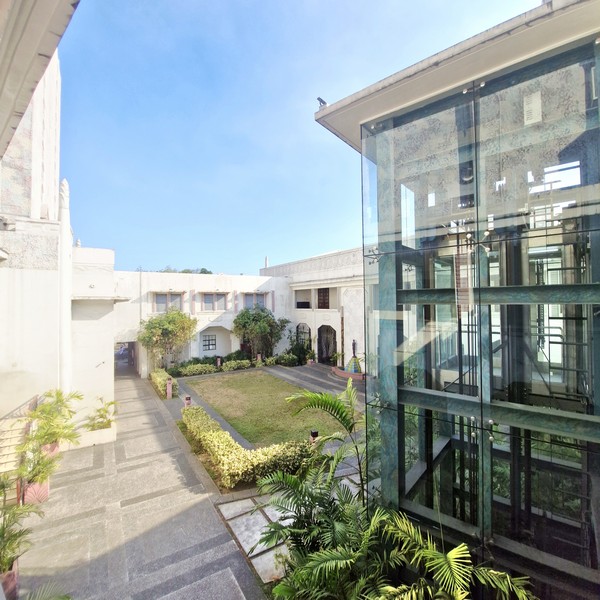
During its heyday as the “Grande Dame” of theaters, the Met played host to vaudeville acts, zarzuelas, operas, pageants, Filipino and Spanish plays, and performances by well-known artists such as violinist Maestro Jascha Hefertz and composer/conductor Dr. Herbert Zipper (who conducted the Manila Symphony Orchestra).
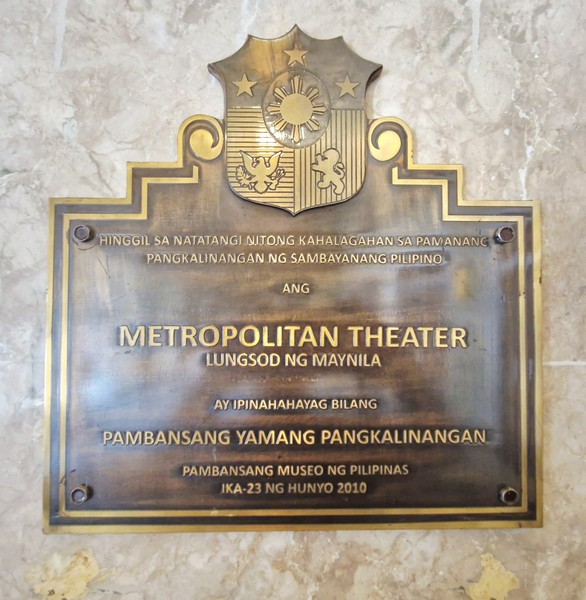
On October 21, 1976, the Metropolitan Theater was declared a National Historical Landmark by the National Historical Commission of the Philippines (NHCP) and, on June 23, 2010, the National Museum of the Philippines recognized the Met as a National Cultural Treasure under the National Cultural Heritage Act.
Following extensive restoration by the National Commission for Culture and the Arts (NCCA), which now oversees the venue, it reopened on December 10, 2021 (the Metropolitan Theater’s 90th anniversary) as a premier venue for arts and culture, including performances and special screenings.
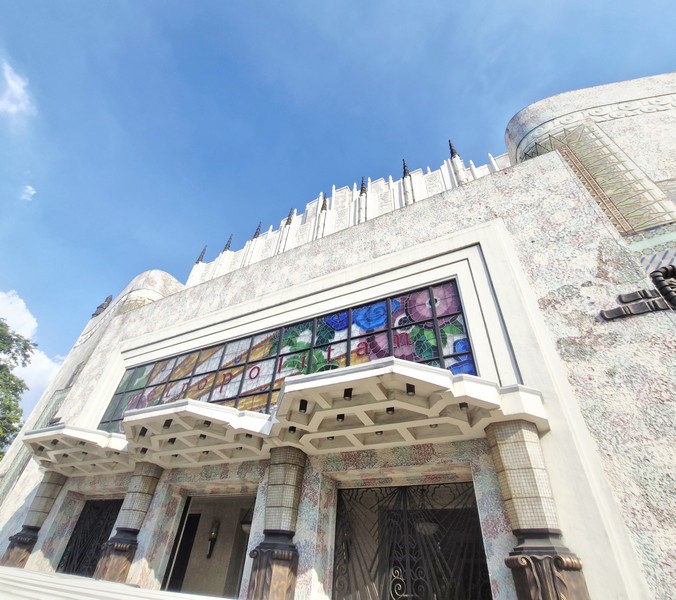
The theater’s still had its exuberant and symmetrical exterior, with its tiara-like pediment with stylized, Muslim-inspired minarets crowning the top of the concave roof (which suggested its status as a theater back in its prime days), plus bas-reliefs with curlicues or mask-like chimeras; whimsical rope designs; friezes; colorful ceramic tiles; intricate grille work at the doors and windows. and is also enhanced by sensuous, exotically-draped female statues, said to be Siamese dancers, done by Italian sculptor Francesco Riccardo Monti (who lived in Manila from 1930 until his death in 1958).
The façade’s focal point is its proscenium-like central window of rectangular stained-glass panels that corresponds with the shape and scale of the Main Theater inside. The stained-glass marquee, executed by the Kraut Art Glass Company, with the “Metropolitan” label backlit and surrounded by Filipino floral motifs, is highlighted, on both sides, by curving walls of colorful, decorated tiles resembling batik patterns of Southeast Asia. The wall that frames the stained-glass is a segmented arch with rows of small finials on the upper edge.
Above the proscenium arch are eight iconic, original bas-relief figures, by Francesco Riccardo Monti, which were discovered intact, in 2017, after dismantling the anomalous additions from the 1978 restoration, surprising the NCCA who originally intended to reproduce the figures from historical photographs.
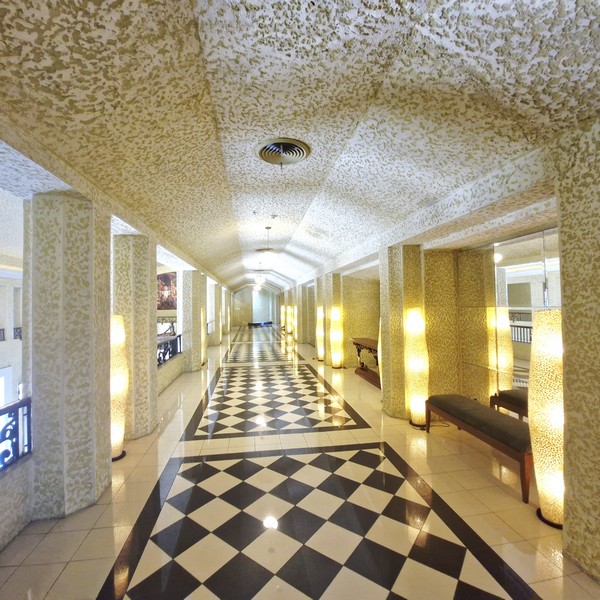
There are also moldings of zigzag and wavy lines that go with the sponged and painted multi-colored walls. Capiz lamps and banana-leaf formed pillars, which go alternately with the theater’s entrances, accent the ground level.
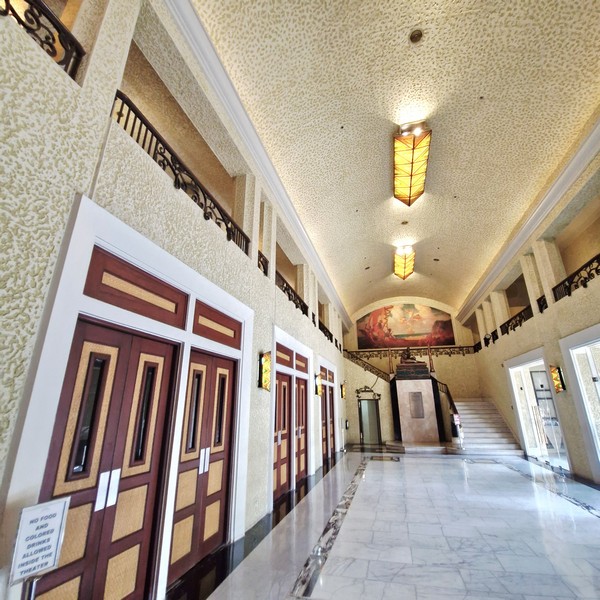
At the entrance are elaborate wrought iron gates, patterned into leaf designs and various lines. I accessed the Main Theater through a foyer with a two-storey ceiling. The foyer’s grillwork features a drooping floral balustrade, in a geometric Art Deco style, originally crafted by Arcadio Arellano, the brother and collaborator of Architect Juan M. Arellano.
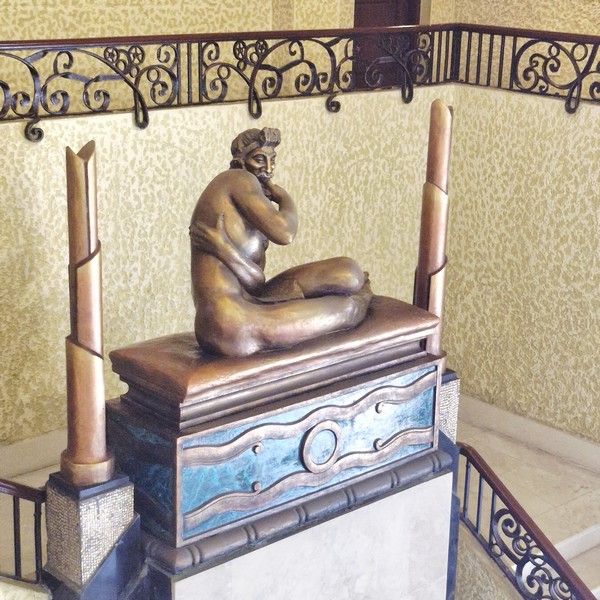
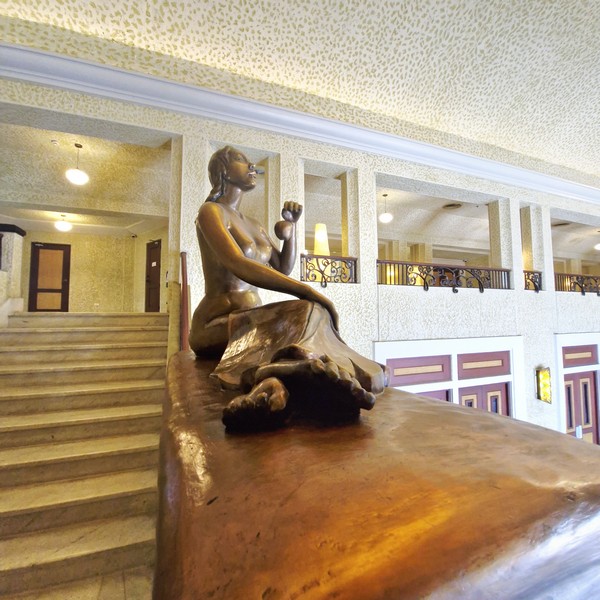
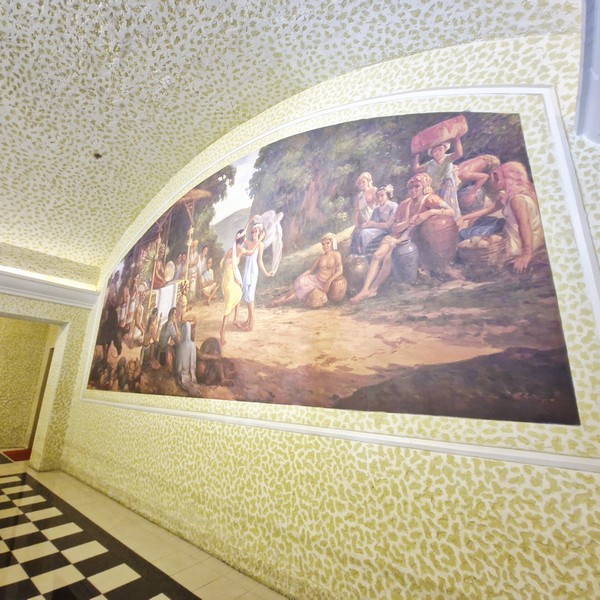
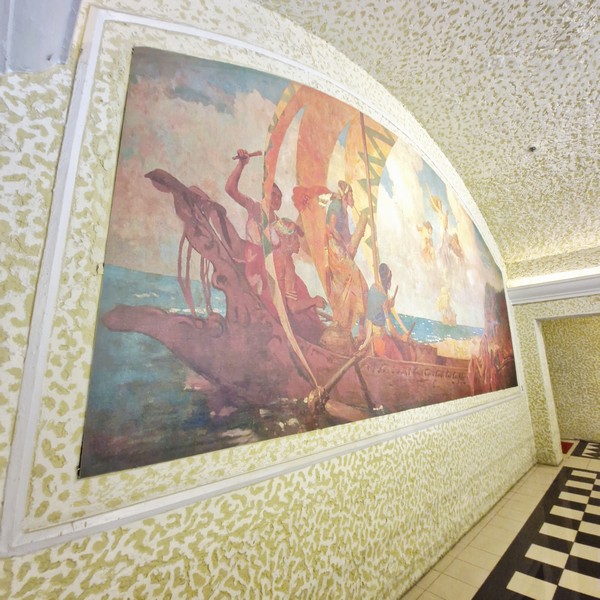
There were stairways, on either side, leading up to the balcony. By the stairways are the Adam and Eve bronze sculptures also done by Francesco Riccardo Monti. On opposite sides of the foyer are reproductions (since the 1996 foreclosure, the original murals are in the GSIS Museum) of two mural paintings, “The Dance” and “The History of Music,” by the late National Artist Fernando Amorsolo.
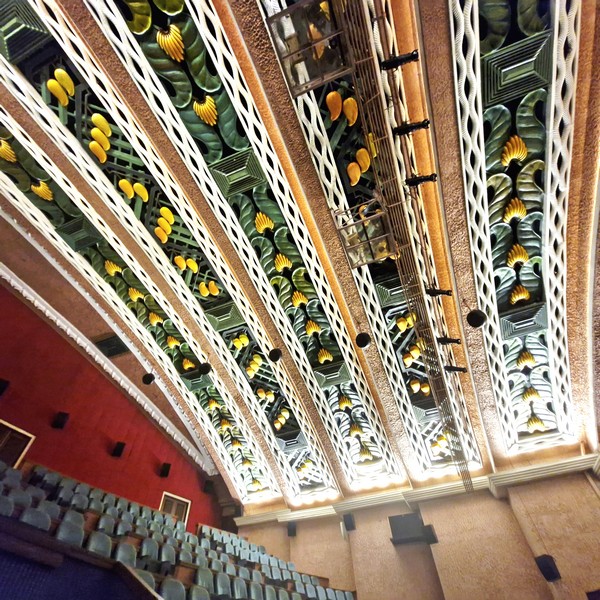
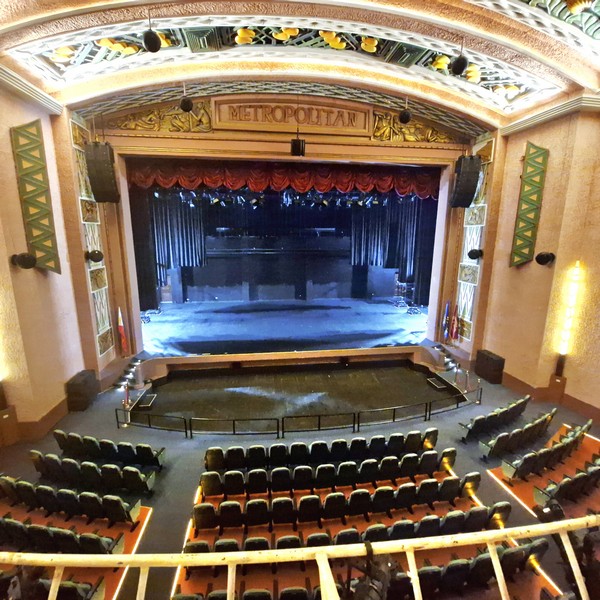
The theater used to seat 1,670 (846 in the orchestra section, 116 in loge and 708 in balcony) but, during its 2020 renovation, the capacity of the Main Theater was reduced to 990 and the floor’s elevation was adjusted to comply with safety regulations.
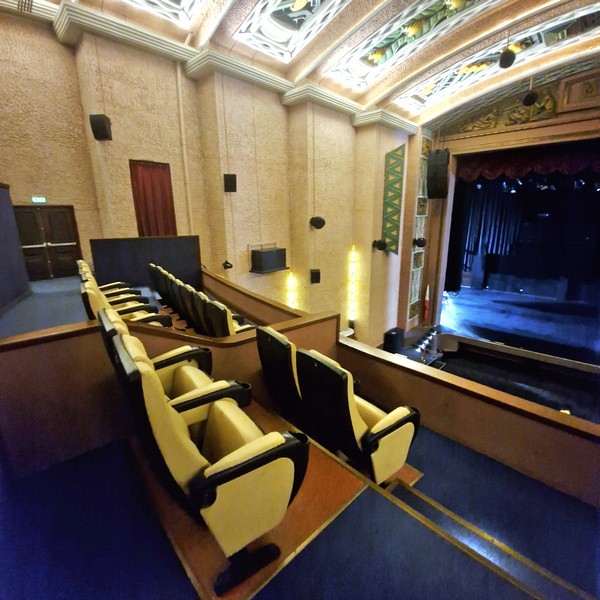
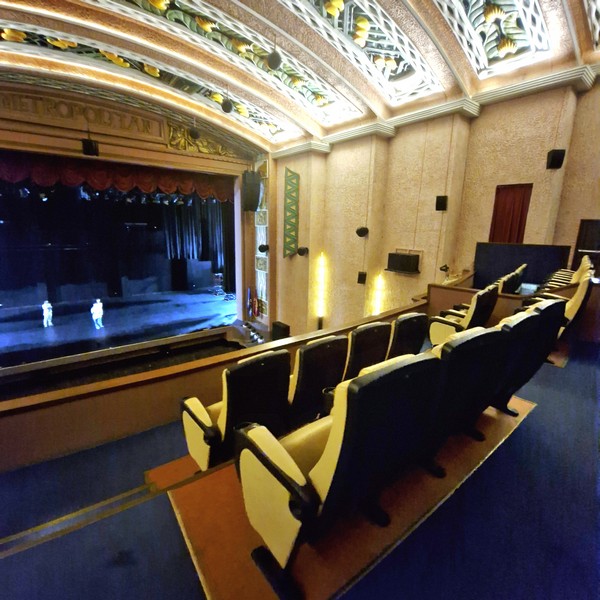
The ceiling is decorated with intricate interior motifs such as Art Deco mangoes, bananas, and tropical leaves bas-reliefs designed by Isabelo Tampinco.

Metropolitan Theater: Padre Burgos Avenue cor. Arroceros Street, Liwasang Bonifacio (formerly Plaza Lawton), Ermita, Manila (near Mehan Garden and the LRT Central Terminal). Tel/Fax: (02) 8248 3068 or (02) 8527-2192 local 805. Mobile number: 0968 542 8521. E-mail: met.visitorsservices@ncca.gov.ph. Coordinates: 14.5940°N 120.9806°E.