Agnaga Falls and Cold Spring (Malay, Aklan)

During one of our family visits to Malay (Aklan), I decided, for a change, to veer outside our normal routine of visiting Boracay Island by visiting one of the town’s little-known tourist attractions – Agnaga Falls.  Though listed as one of Malay’s 7 natural wonders (Boracay is No. 1 of course), not many people, aside from the locals, know about or visit the place.

L-R: Cheska, John Paul, Ningning and Jandy

Joining me were my kids Jandy and Cheska plus their third cousin John Paul and John Paul’s mom, Ningning.  After lunch, we all boarded the Mitsubishi L-200 pickup and were driven my Naciang, Ningning’s husband and my wife Grace’s second cousin, along the road to Buruanga up to the jump-off point.  This was as far as the pickup could go.  Naciang stayed behind with the pickup to await our return.

Agnaga Falls

From here, it was to be all footwork through a dirt trail within a light forest. After about 20 mins. of leisure hiking, the sound of the fall’s flowing waters told us we have finally reached our destination.  The falls wasn’t high, just about twice my height, but the cool turquoise waters at its small, shallow pool were inviting. Besides, we were the only visitors around and we had the falls all to ourselves.   Simply heaven.

Agnaga Falls: Brgy. Kabulihan, Malay, Aklan.

Stopover: Church of the Immaculate Conception (Guagua, Pampanga)

The town’s brick and stone church was started in 1641 and supervised by Fr. Jose Duque.  It was artistically painted by Fr. Antonio Bravo in 1862 and the beautiful dome above the transept was built by Fr. Paulino Fernandez in 1886.

Church of the Immaculate Conception

Church of the Immaculate Conception

Its Classic facade has slender, superimposed and paired Doric columns and a scarcity of decorative elements.  The undulating pediment has a raking cornice in the form of a large scroll.  It also has an oval window at the retablo and geometric motifs within a stilted semicircular arch molding.

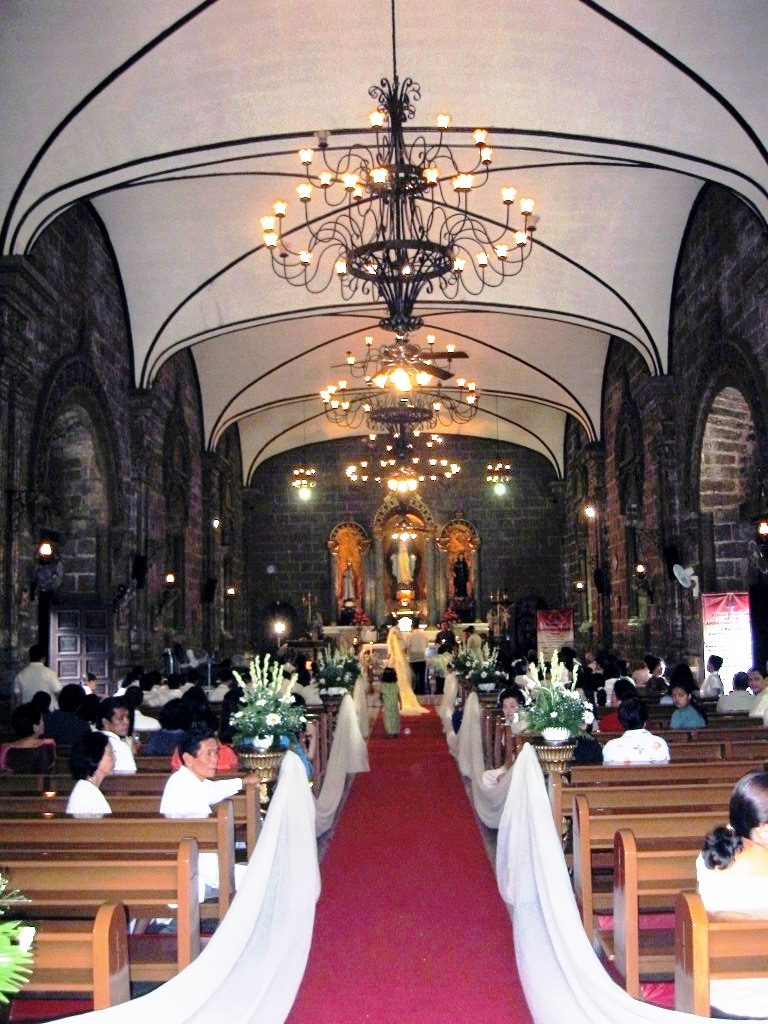
The church's interior

The church’s interior

The present stone convent was built by Fr. Manuel Carillo but was recently razed with only the walls remaining.

The altar retablo

The altar retablo

How to Get There: Guagua is located 77 kms. from Manila and 10 kms. south of the City of San Fernando.

Church of St. Augustine (Lubao, Pampanga)

This church was first built by Fr. Juan Gallegos using light materials.  The present brick and adobe church was started by Fr. Francisco Coronel, continued by Fr. Geronimo de Venasque in 1635 and completed by Fr. Francisco Figueroa in 1638.  It was damaged during the 1645 earthquake and was enlarged in 1829 using masonry materials.  Fr. Antonio Bravo did some repair work in 1877 while Fr. Antonio Moradillo worked on the interior decoration in 1893 (the murals depicting scenes from the life of St. Augustine were probably done during this time).

Church of St. Augustine

Church of St. Augustine

The church was occupied by revolutionaries in 1898, used as a hospital for American soldiers in 1899 and in 1942, during World War II, the dome, transept and roof collapsed during the heavy Japanese bombardment.  The main retablo was undamaged but sunken panels and other liturgical ornamentations done by Italian artist Alberoni were lost.  It was restored from 1949 to 1954 by Fr. Melanio Garcia but was again damaged by a strong typhoon in 1962.

The church's facade

The church’s Neo-Classical-style facade

The church is 82.45 m. long, 21.12 m. wide, 10.50 m. high and has 2.46-m. thick walls.  The simple, plastered stone Neo-Classic-style facade has a semicircular arched main entrance flanked by engaged, fluted pilasters spanned by a lintel frame above which is a rectangular window with the same pilaster and lintel arrangement and flanked by small niches.  Above the window is a statued niche with a small segmental pediment above it and elegant curvilinear lines flowing from the mid-section.  An imaginary triangular pediment masks the roof.

The 5-storey, octagonal bell tower

The 5-storey, stone and brick bell tower

Its only nave was originally painted by Dibella and Alberoni, both Italian artists.  The central retablo is flanked by rectangular openings with triangular segments as well as coupled pilasters on the first level and single columns on the second level.   The 5-storey, 31-m. high stone and brick bell tower, still unrestored, has two square stories and three octagonal.  The convent, at the opposite end of the church, is profusely ornamented.

The church's retablo

The church’s retablo

How to Get There; Lubao is located 83 kms. from Manila and 16 kms. south of the City of San Fernando.

Ocean Adventure Marine Park (Subic Freeport Zone, Zambales)

After dropping off our luggage and freshening up at the Subic International Hotel, Jandy and I then returned to our Toyota Revo and hied off to Ocean Adventure Park, nestled at Camayan Wharf in the West Ilanin Forest area inside the Subic Bay Freeport Zone.  Once in, we first had to satisfy our growling stomachs, doing just that with much-needed lunch at the park’s 240-sq. m., 70-pax Ilanin Bay Cafe.

Bottlenose dolphins

The world-class Ocean Adventure, managed by the Subic Bay Marine Exploratorium Inc. (SBME), is the first and most astounding nautical sanctuary in the country and the first and only open-water marine park facility in Southeast Asia.  Opened on September 15, 2001, this 20,000-sq. m. (12,000 sq. m. on land and 8,000 sq. m. on water) park showcases some of the world’s most amazing sea mammals and is home to 8 South American sea lions (Otaria byronia), 6 false killer whales (Pseudorca Crassidens), 4 bottlenose dolphins (Tursiops truncatus gili) from Japan, and porpoises, all moving about in their inherent, natural habitat (not man-made as in similar parks abroad), fenced off only on one side of the shore.

Park trainers

The park aims to provide guests with what they call “edutainment” (educational entertainment), educating the people on marine life and the rich resources people should learn to value and conserve.  It thus gives the Filipinos an opportunity to truly appreciate the value of marine mammals as partners of humanity in the enormous task of saving our oceans.  The park is currently managed by a team of highly trained professionals, all formerly involved with internationally recognized theme parks such as the Hong Kong’s Ocean Park, Walt Disney World and Florida’s Animal Kingdom. In its effort to protect, preserve and develop wildlife and the forestland, Ocean Adventure also corroborates with the Wildlife in Needs (WIN) Foundation and the Subic Bay Metropolitan Authority (SBMA) Ecology Center, putting up a rescue center within the compound for sick, injured and confiscated wildlife in the Subic Bay area.  About 50 injured animals are presently under the care of experts and veterinarians in the facility.  The WIN Rescue Center is open for public viewing.  Here, visitors can get a peak on how the animals are being cared for and treated.

The Sea Lion Show

The Animal Care Clinic, a behind-the-scene look at how the animals are cared for, offers visitors a chance to view the actual lab work evaluating individual health parameters of the mammals.  The Animal Nutrition Center, on the other hand, is a behind-the-scene look at the kitchen support extended to the animals. Visitors can see how animal food and dietary programs are prepared.   The Sea Lion Show, at the 350-seat Nautilus Theater, starred the adorable and amusing showgirls Brandy, Simba and Thalia.  They amused us, as well as the audience, with their funny antics.

Ocean Discovery Aquarium

Next on my itinerary was the Whale Show at the 700-seat El Capitan Stadium. In between shows, we visited the 280-sq. m. Ocean Discovery Aquarium.  Its arrangement of fresh water and seawater (marine) habitats hosts different species of corals and fishes of the Philippine marine ecosystem, recreating Subic’s marine life at different levels.  The Ocean Discovery Aquarium aims to inspire understanding and help promote conservation of the natural environment by providing the public an entertaining and educational facility that serves as base for protective and educational activities, extending into the surrounding forest watershed and bay area. The 50-pax Learning Center, a classroom and library, offers educational materials and information on marine mammals and marine conservation.  We also visited the 180-sq. m. Ocean Treasures, the gift shop located by the Entry/Exit gate.

The Whale Show

The Whale Show, the main attraction, featured the three awesome false killer whales Cook, Founder and Tonka plus some dolphins. After the show, Jandy and I opted to have our pictures taken, petting a dolphin. For the more “adventurous,” the park also offers a “Whale Encounter Program” at the Encounter Cove where guests get to join in and swim with the whales in the water, pet and feed them and have souvenir photos taken with the gentle creatures.  It also offers a “Dive with the Whales Program” and dive courses.

Ocean Adventure: Camayan Wharf, West Ilanin Forest Area, Subic Bay Freeport Zone.  Tel: (047) 252-9000.  Fax: (047) 252-5883. Manila tel: (632) 706-3344 to 46.  Fax: (632) 706-0808.  E-mail: info@oceanadventure.com.ph. Website: www.oceanadventure.com.

Subic International Hotel (Subic Freeport Zone, Zambales)

By brother Frank called me one day saying that he had a soon to expire gift certificate for an overnight stay at 209-room Subic International Hotel for me to use. He and his wife Cherry couldn’t avail of it as its day of its expiration just so happens to be their wedding anniversary (December 17).  Their inability to use it was happily my gain.   I left every early in the morning of December 17, bringing along my equally enthusiastic son Jandy.  The 3.5-hour trip to Subic was smooth all the way and uneventful, arriving at the hotel by 11 AM.

Subic International Hotel

We checked in at one of the 5-storey Bravo Wing Building’s 134 de luxe rooms with airconditioning, 21″ cable TV, mini refrigerator, safety deposit box, IDD/NDD phone  (through telephone operator) and bath.  The wing also has 8 suites.

Our de luxe room

As soon as we were checked in, we just chilled out in our room.  The next day was to be spent in the Ocean Adventure Marine Park.

Checked out “Ocean Adventure Marine Park

Subic International Hotel: Rizal St. cor. Sta. Rita Rd., Subic Freeport Zone, Zambales.  Tel: (047) 252-2222 and 252-6703. Website: www.subichotel.com. Manila booking office: Suite 612, Pacific Bldg., 460 Quintin Paredes St., Binondo, Manila. Tel: (632) 243-2222 to 33. Fax: (632) 243-0852 to 53. E-mail: sales@subichotel.com.

Majestic Mayon Volcano (Albay)

The Cagsawa Ruins and cloud-shrouded Mayon

Our Roll-On Roll Off (RORO) ferry from Allen (Northern Samar) finally arrived at Matnog (Sorsogon) by 12:15 PM and as soon as the ferry ramp was down, Charlie and I were soon on our way to Naga City (Camarines Sur), hoping to make it there by evening.  At Legaspi City, we had a late lunch at Waway Restaurant along Penaranda St., famous for its Bicolano fare such as laing, Bicol Express and chicharon bulaklak. This done, it was back to our Ford Explorer but, just out of the city, we just could resist making a stopover at the Cagsawa Ruins in nearby Daraga town, with its panoramic backdrop of Mayon Volcano, one of the Bicol Region’s 2 great landmarks (the other is Naga City’s Penafrancia Shrine, home of the Virgin of Penafrancia).

The swirling clouds around Mayon Volcano

Though we can not see its cloud-shrouded perfect cone, the view wasn’t quite disappointing as the swirling clouds covering the volcano halfway up the cone were a spectacle in itself.   Most pictures of Mayon Volcano (including ours) are taken with the Cagsawa Ruins in the foreground.  Many people doing so within the ruins do not know that they are standing on a mass grave.   

Ruin’s of priest’s house

During that dreadful morning (8 AM) of February 1, 1814, the volcano erupted, forming giant cauliflower-shaped gray clouds and spewing red-hot boulders and a river of boiling lava  from the volcano’s crater. It became dangerous for people living around the volcano to stay at home as the huge, hot rocks fell on their roofs and spread fires.   About 1,200 people fled their homes for the seeming safety of the church.  Here, they were buried alive when 40 m. of mud and ash engulfed them.  By 10 AM, the large stones had stop falling, raining sand instead, and by 1:30 PM, the skies began to clear and only clouds of smoke and ash spewed out of the volcano.  Mayon’s short-lived, 6-hr. eruption was over but so were the lives of the people trapped in the church.  

Today, only the blackened top section of the church steeple and some walls of the priests’ house and the municipal building remain.  Stores within the area are now doing brisk business selling souvenirs (T-shirts, postcards and actual photos of the latest eruption) and foodstuff (pili nuts, etc.).  Only the ruins and a historical marker installed in 1940 tell the story of that dreadful day nearly 2 centuries ago.

Stopover at Carcar City (Cebu)

The cake-like kiosk

Another long stopover, for merienda, was made at a Jollibee in the  junction town of Carcar, 40.3 kms. (a 1-hour drive) from Cebu City. It just rained, but this didn’t stop me from exploring Cebu’s version of a “heritage town” in detail. Just outside, a wonderful round kiosk from the American era greeted me, valiantly standing proud, amid large offending billboards, at the center of the Carcar Rotunda. It is one of the best surviving examples of its genre in the country.Carcaranons engage in blacksmithing and the making of footwear and native delicacies such as ampao (sweetened and crispy rice crunchies), bucarillo (colored coconut candy) and chicharon (pork skin cracklings). Tacoy (sweet pomelos) are also grown here.

Church of St. Catherine of Alexandria

The town’s affluence during the Spanish colonial era is still evident in its sprawling plaza and its surviving large and small intricately decorated antique manors. Carcar is noted for its striking examples of preserved colonial architecture, both from the Spanish and American eras. The most notable structure is the Church of St. Catherine of Alexandria.

Church interior

Its lovely and massive Graeco-Tuscan façade has a strong Muslim influence as seen from its double recessed arched main entrance (similar to an iwan of a Middle Eastern mosque).

The church patio, surrounded by a low fence of coral stone and wrought iron, has statues of the 12 Apostles, all painted white, except for that of Judas (standing all alone on a pedestal in front of the convent), which is painted black.

St. Catherine’s Dispensary

On the same hill as the Church are the American-era Carcar Dispensary and St. Catherine’s Academy (founded in 1923). The façades of both are decorated with carved wooden gingerbread fretwork, cut out in the manner of Victorian houses and all looking as delicate as fragile heirloom lace that could flutter even with a slight breeze. At the foot of the hill is a small but imposing plaza decorated with statues.

Mercado Mansion

Within the town are 46 quaint and antique ancestral houses called balay na bato (stone houses), some decorated with intricate lacy (calado) woodwork from the 1920s. This calado architecture, prevalent in Carcar, is unsurpassed in the country. A number of old houses, some older than the church, are found at the foot of the hill.


Stopover: Church of Nuestra Señora Patrocinio de Maria (Boljo-on, Cebu)

Church of Nuestra Señora Patrocinio de Maria

Standing on a small plateau near the beach, this church was destroyed in a piratical raid in 1782. The present masonry church was started by Fr. Ambrosio Otero in 1783, continued by Fr. Manuel Cordero in 1794 and was finished by Fr. Julian Bermejo.

The convent

Fr. Bermejo also built a stone fence to enclose the church and convent.  An organ was installed on the choir loft in 1880.  The large convent and church were restored by Fr. Leandro Moran (parish priest from 1920 to 1948).

The church pilasters

The church has a main nave, a transept and is 65 m. long, 12 m. wide, 12 m. high and its walls are supported by 28 2-m. thick pilasters made with mortar and lime.  Their beautifully decorated and elegant interior has ornate, gilded, 18th century retablos with wooden railings with Chinese-inspired tracery.  The Pseudo-Baroque-Rococo communion rail, with ornate silverwork, has been stolen. The austere Classic facade has three levels, an elongated pediment and is decorated with bas reliefs and floral and geometric motifs.

The bell tower

The rectangular, fortress-like bell tower, built in 1701, has fort windows used to show cannons to defend against Moro pirates. The sound of its silver bells reached Oslob and Alcoy. But in 1802, they were stolen by Muslim hordes led by Datu Orendain (because of their weight, the Moro vinta sunk). Today it has 3 bells. The L-shaped convent, also built and finished in 1841, by Fr. Bermejo, still has its original tile roof.  Its ground floor now houses a museum.  Outside, at the epistle side of the church is an enclosed cemetery with an arched entrance.  An old school building, built in 1940, is now the Catholic Womens League (CWL) headquarters.

A blockhouse

This relatively well-preserved church is the oldest remaining original stone church in Cebu.  It is now listed by the National Museum  as a National Cultural Treasure.  In 1998, this church was declared for conservation and restoration and, in 1999, technical studies have been undertaken, with the help of the German government, to pursue conservation and restoration efforts.

Cebu Trail: Oslob to Carcar City

Looc Pier (Sibulan)

We left Dumaguete City (Negros Oriental) after lunch and drove our Ford Explorer 5.5 kms. north to Sibulan’s Looc Pier, where the M/T Joseph-1, a Roll-On Roll-Off ferry, would take us and the car over to Brgy. Mainit in Oslob, Cebu. The Explorer was the last to be loaded on board and the ship finally left Looc Port by 1:30 PM.

Our Ford Explorer disembarking from the M/T Joseph-1 at Mainit Port

The sea journey to Oslob (Cebu) was smooth all the way and, after less than an hour, our ship arrived at Mainit Port by 2:15 PM.  Being the last car loaded at Sibulan, our Ford Explorer was, conversely, the first one off the ship.

Church of Nuestra Señora Patrocinio de Maria (Boljo-on)

From thereon, with Charlie on the wheel, we would have to drive the remaining 132.5-kms. up to Cebu City but we did this at a leisurely pace.  Just 28 kms./45 mins. out of Oslob, we made a short 10-min. stopover (1 of 3 we made) at the Church of Nuestra Señora Patrocinio de Maria in Boljo-on along the highway and facing the beach. This relatively well-preserved church is the oldest remaining original stone church in Cebu.  It is now listed by the National Museum  as a National Cultural Treasure. The church was closed during our visit.

Check out “Church of Nuestra Señora Patrocinio de Maria

Church of Our Lady of the Pillar

Church of Our Lady of the Pillar (Sibonga)

Continuing on for 45.5 kms., we made another stopover at the Church of Our Lady of the Pillar in Sibonga which had a simple and bare, Pseudo-Gothic façade.  Like the previous church, this too was closed and, thus, failed to see its wooden colonnade and a painted ceiling mural done by Raymundo Francia.

Check out “Church of Our Lady of the Pillar

San Isidro Labrador Church

Church of St. Isidore the Farmer (San Fernando)

Along the way, prior to our arrival in Carcar, I also took quick exterior shots of the Gothic-style Church of St. Isidore the Farmer in San Fernando and the Church of St. Francis of Assisi (with its unusual façade, suggestive of Mexican art that is skillfully integrated into the local Filipino religious architecture) in Naga.

Check out “Church of St. Isidore the Farmer” and “Archdiocesan Shrine of St. Francis of Assisi

Church of St. Francis of Assisi

Church of St. Francis of Assisi (Naga)

Silliman University (Dumaguete City, Negros Oriental)

A big portion of Dumaguete City’s progress was said to have been due to the presence of the Protestant-run Silliman University, founded as the Silliman Institute (an elementary school) by American Presbyterian missionary Dr. David Sutherland Hibbard and his wife Laura, through a grant, on August 28, 1901, by Dr. Horace Brinsmade Silliman.  It was later converted into a college in 1910 and into a university on March 1938.  This 61-hectare university, with its 13 colleges and schools, is the first university outside Manila and is also the first and only Protestant university in the Philippines.  It is dotted with many old and shady acacia trees.

Silliman University campus

The university is another showcase of American-era architecture.   Silliman Hall, built along Silliman Ave. in the Southern U.S. architectural style, is the oldest building within the campus.  It was inaugurated on 30 November 1903 and was restored in 2000.  The iron posts supporting the metal ceiling of the south wing was salvaged out of construction materials from a New York theater.  The S. U. Ethnographic Museum, at the building’s second floor, houses an extensive collection of artifacts and archaeological findings, 2,000-year old Sung and Ming porcelain, voodoo paraphernalia from Siquijor and rare shells such as Glory of the Sea (Conus gloriamaris).

Silliman Hall

Other old buildings within the campus include Guy Hall (completed in 1918), Oriental Hall (built in 1921), Channon Hall (built in 1923) and the Schiede Chapel, the former Mission Hospital Chapel (built in 1937).  Hibbard Hall, started in 1930 and completed in 1949, was the former library building (since 1932).  Built on a more modern note is the 900-person Henry Luce Auditorium, named after Claire Isabel McGill Luce, the founder and publisher of Time-Life magazines.  It was built at a cost of PhP5 million from January 2, 1973 to October 6, 1974.  The Chapel of the Evangel, along Hibbard Ave., was completed in 1957 and was designed by world-famous Chinese-American architect I.M. Pei.  The S.U. Main Library and Media Center, built at a cost of US$ 1.275 million through a grant from USAID and inaugurated in 1979, is reputed to have the biggest collection (more than 100,000 volumes) of books and publications in Asia.  The 188-bed S.U. Medical Center Hospital, along Aldecoa Drive, was built at a cost of PhP5.5 million and was inaugurated on 28 August 1976.

Silliman University: Real St., Dumaguete City, Negros Oriental.