
I still had the whole morning for sightseeing on our fourth and last day in Taipei so I availed of the Northern Coast Tour (Keelung City) offered by Edison Travel Service (NT$1,000/pax). After breakfast at the hotel, Jandy and I, as well as a 69 year old retired USAF serviceman named Gerald and his wife Leona, were picked up at the hotel lobby by our tour guide. The sun was already up and shining (this after 3 days of rain) when we boarded our van for the 45-min. drive to Keelung City. Nicknamed the “Rainy Port” (due to its frequent rain and maritime role), Keelung City is Taiwan’s second largest seaport (after Kaohsiung).

Keelung City Proper
From the city proper, our van drove up a hill, east of the city, to Chung Cheng Park (derived from Chiang Chung-cheng, a given name of Chiang Kai-shek). Situated on the side of Ta Sha Wan Shan, atop a hill off Hsieh Road, Chung Cheng Park (also spelled as Jhongjheng Park) was formerly called Kang Park in the past. The first immigrants to Taiwan used to fight with each other for land. In order to stop these disputes, they set up a temple for yearly worship. During the Japanese occupation, the temple was in Kao Sha Park and later moved to Chung Cheng Park.

Entrance to Chang Chung Park
There are three levels in the park. On the first level is a historic cannon fort. On the second level is a Buddhist library, Chung Lieh Temple and Chu Pu Tan Temple. The temple attracts many worshipers on July 15, the Chung Yuan (Hungry Ghost) Festival, when families lights a lamp in front of their door in order to light the way for ghosts at night.

Chang Chung Park
Our destination was the Kuan Hai Pavilion, on the third level. Here, we had a scenic view of Keelung City, its excellent 2,000 m. long and 400 m. wide harbor (embraced by mountains to its east, west and south); luxury passenger ships; smaller commercial craft; naval and coast guard vessels: and the azure Pacific Ocean.

Naval and commercial ships

Dock facilities

The city proper
Also here is the 22.5 m. (74-ft.) high, white smiling statue of Guan Yin (the Buddhist message of compassion and peace), the Buddhist Goddess of Mercy. The landmark of Chung Cheng Park, it is the biggest goddess statue in Southeast Asia. Inside the statue, Jandy and I climbed a steep stairway leading to the top. From portholes on the sides, we could take in views of the harbor and the city.

For me, Chung Cheng Park is a combination of a Buddhist holy site and amusement theme park. The grounds by the Guanyin statue are crowded with snack vendors and souvenir shops while toy vehicles for children to ride around on, some of them musical, are offered for rent.

The souvenir shop and children’s rides for rent
Behind the statue is a Buddhist temple. We noticed a backwards swastika, a Buddhist symbol of peace (as opposed to the forward facing Nazi symbol), on top of a bell tower (you can ring the bell for a NT$50 donation). Further downhill are several 3-storey pagodas, a museum and a martyrs’ shrine. Since this park is near downtown, it is popular with city folk as well as tourists.

The backward swastika symbol
Chung Cheng Park: Keelung City, Taiwan. Tel: (+886-2) 2428-7664.
How to Get There: take 206 bus and stop at provincial hospital. The park entrance is on the other side.
Xinsheng Park (Taipei City, Taiwan)
From Xintian Temple, Jandy and I again made our way along Song Jiang Road all the way to the 19.5-hectare Xinsheng Park, the second largest park in Taipei. Situated around Minquan East Rd., between Xinsheng North Rd. Section 3 and Binjiang St., Xinsheng Park was developed in 1978 and includes a warm-water swimming pool, tennis courts, children’s playgrounds, a maze garden, a baseball field and basketball courts.

A poignant scene of a father and daughter flying a kite at Xinsheng Park
Every now and then, we witnessed, up close, the periodic take-offs and landings of low-flying jet aircraft as the park is just under the flight path of the nearby Songshan International Airport. In between flights, the park is still a great place for relaxing, flying a kite, exercising or just reading a book. The widened park avenue is now popular with young people who indulge in skateboarding on weekends and holidays.
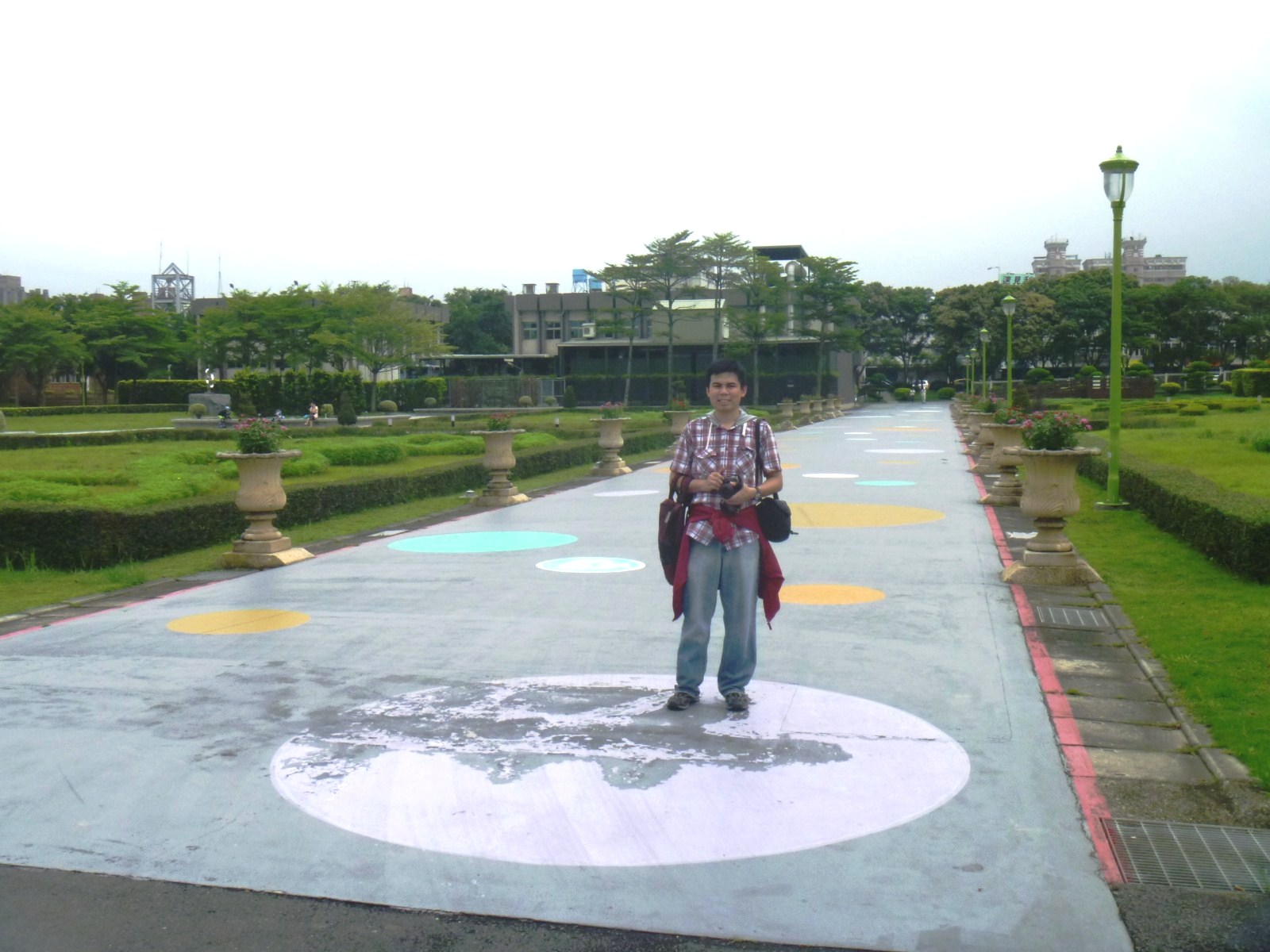
Serenity Garden
The park’s colorful plants, bushes and flowers, planted and taken care of by the Yuanshan Park Administration, were brought in from the Minzu nursery where they were raised from seeds or bulbs. The nursery produces about 100,000 plants annually for placement in parks. Flora in the park include African balsam; scarlet sage; chrysanthemums; maidenhair; crab apples; cherry trees; amaranths; jonquils; banyans (with complete and beautiful canopies), tall and upstanding araucarias; garcinias (scattered in the central axis); poicianas (with charming flowers); Taiwanese goldrain trees; bauhinia; coral bean trees; wax trees; kapoks; hazel sterculias (with the most distinctive flowers and fruits); Indian dillenias, among others. The luxuriant foliage changes with the 4 seasons of the year.

Also scattered around the lush greens are 9 sculptures donated by the Taipei Lions Club and the Rotary Clubs: “Leisure Years,” “Auspicious Earth,” “Flock of Cranes,” “Hope,” “Prosperity,” “Friendship and Peace,” “Father’s Words,” “The Alignment of Spring” and “Unified.”

Park Sculpture

Park Sculpture
Xinsheng Park was 1 of the 4 exhibition regions during the 171-day (November 6, 2010-April 25, 2011) Taipei International Flower Expo (the others were Yuanshan Park, Taipei Artist Park and Dajia Riverside Park). During the expo, it was home to 3 themed floral displaying sites (Floral Tunnel, Fujian Garden and Palace of Floral Tea) and 4 pavilions (Pavilion of Regimen, Pavilion of Dreams, Pavilion of Angel Life and the Pavilion of Future). The green whale sculptures and sculpture of waves at the Flower Base under Trees Area have remained, while Serenity Garden, the European geometric garden with an oriental sensation, was also kept intact.

Flower Base under Trees Area (the green whale sculpture is on the right)
The last 3 pavilions, which received green building certification, were designed by local architect Chang Ching-hwa, the designer of Taipei’s Beitou Library, who is well known for incorporating reusable and eco-friendly materials into her works. Powered by solar panels (making them the city’s largest energy-saving facility), all 3 were built completely out of wood and recyclable materials. The roofs are layered with ETFE, the thermal insulating plastics used for the Beijing National Aquatics Center.

Pavilion of Future
Jandy and I first visited the Pavilion of Future. Probably the greenest building in the Taipei International Flora Expo, it was designed to showcase gardening technology with an eco-friendly focus, energy conservation, waste reduction and health protection. This intelligent greenhouse, Taiwan’s first energy-conserving greenhouse, uses a combination of ultraviolet ray insulation, floor cooling systems, solar panels and other facilities to help manage indoor temperature.

Interior of Pavilion of Future
Next, we dropped by the Pavilion of Regimen, also known as the “White Mansion.” During the expo, it displayed Taiwan’s own unique bonsai aesthetics and techniques (“Healthy Living and Endless Life Bonsais”), precious trees and plants that are over hundreds of years old, plus a large variety of plants and herbs used in Chinese medicine.

Pavilion of Regimen
Xinsheng Park: 105, Section 3, Xinsheng North Rd., Zhongshan District, Taipei, Taiwan. Tel: (+886-2) 2598-3024 (Administering Dept:Yuanshan Park Administration).
A Stroll in Paco Park
After dropping off Cheska at ACTS (where she was taking review classes for her Med Tech board exam), I decided, on my way home, to drop by historic Paco Park. Getting there proved to be difficult for me as I had to make my way around a maze of one-way streets. I decided to park my car just a few blocks away and walk the remaining distance.
 |
| Paco Park |
Just about everybody, couch potato or not, is familiar, one way or the other, with the TV program “Paco Park Presents.” The concert was begun by Dr. Christoph Jessen (Press and Cultural Attache of the Federal Republic of Germany) with the late National Park Development Committee (NPDC) Vice-Chairman and journalist Teodoro “Doroy” Valencia on February 29, 1980 as a part of the celebration of Philippine-German Month and a gala tribute for then outgoing German ambassador Wolfgang Eger. The “Paco Park Presents” classical concert became a tradition and it now presents chamber, traditional and pop music performed for free by the finest international and local solo artists, duets and small ensembles at an improvised outdoor stage. Truly a unique way of bringing classical music, via intimate, open-air concerts, to the masses.
 |
| Park entrance |
I have been to the park a couple of times before as two of my siblings, my elder brother Frank (to the former Rosario “Cherry” Correa on December 17, 1978) and youngest sister Tellie (on December 27, 1982) as well as my good friend and fellow architect, Ed Yambao (to the former Gloria “Glo” Pagsanghan also on the same date as my sister) got married in the park’s St. Pancratius (named after a 14 year old martyr of the 4th century) Chapel. My late parents also renewed their marriage vows there during their silver wedding anniversary on the same day Frank got married.
 |
| Historical Research and Markers Committee plaque |
 |
| National Historical Shrine plaque |
Why do people marry at a place that was once a home for the dead? Haven’t they heard of the often-mentioned warning that marriages made in such a place live but a short life? Couples don’t seem to mind at all even if the receptions are held besides rows of empty, gaping niches. For me, it must be this recreational garden area’s atmosphere of peace and tranquility. I featured this cemetery in my first book, “A Philippine Odyssey: A Collection of Featured Travel Articles” (New Day Publishers, 2005) under the heading “Presenting Paco Park.”

|
| The Outer Cemetery |

This 4,114.8 sq. m. circular park, one of the oldest landmarks of Manila, is located at Paco District, a nondescript commercial and residential area east of Taft Ave.. Formerly called San Fernando de Dilao, Paco was the Catalan nickname for Francisco and was presumably adapted by the natives to refer to the Franciscan friars who ran the parish. The park was originally a cemetery built in 1807, through an administrative order, according to the plan of maestro de obras Nicolas Ruiz. It was completed on April 22, 1822 under the supervision of Don Jose Coll. The cemetery was, however, already in use two years before its completion to accommodate victims of the cholera epidemic which broke out 3 days after a strong October 1, 1820 typhoon ravaged the city.
 |
| Doves by the ticket booth |
The epidemic was falsely rumored to have been caused by the poisoning of the Pasig River and the local wells by the foreign merchants, businessmen and scientists then residing in the city. As a result, persons and property of said foreigners were attacked by violent Filipino mobs affected by this malady. Casualties were 1 Chinese, 1 Spaniard, 12 French, 1 British captain, 1 American Marine guard, 2 Danes and 12 British and American sailors. Through energetic measures, the epidemic was under control in less than a month. Dominican friars excelled themselves in attending to the sick and, in grateful recognition of their services, 9 of the niches in the cemetery were donated to them by the city of Manila.
 |
| The Gomburza Memorial |
In 1859, the cemetery was enlarged to 4,540 varas cuadradas (approximately 4,500 square yards) and enclosed with a circular stone wall by Gov.-Gen. Fernando de Norzagaray y Escudero (1856-59). A Chinese builder won the contract to build the circular stone wall of this cemetery for PhP19,700. The cemetery used to have a chaplain (who lived across the site now occupied by the Paco Fire Station), a sacristan and 8 caretakers.
 |
| Gomburza Memorial plaque |
At that time, the niches cost PhP20 for three years subject to renewal. No one was allowed to own the niches in perpetuity. Niches in the inner wall were reserved as exclusive burial places for prominent Spaniards. Norzagaray’s successor, acting Gov.-Gen. Ramon Solano y Llanderal (1859-60), was buried in a now unknown site inside the mortuary chapel.
 |
| Jose Rizal Grave Site |
The cemetery was the burial site of Frs. Mariano Gomez, Jose Burgos and Jacinto Zamora, the triumvirate of Filipino priests unjustly implicated in the January 20-22, 1872 Cavite Mutiny. They were executed by garrote (a strangulation machine) at sunrise of February 17 at the Luneta (now Rizal Park) in Bagumbayan. All three were buried in an unmarked grave near the outer wall but the site has not been located up to now. Instead, a memorial was installed on February 17, 1898.
 |
| Grave Site plaque |
After the execution of our National Hero, Dr. Jose Rizal, also in the Luneta at dawn of December 30, 1896, the Spanish authorities, fearful of public unrest (and of his followers removing his remains and establishing a cult), secretly buried him also near the outer wall. Rizal’s sisters fanned out in search of his remains and found them at the cemetery. The mismarked tombstone, with the initials R.P.J., was said to have been the result of the sisters’ bribing a guardia civil veterana (who guarded the spot for 15 days) to mark the spot. Rizal’s remains were exhumed on August 17, 1898, placed in an urn made by Teodoro Romualdo de Jesus and deposited at the house of Rizal’s mother at Estraude St. in Binondo.
 |
| Elaborate niche of Margarita Miguel de Cobarrubias (September 1, 1907) |
The last burials here were in 1912 (the same year Rizal was finally laid to his rest at its present monument in Rizal Park) and the cemetery fell into disrepair, its empty, semicircular niches hollow reminders for the purpose they once served. During World War II, the park, with its thick adobe walls, was used by Japanese forces as a central supply and ammunition depot. They dug several trenches and constructed pillboxes with 75 mm. guns. In 1948, proposals were made to convert the cemetery into a park. Unclaimed remains were transferred to the Manila South Cemetery’s paupers’ lot. Through the guidance of Doroy Valencia, its beautification and restoration was done by renowned landscape architect Ildefonso “IP” Santos. In 1966, it was made into a national park.
 |
| The more common semicircular niche (Timoteo de los Angeles, June 3, 1910, 53 years old) |
The park has two concentric walls, along which are rows of niches hollowed out of aging adobe for the bones of the dead and separated by a 14.5 m. wide walkway. The wall niches used to be 5 tiers high but only 3 tiers are visible today as its floor was raised due to flooding in some parts. Before, Paco district was a reclaimed swampland with non-existent drainage (sewers were only installed during the early 20th century). The cemetery then was a muddy catch basin for rainwater. I.P Santos elevated the middle portion of the park so that the water flowed outwards. He was sharply criticized for this.
 |
| Gate leading to the ossuary |
Strolling around the outer wall, you will espy the original Rizal grave (with its white cross with the initials R.P.J.) as well as the Gomburza memorial. At the back of the St. Pancratius Chapel is an arch with a wrought iron gate leading to the Ossorio (ossuary), an enclosed burial site for infants and babies. Flights of steps on either side of the gate lead to an interconnecting upper promenade. There are 2 other ossorios beside it, all with walls decorated with intricate stone carvings of festoons and angels. In spite of their otherworldly air, these places seem to be favorite tambayans (hangouts) of students.
 |
| Flight of stairs leading to upper promenade |
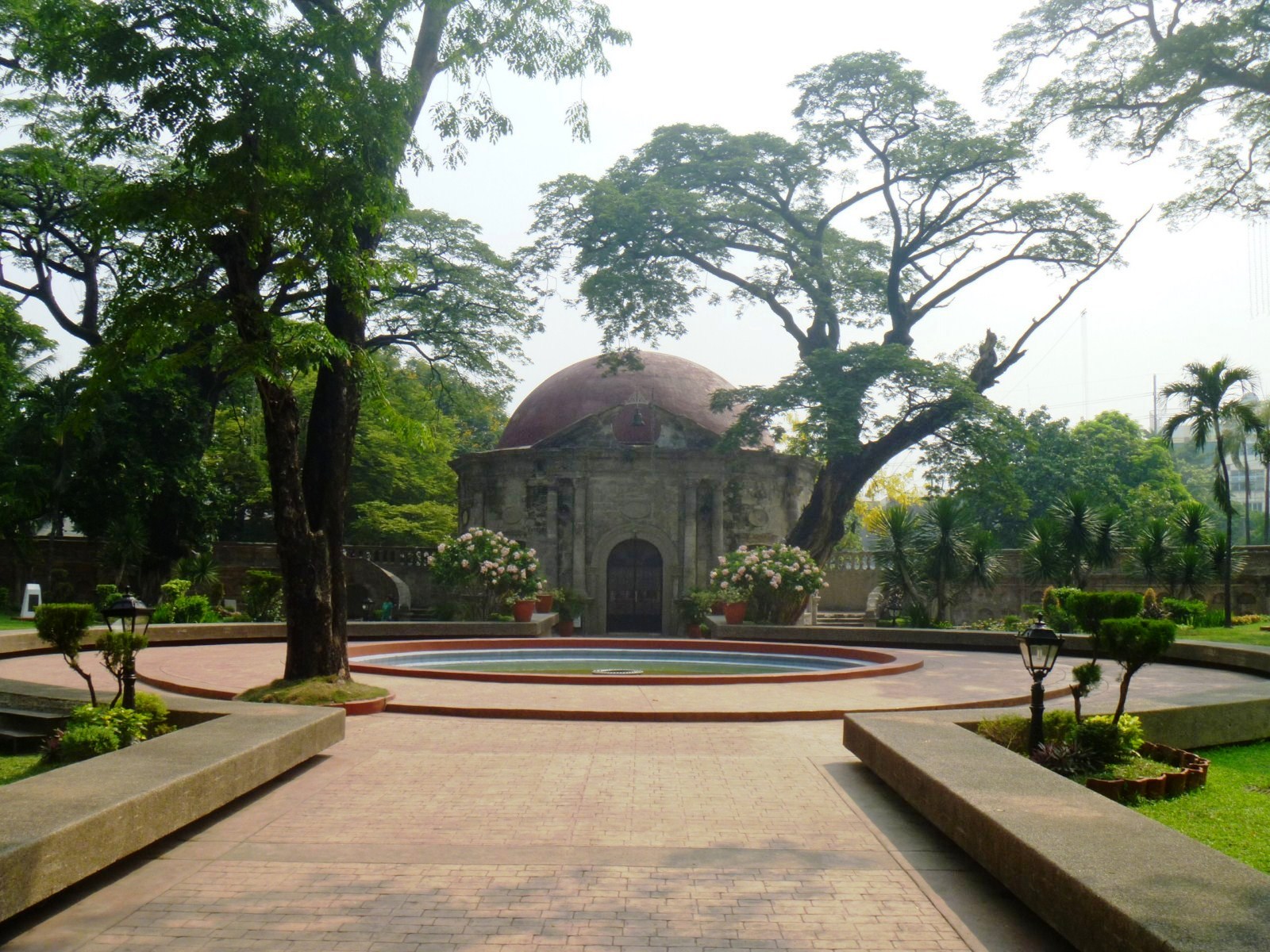
The inner cemetery can be entered via an elaborate main stone-columned archway whose triangular pediment has a sign with the Latin inscription “Beatimortui qui in Domino Moriuntur – John in 14:13 Apoc.” (“Blessed are those who die in the Lord”). Inside the inner courtyard, one is greeted by a romantic setting of a 3-tiered circular fountain, the small oval, domed St. Pancratius Chapel, 8 century-old, widespreading acacia trees (Samarea saman), wondrously gnarled white kalachuchi trees and pocket gardens with park benches.
 |
| Entrance to Inner Cemetery |
The inner courtyard’s focal point is the St. Pancratius Chapel, now under the care of the Vincentian Fathers (who manage the nearby Adamson University). Formerly a mausoleum for Spanish elite during the first half of the 19th century, this chapel, done in the Classical style, has a stone dome, stone walls dressed in velvety growths of lichen, moss and creepers, triangular pediment from which hangs a bell and a cross.
 |
| Inner Cemetery |
On each side of the main entrance, I counted 31 bays with 9 niches per bay. My estimate is there were once 2,790 niches within the inner courtyard alone of which only 1,674 are exposed. Fourteen of these still have their burial plaques dating from 1898 to 1913 (?). On both flanks of chapel are two side entrances leading to the outer wall and two beautiful stairs leading to an interconnected 2-m. wide (the width is dictated by the length of the burial niche underneath) upper open terrace with stone balustrades.
 |
| St. Pancratius Chapel |
Filipino eskrima (stick martial arts called arnis in the West) practitioners also hone their traditional fighting skills within the park and the Arnis Combat Kiathson System Philippines (they offer eskrima lessons) is based here.
 |
| The 3-tiered circular fountain |
Paco Park: Gen. Luna St. (at the east end of Padre Faura St.), Paco District, Manila. Open daily (except Wednesdays), 8 AM-5 PM. Admission: PhP5. The “Concert at the Park” is held every Friday, at sunset. Schedule of masses at St. Pancratius Chapel (Sundays & holidays): 10 AM, 11 AM, 5 PM & 6 PM, also 9 AM every 12th day of the month). Wedding arrangements at St. Vincent de Paul Parish Office, 959 San Marcelino St., Ermita, Manila. Tel: 527-7853 7 524-2022 local 101.
Luis de Camoes Garden (Macau)
From the Barrier Gate, Jandy, Cheska and I took the public bus and dropped off at the hilly, heavily wooded Camoes Garden (also known as Dove’s Nest), one of Macau’s oldest parks and its largest (at nearly 20,000 sq. m.). Upon entry into the park, we were welcomed by a fountain, built in 1990, that contains a bronze sculpture entitled Embrace, specially made to symbolize the centuries’ old friendship between Portugal and China.

The Park’s Fountain and its Bronze Scuplture “Embrace”
The land where the park stands was donated by a Portuguese merchant, after his death, to the government. It was later opened to public as a memorial garden dedicated to Luis Vaz de Camoes (1524-June 10, 1580), Portugal’s greatest poet, who was exiled to Macau for 2 years, after riling the court officials.

Camoes Grotto
We visited the Cameos Grotto, the most famous scenic spot in this garden. Here, Luis de Camoes lived in a cave where he later finished Os Lusiadas (Soul of Portugal), the national epic that chronicles the great Portuguese explorations that created the world’s first globe-girdling empire. His bronze bust was installed in natural rocky alcove in the wooded garden in 1886 when the grotto became state property.

The Park’s Pleasant Gardens and Walkways
In front of the grotto is a spacious and pleasant garden, with benches shaded by banyan trees, where people meet with friends or bring their caged birds (a Chinese custom) for an outing. At the far end of the park is a statue dedicated to martyred St. Andrew Kim Taegon (August 21, 1822-September 15, 1846), the first Korean Catholic priest. Camoes Garden also comes alive in the morning when groups perform slow, silent t’ai chi or lively aerobics.

A Small Park Pond
Walking along the winding path, we reached the Gazebo, a Chinese pavilion at the highest point in the park. Here, stone tables and stools were installed for local people to rest, read newspapers, play Chinese checkers or chess, or enjoy the panoramic view of the city’s Inner Harbor.

Panoramic View of the Inner Harbor
Luis de Camoes Gardens: Praca Luis de Camoes, Macau. Open daily, 6 AM-10 PM.
Jurong Bird Park (Singapore)
We decided to spend our second day at Singapore all day at the fresh and interesting Jurong Bird Park, a first for all of us. At first glance, I did not think that a park with just birds would interest me (that’s why I didn’t go there during previous visits to Singapore), but I was to be proven wrong. Again, the park being very far from the city, we all went there (and returned) via 2 taxis, arriving there by noon after a 20-min. trip.

Main Entrance of Jurong Bird Park
Managed by Wildlife Reserves Singapore, this world-famous S$3.5 million, 202,000 sq. m. (50 acre) bird zoo and landscaped park, built on the western slope of Jurong Hill, within the Boon Lay Planning Area of the Jurong District, was opened on January 3, 1971. In 2006, it completed its S$10-million makeover.

Souvenir Shop at Main Entrance
The well-maintained Jurong Bird Park, currently the world’s largest bird park in terms of number of birds and second largest in terms of land area, after Germany’s Vogelpark Walsrode, is home to an impressive collection of 4,600 exotic birds of 380 species, (29 of which are endangered) from South East Asia, Africa, South America and Australia. Some exhibits are fully open (Flamingo Lake, Swan Lake and Pelican Cove), some are cage-based (Parrot Paradise) and 4 are large walk-in aviaries.

Birds and Buddies Show (1 PM, Pools Amphitheatre)
Upon arrival, we opted to first watch the 1 PM Birds and Buddies Show (formerly called the “All Star Birdshow”) at the Pools Amphitheater. This lively and entertaining, 25-min. bird show, professionally presented with an environmental message, showcases a large number of species of performing birds, trained to such amazing levels, interacting with humans in a single act.

Birds and Buddies Show (3 PM, Pools Amphitheater)
During the show, we were enthralled by the antics of talented birds like the mimicking cockatoos, parrots and macaws singing , playing basketball, doing stunts etc.. We liked it so much, we attended the second show at 3 PM, also at the same venue.

In between these 2 Birds and Buddies Shows,Jandy, Cheska and I climbed up a couple of flights of stairs and hopped aboard the relaxing, airconditioned Panorail (S$5), the world’s only monorail that runs through an aviary.

The Panorail
We dropped off at the Lory Station were we visited the 3,000 sq. m. (32,000 sq. ft.), 9 storey high Lory Loft, the world’s largest walk-in flight aviary for stunningly colorful lories and lorikeets.

Lory Loft
Here, we walked on suspended bridges at tree top level, surrounded by over 1,000 free-flying lories. The ambiance here is said to be similar to that of a rainforest vale in tropical Northern Australia. Cheska, wanting an up close encounter, tried to offer the lories a specially concocted nectar mix in a little cup (S$3) so that the birds would flock to her.

Up Close and Personal With a Lory
We also visited, on foot, the 32 aviaries (housing 92 species of parrots) and the interpretative pavilion at the 1-hectare Parrot Paradise; the impressive colony of 1,001 roosting, flamboyant flamingos at the beautifully-landscaped Flamingo Lake; and Pelican Cove.

- Flamingo Lake
At Pelican Cove, we observed a cosmopolitan colony of all 7 species of pelicans, including the endangered, 11-15 kg. Dalmatian pelican (the largest of the 7), while strolling along a boardwalk. However, we failed to catch them at the world’s first underwater viewing gallery for pelicans, where the birds scoop for fish at feeding time.

Pelican Cove
Next to Pelican Cove is Swan Lake where, from an observation deck close to the water edge, we observed, at close quarters, graceful Black-necked Swan, Black Swan and the Mute Swans roosting, fishing, bathing and swimming amidst the tranquil ambiance.

- Swan Lake
Jandy and I again hopped aboard the Panorail and dropped off at the Waterfall Station where we visited the African Waterfall Aviary, the world’s largest walk-in aviary with more than 1,500 free-flying birds from over 50 species from Africa. Species here include the golden-breasted starling, turacos, bee-eaters and the hoopoe.

African Waterfall Aviary
Here, the birds tend to stay further away and we needed to move slowly round the jungle landscaped paths to avoid spooking them. Later, we met up with Mom, Dad, Grace and Cheska at the 30 m. high Jurong Falls, the world’s tallest man-made waterfall in an aviary and a popular photo-ops.

The 30 Meter High Waterfall
At 4 PM, we watched the Birds of Prey Show at the Fuji Hawk Walk. Here, we watched majestic birds of prey such as eagles, hawks, vultures and falcons fly in aerial loops and soar above, moving from one treetop to another. We also learned about falconry as these birds were put through their actions in a simulated hunt. The birds sometimes swoop just 6 inches from our head.

Birds of Prey Show (4 PM, Fuji Hawk Walk)
After the show, Cheska and Jandy had a cool time having their pictures taken with a live owl, first putting on gloves so that the owl can be transferred to their hands.

Up Close and Personal…. This Time With an Owl
After the show, we next visited the 1,600 sq. m. (17,000 sq. ft.) Penguin Coast which houses 6 species of penguins. Featuring a 21-metre (69 ft) tall Portuguese galleon facade designed to resemble a ship, the interior of Penguin Coast, a great place to escape to during a hot day and one of the few places where you can see live king penguins outside of Antarctica.

Penguin Coast
Constructed with wooden beams and flooring, Penguin Coast has 2 displays, one indoor and the other outdoor. The Humboldt, Rockhopper, Macaroni, Fairy and King Penguins live indoors in a captivating, climate-controlled den while Jackass penguins, one of the few species that are adapted to the tropics, can be viewed, with Cape Shelducks and gulls, at an outdoor penguin enclosure.

World of Darkness
At 5 PM, we dropped by the 400 sq. m. World of Darkness, Asia’s first nocturnal bird house, opened in April 1982. It features a system of reverse lighting, converting day to night and vice versa, thereby inducing night-active creatures to come alive during the daylight hours. It is akin to a quiet nocturnal walk along a starlit jungle path, watching birds in a simulated “moonlit” night and hearing them beckon. On display are 31 birds (mostly owls) from 9 species: Black-crowned Herons, Stone Curlews, Lesser Whistling Ducks (Javan Tree Ducks), Snowy Owls, Malay Fish Owls, Eurasian Eagle Owls, Barn Owls, Great Grey Owls and the Bobook Owls.

- Royal Ramble
Next, we dropped by the 800 sq. m. Royal Ramble where we had an unobtrusive view of the world’s largest pigeons. It has a 40 m. long walkway and 3 separate aviaries housing the 3 species of Crowned Pigeons found in the world (Common Crowned Pigeon, the Victoria Crowned Pigeon and the Scheepmaker’s Crowned Pigeon).

- Dinosaur Descendants
Finally, at the 4,579 sq. ft. Dinosaurs Descendants we were greeted by a huge rock with a relief of feathers and ostrich eggs. Here, we learned the similarities and intriguing facts which link ratites (flightless birds such as ostriches and cassowaries) to dinosaurs, amidst the simulated grassland habitats of these birds.

- Dinner at Bongo Burgers
Come evening, we dined at Bongo Burgers’ delectable but quite pricey choice of pure and lean patties in generous, American-sized servings.
Jurong Bird Park: 2 Jurong Hill, Singapore 628925. Admission: S$18.00 (adults) and S$12.00 (children, 3 – 12 years). Tel: (65) 6265 0022. Fax: (65) 6261 1869. E-mail:info.jbp@wrs.com.sg. Website: www.birdpark.com.sg. Open daily, 8.30 AM-6 PM.
Kowloon Park (Hong Kong)
After checking in at Kimberley Hotel, all of us decided to have our lunch at a restaurant along Kimberley Road. After lunch, we all returned to the hotel where Grace, Dad and Mom decided to catch up with lost sleep. Not so with me, Jandy and Cheska, deciding, instead, to do some sightseeing of our own.

Kowloon Park Entrance
From the hotel, we all walked to the nearby 13.47-hectare (33-acre) Kowloon Park. The park was formerly a site of the Whitfield Camp Barracks for the British force with a battery (Kowloon West Battery II) on its west side. In 1970, the Urban Council redeveloped the site into the Kowloon Park and it was officially opened on June 24, 1970. From 1975- 1978, part of the site was occupied in the construction of the MTR. In 1989, the park was redeveloped at a cost of $300 million, which was funded by the then Royal Hong Kong Jockey Club.

Due to topographical and other site constraints, the northern part of Kowloon Park is selected for active recreational area (Aquatics Center with 4 swimming pools, tennis courts, etc.) whereas the passive amenities area (children’s playground, aviary, Chinese Garden, Bird Lake and exhibition center) is mainly in the south. We were more interested in the latter.


Tai Chi Enthusiast at Chinese Garden
Behind the Kowloon Mosque and next to the Health Education, Exhibition and Information Centre, we came upon a bronze sculpture of 2 ribbons that intertwine to form a heart, inaugurated on December 1, 1997, World AIDS Day, crafted by Van Lau, an influential Hong Kong artist responsible for many of the city’s other sculptures. It commemorates the victims and the fight against HIV/AIDS.

The Ribbon Symbol of AIDS
At the Pond Garden is the “Pool Pavilion” done by British sculptor David Watkins in 1989. This is a fabulous piece of artwork, which gives a delightful touch to the park, consists of bent parallel steel tubes joined together, taking the shape of trees. The sculpture is placed at the center of a pond and people can get through it and become part of the work themselves. The witty shapes of the tubes radiate a festive mood and it takes you right in the middle of a carnival.

David Watkin’s “Pool Pavilion”
The park has lots trees, beautiful gardens, plenty of paved sidewalks for walking or jogging, and a large area for concerts and special events. At the Chinese Garden, we watched various groups practicing martial arts and taichi.

The Park’s Aviary
It is also a haven for birdlife. The park has a nice aviary composed of 7 planted enclosures accommodating over 140 birds of 38 species (parrots, pigeons, pheasants, etc.) plus plenty of shaded areas where visitors can sit and watch the antics of the birds. There’s also a rockery, a man-made waterfall and a decorative trellis. The park also has a Bird Lake with 200 finches of 20 species.

Greater Flamingos at Bird Lake
The park also has a pair of identical, 2-storey, colonial military barrack blocks, constructed in circa 1910. Linked by an extension block constructed in the 1980s to provide more space for the former Hong Kong Museum of History from 1983 to 1998, it now houses the Hong Kong Heritage Discovery Centre.

Hong Kong Heritage Discovery Center
Kowloon Park: 22 Austin Rd., Tsim Sha Tsui, Kowloon, Hong Kong. Admission is free except for Swimming Center and Sports Center. Tel: 2724 3344. Fax: 2724 4197. E-mail: kpqr@lcsd.gov.hk.
How to Get There: By subway, take Subway Tsuen Wan Line and get off at Jordan or Tism Sha Tsui station and walk to the park. By bus, take Bus No. 1, 1A, 2, 2C, 6, 6A, 7, 9, 13X, 26, 35A, 41A, 63X, 81C, 87D, 98D, 203, 208, 219X, 234X, 271, 281A, 296D or A2 and get off at Kowloon Park.
City Tour – Botanic Garden (Singapore)
Lastly, from Mt. Faber, we then proceeded to the 74-hectare (183-acre) Botanic Garden. This combination of 4 hectares of primary jungle and elegantly planned and manicured gardens and greenhouses is home to 1,000 species and 2,000 hybrids of orchids, including many rare specimens. Malaysia’s rubber industry had its origins here in the 19th century when Henry Ridley successfully propagated and tapped Brazilian rubber trees from London’s Kew Gardens in 1877.

- Botanic Garden – Vanda Miss Joachim
A high point of our visit here is the Victorian-style Orchid Pavilion with its 1,200 orchid plants, including the Vanda Miss Joaquim (honoring the daughter of a respected Armenian family), Singapore’s national flower, and a lilac bloom named after Singapore’s four millionth visitor, Jane Deny of Australia. A lake, home to waterfowl, ducks and kingfishers, adds to the serenity of the gardens. We also browse around at the RISIS Souvenir Shop.

- Botanic Garden – RISIS Souvenir Shop
After our city tour, we had lunch along Victoria St.
Botanic Garden: 1 Cluny Rd. cor. Napier St., Singapore 259569. Tel: 6471 7361. Open daily, 5 AM-12 midnight. Admission is free.
Burnham Park (Baguio City, Benguet)
The next day, after breakfast at the hotel, Grace and I took the jeepney to Burnham Park. It being our last day in the city, we didn’t want to leave without having visited the park. This centrally located and thickly-wooded park, named after Daniel H. Burnham, the American architect and urban planner who planned Baguio, is the city’s foremost and oldest park which forms the heart of the city.
 |
| Burnham Park |
Grace and I particularly liked its focal point, the romantic, photogenic and man-made Burnham Lake. The lake was formerly a natural spring which drained northward to the foot of Session Rd. to join with the Balili River in La Trinidad. Grace, a lover of flowers, also visited the orchidarium with its various flowers and orchids on display and for sale. Also within the park are restaurants, a children’s playground, flower-punctuated walks, parade ground, and sports and recreational facilities (skating, biking, football, etc.).
 |
| Grace at Burnham Lake |