Mardi Gras in the Philippines (Kalibo, Aklan)

We were now in our second day at the Akelco (Aklan Electric Cooperative) guesthouse in Lezo (Aklan), having just arrived there yesterday afternoon upon the invitation of its general manager Job Y. Besana.  Today was to be a fun day as we were going to attend the extraordinary Ati-Atihan Festival, one of the most exciting and exuberant festivals in the country. The Ati-Atihan is invariably described by many as the “Mardi Gras of the Philippines” or the “country’s greatest party.”

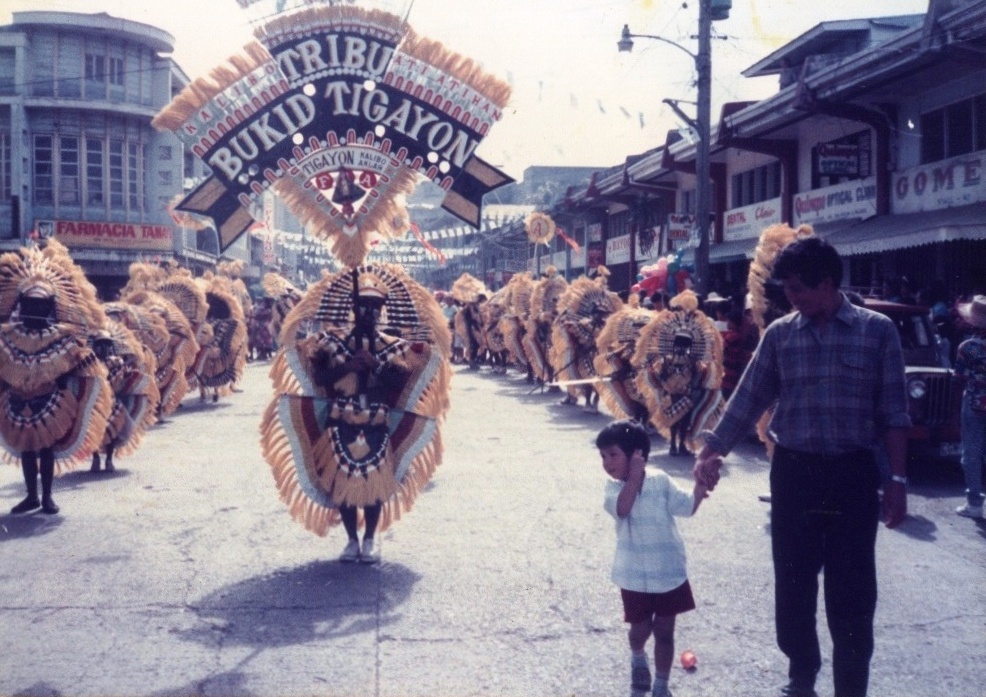
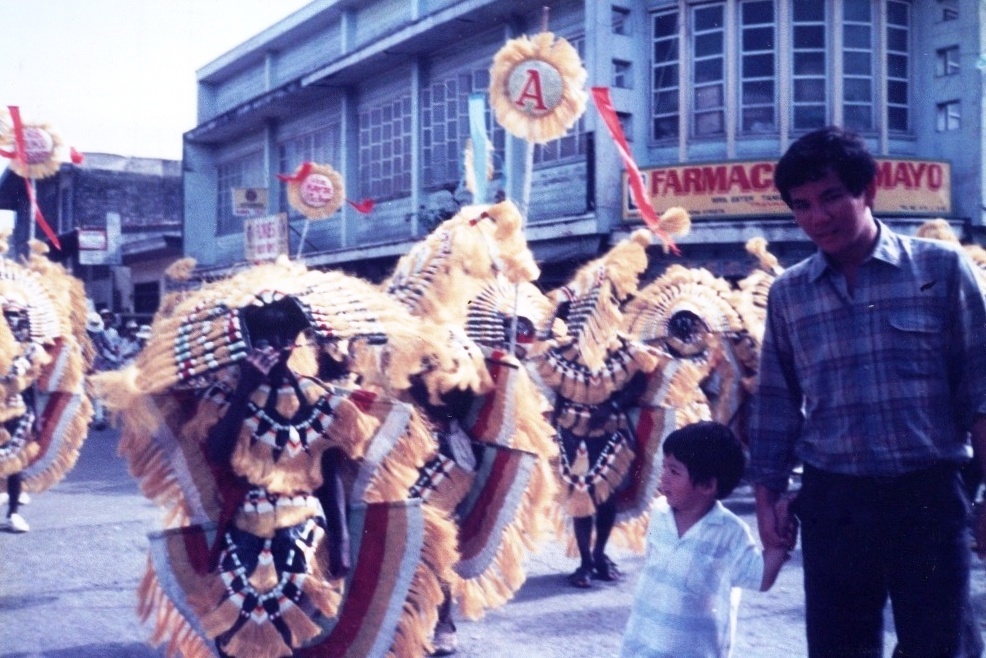
Parading with Tribu Bukid Tigayon

This spectacular, 300-year old celebration is held in honor of the Sto. Niño (Holy Child), Kalibo’s patron saint, who was said to have saved the town from Moro raiders.  A mixture of pagan and Christian elements, this exuberant festival usually attracts an estimated 50,000 local and foreign tourists yearly.  Flights to and from Kalibo, as well as the town’s hotels and pension houses, are usually fully booked at this time.

However, we arrived just a little over a month after the December 1-9, 1989 coup de etat attempt in Manila and, as a consequence, foreign tourist arrivals are down. However, there was a plus side to this as lesser crowds  means easier access to the festival action.   We left the Akelco guesthouse right after lunch and, although Kalibo was  just less than 10 kms. away, the going was slow as we approached the town as there were still lots of people gathered along the street to watch the parade.

After parking our car, it was all footwork from hereon as we walked towards the parade route.  The parade was already underway when we arrived.   The parade featured tribus (“tribes”) composed of members of local barangays and organizations, each with its own striking costume made from local materials like coconut shells, feathers and fronds.  Participants also blacken their faces with soot and imitate the Atis, Aklan’s Negrito inhabitants, after whom the festival was named for.

Grace, Mommy, Jandy and I

The atmosphere was electrifying with its swirl of riotous color, reverberating drumbeats and cries of “Hala Bira!” and “Viva kay Señor Sto. Niño” (“Long Live the Holy Child”) as participants dance the Ati-Ati, a ritual dance with different movements.  Foreign, as well as, local visitors were also enticed to join in the dancing, drinking and the uninhibited revelry.   The festival also features a beauty pageant (Miss Kalibo Ati-Atihan), fireworks display, a Purchase of Panay re-enactment, a 9-day novena, field mass, pahilot (or paeappak, an old faith healing tradition), cockfight derbies, crafts fair and a torch parade and procession.    

Jandy admiring an Ati

Kalibo Tourism Office: Magsaysay Park, Kalibo, Aklan. Tel: (036) 262-1020, 268-4110, 262-3241 & 262-3079. Fax: (036)  268-4120 & 262-3241.

Boracay Here We Come! (Malay, Aklan)

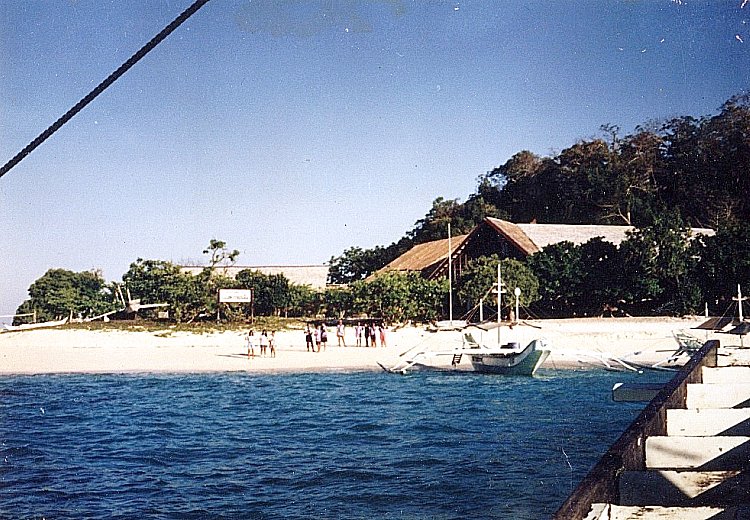
After breakfast at Dad’s ancestral home in Malay, we boarded the L-200 and were driven, along 6 kms. of dirt road, to the makeshift jetty port at Brgy. Caticlan.  Here, we boarded a big outrigger boat for Boracay Island.  Our 15-min. pumpboat ride to the island was smooth all the way and soon the crystal blue waters turned sparklingly clear as we approached the island’s famous White Beach.  It was just about noontime and the palm-fringed beach’s dazzlingly white sand was practically deserted and enchanting.

On our way

Our boat docked at Boat Station 2, actually just an open beach point without piers where boats land.  All passengers, including us, have to alight the boat via a narrow gangplank then wade a short distance through the shallow water to the beach.  Others, however, hired brawny porters to carry them to shore on their shoulders.  From the beach, we walked a short distance to a narrow alley.  From the alley entrance, we walked a further 100 m. to Lion’s Den Resort on our left.

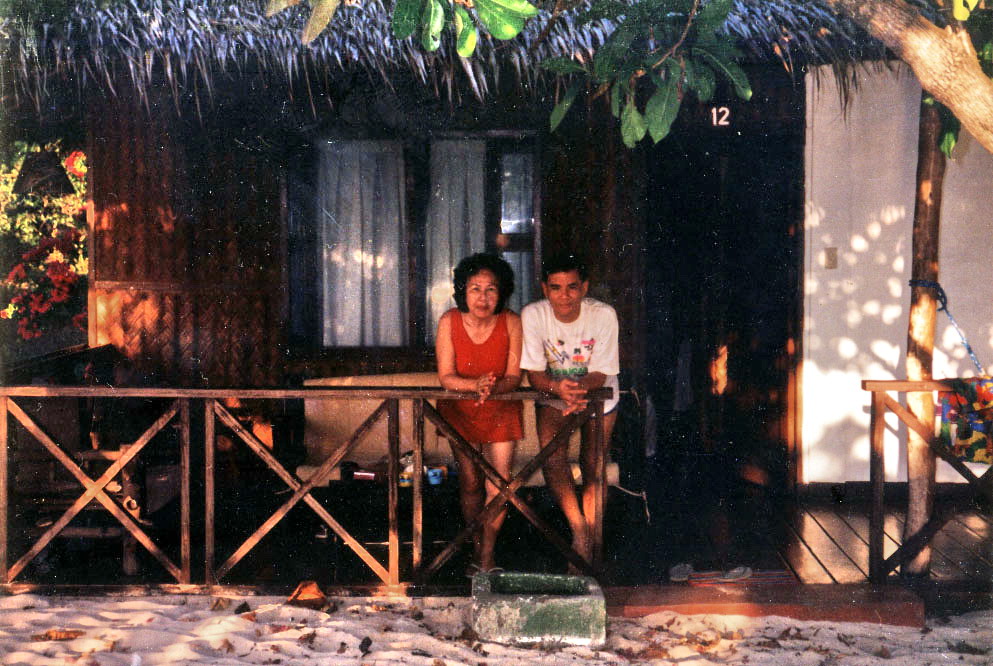
This rustic resort, owned and managed by Lowell A. Talamisan, an apo (grandnephew) of my father-in-law and a nephew of my wife Grace, is conveniently located midway between the beach and Main Road.  Here, we stayed at one of the resort’s quaint and cozy nipa and bamboo cottages with private bath.  Our cottage also had a verandah with a nice hammock slung at the posts.

Jandy and his lola relaxing at the verandah

Boracay Island then was without electricity and our cottage was lit at night with gas lanterns.  Other high-end resorts were powered by generators.  This didn’t matter to us then, since food and accommodation were inexpensive and the people were friendly. Sometimes we would dine on grilled blue marlin at the resort or dine out at the restaurant of the nearby Red Coconut Resort.

White Beach circa 1990

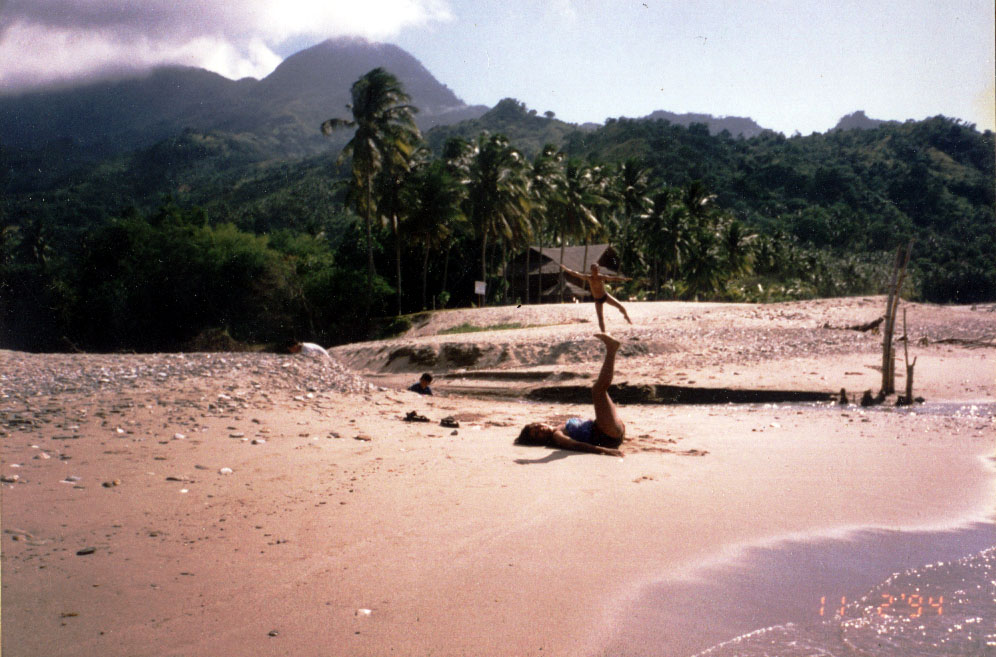
The most exhilarating portion of our 3-day stay on the island was  the  feel of the sand of White Beach, snow white and fine as sifted confectionary sugar, top-grade cake flour or baby powder.   It was so white you can get a total suntan  due to the  sun’s  reflection on the sand.  The  aquamarine  water was shallow and clear and the sunset was always magnificent.

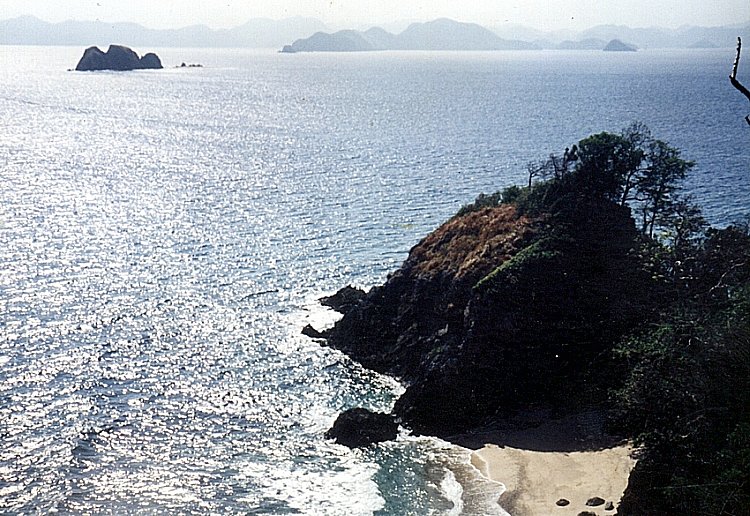
Sand, sea and sky at Boracay

Up north along White Beach, across Willy’s Beach Resort, is Willy’s Rock, the familiar and frequently photographed landmark that dominates the seascape.  This large, castle-like natural boulder rises 7 m. (23 ft.) from the sand.

Posing by the much photographed Willy’s Rock


My First Visit to Aklan

My father-in-law, Engr. Manuel L. Sta. Maria, retired deputy administrator of the National Electrification Administration (NEA) and a resident of Malay, Aklan, suggested that we visit his hometown and its emerging star – Boracay  Island. It would my first and Grace’s second visit, she having visited the place sometime in 1978 when White Beach was then blissfully deserted.

Grace at Boracay, circa 1978

The timing of the visit couldn’t have been any better.  Grace (then 5 months pregnant with my daughter Cheska), 3-1/2 year-old Jandy, my in-laws and I arrived  in Kalibo on  board a Philippine Airlines morning flight, just over a month after the nearly successful December 1-9, 1989 coup de etat.  Tourist arrivals were still down but this later proved to be a blessing in disguise.

Our arrival at Kalibo Airport
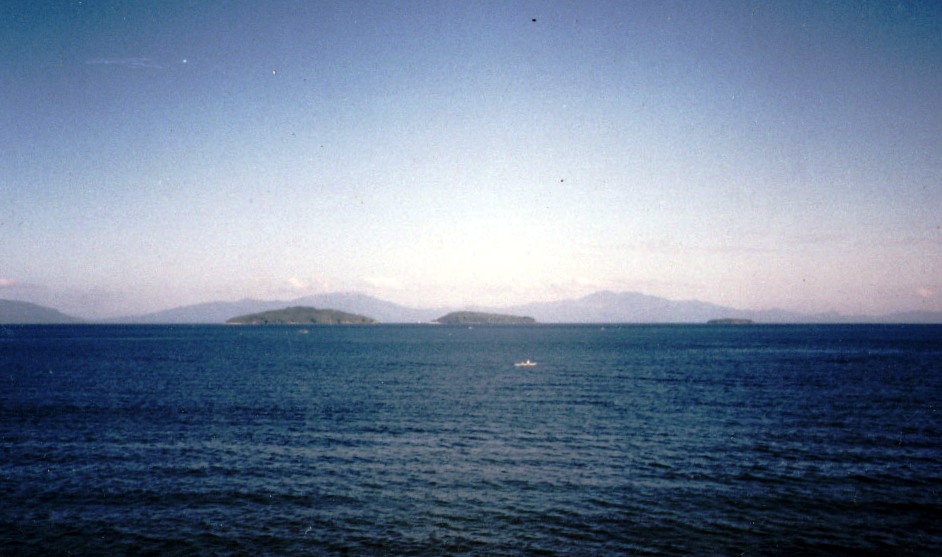
We were all picked up at the airport by an airconditioned L-200 pickup. The trip to Malay town proper took all of of 90 mins. and the  going  was rough as we approached Brgy. Caticlan, Malay, , the gateway to Boracay Island, because the zigzag road there was still unpaved and dusty.  Foreign tourists, however, didn’t seem to mind as we  saw many  of them  clinging precariously onto the roofs of  jeepneys, thoroughly  enjoying  the bumpy and dusty ride to Brgy Caticlan.  The views of the Sibuyan Sea from the road were magnificent.  Along the dusty part of the road to Malay, we chance upon Malay Mayor Roger S. Aguirre, the nephew of my father-in-law and Grace’s first cousin, who was supervising the concreting the road.
  
My father-in-law’s ancestral house

We finally arrived at my  father-in-law’s old 2-storey, wood and concrete  ancestral house located near the plaza and seashore. The town of Malay was created only in 1949, being a barrio of Buruanga before that time.  The father of Tay Lolong (as my father-in-law was called there), Mr. Melanio Sta. Maria, was mayor of Buruanga from 1925-29.  The street in front of the house was named after him.

Jandy frolicking by the beach
About 50 m. from the house was the shallow, brown sand beach of the town and beyond it, seemingly within paddling distance, were the enticing white sands of Boracay’s White Beach.  We just couldn’t wait to get there.

Puerto Azul Golf and Country Club (Ternate, Cavite)

From the  Palace in the Sky in Tagaytay City, we next motored, via the Naic-Indang Rd., to the town of Ternate where we  visited the 1,024-hectare Puerto Azul Golf & Country Club.  This 5-star resort, carved out of heavily forested valleys and towering mountains, was developed during the 1970s Marcos era.

Check out “Palace in the Sky

We first made a stopover at Paniman Beach along Paniman Bay, one of the resort’s 4 gray sand beaches (the others are Caysubic, Cayokno and Palicpican).  During its earlier days, this beach used to be covered with white sand said to have been brought over from Boracay, then unknown to the Filipinos.  The white sand is now gone, washed away by the tides.

Mel and Grace at one of Puerto Azul’s beaches

From the beach, we next negotiated a steep road to get to its lookout which has a view of the resort’s 100-hectare golf course, a private club open only to hotel guests.  One of the country’s most scenic courses, the golf here is surpassed only by views of Palicpican Beach.  Designed by world-renowned golfer Gary Player and Ron Kirby, this 18-hole, 6,556-yard, par 72 (adjustable to 71 for big events like the Philippine Open) golf course has a front 9 with rugged terrain punctuated with mountains, pristine rivers and streams while the back nine is close to the sea.

The scenic golf course

The course takes you through jungle, up and over mountains and finishes up on the beach.  An elevator takes you from the 6th green up to the 7th tee.  The last two tee shots on the back nine are probably the most dramatic. The par 3 17th Hole, the courses’ signature hole, is protected on its left by one of the deepest water hazards in Philippine golf – the South China Sea.  The 18th hole is across the beach.  Facilities include the nine-hole par-36 Camandag Executive Links, a driving range, tee house, clubhouse, restaurant, bars, locker and shower rooms swimming pool, sauna and massage.

L-R, Alex, Mel, Grace, Jandy and the author at the lookout

We can also see some of the 17 3 to 4-storey cluster buildings which houses 325 airconditioned rooms.  The resort is also home to restaurants, coffee shops, bars, 2 swimming pools, 300-pax ballrooms, 8 60-pax function rooms, business center, jacuzzi, sauna, 6 outdoor and 3 indoor tennis courts, 6-lane bowling center, volleyball/basketball court, two squash courts and 2 nature trails.

AUTHOR’S NOTES

Though still open, this resort, once dubbed as “Asia’s Paradise Resort” and the “World’s Golfing Capital,” seems to have been abandoned, reportedly due to lack of financial resources to maintain the site.  The hotel and cottages are worn out, the beach is dirty and only South Korean nationals use the not so well-maintained golf course.  However, Boulevard Holdings, the owner and operator of the site, plans to renovate the existing hotel and build an 8-room boutique hotel and 150-room grand convention hotel.

Puerto Azul Golf and Country Club: Brgy. Sapang,  Ternate, Cavite.  Tel:  524-0026 to 27.  Manila sales office: Tel: 844-8541.

Palace in the Sky (Tagaytay City, Cavite)

Come Holy Thursday, Grace, then 2.5-year old Jandy and I, plus our E. Ganzon, Inc. friends Alex D. Guda and Mel Miranda decided to go  on a day tour to the controversial, half-finished Palace in the Sky.   Located 8 kms. east of the Tagaytay City rotunda, on the 710-m. high Mt. Gonzales  (or Mt. Sungay), the former “Palace” was a multi-million exercise in extravagance started in 1981 by the late former Pres. Ferdinand E. Marcos for the 1983 state visit of then U.S. Pres. Ronald Reagan.  The state visit unfortunately (or is it fortunately?) never pushed through after the August 21, 1983 assassination of Benigno “Ninoy” Aquino Jr..  Marcos was deposed by the People Power Revolution of February 1986 and it was left unfinished and abandoned. 

Palace in the Sky

Upon our arrival, Alex, Grace, Jandy and I hiked along the asphalt road going all the way to the top but Mel took the more easygoing horseback ride. Even in its unfinished state, it was quite “palatial,” a true symbol of greed and indifference.  Also called the “Malacanang of Tagaytay” and “Bahay ni Imelda,” the pyramid-shaped villa had a huge kidney-shaped swimming pool and a tall radio antenna.

Hiking our way up the asphalt road

There was no one about, it being a holiday, but inside the palace were signs of new construction going on.  I even noticed, and was baffled, by a blueprint plan for a “torture chamber.”  A mystery indeed!  From the view deck we experienced the sweet, fresh and invigorating air of the city and admired the marvelous 360 degree view of 4 bodies of water (Taal Lake, Laguna de Bay, Balayan Bay and Manila Bay) and landward views of Metro Manila, Batangas, Rizal, Cavite, Quezon and even Mindoro, a spectacle initially meant for a chosen few.

AUTHOR’S NOTES

Nine month after our visit, the “Palace” hugged some of headlines when rebel soldiers took over the villa’s radio antenna during the failed December coup de etat.  In 1990, the mystery of the “torture chamber” was unveiled when the movie Delta Force 2:  The Columbian Connection, starring Chuck Norris, as a U.S. commando leader, and Billy Drago, as a Colombian drug lord, was shown in local cinemas.  The “Palace” turned out to be the drug lord’s seemingly impenetrable mansion and the “torture chamber,” his private viewing gallery where U.S. DEA agents were smothered to death by poison gas.  Some mystery!

On January 14, 1996, the “Palace” was ordered rehabilitated and refurbished into a 4,516-hectare resort by then Pres. Fidel V. Ramos.  Since then, it has been democratically renamed as the People’s Park in the Sky and is now enjoyed by poor and ordinary citizens.  Today, it has a lower ground restaurant, bar, 200-person open-air amphitheater (where free cultural and musical shows are held, Saturday and Sundays), view deck, native picnic huts and tables, wishing well (toss a coin and make a wish), fishing lagoon (the former swimming pool), art gallery, a grotto with 25-foot statue of the Sacred Heart of Jesus and Our Lady of Fair Love, 150-person second floor seminar room (Centennial Room), second floor museum, lower ground tourism office, souvenir shops and a giant replica of the pineapple.

Today, the park has again fallen into neglect.  The fishing lagoon is now filled up into a garden, graffiti is everywhere and the premises are dirty.  Only the views remain spectacular.

People’s Park in the Sky: Brgy. Dapdap West and Dapdap East, Tagaytay City, Cavite.  Admission: PhP15.

AERA Memorial Museum (Villa Escudero Plantation & Resort, San Pablo, Laguna)

Part of day tour package of Villa Escudero Plantation & Resort included admission to the resort’s AERA Memorial Museum which houses the priceless collections of Arsenio and Rosario (nee Adap) Escudero.  Begun on June 29, 1923, it is run by the AERA (acronym of the founders’ names) Memorial Foundation.  It is housed in an exact replica of the beautiful San Francisco Church of Intramuros.  The original church was destroyed by heavy American artillery bombardment on February 3, 1945 during the liberation of Manila and the site is now occupied by Mapua Institute of Technology. 

The pink-colored  building took 10 years to build on a massive 7-ft. thick concrete foundation and has a high 200-sq. ft. ceiling with trompe l’ oeil paintings by Benny Cabezada.  Attached to the ceiling are ten chandeliers copied from an Arte Espanol original.  Its display arrangement was said to have taken 3 years to complete.  Ninety percent of the display is family-owned while the rest were donated or acquired by the foundation.

AERA Memorial Museum

The museum’s collection of religious art is its main attraction.   A wooden bas-relief of the Nuestra Senora de Augustia, donated by my late uncle and National Artist, Arch. Leandro V. Locsin, is located by the massive  ornate door made in 1768.  By the way, cameras and videocams are not allowed.   A kamagongSto. Entierro (glass bier of the Dead Christ, circa 1856) carriage fashioned by noted sculptor, Isabelo Tampingco, was formerly from the Sta. Cruz Church of Manila.  It is adorned with 24 batikuling (a local aromatic softwood) cherubs and was donated by Dona Maria Luisa Quiogue (of the funeral parlor chain).

Other displays include an ivory-headed statue of Virgen Dolorosa from a church in Marinduque, a Pieta by Ireneo Cristobal, rows of ivory-headed santos, a granite Chinese fu dog guarding the staircase, an ornate wrought iron pulpit (raised platform used by a preacher) on the right side of the nave, silver sanctuary lamps, statues of Christ with the Cross on his Second Fall, a statue of Christ embracing a molave Cross, silver main altar acquired from Quiapo parish in the 1960s and a massive retablo (altar backdrop) from Agno (Pangasinan).
       
Its non-religious collection includes a couple of 1,400-year old and 1.5-ft. high Chinese Tsu-Chao jars, 12th and 13th century celadon pottery, tear vials of early Roman aristocrats, gilded carrozas (Spanish carriages), life-size dioramas of ethnic tribes in authentic costumes, ethnic artifacts and clothing, antique furniture, paintings, a numismatic display of obsolete coins and money, U.S. astronaut suits, a Philippine and African beetle collection and an extensive freshwater, terrestrial and marine shell collection (including the rare “Golden Cowrie”). 
       
Next to it are a dioramas of stuffed rare and some already extinct Philippine fauna. The only foreign stuffed animal is a big leopard shot during the 1923 Manila Carnival for attacking and killing a dancer.  It was later bought by the Escuderos and mounted.   A properly identified 22,000-piece butterfly collection is at the ground floor gallery.  A walk through our country’s political history is revealed in the display of inaugural suits and gowns of all the past twelve Philippine presidents and their First Ladies, from Emilio Aguinaldo to Corazon Aquino.  There are also costumes of former beauty queens.  Outside are World War II weapons and relics including tanks and cannons.
       
For me, the most unusual (and grotesque) item in the collection is an amazingly preserved, fist-size shrunken head from the Upper Amazon River Indians of Ecuador.  A trophy of war and bravery, it was acquired from a Swedish collector.  Another unusual item is a pen-and-ink portrait of Christ which was donated by an American couple in 1970 and surrounded by cherubs.  I took a closer look with a magnifying glass and it revealed an actual text of the New Testament, from the first word to the last.  

Villa Escudero Plantation & Resort: San Pablo City, Laguna.  Manila booking office: 1059 Estrada St., Malate, Manila.  Tel: (632) 521-0830, 523-0392 and 523-2944. Website: www.villaescudero.com

Villa Escudero Plantation & Resort (San Pablo City, Quezon)

It was time for our annual R.R. Payumo & Partners office outing and management decided on a  day tour of Villa Escudero Plantation & Resort, an exotic 450-hectare Class “AA” resort opened in 1981.  A favorite destination among local and foreign tourists, it is situated within a vast 800-hectare (2,000-acre), self-contained working coconut plantation that encompasses San Pablo City (where most of its land belongs) in Laguna and the towns of Dolores and Tiaong in Quezon.  A total of 18 office staff joined (Annie Guevara, Vangie Vargas, Nelson Valdez, Toots Gomez, Eric Tinio, Mario de Padua, Ading Aquino, Mario Nabor, among others).

Arrival at the resort

Our trip, via a chartered bus, took all of 2.5 hrs. via the South Expressway and the highway to Lucena City.  About 10 kms. (6.2 miles) south of San Pablo City, we entered the Laguna-Quezon (Tiaong) border arch and, a few hundred past the arch, on the left, is the entrance to the resort. Upon arrival, we were welcomed at the reception hall with a warm greeting and cool native sago or fruit drinks.

Our carabao cart ride

After our welcome, we were uniquely toured around the park-like setting of the resort via a large, festively-decorated and carabao-pulled cart (aptly named Macho).  Along the way, local female folk singers serenaded us with Filipino songs to the accompaniment of a male guitarist.  All are appropriately dressed in native costumes: the women in baro’t saya or kimona and the men in camisa de chino and colorful trousers. Truly a laid-back and unique countryside experience in a serene pastoral atmosphere.

Labasin Hydroelectric Dam

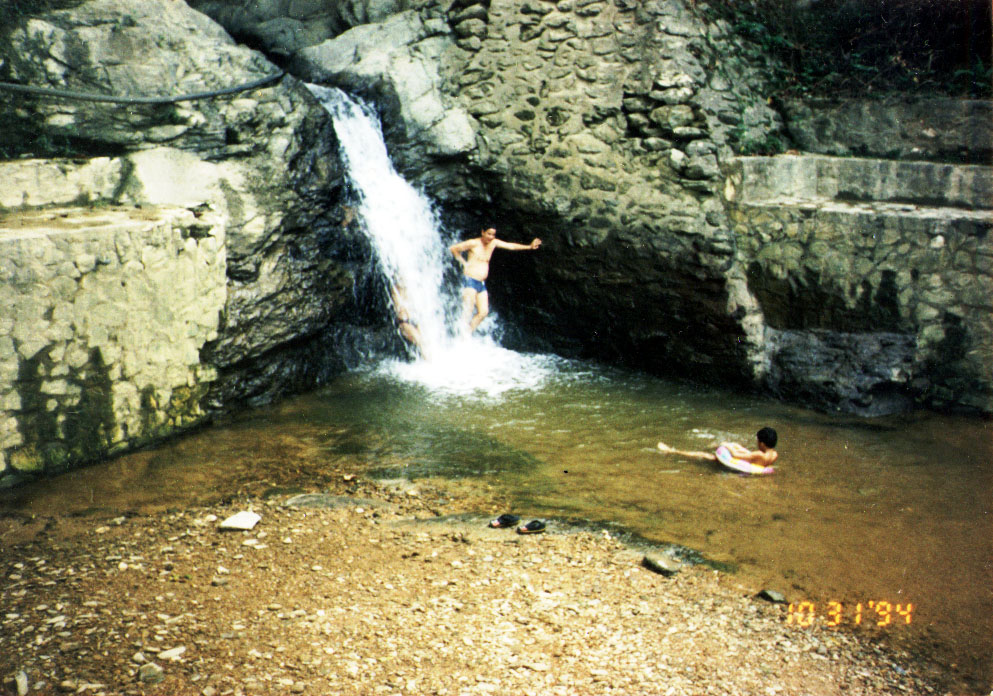
Later, we had a delicious native-style buffet lunch beside the man-made  Labasin Waterfalls, actually the spillway of the Labasin hydroelectric dam. We all sat at rows of shaded wood and bamboo dining tables with 8 inches of running spring waters swirling around the calves of our bare feet, a truly singular and memorable experience as we dined al fresco with the falls as a backdrop.  The Labasin dam also created a long, narrow and deep artificial lake or reservoir from the waters of the Lagnas River.  Filled with dalag (mudfish) and tilapia, fishing is offered here but we opted to avail  of the relaxing bamboo raft ride at this lake which was included in the day tour.

Frolicking at Labasin Falls

Villa Escudero Plantation & Resort: San Pablo City, Laguna.  Manila booking office: 1059 Estrada St., Malate, Manila.  Tel: (632) 521-0830, 523-0392 and 523-2944.  Website: www.villaescudero.com.

Burnham Park (Baguio City, Benguet)

The next day, after breakfast at the hotel, Grace and I took the jeepney to Burnham Park.  It being our last day in the city, we didn’t want to leave without having visited the park. This centrally located and thickly-wooded park, named after Daniel H. Burnham, the American architect and urban planner who planned Baguio, is the city’s foremost and oldest park which forms the heart of the city.   

Burnham Park

Grace and I particularly liked its focal point, the romantic, photogenic and man-made Burnham Lake.  The lake was formerly a natural spring which drained northward to the foot of Session Rd. to join with the Balili River in La Trinidad.  Grace, a lover of flowers, also visited the orchidarium with its various flowers and orchids on display and for sale.  Also within the park are restaurants, a children’s playground, flower-punctuated walks, parade ground, and sports and recreational facilities (skating, biking, football, etc.).

Grace at Burnham Lake
Burnham Park: Baguio City, Benguet

Cathedral of Our Lady of the Atonement (Baguio City, Benguet)

The next day, Grace was feeling better after the previous day’s morning sickness, so we decided to do some sightseeing at the city proper by dropping at the hilltop, twin-towered Cathedral of Our Lady of Atonement, more commonly known among tourists and locals alike as the Baguio Cathedral.

Cathedral of Our Lady of Atonement

The cathedral has an attractive pink facade with a rose window and twin square bell towers with pyramidal roofs.  Its grounds contain the graves of bombing victims killed during World War II. This cathedral was built by the CICM missionaries and was first opened to the public on November 25, 1900 (Feast of Christ the King).  

Cathedral of Our Lady of Atonement: Assumption Road,  Baguio City, Benguet.  Tel: (074) 442-4256.

How to Get There: Access is near the post office, the 100 stone steps from Session Road or from St. Louis University.  

Hyatt Terraces Hotel (Baguio City, Benguet)

Grace and I were now into our third month in our marriage with Grace in her second month of pregnancy (with our son Jandy).  For a break, we decided to avail of a Rajah Tour 3-day/2-night travel package (PhP1,991) to Baguio City which included accommodation at the Hyatt Terraces Hotel,  the city’s only 5-star hotel.  

Grace posing beside the Hyatt Terraces Hotel
Breakfast inside Suite 711
View of city from our balcony

Here, we stayed in at Suite 711, one of the 303-room hotel’s  220 de luxe rooms, all with with bath, TV and private balconies.  The hotel also has 4 duplex penthouses, 40 executive suites with fireplaces and kitchens, and 50 executive suites with kitchenettes.  There are also 3 specialty restaurants (Copper Grill, Kaili Cafe/Restaurant), 2 bars,  a disco (Gold Mine), casino and convention facilities for 220 persons.  

Dinner while being serenaded at the Copper Grill

Located on a pine tree-clad hill along South Drive, near Camp John Hay, the Hyatt Terraces Hotel, said to be the grandest hotel outside Metro Manila, is an architectural showcase of primitive mountain art and contemporary Western design.  Its magnificent and picturesque atrium lobby, best viewed from its interior scenic elevator, is decorated with colorful, handwoven tapestries and refreshing greenery.  

Kaili Cafe Restaurant at atrium lobby

At 4:26 PM, on July 16, 1990, a little over 4 years after our stay, a magnitude 7.8 earthquake struck Luzon, killing 1,621 people.  In Baguio City, 28 buildings collapsed during the earthquake.  One of the most prominent buildings destroyed was the Hyatt Terraces Hotel when the central wing’s terraced front collapsed, like an accordion, onto the hotel lobby, killing 98 employees and guests.

However, 3 hotel employees were still pulled out alive after international rescue teams had abandoned the site, convinced that there were no more survivors.  Eleven days after the earthquake, Luisa Mallorca and Arnel Calabia were extricated from the rubble while, 3 days later, cook Pedrito Dy was also recovered.  All 3 survived by drinking their own urine while, in Dy’s case, he also drank rain water.  Dy’s 14-day ordeal was cited as a world record for entombment under rubble.  Today, all that remains in the site, still undeveloped and said to be haunted, is its old fountain.  

On the day of the earthquake, it just so happen that I was again in Baguio  City, together with my son Jandy, my cancer-stricken father, my mother, sisters Tellie and Salve, my brother Frank  with his wife Cherry and children Jaja, Sandy and Gelo, and my Aunt Pacita with her children Myron and Randy.  We all stayed in a home of Tellie’s friend and left the city just before lunch.  I remember feeling so bad for not being allowed to stay longer in the city.  We all felt the earthquake upon arrival at our home.  Had they given in to my request and we had stayed longer in the city, we might have been trapped there or, worst, buried in a landslide along Kennon Road.