Taipei Fine Arts Museum (Taiwan)

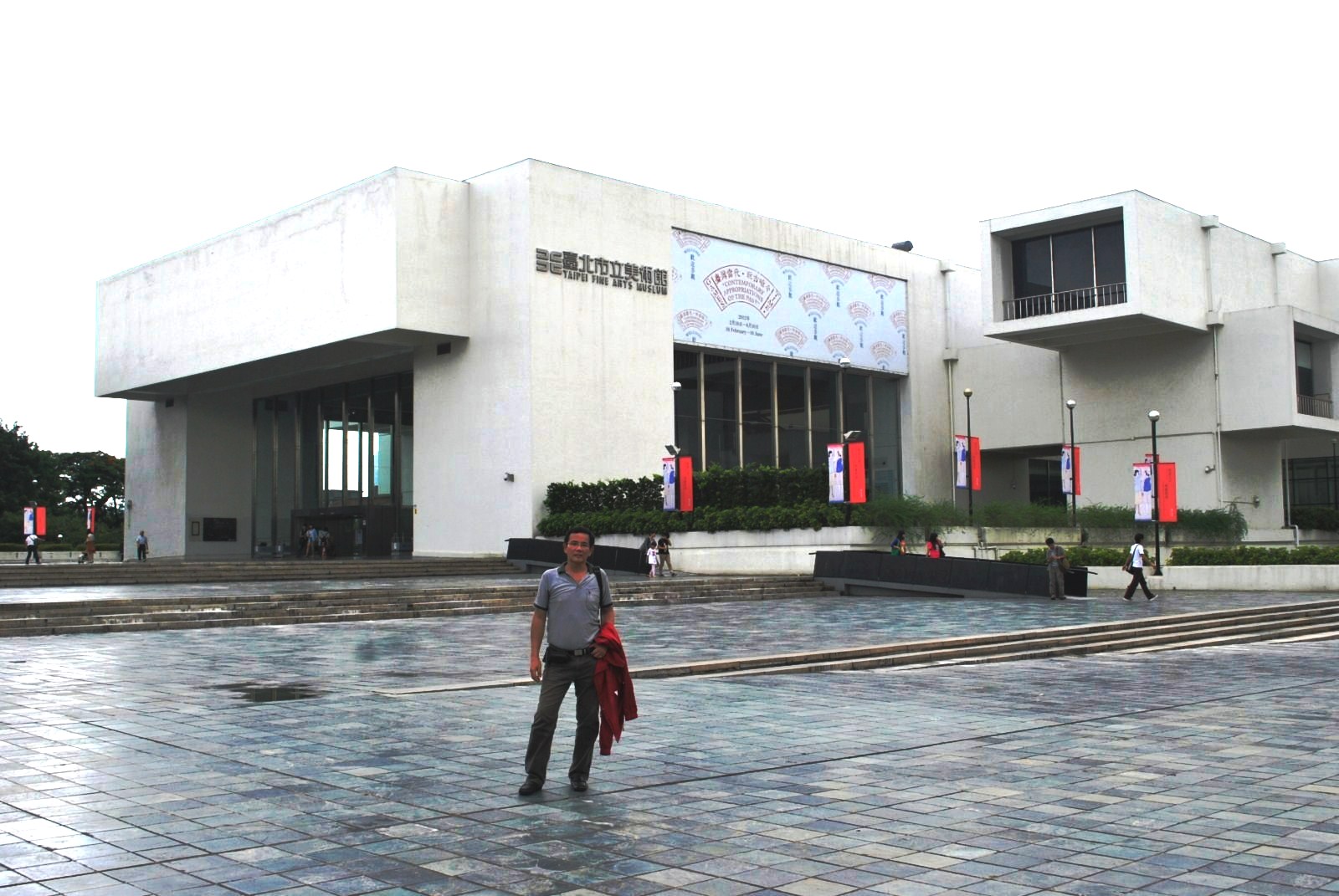
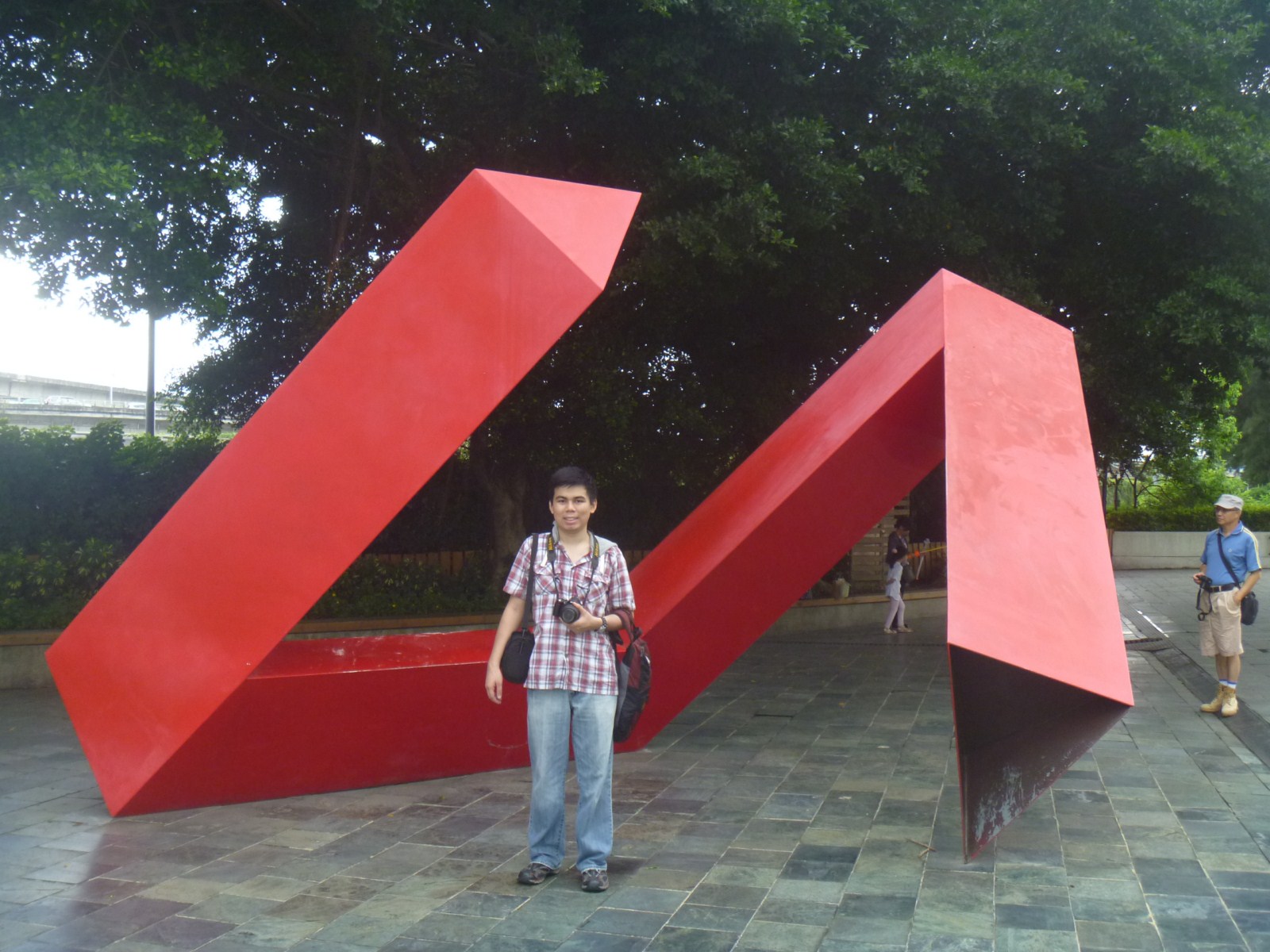
From the Lin An Tai Historical House & Museum, Jandy and I proceeded to a 7-Eleven outlet for some ice cream before making our way to the 6-storey, 20,442 sq. m. Taipei Fine Arts Museum.  Shaped like a pound sign, it is a traditional siheyuan courtyard with a modern edge and its shape plus the creative sculptures (notably Ju Ming’s “Taichi Arch” and Lee Tsai-chien’s “Homerun”) in front made the museum easy for us to identify from afar.

Taipei Fine Arts Museum

Opened on December 24, 1983, it was the first purpose-built museum in Taiwan to host modern and contemporary art exhibitions.The museum has an actual constructed exhibition area of 11,741 sq. m. with more than 4000 pieces of art works. It consists of 24 galleries and is said to be larger than the National Palace Museum in terms of interior space. The art exhibits, which include the work of international and Taiwanese artists, change every few months.

Lee Tsai-chien’s “Homerun”

Each building floor has different arrangements, with the second floor displaying permanent collections while the third floor displays theme exhibitions. The basement is organized into 4 zones (D, E, F and G) for exhibitions and major art competitions.

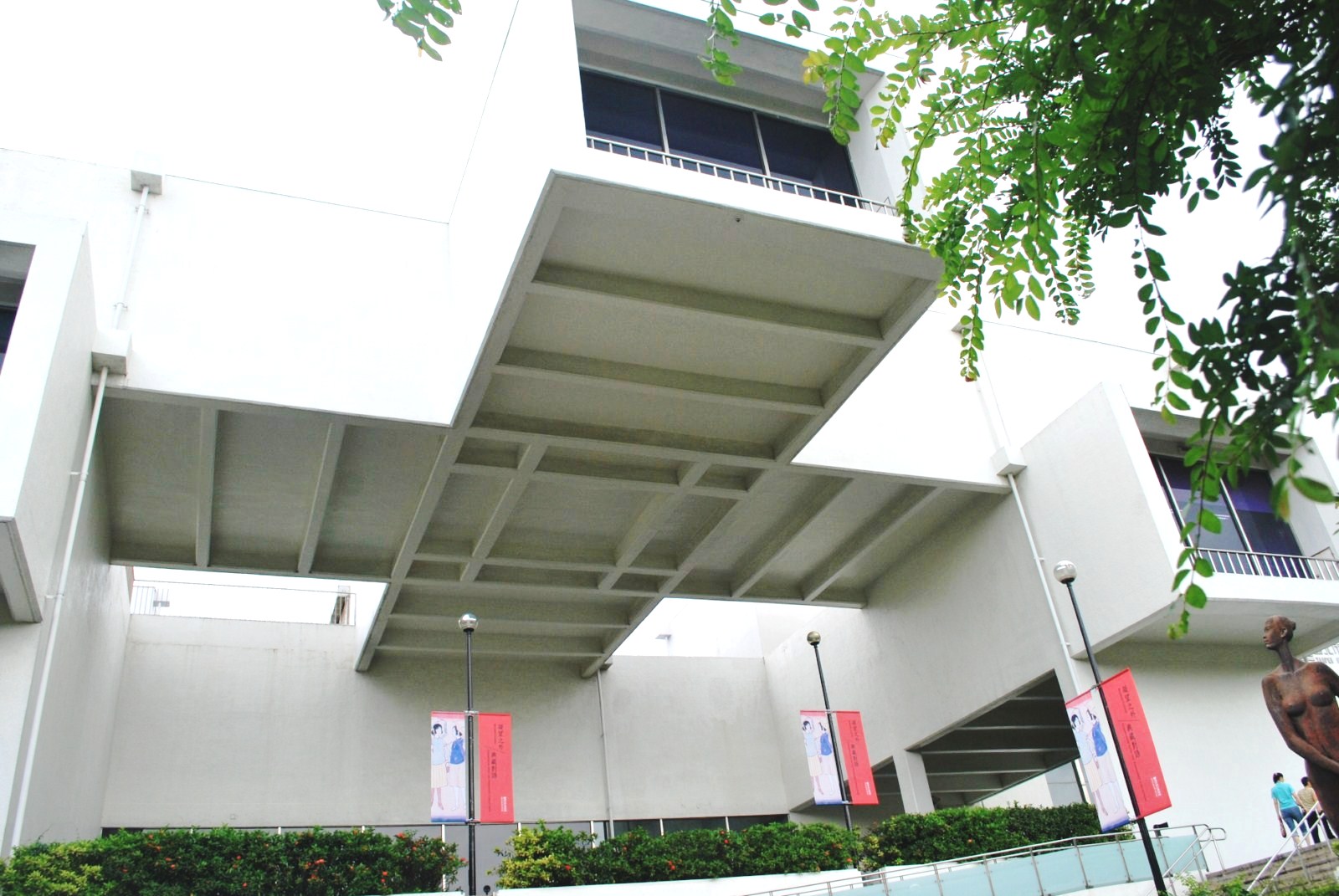
Suspended gallery

Symmetrical and suspended gallery spaces are spread on each floor to form a new space where visitors can view and appreciate art. The grand windows also allow museum visitors to take in the beauteous views that overlook Yuan Shan, the Fine Arts Park Area and the surrounding environments. The building also houses audio rooms, art classrooms, gift shop (sells artwork and numerous souvenirs) and a library.

Another suspended gallery, this time glass-encased

The museum’s architecture, a local adaption of the Japanese Metabolist Movement (espouses large scale, flexible and expandable structures that evoked the processes of organic growth), is infused with elements borrowed from traditional Chinese architecture, which are presented via the structure of piled brackets in the form of suspended corridors, that, together, form a tubular-shaped composition. This tube-shape is identical to the Chinese character for “fountain,” hence fostering the museum’s analogue as a live source of culture. The task of designing and construction was given over to local architect Kao Er-Pan.

The Julian Rosefeldt “World Making” solo show

We didn’t view the paid exhibits but I did visit Julian Rosefeldt‘s  “World Making,” a free solo show of this much celebrated contemporary German new-media artist’s lavishly-produced 16 mm. and 35 mm. films and photo works (2001-2011).  Projected onto several screens to create a panorama-like effect, his films carry the viewer off into a surreal, theatrical world whose inhabitants are caught in the structures and rituals of everyday life.

The museum library

Taipei Fine Arts Museum: 181 Zhongshan North Road, Section 3, Zhongshan District, 10461 Taipei City, Taiwan.  Tel: (+886-2) 2595-7656. Fax: (+886-2) 2594-4104.  E-mail: info@tfam.gov.tw.  Website: www.tfam.taipei.gov.tw. Open Tuesdays-Sundays, 9:30 AM-5:30 PM (8:30 PM on Saturdays).  Admission: NT$30 (for adults) and NT$15 (discounted), 30% discount for group with more than 20 members.

How to Get There: Bus routes 203, 218, 220, 260, 277, 279, 310, 40, 42, 612, all exit at Taipei Fine Arts Museum station.  Via MRT, take the Danshui line and exit Yuanshan Station.  From here, it is a 5 min. walk to the museum.

Lin An Tai Historical House and Museum (Taipei City, Taiwan)

Within walking distance from Xinsheng Park is the Lin An Tai Historical House and Museum,  one of the few traditional courtyard complexes preserved in northern Taiwan and the best-preserved and maintained ancient house in Taipei City.  This traditional Chinese courtyard house, famous for its delicate carvings, was built in the southern Fujianese style which incorporates 3-sided courtyards, woods and gardens, all natural and shaped to embody the pristine elements.

Entrance to Lin An Tai Historical House and Museum

In 1754, Lin Chin-Ming (also known as Lin, Yao-Kung), a native from Anxi County of Fujian Province, sailed across the strait to Taiwan with his family. The Lin family engaged in trade in northern Taiwan and, with the money they made, they built this big, very refined 5-annex house with a square at where No.141 of Siwei Rd. now lies. The main building was completed between 1783 and 1785 while the side buildings were completed, one after the other, between 1822 and 1823.  In memory of his hometown, the fourth son, Lin, Chin-Neng (also known as Lin, Hui-Kung) named the house as “An Tai,” representing Anxi County and Rong Tai Company, the company he founded in Bangka.

Paved Front Yard of Lin An Tai Historical House and Museum

In 1978, due to its being located within the range of the project to expand Dunhua South Road plus its rejection as a historical site, the house faced demolition.  To save it, local activists petitioned to have the building spared as a cultural site. A blueprint containing every single measurement of the building was saved. The building was then meticulously dismantled, from decorations to bricks; stored safely and then relocated, piece by piece, to its current site at Binjang Park, in the shadows of the Jiankuo Expressway, in 1986.  In May 2000, it was opened  to the public as a museum and, in 2010, after its courtyard was extended, the museum became one of the exhibition halls of the Taipei International Flora Exposition.

Front Yard of Lin An Tai Historical House and Museum

The house’s landscaped courtyard, layout of buildings, waterscapes (“the proportion of water, bamboo and house is 30%, 20% and 10% respectively”), artificial hills and plants are all done in accordance with feng shui and Taoism,  reflecting the ancient Chinese’s multi-directional views of nature and life. In the past, the house had a Toad Peak in front of it as its “Mountain of feng shui,” plus shielding hills on both sides and a wind-gathering flat square in front of the semi-circular pond. Today, to reinstate the feng shui landscapes of the old house, an artificial hill, called Gu Zhu Ming Shan (Artificial Clay Modeling Hill), was created, using wire-mesh concrete, in front of a flat square and 2 slightly raised grasslands were used to surround the square.

Gu Zhu Ming Shan (Artificial Clay Modeling Hill)

Past the imposing front gate is the large, crescent-shaped (the best shape for bringing wealth in terms of feng shui) lotus pond, another feng shui device. Its shining surface deflects negative qi from sweeping through the main portal.  It also had practical purposes as it was used as a defense line if under attack, for raising fish, to fight fires, supply water, keep a moderate temperature by cooling incoming breezes and adds to the splendor of the old house’s surroundings.  Flowers grown all have their own symbolism – noble character (plum, orchid, bamboos and chrysanthemum), eternal youth (pine and cypress), wealth (peony), self-respect (lotus) and relief (lily).

The crescent-shaped lotus pond

This 34-room, stone and brick house has elegant decorations; beautiful, sloping swallow-tail roofs (this flouted imperial rules as this roofing style was the exclusive privilege of high-level mandarins) and the stone and artwork used were brought by ship from Fujian.  The roof ridges arch upwards to form a swallowtail structure. The mansion has a south-north axis, with rooms on the right and left side of the courtyard.

Courtyard of Lin An Tai Historical House and Museum

Its front door has creative carvings of 6 dragons, representing the 6 sons in the family while the carvings of vases and bats carry the meanings of good luck, wealth and safety. Pillow-shaped stones, gate pillars and hollows for the door axles are all carved from a single piece of stone. Each door was equipped with a hidden lock. The front yard is paved with red, moss-free and non-slip stones that were used by mainland merchants to stabilize their big sailing ships

Elaborate wood carving

Carved on the pillars, made of Chingtou stones, is a couplet “To live with a kind heart and maintain the achievements of ancestors.” Chinese characters, signifying good fortune and longevity, are printed on the two sides. By adding anti-termite agents, the original Guanyin stone, Fuzhou fir wood, and local bamboo, reed and bricks have been kept intact.

The main hall

Beyond the entrance is an intricately carved screen wall to divert evil. The main hall consists of a colorfully adorned altar depicting scenes from Chinese mythology. The ancestors depicted at the altar are worshiped in an annual ceremony. Walking through the house, we directly experienced the lifestyle of the Taiwanese people 200 years ago as the interiors of the house are full of decorative details and antiques such as an earthen rice grinder, a stone mill, cupboards, a huge cooking hearth in the kitchen, an intricately carved wooden bed and a dresser.

Intricately carved wooden antique furniture

Lin An Tai Historical House and Museum: 5 Binjiang St., Zhongshan District, Taipei City, Taiwan. Tel: (+886-2) 2599-6026, (+886-2) 2720-8889 (ext.6239) and (+886-2) 2598-1572. Fax: (+886-2) 2599-6521.  Open daily except Mondays and folk holidays (Chinese New Year, Tomb Sweeping Festival, Dragon Boat Festival and Mid-Autumn Festival), 9 AM-9 PM (5 PM on Sundays). Admission is free.

How to Get  There:  take the MRT to Yuanshan Station (Exit 1), then hop on the bus 222 to the Xinsheng Park stop.

Xinsheng Park (Taipei City, Taiwan)

From Xintian Temple, Jandy and I again made our way along Song Jiang Road all the way to the 19.5-hectare Xinsheng Park, the second largest park in Taipei. Situated around Minquan East Rd., between Xinsheng North Rd. Section 3 and Binjiang St., Xinsheng Park was developed in 1978 and includes a warm-water swimming pool, tennis courts, children’s playgrounds, a maze garden, a baseball field and basketball courts.

A poignant scene of a father and daughter flying a kite at Xinsheng Park

Every now and then, we witnessed, up close, the periodic take-offs and landings of low-flying jet aircraft as the park is just under the flight path of the nearby Songshan International Airport.  In between flights, the park is still a great place for relaxing, flying a kite, exercising or just reading a book. The widened park avenue is now popular with young people who indulge in skateboarding on weekends and holidays.

Serenity Garden

The park’s colorful plants, bushes and flowers, planted and taken care of by the Yuanshan Park Administration, were brought in from the Minzu nursery where they were raised from seeds or bulbs. The nursery produces about 100,000 plants annually for placement in parks.  Flora in the park include African balsam; scarlet sage; chrysanthemums; maidenhair; crab apples; cherry trees; amaranths; jonquils; banyans (with complete and beautiful canopies), tall and upstanding araucarias; garcinias (scattered in the central axis); poicianas (with charming flowers); Taiwanese goldrain trees; bauhinia; coral bean trees; wax trees; kapoks; hazel sterculias (with the most distinctive flowers and fruits); Indian dillenias, among others. The luxuriant foliage changes with the 4 seasons of the year.

Also scattered around the lush greens are 9 sculptures  donated by the Taipei Lions Club and the Rotary Clubs:  “Leisure Years,”  “Auspicious Earth,”  “Flock of Cranes,” “Hope,” “Prosperity,”  “Friendship and Peace,”  “Father’s Words,”  “The Alignment of Spring” and “Unified.”

Park Sculpture

Park Sculpture

Xinsheng Park was 1 of the 4 exhibition regions during the 171-day (November 6, 2010-April 25, 2011) Taipei International Flower Expo (the others were Yuanshan Park, Taipei Artist Park and Dajia Riverside Park).  During the expo, it was home to 3 themed floral displaying sites (Floral Tunnel, Fujian Garden and Palace of Floral Tea) and 4 pavilions (Pavilion of Regimen, Pavilion of Dreams, Pavilion of Angel Life and the Pavilion of Future).  The green whale sculptures and sculpture of waves at the Flower Base under Trees Area have remained, while Serenity Garden, the European geometric garden with an oriental sensation, was also kept intact.

Flower Base under Trees Area (the green whale sculpture is on the right)

The last 3 pavilions, which received green building certification, were designed by local architect Chang Ching-hwa, ­the designer of Taipei’s Beitou Library, who is well known for incorporating reusable and eco-friendly materials into her works. Powered by solar panels (making them the city’s largest energy-saving facility), all 3 were built completely out of wood and recyclable materials. The roofs are layered with ETFE, the thermal insulating plastics used for the Beijing National Aquatics Center.

Pavilion of Future

Jandy and I first visited the Pavilion of Future.  Probably the greenest building in the Taipei International Flora Expo, it was designed to showcase gardening technology with an eco-friendly focus, energy conservation, waste reduction and health protection.  This intelligent greenhouse, Taiwan’s first energy-conserving greenhouse, uses a combination of ultraviolet ray insulation, floor cooling systems, solar panels and other facilities to help manage indoor temperature.

Interior of Pavilion of Future

Next, we dropped by the Pavilion of Regimen, also known as the “White Mansion.”  During the expo, it displayed Taiwan’s own unique bonsai aesthetics and techniques (“Healthy Living and Endless Life Bonsais”),  precious trees and plants that are over hundreds of years old, plus a large variety of plants and herbs used in Chinese medicine.

Pavilion of Regimen

Xinsheng Park: 105, Section 3, Xinsheng North Rd., Zhongshan District, Taipei, Taiwan. Tel: (+886-2) 2598-3024  (Administering Dept:Yuanshan Park Administration).

How To Get There: Take bus 5, 33, 72, 74, 222, 279, 286, 505, 642 bus and get off at Minzu East Rd and Song Jiang Rd.

Xingtian Temple (Taipei City, Taiwan)

After checking in at our hotel room and freshening up a bit, Jandy and I went out for lunch, bringing our jackets as it was drizzling when we arrived in Taipei.  After changing a US$100 note for New Taiwan Dollars at Taipei Fortune Hotel (the banks were closed it being a Saturday), we walked along Song Jiang Road to Changchun Road where, near the corner, we dined on burgers at a MacDonald’s outlet.

Xingtian Temple as seen from Song Jiang Road

Thus sated, we started our own tour of the city, walking back to Song Jiang Road, past our hotel, towards Minquian East Road, where the 7,000 sq. m. Xintian Temple (and an MRT station) is located.   This relatively new temple (also called Hsing Tien Kong or Shingtien Temple), built in 1967, is one of the biggest and most popular (visitors sometimes number more than 20,000 a day) temples in Taipei.

Entrance to Xingtian Temple

The temple is dedicated to Guan Yu or Guan Gong (162-219 A D ), a famous general who lived  during the Three Kingdoms period (184-280 AD) and an important character in the Chinese classic Romance of the Three Kingdoms.  A man who valued loyalty and righteousness above all things, Guan Gong was later deified and worshiped as the God of War (and, by extension, of martial arts).  Since he had a gift for strategy and tactics and was also adept at managing finances, Guan Gong is also worshiped as the patron deity of businessmen and merchants.

Main building of Xingtian Temple

It being a weekend, this  simple and dignified temple’s courtyard was filled with with crowds of worshipers bowing their heads, burning incense or kneeling in devotion, praying for help or seeking divine guidance by consulting oracle blocks.  Sculptures of dragons feature prominently in this temple’s design.  Its soaring, ship-prow roofs are adorned with carved dragons.

The unusual censer (incense urn)

At the front courtyard of the hall, we noticed a censer (incense urn) with 2 handles in the shape of golden-winged dragons clinging to each side, a somewhat unusual design, with its 2-tiered metal canopy adorned with a horde of dragons’ heads stretching toward the sky.

A long table with offerings

On the main altar, we saw long tables with offerings of fresh flowers, fresh fruit (pineapples, bananas, apples, etc.), migao (a sticky, slightly sweet rice cake) and tea from the faithful.  The temple forbids the killing of of animals as offerings;  discourages the burning of ritual paper money (or “ghost” or “spirit” money) as an offering to the deities and the spirits of the deceased; the staging of operas for the gods; the presenting of gold medallions in gratitude to the deities; and the like. Candles are supplied for free to worshipers and there is no donation box (a first for traditional religion in Taiwan). After the gods have partaken of the offering’s essence, these are eventually given to the needy.

Statue of the red-faced, black-bearded Guang Gong

Among a pantheon of Chinese deities is the easily identifiable statue of the black-bearded, red-faced Guan Gong.  In his youth, the face color of this defender of the weak was said to have been given to him  by an immortal as a disguise after he killed a local bully. Along the hallways of the temple are elderly seated nuns, in  blue robes, reading scriptures.

Blue-robed nuns reading scriptures

People also stand in line to get blessed by these blue-robed nuns who wave incense onto the clothes of visitors in the practice of shoujing (which restores souls that have left the body in a frightened state).  These nuns, who tend to the day-to-day operation of the temple, also hand out incense sticks.

A nun blessing a worshiper

We missed visiting the “Street of Fortune Telling ,” the famous psychic alley located at the underground pedestrian passage  under the Song Jiang-Minquan intersection, filled with numerous fortune telling stands.  These fortune tellers, who do a brisk trade taking commercial advantage of the temple’s popularity, offer answers to troubled people or discuss the future.

 Xingtian Temple: No. 109, Section 2, Minquan East Rd., Zhongshan District, Taipei, Taiwan.  Tel: (+886-2) 2503-1831 and (+886-2) 2502-7924.

How to Get There: Take the THSR (Taiwan High Speed Rail) or TRA to Taipei Station, transfer to the MRT to Xingtian Temple Station.  Go out Exit 3, then turn right.  The temple is on the other side of a crossroad. You can also take the 5, 33, 49, 63, 72, 74, 214, 222, 225, 283, 285, 286, 505 or 617 bus to Xingtian Temple Stop.

The Other Ati-Atihan Festival (Aklan)

The highlight of my 5-day visit to Aklan with Gil Bilog, my wife Grace’s first cousin (on her mother’s side), was our visit to Ibajay town to attend the Ati-Atihan.     Held on the weekend after the more well-known and recently held (just a week ago) Kalibo version of the festival, this Ati-Atihan is less commercialized but just as old and is said by Ibajaynons to be the original and more authentic of the two. It being a Sunday, Gil and I planned to leave very early to make it to the town’s 8:30 AM mass. Joining us was Carl Flores, John Paul Sta. Maria and Jayrel Vicedo, Grace’s first cousin, nephew and grandnephew respectively (all on her father’s side).  Jayrel was to drive us there on our Mitsubishi Adventure. We left Malay poblacion by 7:30 AM and the 35-km. drive took just a little over 30 mins. 

Gil and I outside the Church of St. Peter the Apostle

After parking our car at the town center, we made a short walk to the Church of St. Peter the Apostle.  When we entered the church, the main aisle was cleared of pews and the churchgoers, including us, stood at the sides.  Special guest was Kalibo Bishop Jose Corazon Talaoc who delivered his homily in Aklanon.  Many devotees brought images of the highly venerated Sto. Nino (Holy Child Jesus), in varying shapes and sizes.  Old stories said that the image of the Sto. Nino  miraculously protected Ibajay from the bandits and and Moro pirates by preventing the invaders from docking their ships along the shoreline of the town.

The church interior

The end of the mass signaled the start of the culminating parade, a competition among groups (representing different tribes), with devotees dressed as warriors in flamboyant and colorful costumes made from native materials adroitly fashioned into feathers, headdresses and vests and carrying images of the Sto. Nino. By tradition, the devotees paint their faces with black soot and imitated the playful likeness of the Ati (or Aetas), the short, dark-skinned and kinky-haired first settlers of the Philippines. Ibajay claims to be the original site where the Atis came down from the hills to celebrate with the lowlanders.

Devotees dressed in flamboyant and colorful costumes

This parade is coupled with festive merrymaking, with heads, torsos, hands and feet gyrating and swaying to the sounds of whistles and rhythmic, hypnotic and continuous beating of drums with repeated shouts of “Viva Kay Senor Sto, Nino Viva!”  Some tourists and locals also smeared their arms, legs, and even their whole torso with soot, and joined in the street dancing.

A coconut-themed float

There were also simple floats, representing the town’s different barangays, decorated with palm fronds, fruits and vegetables and the all-important image of the Sto. Nino. On stakes were cooked fish, grilled chicken,  succulent steamed mud crabs, cholesterol-rich lechon (roasted pigs) and even bayawak (monitor lizards). The parade wound through the town, from the municipal hall to the main highway and back to the town center ending with an entrance to the church for a blessing.

Bayawak and steamed mud crabs on stakes

Unlike other major festivals, there’s no big cash prize for the best float, costume or dancing. We watched the parade from our vantage point at the palatial residence of Ang Kasangga Partylist Cong. Teodorico “Nonong” T. Haresco, Jr. (a fourth cousin of Grace).  After the parade, we dined, as guests of Cong. Haresco, on lechon, prawns and a dessert of buko pandan.  After lunch, we dropped by the residence of Judge Cesar Sta. Maria (another fourth cousin of Grace) and posed by the Ibajay Municipal Hall before returning to Malay.

L-R: Jayrel, Gil, the author and Carl

New Year’s Countdown at Manila Hotel

Last New Year, my family and I tried tried something new and different, spending the start of the year outside the country, firecracker-free in Kuala Lumpur, Malaysia, a first for all of us.  We just watched the fireworks at the Petronas Towers.  This year, we still had the same mindset, opting again to spend it outside our home (but not outside the country), this time a New Year’s countdown at the prestigious Manila Hotel for an incomparable evening of feast and festivities in a manner worthy of the country’s oldest bastion of hospitality.

Manila  Hotel – the Grande Dame of Manila

The Manila Hotel was opened for the first time to the public on July 4, 1912.  The original US$700,000 hotel, also the country’s first air-conditioned building, was designed in the California Missionary-style by American architect William E. Parsons in 1910.  At the time, this magnificent, white, green-tile-roofed edifice had 149 spacious, high-ceiling rooms. Its fifth floor penthouse, designed by Arch. Andres Luna de San Pedro (son of painter Juan Luna), was, from 1935 to 1941, the home of Gen. Douglas MacArthur (its first chairman of the board), his wife Jean and son Arthur.

The hotel’s beautiful lobby

The hotel played host to author Ernest Hemingway (who said “Its a good story if it’s like Manila Hotel”), actor Douglas Fairbanks, Jr., Edward (Prince of Wales), playwright Claire Boothe Luceand, during the Japanese Occupation,  Prime Minister Hideki Tojo and Gen. Tomoyuki Yamashita.  During the liberation of Manila, it was severely damaged by room-to-room fighting.  Reopened on July 4, 1946, it hosted author James A. Michener; actors Bob Hope, Marlon Brando, Charlton Heston, John Wayne, Tyrone Power and Burgess Meredith; U.S. Secretary John Foster Dulles; Sen. Robert F. Kennedy; British Prime Minister Sir Anthony Eden, the Rockefeller brothers, Publisher Henry R. Luce, rock star Michael Jackson; U.S. Vice-Pres. Richard M. Nixon, U.S. Presidents Dwight Eisenhower and Lyndon B. Johnson, the Beatles and other notable personalities.

The lobby dressed up for the New Year countdown

In 1977, the hotel underwent a US$30,000,000 renovation with an 18-storey tower designed by the late National Artist Architect Leandro V. Locsin built behind the old building.  The lavish interiors were done by American Patricia and Dale Keller and the renovated hotel reopened on October 6, 1977.

The Sunset Suite

We made our own grand entrance at the hotel’s main lobby on the afternoon of the 31st of December.  The 125 ft. (38 m.) long by 25 ft. (7.6 m) wide main lobby, lined with white Doric columns, was designed, not only for making grand entrances, but for sitting as well, its furniture carved with Philippine mahogany.  The lobby floors were made with Philippine marble while the ceiling is lined with chandeliers made of brass, crystal and seashells. Traditional Filipino art also adorns its walls.

Cafe Ilang-Ilang’s Dessert Station

The hotel that day was 90% booked for the countdown, with a long queue at the check-in counter, and it took some time before we finally checked into our fourth floor Sunset Suite, one of 570  traditionally decorated and elegantly furnished rooms that reflect the hotel’s storied past blended with the conveniences of a modern luxury hotel. Our suite had 2 bedrooms, a dining area and a living area.  Amenities here include individually controlled central air conditioning, remote-control TV with cable channels, minibars, separate bath and toilet with extension phone, and secure in-room safes.

Grace, Cheska, the author and Jandy at Cafe Ilang-Ilang

Once settled in, we then went down for our crossover buffet dinner (6 PM to 9 PM) which extends through all the hotel’s celebrated food and beverage outlets: Cafe Ilang-Ilang, Champagne Room, Mabuhay Palace (an impeccable Chinese restaurant), Tap Room Bar and Lobby Lounge.  That night, it was not a choice of which restaurant to go to, but, rather, which restaurant to visit first.  We chose the famous Cafe Ilang-Ilang which was recently renovated and launched as a 3-period meal buffet restaurant. It opens to the newly renovated Pool and Garden areas and boasts of 9 live cooking stations.

The Tap Room Bar

Here, we faced a stunning and wide array of Filipino and international (Korean, Japanese, Indian, etc.) cuisine, tried-and-true dishes prepared by Filipino and foreign chefs, all backed by years of professional experience in acclaimed restaurants around the world.  To fully enjoy the cafe’s  stellar main courses, we ate small portions of everything.

The countdown begins …..

After our filling buffet dinner, we moved on to the Tap Room Bar for dessert and brewed coffee. We capped our evening with the New Year’s Countdown at the Lobby where, prior to bidding farewell to 2011 and counting the seconds to 2012, we enjoyed live entertainment, with music and dancing provided by the Filipinas Band.

The Filipinas Band
Manila Hotel: 1 Rizal Park, Ermita, Manila: Tel: 527-0011. Fax: 527-0022-24 & 527-1124.  Domestic Toll Free: 1-800-9-1888-0011.  Email: sales@manila-hotel.com.ph and reservations@manila-hotel.com.ph.  Website: www.manilahotel.com.ph.

The Amazing Street Art of Angono (Rizal)

After our tour of the Ang Nuno Artist Foundation Gallery at Balaw-Balaw Restaurant, Jandy and I again boarded our car to tour the town proper.  Angono’s streets are very narrow and hopelessly riddled with traffic.

C.V. Francisco – Bunung Brazo, 1958 (Charlie Anorico, 2005)

However, upon reaching Dona Aurora St., my exasperation was somewhat mitigated when we caught sight of amazing concrete murals beautifully embellishing and adorning this street, all meant to honor Angono’s artistic roots.

Mt. Makiling in the Eyes of Botong (Carlos V. Francisco)

These extraordinary works of art are bas relief reproductions of local son and well-known Filipino muralist Carlos “Botong” Francisco’s works cast in concrete, all done by Charlie Anorico, Gerry Bantang and Ebong Pimpino.

C. V. Francisco – Merienda, 1958 (Charlie B. Anorico, 1999)

Upon turning a different corner, we were greeted by another mural honoring Lucio San Pedro, another local son, whose most famous composition, the perennial Filipino lullaby “Sa Ugoy ng Duyan,” is depicted on a wall as a music sheet, with cast metal notes jutting out of the concrete.

In fact, these murals as well as sculptures are a recurring theme throughout the town, with a  preponderance of mermaids.  The stone marker of Brgy. Poblaction is a sculpture of “Ang Nuno” (meaning “old man”), the origin of the town’s name.

There’s even a reproduction of the Statue of Liberty, painted in gold.  Angono is truly a town still very much in touch with its unique artistic heritage.

Bayanihan (Carlos V. Francisco, 1960)

Angono Street Murals: Dona Aurora St., Brgy. Poblacion Itaas, Angono, Rizal

Ang Nuno Artists Foundation Gallery (Angono, Rizal)

Balaw-Balaw Restaurant

After my interview with Nemi R. Miranda, Jandy and I moved next door to the Balaw-Balaw Specialty Restaurant.  This restaurant, made famous by Andrew Zimmern in Discovery Travel and Living’s “Bizarre Foods,” offers truly exotic cuisine such as sautéed ants and crickets, wood worms and frog cooked adobo style, Soup No. 5 (cow butt and testicles),  adobong uok (beetle larvae), among others.

Wooden sculptures of Angono’s higantes

Andrew tried the last two.  However, having already taken lunch, we weren’t there for the exotic food (Maybe next time).  Rather, we wanted to explore the Ang Nuno Artists Foundation Gallery  at the second floor.

Luckily, Andre, the restaurant manager (and also an artist) son of the late artist and sculptor Perdigon N. Vocalan, was there and he granted us permission to explore the gallery upstairs. The dining area is already a gallery of sorts, with colorful paper mache sculptures and paintings (with subjects ranging from basket of fruits to mythical creatures) all around the patchwork property.  Outside, soda bottle lanterns hang from trees.

Upon climbing the spiral staircase, we were ushered into an impressive repository of Philippine treasures that showcases Filipino heritage through colorful papier mache, antiques and artworks by Perdigon, his sons Andre and Rembrandt as well as other independent and budding local artists and craftsmen from Angono and other Rizal towns.

A collection of wood sculpture and furniture

The accomplished Vocalan was influenced by the late National Artist and Angonon Carlos “Botong” Francisco (November 4, 1912 – March 31, 1969) and his  various paintings, sculptures and woodcarvings, inspired by Filipino traditions and legends,capture Angono’s rich cultural heritage as well as depict folk stories and characters like the kapre (a menacing creature that seeks refuge in big trees), duwende (goblin)tikbalang (demon horse), manananggal (a woman with the ability to detach the two halves of its body at the waist), and the like. He also depicted women in all their glory and beauty.  There are also several depictions of the Mother and Child.

Dining table with tapayan above it

The gallery, a reflection of Perdigon’s eclectic taste, also has an impressive collection of antiques and religious objects such as statues of saints (some just heads without a body), a complete tableau of the Last Supper and a Santo Entierro (statue of the dead Christ). There’s also a collection of antique furniture including folding chairs, a complete dining table set (with earthen, knee-tall jars or tapayans hanging above it)  and a huge, intricately carved wooden door.

Tableau of Last Supper

I also took a peek, via a spiral stairway, at the third floor which houses a workshop  where huge, colorful masks of the higantes for the Higantes Festival are made. In 1987, Perdigon conceived the idea of the Higantes Festival.

Wooden sculpture of a mermaid

He advocated having more higantes (papier mache giants) in the town fiesta by coordinating with the barangays of Angono to come up with higantes that will represent their barangay. Miniature papier mache dolls, great examples of Filipino folk art, are also made here for souvenir hunters.

More wooden sculpture

Ang Nuno Artists Foundation Gallery: Balaw-Balaw Specialty Restaurant, 16 Doña Justa Subd., Phase I, Brgy. San Roque, Angono, Rizal.  Tel: (632) 651-0110 & 295-2698. Mobile number: (0923) 714-4209. E-mail: balaw2x@yahoo.com. Open daily, 10 AM-10 PM.

Nemiranda Arthouse (Angono, Rizal)

Nemiranda Arthouse/Atelier Cafe

After lunch at a Shakey’s outlet in Taytay,  Jandy and I proceeded to the next town of Angono, the “Arts Capital of the Philippines.”  Using the only Angono map I had, I tried to find the Nemiranda Arthouse/Atelier Cafe only to find out it wasn’t where its supposed to be in the map.

I finally resorted to asking the locals.  That worked and soon enough we found the place, a lofty old wood, bamboo and concrete house converted into a home-studio with a prominent signage at the street corner.

I entered the arthouse (also known as “The House of Myths and Legends”), via a side gate, into the coffee shop where I was welcomed by Katrina, the painter daughter of 62 year old local artist Nemesio “Nemi” R. Miranda (popularly known in the art circle as Nemiranda), who was currently touring some children around the art gallery.

I was hoping to interview Nemiranda, but Katrina told me that I just missed him as he left on his motorcycle.  She gave us free rein to tour the extensive, 3-floor art gallery ourselves.  A massive, larger-than-life, pastel blue stone mermaid (sirena) is prominently placed above the art gallery’s arched entrance.

Art Gallery entrance

A Fine Arts graduate of  University of Sto. Tomas and a disciple of the late noted Angono artist Carlos “Botong” Francisco, this highly figurative artist’s artworks employ figurative realism  (which he calls “imaginative figurism”) wherein the human form is drawn from pure imagination.

Nemiranda’s work inevitably evolves around the female form and it is vividly seen in almost every artwork that we observed. These include mother and child sketches, mermaids, nudes (Nemiranda is also deemed as an erotic painter) done in different styles, women giving birth, nursing mothers, etc..

Nemiranda’s Imaginary Figurism

Other stunningly beautiful paintings depict random subjects such as rural life (families in pastoral scenes, etc.) and subjects from local folklore such as mythical creatures and nature goddesses.  On display at one section are wood carvings of the “Stations of the Cross.” Also on display are artworks by Nemiranda’s 5 sons and daughter Katrina as well as fellow artists from Rizal.

Wood carvings of the “Stations of the Cross”

We also saw Nemiranda’s impressive collection of local and international awards, proof of his countless unparalleled excellence and achievements in the arts.   At the end of the gallery are some art pieces for sale. This veteran artist has launched over 35 solo art exhibitions in various parts of the world and was commissioned to do monumental sculptures and mural paintings throughout the country.

Sculpture of a pregnant woman

Some of Nemiranda’s popular and impressive commissioned works includes the “History of the Philippine Army,” a relief sculpture located at the parade ground of Fort Bonifacio; the EDSA Shrine Mural (along with 14 other Angono artists), muted murals interpreting and depicting the 4-day  People Power revolution in the main chapel of the EDSA Shrine; the EDSA II Relief Sculptures; “The Way of Mary,” a 20-relief sculpture of the Mysteries of the Holy Rosary, from EDSA Shrine to Antipolo Shrine; and the 40-ft. high “Crucified Christ” (unveiled in Tacloban City in 2002), the map of Leyte interpreted as a sculptural island shaped by nature into the image of the crucified Christ. His paintings also hang in the many prestigious homes and offices, both here and abroad.

A collection of nude paintings

Jandy and I were still exploring the art gallery when Nemiranda finally arrived.  We were introduced to him by Katrina and I proceeded to interview him at length. As a true-blooded Angonon, Nemiranda has been instrumental in making Angono as the “Art Capital of the Philippines,” making great contributions in promoting the town’s rich heritage.

The Arthouse is also part of Nemiranda’s mission to nurture the artistic consciousness, not just for the Angonons, but for all Filipinos as well, conducting, for years on a regular basis, lectures, guiding services and painting workshops designed to inspire the youth who, by talking to Nemiranda and watching the artist go through the creative process, might see how an idea can grow into a finished work of art.

Some of Nemiranda’s numerous awards

In 1975, Nemiranda  founded the renowned Angono Ateliers Association, the first in the town to popularize sculpture in concrete (started in 1970).  He was also chairman of the Angono Tourism Council and the promoter of the town’s Higantes (“giant”) Festival and the fluvial procession dedicated to San Clemente, Angono’s patron saint. He also institutionalized the Nemiranda Family Art Museum, the Angono School for the Arts and the Nemiranda Atelier Café, all catering to the development, promotion and growth of the Angono art community.

The author with Nemiranda
Nemiranda Arthouse/Atelier Cafe: 10 Doña Elena St., Doña Justa Village, Brgy. San Roque, Angono, Rizal. Tel:  (632) 651-0109-10. Fax: (632) 651-3867. Email: inquiry@nemiranda.net and nemi_miranda@yahoo.com. Website: www.nemiranda.net. Admission fee: PhP30.

Church of St. John the Baptist (Taytay, Rizal)

Church of St. John the Baptist

The town’s first church (Visita de Sta. Ana de Sapa) was a chapel made of light materials near the shores of Laguna de Bay dedicated to its patron saint, John the Baptist.

Due to frequent flooding from the shores of Laguna de Bay, it was transferred by Jesuit Fr. Pedro Chirino (who documented the Tagalog language as well as the way of life of Filipinos from his interactions with the inhabitants, forming the basis for his book Relación de las Islas Filipinas) to its present site, a higher location in a hill which called San Juan del Monte where the parish has remained to this day.

The Early Renaissance facade

The town’s church, started in 1599 and completed in 1601, was considered to be the first church built by the Jesuits out of stone outside Manila.

Bas-relief of the Holy Eucharist.  The fluted Ionic pilasters are both topped by angels.

In 1630, a larger church was constructed by Fr. Juan de Salazar. In 1632, a typhoon blew away the roofing of the new church, which was soon replaced with the help of the townspeople.

Bas-relief of Crossed Keys. The two symbolic keys form a St. Andrew’s Cross. These keys appear on the coat-of-arms of the Holy See,Vatican City and of every pope since the 12th century.

In 1639, the church sustained significant damage when the Chinese, during their revolt against Spanish authorities, set fire to the church.

Bas-relief of a cross between two lambs. The lambs represent the faithful coming to Christ (represented by the Cross)

St. Pedro Calungsod (the second Filipino declared as a saint by the Catholic Church) once served as an altar boy in the church in 1666 and then serving as assistant to Blessed Diego Luis de San Vitores in the Marianas in 1672 (when both were martyred). In 1768 (under secular priests) and 1864 (under Augustinian Recollects), additional works were made to the church.

Statue of St. John the Baptist

During the Philippine–American War, both the church and the convent were reduced to ruins. After the war, the church was reconstructed. Massive renovations in the 1970s left very little of the original Classic façade.

Jandy with the church interior in the background

The present church, built with concrete, shows no traces of the old Jesuit church. In 1992, the National Historical Institute (NHI), now the National Historical Commission of the Philippines (NHCP), unveiled a historical marker in the church.

NHI plaque installed in 1992

AUTHOR’S NOTES:

The church’s Early Renaissance facade has three levels of superpositioned, fluted pilasters (the first level is Doric and the other two Ionic).  The first level has a semicircular arch main door with canopy (a later addition), with a semicircular arch statued niche above it and along the flanks.

The walls of the second and third levels are decorated with pairs of huge bas-reliefs of the Crossed Keys and a Cross between two lambs and one of the Holy Eucharist.  The triangular pediment, topped by a cross, is lined with dentils.

The four-storey square bell tower, on the right side of the church, has semicircular arch windows and is topped by a pyramidal roof.  On the left side of the church is a huge statue of St. John the Baptist.

The main altar

Church of St. John the Baptist: J. Sumulong St., Brgy. San Isidro, TaytayRizal.  View Map>>> Tel: (632) 8658-6489.  Feast of St. John the Baptist: June 24.

How to Get There: Taytay is located 23.4 kms. from Manila and kms. (a drive) from Antipolo City.