Marina Bay Sands SkyPark (Singapore)

The next day was to be my niece Jaja’s wedding day but, since it was to be held in the late afternoon, Jandy and I still had the whole morning for sightseeing. After breakfast at our hotel, we took a taxi to the 20-hectare Marina Bay Sands, an integrated resort fronting Marina Bay officially opened last June 23, 2010, after a partial opening (which included the casino) on April 27.  Designed by Moshe Safdien Architects (with Aedas Singapore as the local architect of record),  its engineering was provided by Arup and Parsons Brinkerhoff (which had originally worked on such prestigious projects such as the Beijing National Aquatics Center and the Sydney Opera House) and the main contractor was Ssanyong Engineering and Construction. The resort’s architecture as well as major design changes along the way were also approved by the late Master Chong Swan Lek and Master Louisa Ong-Lee, its feng shui consultants.

Marina Bay Sands

Developed by Las Vegas Sands, this S$8 billion (including cost of the prime land) casino is billed as most expensive stand-alone atrium casino in the world, with 500 tables and 1,600 slot machines.  However, we were not visiting for the gambling.  Rather, we were there for the 360-degree Singapore skyline view atop its 340m-long (stretching longer than the Eiffel tower laid down or four and a half A380 Jumbo Jets), 1-hectare and 3,900-pax SkyPark, a sky terrace which connects the three 55-story hotel towers and is set on top of the world’s largest, gravity-defying public cantilevered platform, overhanging the north tower by 67 m..

Marina Bay Sand’s atrium lobby

Aside from housing the world’s largest casino, the resort features a 2,561-room hotel, a 1,300,000-sq. ft. (120,000 m2) convention-exhibition center, the 800,000 sq. ft. (74,000 m2) The Shoppes at Marina Bay Sands mall (with over 300 stores and F&B outlets), the 200,000 sq. ft. (19,000 m2), lotus-shaped ArtScience Museum located next to the three blocks (currently featuring “Titanic: The Artifact Exhibition”), two large theaters (the 1,680-pax Sands Theater and the 2,155-pax Grand Theater), two floating Crystal Pavilions (the 2nd houses the world’s largest Louis Vuitton boutique) and a 6,500 sq. ft. (600 m2) indoor ice skating rink (which uses artificial ice). There are also 7 “celebrity chef” restaurants (6 within the Shoppes) – Cut, Waku Ghin, Pizzeria and Osteria Mozza, Guy Savoy, DB Bistro Moderne, Santi and Rasapura Masters.

The lotus-shaped ArtScience Museum

Upon arrival, we entered the hotel’s huge atrium lobby, decorated with tall Christmas trees, and walked some distance to the SkyPark Box Office located at the Basement 1, Tower 3. After purchasing our entry tickets here, we proceeded to the porte cochere area outside the Tower 3 and took the elevator to 57th floor where the SkyPark is located. The SkyPark is also home to the world’s longest elevated outdoor swimming pool, perched 191 m. above  ground and with a 146-m. (478-ft) vanishing edge. However, we missed out to view the pool (as well as its lush gardens and rooftop The Sky on 57 restaurant) as it is available only to 50 observation deck guests that have registered for the 15-min. guided tours (available at 10 AM, 2 PM and 9 PM only). The pools were made with up to 422,000 pounds of stainless steel and can hold 376,500 gallons (1,424 cu. m.) of water.  Within the observation deck is the KU DÉ TA nightclub.

.

The day, though slightly overcast, still afforded us a spectacular, unforgettable panoramic view, from 10 observation deck view points, of Singapore’s Central Business District, the Merlion, Old Supreme Court Bldg., New Supreme Court Bldg., City Hall Bldg., Esplanade, St. Andrews Cathedral, Float @ Marina Bay, Helix Bridge, the Singapore River, the Formula One pit building and racetrack, the Padand (Singapore Recreational Club and Cricket Club), Marina Barrage, East Coast Parkway, Benjamin Sheares Bridge, Changi Airport control tower, the Singapore Flyer (an observation wheel), Nicoll Highway, Little India, Sentosa Island, Singapore Port and, beyond, Kusu Island and Indonesia’s Batam Island.  Just below are the resort’s theaters, the Event Plaza, the Crystal Pavilions, the  Sands Expo and Convention Center, the ArtScience Museum, the Marina Bay Sands casino and The Shoppes at Marina Bay Sands.

The Singapore skyline

Marina Bay Sands SkyPark: Open daily, 9:30 AM-10 PM (11 PM on Fridays, Saturdays and Sundays). Admission Fee: S$20 for adults, S$14 for children (aged between 2–12 years) and S$17 for senior citizens (aged 65 years and above).  Children under 2 years of age may enter for free. Ticketing Hotline: +65 6688 8826

The Iconic Bridges of the Singapore River

Upon reaching the end of South Bridge Rd., Jandy and I were now at the banks of the historic 6-km. long (19,690-ft.) long Singapore River. Here, we viewed a  number of pedestrian and vehicular bridges that span this river, serving the needs of Singaporeans and visitors alike by connecting residential, commercial and entertainment areas.  They also add history (rickshaws, ox carts, cattle, horses, etc. used to pass here), high technology and color to the Singapore skyline. Three of these bridges – Anderson Bridge, Cavenagh Bridge and Elgin Bridge – were, on November 3, 2008, selected for conservation as part of the Urban Redevelopment Authority’s expanded conservation program. The Anderson Bridge and the newer Esplanade Bridge also forms part of the Singapore Grand Prix‘s Marina Bay street circuit which debuted on September 28, 2008.

Singapore River

The Cavenagh Bridge, opened in 1870 (the third bridge to be built in Singapore) to ease access between the civic district on the north bank and the commercial district (now Raffles Place) on the south bank , is the oldest among the original bridges spanning the Singapore River.   It spanned the lower reaches of the Singapore River in the Downtown Core. Before this bridge was built, people could only get to the 2 districts via a detour over Elgin Bridge or by paying 1 duit (¼ cent) for a boat ride across the river.  Originally known as the Edinburgh Bridge (to commemorate the visit of the Duke of Edinburgh), it was renamed in honor of Maj.-Gen. William Orfeur Cavenagh, the last India-appointed Governor of the Straits Settlements (1859-1867). His family’s coat-of-arm scan still be seen atop the sign at both ends of the bridge.

Cavenagh Bridge

Cavenagh Bridge, originally designed as a drawbridge, is also Singapore’s first and only steel suspension bridge, with elaborate suspension struts. During construction, numerous steel rivets were used and steel casting methods commonly used during that era were employed. Its parts were manufactured by P & W MacLellan, Glasgow Engineers (Scotland ) at a cost of S$80,000, built and tested in Glasgow to withstand a load 4 times its own weight, shipped to Singapore in parts and it reassembled by Indian convict labor. Subsequently, in the late 1880s, the bridge became overloaded due to the flourishing trade on the Singapore River and vehicular traffic volume overtook the capacity of the bridge.  Added to this was its low draught which was insufficient for the passage of boats during high tide.

Cavenagh Bridge

The bridge was  eventually spared from demolition by conversion to a pedestrian bridge.  In the 1990s, lighting was added to accentuate its architectural features at nightfall. It now complements the renovated Fullerton Hotel (formerly the Fullerton Building) beside the bridge. At the southwest abutment of the bridge are sculptures of a family of Singapura cats (kucinta or drain cats), recognized as one of the smallest breeds of cats in the world. At both ends of the bridge are preserved police notices  restricting the passage of vehicles that weighed beyond 3 CWT (152 kgs. or 336 lbs.), including cattle and horses.

Anderson Bridge

Cavenaugh Bridge’s replacement was the century-old Anderson Bridge, near the river’s mouth, which provided sufficient clearance for vessels to pass under during high tide. Connecting the financial district directly to City Hall, this bridge is also located near the Fullerton Hotel and the former Merlion Park.  An excellent combination of intricate plaster and metalwork, this elegant bridge has 3 steel arches with supporting steel ribs across them, 2 rusticated archways and a fluted pier on each end.  The abutments were built by the Westminster Construction Company Limited. Started in 1908, it was officially opened on March 12, 1910 by Sir John Anderson (Governor of the Straits Settlements and High Commissioner for the Federated Malay States from 1904–1911) after whom the bridge was named. During the 1942-1945 Japanese Occupation, the severed heads of criminals were hung on the bridge as a warning to discourage citizens from breaking the law.

Anderson Bridge – Western Approach

The slightly younger, concrete Elgin Bridge, a vehicular bridge in the Boat Quay area linking the Downtown Core to the Singapore Planning Area located within Singapore’s Central Area, was named after India governor-general (March 21, 1862-November 20, 1863) Lord James Bruce, the 8th Earl of Elgin.  Elgin Bridge is believed to have existed, as early as 1819, at its current location as an unnamed footbridge linking the Chinese community, on the southern side, to the Indian merchants of High St. on the northern side.  As this was the first bridge across the river, the two roads leading to it were named North Bridge Rd. and South Bridge Rd. accordingly.

Elgin Bridge

In 1822, this footbridge was replaced by the Presentment Bridge, a wooden drawbridge (also called the Monkey Bridge, as its narrowness limited the number of people crossing at a time, therefore using it required some agility) was built by Lt. P. Jackson. In 1843, a wooden footbridge, built by John Turnbull Thomson replaced the drawbridge (also called the Thomson Bridge).  In 1862, an iron bridge was built but, in 1925, the iron bridge had to make way for the new, existing bridge which was opened to traffic by Sir Hugh Clifford, Governor of the Straits Settlements, on  May 30, 1929.

Elgin Bridge – Approach

At one end of the bridge is the crest of the Singapore Municipal Commission. Its elegant cast iron lamps, on both sides of the bridge, were designed by the Italian sculptor Cavaliere Rudolfo Nolli whose signature graces the bronze plaques beneath the lamps, each with a lion standing in front of a royal palm tree engraved on it. Elgin Bridge is known as thih tiau kio in Hokkien, meaning “iron suspension bridge.”

Esplanade Bridge

The 260 m. (850-ft.) long, 70 m. (230-ft.) wide, low-level concrete arched Esplanade Bridge, a vehicular and pedestrian bridge along Esplanade Drive, in front of the mouth of the Singapore River, was built, from early 1994-1997, to provide faster access between Marina Center and the Shenton Way financial district.  After completion, it was found out that the bridge blocked views of the iconic Merlion statue from the Marina Bay waterfront, causing the statue to be transferred from the back to a more prominent place at the front of the bridge.

Esplanade Bridge

The Esplanade Bridge has 7 spans and supports two 4-lane carriageways and walkways along both sides.  The bridge offers panoramic views of Marina South, the rest of  Marina Bay and both sides of the Singapore River.  As such, it is often subject to occasional road closures during National Day and New Year’s Eve and the street lamps along it are shut off to allow spectators, pedestrians and revelers who pack all 8 lanes of the bridge a pleasant and unadulterated view of the fireworks.

Helix Bridge

The Helix Bridge, next to Bayfront Ave., was opened on July 18, 2010.  Previously known as the Double Helix Bridge, it is the world’s first curved bridge. This 280 m. (918-ft.) long pedestrian bridge is (Singapore’s longest) is located beside the Benjamin Sheares Bridge and is accompanied by the Bayfront Bridge, a vehicular bridge. The Helix Bridge links the hotels, commercial buildings and shops of Marina Center with Marina South in the Marina Bay area (a body of water formed through land reclamation at the mouth of the Singapore River).

Helix Bridge – Approach

The bridge has 5 strategically located viewing platforms sited at strategic locations.  They provide stunning views of the Singapore skyline and events taking place within Marina Bay. The bridge also functions as a gallery where children’s paintings and drawings are exhibited for public viewing.  The bridge is illuminated at night by a series of lights that highlight the double-helix structure, thereby creating a special visual experience for the visitors. Pairs of colored letters “C” (cytosine), “G” (guanine), “A” (adenine) and “T” (thymine), representing the bases of DNA, are lit up in red and green.

Helix Bridge – Approach

The Helix Bridge was designed by an international consortium including the Cox Group of Australian architects, Arup engineers, and Singapore’s Architects 61 and was fabricated and erected by TTJ Design and Engineering.  The bridge’s design features a series of connecting struts that hold together two spiraling steel members that resembles the structure of DNA (the building blocks of life), symbolizing life and continuity, renewal, abundance and growth, with the aim of attracting happiness and prosperity to Marina Bay.

Helix Bridge – Detail

It used approximately 650 tons of duplex stainless steel and 1,000 tons of carbon steel tubes to create the bridge’s major and minor helix that spirals in opposite directions. To provide shade for pedestrians, canopies made of fritted glass and perforated steel mesh were incorporated along parts of the bridge’s inner spiral.

View of Marina Bay From Helix Bridge

The Coleman Bridge, a vehicular bridge linking Hill St. and New Bridge Rd., near Clarke Quay, was the second bridge built across the Singapore River and the first built in masonry.  Part of the bridge demarcates a boundary between the Downtown Core and the Singapore River Planning Area, both located within the Central Business District. It first started out as a 9-arched brick bridge, built in 1840, designed by and named after Irish architect (Singapore’s first) George Drumgoole Coleman (1795–1844). It was referred to as the New Bridge, lending its name to New Bridge Road, the roadon its southern end.

Coleman Bridge

In 1865, the brick bridge was replaced by one made of not well constructed wood and, in 1886, an ironbridge was built to replace it. Considered one of the most attractive spanning the Singapore River, this iron bridge, however, was unable to cope with the increasingly heavy traffic flow between New Bridge Road and Hill Street and was finally demolished in 1986 and was replaced by the present concrete bridge. However, in recognition of its historical significance, the new bridge incorporated several features of the iron bridge such as the decorative lamp posts and iron railings. The Coleman Bridge is known, in Cantonese, as yi ma lo khiu (“the bridge at the second road”).

Chinatown District (Singapore)

From Tanjong Pagar, we crossed over to the Chinatown district via South Bridge Rd.  This traditional Chinese precinct is bounded by South Bridge Rd., Kreta Ayer Rd., New Bridge Road and Upper Cross St..  South Bridge Road is unique, being an example of Singapore’s multi-racial and multi-religious community, with the Sri Mariamman Temple (1827), Jamae Mosque or Masjid Chuliam (1830), Fairfield Methodist Church and  Buddha Tooth Relic Temple and Museum (2007) are all located here.

South Bridge Road

In 1843, the area was leased or granted to the public for the building of shophouses, many of which doubled as shops, warehouses, family quarters and workers dormitory.  They display strong Fujianese, Teochew and Cantonese influence.  Today, relatively little has changed with the original buildings in the area.

Colorful Chinatown Shophouses

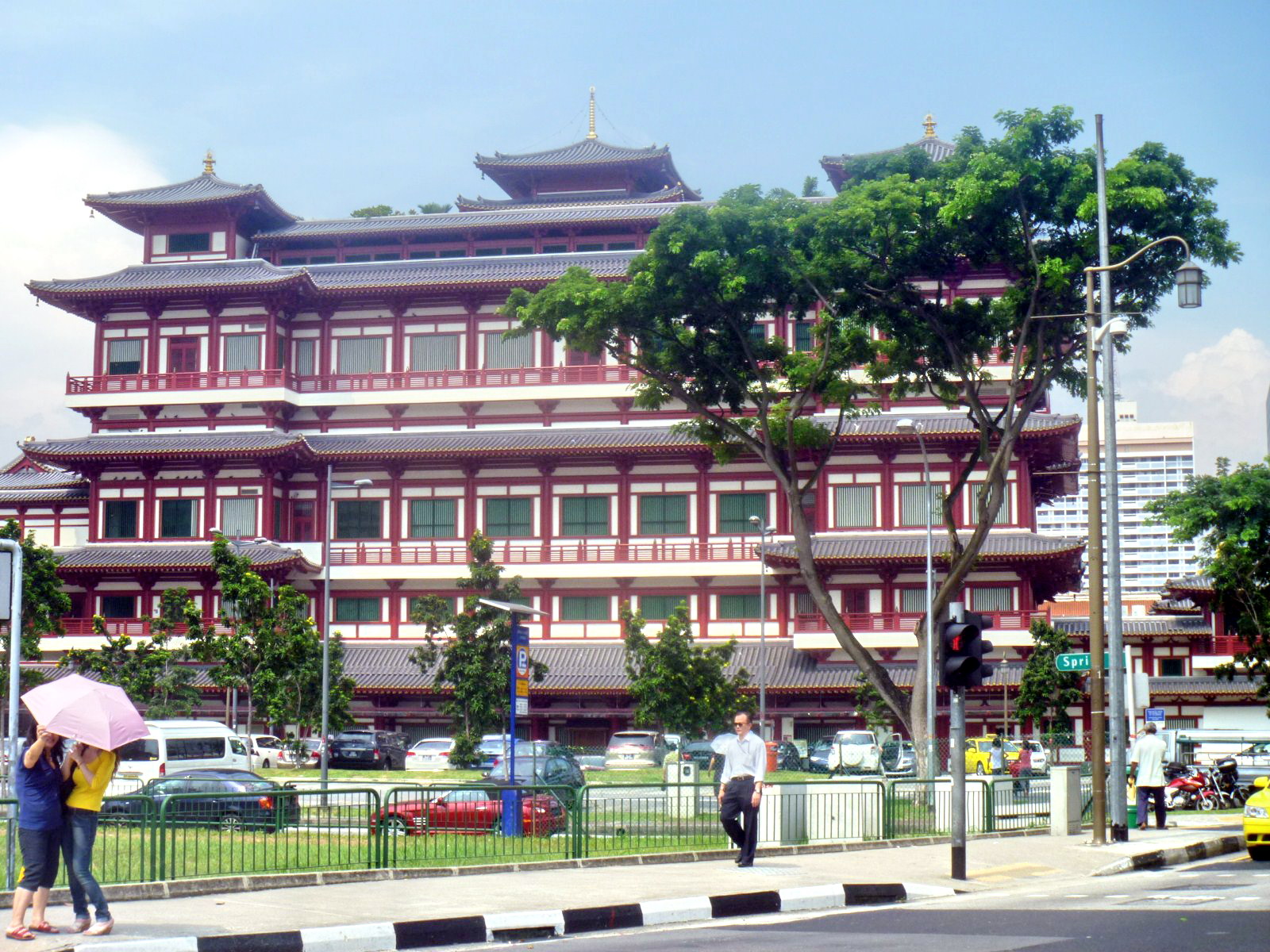
Jandy and I first visited the Buddha Tooth Relic Temple and Museum. This S$62 million temple, its architectural style based on the Tang Dynasty, was built in 2007 to house the tooth relic of the historical Buddha found in 1980 in a collapsed stupa in Myanmar.

Buddha Tooth Relic Temple and Museum

Sri Mariamman Temple, with its landmark ornamental tower entrance (gopuram), is the oldest Hindu temple in Singapore.  More popularly known as Mariamman Kovil or Kling Street Temple, it was first built in 1827 by immigrants from the Nagapatnam and Cuddalore districts of South India.  However, unlike my first visit here in 1992, I wasn’t allowed to take pictures inside.

Sri Mariamman Temple

In 1843, the temple was rebuilt in plaster and brick and, in 1962, a new temple structure with intricate sculptural works reminiscent of temple architecture in India was built. The original gopuram, built in the late 1800’s, was rebuilt in the 1930s and, in the 1960s, was repaired and restored with elaborate proliferation of sculptures.

Jamae Mosque

The nearby Jamae Mosque, on the other hand, was built in 1826 by the Chulias (Tamil Muslims). Its unique architectural style is eclectic. The entrance gate is distinctively South Indian while the 2 prayer halls and the shrine are in the Neo-Classical style typical of George Drumgoole Coleman. The mosque was gazetted a National Monument on 29 November 1974.

Chinatown Heritage Center

Kreta Ayer, considered by many to be the heart of Chinatown, houses the Chinatown Heritage Center, Chinatown Night Market and Chinatown Food Street.  The newly-restored Chinatown Heritage Center, occupying 3 shophouses along Pagoda St.,  houses memories and untold stories of Singapore’s early forefathers. The Chinatown Complex, along Smith Street, houses a wet market and shops selling sundry goods. At its second floor food center, Jandy and I indulged in some authentic Singaporean hawker food fare for lunch.

Trengganu Street

Shophouses do not have a single classification, combining different elements of Baroque and Victorian architecture with narrow wooden jalousies (often with adjustable slats) and decorative fanlights over the windows and pilasters, balconies and plasterwork seemingly Mediterranean in flavor.  Many of them are painted in a variety of different pastel colors. Trengganu St. (converted into a pedestrian mall transformed into a night market after dark), Pagoda St. and Temple St. as well as development in Upper Cross St. and the houses along Club St. are examples of this type of architecture.

Buddha Tooth Relic Temple and Museum: 288 South Bridge Rd., Singapore 058840. Tel: 6220 0220. Fax: 6220 1261. Open daily, 7 AM-7 PM.  E-mail: services@btrts.org.sg.  Website: www.btrts.org.sq.

Tanjong Pagar Conservation District (Singapore)

After a Big Mac lunch at a nearby MacDonald’s outlet and a short nap at our hotel room, Jandy and I started our own walking tour of the city. The Amara Hotel Singapore was within walking distance to the Tanjong Pagar Conservation District, along the fringes of Chinatown and Raffles Place.  Characterized by soaring skyscrapers and rows of exquisitely preserved pre-World War II shophouses, it is bounded by Neil Rd., Maxwell Rd., Peck Seah St., Wallich St., Tanjong Pagar Rd. and Craig Rd..  This was first in our itinerary.

Tanjong Pagar Street

This historic district was formerly a Malay fishing village and, from the mid 19th century, an enclave for thousands of immigrant Chinese  and Indian dock workers (Tanjong Pagar was where Singapore’s waterfront used to be before reclamation). It was also once the lucrative center of operations for rickshaw pullers awaiting clients and their presence was so prevalent that, in 1904, the government established a Jinricksha Station, Singapore’s last reminder of the once ubiquitous rickshaw, at the junction of Tanjong Pagar Rd. and Neil Rd..

Jinricksha Station

On July 7, 1989, Tanjong Pagar became the first area to be gazetted under the Singapore government’s conservation plan. Many of the area’s more than 200 2 and 3-storey shophouses of the Early, Transitional and Late Shophouse Styles, built between 1870 and 1940, were beautifully restored to their original appearance. Today, it has become a fashionable district, her rows of shophouses filled with thriving businesses such as cafes, bars, a large number of bridal saloons and restaurants.

Duxton Hill

The slopes of Duxton Hill was the site of a 13-hectare nutmeg plantation owned by Dr. J.W. Montgomerie (1797–1856), who was an Assistant Surgeon in the service of the Government.  Upon his death, the land was auctioned off and 14 acres went to Syed Abdullah bin Omar Aljunied, an Arab who divided them into 4 lots which were leased to wealthy Straits Chinese developers who, by the 1890s, had built 2 and 3-storey shophouses.

Shophouse Windows

The earlier shophouses, of Chinese design, feature low, squat proportions and minimal ornamentation while later ones combined colonial and ethnic elements such as Chinese panel frescoes and Malay timber fretwork.

Panumpaang Bayan (Tanza, Cavite)

From the Tejeros Convention Site in Rosario, Jandy and I were back on the road again, this time proceeding to the next historical town of Tanza and on to its church and convent.  Over a hundred years ago, Gen. Emilio Aguinaldo also followed our lead, proceeding, after his election as President of the revolutionary government in Tejeros, the day before, to the hall of the town’s 2-storey parish convent (now called the Panumpaang Bayan or Oath Taking Hall), built in the 1860s.

Parish Convent Hall (Panumpaang Bayan)

Here, around 8 PM on March 23, 1897, Gen. Aguinaldo and Gen. Mariano Trias took their oath of office in a solemn ritual, before Fr. Cenon Villafranca, as President and Vice-President, respectively, of the revolutionary government that replaced the Katipunan.  The next day, around 1 AM, Pascual Alvarez (as Director of the Interior), Severino de las Alas (as Director of Justice), Emiliano Riego de Dios (as Director of War) and the reluctant Artemio Ricarte* (as Captain-General or General-in-Chief), one by one, also took their oath of office.  The first cabinet meeting also took place here.

*It was said that Ricarte was forced to take his oath of office so that he could leave the place unmolested.  In fact, he signed a protest regarding this, stating that he could not accept the position of Captain-General because the election in Tejeros (Rosario, Cavite) did not reflect the real “will of the people” and that he took his oath because he feared for his life.

AUTHOR’S NOTES

In 2012, the renovation of the convent was started and, on March 23, 2014 (the 117th anniversary of the oath taking), its second floor was inaugurated as the Sta. Cruz Convent Museum.  It now houses historical memorabilia, the black flag used by Gen. Mariano Llanera, paintings that depict the history and arts of Tanza, antique furniture and life size diorama depicting the “Oath in Tanza.” It is open Tuesdays to Sundays, 8 AM to 5 PM. Admission is free.

Panumpaang Bayan: Brgy. Poblacion 1, Tanza.

Home of Another Aguinaldo (Kawit, Cavite)

After my visit to the Aguinaldo Shrine, Jandy and I returned to our car and retraced our way back to Brgy. Binakayan, also within Kawit, this time in search of the home of where Baldomero Aguinaldo (February 26, 1869-February 14, 1915), Emilio Aguinaldo’s first cousin, lived as an adult.

Check out “Aguinaldo Shrine” and “Liwasang Emilio Aguinaldo

Baldomero was also a lieutenant-general during the Philippine Revolution (he figured in the battles of Binakayan-Dalahican, Noveleta, Zapote River, Salitran and Alapan), Emilio’s right-hand man and a member of the latter’s cabinet (Auditor General, Director of Finance, Secretary of the Treasury, Auditor of War and Secretary of War and Public Works).  He also helped draft and signed the Constitution of Biak-na-Bato. During the Philippine-American War, he returned to the battlefield as commanding general of the Southern Luzon provinces.

Baldomero Aguinaldo Shrine

Built with narra and molave wood in 1906 and now painted in pastel blue and white, this typical 2-storey country home of a gentleman farmer was turned over by his grandson, former Prime Minister Cesar E.A. Virata (who also happens to be the father of my U.P. classmate Steven) to the Philippine government in 1982. This shrine has a museum on the ground floor with a diorama of the Battle of Binakayan.  On the second floor are antique furniture such as a turn-of-the-century upright piano.  Opposite the house is the former kamalig (storage shed for produce), now a museum showcasing Cavite’s role in the revolution.  On the walls are photographs and drawings of Cavite’s military heroes.

Behind the house, in a quiet corner, is the family plot where Baldomero, his wife (Petrona Fauni Reyes-Aguinaldo), their 2 children (Leonor and Aureliano) and their spouses (Dr. Enrique T. Virata and Liwanag Virata) are all buried.  The shrine is now administered and managed by the National Historical Institute (NHI) which installed a historical marker here on June 12, 1983.

NHI Historical Marker
Baldomero Aguinaldo Shrine: Brgy. Binakayan, Kawit, Cavite.  Open Tuesdays to Saturdays, 8 AM to 4 PM.  Admission is free.  Lectures and guiding service can be arranged.

Ganduyan Museum Tour with Ms. Christina Aben (Sagada, Mountain Province)

Ganduyan Museum

Jandy and I were now on our third and final day in Sagada and we still had time to kill before leaving on the 10 AM G.L. bus.  After a Filipino breakfast at Ganduyan Inn’s cafe, we decided to visit the next door Ganduyan Museum, managed by Marina Biag’s mom Ms. Christina Aben.   Since the early 1970s, Ms. Aben has amassed a spectacular and meticulous collection of tribal artifacts with a passionate curator’s eye for quality and rarity, all detailing the rich but vanishing Cordillera Igorot culture.  Wishing to share her passion for unique Igorot art and culture with the world, she placed them all in a one-room, second floor museum which she opened in 1984. Because of the museum’s limited space,  Ms. Aben, with a designer’s eye for presentation, carefully chooses what to display and how to display it.

Ms. Christina Aben

The museum closed down in 1986 and it remained so when Jandy and I first visited Sagada in 1998.  It was open that morning and we were personally met by Ms. Aben who escorted us up the stairs to the museum, removing our shoes first at the stair’s foot before going up.  She’s a cancer survivor and a housewife with a high school education who speaks impeccable English. Ms Aben is also an enthusiastic, erudite and well-informed hostess who loves to share the meaning and importance of every museum piece to anyone willing to listen.

Ganduyan Museum – Display

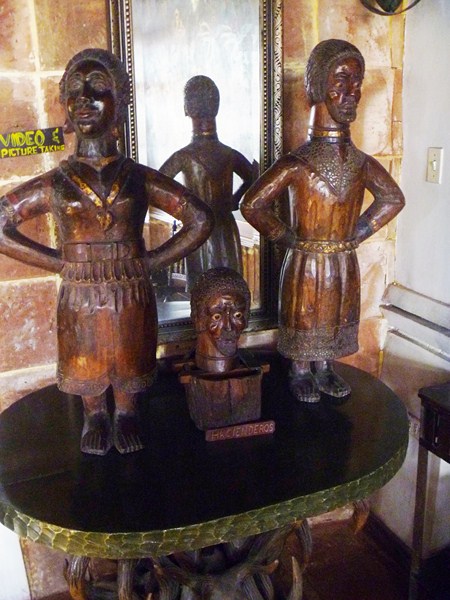
The museum was a veritable treasure trove of antique basketry, weapons, farm tools, trade beads, jars, wooden items and textiles from the Cordillera region, all offering an insight into the rich culture of the Cordillera Igorots.  Ms. Aben gladly explained the history and significance of each individual item on display, starting with her trade bead collection which came at a time when the Igorots traded with the Chinese, Indians, Arabs and other foreigners from the lowlands.   Beads include alligator teeth and mother-of-pearl shells not found in the Cordilleras.  Beaded necklaces from different tribal groups of the Cordilleras (Kalinga, Nabaloi, Ifugao or Igorot)have beading patterns that differ from one ethnic tribe to another.

Ganduyan Museum – Display

We next moved on to the men’s accessories section.  These include a money belt, a warrior’s purse,  pipes, caps (used as pillow and water cup), woven g-strings, anklets, armlets, spoons and amulets (including a snake vertebra believed to increase the warrior’s physical and internal prowess). Drinking  cups for wine, both for men and women, vary in size and kind. Igorots treated status with utmost importance, from clothing (the rich could wear clothes that the poor could not), kitchenware (made from wood,  metal and, sometimes, animal bone, all  classified by social class) and even in death.  Doors, scarves, table runners, warrior’s shields and other accessories are decorated with the lizard (or gecko), animals said to bring luck and longevity.  The many weapons of head hunters of the Cordilleras on display include shields with concave ends (meant to trap the enemy at the neck before the warrior goes for the kill and chops the head off).

Ganduyan Museum: Poblacion, Sagada, Mountain Province.  Open daily, 8 AM-7 PM.  Admission: PhP25.

Back to Sagada (Mountain Province)

Ganduyan Inn

It was raining during more than half of our 6.5-hr.  trip from Baguio City to Sagada and it was still raining when our bus arrived at Sagada by 6:30 PM.  From the bus stop, Jandy and I ran towards the accommodation  nearest the bus stop – the 3-storey Ganduyan Inn.

This wasn’t our first time to stay here, having been here 13 years ago (in 1998).  Back then, we stayed in a spartan room without private bath (PhP75 per head).  The common baths then had no hot water.  Still managing the inn were Marina and Hanzel Biag.  This time, Jandy and I stayed in a slightly bigger (though still spartan) room with twin beds and a private bath with hot water (PhP750 per day).

Twin room with private bath

Since the inn’s coffee shop didn’t offer dinner (they only serve breakfast), Jandy and I walked to the basement of the nearby Edward Longid Centrum, an Episcopalian church-raised commercial building inaugurated last January 25, 2010, where we had a delicious dinner of pork asado and roast chicken plus a cup of Sagada’s signature brewed coffee at Cuisina Igorota.

The basement also has 2 other local restaurants (Dap-Ayan Sagada and 7J’s Diner & Snack Haus), all offering various local cuisine at a very cheap price. The town’s pharmacy is also located at the second floor of the building.

Edward Longid Centrum


Ganduyan Inn
: Poblacion, Sagada, Mountain Province.  Mobile number: (0921) 273-8097 (Smart) and (0927) 434-0212 (Globe).  E-mail : ganduyan_inn@yahoo.com.

Home of "The Other Rizal" (Los Banos, Laguna)

The Paciano Rizal Shrine

My next stop in my Laguna (Calamba City to Sta. Cruz) joy ride with my son Jandy was the charming resort town of Los Banos.  The town is famous for its hot medicinal sulfur springs that flow from the foot of Mt. Makiling and its present name is derived from the Spanish word for “The Baths.” These thermal springs were discovered in 1590 by Franciscan martyr St. Peter Baptist (San Pedro Bautista).   Today, most of the sulfur springs are piped into the pools and baths of the many hot spring resorts that line the National Highway.  This is the Los Banos that most people know and not many people know this town’s association with “the other Rizal.”

The old Los Banos Municipal Hall

To find out, I parked my Toyota Revo at the old municipal hall (a new one is being built along the National Highway).  Beside the town’s fire station is the inconspicuous retirement home of Paciano Mercado Rizal, Jose Rizal‘s elder (and only) brother who was also a revolutionary general (he led the defense of Laguna) and Emilio Aguinaldo‘s first Minister of Finance.  Though not as popular as the Jose Rizal Shrine in Calamba, this shrine, jutting out to Laguna de Bay, was built atop a hot spring in 1927 by Andres Luna de San Pedro (son of master painter Juan Luna) when Paciano’s original nipa hut was destroyed in a typhoon in 1926.

The back of the house

Rizal lived here, as a gentleman-farmer, with 2 helpers (with occasional visits from his grandsons, from daughter Emiliana, Franz and Edmundo), until his death from tuberculosis on April 30, 1930.  First buried in Manila North Cemetery, his remains were later transferred here, with full military honors, in 1985.  A historical marker was installed here on April 13, 1983 and the house was declared as a National Historical Shrine by the National Historical Institute on July 31, 1992.

Laguna de Bay

This modest American-style, one-bedroom bungalow was turned into a Japanese garrison during World War II, resulting in the loss of much of Paciano’s personal effects. Still around are some photos of his grandchildren, binoculars he used during the revolution, a pair of his shoes and a Quiroga bed.  Rizal’s spinster sisters Josefa and Trinidad are also buried in the sprawling garden which has a bronze statue of Paciano Rizal, on a pedestal, in his general’s uniform.  The shrine has a view of Talim Island. At the back of the house is the Paciano Rizal Park.

A Walking Tour of Mauban (Quezon)

The Municipal Hall

We finally arrived at Mauban, at the midst of its Maubanog Festival, by 4 PM and we made a stopover at the municipal hall were we all dropped by the Municipal Tourism Office and paid a courtesy call on Mayor Fernando Q. Llamas, the uncle of our good friend Lee Llamas.  Prominently displayed outside the municipal hall is an old cannon, 1 of 3 (the other 2 are at the Museo ng Mauban) bestowed by Spanish Gov.-Gen. Rafael Maria Aguilar to the town as a reward for the rescue efforts done for the Spanish friars captured by Moro pirates. The cannon were later used against the Spanish to effect the surrender of Tayabas to the revolutionaries in 1898.  All 3 were  restored on April 16, 2004.  

Traditional Mauban products

After our courtesy call on the Mayor, we  all dropped by the Mauban Product Development Office, beside the municipal hall, to check out the town’s traditional products such as finely-crafted nilala woven hats, baskets, slippers, wallets, bags, boxes, caddies, etc.;  delicacies such as pinangat, binalawan, pinais, tikoy, kalamay, pastillas, botarts, mazapan, suspiro, etc.; and nipanog, wine made with sasa (toddy palm nectar) instead of coconut and available in different flavors such as liputi, katmon, guyabano, mango, pineapple, guava, jackfruit, kalamias, tamarind and santol. Being a fiesta, booths selling these products, and more, were found in front of the municipal hall as well as along the major streets. 

Church of St. Bonaventure

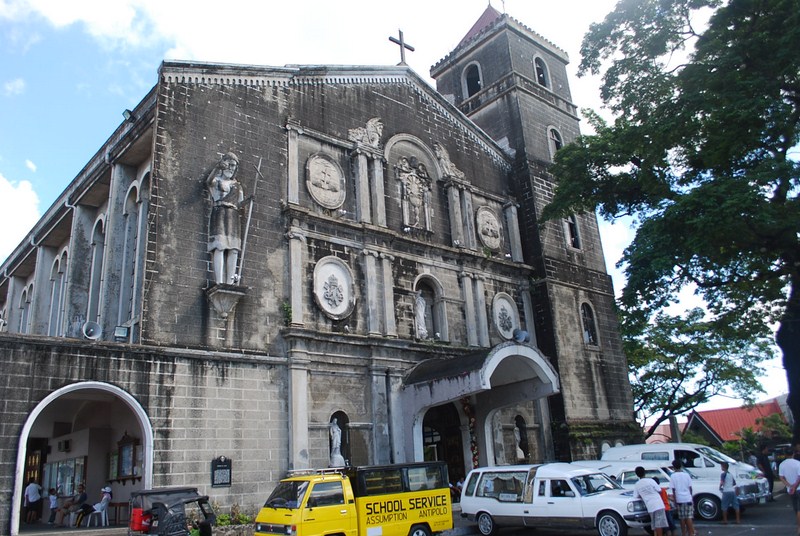
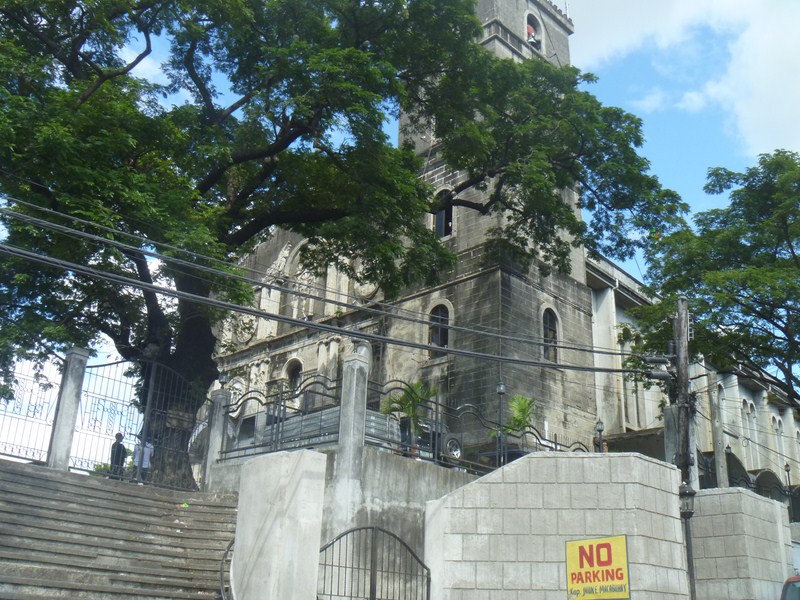
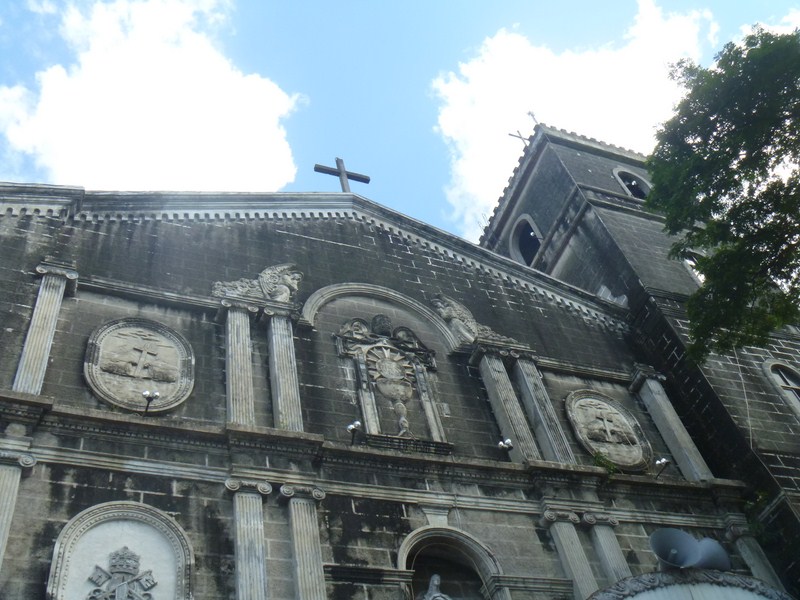
While they were checking out the products, I took time out to visit the town’s present, modern Church of St. Bonaventure (the town’s patron saint).   This church underwent a lot of rebuilding since it was first built in 1647 and demolished in 1769.  The second structure, built in 1773, was badly damaged during the 1830 earthquake and rebuilt between 1836 and 1845.  The church collapsed during the July 1880 earthquake and the present church was built in 1891.  The bell tower, built in 1773, was seriously damaged during the 1880 earthquake and the portion that remained was partially destroyed again during the August 20, 1937 earthquake. 

Gat Uban Park

With the sun still up, we still had time to make a walking tour to Gat Uban Park, at the end of Gomez St., along the sea wall.  The park has a seaward facing statue the legendary Dumagat warrior and leader Gat Pangil who defended the town against ruthless Moro attacks.  Gat Pangil was also known as Gat Uban because of his gray hair (uban).  Accordingly, the town was named after the fact.  The well-lighted promenade area, with its gentle sea breeze, is a favorite meeting place for Maubanons. 

View from Rizal Hill Park

It was near sunset when we dropped by Rizal Hill Park (locally called Calvario Hill), along San Buenaventura St. in Brgy. Rizaliana.  To get to the top, we had a  choice of taking the shorter route (climbing a steep concrete stairway) or the longer route via a winding ramp skirting the hill.  Of course, we chose the latter.  At the top of the hill is a statue of National Hero Jose Rizal, erected on December 1912 by the Mauban Circle Association of Students.  The  park offers a panoramic view of the whole town.  In olden times, the hill was used as a sentinel post and a place for religious activities during the Spanish era, as headquarters by American troops, as an outpost by the Philippine Constabulary during the Japanese Occupation and, after the war, by the Civilian Emergency Administration.

Rizal Hill Park

Soon after our arrival,  Mr. Ludovico Badoy and Ms. Carminda R. Arevalo, Executive Director  and Officer-in-Charge (NHCP Research, Publications and Heraldry Division), respectively, of the National Historical Commission of the Philippines (NHCP), formerly the National Historical Institute (NHI), also arrived.  They supervised the installation of a historical marker recognizing the hill for its historical significance.  The marker was to be unveiled the next day, with Mayor Llamas and Mr. Badoy leading the ceremony.  It was now evening when we left the hill and, after dinner at the house of Mayor Llamas, we were billeted for the night at the nearby Llamas ancestral house.

Municipal Tourism Office – Municipal Hall, Poblacion, Mauban, Quezon.  Tel: (042) 784-1205 and 713-0314.  E-mail: gat_uban@yahoo.com.