The Moriones of Marinduque

At Boac Park, we had our first encounter with Marinduque’s signature Moriones Festival.  This religious melodrama, held here and in the nearby towns of Gasan and Mogpog, is the province’s main tourist attraction and  is based on the legend of the blind Roman centurion, Longinus.  Unusual for a Lenten festival, Longinus, not Jesus, is the focus of the week-long Moriones passion play. 

According to an often told legend, Longinus (or Longhino in Tagalog), who is blind in the left eye, was the Roman captain who pierced the heart of Jesus to ensure that He was already dead.  As he pierced the torso of the crucified Jesus with his spear, blood from the wound spurted into his blind left eye, miraculously curing his blindness.  While guarding Christ’s tomb, he also witnessed His resurrection.  From then on, he attained faith and goes around town spreading the news of Christ’s divinity and the testimony of the miraculous healing of his blindness.  The Roman authorities found his testimony seditious and ordered his immediate arrest.  Longinus is forced to flee but, after long searches, is captured not once, but thrice, escaping each time.  He is finally captured, for the fourth time, on Easter Sunday, brought before Pontius Pilate, tried and then executed by beheading. 

The passion play’s origin is uncertain.  Some say it originated from Mexico, being brought here in 1870 by Jesuit Mexican priest Fr. Pedro Santiago to dramatize the power of the Christian faith and to attract the rural population from the interior to participate and be converted to Christianity.  Mompog also   prides itself with being the origin of the Moriones Festival (as well as the Tubunganceremony).  However, the festival is also said to have originated from the town of Gen. Luna in Quezon, located 240 kilometers from Manila and 103.34 kilometers from Lucena City.  Even today, the town reenacts the Centurion at ang Bahay na Kubol during Holy Week with Lenten parades of senturyons and a reenactment of the 14 Stations of the Cross.   

The park was teeming withe the festival’s main characters, the moriones (the word morion relates to the centurion’s helmet, mask or visor).  They wear ingeniously outlandish, homemade Roman soldier costumes (close-fitting jackets, feathered helmets, thong sandals and capes).  The fantastic helmets are decorated with colored paper and tinsel flowers.  The colorful but grotesque masks are carved from a light native wood called dapdap and painted with faces that are neither good or kind-looking.  Longinus’ mask is the one with the blind left eye.  These “Roman” soldiers, mostly antipos (penitents atoning for sins or persons giving thanks for answered prayers, good harvest or cured illnesses) accompany Jesus on the way to his crucifixion.  Longinus is usually played by an old but nevertheless  strong man.
 
At the park, we gamely posed with a number of these moriones.  Other “Roman” soldiers were roaming the streets, beating indigenous kulatangs and chasing or scaring onlookers by thrusting their swords and spears, an act believed to drive away evil spirits.  They also play pranks on people, sing to the ladies or even engage in mock duels with their swords.  Some were riding Roman chariots.
 
Jandy takes a chariot ride

At the park gymnasium, Cheska, Jowel and Yor also joined a “Maskara Mo, Kulayan Mo!”mask painting contest.  Cheska was later informed, by text, that she was among the winners chosen.

Cheska and Jowel with their finished masks
 

A Unique Ivatan Feast (Batanes)

Back at the town proper, I was invited by Mayor Caballero to join Gov. Gato, Cong. Abad and his other esteemed guests in a true Ivatan feast at the municipal hall.  The Ivatan fare spread before us, though simple, was hearty, filling, ingenious and nutritious, using  ingredients that are rich and unusual. Its taste and texture distinguishes it from the country’s other regional cuisines.

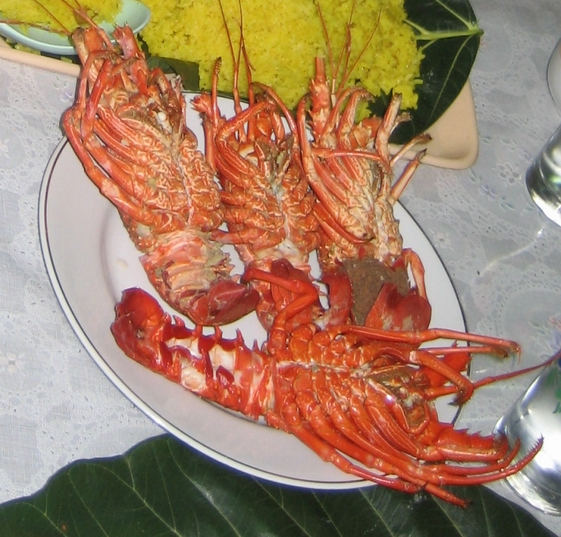
Spiny lobster (payi)

The prepared fare consisted spiny lobster (locally called payi, here I got it at just PhP250/kilo), tasty steamed coconut crabs (tatus), flying fish (dibang, plentiful from January to June), Spanish mackerel (tanigi) and the local meatball dish called tabtab (called uvud in Mahatao).

Uved

Uved, a staple food in every Ivatan’s dining table, is a mixture of the minced or finely grated core of the banana stalk pith (the big rhizome), ground pork or beef, minced bits of deboned dibang or tanigi, sweet potatoes, ube, some pig’s blood and other rootcrops, seasoned with local herbs, garlic, onions salt and pepper, molded into small balls, steamed and then served with a salad of tomato, onions and seaweed. 

Yellow rice on kab”baya leaf

Instead of the usual white rice, we were served fragrant, delicious supasvery sticky cooked yellow rice colored and flavored with and extract of yellow ginger or turmeric (locally called nihaman). Instead of plates, we ate this unique fare on the green leaves of a local breadfruit tree called kab’baya

Florestida Estrella and the House of Dakay (Ivana, Batanes)

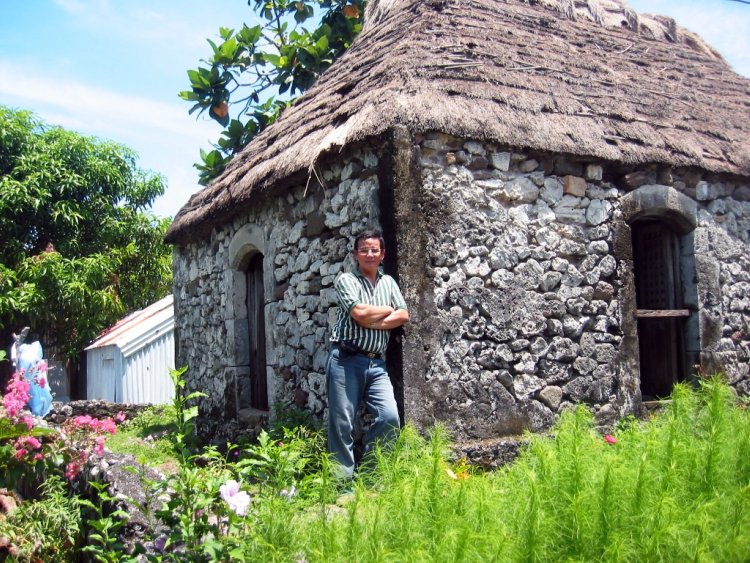
Posing beside the House of Dakay

During my 1.5-hr. tour of Batan Island with my 2 guides Ms. Joy Gabaldon and Mr. Jose “Boging” Astudillo and Toyota Revo driver Mr. Luciano “Anong” de Guzman, we passed by many of the Ivatan’s small, quaint, squat and low but ingeniously designed and typhoon-resistant houses, liken to those in the Scottish Highlands or France’s Provencal region. Locally called sinandumparan, these squat, low, solid stone and lime cottages are found all over the province and nowhere else in the country, as the lowland bahay kubo simply could not survive the harsh Batanes environment.

Ivana

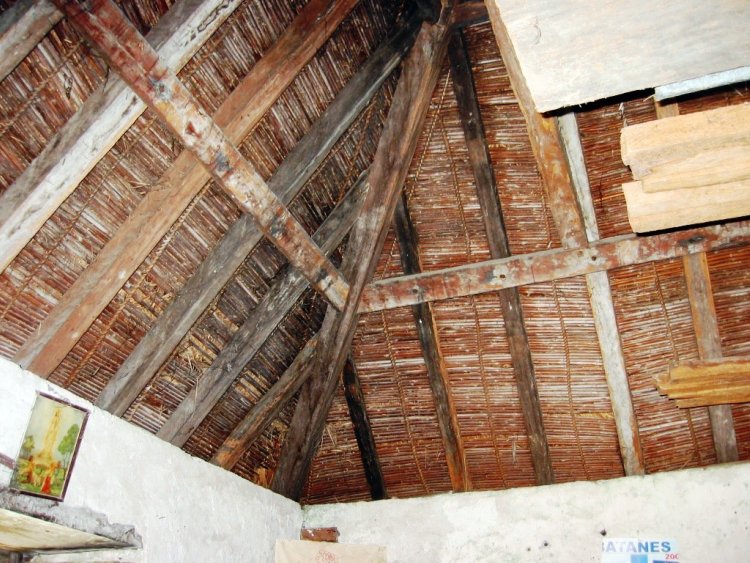
First built around 1795 by imported stonecutters, masons and carpenters from Cagayan, they have meter-thick lime and stone walls (sometimes with wood reinforcement for earthquake resistance), are built directly to the ground and are laid out on narrow, cobbled streets that follow the contour of the land.  They are cool during the warm season and warm in the cold months.  The gabled roofs have foot-thick cogon (which keeps the house cool in the hottest weather) tightly bound and woven together to make it water proof and fastened with reeds to sturdy wooden rafters.  The roof is held down by a panpet (a thick rope roof net) fastened to strong pegs on large, half-buried stones. The small, narrow door faces the east or northeast, away from the worst typhoon winds.  The tiny, square windows are located on three walls only.  The wall that doesn’t have it faces the direction of the strongest winds during typhoons.

Sinandumparan ceiling

We made one long stopover at one such house, the Vahay ni Dakay (House of Dakay).  The oldest sinandumparan in Batanes, it is included on the UNESCO Heritage Building list and expected for grading.  Now resided in by octogenarian Florestida Estrella, it was built in 1887 by Elena Estrella, cobbled together with corals washed from the shore and stones that are abundant in the coastal town of Ivana.  Elena later bequeathed it to her nephew Jose Dacay (Florestida’s grandfather).  This traditional house withstood the September 13, 1918 (one of only 5 houses that survived in Ivana) and the July 16, 2000 (magnitude 7) earthquakes.

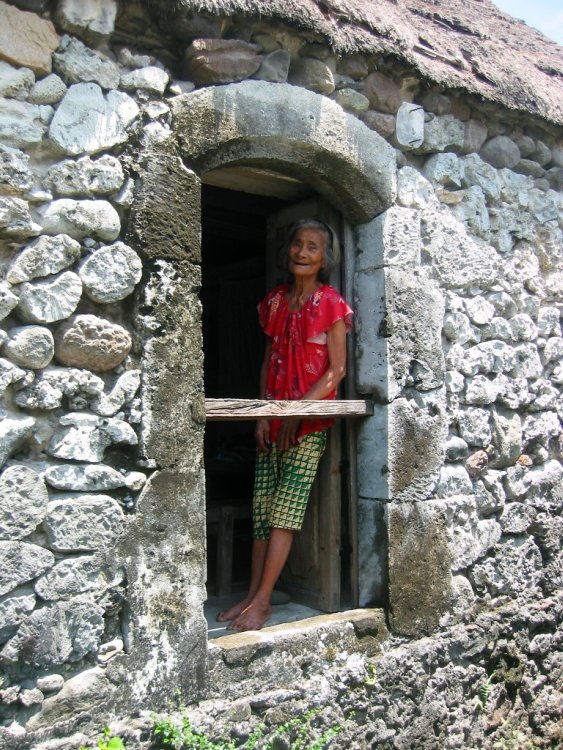
Lola Ida

The friendly Florestida, fondly called Lola Ida, has an easy smile and weather-beaten face.  She was formerly only used to a quiet village existence. During the early years, her family moved the Visayas, returning to the area when she was 12.  She had stayed ever since, never marrying and many of her childhood friends have since died. Now, her tiny world has been opened to many foreign (including Australians and Canadians) and local tourists who give her donations and take her picture (she is the most photographed Ivatan in Batanes), making her the subject of many articles, postcards and promotional calendars. These same tourists also urge authorities to help preserve her house. Lola Ida keeps a blue logbook containing the names of visitors (mine now included) over the past years.  Like Lola Ida, the Ivatan’s tiny world may soon be open to tourism.  Let’s just hope it doesn’t destroy the very character that made it known in the first place.

The Pintados-Kasadyaan Festival (Tacloban City, Leyte)

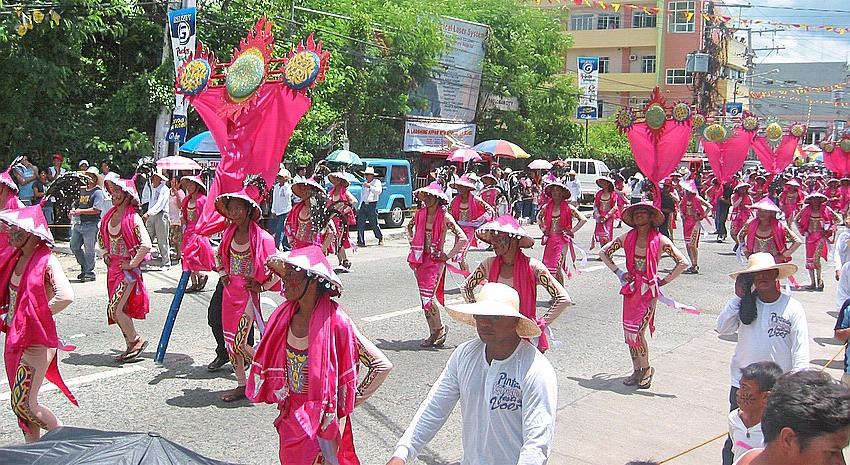
While Charlie was still recuperating from a bout of flu (and avoid catching it) at Sabin Resort in Ormoc City, I left, via van, for the 2-hr. trip for Tacloban City.  My timing was perfect as the city was holding its Pintados-Kasadyaan Festival, the biggest and most colorful festival in the Eastern Visayas Region.  Heldon June 29,  it features street pageantry of ethnic dancing to the rhythm of bamboo sticks and a contest focusing on the Leyteños’ old custom of tattooing that signifies courage and status in the community which earned for the Leyteños the name of pintados.

Instigated by former Leyte Gov. Remedios Loreto-Petilla, this cultural-religious festival was first held on May 12, 1996 and it was only in 1999 that it was fixed to June 29, the Feast of the Señor Sto. Niño de Leyte.   It showcases the rich cultural heritage of the Leytenos and Samarenos, incorporating indigenous music and dances.The Kasadya-an (Visayan word meaning “merriment and gaiety“) Festival, on the other hand, showcases the unique culture and colorful history of the province of Leyte.

Miss Pintados 2005 Leslie B. Montano

I was staying at my brother-in-law Manny’s house along Avenida Veteranos which happened to be along the route where the grand street dancing parade would pass, thus giving me a ringside view of the various congregations showcasing the various municipal festivals of Leyte and the neighboring Samar and Biliran provinces via a colorful and vibrant dance-drama parade.  The Alikaraw Festival contingent of Hilongos was adjudged as the street dance champion.  Other floats, including one carrying Ms. Leslie B. Montano (Miss Pintados 2005), joined the parade.  She was crowned just the night before at the city’s Human Resources and Development Center (HRDC).

Stopover at Carcar City (Cebu)

The cake-like kiosk

Another long stopover, for merienda, was made at a Jollibee in the  junction town of Carcar, 40.3 kms. (a 1-hour drive) from Cebu City. It just rained, but this didn’t stop me from exploring Cebu’s version of a “heritage town” in detail. Just outside, a wonderful round kiosk from the American era greeted me, valiantly standing proud, amid large offending billboards, at the center of the Carcar Rotunda. It is one of the best surviving examples of its genre in the country.Carcaranons engage in blacksmithing and the making of footwear and native delicacies such as ampao (sweetened and crispy rice crunchies), bucarillo (colored coconut candy) and chicharon (pork skin cracklings). Tacoy (sweet pomelos) are also grown here.

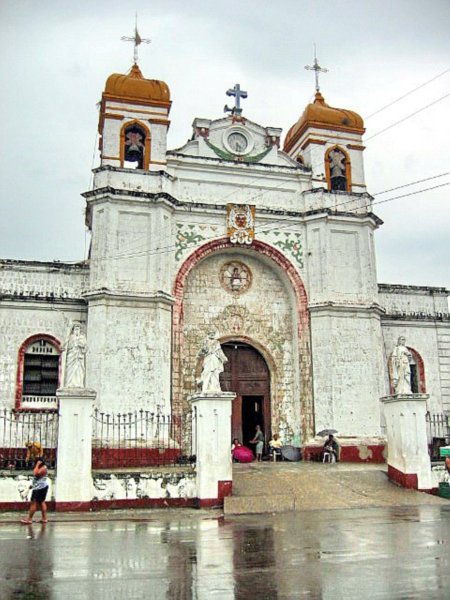
Church of St. Catherine of Alexandria

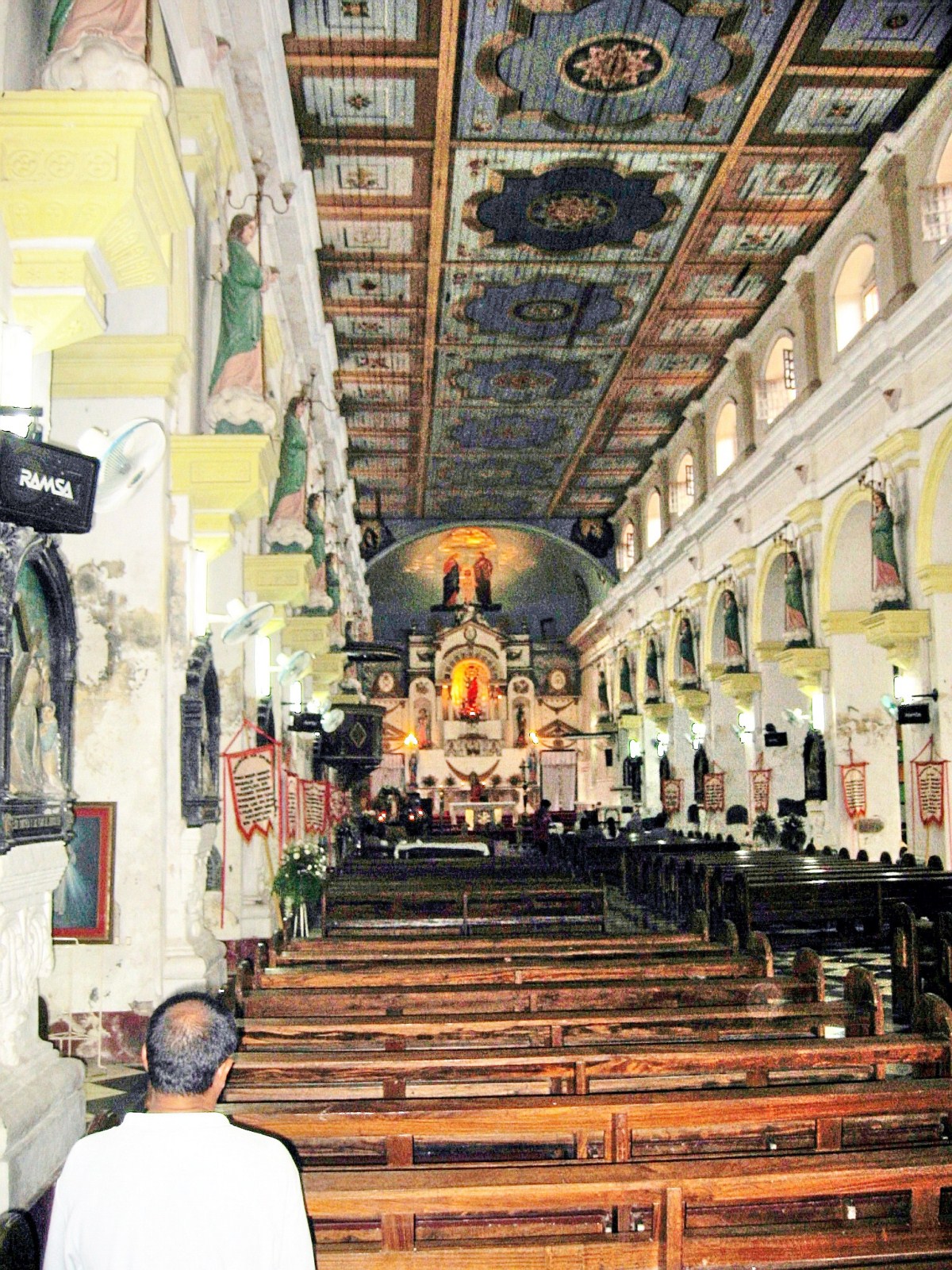
The town’s affluence during the Spanish colonial era is still evident in its sprawling plaza and its surviving large and small intricately decorated antique manors. Carcar is noted for its striking examples of preserved colonial architecture, both from the Spanish and American eras. The most notable structure is the Church of St. Catherine of Alexandria.

Church interior

Its lovely and massive Graeco-Tuscan façade has a strong Muslim influence as seen from its double recessed arched main entrance (similar to an iwan of a Middle Eastern mosque).

The church patio, surrounded by a low fence of coral stone and wrought iron, has statues of the 12 Apostles, all painted white, except for that of Judas (standing all alone on a pedestal in front of the convent), which is painted black.

St. Catherine’s Dispensary

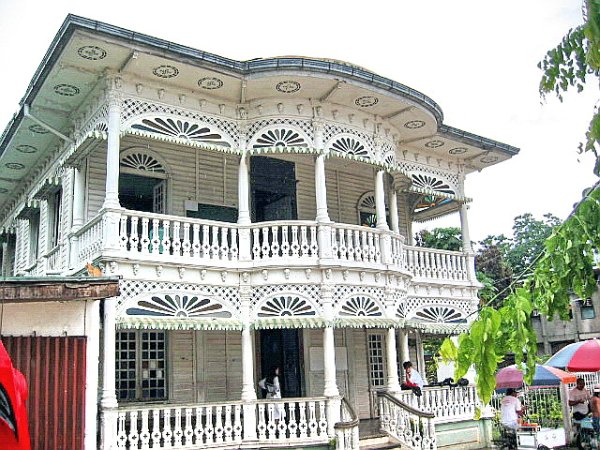
On the same hill as the Church are the American-era Carcar Dispensary and St. Catherine’s Academy (founded in 1923). The façades of both are decorated with carved wooden gingerbread fretwork, cut out in the manner of Victorian houses and all looking as delicate as fragile heirloom lace that could flutter even with a slight breeze. At the foot of the hill is a small but imposing plaza decorated with statues.

Mercado Mansion

Within the town are 46 quaint and antique ancestral houses called balay na bato (stone houses), some decorated with intricate lacy (calado) woodwork from the 1920s. This calado architecture, prevalent in Carcar, is unsurpassed in the country. A number of old houses, some older than the church, are found at the foot of the hill.


Stopover: Church of Nuestra Señora Patrocinio de Maria (Boljo-on, Cebu)

Church of Nuestra Señora Patrocinio de Maria

Standing on a small plateau near the beach, this church was destroyed in a piratical raid in 1782. The present masonry church was started by Fr. Ambrosio Otero in 1783, continued by Fr. Manuel Cordero in 1794 and was finished by Fr. Julian Bermejo.

The convent

Fr. Bermejo also built a stone fence to enclose the church and convent.  An organ was installed on the choir loft in 1880.  The large convent and church were restored by Fr. Leandro Moran (parish priest from 1920 to 1948).

The church pilasters

The church has a main nave, a transept and is 65 m. long, 12 m. wide, 12 m. high and its walls are supported by 28 2-m. thick pilasters made with mortar and lime.  Their beautifully decorated and elegant interior has ornate, gilded, 18th century retablos with wooden railings with Chinese-inspired tracery.  The Pseudo-Baroque-Rococo communion rail, with ornate silverwork, has been stolen. The austere Classic facade has three levels, an elongated pediment and is decorated with bas reliefs and floral and geometric motifs.

The bell tower

The rectangular, fortress-like bell tower, built in 1701, has fort windows used to show cannons to defend against Moro pirates. The sound of its silver bells reached Oslob and Alcoy. But in 1802, they were stolen by Muslim hordes led by Datu Orendain (because of their weight, the Moro vinta sunk). Today it has 3 bells. The L-shaped convent, also built and finished in 1841, by Fr. Bermejo, still has its original tile roof.  Its ground floor now houses a museum.  Outside, at the epistle side of the church is an enclosed cemetery with an arched entrance.  An old school building, built in 1940, is now the Catholic Womens League (CWL) headquarters.

A blockhouse

This relatively well-preserved church is the oldest remaining original stone church in Cebu.  It is now listed by the National Museum  as a National Cultural Treasure.  In 1998, this church was declared for conservation and restoration and, in 1999, technical studies have been undertaken, with the help of the German government, to pursue conservation and restoration efforts.

Cebu Trail: Oslob to Carcar City

Looc Pier (Sibulan)

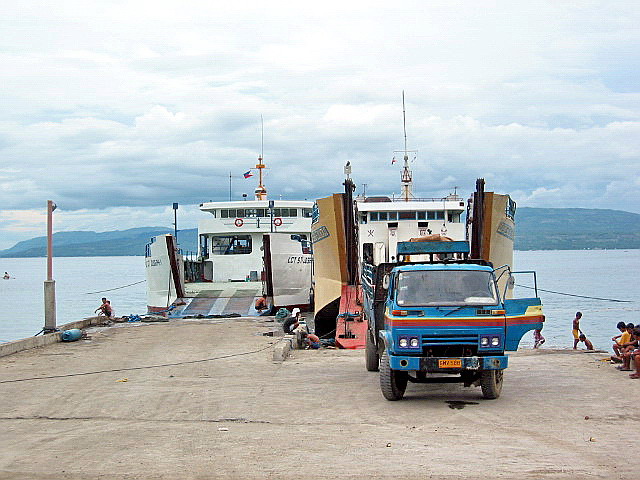
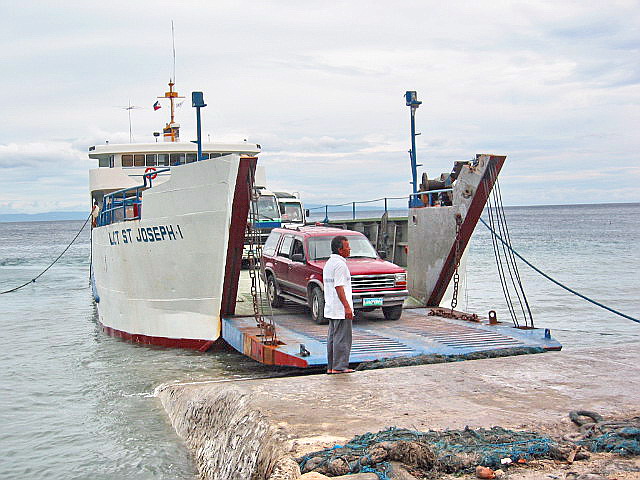
We left Dumaguete City (Negros Oriental) after lunch and drove our Ford Explorer 5.5 kms. north to Sibulan’s Looc Pier, where the M/T Joseph-1, a Roll-On Roll-Off ferry, would take us and the car over to Brgy. Mainit in Oslob, Cebu. The Explorer was the last to be loaded on board and the ship finally left Looc Port by 1:30 PM.

Our Ford Explorer disembarking from the M/T Joseph-1 at Mainit Port

The sea journey to Oslob (Cebu) was smooth all the way and, after less than an hour, our ship arrived at Mainit Port by 2:15 PM.  Being the last car loaded at Sibulan, our Ford Explorer was, conversely, the first one off the ship.

Church of Nuestra Señora Patrocinio de Maria (Boljo-on)

From thereon, with Charlie on the wheel, we would have to drive the remaining 132.5-kms. up to Cebu City but we did this at a leisurely pace.  Just 28 kms./45 mins. out of Oslob, we made a short 10-min. stopover (1 of 3 we made) at the Church of Nuestra Señora Patrocinio de Maria in Boljo-on along the highway and facing the beach. This relatively well-preserved church is the oldest remaining original stone church in Cebu.  It is now listed by the National Museum  as a National Cultural Treasure. The church was closed during our visit.

Check out “Church of Nuestra Señora Patrocinio de Maria

Church of Our Lady of the Pillar

Church of Our Lady of the Pillar (Sibonga)

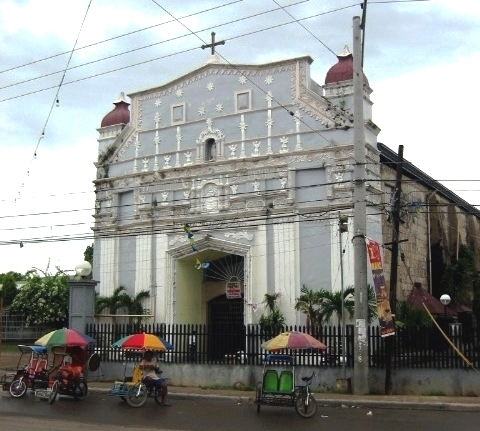
Continuing on for 45.5 kms., we made another stopover at the Church of Our Lady of the Pillar in Sibonga which had a simple and bare, Pseudo-Gothic façade.  Like the previous church, this too was closed and, thus, failed to see its wooden colonnade and a painted ceiling mural done by Raymundo Francia.

Check out “Church of Our Lady of the Pillar

San Isidro Labrador Church

Church of St. Isidore the Farmer (San Fernando)

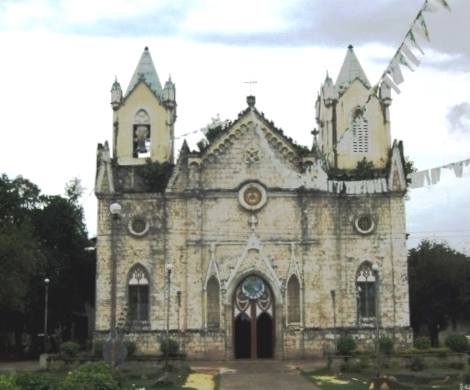
Along the way, prior to our arrival in Carcar, I also took quick exterior shots of the Gothic-style Church of St. Isidore the Farmer in San Fernando and the Church of St. Francis of Assisi (with its unusual façade, suggestive of Mexican art that is skillfully integrated into the local Filipino religious architecture) in Naga.

Check out “Church of St. Isidore the Farmer” and “Archdiocesan Shrine of St. Francis of Assisi

Church of St. Francis of Assisi

Church of St. Francis of Assisi (Naga)

Molo District: The "Athens of the Philippines" (Iloilo City)

Molo District, located 4 kms. from the city proper, was the former Chinese quarter of Arevalo called the Parian. Formerly a town before it was absorbed by Ilolilo City, it is also called the “Athens of the Philippines” because it produced some of the best political leaders and thinkers of the land such as Gregorio S. Araneta (secretary of the Malolos Congress), Gen. Aniceto L. Lacson and Chief Justice Ramon Avancena.  Here, you can try the popular pancit molo, spiced pork-chicken meatballs daintily wrapped in thin dough and boiled in peppery chicken-pork broth.  It was introduced here by the Chinese during the 18th century.

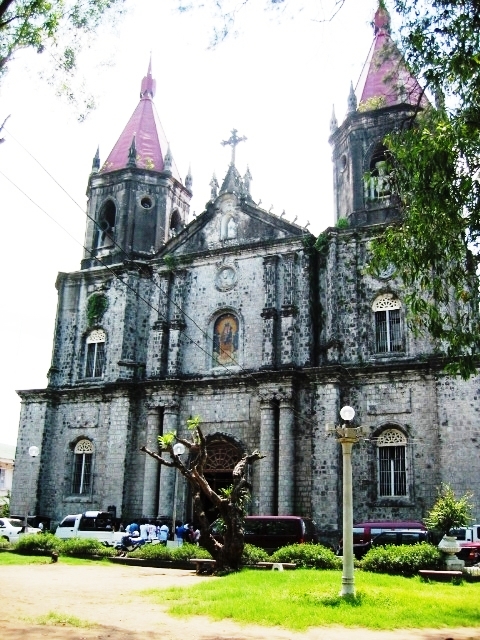
Church of St. Anne

The district’s twin-towered, GothicRenaissance Church of St. Anne, one of a few churches in Iloilo not built by the Augustinians, was built with coral rock and a tile roof, in 1831, under the supervision of Don Jose Manuel Locsin. In 1863, it was replaced by a temporary church by Fr. Jose Ma. Sichon until it was renovated in 1869 by Bishop Mariano Cuartero.  On August 4, 1886, our National Hero Jose P. Rizal visited this church to pray on his way to Manila from exile in Dapitan, referring to it as “la iglesia bonita.”  During the liberation of Iloilo in 1945, the church withstood artillery barrages but its two bell towers were totally destroyed and the church partially damaged.  It was rebuilt after the war.  The church, declared as a National Landmark by the National Historical Institute in 1992, has stained-glass windows and 5 wooden Gothic-style retablos. It is also called the Women’s Lib church because of the 16 life-size female saints’ statues lining the nave.  The district’s patron saint, St. Anne is in a prominent corner of its massive, antique wooden altar.

A nearby bandstand

In front of the church is a plaza filled with old trees, with gnarled trunks and branches, and an interesting domed gazebo which is actually a bandstand, a typical feature in Western Visayas plazas.

Church of St. Anne: cor. Jocson and San Marcos Sts., Molo District, Iloilo City, Iloilo.

La Paz District (Iloilo City)

La Paz District, located 2 kms. from the city proper, was formerly called Lobo, Llaunon, Ilawod and Iznart (after Iloilo alcalde mayor Manuel Iznart), was established as a parish in 1868. It is noted for its La Pazbatchoy, a delicacy made of flat, scissored noodles and pork innards simmered in broth and topped with crushed pork crackers and spicy herbs.  It is served in restaurants around the market. 

Church of Our Lady of Peace
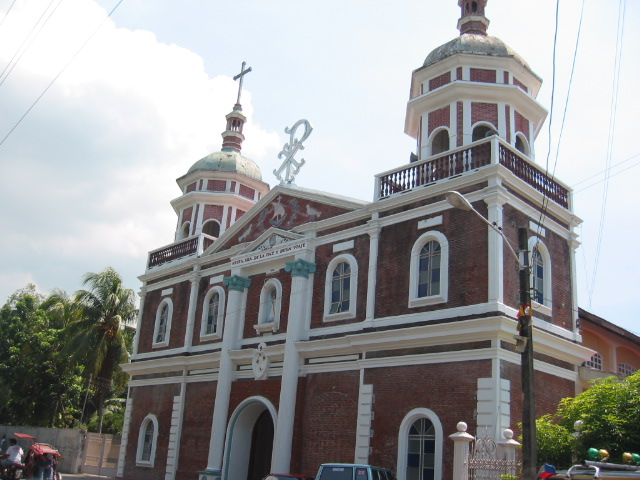
Its brick and stone, Neo-Classic style Church of Nuestra Señora de la Paz y Buen Viaje (Our Lady of Peace and Good Voyage), at the plaza, was started in 1847 by Fr. Candido Gonzalez, continued by Fr. Leandro Jambrina (in 1879) and Fr. Manuel Camara (in 1880) and enlarged and finished, in 1895, by Fr. Mariano Isart.  In 1909, it was restored by Fr. Anselmo Corcuera.  The stone convent was started by Fr. Mariano Isart based on plans by Don Julio Hernandez and Don Lorenzo Romero.  It was damaged during World War II and the 1948 earthquake.  

The church interior

Two engaged columns, supporting a triangular pediment, are recent additions (1970).  The 2-level church facade is flanked by twin octagonal, domed bell towers

Church of Our Lady of Peace and Good Voyage: Jereos St., La Paz District, Iloilo City, Iloilo.


Church of St. Joseph the Patriarch (Aguilar, Pangasinan)

This fine old Spanish-era church was first built in 1809 by Dominican Father Bernardo Pons.  The foundation of the present church and bell tower were first laid by Fr. Benito Sanchez Fraga, continued by Frs. Ramon Dalmau and Francisco Treserra and finished by Fr. Pedro Villanova.  It was inaugurated on June 4, 1854.  The choir loft and sacristy were built by Fr. Lucio Asensio.  From 1866 to 1878, Fr. Gallego built the main altar and ceiling, painted the church and finished the bell tower.   The bell tower was destroyed during the March 16, 1892 earthquake and later repaired by Fr. Victor Herrero.

Church of St. Joseph the Patriarch

Church of St. Joseph the Patriarch

The church has a distinct 3-level Baroque facade with a large volute at the pediment sloping down to the second level.  There are also superpositioned columns, a segmented arched main entrance, depressed segmented arched windows on the second level and a statued niche at the third level.   The foundations of its present convent was first laid in 1832 by Fr. Juan Alvarez del Manzano, continued by Fr. Nicolas Fuentes and finished by Fr. Benito Sanchez Fraga.

The church interior

The church interior

How to Get There: San Fabian is located 9 kms. south of Lingayen and 191 kms. from Manila.