Church of Sts. Peter & Paul (Bauang, La Union)

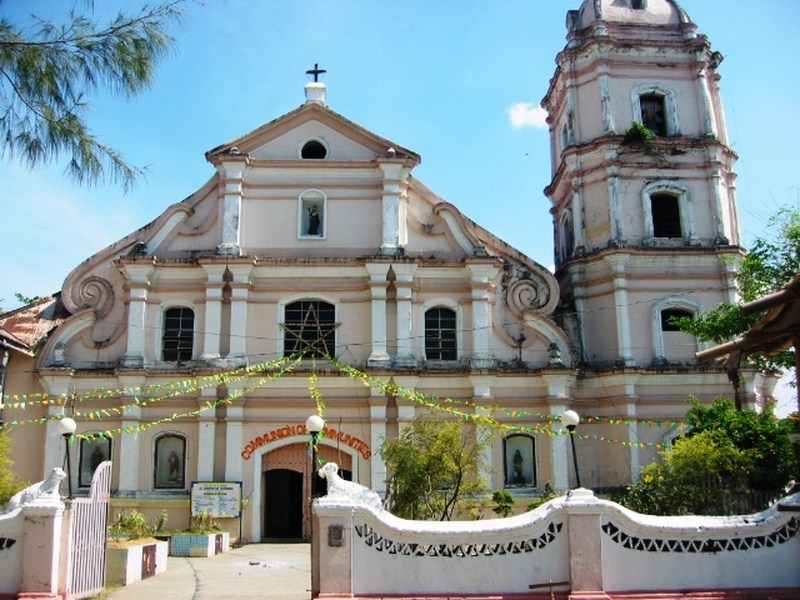
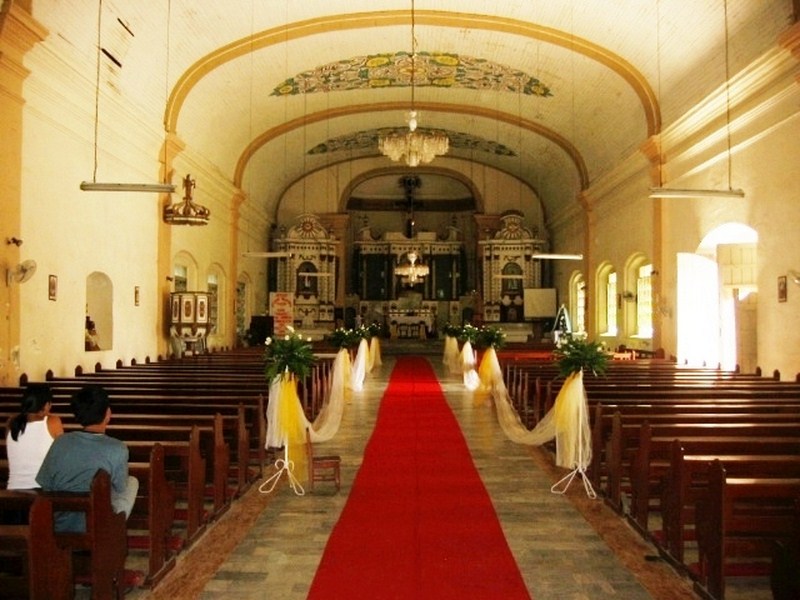
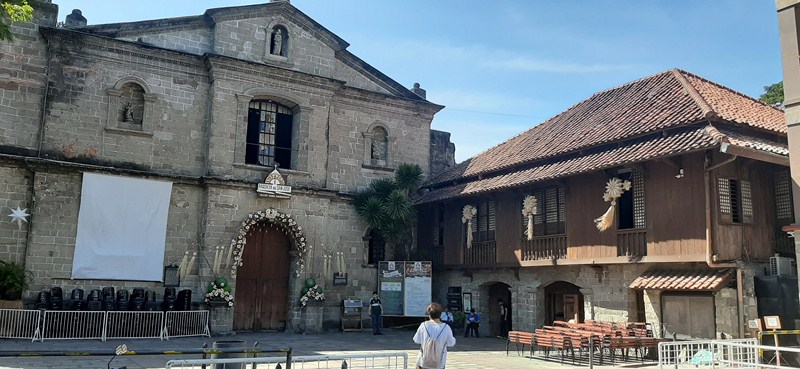
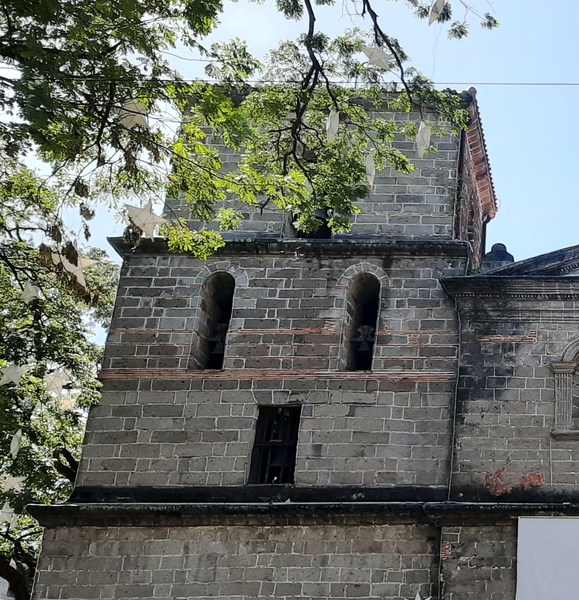
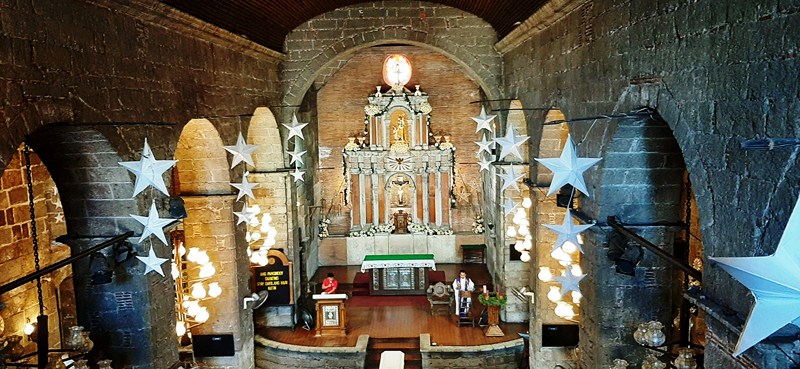
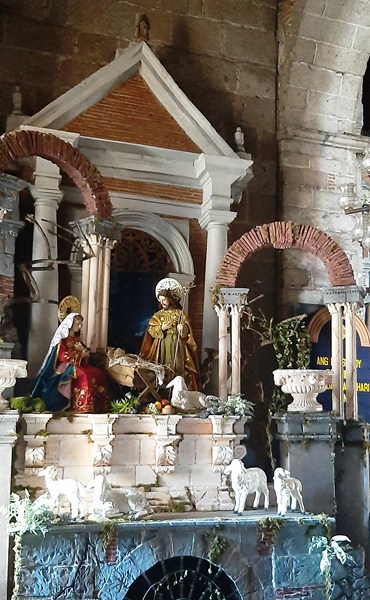
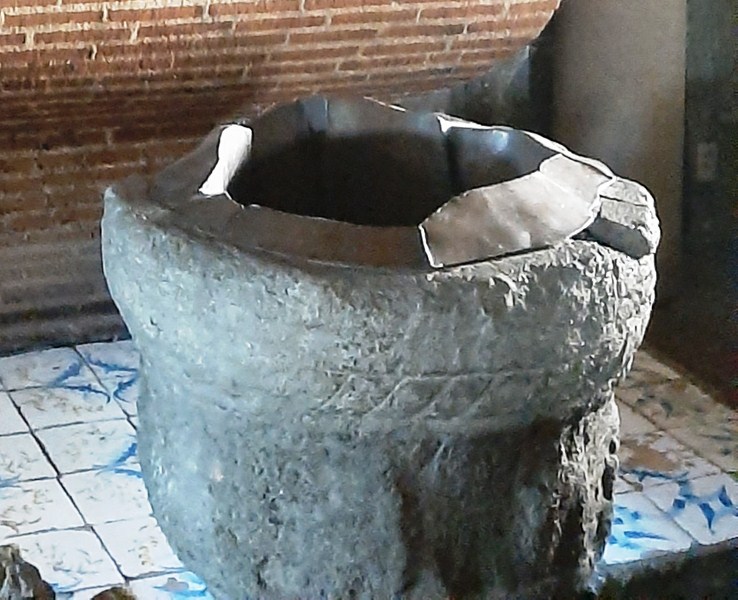
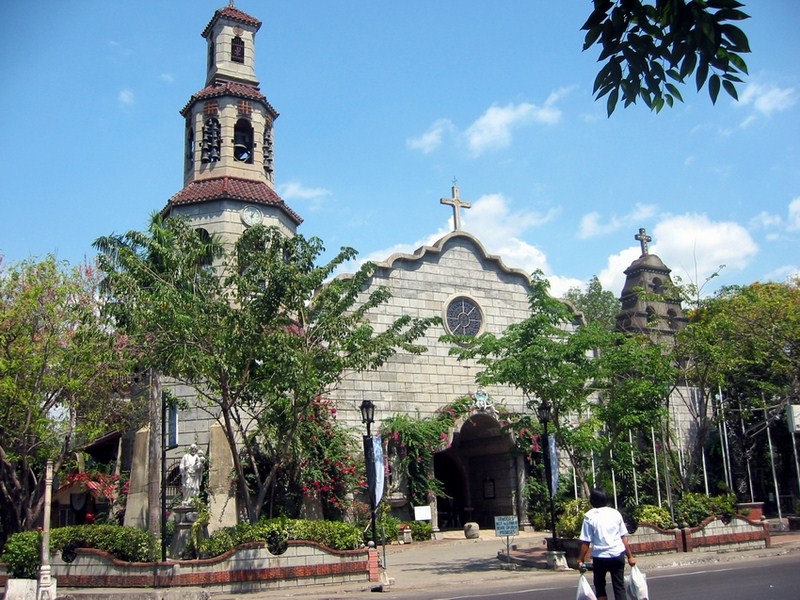
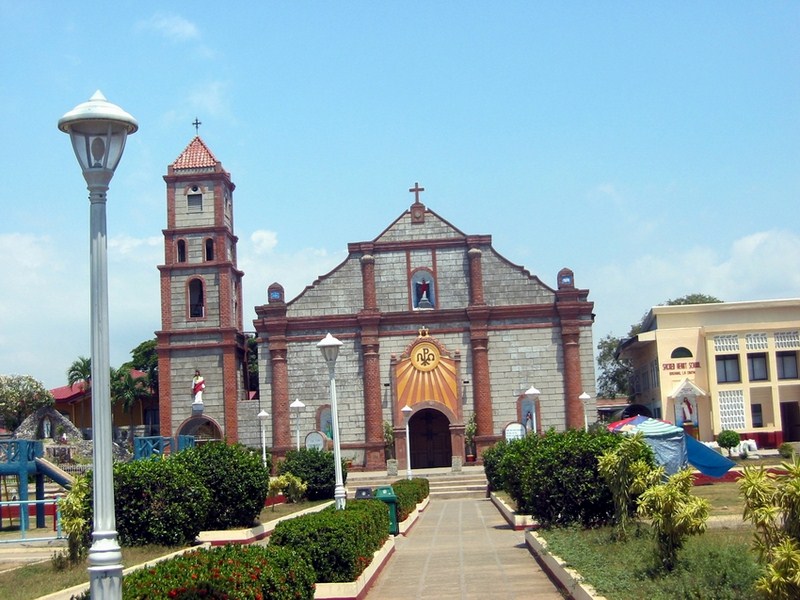
The town’s church, already built around 1873 by Fr. Mariano Garcia, was severely damaged during the 1892 earthquake, restored by Fr. Leonardo Collado in 1895, slightly damaged in 1944 and its interior was painted in 1978 by Fr. Esteban Mosuela.  Its facade was damaged during the July 16, 1990 earthquake and was rebuilt.  The rectangular, 4-storey bell tower on the left, restored with cement and hollow blocks in 1973, has two bells.  The stone convent, built in 1873 by Fr. Mariano Garcia, was destroyed in 1955, was restored and is now the Sacred Heart School.

Church of Sts. Peter & Paul

Church of Sts. Peter & Paul

The plain and sober-looking Neo-Classical facade has a segmented arch main entrance topped by foliage and flanked by four massive Tuscan columns with double capitals and two semicircular arched statued niches.  The undulating, low and broken pediment, separated from the lower level by a heavy architrave, has a semicircular arched niche flanked by two less massive and shorter Tuscan columns.

How to Get There: Bauang is located 259.38 kms. (a 5.5-hour drive) from Manila and 9.81 kms. (a 30-min. drive) south of the City of San Fernando.

Church of St. Andrew and St. Joseph (Bacarra, Ilocos Norte)

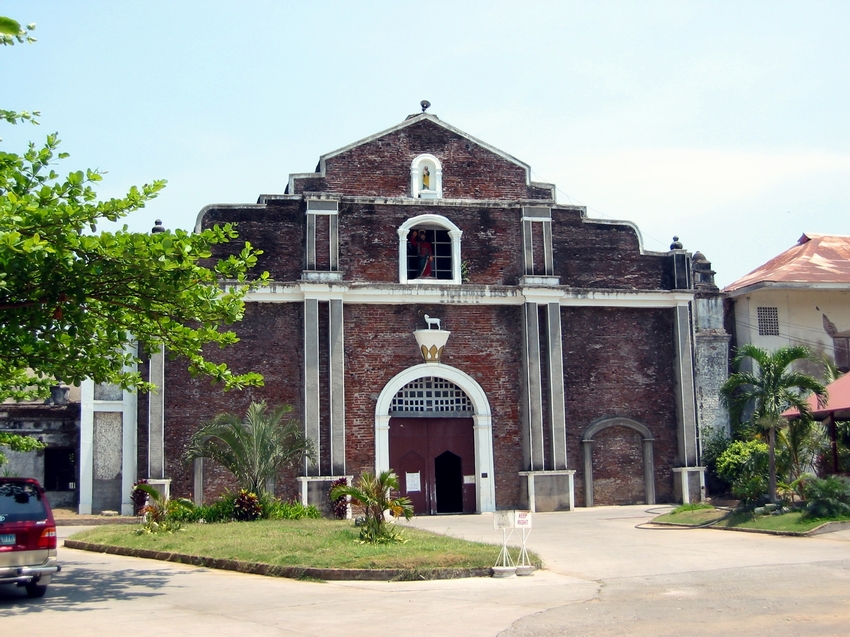
From Burgos, we drove a further 45 kms., past Pasuquin, to the town of Bacarra where we made a stopover to visit the town’s compelling landmark, the Church of St. Andrew and St. Joseph.  This church was built by Frs. Antonio Villanueva (1702 to 1705), Diego Mendarrosqueta (1704 to 1705) and Miguel Albiol (1705 to 1710) but was damaged during the 1709 earthquake and restored in 1868 by Fr. Felipe Fernandez (who also built a spacious and magnificent convent).  Again damaged during the July 18, 1880 earthquake, its roof and floor were later replaced.  The church was seized by the Aglipayans in 1901.  Damaged again during the 1931 and 1944 earthquakes, it was repaired by Fr. Celedonio Albano in 1940 and Fr. Fidel Albano in 1947.  Between 1965 and 1976, Fr. Amado Luz completed the interior and exterior painting.  The church was again damaged during the 1980 earthquake.  Fr. Pedro Berger built the 3-storey bell tower.

Church of St. Andrew and St. Joseph

This church, with its stark interior, used to have a Baroque-style facade which was destroyed during the 1983 earthquake.  The façade then had 4 sets of columns with double capitals sporting rosettes and acanthus leaves, all rising vertically from rectangular pedestals.  It was topped by a horizontal architrave and moving frieze, filled with geometric forms and stylized foliage motifs, and crowned by a pediment framed by huge wavy scrolls. The facade now has scant decorative elements and neat lines.  The Classic columns have been replaced by square ones and the simple straight lines on the pediment suggest where the huge, heavy scrolls used to be. The semicircular arched main entrance is flanked by two smaller, segmented blind windows on the lower section.   The choir loft window is flanked by rectangular openings with triangular canopies.

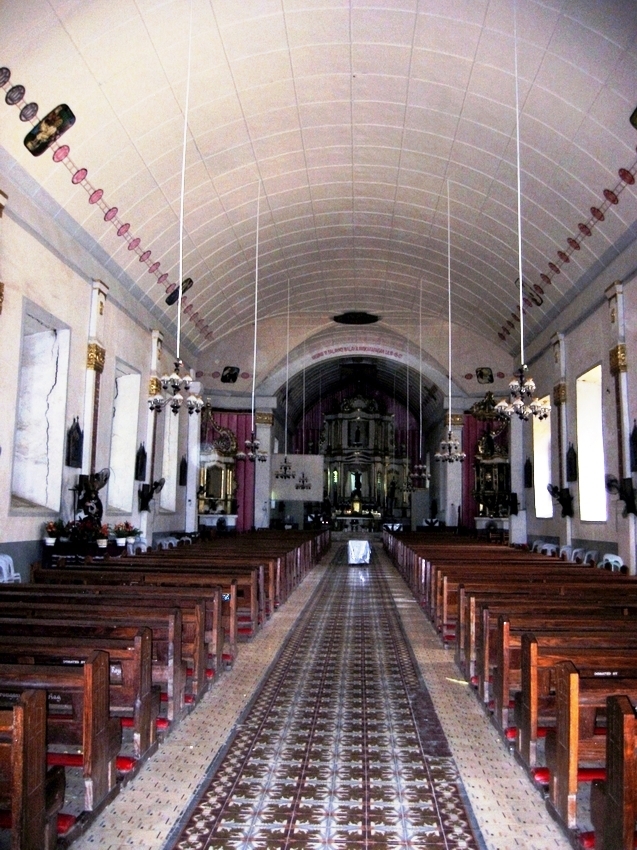
The church’s retablo is flanked by two small and graceful Ionic columns and broken volutes. Also inside are capiz-paned windows with wrought iron grilles, an old baptistery with domed roof, an upper storey with its original 250-year old narra floor and elegantly painted ceilings.  It also has a collection of ecclesiastical silver and pewter, plus church records dating back to 1702.   The adjacent L-shaped convent is reached by steps from the nave.

The bell tower

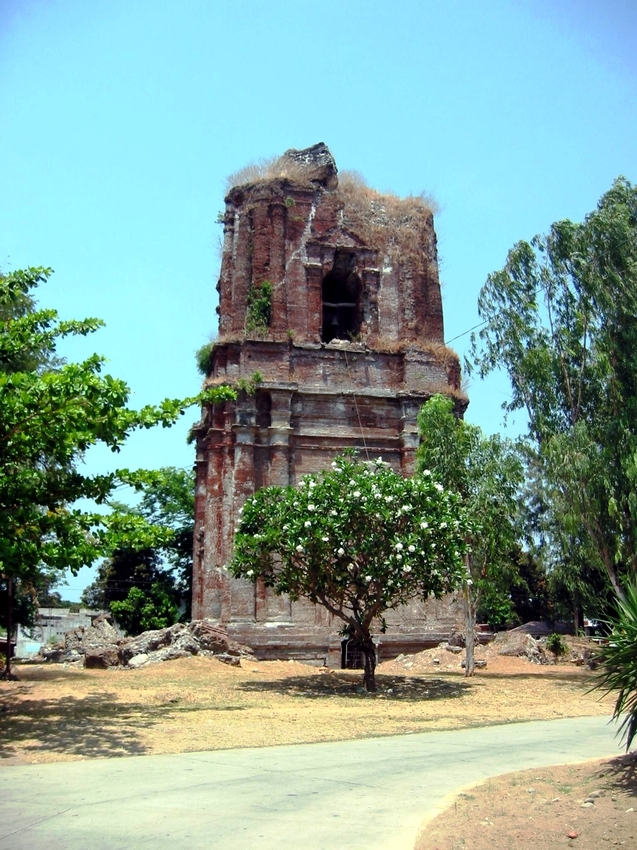
The massive 3-storey, 50-m. high square belfry has 4-m. thick brick walls supported by engaged columns (5 on ground level and 2 on the second story).  Its top segment, the campanille, crashed down into the third story during the 1931 earthquake where it remained until the November 22, 1981 earthquake when the dome fell almost in its entirety.  The September 7, 1983 earthquake caused its complete collapse.

After our church visit, we returned to our car and drove the remaining 8 kms. to Laoag City where we had lunch at a Max’s Restaurant outlet.

Patapat Viaduct (Pagudpud, Ilocos Norte)

It was already very late in the afternoon when we proceeded, for some photo ops, at the 1.3-km. (0.81 mile) long Patapat Causeway Bridge near the border of Cagayan, a must-see for first time visitors to Pagudpud.  Here, the Cordillera Mountains ends, edging out the coastal plains and plunging into Pasaleng Bay.  

Patapat Viaduct

As there is no narrow coastal plain along this area to build a road, this bridge, instead hugs the mountainside nearest to the cliff and extends toward the sea.  This concrete coastal viaduct, connecting the Maharlika Highway, from Laoag City to the Cagayan Valley Region, is the 4th longest bridge in the country.  It rises 31 m. (102 ft.) above sea level and is located 16 kms. from the town proper.   

The dramatic landscape and seascape

Our drive here gave us a 360-degree view of the most magnificent and dramatic land and seascapes along the Philippine highway system.  Visitors sometimes toss coins into the coves and surf below to ensure safe travel. Along the cliff sides, cascades and mini-falls descend directly to the road side.

Pasaleng Bay

Upon our return to Saud Beach Resort, we went restaurant hopping along the beach, for a change of pace and cuisine, and settled for dinner at the restaurant of Terra Rika Beach & Dive Resort.  Come morning,  our last day at Pagudpud, I decided to burn some of my extra calories with an early morning stroll, prior to breakfast, at the beach to see its true length.  I hiked as far as Jalao Point and its small, modern lighthouse before turning back.  After breakfast, we all checked out of the resort and left Pagudpud by 11 AM.

Jalao Point


Cathedral of St. William the Hermit (Laoag City, Ilocos Norte)

From Sinait, we finally entered the province of Ilocos Norte and drove the remaining 50 kms., without any stopover, to the provincial capital of Laoag City where we met up with the others for merienda at a Greenwich outlet.  While they were still dining, I slipped out and walked a short distance to to visit the city’s Cathedral of St. William the Hermit and its separate and unusual Sinking Bell Tower.

Cathedral of St. William the Hermit

This church was first built in 1580 as a wood and thatched nipa palm chapel.  The present Italian Renaissance and Baroque-style church was built between 1650 and 1700, seriously damaged during the November 14, 1707 earthquake, partially destroyed by fire in 1843 and completely restored by Fr. Vicente Barreiro.  It was again damaged during the July 18, 1880 earthquake and repaired again by Fr. Santiago Muniz and Engr. Antonio de la Camara.   The church was occupied by Pedro Almazan in 1661, by revolutionaries in 1896, American forces in 1899 and by Aglipayans in 1901.  It was the scene of the 1932 diocesan Marian Congress and was slightly damaged during the September 7, 1983 earthquake when statues from the altar and niches fell to the floor.

This stone and brick church has a unique, recently-plastered, 2-storey facade with a main arched entrance flanked by 4 pairs of overscaled, twin-engaged pilasters, without pediments, crowned by a series of coupled urn-motif finials and pseudo-Corinthian capitals with its rosettes and acanthus leaves.  Rising from the architrave and decorating the choir loft level are 5 sets of mini-columns with pseudo-Doric capitals.  Columns in each story follow their own patterns, ending abruptly without reaching the next level.  There are also capiz windows with wrought iron grilles and two exterior stone staircases, one of which is converted to a Lourdes-type grotto.  From its barrel-vaulted ceilings hang chandeliers donated by the late Pres. Ferdinand E. Marcos.  Over the main altar is the Augustinian symbol of a transfixed heart and a tasseled hat.  The deeply recessed niche shows the image of San Guillermo, the patron saint of Laoag.

The Sinking Bell Tower
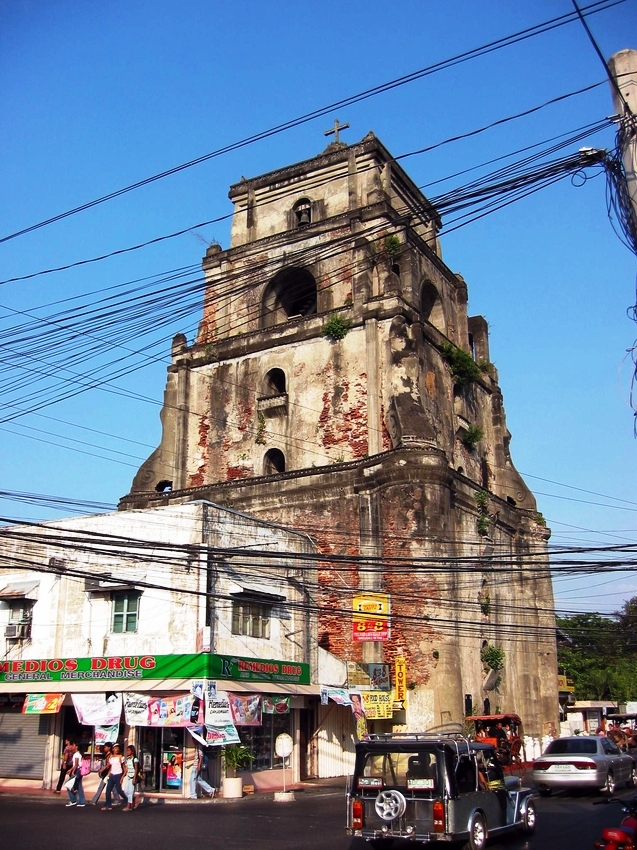
About 85 m. away from the St. William’s Cathedral is the 45-m. high, 90-m. diameter (at base) Sinking Bell Tower, at the northern end of Don Mariano Marcos Bridge.  One of the most massive and tallest in the country, it was built even before the foundations of the cathedral were laid (around 1660).  Made of bricks (joined by molasses and the juice of sablot leaves mixed with lime and sand), it leans slightly to the north and has sunk half a storey since its construction allegedly due to the 1957 earthquake and its being built on a sandy subsurface.  Now, a man can not pass through its gate without stooping.  Patterned after a famous bell tower in Italy, it is reinforced with four massive columns, crowned by fascias, in each corner and rises, ziggurat-like, with each segment growing smaller as you go higher until you reach its smallest segment, the dome.  Buttresses of the second and third stories end up in Baroque scrolls. A big clock on the tower’s western face has long since gone.  A winding stairway, with two flights on each storey, leads to the belfry where huge bells are installed.
Grace and the kids were already waiting for me when I returned to Greenwich.  We parted ways with Tellie and Frankie and left for the final 75-km. drive to Pagudpud.

Cathedral of St. William the Hermit: A. Bonifacio St.,  Laoag City, Ilocos Norte.

Stopover – Church of St. Nicholas of Tolentino (Sinait, Ilocos Sur)

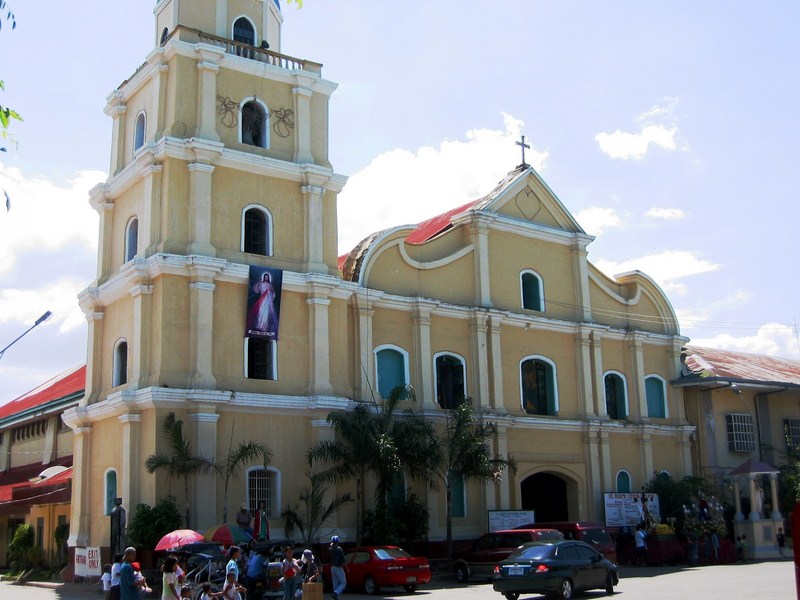
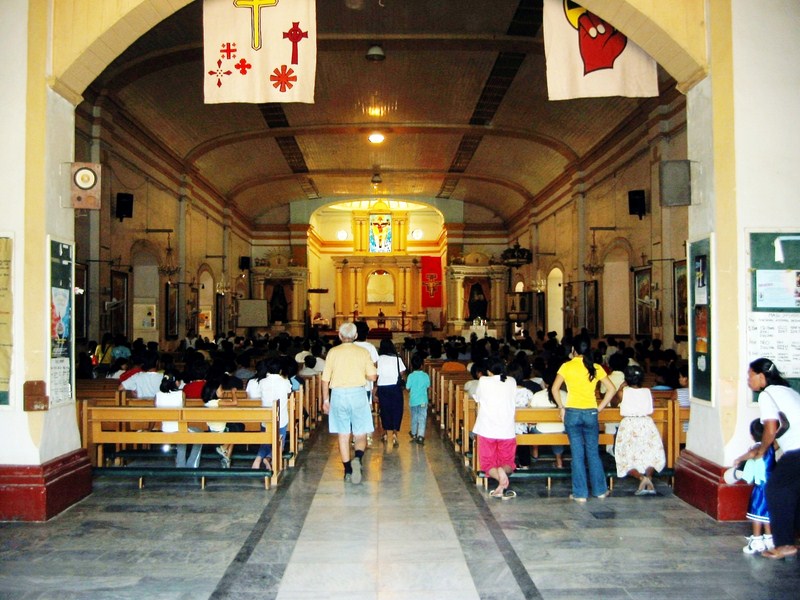
About 8 kms. after Cabugao, we entered the town of Sinait, the last Ilocos Sur town before entering the province of Ilocos Norte.  Here, we all made a longer stopover at the Church of St. Nicholas of Tolentino.  This church, damaged during the earthquake of 1620, was burned in 1760 and finished between 1760 and 1822.  It was restored by Fr. Celestino Paniagua (parish priest from 1889 to 1895).  Damaged by typhoon in 1953, the church was repaired in 1960 by Fr. Raymundo Garcia.

Church of St. Nicholas of Tolentino

The church has a massive, stucco-cement Neo-Classic and Baroque facade with no openings and flanked by 2 almost square twin bell towers.  The simple arched main entrance, flanked by two pilasters, has a rectangular window above it flanked by two small occoli decorated along the outer edges.  Above it is a small niche. A wooden tablet, carved with the Spanish coat-of-arms, is above the main door.  The quaint Moorish-inspired belfries have 2 levels, topped by balustrades, with one semicircular blind opening at the second level.

The church interior

The church houses the miraculous 17th century, life-size crucifix of the Black Nazarene or Santo Cristo de Sinait.

According to a long-lost manuscript, written between 1731 and 1734, this crucifix was found by some Sinait fishermen in 1620 floating along the coast of Sitio Lugao, Dadalaquitan Norte, in a casket together with the image of La Virgen Milagrosa de Badoc and was immediately placed inside the church.

Carved in hardwood and 18 feet long, it has a rich brown color and an impressive countenance. The sanctuary became famous throughout the Ilocos and devotion to the image was tirelessly spread in 1754 by Father Juan Dominguez.  It is believed to have aborted a plague that hit Vigan in 1756 and according to residents, still perspires sweet-scented oil.  A replica was recently installed by parish priest, Fr. Raymundo Garcia, at the spot where the statue was supposedly found

Church of St. Mark the Evangelist (Cabugao, Ilocos Sur)

About 13 kms. past Magsingal, after the town of San Juan, I again made a short stopover at the town of Cabugao to photograph the roadside Church of St. Mark the Evangelist.  Built from 1695 to 1696 by Fr. Andres Canalejo, this church was reinforced in 1824, finished by Fr. Juan Zugasti between 1817 and 1834, seriously damaged in 1870, restored by Fr. Saturnino Pinto, damaged during the 1880 earthquake and restored by Fr. Juan Zallo.  It was damaged by a fire in 1965.

Church of St. Mark the Evangelist

This church’s scantily decorated Baroque facade, divided into 2 levels, has a semicircular arched main entrance flanked by paired Doric columns and blind segmented windows on the first level, semicircular arched windows on the second level.  Its broken  pediment,  with crestings on the raking cornice, is topped by a domed turret.  On its left is a 5-storey bell tower.

Archdiocesan Cathedral of the Conversion of St. Paul the Apostle (Vigan City, Ilocos Sur)

The next day,  I ate a late breakfast of Vigan longanisa (Ilocano pork sausages) with egg, watching out the window as Frank’s wife Cherry, my nieces Jaja and Sandy and nephew Gelo, as well as Tellie’s daughter Mandy (with her yayas) enjoyed a horse-drawn ride in a calesa, a truly unique way to tour the city.

Sandy and Jaja on board a calesa

After breakfast, we all made our way to the cream and white Vigan Cathedral, officially called the Archdiocesan Cathedral of the Conversion of St. Paul the Apostle, to hear the 10 AM mass, it being Palm Sunday.  Mena Crisologo, that early morning, was quite impressive as the diffused light transformed the buildings and street into a scene straight out of 18th century Vigan.

Vigan Cathedral

The Earthquake Baroque-style cathedral was started in 1790 and was completed in 1800.   Inside are 3 naves, 12 altars and a choir loft.  Chinese influence is seen in the baptistery, altar, brass communion handrails, a pair of Fu dogs and stylized moldings carved about the exterior doors.  Most of the original church paraphernalia and artifacts are still in place.  The main altar has beaten silver panels.  Its octagonal Italian Baroque bell tower, on a square base, was built from 1790 to 1800 and stands, separately, 15 m. south of the cathedral, in Plaza Burgos.

Loboc River Cruise (Bohol)

After our short bonding with the tarsiers and my church visit, we all returned to the dock where our double-hulled, flower-bedecked floating restaurant was now waiting for us.  The restaurant has 4 long tables, 8 benches, kitchen, mini-bar and comfort room and is pushed along the river by a motorized boat.   We started our cruise from Loay Bridge. Cruising along, we dined on grilled pork or fish, fried shrimps or steamed crabs, all with chopped tomatoes and onions on the side; pansit plus other native fare, all served with generous servings of pandan-scented rice on wooden plates lined with banana leaves.  We washed these all down with either ice-cold soft drinks or the much healthier buko juice.   

Loboc River Cruise

The idyllic rural scenery is also a visual treat.  Along the way we observed heartwarming daily activities like mothers washing clothes and children bathing nude or diving from coconut trees bent precariously close to the water.  We also passed returning floating restaurants and small native outriggers loaded with passengers.  The endpoint of our 2-km.  cruise was Busay (or Tontonan) Waterfalls.  The falls drops 15 m. in 2 stages and is used to generate electricity for the town.   Here, we dropped anchor and guests were given the option to go for a quick, cool swim or just continue chatting or dining.  We just did the latter.  After about 30 mins., the boat made the return trip back to Loboc.   

Busay Falls

Holy Week in Morong (Bataan)

Napot Point

After our Dambana ng Kagitingan pilgrimage, it was back to my car again for the final drive to Morong. Along the final 23-km. stretch from Bagac to Morong, we passed the controversial Bataan Nuclear Power Plant, situated 18 m. above sea level at Napot Point.  Morong was the chosen site for this “white elephant,” which was supposed to be the first nuclear power plant in the country.

Begun in 1977, it was constructed by Westinghouse (allegedly under a “conspiracy of corruption”) and was expected to generate 620 MW of electricity when completed.  After much delays (construction was stopped in June 1979 due to the Three Mile Island incident in the U.S.), it was finally completed in 1985 at a cost of US$1.95 billion (its initial budget was US$1.1 billion).  However, cause-oriented groups staged a number of “No Nukes” rallies.

They protested its potential to life and property, and its being built on a major earthquake fault line.  The Chernobyl nuclear plant accident in the former Soviet Union in 1986 was the final nail in its coffin as Pres. Corazon Aquino ordered it mothballed that same year.  To this day, it has not been decided what to do with this overpriced but unsafe complex and the sophisticated equipment already installed there.  In the meantime, the country is left with the problem and an incurred US$2.2 billion debt.

Sunset at Morong

We finally reached Morong late in the afternoon and stayed at Vener’s house, located near the town’s Spanish-era church and a few hundred meters from the beach.  A soothing and well-deserved cool afternoon dip at the beach, augmented by a beautiful fiery sunset, relaxed our tired bodies. Early morning of the next day, Good Friday, provided an opportunity to observe, up close, the countrywide Holy Week ritual of self-flagellation.  I first encountered this shocking and bloody ritual when I was still living in Malibay (Pasay City).  Here in Morong it is called pagbubulyos.   This is performed mostly by men, both young and old, who wish to fulfill a panata (vow) of public atonement for one’s sins.  This panata is done for a minimum of 10 successive years and is reflected in the bulyos, a whip consisting of bamboo strips tied to sturdy cord.   Each strip represents one year of atonement, its number being reduced every succeeding year until he completes his panata.  Each strip should be secured properly.  If one is detached during his rounds, another strip (and another year) is added to his bulyos.

Before the actual flagellation, the flagellant’s back is prepared by beating with stick and paddles until swollen and numb.  Numerous small cuts on the back are then made with razors, with vinegar or salt sometimes applied to the cuts.   Only then is the raw back whipped continuously by the bulyos.  The flagellants, most with heads covered, walk barefoot along the town’s streets, stopping by the church to pray, then continuing on until they reach the sea where a healing noontime dip awaits them.

Sto. Lucia Complex (Dolores, Quezon)

Lakbay Kalikasan, Southeast Asia’s first and premier outbound education outfitter, embarked on a series of outbound education demonstration tours for teachers from other schools willing to try out their outbound education programs and they invited me to cover one of these tours that promote appreciation of the living remnants of a pre-Hispanic tradition which is still being practiced today in Mt. Banahaw, that of worshiping nature (rivers, mountains, old trees and fields) in the belief that such natural objects were the habitats of spirits. Jesu-Mariae School, my son Jandy’s school, joined the tour and they were represented by Robert “Rob” V. Castañeda and Eleser “Ely” Borero.  

Hiking up Calvario

Our destination was Mt. Banahaw’s Brgy. Sta. Lucia Complex 1 in Dolores (Quezon), one of Banahaw’s 4 complexes – the others being Kinabuhayan (Resurrection), Durungawan (Window) and Ilalim (Crater), which lies at the foot of the 1,470-m. high Mt. Cristobal.  We left the EDSA Shrine (our assembly place) by 5:30 AM, April 9 (Bataan Day), on board one of two vans. Joining us were 16 other teachers from 6 Metro Manila schools (Augustinian Abbey School, Madre Pia, Miriam College, Olivarez College, St. Benedict and Santa Catalina High School).  Our Lakbay Kalikasan hosts were Mr. Ramon Jocson (Corps Director), Mr. Ronaldo Dalofin (Team Leader/Lecturer 2), Mr. Roger Quizol (Team Leader 2), Mr. Oscar Orbe (Team Leader 3) and Ms. Billy de la Cruz (Facilitator 3).   The trip to Dolores was to take all of 3 hours.

Upon arrival at Sta. Lucia, we visited the compound of the Suprema Iglesia del Ciudad Mystica del Dios, Inc.  (Supreme Church of the Mystic City of God), the largest of Banahaw’s 66 to 88 registered colorums, entering it via a huge 20-foot high stainless steel gate.   The word colorum is derived from the Latin Mass invocation in saecula saeculorum.  These esoteric folk Christian religious communities, varying in size from several thousand members to a few adherents, believed that Mt. Banahaw is the site of the Holy Land and that Christ walked in the area.  They also share an intense nationalism and reverence for National Hero Jose Rizal who is considered a demigod or the Tagalog Jesus Christ.  Many sects also believe in the ascendancy of the female (Ciudad Mystica included) and women, rather than men, perform the priestly functions. These religious sects around Dolores resent the kulto (cult) connotation insinuated by non-believers. 

Piedra Mental

Mt. Banahaw is full of sacred natural shrines locally called puwestos (places), all said to have been discovered by Katipunero Agripino Lontok, and one of our objectives was to undergo and relive the pre-Hispanic tradition of pamumuwesto (spiritual pilgrimage) by hiking, crossing rivers and entering caves, all sacred destinations with deep historical and symbolical meanings, communing with the spirits for paglilinaw (discernment) and paglilinis ng loob (inner cleansing) so that we may take the challenges ahead.  Along the way, lectures and meditations are intermittently given and, in all puwestos, candles are always lit.

My baptism

We descended, down a gorge, to Sta. Lucia Falls, fed by the cool Lagnas (or Kinabuhayan) River, and Piedra Mental, a stone altar where pilgrims pray for mental discernment as they go through the pamumuwesto. At the stream which courses down Banahaw (also called Ilog ng Jordan, alluding to John the Baptist’s baptism of Christ), we “cleansed” or “purified” (water is a universal archetype for cleansing) ourselves and drank the sulfuric waters of the falls 3 times (symbolic of the Triune God – the Father, the Son and the Holy Spirit) prior to our entering the sacred caves (kuweba), the pilgrim’s church.  After our ritual baptism, we we then climbed up the steep gorge. 

One of many caves in Sta. Lucia Complex

At the huge boulder of Kaban ni San Isidro, the gate to the entire complex of Sto. Kalbaryo, we lighted candles and said a short prayer for safety and guidance, while at the book-shaped boulder called Aklat ng Buhay (the Book of Life said to contain our names, date of birth and even date of death) at Prisintahan , we imaginatively “register” our names and those of our loved ones. A real hurdle was the 40-m. long Santong Husgado (Holy Judge), one of the caves at Ina ng Awa revered by the religious sects and given Biblical names.  Said to test the purity of those who enter, it is believed that when you get out of this cave, 7 years of your sins will be forgiven but, if you are not completely malinis (cleansed), you will be trapped inside. 

Santong Husgado

We had to hike, barefoot, from Ina ng Awa to the cave opening (with lit candles strategically placed along the cave), carrying just the clothes on our back.  The ladies,  with their small frames, decided to go in first.  I was the last to enter this “cave” which was more of a rabbit hole.  All the while, I was figuring out how to get my 5’-10,” 188-pound frame inside that hole. Ready and willing for this test of faith (pagsubok), I kept remembering the familiar Biblical proverb “I can do anything through Christ who strengthens me” (Philippians 4:13).  Crawling through it entailed a lot of body contorting as well as decision-making. “Should I enter head or feet first?”  “Should I do it on my stomach or on my back?” Finally, after what seemed like an eternity of struggle, I finally made it out to Ina ng Awa. Now I know how a worm feels.   I, together with the others, were all mud-splattered yet, surprisingly, our habit-cladded sister colleague from Madre Pia was still spotlessly clean.  Could it be divine intervention?  I wonder.   

Lakbay Kalikasan: G/F Balai Lakbay, 2 Alondras St., Mira-Nila Homes, Tandang Sora Ave., Quezon City, Metro Manila.  Tel: (632) 932-7818 to 19.  Mobile number: (0917) 500-4796. Website: www.lakbaykalikasan.com.