Manila Bay Cruise


I recently accepted an invitation from Mr. Roland J. Portes, Gen. Manager of Sun Cruises (who are behind the Manila to Corregidor ferry), to experience, with my family, their one-of-a-kind Manila Bay Cruise on board their newly refurbished M/V Spirit of Manila.  Launched in 2010, this double-decker cruise yacht is docked beside the Jumbo Palace, just after the Tanghalang Francisco Balagtas (Folk Arts Theater).   Joining my wife Grace, son Jandy, daughter Cheska, Marve, my grandson Kyle and I is Grace’s boss Engr. Eulalio “Loy” Ganzon, president of E. Ganzon, Inc., and her officemate Arch. Mamel Yap.

Sunset at Manila Bay

This world-class dinner cruise service, available for Filipinos and international tourists alike, has 3 sailing times – 4:30PM to 5:45PM; 6:15PM to 7:30PM; and 8 PM to 9:15PM.  We opted for the popular second schedule to catch the famous Manila Bay sunset as well as the 7 PM fireworks spectacle of the nearby SM Mall of Asia.  Even before the ferry left at 6:15 PM, the sun was already starting to set, fully round and spectacularly painting the sky with a reddish or orange hue.

MV Spirit of Manila

The M/V Spirit of Manila, which can accommodate between 90 to 120 passengers, has two decks with the dining room just about taking up all the decks. The lower deck is enclosed and airconditioned while the open-air, upper deck is for al fresco dining. Its crew appears to be professionally trained, as Sun Cruises’ parent company, the Magsaysay Group, is known for its training center for seamen.

The airconditioned lower deck

This extraordinary cruise, at a leisurely 13 knots, took at least an hour and fifteen minutes and the waters were calm during this pleasantly tropical Saturday evening.  The clean and seaworthy boat was generally stable throughout the cruise and we traveled between decks without any difficulty. Once we left the dock and got under way, our route across Manila Bay took us southwards, toward the vicinity of SM Mall of Asia, Asia’s third largest mall, before heading toward Roxas Boulevard then turning around and heading back to the dock.

The dinner buffet table

After the sun set, we were awed with the towering skyline of the Ermita and the Makati Business District, visible for a time, as well as Manila’s fine buildings such as GSIS and the Manila Film Center.  Not many get to see Manila’s skyline by the bay, one of the best natural harbors in the world.

Dusk at the Manila Film Palace

Then, as dusk fell, it started to fade as the garish and magnificent lights along Roxas Boulevard, seemingly more attractive when seen from a distance, came to life against the black velvet night sky, its reflection also seen on Manila Bay as we felt the sea breeze.  Come 7 PM, we were treated to a fireworks display set amidst the spectacular changing lights of SM Mall of Asia’s The Eye Ferris Wheel, truly a sight to behold.

The acoustic duo – Irene D. Uriat and Alfredo M. Ladera

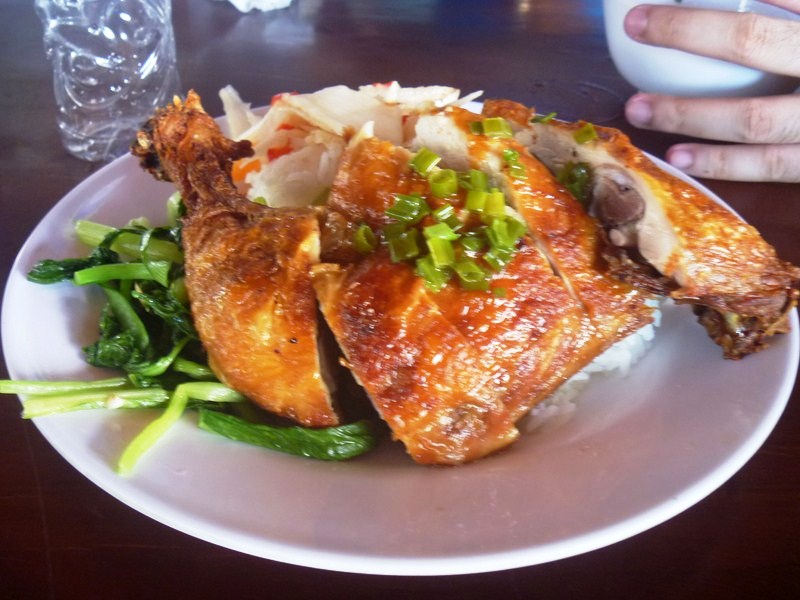
An important and much anticipated part of this cruise is the sumptuous, full course (appetizer, soup, main course, dessert) gourmet buffet dinner of Filipino and international (Continental, Oriental and Spanish) cuisine that will surely satisfy anyone’s palate. Catered by Manila Catering Services, the official caterer of the cruise, Sun Cruises’ meals are cooked elsewhere then re-plated on board. The menu for this night consisted of an appetizer of tempura crackers; onion soup; four main courses (pancit bihon with chicharon, fish fillet with sweet and sour sauce, roasted chicken and pork Korean); and dessert of buko pandan and coffee jelly.

Sunset Over Manila Bay

The dinner cruise also included live entertainment in the form of the acoustic duo consisting of vocalist Ms. Faye Irene D. Uriat accompanied by guitarist Mr. Alfredo M. Ladera.  They added to an already relaxing, soothing and romantic atmosphere and, after singing a number of tunes, they gladly asked for the audience’s requests as well as serenaded birthday and wedding anniversary celebrants. It was all great fun.  This enchanting, exhilarating and romantic experience is ideal for those who want to have a quick but unforgettable getaway from the hustle and bustle of Metro Manila.

The garish and magnificent lights along Roxas Boulevard

Sun Cruises: Fernando Ma. Guerrero cor. Paseo Palisoc St., CCP Complex, Roxas Blvd., Pasay City. Tel: (632) 834-6857 to 58, (632) 966-9391 to 92 or (632) 527-5555.  Website: www.corregidorphilippines.com. Cost: Php550 per person (includes roundtrip fee, dinner and live entertainment, drinks not included). Ticketing booth is located at the entrance of the dock. They don’t operate during bad weather and typhoons.

The Coral Garden and Underwater Cave of Puerto Galera (Mindoro Oriental)

A number of us availed of a package tour to San Antonio Island consisting  of a visit to an underwater cave and snorkeling the spots around the Coral Garden, the  premier snorkeling area of Puerto Galera, looking for a meter long giant clam underneath —all for PhP300. Our outrigger boat was small carrying, aside from the boatman, just me and Sheena as big boats cannot go near the shallow area of the Coral Garden.  Though I dabbed lots of sunblock on my skin, I forgot to bring a hat and my sunglasses, sorely needed as the sun was way up in the sky..

On our way to the Coral Garden

On our way to the Coral Garden

Our boat made landfall at another resort to pick up our snorkels then proceeded to the Coral Gardens.  Here, we donned our snorkels, dropped into the water and clung on to a nylon cord, between the boat and the outrigger, as the boat slowly dragged us along as we snorkeled. At some parts, the water was so shallow the corals almost touched my belly.  Tourists here are encouraged to bring bread to feed the fishes.

Snorkelling alongside the moving boat

Snorkelling alongside the moving boat

The underwater cave, our next destination, was just a 10-min. boat ride from Coral Garden.  It was located on one corner of a small coral rock formation beside a small white sand beach called Munting Buhangin.  There were a lot of boats parked along the beach and we could also see a long queue of tourists lining up to enter the cave. As such there were stalls, manned by locals, selling refreshing halo-halo (PhP25). Not waiting to see our boat parked, Sheena and I alighted from the boat and made our way to the rock formation.

The narrow white sand beach

The narrow white sand Munting Buhangin Beach

Getting up the rock formation was difficult as we had to carefully find our footing as the rocks were quite sharp and jagged. Its a good thing I brought along thick slippers.  The top of the formation has a panoramic view of the beach, the emerald green water of the sea and various rock formations nearby.The entrance of the cave had a bamboo stairs where we could climb down.

The queue up the rock formation

The queue up the rock formation

The underwater cave was not totally drenched in darkness, thanks to some rays of the sun beaming through a natural skylight.  The water inside was now deep, it being high tide when we arrived, but it wasn’t so cold.  High tide also prevented us from seeing the cave’s opening to the sea. Sheena and I alternately took each other’s picture inside the cave and through the skylight as we weren’t able to bring our boatman with us to take our pictures.

The author inside the underwater cave

The author inside the underwater cave

Back at our boat, we continued on towards the Coral Garden where we could find the giant clam. The place was almost in the middle of the bay. We again donned our snorkels and dove in. The Coral Garden obviously was littered with colorful corals plus different variety of fishes. However, even if I kept my eyes opened and peeled I still couldn’t find the giant clam.

Sheena underneath the cave's skylight

Sheena underneath the cave’s skylight

Automobile Association Philippines (AAP): 28 EDSA, Greenhills, San Juan City.  Tel: (632) 655-5889.  Fax: (632) 655-1878.  E-mail: info@aap.org.ph. Website: www.aap.org.ph.
AAP Travel: G/F, Sea Tower Bldg., 2332 Roxas Blvd. cor. Arnaiz Ave., Pasay City. Tel: (632) 551-0025.  Fax: (632) 551-0014. E-mail: info@aaptravel.com.  Website:www.aaptravel.com.ph.
Provincial Tourism Office: Provincial Capitol, Calapan City, Mindoro Oriental.  Tel: (043) 286-7046 and (043) 441-0306.

Boquete Island (Puerto Galera, Mindoro Oriental)

Of course, any visit to to Puerto Galera is never complete without trying out some of the town’s 13 superb beaches and a number of its offshore islands.  Come morning of the last caravan day, after breakfast at Marivelles Restaurant at the top floor of Marco Vincent Dive Resort, we were driven to the town’s seaside tourism information office.

Boquete Island

Boquete Island

Here, big outrigger boats were docked to take us to the small yet charming and beautiful Boquete Island (also called Paniquian Island), one of the islands that dot Muelle Bay.  Technically, it is a peninsula as it is connected to the mainland by a 50 m. long, scenic white sand sandbar, but it does become an island during high tide. Elizabeth’s Hideaway Resort & Restaurant, formerly Sandbar Boquete Beach Club, is located nearby.

Puerto Galera Tourist Information Center

Puerto Galera Tourist Information Center

Windsurfing is done off the sandbar which is perfect for speed trials as its sheltered waters are generally flat.  Wind speeds here can reach 20 knots at times although, generally, the wind speeds are consistent during the daytime at between 10 and 15 knots..  The sandbar is a regular venue for the second leg of the Philippine National Windsurfing Championship circuit.

Boarding our boat

Boarding our boat

Ms. Susan E. Cruz (Tourism Operations Assistant) and Ms. Sienna May R. Manongsong, both of the Oriental Mindoro Provincial Tourism Office joined us.  The boat trip took a little over 30 mins. and we made landfall at the white sand beach fronting the unfinished Friday Boquete Resort.  Here, we were to have lunch at one of its picnic sheds.

On our way

On our way

The beach is nice and secluded, with clear blue waters, and is away from the maddening crowd and the loud sounds of bars, restaurants and party places of White Beach.  However, sea urchins are present a short distance from the shore.  East of the island are the waters of Muelle Bay while to the west is Balatero Cove.

A resort we passed during our trip

A resort we passed during our trip

This 3.8 hectare property, located on a powdery white & pink sand beach inside the lagoons of UNESCO-protected Muelle Bay, is a sister resort of the 5-star Friday’s Boracay Beach Resort in Aklan and both are owned by the publicly listed Boulevard Holdings, Inc. (BHI).

Making landfall at Boquete Island

Making landfall at Boquete Island

When operational, it would have 62 luxurious native cottage styled rooms, a restaurant (that can be converted into an events are), beach grill, lobby lounge and bar, a huge outdoor ,free flow swimming pool and deck, art/shop boutique; dive training pool; full-scale dive shop, a spa treatment pavilion, and gymnasium.

Fridays Boquete Beach Resort

Fridays Boquete Beach Resort

As lunch was still hours away, we still had time to do banana boating (PhP350/pax) or avail of a package tour to San Antonio Island consisting  of a visit to an underwater cave and snorkeling the spots around the Coral Garden, looking for a meter long giant clam underneath —all for PhP300.

Banana boat ride

Banana boat ride

Of those who availed of the banana boating, half opted for its milder form (no overturning) while  Eva, Cel, Mike, Sheena, Gabby and yours truly went extreme and were rewarded with three dunkings, the last one when we were returning to shore.

Getting ready for our extreme banana boat ride

Getting ready for our extreme banana boat ride

Automobile Association Philippines (AAP): 28 EDSA, Greenhills, San Juan City.  Tel: (632) 655-5889.  Fax: (632) 655-1878.  E-mail: info@aap.org.ph. Website: www.aap.org.ph.
AAP Travel: G/F, Sea Tower Bldg., 2332 Roxas Blvd. cor. Arnaiz Ave., Pasay City. Tel: (632) 551-0025.  Fax: (632) 551-0014. E-mail: info@aaptravel.com.  Website:www.aaptravel.com.ph.
Provincial Tourism Office: Provincial Capitol, Calapan City, Mindoro Oriental.  Tel: (043) 286-7046 and (043) 441-0306.

The Mangyan Village of Talipanan (Puerto Galera, Mindoro Oriental)

From the Puerto Galera Municipal Hall, we returned to our respective vans, with Ms. Aileen N. Bareng (Senior Tourism Operations Officer of Puerto Galera) plus Ms Susan E. Cruz (Tourism Operations Assistant) and Sienna May R. Manongsong, both of the Oriental Mindoro Provincial Tourism Office joining us, and were driven to the Iraya Mangyan Village at Sitio Talipanan.

Weaving hut

Weaving hut

The Mangyans, the indigenous people of Mindoro Island,  consists of 8 ethnic sub-groups, the Iraya being one of them.  This tribe used to prospered along the coastal areas until they were forced to move from their land and were treated as second class citizens, neglected and discriminated.

Iraya-Mangyan weavers at work

Iraya-Mangyan weavers at work

They never wore slippers, wore old and torn clothes, and could rarely afford to eat rice in a week, surviving by gathering lami (sweet potato). After a major battle between government forces and communist rebels in 1986, the indigenous families were forced to leave the mountain and squat in the lowlands. The foot of Mt. Malasimbo in Puerto Galera alone is home to as many as 200 Iraya-Mangyan families.

Nito handicrafts on display at showroom

Nito handicrafts on display at the showroom

Nito jars

Nito jars

Since 1989, the Ayala Foundation, with the help of Ms. Beatriz “Bea” Zobel (wife of businessman and philanthropist Don Jaime Zobel de Ayala), has been implementing numerous projects covering education, livelihood development, housing management and health for these Iraya-Mangyans so that they may become more active participants in and productive members of their community yet be capable of managing its own affairs and activities without compromising its own culture.

Neat row of Mangyan houses

A neat row of Mangyan houses

In 1990, the Jaime and Bea bought a piece of the property for them and, in 2007, the couple acquired the rest of land and started developing the Mangyan Village, complete with power and water supplies.  Through their effort to bring the Mangyans to the mainstream of Philippine society through education, the village has produced a number of successful graduates (licensed teachers, community workers, ec.) who are now doing their part in helping their fellow Iraya-Mangyans.

Oriental Mindoro Cruise Drive Caravan ladies exploring village

Oriental Mindoro Cruise Drive Caravan ladies exploring the village

At the village, Oriental Mindoro Cruise Drive Caravan participants were welcomed by Mr. Fabian “Pabling” de Jesus, the 53 year old Batangueño right hand man of the Ayalas in Mindoro, who is at the helm of this project.  We met him at a large pavilion, at the center of the village, were about 52 Iraya-Mangyan, mostly women and wearing their uniform yellow shirts, were busy weaving strands of nito (Lygodium circinatum), a richly colored tropical vine of the fern family, into beautiful but functional baskets, plates with intricate designs, beer bottle holders, place mats, laundry baskets, jars and storage boxes. Mangyans are  expert basket weavers. At the very least, each Mangyan earns around PhP60-P70 in a day. In 2013, the Mangyan Village received 1,879 visitors who availed of these locally produced handicrafts.

An Iraya=Mangyan family in their new home

An Iraya-Mangyan family in their new home (photo: Ms. Sheena Ferrer)

The finished nito products are displayed at the adjoining showroom. The products are also brought to Makati City where the Ayalas opened two stores. The Mangyan workers receive shares from the sales and 4 kilos of rice every week. The Foundation also provides livelihood training in dressmaking, beading, masonry, electrical wiring and agriculture, among others.

Author crossing bamboo bridge (photo: Sheena Ferrer)

Author crossing bamboo bridge (photo: Ms. Sheena Ferrer)

When we visited this 4.2-hectare community located 9 kms. from the town proper, they already had a 4-classroom public elementary school (which accommodates grades 1 to 6 students), a medical facility managed by Indian nuns, common comfort rooms and 69 nice 36 sq. m. 2-bedroom houses complete with electricity, beds, furniture and kitchen and eating utensils.  Priority was given to the community elders.  Each house was estimated to have cost PhP150,000 which includes labor and materials. According to Mr. de Jesus, they are looking at building about 300 of these houses.

Iraya-Mangyan children

Iraya-Mangyan children (photo: Ms. Sheena Ferrer)

Mangyan Village: Sitio Talipanan, Brgy. Aninuan, Puerto Galera, Mindoro Oriental.

Automobile Association Philippines (AAP): 28 EDSA, Greenhills, San Juan City.  Tel: (632) 655-5889.  Fax: (632) 655-1878.  E-mail: info@aap.org.ph. Website: www.aap.org.ph.

AAP Travel: G/F, Sea Tower Bldg., 2332 Roxas Blvd. cor. Arnaiz Ave., Pasay City. Tel: (632) 551-0025.  Fax: (632) 551-0014. E-mail: info@aaptravel.com.  Website: www.aaptravel.com.ph.

Bancuro Church Ruins (Naujan, Mindoro Oriental)

After lunch at Benilda ng Bancuro Resort & Restaurant, next on our Oriental Mindoro Cruise Drive Caravan tour was the Bancuro Church Ruins, more popularly known as Simbahan Bato (Stone Church), just a short drive from the resort.

Bancuro Church Ruins (Simbahan Bato)

Bancuro Church Ruins (Simbahan Bato)

This old, roofless ruin is what remains of an Augustinian Recollect church and priory that was built in the 1690s, on swampy ground, with adobe and coral rock.  The church also served as a fort and a place of refuge against Moro invaders.

The native-style church within a church

The native-style “church within a church”

After several tries by marauding Moro pirates, the place was finally overran by them.  The pirate were said to be looking for the church’s bell, said to be made of gold but, not being able to find it, they instead burned the church to the ground in 1824.

The Augustinian symbol of a pierced heart

The Augustinian symbol of a pierced heart

The 2-level church has never been reconstructed and its coralstone and adobe walls were crumbling and creeping with vines until the 1960s, when a small chapel (literally “a church within a church”) was built within its massive walls.  It was renovated in 2011.

Masonic symbol of a square over compass?

Masonic symbol of a square over compass? 

Still trying to decipher it.

Still trying to decipher this. I recognize the pierced heart on the left. The symbol beside it looks like the Greek symbol for “pi.”

Above the main entrance arch, on the second level, is a small statue niche, above which is the Augustinian symbol of the pierced heart. Flanking it are rectangular openings. Pockets along the walls display several Christian icons. Outside the native-style church is a small plaza with 2 shrines (one for Jesus and the other for the Virgin Mary).

Oriental Mindoro Cruise Drive Caravan participants at church entrance

Oriental Mindoro Cruise Drive Caravan participants at church entrance

Simbahan Bato: Brgy. Bancuro, Naujan, Mindoro Oriental.  It is a 45-min. jeepney ride from the town proper.

Automobile Association Philippines (AAP): 28 EDSA, Greenhills, San Juan City.  Tel: (632) 655-5889.  Fax: (632) 655-1878.  E-mail: info@aap.org.ph. Website: www.aap.org.ph.

AAP Travel: G/F, Sea Tower Bldg., 2332 Roxas Blvd. cor. Arnaiz Ave., Pasay City. Tel: (632) 551-0025.  Fax: (632) 551-0014. E-mail: info@aaptravel.com.  Website:www.aaptravel.com.ph.

Church of St. Nicholas of Tolentine (Talisay City, Negros Occidental)

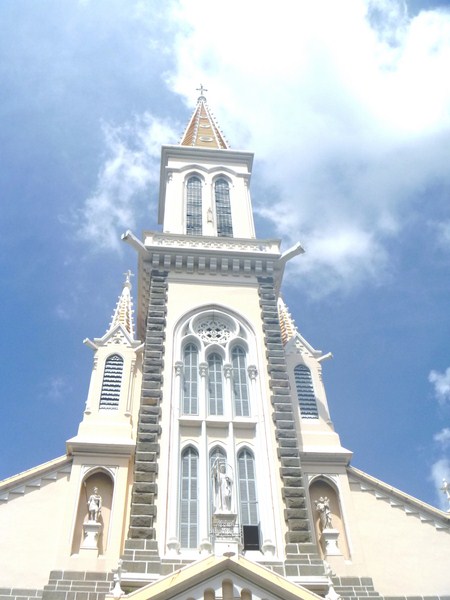
This city’s church was first built with light materials by Augustinian Recollect Fr. Fernando Cuenca and continued and completed by Fr. Miguel Garcia in the first quarter of the 1900s.  Fr. Garcia also built the convent whose ground floor he converted into a clinic. On February 1873, Fr. Ezekiel Moreno came and stayed at this famous rectory cum hospital for hydrotherapeutic treatment.

Church of St. Nicolas of Tolentino

Church of St. Nicolas of Tolentino

However, this church was destroyed as was its second replacement which was built with light materials.  The present structure, the third on the site, was started in 1936 by Fr. Luis Alvarez and completed by Fr. Santiago Vida.  On September 9, 1939, it was blessed by Msgr. Guglielmo Piani, Apostolic Delegate to the Philippines.  The remains of Fr. Fernando Cuenca and Gen Aniceto L. Lacson are kept here.

The church interior

The church interior

The only church left in the perpetual care of the Augustinian Recollects in the Diocese of Bacolod, it has a High Renaissance façade, a projecting portico on the main entrance and is flanked by two domed bell towers with tempiettos at the top of the dome and the base of the tower.

The altar retablo

The altar retablo

How To Get There: Talisay City is located 7.3 kms. (a 10 to 15-min. drive) north of Bacolod City.

Chapel of St. Joseph the Worker (Victorias City, Negros Occidental)

The highlight of our visit to the Victorias Milling Co. (VICMICO) was the Chapel of St. Joseph the Worker, an artistic landmark in the Western Visayas that heralded the birth of Filipino religious art in the country.  This modern and futuristic  church, also called the Ossorio Chapel, was designed by New York architect Anthony Raymond (an apprentice of the great American architect Frank Lloyd Wright) and was built, on the site of the old factory, from 1948 to 1949.  Earthquake-proof, its tower and nave are connected by movable beams.

The Chapel of St. Joseph the Worker

The Chapel of St. Joseph the Worker

This Chapel, built for VMC personnel and their families, was once featured in Life Magazine (as well as Liturgical Art Magazine) as “The Church of the Angry Christ.”  It features mosaic panels formed with bits of broken bottles of soda, milk of magnesia and other colored bottles gathered by parishioners.

The chapel interior

The chapel interior

A symbol of avant garde art, it depicts the angry Christ (God the Son), with a flaming heart and seated on skulls and a serpent (which represents death), on Judgment Day with big eyes and long, outstretched hands (symbolizing His welcoming of the faithful who were called to this continual last judgment), being received by God the Father, represented by 2 huge, red-orange hands.  The Holy Spirit, represented by a descending dove with multi-colored wings, hangs above. All over the place are multi-colored angels.

The controversial mural

The controversial mural

Christ is flanked by brown-skinned Filipinized saints in native attire, standing as witness to Christ’s resurrection – St. Joseph and the St. John the Baptist on the left and Mary and St. John the Evangelist on the right.  The first Filipinism in liturgical art, its singular rendition of brown-skinned Filipinos as Catholic saints has deliberately “Filipinized” traditional Biblical themes, thus giving it a Filipino face.

Triangle with an overseeing eye

Triangle with an overseeing eye

The controversial altar mural, done in a psychedelic splash of primary colors, was also criticized in the 1950s because of its solid, vibrant colors and striking brush strokes.  It also created a stir in conservative church circles for its depiction of Jesus Christ as angry and fierce-looking, instead of a merciful and gentle god. The altar’s beam has a triangle with an overseeing eye, looking at those who are called – the faithful attending the mass.

Skylight above altar

Skylight above altar

Belgian-born American liturgical artist Adelaide “Ade” de Buthune, the Baroness of Schaerbeek, assisted by Romulo Sta. Ana, was commissioned to decorate the baptistery (depicting Christ being baptized as a Filipino), the tabernacle, the mosaic outer walls (particularly the mosaic of Joseph’s wedding to Mary) and murals at the back.

A sculpture of Benjamin VValenciano

A sculpture of Benjamin VValenciano

Local engraver Arcadio Anore executed Bethune’s designs for the brass plates decorating the pulpit, baptistery and other parts of the church. Local artist Benjamin Valenciano, a carpenter from Victorias, did the the crucifix, the Stations of the Cross and the images of Joseph and Mary, garbed as ordinary brown-skinned Filipinos.

Bell tower

Bell tower

Philippine-born American abstract expressionist Alfonso A. Ossorio, the New York-based artist son of Don Miguel Ossorio, did the mural decoration of the altar within 11 months.  Alfonso studied Fine Arts at Harvard University (Cambridge, Massachussets, U.S.A.) and continued his studies at the Rhode Island School of Design. Among his friends were the famous abstract expressionist artists Jackson Pollock and Clyfford Still.

The Last Supper

The Last Supper

As painting medium, Alfonso used ethyl silicate 40, recommended to him by Ralph Mayer, a paint chemist, as appropriate for the tropics as it fghts humidity and withstands the dampness. Up to now, the murals have not been retouched and their bright colors still looks magnificent.

The Virgin Mary with the Holy Spirit

The Virgin Mary with the Holy Spirit

The front facade of the church has a mural showing three scenes from the life of St. Joseph – the marriage to Mary, the workshop at Nazareth, and the death of Joseph. There;s also the comic-like painting outside depicting “The Prodigal Son” (believed to be a pioneering work on the comics art in the Philippines) while the back of the church depicts “The Last Supper” and “The Virgin Mary with the Holy Spirit.”

The workshop at Nazareth

The workshop at Nazareth

Outside the church is a Carabao Sundial, built in December 1975 by Senior Machine Shop students of Don Bosco Institute, led by Hezekiah B. Katalbas and Vicente Gonzaga, with the assistance of VMC management.  Its horn is exaggerated to become the dial face.

The Three Kings

The Three Kings

As it features the works of world famous artists, this chapel should be protected and preserved for other generations to appreciate and, to ensure its preservation, it should be declared as a National Heritage Site or National Cultural Treasure.

The Carabao Sundial

The Carabao Sundial

Church of St. Joseph the Worker: Victorias Milling Co. (VICMICO), Victorias City, Negros Occidental.

How to Get There: Victorias City is located 34 kms. (a 45-min. bus or jeepney drive) northeast of Bacolod City.  Upon reaching the intersection of the National Highway and the road leading to VMC, hire a tricycle that goes straight to the church.

Chapel of the Cartwheels (Manapla, Negros Occidental)

From the mansion, Mark next drove us a short distance, across the field behind the Gaston Mansion, to the hacienda’s unique chapel.  Built during the hacienda days of the 1960s, it is probably the most native-looking of all Philippine churches.

Chapel of the Cartwheels

Chapel of the Cartwheels

Built by secular priest Msgr. Guillermo “Gigi” Gaston for the farm’s workers, its farming motif is reflected in its facade made mainly from various farm implements including plows, mortar (candle holders) and pestles (a holy water container), all indigenous to Hacienda Rosalia, as well as margaha sand and rocks from the nearby seashore.  The chapel’s benches were each made with slabs of hardwood by families who attended the mass.

The chapel's interior

The chapel’s interior

Its tall roof is a stylized wooden salakot (headgear) and the walls are made of artistically-linked discarded carabao cartwheels, an idea thought of by Msgr. Gaston who knew that the farm workers and their families could easily relate to this simple but widely used object in the farms where they worked.

The chapel's altar

The chapel’s altar

For him, the cartwheel also symbolizes the Holy Trinity with God the Father as the center of the wheel; Jesus Christ as the spokes surrounding it, leading the people towards God; and the the Holy Spirit as the outer rim  who ensures that the people don’t get lost on their way towards the center.

Seating area for the priest and 2 sacristans

Seating area for the priest and 2 sacristans

A huge, centuries-old boulder serves as the altar and the wall behind it is made of native stone and punctured by 3 cartwheel-shaped stained glass windows (representing God the Father, God the Son and God the Holy Spirit) with broken pieces of glass bottles (wine, milk and soda) in different colors, giving the altar a more creative and lively look. Boulders were also used as the podium top and seats for the sacristans.

Stained glass window

Stained glass window

The sliding doors feature mats of 128 panels portraying Biblical events and the usual Christ on the cross is modified by a farmer crucified on a cartwheel. Masses,  attended by hacienda farm workers and their families, are still being held in the chapel. The chapel, also open to guests and tourists who visit the town, is also a popular venue for weddings.

Christ on a crucified on a cartwheel

Christ crucified on a cartwheel

Chapel of the Cartwheels: Hacienda Rosalia, Manapla, Negros Occidental.

How to Get There: Manapla is located 44.7 kms. (a 1-hour drive) northeast of Bacolod City.

The Gaston Mansion (Manapla, Negros Occidental)

Jandy and I arrived at the Manapla Municipal Hall by 10:30 AM.  Here, we met up with town councilor Marcos “Mark” L. Escalante, my nephew and son of town mayor Lourdes Socorro “Uding” L. Escalante, my first cousin, who was at the U.S. at that time. Mark drove us to Hacienda Rosalia, home of the Gaston Mansion and the Chapel of the Cartwheels, two of Manapla’s tourist attractions.

The Gaston Mansion

The Gaston Mansion

The mansion's lush garden

The mansion’s lush garden

We first stopped over at the Gaston Mansion.  Its resident and current owner, the secular priest Msgr. Guillermo “Gigi” Gaston, wasn’t around, being at Bacolod at the time of our visit, but the caretaker allowed us to look around the living and dining areas of the mansion.  Incidentally, the mansion was featured in Peque Galalga’s 1982 multi-awarded film Oro Plata Mata, where it was referred to as Hacienda Lorenzo.

The ground floor

The ground floor

Stairway to second floor

Stairway to second floor

This stately and elegant, 2-storey mansion, the  ancestral home of Jose Gaston, one of the sons of Yves Leopold Germain Gaston, and his wife Consuelo Ascona, was built in the 1930s.  They had 8 children.  It is set in lush, verdant and gorgeous garden of flowers, shrubs, trees, potted palms and herbs. Within the grounds are a now-disused swimming pool (used as hiding place during World War II), a Victorian fountain, a pond and a time-worn shoe house (which was used before as a playground).

Dining Area

Dining Area

Chess table

Chess table

Its second floor dining room, opening into a breezy azotea overlooking the garden, had a wooden floor, a high ceiling and large windows.  What truly amazed me was its antique, 24-seater wooden table.  All around it are cabinets filled with crystal stemware, antique silverware and fine china.  Buffet lunches, served by servants of the Gaston family, are also offered for paying guests.

China cabinet

China cabinet

Antique telephone

Antique telephone

Gaston Mansion: Hacienda Rosalia, Manapla, Negros Occidental.

How to Get There: Manapla is located 44.7 kms. (a 1-hour drive) northeast of Bacolod City.

The Ruins (Talisay City, Negros Occidental)

The highlight of our Silay Heritage Tour was our visit to The Ruins in nearby Talisay City.  Here, a wacky, English and Tagalog-speaking tour guide narrated to visitors the fascinating tale of The Ruins, injecting humor along the way.

The Ruins - the Taj Mahal of Negros

The Ruins – the Taj Mahal of Negros

The Ruins is what remains of the grand, 2-storey mansion that Negrense sugar baron, Don Mariano “Anoy” Ledesma Lacson (1865-1948) built in the middle of his 440-hectare sugar cane plantation in the early 1920s, following the death of his first wife, Maria Braga, a Portuguese from Macau who died in an accident while pregnant with their 11th child. Don Mariano is the youngest of the 8 children of Lucio Lacson and Clara Ledesma from Molo, Iloilo.

Our tour guide explaining the history of The Ruins

Our tour guide explaining the history of The Ruins

He later remarried, this time to Concepcion Diaz from Talisay, adding 3 more children to his existing brood of 10 (which included Rafael Lacson, the former governor of Negros Occidental). It became the residence of Don Mariano and his unmarried children. After drawing lots, Don Manuel’s sugar plantation was divided among the 10 children by his first wife Maria and  the mansion went to Mercedes Lacson who married Manuel Javellana from Jaro District in Iloilo.

The interior of The Ruins

The interior of The Ruins

Later, the land was again divided into equal parts among the couple’s 12 children and the 3.6 hectares that included the mansion was given to Ramon Javellana. Raymund Javellana, one of Ramon’s children, thought of restoring the mansion and converting it to a tourist spot but the mansion remained abandoned for 67 years until they started to develop it on May 2007.  On January 2008, it was officially opened to the public as a tourist attraction.

The main entrance

The main entrance

The 903 sq. m., 10-room (8 rooms for their children, a master’s bedroom and a family room) mansion, of Italianate architecture, has twin Neo-Romanesque columns with the first letters of the names of Don Manuel and Dona Maria engraved onto the mansion’s posts.  They actually looked like Es that face each other.

The mansion grounds

Cheska, Marve, Kyle and Grace at the mansion grounds

Facing the main door, the boys’ and girls’ bedrooms, at the ground and second floors respectively, were all located on the left side. The master’s bedroom and the family room were both located upstairs and facing west, on the left and right, respectively. A small arched window, between the kitchen and the dining area, facilitated the movement of food, minimizing the servants going in and out of the kitchen.

The "M" moldings

The “M” moldings

The picturesque mansion, one of the top 12 fascinating ruins in the world and the Taj Mahal of Negros, has many interesting tales to tell.  Its top edges also feature a shell-inspired decor which, in New England, indicates that the homeowner is a ship captain. At the glassed-in sunroom with bay windows, Don Mariano would be often seen sitting as he viewed ships that come and go along the coastal waters of Talisay. Maria Braga’s father was also a ship captain.  Again, in keeping with the marine theme, the mansion’s second story also features a belvedere, between the master’s and family room  and also facing the west, where the family would gather to watch the sunset.

The restaurant dining area

The restaurant dining area

Felipe, one of Don Manuel’s sons, supervised the continuous concrete mixing and pouring, done 24 hours a day, 7 days a week.  This ensured that the concrete was very compact and that no air got in, resulting in the high-quality strength of the structure.  The concrete mixture also incorporated egg whites which, to this day, visitors can still see the gloss or shine on the mansion’s walls because of it.

The remains of the stairs

The remains of the stairs

In 1942, during the Japanese occupation in the early part of World War II, the mansion was reduced to its skeletal frame when USAFFE (United States Armed Forces in the Far East) guerillas set the mansion ablaze, with the consent of Don Manuel, so it would not be used as headquarters by the Japanese forces.

Detail of column capital

Detail of column capital

The mansion’s roof, ceiling and the 2-inch thick, meter wide and approximately 20.5 m. long, jointless wooden floors, extending from the main entrance up to the end of the dining area, were all burned during the non-stop, 3-day fire but the foundations remained standing, thanks to its oversized steel bar reinforcement and the meticulous way of pouring the A-grade mixture.  The original Spanish machuca floor tiles, the hardest and most expensive during that time, also survived.

Detail of arch

Detail of arch

The original, 4-tiered fountain outside the mansion was, in its heyday, surrounded by a beautiful lily garden maintained by a Japanese gardener who, following the burning of the mansion, mysteriously disappeared.   Today, its landscaped garden draws various inspirations – from formal English to Japanese-inspired gardens.

The original 4-tier fountain

The original 4-tier fountain

Viewed just outside the mansion, with a tree on top, is the chimney (simborio) of the muscovado sugar mill (where the juice of the sugarcane is extracted) of the family’s sugar farm. From the mill, the extracted sugarcane juice is then transferred to large vats, heated and then cooled to produce the sugar crystals.

Exterior detail

Exterior detail

Inside The Ruins is a semi-fine dining restaurant (offering Mediterranean cuisine), a mini-bar and a souvenir shop while around it are modern additions – an 18-hole mini golf course, a snack bar and newly built toilets that still use the mansion’s original septic tank.

Belvedere detail

Belvedere detail

Aside from tours and dining, The Ruins are also be used for special events such as weddings, family reunions, pre-nuptial pictorials, etc.  There are also a stall selling Erv’s sugar cane juice, camping and picnic grounds, bath houses and a pavilion. Also within the grounds is a 3 m. high obelisk,the Landmark Award of the Philippine Institute of Civil Engineering (PICE). Too bad, we left at 5 PM.  According to our guide, you will see the building glow from the sunset around 5:30 PM.
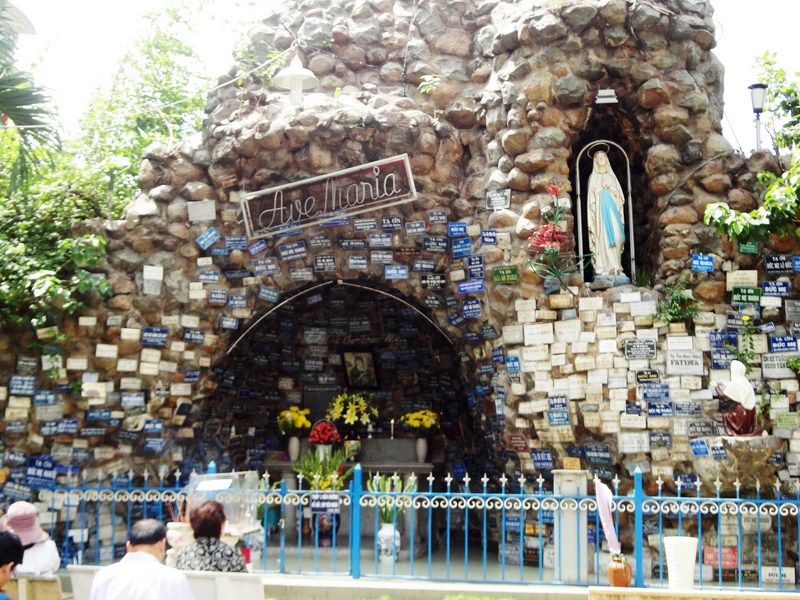
The simborio

The simborio

The Ruins: Open daily, 8:30 AM to 8 PM. Tel: (034) 476 4334. Admission: PhP60 (adults), PhP40 (students) and PhP30 (children).