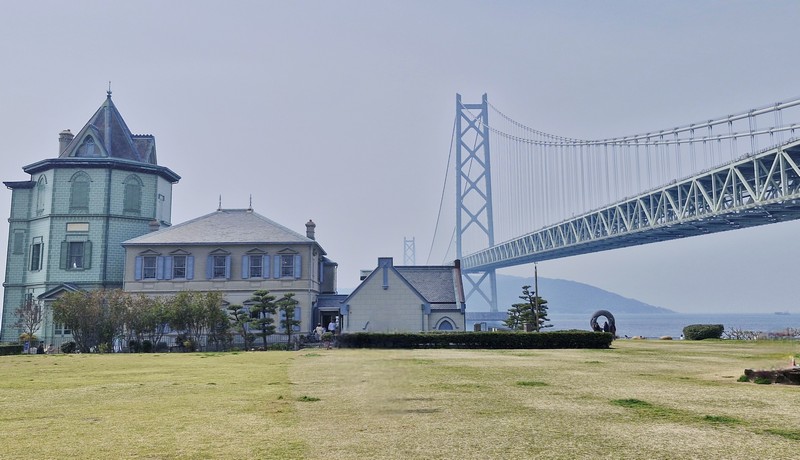
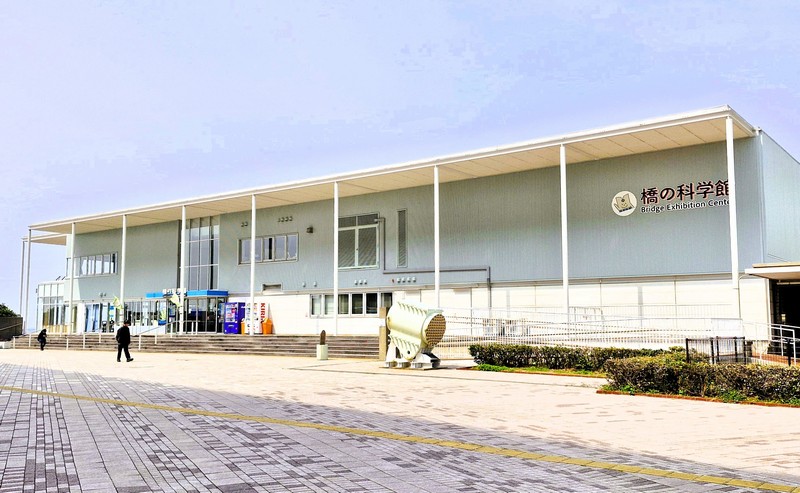
From Meriken Park, it was a 16.1-km. (30-min. drive) to our second stopover – the exotic atmosphere of Hyogo Prefectural Maiko Park. This 7.8-hectare oceanside city park features large grassy areas with sea and bridge views; a 1,500-pine forest; the Akashi Kaikyo Bridge Exhibition Center (displays showing the history of what is the world’s longest suspension bridge) and several historic houses. The current Maiko Park was opened as the first Hyogo prefectural urban park in 1900.
Check out “Meriken Park”
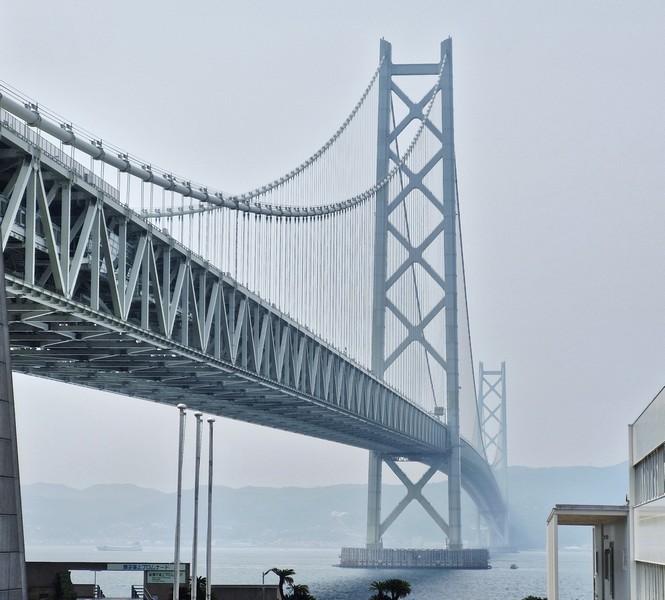
There are plenty of things to do and see at the park. It is the gateway for the 3,911 m. long Akashi-Kaikyo Bridge which is the world’s largest suspension bridge. Linking Hyogo Prefecture (Kobe) with Awaji Island, it also boasts the world’s longest central span at 1,991 meters. At night, the bridge is illuminated with colorful lights. This stunning sight, for those crossing the strait, has earned it the nickname “Pearl Bridge.”
Underneath the bridge is the Maiko Marine Promenade, a viewing facility built in the bridge girder, approximately 47 m. above the sea and 150 m. above the ground, that offers fantastic views of the Seto Inland Sea and Akashi Strait. An approximately 317 m. long, circuit-style promenade on the Akashi-Kaikyo Bridge opened on April 5, 1998, it was constructed on the Kobe side of the bridge as an additional facility. Information materials and a DVD system that explain the bridge are available on the first floor of the promenade. There is an observation camera system which makes you feel like you’re on top of the bridge’s 300-m. high main tower. At the observation lounge, on the 8th floor, you can try an additional thrill – the “log-bridge 47 meters above the sea.”
You can also see and visit three historical buildings. Other Japanese residences, in Osaka and Kobe, have been gradually disappearing since the Hanshin/Awaji Great Earthquake. The Former Residence of Sanji Muto was built in 1907, during the Meiji period, at Maiko Beach, by businessman (he was president of the Kanebo textile company), journalist and politician (he was an active member of the House of Representatives) Muto Sanji.
After Muto was murdered in 1934 (as part of the fallout of the Teijin Incident), it was used by Kanegabuchi Boseki Co., Ltd. as its social welfare facility, and was called the Kanebo Maiko Club (also known as the Old Kanebo Maiko Club). However, for the expansion work of National Route 2, it was taken down, in conjunction with the construction of the Akashi-Kaikyo Bridge, and the Western-style building was relocated to Kariguchidai, Tarumi-ku.
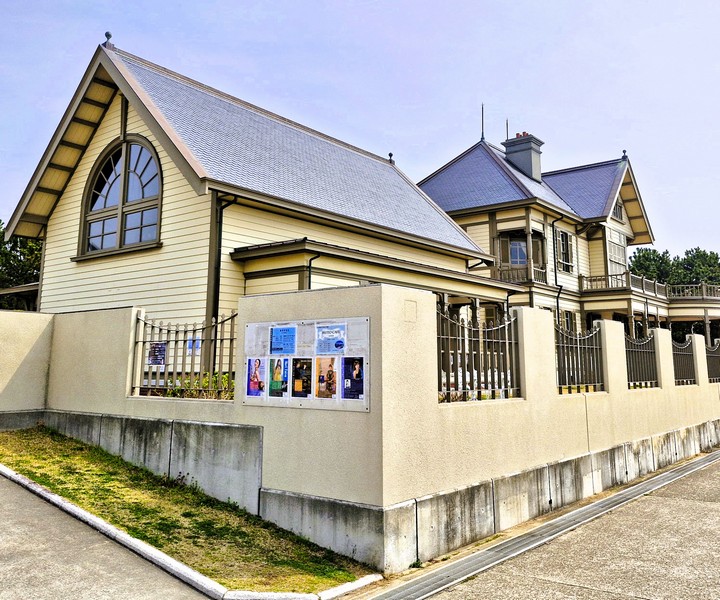
In 2007, Kanebo Co., Ltd. donated the building and furnishings to Hyogo Prefecture and, that same year, the prefecture started relocation/restoration work to move the building back to Maiko Park, its original location. In July 2011, it was registered as a National Tangible Cultural Property. Now a new tourist attraction representing Maiko Park, visitors can enjoy the scenery, from this Western-style seaside cottage, of the Akashi Strait and the pine forest. Inside, it features preserved Meiji-period furniture and stained glass.
The Former Japanese Residence of the Kinoshita Family is an early modern Japanese home built in the tea ceremony arbor (sukiyazukuri) style. Originally completed as a private residence, in 1941, for a man named Ryosuke Matano, it came into Mr. Kichizaemon Kinoshita’s possession in 1952 and, in 2000, the bereaved family of the late Mr. Kichijiro Kinoshita donated it to Hyogo Prefecture. In December 2001, as it has almost completely retained its appearance since its establishment, it was registered as a National Tangible Cultural Property.
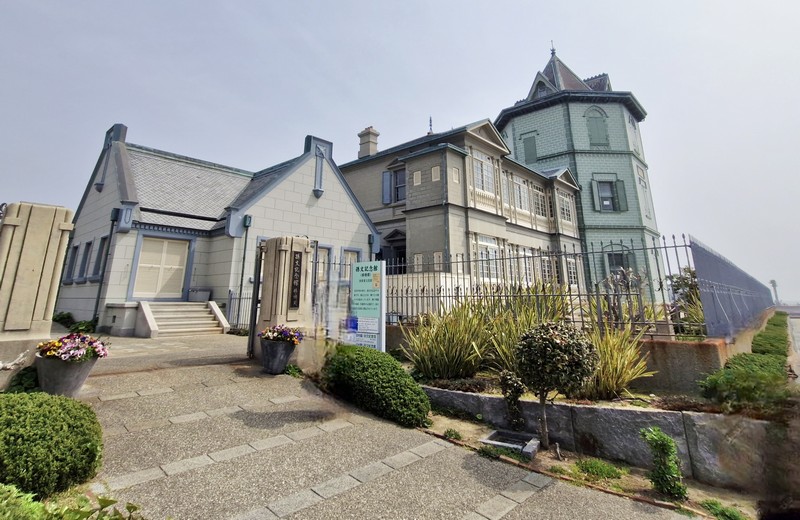
The iconic Sun Yat-Sen Memorial Hall (Ijokaku), built in 1915 by Wu Jintang (1855-1926), a prosperous Chinese merchant in Kobe, is a cottage with a three-storey octagonal tower (added, as an annex, in 1915) that was shown to the public, in 1984, as Sonchuzan Memorial Hall. It exhibits information materials related to Chinese revolutionary and first president of the Republic of China Sun Yat-sen who was honored with a dinner, hosted by the local Chinese business community, in 1913. On December 10, 1993, tt was registered as a Prefectural Important Tangible Cultural Property and, on November 14, 2001, as a National Important Tangible Cultural Property.
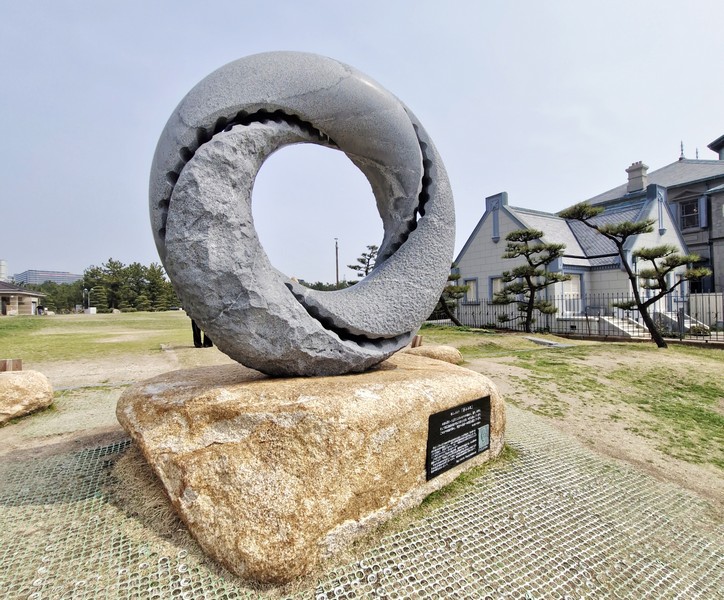
Nearby is monument “Dream Lens,” an iconic photo spot created by a sculptor Keizo Ushio. It was installed to commemorate the 5th anniversary of the foundation of the Akashi-Kaikyo Bridge, the embodiment of half a century of technology. The Moebius strip, made of rock with three different types of surface, represents people, nature, and science as well as the main island of Japan, Awaji Island, and Shikoku, which are connected by the Akashi-Kaikyo Bridge. These three layers harmonize well, expressing hope for development in the future.
Hyogo Prefectural Maiko Park: 4-2051 Higashimaikocho, Tarumi-ku, Kobe, Hyogo 655-0047, Japan. Tel: +81 78-785-5090.
How to Get There: The closest train stations to Maiko Park and the Akashi Kaikyo Bridge are Maiko Station on the JR Sanyo Line and Maikokoen Station on the Sanyo Electric Railway, both just a few hundred meters from the park. The journey is 35 to 45 minutes from Himeji, or 25 minutes from Sannomiya Station in Kobe.