House Museum of Alexandre Chavchavadze (Georgia)

After lunch at Pheasant’s Tears in Sighnaghi, Buddy, Pancho, Melissa, Riva, our guide Sopho and I continued on the final leg of our 3-day, GNTA-sponsored Georgian Countryside Tour, a 50-km./40-min. drive to the village of Tsinandali in the Kakheti region (79 kms. east of Tbilisi).
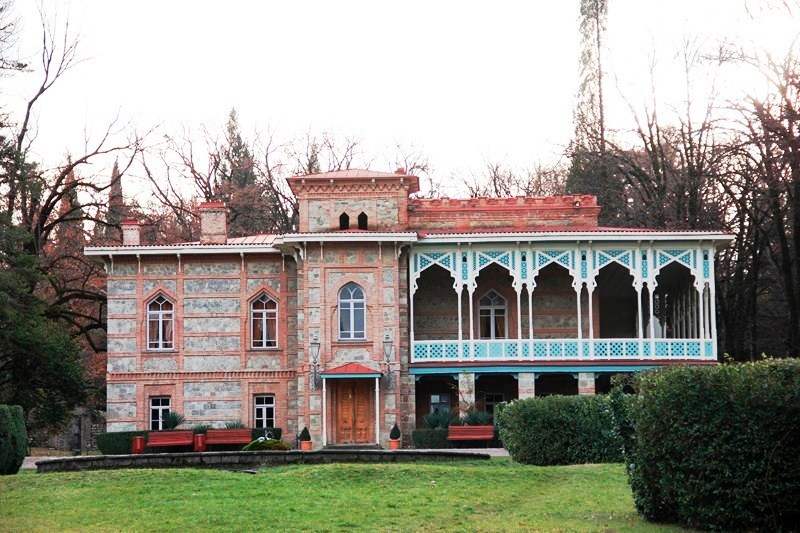
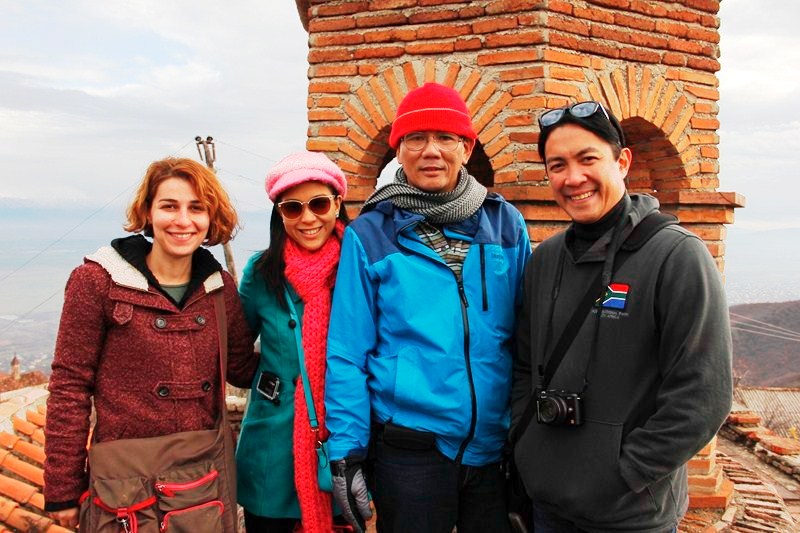
The house-museum (photo - Ms. Riva Galvestan)

The House Museum of Alexandre Chavchavadse (photo:- Ms. Riva Galvestan)

The village, lying in the Alazani River valley, was inherited by the 19th century aristocratic poet (considered to be the founder of Georgian romantic poetry), writer, military leader, diplomat, public figure and inventor Alexandre Chavchavadze (1786-1846), one of the most important figures of his time, from his father, Prince Garsevan  Chavchavadze.
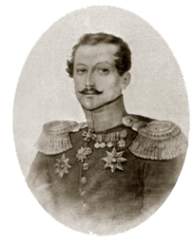
Alexandre Chavchavadze (photo - www.tsinandali.com)

Alexandre Chavchavadze (photo: www.tsinandali.com)

Alexandre refurbished the estate, constructed a new Italianate palace and, in 1835, built a decorative garden, a tranquil refuge in the shadow of the dramatic neighboring Caucasian Mountains. Here, he frequently entertained his foreign guests with music, wit and, most especially, the fine vintage wine made at his estate winery (marani), Georgia’s oldest and largest.
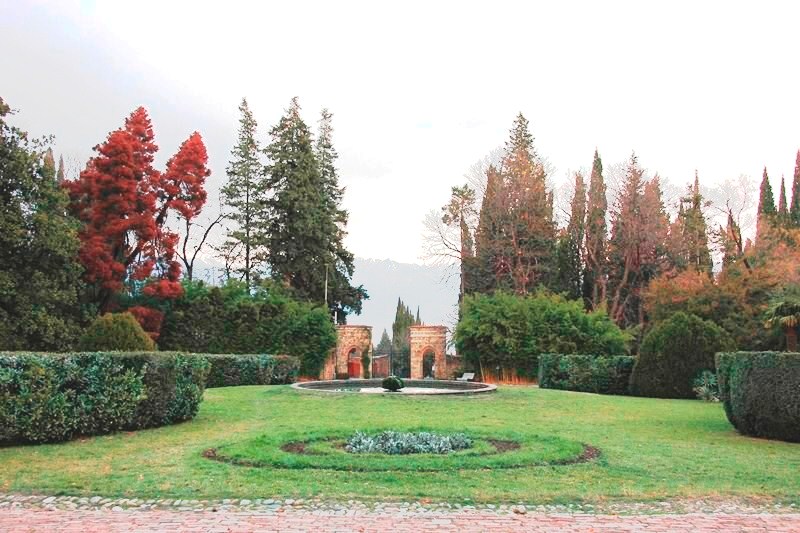
The park (photo: Ms. Riva Galvestan)

The park (photo: Ms. Riva Galvestan)

Familiar with European ways, Alexandre combined European and centuries-long Georgian winemaking traditions when he built the winery in 1846.  He died  in a bizarre accident in Tbilisi when his cloak got caught in the wheel of his carriage and he was thrown out, hitting his head on the ground.
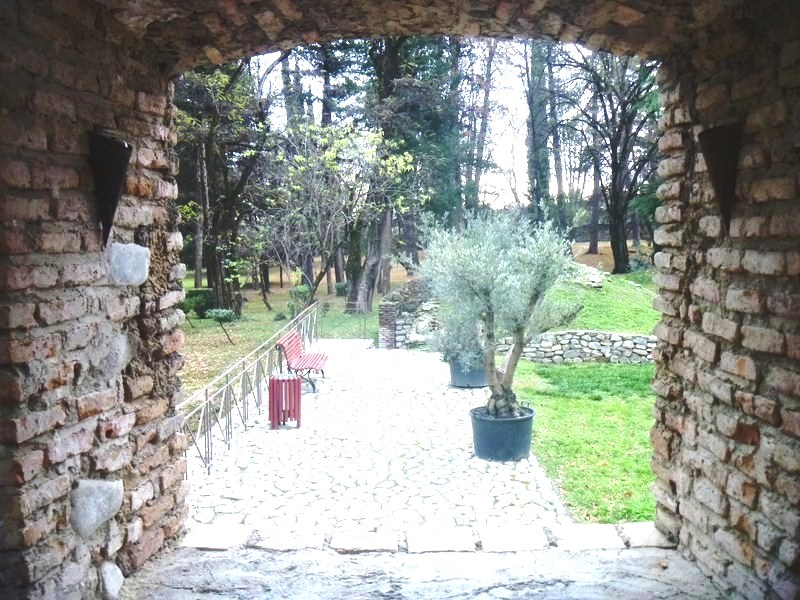
Another view of the garden

Another view of the garden

Alexandre’s vineyard is still cultivated to this day and the highly regarded dry white Tsinandali is still produced here. Visitors can see a bottle of Saperavi wine from 1839, the first harvest at Tsinandali, plus a unique collection of 16,500 bottles of other sorts of wines from many countries.
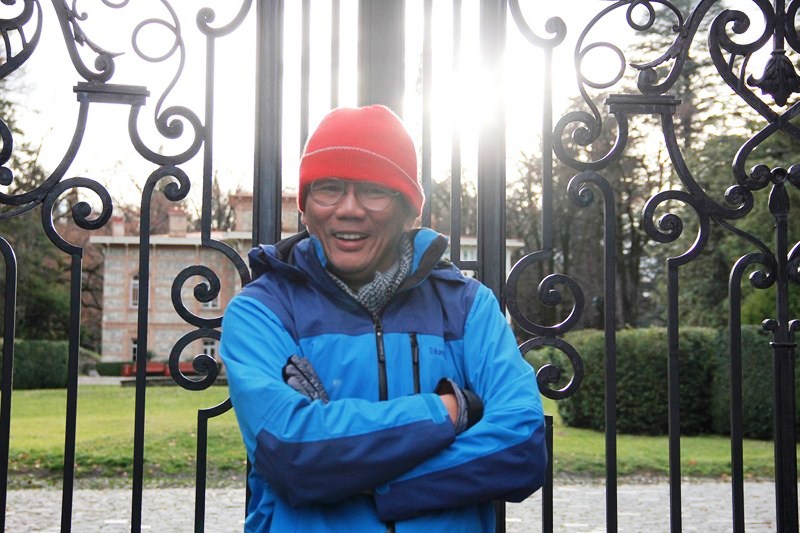
The author waiting outside the manor's iron gate (photo - Ms. Riva Galvestan)

The author waiting outside the manor’s iron gate (photo: Ms. Riva Galvestan)

On February 8, 1886, after David Chavchavadze’s (Alexandre’s son) death, the Chavchavadze family estate and park were acquired by the Estate Department of the Russian Empire and passed to the property of Tsar Alexander III and the Imperial family due to the failure to pay the debt to the Russian Public Bank.
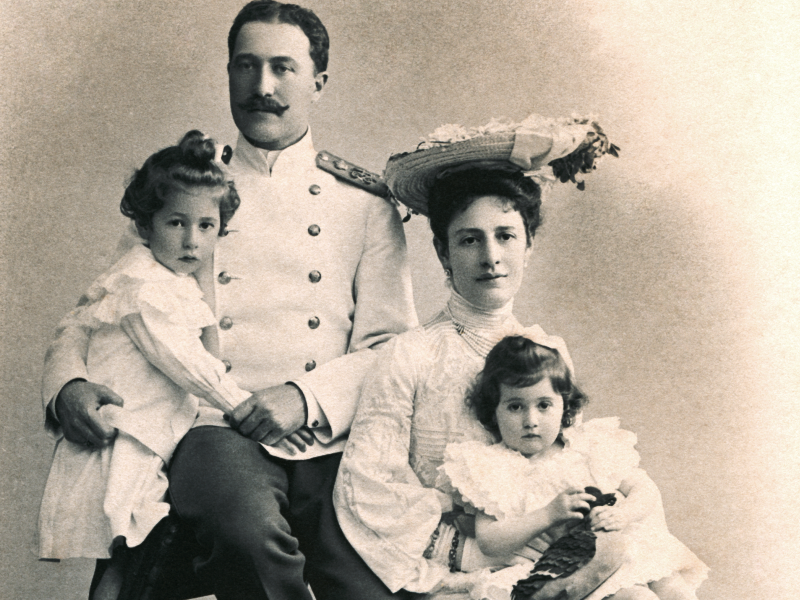
Photo of Chavchavadze's descedants (photo - www.tsinandali.com)

Photo of Chavchavadze’s descedants (photo: www.tsinandali.com)

David had to mortgage the house to raise 14,000 silver rubles as ransom for the 23 women and children (including his wife and children) as well as servants of the household kidnapped on  September 1854 by the charismatic Muslim leader Imam Shamyl and his Lezgin tribesmen from the Dagestan mountains.
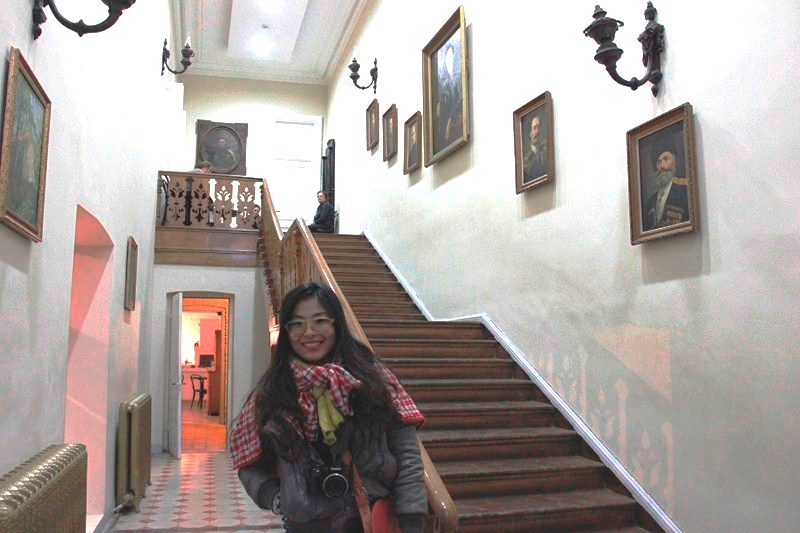
Melissa at the stairway (photo: Ms. Riva Galvestan)

Melissa at the stairway (photo: Ms. Riva Galvestan)

In 1887, the Tsinandali garden was renovated and, in 1917, was passed to the state. On August 1, 1947, the estate was organized into a museum and, in 2008, underwent renovation works when its rooms were restored with 19th century furnishings.
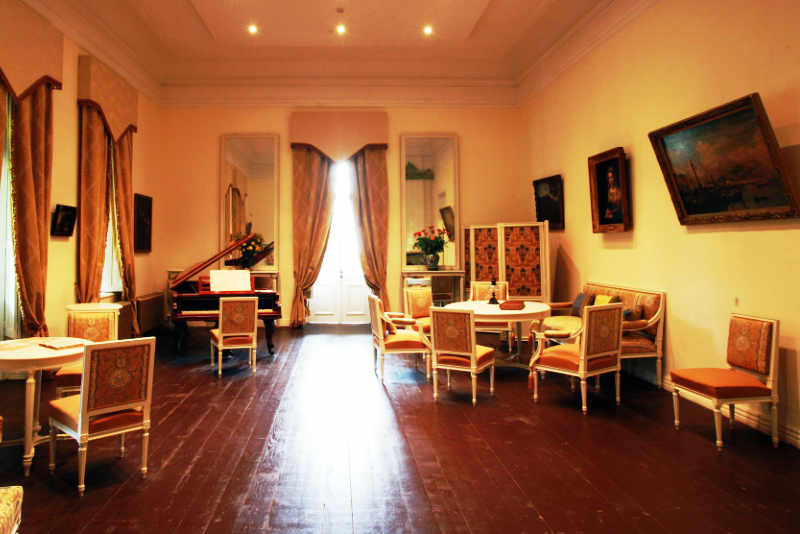
The White Salon (photo - www.tsinandali.com)

The White Salon (photo – www.tsinandali.com)

The 18-hectare house-museum, now leased to the Silk Road Group, a Georgia-based company, often hosts various exhibitions of works of various prominent Georgian and foreign artists such as Salvador Dali, Elene Akhvlediani, Levan Mekhuzla, Dimitri and Sandro Eristavi, Sergo Kobuladze and Karlo Kacharava. Each season, new exhibits make museum even more attractive, turning it into an important cultural site.
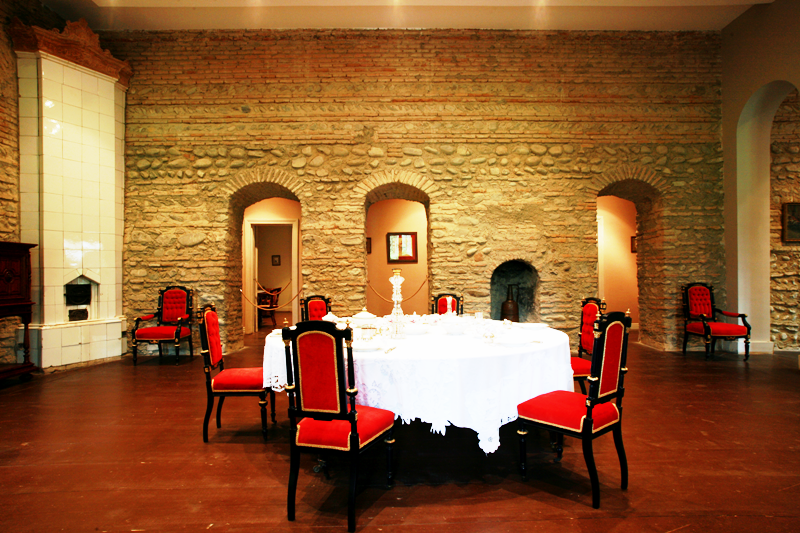
Dining Room (photo: www.tsinandali.com)

Dining Room (photo: www.tsinandali.com)

The perfect mixture of Georgian and European architectural cultures, this relatively small and unpretentious, 2-storey manor house, made with local sandstone, symbolizes the values Aleksandre Chavchavadze wanted to establish in Georgia. The exterior facade features unusually fine stonework and a veranda that incorporates Eastern ornamental woodwork and decorative elements that wraps around two sides of the house.
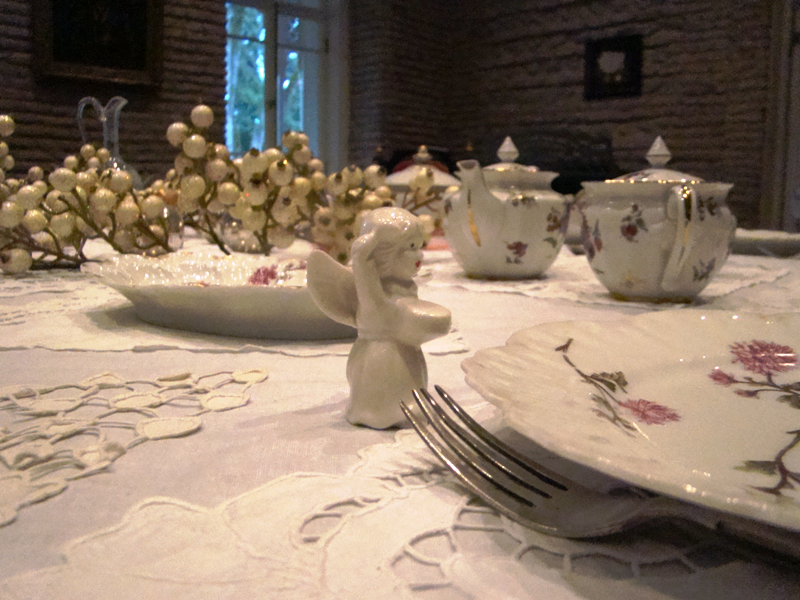
Crockery (photo: www.tsinandali.com)

Crockery at the dining table (photo: www.tsinandali.com)

The rectangular house is situated in the midst of a beautiful and serene 18-hectare park. Its unique and interesting layout features a mixture of natural and decorated gardens. The first landowner in Georgia to employ European landscape designers, Alexandre had the park was renovated in 1887 by the famous landscape designer Arnold Ragel.
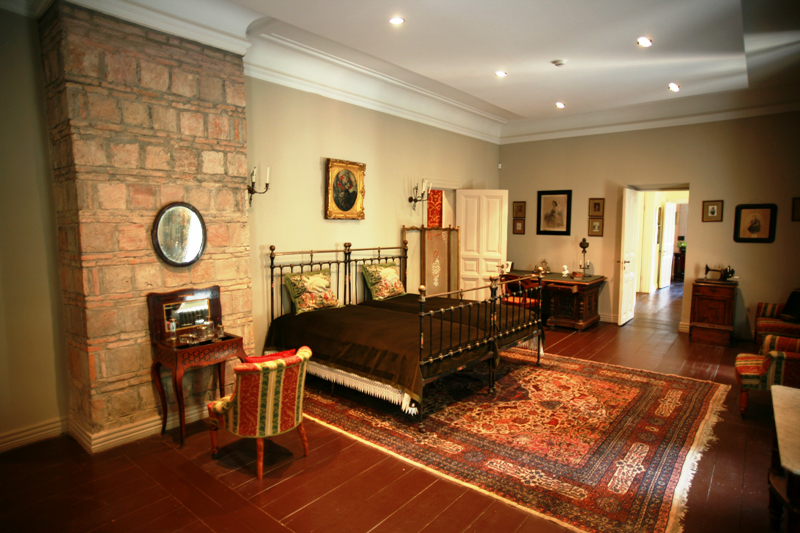
Bedroom (photo: www.tsinandali.com)

Bedroom (photo: www.tsinandali.com)

The park, a harmonious synthesis of wilderness and decorative landscapes, incorporates a number of existing oak, lime and maple trees (now 400 to 500 years old) and consists of orchards, walks and paths lined with vines, flowerbeds, and traditional Georgian rose bushes. On August 20, 1987, the Georgian government placed Tsinandali park on the list of the National Monuments of Landscape Architecture.
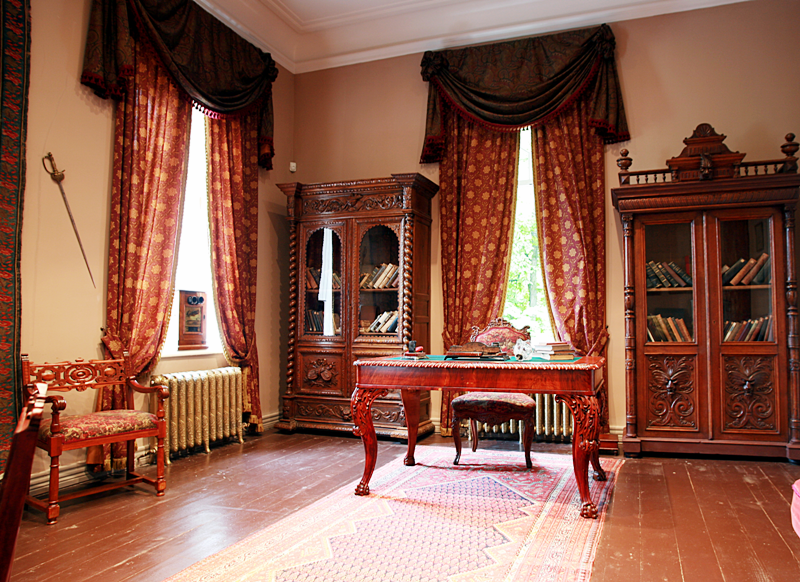
The Library (photo: www.tsinandali.com)

The Library (photo: www.tsinandali.com)

We arrived at the estate just before closing time, parking along a driveway flanked by superb sentinels of cypress trees.  From the imposing iron entrance gate, we walked toward the house, anxious to get away from the biting cold.  Upon entering, we were met by our English-speaking Georgian guide who directed us, up the grand stairway, to the second floor where we were to explore nine rooms of the house that show what the good life in Kakheti must have been like in the 19th century. The exhibits, exclusively devoted to Alexandre’s memorabilia and that of his family, were captioned in Russian and Georgian only.
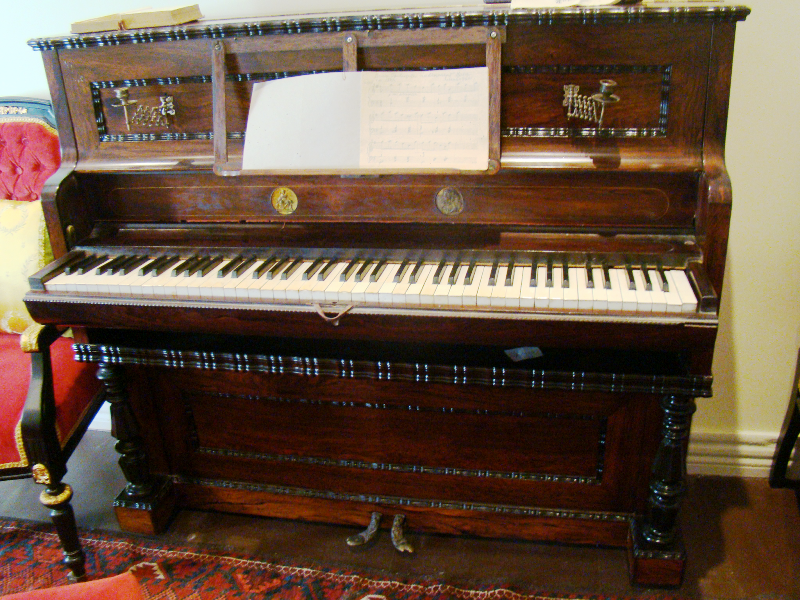
Nina's French piano (photo: www.tsinandali.com)

Nina’s French piano (photo: www.tsinandali.com)

Our guide showed us objects that represent both the poet’s life and creative work –  his epistolary and iconography archive; editions on various subjects in French, German, English, Polish and Armenian languages; manuscripts; works of photographer Ermakov; samples of painting and lithography; household objects; crockery (Chinese, Japanese, French, German, Italian, Georgian, Russian) and musical instruments.
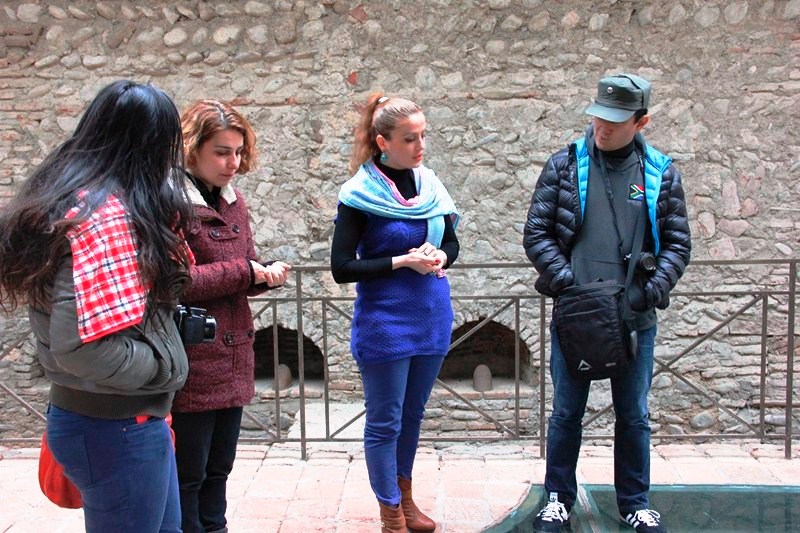
L-R: Melissa, Sopho, our Georgian guide and Consul Cunanan (photo - Ms. Riva Galvestan)

L-R: Melissa, Sopho, our Georgian guide and Consul Cunanan (photo – Ms. Riva Galvestan)

The museum still had some of its original Georgian, Russian and French  furniture, including the French piano (the first recorded piano in Georgia) with a folding keyboard, bought from Europe and given by Alexander Griboedov to his wife Nina (Alexandre’s daughter). There were also interesting paintings and photos of people and events associated with the house, including the Lezgin raid. There’s also a reproduction of the Winterhalter portrait of Chavchavadze’s wife Salome. Photography wasn’t allowed inside.
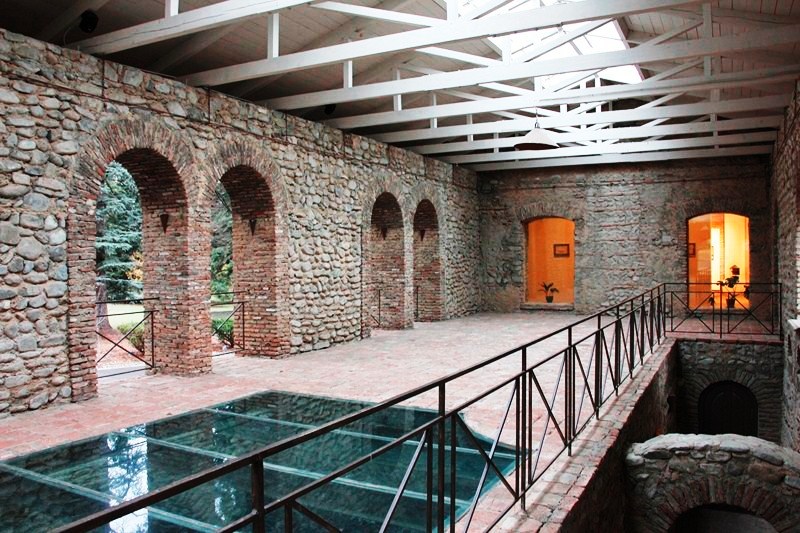
The hallway leading to the wine cellar (photo: Ms. Riva Galvestan)

The hallway leading to the wine cellar (photo: Ms. Riva Galvestan)

There is a souvenir shop on the ground floor of the museum where one can find arts and crafts from the Kakheti region. Copies of Nino Chavchavadze’s handkerchief and of artifacts from archaeological excavations in Georgia are among the items for sale.   Before leaving, we had coffee at the museum’s café.
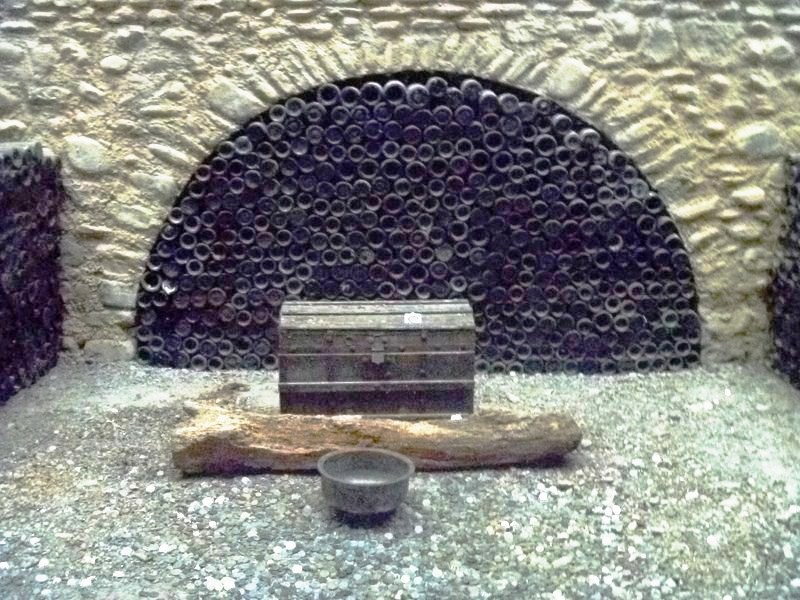
The wine cellar

The wine cellar

Tsinandali Museum: 2217 M-42, Tsinandali, Telavi District. Tel: (+995, 350) 3 37 17. Mobile number(+995 5 99) 71 41 22.  E-mail: maia_kokocha@yahoo.com. Website: www.tsinandali.com.  Open Mondays to Thursdays, 10 AM – 6 PM, Fridays to Sundays, 10 AM – 7 PM. During the winter months, the museum closes at 5 PM.
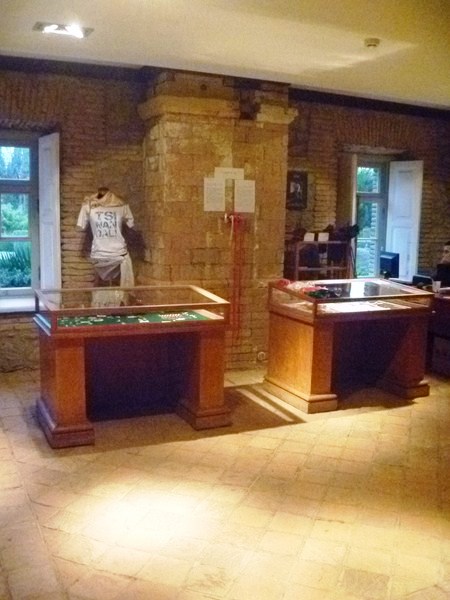
Souvenir shop

Souvenir shop

Admission: standard (5 GEL, includes entrance to the garden, museum and vineyard as well as a guide to the museum exhibits), standard + tasting of one sort of Georgian wine (7 GEL), standard + tasting of various Georgian wines (20 GEL), visiting only park (2 GEL), schoolchildren (3 GEL) and university/college students (4 GEL). Entrance is free on May 18 (International Museum Day). Admission is also free for “Museum Honored Guests,” ICOM & UNESCO, children under school age and socially deprived, and refugees. 

Georgia National Tourism Administration: 4, Sanapiro St, 0105, Tbilisi, Georgia. Tel: +995 32 43 69 99. E-mail: info@gnta.ge. Website: www.georgia.travel; www.gnta.ge.

Qatar Airways has daily flights from Diosdado Macapagal International Airport (Clark, Pampanga) to Tbilisi (Republic of Georgia) with stopovers at Hamad International Airport (Doha, Qatar, 15 hrs.) and Heydar Aliyev International Airport (Baku, Azerbaijan, 1 hr.). Website: www.qatarairways.com.
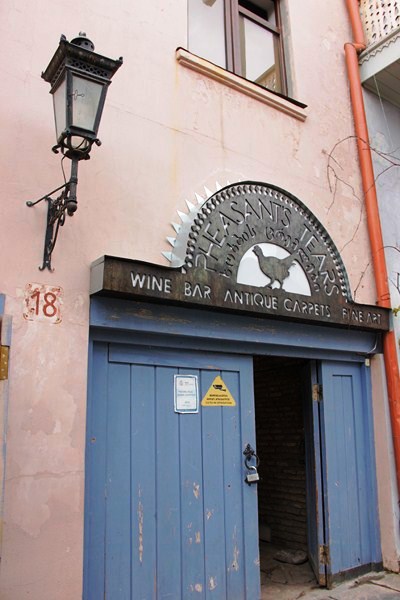
Pheasant’s Tears (Sighnaghi, Georgia)

(All photos courtesy of Ms. Riva Galveztan)

The endpoint of our GNTA-sponsored walking tour of Sighnaghi town proper was Pheasant’s Tears where Buddy, Pancho, Riva, Mel and I, together with our Georgian guide Sopho Makashvili, were to have lunch and sample some Georgian wine.  Pheasant’s Tears, a Georgian winery that produces artisanal natural wines according to ancient Georgian traditions, was founded in 2007 by John H. Wurdeman V and Gela Patalishvili.

Pheasant's Tears

Pheasant’s Tears

John, an en plein air painter and the first American graduate of the prestigious Surikov Institute in Moscow, first came to Georgia in 1996 and bought a house in Sighnaghi the following year. In 1998, he relocated to Georgia full time. Gela, a winegrower whose family’s connection with wine goes back 8 generations, met John in 2005 when John was painting in a vineyard near the highway in the Alazani Valley near the village of Tibaani.  They decided to work together and set up Pheasant’s Tears. The name “pheasant’s tears” refers to a Georgian story in which only the very best wines are good enough to make a pheasant cry.  

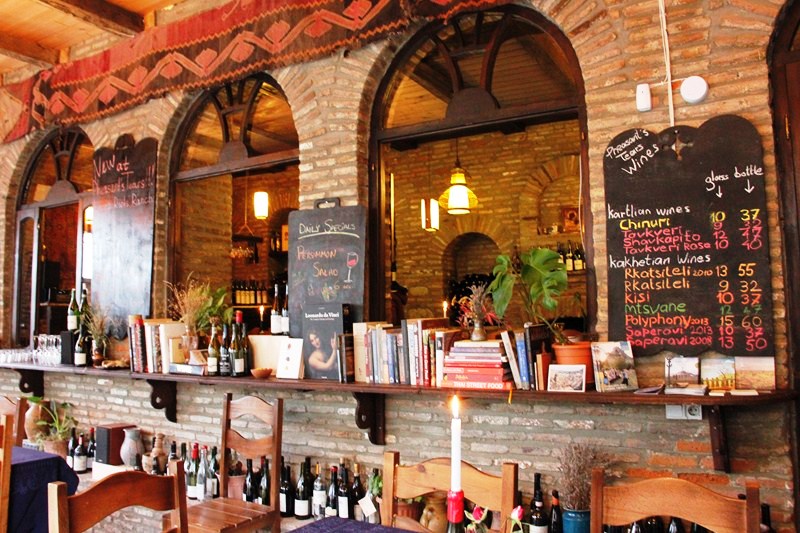
The restaurant's rustic interior

The restaurant’s rustic interior

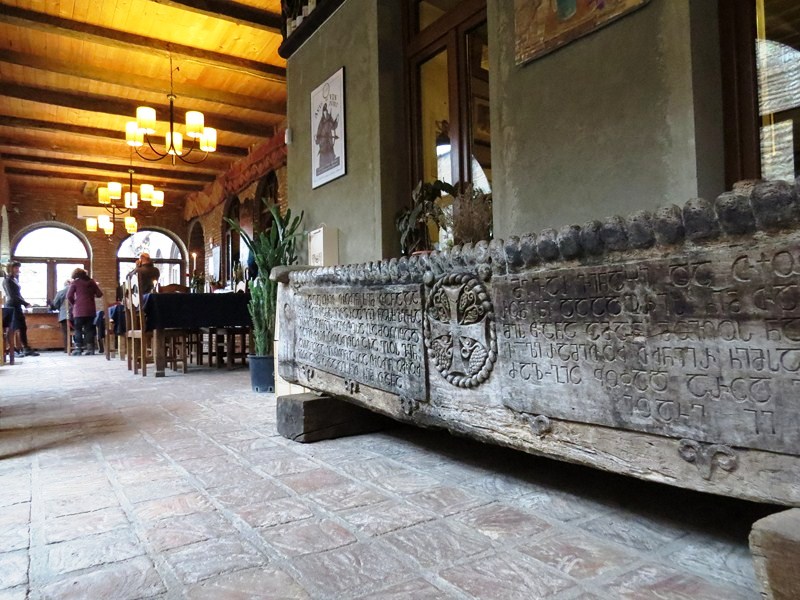
An old wine press

An old wine press

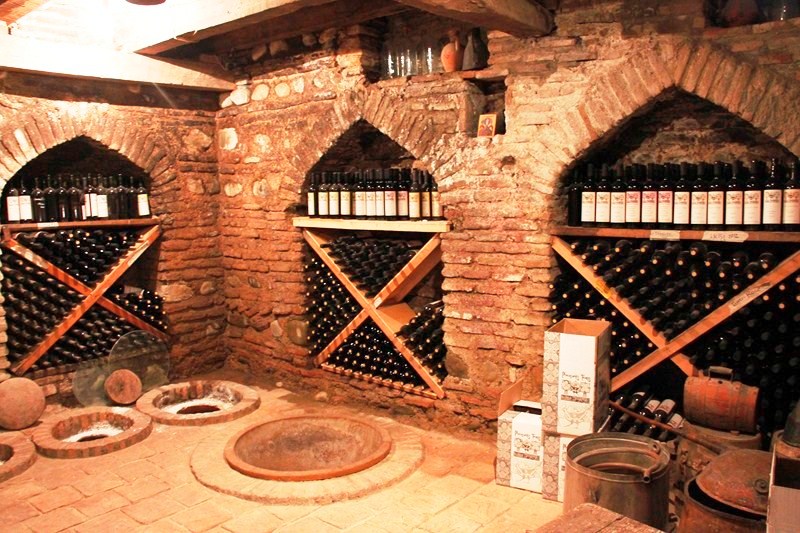
Upon arrival, we were welcomed by Mr. Shergil Pirtskhelani, Pheasant’s Tears sommelier (wine steward), who brought us all to the winery’s basement cellar and gave us a brief introduction on ancient Georgian wine making traditions.  All wines are fermented in kvevri, traditional clay amphorae which are lined with organic beeswax and buried into the ground. Kvevri wines seem to age faster than conventional wines.

The wine cellar

The wine cellar

Fermentations using naturally occurring yeast is employed and slightly different techniques are used to make each of the wines. Some have moderate skin contact while others have minimal (3 weeks to 6 months). Stems are included in the wine making process. In 2013, the ancient traditional kvevri wine-making method was inscribed on the UNESCO representative list of “Intangible Cultural Heritage of Humanity.”

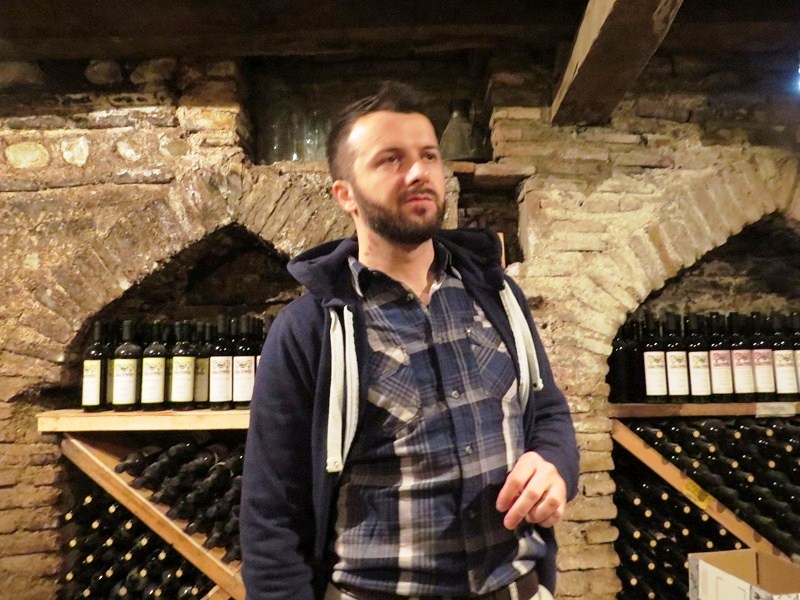
Our host Shergil Pirtskhelani

Our host Shergil Pirtskhelani

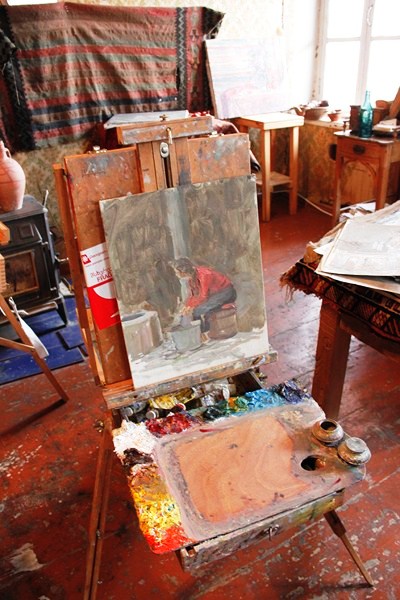
After this brief introduction, Shergil then toured us around John’s (who was at Tokyo during our visit) studio which houses his books, painting paraphernalia (easels, paint, brushes, etc.) and artwork that reflects John’s overflowing passion and love for Georgia.

Studio of John H. Wurdeman V

Studio of John H. Wurdeman V

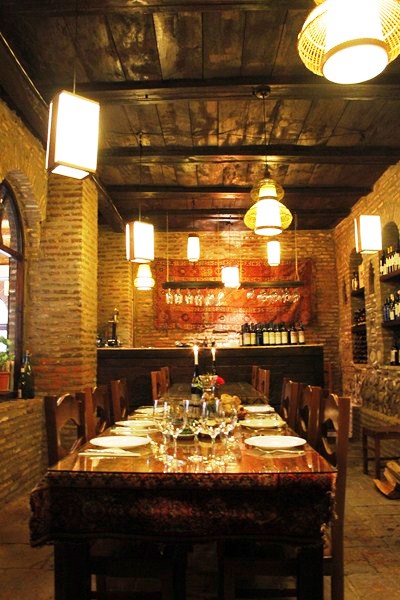
It was now time for lunch and we all went down to the private dining room which had a warming fireplace.  The supra (Georgian feast) before us, prepared with fresh ingredients from the local markets by head chef Gia Rokashvili, a local Sighnaghian, was a take on traditional Georgian cuisine with an eye towards wine and food pairings, all designed to accommodate both veggie (Sopho and Riva belonged to this category) and meat lovers.

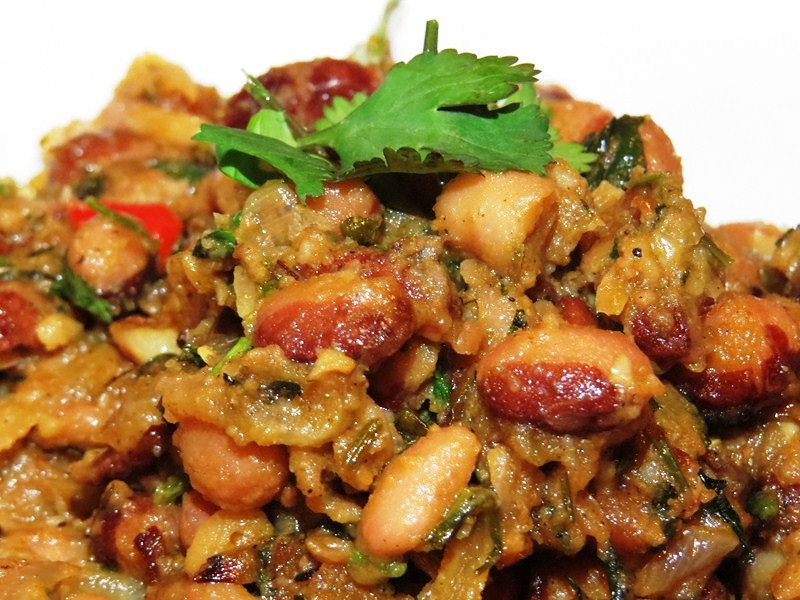
Kidney beans with wild thyme

Kidney beans with wild thyme

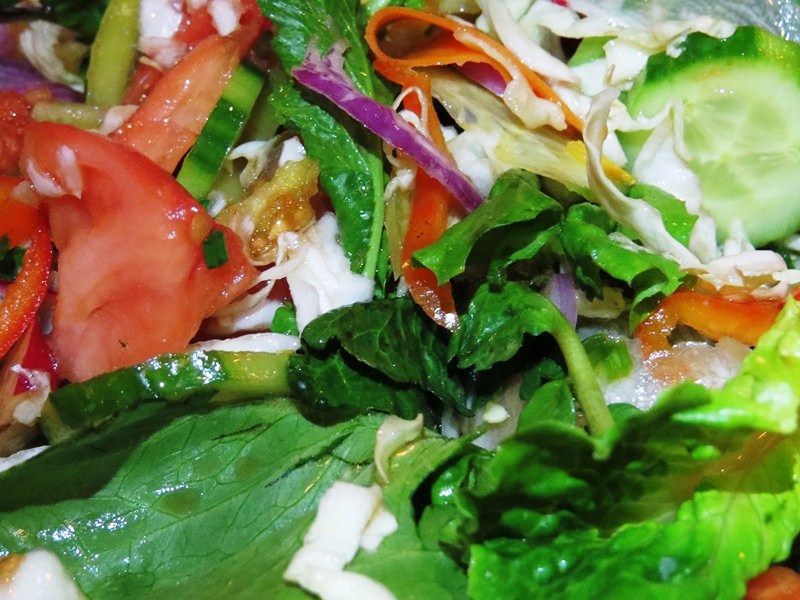
Fresh vegetable salad

Fresh vegetable salad

Stewed veal with vegetables

Stewed veal with vegetables

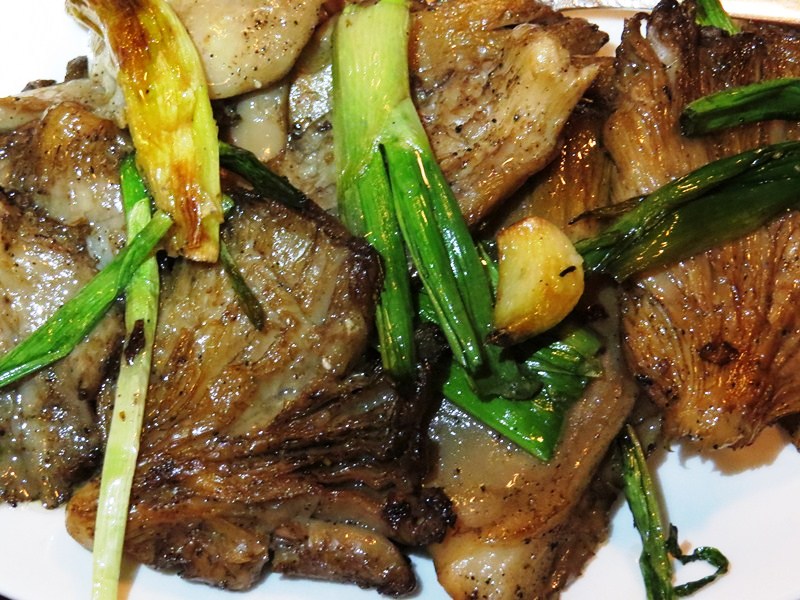
On the menu was matsoni (strained water buffalo yoghurt with red pepper); curds with black pepper and green onions; fresh vegetable salad, (radish, carrots, arugula, cabbage, onions, olives, tomatoes and cucumber in sunflower seed oil); mushrooms sautéed with garlic; kidney beans with wild thyme; omelet (radish greens, onions, pepper and broccoli); roast potatoes with tkemali (wild plum sauce) and stewed veal with vegetables.

The private dining room

The private dining room

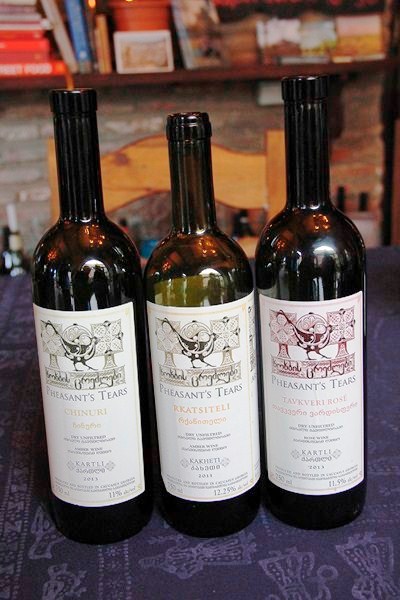
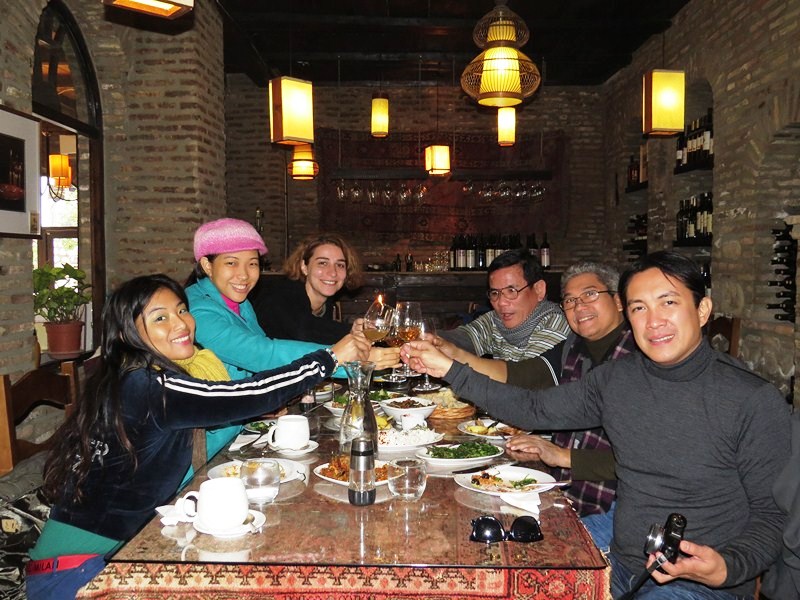
While dining, Shergil poured 3 kinds of Georgian wine in our respective wine glasses for us to taste, helping us understand the roots that these wines came from.  We started with Chinuri 2013, the lightest, crispest white wine in the line-up; followed by Rkatsiteli 2011 which was spicy and exotic on the nose, with warm peachy notes; and Tavkvevri 2013, a vivid, juicy and berryish red wine.  He also assumed the role of tamada (Georgian toastmaster) as we sampled each of these wines.

Chinuri, Rkatsiteli and Tavkvevri wine

Chinuri, Rkatsiteli and Tavkvevri wine

L-R- Mel, Riva, Sopho, the author, Pancho and Buddy

L-R- Mel, Riva, Sopho, the author, Pancho and Buddy

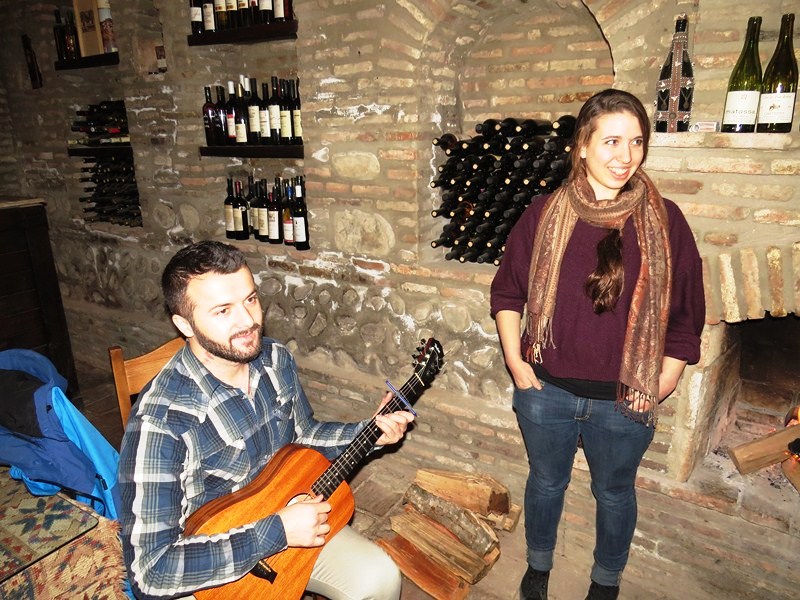
Shergil happened to be a music teacher who teaches folk and sacred songs from Georgia with traditional Georgian stringed instruments. After our magnificent repast, he regaled us by playing the guitar while Ms. Enek Peterson, an American from Boston (Massachusetts), serenaded us with the popular spiritual song “Hallelujah” (written by Canadian singer-songwriter Leonard Cohen in 1984) plus a Georgian song. This capped a wonderful afternoon filled with great art, delightful Georgian cuisine and soul-searching music.

Shergil and Enek serenading us with two songs

Shergil and Enek serenading us with two songs

Pheasant’s Tears: 18 Baratashvili St., Sighnaghi, Georgia 4200.  Tel: 0 355 23 15 56.  Mobile number: +(995 599) 53-44-84. E-mail: jwurdeman@pheasantstears.com. Website: ww.pheasantstears.com.

Georgia National Tourism Administration: 4, Sanapiro St, 0105, Tbilisi, Georgia. Tel: +995 32 43 69 99. E-mail: info@gnta.ge. Website: www.georgia.travel; www.gnta.ge.

Qatar Airways has daily flights from Diosdado Macapagal International Airport (Clark, Pampanga) to Tbilisi (Republic of Georgia) with stopovers at Hamad International Airport (Doha, Qatar, 15 hrs.) and Heydar Aliyev International Airport (Baku, Azerbaijan, 1 hr.). Website: www.qatarairways.com.
Sighnaghi: City of Love (Georgia)

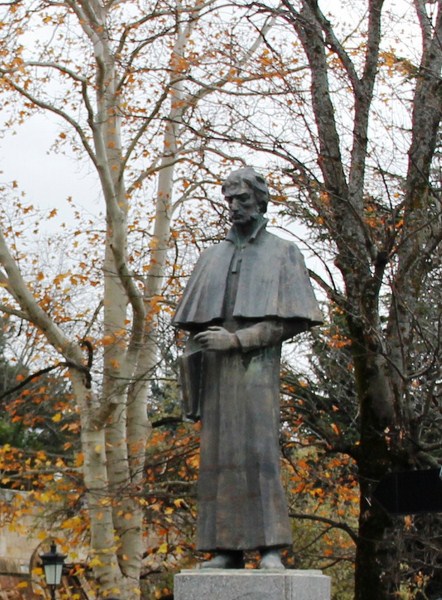
After our short stopover at the venerated Bodbe Monastery, we continued on our GNTA-sponsored tour, proceeding on a short 2-km. drive to the town center of Sighnaghi.  We arrived at the town by 11:30 AM and alighted at a park with a monument to Georgian philosopher, journalist, historian and native son Solomon Dodashvili (May 17, 1805 – August 20, 1836).

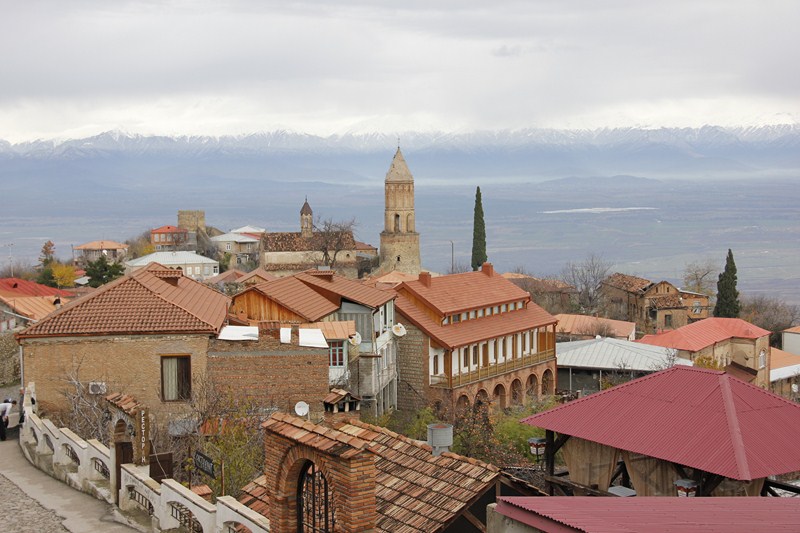
Postcard-pretty Sighnaghi

Postcard-pretty Sighnaghi (photo: Ms. Riva Galveztan)

Other famous sons of the town include composer Vano Sarajishvili, political figure Sandro Mirianashvili and world-renowned primitivist painter Niko Pirosmani. We were to have lunch at Pheasant’s Tears but, as we still had some time to spare, our Georgian guide  Sopho Makashvili took us on a walking tour around the town.

Monument to native son Solomon Dogashvili

Monument to native son Solomon Dogashvili (photo: Ms. Riva Galveztan)

Sighnaghi, located in Georgia’s easternmost region of Kakheti, is the administrative center of the Sighnaghi district and one of the country’s smallest (2.978 km²) towns (2002 population: 2,146).  One of Georgia’s leading trading centers in the 19th century,  Sighnaghi’s economy is dominated by the production of wine, leather, gobelin tapestry, woodcarving, metal craft, ceramics, traditional carpets and traditional food.

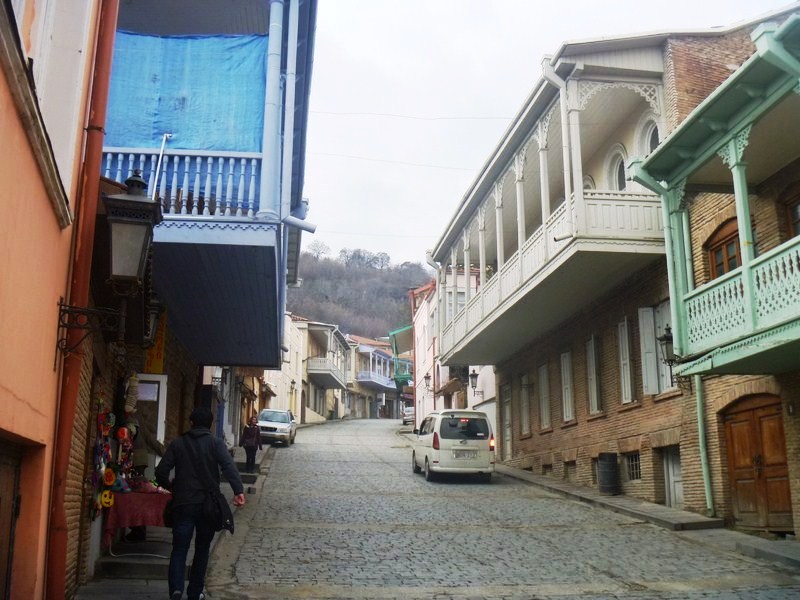
Uniquely designed terrace architecture of the town

Uniquely designed terrace architecture of the town

The town and its environs, also known for their landscapes and historical monuments, has recently undergone a fundamental reconstruction and has become an important part of the Georgian tourism industry (it is now known as the “City of Love”).  The town is also the jump-off point for exploring the lush vineyards of Kakheti, the cradle of wine (Georgia boasts of 500 varieties of grapes, more than anywhere else in the world).

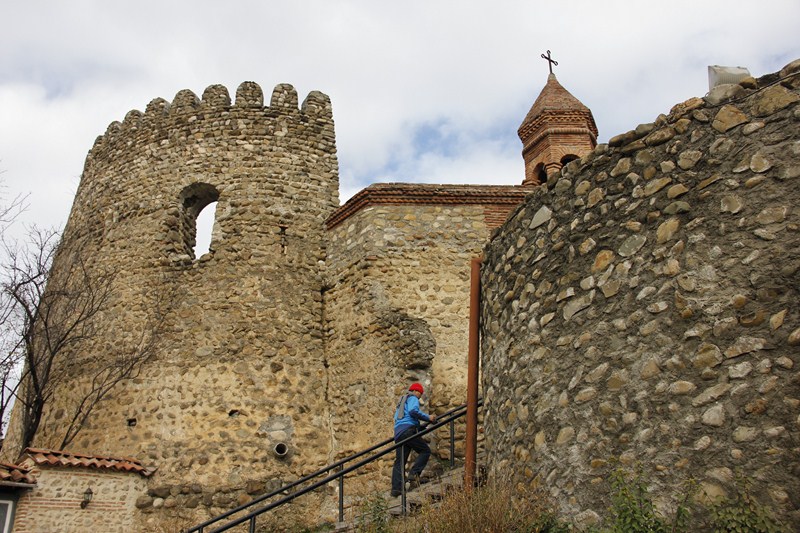
The author exploring part of Sighnaghi's defensive wall and towers

Exploring part of Sighnaghi’s defensive wall and towers (photo: Ms. Riva Galveztan)

The town was developed in the early 18th century by the king Erekle II (Heraclius II) as a refuge for the population against Lezgin and Persian attack, hence the name sighnaghi which comes from the Azeri word signak meaning “shelter.” In 1762, he sponsored the construction of the town and erected a fortress to defend the area from marauding attacks by Dagestan tribesmen.  The 4.5 m. high, 1.5 m. wide and 4.5 km. long city wall, one of the biggest in Georgia, has 23 towers, each named after local villages the town is surrounded by, and 6 entrances.

Our guide Sopho Makashvili, Riva Galvezltan, the author and Consul Buddy Cunanan

Our guide Sopho Makashvili, Riva Galvezltan, the author and Consul Buddy Cunanan (photo: Ms. Riva Galveztan)

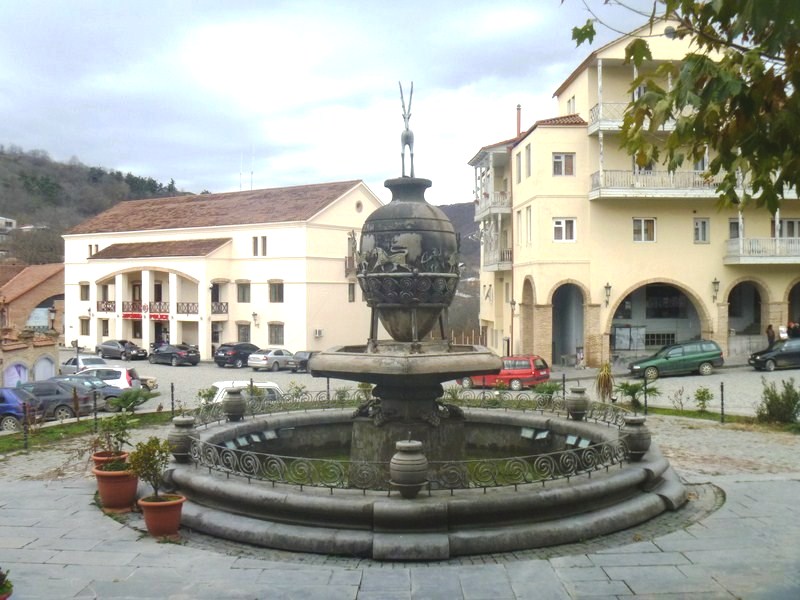
Sopho showed us, from afar, the section of the city’s defensive wall that has been restored for tourism and we climbed one of the towers for a panoramic view of the town.  Walking along the town’s narrow cobblestone streets, I was also enthralled by the uniquely designed terrace architecture of the 2 to 3-storey tiled-roof houses of Sighnaghi, the majority of which still date back from 17th, 18th and 19th century.  Built with fine Georgian brick, they were built to accommodate a variety of stores and workshops, above which are wooden, lacy balconies and bow-backed windows.  The town also has a beautiful fountain.

A beautiful fountain

A beautiful fountain

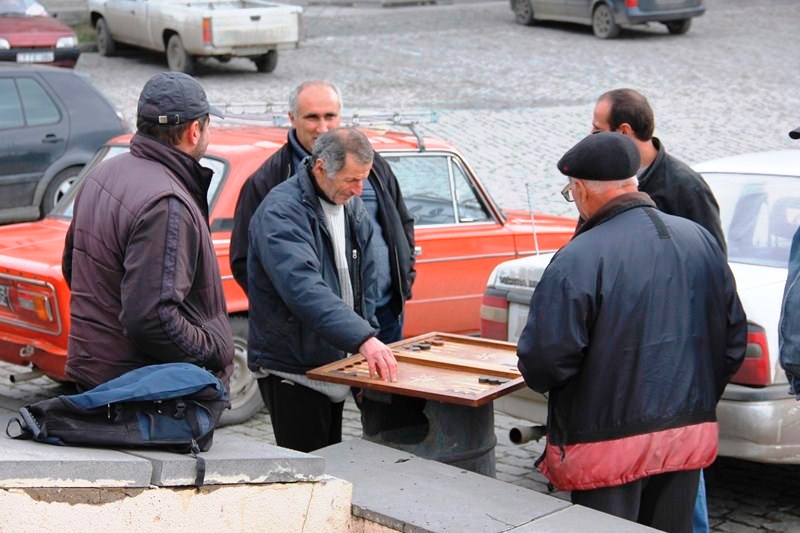
Consul Buddy Cunanan and I also observed a number of Georgian men playing nardi (backgammon). Popular in Georgia, men, women, children and the elderly all know how to play it, and just about every family owns a backgammon set. They say that life in Georgia is like a game of backgammon – people tend to approach life like a game of chance.

Georgian men playing backgammon in the open

Georgian men playing nardi (backgammon) in the open (photo: Ms. Riva Galveztan)

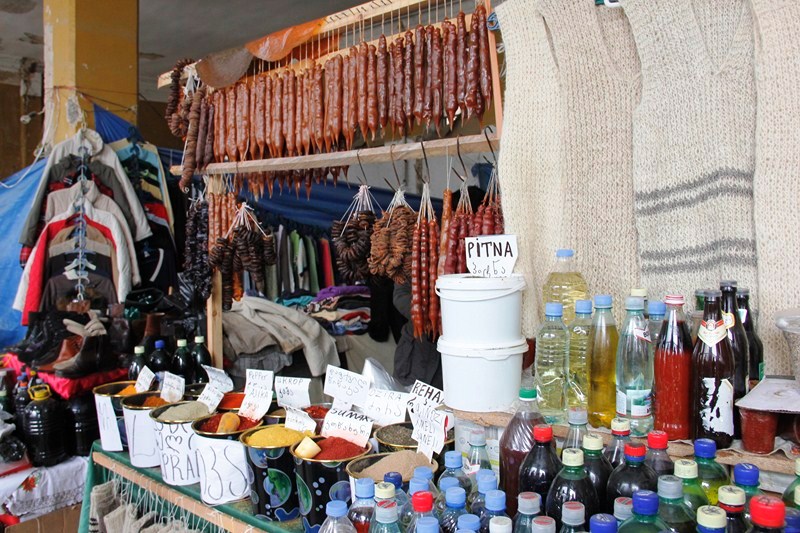
We also visited the town’s market, near the town hall, where fresh fruits and vegetables, locally made Georgian red (saperavi) and white wine and the clear and strong chacha (Georgian pomace brandy); natural honey; churchkhela (the traditional type of Georgian candy from the Caucasus region also referred to as the Georgian “Snickers”) and cheeses.  Buddy and I each tried out a glass of Georgian wine.

An array of products sold at the market

An array of products sold at the market (photo: Ms. Riva Galveztan)

There are also Georgian spice and spice mixes such as khmeli suneli (a powdered herb/spice mixture), adjika (a spicy paste or sauce seasoned with hot chili peppers) and pilpili (pepper) plus a picturesque array of knitted goods (Georgian socks with traditional patterns, local wool, hats, scarves, slippers, baby booties, etc.) for sale at cheap prices.

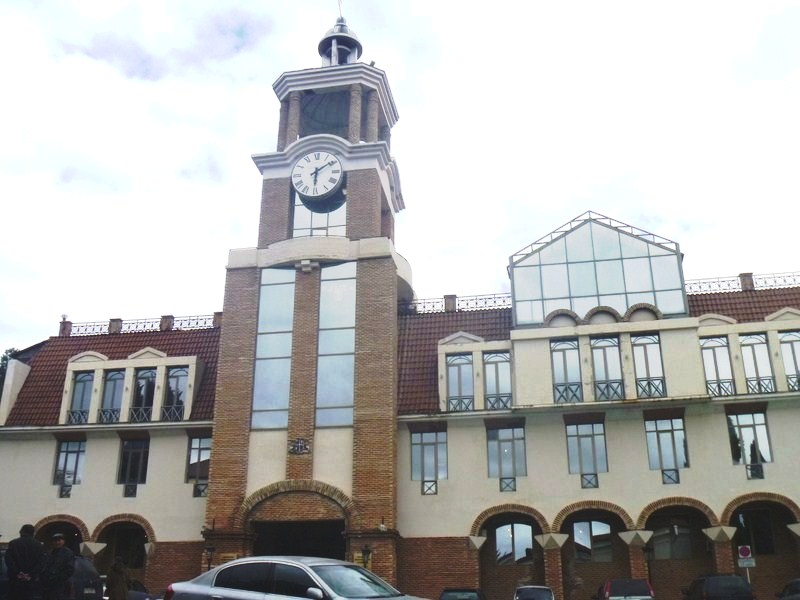
The town hall with its distinctive clock tower

The town hall with its distinctive clock tower

Georgia National Tourism Administration: 4, Sanapiro St, 0105, Tbilisi, Georgia. Tel: +995 32 43 69 99. E-mail: info@gnta.ge. Website: www.georgia.travel; www.gnta.ge.

Qatar Airways has daily flights from Diosdado Macapagal International Airport (Clark, Pampanga) to Tbilisi (Republic of Georgia) with stopovers at Hamad International Airport (Doha, Qatar, 15 hrs.) and Heydar Aliyev International Airport (Baku, Azerbaijan, 1 hr.). Website: www.qatarairways.com.
The Monastery of St. Nino at Bodbe (Sighnaghi, Georgia)

Just 2 kms. from the town of Sighnaghi, we made another stopover at the Monastery of St. Nino at Bobde, one of the major pilgrimage sites in Georgia as it is the burial place of the revered St. Nino. A 4th-century female evangelist of Georgians, she is credited with the conversion of the ancient East Georgian Kingdom of Iberia (and Armenia by some accounts) to the Orthodox Christian faith.  She withdrew to the Bodbe Gorge, in Kakheti, and died there around 338-340 AD.  At the behest of Iberian King Mirian III (reign: 284-361 AD), a small monastery was built at the place where St. Nino was buried.

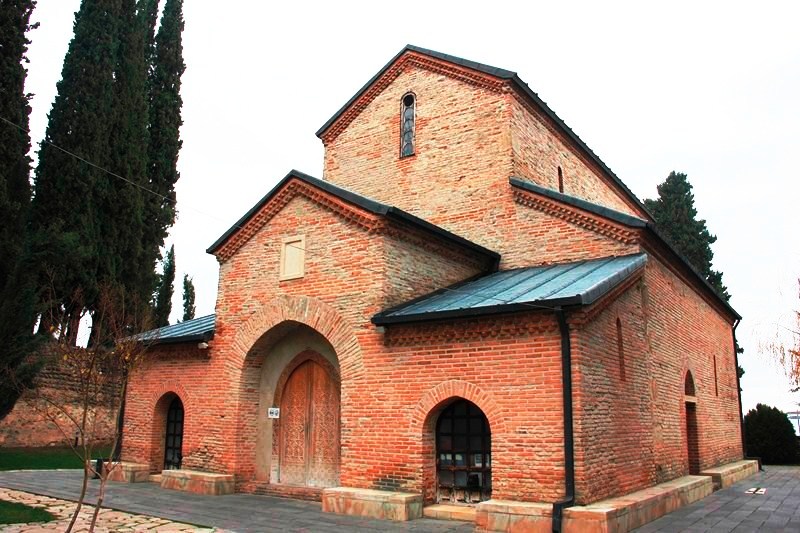
The monastery church

The monastery church

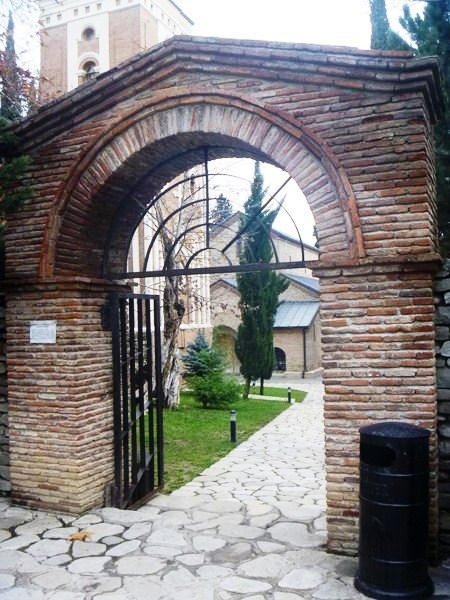
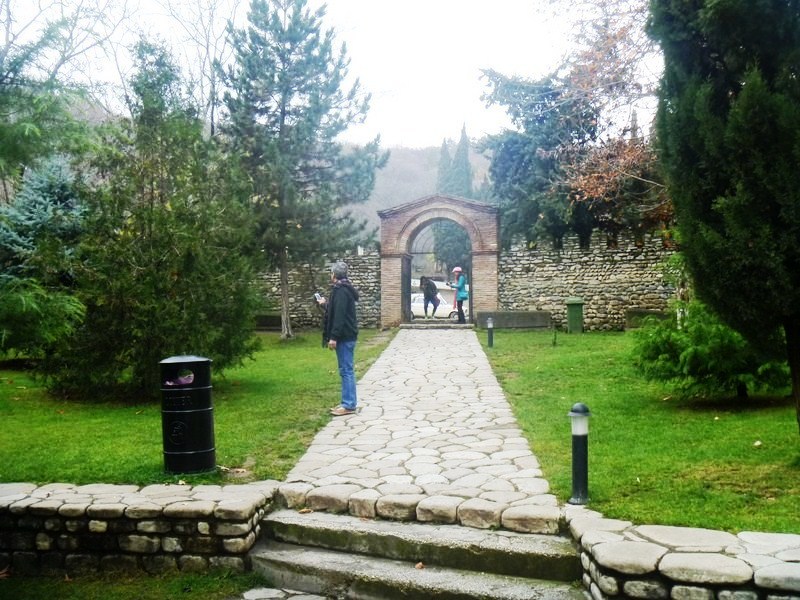
The monastery gate

The monastery gate

During the late Middle Ages, the monastery gained particular prominence when it was favored by the kings of Kakheti who chose it as the place of their coronation. In 1615, the Bodbe monastery was pillaged by troops of Shah Abbas I of Persia but was restored by King Teimuraz I of Kakheti (reign: 1605-1648). With the revival of monastic life in Bodbe, a theological school was opened  and the monastery also operated one of the largest depositories of religious books in Georgia and was home to several religious writers and scribes.

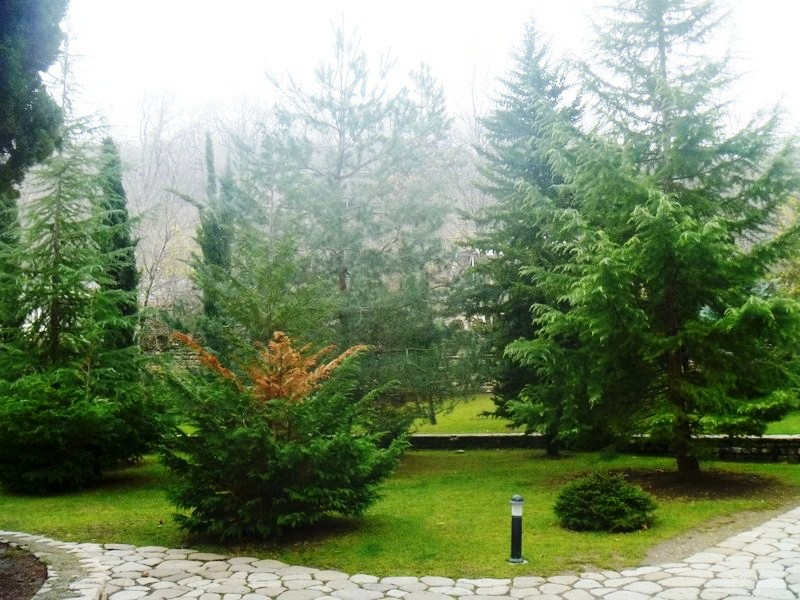
The well-kept garden with cypress trees

The well-kept garden with cypress trees

Under Metropolitan John Maqashvili, Bodbe monastery continued to flourish even after the annexation of Georgia by the Russian Empire (1801), enjoying the patronage of Tsar Alexander I of Russia. In 1823, the monastery was repaired and adorned with murals. However, upon John’s death in 1837, the Russian Orthodox exarchate, active in Georgia since 1810, abolished the convent and converted it into a parish church.  The monastery went into disrepair in the following decades but, in the 1860s, Archimandrite Macarius (Batatashvili) began to restore the monastery and established a chanting school.

The cobble stone walkway

The cobble stone walkway

In the 1880s, Mikhail Sabinin refurbished the chapel housing St. Nino’s relics. In 1889, Tsar Alexander III of Russia visited Bodbe and decreed to open a nunnery there. The resurrected convent operated a school where needlework and painting was taught but, in 1924, the Soviet government closed down the monastery and converted it into a hospital. In 1991, after the dissolution of the Soviet Union, the Bodbe monastery was resumed as a convent. Between 1990 and 2000, restoration works were carried out.  In 2003, restoration was resumed when part of the 17th-century wall surrounding the basilica was demolished and the earlier, original one restored.

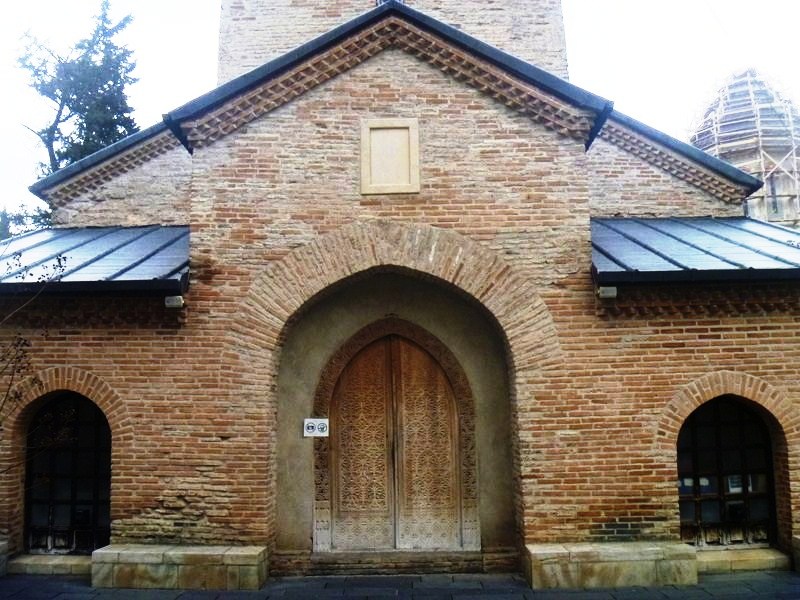
The church entrance

The church entrance

Today, the monastery, nestled among tall cypress trees on a steep hillside overlooking the Alazani Valley, is very well set up to the handle the thousands of visitors it receives each year. Just outside the gates is a complex with amenities such as parking, a restaurant run by the nuns, and clean restrooms.

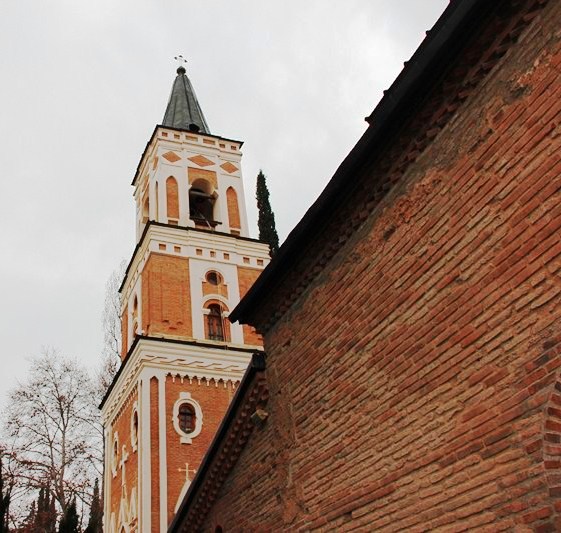
The bell tower (photo: Ms. Riva Galveztan)

The bell tower (photo: Ms. Riva Galveztan)

Once inside the gate, we were welcomed by lovely, well-kept and peaceful gardens and orchards. I instantly felt relaxed as we walked its smooth stone walkways surrounded by its peaceful beauty.  In spite of our arrival, the nuns we saw still went about their daily business and devotions. The first structure that greets you is the free-standing, 3-storey bell-tower which was erected between 1862 and 1885.

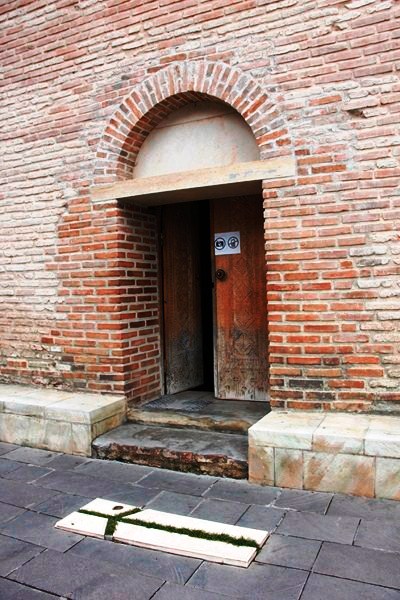
A grave beside a side entrance

A grave beside a side entrance

Adjacent to the tower is the extant church, a 3-nave aisled basilica with 3 protruding apses.  Originally built between the 9th and 11th centuries, it had been significantly modified and restored, especially in the 17th and 19th centuries when both exterior and interior walls were plastered. Integrated within the basilica is a small hall church with an apse built over St. Nino’s grave.  Photography wasn’t allowed inside and strict dress code is observed. The church is richly decorated with frescoes and there are a few impressive icons in it. The tomb of St. Nino is covered with a marble memorial.

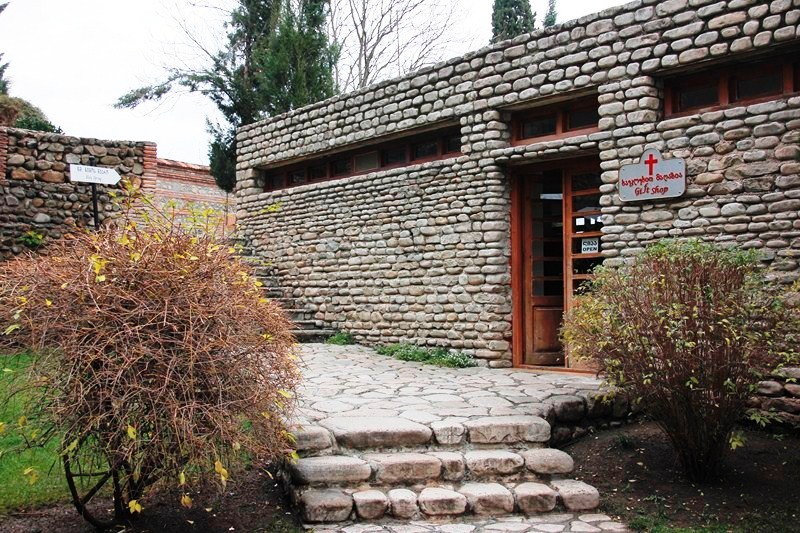
The Gift Shop (photo: Ms. Riva Galveztan)

The Gift Shop (photo: Ms. Riva Galveztan)

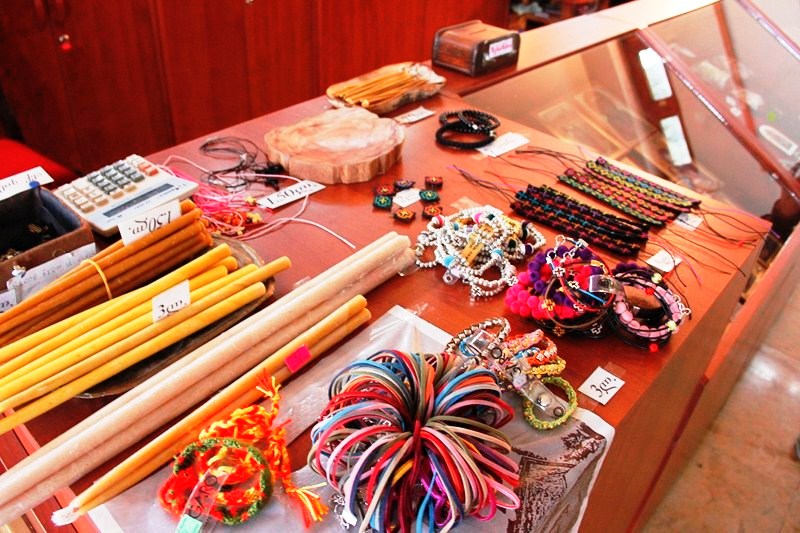
Items on sale at the Gift Shop (photo: Ms. Riva Galveztan)

Items on sale at the Gift Shop (photo: Ms. Riva Galveztan)

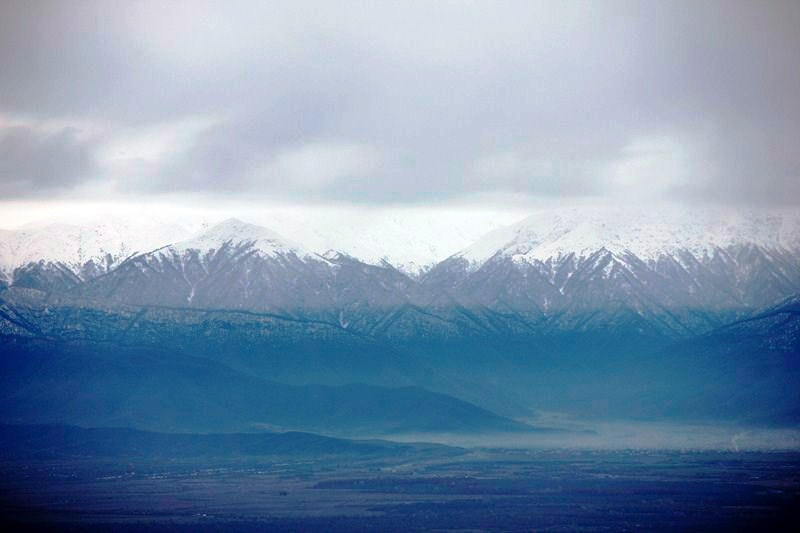
At the back of the church is a viewpoint with a spectacular view of the Alazani Valley beneath us and, as it was a fine, clear day, the snow-clad  Greater Caucasus mountains beyond. Quite enchanting.  We also visited the nice gift shop which has religious and cultural items (icons, prayer ropes, books, local Georgian crafts, postcards, candles, trinkets, etc.) on sale.  Here, I bought a beautiful watercolor painting of St. Nino (not an iconic painting but a modern painting) as well as one of Emperor Constantine and St. Helena together. I left these with Buddy, who had it blessed inside the basilica, together with those he bought.

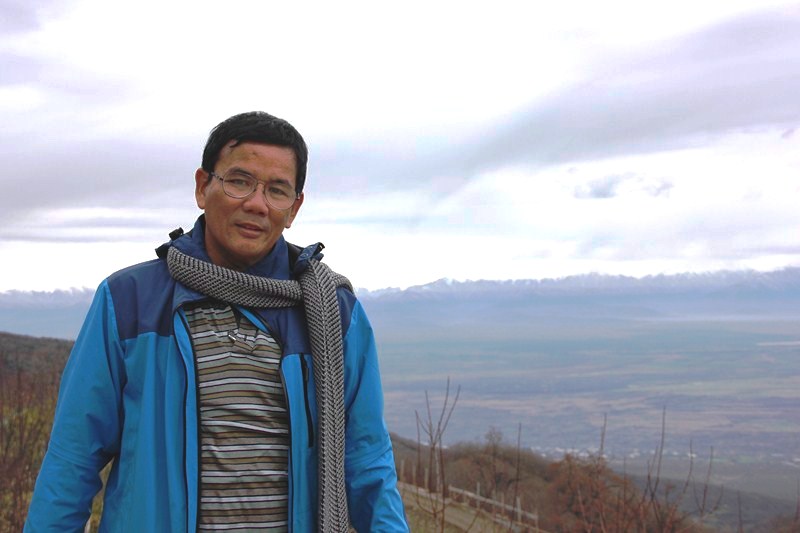
The author at the view point (photo: Ms. Riva Galveztan)

The author at the view point (photo: Ms. Riva Galveztan)

I noticed a sign pointing us to the direction of St. Nino’s Spring which is some 3 kms. from the convent. To get there, we would have to hike steeply down some 600 odd steps (with occasional landings with benches) that wind its way through pleasant woodland.  Too bad we didn’t have time to do so. In the 1990s, the small Chapel of St. Zabulon and St. Sosana was constructed to house the spring, which is believed to have magical curative properties.  According to a local legend, the spring emerged through Nino’s prayers.

The Greater Caucasus Mountains

The snow-clad Greater Caucasus Mountains

I truly appreciated our visit to this very tranquil and restful place, probably the most dramatic monastery in the country. With its divine atmosphere, it is certainly worth a long stopover.

The monastery's orchards

The monastery’s orchards

Georgia National Tourism Administration: 4, Sanapiro St, 0105, Tbilisi, Georgia. Tel: +995 32 43 69 99. E-mail: info@gnta.ge. Website: www.georgia.travel; www.gnta.ge.

Qatar Airways has daily flights from Diosdado Macapagal International Airport (Clark, Pampanga) to Tbilisi (Republic of Georgia) with stopovers at Hamad International Airport (Doha, Qatar, 15 hrs.) and Heydar Aliyev International Airport (Baku, Azerbaijan, 1 hr.). Website: www.qatarairways.com.
Shoti Making at Badiauri Village (Sagarejo, Georgia)

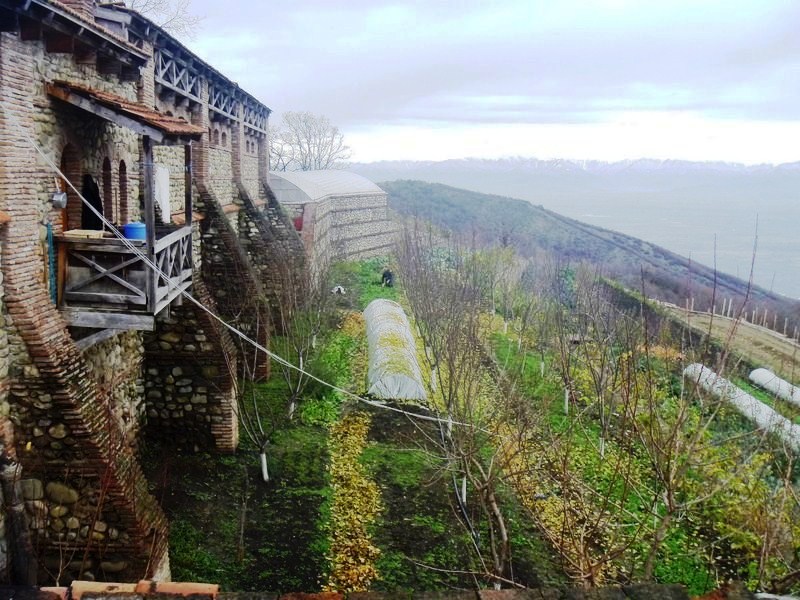
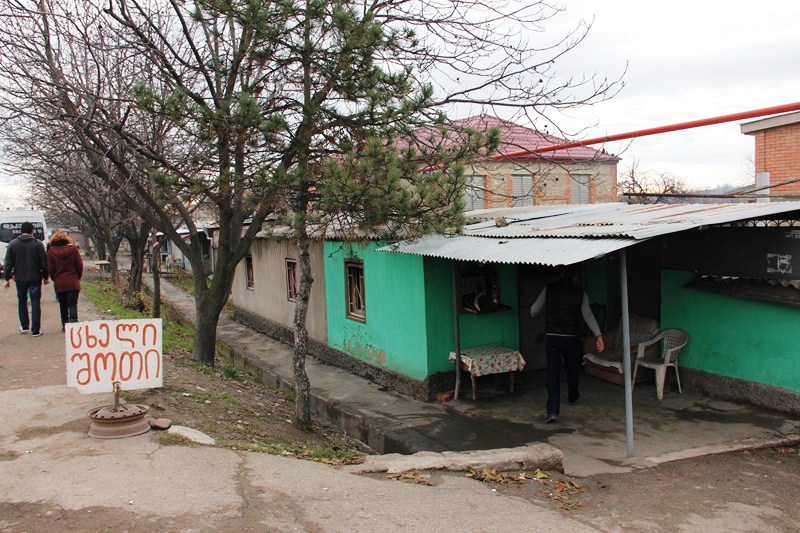
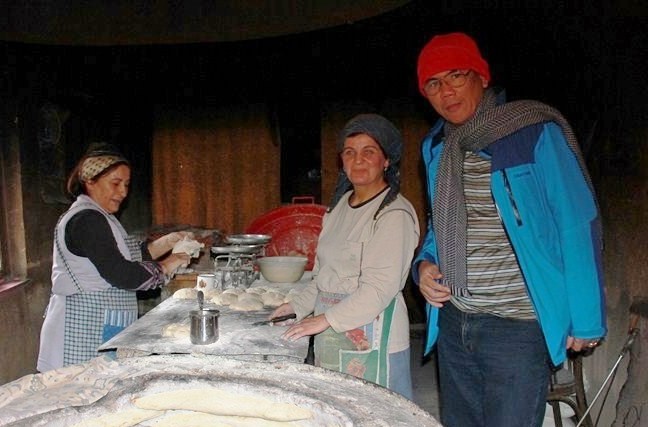
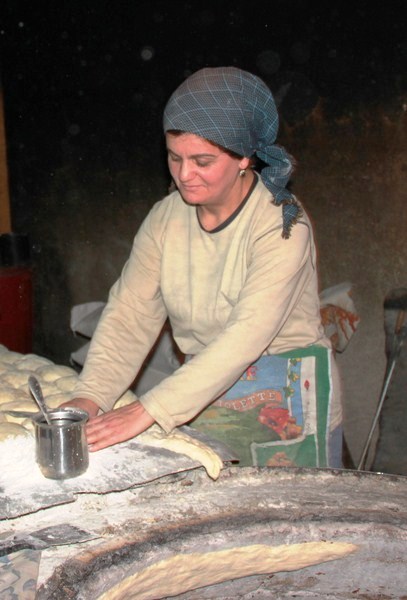
We were now on our third and final day of our GNTA-sponsored Georgian Countryside Tour and Buddy, Pancho, Melissa, Riva and I, together with our Georgian guide Sopho, were to travel east again on a 112-km./2-hr. drive, via S5, to the town of Sighnaghi. Just about 75 kms. and a little over an hour out of Tblisi, we made a stopover at the village of Badiauri in the town of Sagarejo where we dropped by a bakery.  Here, we observed two elderly Georgian ladies making Georgian bread called puri (pronounced “poo-ree”), the Georgian table staple which is usually served with every meal.

Badiauri Village in Sagarejo

Badiauri Village in Sagarejo

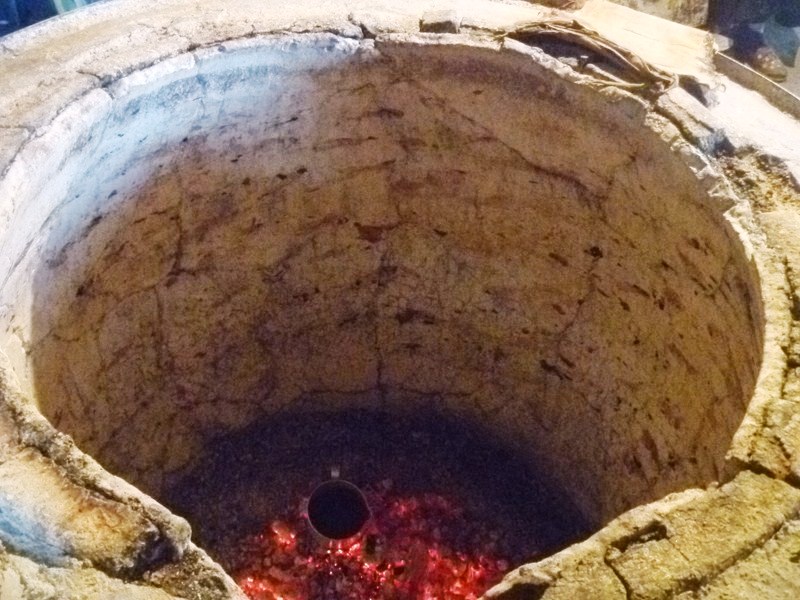
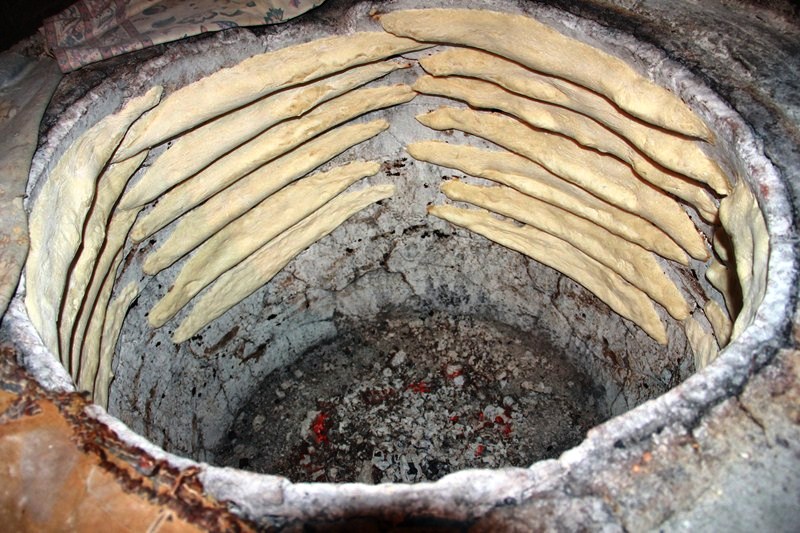
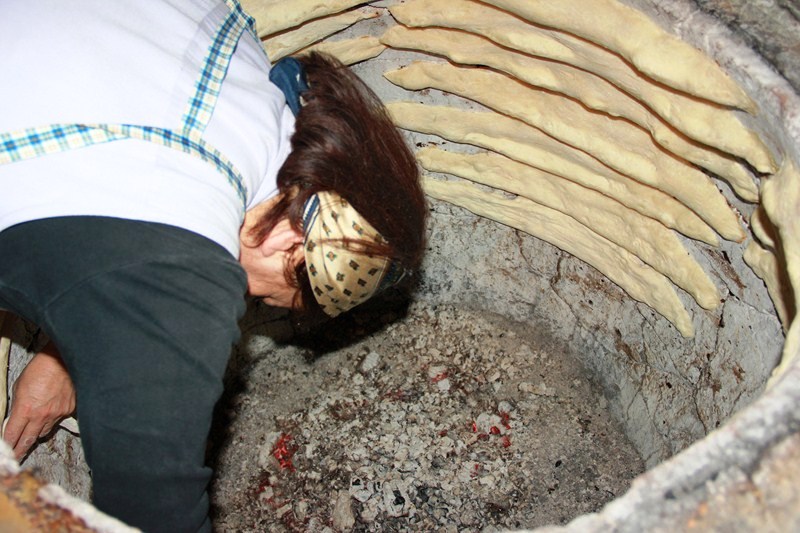
The traditional and very popular puri, especially the long pointed bread called shotis puri, is traditionally baked in a deep, circular, beehive-shaped oven called a tone (pronounced “ton-AY”).  A tone (torne/turne in old Georgian), the Georgian version of the tandoor, is made with a mixture of special quartz sand, which is used in making glass, and a fireproof clay called chamuti.  When it dries, it fuses into a hard, fireproof surface. This mixture is spread on the outside of the tone and wrapped in linen.  The interior, on the other hand, is lined with fire proof bricks.  A tone usually lasts for 7-8 years before it will need to be replaced.

The traditional clay oven called a tone

The traditional clay oven called a tone

Most streets in Georgia have at least one traditional bakery and I have already observed one local bakery before when I was in Borjomi.  In earlier times, all bakers came from Racha Region of Western Georgia and they are generally acknowledged to be the best bakers in Georgia.

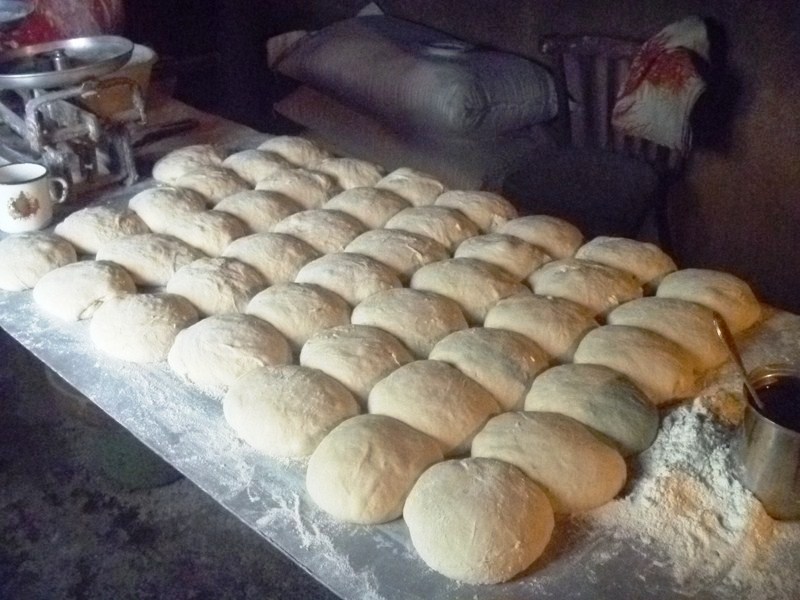
The individual balls of dough

The individual balls of dough

It takes time to learn how to make good bread which is made from just flour, water, yeast and salt. It also takes much physical strength to hand mix (25 kgs. at a time) and knead the dough but the two ladies were up to the task, taking lumps of dough, grasping them at two ends and stretching them across a kind of curved paddle covered in cloth.

Shaping the dough into spindle shapes

Shaping the dough into spindle shapes

For at least 40 minutes, they let the dough stand for it to rise and the yeast to ferment. Then, they cut the mass of dough into individual “balls” of bread (each weighing about 600 gms.), place them in rows, dust them with flour (to prevent their sticking on the surface) and again let them stand for at least another hour.

Slapping the dough to the top side of the tone

Slapping the dough to the top side of the tone

Then, they roll the dough, making them spindle-shaped with a broad center portion and tapering ends. Once the tone reaches the desired heat, determined not by a thermometer but by testing the inside wall with loose flour, they then stick the paddle into the oven and skillfully slap the dough tightly against the inside wall of the tone sitting in the middle of the bakery.

The dough is baked for 10 minsutes

The dough is baked for 10 minsutes

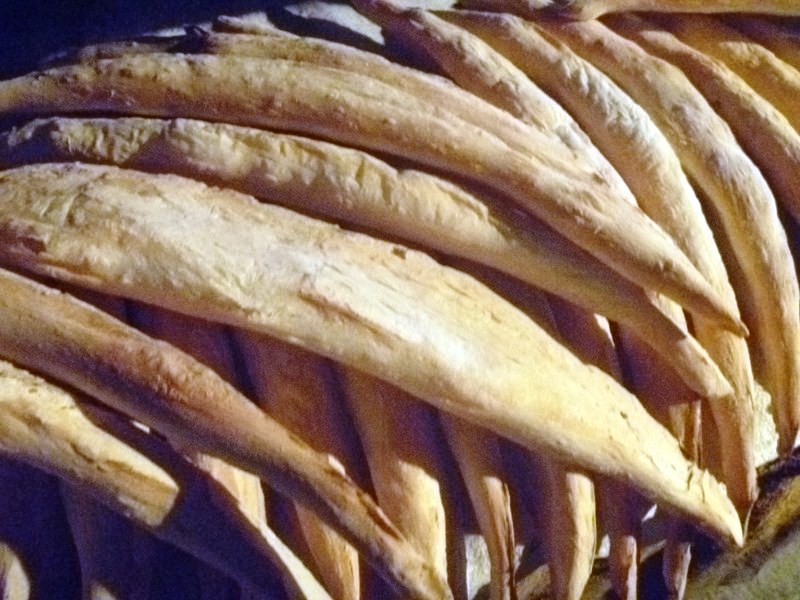
In less than 10 minutes, they were done and they took out the baked bread without dropping it in the fire. The fresh shoti come out looking like canoes.  They were delicious, with crispy edges, a moist white center and a great aroma.

Freshly-baked shotis puri

Freshly-baked shotis puri

Ten 50-kg. bags of flour can make more than 1,400 loaves of bread. Nowadays, modern bread factories use electrically powered mixers for the dough when making traditional bread.

The author with the 2 lady bakers

The author with the 2 lady bakers

Georgia National Tourism Administration: 4, Sanapiro St, 0105, Tbilisi, Georgia. Tel: +995 32 43 69 99. E-mail: info@gnta.ge. Website:www.georgia.travelwww.gnta.ge.

Qatar Airways has daily flights from Diosdado Macapagal International Airport (Clark, Pampanga) to Tbilisi (Republic of Georgia) with stopovers at Hamad International Airport (Doha, Qatar, 15 hrs.) and Heydar Aliyev International Airport (Baku, Azerbaijan, 1 hr.). Website: www.qatarairways.com.
Gergeti Trinity Church (Stepantsminda, Georgia)

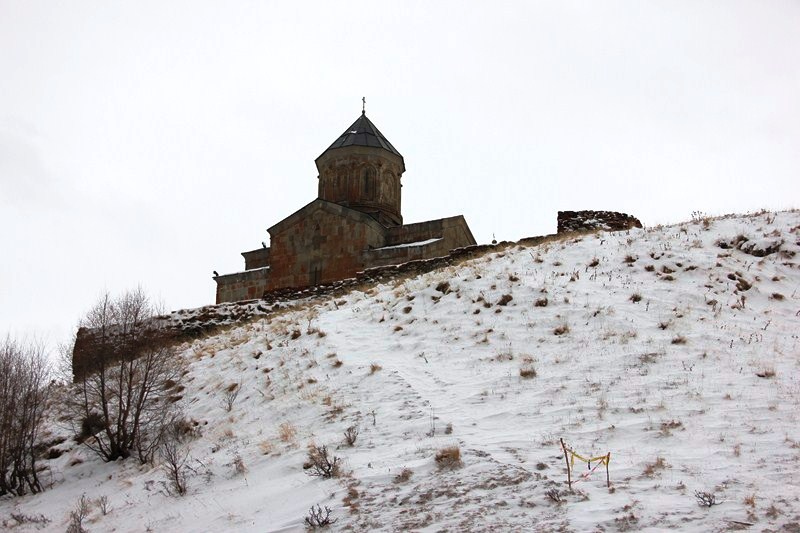
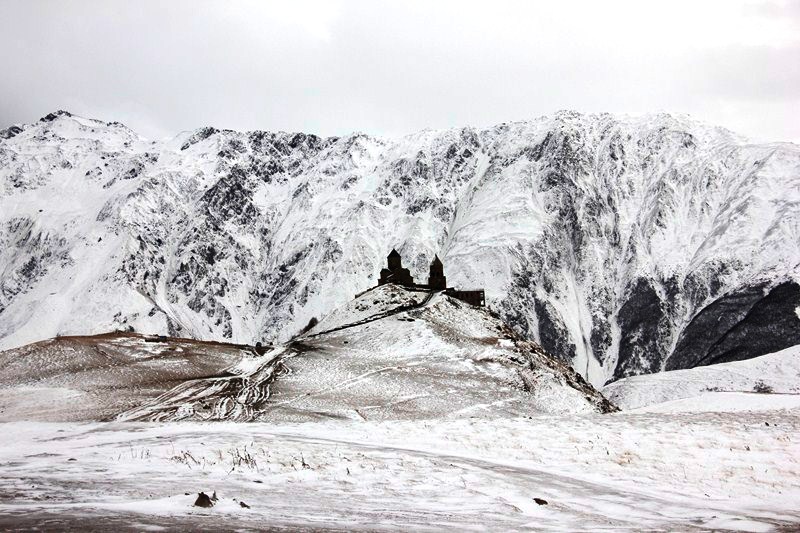
After our lunch at the Rooms Hotel in Stepantsminda, Buddy, Pancho, Melissa, Riva, Sopho and I again boarded our Mitsubishi Delica L-400 van that would take us, a further 450 m. up, to Gergeti Trinity Church, a popular name for the Holy Trinity Church.  This isolated church, situated on the right bank of the river Chkheri (the left tributary of the river Terek), at an elevation of 2,170 m, is located just outside the town, near the shepherd’s village of Gergeti.

Gergeti Trinity Church

Gergeti Trinity Church

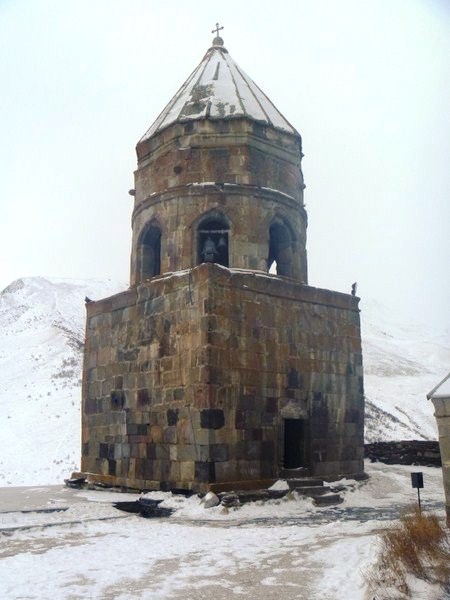
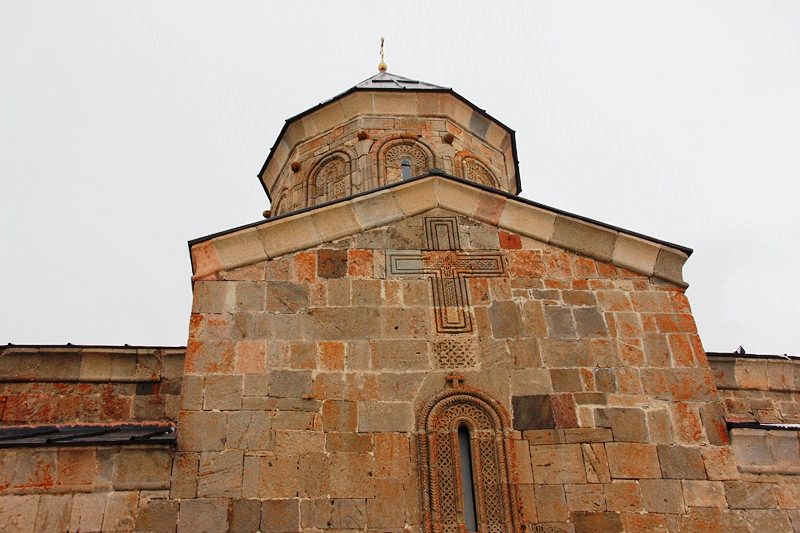
The small but well-preserved church, known to be the only cross-cupola church in Khevi province, was built in the 14th century.  Its separate bell tower dates back to the same period as the church itself.  During the Soviet Period all religious services were prohibited, but the church still remained to be a popular tourist destination. The church is now an active establishment of the Georgian Orthodox and Apostolic Church.

The separate bell tower

The separate bell tower

The drive, up a rough, rocky and snow-laden mountain trail through the forest, took us around 30 minutes. There was fantastic scenery all throughout the ascent, with scenic alpine valleys, crystal-clear streams, and great vistas of mountains.

The church with Caucasus Mountains in the background

The church with Caucasus Mountains in the background

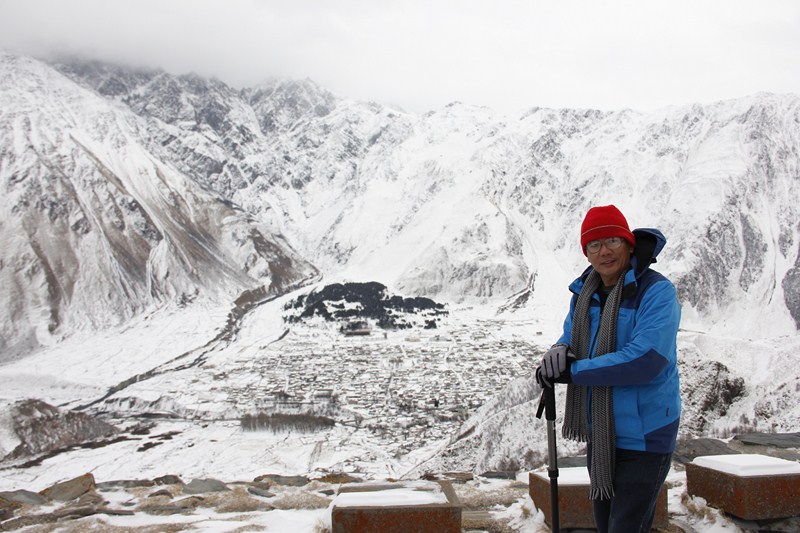
Upon our arrival just below the church, Sopho, Buddy, Riva and I hiked up the remaining distance to the church.  Pancho and Melissa stayed behind in the van. Once there, we were held in awe by the breathtaking and panoramic view of the towering Caucasus Mountains, with the fabulous 5,034 m. (16,516 ft.) high, snow-capped Mt. Kazbegi (Georgia’s 3rd highest mountain, after Mt. Shkhara and Janga, and the seventh highest peak in the Caucasus Mountains) in the foreground of the church.

The author at the viewpoint

The author at the viewpoint

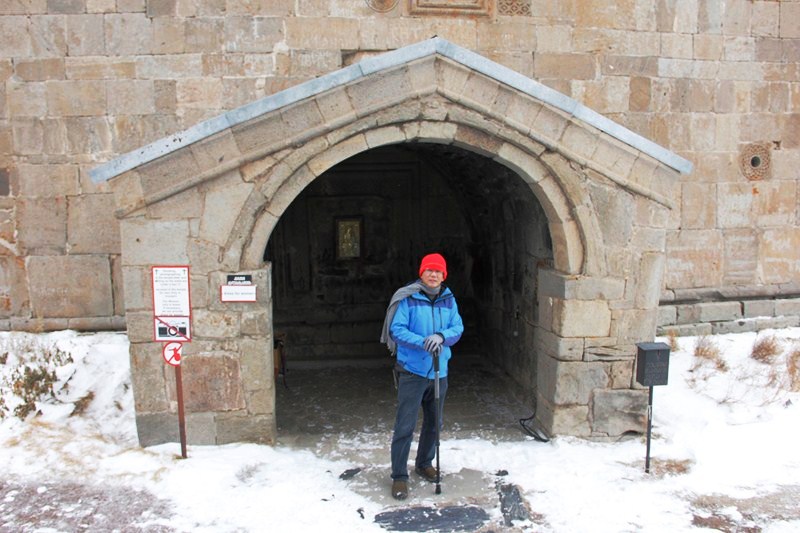
Inside this small but gorgeous and intimate church are amazing old doors, some impressive frescoes and beautiful paintings of icons (including a rare Black Madonna icon which was saved from a fire). Probably the most fundamentalist of Georgian Orthodox churches, ladies really need to wear a headscarf, long sleeves and a skirt to go inside (there is a changing room with these items provided).  Men also have to wear trousers to get in.

_MG_9350


The church facade

The church facade

There was no entrance fee but photography wasn’t allowed inside. In the ceiling, there is a trap door where, according to the 18th century Georgian author Vakhushti Batonishvili, the precious relics from Mtskheta, such as St. Nino’s cross, were brought here for safekeeping in times of danger or possible invasion.

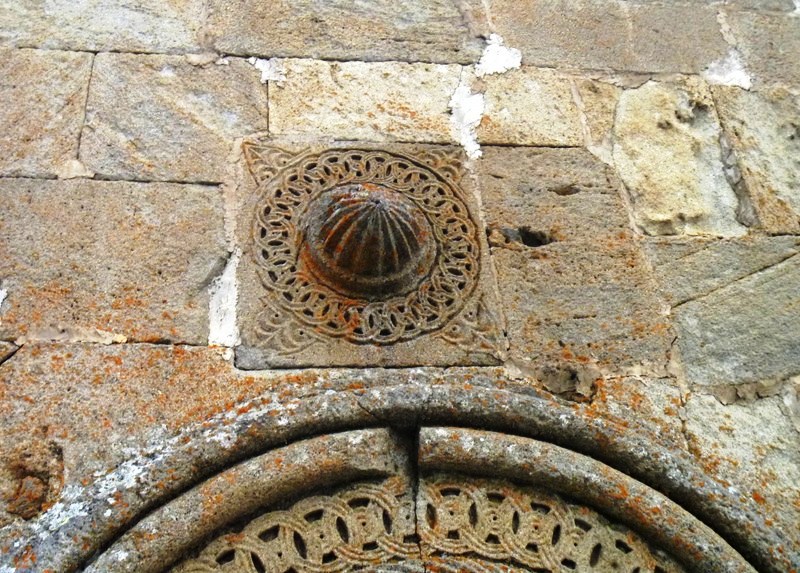
Bas-reliefs (1)

Bas-reliefs (2)

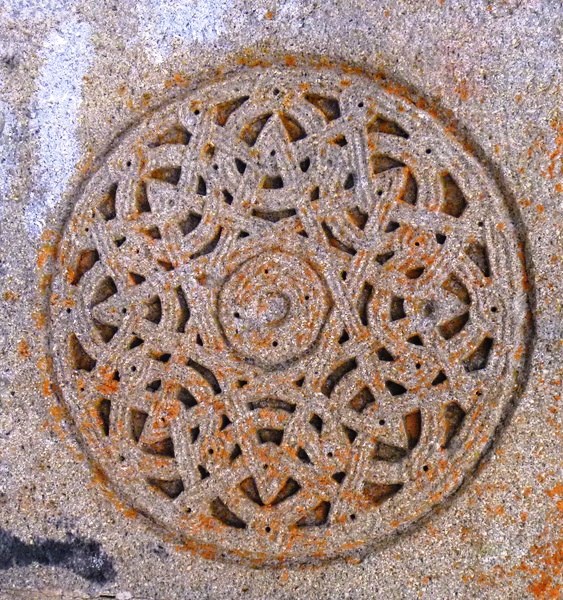
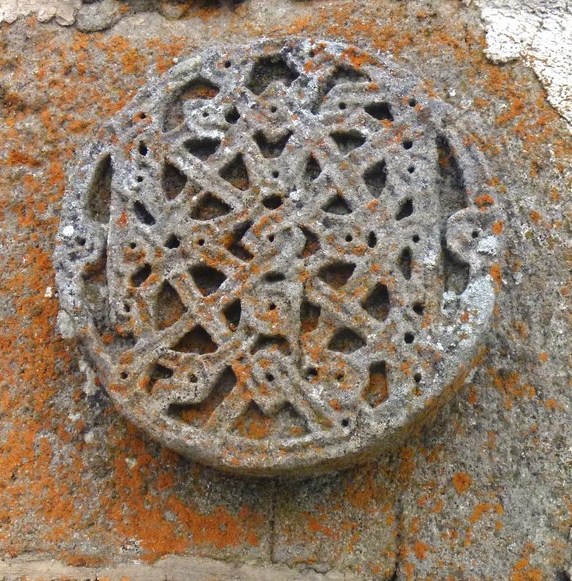
Detail of bas-reliefs

Detail of bas-reliefs

The church, a popular waypoint for trekkers in the area, can also be reached via a steep 1.5 to 3 hour (depending on your fitness level) uphill climb. Gergeti Trinity Church’s isolated location on top of a steep mountain, surrounded by the vastness of nature, has truly made it a worthy symbol for Georgia. The sheer scale and immensity of this serene place was incredible and it’s too beautiful not to visit if you ever find yourself in Georgia.

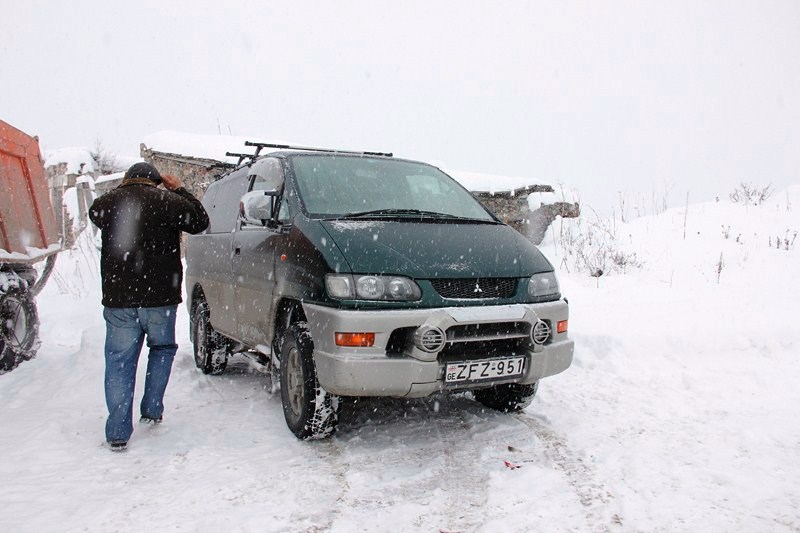
Our Mitsubishi Delica L-400 4x4 van

The Mitsubishi Delica L-400 4×4 van we used to get up the mountain

Georgia National Tourism Administration: 4, Sanapiro St, 0105, Tbilisi, Georgia. Tel: +995 32 43 69 99. E-mail: info@gnta.ge. Website: www.georgia.travel; www.gnta.ge.

Qatar Airways has daily flights from Diosdado Macapagal International Airport (Clark, Pampanga) to Tbilisi (Republic of Georgia) with stopovers at Hamad International Airport (Doha, Qatar, 15 hrs.) and Heydar Aliyev International Airport (Baku, Azerbaijan, 1 hr.). Website: www.qatarairways.com.
Stopover at Gudauri (Georgia)

From Ananuri Fortress, we again proceeded on our way, traveling along the Georgian Military Highway for another 57 kms. (45 mins.) to Gudauri, a ski resort situated in the Stepantsminda District, on the southern slopes of The Greater Caucasus Mountain Range.  Midway along the route, the scenery began to change from brown to white as we went up the snow-capped mountain.

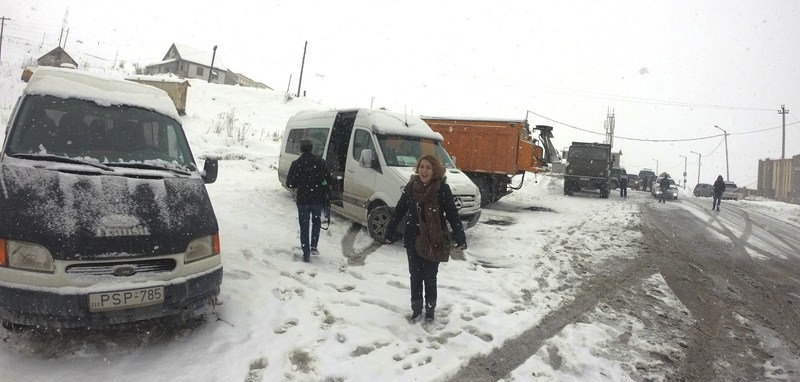
Stopover at Gudauri

Stopover at Gudauri

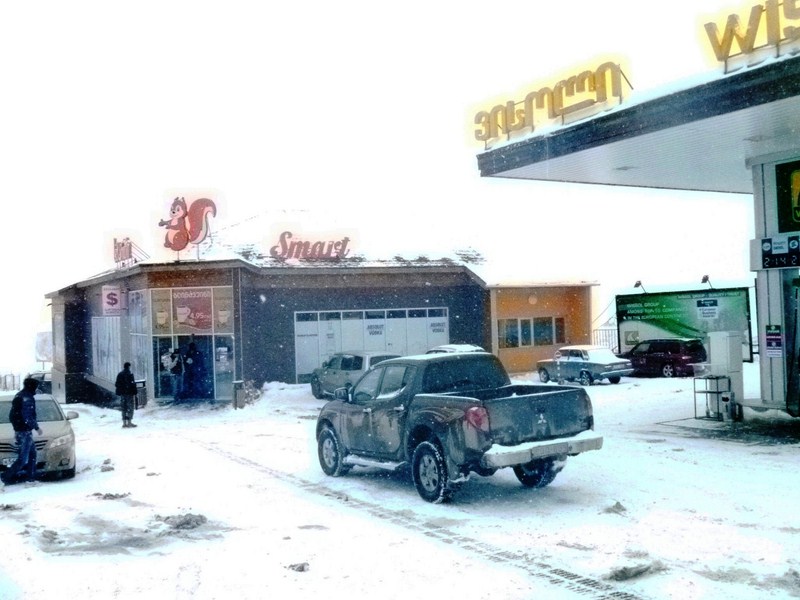
The resort town, located near the Cross Pass, was already blanketed in about 8 inches of snow. Our Mercedes-Benz Sprinter panel van stopped near a Smart Supermarket branch and a gas station and waited for the arrival of a smaller Mitsubishi Delica L-400 4×4 van that would take us to Stepantsminda town proper.

Smart Supermarket

Smart Supermarket

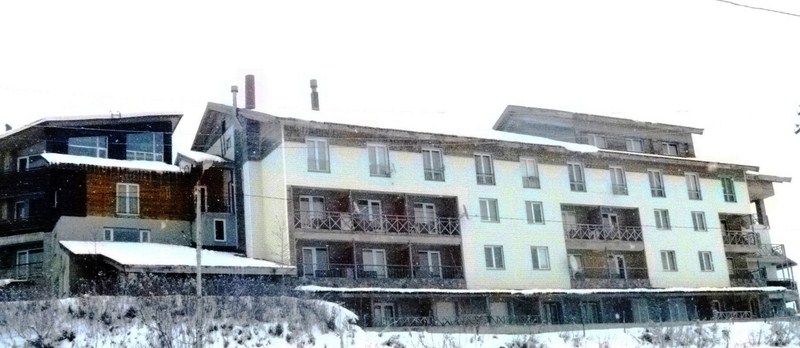
Good Travel in Axis Palace Apartment

Good Travel in Axis Palace Apartment

As Gudauri is located at an elevation of 2,196 m. (7,200 ft.) above sea level, it offers high quality skiing opportunities and we arrived at the town just when the ski season (December to April) was about to begin. Its slopes are completely above the tree line and generally considered to be avalanche-safe, best for free-riders.

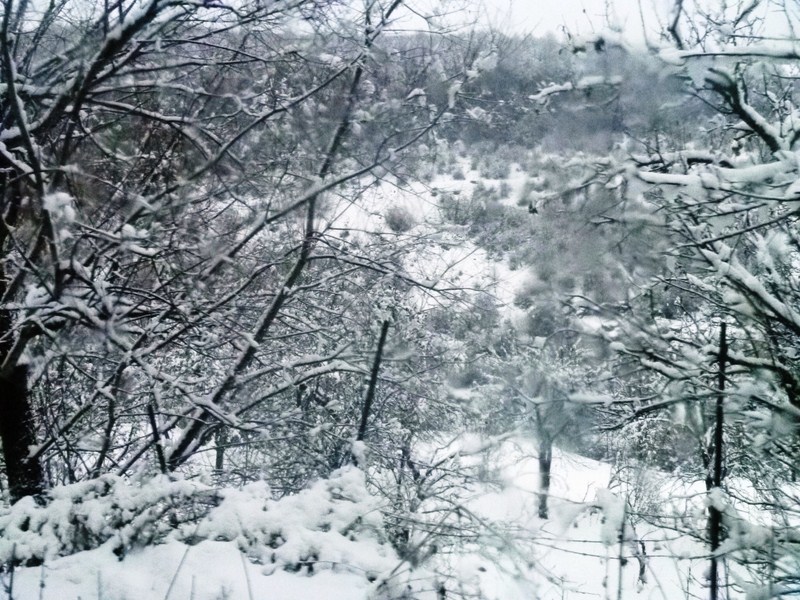
Winter wonderland

Winter wonderland

Skiers here can experience some of the most sublime runs in Europe, at altitudes between 1,500 and 4,200 m. above sea level. Gudauri is also one of the best places in Georgia for heliskiing, speedriding and paragliding.

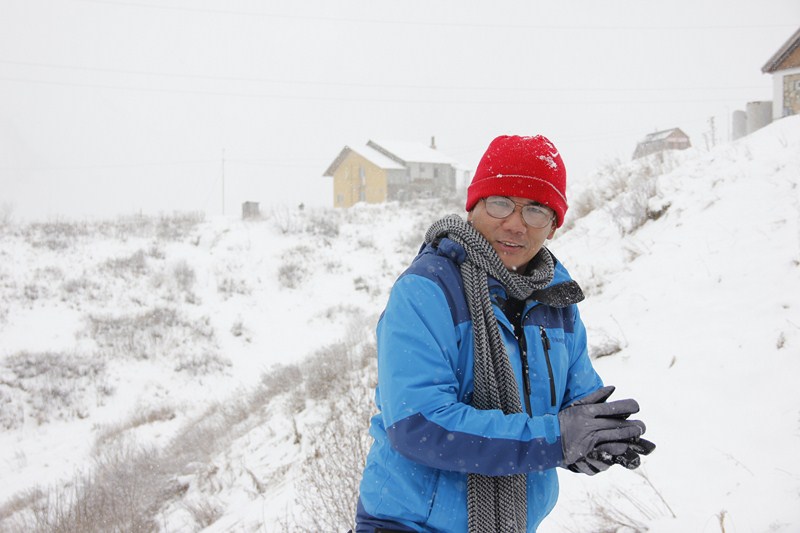
Building my first snowball

Building my first snowball

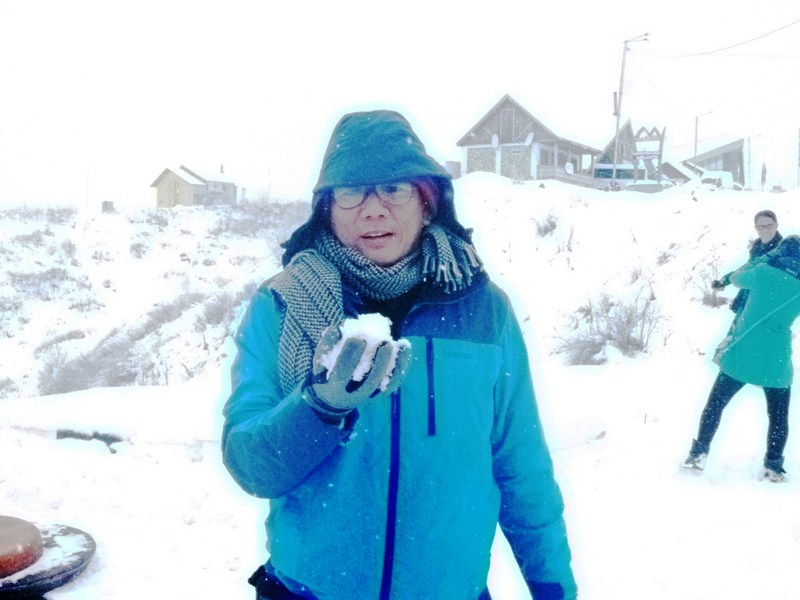
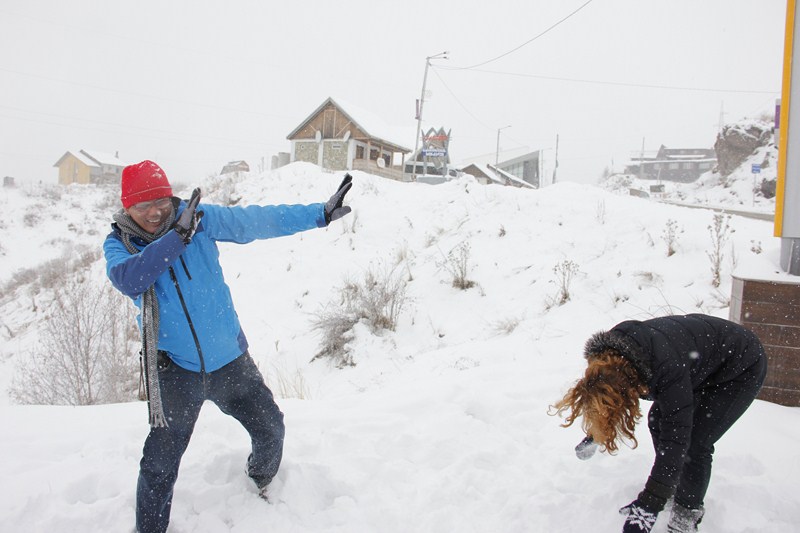
As we were just here for a short stopover, we weren’t going to experience these alpine sports but this didn’t stop us from enjoying some of the finest powder-snow in the Caucasus (a first for me) as we participated in a snowball fight, particularly targeting our Georgian guide Sopho.

P1220773

Snowballs away!!!!

Snowballs away!!!!

I also made my first snow angel, lying on my back on the shallow undisturbed snow and moving my arms up and down, and my legs from side to side, to form the shape of a stylized angel.  It was pure fun.

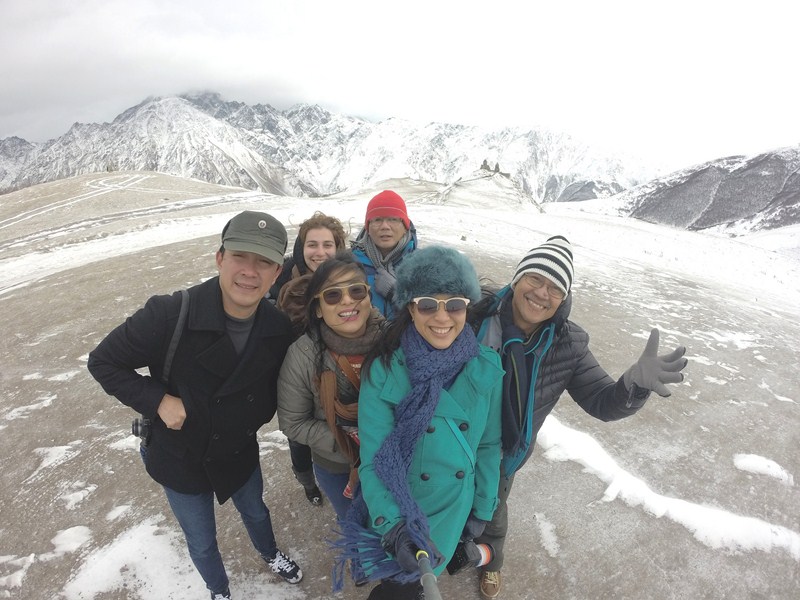
Selfie at Gudauri

Selfie at Gudauri

Georgia National Tourism Administration: 4, Sanapiro St, 0105, Tbilisi, Georgia. Tel: +995 32 43 69 99. E-mail: info@gnta.ge. Website: www.georgia.travel; www.gnta.ge.

Qatar Airways has daily flights from Diosdado Macapagal International Airport (Clark, Pampanga) to Tbilisi (Republic of Georgia) with stopovers at Hamad International Airport (Doha, Qatar, 15 hrs.) and Heydar Aliyev International Airport (Baku, Azerbaijan, 1 hr.). Website: www.qatarairways.com.
Ananuri Fortress (Georgia)

(All photos courtesy of Ms. Riva Galveztan)

We started Day Two of our GNTA-sponsored tour of the Georgian countryside by traveling 157 kms. to the northeastern Georgian town of Stepantsminda (formerly Kazbegi).  To get there, we would travel along the Georgian Military Highway.  This historic mountain road that crosses the Greater Caucasus Mountains, connecting Tbilisi in Georgia with the Russian town of  Vladikavkaz in North Ossetia, passes through narrow gorges squeezed between colossal mountains, making for some amazing views.

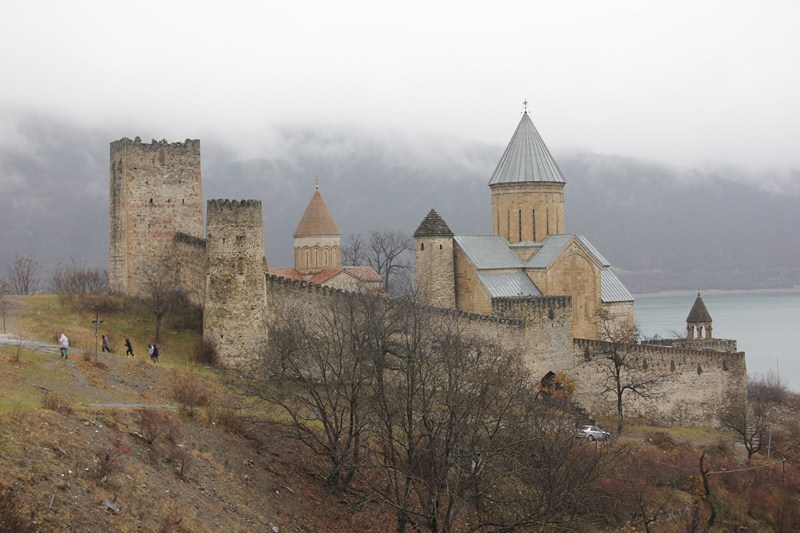
The amazingly scenic Ananuri Fortress

The amazingly scenic Ananuri Fortress

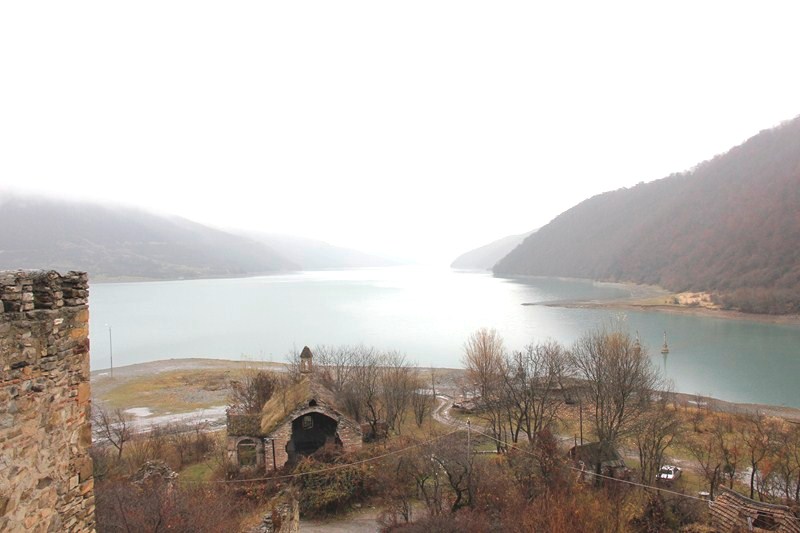
On one of the turns along the highway, about 72 kms. (45 miles) and an hour away out of Tbilisi, we made a stopover at the scenic Ananuri Fortress which stands spectacularly on a promontory above the large, 11.5 sq. km., azure-blue Zhinvali water reservoir on the Aragvi River, an important water supply for Tbilisi formed after the construction of the Zhinvali Dam.

The Zhinvali water reservoir

The Zhinvali water reservoir

To get to the castle, we had to make a short walk down a narrow road.  This castle complex, the seat of the redoubtable eristavis (dukes) of Aragvi, a feudal dynasty which ruled the area from the 13th century, was the scene of numerous battles as it guarded the way to the ancient capital of Dusheti and, centuries later, the main road linking Georgia with Russia, serving as a garrison for Russian troops.

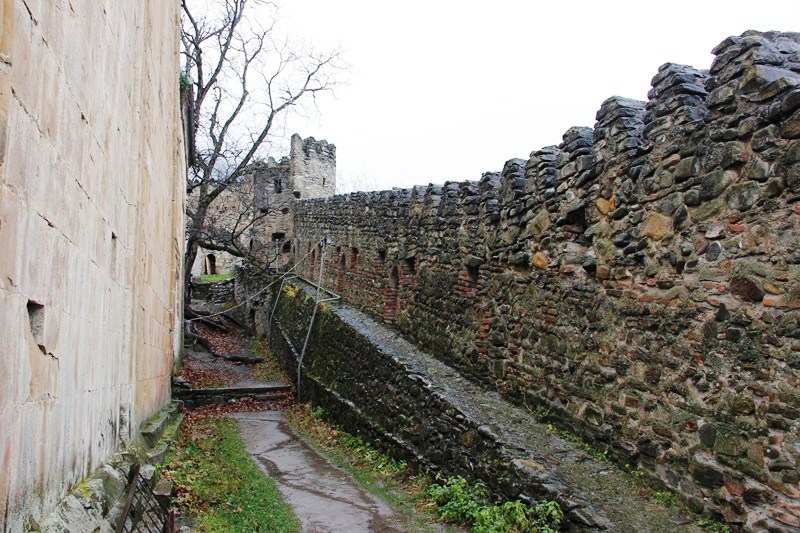
The crenellated curtain wall

The crenellated curtain wall

Zurab Aragveli, a ruthless local prince known for attacking neighboring mountain clans and even blinding his own brother, was responsible for building much of what is now seen. In 1739, the fortress was attacked and set on fire by forces commanded by Shanshe, the duke of  the rival duchy of Ksani, and the Aragvi clan was massacred. The usurpers, in turn, were killed 4 years later when local peasants revolted against their rule.

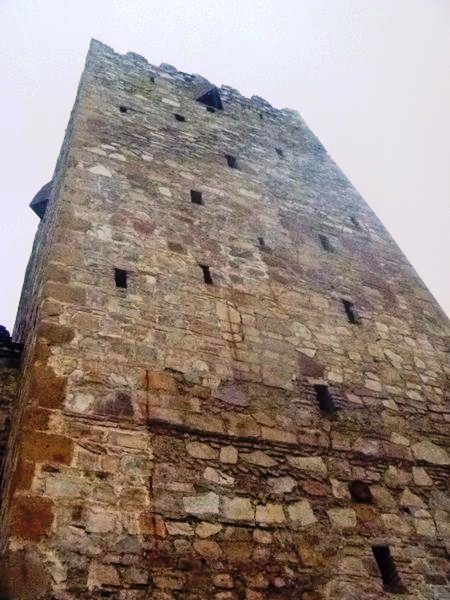
One of the fort's towers

One of the fort’s towers

King Teimuraz II was invited to rule directly over them but, in 1746, the king was forced to suppress, with the help of King Erekle II of Kakheti, another peasant uprising. The fortress remained in use until the beginning of the 19th century. In 2007, the complex was placed on the tentative list for inclusion into the UNESCO World Heritage Site program.

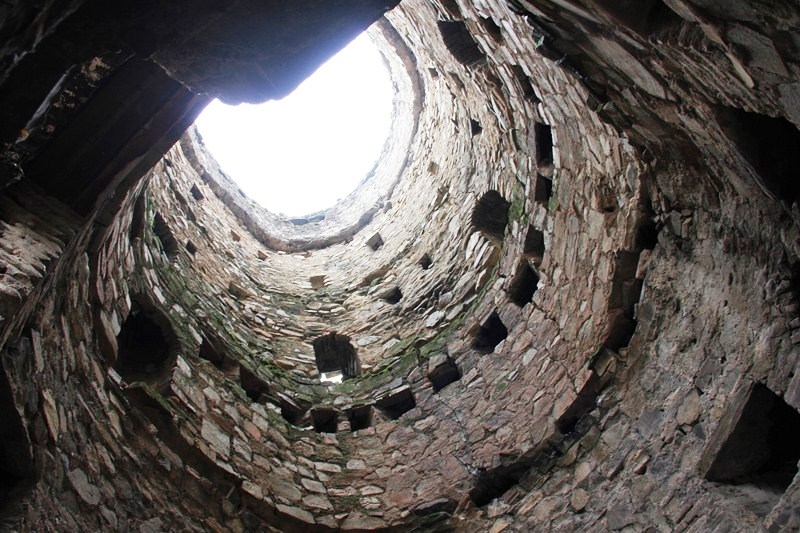
Interior of one of the towers

Interior of one of the round towers

The late-feudal Georgian fortress complex, incorporating a circuit wall with turrets, porch, churches, a spring, a reservoir and a Svanetian tower with a stepped pyramidal roof, consists of 2 fortifications joined by a crenellated curtain wall. The well-preserved upper fortification, with a large square tower (known as Sheupovari), is the location of the last defense of the Aragvi against Shanshe.

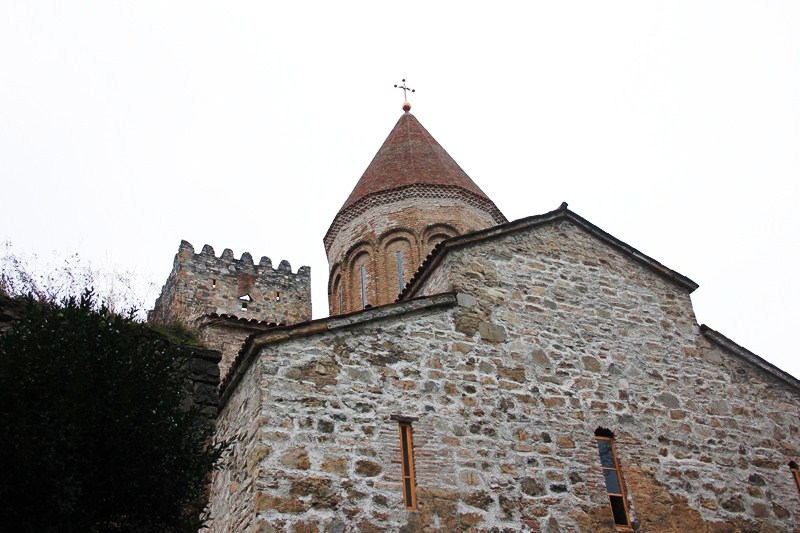
The Church of the Assumption

The Church of the Assumption

The lower fortification, with a round tower, is mostly in ruins.  Within the complex are two churches. The brick Church of the Virgin, the older of the two, dates from the first half of the 17th century. Abutting a tall square tower, it has the graves of some of the Dukes of Aragvi. Its interior, no longer decorated, has a stone baldaquin erected by the widow of Duke Edishera, who prematurely died in 1674 without giving her a child.

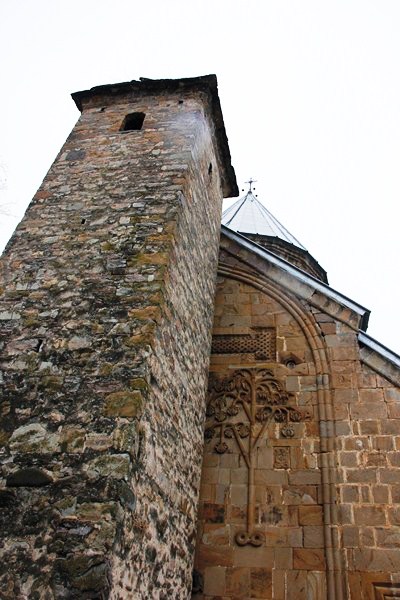
The tall, narrow watchtower adjacent to the west wall of the church

The tall, narrow watchtower adjacent to the west wall of the church

We were to visit the upper fortification.  Three of the upper fortification’s five massive towers, including the largest Sheupovari Tower, face the Georgian Military Highway. We all entered the complex to the right of the fortification, from the middle of the southern wall. As we entered the fortress, we faced the Church of the Assumption (Ghvtismshobeli), the main domed cathedral and the larger of the two churches.

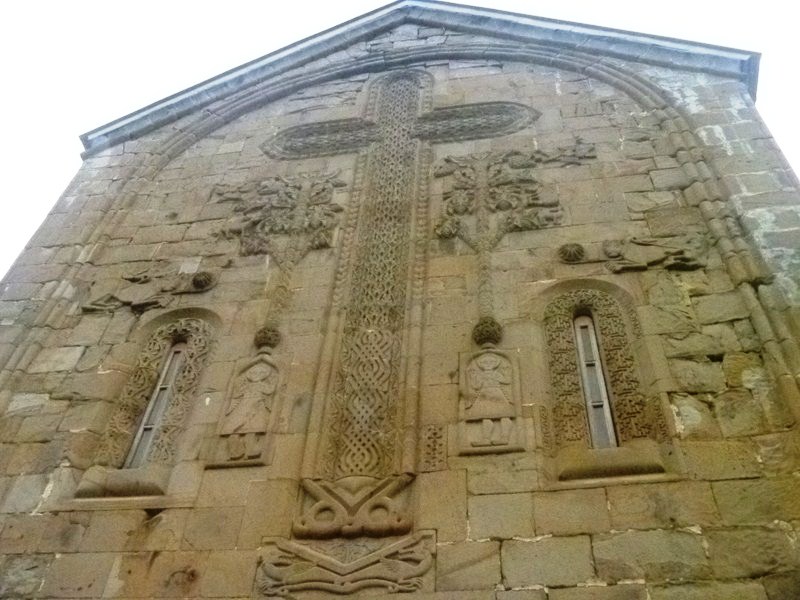
Grapevine cross carved on the south façade of the church

Grapevine cross carved on the south façade of the church

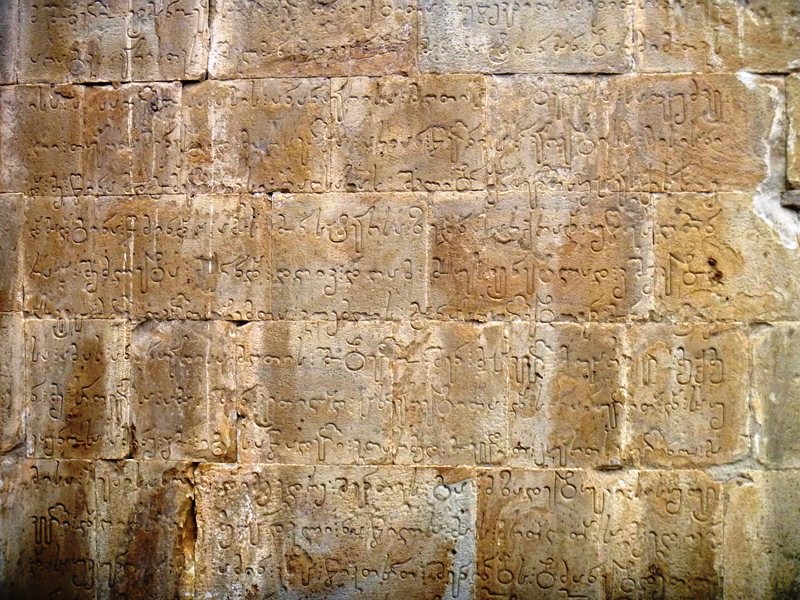
Georgian script carved on the south facade of the church

Georgian script carved on the south facade of the church

The church, built in 1689 for the son of Duke Bardzem and designed by architect: K. Bakhsarashvili, has a central dome and its earliest pyramidal tower is located by its western wall.  It is interesting to explore from the outside as it has a richly decorated façade with some very well-preserved bas-reliefs featuring human, animal and floral images.  The north entrance has Georgian script carved on the walls while the south façade has a carved grapevine cross. Adjacent to the west wall of the church is a tall, narrow watch tower dating from the 13th or 14th century.

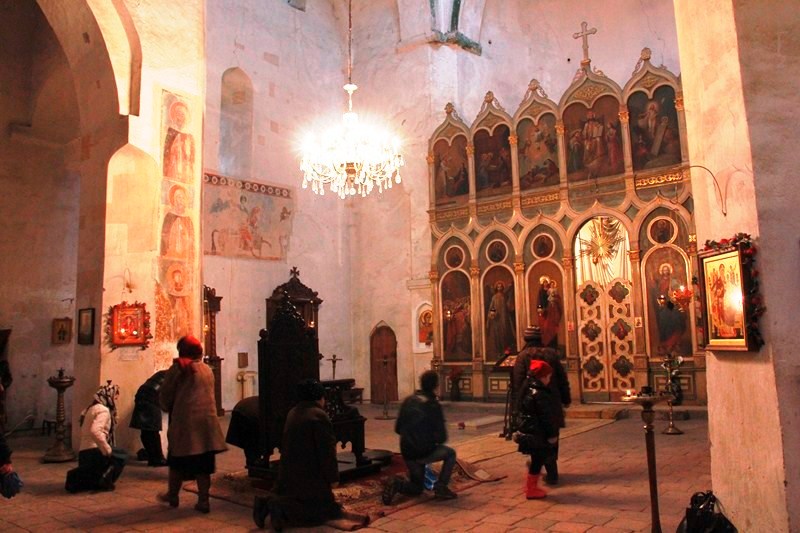
The church's modest interior

The church’s modest interior

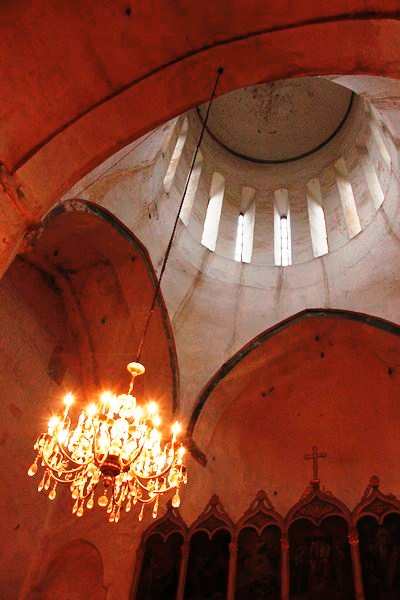
The central dome of the church

The central dome of the church

Inside its modest interior, we could still see the remains of a number of frescoes, most of which were destroyed by a fire in the 18th century.  Among the scenes depicted are the famous Thirteen Assyrian Fathers, prominent ecclesiastical figures which represent convincing evidence for the study of the iconography of these figures. We also saw people lighting candles (bought from the kiosk on the left hand side as you enter the church) and placing them underneath paintings and icons of saints.  Along the church’s east wall are several tombstones.

Fresco of the Thirteen Syrian Fathers

Fresco of the Thirteen  Assyrian Fathers

Too bad we didn’t have time to climb its towers.  This fortified ensemble truly was photogenic, thanks to its wonderful location overlooking the Zhinvali Reservoir, as well historically significant, thanks to centuries of royal rivalry. Indeed this true castle, the first one I ever visited, is about as medieval as one can get and was well worth a visit.

Melissa, Sopho and Consul Cunanan

Melissa, Sopho and Consul Cunanan

Ananuri Fortress: Georgian Military Highway, Ananuri. Open daily, 9 AM – 7 PM. Admission is free.

Georgia National Tourism Administration: 4, Sanapiro St, 0105, Tbilisi, Georgia. Tel: +995 32 43 69 99. E-mail: info@gnta.ge. Website: www.georgia.travel; www.gnta.ge.

Qatar Airways has daily flights from Diosdado Macapagal International Airport (Clark, Pampanga) to Tbilisi (Republic of Georgia) with stopovers at Hamad International Airport (Doha, Qatar, 15 hrs.) and Heydar Aliyev International Airport (Baku, Azerbaijan, 1 hr.). Website: www.qatarairways.com.
Uplistsikhe Cave Complex (Georgia)

We were already through with the first day of our 3-day GNTA-sponsored tour of the Georgia countryside, our last destination being the Stalin State Museum in Gori.  We still had a lot of daylight left, so we decided to continue on to the ancient, rock-hewn and now abandoned town of Uplistsikhe (literally meaning “the lord’s fortress”), located in Shida Kartli, a suburb just 14 kms. (a 20-min. drive) east of Gori.

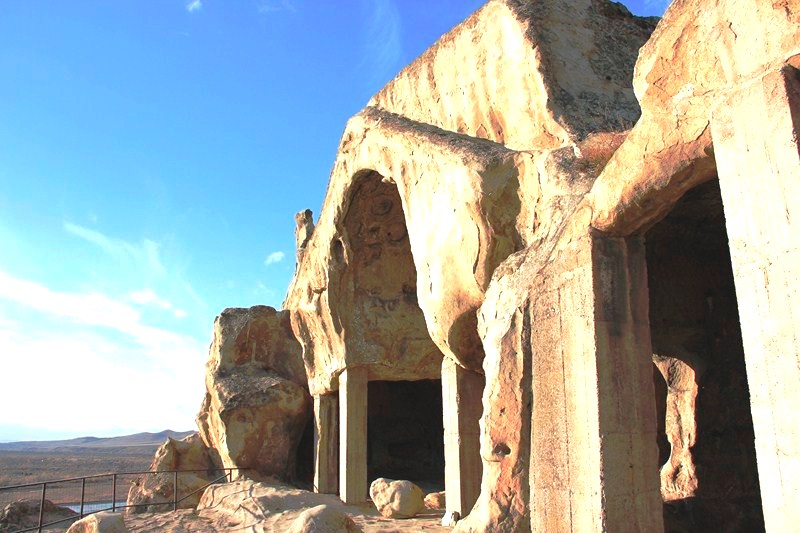
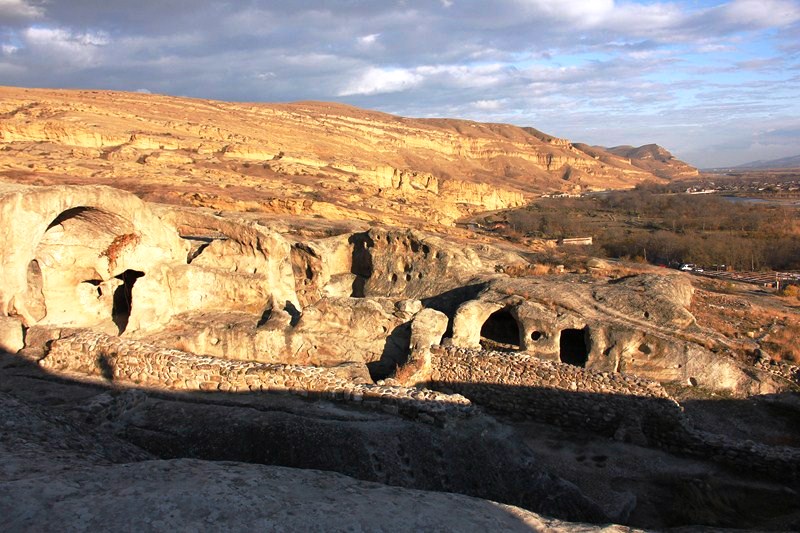
Uplistsikhe Cave Complex

Uplistsikhe Cave Complex

Uplistsikhe is remarkable for the unique combination of various styles from rock-cut cultures of the region, most notably from Cappadocia in Anatolia (now modern Turkey) and Northern Iran, and the co-existence of pagan and Christian architecture. Built on the high rocky sandstone massif along the left bank of the Mtkvari River, the area was identified by archaeologists as one of the oldest urban settlements in Georgia, containing various structures dating from its founding in the Late Bronze Age (around 1,000 BC) to the Late Middle Ages (13th century AD). Its natural sandstone rock easily lent itself to various kinds of treatment, making it possible to create complex decorative compositions.

The Mtkvari River

The Mtkvari River

Strategically located in the heartland of ancient kingdom of Kartli (or Iberia as it was known to the Classical authors), the town’s age and importance as a major political and religious center of the country (between the 6th century BC and the 11th century AD) led medieval Georgian written tradition to ascribe its foundation to the mythical Uplos, son of Mtskhetos, and grandson of Kartlos.

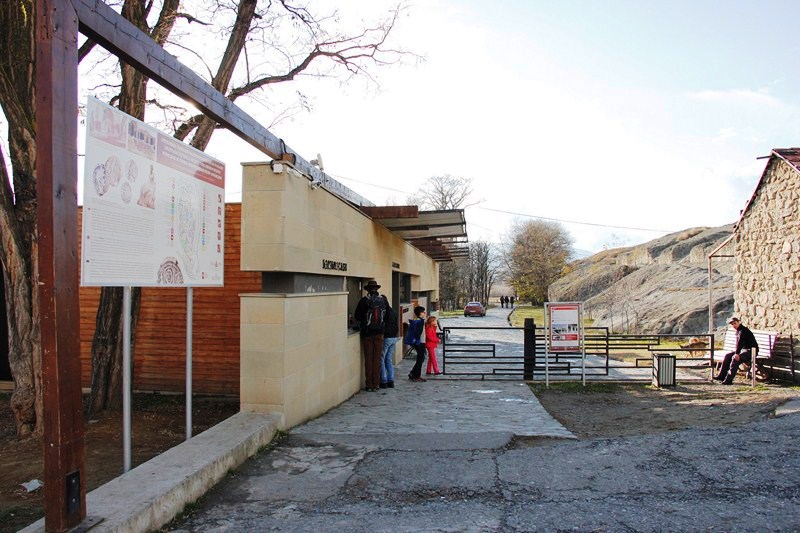
The tourist complex

The tourist complex

Early in the 4th century, with the Christianization of Kartli, Uplistsikhe seems to have declined in its importance, losing its position to Mtskheta and, later, to Tbilisi, new centers of Christian culture. During the Muslim conquest of Tbilisi in the 8th and 9th century, Uplistsikhe reemerged as a principal Georgian stronghold, becoming the residence of the kings of Kartli, during which the town grew to a size of around 20,000 people and evolved into an important caravan trading post along the Silk Road.  However, a Mongol raid in 1240 destroyed large parts of the town, marking the ultimate eclipse of the town.  It was virtually abandoned and, only occasionally, in times of foreign intrusions, used as a temporary shelter.

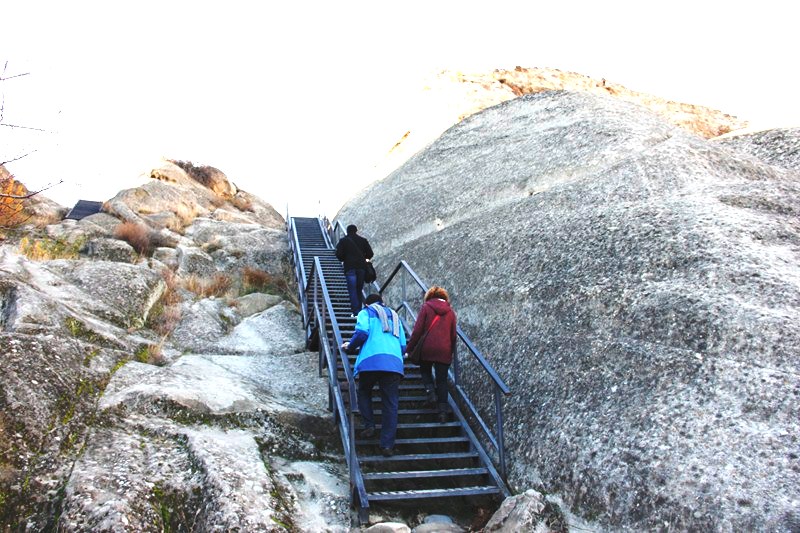
The start of our hike

The start of our hike

The approximately 4-hectare Uplistsikhe complex, tentatively divided into 3 parts, consists of a south (lower), middle (the largest) and north (upper) part. The middle part, containing the bulk of Uplistsikhe’s rock-cut structures, is connected to the southern part via a narrow rock-cut pass and a tunnel. Narrow alleys and, sometimes, staircases radiate from the central “street” to the different structures.

The Theateron (Theater)

The Theateron (Theater)

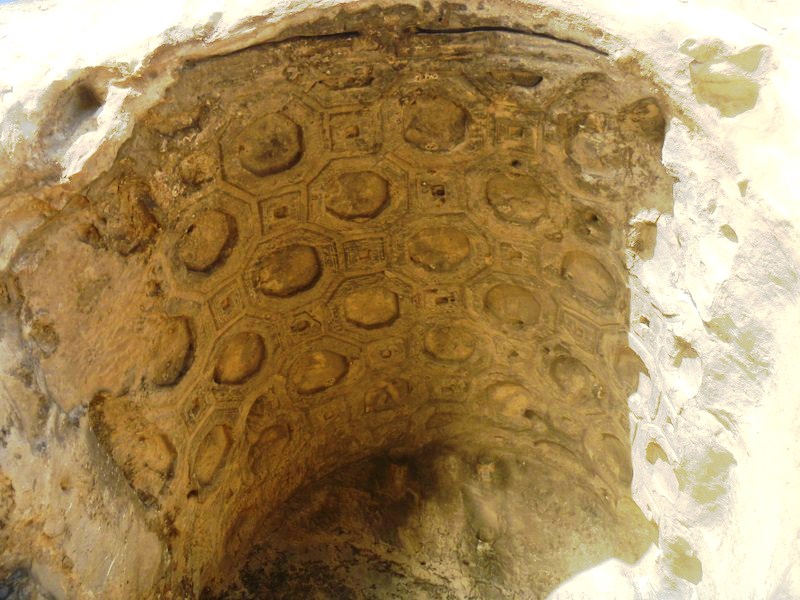
The ornate ceiling carved with octagonal Roman-style designs

The ornate ceiling carved with octagonal Roman-style designs

Most of the caves are devoid of any decorations. However, some of the larger structures have coffered, tunnel-vaulted ceilings, with stone carved in imitation of logs, as well as niches, which may have been used for ceremonial purposes, in the back or sides. Archaeological excavations in the area since 1957 (when only the tops of a few caves were visible) have uncovered numerous artifacts from different periods, many of which are in the safekeeping of the National Museum in Tbilisi.  Most of the unearthed artifacts include gold, silver and bronze jewelry, plus samples of ceramics and sculptures.

Sopho and Pancho performing "Romeo and Juliet" at the Theateron

Sopho and Pancho performing “Romeo and Juliet” at the Theateron

The earthquake in 1920 completely destroyed several parts of the most vulnerable areas and the stability of the monument remains under substantial threat, prompting the Fund of Cultural Heritage of Georgia, a joint project of the World Bank and Government of Georgia, to launch a limited program of conservation in 2000. Since 2007, the Uplistsikhe cave complex has been on the tentative list for inclusion into the UNESCO World Heritage program. Originally, the city had about 700 caves but, today, only 150 remain.

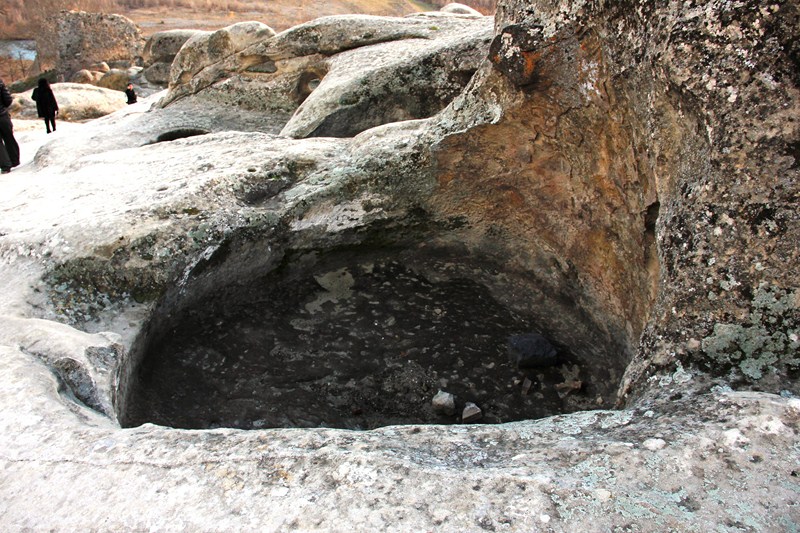
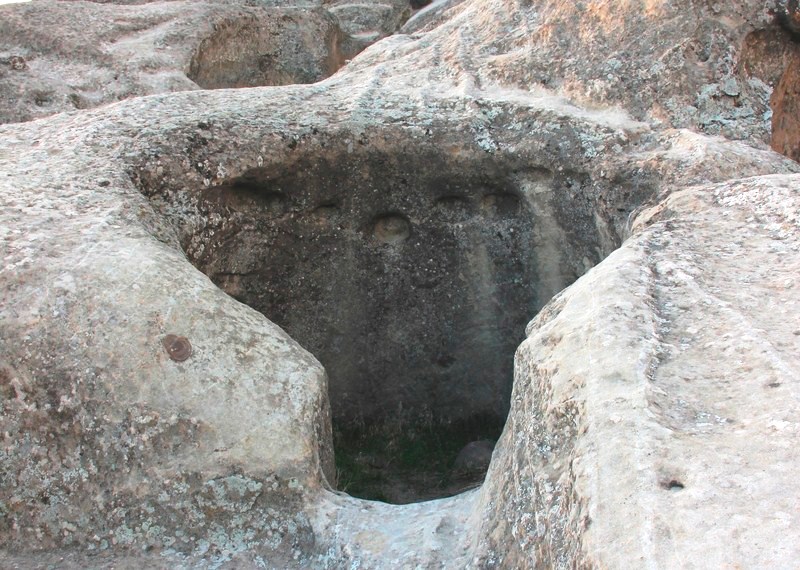
Round pits thought to have been used for corn storage or for sacrificial purposes

Round pits thought to have been used for corn storage or for sacrificial purposes

We all arrived at Uplistsikhe at around 4 PM, paid the entrance fee and started our 2-hour exploration of the 40,000 sq. m. Shida Qalaqi (“Inner City”), which is less than half of the original whole, by hiking about 5 m. up the rocks (opposite the toilets and cafe at the entrance), then following the rock-cut path to the left. Steps, with metal railings, lead us up through what was the main gateTo the right, sitting under a corrugated roof, is the excavated main tower of the Shida Qalaqi’s defensive walls.

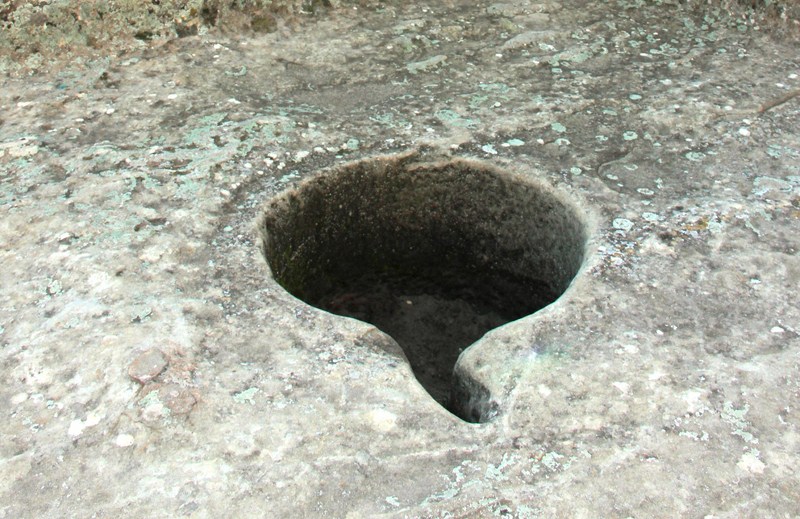
Tadpole-shaped pits that may have been ovens for baking bread

Tadpole-shaped pits that may have been ovens for baking bread

We observed many round pits dug in rock, thought to have been used for corn storage or for sacrificial purposes, while tadpole-shaped pits may have been ovens used for baking bread.  Scattered throughout the city are narrow circular holes, of different depths, cut in the ground to hold several prisoners.

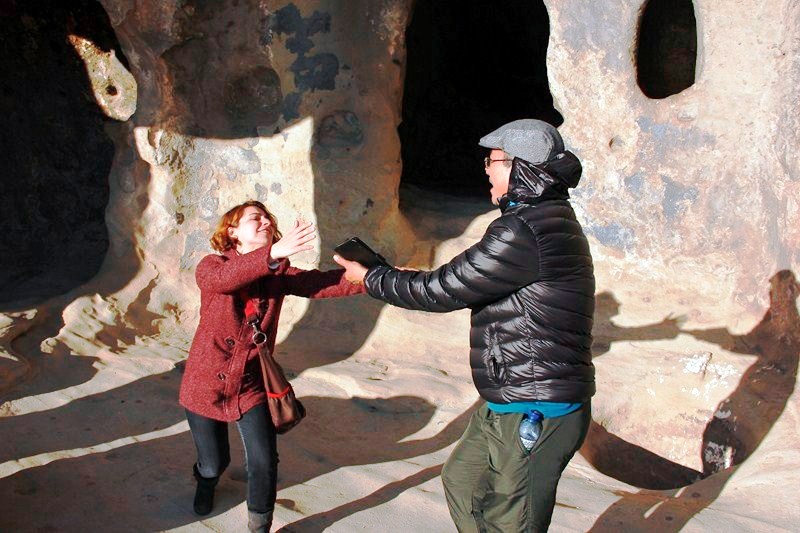
Inspecting a wine cellar

Inspecting a wine cellar

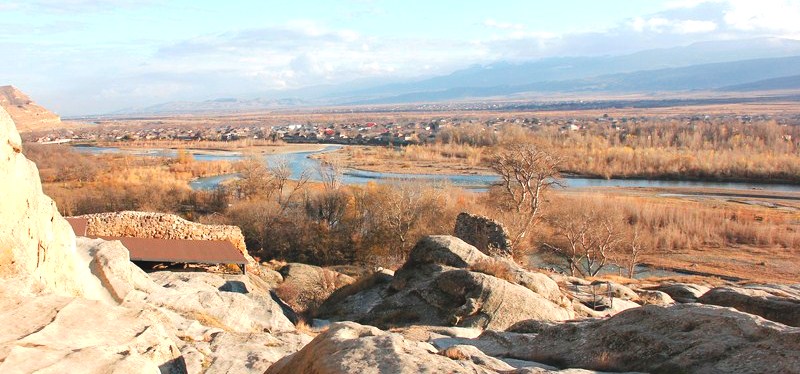
We also noticed a wine cellar, a pool for water storage and a wine press where grapes are crushed, allowing the juice to run down a chute into another container.  During the hike, we made short stops in between to admire the beautiful view of the river and the whole surroundings.

A wine press

A wine press

Ahead of us, overlooking the Mtkvari River, is the Theateron (Theater), probably a temple from the 1st or 2nd century AD where religious mystery plays may have been performed.  This cave has a pointed arch, carved in the rock above it, and an ornate, tunnel-vaulted ceiling carved with octagonal Roman-style designs resembling three-dimensional plaster work.  Behind the stage are dressing rooms.

The Temple of Makvliani

The Temple of Makvliani

Returning towards the main gate, we turned left to wind your way up the main street. Down to the right is the large pre-Christian Temple of MakvlianiWith an inner recess behind an arched portico, the open hall in front has stone seats for priests.

Tamaris Darbazi (Hall of Queen Tamar)

Tamaris Darbazi (Hall of Queen Tamar)

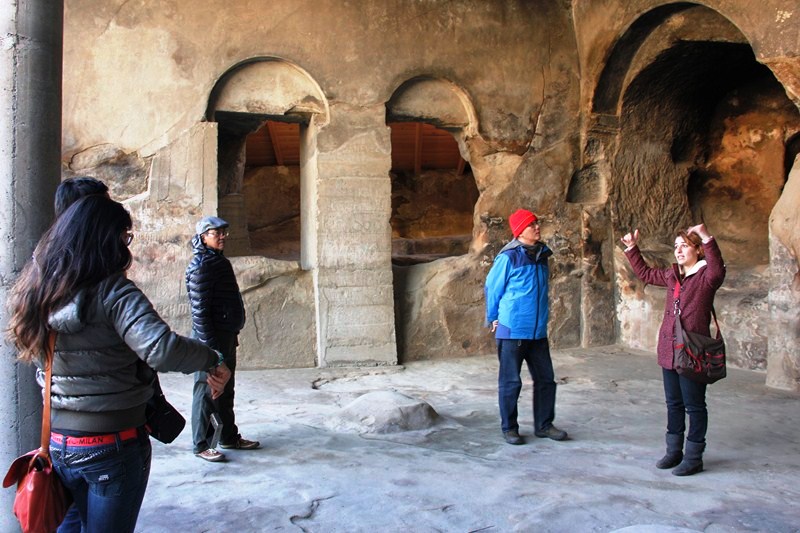
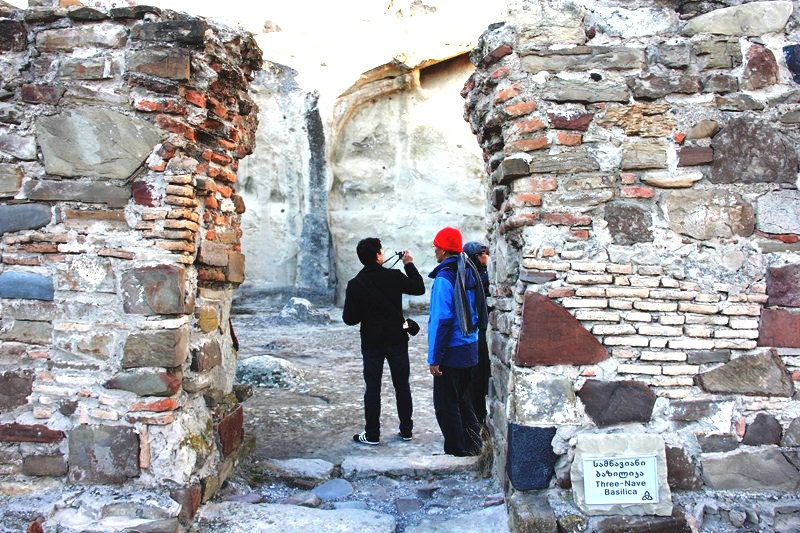
A little further up, on the left, is the big hall known as Tamaris Darbazi (Hall of Queen Tamar), almost certainly a pagan temple (though Georgia’s great Christian Queen Tamar may have used it later).  Behind two columns cut from the rock is a stone seat dating from antiquity. The hall has loggias on three sides.  The ribbed stone ceiling, cut to look like wooden beams, has a hole to let smoke out and light in. An open area, to its left, has stone niches along one side, thought to have once been a pharmacy or dovecote. To the right of Tamaris Darbazi is a large cave building, probably a pagan sun temple used for animal sacrifices and, later, converted into a 3-naved Christian basilica.

The 3-naved Christian basilica

The 3-naved Christian basilica

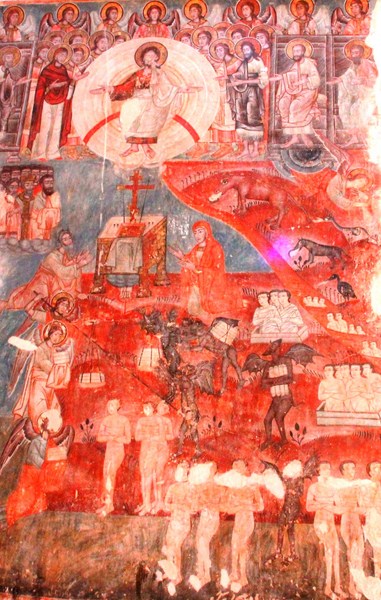
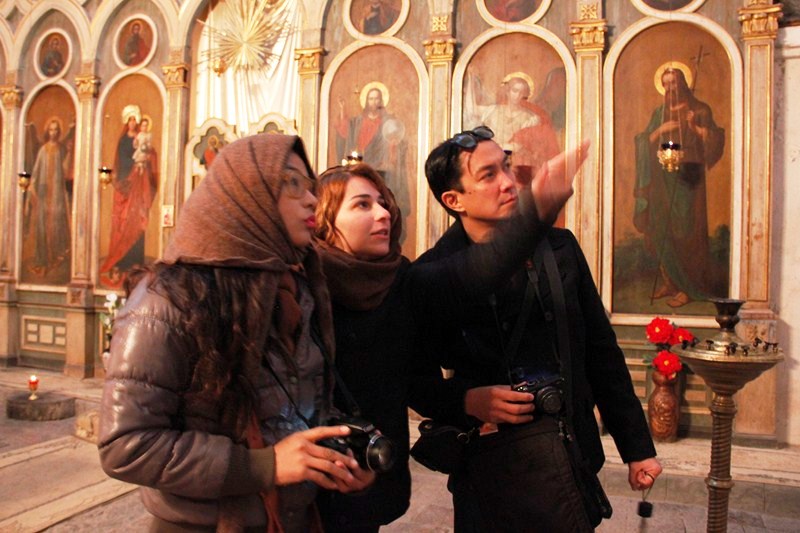
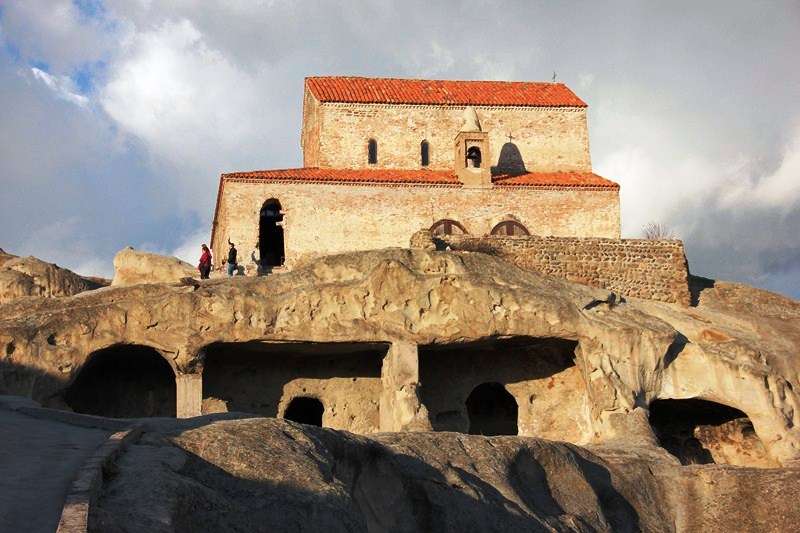
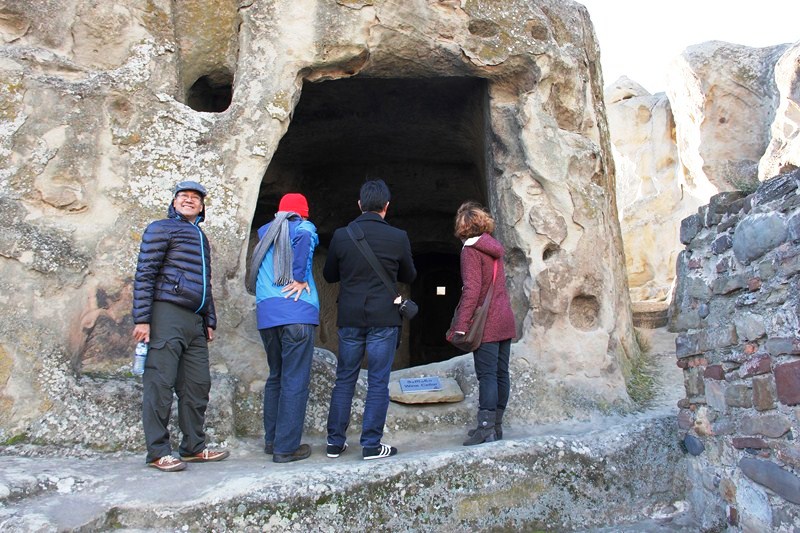
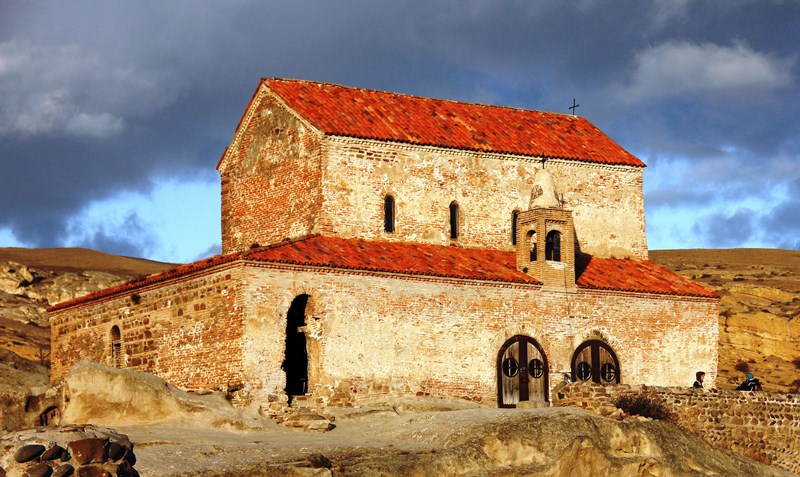
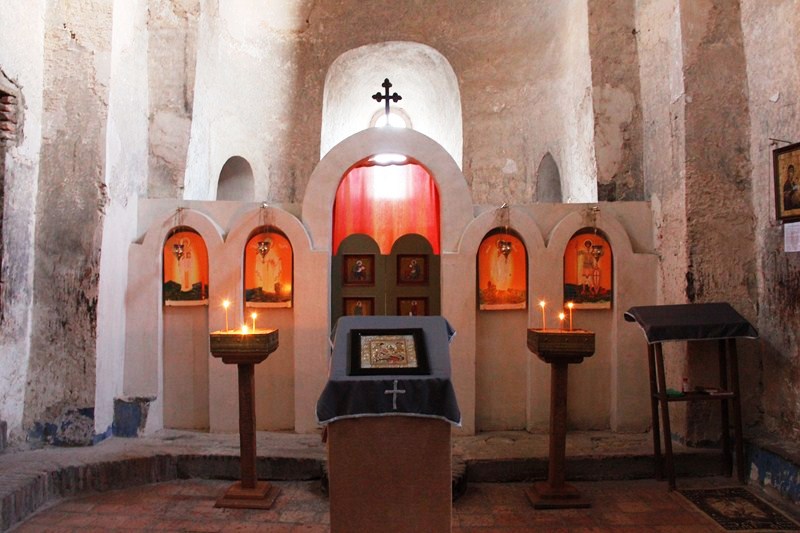
Near the summit of the hill is the Uplistsulis Eklesia (Prince’s Church), a picturesque triple-church Christian basilica built with stone and brick in the 9th -10th centuries over what was probably Upliistsikhe’s most important pagan temple. Inside the simple interior are some candlelit icons but no frescoes (they have been whitewashed).

Uplistsulis Eklesia (Prince’s Church)

Uplistsulis Eklesia (Prince’s Church)

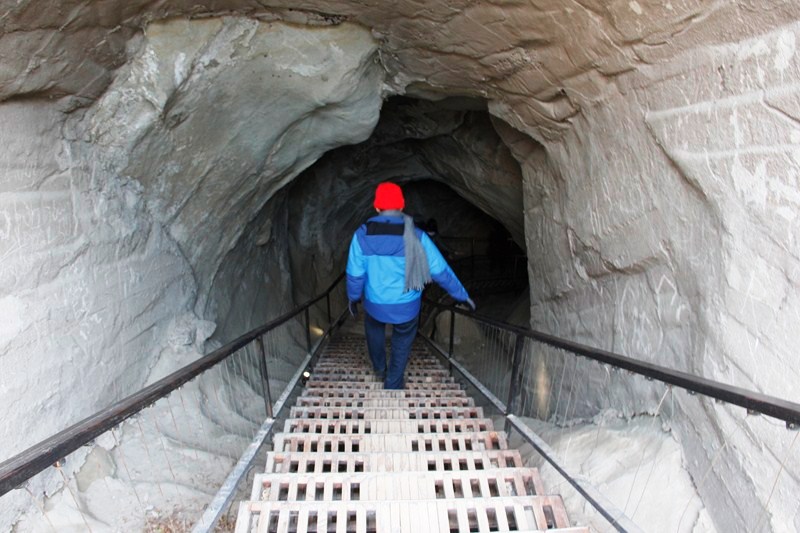
Outside, we again had breathtaking views of the river and the Caucasus Mountains. On our way back, we entered a dark, 40 m. long tunnel with a long flight of metal stairs, behind a reconstructed wall beside the old main gate, running down to the Mtkvari River, an emergency escape route that could also have been used for carrying water up to the city.

The simple church interior

The simple church interior

Our visit to this lovely place with an interesting history was unique in that we really had full access to the whole site (elsewhere most of this would all be fenced off) so we really got the feel of this city literally cut into the mountainside by soaking up its history and rustic charm. Well off the beaten track, but definitely worth a visit. The memory of this lovely ancient cave city would linger in my mind long after I have gone home.

Exiting down the 40 m. long tunnel

Exiting down the 40 m. long tunnel

Uplistsikhe: Shida Kartli, Gori, Georgia.  Open 11 AM – 6 PM. Admission: 3 GEL.

Qatar Airways has daily flights from Diosdado Macapagal International Airport (Clark, Pampanga) to Tbilisi (Republic of Georgia) with stopovers at Hamad International Airport (Doha, Qatar, 15 hrs.) and Heydar Aliyev International Airport (Baku, Azerbaijan, 1 hr.). Website: www.qatarairways.com.
Stalin State Museum (Gori, Georgia)

After lunch, Buddy, Pancho, Melissa, Riva and I, plus our Georgian guide Sopho Makashvili, proceeded on our GNTA-sponsored tour of Stalin State Museum located within Gori town proper.  This museum, officially dedicated to the life of Soviet Union leader Joseph Stalin (who was born Iosef Dzhugashvili in Gori on December 18, 1878), was begun in 1951, ostensibly as a local history museum but was clearly intended to become a memorial to Stalin, who died on March 5, 1953.  It defiantly opened in 1957, the year after Nikita Khruschev’s secret speech denouncing Stalin.

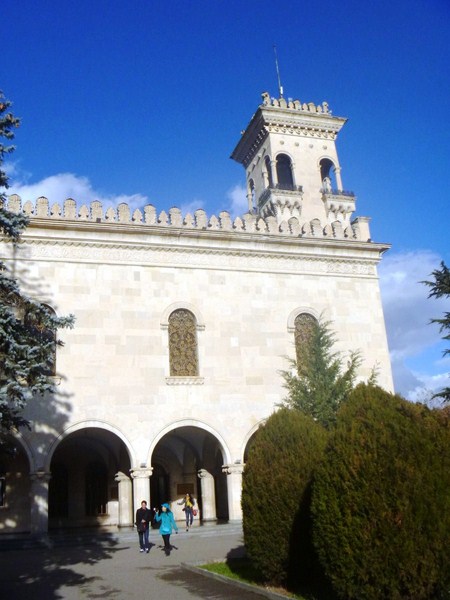
The large, ornate Exposition Building

The large, ornate Exposition Building

The Expostion Building's tower

The Expostion Building’s tower

In 1989, with the downfall of the Soviet Union and independence movement of Georgia, the museum was “closed,” post-perestroika. However, school groups were still being shown around and, now, it has abandoned all pretense of being closed and has since been reopened. Now a popular tourist attraction, it has retained, until recent years, its Soviet-era characteristics and it now highlights the Soviet-era Stalin personality cult. The museum has 3 sections, all located in the town’s central square.

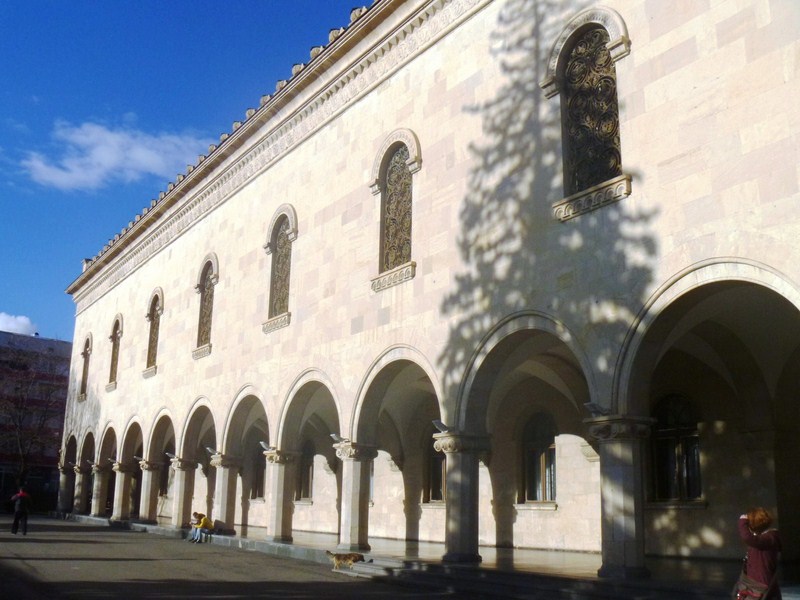
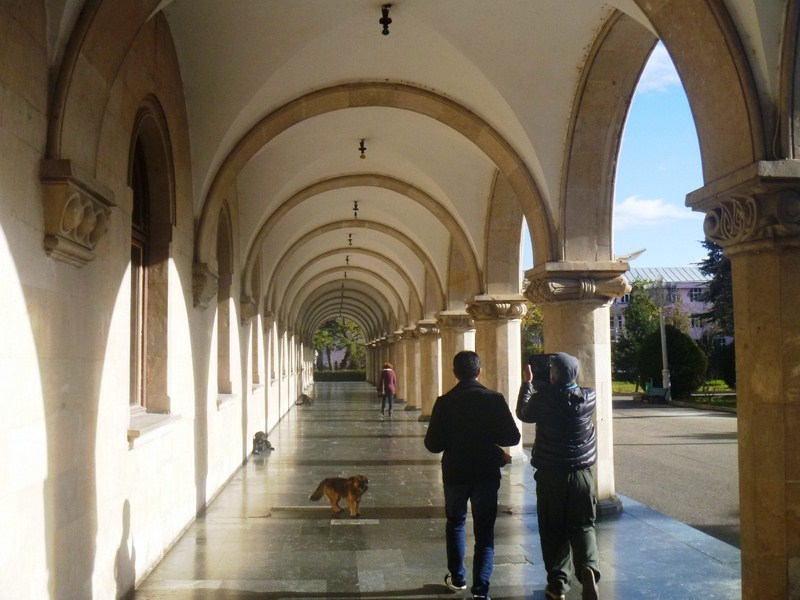
The Exposition Building's collonade

The Exposition Building’s collonade

P1220544

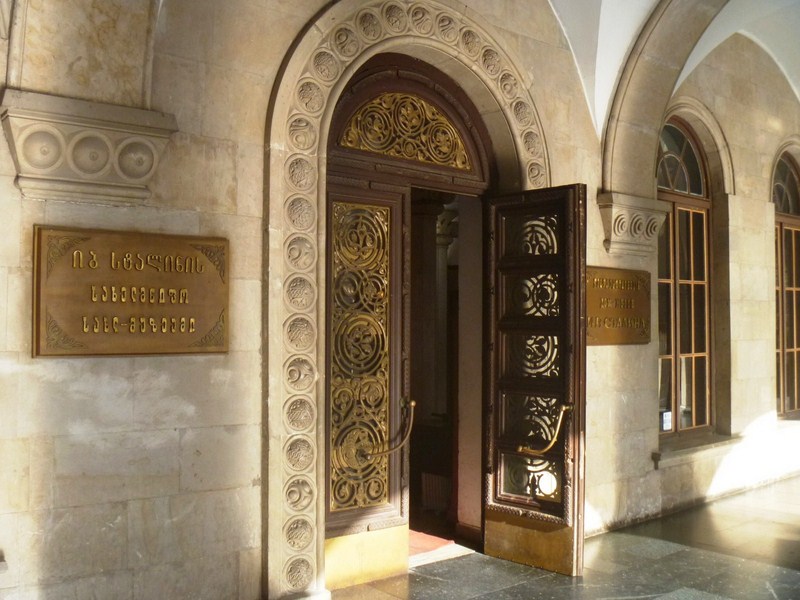
We first dropped by the main corpus of the complex, the Exposition Building with a tower at one end.  This large, ornate palazzo, one of the biggest buildings in town, was built in the Stalinist Gothic style. While waiting for our guide at the lobby of this rather typical Soviet-era house museum, we checked out the gift shop.

The museum Gift Shop

The museum Gift Shop

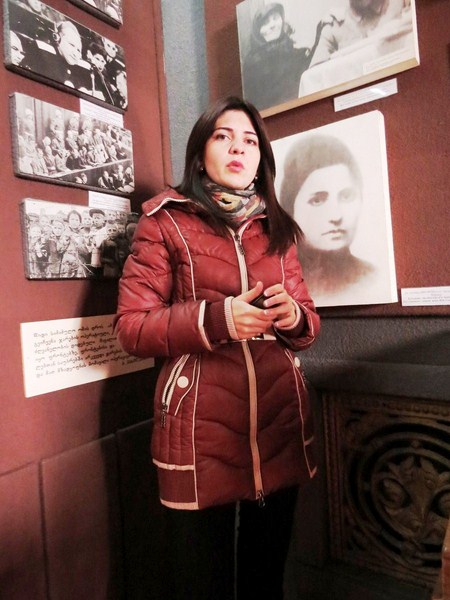
Some of the “souvenirs” on sale include key chains, mugs, lighters, wine flasks, mini busts and Stalin red wine but the vast majority seemed too kitschy to purchase.  After a short wait, we finally met up with our English-speaking guide – the svelte, friendly and polite Natia Jolbordi.

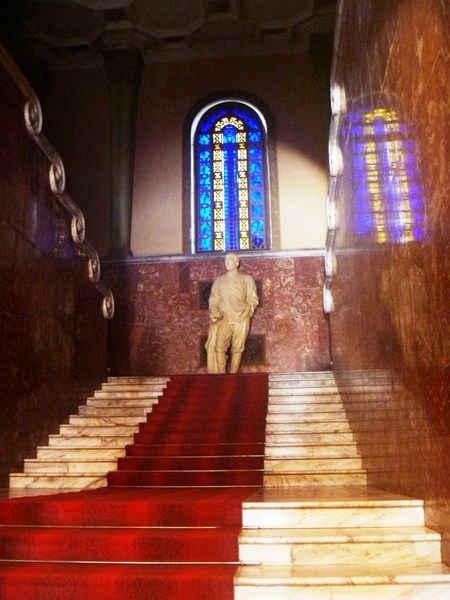
The grand, W-shaped stairway with Stalin's statue on the landing

The grand, W-shaped stairway with Stalin’s statue on the landing

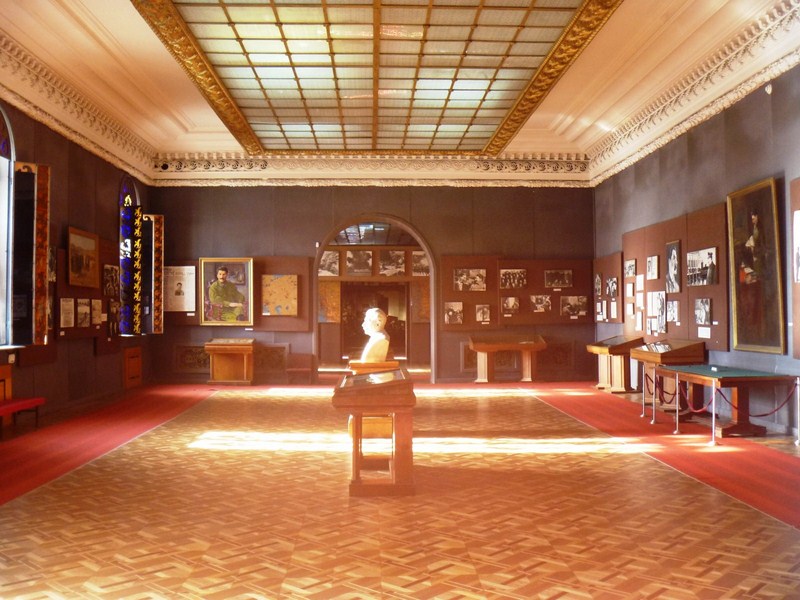
The museum tours starts at the second floor of the building which may be reached only by a  grand, W-shaped stairway (there are no elevators) whose landing has a life-size statue of Stalin.  This complex of exhibits is divided into six halls, all well laid out in roughly chronological order and most dedicated to Stalin’s role in the big patriotic war and his victory over Nazism and fascism.
Our guide Natia Jolbordi

Our guide Natia Jolbordi

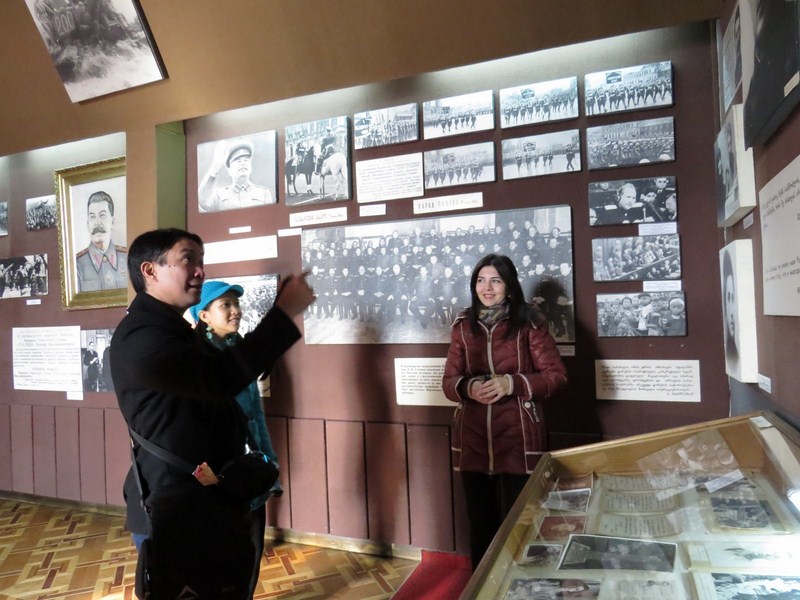
About 70% of the exhibits are photos (mostly reproductions) of various events, pictures from Dzugashvili’s life and of leaders and important events of the Soviet Union. The display also includes artifacts related to Stalin in different periods in his life, illustrations, paintings and newspaper articles headlining his achievements.  Many of the items on display have written English descriptions but most, however, are described in Georgian and Russian and that’s why it is so important to have an English-speaking guide.
A display hall

A display hall

Private things of Stalin's mother

Private things of Stalin’s mother

Our museum guide, Natia went through the very well presented information in a very knowledgeable manner and, after she had finished, was on hand to answer our questions. I was particularly interested in Stalin’s personal life: childhood, his early days when he was in school and the information about his own family and children.

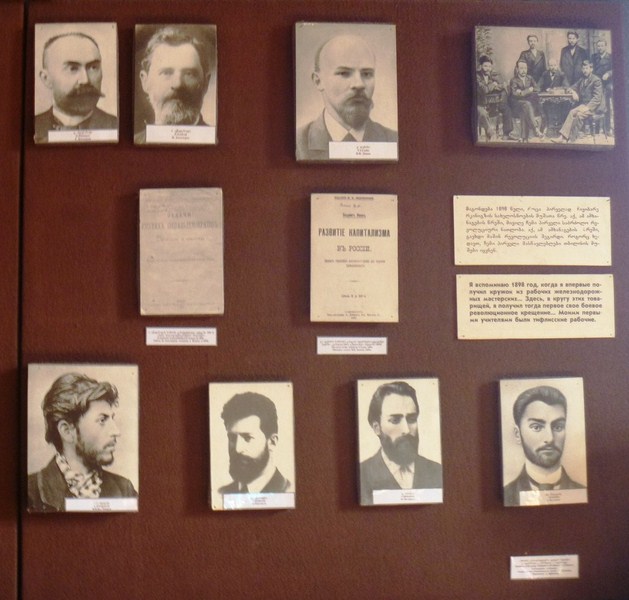
Photos of Stalin and his contemporaries

Photos of a young Stalin (lower left) and his contemporaries

I was very enlightened by the story of his eldest son Yakov (from his first wife Ekaterina Svanidze) whom he lost on April 14, 1943 at Sachsenhausen concentration camp, (Oranienburg, Germany) during World War II. I also found the early “revolutionary” years of Stalin especially interesting. Natia told us everything down to the minute detail. She was great.

Buddy posing a question to Natia

Consul Buddy Cunanan posing a question to Natia

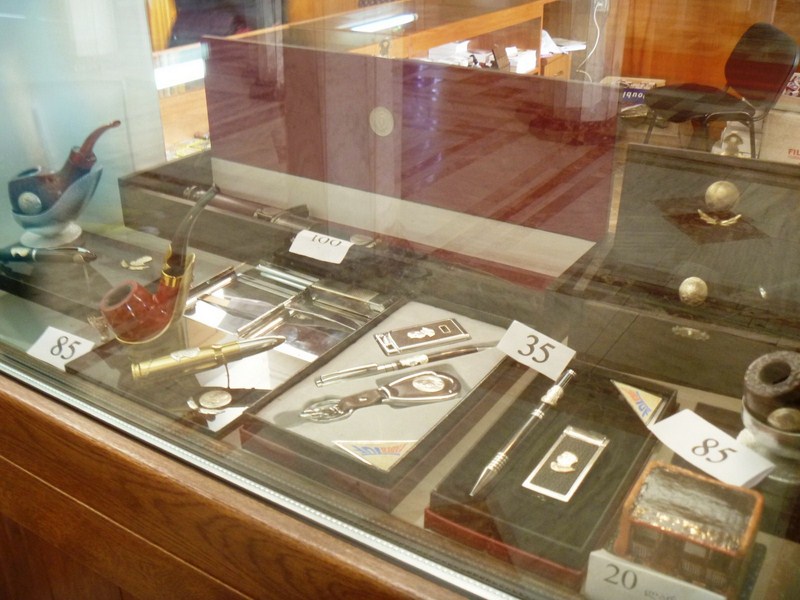
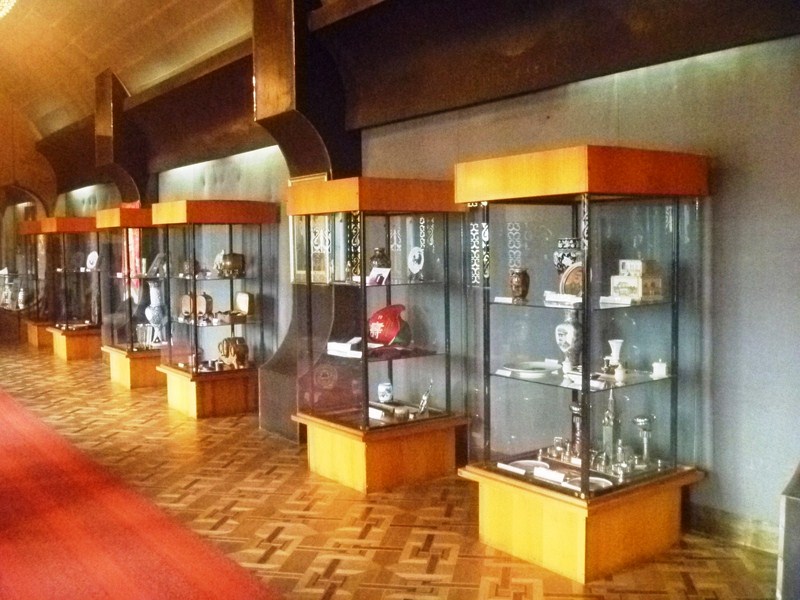
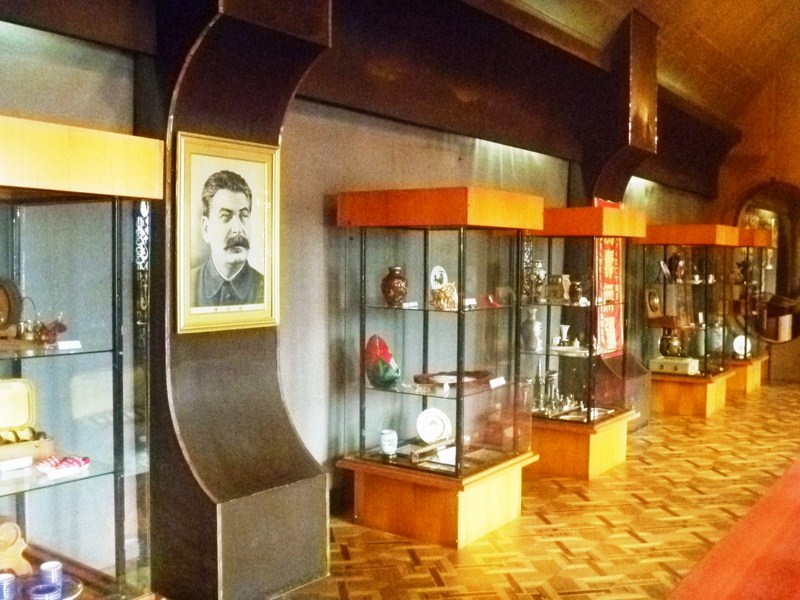
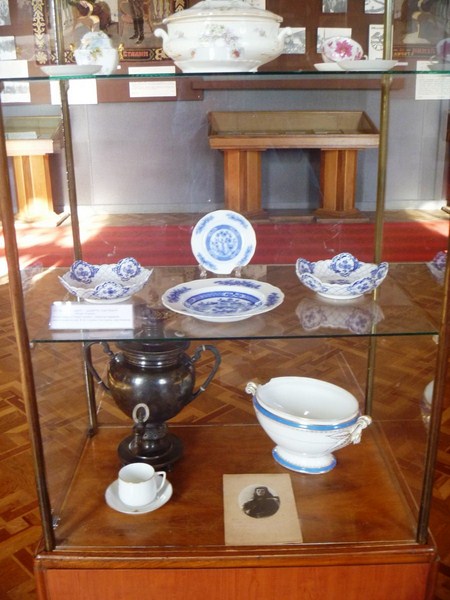
We also had the opportunity to see display cases containing a couple of Stalin’s famous pipes, private things of Ekaterina Jugashvili (Stalin’s mother), medals awarded to him and gifts (carpets with the face of Stalin, needlepoints, a tobacco-leave mosaic, a hammer and sickle desk lamp, etc.) from various other nations and made to him over the years during his reign.

P1220604

Display cases with gifts to Stalin

Display cases with gifts to Stalin

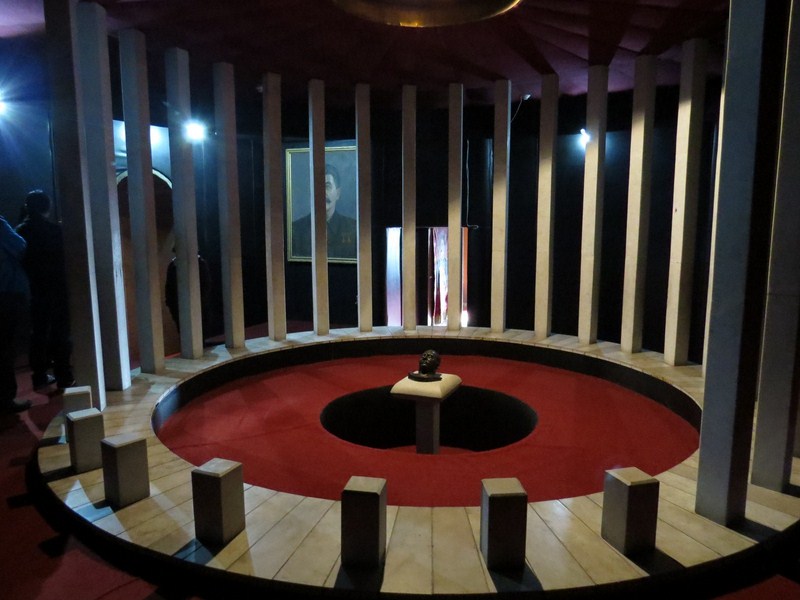
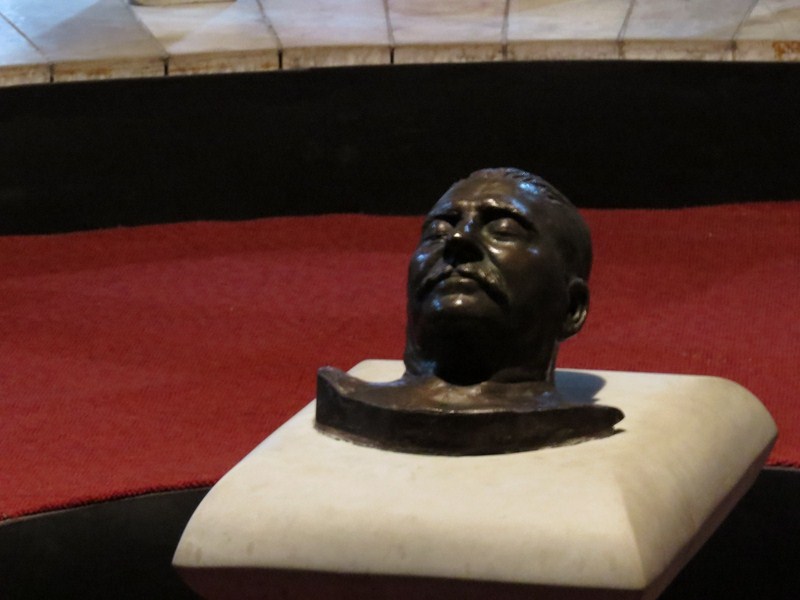
Our journey ended in a darkened room with one of 12 copies of the death mask of Stalin on view, taken shortly after his death and presented in a red velvet ring as if it were a holy relic.

IMG_1779

Stalin's death mask (photos: Ms. Riva Galveztan)

Stalin’s death mask (photos: Ms. Riva Galveztan)

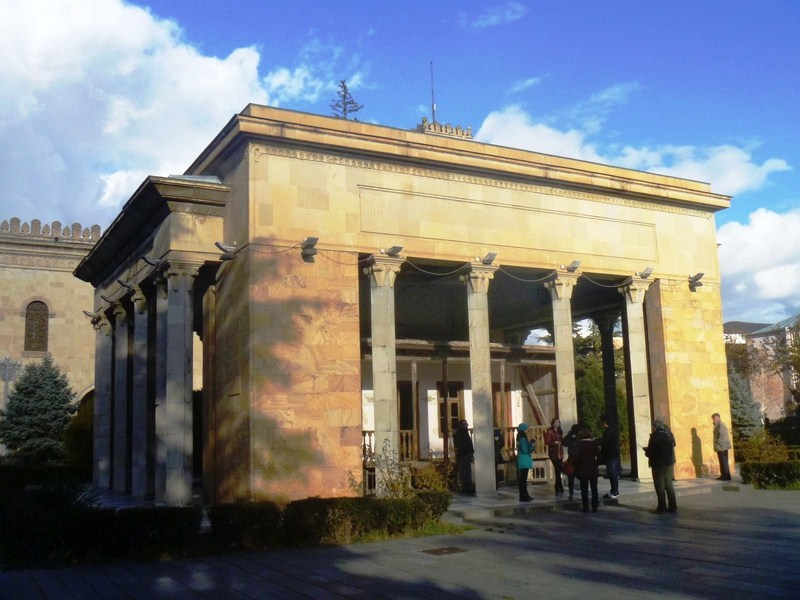
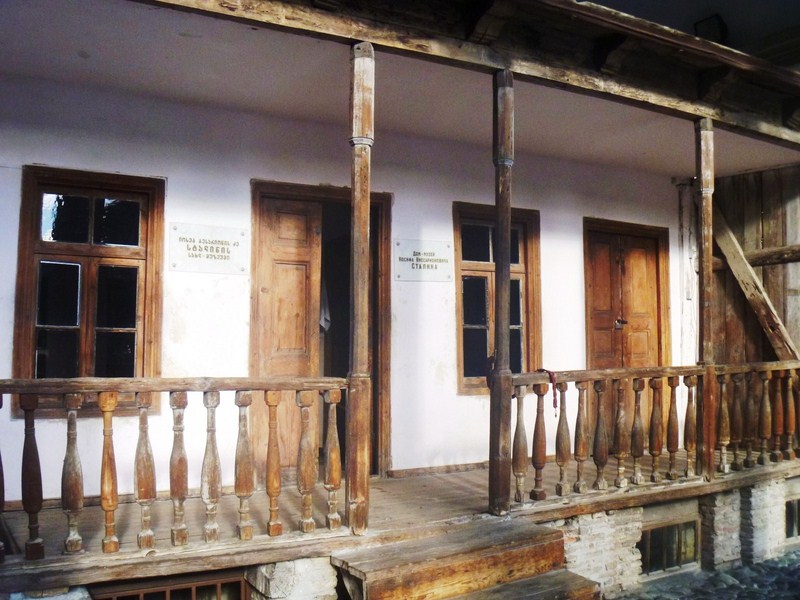
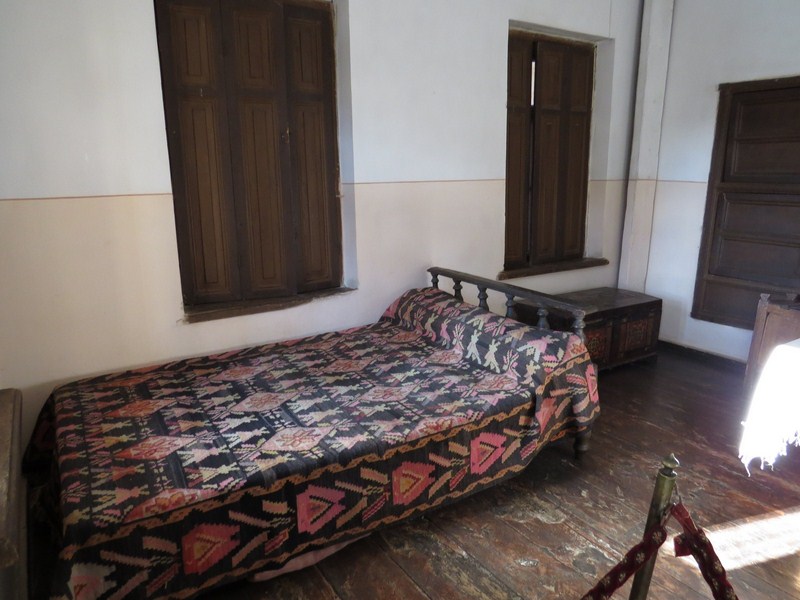
We now all left the main building and moved out, into the sunlight, towards a Greco-Italianate-style pavilion where, enshrined within, is a small wooden duplex hut where Stalin was born and spent his first four years. Stalin’s father Vissarion Jughashvili, a local shoemaker, rented the one room on the left hand side of the building and maintained a workshop in the basement. We all took a peek inside to see its sparse furnishings.

The Greco-Italianate-style pavilion housing Stalin's boyhood home

The Greco-Italianate-style pavilion housing Stalin’s boyhood home

Stalin's boyhood home

Stalin’s boyhood home

The home's sparse furnishings (photo: Ms. Riva Galveztan)

The home’s sparse furnishings (photo: Ms. Riva Galveztan)

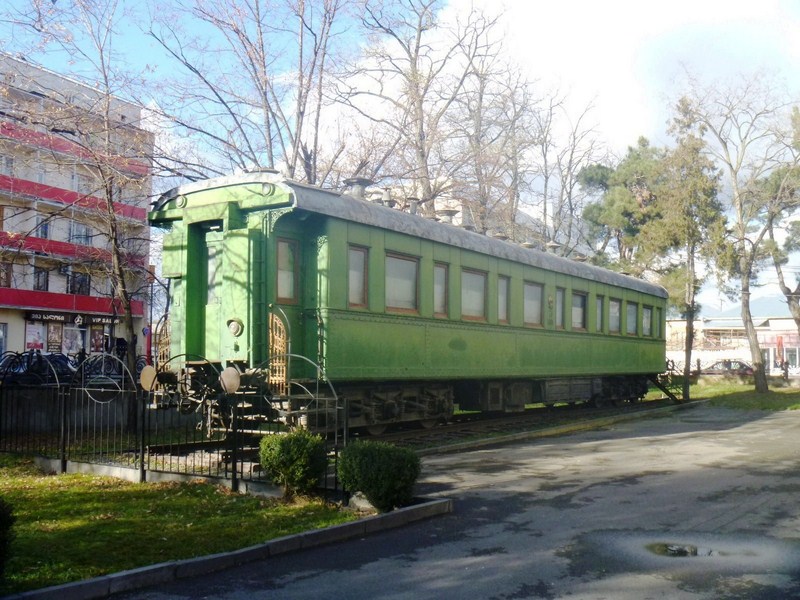
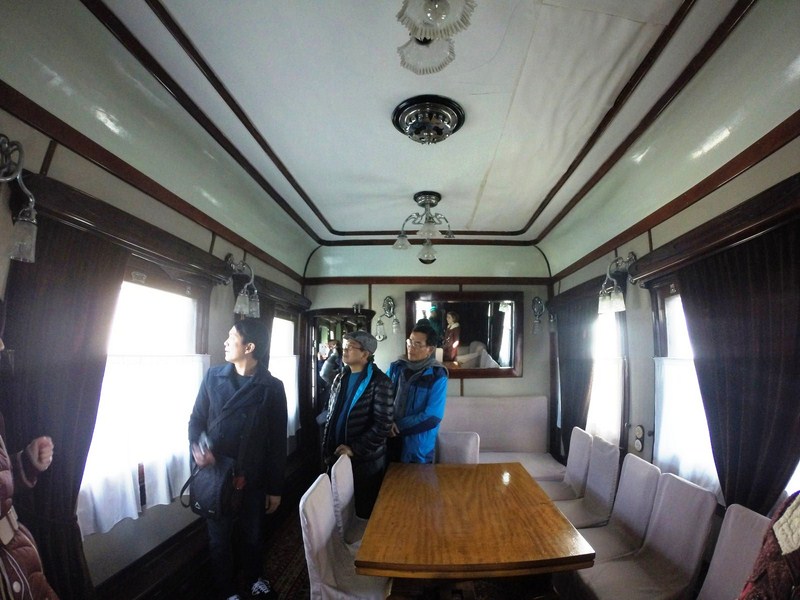
Finally, we moved on to check out Stalin’s personal green, Art Nouveau Pullman railway carriage, parked to one side of the Exposition Building.  The former Tsar Nicolas II’s train, it was used by Stalin, from 1941 onwards, for his travel to Allied conferences in Tehran (Iran, November 28 – December 1, 1943), Yalta (Crimea, February 4 – 11, 1945) and Potsdam (Germany, July 17 – August 2, 1945). In 1985, upon being recovered from the railway yards at Rostov-on-Don, it was sent to the museum. 
Stalin's private railway carriage

Stalin’s private railway carriage

Weighing 83 tons and armor-plated (a demonstration of Stalin’s acute sense of security), Stalin’s Air Force One still had surprising luxury (for that era) as he kept all the trappings of grandeur of his former enemy.  The carriage had Stalin’s bedroom, his toilet, rooms for his aides, a kitchen and a conference room at its end. 
Checking out Stalin's conference area (photo: Ms. Riva Galveztan)

Buddy, Pancho and the author checking out Stalin’s conference room (photo: Ms. Riva Galveztan)

Stalin is Georgia’s most famous though controversial son and, in a culture which reveres strong personalities, that counts for a lot in this small country. The Stalin State Museum, a time warp from Soviet Union times, was truly worth a visit. 
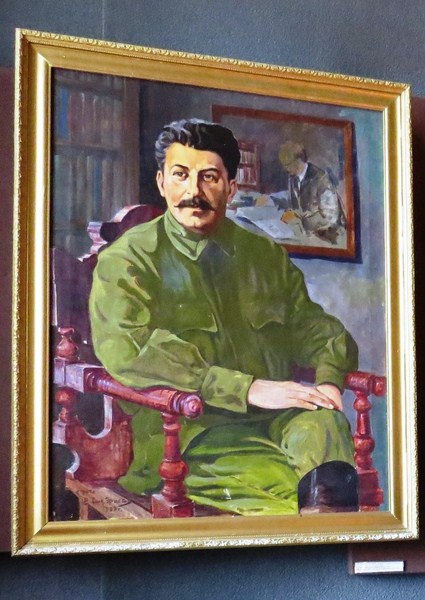
Portrait of a sitting Stalin

Portrait of a sitting Stalin

Stalin State Museum: 32 Stalin Ave., Gori, Georgia. Tel:  995 270 7 52 15.  Open daily except public holidays, 10 AM – 5 PM. Admission:  10 GEL per pax plus an additional 5 GEL per pax if you want to visit Stalin’s train wagon. 

Georgia National Tourism Administration: 4, Sanapiro St, 0105, Tbilisi, Georgia. Tel: +995 32 43 69 99. E-mail: info@gnta.ge. Website: www.georgia.travel; www.gnta.ge.

Qatar Airways has daily flights from Diosdado Macapagal International Airport (Clark, Pampanga) to Tbilisi (Republic of Georgia) with stopovers at Hamad International Airport (Doha, Qatar, 15 hrs.) and Heydar Aliyev International Airport (Baku, Azerbaijan, 1 hr.). Website: www.qatarairways.com.