Royal Palace – Exhibition Halls (Phnom Penh, Cambodia)

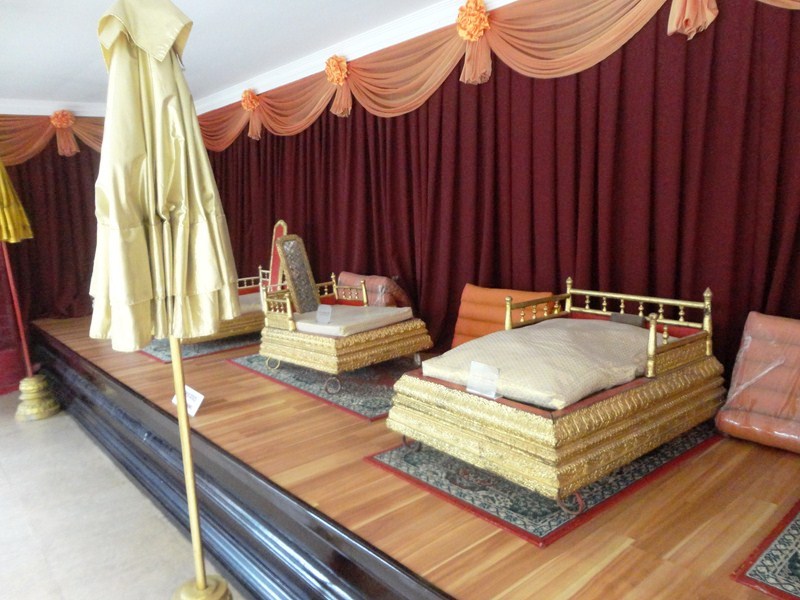
Prior to ending our tour of the Royal Palace, Osang, Violet, Jandy and I visited a number of exhibition halls.  The multi-purpose White Elephant room, located just outside the palace’s southeast wall, was traditionally used for special regal occasions including Royal births, deaths or weddings. The sacred white elephant is the most auspicious and revered symbol of royal beneficence. Here, we saw lines of ornate, gold-adorned chairs that elephants carried royals on.

White Elepant House

White Elepant House

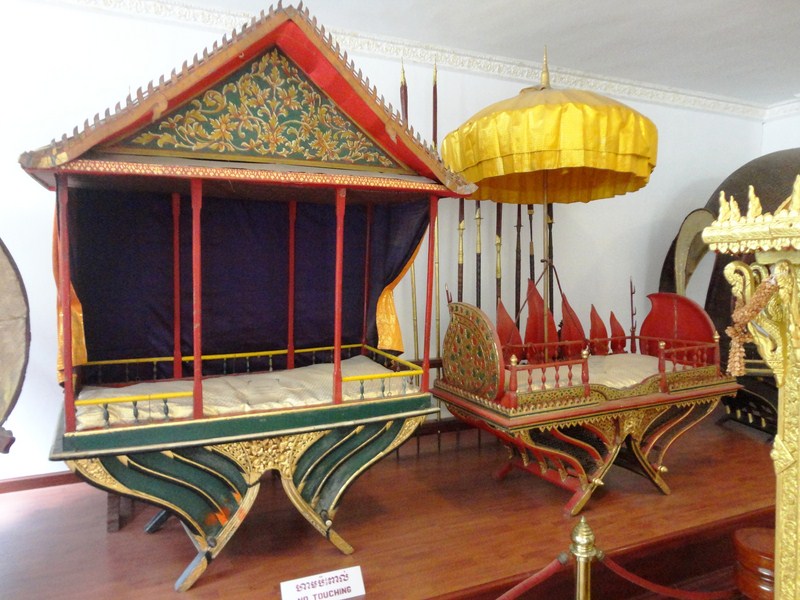
The Showroom of Royal Palanquins and Bossabok displays royal palanquins used by Cambodian kings and queens as they are paraded around the city as well as bossaboks (traditional Khmer-style thrones).

The Showroom of Royal Palanquins and Bossabok

The Showroom of Royal Palanquins and Bossabok

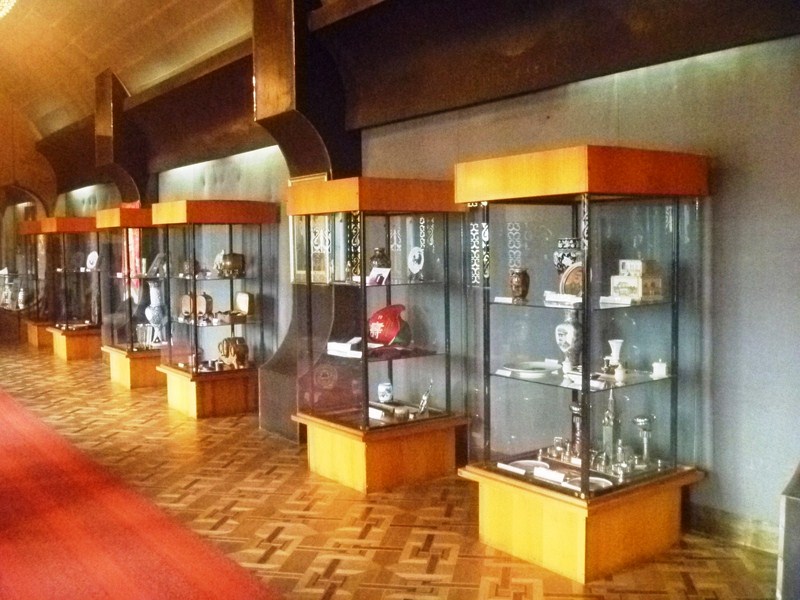
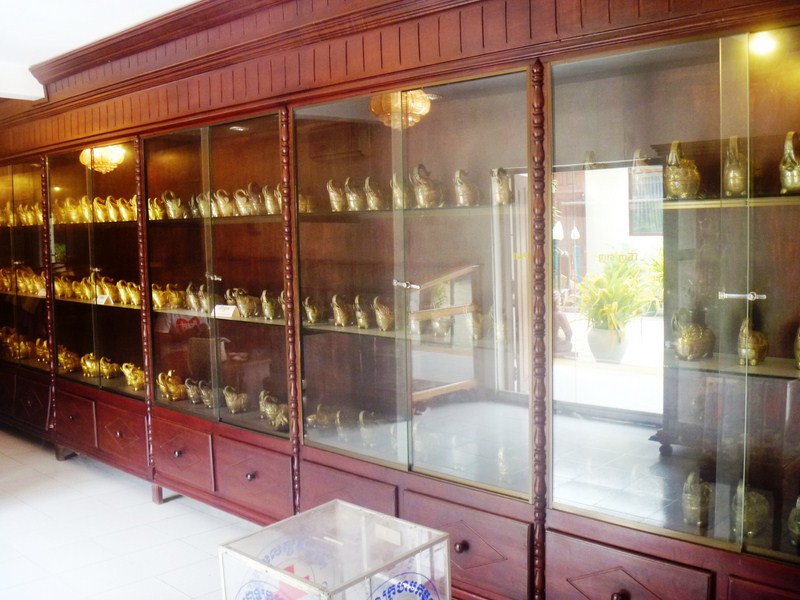
The Elephant Boxes Showroom in Gold, Silver, Brass, Marble and Wood has wood and glass display cases filled with elephant figurines, of various sizes, made with gold, silver, brass, marble and wood.

The Elephant Boxes Showroom in Gold, Silver, Brass, Marble and Wood

The Elephant Boxes Showroom in Gold, Silver, Brass, Marble and Wood

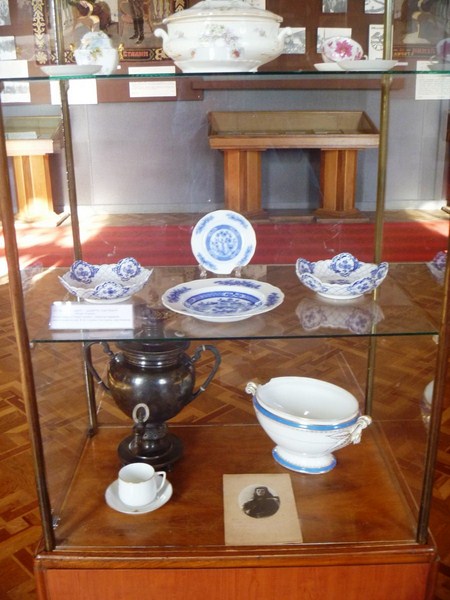
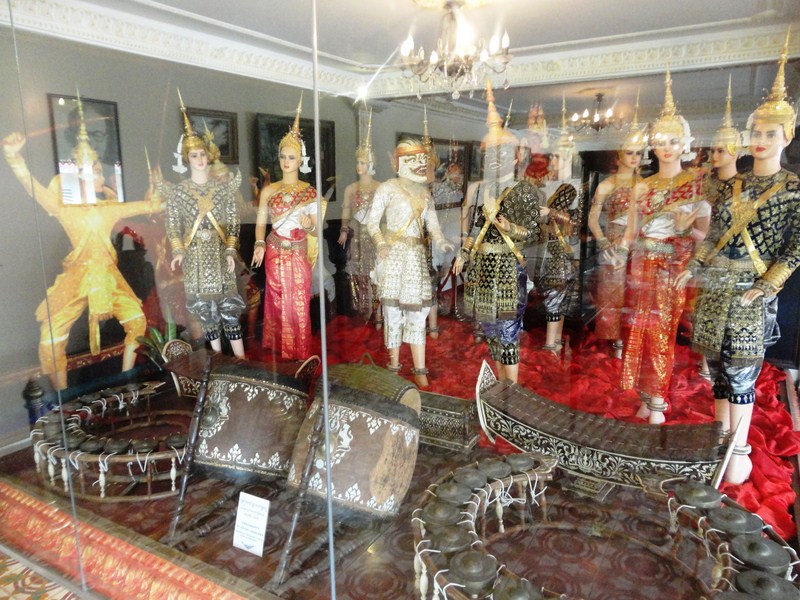
The second floor, airconditioned Showroom of Royal Dancers Ornaments (Preah Kossamak) has wood and glass display cases exhibiting Royal Palace documents; royal dinner sets and silverware; utensils; medals; and dance costumes, musical instruments and ornaments of the Royal Dancers.

Showroom of Royal Dancers Ornaments (Preah Kossamak)

Showroom of Royal Dancers Ornaments (Preah Kossamak)

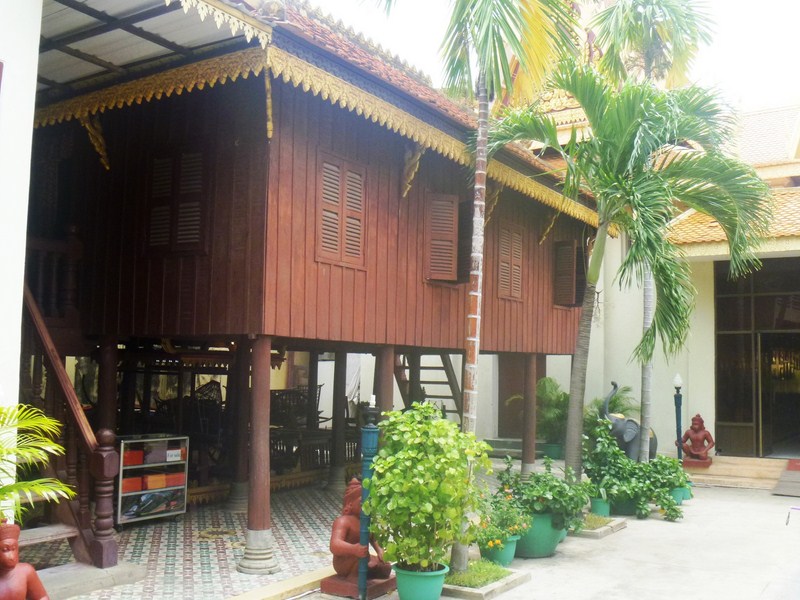
There is also a model of a typical, 2-storey traditional Khmer house,  an exhibit of.photos of recent Royal Processions and a model of the King’s inauguration procession.

Traditional Khmer house

Traditional Khmer house

Royal Palace: Samdach Sothearos Blvd., Phnom Penh.  Open daily, 8 to 11 AM and 2 to 5 PM.

Royal Palace – The Throne Hall (Phnom Penh, Cambodia)

Throne Hall (Preah Tineang Tevea Vinichhay)

Throne Hall (Preah Tineang Tevea Vinichhay)

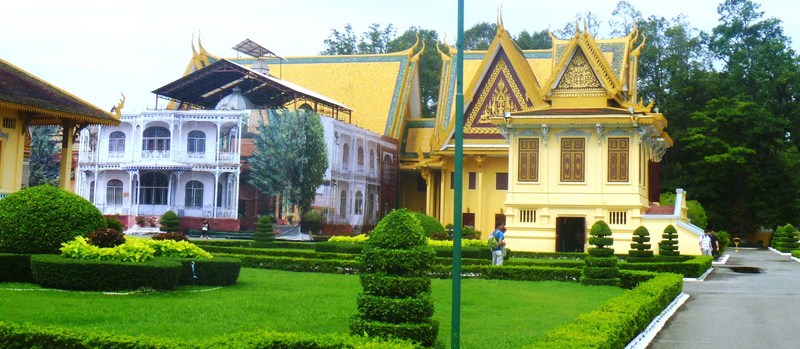
Upon paying the admission fee of US$6.25, Jandy, Osang, Violet and I started our guide-less tour of the Royal Palace grounds.The first major building we passed was the open-sided Preah Tineang Phhochani, the banqueting and dance hall, inaugurated in 1912. The pristine gardens of the palace grounds are dotted with topiaried trees and are planted with tropical flowers and plants such as Allamanda catharticaCouroupita guianensis and Jatropha integerrima.

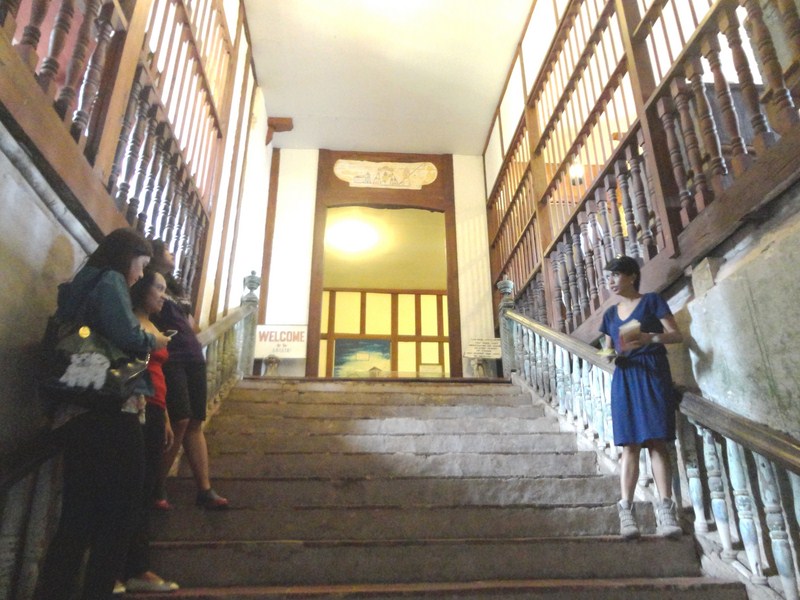
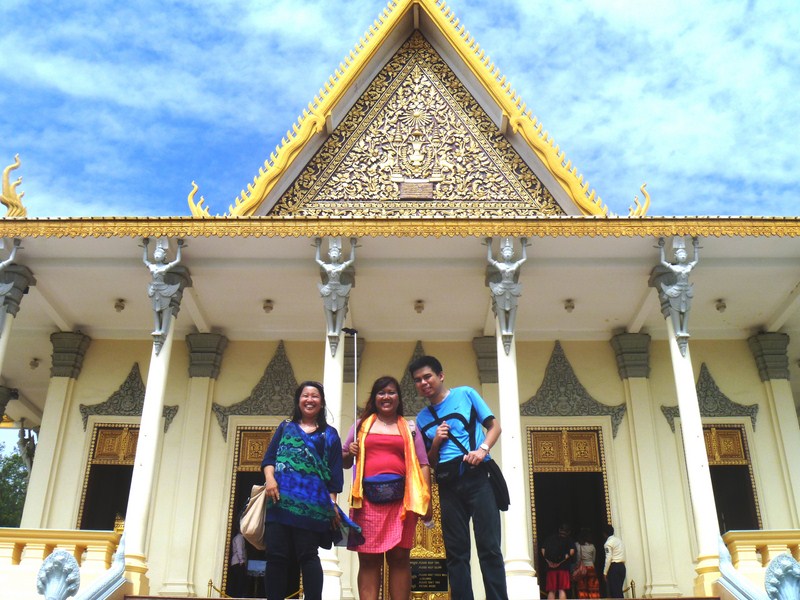
Osang, Violet and Jandy at top of grand stairway

Osang, Violet and Jandy at top of grand stairway

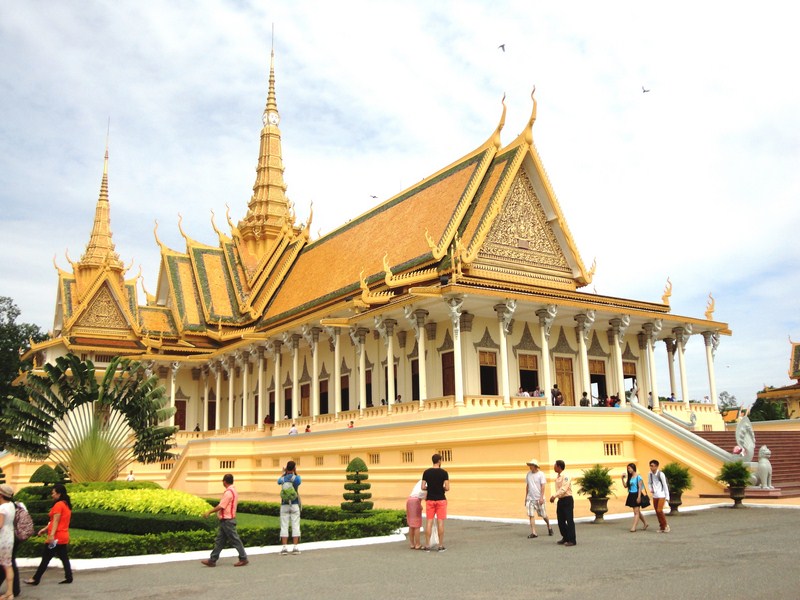
We started with the cross-shaped Throne Hall (Preah Thineang Dheva Vinnichay Mohai Moha Prasat, or “Sacred Seat of Judgement”), the most impressive building in the royal compound.  The Throne Hall , crowned with 3 spires, is the second building to be built on this site.  The King’s confidants, generals and royal officials once carried out their duties here and it is still in use today as a place for religious and royal ceremonies (such as coronations and royal weddings) as well as a meeting place for the King’s guests.

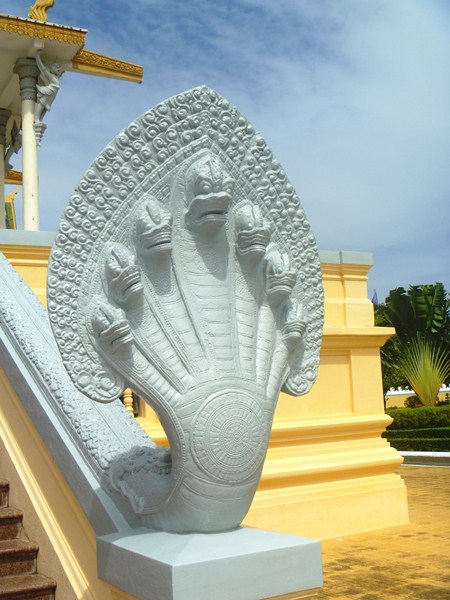
A 7-headed naga

A 7-headed naga

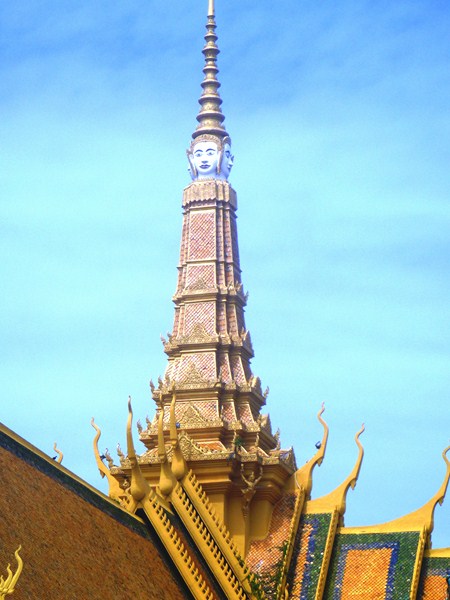
The first building was constructed of wood in 1869-1870, under King Norodom, then demolished in 1915 and the present 30 x 60 m. building, a  faithful reproduction of Norodom’s wooden palace, was built in 1917 and inaugurated by King Bat Sisowath in 1919. This building, as well as all buildings and structures at the Royal Palace, faces the east (best photographed in the morning). The building’s central, 59 m. high spire is topped with the white, 4-faced head of Brahma.

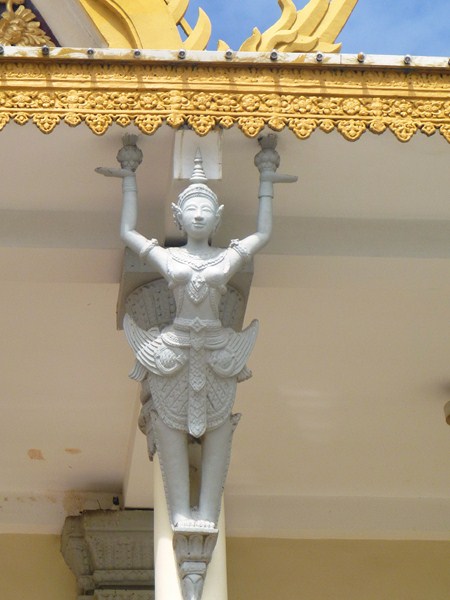
A garuda appearing to support the roof

A garuda appearing to support the roof

Inside are 3 royal thrones (2 traditional and 1 Western-style) and golden busts of Cambodians kings and queens, starting from the reign King Ang Doung onwards. However, we, as well as all other visitors, weren’t allowed to go inside, much less take pictures of the interiors, even from the outside.  We could only take photographs of its exterior.

Spire topped with the white, 4-faced head of Brahma

Spire topped with the white, 4-faced head of Brahma

The hall’s broad and grand entrance stairway has banisters formed by 7-headed nagas.  Each column of the colonnaded veranda is topped by a garuda with outstretched wings, all seemingly supporting the eaves of the roof.

Hor Samranphirum

Hor Samranphirum

To the right of the Throne Hall is the Hor Samran Phirum, the Royal Rest House, built between 1915 and 1917.  It is not open for public viewing. On coronation day, this small pavilion is used as a royal rest house and waiting area.  Here, the incoming King and Queen wait for their elephants to be bought around. On one side of the building is a door and some posts which are used to harness the elephants while the royals board.  The king no longer keeps elephants and, today, this building is used to house gifts from foreign dignitaries as well as the royal musical instruments and utensils used in royal coronation processions.

Hor Samritvimean

Hor Samrit Vimean

Exhibits at Hor Samritvimean

Exhibits at Hor Samrit Vimean

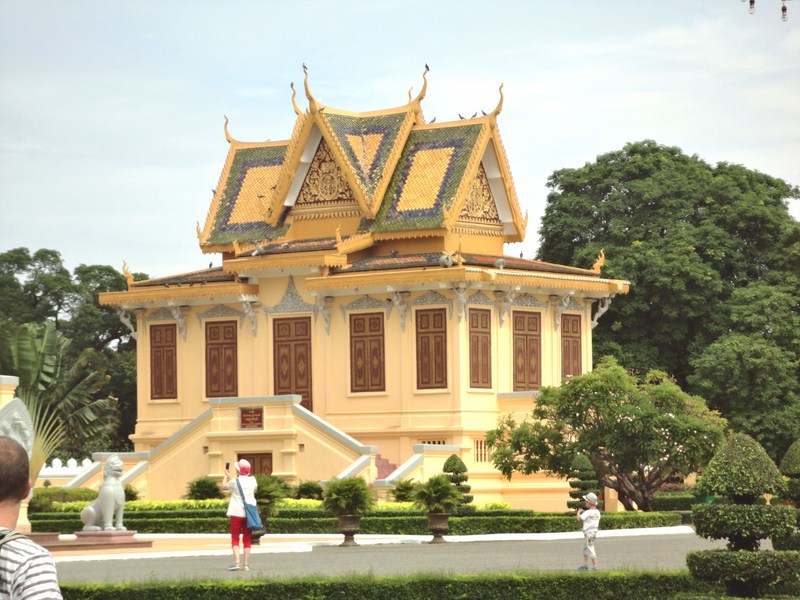
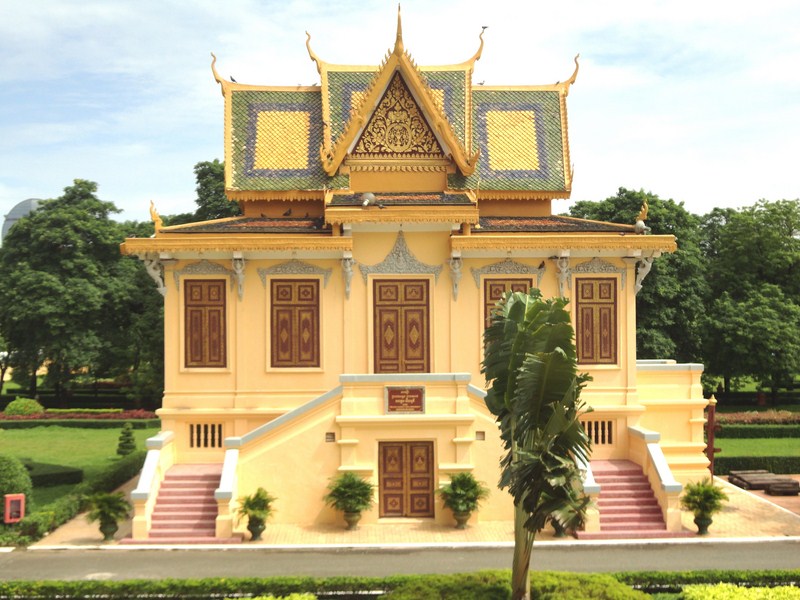
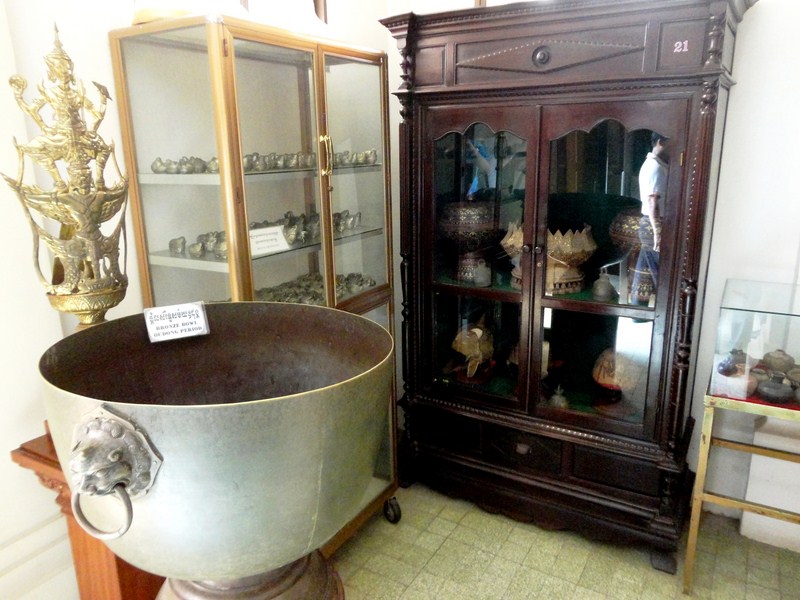
One small but elaborate pavilion we could photograph, both inside and out, was the Hor Samrit Vimean, also known as the Bronze Palace. The Royal treasury, this tall but narrow building houses regalia vital to the coronation ceremony including the Great Crown of Victory; The Great White umbrella of state; The Sacred Sword; The Victory Spear; The Fan; various procession group figures bearing the national, religious and monarchy flags; and clothing worn during King Sihamoni’s coronation on October 2004. We joined other tourists at the small display room at the lower floor where we observed, and photographed, display cases exhibiting some of the more minor royal regalia and utensils. At the rear, we note the 7 mannequins wearing seven days’ worth of colors.

Preah Tineang Phhochani

Preah Tineang Phhochani

Just north of the Preah Tineang Phhochani, the palace grounds are closed to visitors so we could only observe the other buildings beyond from afar. Getting a much-needed facelift and shielded by a huge tarpaulin (with the actual likeness of the building inside) during our visit was the cast-iron, French-style Pavilion of Napoleon lll, the oldest surviving structure on the palace grounds.  It was presented by French Emperor Napoleon III to King Norodom in 1876 and re-erected here. The pavilion was used by the Empress Eugenie (Napoleon’s wife) during her inauguration of the Suez Canal in in Ismailia, Egypt in 1869. It now serves as a museum of royal memorabilia and a photo exhibit of former Cambodian kings.

The Pavilion of Napoleon III and the Preah Reach Damnak Chan

The Pavilion of Napoleon III and the Preah Reach Damnak Chan

West of the pavilion is the Preah Reach Damnak Chan.  Built in 1953, it’s partly a museum housing a collection of gifts to the royal family while another part is an office for the Ministry of the Royal Palace.  Just past the Pavilion of Napoleon III, a gateway provided us access to the Silver Pagoda.

Royal Palace: Samdach Sothearos Blvd., Phnom Penh.  Open daily, 8 to 11 AM and 2 to 5 PM.

Preah Sothearos Boulevard (Phnom Penh, Cambodia)

Preah Sothearos Boulevard

Preah Sothearos Boulevard

After our short visit to the National Museum, Osang, Violet, Jandy and I proceeded on our way to the nearby Royal Palace. The Royal Palace, a good example of Khmer architecture, covers an area of 174,870 sq. m. (402 m. x 435 m.). Its layout features a defensive wall (kampaeng), throne hall (preah tineang), Temple of the Emerald Buddha (Wat Preah Keo Morakot), stupas (chedei), towering spires (prang prasat) and mural paintings.

Osang feeding the doves

Osang feeding the doves

The complex is divided by walls into four main compounds.  On the south side is the Silver Pagoda, on the north is the Khemarin Palace, on the west is the private sector (or the Inner Court) while the central compound contains the Throne Hall . The buildings of the palace were gradually built over time, some were dismantled and rebuilt as late as the 1960s, but some old buildings date back to the 19th century.

Gamely posing with a sentry at his ost

Gamely posing with a sentry at his post

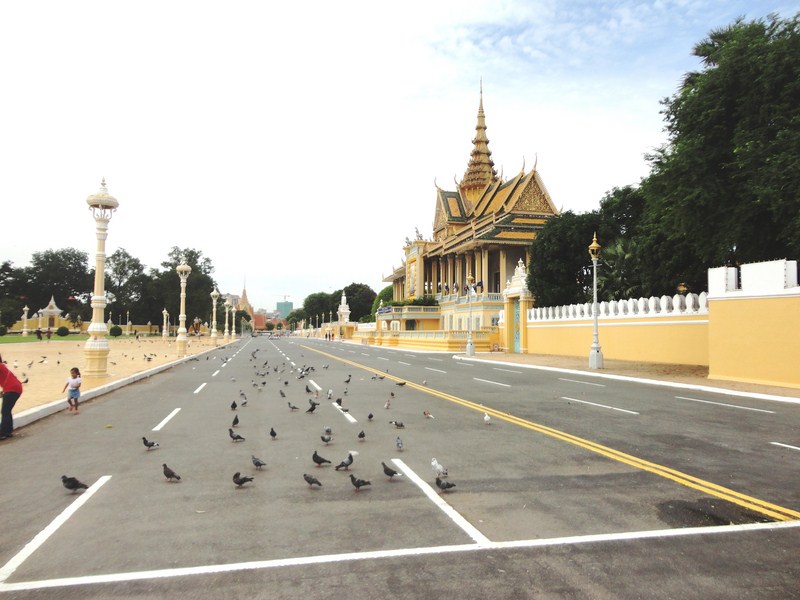
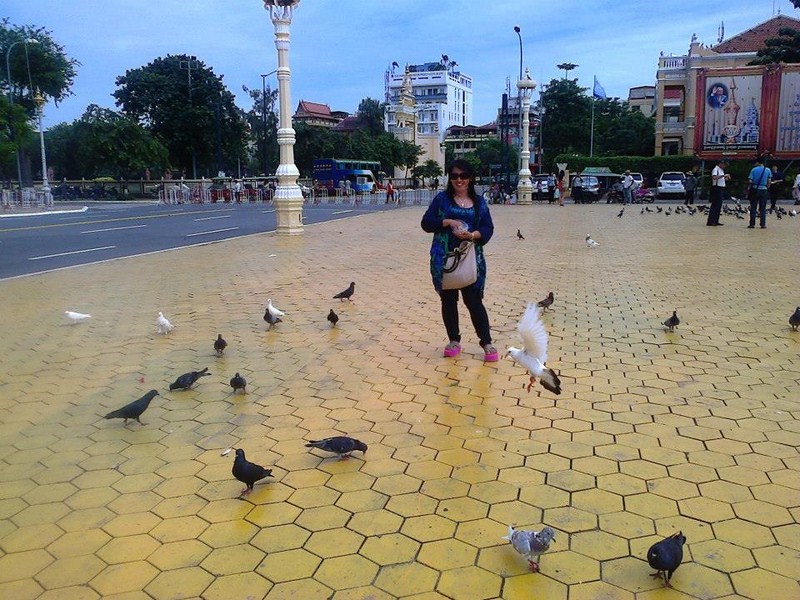
From Street 184, we turned right to the surprisingly car-free (save for one tourist bus) Preah Sothearos Blvd. On its left is a wide promenade with yellow hexagonal floor tiles.  Here, flocks of black, white and gray doves congregate.  Children enjoy chasing them while adults feed them with corn kernels and peanuts bought from vendors nearby. Beyond the promenade is a small park, Sisowath Quay and the mighty Mekong River.

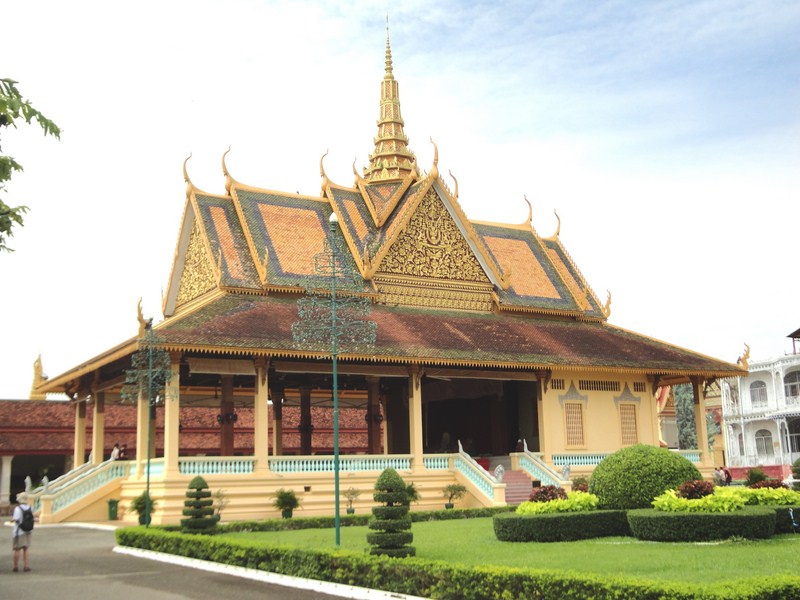
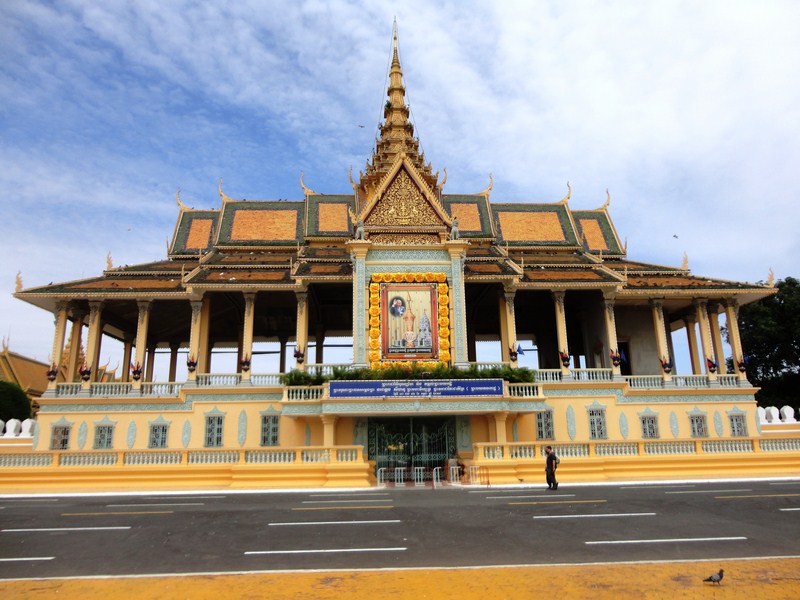
The open-air  Preah Thineang Chan Chhaya ("Moonlight Pavilion")

The open-air Preah Thineang Chan Chhaya (“Moonlight Pavilion”)

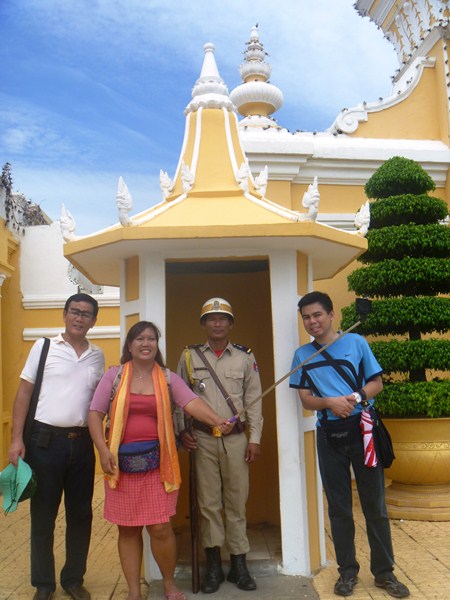
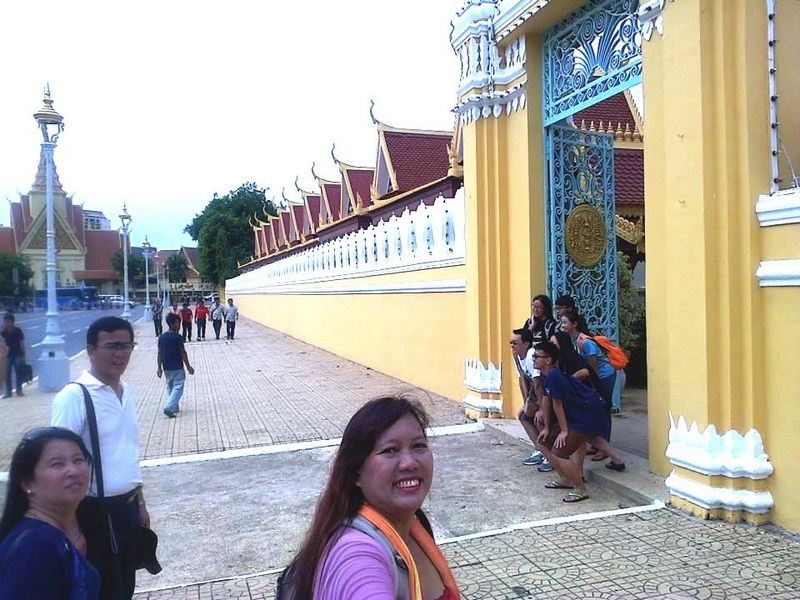
On the boulevard’s right are the high, yellow crenelated walls of the Royal Palace. We passed two guardhouses, one of them manned, gamely posing with the guard on duty. The  open-air  Preah Thineang Chan Chhaya (“Moonlight Pavilion”), built alongside a section of the palace walls, dominates the facade.

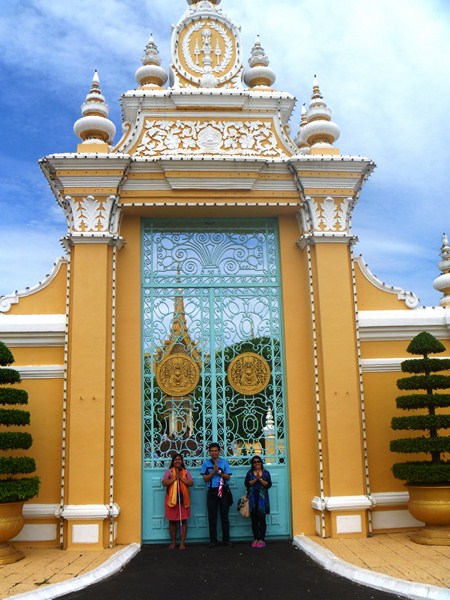
The Victory Gate

The Victory Gate

One of the most notable buildings of the Royal Palace, it serves as a venue for the Royal Dancers, as a tribune for the King to address the crowds and as a place to hold state and royal banquets. During the 2004 coronation of King Norodom Sihamoni, it was used for a banquet and a tribune for the new king.  It also has a balcony that is used for viewing parades marching along Sothearos Boulevard.

Finally ... the visitor's entrance gate

Finally … the visitor’s entrance gate

Past the pavilion is the Victory Gate which faces the entrance steps leading to the palace’s Throne Hall. Traditionally, this gate was only used by the king and queen though it is now used to admit visiting dignitaries.  As such, this gate was locked.  However, the entrance for tourists wanting to tour the palace was nearby.  Upon entering, we walked along a short corridor to the ticket booth.


National Museum of Cambodia (Phnom Penh)

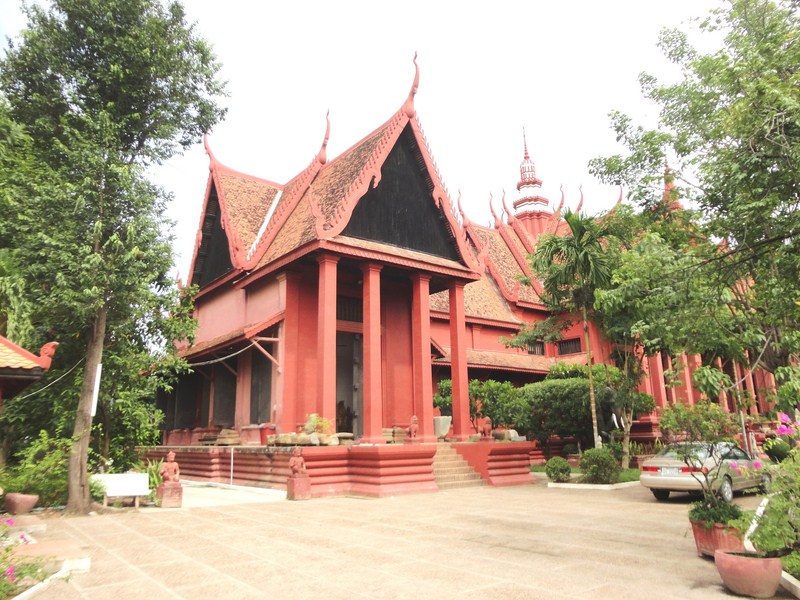
The National Museum

The National Museum

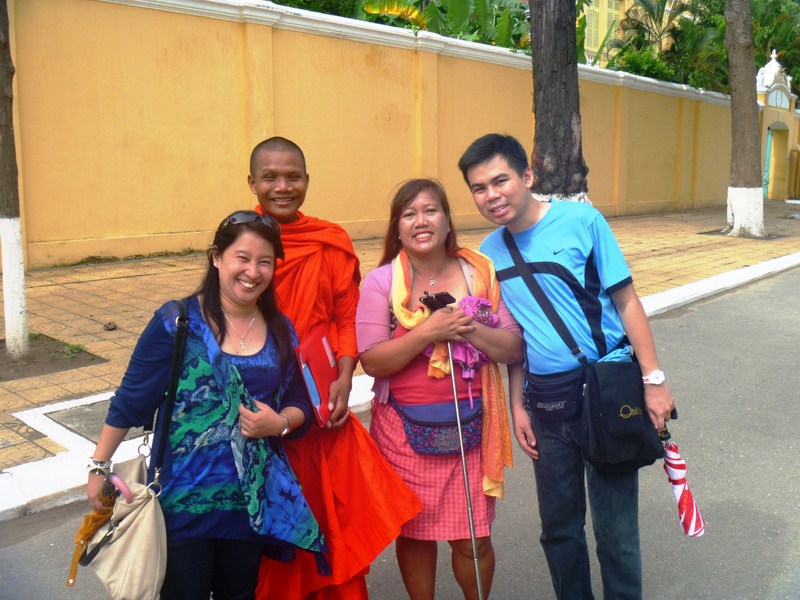
Jandy and I met up with Osang and Violet while were still having breakfast at our hotel.  Together, we all left for our walking tour of the city’s tourist attractions.  After last night’s rain, the early morning sun was a welcome sight.  Street 184, where our hotel was located, was also bounded by 2 of the city’s prime tourist attractions – the National Museum and the Royal Palace. We first headed out for the latter. Along the route, we met up and had a short chat (he spoke good English) with an orange-robed monk on his way home.

Street 184 (6) - Copy

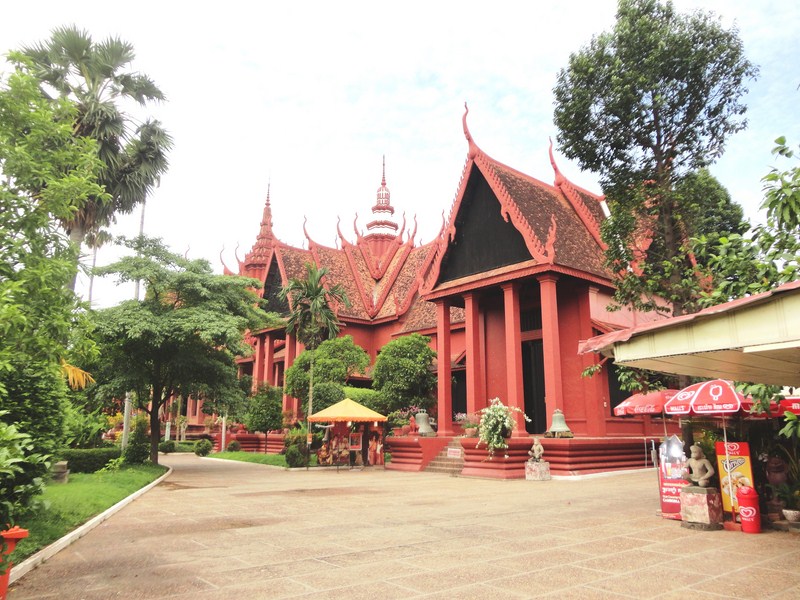
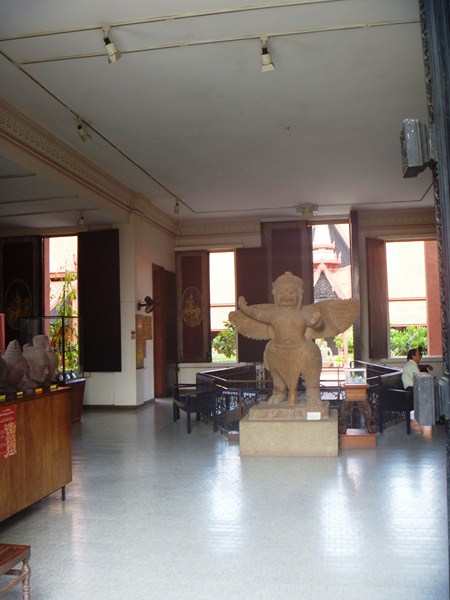
The National Museum, an excellent repository of many heritage artifacts, murals and paintings that display the talents of the Khmer people, is Cambodia’s largest museum of cultural history and the country’s leading historical and archaeological museum.  The museum, housing one of the world’s largest collections of Khmer art (sculptural, ceramics, bronzes, ethnographic objects, etc.), also has a collection of over 14,000 items from prehistoric times to periods before, during, and after the Khmer Empire including the legendary statue of the “Leper King.”

DSC03532

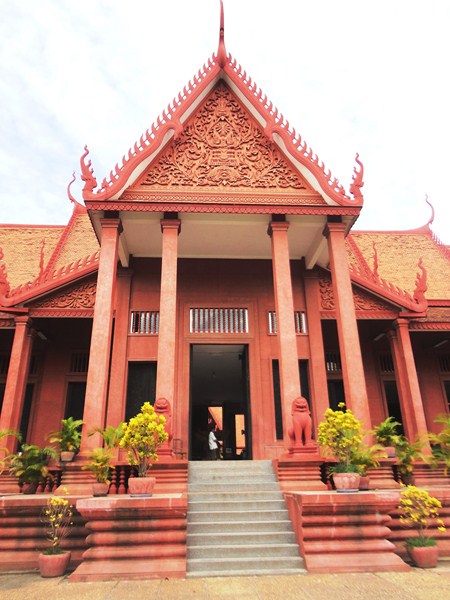
Located to the north of the Royal Palace and on the west side of Veal Preah Man Square, the museum is under the authority of Cambodian Ministry of Culture and Fine Arts. On the west side of the museum is the Royal University of Fine Arts.  The museum buildings, designed by French historian, curator and author George Groslier (1887–1945), were constructed between 1917 and 1924.  Though inspired by traditional Khmer temple architecture seen on ancient bas-reliefs, it inevitably portrayed elements of the French style of architecture in its structures to meet the museum-size requirements.

Main entrance

Main entrance

The new museum’s foundation stone was laid on August 15, 1917 and officially inaugurated, during the Khmer New Year, on April 13, 1920 in the presence of King Sisowath, François-Marius Baudoin (Résident-supérieur) and Groslier, the director of Cambodian Arts and conservator of the museum. In 1924, to make the building even more imposing, the original building was altered by adding wings at either end of the eastern façade.  On August 9, 1951, following independence in 1953, the French ceded control of the National Museum and Arts Administration to the Cambodians. In 1966, Chea Thay Seng became the first Cambodian Director of the Museum and Dean of the newly created Department of Archaeology at the Royal University of Fine Arts. The museum was renovated in 1968.

The museum lobby

The museum lobby

During Khmer Rouge regime of 1975-79, the museum, along with the rest of Phnom Penh, was evacuated and abandoned and many of the museum’s employees also lost their lives. When the Khmer Rouge were ousted, the museum was found in disrepair; its roof rotten and home to a vast colony of bats, the garden was overgrown and its collection in disarray, with many objects damaged or stolen. The museum was quickly tidied up and repaired and, on April 13, 1979, was again reopened to the public. In 2000, the Post-Angkorian Buddha,a permanent exhibition supported by UNESCO and a number of individuals and local businesses, was opened to extend the religious function of the museum. 

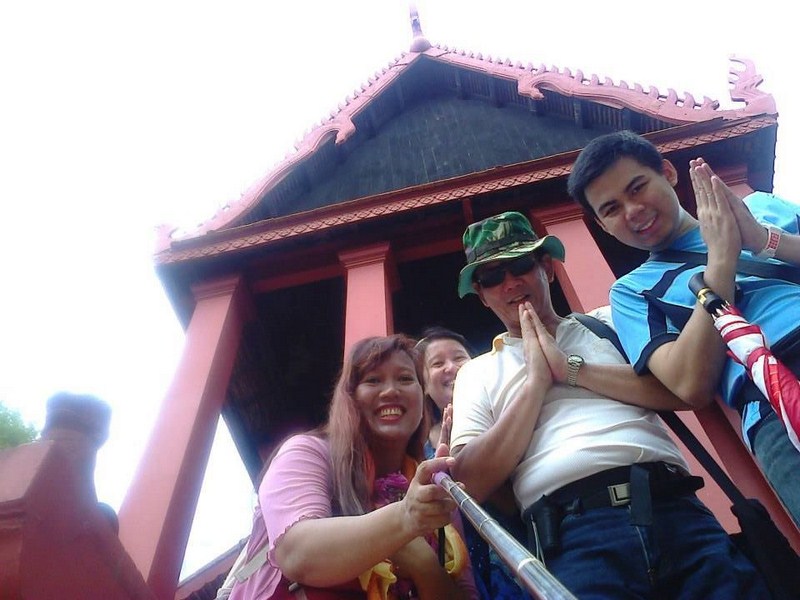
Violet, Osang, the author and Jandy

Violet, Osang, the author and Jandy

National Museum: Street 13, Preah Ang Eng, Phnom Penh, Cambodia. Tel: +855 23 217 643. The visitor’s entrance to the compound are at the corner of Streets 13 and 178.  Multi-lingual tour guides are available. Photography is limited. Open 8 AM – 5 PM.  Admission: US$5/pax.

Silay Museum (Silay City, Negros Occidental)

Entrance

Entrance

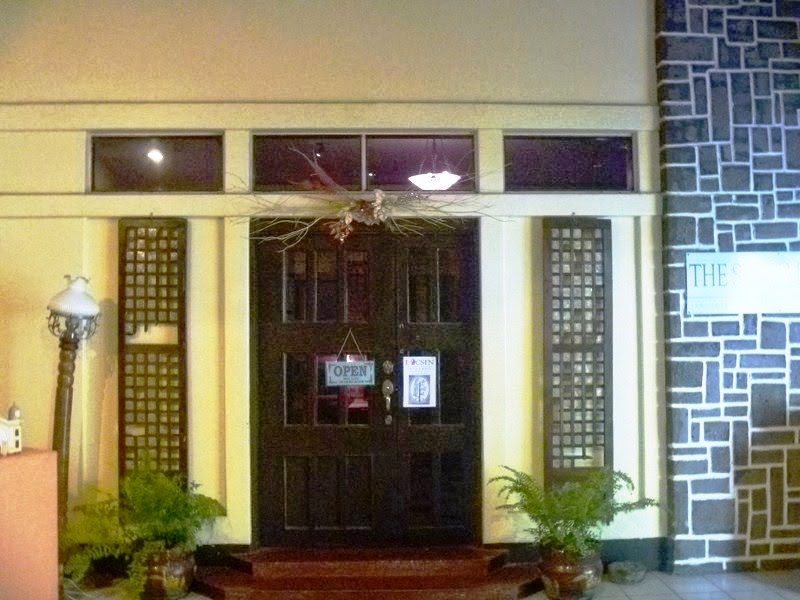
The Silay Museum, inaugurated last November 4, 2012, the eve of the Cinco de Nobiembre celebration, is located at the former site of the City Library.  It is a fulfillment of the dream of Mayor Jose “Oti” Montelibano and the Silaynons for a museum that would tell Silay’s history and the aspirations of its people. The concept, prepared by city councilor Neil Solomon L. Locsin, grandson of the late Sen. Jose C. Locsin, was executed by cultural affairs officer Achilles “Panoy” Corteza.  

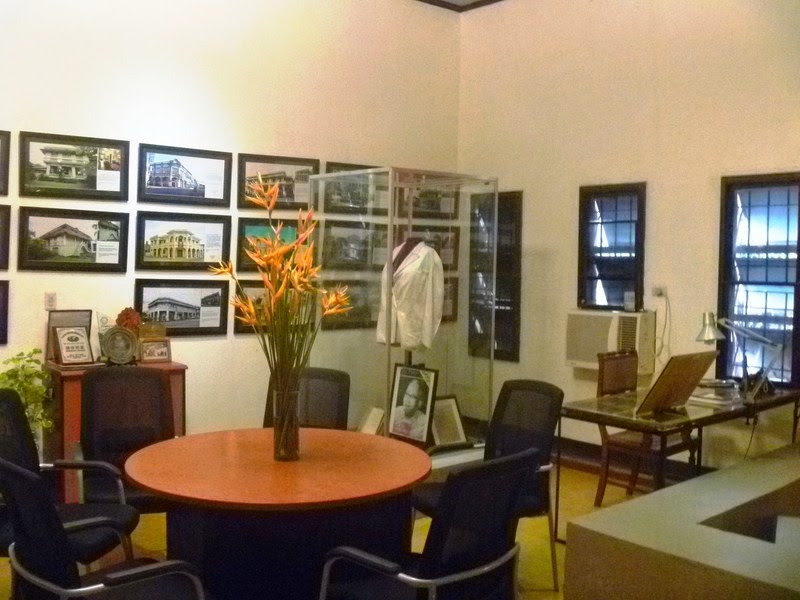
Jose C. Locsin Memoabilia

Jose C. Locsin Memorabilia

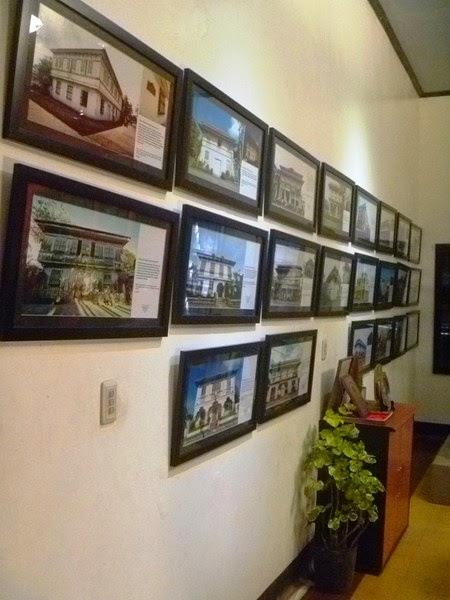
Near the door and adorning a cozy nook along the walls are  numerous photographs, taken by members of the Camera Club of Negros, through the Negros Cultural Foundation, of 28 ancestral houses which were identified by the National Historical Commission (NHC) as architectural landmarks. 

Photo Gallery of Ancestral Houses

Photo Gallery of Ancestral Houses

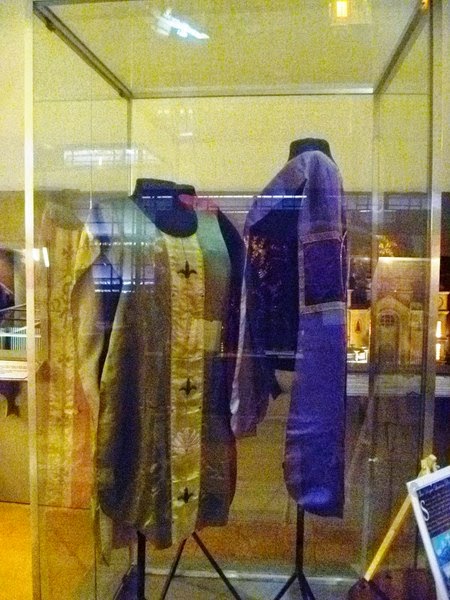
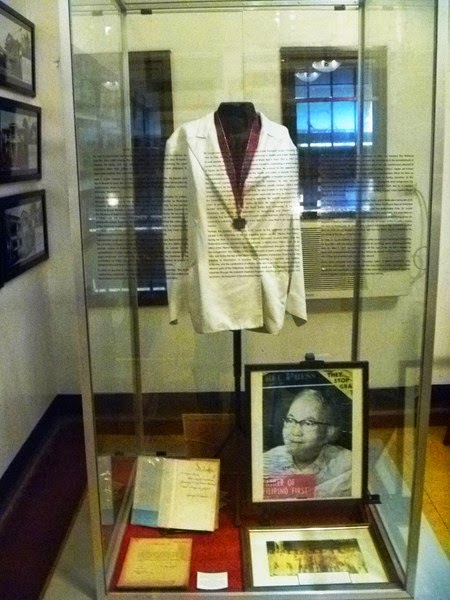
museum-1Glass enclosures preserve a collection of clothes and manuscripts owned by famous sons and daughters of Silay.  They include the vestments of Silay parish priest Fr. Eusebio Locsin of Molo (who encouraged his relatives in Iloilo to settle in Silay because of its promising sugar industry), collection of traje de Silay (gowns) and precious documents (last entry of Fr. Eulogio Saez in Libro de Baptismo de Silay, etc.) and articles  (old statue of San Diego Alcala, etc.) from the San Diego Pro-Cathedral and the Diocese of Bacolod, with permission from Fr. Demetri Gatia and Bishop Vicente M. Navarra.

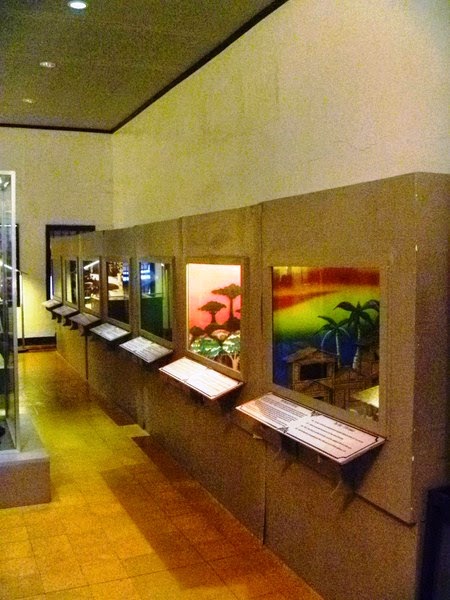
Dioramas

Dioramas

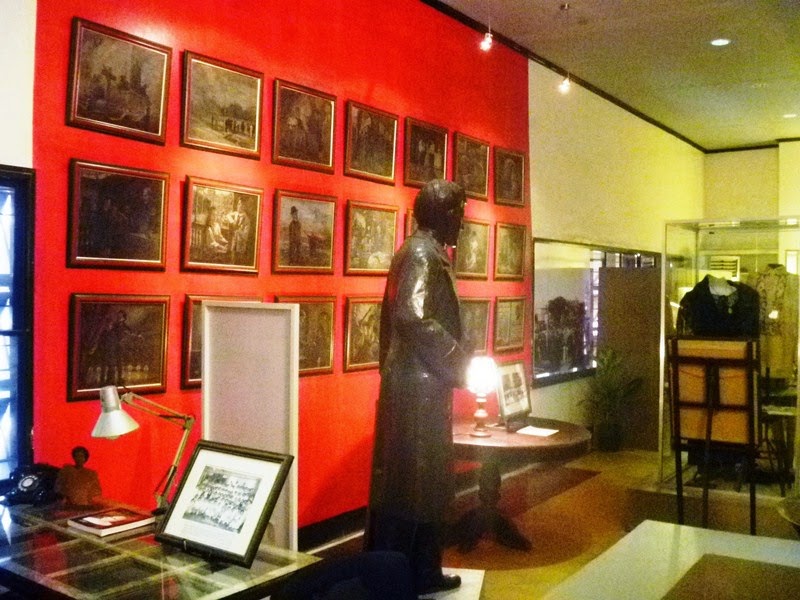
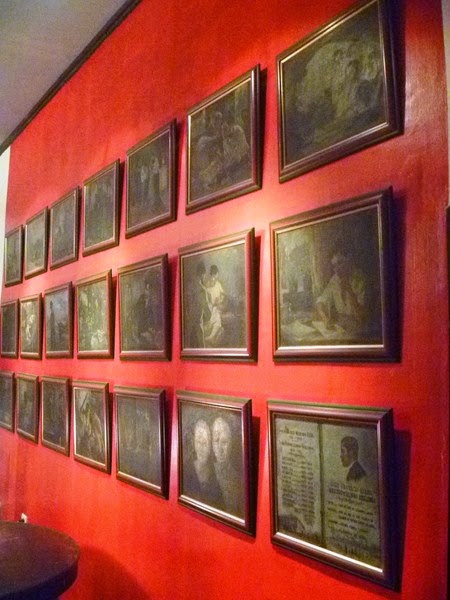
A collection of 27 paintings (“KABUHI, Paghim akas kag Pagkabahaginan ni Rizal”), done by the relatively unknown and underrated Caviteno master painter Simon Saulog (1916-1995), was commissioned by Sen. Jose C. Locsin in 1957 for the Filipiniana section of the public library.  They depict the different episodes in the work, life and death of Philippine National Hero Jose Rizal whom the senator personally admired. Saulog was trained in the Fernando Amorsolo school of painting espousing Classicism and idealizing rural life.

museum-3

Its seven eye-catching and colorful dioramas, inspired by the Ayala Museum. tells the cultural history of Silay from its beginnings (The Village by the Sea: 16th -17th Century, Life within the Estacada: 18th Century), how it was shaped by the sugar industry (Migration and Development: 19th Century), the the struggle for freedom (Cradle of Freedom: 1898 Cinco de Noviembre Revolution), the birth of the “Paris of Negros” (The Golden Age: The 20th Century), the effects of the war (The Last Stand: World War II, ) and to where it is now (Cityhood). 

Fr. Eusebio Locsin vestments

Fr. Eusebio Locsin vestments

Also on display are memorabilia and manuscripts (including a classified document presented to him that discusses, among other things, action plans that the country will take upon the expiration of the 1954-1974 Laurel-Langley Agreement) of the late Sen. Jose C. Locsin;, old coins and paper currency; antique furniture;  scaled models of Balay Negrense and San Diego Pro-Cathedral; an old kawa (cauldron used in the making of muscovado sugar); and old photos of Silay and its notable personalities. 

Simon Saulog paintings

Simon Saulog paintings

Silay Museum: Jose C. Locsin Cultural and Civic Center (in front of the Silay Tourism Office), 6116 Silay City, Negros Occidental. Tel: (034) 495-5553.

Silay City Tourism Division: Tel: (034) 495-5553.Fax: (034) 495-0848. Email: silaycity_tourism@yahoo.com.
CCP Museo ng Kalinangang Pilipino (Pasay City)

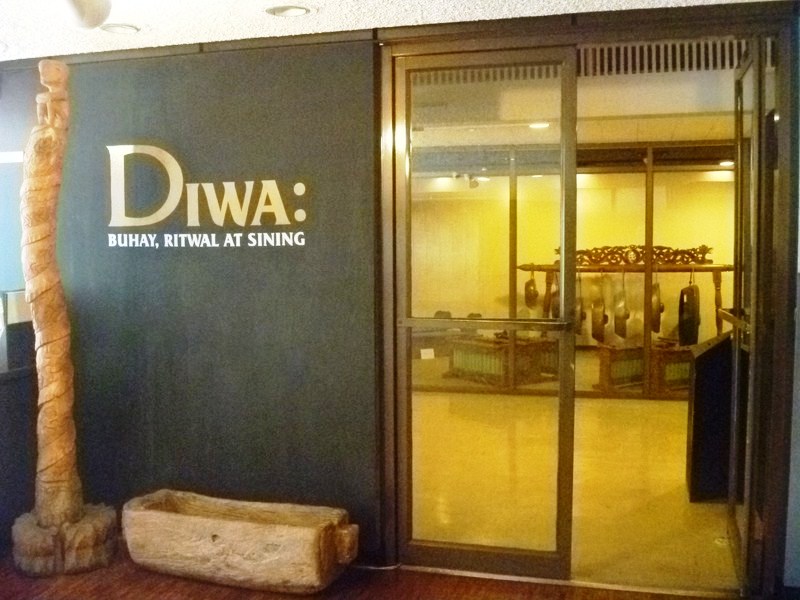
Diwa: Buhay, Ritwal at Sining

The Museo ng Kalinangang Pilipino (Museum of Philippine Culture), an integrated humanities museum established in 1988, gathers together the works of Filipino traditional artists and preserves Filipino artistic traditions; studies and interprets these to provide a deeper understanding of Filipino national culture evolving with and for the people; and strengthens the people’s awareness of the integral, dynamic role of creativity and artistic expression in national life and culture.

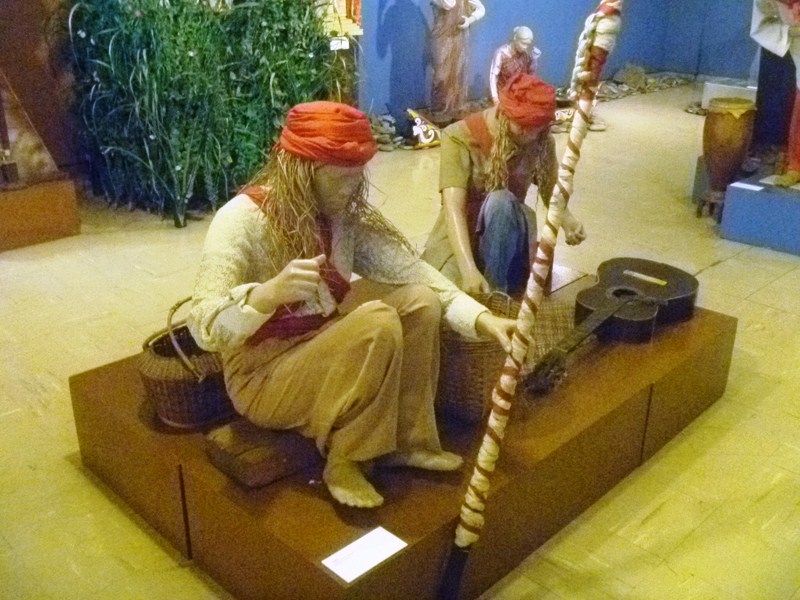
Bpagapel (Maguindanawon healing rite)

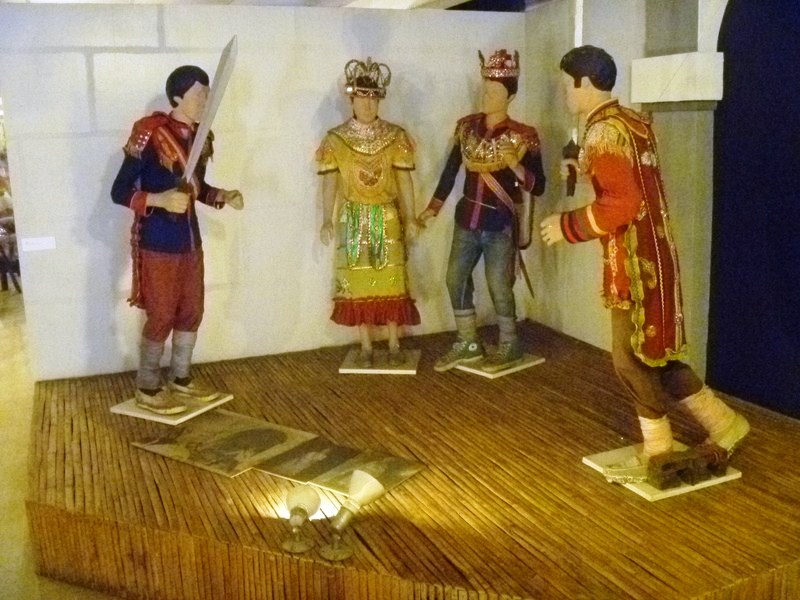
“Diwa: Buhay, Ritwal at Sining” (Spirit, Life, Ritual and Art), a permanent exhibit, presents an overview of aspects of Philippine traditional culture and showcases significant Filipino artistic traditions as well as explores the development of Philippine art and aesthetics in the socio-cultural context.   

Komedya of Peñaranda, Nueva Ecija

Different artistic forms are presented as a result of the Filipino’s interaction with five conditions/concepts – Bayan (Nation), Buhay at Kamatayan (Life and Death), Kamag-anakan at Pamayanan (Kin and Community), Lupa (Land), and Kaluwalhatian (Divinity).

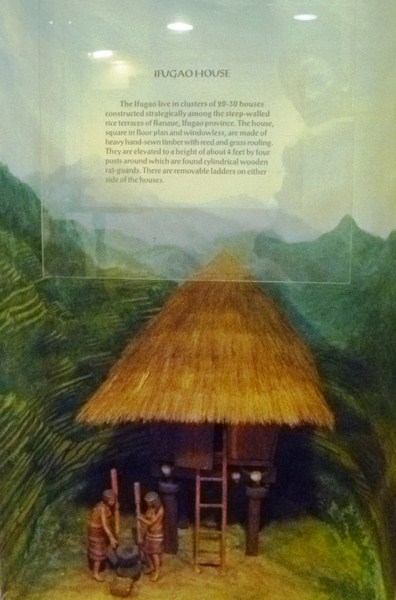
Ifugao House

On display are sunduks (grave markers) and models of indigenous houses (the Agta lean-to, the Higaonon treehouse, the Badjao houseboat, the Ivatan house, the Mandaya house, the Ifugao house and the Maranao torogan).

Sunduk (grave marker) of Tausug of Sulu)

CCP Museo ng Kalinangang Pilipino: 4/F, Cultural Center of the Philippines Main Bldg., CCP Complex, Pasay City. Tel (Visual Arts & Museum Division)(632) 832- 3702, (632) 832-5094 and (632) 832-1125 local 1504,1505 and 1508.  Open Tuesdays to Sundays, 10 AM to 6 PM. Admission: PhP40 for adults and PhP30 for students and children. If there are performances at the Main Theater, exhibit hours are extended up to 10 PM. Mobile number: (0920) 470-0690.  E-mail: ccp.exhibits@gmail.com.
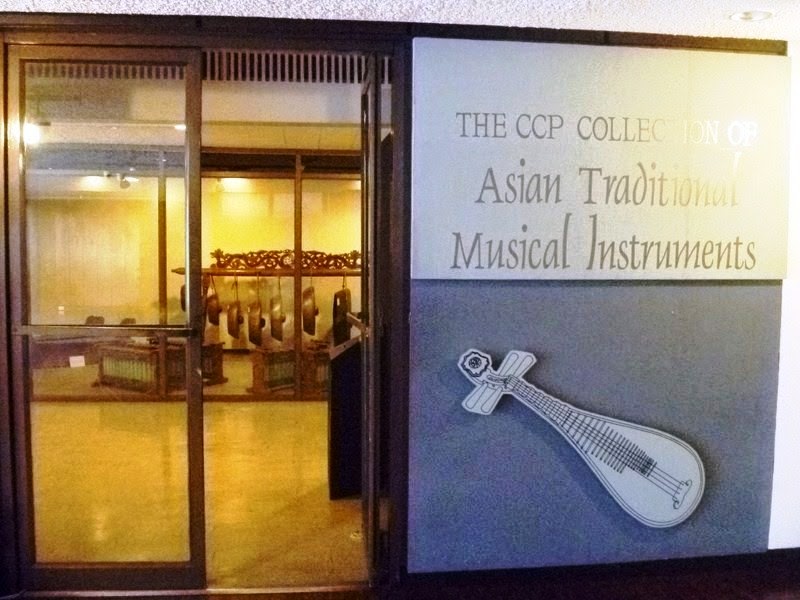
CCP Collection of Traditional Asian Musical Instruments (Pasay City)

CCP Collection of Traditional Asian Musical Instruments

CCP Collection of Traditional Asian Musical Instruments

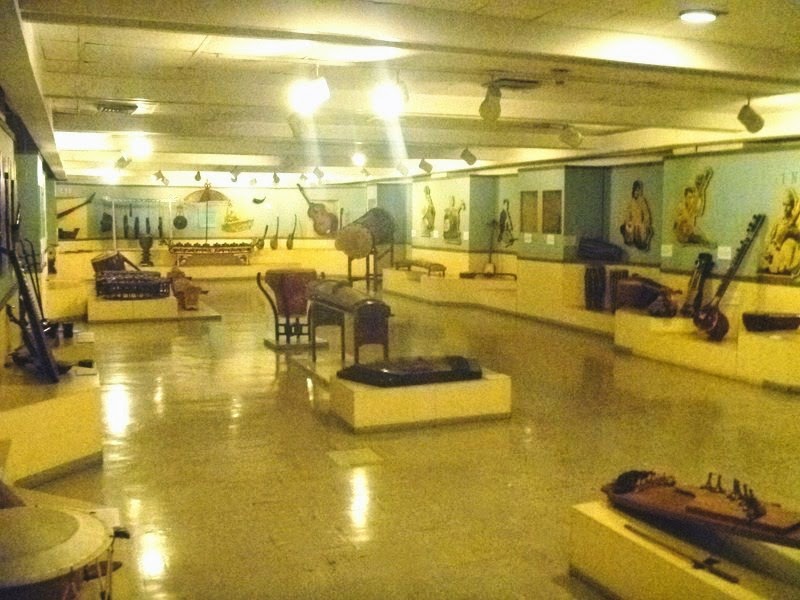
The CCP Collection of Traditional Asian Musical Instruments, another important permanent exhibit at the Museo ng Kalinangan Pilipino, displays a collection of Philippine and Asian traditional musical (stringed, percussion, woodwind, etc.) instruments.  The Asian instruments were acquired by the CCP from 1969 to 1986 through donations by a number of Southeast Asian and East Asian countries.

Interior

Interior

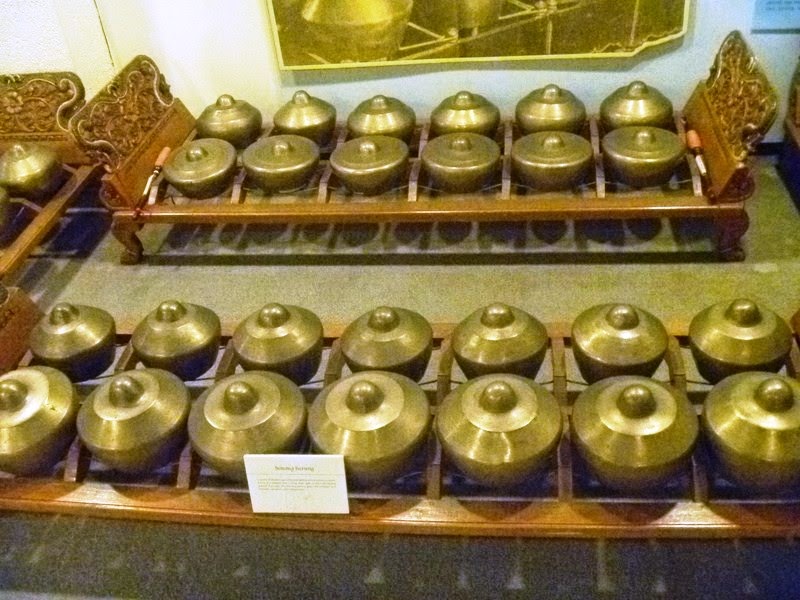
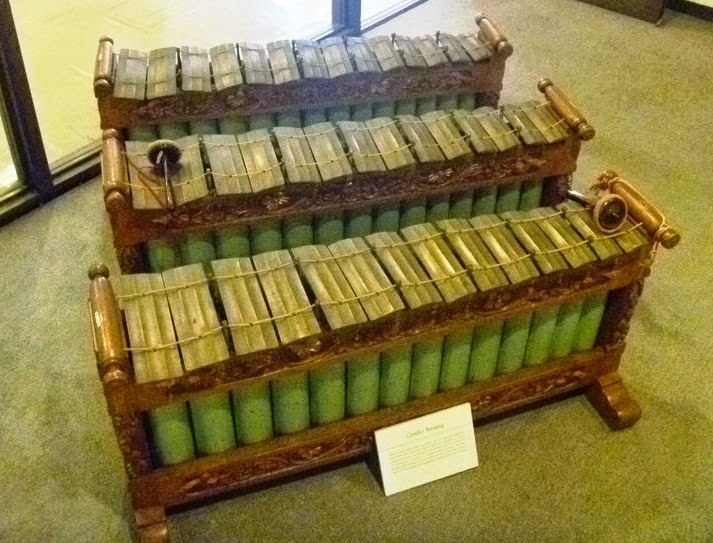
Indonesia donated a gender barung (14 bronze bars suspended by a cord over sheet iron resonating tubes in a teakwood frame), a bonang barung (12 bronze pots in two rows of six located in square openings in rectangular teakwood), a gender panerus (14 bronze bars suspended by a cord over sheet iron resonating tubes in a teakwood frame), a saron panerus (known by its nickname Peking, it is the smallest saron in the Saron family), a gong ageng (Javanese meaning “large gong”), a  gambang (a xylophone-like musical instrument), a saron barungsaron demung and a slenthem (a Javanese metallophone which makes up part of a gamelan orchestra).

Bonang Barung

Bonang Barung

Gender Barung

Gender Barung

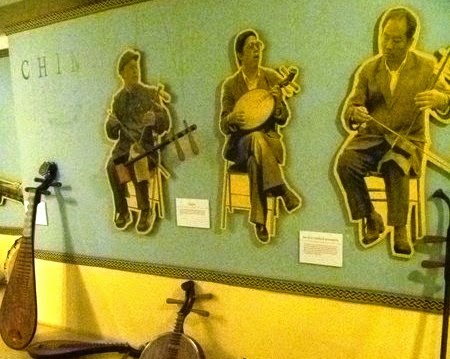
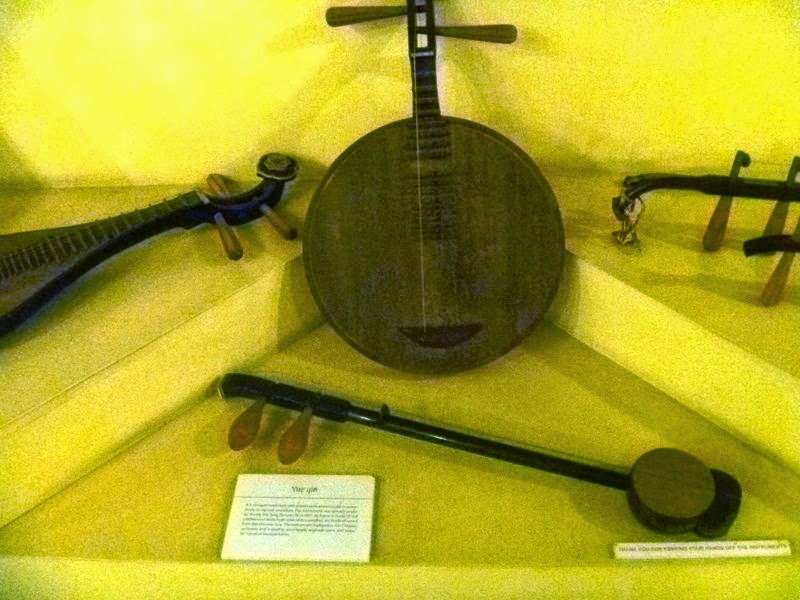
The Chinese government donated a gu zheng (a plucked zither with 18 or more strings and movable bridges), a chung hu (a medium- pitched fiddle), an er hu (a two-stringed bowed musical instrument), a ti hu (a two-stringed bowed vertical fiddle), a pan hu (a “piccolo” version of the er hu), a ching er hu, a yueh hu (a bowed string instrument) and a hua pen gu (a flower pot drum).
China Exhibit

China Exhibit

Yue qin (China)

Yue qin (China)

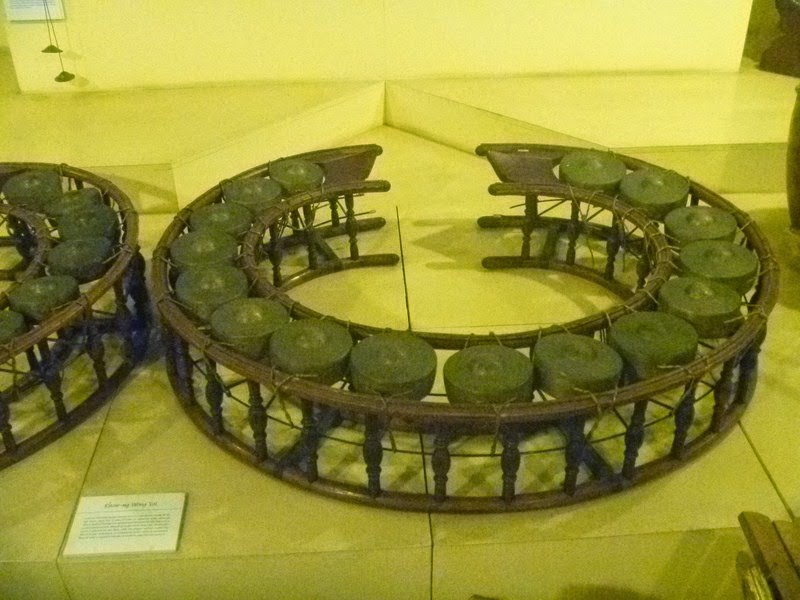
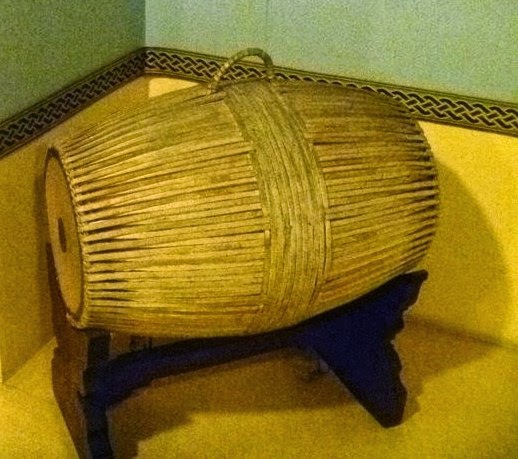
Thailand donated a khaw-ng wong lek (or khong wong lek, a gong circle with 18 tuned bossed gongs), a khaw ng mong, glaw-ng that (drum with two heads stretched tightly and fastened down with pegs or nails), a ta pho-n (barrel-shaped drums with 2 heads) and a khaw-ng wong yai (or khong wong yai, a  circle with gongs with 16 tuned bossed gongs in a rattan frame and is played with two beaters).
Khaw-ng Wong Yai

Khaw-ng Wong Yai

Ta Pho-n

Ta Pho-n

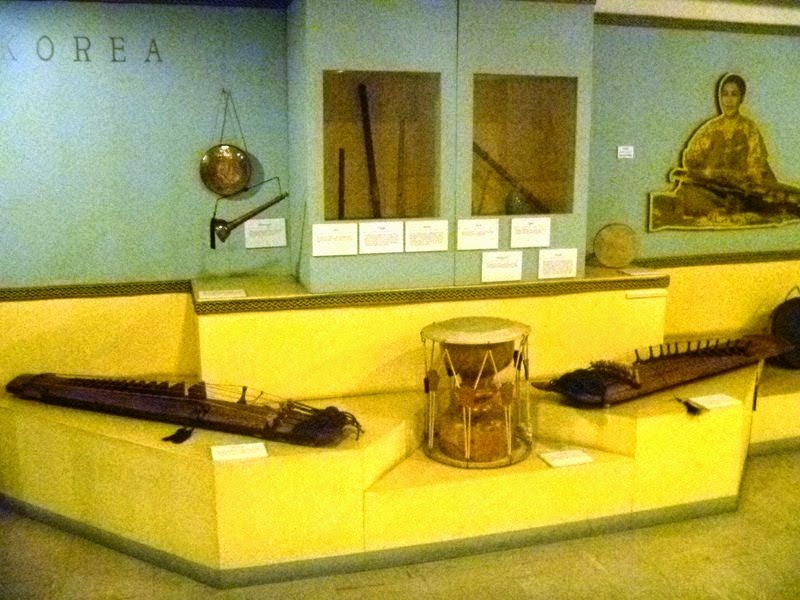
South Korea, the latest to donate, contributed  an ajaeng (a large bowed zither having 7 strings), a changgo (or janggu, an hourglass-shaped, waisted drum used in traditional music), a taegum (or daegeum, a transverse bamboo flute with a distinctive sound), a komun’go (or geomungo, a traditional stringed musical instrument of the family of zither instruments with both bridges and frets), a hyang-p’iri (a cylindrical, double reed oboe), a tanso (or danso, a notched, end blown vertical bamboo flute), a chi, a kayagun (or gayageum, a traditional zither-like stringed instrument), a hun (a globular flute), a sogum (or sogeum, a small bamboo transverse flute) and a tungso (a comparatively long notched bamboo flute).

South Korean Exhibit

South Korean Exhibit

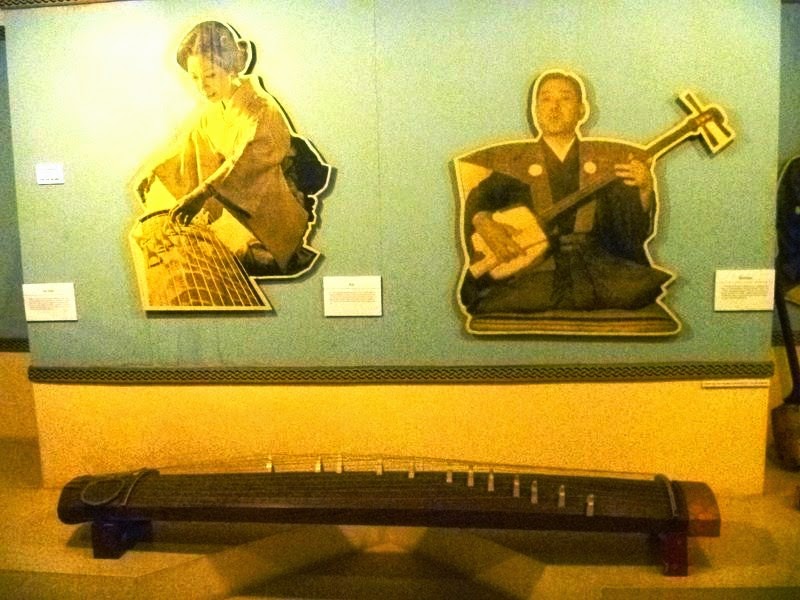
From Japan came the shakuhachi (a Japanese end-blown flute) and a biwa (a Japanese short-necked fretted lute, often used in narrative storytelling) while India brought in a tabla (a 2-piece percussion instrument), flutes and a  tavil (or thavil, a Southern Indian drum).

Japanese Exhibit

Japanese Exhibit

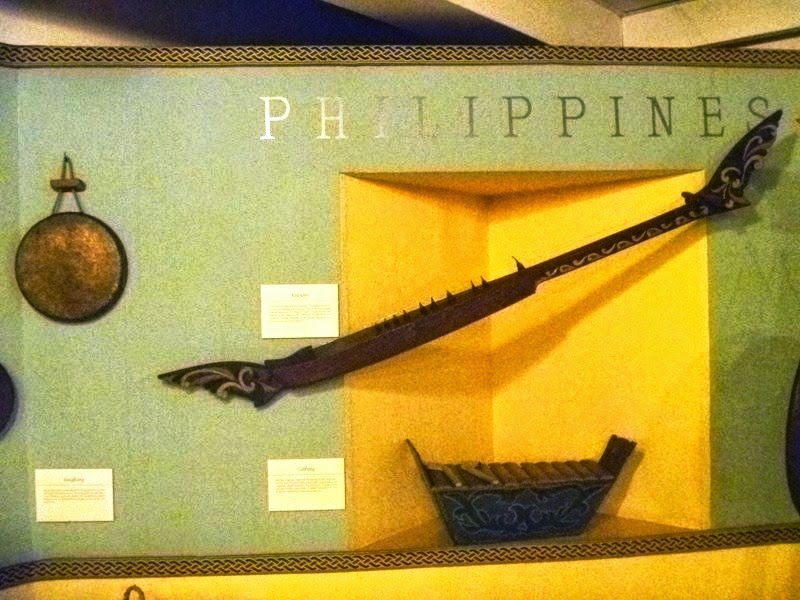
The Philippine musical instruments were donated by the late Dr. Lucrecia R. Kasilag, a National Artist for Music and a musical instrument collector for over 50 years.  She is particularly known for incorporating indigenous Filipino instruments into orchestral productions.

Philippine Exhibit

Philippine Exhibit

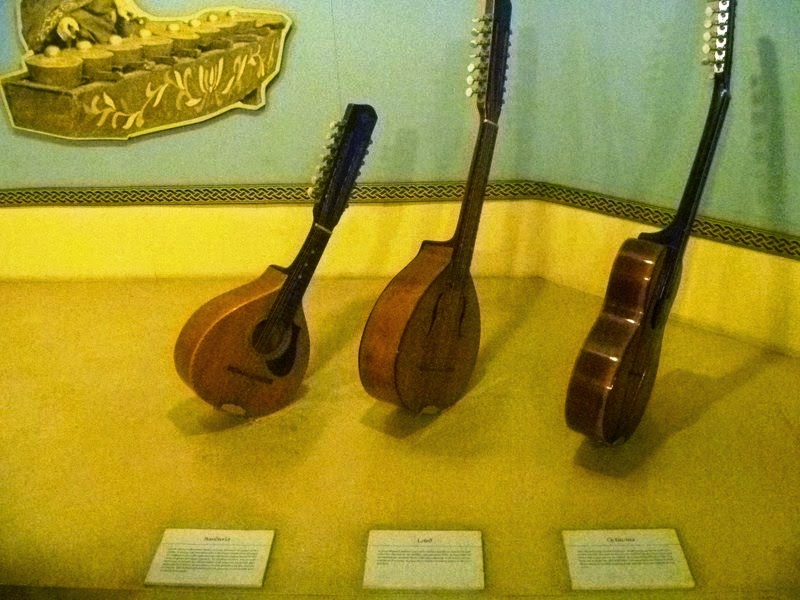
The instruments on display include a kudyapi (or kutiyapi, a two-stringed, fretted boat-lute), a gangsa (a single hand-held smooth-surfaced gong with a narrow rim), an octavina (a guitar-shaped Filipino instrument with a tuning similar to the laud ), a laúd (a plectrum-plucked chordophone), a bandurria (a steel-stringed, 12-stringed instrument), a bajo de unas (bass guitar), a bungkaka (a bamboo buzzer), a kubing (a type of jaw harp made from bamboo), a gabbang (a bamboo xylophone widely used in the southern Philippines), and the all too familiar guitar.
Banduria, Laud and Octavina

Banduria, Laud and Octavina

CCP Museo ng Kalinangang Pilipino: 4/F, Cultural Center of the Philippines Main Bldg., CCP Complex, Pasay City. Tel (Visual Arts & Museum Division): (632) 832- 3702, (632) 832-5094 and (632) 832-1125 local 1504,1505 and 1508.  Open Tuesdays to Sundays, 10 AM to 6 PM. Admission: PhP40 for adults and PhP30 for students and children. If there are performances at the Main Theater, exhibit hours are extended up to 10 PM. Mobile number: (0920) 470-0690.  E-mail: ccp.exhibits@gmail.com.
A Mind-Blowing Museum Experience

For her Christmas gift to us, my daughter Cheska gave all of us passes to the Mind Museum which she bought, at the discounted price of PhP450 each, from Deal Grocer.  As we were all busy during the holidays, Grace, Jandy, Cheska, Marve and I, with my 1 year old grandson Kyle, only availed of it right after the New Year.

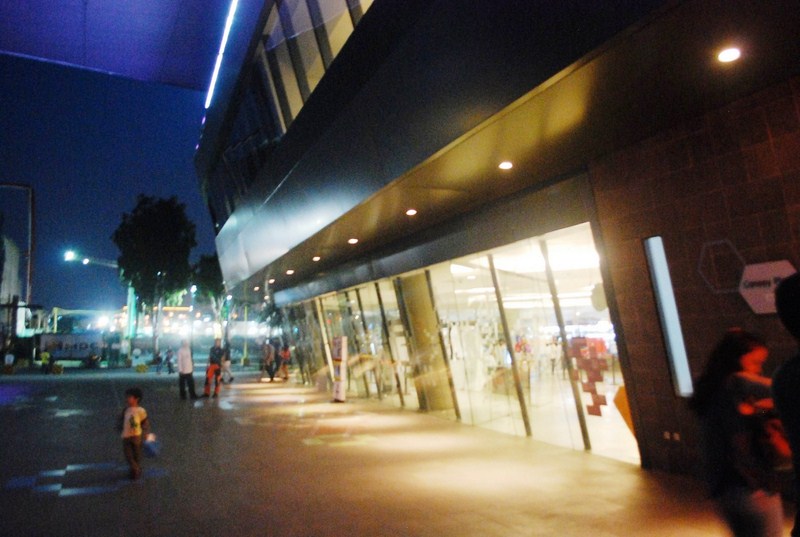
The Mind Museum

The Mind Museum

This educational facility, the first world-class science museum in the Philippines, aims to foster the public understanding of science and art in a different light.  Formally opened on March 16, 2012 (after a Pre-Opening Ceremony that took place on December 15, 2011) and located on a 1.2 hectare lot within the 12,500 sq. m. J.Y. Campos Park, this PhP1,000,000,000 (US$ 23.5 million) museum was totally funded by private donations from corporations and individuals.
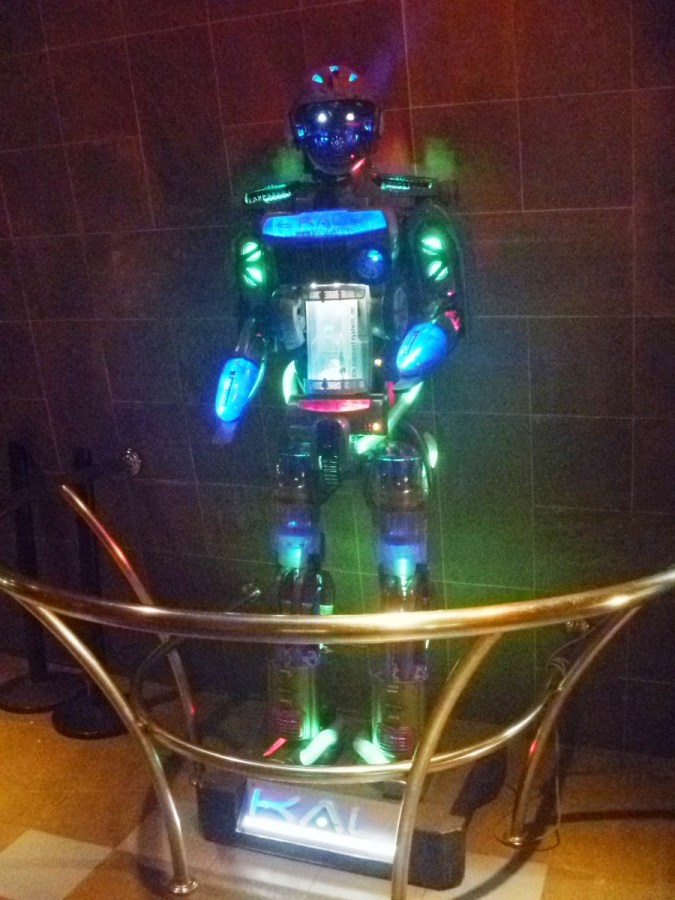
The 7 ft. high robot named KAL

The 7 ft. high robot named KAL

With Lor Calma & Partners as the building architect and Science Center Singapore as museum planning consultant, this museum has more than 250 hands-on, minds-on interactive exhibits, 90% of which were  designed and fabricated by Filipino designers, scientists and engineers to clearly and beautifully flesh out a science principle or fact in 5,000 sq. m. exhibition halls designed by master planner Jack Rouse Associates (recognized as among the top ten museum and theme park designers in the world).

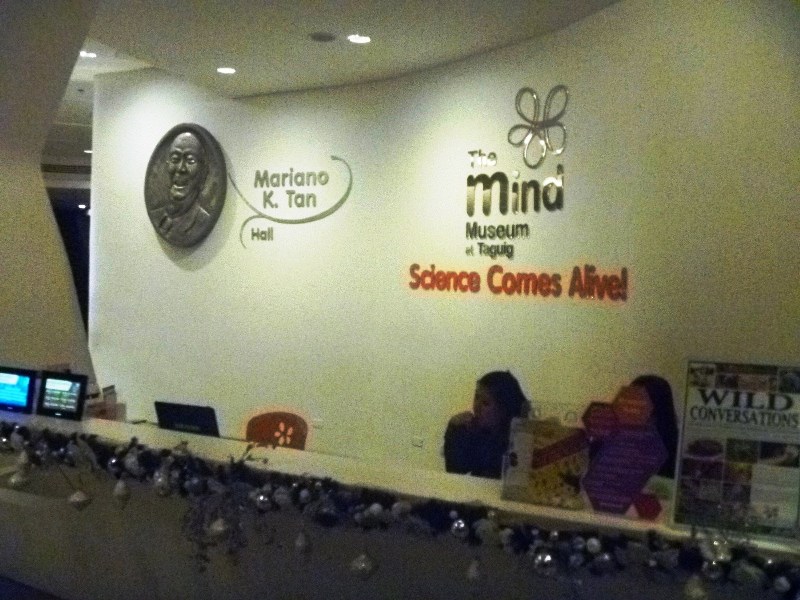
The reception desk at lobby

The reception desk at lobby

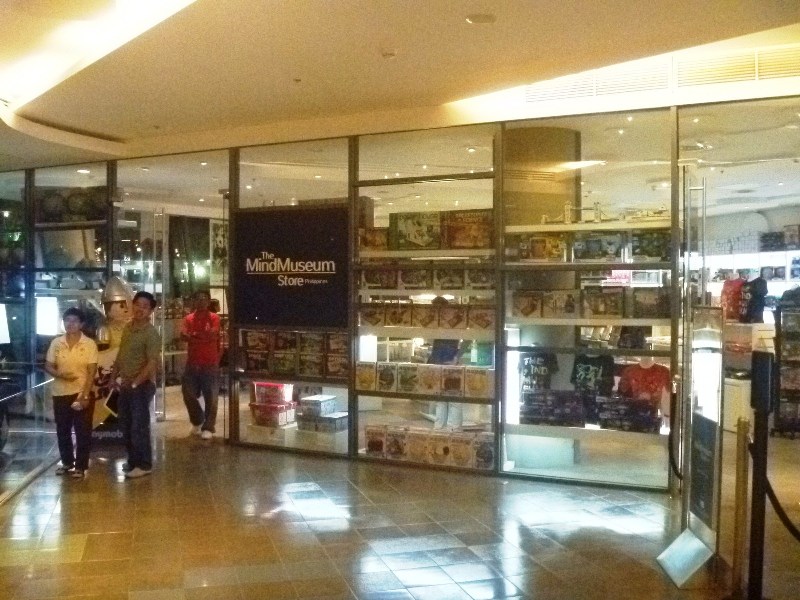
The Mind Museum Store

The Mind Museum Store

This interesting, awe-inspiring building has a futuristic, space-age yet organic look based on cell growth and molecular structures.  Its innovative and sustainable design, mirroring the functionality of nature and contributing to more energy efficiency, features slanted exterior walls (to minimize sunlight entry), a specially curved roof (for more efficient rain collection) and strategic orientation (to utilize the shadows of adjacent buildings). The National Geographic Channel provided the required footages and stills for the exhibit.

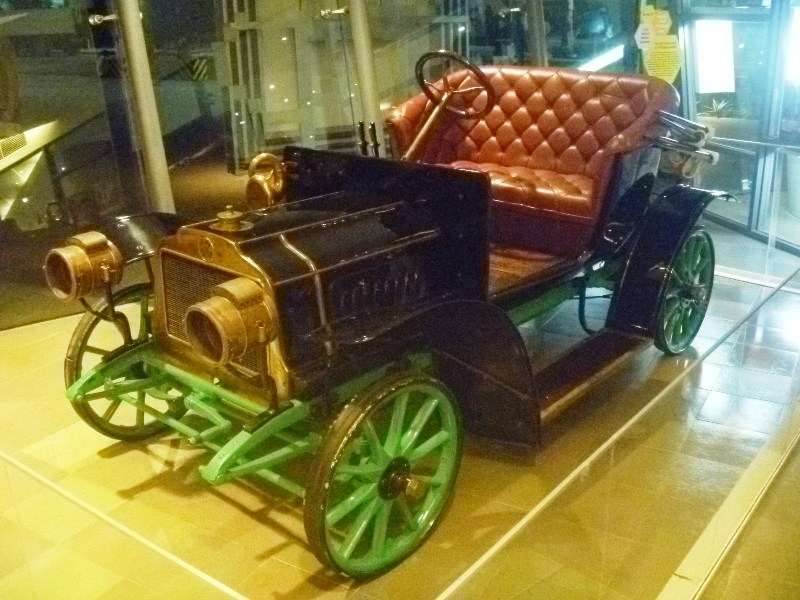
The 1904 Richard Brasier Roadster

The 1904 Richard Brasier Roadster

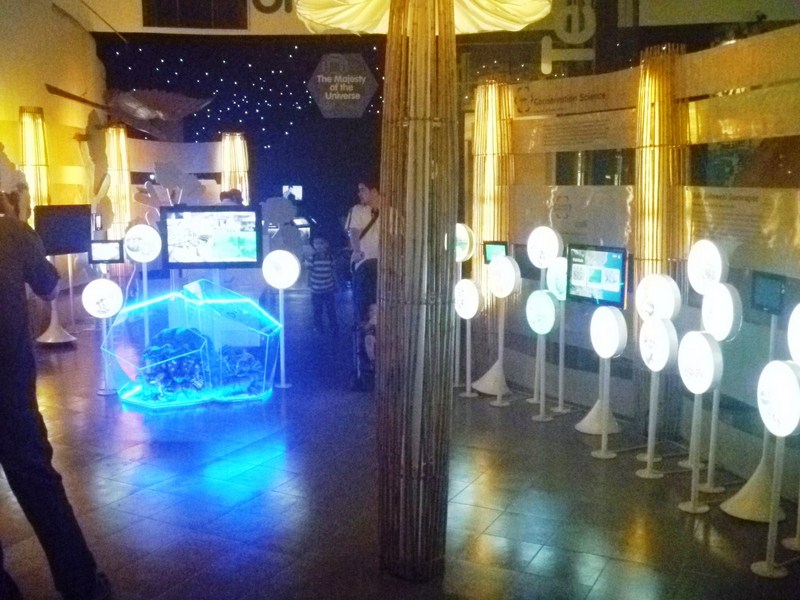
We had 3 hours to interact and experience the science exhibits and we were allowed to take photos. Sony Philippines, itself a technology giant, enhanced the experience by providing top-of-the-line and state-of-the-art gadgets such as Bravia LCD television sets, touch screen VAIOs, and 3D Projector Systems. The rest of the exhibits are privately sponsored.

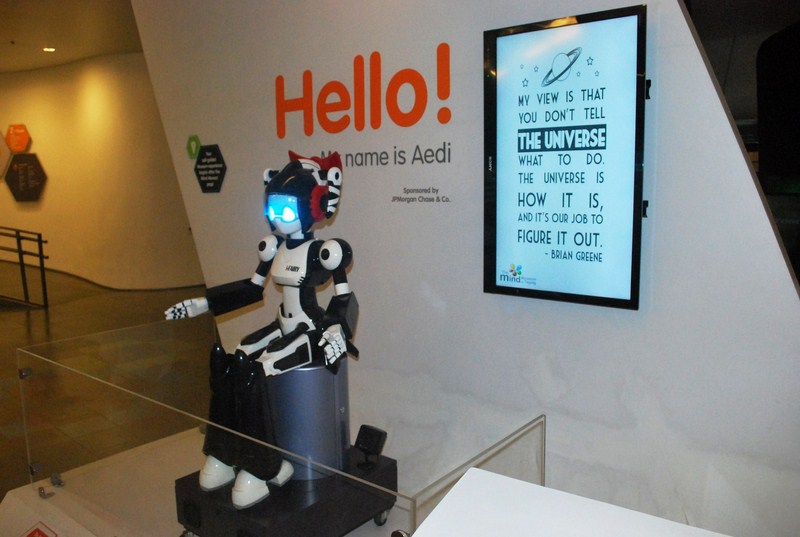
Aedi the welcoming robot

Aedi the welcoming robot

Beside the museum entrance is the 7 ft. tall KAL . Made with recycled vacuum cleaner parts, among other things, it is all about Environment Sustainability – how technology and  innovation (such as robotics) can be used to improve the quality of life.

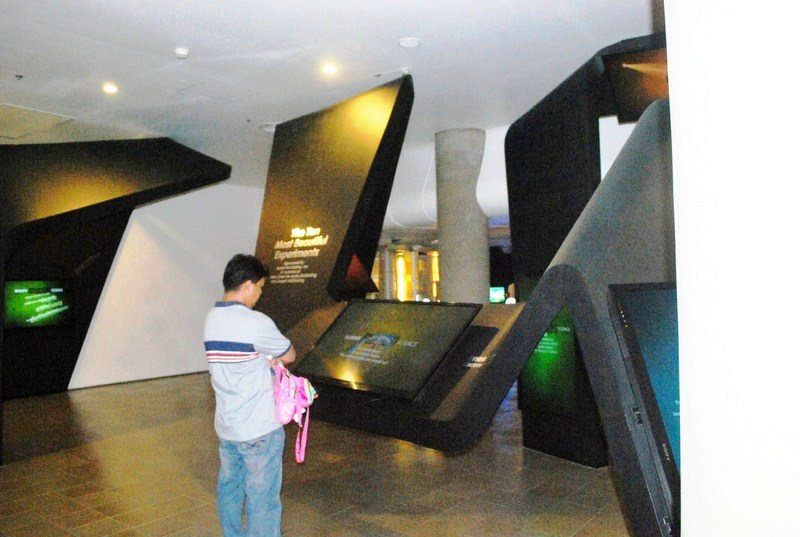
The 10 Most Beautiful Experiments  Exhibit

The 10 Most Beautiful Experiments Exhibit

Within the lobby is a souvenir shop and a 9-horsepower, 2-cylinder 1904 Richard Brasier roadster, the first car to ever grace the Philippine roads.  It was brought into the country by the trading firm Estrella del Norte in 1904 and is on loan from Pilipinas Shell.

The Philippine Science Hall

The Philippine Science Hall

An anthropomorphic robot named Aedi (“idea” spelled backwards) welcomed us at the lobby and introduced us to the museum, informing us on what lies ahead.

The Atom Centerpiece

The Atom Centerpiece

Our first stop was the “Hall of 10 Most Beautiful Experiments,” a visual set of LCD displays of experiments based on acclaimed philosopher and science historian Robert P. Crease’s book The Prism and the Pendulum: 10 Most Beautiful Experiments in Science.

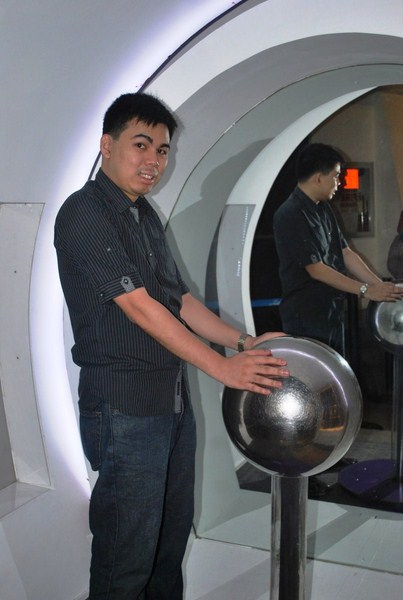
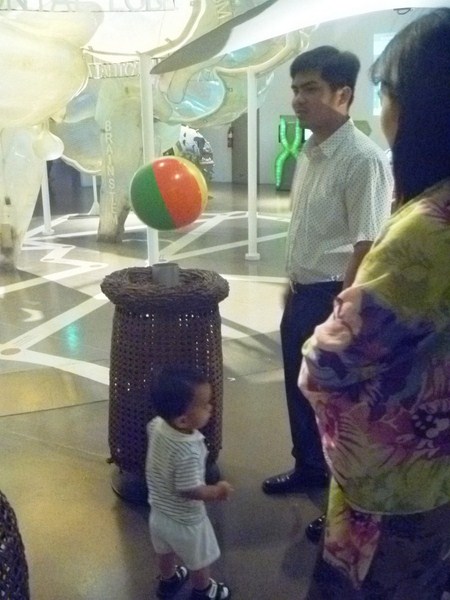
Jandy tries out the Van de Graff Static Ball

Jandy tries out the Van de Graff Static Ball

At the center of the museum is the Hall of Philippine Science which showcases the passion for science of world-renowned Filipino scientists, both here and around the world, via digital photographs featuring their lives and achievements, and local scientific endeavors spanning local issues such as sustainable communities, rice culture, etc.. Interactive stations here spew out random facts and trivia questions.

The Whirlpool

The Whirlpool

After this hall are five main galleries, Atom (has the most interactive exhibits), Earth, Life and Universe, stretching from left to right, at the ground floor, and Technology (the largest exhibit) at the second floor.

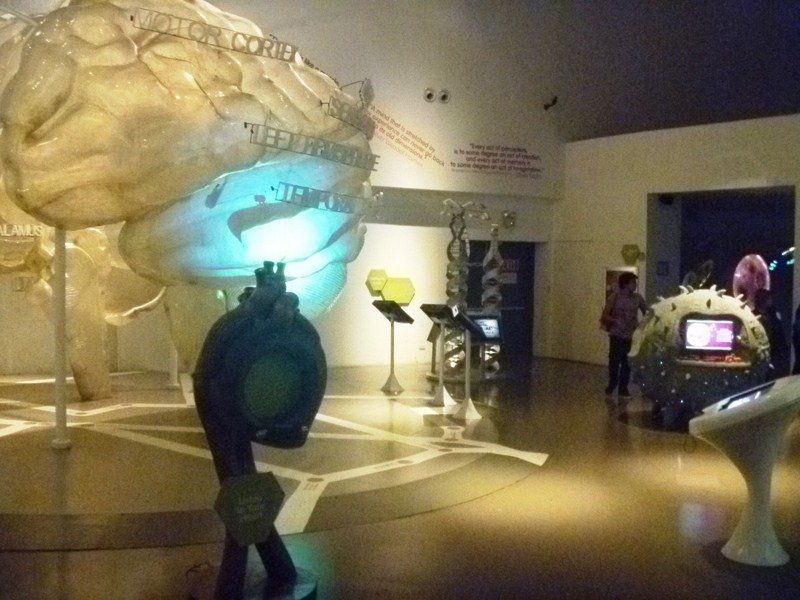
The gigantic Human Brain

The gigantic Human Brain

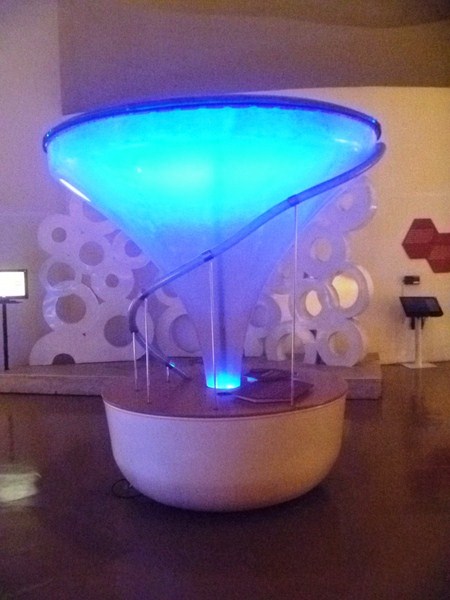
The Atom Gallery has exhibit pieces that show the strange world of the very small in terms of forces and particles. The Van de Graff static ball, where one can explore how electrostatic energy is generated and what effects it produces, is my favorite here.  When I touched the static ball, I experienced my hair standing on end.  Other interactive exhibits here include the Atom Centerpiece (a 3D visualization of the atom), Everything is Made Up of Atoms (a sculptural exhibit that shows the many levels of spaces inside a chocolate bar), Whirlpool (an enthralling exhibition of gravity and centripetal force), Carbon: Basis of All Life on Earth (a game area where guests can create their own allotropes), Periodic Table (learn about the 118 elements),  Electric Table: Magnets and Current, Energy Forms (convert kinetic energy to mechanical energy to electrical energy and then to heat), Newton’s Cradle (Isaac Newton‘s Third Law of Motion at work), Frequencies (see what a pitch looks like) and Shadow Box (leave your mark on the phosphorescent walls). 

Bernoulli's Principle at work

Bernoulli’s Principle at work

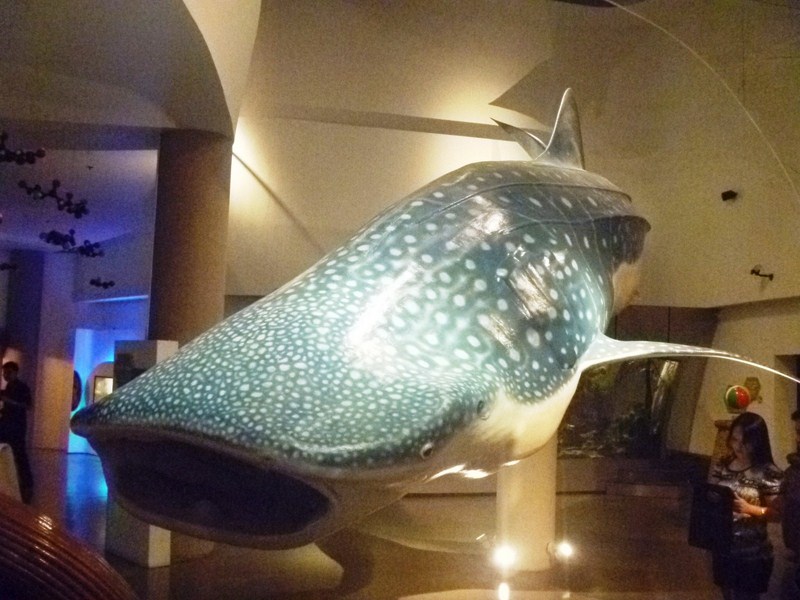
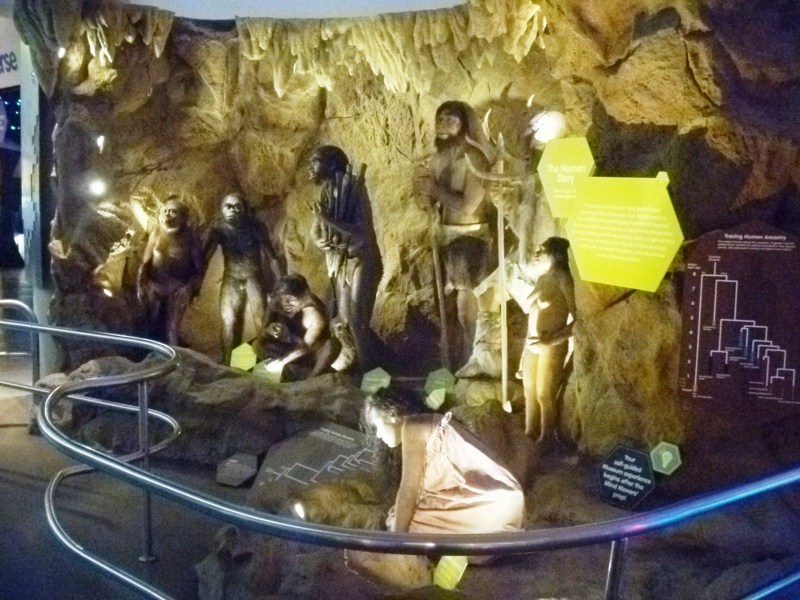
The Life Gallery provides us a deeper understanding of how life surrounds and inhabits us – from microbes to large animals and from DNA, cells to a giant, lit-up human brain model.  The latter, one of the largest exhibits in the entire museum, is a walk through exhibit where you can identify what brain part lights up when you sense, feel or think. Its other exhibits include The Human Story (a faithful replica of our prehistoric ancestors), Bernoulli’s Principle (the principle that explains how birds are able to fly), Whale Shark (a suspended life-size and life-like model of a whale shark, locally called a butanding), Small Worlds Within (a multi-media interactive program that will help guests learn more about cells) and the Web of Life.

The Butanding (Whale Shark)

The Butanding (Whale Shark)

The Human Story

The Human Story

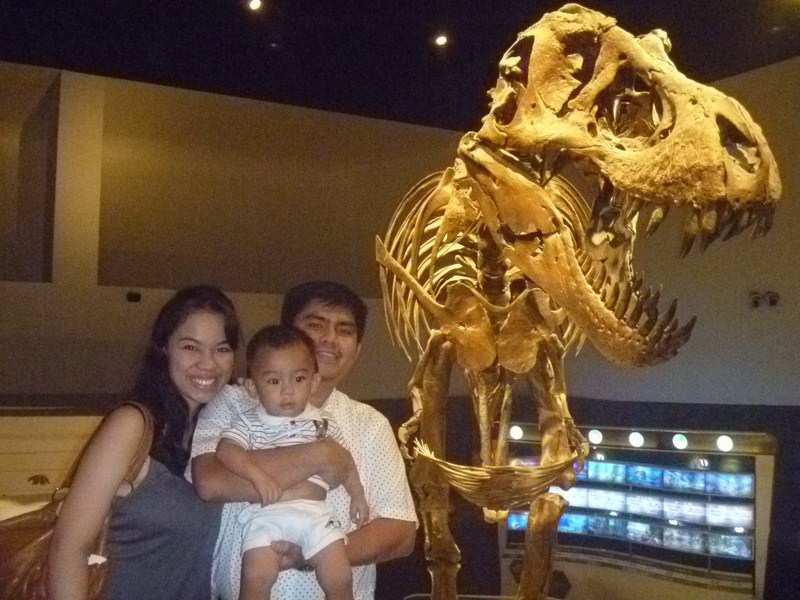
The Earth Gallery tells of the story of the planet and our archipelago across the breadth of time. Stan, the most impressive towering exhibit in the museum, is the first permanent T-rex exhibit in the Philippines.  This life-sized replica of a tyrannosaurus rex skeleton was named after Stan Sacrison who, in 1987, discovered the most complete male T-rex in 1987 in Hell Creek Formation, South Dakota, USA. 

Stan the Tyrannosaurus Rex

Stan the Tyrannosaurus Rex

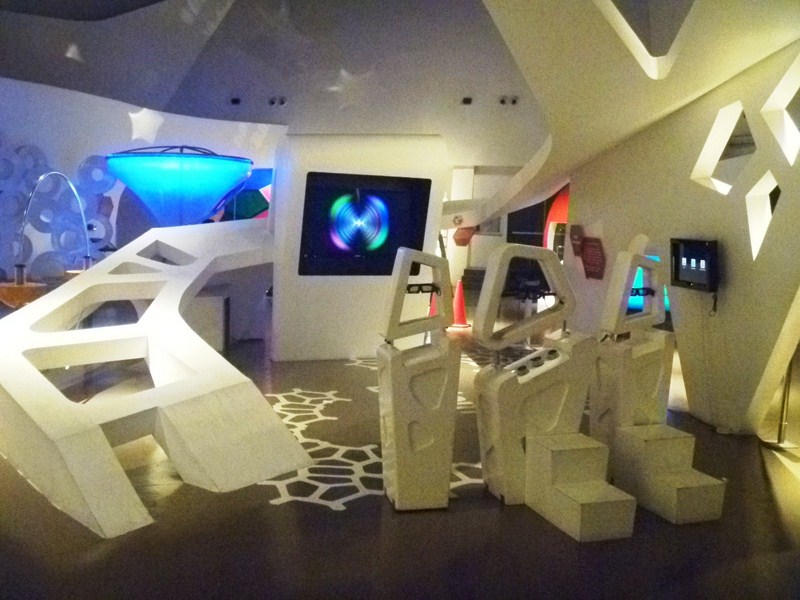
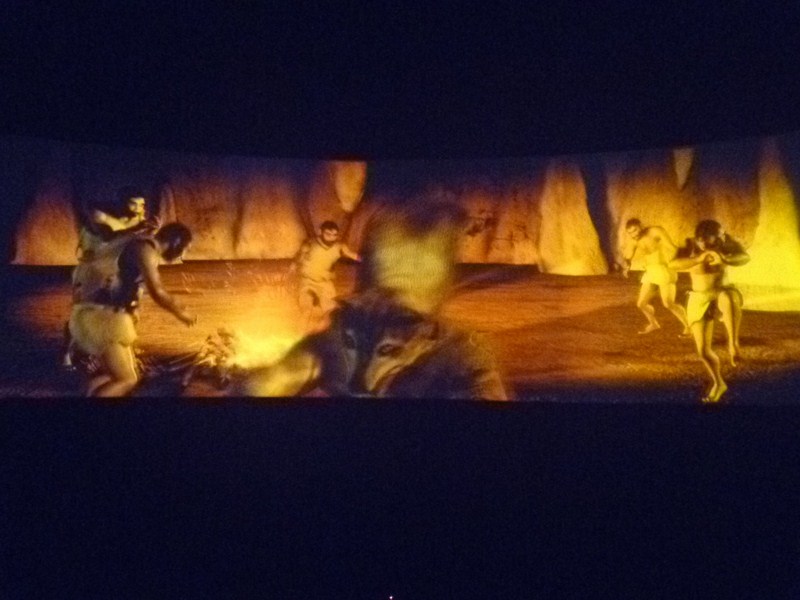
Nearby is an exhibit of petrified dinosaur bones and coprolite (dinosaur poop) while underneath the dinosaur is a fossil dig where visitors are allowed to dig, with pails and shovels, for their own fossils.  At its Nature’s Hourglass, a mini-theater that acts as a virtual time machine, we watched (with 3D glasses) a 12-min., fully animated 3D film, made by an all-Filipino crew, entitled “Birthplace,” that tells the story of Earth’s 4.6 billion year natural history and evolution.

The 3D movie "Birthplace" at Nature's Hourglass

The 3D movie “Birthplace” at Nature’s Hourglass

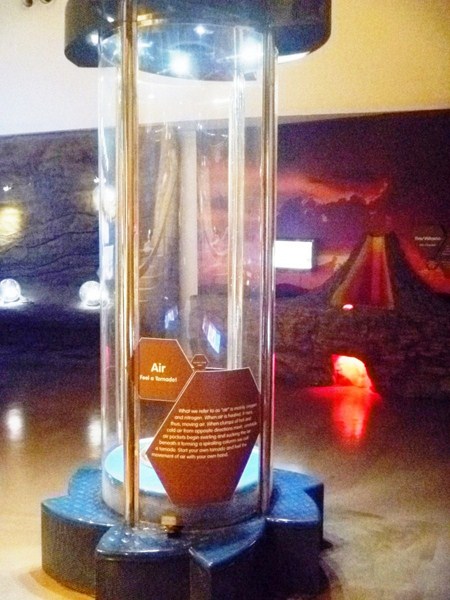
Other exhibits include Air (pass your hand over the sensor and watch a tornado form), Rock of  Ages/Mass Extinction (depicts the layering of the earth’s crust and illustrates the different geological ages and 2 of the 5 mass extinctions that have occurred over the span of earth’s history), Volcano (see how volcanoes erupt), Knowing Home: Floating Globe (watch a live feed that displays the current state of the planet earth), Spin Browser (watch plants grow or animals move in high speed or slow motion), Fungi: A One Billion Year Old Kingdom, and Beneficial or Harmful Bacteria.

Air

Air

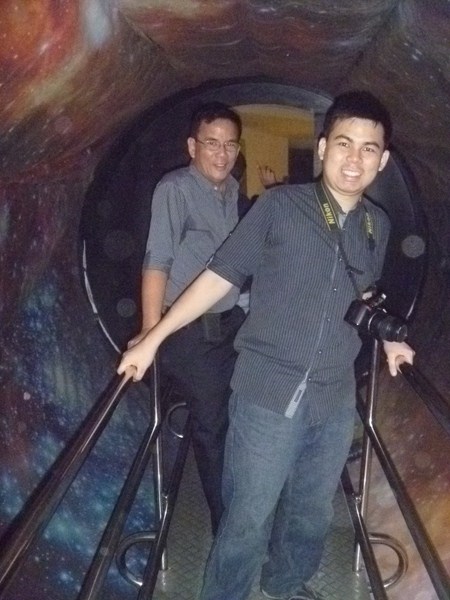
On our way to the Universe Gallery, we passed through Tunnel Craft, a spinning, 2-way revolving tunnel, with moving imagery from the Hubble Space Telescope that simulated travel between outer space and earth but made us dizzy. 

Getting dizzy at Tunnel Craft

Getting dizzy at Tunnel Craft

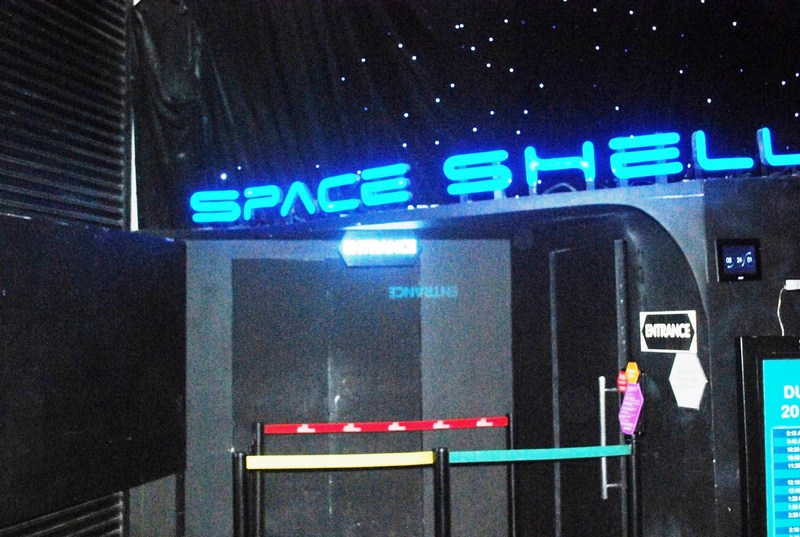
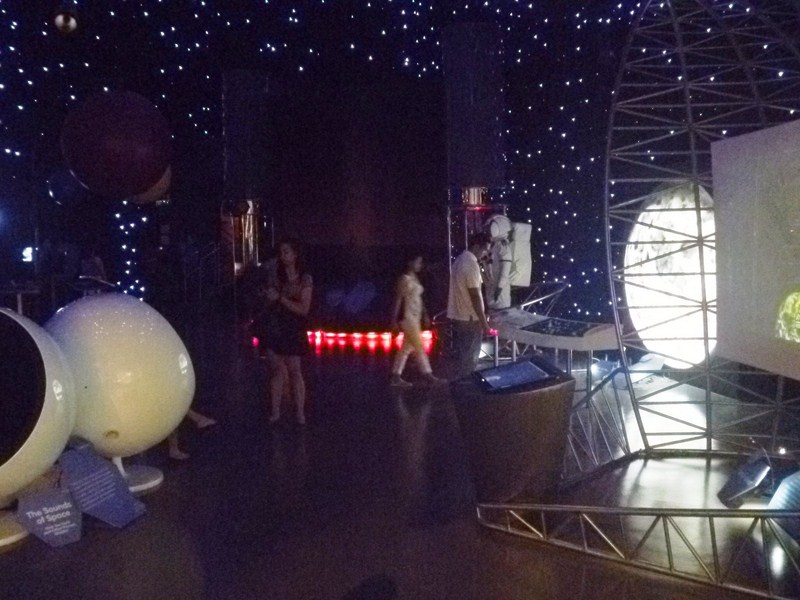
The Universe Galley, which shows how we, with the tools we invent and innovate, are able to express our evolving humanity, features the mysterious vastness of the universe and holds clues as to where we came from and where we are going.  The centerpiece of this gallery is an unique, 8 m. diameter, 35-50-pax mini-planetarium that uses, instead of chairs, memory foam where visitors can lounge on to simulate literally lying on the ground and staring at the stars in the night sky.  Here, we watched films that discuss the other planets and starts, as well as debates, the existence of extraterrestrial life.  We also tried out pods where we could hear sounds from outer space.

The Space Shell - a mini planetarium

The Space Shell – a mini planetarium

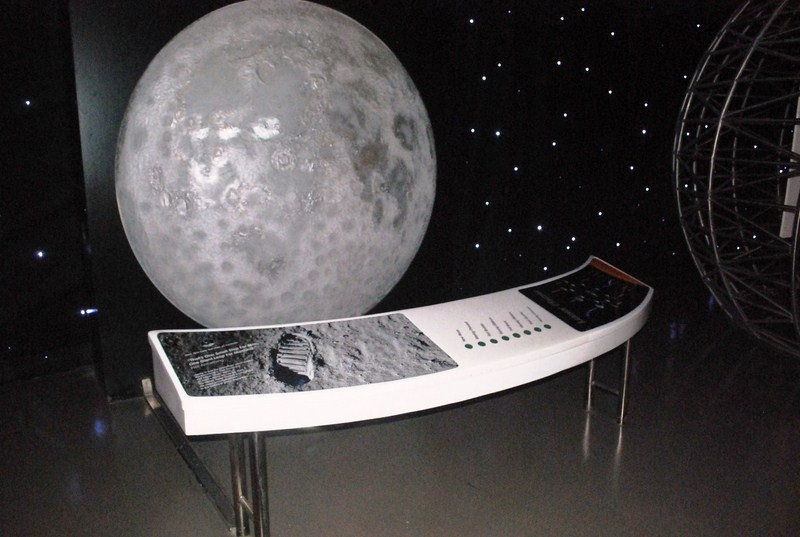
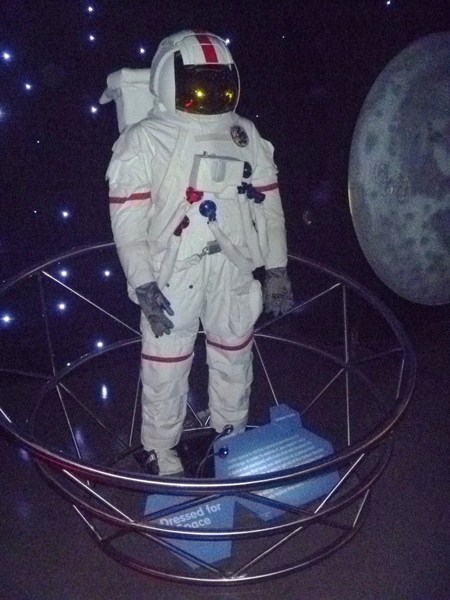
Other exhibits here include Look at the Moon (an interactive wall display that shows the moon’s different phases, and includes other information about the moon’s cycle and path around the earth), The Lifetime of a Star (describes how stars are born and how they die), The Solar System, Dressed for Space (an astronaut suit) and Space Quest History (1990-2011).

Look at the Moon

Look at the Moon

Dressed for Space - an astronaut's suit

Dressed for Space – an astronaut’s suit

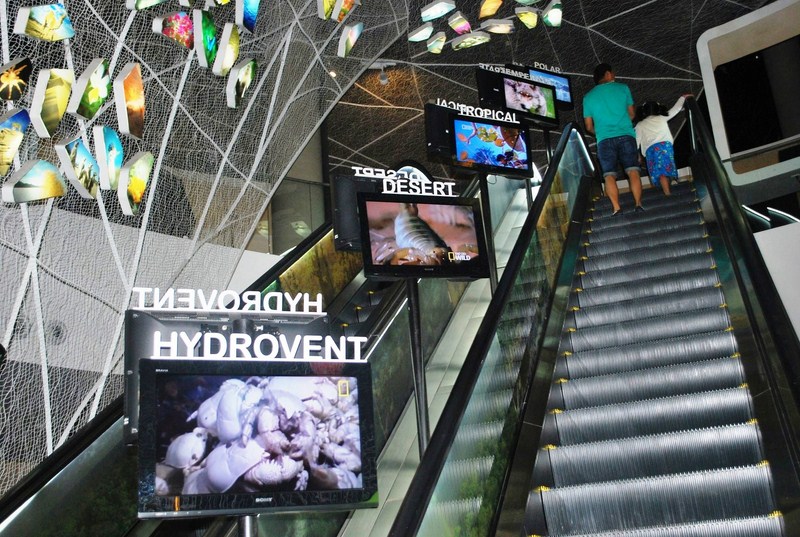
The Avenue of Life, the escalator to the second floor, was an exhibit in itself.  On the way up, we immersed ourselves in sights and sounds that showcased five of the Earth’s major habitats such as the temperate regions, polar environments, deserts and even the cold, sunless existence in the deep waters of hydrothermal vents.

The Avenue of Life escalator

The Avenue of Life escalator

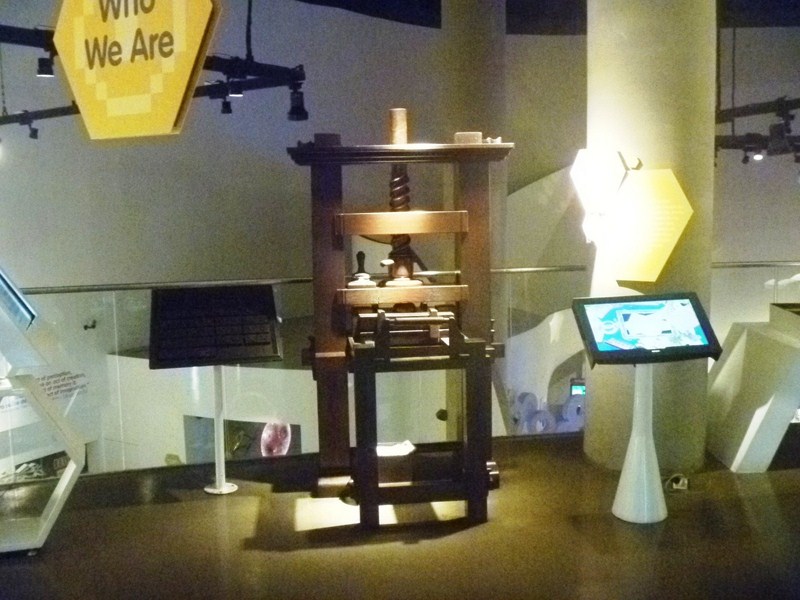
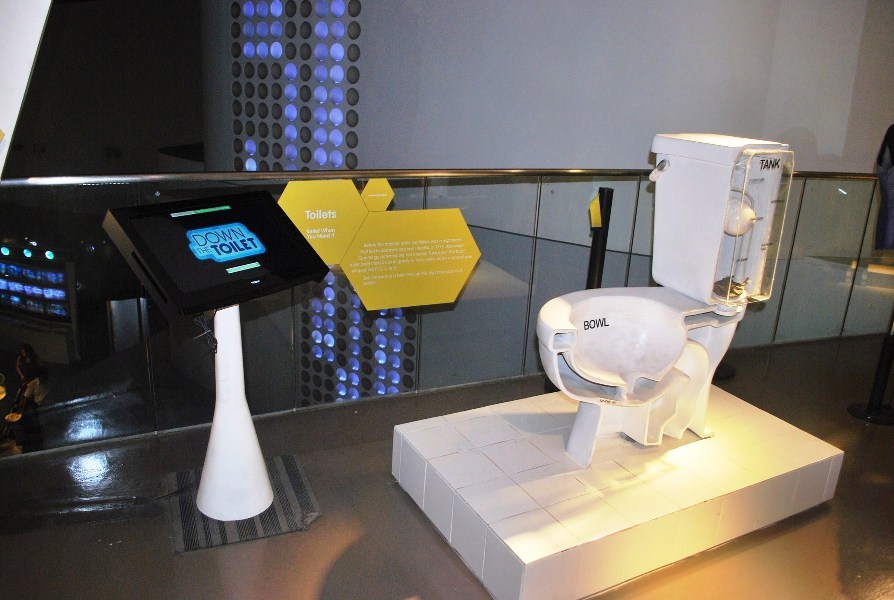
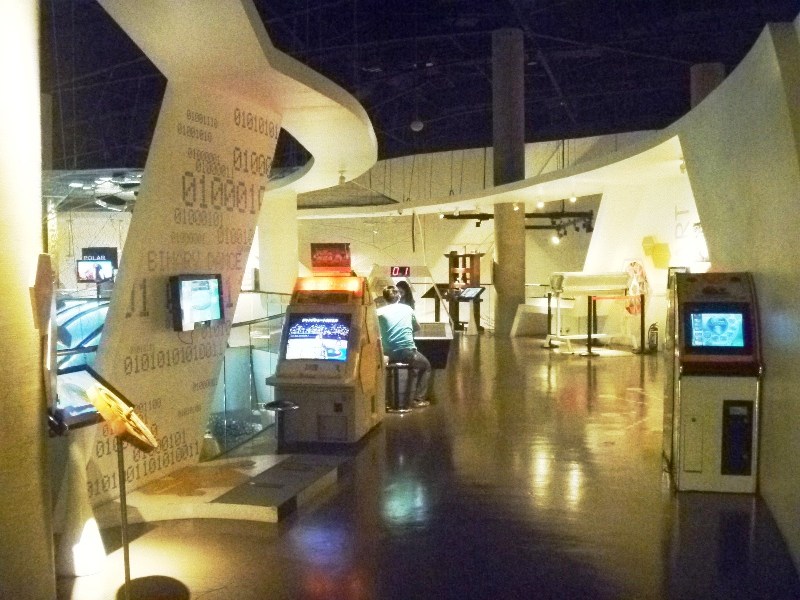
The second floor, which houses mostly Technology exhibits, is divided into 5 sub-galleries – “Who We Are,” “How We Know,” “How Things Work,” “Here to There” and “How We Live.”  Here, we found a fun toilet display, an interactive presentation of an archaic Gutenberg printing press and a Timezone-like row of arcade consoles illustrating how video games (Pong, Pacman, etc.) changed through the years.

The Gutenberg Printing Press

The Gutenberg Printing Press

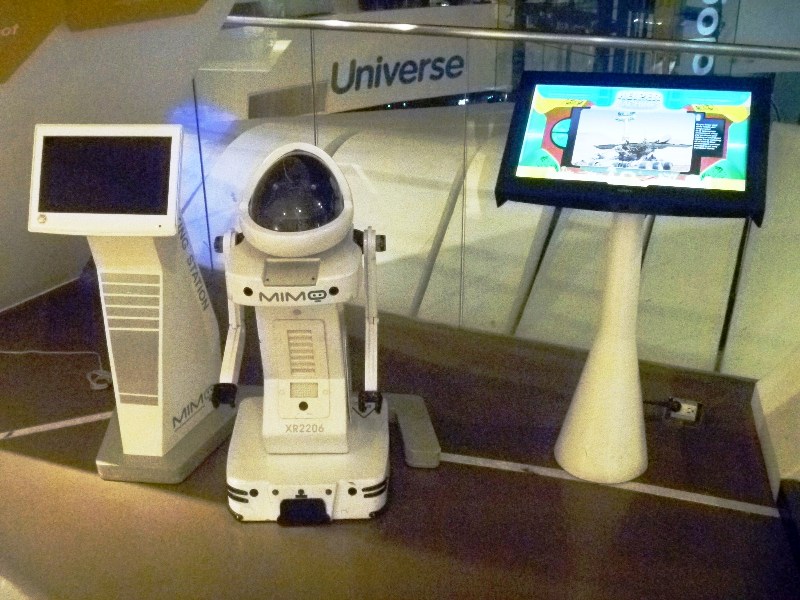
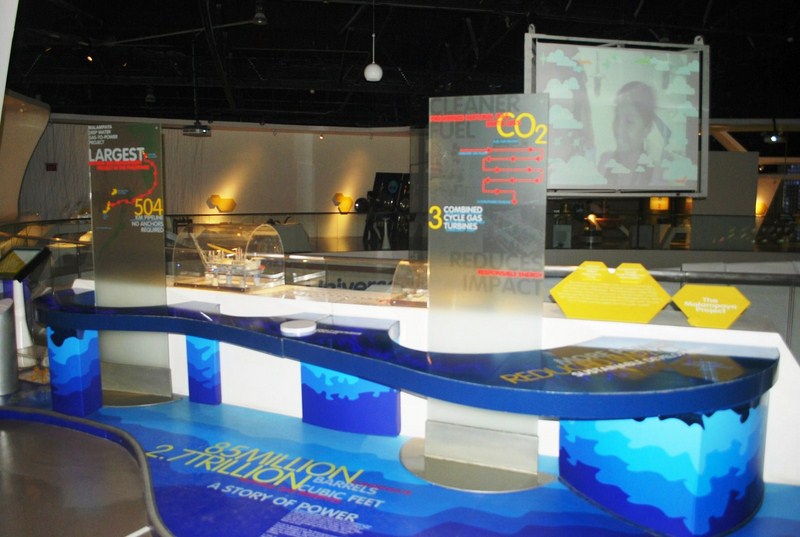
You would also enjoy the Laser Harp, the Night Vision Goggles Exhibit, MIMO (an in-house obstacle avoiding robot), Solar Bugs (shows how solar panels serve as power sources), Mathematics: Cars with Different Wheel Shapes, Mathematics: Elliptical Billiard Table (hit any of the two balls and it is sure to rebound and hit the other ball), The Malampaya Project (a representation of the discovery of 2.7 trillion cubic tons of natural gas near Palawan), Scents (check the scents in these spheres and see if you recall a specific memory because of it) and Beauty Symmetry: The Beauty is in the Phi of the Beholder (highlights the technologies that we come up with – in cosmetics, architecture, and art – to express the role of proportion in our lives).

MIMO

MIMO the in-house obstacle avoiding robot

The museum also has a 198-seat (with space for 2 wheel chairs) auditorium, 2 40-seat classrooms (Mind Pods), a 35-seat laboratory (Mind Lab) and an outdoor Science-in-the-Park where visitors can experience playful science through four-themed pockets: Music, Math, Living and Water.

The Malampaya Project

The Malampaya Project

All in all, we found ourselves thoroughly enjoying relearning about the human brain, solar system, and evolution in ways that we never did in grade school. Anyone, no matter how old, educated or well-read, even indifferent adults, will discover reasons to view, try out and marvel at the exhibits.

Cross section of a toilet

Cross section of a toilet

Mind Museum: J.Y. Campos Park, 3rd Ave., Bonifacio Global City, 1634 Taguig City. Tel: +632 909-MIND (6463).  E-mail: inquiry@themindmuseum.org and tickets.themindmuseum.org.  Website: TheMindMuseum.Org. Facebook: The Mind Museum. Twitter: @themindmuseum.

The Technology Exhibit Hall

The Technology Exhibit Hall 

The Universe Gallery

The Universe Gallery

Ticket Prices (with 3 hr. limit): adults (PhP600); children and private school students up to college (PhP450);  and public school students (up to college) and teachers with valid school ID (PhP150). Senior Citizen rebate will be given at the gate upon presentation of ID. Children 2 ft. and below are free.  Ticket time slots are 9 AM to 12 noon; 12 noon to 3 PM; 3 PM to 6 PM; and 6 PM to 9 PM.  An all day pass costs PhP750.

Pacific War Memorial Museum (Corregidor Island)

Our Corregidor Island tour included a 30-min. stopover at the Pacific War Memorial and, since I’ve been here before, decided to spend a much longer time to explore its small, bunker-like, modest and airconditioned marble museum, located behind the Cine Corregidor ruins.  This museum is the repository of relics and memorabilia related to the history of Corregidor, all found after the war.

Pacific War Memorial Museum

Pacific War Memorial Museum

At the entrance is a guard dressed in a Philippine Commonwealth Period-style uniform similar to the Philippine Scout.  An old tattered US flag with only 45 (Oklahoma, New Mexico, Arizona, Alaska and Hawaii weren’t even states yet) stars welcomed me at the entrance.

The museum interior with mural in background

The museum interior with mural in background

A 45-star American flag

A 45-star American flag

The museum had a lot of glass cases displaying valuable items, with descriptive information, such as  a lot of interesting black-and-white wartime photos of some battles at Corregidor; actual military uniforms of U.S. and Japanese soldiers, all worn by mannequins which highlight their height difference;  a ship’s signal-flag, and medals of war.

30 caliber, water-cooled machine gun

30 caliber, water-cooled machine gun

A 191 mm. mortar

A 191 mm. mortar

An anti-tank weapon

An anti-tank weapon

Weapons from World War II and used by both sides included rifles, mortars, bombs, machine guns (30 caliber, air-cooled or water-cooled machine guns, 50 caliber, water-cooled anti-aircraft machine gun, etc.), a 55 mm. anti-tank gun, mortars (60 mm. mortar, 191 mm. mortar, etc.), cannons, an army trench knife found on Denver Hill in 1992 (with the engraving U.S. 1918), a 1917 model (type CRM-51027) field telephone of the US Army Signal Corps; etc..

War photos

War photos

Not that related to World War II but nevertheless important is a book entitled “Souvenir of the 8th Army Corps Philippine Expedition” and a hand-embroidered tapestry, both donated to the museum by Douglas Bello of Los Angeles, California, USA.  He inherited these materials from his great-uncle who was part of Adm. George Dewey’s fleet during the Battle of Manila Bay.

Souvenir of the 8th Army Corps Philippine Expedition

Souvenir of the 8th Army Corps Philippine Expedition

Also on display are scaled models of World War II aircraft (B-24 Liberator, B-25 MitchellB-26 MarauderP-38 LightingP-51 Mustang, etc.), and ships and Philippine Commonwealth Era and Japanese Occupation currency as well as U.S. and Asian coins.  A large mosaic covering a whole wall depicts Corregidor and the battles that were fought there, a map of the Pacific campaign and a diagram of the Allied Offensive that eventually retook the Philippines and won the war .

Model of B-24 Liberator

Model of B-24 Liberator

Model of B-25 Mitchell

Model of B-25 Mitchell

I spent more than a few moments pondering the personal items on display which really drew me into the experience of a soldier during war, making it a shared experience.  They include identification cards; belt buckles, badges, diaries; dog tags of both American and Filipino soldiers, displayed side-by-side; and random items carried by soldiers into battle (chocolate bars, food tins, morphine ampules, etc.), Japanese scissors found in Corregidor by Lt. Dick Williams; a period Coca-Cola bottle; music discs (the size of a plate); and a rice canteen used by the Japanese during the war.

Gen. George M. Jones dress uniform

Gen. George M. Jones dress uniform

There’s also a pair of combat boots and dress uniform (as brigadier-general) belonging to then Col. George M. Jones, commander of the 503rd Regimental Combat Team that retook Corregidor from the Japanese on February 16, 1945.  Letters written by soldiers document the struggle to hold Corregidor.  There’s also a letter written by Gen. Jonathan M. Wainwright to U.S. Pres. Franklin Delano Roosevelt acknowledging Corregidor’s surrender.

Display of cutlery and china

Display of cutlery and china

The museum also has a documentary film projection room and a souvenir shop.

Sun Cruises, Inc. (SCI) – Reservation Office: CCP Terminal A, CCP Complex, Roxas Blvd., Manila.  Tel: (632) 831-8140 and (632) 834-6857 to 58.  Fax: (632) 834-1523.  E-mail: suncruises@magsaysay.com.ph.

Sun Cruises, Inc. (SCI) – Sales Office: 21/F,  Times Plaza Bldg., Ermita, Manila.  Tel: (632) 527-5555 local 4511 and 4512.  Fax: (632) 527-5555 local 4513.  E-mail: sales@suncruises.com.ph.

Kalibo Town Proper (Aklan)

It was time for Jandy and I to return to Manila and, as we still needed to buy some paint materials, I joined Grace, Marve, Cheska, John Paul and Kyle on their way to Kalibo where building materials were much cheaper than in Malay.  After that, we could all have dinner prior to them dropping us off at the airport.  The hardware was located at the center of town, across Pastrana Park.  While Marve was attending to the purchases, I took time off to explore the the huge central plaza where all major arterial streets in Kalibo intersect.

Kalibo town proper

Kalibo town proper

Around the park are the Cathedral of St. John the Baptist, the Museo it Akean, a Jollibee branch; the Gil M. Mijares Bldg., the former old tribunal which now houses Kalibo Police Station, Municipal Library and the Kalibo Sto. Nino Ati-Atihan Foundation, Inc. (KASAFI).

Pastrana Park

Pastrana Park

Across the park is the Cathedral of St. John the Baptist. The town’s parish was created on September 18, 1581 with Fr. Andres de Ibarra, O.S.A., as its first parish priest.  The church was first built in 1804 but, from 1947-48, a new, bigger and more sturdy church was built.  After an earthquake in 1991, the church was rebuilt from 1993-97 under the guidance of Kalibo Bishop Gabriel V. Reyes.

Cathedral of St. John the Baptist

Cathedral of St. John the Baptist

The cathedral's modern interior

The cathedral’s modern interior

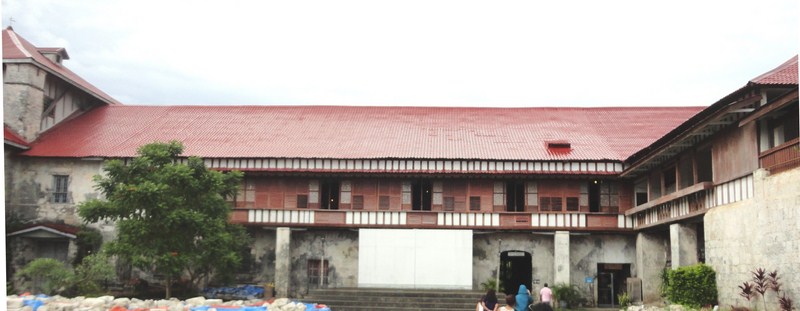
Adjacent to the cathedral is the elegantly-designed Museo it Akean.  Also called the Aklan Museum, this private museum is housed in the century-old, Spanish-era Estuylahan it Hari (“School of the King”), established in 1882.  Before World War II, it was a movie theater showing silent films and later a building of the Kalibo Institute.  During the war, it was converted into a Japanese garrison.  After the war, it was turned into a trial court sala and a warehouse before it was recently renovated and converted into a museum in 1980.

Museo It Akean

Museo It Akean

The museum showcases the history and remains of the old civilization of Minuro it Akean as well as contemporary local art. On display are talibong swords; wood and metacraft; the memorabilia of Archbishop Gabriel M. Reyes, Jaime Cardinal Sin and Godofredo P. Ramos; pina textiles, paintings of Aklanon artists; jars; pottery; religious relics; furniture; crafts; tools and artifacts from the Spanish era, and literature of Aklan.

Museo it Akean: cor. S. Martelino and Archbishop G. Reyes Sts., Kalibo, Aklan.  Admission: PhP15. Open daily, 8 AM to 5 PM.