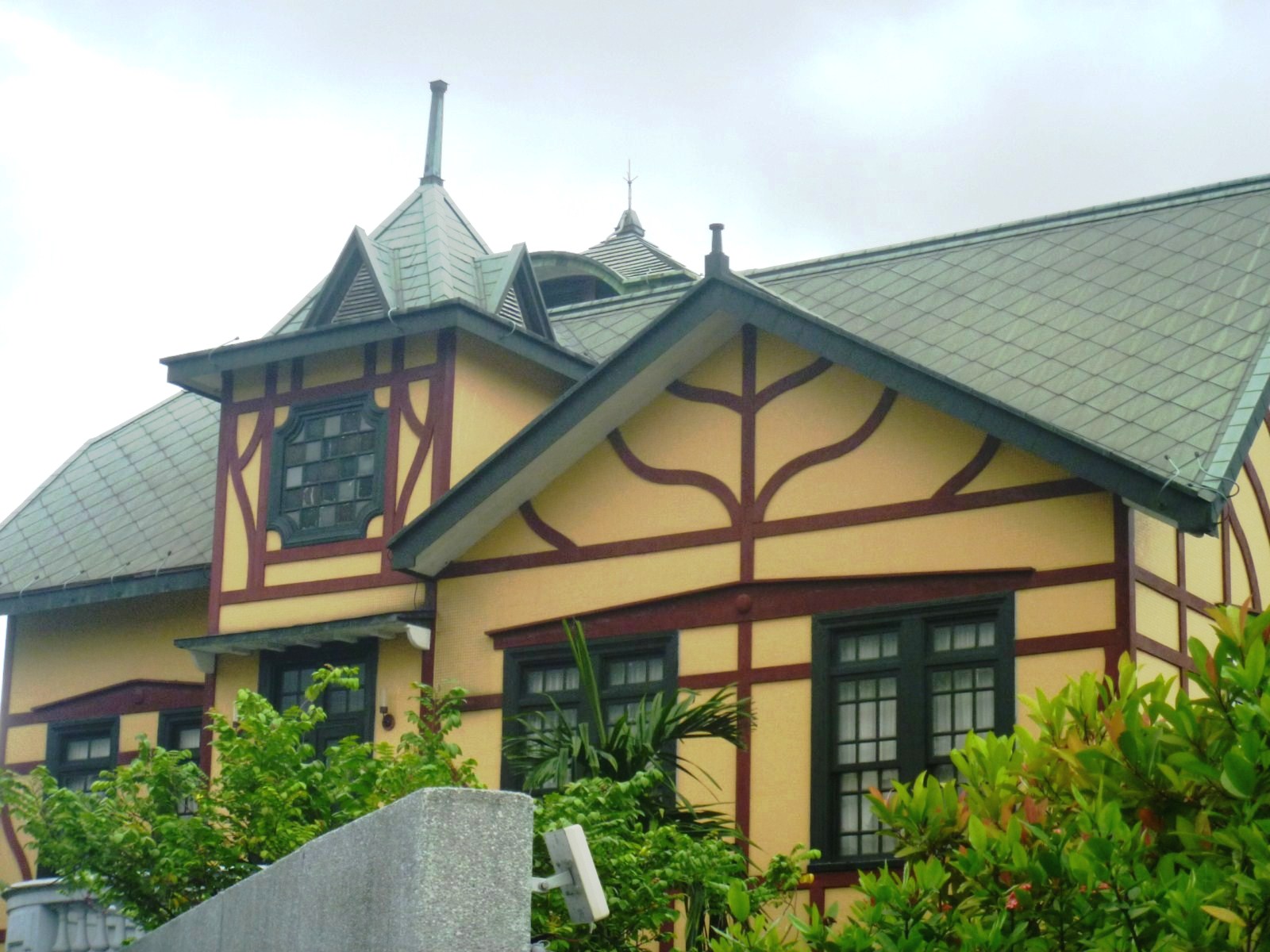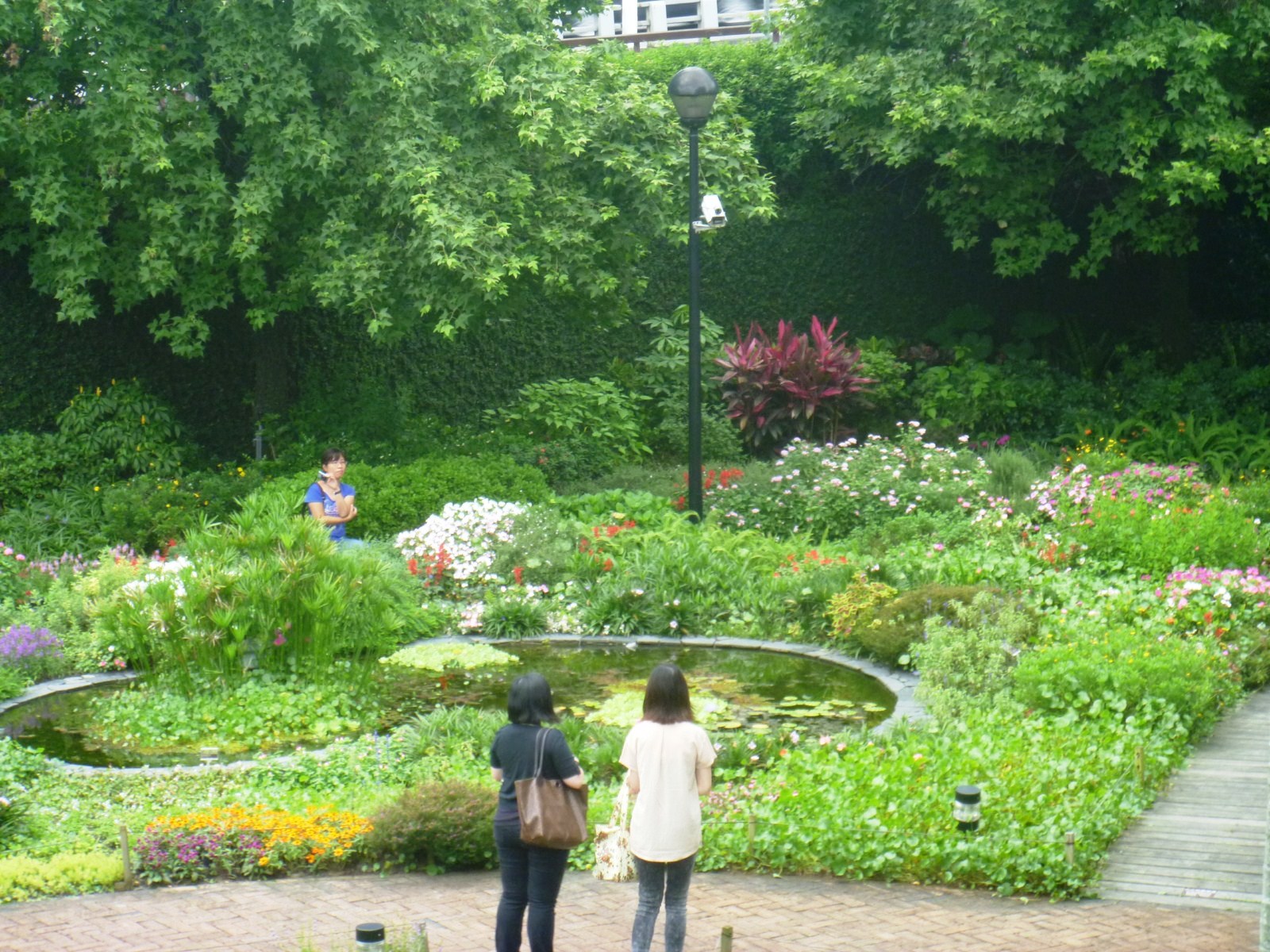
Lin An Tai Historical House and Museum (Taipei City, Taiwan)

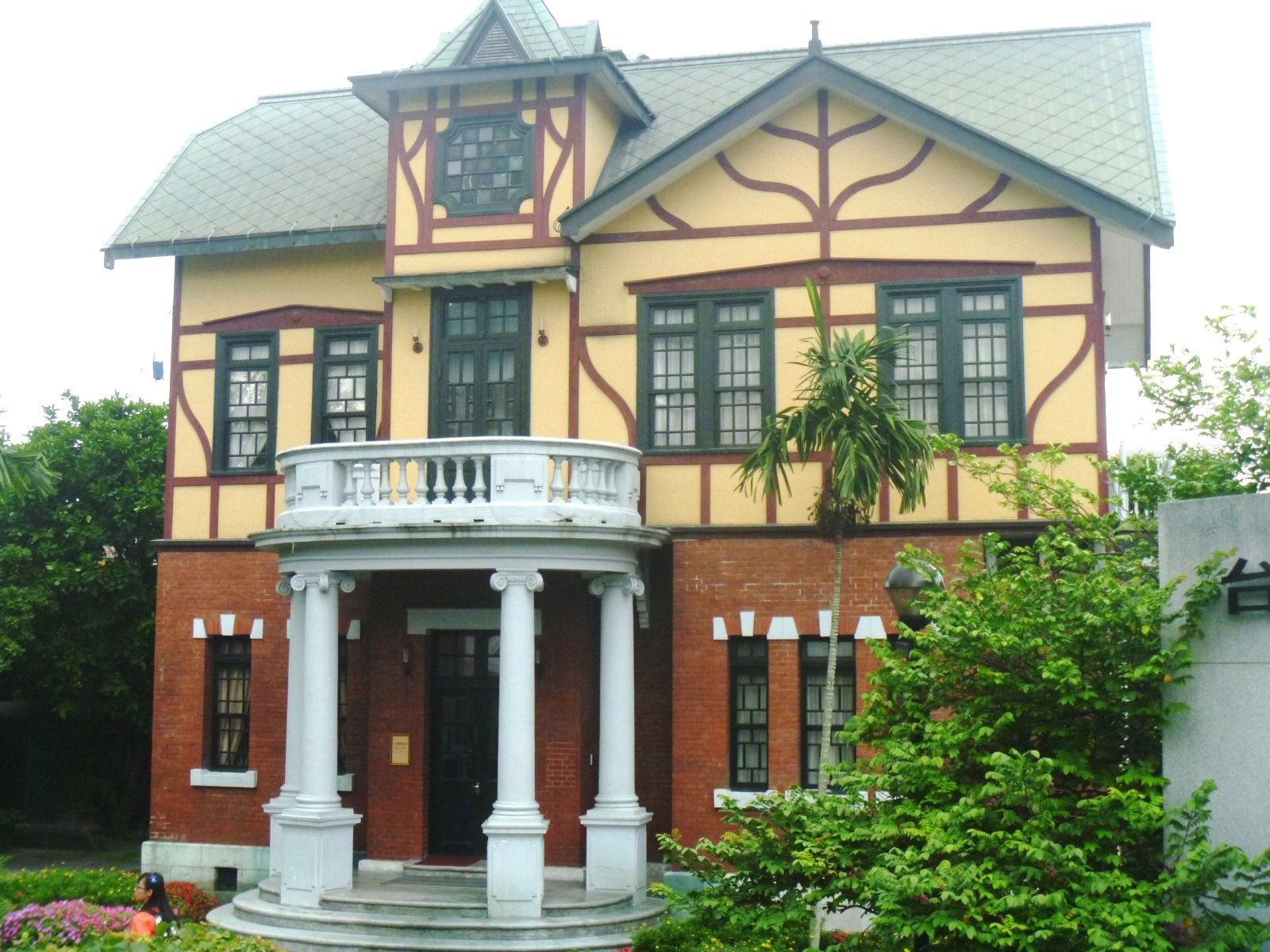
Within walking distance from Xinsheng Park is the Lin An Tai Historical House and Museum,  one of the few traditional courtyard complexes preserved in northern Taiwan and the best-preserved and maintained ancient house in Taipei City.  This traditional Chinese courtyard house, famous for its delicate carvings, was built in the southern Fujianese style which incorporates 3-sided courtyards, woods and gardens, all natural and shaped to embody the pristine elements.

Entrance to Lin An Tai Historical House and Museum

In 1754, Lin Chin-Ming (also known as Lin, Yao-Kung), a native from Anxi County of Fujian Province, sailed across the strait to Taiwan with his family. The Lin family engaged in trade in northern Taiwan and, with the money they made, they built this big, very refined 5-annex house with a square at where No.141 of Siwei Rd. now lies. The main building was completed between 1783 and 1785 while the side buildings were completed, one after the other, between 1822 and 1823.  In memory of his hometown, the fourth son, Lin, Chin-Neng (also known as Lin, Hui-Kung) named the house as “An Tai,” representing Anxi County and Rong Tai Company, the company he founded in Bangka.

Paved Front Yard of Lin An Tai Historical House and Museum

In 1978, due to its being located within the range of the project to expand Dunhua South Road plus its rejection as a historical site, the house faced demolition.  To save it, local activists petitioned to have the building spared as a cultural site. A blueprint containing every single measurement of the building was saved. The building was then meticulously dismantled, from decorations to bricks; stored safely and then relocated, piece by piece, to its current site at Binjang Park, in the shadows of the Jiankuo Expressway, in 1986.  In May 2000, it was opened  to the public as a museum and, in 2010, after its courtyard was extended, the museum became one of the exhibition halls of the Taipei International Flora Exposition.

Front Yard of Lin An Tai Historical House and Museum

The house’s landscaped courtyard, layout of buildings, waterscapes (“the proportion of water, bamboo and house is 30%, 20% and 10% respectively”), artificial hills and plants are all done in accordance with feng shui and Taoism,  reflecting the ancient Chinese’s multi-directional views of nature and life. In the past, the house had a Toad Peak in front of it as its “Mountain of feng shui,” plus shielding hills on both sides and a wind-gathering flat square in front of the semi-circular pond. Today, to reinstate the feng shui landscapes of the old house, an artificial hill, called Gu Zhu Ming Shan (Artificial Clay Modeling Hill), was created, using wire-mesh concrete, in front of a flat square and 2 slightly raised grasslands were used to surround the square.

Gu Zhu Ming Shan (Artificial Clay Modeling Hill)

Past the imposing front gate is the large, crescent-shaped (the best shape for bringing wealth in terms of feng shui) lotus pond, another feng shui device. Its shining surface deflects negative qi from sweeping through the main portal.  It also had practical purposes as it was used as a defense line if under attack, for raising fish, to fight fires, supply water, keep a moderate temperature by cooling incoming breezes and adds to the splendor of the old house’s surroundings.  Flowers grown all have their own symbolism – noble character (plum, orchid, bamboos and chrysanthemum), eternal youth (pine and cypress), wealth (peony), self-respect (lotus) and relief (lily).

The crescent-shaped lotus pond

This 34-room, stone and brick house has elegant decorations; beautiful, sloping swallow-tail roofs (this flouted imperial rules as this roofing style was the exclusive privilege of high-level mandarins) and the stone and artwork used were brought by ship from Fujian.  The roof ridges arch upwards to form a swallowtail structure. The mansion has a south-north axis, with rooms on the right and left side of the courtyard.

Courtyard of Lin An Tai Historical House and Museum

Its front door has creative carvings of 6 dragons, representing the 6 sons in the family while the carvings of vases and bats carry the meanings of good luck, wealth and safety. Pillow-shaped stones, gate pillars and hollows for the door axles are all carved from a single piece of stone. Each door was equipped with a hidden lock. The front yard is paved with red, moss-free and non-slip stones that were used by mainland merchants to stabilize their big sailing ships

Elaborate wood carving

Carved on the pillars, made of Chingtou stones, is a couplet “To live with a kind heart and maintain the achievements of ancestors.” Chinese characters, signifying good fortune and longevity, are printed on the two sides. By adding anti-termite agents, the original Guanyin stone, Fuzhou fir wood, and local bamboo, reed and bricks have been kept intact.

The main hall

Beyond the entrance is an intricately carved screen wall to divert evil. The main hall consists of a colorfully adorned altar depicting scenes from Chinese mythology. The ancestors depicted at the altar are worshiped in an annual ceremony. Walking through the house, we directly experienced the lifestyle of the Taiwanese people 200 years ago as the interiors of the house are full of decorative details and antiques such as an earthen rice grinder, a stone mill, cupboards, a huge cooking hearth in the kitchen, an intricately carved wooden bed and a dresser.

Intricately carved wooden antique furniture

Lin An Tai Historical House and Museum: 5 Binjiang St., Zhongshan District, Taipei City, Taiwan. Tel: (+886-2) 2599-6026, (+886-2) 2720-8889 (ext.6239) and (+886-2) 2598-1572. Fax: (+886-2) 2599-6521.  Open daily except Mondays and folk holidays (Chinese New Year, Tomb Sweeping Festival, Dragon Boat Festival and Mid-Autumn Festival), 9 AM-9 PM (5 PM on Sundays). Admission is free.

How to Get  There:  take the MRT to Yuanshan Station (Exit 1), then hop on the bus 222 to the Xinsheng Park stop.

Philippine Air Force Aerospace Museum – Aircraft Park (Pasay City)

After attending an exhibit of Jandy’s Asia Pacific College Multi-Media Arts classmates at Villamor Air base, we dropped by the Philippine Air Force Aerospace Museum which we passed just before the base guardhouse.  We didn’t have time to explore the indoor museum exhibit, but we did checked out the Outdoor Aircraft Park where we got up close and personal with some 16 actual aircraft, 13 airplanes (1 presidential) and 3 helicopters (1 presidential), that became part of Philippine Air Force history.

Outdoor Aircraft Park

Five of planes surround the monument to Col. Jesus Antonio Villamor (November 7, 1914-October 28, 1971), a World War II major in the Philippine Army Air Corps, 6th Pursuit Squadron and a two-time recipient of the U.S. Distinguished Service Cross plus the Philippine Medal of Valor.  He shot down two Japanese planes during World War II.  His first kill, with his obsolete Boeing P-26 “Peashooter” fighter, was a navy carrier-based Mitsubishi “Zero” A6M fighter over Zablan Field on December 10, 1941 and his second, two days later, was a Mitsubishi “Nell” G3M navy attack bomber over at Batangas.  The Col. Jesus Villamor Airbase, formerly Nichols Field in Pasay City, was renamed after him in 1982.

Col. Jesus Villamor Monument

The T-6 “Texan” (with body number 662), manufactured by North American Aviation, was acquired in 1948 to serve the Basic School Squadron in Floridablanca Air Base (now Basa Air Base in Pampanga) as a advance flying trainer.  In 1958, it was replaced by the T-28 “Trojan” as the basic trainer for the PAF Flying School.

T-6 “Texan”

The T-28 “Trojan,” locally called “Tora-Tora” (because of its resemblance to the World War II Japanese “Zero” fighter), was manufactured by North American Aviation.  In 1960, 15 of these aircraft were acquired for the 100th Training Wing for the use of cadet pilots in flight training.  In 1975, it was used by the 15th Strike Wing against secessionists and insurgents.  It became famous during the August 1987 and December 1989 coup attempts.  It was retired on July 1992 during the 45th PAF anniversary.

T-28 “Trojan”

The F-86D “Sabrejet” (body number 140), manufactured by North American Aviation, was distinguishable from other F-86 models by its introduction of the concept of gunless collision-course interception.  This all-weather jet interceptor can fly at night or during bad weather and engage the enemy using radar.   Acquired by the PAF from the U.S. in 1960, it was used by the 8th Interceptor Squadron for air defense functions but was phased out in 1968.

F-86D “Sabrejet”

The F-86F “Sabrejet” (body number 468), manufactured by North American Aviation, was referred to as the “Magnificent Machine,” “MIG Killer” and the “Sports car of the Sky.”  It first saw combat in the Korean War and had a kill ration of 15 to 1 over the Russian-made MIG-15.  The PAF’s first jet fighter, 30 of these aircraft arrived from the U.S. on August 31, 1957 through the RP-US Military Assistance Program.  From 1957 to 1964, it was also used by the Blue Diamonds Team in aerobatic demonstrations.  It was phased out in 1979.

The F-86F “Sabrejet”

The needle-nosed F-5A “FreedomFighter,” manufactured by Northrop Corporation, arrived in the country on August 29, 1965.  Assigned to the 5th Fighter Wing in Basa Air Base in Floridablanca (Pampanga) as a front line fighter, this aircraft was also used by the Blue Diamonds in aerial demonstrations during significant national, AFP and PAF celebrations.

F-5A “Freedom Fighter”

The F-8H “Crusader” (body number 313), manufactured by Vought Crusader, was delivered to the country in 1978. This carrier-based fighter has variable incidence wings, all-weather radar autopilot and a sophisticated weapons delivery system.  Used by the 5th Fighter Wing for air defense, surveillance and reconnaissance missions, it can be equipped with various weapons such as air-to-air missiles, rockets, 20 mm. cannons, M-60 machine guns and 500-lb. bombs.

F-8H “Crusader”

The T-33 “Shooting Star” (body number 806), a jet trainer (popularly called “T-Bird”) manufactured by Lockheed, was the outgrowth of the Lockheed F-80, the first jet fighter, and was the world’s most widely used jet trainer.  Acquired in 1955, it ushered the PAF into the jet age and was used by the 5th Fighter Wing for jet qualification, instrument training and proficiency flying.

T-33 “Shooting Star”

The HU-16 “Albatross,” a general utility amphibian manufactured by the Grumman Aircraft Corporation, was assigned, in 1971, to the 505th Search and Rescue Squadron under the 205th Airlift Wing. Its favorable peculiarity (triphibian landing gear) and its all metal, V-shaped hull gave it more capability to perform water rescue operations as it had the power to take off and land both in water and land.

UH-16 “Albatross”

The C-47 “Dakota” (or “Skytrain”), the most famous commercial transport plane in the world, was manufactured by the Douglas Aircraft Corporation.  Fondly called the “Gooney Bird” in the military service, it was given to the Philippine Army Air Corps (PAAC) for air transport operations. In 1973, it was converted into a fighting aircraft, with machine guns electronically operated and controlled by the pilot.

It was also used by the PAF Weather Reconnaissance Squadron for rainmaking and rain suppression operations.  The 303rd Aerial Recon Squadron used it for photo mapping and aerial surveillance.  Even after so many decades of service, it proved to be multi-functional and, as of 1995, there were still 2,000 of these planes flying all over the world.  On May 18, 1947, a C-47 (named Lil Marlene) carrying PAF Chief Col. Edwin Andrews and other high government officials crashed in Lanao.

C-47 “Dakota”

The Aermacchi SF-260 “Marchetti” (with body number 639), manufactured by SIAI Marchetti of Italy,  was a trainer/COIN aircraft acquired (1 warrior and 4 trainer) in 1973 and first used, for flying training, by the PAF Flying School Class 1973-A.  The aircraft was further modified to load 250-lb. bombs and MA-3 rocket launchers and deployed in combat operations to conduct close air support to ground operations.

Aermacchi SF-260 “Marchetti”

T-41D “Mascellero” (with body number 858), manufactured by the Cessna Aircraft Corporation (it was commercially called Cessna 172) in 1964, was acquired by the PAF in 1968 through the Joint United States Military Advisory Group (JUSMAG) for pilot training (as a preliminary flight screener for candidates) and proficiency flying and was first used by the PAF Flying School Class 1970-A.

T-41D “Mascellero”

The T-34 “Mentor” (with body number 506), manufactured by the Beechcraft Aircraft Corporation, signalled the modernization of the PAF’s flight training.  Two of these were acquired on October 1958 and a total of 36 were built by Japan for the PAF as part of its War Reparations Program.   In the early 1970s, it was subsequently used for air reconnaissance after being replaced by the T-41D “Mascellero” as a primary fighter.

T-34 “Mentor”

The YS-11A, manufactured by the Nihon Aircraft Manufacturing Company (NAMC), was a twin-engine, medium-range turboprop transport plane (RP 77) assigned to the 700th Special Mission Wing, mainly used, from 1971 t0 1993, by the Philippine President and the First Family.

YS-11A

The UH-1H “Iroquois,” manufactured by the Bell Helicopter Company, was nicknamed “Huey” and was extensively used by the Americans for air mobility and rapid deployment of troops during the Vietnam War.  The PAF acquired 75 Hueys in 1969 under the RP-US Military Assistance Program.  Still in service today due to its rugged design and low maintainability, it was assigned to the 205th Helicopter Wing and 505th Search and Rescue Group and used primarily for tactical troop transport, front-line casualty evacuation, resupply and troop extraction.

UH-1H “Iroquois”
Visitors like Jandy are allowed to pose inside

The UH-34D “Choctaw” (S-58), manufactured by the Sikorsky Aircraft Division, first flew on March 8, 1954 and was used by the PAF in search and rescue operations, from 1969 to 1980, under the 505th Search and Rescue Squadron, 205th Composite Wing, as well as troop transport, aerial photogrammetry, mapping and intelligence work.  It was phased out on October 1974.

UH-34D “Chowtaw”

The S-62B/HH-52A helicopter, manufactured by Sikorsky Aircraft Division, was acquired to provide air transport for the Philippine President.  In service from 1968 to 1975, it under the operation and maintenance of the 7001st Presidential Airlift Mission Squadron, now the 250th Presidential Airlift Wing.  This helicopter was eventually phased out due to its single engine feature which did not conform to the requirement for multi-engine category for VIP transport.

S-62B/HH-52A

Philippine Air Force Aerospace Museum: Gozar cor. Alia St., Col. Jesus Villamor Air Base, Pasay City.  Open Mondays to Fridays, 8 AM to 5 PM, Saturdays, 8 AM to 12 noon. Admission is free.  Tel: (632) 854-6703 and 29 and 762-6628.

Ang Nuno Artists Foundation Gallery (Angono, Rizal)

Balaw-Balaw Restaurant

After my interview with Nemi R. Miranda, Jandy and I moved next door to the Balaw-Balaw Specialty Restaurant.  This restaurant, made famous by Andrew Zimmern in Discovery Travel and Living’s “Bizarre Foods,” offers truly exotic cuisine such as sautéed ants and crickets, wood worms and frog cooked adobo style, Soup No. 5 (cow butt and testicles),  adobong uok (beetle larvae), among others.

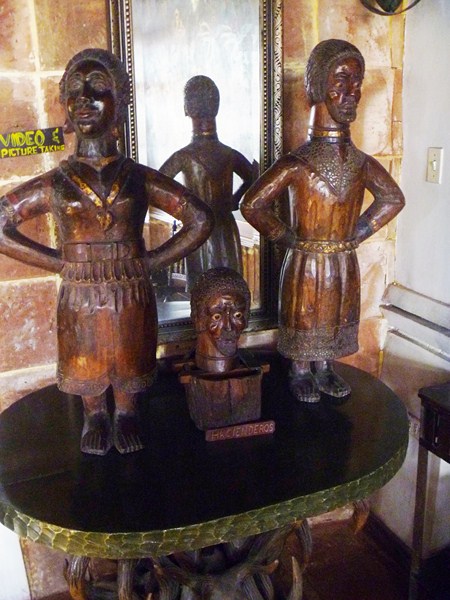
Wooden sculptures of Angono’s higantes

Andrew tried the last two.  However, having already taken lunch, we weren’t there for the exotic food (Maybe next time).  Rather, we wanted to explore the Ang Nuno Artists Foundation Gallery  at the second floor.

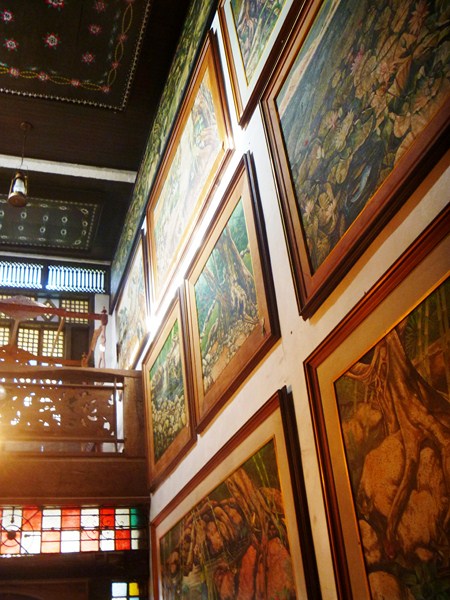
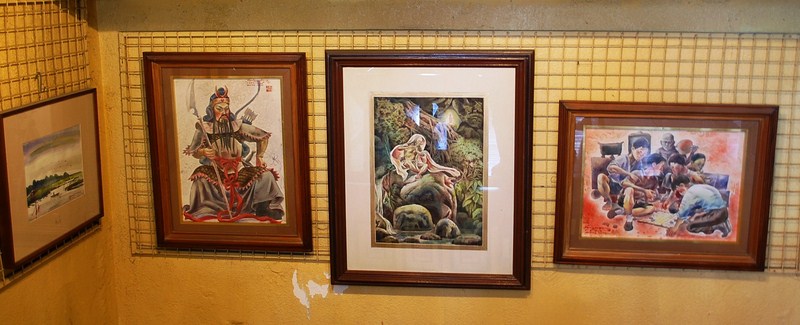
Luckily, Andre, the restaurant manager (and also an artist) son of the late artist and sculptor Perdigon N. Vocalan, was there and he granted us permission to explore the gallery upstairs. The dining area is already a gallery of sorts, with colorful paper mache sculptures and paintings (with subjects ranging from basket of fruits to mythical creatures) all around the patchwork property.  Outside, soda bottle lanterns hang from trees.

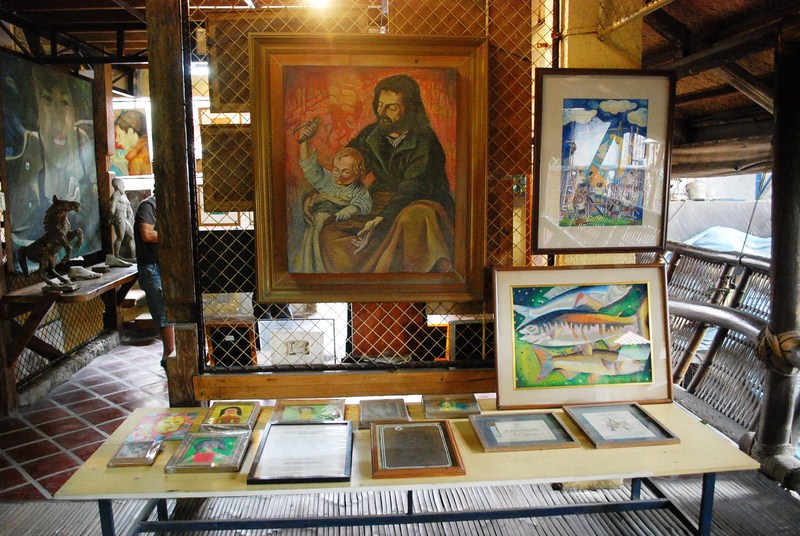
Upon climbing the spiral staircase, we were ushered into an impressive repository of Philippine treasures that showcases Filipino heritage through colorful papier mache, antiques and artworks by Perdigon, his sons Andre and Rembrandt as well as other independent and budding local artists and craftsmen from Angono and other Rizal towns.

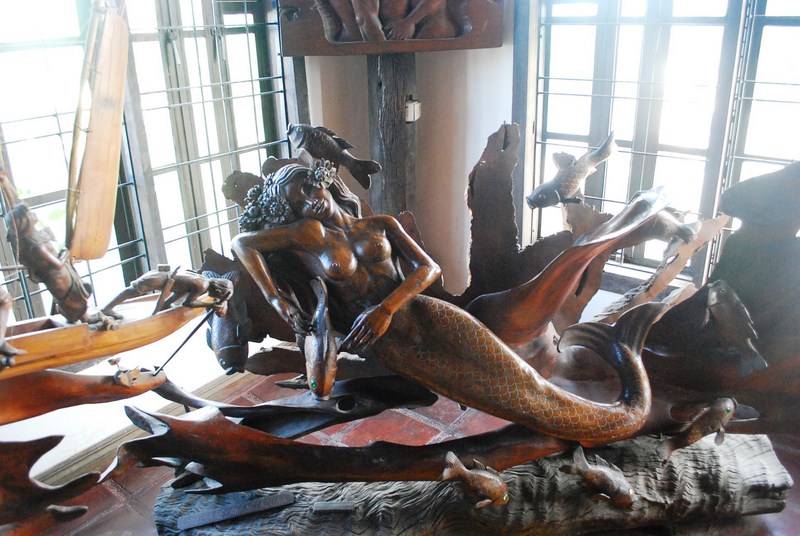
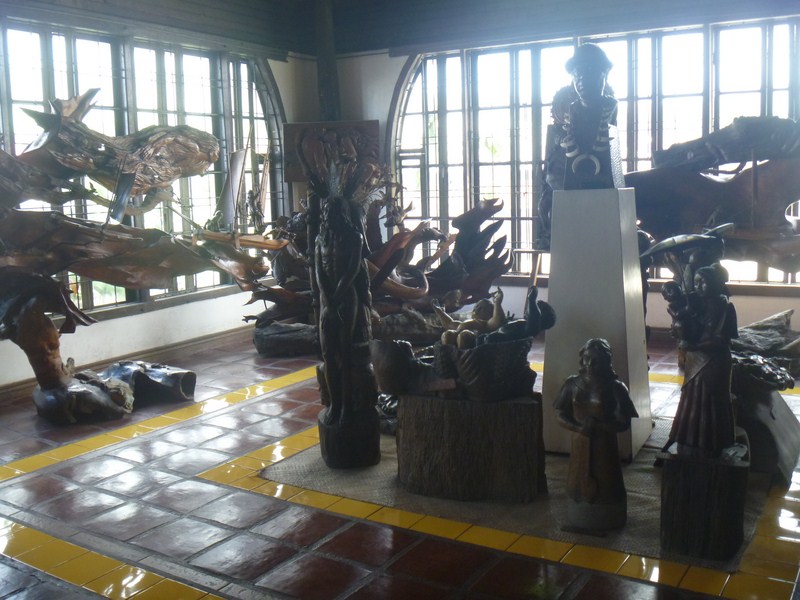
A collection of wood sculpture and furniture

The accomplished Vocalan was influenced by the late National Artist and Angonon Carlos “Botong” Francisco (November 4, 1912 – March 31, 1969) and his  various paintings, sculptures and woodcarvings, inspired by Filipino traditions and legends,capture Angono’s rich cultural heritage as well as depict folk stories and characters like the kapre (a menacing creature that seeks refuge in big trees), duwende (goblin)tikbalang (demon horse), manananggal (a woman with the ability to detach the two halves of its body at the waist), and the like. He also depicted women in all their glory and beauty.  There are also several depictions of the Mother and Child.

Dining table with tapayan above it

The gallery, a reflection of Perdigon’s eclectic taste, also has an impressive collection of antiques and religious objects such as statues of saints (some just heads without a body), a complete tableau of the Last Supper and a Santo Entierro (statue of the dead Christ). There’s also a collection of antique furniture including folding chairs, a complete dining table set (with earthen, knee-tall jars or tapayans hanging above it)  and a huge, intricately carved wooden door.

Tableau of Last Supper

I also took a peek, via a spiral stairway, at the third floor which houses a workshop  where huge, colorful masks of the higantes for the Higantes Festival are made. In 1987, Perdigon conceived the idea of the Higantes Festival.

Wooden sculpture of a mermaid

He advocated having more higantes (papier mache giants) in the town fiesta by coordinating with the barangays of Angono to come up with higantes that will represent their barangay. Miniature papier mache dolls, great examples of Filipino folk art, are also made here for souvenir hunters.

More wooden sculpture

Ang Nuno Artists Foundation Gallery: Balaw-Balaw Specialty Restaurant, 16 Doña Justa Subd., Phase I, Brgy. San Roque, Angono, Rizal.  Tel: (632) 651-0110 & 295-2698. Mobile number: (0923) 714-4209. E-mail: balaw2x@yahoo.com. Open daily, 10 AM-10 PM.

Nemiranda Arthouse (Angono, Rizal)

Nemiranda Arthouse/Atelier Cafe

After lunch at a Shakey’s outlet in Taytay,  Jandy and I proceeded to the next town of Angono, the “Arts Capital of the Philippines.”  Using the only Angono map I had, I tried to find the Nemiranda Arthouse/Atelier Cafe only to find out it wasn’t where its supposed to be in the map.

I finally resorted to asking the locals.  That worked and soon enough we found the place, a lofty old wood, bamboo and concrete house converted into a home-studio with a prominent signage at the street corner.

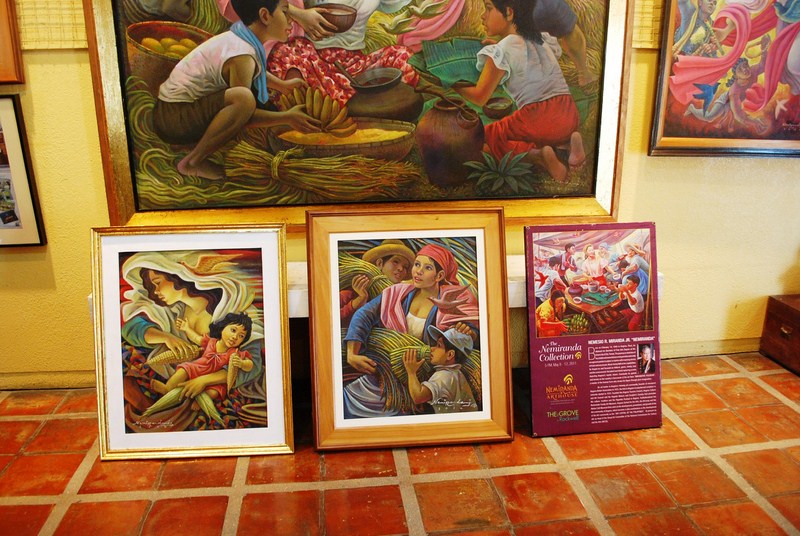
I entered the arthouse (also known as “The House of Myths and Legends”), via a side gate, into the coffee shop where I was welcomed by Katrina, the painter daughter of 62 year old local artist Nemesio “Nemi” R. Miranda (popularly known in the art circle as Nemiranda), who was currently touring some children around the art gallery.

I was hoping to interview Nemiranda, but Katrina told me that I just missed him as he left on his motorcycle.  She gave us free rein to tour the extensive, 3-floor art gallery ourselves.  A massive, larger-than-life, pastel blue stone mermaid (sirena) is prominently placed above the art gallery’s arched entrance.

Art Gallery entrance

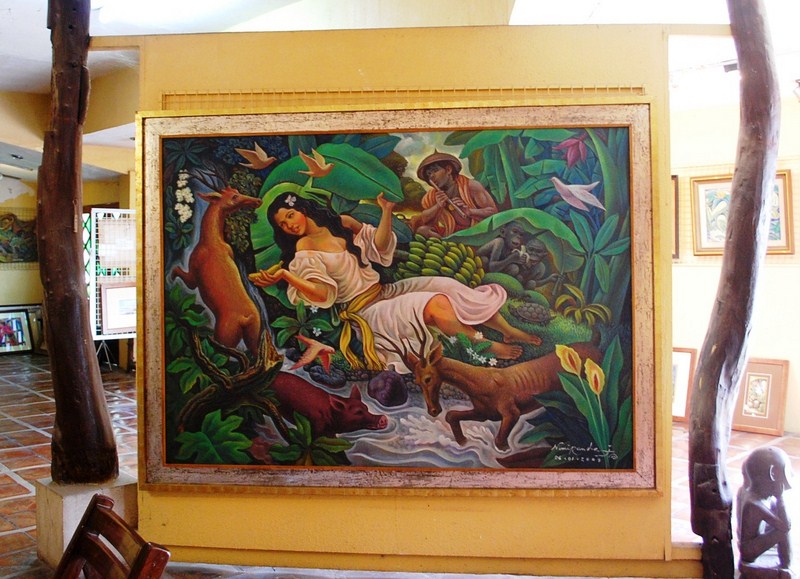
A Fine Arts graduate of  University of Sto. Tomas and a disciple of the late noted Angono artist Carlos “Botong” Francisco, this highly figurative artist’s artworks employ figurative realism  (which he calls “imaginative figurism”) wherein the human form is drawn from pure imagination.

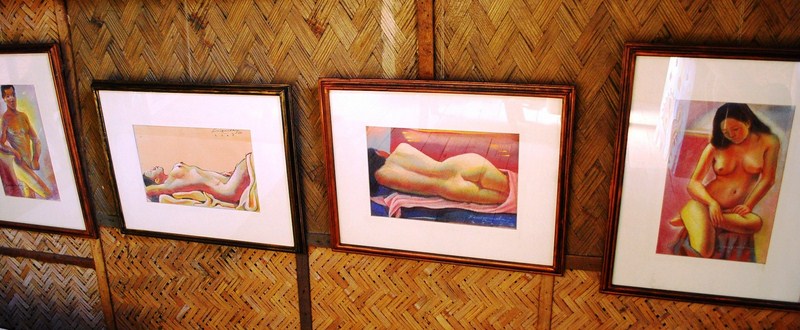
Nemiranda’s work inevitably evolves around the female form and it is vividly seen in almost every artwork that we observed. These include mother and child sketches, mermaids, nudes (Nemiranda is also deemed as an erotic painter) done in different styles, women giving birth, nursing mothers, etc..

Nemiranda’s Imaginary Figurism

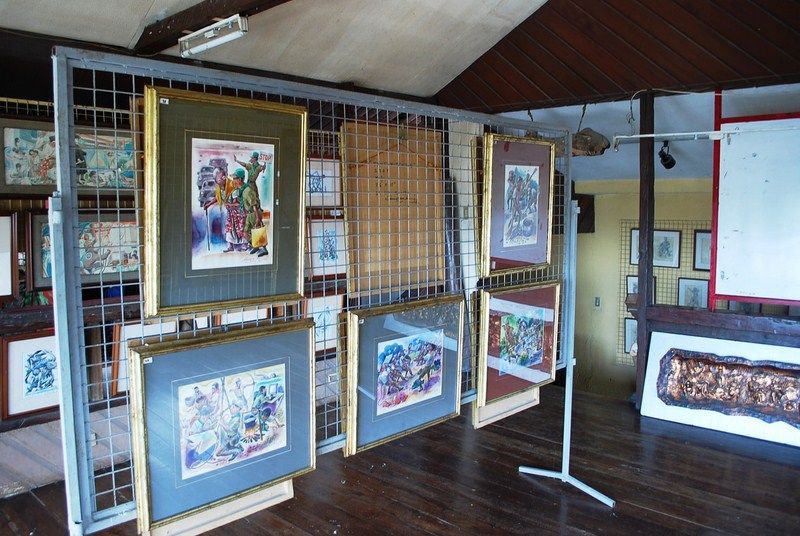
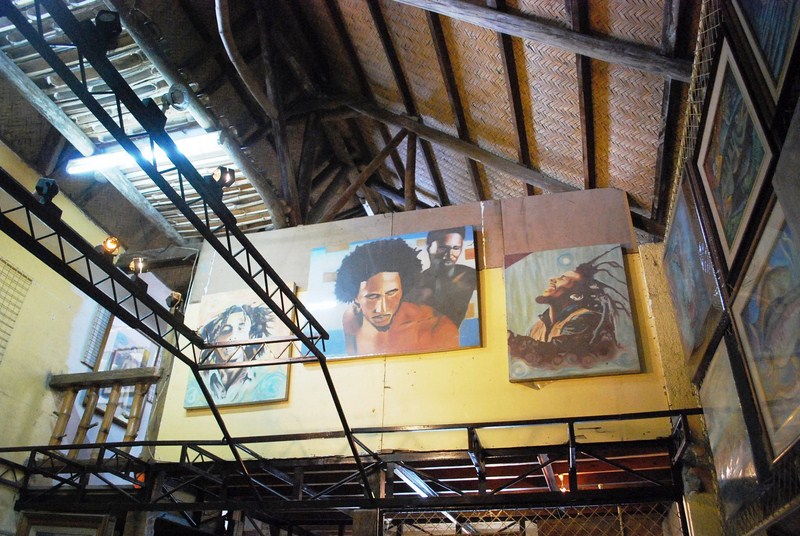
Other stunningly beautiful paintings depict random subjects such as rural life (families in pastoral scenes, etc.) and subjects from local folklore such as mythical creatures and nature goddesses.  On display at one section are wood carvings of the “Stations of the Cross.” Also on display are artworks by Nemiranda’s 5 sons and daughter Katrina as well as fellow artists from Rizal.

Wood carvings of the “Stations of the Cross”

We also saw Nemiranda’s impressive collection of local and international awards, proof of his countless unparalleled excellence and achievements in the arts.   At the end of the gallery are some art pieces for sale. This veteran artist has launched over 35 solo art exhibitions in various parts of the world and was commissioned to do monumental sculptures and mural paintings throughout the country.

Sculpture of a pregnant woman

Some of Nemiranda’s popular and impressive commissioned works includes the “History of the Philippine Army,” a relief sculpture located at the parade ground of Fort Bonifacio; the EDSA Shrine Mural (along with 14 other Angono artists), muted murals interpreting and depicting the 4-day  People Power revolution in the main chapel of the EDSA Shrine; the EDSA II Relief Sculptures; “The Way of Mary,” a 20-relief sculpture of the Mysteries of the Holy Rosary, from EDSA Shrine to Antipolo Shrine; and the 40-ft. high “Crucified Christ” (unveiled in Tacloban City in 2002), the map of Leyte interpreted as a sculptural island shaped by nature into the image of the crucified Christ. His paintings also hang in the many prestigious homes and offices, both here and abroad.

A collection of nude paintings

Jandy and I were still exploring the art gallery when Nemiranda finally arrived.  We were introduced to him by Katrina and I proceeded to interview him at length. As a true-blooded Angonon, Nemiranda has been instrumental in making Angono as the “Art Capital of the Philippines,” making great contributions in promoting the town’s rich heritage.

The Arthouse is also part of Nemiranda’s mission to nurture the artistic consciousness, not just for the Angonons, but for all Filipinos as well, conducting, for years on a regular basis, lectures, guiding services and painting workshops designed to inspire the youth who, by talking to Nemiranda and watching the artist go through the creative process, might see how an idea can grow into a finished work of art.

Some of Nemiranda’s numerous awards

In 1975, Nemiranda  founded the renowned Angono Ateliers Association, the first in the town to popularize sculpture in concrete (started in 1970).  He was also chairman of the Angono Tourism Council and the promoter of the town’s Higantes (“giant”) Festival and the fluvial procession dedicated to San Clemente, Angono’s patron saint. He also institutionalized the Nemiranda Family Art Museum, the Angono School for the Arts and the Nemiranda Atelier Café, all catering to the development, promotion and growth of the Angono art community.

The author with Nemiranda
Nemiranda Arthouse/Atelier Cafe: 10 Doña Elena St., Doña Justa Village, Brgy. San Roque, Angono, Rizal. Tel:  (632) 651-0109-10. Fax: (632) 651-3867. Email: inquiry@nemiranda.net and nemi_miranda@yahoo.com. Website: www.nemiranda.net. Admission fee: PhP30.

Chinatown District (Singapore)

From Tanjong Pagar, we crossed over to the Chinatown district via South Bridge Rd.  This traditional Chinese precinct is bounded by South Bridge Rd., Kreta Ayer Rd., New Bridge Road and Upper Cross St..  South Bridge Road is unique, being an example of Singapore’s multi-racial and multi-religious community, with the Sri Mariamman Temple (1827), Jamae Mosque or Masjid Chuliam (1830), Fairfield Methodist Church and  Buddha Tooth Relic Temple and Museum (2007) are all located here.

South Bridge Road

In 1843, the area was leased or granted to the public for the building of shophouses, many of which doubled as shops, warehouses, family quarters and workers dormitory.  They display strong Fujianese, Teochew and Cantonese influence.  Today, relatively little has changed with the original buildings in the area.

Colorful Chinatown Shophouses

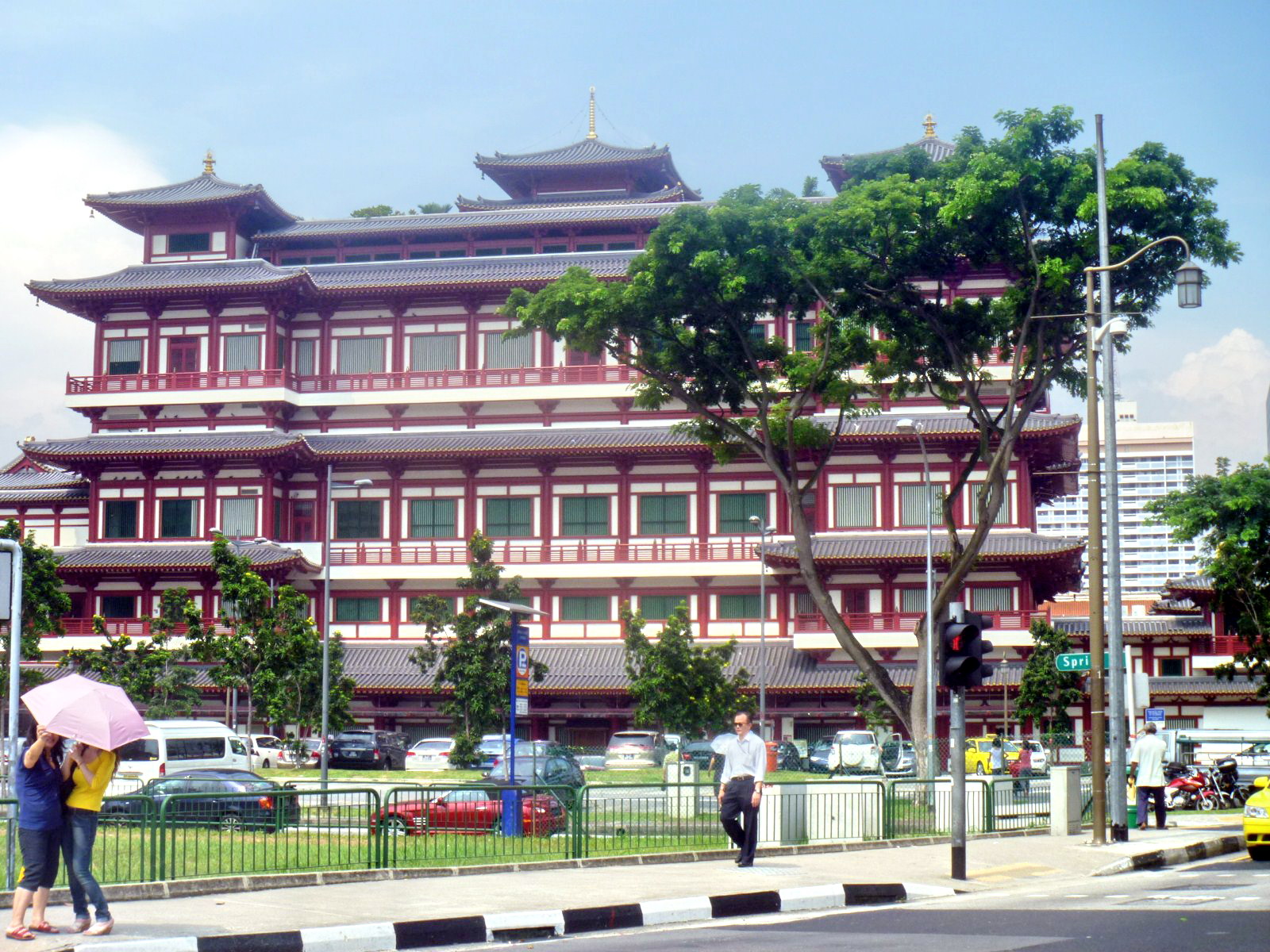
Jandy and I first visited the Buddha Tooth Relic Temple and Museum. This S$62 million temple, its architectural style based on the Tang Dynasty, was built in 2007 to house the tooth relic of the historical Buddha found in 1980 in a collapsed stupa in Myanmar.

Buddha Tooth Relic Temple and Museum

Sri Mariamman Temple, with its landmark ornamental tower entrance (gopuram), is the oldest Hindu temple in Singapore.  More popularly known as Mariamman Kovil or Kling Street Temple, it was first built in 1827 by immigrants from the Nagapatnam and Cuddalore districts of South India.  However, unlike my first visit here in 1992, I wasn’t allowed to take pictures inside.

Sri Mariamman Temple

In 1843, the temple was rebuilt in plaster and brick and, in 1962, a new temple structure with intricate sculptural works reminiscent of temple architecture in India was built. The original gopuram, built in the late 1800’s, was rebuilt in the 1930s and, in the 1960s, was repaired and restored with elaborate proliferation of sculptures.

Jamae Mosque

The nearby Jamae Mosque, on the other hand, was built in 1826 by the Chulias (Tamil Muslims). Its unique architectural style is eclectic. The entrance gate is distinctively South Indian while the 2 prayer halls and the shrine are in the Neo-Classical style typical of George Drumgoole Coleman. The mosque was gazetted a National Monument on 29 November 1974.

Chinatown Heritage Center

Kreta Ayer, considered by many to be the heart of Chinatown, houses the Chinatown Heritage Center, Chinatown Night Market and Chinatown Food Street.  The newly-restored Chinatown Heritage Center, occupying 3 shophouses along Pagoda St.,  houses memories and untold stories of Singapore’s early forefathers. The Chinatown Complex, along Smith Street, houses a wet market and shops selling sundry goods. At its second floor food center, Jandy and I indulged in some authentic Singaporean hawker food fare for lunch.

Trengganu Street

Shophouses do not have a single classification, combining different elements of Baroque and Victorian architecture with narrow wooden jalousies (often with adjustable slats) and decorative fanlights over the windows and pilasters, balconies and plasterwork seemingly Mediterranean in flavor.  Many of them are painted in a variety of different pastel colors. Trengganu St. (converted into a pedestrian mall transformed into a night market after dark), Pagoda St. and Temple St. as well as development in Upper Cross St. and the houses along Club St. are examples of this type of architecture.

Buddha Tooth Relic Temple and Museum: 288 South Bridge Rd., Singapore 058840. Tel: 6220 0220. Fax: 6220 1261. Open daily, 7 AM-7 PM.  E-mail: services@btrts.org.sg.  Website: www.btrts.org.sq.

Home of Another Aguinaldo (Kawit, Cavite)

After my visit to the Aguinaldo Shrine, Jandy and I returned to our car and retraced our way back to Brgy. Binakayan, also within Kawit, this time in search of the home of where Baldomero Aguinaldo (February 26, 1869-February 14, 1915), Emilio Aguinaldo’s first cousin, lived as an adult.

Check out “Aguinaldo Shrine” and “Liwasang Emilio Aguinaldo

Baldomero was also a lieutenant-general during the Philippine Revolution (he figured in the battles of Binakayan-Dalahican, Noveleta, Zapote River, Salitran and Alapan), Emilio’s right-hand man and a member of the latter’s cabinet (Auditor General, Director of Finance, Secretary of the Treasury, Auditor of War and Secretary of War and Public Works).  He also helped draft and signed the Constitution of Biak-na-Bato. During the Philippine-American War, he returned to the battlefield as commanding general of the Southern Luzon provinces.

Baldomero Aguinaldo Shrine

Built with narra and molave wood in 1906 and now painted in pastel blue and white, this typical 2-storey country home of a gentleman farmer was turned over by his grandson, former Prime Minister Cesar E.A. Virata (who also happens to be the father of my U.P. classmate Steven) to the Philippine government in 1982. This shrine has a museum on the ground floor with a diorama of the Battle of Binakayan.  On the second floor are antique furniture such as a turn-of-the-century upright piano.  Opposite the house is the former kamalig (storage shed for produce), now a museum showcasing Cavite’s role in the revolution.  On the walls are photographs and drawings of Cavite’s military heroes.

Behind the house, in a quiet corner, is the family plot where Baldomero, his wife (Petrona Fauni Reyes-Aguinaldo), their 2 children (Leonor and Aureliano) and their spouses (Dr. Enrique T. Virata and Liwanag Virata) are all buried.  The shrine is now administered and managed by the National Historical Institute (NHI) which installed a historical marker here on June 12, 1983.

NHI Historical Marker
Baldomero Aguinaldo Shrine: Brgy. Binakayan, Kawit, Cavite.  Open Tuesdays to Saturdays, 8 AM to 4 PM.  Admission is free.  Lectures and guiding service can be arranged.

Ganduyan Museum Tour with Ms. Christina Aben (Sagada, Mountain Province)

Ganduyan Museum

Jandy and I were now on our third and final day in Sagada and we still had time to kill before leaving on the 10 AM G.L. bus.  After a Filipino breakfast at Ganduyan Inn’s cafe, we decided to visit the next door Ganduyan Museum, managed by Marina Biag’s mom Ms. Christina Aben.   Since the early 1970s, Ms. Aben has amassed a spectacular and meticulous collection of tribal artifacts with a passionate curator’s eye for quality and rarity, all detailing the rich but vanishing Cordillera Igorot culture.  Wishing to share her passion for unique Igorot art and culture with the world, she placed them all in a one-room, second floor museum which she opened in 1984. Because of the museum’s limited space,  Ms. Aben, with a designer’s eye for presentation, carefully chooses what to display and how to display it.

Ms. Christina Aben

The museum closed down in 1986 and it remained so when Jandy and I first visited Sagada in 1998.  It was open that morning and we were personally met by Ms. Aben who escorted us up the stairs to the museum, removing our shoes first at the stair’s foot before going up.  She’s a cancer survivor and a housewife with a high school education who speaks impeccable English. Ms Aben is also an enthusiastic, erudite and well-informed hostess who loves to share the meaning and importance of every museum piece to anyone willing to listen.

Ganduyan Museum – Display

The museum was a veritable treasure trove of antique basketry, weapons, farm tools, trade beads, jars, wooden items and textiles from the Cordillera region, all offering an insight into the rich culture of the Cordillera Igorots.  Ms. Aben gladly explained the history and significance of each individual item on display, starting with her trade bead collection which came at a time when the Igorots traded with the Chinese, Indians, Arabs and other foreigners from the lowlands.   Beads include alligator teeth and mother-of-pearl shells not found in the Cordilleras.  Beaded necklaces from different tribal groups of the Cordilleras (Kalinga, Nabaloi, Ifugao or Igorot)have beading patterns that differ from one ethnic tribe to another.

Ganduyan Museum – Display

We next moved on to the men’s accessories section.  These include a money belt, a warrior’s purse,  pipes, caps (used as pillow and water cup), woven g-strings, anklets, armlets, spoons and amulets (including a snake vertebra believed to increase the warrior’s physical and internal prowess). Drinking  cups for wine, both for men and women, vary in size and kind. Igorots treated status with utmost importance, from clothing (the rich could wear clothes that the poor could not), kitchenware (made from wood,  metal and, sometimes, animal bone, all  classified by social class) and even in death.  Doors, scarves, table runners, warrior’s shields and other accessories are decorated with the lizard (or gecko), animals said to bring luck and longevity.  The many weapons of head hunters of the Cordilleras on display include shields with concave ends (meant to trap the enemy at the neck before the warrior goes for the kill and chops the head off).

Ganduyan Museum: Poblacion, Sagada, Mountain Province.  Open daily, 8 AM-7 PM.  Admission: PhP25.

Pila Museum (Laguna)

A short leisurely walk from the town plaza brought us to the Pila Museum, the former Spanish-era escuela pia (school).  This refurbished building, probably the oldest structure in the town, now houses priceless pre-Hispanic Northern Sung (960-1127 AD), Southern Sung (1127-1280 AD) and Yuan Dynasty (1280-1368 AD) Chinese porcelain (plates, jars, jugs, etc.) and tradeware transferred to this heritage building in 1994 by the Pila Historical Society Foundation.

Pila Museum

These were recovered, from May to October 1967, from the Esso Standard Philippines-Manuel Elizalde excavations of an ancient crematorium (the oldest in the country) and habitation sites among the coconut plantations in Brgy. Pinagbayanan and Bagong Pook.  The project was led by Ms. Julita G. Fernandez and Ms. Amelia O. Rogel, graduate students of anthropology from the University of the Philippines.  They were supervised by Dr. Robert Fox and Mr. Avelino Legaspi of the Anthropology Division of the National Museum.

Some 250 to 300 pieces of the finds were donated to the town by Mr. and Mrs. Manuel Elizalde. These include celadon dishes with fish motif; celadon censers; qingbai blue and white jarlets; small, lead-glazed water droppers and teapots; qingbai double gourd vessels; large, gray-glazed ewers; figurines of carabao with riders in plain and spotted qingbai; brown wares of all shapes and sizes; iron and glass bracelets; and colored beads and earrings that appear to be gold or copper.

Home of "The Other Rizal" (Los Banos, Laguna)

The Paciano Rizal Shrine

My next stop in my Laguna (Calamba City to Sta. Cruz) joy ride with my son Jandy was the charming resort town of Los Banos.  The town is famous for its hot medicinal sulfur springs that flow from the foot of Mt. Makiling and its present name is derived from the Spanish word for “The Baths.” These thermal springs were discovered in 1590 by Franciscan martyr St. Peter Baptist (San Pedro Bautista).   Today, most of the sulfur springs are piped into the pools and baths of the many hot spring resorts that line the National Highway.  This is the Los Banos that most people know and not many people know this town’s association with “the other Rizal.”

The old Los Banos Municipal Hall

To find out, I parked my Toyota Revo at the old municipal hall (a new one is being built along the National Highway).  Beside the town’s fire station is the inconspicuous retirement home of Paciano Mercado Rizal, Jose Rizal‘s elder (and only) brother who was also a revolutionary general (he led the defense of Laguna) and Emilio Aguinaldo‘s first Minister of Finance.  Though not as popular as the Jose Rizal Shrine in Calamba, this shrine, jutting out to Laguna de Bay, was built atop a hot spring in 1927 by Andres Luna de San Pedro (son of master painter Juan Luna) when Paciano’s original nipa hut was destroyed in a typhoon in 1926.

The back of the house

Rizal lived here, as a gentleman-farmer, with 2 helpers (with occasional visits from his grandsons, from daughter Emiliana, Franz and Edmundo), until his death from tuberculosis on April 30, 1930.  First buried in Manila North Cemetery, his remains were later transferred here, with full military honors, in 1985.  A historical marker was installed here on April 13, 1983 and the house was declared as a National Historical Shrine by the National Historical Institute on July 31, 1992.

Laguna de Bay

This modest American-style, one-bedroom bungalow was turned into a Japanese garrison during World War II, resulting in the loss of much of Paciano’s personal effects. Still around are some photos of his grandchildren, binoculars he used during the revolution, a pair of his shoes and a Quiroga bed.  Rizal’s spinster sisters Josefa and Trinidad are also buried in the sprawling garden which has a bronze statue of Paciano Rizal, on a pedestal, in his general’s uniform.  The shrine has a view of Talim Island. At the back of the house is the Paciano Rizal Park.

Vinanmek Mansion (Bangkok, Thailand)

Included in the admission ticket to the Grand Palace was free entry to the Vimanmek Palace (also called the Vimanmek Teak Mansion), at the Dusit Palace Complex, and we next proceeded there.  The world’s largest building made of golden teak, its elaborate style reflects a unique blend of Victorian and delicate Thai architecture. The mansion is one of 16 mansions or residential halls (out of 20) in the complex that can be visited by tourists.

Vinanmek Mansion

A former royal palace, it was built in 1900 by King Chulalongkorn (King Rama V, 1868-1910), a few years after his return from Europe in 1897, using his personal money to purchase orchards and paddy fields between Padung Krungkasem Canal and Samsen Canal for the construction of a royal garden which he named the Dusit Garden. Vimanmek Mansion was the first permanent residence there.  Upon its completion, King Rama V then transferred here from the Grand Palace and stayed for 5 years until the completion of Amporn Satan Residence in 1906 (where he live until his death). Vimanmek Mansion was then closed down and members of the royal family moved back to the Grand Palace. In 1982, it was renovated and converted into a museum.

Octagonal Wing Where King Rama V Resided

This 72-room building has 2 right-angled wings, each 60 m. long and 20 m. wide. It is 3-storeyed except for the octagonal part, where King Rama V resided, which has 4 storeys.  Although the ground floor is brick and cement, the upper floors are made with beautiful golden teakwood.

Entrance Stairway to Vinanmek Mansion

Before touring, we had to put all our belongings in a locker (same as in the Jim Thompson House).  It was also a shame we can’t take photos inside.  Before entering, we also had to remove our shoes and wait our turn.  The mansion was a veritable museum that displays the king’s photographs, art and artifacts that commemorate his royal visit to Europe.  We also viewed an exhibit of Thai handicrafts in 31 exhibition rooms, some of which maintain the atmosphere of the past, especially the bedrooms, the Audience Chamber and the bathrooms. Some rooms display silverware, ceramics, glassware and ivory.

Vinanmek Mansion: Ratchawithi Rd., Dusit, Bangkok, Thailand.  Tel: +66 2 628 6300 Ext. 5120-5121.  Fax: +66 2 628 6300 Ext. 5136.  Website: www.vinanmek.com.