Tam-awan Village: A Showcase of Cordillera Life (Baguio City, Benguet)

Tam-awan Village

The first leg of our Manila North Tollways Corporation (MNTC)/North Philippines Visitor’s Bureau (NPVB)-sponsored Lakbay Norte 2 Tour brought us to Baguio City, the country’s “Summer Capital,” where we were to check out the city’s art scene inspired by Baguio’s lovely natural environment and the rich Cordillera cultural heritage.  Our first stop was, fittingly, Tam-awan Village in Pinsao Proper where we were welcomed by Baguio City Visitors Bureau (BCVB) representatives Eric Pangilinan, Matt Roncal and Claire Iniong. This model village is laid out just like a traditional Cordillera village, making it accessible for those who have not had the opportunity to explore the different parts of the vast Cordillera region in the Philippines.  This recreated village, uniquely blending indigenous aesthetics and exquisite Cordilleran craftsmanship, has a charming collection of 9 authentic knock down huts built by clever mortise makers without nails or hardware Seven of these are compact and deceptively simple Ifugao huts transported from Bangaan, (Ifugao ).  The other two are more spacious Kalinga huts made of hand-hewn pine wood.  Some huts are over a hundred years old but have new cogon roofs which are periodically re-roofed from time to time.  All huts are named after the areas where they come from.

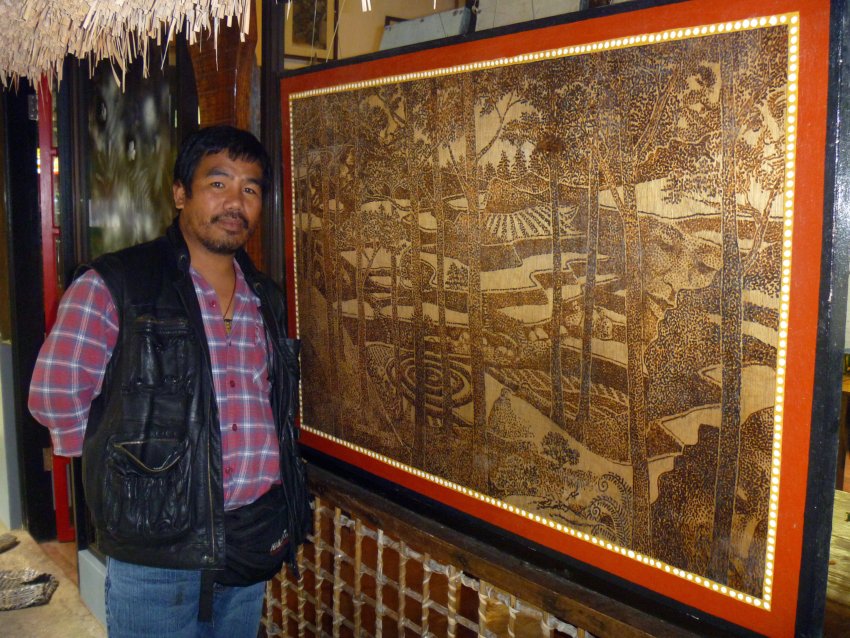
Jordan Mang-osan with one of his works  

Upon entering the compound, our media group, consisting of travel writers, bloggers and photographers, all explored the grounds including its art works at the art gallery and gazebo (across which is a stone-paved dap-ay where rituals and dances are performed) and the areas used for conferences, seminars and workshops.  Workshops here offer livelihood and crafts demonstrations on woodcarving, bamboo crafts, papermaking, weaving, printmaking, rice wine making and solar drawing, all envisioned to foster a deeper understanding, respect and pride in the cultural heritage of the Cordillera people.  The latter, a specialty of  Mr. Mang-osan, is an ancient Ifugao technique wherein a wooden surface  is burned using the sun’s rays to create an image.  

Portrait Sketching Session with local artistsA highlight of our visit was having our portraits sketched (for a fee of PhP100 per sketch), using charcoal pencil, by one of the many well-known artists who have their artwork on display. Other members of our group tried a hot cup of aromatic native Arabica coffee or sipped a glass of Winers tapuy (made from rice) or bugnay (made from Benguet strawberries) wine. Come lunchtime, we were served native pinikpikan, kintuman (brown rice), a salad of Baguio veggies and strawberry crepes for dessert.   Pinikpikan is prepared by beating a live chicken with a stick prior to cooking. The beating bruises the chicken’s flesh, bringing blood to its surface, which is said to improve the flavor after cooking.   
Tam-awan Village: 366-C Pinsao Proper, Baguio City, Benguet.  Tel: (074) 446-2949.  Fax: (074) 442-5553.  Website: www.tam-awanvillage.com. Admission: PhP50 (adults), PhP30 (students and senior citizens), and PhP20 (children).
Baguio Convention Visitors Bureau: 2/F Philippine Tourism Authority Bldg., Abad Santos Drive, Burnham Park, Baguio City, Benguet.  Tel: (074) 442-4315.  E-mail: baguio.cvb@gmail.com.

Dutch Square (Melaka, Malaysia)

From the ruins of the Church of St. Paul, we went down St. Paul’s Hill, to picturesque and postcard pretty Dutch Square (also called Red Square).  Along the way, we passed the Democratic Government Museum (Muzium Pemerintahan Demokrasi), formerly Melaka’s State Legislative Assembly building.

Democratic Government Museum

At the square, the port-red theme (originally painted as white, it was repainted as such in 1911) predominates with the buildings around the square as well as the Tang Beng Swee Clock Tower (also called the Red Clock Tower, it  was erected in 1886 to honor the generous Chinese tycoon Tan Beng Swee).

Tang Beng Swee Clock Tower

The massive Stadthuys, built between 1641 and 1660, is a reproduction of the former Stadhuis (town hall) of the Frisian town of Hoorn in the Netherlands which existed from 1420 until 1796.  This building was the official residence of the Dutch governor and his deputy.  Believed to be the oldest Dutch building in the East, this preserved example of original Dutch architecture has solid doors and louvered windows. Now the Museum of History and Ethnography (converted as such in 1982), it exhibits traditional wedding clothes and artifacts of Melaka, dating back to its days of glory.

Nearby is Christ Church, the oldest functioning Protestant church in Malaysia.  Built in 1753, in the Dutch Colonial architectural style, as the Bovenkerk (High Church), the main parish church of the Dutch Reformed community, it was re-consecrated in 1838 with the rites of the Church of England and renamed Christ Church. After the British takeover of Malacca, its original Dutch windows were reduced and ornamented.  The porch and vestry were built only in the mid-19th century.

Christ Church

This church, measuring 25 m. (82 ft.) by 13 m. (42 ft.), has a roof  covered with Dutch tiles, walls of brickbuilt on local lateriteblocks then coated with Chinese plaster, and floors paved with granite blocks originally used as ballast for merchant ships.  Inside are hand-crafted church benches, joint-less ceiling skylights, a copper replica of the Bible, a headstone written in the Armenian language and a replica of “Last Supper” made with glazed tiles and located over the altar.  Its 12 m. (40 ft.) high ceiling has 15 m. long beams made from a single tree.

Christ Church – Interior

Between the two buildings, right in the middle of Dutch Square, is the Queen Victoria Diamond Jubilee Fountain, probably one of a few functioning colonial water fountains in Malaysia. Erected in 1904 with English marble, it commemorates the queen’s 60th anniversary (Diamond Jubilee) on the British throne.

Queen Victoria Diamond Jubilee Fountain

The Malaysia Youth Museum & Art Gallery (Balai Senilukis Melaka), between Christ Church and Laksamana Road, was built in 1784 as the Dutch Administrative Complex. In 1826, it was converted into the Malacca Free School and, in the 1920s, was renovated to be a 2-storey building to be later used as a post office before conversion into a museum.

Malaysia Youth Museum & Art Gallery

The Forbidden City – Inner Court (Beijing, People’s Republic of China)

The Inner Court is composed of the 3 main structures at the rear of the Forbidden City, all official residences of the Emperor and Empress and all smaller than the Outer Court halls, namely the Palace of Heavenly Purity (Qianqinggong), the Hall of Union (Jiaotaidian) and the Palace of Earthly Tranquility (Kunninggong).

Palace of Heavenly Purity

The first structure inside the inner court is the  Palace of Heavenly Purity, the largest of the 3 halls. During the Ming Dynasty, it was the residence (the large space was divided into 9 rooms on 2 levels, with 27 beds) of the Emperor and, during the Qing Dynasty, the palace often served as the Emperor’s audience hall, where he held council with the Grand Council, received ministers and emissaries, and held banquets. This double-eaved building, connected to the Gate of Heavenly Purity to its south by a raised walkway, is set on a single-level white marble platform.  At the center of the palace, set atop an elaborate platform, is a throne and a desk, on which the Emperor wrote notes and signed documents during councils with ministers. A caisson is set into the roof, featuring a coiled dragon.

Behind it is the  Hall of Union. Square in shape and with a pyramidal roof, the 25 Imperial seals of the Qing Dynasty, as well as other ceremonial items, were stored here. The third hall is the Palace of Earthly Tranquility, the emperors’ wedding room. This double-eaved building is 9 bays wide and 3 bays deep.

Exhibit Hall of Textiles and Apparel

Besides the 3 main buildings are the 6 eastern palaces and 6 western palaces, where the emperor used to handle everyday affairs, and which was the living quarters of the emperor, empresses and concubines. Those palaces have been converted into exhibition halls, where a spectacular set of imperial collections is displayed. The Exhibit Hall of Textiles and Apparel, reflecting the nomadic heritage of the rulers, showcases stately court robes plus the emperor’s accouterments.

Imperial Garden

Behind these 3 halls lies the relatively small and compact 1,2,000 sq. m. Imperial Garden (Yu HuaYuan), he private garden of the imperial family (used exclusively by the imperial family to sip tea, play chess, meditate and generally relax) and the last part of the Forbidden City. The garden was built in 1417 during the Ming Dynasty. The most typical imperial garden in China, it is an aesthetic change from the crimson and gray building complex to a colorful and luxuriant atmosphere. The garden contains several elaborate landscaping features.

Hall of Imperial Peace

Within the garden, there are about 20 structures in different styles. It is interesting how the manmade structures maintain harmony with trees, rockeries, flowerbeds and bronze incense burners in this relatively small space.  The Hall of Imperial Peace (Qin’AnDian), first built in the 15th century, is the main structure in the Imperial Garden and the only one on the central axis – it stands in the center of the garden, encircled by a rectangular wall.  In each of the four corners of the Imperial Garden there is a pavilion, symbolizing the four seasons. The Pavilion of Myriad Springs is the most famous and lies in the south east corner of the garden. It was built in 1535 and restored during the Qing Dynasty.

Pavilion of Myriad Springs

To the north of the garden is the Gate of Divine Might, the north gate of the palace (we exited here). On the left side of the Inner Court is the Mental Cultivation Hall (Yangxindian), the most important building except for the Hall of Supreme Harmony. From the time of the third emperor, Yongzhen, all the Qing emperors, 8 in total resided in this hall.

Bernardino-Ysabel Jalandoni Museum (Silay City, Negros Occidental)

From Balay Negrense, Solo next brought us to the nearby 2-storey Bernardino-Ysabel Jalandoni Museum, beside the City Public Market  and near the San Diego Pro-Cathedral.  Also called the Pink Museum, the house was first owned by Don Bernardino Jalandoni and his wife Dona Ysabel Ledesma-Jalandoni.
Bernardino-Ysabel Jalandoni Museum
Their grandson, Luis Jalandoni, was a former priest who became one of the top leaders of Communist Party of the Philippines.  Since the 1970s, he has been living in exile in the Netherlands.  Luis spent the first 12 years of his life in this house.  The current heirs, Mr. and Mrs. Antonio J. Montinola have entrusted its care to the Silay Heritage Foundation, a non-government organization.  Built from 1908-1912, it was declared, on November 6, 1993, as a National Historical Landmark by the National Historical Institute (NHI).
The expensive doll collection
The sala
A 4-poster, “An Tay” bed
The Steinway piano
Solo and Jandy browsing through books
on the round, single slab table
An old phonograph

We were toured around the house by a male guide.  The house was built with durable balayong, a hardwood coming all the way from Mindoro.  At the ground floor are photographs of Silay’s ancestral houses, a display to the Jalandoni’s expensive doll collection, 2 carriages, a gallinera (its bottom was used as a temporary enclosure for chickens) and a carroza with the statue of the Blessed Virgin Mary which is still being paraded around the city during Holy Week.

A Stradivarius violin
A grandfather clock
A wooden harp

The second floor has embossed, prefabricated steel trayed ceilings imported from Hamburg, Germany.  Intricately carved, French-designed wooden calado transoms, a study of visual aesthetics and function, allow air to circulate within the house.  On display are antique furniture (including a single slab round table and 4-poster, Chinese-made “An Tay” beds), a wooden harp, Ming Dynasty chinaware, an old telephone, sewing machine, a Stradivarius violin, a grandfather clock, an old phonograph, a Steinway piano, chandeliers, etc.  The museum also features a fine collection of books, glassware and lace supplied by the Silay Heritage Foundation members.

Grace and Cheska at the grand stairway
Bernardino-Ysabel Jalandoni Museum: cor. Rizal and Severino Sts., Silay City, Negros Occidental.  Open Tuesdays to Sundays, 9 AM-5 PM.  Admission: PhP50.  Tel: (034) 495-5093.

Balay Negrense (Silay City, Negros Occidental)

After lunch at Locsin Reunion venue, Solo again toured us around the city, this visiting the 12-bedroom Balay Negrense (Hiligaynon for “Negrense House”), one of the largest if not the largest ancestral house in the city.  The first museum to be established in Negros Occidental, it was built in the Neo-Renaissance style, from 1898-1912, by Yves Gaston.  Yves was the son of 19th century sugar baron Yves Leopold Germain Gaston of Lisieux (Normandy, France) and Prudencia Fernandez, a Batanguena.  Yves generated wide-scale interest in commercial-scale sugar cultivation with his horno econonmico, the precursor of today’s sugar mills.  

 
Balay Negrense

Victor Gaston and his 12 children lived here from 1901 until Victor’s death in 1927. During World War II, the house was said to have been occupied by Japanese military officers. Later, the house became a venue for a ballet school run by one of the descendants until the early 1970s but was abandoned shortly thereafter and fell into disrepair.

The grand W-shaped staircase

The Negros Cultural Foundation, a group of concerned Negrenses, managed to acquire, through a donation, the house from the heirs of Gaston. The structure was then repaired and furnished with period furniture and fixtures through donations from prominent individuals and, later, the Department of Tourism.  This lifestyle museum was officially inaugurated on October 6, 1990.  

The spacious living area
The round table with names of Gaston descendants

Now a showcase of Negrense art and culture, it displays antique furniture, a grand piano, Filipiniana costumes and Gaston memorabilia.  The museum boasts of a grand W-shaped stairway (women used the right stairway, men the left), calado or carved panels that served as ventilators between rooms, etched window glass, fancy-grilled ventanillas (smaller windows beneath the large windows with sliding panels that can be opened to admit the wind) and sprawling gardens.  Solo showed us a big round table with lists of the names of the owner’s descendants, some of them familiar names of celebrities and politicians.  Some of them were my relatives.

The grand piano
The 2-storey house has a lower storey of concrete, with foundation posts made with trunks from the balayong tree, a local hardwood also used as floorboards for the house. The upper storey is made of wood while the roof uses galvanized iron.  The house has a 4-m. high ceiling and is elevated from the ground level by a 1 m. high crawlspace which enhanced air circulation, allowing the wooden foundations to be aerated, preventing dampness from rotting the wood and preserving the integrity of the house.
 
L-R: Jandy, Grace, Solo and Cheska
 
Balay Negrense: Cinco de Noviembre St., Brgy. III, Silay City, 6116 Negros Occidental.  Open Tuesdays to Sundays, 9 AM-5 PM. Tel: (034) 714-7676 and 495-4916.

Ramon Hofilena: The "Father of Heritage Conservation" in Silay City (Negros Occidental)

Manuel Severino Hofilena Heritage House

Certainly one of the highlights of our three-day visit to Silay City (Nregros Occidental), with my wife Grace and children Jandy and Cheska, was, aside from attending the 8th Locsin Family Reunion (my first), our tour of some of Silay’s 31 ancestral homes, accompanied by my young Silayanon cousin  Neil Solomon “Solo” Locsin.  Our longest visit was at the Manuel Severino Hofilena Heritage House, an illustrado’s house built in 1934.  A visit here was by appointment with current owner Ramon “Monching” Hofilena but Solo set it up for us with call to him. On hand to greet us was the 72-year old Ramon Hofilena himself.  

Ramon Hofilena

Since 1962, Monching has been welcoming visitors to his family’s ancestral house, the first Heritage House in Silay to be opened to visitors.  Also, since his return from New York in the 1970s, Monching has also been on a life-long crusade  to restore and protect Negrense cultural heritage.  He organized the Annual Cultural Tour of Negros Occidental (ACTNO), the longest running (nearly 40 years) cultural tour in the world.  Its itinerary includes Bacolod  City, Silay City (Jalandoni and Hofileña heritage homes), Victorias City (Church of St Joseph the Worker); Manapla (Chapel of the Carwheels) and Talisay City (PhP600/person, limited to 55 people).  The tour is often conducted yearly on all Saturdays of December, except holidays, from 9 AM to 5:30 PM.

The living room

The interiors of the house to be  exudes touches of genteel elegance.  The formal living room still has its original 1930s Art Deco period furniture.  Beside it is a 150-200 year old, German-made M.F. Rachals upright piano handed down by Monching’s great grandmother. Monching, a lover of art and culture, gave us a two-hour guided tour of his collection of museum-worthy pieces such as  antique lamps and chandeliers, large Ming dynasty jars, copies of the world’s first pocket books, silver picture frames (with pictures of his parents and 8 siblings; all of whom were involved in the arts: piano teachers, ballet and flamenco dancers, theater artists), a dining table set with fine china, silverware, wooden images of St. Vincent Ferrer, saved from the island’s old churches), wine glasses and silver candelabras, none of them reproductions.

The dining room


The comedor (dining room) has hardwood and glass cabinets (plateras ) that display Pre-Hispanic Chinese porcelain and ceramics, all of them archeological finds discovered in Silay (some an incredible 3,000 years old).  Monching also has a  collection of small dolls (said to be the smallest in the world, you need a magnifying glass to appreciate them) and curios from around the world, including tektites (meteorite stones) and anting-antings (good luck amulets).  The house also has an old press from Silay Printmaking (founded in 1970), the oldest printmaking workshop outside Manila.  Monching is working to popularize printmaking as an art form.  

Monching shows us his painting collection

Upstairs, lining the walls, are Monching’s  impressive collection (the most comprehensive personal collection on public display) of more than 1,000 works by foreign artists Francisco Goya, Pablo Picasso, Albrecht Durer, Katsushika Hokusai and Utagawa Hiroshige; National Hero Dr. Jose Rizal (when he was 15 year old student at Ateneo) and works of local artists from the 19th century to the present – Juan Luna, Felix Resurreccion Hidalgo, Ang Kiukok, Fernando Amorsolo, H.R. Ocampo, Jose T. Joya, Cesar Legaspi, Napoleon Abueva, Vicente Manansala and Bencab (Benedicto Cabrera).  Monching, with much emotion, gives special mention to abstract expressionist paintings of Conrado Judith, a poor and unknown Silaynon high-school graduate with no formal art education who died from tuberculosis at the age of 34. His canvas paintings, some damaged by sun and rain, were discovered by Monching in his thatch house.

L-R: Ramon Hofilena, Solo Locsin, Grace, Jandy, me and Cheska
Manuel Severino Hofilena Heritage House: Cinco de Noviembre St., Silay City, Negros Occidental.  Visits are by appointment.  Tel: (034) 495-4561.

Silay City’s Ancestral Houses (Negros Occidental)

Calle Rizal

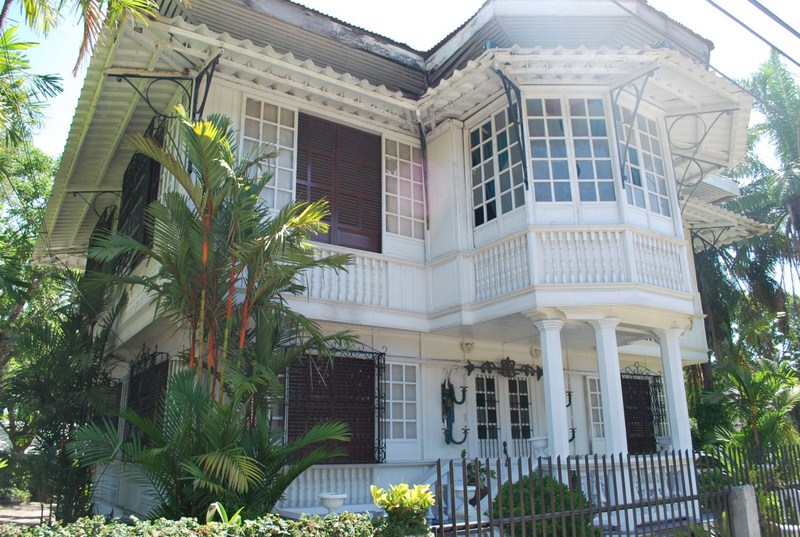
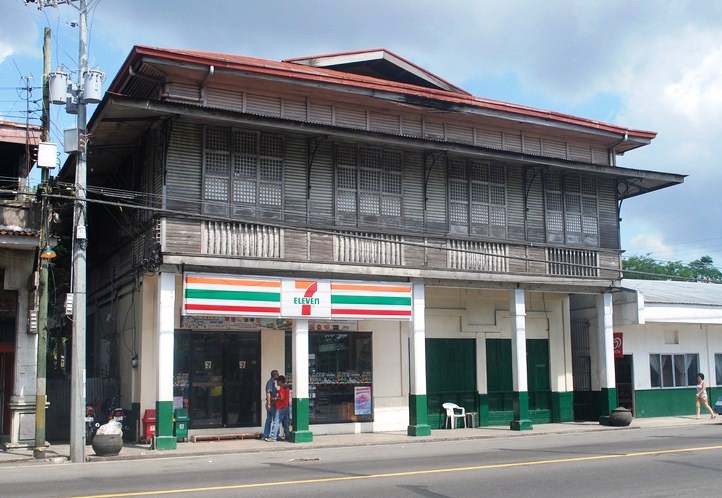
Another reason for my visit with my family to Silay City, aside from visiting my mom’s hometown and attending the 8th Locsin Family Reunion, was to see for myself Silay’s ancestral houses.  Silay, founded in 1760, became prosperous in 1846 with the cultivation of sugar cane and its new-found wealth translated into the construction of many opulent ancestral homes, located mostly along Calle Rizal.

The two-storey Antonio dela Rama Locsin Heritage House, dating back to the Spanish Colonial Period, is said to be the oldest house in Silay. This was the house where the late Architect Leandro V. Locsin (National Artist for Architecture) grew up. The house has capiz sliding windows and ventanillas.

Silay is the second city in the Philippines, after Vigan City (Ilocos Sur), to be named a museum city, making it one of the country’s top 25 tourist destinations.

The Soledad and Maria Montelibano Lacson Ancestral House, with its American-inspired look, features windows with glass panes and a galvanized iron sheet media agua, a secondary roof that helps protect windows from rain. The second floor still retains its sliding capiz windows and ventanillas.  When coming from Talisay City, this is the first ancestral house that will greet you.

Most ancestral houses in the city are named after their owners while other more famous houses are known for their unique characteristics or colors (Twin Houses, Green Hose, White House, Pink House, etc.).

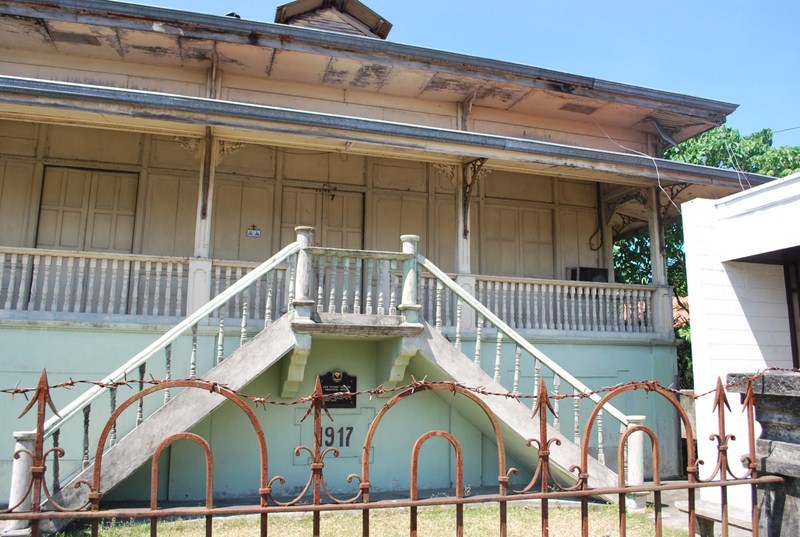
The ancestral house of Jose “Pitong” Ledesma, along Cinco de Noviembre Street, was built in 1917.  It was the home of the renowned Silaynon pianist, conductor and philantrophist who was known for his sonata Tanda de Valse.” Ledesma also brought operettas de zarzuelas from Europe to Silay. The present owner of the house is Magdalena Locsin-Ledesma, piano accompanist of opera singer Conchita Gaston.

A total of 31 (some well-preserved) have been identified by the National Historical Institute (NHI, now the National Historical Commission of the Philippines) as National Treasures.  Nine of them are Level 1 (Declared):

  • Carlos Arceo Ledesma Heritage House
  • Antonio de la Rama Locsin Ancestral House
  • Delfin Ledesma Heritage House – 28 Generoso Gamboa Street
  • Juana Coloso Ledesma House
  • Amelia Hilado Flores House (owned by Jison-Alano)
  • Arsenio Lopez Jison Ancestral House – Rizal Street
  • Antonio Novela Sian House – cor. of Rizal and Zamora Streets
  • Manuel de la Rama Locsin Ancestral House – Rizal Street
  • Josefita Tionko Lacson Ancestral House

The two-storey Teodoro Morada Ancestral House, also called the “White House, was built in the early 1990s. A fusion of Spanish and American colonial architecture, this beautifully restored heritage house exudes a genteel Neo-Classical liner. It has a grand double winding staircase on the ground floor, glass paned windows, and a second set of Persiana windows behind them. Now the home of Rene and Jessica Velez Dimacali, is the favorite house in Silay of Liza Macuja.

Sadly, three Level 1 houses have already been demolished.  They are the Augusto Hilado Severino House (bought by the Iglesia Ni Cristo), the Claudio Hilado Akol Heritage House (bought by the Locsin Genealogy Foundation – balcony has been retained) and the Modesto Ramirez Hojilla (Carlos Javelosa Jalandoni) Ancestral House.

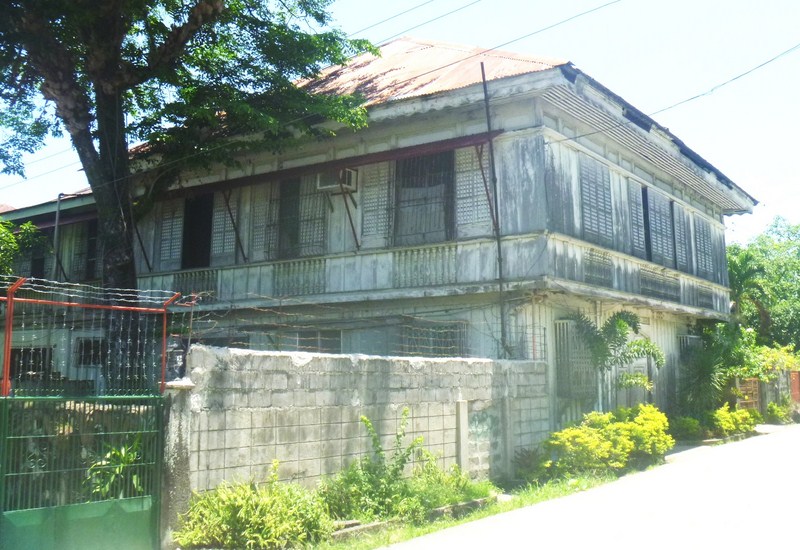
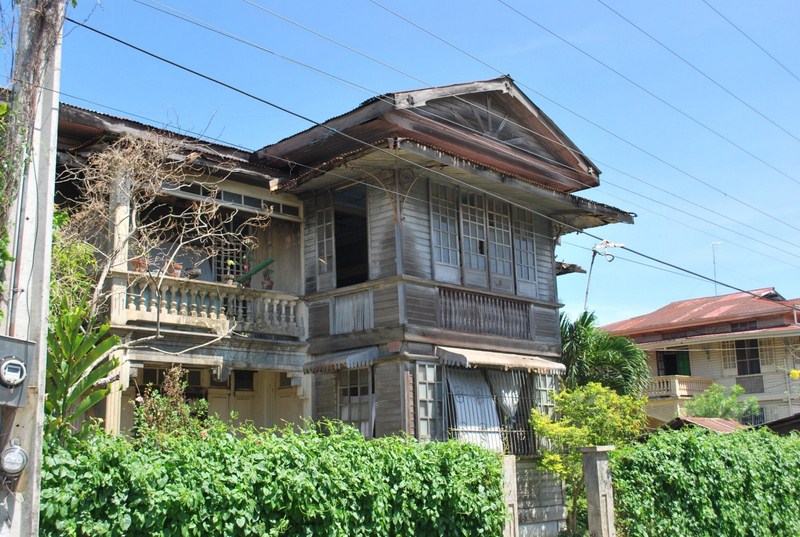
The two-storey Modesto Ramirez Hojilla Ancestral House, a Beaux Arts-style house currently owned by Carlos Javelosa Jalandoni Sr., was built in the 1920s. It is an example of an American Era adaptation of the classic bahay na bato which was influenced by 19th century “salt shaker” houses, with their wooden horizontal clipboard facades. Currently dilapidated, it is notable for its adaptation, introduced by the Americans, to Filipinos living on the ground floor.

Nineteen others are Level 2 (With Marker).  My grandfather’s house, built in the 1930s and locally called Balay Daku or “Big House, is one of these.   The others are:

  • Victor Fernandez Gaston Heritage House (Balay Negrense) – Cinco de Noviembre Street, Brgy. III
  • Alejandro Amechazura Heritage House – Plaridel Street, now the office of Celsoy Agro-Industrial Corporation
  • Manuel Severino Hofileña Heritage House – Cinco de Noviembre Street
  • Bernardino and Ysabel Lopez-Jalandoni Ancestral House – Rizal Street, Brgy. II, a lifestyle museum, commonly called The Pink House
  • Jose “Pitong” Ledesma Heritage House – cor. Jose Ledesma and Teodoro Morada Streets
  • Kapitan Marciano Montelibano Lacson Heritage House -Rizal cor. Zamora Streets, Brgy. II, home of New City Cafe (Kapehan Sang Silay)
  • Vicente Conlu Montelibano Heritage House – Zamora Street
  • Maria Ledesma Golez Heritage House  – Rizal Street, now RCBC Silay branch
  • El Ideal Bakery (Cesar Lacson Locsin  Ancestral House) – 118 Rizal Street
  • Jose Benedicto Gamboa Heritage House – Roque Hofilena Street, the Oro, Plata, Mata” (1982) house
  • Angel Araneta Ledesma Heritage House  (Culture and Arts Office of Silay) – Plaridel Street, commonly called The Green House
  • Teodoro Morada Heritage House – cor. of Cinco de Noviembre and Zamora Streets
  • Digna Locsin Consing Heritage House
  • Generoso Reyes Gamboa Heritage House (Twin Houses) – 960 Zamora cor. Cinco de Noviembre Streets
  • Soledad and Maria Montelibano Lacson Heritage House – Rizal Street
  • German Locsin Unson Ancestral House – 5 Zamora Street
  • Severino Building/Lino Lope Severino Ancestral House – cor. Rizal and Burgos Streets.
  • Benita Jara Ancestral House (ancestor of Nicolas Armin Jalandoni- last owner) –  Generoso Gamboa Street, now Silay City Sangguniang Panlungsod Building.

Check out “Jose C. Locsin Ancestral House,” “Balay Negrense,” Ramon Hofilena: The “Father of Heritage Conservation” in Silay City and the “Bernardino-Ysabel Jalandoni Museum

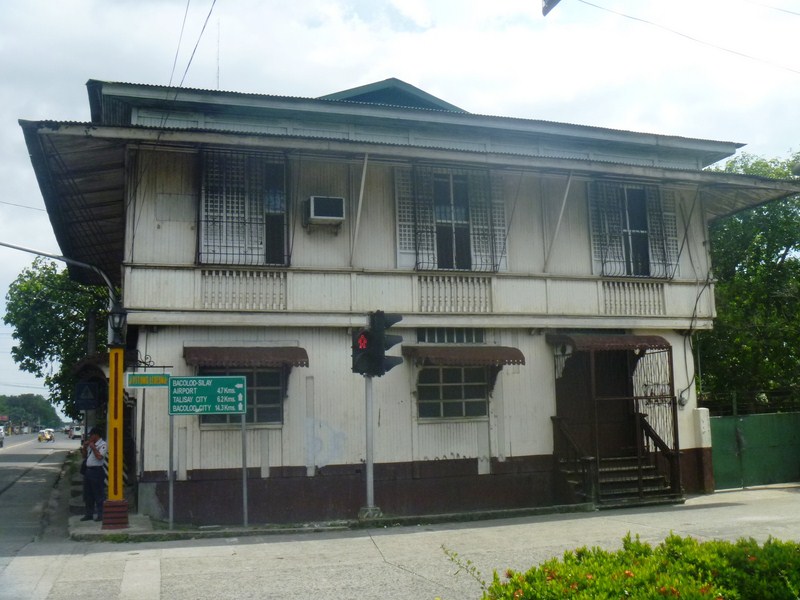
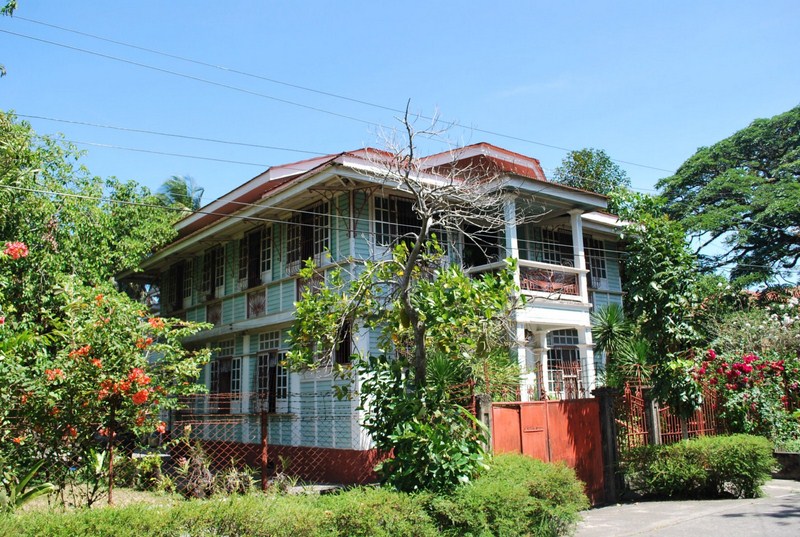
The two-storey Digna Locsin Consing Ancestral House, across the Teodoro Morada Ancestral House, is also called the “Red House.” Now the home of Judge Reynaldo Alan, this heritage house displays American-Period horizontal clapboard sidings with Art Deco grillework.

There are also a number of ancestral houses that have not been declared as Heritage Houses.  They are the Felix Tad-y Lacson Ancestral House (sadly, demolished 2014), the Antonia de la Rama Locsin Ancestral House, the  Aguinaldo Gamboa House (house where Gen. Douglas MacArthur stayed), St. Theresita’s Academy and the Locsin House (Freedom Blvd, Brgy.Mambulac).

The Josefita Tionko Lacson House, the only heritage house in Silay with an elevator, has a Nativity scene show every December featuring Belen characters purchased during her many travels in Europe. Her house, propped up by Classical columns, allows the public to remain under shade.

Silay City Tourism Office: Sen. Jose C. Locsin Cultural and Civic Center, 6116 Silay City.  Tel: (034) 495-5553.  Fax: (034) 495-0848.  E-mail: silaycity_tourism@yahoo.com. Open Mondays to Fridays, 9 AM – 5 PM.  Coordinates: 10.79907,122.97658.

Return to the Hundred Islands (Alaminos City, Pangasinan)

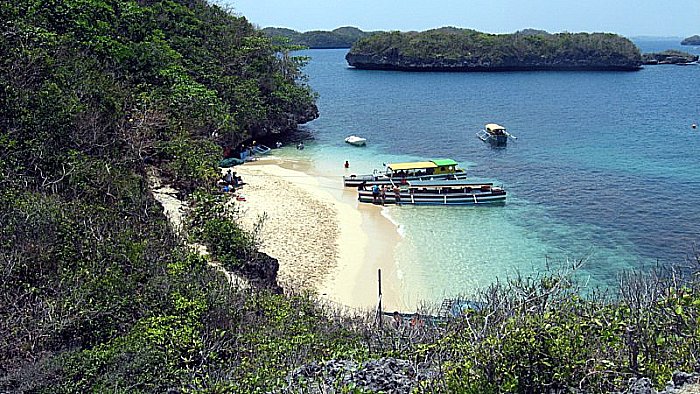
View of Islands from View Deck

The last time I’ve been to the Hundred Islands in Alaminos City, Pangasinan was way back March of 2005, Holy Week with son Jandy and 2 lady friends, and we only got to explore 3 of its islands, camping overnight at Marta Island. I considered this a poor batting average considering that there are 127 of these granite and scrub-covered islands and islets, a number of them having white sand beaches.  Again it was Holy Week and this time I, together with Jandy and daughter Cheska, found ourselves in Pangasinan, staying at El Puerto Marina Resort and Spa at the provincial capital town of Lingayen.  The resort offered day tours to the islands and we decided, especially Cheska who was a first-timer to these islands, to join the tour.  Our group included Fil-American Ms. Katrina Nogoy and Malaysian-American Ms. Janet Jun Siew Loh, both visiting school teachers from Japan.  Our guide was resort employee Mr. Viramel “Ram” Velasco. 

Lucap Wharf

The trip, via a van driven by Mr. Nixon Fernando, to Brgy. Lucap, take-off point to the islands, took all of 1 hour. Again, it being a long holiday, the wharf and every island with a white sand beach was packed with tourists.  Although I brought a 5-pax tent with me to Lingayen, camping on an island was out of the question.  However, we decided to explore beyond the normal tourist boat route which only included the partially developed Children, Governor’s and Quezon Islands, this time including the other outlying but interesting islands, paying a hefty PhP800 to do so.  While waiting for our boat, I made a short visit to Lucap’s Marine Museum which has a collection of corals and other marine life.  This 1,844-hectare national park, declared as such on January 18, 1940 through Proclamation No. 667, is believed to be the second largest marine reservation in the world with 2,000 species of marine life.

Lucap Wharf Marine Museum

The whole park can be readily covered, even by a slow banca, in half a day.  Most of the islands we passed are small (the smallest being less than 20 sq. m.), heavily-undercut at the base and have an elevation of 20 m. .  Many do not have trees to shade you from the sun and do not carry a name.  Some that do carry names are fancifully named after luminaries in the country (Marcos Island, Romulo Island, Quezon Island, etc.) while others are named after plants and animals that they resemble (Mushroom Island, Turtle Island, etc.).  An interesting photo opportunity was Cathedral Island, so named after its cathedral-like, fruit bat-inhabited cave with domed rock formations.  

Cathedral Island and Cave

Our first stop was Governor’s Island.  The island had white sand beaches on both sides but lolling around at the packed beaches wasn’t yet in our agenda.  Instead, all five of us decided to climb up the top of the island which, unlike 5 years ago, now had paved stairs and roped railings leading to a concrete view deck with railing (and packed with tourists).  What hasn’t changed, though, was the magnificent and panoramic view it afforded of this mini-archipelago said to have been formed from the tears of a prehistoric lovelorn giant who pined for his lost lady love.   The island also has a not-too-deep, sea-sculpted cave.

Marcos Island

Our next and longest stopover was Marcos Island.  Marked by mermaid statues, the island consists of 3 mounds, a 70-foot drop-off, a nice white sand beach (difficult to land on when the waves are high) and a helipad on the smaller dome.   From the beach, a well-marked trail, on the left, leads to the top of the island where its chief attraction is the bat-inhabited Imelda Cave which can be peered down from a blowhole above. Here, the adventurous and brave could climb down a wooden stairs to a ledge where they can cliff dive to the sea below.    

Waiting in line for our cliff dive
All five of us took a shot at it but the visibly scared Katrina and Jandy (although he knows how to swim) donned life vests just in case.  Upon hitting its suitably deep waters, we swam or clung to the cave walls, out to the cave mouth and back to the white sand beach.  Although Janet and Katrina only tried it once, we liked it so much that we went back for second shots (Cheska tried it thrice).  With our adrenaline rush sated, we finally settled down to lolling around in the rock-shaded portion of its beach. 
Cheska taking the plunge

It was now noontime and, after this exciting but adrenalin-sapping exercise, we were visibly hungry, our previous meal being an early breakfast at the resort.  We got back to our boat and proceeded to Quezon Island (at 25 hectares, the largest in this mini-archipelago).  This most frequented island was truly packed to rafters with tourists as it had, aside from its white sand beach, a pavilion for guests, stores (where one could dine) and toilet and bathing facilities (for a fee).  Again, it being a holiday, prices of goods bordered on the cutthroat but, hungry as we were, still ordered cooked Spam (at PhP250, twice that in Manila) plus rice (at PhP25 per cup) washed down with half-liter bottles of water (at PhP60).  The island also has a nursery for giant clams (locally called taklobo), a demonstration site for 300 clams dispersed here and at Children’s and Governor’s Islands, and all monitored on a regular basis. These, as well as the corals and mangroves, were rehabilitated through a program called “Marine Biodiversity Enhancement,”  a project of the Philippine Tourism Authority (PTA), the University of the Philippines Marine Science Institute (UPMSI) and the Marine Environment and Resources Foundation (MERF). 

Cuenco Island and its Cave
Backed at our boat, we passed by, but did not land, at the similarly packed Children’s Island which has a walkway and a calm, nearly wave-free shoreline suitable for children (hence its name). Cuenco Island, also called Quinco Island, was our last stopover.  This interesting island has two white sand beaches, on two sides, and a huge cave that passes through its center. 

War Memorial Museum (Lingayen, Pangasinan)

War Memorial Museum

War Memorial Museum

This open-air museum, within the Lingayen Gulf War Memorial at the Provincial Capitol Compound, has relics of the American landing during World War II. On December 22, 1941, during World War IIJapanese Gen. Masaharu Homma and his 43,000 troops landed at Lingayen Gulf. Four years later, on January 9, 1945, Gen. Douglas MacArthur also landed here with 68,000 American troops during the liberation.  A stone marker here marks the landing site.

The exhibits

The exhibits

The open-air exhibits include a twin 40 millimeter ant-aircraft gun, a naval 3” gun, a Japanese Nakajima “Kate” torpedo bomber and two repainted U.S. M24 “Chaffee” tanks (one has its turret turned to the side, and the other’s turret is to the front).

A repainted U.S. M10 tank

A repainted U.S. M24 “Chaffee” tank

Japanese Nakajima “Kate” torpedo bomber

Japanese Nakajima “Kate” torpedo bomber

The author, Cheska and Jandy beside an ant-aircraft gun

The author, Cheska and Jandy beside a twin 44 mm. anti-aircraft gun

A pagoda displays a collection of historic photographs (including information on HMAS Australia hit by Kamikazes) while a bronze compass and map, in the center of the compound, details the US Army units that landed on January 9, 1945 at Lingayen Gulf.

Mount Fortress and Museu de Macau (Macau)

From St. Anthony Church, Jandy and Cheska, and I walked to Mount Fortress (Fortaleza do Monte), one of Macau’s fortresses that give parts of city an old European skyline. From the fort’s vantage point, we easily visualized how effectively the forts covered all approaches to Macau. As with forts in Europe, those in Macau stood on stone foundations, with many of the walls differing considerably. They were made with chunambo (said to be able to withstand cannonballs), a mixture of earth, straw, lime and oyster shells, tightly packed in layers between strips of wood.

Mount Fortress

The approximately 8,000 sq. m., trapezoid-shaped Mount Fortress, strategically located on a hill top 52 m. above sea level, was built from 1617 to 1626 to protect the Porto Interior (Inner Harbor), the Praia Grande Bay and, to a lesser extent, the Porto Exterior (Outer Harbor) and the Chinese border. The city’s principal military defense structure, it was crucial in successfully holding off the attempted Dutch invasion of Macao in 1622.

The Cannons of Mount Fortress

The fort was equipped with cannons, military barracks, well and an arsenal that held sufficient ammunition and supplies to endure a siege lasting up to 2 years. Its 4 corners protrude to form bulwarks. The northeastern, southeastern and southwestern walls are built on 3.7-m. wide granite bases. The walls, 9 m. high narrowing upwards to 2.7 m. wide at the top, are made of solid rammed earth, further strengthened by a thick stucco of ground oyster shells.

A Fantastic View of the City From Mount Fortress

The parapets were crenelated for the installation of 32 cannons and the two corners of the southeast wall have watchtowers. The walls facing the Chinese mainland do not have any battlements, indicating that the fortress was built only for defense against attacks from the sea.

Museu de Macau

On April 18, 1998, the 2,800 sq. m. Macao Museum was installed at the site, consisting of 2 underground levels and a third one above the fortress’ top platform following the location, volume and design of the old military barracks that existed at the site before the area was demilitarized in 1965. The museum presents the history of the city and territory of the former Portuguese colonyof Macau.

Museu de Macau – Interior