Negros Museum (Bacolod City, Negros Occidental)

Negros Museum

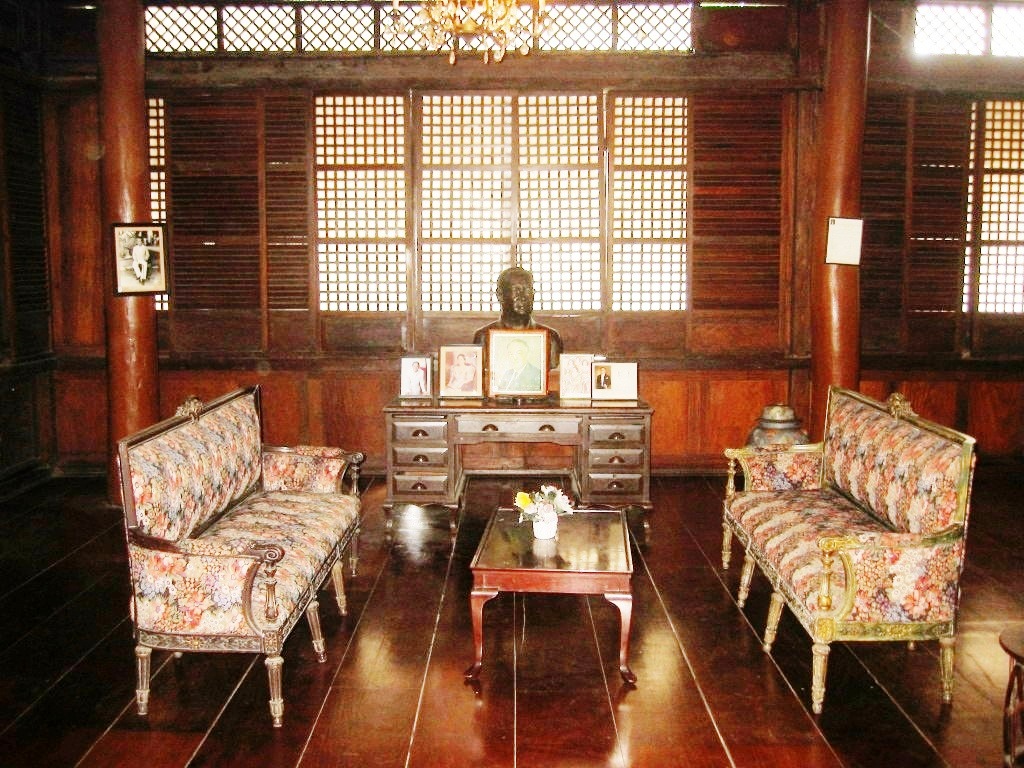
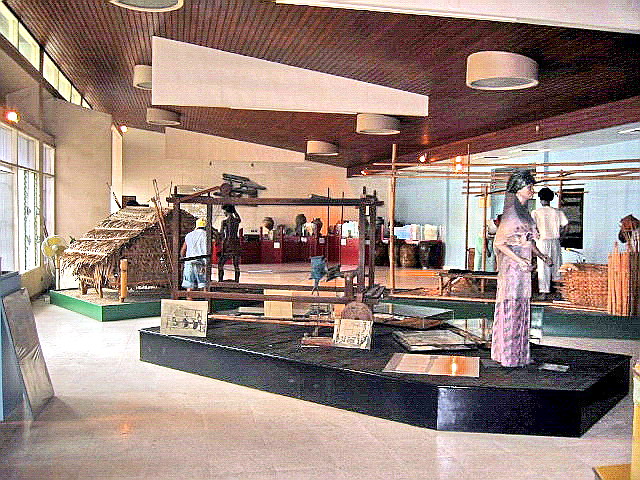
Upon completion of our GPS mapping and prior to leaving Bacolod City, I made a short visit to the nearby Negros Museum and interviewed Ms. Chinette A. Gaston, the museum administrator, about the museum’s history and exhibits as well as reminisce about my grandfather Jose C. Locsin.  This former Agricultural Building, similar in style with the Capitol, was built from 1938 to 1941 (the advent of World War II) on the former site of the 1930s Negros Occidental Carnival and Exposition.  During the war, it was used as an office of the Japanese.  In 1986, it was renovated with a grant from the Canadian Government and, on May 2003, became the new Negros Museum (it was formerly housed in the Capitol).    

Negros Museum lobby

After my interview with Ms. Gaston, she gave me free rein to view the museum’s exhibits.  This museum, run by the Negros Cultural Foundation, a non-profit, non-stock and non-government organization, is committed to preserving the cultural and historical heritage of the province. It is unique in that, aside from collecting antiquities, it also collects stories about the people of Negros.  On display, all with interesting stories to tell, are a 40-ft. long batil (long boat), a life-size replica of an Iron Dinosaur (steam locomotive) donated by the Victorias Milling Co., a real sugar laboratory using traditional equipment (donated by the La Carlota Sugar Central), a gallery of portraits of past provincial governors (including my grandfather who was governor from October 16, 1925 to October 15, 1928), 9 huge paintings by Bacolod artists, depicting life in the pre-Hispanic period, and those by Charlie Co, which explores the economic and social ascent of Chinese in Negros (from hotelier Antonio Chan to National Artist and Arch. Leandro V. Locsin).  Of particular interest for toy lovers is the JGM Gallery of International Folk Art and Toys, opened in 1998.   On display here toys and folk arts collected, over a period of 30 years, by Mara Montelibano (daughter of Jose Garcia Montelibano after whom the gallery was named) from the Philippines and 65 other countries around the world.

Negros Museum: Gatuslao cor. Lacson St., Bacolod City, Negros Occidental.  Open Tuesdays to Saturdays, 10 AM to 6 PM.  Guided tours at 10 to 11 AM and 3:30 to 5:30 PM.  Tel: (034) 434-5552.  Fax: (034) 433-4764.

Museo Iloilo (Iloilo City)

After my walking tour of the city, I was picked up by Charlie and we proceeded to the Provincial Capitol where we visited the Provincial Tourism Office.  Prior to lunch, we dropped by Museo Iloilo, behind the capitol.  Referred to as the city’s “Window to the East,” the museum showcases Iloilo’s rich cultural heritage.  The first government-sponsored museum outside Metro Manila, this museum was designed by Ilonggo architect Sergio Penasales and is now managed by the Iloilo Cultural Research Foundation, Inc..

Museo Iloilo

Its well-displayed collection includes Stone Age tools, gold-leaf burial masks, ornamented teeth, seashell jewelry and coffins from pre-Hispanic graves; photos; pottery from China, Annam and Siam; relics from the revolution and World War II; ethnic swords, knives and spears of the Mondo tribe (descendants of Pre-Malay Indonesian) of Panay; Carbon 14-dated fossils; and modern art by Ilonggo artists and craftsmen.  A permanent exhibit features an Ati family.

Museo Iloilo interior

Its Spanish ecclesiastical art collection includes religious statuary (including a statue of a female saint holding her lopped off breast); church vestments; a tableau of the Last Supper; and a Santo Entierro (bier of a dead Christ).

China, Siam and Annam Pottery
Santo Entierro
Photos of old Iloilo churches
Ethnic weapons
Ancient coffins and pottery
Weaving loom

A section is devoted to articles recovered by divers from the wreck of a nineteenth century British steamer lying in 7 m. of water on the Oton Shoals, off Guimaras Island.  Exhibited as the “Bottle Wreck,” its glass hoard includes bottles of port wine and Glasgow beer, as well as Victorian china.

Museo Iloilo: Bonifacio Drive, Iloilo City, Iloilo. Open Mondays to Saturdays (except holidays), 8-11 AM and 2-5 PM.  Admission: PhP20/pax (PhP15 for students).

Mystical Mt. Makiling (Los Banos, Laguna)

It was field trip time for my daughter Cheska’s Colegio San Agustin class and Lakbay Kalikasan, Southeast Asia’s first and premier outbound education outfitter, was tasked to organize it.    Mt. Makiling was the selected destination.  Upon invitation by Mr. Ramon Jocson, Lakbay’s Corps Director, I decided to tag along.

Mt. Makiling
This 1,090-m. high, 3-peaked mountain, located 65 kms. southeast of Manila, is, owing to its natural history, the most biologically well-known of Philippine mountain and a favorite for field trips.  The slopes of the mountain form a 4,244-hectare national park covering portions of Bay, Calamba City and Los Baños; all in Laguna, and Sto. Tomas in Batangas.  These places depend on the watershed of the mountain for their domestic water requirements and irrigation while Los Baños’ and Calamba’s resorts and tourism industries depend on it for their hot springs.


Most field trips, including this one, enter via U.P. Los Baños (UPLB) which is halfway up the summit.  The mountain is also accessible from Alaminos (Laguna) and, for the extreme adventurer, from the more difficult and barely passable (due to the thick jungle) Sto. Tomas route, on the other side of the mountain.   Makiling is said to be the legendary home of the beautiful local goddess, Mariang Makiling.

According to folklore, she was the beautiful young daughter of two deities: Dayang Makiling and Gat Panahon.  Half goddess, half spirit of the air, she was tall, svelte, sweet, with big black tantalizing eyes, long, black, abundant hair reaching to her ankles, pure brown skin, and enchanting smile and a captivating, melodic voice.  She was born of the rays of the moon and lived in the beautiful mountain, roaming the forest and protecting its wild boars and other animals.

Visible to, and loved and respected by the townspeople, she had a generous heart, scattering golden ginger in the yards of every house in her domain and never turning down a request for help or assistance.  She rewarded hunters, who, at her request, spared the animals.

Her kindness, sympathy and acts of benevolence were often forgotten and disregarded by the people.  To punish them, she denied permission to pick fruits in the forest and prohibited hunting of wild animals. For those who disobeyed, she would cause the sky to grow dark and the heavy rain to fall.  To hunters, she assumes a frightful form and sends them to their death.  She fell in love with a mortal man who proposed to her but backed out before their wedding day and later married a mortal woman.  Despondent, she disappeared into the forest and was never seen again.  Her presence, however, is still felt as she continues to watch over the mountain’s natural bounty.

Makiling is one of the few mountains in Luzon that still has some primary forests.  It originally had lowland dipterocarp forests up to the 600 m. mark but the western and southern flanks are now denuded due to kaingin (slash and burn) farming and logging while the eastern slopes are covered with coconut, banana, coffee and other crops.  However, exotic lowland type dipterocarp forest trees and orchards have been introduced for reforestation at its lower slope, transforming the forest below 300 m. into a “parang” type of vegetation.  Above 900 m. are some montane forest and, at the summit, a dwarf mossy forest.  Makiling is a dormant volcanic massif but remnants of its north wall crater no longer exist.  However, heat still escapes from it in the form of mud springs and hot sulphur springs.       Makiling is also a field laboratory for many environmental and biological researches in UPLB.   Aside from being a favorite for school field trips, Makiling is also a popular camping and hiking area for Boys and Girls Scouts, as well as other camping enthusiasts.  The 10th World Boy Scout Jamboree was held on the mountain from June 17 to 26, 1959 and camping is still done at the BSP Wood Badge Area.

Camping, however, wasn’t in the field trip agenda.  They were here to learn. This outdoor classroom showcases the rich biodiversity of the country, being home to 2,038 species of vascular flora (85% of Philippine flora spread out in 949 genera, 19 sub-species and 167 varieties), 24 species of mammals (10 families and 19 genera) and 21 species of amphibians (4 families and 8 genera), 10 of which are endemic. Bryoflora includes giant ferns, 34 species of mosses and 42 species of liverworts.   About 60% of all known fungi have also been found here.     Popular with bird watchers, the mountain is home to 163 species of birds (spread out in 110 genera and 16 families).

Museum of Natural History
A repository for all these biological specimens is the Museum of Natural History, located immediately to the left of the archway going into the College of Forestry and Natural Resources. Housed in a former student dormitory of UPLB, here students are awed by its collection of more than 200,000 Philippine plants, animals, microorganisms and other bioda.  Most of the late Prof. Dioscoro Rabor’s priceless collections are also housed here. Its exhibits feature, among others, the Philippine eagle, tamaraw, tarsier; snails in Mt. Makiling and Laguna de Bay; Philippine plants, forests, shells; Philippine cobras, marine turtles and mammals; and a Philippine map made of 4,012 locusts and lahar from Mt. Pinatubo. A visit here is the piece de resistance for any Makiling field trip.

Magsingal Cultural Museum (Magsingal, Ilocos Sur)

We finally left Vigan City by 1 PM and, 11.2 kms. out of the city, past the towns of San Ildelfonso and Sto. Domingo, we made a short stopover at the the Magsingal Cultural Museum, also called the Museum of Ilocano Culture and Artifacts.  Managed by the National Museum, parts of its displays are housed within the ruins of the town’s former Church of St. William.

The old church was started in 1662 by Fr. Alonso Cortes, finished in 1723, destroyed by earthquake soon after, rebuilt in 1730 and then burned by the rebel forces of Diego Silang.  Only the intact bell tower and part of the ruined walls remain.  On October 1982, it was restored and transformed into a museum housing the private collection of the late Mr. Angel Cortez (former curator of the Magsingal Museum).

It showcases the material culture of Northern Luzon.  The curator’s house across the street displays Neolithic tools, excavated porcelain and earthenware, antique santos, weapons and implements, baskets and headgear and old parish records.

Magsingal Cultural Museum: National Highway, Magsingal, Ilocos Sur. Open daily, 9-11:30 AM and 1:30-4:30 PM.  Visit is by appointment. Admission is free.

National Museum (Vigan City, Ilocos Sur)

It was now  late in the afternoon and I still had time for a visit to the 2-storey, 422-sq. m. National Museum, formerly the Ayala Museum and Library.  This house, built in 1788, was the former birthplace and colonial residence of martyred priest Fr. Jose A. Burgos.  At its ground floor is a Hall of Fame of Ilocano heroes and achievers, dioramas of local historical events (Tobacco Monopoly in 1782, Paoay Church Construction in 1704, Gomburza Execution, Battle of Tirad Pass, etc.), Filipiniana costumes, and Tingguian, looms for abel weaving, farming and fishing implements and Ilocano ethnic arts and crafts (burnay products, etc.).  There are also scaled models of two trading ships.  The first, a pichili trading junk, also called the Shantung junk, is regarded as the oldest type of Chinese sea junk used in fishing and trading.   Its actual length was 150 ft. and it stood 14 ft. high.  The second was that of a Japanese vessel that trade in Luzon from 1596 to 1615.  Around the models are trade ceramics.

National Museum
Upstairs are antique collections and memorabilia of the Burgos family such as Vienna furniture (beds, mirrors, divans, dining chairs, pianos, etc.) plus an old harp, gramophone, old telephones and other period pieces and heirlooms. On the walls are a priceless collection of 14 Esteban Villanueva canvasses. Esteban Villanueva was a businessman and unschooled painter from Vigan who depicted bloody events of the 1807 Basi Revolt in 14 36 by 36-inch frames.  At one time they were owned by Buenaventura Bello, a former president of the Ilocano Historical Association.  Until a few years ago, the paintings remained unrestored but a contemporary artist was commissioned to retouch them.  In spite of this, the painter’s original style is noticeable: details of costume and face, lack of perspective, the composition of the groups, ominous comets and even the little horse.  All were signed “E. Villanueva.”

I made it back to the inn before nightfall, joining Grace and Jandy for a sumptuous dinner of crispy okoy (flaky shrimp cakes) and pansit at the inn’s coffee shop.  Once filled, I finally decided to hit the sack for a well-deserved shuteye.

National Museum: cor. Plaza Singson Encarnacion and Burgos St., Vigan City, Ilocos Sur.       Open Tuesdays to Saturdays, 8:30 to 11:30 AM and 1:30 to 4:30 PM.  Weekend and holidays are by appointment.  Admission: PhP10 per adult and PhP5 for children (12 years and below).

Rizal Shrine (Calamba City, Laguna)

After hearing mass at the Church of St. John the Baptist in Calamba City, Jandy Cheska and I crossed over to visit the Rizal Shrine, the birthplace of our National Hero Jose Rizal.  This bahay na bato, the first in Calamba, took two years for Rizal’s father to build. Now a property of the national government and administered and maintained by the National Historical Institute (NHI), this reproduction of the original Spanish Colonial-style, 2-storey house has a red tile roof, thick stone ground floor walls, doors wide enough for a carriage to enter, wooden upper walls of narraand molave and balustrades and capiz shell windows.  

Rizal Shrine


However, we weren’t allowed to take pictures inside.  Its controversial stairway (questioned by old folks to be slightly misplaced saying it should have been a little closer to the wall), with its circular base, leads to the caida (the banquet hall which served as library to Don Francisco and is in turned connected to the sala(living room) by an ornate doorway.  On both sides of the sala are the bedrooms. The house contains replicas of Rizal’s antique family furniture, household articles, library and Rizal memorabilia. Antique items include a very old coffee grinder, a punka (ceiling fan) and a water filter that purifies water from the well.  In the garden are various Philippine fruit trees, an empty stable with a square-shaped calesaon the side and a bronze statue of Rizal as a child done by Duddley Diaz (unveiled on 19 June 1998). The shrine also has a souvenir shop.


Rizal Shrine: J.P. Rizal St. (formerly Calle Real), Calamba City, Laguna.  Lectures and guiding services can be arranged. Open Tuesdays to Saturdays, 8:30 AM to 4:30 PM.  Admission is free.  Tel: (092) 545-2010.  
 
How to Get There: Calamba City is located 55 kms. from Manila and is accessible via the South Luzon Expressway (SLEX).  Take the Calamba Exit.
 

Church of St. Peter the Apostle (Loboc, Bohol)

On my own, I made a short visit to Loboc’s Church of St. Peter the Apostle, listed by the National Museum as a National Cultural Treasure.  Built in 1602 by Fr. de Torres, it is the second oldest church in Bohol.  The present church was built in 1734. 

Church of St. Peter the Apostle

Inside are remarkable nave paintings done (from May 1926 to July 1927) on the walls and ceiling by three artists (Canuto Avila and son Ricardo, Ray Francia), the biggest number of murals on religious subjects.  The ceiling was retouched in 1995 by Cris Naparota.   It also has a Neo-Gothic pulpit with a late 19th century sounding board (portavoz) and 5 retablos between the transept and sacristy. 

Bell Tower

Outside the church, near the riverbank, is the separate 21-m. high, 4-storey octagonal stone bell tower, built after 1768.   It has 7 bells, the oldest dated 1863 and 2 others dated 1914 and 1937.  The tower also has a large wooden matraca (a cranked noisemaker) dated 1899 and a clock from Altonaga Co., acquired through public subscription and installed in 1893.   The bell tower was almost destroyed during the construction of the unfinished Loay Bridge, a folly of the Marcos era which was supposed to be part of an elevated expressway just across the road.  Timely objection by the Lobocanons prevented its destruction.  The project was discontinued. 

Dambana ng Kagitingan (Pilar, Bataan)

The Memorial Cross

Come Holy Week, I was invited by Jandy’s teacher Ms. Veneriza “Vener” Trillo to vacation at their home at Morong in Bataan.  That being the case, I also planned to make a stopover at the Dambana ng Kagitingan in Pilar.  Its giant cross, on the 553-m. high Mt. Samat, stands as a mute symbol of the heroic World War II resistance put up by Filipino-American forces against the invading Japanese 60 years ago.  A visit to Bataan is certainly meaningless without seeing it.  On this pilgrimage, I brought along my son Jandy, his classmate Jeff Agtonong, teachers Mr. Erwin Vizcarra and Mr. Ronnie Boy Lansangan plus Ms. Marianne de Guzman,  Ronnie’s friend. 

Mt. Samat

We left Manila very early in the morning (4 AM) of April 17 (Holy Thursday), taking the longer (150.40 kms. from the Balintawak flyover) route along Bataan’s east coast instead of the shorter Subic Bay Metropolitan Authority (SBMA) route.  Normally it would take 3 hrs. tops to travel the said distance, but hey, this is Holy Week and heavy traffic is the rule and not the exception.  It was everywhere, from the North Luzon Expressway (NLEX), then being widened, all the way up to Lubao in Pampanga.  The Lubao section (then being rehabilitated) was the worst, with over an hour wasted.  After Lubao, it was smooth driving all the way as we entered Bataan, the Roman Superhighway and the Angel Linao Highway, to Pilar town. Along the way, we passed the entrance to Dunsolan Falls, located along Mt. Samat’s western slope, and Mt. Samat Inn.  Upon reaching the Mt. Samat turn-off, it was a steep drive up a 7-km. long winding asphalt road.  We finally reached the shrine by 10 AM.

The colonnade of Dambana ng Kagitingan

The shrine, at the end of the road, is located just 70 m. below the mountain’s peak.  It was built at a cost of PhP7 million (including access roads) and was opened on April 9, 1974, the anniversary of Bataan’s fall (Araw ng Kagitingan).  Our pilgrimage to the shrine was done nearly 30 years after the fact. Today, the Araw ng Kagitingan held at the shrine usually features wreath-laying ceremonies, remembrance of the Death March and tributes to World War II veterans, whether dead or still living. 

The base of the cross

Immediately above us, reached by a long flight of stairs, is the shrine’s marble-capped colonnade.  It has an altar, an esplanade and a museum.  The shrine’s 12 relief columns, done in marble, depict historical events and important battles that took place in Bataan. The altar, used for religious services, has a stained-glass mural behind it. There are also statues of war heroes, two bronze urns (symbolic of the Eternal Flame of Freedom) and 18 bronze insignias and flagpoles with colors of USAFFE division units.  What struck the eye; however, were the two huge panels on the north and south walls inscribed with accounts of the Battle of Bataan in relief.   The colonnade’s basement museum, reached by a spiral stairway, displays an array of authentic World War II American and Japanese weapons (rifles, machine guns, mortars, shells, bayonets, etc.), uniforms (helmets, boots, belts, etc.), old photos, news clippings and, in the center of the dimly-lit hall, a scaled 3-D model of the Bataan peninsula indicating important battle sites.

The museum

Upon finishing our museum tour, we crammed our necks up to look at our ultimate destination: the towering Memorial Cross.  From the colonnade, we made the long but leisurely walk up the 14-flight zigzagging footpath (paved with bloodstones from Corregidor Island) on the mountain slope to the cross.  Once up, I found out that we could have drove all the way up to a parking lot beside it.  Some exercise (in futility?) it turned out to be as I later walked down the winding road to fetch the car.  The cross was huge, 91.8 m. high to be exact. Built in 1968 with steel and reinforced concrete, it stands on an 11 meter high platform capped with nabiag na bato slabs sculpted with bas reliefs depicting significant battles and historical events.  Above this base, the cross is finished with chipped granolithic marble. Its 30 m. wide arms (15 m. on each arm) rise 74 m. from the base and can be reached by an elevator. 

View of the shrine from the Memorial Cross
We failed to make it to the last morning trip up the viewing gallery at the cross’ arms as it was now lunchtime.  We had to wait another hour, becoming the second batch up that afternoon.  The 18-ft. by 90-ft. viewing gallery has a 7-ft. high clearance. It was pleasantly cool and windy up there, quite a different scenario from 6 decades ago when the area reeked with smell of death and the intense heat of battle. The views, nevertheless, were spectacular.  From the gallery, we could view the sea, mountains, forests (somewhat denuded at certain areas) and distant Manila, located 126.34 kms. northeast.  The cross is finished with luminous material and can be seen on a clear night as far away as Manila across Manila Bay.    

Basilica Minore de Penafrancia (Naga City, Camarines Sur)

From the Ermita, we crossed the Naga River, and made our way to the Basilica Minore de Peñafrancia.  This imposing modern shrine, started on April 18, 1976, was completed, after some delays due to financial concerns, on September 1981.  The original statue of the Virgin of Peñafrancia was transferred here from the Ermita on May 22, 1982.

This Romanesque-style basilica was given the title “Basilica Minore” on May 22, 1985.  The only basilica in the Bicol Region and the whole Roman Catholic Archdiocese of Caceres, its grounds has a fine view of Mt. Isarog.

Basilica Minore de Penafrancia

After touring the basilica itself, we next proceeded to the nearby Altersheim Building where we had the chance to interview Rev. Monsignor Romulo A. Vergara, H.P., the rector of the Peñafrancia Basilica and a cousin of our media colleague Rick Alberto.  We were also shown (and privileged to touch) the original Statue of Our Lady.  The one I saw at the basilica just happens to be a replica.

Monsignor Vergara and the original statue of Our Lady
Basilica Minore de Penafrancia: Balatas Rd., Brgy. Balatas,  Naga City, Camarines Sur.  Tel: (054) 473-3644. E-mail: info@penafrancia.org.ph.  Website:  www.penafrancia.org.ph.

Museo del Seminario Conciliar (Naga City, Camarines Sur)

The Museo del Seminario Conciliar, opened on September 1998, consists of a Marian Room, Ecclesiastical Collection, Gallery and Archive and the Archaeological Collection.

The Marian Room has a replica of Our Lady of Peñafrancia, pictures of the original Lady of Peña de Francia in Salamanca, Spain and extant postcard-size pictures of the canonical coronation of Our Lady of Peñafrancia.

The Ecclesiastical Collection displays retablos (altar backdrops), antique santos, vestments, chalices, monstrances and episcopal seals of the liberal-minded Bishop Francisco Gainza and hard-line Bishop Arsenio Campo, the last Spanish bishop to serve in Bicol.

The Archives-Gallery contains the memorabilia of Monsignor Jorge Barlin as well as pictures of the various Bicol bishops including Jose Cardinal Sanchez, the first Bicolano cardinal.  The Archive has books in Latin and Spanish printed in the 1600s, 1700s and 1800s as well as baptismal and marriage registries in the 1700s and early 1800s.

The Archaeological section displays the collection of Ermelo M. Almeda.  It consists of Philippine pottery and burial jars found in archaeological diggings in the Bicol region, Calatagan (Batangas), Marikina City (Metro Manila), Samar and Palawan; porcelain ware from Vietnam and Thailand and Chinese porcelain ware from the Tang Dynasty (618 to 906 AD) to the Qing Dynasty (1645 to 1912).

Museo del Seminario Conciliar: Holy Rosary Minor Seminary, Naga City, Camarines Sur.