Once settled in our suite at Villa Carlos Resort, we prepared breakfast at the balcony, cooking (not allowed though) canned food which we brought along for the trip using my portable stove. That done, we now left the resort to explore Boac in detail. The town proper had many large, high-ceilinged Spanish and American-era ancestral houses, some well-preserved and others dilapidated and in need of repair. Many have capiz windows, ventanillas and double roofs with unusual braces reminiscent of braces used to prop up windows in nipa houses.
Category Archives: PLACES OF INTEREST
Villa Carlos Resort (Boac, Marinduque)
Once on terra firma, we boarded a jeepney at Balanacan Pier for Boac, the provincial capital, all the while hoping that there would be accommodations available at this unholy hour when everyone was supposed to be asleep. As I feared, there were none available at the town proper, it being the holiday season. Soon all the passengers had alighted from the jeepney save for us.
![]() |
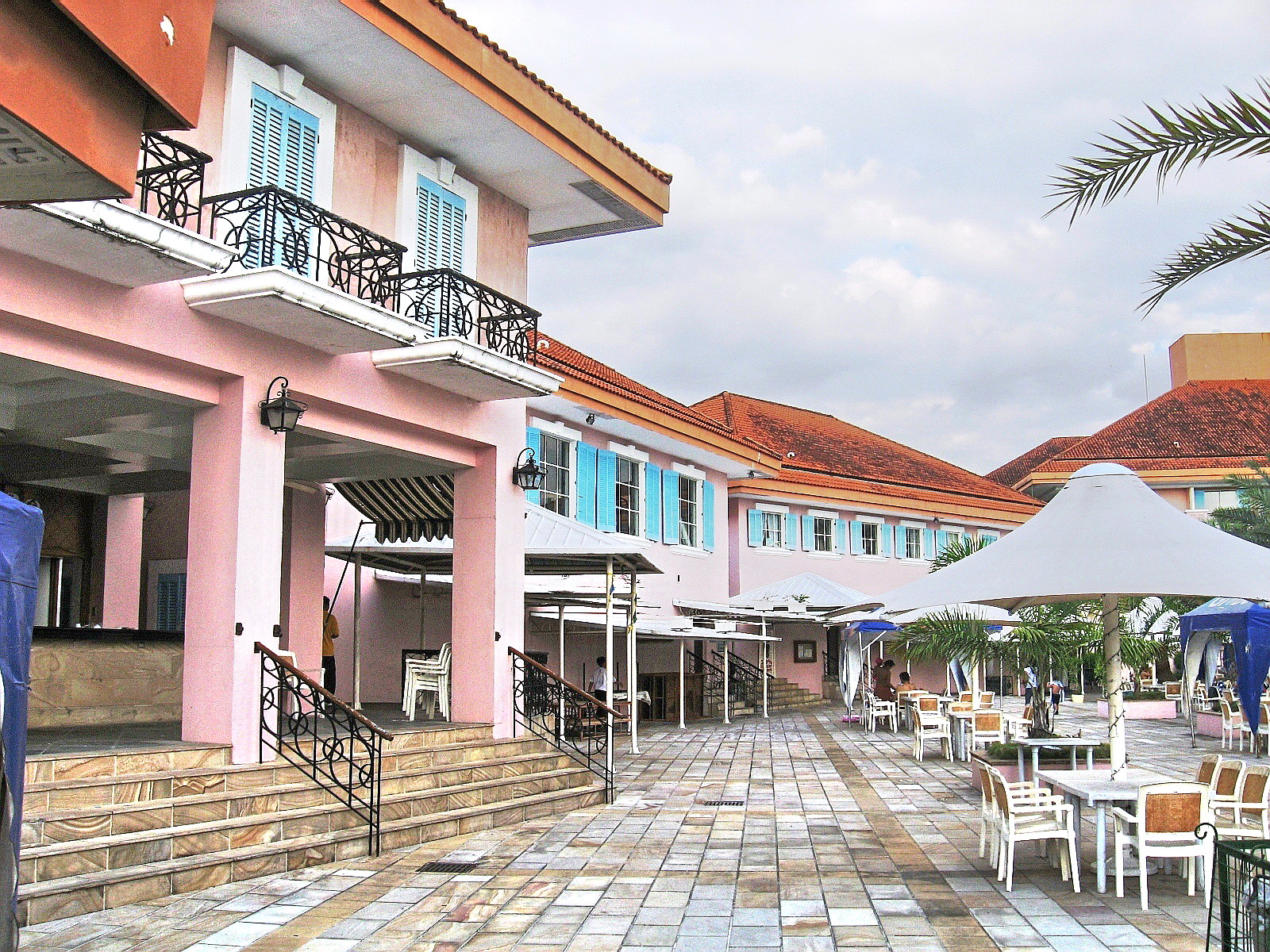
| Villa Carlos Resort |
Our jeepney driver suggested a beach resort and dropped us off at Villa Carlos Resort where the caretaker allowed us to pitch tents by the beach. It was now 1:30 AM. Jandy, Verner, Jowel and Yor slept inside the tents while Cheska and I slept out in the open, on benches at a nipa and bamboo picnic shed.
![]() |
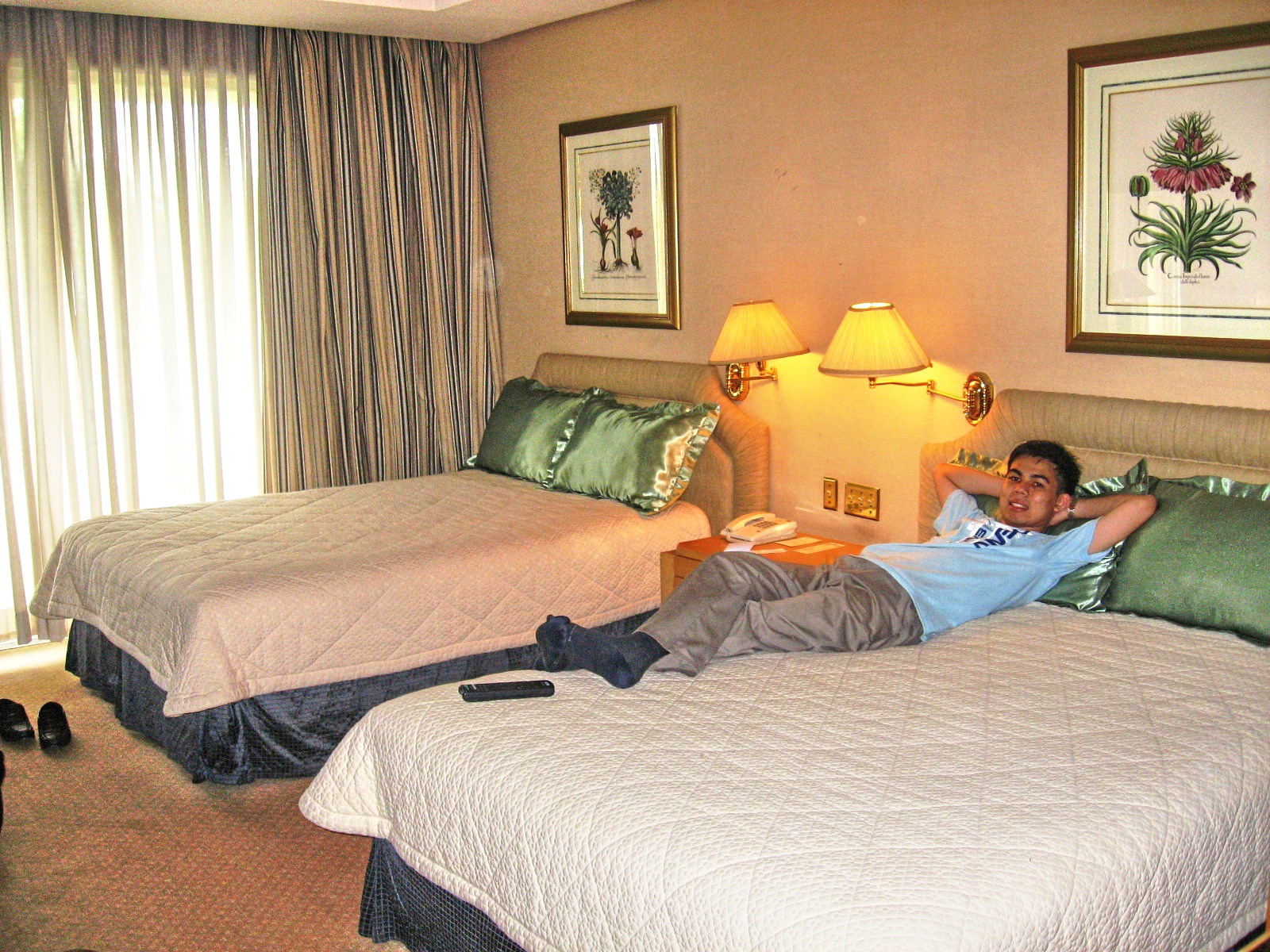
| Our suite |
Come morning, I had a chat with the affable resort owner, Ms. Emily Ignacio-Alaan. Fortune smiled at us that early morning as Ms. Alaan allowed us to use, after a guest canceled their booking at the last moment, an airconditioned suite with 3 king-size beds, a small TV, compartmentalized bathroom (shower and water closet had separate compartments with the lavatory between both) and, best of all, a private balcony (with a round marble table and monobloc chairs) overlooking the sea.
![]() |
| The dining hall |
The room was rented out for PhP1,600 a night, way over our spartan budget, but Ms. Alaan agreed to halve the cost provided we didn’t use the room airconditioner. This suited us fine, as the cool evening breeze negated the use of airconditioning. The resort also had a restaurant and a videoke (which gladdened Jowel). A covered badminton court was still being built during our stay.
![]() |
| Cheska sunbathing by the balcony |
![]() |
| People frolicking at Ihatub Beach |
The suite’s balcony was perfect for viewing the gathering of tuba (coconut wine) in the morning, people frolicking along the black sand Ihatub Beach in the afternoon and, come dusk, a beautiful sunset. Cheska, Vener and Yor opted to sleep here, the balcony being cooled by the sea breeze in the evening. With our accommodation worries out of the way, we could now explore, using the resort as our base, this beautiful-island province in detail.
In 2007, management of the resort changed hands and the resort was renamed Villa sa Aplaya Beach Resort. It now has 11 airconditioned rooms with bath, 21″ cable TV and refrigerator plus, aside from the abovementioned facilities, a 25-pax conference room. The badminton court is now operational.
![]() |
| The beautiful sunset at the resort |
Aguinaldo Shrine (Kawit, Cavite)
After bringing my son Jandy to school, I decided, on a whim, to do some sightseeing outside Metro Manila, motoring all the way, via the Cavite Coastal Rd., to Kawit in Cavite where I plan to visit the Aguinaldo Shrine, the birthplace of Philippine Independence. Upon arrival at the shrine, I met up with Mr. Alvin Alcid, the shrine curator, who toured me around the mansion.
| Aguinaldo Shrine |
The stately, 6-storey (including a mezzanine) Aguinaldo’s house started out in 1845 as a wood and nipa thatch structure before being rebuilt in 1849 as a bahay na bato with a stonewalled ground floor and a wooden second floor with banks of capiz windows. Emilio Aguinaldo was born (according to his mother) here on March 22, 1869 (March 26 according to his partida de baptismo or parish records).
| The Independence Balcony |
The mansion underwent another facelift from 1919 to 1921. To commemorate the “original” Independence Day (albeit on a personal basis), Aguinaldo added the elaborate, cannon-capped “Independence Balcony” to replace the bank of capiz windows at the living room. The Philippine sun, stars and foliate patterns decorate its eaves. The balcony is now used during June 12 Independence Day celebrations.
| The watchtower |
Before his death on February 6, 1964, at the venerable age of 94 (our oldest president), Aguinaldo, in a fitting, final gesture, turned over his home and a portion of the gardens to the government on June 12, 1963 to “perpetuate the spirit of the Philippine Revolution of 1896.” Four months later, on June 18, 1964, the mansion was declared a National Shrine and a National Treasure, by virtue of Republic Act No. 4039, and placed under the management of the National Historical Institute (now National Historical Commission of the Philippines).
| Aguinaldo’s bedroom |
The architecturally-inclined former president also added a family wing of children’s bedrooms; a gabled, 3-storey, spired watchtower (Aguinaldo’s favorite spot for viewing, on a clear day, the skyline of Manila) on top of the mansion (designed to match a 200-year old tamarind tree, since felled by lightning), and below it, a bedroom called the Tower Suite, his favorite retreat in his later years.
Today, the entire house uniquely blends Rococo, Baroque and Gothic architectural styles characteristic of the Spanish and American colonial period. The entire ground floor, formerly the zaguan or grain storage area, was converted into a revolutionary-theme museum. On exhibit are Aguinaldo’s personal memorabilia and uniforms, dioramas of the Battle of Zapote River, the Battle of Binakayan and Aguinaldo’s oath-taking as president, an exhibit of prominent Cavite revolutionary heroes, historical relics and weapons. There is also a chess set and a bowling alley.
Aguinaldo had a very inventive and secretive mind. The antique, mostly Philippine hardwood furniture done by skilled native woodcarvers, some designed by the general himself, includes an armoire, inlaid ivory love seats, four-poster beds, China cabinets and Vienna rocking chairs. Some chairs and cabinets have secret compartments to hide important documents or even weapons. Ingenious sliding wall panels, along the narrow stairways to the upper rooms and in the bedrooms, are used as secret storage areas large enough for two people to hide.
| The Dining Room |
There are also camouflaged secret passages made just for the general. The one leading to his second floor bedroom is concealed by a wall of shelves at the main stair landing. Below the ground is a stone air raid shelter concealed under the kitchen’s wooden dining table top.
| The decorated dining room ceiling |
On the second floor are the general’s bedroom, the grand hall, conference room, dining room and kitchen and the azotea. The rectangular grand hall is a visual showcase of Aguinaldo’s nationalistic fervor. On the walls and pillars are recurring flag patterns done in polished wooden mosaic. The floor, a waxed-and-polished jigsaw puzzle of flags, is a mosaic of wooden trapezoids. The decorated ceiling, which commemorates the events of August 30, 1896 (the start of the revolution), features Inang Pilipinas (Mother Philippines), an eight-rayed sun representing the first 8 provinces to rise in revolt, and the furled flags and dove of the pre-World War II League of Nations (symbolic of Aguinaldo’s aspiration for Philippine recognition in the League of Nations).
| Corridor leading to children’s bedrooms |
At the end of the hall are the historic windows and the added “Independence Balcony.” The dining room ceiling is a gallery of soaring symbols featuring a bas-relief map of the country with Cavite (site of his glorious victories) painted red to symbolize war. Overlooking the grand hall, like an alcove or balcony, is the mezzanine library. A corridor leads to the mansion’s eastern wing where Aguinaldo’s daughters used to live with their families.
| Children’s bedrooms |
Another flight of stairs lead me to the Ambassador’s Room, the former study of Ambassador Jose Melencio, Aguinaldo’s son-in-law. Above it, through a narrow stairway, is Aguinaldo’s Tower Suite. In it are a brass bed and a large roll-top escritorio. To reach the spired tower, the general’s favorite retreat, I had to climb a foot-wide, almost ladder-like stair. Here, I had a bird’s eye view of the town and Aguinaldo Park (Liwasang Emilio Aguinaldo).
Check out “Liwasang Emilio Aguinaldo“
| Aguinaldo Park |
| View of town from Tower Suite |
At the garden behind the house is Aguinaldo’s marble tomb, facing the river whose waters often served as a secret escape route.
| Aguinaldo’s marble tomb |
Minor Basilica of the Black Nazarene (Quiapo, Manila)
| Minor Basilica of the Black Nazarene |
| Interior of the basilica |
Minor Basilca of San Lorenzo Ruiz (Binondo, Manila)
From the National Shrine of the Perpetual Adoration of the Blessed Sacrament in Sta. Cruz, Jandy and I walked towards Escolta and then turned right at T. Pinpin St. to get to the Minor Basilica of San Lorenzo Ruiz, more popularly known as Binondo Church. Founded by the Dominicans in 1587, it similarly was built, just like Sta. Cruz Church, to serve Chinese converts. Built before 1614, the original church was destroyed during the British bombardment in 1762. Its dome was constructed in 1781 by Domingo Cruz y Gonzalez. St. Lorenzo Ruiz, after whom the basilica was named, trained in this church before leaving for Japan as a missionary.
| Minor Basilica of St. Lorenzo Ruiz |
The church was slightly damaged during the June 3, 1863 earthquake and was repaired between 1946 and 1971, after severe the World War II bombing on September 22, 1944 (only the Western facade and bell tower survived), and enlarged. The basilica’s imposing, still original (with some renovations) Italian High Renaissance facade is buttressed on the sides by pilasters terminating in urn-like decorations. Its pediment, framed by a foliated scroll and topped by a tower at the apex, has a centrally located small circular window framed by smaller columns and pediment.
| The basilica’s interior |
The original 6-storey octagonal bell tower, which suggests Chinese culture, has pedimented window openings and cantons at the angles. Inside the church are ornate pastel-colored reredos behind the main altar and it houses the image of Nuestra Señora del Rosario (Our Lady of the Rosary). Fronting the church is Plaza de Calderon de la Barca (or simply Plaza Binondo).
Minor Basilica of San Lorenzo Ruiz: Plaza Binondo, Q. Paredes St., Binondo, Manila. Tel: (632) 242-4850 and 242-4041. Fax: (632) 241-4653.
National Shrine of the Perpetual Adoration of the Blessed Sacrament (Sta. Cruz, Manila)
After lunch at a MacDonald’s outlet in Sta. Cruz, Jandy and I went on a walking tour of 3 of the churches in the vicinity. Fittingly, the first church we visited was the nearby National Shrine of the Perpetual Adoration of the Blessed Sacrament, more popularly known as Sta. Cruz Church. This church was founded by Jesuits in 1608 to serve Chinese converts. Its courtyard was the scene of the formal return of Manila to Spain on May 31, 1764, after Britain’s 20-month occupation.
| National Shrine of the Perpetual Adoration of the Blessed Sacrament |
This church, built and administered by the Jesuits up to 1768, was damaged during the June 3, 1863 earthquake and rebuilt in 1868 by Fr. Agustin de Mendoza. It was again damaged during the July 19, 1880 earthquake and destroyed during the fighting in 1945. The church was rebuilt in 1957.
| The church interior |
The church’s characteristically Baroque façade has Ionic columns that divide the first 2 levels into 3 parts. It also has 3 semicircular arched entrances at the first level, a centrally located rose window flanked by semicircular arched windows at the second level, and a pediment with an undulating raking cornice and a centrally located statued niche with a broken pediment.
On the church’s right is a 6-storey domed bell tower. The church’s interior has a mosaic altar background done by Elizabeth Chan. The statue of the Nuestra Señora del Pilar (Our Lady of the Pillar) brought from Spain prior to 1768, was canonically erected in this church in 1743.
National Shrine of the Perpetual Adoration of the Blessed Sacrament: Plaza Sta. Cruz, Manila. Tel: (632) 733-0245 to 46. Fax: (632) 733-0239.
Church of the Holy Sacrifice (University of the Philippines, Quezon City)
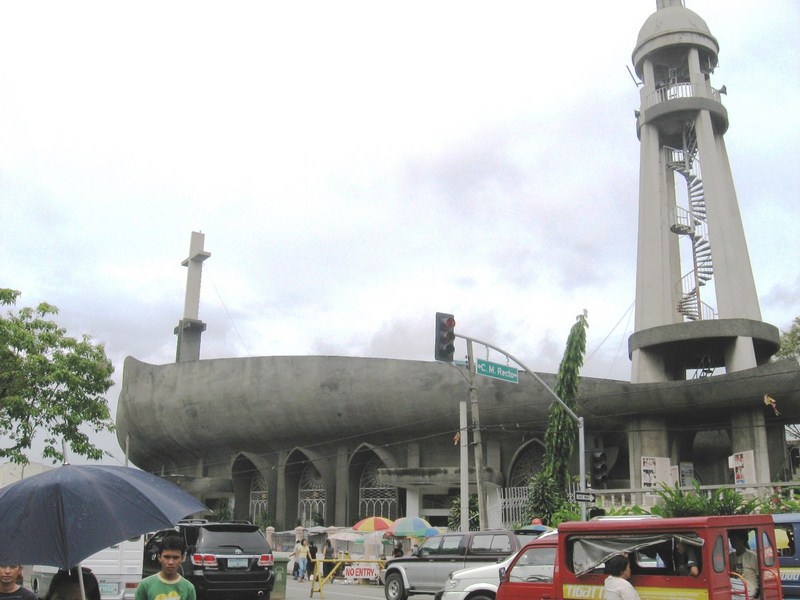
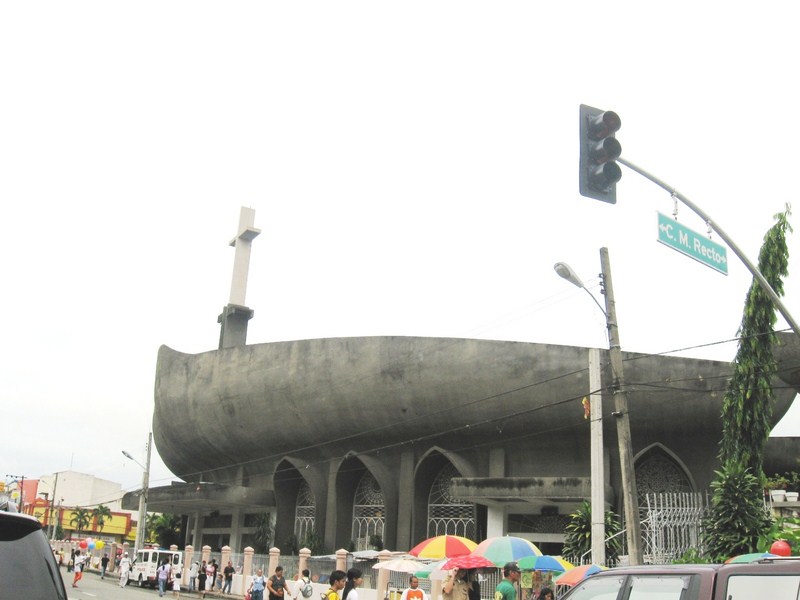
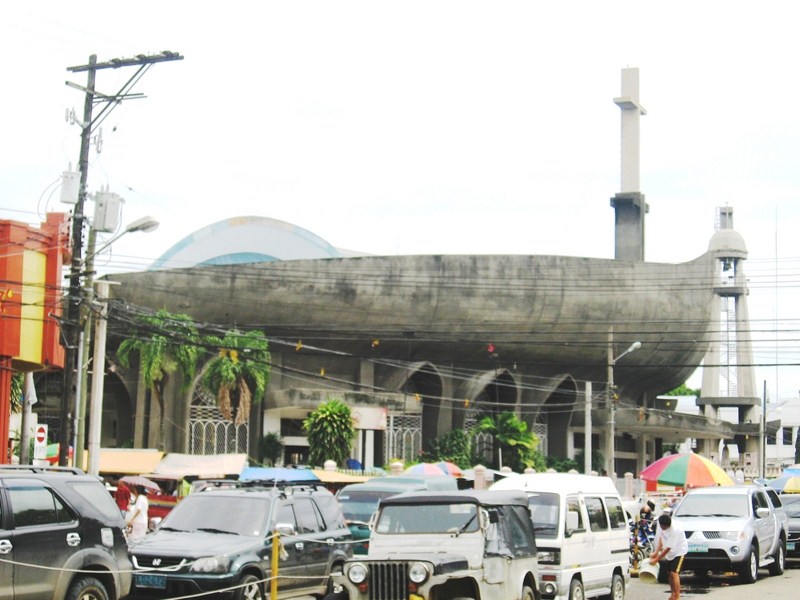
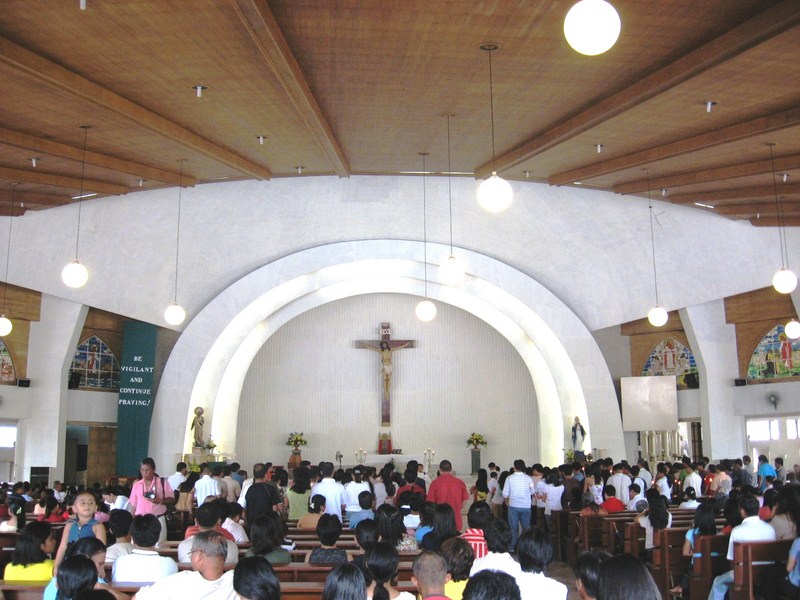
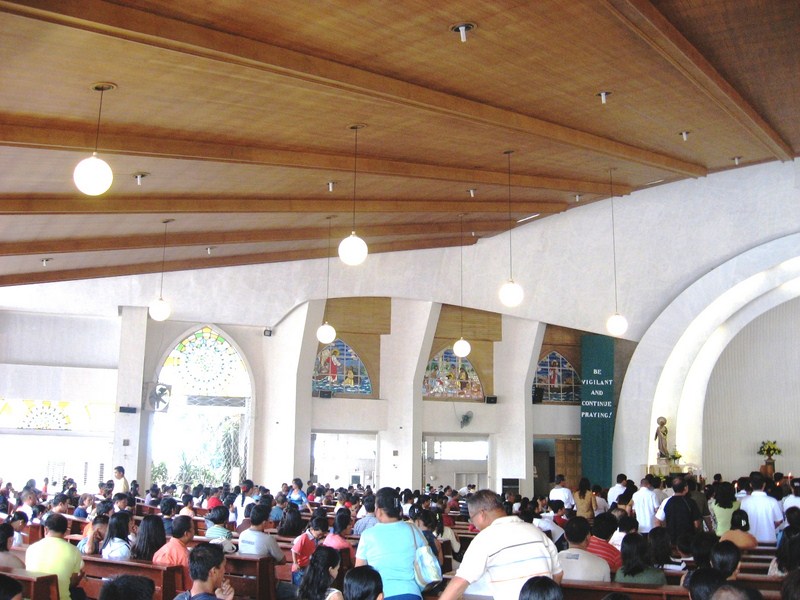
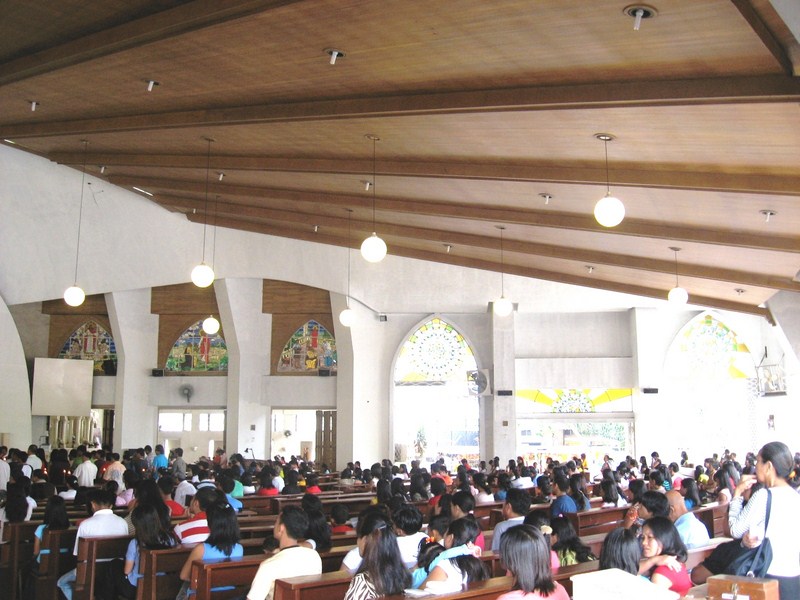
After my coordination meeting at the New Day Publisher’s office (where we discussed my forthcoming book “A Tourist Guide to Notable Philippine Churches”), I proceeded to the University of the Philippines in Diliman, my college alma mater, where I had lunch at the U.P. Coop. After lunch, I walked over to the flying saucer-shaped Church of the Holy Sacrifice to take pictures for inclusion as one of the churches featured in my book as well as in the “About the Author” section.
| The Church of the Holy Sacrifice |
| The cross done by Napoleon Abueva |
| One panel of Vicente Manasala’s Stations of the Cross |
On January 12, 2005, the church was recognized as a National Historical Landmark and a Cultural Treasure by the National Historical Institute and the National Museum, respectively.
Church of Our Lady of Grace (Makati City)
From the Church of St. Peter and St. Paul, I moved on to my next destination, travelling some distance (via EDSA, making a U-turn via the cloverleaf then turning right at Bernardino St.) to get to the Church of Our Lady of Grace. Similarly, like at the Church of St. Peter and St. Paul, a wedding was ongoing when I arrived. This church, founded as an Augustinian mission in 1601, was completed in 1629, damaged during the 1658 earthquake, repaired from 1659 to 1662 by Fr. Alonso Quijano and again in 1706 by Fr. Juan Olarte. It was ransacked and occupied by the British in 1762 (they made it into their headquarters) and its roof collapsed during the July 19, 1880 earthquake.
| Church of Our Lady of Grace |
The church was rebuilt between 1881 and 1885 by Fr. Jose Corrugedo, served as an orphanage and trade school for victims of the 1882 cholera epidemic and was burned down in 1898 and 1899 when Filipino revolutionaries, and later the Americans, occupied it. During World War II, it was used as a garrison and headquarters of the Japanese. The church was rebuilt after an agreement forged on June 29, 1970 between Cardinal Rufino J. Santos and Fr. Casimiro Garcia, O.S.A., Augustinian Vicar in the country.
| The church’s interior |
Church of St. Peter and St. Paul (Makati City)
| Church of St. Peter and St. Paul |
| The church’s interior |
Country Nook (Basco, Batanes)
| Country Nook |
On the day prior to my departure, I was invited to joined a picnic at Country Nook hosted by youthful Basco Mayor Manuel Viola, again feasting on true Ivatan seafood fare. Country Nook had a couple of magnificent rock formations just offshore. Joining us was Ms. Carol Pobre (of DOT Region II) and Francis “Chico” Domingo, a certified PADI divemaster and A.D.S. instructor. They were to dive deeper portions of Batanes’ marine environment which is rich with marine resources. Batanes is one of the few remaining sites where pink and red corals (Corallum sp.), some of the rarest sea corals in the world, are found. Chico has a vast knowledge of the province’s dive sites.
| Carol and Chico take a dive |
I could only watch in envy as Carol, accompanied by Chico, explored the offshore marine sanctuary’s beautiful underwater scenery and marine life. I was offered and wanted to join them but, according to Chico, diving wasn’t allowed 12 hours prior to my flight (I was leaving 8 AM the next day). Carol was leaving a day after my departure. However, my disappointment was later dispelled by a beautiful Batanes sunset.
| A beautiful Batanes sunset. Carol is in the foreground |
Country Nook: Sitio Vavayat, Brgy. Chanarian, Basco, Batanes